In late 2019, several patients developed respiratory problems of unknown cause. Through investigation, it was revealed that a sort of coronavirus, first reported in Wuhan, China, with an unknown source of transmission was the cause. Reference Wang, Hu and Hu1,Reference Zhou, Yu and Du2 Due to the large spread in geographical areas, many people are not sure how they got the virus. Reference Zhai, Wang and Zhang3,Reference Kucharski, Russell and Diamond4
According to the guidelines of the Centers for Disease Control and Prevention (CDC), the incubation period of the disease is approximately 2 wk. The virus infected almost all countries in less than a month. Reference Stratton5,Reference Lai, Shih and Ko6 Pre-hospital Emergency Service (PHES) is a system for managing all aspects of outpatient care. This system is 1 of the most important components of health and is essential for improving the consequences of time-sensitive accidents and diseases. Reference Jadidi, Safarabadi and Irannejhad7,Reference Saghafinia and Motamedi8 PHES as the first line of care and treatment in dealing with emergency patients is of considerable importance. Reference Yang, Cao and Qin9 Approximately 47 y have passed since the foundation of PHES in Iran. Currently, it’s more like the Anglo-American model. The provided services are often Basic Life Supports (BLS). Reference Bidgoli, Bogg and Hasselberg10 PHES staff face different challenges during their working period. In this regard, the results of studies show that emergency staff experience significant stress, because they are the first persons to be involved in accidents, including road and natural disasters. Reference Dadashzadeh, Rahmani and Hassankhani11 In the study conducted by Shakeri et al., items such as lack and inappropriate distribution of emergency bases, nonstandard bases, lack of standard ambulance and burnout existing ambulances, lack of Standard Operating Procedures (SOPs), imperfect medical direction (10-50 code), and lack of specialized fleet operations (air, rail, and marine) are considered as the most important problems of pre-hospital emergencies service. Reference Shakeri, Jafari and Khankeh12 Due to the special nature of emergency services, they are very important factors in the effectiveness and efficiency of services. Reference Shakeri, Jafari and Khankeh12
It is important to study how the main providers of PHES view the concept and tasks of prevention and care services, and to what extent, they believe in participating in service integration programs. And finally, what challenges they see in the field of upgrading preventive services at the emergency level. In any case, PHES personnel are one of the groups that have the most evidence-based information in this field and are very aware of the challenges due to their involvement in executive work. Reference Farahmandnia, Hamdanieh and Aghababaeian13 Time constraints in dealing with patients’ emergencies, patients’ companions’ expectations, fear of incompetence in saving the lives of dying people, decision-making in critical situations, and manpower-related factors form conditions that predispose the staff and employees of this unit to tension. Therefore, these challenges affect their quality of work in health threatening situations and the areas covered by them. Reference Mastaneh and Mouseli14
With the outbreak of coronavirus disease 2019 (COVID-19) epidemic, the workload of the PHES has also increased so that according to the head of Iranian emergency unit, the number of calls with emergency communication unit has increased 4-fold. 15 During the epidemic, in addition to its usual duties, the PHES is responsible for not only transferring COVID-19 positive patients between medical centers but also transferring suspected patients with COVID-19 symptoms. Therefore, with regard to the importance of the function of PHES as the front-line staff of Iranian health system and its role in controlling the recent epidemic, this study was conducted to identify the challenges of PHES in the face of COVID-19 crisis.
Methods
Research Design
This study was conducted from July 2020 to February 2021 using qualitative content analysis to obtain the experiences of participants about PHES challenges during the COVID-19 pandemic in Iran. As a research method for making replicable and valid inferences from data, content analysis was considered.
Participants
Participants were purposively sampled from PHES personnel who work in PHES during COVID-19 in Chaharmahal and Bakhtiari Province, Iran. The inclusion criteria were PHES personnel who provided direct care to confirmed COVID-19 patients and have rich and in-depth knowledge and experience of the concept under study and agreed to join in this study. A total of 24 personnel were joined in this study.
Data Collection
Data were collected through semi-structured in-depth interviews from February to June 2020. Preliminary interview outline was drafted based on literature review and experts’ opinions, and pre-interview from 2 PHES personnel. The main questions were the following:
-
1. What challenges did you encounter during COVID-19 outbreak?
-
2. How did you cope with these challenges?
-
3. What impact do you think these challenges will have on your work?
After explaining the aim of study and agreement of participant, researchers arranged the time and place of interview based on participants’ wishes. In this study, 24 interviews were conducted, including 22 formal interviews, and 2 secondary interviews. Sampling was maintained to the point of data saturation. Data saturation was achieved when no new data could be collected. Reference Hesse-Biber16 An attempt was made to determine the place of the interviews by the participant,s and each interview lasted approximately 60 to 80 min. With participant permission, all interviews were recorded, the statements were recorded and transcribed verbatim at the end of each interview.
Data analysis
A research team transcribed the audio recordings word-by-word into written materials, also nonverbal information included. All interviews, original transcripts, and data analysis were in Persian version. All quotations were translated forward and backward into English to ensure that they retained meaning. Data analysis was carried out using the content analysis method as follows: (1) Read and re-read the written materials several times to generate their feeling or thought also researchers noticed latent content, such as posture, crying, silence and, etc. (2) Inductive content analysis was used to organize the data, categorizing into a cluster of themes and verifying with the original statement. (3) All the findings were returned to participant to re-check and revise based on the participant’ feedback. Reference Sandelowski17
Rigor
To check the rigor of the findings, the credibility, dependability, confirmability, and transferability criteria were used. Reference Graneheim and Lundman18 To ensure the reliability of the research results, data analysis was carried out by 2 researchers at the same time. Reference Elo and Kyngäs19 Peer checking and maximum variation of the sampling attested to the conformability and credibility of the findings and underpinned the effort to obtain as wide and varied an experience of the phenomenon as possible. To ensure the accuracy of the collected data, the researcher used long-term and deep engagement with the data. Also, to increase the validity of the data, sampling with maximum variety and review of manuscripts was used by the participants and supervisors who were experienced qualitative researcher. Reference Kyngäs20 Transferability was proven by using in-depth interviews to reflect differences in participant characteristics and adequate quotes gathered. Reference Speziale, Streubert and Carpenter21
Ethical Considerations
All participants gave written informed consent to participate in the study. Moreover, the study was approved by the Ethics Committee of Shahrekord University of Medical Sciences (IR.SKUMS.REC.1399.043)
Results
Demographic Characteristics
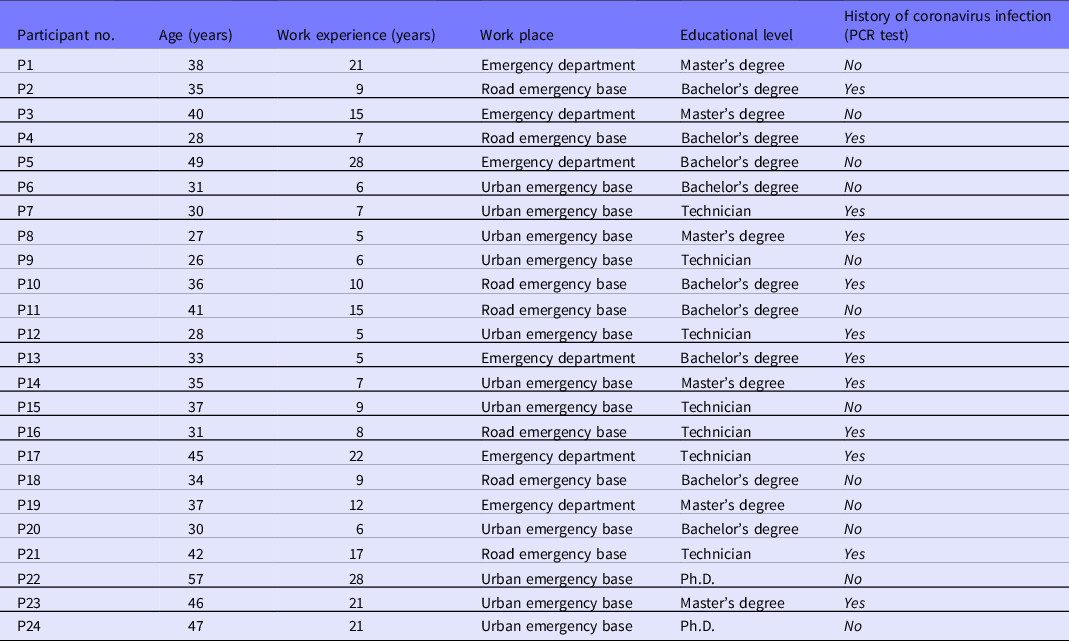
The mean age of the participants was 36.7 y, and all of them were male. It is noteworthy that the PHES in Iran is managed by male operational personnel, and women have not yet entered this field. The demographic characteristics of the participants are presented in Table 1.
Individual characteristics of the participants

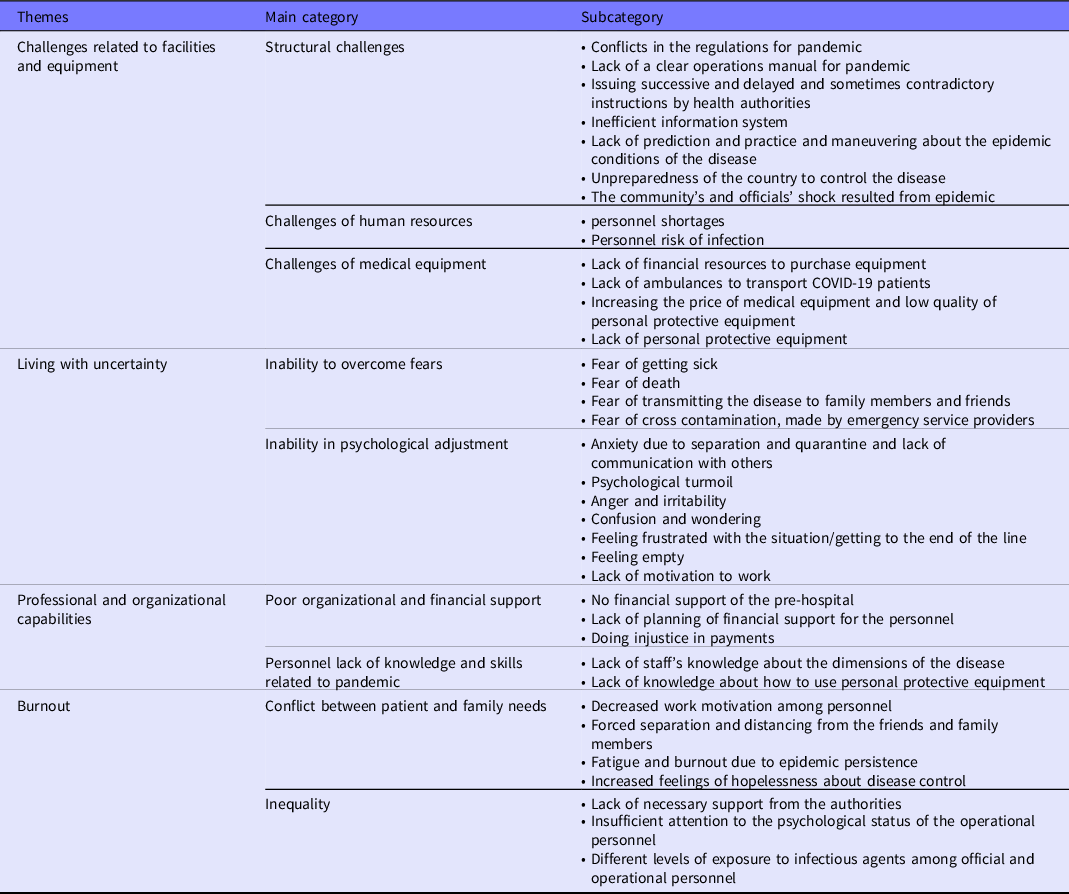
After performing the qualitative content analysis steps, the extracted codes formed the categories and similar sub-categories codes, and then, the sub-categories with common concepts were placed in a category and formed the themes. The main themes, extracted in the present study, included challenges related to facilities and equipment, living with uncertainty, professional and organizational capabilities, burnout. The list of the main and sub-categories is presented in Table 2.
Summary of themes and subthemes

Theme 1. Challenges Related to Facilities and Equipment
One of the concepts extracted from the PHES personnel experience was the challenges related to facilities and equipment. This theme included 3 main categories of “structural challenges,” “challenges of human resources,” and “challenges of medical equipment.”
Category 1. Structural Challenges
According to the data, this category included the subcategory of conflicts in the regulations for pandemic and lack of a clear operations manual for pandemic.
Subcategory 1. Conflicts in the Regulations for Pandemic; Subcategory 2. Lack of a Clear Operations Manual for Pandemic
Lack of transmission protocol in the early phase of the epidemic was the most important problem mentioned by participants in most interviews. Confusion in the rules for dealing with pandemic conditions and how to treat COVID-19 patients caused confusion among the staff, especially in the early days of the epidemic.
“There was no clear protocol for how to transfer the patients in the early phase of the epidemic. Protocols were sent over time, and we did not have clear rules for dealing with those conditions”. (Patient 22)
Category 2. Challenges of Human Resources
Challenges, related to human resources, were 1 of the issues, raised by PHES personnel. It was a challenge that all medical staff somehow struggled with.
Subcategory 1. Personnel Shortages; Subcategory 2. Personnel Risk of Infection
Lack of trained personnel to deal with the crisis was a challenge that was mentioned in most interviews. Personnel were not allowed to be absent or on leave, and if several personnel were involved with COVID-19 at the same time, other personnel would be subjected to heavy workload. Emergency headquarters personnel said that the most important challenge for human resource management was the unpreparedness of the personnel to face the situation and the difficulty in replacing COVID-19 infected personnel.
“We did not have an alternative human power in the emergency medical forces, which is due to the long lasting lack of personnel in the field of emergency medicine for many years in Iran, and unfortunately, this has not been compensated. Almost every day, our EMTs were involved in shifts, and God forbid, if one of them would get sick, not with COVID-19 but with any other diseases, and could not work, we would really have a problem”. (Patient 21)
Subcategory 3. Challenges of Medical Equipment
Lack of adequate personal protection equipment (PPE), such as N95 respirators, medical masks, eye protection, gowns, and gloves, and difficulty in distributing available facilities were some of the challenges that were repeatedly mentioned in the participants’ remarks. One of the emergency medical personnel with 22 y of experience and 45 y of age stated:
"We really had a problem because our staff did not have enough emergency equipment, and the personal equipment, needed for the patient, were not available and a new barrier was created for us in the first days. We had almost as many personal protection kits as a mission because we did not need more than that before, but now the situation was like a shock”. (Patient 17)
Theme 2. Living With Uncertainty
Living with uncertainty was another challenge emphasized by participants. This theme consisted of 2 subthemes of “inability to overcome fears” and “inability in psychological adjustment”.
Fear of disease and death along with fear of transmitting the disease to family members and friends was one of the common feelings of all emergency personnel, which along with the anxiety of the separation and quarantine caused anger and irritability of the personnel and their confusion and wondering about staying at work or resigning.
“It had a bad psychological and physical effect on us. We lost a lot of weight due to stress. We were very worried about not getting sick at home and we were worried about our family and parents. It was our biggest challenge”. (Patient 9)
Theme 3. Professional and Organizational Capabilities
Another concept extracted from PHES personnel experiences was the organization’s inefficiency in providing support for personnel. This theme included 2 subthemes of “poor organizational and financial support” and “personnel lack of knowledge and skills related to pandemic”. According to data analysis, no financial support of the hospital and personnel’s, failure to rewarding the personnel, discrimination (injustice) in payments were important subcategories of this subtheme.
A staff member of the road emergency base with more than 200 h of not-paid overtime during the corona outbreak stated: “Our staff expected (and are yet expecting) that when they all leave their homes and work hard, the system financially would help them, which unfortunately, did not happen”. (Patient 4)
Lack of knowledge about the nature of the disease and inability to use PPE were the most important professional incompetences of personnel.
Continuation of pandemic in Iran and experience of multiple waves of COVID-19 disease outbreak has caused double fatigue along with psychological effects among emergency personnel, so that people and medical personnel believe that the disease is uncontrollable. They are not optimistic about the future.
Theme 4. Burnout
Burnout was another concept extracted from data analysis. Based on the participants’ experiences, conflict between patient and family needs and inequality were important factors that led to some complications including burnout. PHES expressed the following items as exhaustive challenges that lead to conflict between patient and family needs: reduced willingness and motivation among personnel, forced separation and distance from friends and family members, excessive fatigue and exhaustion due to epidemic persistence, and increased sense of hopelessness about disease control.
“Our technician was also concerned about the mission and how to protect himself from the disease, and on the other hand, he wanted to provide services to the patients. He was worried that his services would be disrupted as well. The conflict between doing his job and supporting his family was his other concern”. (P23)
Discussion
In the results section, 4 themes, extracted from the participants’ remarks, were mentioned in detail, which included the challenges related to facilities and equipment, living with uncertainty, professional and organizational capabilities, burnout. challenges related to facilities and equipment were 1 of the important issues, raised in the participants‘ statements. With the onset of the COVID-19 epidemic in Iran, PHES personnel, like other members of the health-care team, faced challenges related to the lack of equipment and facilities, especially PPE such as masks and shields, etc. In similar studies, conducted in other countries, lack of PPE and officials’ shock when faced with the epidemic were mentioned among the experiences of medical staff, including nurses. Reference Chang, Xu and Rebaza22,Reference Sun, Wei and Shi23
Lack of experienced and skilled personnel as well as the weakness in managing the available forces, after a large number of personnel were involved with COVID-19 disease, were among the managerial and human resource challenges during the COVID-19 epidemic. Lack of preparatory programs to deal with epidemic conditions and lack of adequate training of personnel to deal with these conditions, as in many countries, caused managers to be shocked by the vast spread of disease and not to be ready to face the situation and challenges related to staff and human resources shortages in Iran.
In the study of Moradi et al., nurses in intensive care units with regard to their care experiences during the COVID-19 period stated that lack of facilities and financial resources to purchase PPE was a major challenge that caused inefficiency of care providers and hospitals in providing efficient and effective care during the epidemic period. Reference Moradi, Baghaei and Hosseingholipour24 The experience of living with fear and doubt during COVID-19 period included fears of death and transmitting the disease to family members and also the fears associated with the unknown nature of the disease (ie, a shared experience that participants in a present study described as the worst psychological experience of their career). In a similar experiment, participants in the Bijani et al. study stated that fear of infection negatively affected their accuracy in doing their work and how they provided services, and that their fear of spreading the disease sometimes overwhelmed them, even in diagnosis and treatment. This fear did not allow them to thoroughly examine the patient. Reference Bijani, Abedi and Karimi25
The inability to adapt psychologically to the stress, created during the COVID-19 period, caused the staff to develop anger and irritability, as well as confusion and wondering in their decision makings. Lack of motivation to continue working and feeling frustrated and reaching the end of the line were among the sentences that were heard the most of the participants in the interviews. In addition to the patients‘ care and physical needs, the medical staff had to support the patients mentally and psychologically. But how could the staff (who themselves had the stress of transmitting the disease to their family members, and due to multiple shifts and wearing special clothes for long hours mentally were very upset physically and psychologically and were thinking of resigning) take adequate physical and mental care of their patients?
The destructive effects of COVID-19 on the physical and mental health of health-care and treatment staff were mentioned in most of the studies. Ferron et al. and Qureshi and Al Rajhi in their studies pointed to the psychological effects of the COVID-19 epidemic on their staff. Reference Ferron, Agarwal and Cooper26,Reference Qureshi and AlRajhi27 Sun et al. noted in his study that most caregivers and nurses experienced many negative emotions during the COVID-19 period, and that these emotions and their psychological effects, including fear and anxiety, were very significant in the early days of the epidemic. Reference Sun, Wei and Shi28
The individual competencies of the staff and the organization‘s ability to manage the crisis was another major theme, extracted from the statements of the participants in the present study. The emergency headquarters personnel of the PHES, participating in the present study, believed that the quantity and quality of emergency unit services underwent many changes during the COVID-19 period because, in addition to the issue of providing a sufficient number of staff, their skills in providing quality services should also be considered. And this was challenging due to the lack of sufficient skills and work experience of young personnel in the operational departments.
In his study of the ethical challenges of nurses during the COVID-19 period, Rezaee et al. concluded that, according to the experience of the participants, the care of patients with COVID-19 put additional pressure on nurses, and this led to a deficiency in providing appropriate services to patients. In the end, the researcher suggested that it is better for hospital managers to hire experienced nurses in addition to providing just a sufficient number of them. Reference Rezaee, Mardani-Hamooleh and Seraji29
Having effective coping skills and adapting to the situation, decision-making and evidence-based prioritization, coordination and ability in teamwork, work commitment, self-sacrifice, and courage were among the abilities that participants mentioned in their experiences. They expressed that according to the high volume of work and the complexity and unpredictability of the situation, the challenge of unskilled and incapable manpower in the PHES unit made the situation much more difficult and increased the number of errors and diagnostic problems in their missions.
In the Jia et al. study, which aimed to examine nurses‘ experiences of ethical challenges in providing care to patients with COVID-19, professional competence and effective coping skills were among the factors that could affect the way nurses provided care. Participants expressed that nurses needed special knowledge and skills to adapt to the ethical challenges that arose during the COVID-19 period, so that they could choose the most effective strategy and make the right decisions with the help of critical thinking. Reference Jia, Chen and Xiao30
Another challenge from the participants’ perspective is burnout. Conflict between patient and family needs and inequality were 2 challenges that all PHES personnel experienced in different types and and to different degrees. Decreased work motivation among staff due to forced separation and distancing from family members and extreme fatigue, made by the continuation of the epidemic, caused burnout in staff, and this had a negative impact on staff’s performance and morale. Participants compared and described the conditions, created during the epidemic, with those of the imposed Iran-Iraq war. They narrated that, during this period, they also experienced a feeling like the soldiers in the war in the out-of-town bases due to long days away from the family and heavy shifts resulted from load of work. However, they tried to endure the difficult conditions. Khasne et al. in a descriptive cross-sectional study investigated the prevalence of burnout in health-care workers during COVID-19 pandemic in India and reported a prevalence of burnout of approximately 45%. The routine prevalence of burnout was reported as only 27%, while the rest of the burnout cases were related to pandemic. Younger men, and women experienced more burnout in this study. Reference Khasne, Dhakulkar and Mahajan31
Based on the experience of the participants, injustice was one of the most important factors that exacerbated the rate of burnout. They emphasized that lack of necessary support from the authorities and insufficient attention to the mental and psychological condition of the operational personnel caused dissatisfaction and reduced work motivation. Worst of all, despite the different levels of exposure to the infectious agent between the staff and the operational personnel, there was no difference in the amount of the payment received by the personnel. This caused dissatisfaction among operational personnel.
In their article, Mehtarpour and Jaafaripooyan mention the injustice and discriminations as the main factors that can negatively affect the performance of nurses. Nurses’ complaints were mainly about discrimination in payment, job benefits, and high workload (due to insufficient nursing staff) leading to consequences such as fatigue and burnout, lack of knowledge and motivation and severe stress. Reference Mehtarpour and Jaafaripooyan32 Participants in Moradi et al. study pointed to the difference in the amount of payment to physicians and nurses in Iran during the COVID-19 period and stated that, despite less exposure of physicians to virus-infected patients, compared with nurses, injustice in receiving PPE and salaries and benefits occurred as an unpleasant experience, which reduced their motivation to work and intensified their sense of exhaustion. They considered this to be rooted in the doctor-dominant policies in Iran and believed that the management system should provide adequate support to nursing staff during an epidemic and high pressure of workload. Reference Moradi, Baghaei and Hosseingholipour24
It is noteworthy that a main and impactful challenge in the Iranian relief system, includes the lack of the same telephone number (SOS response) for emergency rescue services such as PHES, as well as firefighting, Iranian Red Crescent Society, and police departments. If implemented, the system will reduce response time and inter-organizational inconsistencies. Reference Shakeri, Jafari and Khankeh12,Reference Haddadi, Sarvar and Soori33
Limitations
One of the limitations of this study was the working conditions of the emergency staff in such a way that, whenever there was a possibility of an emergency mission, interviews had to be left incomplete. To address this, the interview schedule was coordinated with participants during leisure and nonworking hours as much as possible. Another limitation of the study was the possibility of transmission of COVID-19 disease between the researchers and the study participants, for which it was tried to conduct the interviews outdoors as much as possible and in accordance with health guidelines.
Conclusions
Regarding the fact that PHES personnel are among the front-line health workers in any disaster, including the COVID-19 outbreak, so they encounter different personnel and organizational challenges that make them exhausted; therefore, it is essential to consider their health and wellbeing through psychological and mental support services, suitably allocating resources such as PPE, and using experienced personnel to care for patients with COVID-19. Such efforts can provide safe care and can facilitate PHES personnel adaptation to the existing situation and optimize their performance. Sharing the experiences of participants in the recent study helps PHES managers, staff, and other members of the health-care team to learn from the challenges posed and avoid problems and errors in similar cases by addressing weaknesses.
Acknowledgments
This study is related to a research design that was ratified and financial support by the research and technology deputy of the Medical Sciences University of Shahrekord (Grant No. 5395). We hereby express my deep gratitude toward the respectable Deputy of Researches and Technology of Shahrekord University of Medical Sciences, and all participants that assisted us in this research work, without whom the study could not be possible.
Funding statement
The project was financially supported by Shahrekord University of Medical Sciences, Shahrekord, Iran (Grant No. 5395).
Conflicts of interest
None.
Ethical standards
Written informed consent was gained from all participants and they were assured that their provided information will remain confidential. The present study was approved by Ethical Committee Medical Sciences University of Shahrekord (Ethics code: IR.SKUMS.REC.1399.043).