Introduction
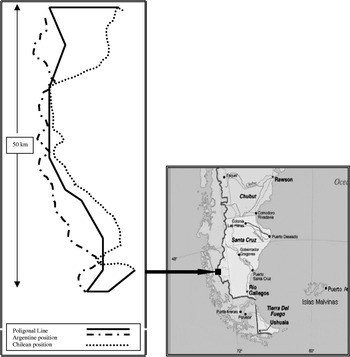
In August 1990, as re-democratisation prompted intensifying integration between Argentina and Chile, the governments of Carlos Menem and Patricio Aylwin sought to resolve outstanding territorial disagreements over their mutual border. Twenty-two border issues were swiftly resolved through a bi-national commission.Footnote 1 However, two zones in the far southern Andes, located in the province of Santa Cruz on the Argentine side, proved more resistant to negotiation. The inability to resolve the first of these, the Laguna del Desierto (the location of a small-scale but fatal confrontation between Argentine and Chilean forces in 1965), resulted in the August 1991 decision to submit that zone to an OAS international court of arbitration, whose final judgment in 1994 favoured Argentine claims to the Laguna del Desierto in their entirety. The zone immediately to the south, the Hielos Continentales (Southern Ice Fields), was to be resolved via alternative means. The key issues were the route the border should follow between Mount FitzRoy and Cerro Daudet, the northern and southernmost points of the disputed zone, and how far to the east or west the frontier would lie at various points along this route (see figure 1). The task was complicated by the glacial nature of the terrain. As Juan Carlos Olima, deputy Argentine foreign minister at the time of the 1990–91 negotiations with Chile, later noted, ‘Argentines and Chileans began from totally different points of view. […] Whilst the Chileans wanted to demarcate under the glaciers, the Argentines wanted to go above them.’Footnote 2
Disputed area (2335 sq.km). 50 km north-south from Mount Fitzroy to Cerro Daudet. Map. Southern Argentina and Chile. ■ Hielos Continentales Disputed Zone.

The mechanism proposed to resolve this problem was the so-called poligonal line. The poligonal, drawn by the respective foreign ministries, linked nineteen points between Mount FitzRoy and Cerro Daudet, allocating Chile 1057 square kilometres, and Argentina 1278 square kilometres, of the contested area.Footnote 3 The poligonal, however, contradicted a series of treaties agreed between the two countries at the end of the nineteenth century, most pertinently an 1881 Treaty of Limits. It implied a change in Argentina's borders, which – according to the Argentine constitution – required the ratification of congress. It also implied the potential loss of 1000 square kilometres of Argentine territory in the province of Santa Cruz, sparking a political controversy which remained unresolved until 1999.Footnote 4
This article analyses the development of the Hielos Continentales controversy in Argentina, focusing specifically on domestic variables. Played out in the national congress, the media, and amongst political elites and population at large, the Hielos Continentales controversy was sparked and subsequently shaped by the new foreign policy rationale of the Menem governments after 1990. That new rationale, tailored to the liberal economic thinking of the Menem administration and its view of Argentina's place in a world increasingly shaped by free markets and radical capitalism, undercut a traditional geopolitical influence in Argentine foreign policy. Thus whilst what Kacowicz labels ‘applied geopolitics’ had significantly shaped the conceptual framework of Argentine international politics over the long-run, provoking arms competition with Brazil and territorial contestation with Chile, it's role was now diminished. This was reflected by changes in civil-military relations: by the early 1990s the influence of military thinking over key ministries was restricted to the Defence Ministry, and even there was subject to strong civilian control.Footnote 5 Power politics and strategic issues were superseded by an economically inspired vision of Argentina's role in the world, coherent with Menem's domestic policies of neo-liberal economic restructuring. In short, the Hielos Continentales territorial controversy analysed here developed in a context of Argentine foreign policy-making shaped less by concepts centred on military and political power – the geopolitical – and more by concepts centred on economic power; the geo-economic.Footnote 6
This reshaping of longstanding foreign policy parameters was not, of course, unique to Argentina. Transformations of long-standing relations between neighbouring countries throughout the region were reflected in economic integration and mutual confidence building measures, as nation-states adapted to the new international realities of the 1990s post-Cold War era.Footnote 7 However, Argentina was the only regional republic which both undertook an abrupt foreign policy volte face, and at the same time attempted to peacefully resolve significant territorial disputes with a neighbouring republic. Indeed, the attempted resolution of territorial discord with Chile was undertaken by Menem's government not least in an attempt to resolve an issue long noted for its ability to destabilise trans-cordillera relations, unacceptable to a government whose economic policies – as one early 1990s analysis noted – were critically dependent on regional integration as ‘a necessary condition to attract investments to the country.’Footnote 8 In addition, by proving that it had now abandoned the possible use of other, more aggressive means to pursue its territorial claims, Argentina might perhaps in future entice the UK to enter negotiations over the Malvinas/Falkland Islands.
The Hielos Continentales dispute was a catalyst for debate and dispute around the new geo-economically framed international politics of the Menem government, a reorientation of foreign policy explicitly at the service of the domestic economy in a globalising international environment and a nominally ‘citizen-centric’ – as opposed to state-centric or elite-centric – foreign policy.Footnote 9 That citizen-centric foreign policy bears the imprint of Carlos Escudé's theory of peripheral realism, itself profoundly influenced by Morgenthau's realism because, as Escudé views it, of Morgenthau's explicit incorporation of citizenries’ interests into realist theory.Footnote 10 According to Escudé (who subsequently became an advisor to Menem's foreign secretary, Guido di Tella), less developed countries generate infinite risks by subordinating economic development to security in the long run. In summary, Escudé characterises peripheral realism as ‘an ideal type of foreign policy designed to serve the narrow interests of the citizenries of peripheral states that can compete for world power only at extreme cost to their own people.’Footnote 11 As Bologna and Busso have noted, the coincidence between Escudé's theoretical position and the foreign policy of the Menem government dates from the appointment of Guido di Tella as head of the Argentine foreign ministry in early 1991, and clearly underpinned the new geo-economic shape of Argentine foreign policy.Footnote 12 That geo-economic stance directly challenged the ‘old’ international politics underpinned by traditional strategic geopolitical notions, historically sustained by significant military and territorial nationalist contributions to foreign policy debate and formulation in Argentina. It was highly contested in Argentina throughout the 1990s amongst foreign policy theorists and Argentine political elites, and citizens more generally.Footnote 13
At the ideational level, the issues of territory with which this article is concerned, were disputed on a continuum which ran between two poles. At one extreme, the Menem government with its new, geo-economically conceived foreign policy, saw territorial resolution as critical to economic integration with Chile, and more broadly to regional economic integration overall. Understood thus, the potential loss of a proportionately insignificant scrap of national territory was a relatively small price to pay. However, such a view clashed with long-run Argentine nationalist concepts of territory as having value in and of itself, irreducible to other values and non-negotiable. It also threatened a range of concepts central to traditional understandings of geopolitical balance in the Southern Cone, notably the so-called ‘bi-oceanic’ principle, which assumed a primary role for Argentina in the Atlantic and Chile in the Pacific, and had been a cornerstone of bi-lateral territorial relations in the far south since the late nineteenth century. Footnote 14
Significantly, the purportedly nationalist protest characteristic of the Hielos Continentales dispute responded both to ‘top-down’ factors of government policy and the opportunism of political actors, and the ‘bottom up’ factors of public opinion and citizen dissent. Whilst government policy and political entrepreneurship – particularly that of then provincial governor Néstor Kirchner – were central to the development of the issue, sustained citizen involvement was equally significant, especially in the Argentine province of Santa Cruz, providing a range of opportunities for Argentine political actors. It is argued here that ‘top-down’ and ‘bottom-up’ dynamics were of equal significance in the development of the dispute. The relationship between these two dynamics was interdependent, responding to both long-term and shorter-term factors, including metropolitan-provincial relations, political opportunism and congressional politics. Argentine politicians continued to use foreign policy issues and territorial nationalism in the domestic arena throughout the 1990s in a broader context where the significance of territory was being reevaluated by government.Footnote 15 Moreover, in view of the apparent rolling back of Menem's international politics by the post-2003 Kirchner presidency, the Hielos Continentales controversy also provides insights into the development of subsequent president Kirchner's international politics, his use of international issues to fortify his domestic political position, and the ways in which these politics respond to the Argentine domestic political environment. It would be an overstatement to claim that the Hielos Continentales issue alone acted as a catalyst for a full reversion to a geopolitically dominated foreign policy orientation under Kirchner. Nonetheless, it does shed light on the more obviously contentious international stance of Kirchner's administration, exemplified in the ongoing Argentina-Uruguay pulp mill dispute, and the high profile of the Falklands/Malvinas issue in the lead-up to Argentina's 2007 presidential elections. Such positions echo Kirchner's own political stance over the Hielos Continentales issue during the 1990s and clearly echo Argentine foreign policy prior to the Menem administration, reflecting the renascence in the post 2003 period of traditionally geopolitical/strategic issues to the detriment of a more economically-centred foreign policy.
Santa Cruz and the Menem-Aylwin Territorial Accords
In August 1991, the announcement of the Menem-Aylwin accords provoked indignation from sectors of the armed forces, nationalists of the political left and right, and citizens of the province of Santa Cruz. Whilst the decision to adopt international arbitration for the Laguna del Desierto effectively prevented Argentine opposition from affecting the course of its resolution, the need to ratify the Hielos Continentales arrangement in the Argentine congress opened the issue to public and congressional debate, sparking a political controversy which defied the Menem government's attempts at ratification until the end of the 1990s.
The most significant driving force amongst the opposition emanated from the province of Santa Cruz, whose politicians and citizens maintained a fierce opposition to Menem's policy throughout the 1990s. That opposition was variously characterised by proponents of the territorial accords as ultra-nationalist, reactionary and xenophobic. Whilst a small but vocal minority of opponents displayed some of these characteristics, particularly in the 1991–2 period, there is little evidence to suggest that opposition amongst Santa Cruz politicians or citizens was driven by anti-Chileanism per se. Rather, the supposed need to ratify the accords for the benefit of integration was fiercely contested by the citizens of Santa Cruz, who believed they had little to learn about integration from those who operated, as Néstor Kirchner claimed, from within ‘ten blocks of Buenos Aires, three or four people who, sometimes, haven't even won an election’.Footnote 16
Such anti-metropolitan sentiment highlighted the complexity of Santa Cruz-Buenos Aires relations, underlining a strong sense of provincial uniqueness. It did not, however, stem from any particular disadvantage suffered by the province in its relations with Buenos Aires during the 1990s. First, Argentina's federal system of government provided Santa Cruz with the significant congressional over-representation typical of the ‘peripheral’ provinces.Footnote 17 With a population of less than 200,000, Santa Cruz elected the same number of senators as the province of Buenos Aires, with a population of over twelve million. In the lower chamber, deputies for Buenos Aires province each represented around 180,000 inhabitants, whilst in Santa Cruz the figure was less than 32,000.Footnote 18 Secondly, as Gibson and Calvo observed, the ‘peripheral’ provinces, including Santa Cruz, did not experience the full effects of Menem's economic restructuring in the first half of the 1990s. Until well after 1993–94, the costs of this fell more squarely on the heavily populated metropolitan provinces (Buenos Aires, Cordoba, Santa Fe and Mendoza), a direct consequence of the significance of ‘peripheral’ politicians in assuring the implementation of Menem's reforms.Footnote 19 Third, as Eaton has argued, Argentine provinces and their governors were growing in importance relative to the national executive through the 1990s.Footnote 20 Finally, Santa Cruz oil wealth freed Governor Kirchner's provincial administration from over-dependence on the discretionary spending which sustained clientelist networks in some peripheral provinces, which were, in effect, a quid pro quo for support for Menem. Oil-based economic strength thus freed Kirchner from the political restrictions implied by economic dependence on discretionary financial flows from the centre and allowed him to maximise the political advantages to be gained from widespread provincial repudiation of the Hielos Continentales agreements.
The Origins of Santa Cruz Opposition to the Hielos Continentales Agreements
Starting in July 1991, the Santa Cruz media began to report the growth of widespread opposition to the territorial accords in the province, claiming that ‘the entire province is on its feet’ in protest.Footnote 21 In response, Foreign Minister Guido Di Tella's deputy, career diplomat Juan Carlos Olima, visited the provincial capital of Río Gallegos in late July 1991. As the national daily Clarín reported, ‘Río Gallegos reverberated with the climate of aggression experienced during the tumultuous visit of deputy foreign minister Olima. The presence of the diplomat […] was taken advantage of by around one hundred people identified with nationalist sectors and the right-wing nationalist Fuerza Repúblicana party of Antonio Bussi to provoke disorder.'Footnote 22 This group was viewed both by Olima and provincial Peronist deputy Rafael Flores as being linked with the carapintadas, the nationalist right, and especially Fuerza Repúblicana, and as being responsible for the hostile atmosphere surrounding Olima's visit to Río Gallegos.Footnote 23
The impression that opponents to the accords were linked to rightist nationalism and to conservative military figures was heightened by the public appearance of conservative Santa Cruz bishop Miguel Alemán (who asserted that ‘we cannot cry like women over that which we do not defend like men’) alongside high-ranking military officers associated with the far right, including former de facto President General Roberto Levingston, protesting the anticipated accords in July 1991. This undermined the protestations of provincial Peronist groups that those who spoke out against the arbitration were being characterised as ‘hawks or neo-nazis’.Footnote 24 Concerns were deepened by an unauthorised armed services radio transmission deeply critical of the agreements shortly before the Menem-Aylwin meeting of August 1991. The author was widely assumed to be Aníbal Laino, Chief of Army Institutional Affairs, and formerly a close associate of ex-de facto Presidents Generals Levingston and Bignone.Footnote 25 Such activities both heightened concerns about the extent to which such groups were driving the opposition, and confirmed government supporters in their beliefs about the attitudes of Santa Cruz citizens, encapsulated in Di Tella's comments that Santa Cruz opponents were ‘dinosaurs’.Footnote 26
Sensitivity to the influence of right-wing nationalists certainly owed much to the delicate state of civil-military relations more generally in the aftermath of the carapintada military mutinies of 1987–1990. It was also linked to clear perceptions in the foreign ministry that territorial issues had long been used by sectors of the armed forces and their civilian allies to gain leverage in the political arena, where nationalists both tapped into and promoted views that Chile was traditionally expansionist.Footnote 27 (As Lacoste has discussed at length, Argentine-Chilean relations over the long-run were significantly shaped by historically inaccurate ideas of their respective borders and territory, and many Argentine and Chilean historians taught that the neighbouring country was expansionist).Footnote 28 Alluding to Chilean claims to Patagonia in the post-independence period, incidents on the border in the 1950s, through the original Laguna del Desierto confrontation in 1965 and on to the Beagle Channel dispute in the late 1970s, influential Argentine geopolitical commentators had long viewed Chile as ‘an amoeba, feeding itself on the territory of its neighbours’.Footnote 29 That perception was complemented by a long-term nationalist view that Argentina was a traditional loser of territory more broadly (ignoring Argentine territorial gains at the expense of its neighbours, notably Paraguay in the nineteenth century), a belief based above all on the Malvinas/Falklands dispute with the United Kingdom.Footnote 30
That presentation of Argentina as a territorial loser within national historiography, criticised both by Di Tella and his advisor Carlos Escudé, was viewed in the Argentine foreign ministry not only as being characteristic of Santa Cruz, but also as having had fundamentally anti-democratic consequences in Argentine history.Footnote 31 Moreover, sensitivity to the effects of territorial ‘misinformation’, to the high profile of a small number of activists apparently strongly influenced by nationalists of the political far right in 1991, and to the recent memory of the carapintada mutinies, all contributed to the characterisation of Santa Cruz opposition itself as being essentially reactionary nationalist. Escudé later claimed that historically the province was more heavily ‘territorially indoctrinated’ than other parts of the country.Footnote 32 Carlos Leonardo de la Rosa, ex-vice governor of Mendoza and a Partido Justicialista (PJ) senator in the mid 1990s, viewed Patagonians on both sides of the border as tending to xenophobia, clearly placing Santa Cruz opposition within this context, whilst Santa Cruz national deputy Rafael Flores also noted that in the province there was a ‘certain adhesion to the territorial question […] you see more Argentine-Chilean conflict and more conflict in the Argentina-Chile relation.’Footnote 33
However, whilst such factors were highly significant in setting the parameters of political dispute, underlying this was the historical and contemporary reality of Santa Cruz's close, almost symbiotic, relationship with the Chilean south. Until well into the twentieth century, the extreme south of Argentina and Chile functioned as a quasi autarchic region, far from the reach of the respective central governments. The internationalised sheep industry which supported southern Patagonia's economy in both countries was largely beyond the control of national government, involving as it did vast swathes of territory owned by foreign interests and labour moving according to the demands of the sheep industry. The city of Buenos Aires was less significant for Santa Cruz than Punta Arenas, in the far south of Chile, and London, the key cities for the ovine industry.Footnote 34 Although tension periodically surfaced in inter-state relations, often during periods of high military influence over government, cross-border relations in the south were generally shaped by an economic interdependence that superseded short-term inter-state tensions. Even the Beagle Channel dispute of 1978–9 had only a limited impact on cross-border relations, and by the early 1990s close relations were once again the norm, with Santa Cruz – and Río Gallegos in particular – home to one of Argentina's most proportionately significant Chilean communities. Frontier committees were established during this period, formalising bureaucratic links between Santa Cruz and the Chilean south.Footnote 35 Assertions that Santa Cruz's rejection of the proposals was solely due to nationalism thus significantly underplays the complexity of the dynamics which characterised that opposition.
Whilst it is certainly true that militant nationalism was present in Santa Cruz in mid to late 1991 as the Menem-Aylwin accords were signed, even its most notable show of strength brought only around 100 supporters onto the streets of Río Gallegos, an indication of the marginality of such opinions within the opposition as a whole.Footnote 36 Moreover, the debates around the issue throughout the 1990s indicate that there was no significant difference between the arguments deployed by the broad mass of Santa Cruz opposition and its representatives, and other opponents beyond the province, including both the Unión Cívica Radical (UCR) and the new centre-left Frepaso.Footnote 37
Perceptions of an ultra-reactionary Santa Cruz also underestimate the diversity of opposition in the province from mid 1991 onwards. The opposition of the provincial legislature was illustrated by a symbolic legislative session, attended by representatives from all sides of the provincial political spectrum, held at Laguna del Desierto in July 1991, whilst both the Santa Cruz Central General de Trabajadores (CGT) and provincial PJ categorically rejected the territorial proposals.Footnote 38 Through July and August 1991, provincial industrial associations, citizens groups, and politicians of all denominations voiced their dissent. Popular opposition to the Laguna del Desierto arbitration process was expressed by a mass protest, in provincial terms, which brought Río Gallegos to a standstill, the scale of the demonstration facilitated by the decision of the Peronist provincial executive to grant a holiday to public employees.Footnote 39
Nevertheless, territorial nationalism was clearly present in Santa Cruz, and for some actors in the Hielos Continentales dispute was sharpened by the ‘frontier’ history and pathology of the Argentine far south. The impact of nationalism on the Hielos Continentales issue, and the reasons why it provoked such sustained opposition, can be better appreciated if the role of territoriality in the historical development of national identities in Latin American nation building generally, and Argentina more specifically, is taken into account. Drawing on the examples of Peru and Ecuador, Herz and Nogueira summarise this phenomenon, observing that ‘territoriality plays, then, a central role in the construction of the national identities of most Latin American states’.Footnote 40 National histories are understood through a lens of territorial loss. Such loss certainly threatens national integrity, but also, in the Peruvian case for example, ‘contributes to the emergence of a new conceptualization’ of national identity.Footnote 41 Argentine national identity was no less territorially constructed, albeit for the most part on a dubious factual basis. Whilst territoriality as a component of national identity had remained undisturbed, and indeed was promoted, by long-run Argentine policy towards Chile shaped by traditional geopolitical concepts, the Menem government's geo-economic focus in bilateral relations directly threatened that territorial component of Argentine identity by subordinating territory to other issues. Viewed thus, it is clear that fierce nationalist opposition to the Hielos Continentales agreement in the far south responded at least in part to just such an implicit reconceptualisation of national identity, and clearly indicated that ‘territorial place … obviously remains important in respect of […] national identity’. Footnote 42
The Controversy Develops, 1992–94
In mid-1992, widespread opposition to ratification of the poligonal surfaced during the run-up to the consideration of the Hielos Continentales proposal in the foreign affairs committee of the chamber of deputies in national congress. The opposition argued against the poligonal on multiple grounds, most significantly that it contravened an 1881 Treaty of Limits that had formally established the border, even if this had not been physically located on the ground. Supplementary arguments over access to water resources, the ‘unprofessional’ and secretive policy-making process, and contesting the supposedly beneficial integrative effects of the territorial proposal were all utilised by opponents. Once again, opposition was most vociferous in Santa Cruz, both in the provincial capital and interior, with citizens' delegations from all over the province lobbying politicians in Río Gallegos.
Ensuring that the issue remained high profile through mid 1992, popular opposition was organised by citizen groups such as the Comisión pro defensa Hielos Continentales in Puerto Santa Cruz which, in an ‘act of repudiation’ in August 1992, cut the road links to Isla Pavón (in the mouth of the Río Santa Cruz) during a day of action attended by ex-foreign ministry official Ricardo Paz, deputies Flores and Riera, and representatives of a number of provincial municipalities.Footnote 43 The provincial legislature and Santa Cruz representatives in the Argentine congress uniformly condemned the poligonal, whilst newly appointed Deputy Foreign Minister Petrella was physically harassed outside congress by a group of Santa Cruz student protestors.Footnote 44 Governor Kirchner, meanwhile, used the media to attack Foreign Minister Di Tella for ‘improvising’ a handover of territory to Chile without consulting residents of the zone.Footnote 45
In response, Menem's government made concerted attempts to shape public opinion. In August 1992, Di Tella and supporters of the poligonal, including PJ heavyweight Carlos Ruckauf, launched a defence of their position in the national media.Footnote 46 In an interview with La Nación, Di Tella claimed that the poligonal defended Argentine territory, rejecting arbitration for the zone as being too uncertain.Footnote 47 His position was supported by Carlos Escudé, who provided an insight into foreign ministry perceptions of Santa Cruz opposition, blaming difficulties over ratification of the poligonal on their ‘irrationality’, their reputed corruption, and opposition to the Menem government's economic and social policies more generally.Footnote 48
Government efforts were, however, stymied from 1992 until the middle of the decade by a cross-party bloc within the chamber of deputies foreign affairs committee, which included PJ deputies Francisco Toto (Santa Cruz), Jose Maria Corchuelo Blasco (Chubut), Graceila Camaño (Buenos Aires) and Humberto Romero (Corrientes). Although the PJ was the dominant force in the lower house and Ruckhauf, president of the foreign affairs committee, a supporter of the territorial agreements, the outcome of the upcoming August 1992 committee vote was uncertain. Of twenty-four committee members, thirteen were PJ legislators. Yet with the UCR and assorted smaller parties voting against the government, the potential PJ majority of two was distinctly vulnerable.Footnote 49 Against the background of broad opposition to the poligonal in Santa Cruz and from the UCR and other opposition parties, four PJ deputies Toto, Camaño, Corchuelo Blasco and Romero were all presumed liable to either abstain or to vote against the government proposal.Footnote 50 Ratification was blocked by a combination of fierce extra-congressional opposition and the refusal of dissident PJ legislators to respond to either persuasion or threat.Footnote 51 Defeat for the government in committee seemed certain; when the vote came in late August 1992, the PJ congressional bloc was forced to resort to procedural management, scheduling an important and controversial education debate to take place at the same time as the foreign affairs committee sat, thus avoiding the humiliation of an outright defeat permanently ending the government's hopes of ratification.Footnote 52
In this context, supporters of the poligonal accused provincial politicians of utilizing the Hielos Continentales issue for opportunistic political gain, and more specifically argued that it was ‘a petty political interest of Santa Cruz politicians, above all of Governor Kirchner; he found in this xenophobic rejection a cause for his partisan political interests’.Footnote 53 Neither were perceptions of the utility of the issue to provincial politicians limited to those, such as De la Rosa, who strongly supported Menem's territorial policy. Peronist deputy Rafael Flores admitted that his own profile as a prominent opponent of the poligonal played a part in assuring his success in the 1993 national legislative elections.Footnote 54 Yet whilst provincial politicians benefited from Santa Cruz opposition, evidence of practical support for, or manipulation of, opposition groups by Kirchner's provincial government is scant. Rather, contemporary accounts suggest that Santa Cruz citizens spontaneously joined with organised groups such as local unions, protesting precisely because they viewed the issue as ‘one of the most significant in provincial history’.Footnote 55
Continued electoral success through the decade might seem to confirm that Kirchner's nascent anti-Menemism dovetailed neatly with the anti-government rhetoric of the opposition movement, and that he was successfully utilising the issue to forward his own political aims. However, this was only one of a number of factors contributing to Kirchner's developing political strength through the 1990s. Most pertinently, having been in economic disarray as Kirchner took office, Santa Cruz was economically stable by the mid 1990s, largely due to the oil and gas revenues which, particularly after the redistribution of those revenues between the national government and Santa Cruz in 1991, ‘constituted the provincial budget itself’.Footnote 56 The continuing flow of oil revenues, boosted by a doubling in the value of production from 1991–95, combined with very substantial financial transfers from federal government to the province during the first half of the 1990s, enabled Kirchner to maintain exceptionally high levels of public employment throughout the 1990s, financed public works, sustained the state apparatus, and contributed to relatively high levels of growth in provincial GDP from 1991 onwards.Footnote 57 Between 1992 and 1995, Río Gallegos displayed one of the lowest rates of unemployment in the entire country, and experienced very low rates of poverty and marginality, with provincial unemployment running at around 50% of the national average from 1991–95.Footnote 58 In this unique context, Kirchner's strength as provincial governor was given an added dimension after 1993 as competition from within provincial Peronism itself declined, Santa Cruz Peronism subsequent to that year seeing no competitive internal elections.Footnote 59
Kirchner thus engaged in the opposition to the Hielos Continentales from a position of strength. Certainly, road blockades in Puerto Santa Cruz, symbolic events at Laguna del Desierto (then later at the Hielos Continentales), protests in Río Gallegos, and activism in Buenos Aires by Santa Cruz students, underline the fact that, far from simply being manipulated by provincial political authorities, citizen organisation and involvement were significant independent dynamics in the opposition movement. Nevertheless, if as one opponent to the accords observed, this was a perfect issue for Governor Kirchner, it is equally clear – given relative economic prosperity in Santa Cruz under his administration and his own enhanced political strength – that Kirchner was hardly dependent on the Hielos Continentales issue to maintain his provincial power base.Footnote 60
What opposition to the Hielos Continentales did provide, however, was a potential opportunity to bring Kirchner forward on the national political stage, developing his political profile at a time when expansionist, public employment promoting Peronism of the type practiced by Kirchner was under attack from Menem's free-market policies. Whilst through the early part of his mandate Kirchner had maintained good enough relations with Menemism to be part of the PJ's executive board in 1993, his anti-Menem views were strengthening by mid-decade and were made overt in his 1994 establishment of the Peronist ‘Federal Current’; a short-lived attempt to ‘correct Menemism from within’.Footnote 61 Kirchner's growing militancy evolved in the context of Peronism's fierce internal struggles through the decade, as traditionalists, anti-Menem reformists, and Menemists themselves fought both for ideological leadership of Peronism and for control of the PJ itself. Kirchner's own attempts to form anti-Menem alliances within Peronism highlighted intra-Peronist conflicts between the centre and the periphery, and mirrored the efforts of other regionally based anti-Menem currents within the PJ from the early 1990s onwards, including Peronist Militancy (1990–91) and the Great North factions (1996–97), both based in the northern peripheral provinces.Footnote 62 Like those attempts to counter Menem, Kirchner's own repeated efforts to reach out from Santa Cruz and develop national alliances with other Peronists met with little success. In view of such failure, the Hielos Continentales served to provide potential linkages to anti-Menem political actors, mediated through the territorial issues themselves.
From the 1994 Arbitral Award to the 1996 Additional Protocol
In late October 1994, the International Arbitral Tribunal announced its decision to favour Argentine claims to the Laguna del Desierto in their entirety. Yet that success signalled not a cooling, but rather an intensification of the Hielos Continentales polemic. Activity around the issue had been muted since the attempt to secure congressional ratification stalled in late 1992. With congressional elections scheduled, the Hielos Continentales were not considered in congress during 1995, but by early 1996 renewed government attempts to expedite ratification re-ignited Santa Cruz opposition. In mid April 1996, a public meeting at the Perito Moreno glacier, on the edges of the Hielos Continentales, attracted some 1,500 people, including Kirchner, Santa Cruz legislators and citizens, and representatives from other parts of Argentina, reiterating their ‘steadfast stance against the ratification of the agreements between Argentina and Chile’.Footnote 63 Kirchner underlined his opposition both to the accords themselves and to the process by which the government was attempting to guide them through congress, criticising the recent exclusion of Santa Cruz legislators from the congressional foreign affairs committee.Footnote 64
Intense activity around the issue both in Santa Cruz and Buenos Aires continued in mid-1996. The Centre for Santa Cruz Residents in the Federal Capital lobbied Patagonian deputies and senators asking that they should oppose approval, whilst the National Institute of the Patagonian Ice Fields noted that only congress could ‘revise the treaties of limits in force’.Footnote 65 Santa Cruz students demonstrated in Río Gallegos and Buenos Aires against the agreements, receiving support in the federal capital from other opposition groups.Footnote 66 These protests were met by continued government efforts to convince Argentines that the Hielos Continentales affair must be resolved if integration was to continue, including the invocation of Perón's dictum that ‘in the year 2000 we will find ourselves either united or dominated’ to try and convince dissenting Peronists.Footnote 67 As the controversy continued through December 1996, Kirchner once more made clear his opposition in characteristic style, asserting that if foreign ministry officials knew the zone, or had even seen it on television, ‘they would have drawn a much better poligonal than they did in a bar’.Footnote 68
Kirchner's anti-ratification stance and anti-Menemism continued to dovetail. On the same day that the joint foreign affairs and defence committees of the lower house were voting on the Hielos Continentales, he was attending, as a prominent member, an opposition ‘multi-sectoral forum’ in central Buenos Aires, alongside two of Menem's staunchest critics, UCR chief Rodolfo Terragno and Frepaso leader Carlos ‘Chacho’ Alvarez.Footnote 69 Although the government managed to pass the bill through the foreign affairs committee in December 1996, Kirchner's alliance with the UCR and Frepaso signaled the slim chance of success the government faced should they attempt to move the ratification into the full chamber of deputies in the coming congressional year.
Unfortunately, the opinions of Santa Cruzeños about the territorial issues were not registered in polls during the 1990s. However, a general picture of attitudes towards Menem's foreign policy and towards Chile in particular can be gleaned from national level surveys. In 1992, Mora y Araujo surveyed opinions about the territorial issues with Chile; 38% were in favour of government policy, 36% against, and 26% offered no opinion.Footnote 70 When asked about their attitudes towards Chile, 42% were favourable, whilst 28% were unfavourable.Footnote 71 In 1996, Mora y Araujo asked about Argentine attitudes towards foreign diasporas in Argentina, finding that 40% viewed Chileans positively, and only 19% negatively.Footnote 72 (This compared to Brazil, 52% positive, 8% negative; Uruguay, 61% positive, 5% negative; Bolivia, 31% positive, 27% negative.) In early 1997, La Nación asked several questions around the theme ‘should congress reject the Hielos Continentales arrangement?’ From a sample of 800 cases in and around Buenos Aires, 23% were ‘very interested’ in the issue, 43% ‘somewhat interested’, and only 9% ‘not interested’. A comparison of this poll with one conducted in November 1992 showed a substantial swing in public opinion towards a rejection of the poligonal and ‘highlighted that some 56% of those questioned evaluate negatively the manner in which the government carried forward the negotiations with Chile.’Footnote 73
Against this background, Santa Cruz opposition to the Hielos Continentales ratification maintained pressure on the government, forcing President Menem to cancel a visit to the province in February 1997. Menemists claimed that Kirchner had sabotaged Menem's visit and threatened to bring him before the PJ's disciplinary committee. Kirchner responded, ‘if the president does not come, it is because he's scared to confront the public, because he knows that they are in the right’.Footnote 74 Kirchner continued his staunch opposition through 1997, in May of that year establishing the Peronist Current, an overtly anti-Menemist grouping which sought to develop a more ‘progressive’ justicialism. Like Kirchner's previous efforts at alliance building within the PJ, the Peronist Current was short-lived.Footnote 75
Such failure on Kirchner's part was hardly surprising. Whilst his political discourse may have chimed with traditional state-centred Peronism, his position as governor of a lightly populated and distant province hardly made him a Peronist ‘heavyweight’. Furthermore, in the context of the formation of Frepaso – by 1997 a real alternative for disaffected Peronists – and of generalised competition within Peronism, Kirchner, despite his anti-Menemism, provided no realistic political alternative. In the light of his failure to develop a meaningful challenge to Menemism by other means, the Hielos Continentales controversy clearly served as an issue where Kirchner could discomfort the national executive and party leadership, both marking out his own political profile as a populist nationalist, and as a useful bonus, attending to the demands of his own provincial constituency. Equally though, Kirchner's exploitation of the issue was subject to conjunctural political dynamics. The effectiveness of his opposition to government policy on the territorial accords owed significantly to the configuration of other political actors lined-up in opposition, and specifically to the fact that the UCR, and Patagonian deputies across the board, had made the issue a locus of congressional opposition to the Menem administration since 1991. As congressional realities changed from 1997 onwards, Kirchner's use of the issue itself became hostage to political developments beyond his influence.
1997–1999: Compromise and Resolution
Although opposition to the poligonal remained firm in Santa Cruz, internal differences increasingly became evident from late 1996 onwards, particularly after Menem and Chilean President Eduardo Frei agreed an additional protocol which specifically addressed concerns over water resources in the Hielos Continentales zone.Footnote 76 This measure encouraged a degree of compromise amongst some opponents, including Rafael Flores (now of Frepaso), increasingly distanced from the more uncompromising strands of opposition represented by Kirchner and by Cristina Fernández de Kirchner, herself of growing importance in the opposition campaign. The October 1997 mid-term elections saw a realignment of political forces, Frepaso emerging as a significant congressional force. Frepaso's electoral consolidation thereafter signalled a new congressional reality for the Hielos Continentales, as politicians from all sides now sought compromise over ratification for different reasons; the Menem government because any slim chance of achieving ratification of the original poligonal had effectively been buried with the weakening of the congressional PJ in the October 1997 elections, whilst neither the UCR nor Frepaso, moving towards an electoral coalition, wished to inherit this thorny issue should they achieve office in the 1999 presidential elections. As the position of the UCR and Frepaso softened, that of the hard-line Santa Cruz opposition was negatively affected. Having taken maximum advantage of UCR opposition to the Hielos Continentales accords from the early 1990s onwards, hard-line Santa Cruz opponents now found their position weakened.
The consequences for the poligonal quickly became evident. In mid December 1997, Foreign Minister Di Tella admitted for the first time that the Argentine congress would not approve the territorial agreements as they stood.Footnote 77 At the same time, confidential discussions began amongst an all-party group of Argentine and Chilean legislators seeking an acceptable alternative to the poligonal, with the tacit approval of the Menem government. Little was made known publicly of the negotiations between December 1997 and mid-1998, a fact lamented by Fernández de Kirchner, who observed that ‘the foreign ministry and three legislators have been working since December on drafting a new poligonal in secret meetings behind the backs of the people.’Footnote 78
Two weeks later, an alternative line to the poligonal was proposed by the cross-party trio of Fernando Maurette (PJ), Marcelo Stubrin (UCR) and Guillermo Estevez Boero (Popular Socialist Party). The new commitment amongst congressional actors to resolve the issue was clearly highlighted by Fernández de Kirchner's position as the sole member of the lower house foreign affairs committee opposing the alternative proposal of Stubrin et al. in July 1998.Footnote 79 By December 1998, the spirit of compromise between the three main political parties and the general acceptance of Stubrin et al.'s alternative proposal saw ratification finally achieved. Thus the Menem government could claim to have resolved this long-standing territorial issue, lauding it as a permanent contribution towards integration with Chile; the UCR/Frepaso alliance could move into the 1999 presidential elections in the knowledge that this would be at least one problem they would not inherit from Menem; and the Santa Cruz opposition, whilst not entirely satisfied with the outcome, had at least achieved their aim of preventing the original proposal from being ratified.
Conclusions
The Hielos Continentales ratification was eventually passed into Argentine law in mid 1999, respecting the central concerns of the opposition movement and fundamentally adhering to the concept of the border laid down in the original treaties from 1881 onwards.Footnote 80 In that sense, ratification was a defeat for the Menem government, as its own attempts to expedite a solution agreed solely by the respective foreign ministries had been comprehensively derailed by an opposition of disparate characteristics, substantially driven by the people and politicians of Santa Cruz. That provincial opposition provided Néstor Kirchner with a platform on which to build his national political profile, underpinned by his own strength in the province, itself buttressed by relative economic prosperity from 1991 onwards. Kirchner's espousal of opposition to the Hielos Continentales accords thus served as a highly significant resource as he attempted to forward his own vision of Peronism in the context of the fierce struggles within both movement and party during the decade. Equally significantly, Kirchner's role in the controversy starkly illustrated the utility of territorial issues for Argentine political actors. Whilst that factor has less relevance for Argentine-Chilean relations subsequent to the resolution of the Hielos Continentales issue, it remains salient in Argentine politics in light of the unresolved Falklands/Malvinas dispute.
It is equally clear, however, that despite Kirchner's efforts to use this issue to forward his own domestic political aims, the success of that strategy was partial at best. Certainly the issue served as a resource in Kirchner's anti-Menem campaign from the early-mid 1990s onwards, and arguably allowed him to develop the alliance-building skills which later became significant for his presidential campaign and subsequent presidency. However, given low levels of public recognition for Kirchner in the run-up to the 2003 presidential elections, in which his success owed more to the failings of other candidates and the generalised distaste for Carlos Menem's candidature amongst a disillusioned and economically battered population than to his own stature as a candidate, it seems clear that the value of this strategy in developing Kirchner's national public profile was limited. So whilst the Hielos Continentales case confirms the long-standing contention that ‘foreign policy issues remain a significant resource in the domestic political process’, it also highlights the difficulties, for political actors and analysts alike, of predicting concrete outcomes from the use of such issues in the domestic political arena.Footnote 81 In so far as Kirchner was able to garner political advantage from the issue, it was because, first, there was an unusually united provincial opposition to government policy; second, a long-standing Argentine public discourse around territory existed which favoured such opposition; and third, the constellation of actors and dynamics around the issue was highly favourable for Kirchner's tactics. So whilst true that foreign policy objectives can and do serve as a domestic political resource, it is also clear that historically specific domestic circumstances preconfigure any attempt to maximise this.
Nevertheless, in the aftermath of the utter discrediting post-2001 of the Menemist model, and the subsequent election of Kirchner to the Casa Rosada, it is clear that strong echoes of Kirchner's politicking around the 1990s opposition to the Hielos Continentales poligonal have resurfaced in current Argentine foreign policy. The already noted contentious aspects of Kirchnerian foreign policy over Uruguay is but one example. Equally notable, the rise up the foreign policy agenda of the Falklands/Malvinas dispute has continued apace since the 2003 presidential elections, supported by the development of a powerful congressional lobby around the Observatorio Malvinas group.Footnote 82 It seems then, that for the time-being at least, Escudé's recommendation of a citizen-centric foreign policy based on non-confrontation (especially with the more powerful nation-states of the north), and the subordination of all other issues to economics, has been cast aside. In view of the meltdown of the Argentine economy in 2001, broadly understood to be in substantial measure a consequence of Menem's economic policies during the 1990s, this is hardly surprising. Whilst criticisms of peripheral realism and its citizen-centric focus are easily made, not least on the basis that it presupposes accepting without deviation the current power relationships between developed and less-developed countries, the central point of Escudé's theory remains valid, namely that the citizenry, not agencies of the state, nor narrow political or sectoral interests, should be the focus of foreign policy design and the beneficiaries of policy implementation. Ironically, the Hielos Continentales policy, nominally implemented to benefit Argentine citizens, was derailed not least because of the implacable opposition of many of those citizens in Santa Cruz.
The eventual resolution of the Hielos Continentales controversy did bring two significant gains for Argentine democratic politics. First, despite its divisive tone and the fact that it had been contested around issues of profound importance with regard to Argentine views on territory, nationalism, national identity, geopolitics and strategic interest, the Hielos Continentales debates never seriously threatened to be conducted in anything but democratic terms. Illiberal views threatened to railroad the debate in its early stages, but were sidelined as the vast majority of actors in the dispute made plain that they held no brief for either xenophobic or anti-democratic behaviour. Secondly, the final resolution of the border between the two countries definitively removed territory as a possible area of conflict between Argentina and Chile. It was thus a substantial achievement, ending the potential use of territorial uncertainty between the two republics by undemocratic groups seeking influence in the domestic political arena.