Introduction
Comprehensive research on non-pheromone semiochemicals (e.g., kairomones or synomones), or their mimics, as lures or attractants for use in thrips pest management, is expedient, because, in comparison with thrips pheromones, these chemicals can be very powerful. For example, compared with traps without the compounds, ethyl nicotinate brings a >100x increase in trap catch for Thrips obscuratus in stonefruit (Penman et al., Reference Penman, Osborne, Worner, Chapman and McLaren1982), and methyl anthranilate brings a >500x increase in trap catch for Thrips hawaiiensis in various vegetables (Imai et al., Reference Imai, Maekawa and Murai2001). Additionally, non-pheromone semiochemicals can attract more than one species of thrips, and attract both males and females (Koschier, Reference Koschier2008). Furthermore, semiochemical technologies have been under-exploited for small insects such as thrips, compared with some other insects (de Kogel et al., Reference de Kogel, Koschier, Broughton, Castañé, Davidson, Hamilton, Kirk, Nielsen, Riudavets, Van Tol and Teulon2016). This paper focuses almost entirely on methyl isonicotinate (MI), active against several key cosmopolitan thrips pests (see below), and does not consider other non-pheromone (e.g., El-Sayed et al., Reference El-Sayed, Mitchell and Suckling2014; Abdullah et al., Reference Abdullah, Greenfield, Ficken, Taylor, Wood and Butt2015) and pheromone (e.g., Kirk, Reference Kirk2017) attractants for thrips.
Methyl isonicotinate
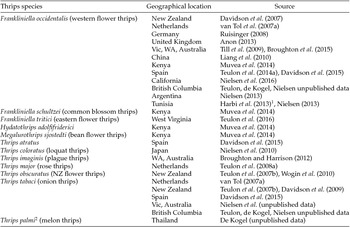
Several non-pheromone compounds have been found to influence the behaviour of walking and flying thrips (Koschier, Reference Koschier2008). However, the patented 4-pyridyl carbonyl compounds (Davidson et al., Reference Davidson, Teulon and Perry2005), especially MI, are probably the most extensively studied of such compounds and have been shown to influence the greatest number of key pest thrips species (Table 1). MI has been extensively tested against a range of potentially attractive compounds (Davidson et al., Reference Davidson, Butler, Winkler and Teulon2007; Reference Davidson, Perry, Larsen, Green, Butler and Teulon2008; Teulon et al., Reference Teulon, Butler, James and Davidson2007a; Reference Teulon, Castañé, Nielsen, El-Sayed, Davidson, Gardner-Gee, Poulton, Kean, Hall, Butler, Sansom, Suckling and Perry2014a). Walking thrips are attracted to MI in Y-tube olfactometers in the laboratory. Flying thrips are trapped in greater numbers on coloured traps baited with MI than on coloured traps without MI in a range of indoor and outdoor crops (fruit, vegetables, ornamentals) in temperate, tropical, and Mediterranean climates throughout the world (Table 1). The presence or absence of the Tomato spotted wilt virus within Frankliniella occidentalis does not substantially affect the behavioural response to MI in Y-tube bioassays (Davidson et al., Reference Davidson, Skill, Butler, Nielsen, Keenan and Bulman2012). MI is thought to be similar to (or the same as, yet to be detected) chemical compounds found in the host plant flowers of thrips, and used in the host finding of (especially) flower-inhabiting thrips (Teulon et al., Reference Teulon, Butler, James and Davidson2007a). MI is a putative non-pheromone semiochemical commonly called a kairomone (in a pest management context) but is probably more accurately described as a synomone (in an ecological context), as both the plant (pollination) and thrips (feeding and oviposition sites) can benefit from the interaction.
Thrips species known to respond to methyl isonicotinate (active ingredient or formulated as Lurem-TR or THSP) as evidenced by increased trap capture

1 Experimental design is unclear so results are difficult to interpret.
2 Needs further verification.
Also, see Muntyan et al. (Reference Muntyan, Il'ev, Batko and Yazlovetsky2013) for Thrips tabaci and ethyl isonicotinate (another 4-pyridyl carbonyl compound) in Moldova.
Efficacy against a range of species
MI influences the behaviour of at least 12 species (Table 1) and is notably effective in increasing trap capture in a variety of situations for two of the most important cosmopolitan virus-vectoring pests – western flower thrips and onion thrips. Additional research is required to confirm efficacy for the melon thrips. Given the presumed similarity of MI to floral compounds (see above), we expect that flower-inhabiting species will have the greatest behavioural response to MI. For western flower thrips, walking directional responses (i.e., attraction) to MI were found to be consistent across populations with different origins, feeding histories, and/or genotypes in a Y-tube olfactometer study (Nielsen et al., Reference Nielsen, Worner, Rostás, Chapman, Butler, de Kogel and Teulon2015). The addition of MI can increase trap catches by between about 2 and 60 times (more commonly, between two and five times) depending on the thrips species, environmental conditions, and design of the experimental bioassays. Mixing MI with additional active ingredients does not increase trap capture for a given species (Teulon et al., Reference Teulon, Nielsen, James, Winkler, McLachlan and Perry2007c; Wogin et al., Reference Wogin, Butler, Teulon and Davidson2010).
Current use of MI for thrips monitoring
MI fulfils a number of criteria important for an effective semiochemical tool: (1) low toxicity – relatively safe for human use, (2) volatility – vaporises under ambient trapping conditions, (3) stability – capable of being stored over time (e.g., >1 y), (4) cost – it is relatively inexpensive to be fitted into established pest monitoring programmes, and (5) efficacious – increases trap capture of males and females of key thrips pest species (Teulon et al., Reference Teulon, Castañé, Nielsen, El-Sayed, Davidson, Gardner-Gee, Poulton, Kean, Hall, Butler, Sansom, Suckling and Perry2014a). MI is the current active ingredient of the commercial lures Lurem-TR (Koppert Biological Systems, 2016), and THSP (Pherobank, 2016). These thrips lures are primarily used with coloured sticky traps for improved monitoring of thrips in temperate greenhouses. Improved monitoring with MI has been demonstrated in a range of greenhouse ornamentals and vegetables, outdoor vegetables, and fruit crops in New Zealand, Australia, Europe, North and South America, Asia, and Africa (Table 1). The addition of lures/attractants to coloured traps may: (1) improve the trapping effectiveness of these coloured traps; (2) lead to earlier and more accurate detection of thrips (e.g., early in the season or at low population densities); and (3) improve presence/absence monitoring at low densities for border biosecurity incursions. Lurem-TR won an Innovation Silver Award, Category: Protection of the Environment, International Horticulture Fair: Exhibition for the Technical Means of the Fruit and Vegetable Industry, Sifel 2008, France (Koppert Biological Systems, 2008), in recognition of this innovative approach to thrips pest management.
Key considerations for use
Research and application of MI and other lures for thrips pest management are still at a rudimentary stage and the effectiveness of the lures may be influenced by a number of intrinsic and extrinsic factors, including compound concentration, release rate, type of trap used, crop, and location (field or glasshouse) (Nielsen, Reference Nielsen2013). In particular, it has been reported as follows:
-
• Host plant characteristics (e.g., colour, odour) may influence the effectiveness of the lure (Davidson et al., Reference Davidson, Butler and Teulon2009). Strong host plant odours may compete with MI. However, C. Castañé, D. A. J. Teulon et al. (unpublished data) have shown season-long effectiveness with western flower thrips (increased thrips capture in coloured traps with MI) from flowering to harvest in nectarine. Additionally, Koschier et al. (Reference Koschier, Nielsen, Spangl, Davidson and Teulon2017) have shown that MI remains an effective attractant for western flower thrips in the presence of competing odours in a Y-tube olfactometer.
-
• Odour from lures may increase thrips capture in traps without lures, if they are proximal to each other (Teulon et al., Reference Teulon, Butler, James and Davidson2007a; Reference Teulon, Davidson, Butler and Nielsen2014b; Reference Teulon, Nielsen, Jones, Leskey and Gover2016), indicating that previous work might have underestimated the effect of MI to increase thrips trap capture, especially where there was a high concentration of baited traps in a given area.
-
• There is growing evidence for MI dose/thrips response relationship, with greater numbers of thrips being caught with a higher MI release rate (Teulon et al., Reference Teulon, Davidson, Butler and Nielsen2014b). Such a relationship needs to be understood for the development of more effective management techniques, including lures; for example, for mass trapping (see below).
It is likely that one solution will not fit for all thrips species/crop combinations. The biology of different thrips pests, the characteristics of their different host plants, and the interactions between these two and climatic conditions will contribute significantly to the successful exploitation of non-pheromone semiochemicals for thrips pest management.
Potential uses of MI in thrips pest management
In addition to improved monitoring for thrips (see above), MI has the potential to be used in a range of thrips management tactics (Teulon et al., Reference Teulon, Davidson, Nielsen, Perry, van Tol, de Kogel, Mason, Gillespie and Vincent2008b; de Kogel et al., Reference de Kogel, Koschier, Broughton, Castañé, Davidson, Hamilton, Kirk, Nielsen, Riudavets, Van Tol and Teulon2016), in both indoor and outdoor crops. These are summarised below:
Mass trapping
We have reports that Lurem-TR with coloured sticky traps has been used to mass-trap thrips successfully in greenhouses with crops such as roses (Victoria, Australia), capsicums (Tunisia), and sweet pepper (Morocco). However, we are not aware of any experimental evidence to support these conclusions. The claims in Harbi et al. (Reference Harbi, Elimem and Chermiti2013) and Elimem et al. (Reference Elimem, Teixeira da Silva and Chermiti2014) of successful thrips mass trapping with attractants and coloured sticky traps in North Africa are open to question, because the experimental protocols of both trials included pseudo-replicates rather than true-replicates.
Increasing efficacy of thrips predators
Field trials in Spain have shown that the thrips predators Orius laevigatus and O. albidipennis also respond to MI (Davidson et al., Reference Davidson, Nielsen, Butler, Castañé, Alomar, Riudavets and Teulon2015), indicating possibilities for manipulating populations of thrips and Orius within a crop to maximise predation. Brown lacewings (Hemerobiidae) may also be attracted to MI (Broughton and Harrison, Reference Broughton and Harrison2012); however, Muvea et al. (Reference Muvea, Waiganjo, Kutima, Osiemo, Nyasani and Subramanian2014) found that the addition of Lurem-TR to the sticky traps significantly increased the capture of all thrips species, but not their natural enemies.
Lure and infect
Screen-house trials have shown increased uptake of entomopathogenic fungi and mortality of thrips in the presence of an auto-inoculative device with Lurem-TR in French beans (Niassy et al., Reference Niassy, Maniania, Subramanian, Gitonga and Ekesi2012). However, the volatiles of the Lurem-TR product were found to affect the germination of the fungus Metarhizium anisopliae significantly with prolonged exposure (Niassy et al., Reference Niassy, Maniania, Subramanian, Gitonga and Ekesi2012). Further research has shown that spatial separation of the lure and the fungus can circumvent this effect (Mfuti et al., Reference Mfuti, Subramanian, van Tol, Wiegers, de Kogel, Niassy, du Plessis, Ekesi and Maniania2016) indicating that lure-and-infect systems based on combining MI and entomopathogens are worth being explored further.
Push/pull
Proof-of-concept experiments using MI and a thrips repellent (essential oil of sweet marjorum, Origanum majorana) have shown that the number of thrips (T. tabaci) on white sticky plates can be manipulated to cause a push/pull effect (van Tol et al., Reference van Tol, James, de Kogel and Teulon2007b). The concept of push/pull using MI and thrips repellents has been further demonstrated in Y-tube olfactometer experiments with F. occidentalis, including those in circumstances with competing background plant odours (Koschier et al., Reference Koschier, Nielsen, Spangl, Davidson and Teulon2017). Nonetheless, experiments that better reflect actual cropping systems are required to identify the likely success of this method for thrips pest management.
Trap cropping/spot spraying
There have been several reports of thrips congregating on crop plants near lures containing MI (W.J. de Kogel, unpublished data). Thrips congregating at these points could be managed by killing them with either pesticides or biological control agents as required, rather than by treating the whole crop. There is evidence for the efficacy and positive cost: benefit of spot sprays of M. anisopliae for managing M. sjostedti infesting cowpea in Kenya (Mfuti et al., Reference Mfuti, Niassy, Subramanian, du Plessis, Ekesi, Nguya and Maniania2017). As noted above, some natural enemies are attracted to MI, indicating that pests (and at least some natural enemies) might be aggregated within a crop to maximise predation.
Activator for insecticides and biologicals
Thrips are thigmotactic and seek out confined spaces where they are hard to reach by pesticides or biological control agents, including predators and spores of entomopathogenic fungi. MI blown over western flower thrips on leaf discs in the laboratory increased the walking and take-off behaviour of these thrips, illustrating a potential synergistic use of MI to increase the effectiveness of pesticide and biological control application (van Tol et al., Reference van Tol, de Bruin, Butler, Davidson, Teulon and de Kogel2012). More active and exposed thrips would probably be at greater risk from a range of natural enemies.
Given that a range of semiochemical approaches may be useful for any given thrips species, it is likely that integration of a number of approaches, including the use of semiochemicals, would be likely to achieve the greatest impact on management (Teulon et al., Reference Teulon, Butler, James and Davidson2007a; Broughton et al., Reference Broughton, Cousins and Rahman2015).
The way forward
Research on thrips non-pheromone semiochemical lures is still at a relatively rudimentary stage, although the opportunities are becoming clearer. Understanding the underlying behavioural responses of thrips to odour (and colour) will enhance the development of these cues for thrips pest management, including those intrinsic and extrinsic factors that contribute to variable responses. Based on the body of literature presented here, there is now a real opportunity to move forward in the specific development of new products for mass trapping, lure-and-kill, lure-and-infect, trap cropping, and push/pull, including new dispensers and new formulations designed specifically for these uses. Issues surrounding product registration (not considered here) will also play an important role in bringing these technologies to a broader market.
Acknowledgements
This research was supported by a range of funding sources outlined in the publications listed below but primarily including New Zealand and Netherlands Government science funding to The New Zealand Institute of Plant & Food Research Ltd and Wageningen UR, respectively, as well as AGMARDT and IOBC postdoctoral fellowships and a Bio-Protection Research Centre (Lincoln University) PhD project. In recent years, the research was supported by a Marie Curie International Research Staff Exchange Scheme Fellowship within the 7th European Community Framework Programme and a NZ-EU IRSES Counterpart Fund PIRSES-CA-2011-295194 administered by the Royal Society of New Zealand (Europe Australasian Thrips Semiochemical (EATS) Network).