INTRODUCTION
The pelagic and migratory swordfish Xiphias gladius (Linnaeus, 1758) is found in the open waters of tropical, subtropical and temperate oceans of the world, including the Mediterranean Sea (Palko et al., Reference Palko, Beardsley and Richards1981).
Studies on swordfish ecology and behaviour are limited. Only a few studies on horizontal and vertical movements have been carried out in the Atlantic and Pacific Oceans by means of acoustic telemetry (Carey & Robinson, Reference Carey and Robinson1981; Carey, Reference Carey and Stroud1990) showing that fish swim in the mesopelagic layer during the day and rise to the surface at night.
Studies on swimming behaviour and diel migration were carried out using pop-up tags in the Mediterranean Sea (Canese et al., Reference Canese, Garibaldi, Giusti, Romeo and Greco2004), Atlantic Ocean (Poisson et al., Reference Poisson, Taquet, Ogor and Troadec2001) and archival tags off the east coast of Japan (Takahashi et al., Reference Takahashi, Okamura, Yokawa and Okazaki2003).
Swordfish showed a well defined diving behaviour, swimming for the majority of the daytime deeper than 200 m and then rising to the surface after sunset and into the night, probably related to trophic reasons. Studies of swordfish feeding habits clearly show that the daily pattern of fish movement is vertical, they go deep during daylight hours and come to the surface at night where they prey on epi- and meso-pelagic cephalopods (Bello, Reference Bello1991)—mainly the ommastrephid squid Todarodes sagittatus—which is known to migrate towards the surface at night (Clarke, Reference Clarke1986; Peristeraki et al., Reference Peristeraki, Tserpes and Lefkaditou2005).
Knowing that swordfish come to the sea surface at night, harpoon fishing relies on the occurrence of swordfish near the sea surface during the day, where they are commonly found resting in the warmer surface waters. This fishing activity is carried out in several countries (Japan, Turkey, Chile and Sicily) during spring and summer. In the Mediterranean Sea these seasons include the reproductive period that stretches from May to August, with a peak in July (De Metrio & Megalofonou, Reference De Metrio and Megalofonou1987; De la Serna & Alot, Reference De la Serna and Alot1990; De Metrio et al., Reference De Metrio, Giacchetta and Santamaria1995; Orsi-Relini et al., Reference Orsi-Relini, Calandri, Garibaldi and Cima1996, Reference Orsi-Relini, Palandri and Garibaldi2003; Tserpes et al., Reference Tserpes, Peristeraki and Somarakis2001). A single spawning area is located in Sicilian waters (the Tyrrhenian Sea and Strait of Messina), as concluded by the presence of eggs, larvae and ripe adults (Sanzo, Reference Sanzo1922, Reference Sanzo1930; Cavaliere, Reference Cavaliere1962; Rey, Reference Rey1988; Cavallaro et al., Reference Cavallaro, Cefali and Potoschi1990). This area might have a wider extension in the Balearic Islands, Spanish Mediterranean coast and the Liguria Sea (Rey, Reference Rey1988; de la Serna et al., Reference De la Serna, Ortiz de Urbina and Macias1996; Orsi-Relini et al., Reference Orsi-Relini, Calandri, Garibaldi and Cima1996).
Harpoon fishing in the southern Tyrrhenian Sea (including the Strait of Messina) is one of the most ancient fishing techniques (since 1000 BC) employed to catch large pelagic fish in the Mediterranean Sea (Sisci, Reference Sisci1984; Cavallaro & Lo Duca, Reference Cavallaro and Lo Duca1996; Di Natale et al., Reference Di Natale, Mangano, Navarra, Schimmenti, Valastro, Bascone and Asaro1996, Reference Di Natale, Celona and Mangano2005; Romeo et al., Reference Romeo, Ancora, Manganaro, Andaloro and Fossi2001, Reference Romeo, Ancora, Consoli, Ausili, Fossi and Andaloro2003a). The Feluca or Passerella boat is an ideal platform to approach and observe swordfish behaviour from a short distance, close to the sea surface (Romeo et al., Reference Romeo, Consoli, Florio, Fossi, Fortuna, Lauriano, Andaloro and Notarbartolo di Sciara2003b). Swordfish visual acuity (Fritsches et al., Reference Fritsches, Brill and Warrant2005) and its aggressiveness toward fish, whales, ships and men (Gudger, Reference Gudger1938; Smith, Reference Smith1956; Jonsgard, Reference Jonsgard1962; Caravajal et al., Reference Caravajal Galbis, Madueño Mafé, Gomez Baschwitz and Paniagua Rodriguez2002), prevent the approach and sighting by means of classic visual census techniques.
At this time, there are no studies or published papers regarding swordfish behaviour on the sea surface during daylight, even if swordfish demonstrate a variety of swimming behaviours largely only known by fishermen targeting swordfish. Seasonal fisheries based on the surface behaviour in swordfish are widespread suggesting that this behaviour is seasonally common throughout the species (Carey & Robinson, Reference Carey and Robinson1981) and this behaviour has been suggested to be associated with spawning by Orsi Relini et al. (Reference Orsi-Relini, Palandri and Garibaldi2003). Therefore, the aims of the present research were: (1) to delineate the behavioural category in relation to sex and spawning period; and (2) to define the relation between maturity stage and behavioural category, by using the sighting technique from the Feluca boat.
MATERIALS AND METHODS
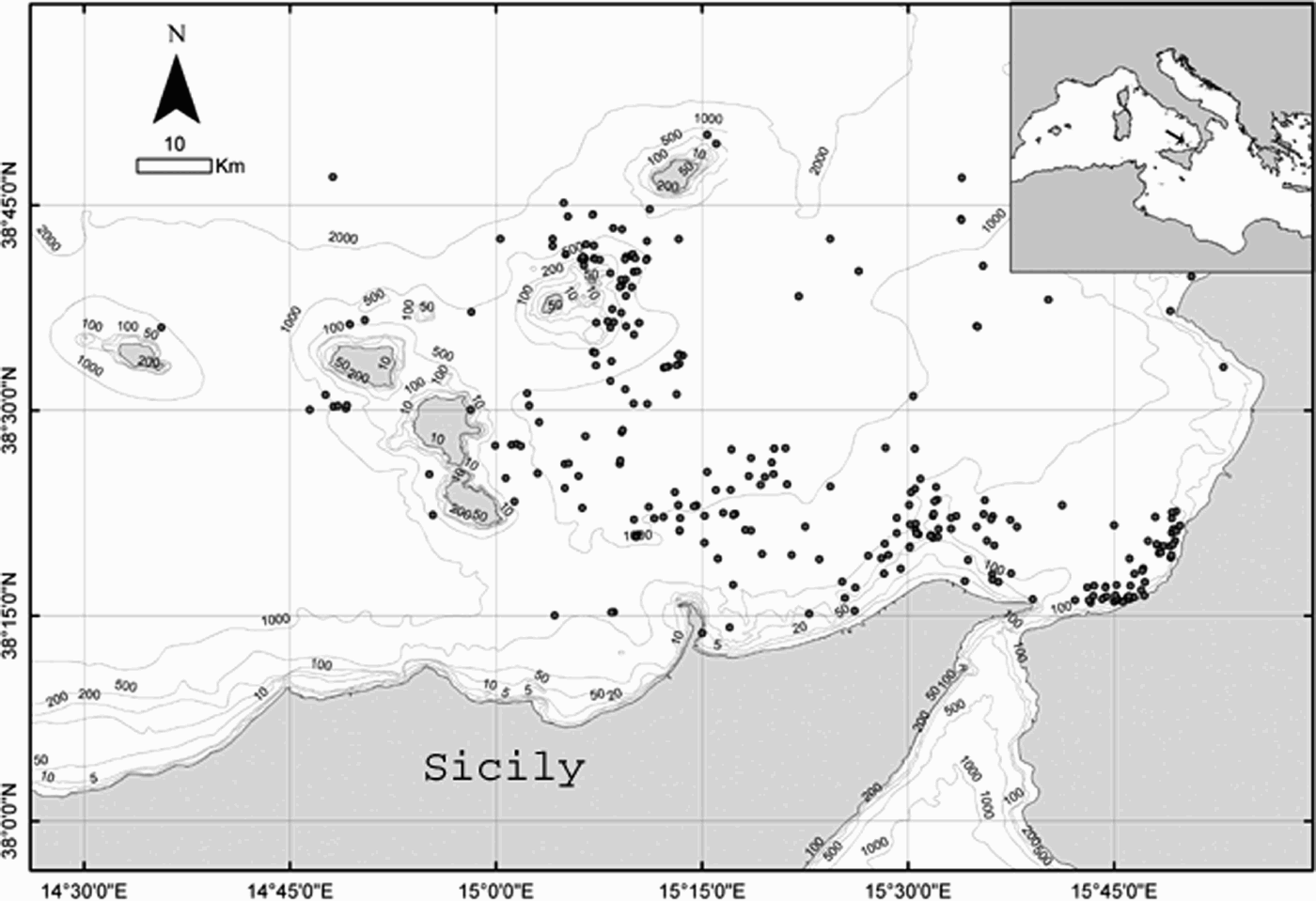
The study area, extending from the neritic area along the north-east coast of Sicily and western coasts of Calabria to the open southern Tyrrhenian Sea, encompasses the volcanic Aeolian archipelago and the Messina Strait (Figure 1). Data were collected, during the fishing seasons 2002–2005, between May and August.
Study area and swordfish encountered.

Observations were carried out on a daily basis from the same vessel during the commercial swordfish harpoon fishing, from a sighting platform (antenna) 25 m above the sea level, from where the boat is piloted and fish are sighted.
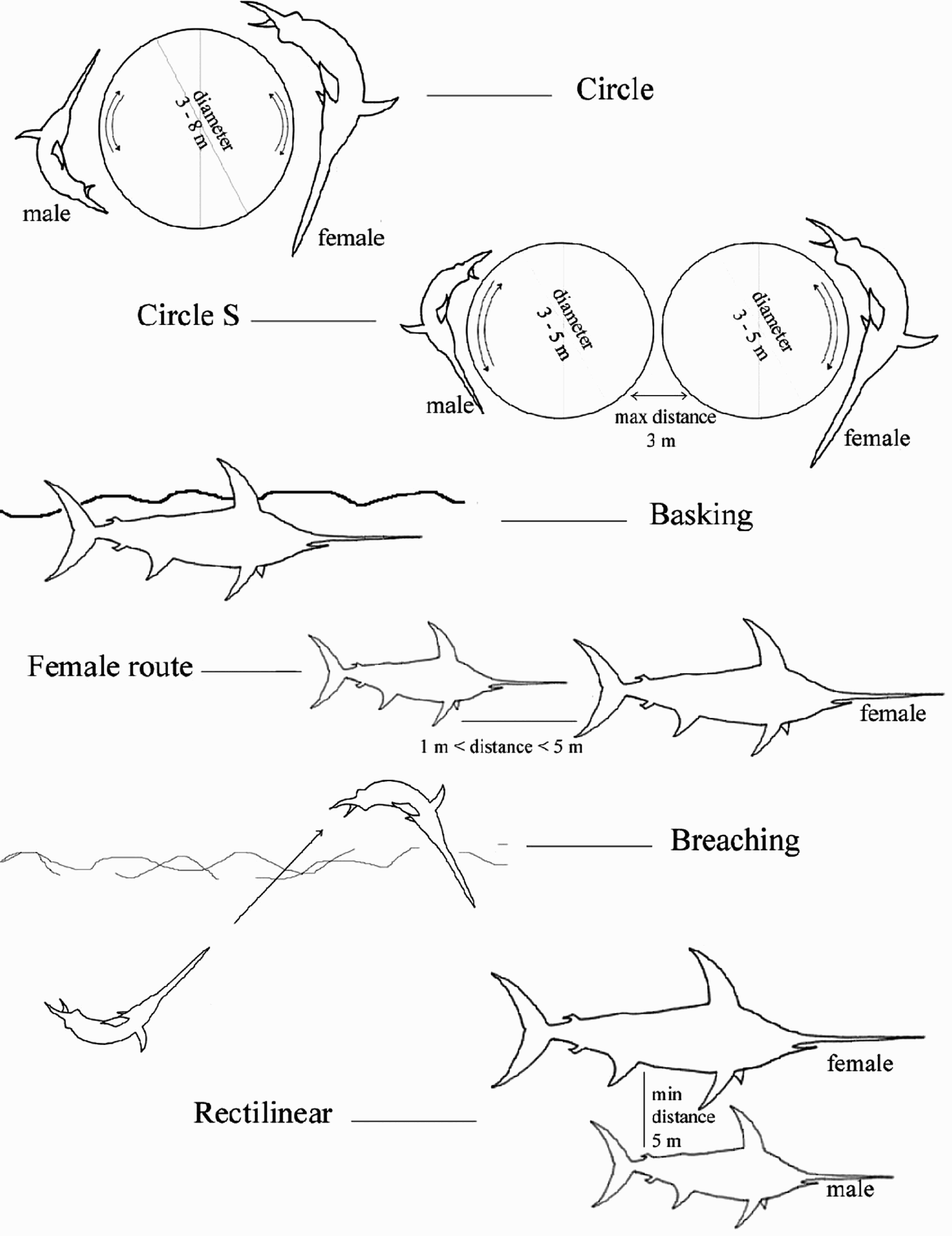
Each observation team was led by the same four observers (3 local fishermen, 1 scientist), during the daylight hours. Observers scanned their assigned area (90° of breadth), from the boat to the horizon. Fishing and sighting activities were maintained under conditions of <3 on the Beaufort scale, by following a course, established by fishermen on previous experience probably related to weather or marine or trophic conditions or maritime traffic. On the basis of behaviours identified by the fishing fleet, we classified a priori the behaviour of single males, single females and pairs of swordfish across seven categories (Figure 2):
1 ‘Circle’: a solitary fish or a pair swimming and turning out in a single full circle with a diameter of approximately 3–8 m, indifferently clockwise or anticlockwise. When fish swam in pairs they remained close to each other at a maximum distance of 5 m.
2 ‘Circle S’: a pair with a male and a female swimming as above but turning out in two distinct circles close to each other (maximum 3 m).
3 ‘Basking’: a solitary specimen swimming slowly showing the dorsal fin (2 cm) or dorsal and caudal fins on the surface and causing a light wake on the sea surface.
4 ‘Female route’: a pair with a female swimming in front of a male; swimming very close to each other (1 m <distance <5 m). Female went ahead setting the course and male followed at every flip.
5 ‘Male route’: a pair with a male swimming in front of a female and setting the course.
6 ‘Rectilinear’: a specimen or a pair swimming at the same depth always in the same direction; when the fish swam in pairs they stay joined at a distance over 5 m from each other and any one seemed to set the route.
7 ‘Breaching’: specimens alone or in pairs swimming at a depth of about 10 m, running up quickly and jumping up from the sea surface. Once arrived at the sea surface they could remain there for a little bit or quickly go back to deep waters.
Pattern of behaviour categories.

Behaviour, divided according to sexes, was also grouped into two groups ‘surface’ and ‘deep’. The first includes the behaviour of the fish (circle, circle S, basking, male route, female route) remaining close to surface waters in up to 3 m depth, for a long time (2 hours). The latter includes the fish staying under 3 m depth (3–10 m) with ‘rectilinear’ and ‘breaching’ behaviour.
Length parameters, including lower jaw fork length ((LJFL) from the tip of the lower jaw to caudal fork; cm) and total weight (kg) were measured for each fish. Length–frequency distributions (5 cm intervals) were divided according to sex (F = 280, LJFL cm 123–268; Wkg 20–215; M = 331, LJFL cm 110–215; Wkg 15–110).
Sex and maturity stages were determined, after the capture, on the basis of macroscopic appearance of the gonad according to Holden & Raitt's (Reference Holden and Raitt1974) scale. All gonads were carefully weighed to the nearest 0.1 g.
The gonadosomatic index was calculated according to the formulation used by Kume & Joseph (Reference Kume and Joseph1969): GSI = gonad weight (g)/LJFL3 (cm) × 104.
Data concerning behaviour of males, females, pairs and maturity stages were organized in contingency tables (where, at the intersection point of a row and a column, it is possible to find the number of individuals sharing the characteristic of that row and that column) and analysed by correspondence analysis (Benzecri & Benzecri, Reference Benzecri and Benzecri1976; Greenacre, Reference Greenacre1984). This is an exploratory technique, and the primary purpose is to produce a simplified (low dimensional) representation of the information in a large frequency table (or tables with similar measures of correspondence); therefore, there are no statistical significance tests customarily applied to the results of a correspondence analysis. For these reasons, associations between maturity stages and behavioural categories were tested by the Chi-square test applied to contingency tables. The same statistical test was used to detect monthly differences between ‘surface’ and ‘deep’ group both in males and females.
Analysis of variance was used to assess differences in average LJFL between males and females and differences in average GSI of females between months. Cochran's test was used to check the assumption of the homogeneity of variances and, whenever necessary, data were transformed to ln (x + 1). If transformation did not produce homogeneous variances ANOVA was used anyway after setting α = 0.01. This was done to compensate for the increased likelihood of type I error (Underwood, Reference Underwood1997). Statistical tests were performed using a software package (StatSoft 2000).
RESULTS
During the 2002–2005 cruises, a total of 404 swordfish was encountered: 73 single females, 124 single males and 207 pairs (male and female), overall 611 animals. Results of correspondence analysis and Chi-square test are reported below.
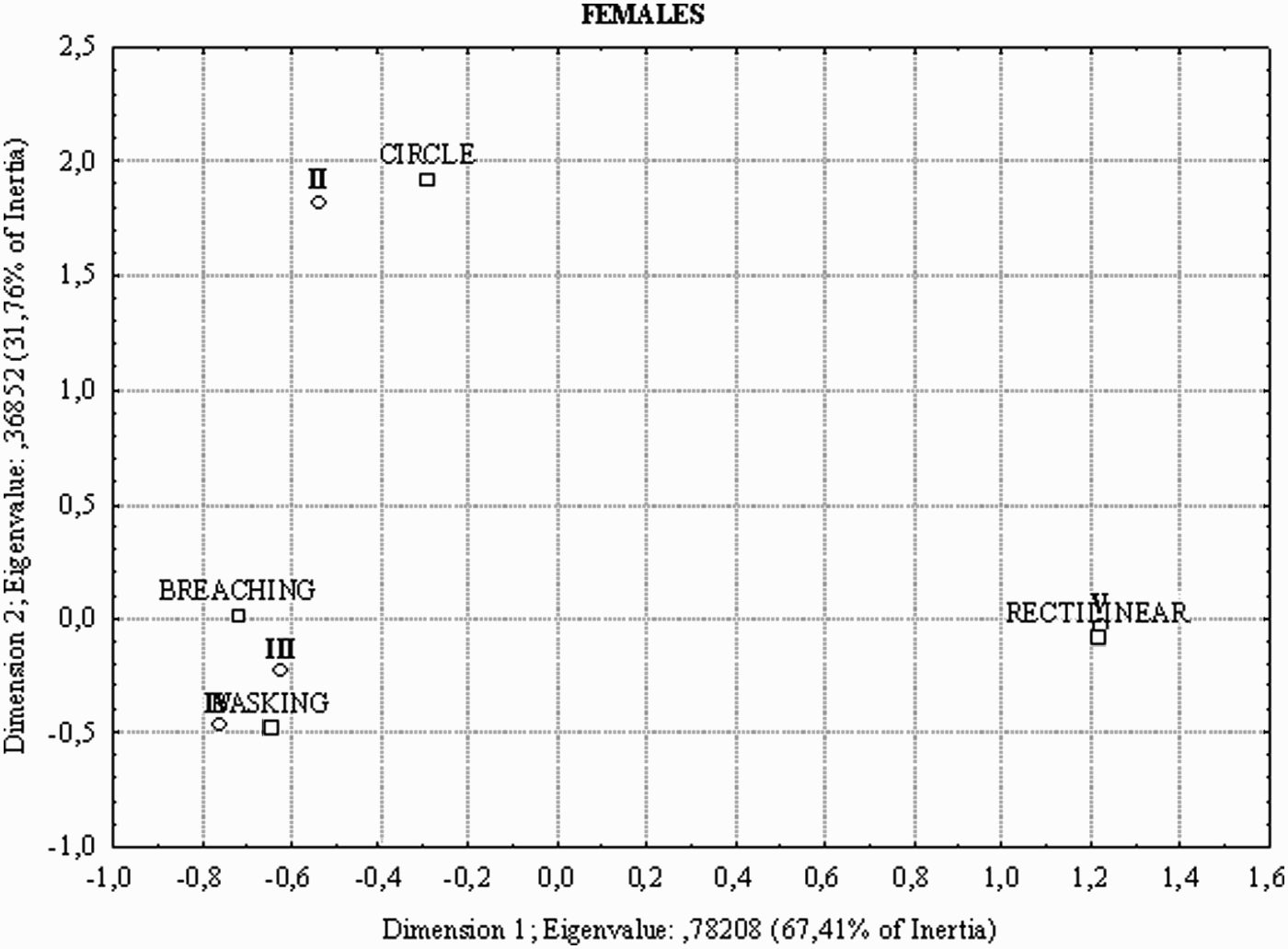
Females: initially, it seemed that by using a single dimension, 67.41% of the inertia can be explained, that is, the relative frequency values reconstructed from a single dimension can reproduce 67.41% of the total Chi-square (and, thus of the inertia) for this two-way table; two dimensions allow us to explain 99.17%. In this case, it is clear that the first two dimensions shall explain practically most of the total inertia for Figure 3. Chi-square test (χ2 = 84.70; df = 9; P < 0.001) detected a significant relationship between maturity stages and the behavioural categories. A high association between ‘rectilinear’ behaviour to the maturity Stage V (spent ovary), on the right was evidenced. Results also showed an association between ‘circle’ behaviour to the maturity Stage II on the upper left, and ‘basking’ and ‘breaching’ behaviour to Stages IV and III respectively on the lower left. At this stage ovaries were in a ripe and ripening state respectively.
Correspondence analysis ordination showing maturity stages and behaviour in female swordfish.

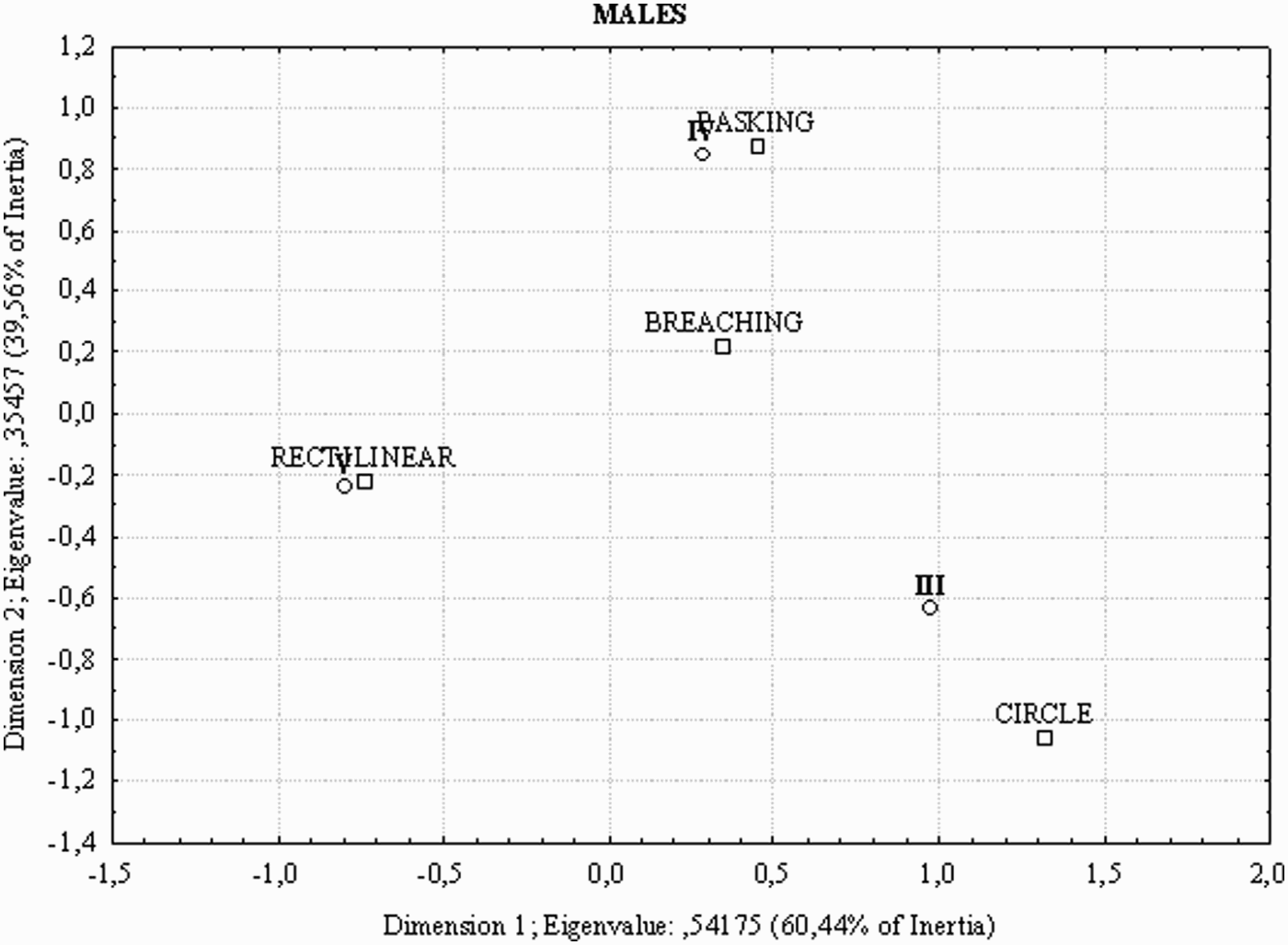
Males: the two dimensions explain 100% of the total inertia. ‘Basking’ stays close to Stage IV, with testis in ripe state (Figure 4). The column point ‘breaching’ is very near to the origin, in fact its relative inertia is very low. The first dimension is characterized by ‘rectilinear’ on the left, associated to the maturity Stage V and ‘basking’, ‘breaching’ and ‘circle’ on the right. The row point furthest to the right on this axis is Stage III, close to ‘circle’. In fact, both provide the highest contribution. Chi-square test (χ2 = 111.14; df = 6; P < 0.001) detected a significant relationship between the maturity stages and the behavioural categories.
Correspondence analysis ordination showing maturity stages and behaviour in male swordfish.

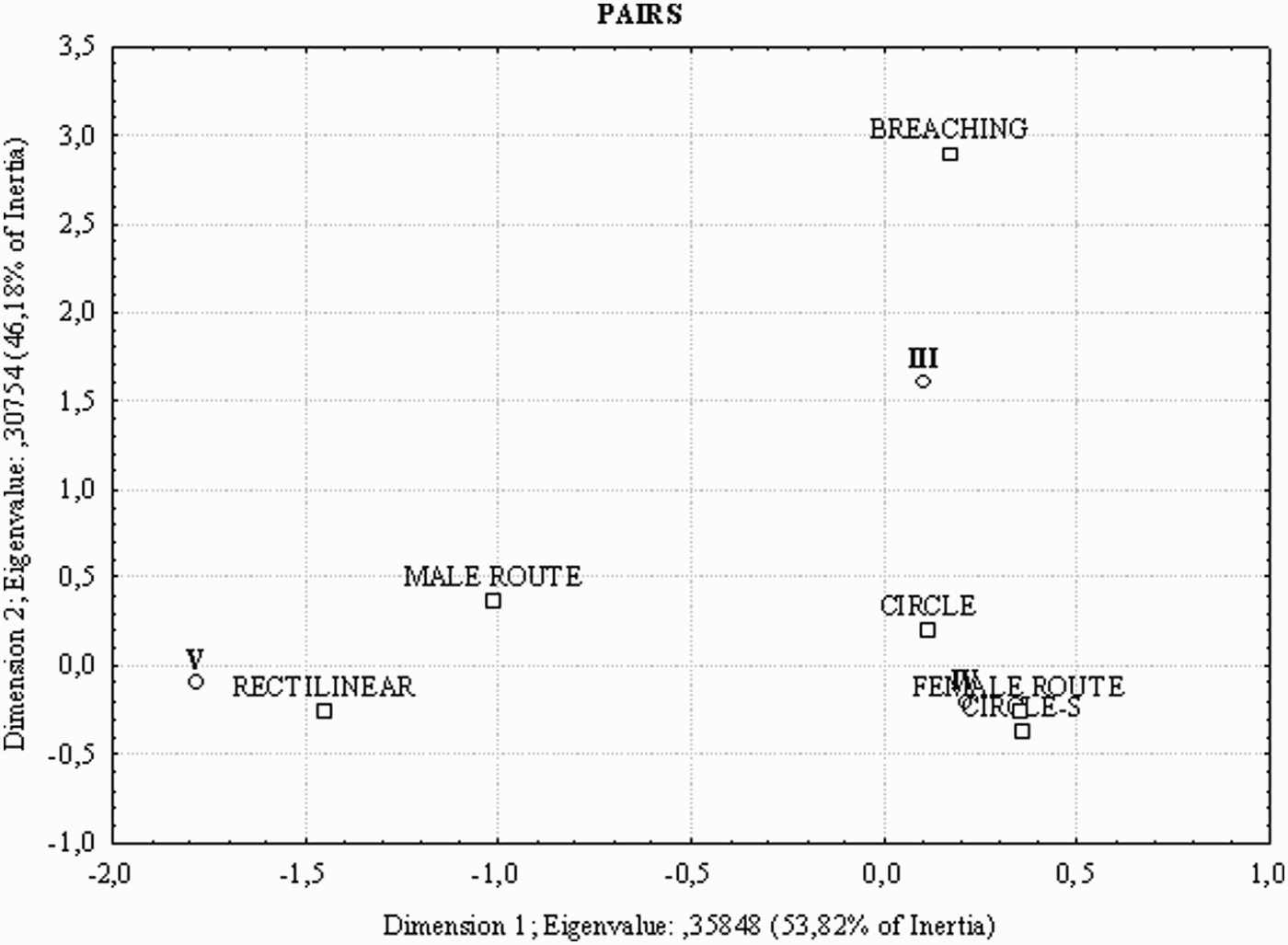
Pairs: once again, the two dimensions explained 100% of the total inertia. The behaviour categories ‘circle’, ‘female route’ and ‘circle-S’ are strictly associated with maturity Stage IV, with the highest relation ‘female route’ and Stage IV with ovary and testis at ripe state.
Stage V is related to the behaviour category defined as ‘rectilinear’ (Figure 5). Chi-square test (χ2 = 137.87; df = 10; P < 0.001) detected a significant relationship between maturity stages and behavioural categories.
Correspondence analysis ordination showing maturity stages and behaviour in pairs of swordfish.

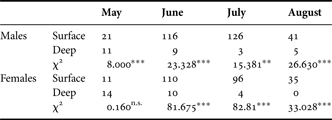
Observed values (Table 1) point out the high presence of a sample on the sea surface during June and July, for both sexes. Moreover, during all the months, the number of specimens on the ‘surface’ was significantly higher than ‘deep’ for both sexes; the only exception was represented by May, when a higher number of females in ‘deep’ was observed (N = 14), although this value was not significant (χ2 = 0.36; df = 1; P > 0.05).
Results of χ2-test examining monthly differences in males and females between the number of specimens near the sea surface and in deep water.

*, P < 0.05; **, P < 0.01; ***, P < 0.001; n.s., not significant (P > 0.05).
Size distributions of males (N = 331) ranged between 110 and 215 cm, with a mean fork length (LJFL cm) of 130, SD = 16.15; for females (N = 280) the value was included between 121 and 268 cm with a mean fork length (LJFL cm) of 164.44, SD = 20.79 cm. The size of females was significantly higher than that of males (t-test = 22.44, df = 600; P < 0.001).
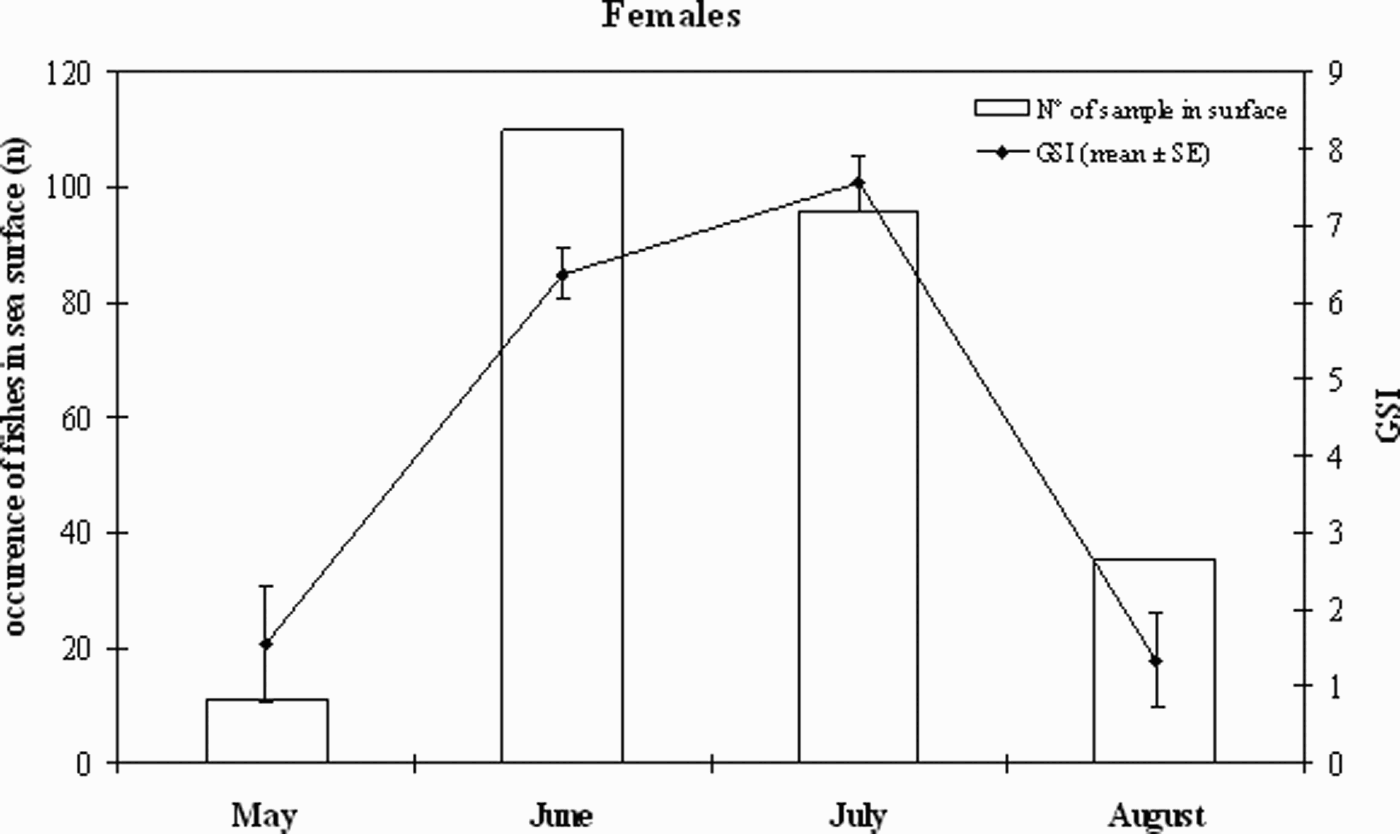
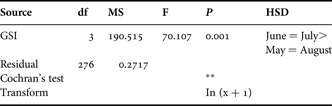
The monthly mean trend of the gonadosomatic index (GSI) and the number of females observed on the sea surface are indicated in Figure 6. The GSI showed a significant growing trend with higher peaks in June and July, (respectively 6.37±0.33 and 7.55±0.37), decreasing in August (1.34 ±0.62). In Table 2 results of the ANOVA are reported.
Monthly variation in the number of female swordfish near the surface and corresponding GSI in mean ±SE.

Summary of one-way ANOVA testing for differences in average GSI between months.

**, P < 0.01.
DISCUSSION
Swordfish showed different patterns of behaviour during the reproductive season and they were associated with the gonadal development. The high number of female swordfish, observed in the surface strata (‘surface’ category) during June and July, is in accordance with the gonadosomatic index values, which reached the highest values in the same period.
The increasing temperature of the surveyed area during the summer months (Spezie et al., Reference Spezie, Sansone, Budillon, Bianco, Alteris, Stefano, Gallarato, La Mura, Faranda and Povero1996) supports gonadal maturation, with a subsequent coming up of the pairs from the depth and presence of specimens close to the sea surface. Ovary maturity, egg production and larvae development are strictly related to water temperature (Arena, Reference Arena1981).
Even if there are no studies about the vertical distribution of swordfish, the observation coming from local fishermen practising other fishing techniques confirmed our results. In fact, swordfish long-line employed in the study area modify the configuration, by regulating the secondary lines’ length, which in summer is lower (5–6 m) than in winter (>15 m). This evolution was also observed from the entangling position of the fish captured by the illegal drift-net; the samples, between April and May, were caught in the set closer to the lead-line, while in June and July they were immediately under the float-line, and often specimens of different sex, probably in pairs, were captured close to one another (personal communication).
The ‘circle’ behaviour could be a particular courtship also observed in other pelagic fish such as Sarda chiliensis (Magnusson & Prescott, Reference Magnusson and Prescott1966). Male and female fish turned out in the same or in the opposite direction, with a circular synchronized swimming. This circle behaviour was also observed for solitary fish and could be associated with a breeding behaviour.
The behaviour ‘basking’ was observed only for solitary fish with mature gonads (females and males) and we do not know if the specimen was waiting for another fish to breed. Fishing typology does not allow lengthy fish observations close to the surface, because their specialized visual system allows the swordfish to see every object. Because of this it stops regular swimming and disappears from the observer's sight. In August (after the GSI values significantly decreased) fish, though remaining in pairs and near the surface, do not show the same fidelity so that the capture of a single fish was more frequent.
‘Rectilinear’ behaviour can be associated with this period (August), when fish showed maturity Stage V, represented by females with ovaries in a recovering stage and GSI near to 1.
Spawning site fidelity (Pujolar et al., Reference Pujolar, Roldan and Pla2002), at the end of the reproductive period can be left by adults that show in their ‘rectlinear’ trend the tendency to follow a defined route to migrate to more productive waters for trophic reasons.
Gonadosomatic index values, used to classify females’ reproductive activity (Hinton et al., Reference Hinton, Taylor and Murphy1997), are in line with the values reported by several authors (Kume & Joseph, Reference Kume and Joseph1969; Taylor & Murphy, Reference Taylor and Murphy1992; Arocha & Lee, Reference Arocha and Lee1995, Reference Arocha and Lee1996; Mejuto & Garcia, Reference Mejuto and Garcia1997; de Martini et al., Reference de Martini, Uchiyama and Williams2000; Orsi-Relini et al., Reference Orsi-Relini, Palandri and Garibaldi2003).
Even if the aspects related to the swordfish reproductive biology are very well known, information related to its reproductive strategy is unknown. Many large pelagic fish such us scomberoids and carangids exhibit schooling phase in their life cycle that may be of adaptative significance for reproduction, as a mechanism facilitates mate-finding. This study underlines that swordfish are not a schooling fish, it generally swims alone and during spawning it forms pairs showing a courtship behaviour. A similar behaviour was observed in the Pacific bonito Sarda chilensis (Magnusson & Prescott, Reference Magnusson and Prescott1966). Results of this study show a strong female dominance during the breeding and a male fidelity toward females. The highest number of sighted pairs is represented by the female swimming ahead of the male that follows every female route change with synchronized swimming.
This behaviour regulates the fishing operations as well. In fact, once the pairs are sighted, fishermen try to capture the female (generally larger). After harpooning it, they wait for it to come up near to the surface, using a secondary boat far away from the Passerella, as males keep on turning around females at the same depth until they surface. The males’ fidelity was also observed by swordfish attack to vessels or fish after the capture of females (Sisci, Reference Sisci1984).
Considering that the studied area is the main spawning area in the Mediterranean Sea for swordfish, our results should be properly taken into account and implemented with tagging studies in order to better understand the behaviour of this important commercial species.
ACKNOWLEDGEMENTS
The research was supported by the ICRAM Institute in the scope of the ecosystem-approached project EOLIDE. Thanks to Patrizia Perzia for the GIS map of the studied area. This work was possible thanks to the following people: Tino Billè, the boat captain, for allowing us to have access to the sighting platform and for the information about swordfish behaviour in the surveyed area. We also thank Nino, Nicola, Michele and Giuseppe Donato, Francesco Billè, Nino and Giacomo Mancuso and all the crew for their assistance with fish collections.