This chapter broadens the basis of the discussion in three respects. First, it will include examples which show how the history of the reception of ancient texts and ideas is intermingled with and to some extent shaped by the artistic forms and cultural politics of receiving traditions. This means that, in looking at examples of modern receptions, it is necessary to consider the routes along which the ancient text or idea itself has travelled and the way in which subsequent cultural assumptions filter representations. Secondly, I have deliberately chosen examples which engage with the claim that the ancient world provides models, in the sense either of examples of how human beings might behave or, more subtly, of ways in which Greek or Roman history or culture has been presented as a base from which subsequent generations might analyse and critique not just the ancient world but also their own. In this aspect of the discussion I shall challenge the notion, put forward by a number of critics (one example is Page duBois) that those looking to the ancient world as a source of insight, whether artistic, moral, or political, are necessarily conservatives.Footnote 1 Thirdly, examination of those aspects helps in the critique of easy generalizations about how it is possible to characterize Greek and Roman material and its reception, or about limitations in the range and potential of either. The focus here will be on Roman ideas and texts; the next chapter will concentrate on Greek examples.
The Roman actor
All the key issues that I summarized above came together in the summer 2002 production, by the Royal Shakespeare Company at Stratford-upon-Avon, of Philip Massinger's tragedy The Roman Actor. The performance was part of a season devoted to the revival, by an ensemble company of twenty-eight actors, of five little-known and seldom-staged sixteenth- and seventeenth-century plays.Footnote 2
In his introduction to the published play text, the season's artistic director, Gregory Doran, commented on the affinities between the public stages of the Rose and the Globe and that developed four hundred years later at the Swan Theatre:
The stages of the Rose and the Globe needed no scenery, that would be conjured by words, words spoken by the actor standing in the centre of a circle of ears. The Swan Theatre in Stratford reproduces just such a relationship between actor and audience: vital, immediate and dangerous.Footnote 3
In 1626 when the play was written, Philip Massinger was the chief playwright for the King's Men, his predecessors being Fletcher and Shakespeare. The company ran both the Globe Theatre in Southwark and the Blackfriars Theatre in the City. The play is one of several in the early seventeenth century that represent the history of Rome in the early Empire. Ben Jonson's tragedy Sejanus (1603) explored the machinations between the emperor Tiberius, his entourage, and those opposed to the Principate. Other plays dealt with more salacious themes: the anonymous Tragedy of Nero (?1624), Thomas May's Julia Agrippina (1628), and Nathaniel Richards’ Messalina (?1635). The plays had in common the use of Tacitus as a source, and especially his treatment of the use and abuse of power and the role of the emperor. In his introduction to the play text, Martin Butler pointed out that Machiavelli's Il principe (The Prince, 1513) was at that time not yet translated into English and that (counter-temporal) mediation of the intrigues of statecraft via Tacitus’ analysis of the early Empire led to an interest in Rome which provided an outlet for contemporary fears and concerns.Footnote 4 Indeed, the rhetoric associated with the coronation of James I and VI had likened the king to a new Augustus who would both bring peace and secure lost empires.
James's successor, Charles I, was addicted to court entertainments which featured classical scenes in which he could dance the role of a Roman emperor entering the city in triumph. The attraction for him of this theme is proved by his purchase in 1628 of Andrea Mantegna's Triumphs of Caesar (eight huge paintings which are now part of the Hampton Court art collection).Footnote 5 It would perhaps be attributing to Massinger an excessive (and courageous) satirical zeal if one were to claim that his depiction in Act 1, Scene 4 of The Roman Actor of Domitian entering Rome in triumph (‘as we now touch the height of human glory, riding in triumph to the Capitol’) actually alludes to Charles I's dancing fantasia. Some in the audience might have made the connection, although few could have foreseen the eventual culmination to the analogy when Charles, like Domitian, was killed because of his abuse of power. More important is the way in which the content and structure of the play examines the cultural and moral role of theatre and thus, in conjunction with the exploration of the emperor's exercise of power, comments on issues which resonated with the contemporary situation.
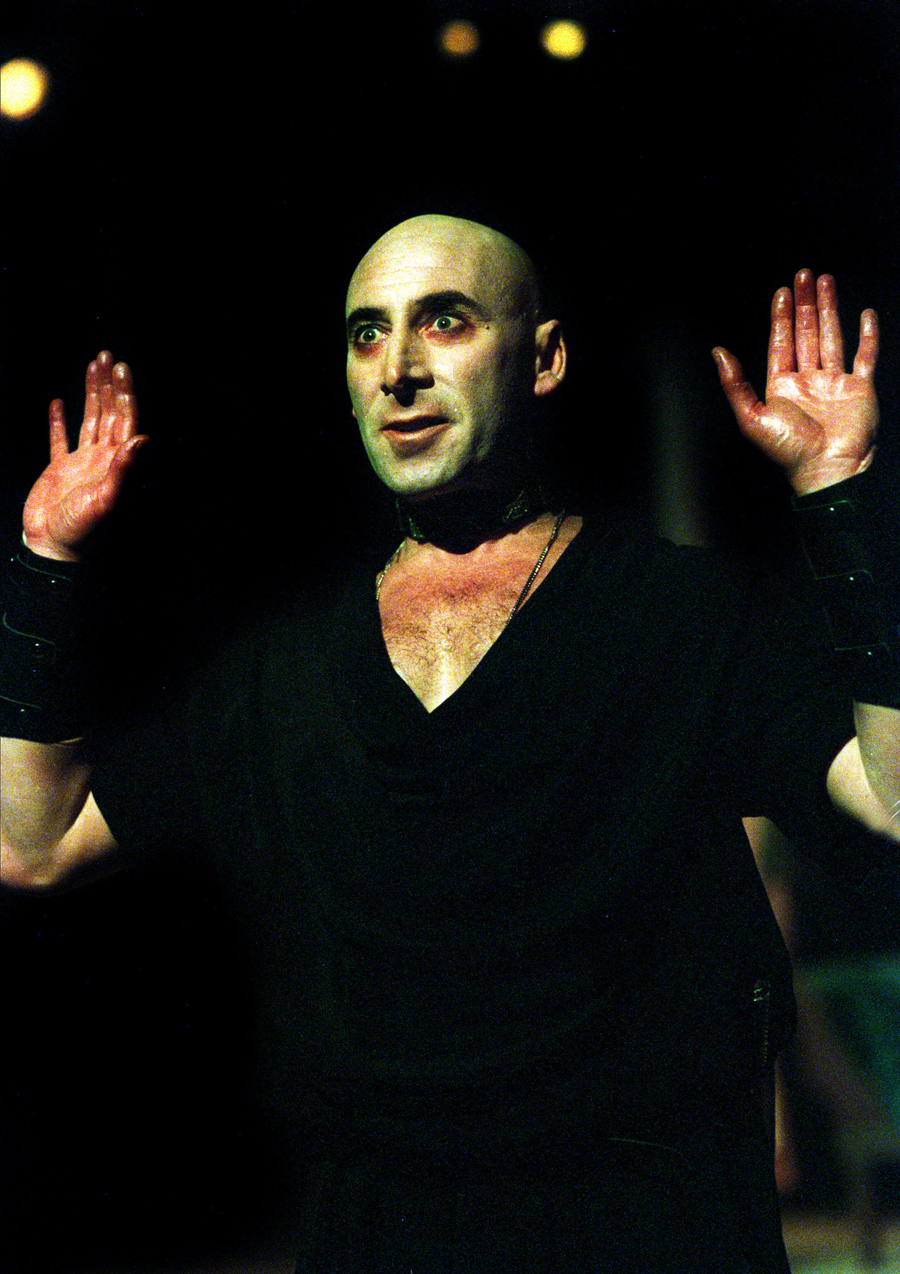
The modern revival gave similar opportunities to the company and the audience. In the 2002 Swan Theatre production, directed by Sean Holmes, Antony Sher played the part of Domitian. His appearance was described by one reviewer as ‘a shaven-headed biker/bouncer type’ (Figure 3).Footnote 6 However, a better analogy in both appearance and behaviour would be with Mussolini. In addition to the theatricality of fascism, its bureaucracy was captured in Domitian's compulsive recording of murders in a black notebook.
The stage set was minimalist: just three pillars, of which the central one allowed Domitian to tower in almost divine triumph over the obsequious Senate. In a situation where this ‘parliament’ (like that of Massinger's time) hardly met, senators who dissented were cruelly done to death. Junius Rusticus and Palphurius Sura were representatives of the ‘old Romans’, whose adherence to the values of the ruling class of the Roman Republic was mingled with inclinations towards Stoicism and opposition to the excesses of the new imperial order from Tiberius onwards but especially in relation to Nero and to Domitian. Those emperors appear to have regarded Stoicism as an ideology of opposition. Massinger's play specifically alludes to the case of Thrasea Paetus, who was accused of giving public expression to criticisms of the emperor Nero by refusing to participate in public affairs, and who was eventually forced to commit suicide.Footnote 7 In The Roman Actor, as Rusticus is being violently tortured and tormented on stage by Domitian he retorts:
Antony Sher as Domitian in The Roman Actor, by Philip Massinger, directed by Gregory Doran, Royal Shakespeare Company, 2002.

However, another major theme of Massinger's play subverts the notion that an easy opposition between Republican virtue and Imperial excess is being portrayed in order to provide an example to all. The relationship of theatre to critique is undermined through the experiences of Paris, represented by Massinger as a tragedian.Footnote 8 At the beginning of the play there is a debate about the ethical value of drama, which Paris cites in his defence against a charge of treason. According to this argument, spectators at a play are inspired to emulate virtue and reform vice. Referring to the moral stance of philosophers, Paris claims:
The tragedy was revived in 1690–2 and again in the eighteenth century. In the nineteenth century, Paris’ oration was sometimes performed on its own, an expression perhaps of the Romantic view that great art transforms. However, in Massinger's play his claims are found wanting. Paris performs at court and his first play, a satire on greed, fails to persuade the spectators to recognize themselves, let alone reform. The second play inspires Domitian's mistress to fall in love with Paris. In the third, he is killed by Domitian, who takes the role of avenger, a performative allusion to the belief that some Roman emperors killed condemned criminals on stage (or in the arena). So, as Butler puts it, ‘this device allows him [Massinger] to put a question mark over the drama's immunity to the excess that characterises Domitian's Rome’.Footnote 9 Put more strongly, the power of theatre itself could be said to be corrupting and, in a moral sense, illusory (as critics from Plato to the Puritans alleged).
Massinger's reworking of Tacitean perspectives on the power intrigues of the early Roman Empire in the context of the cultural and political debates surrounding the Stuart dynasty, and the modern revival, with its allusion not only to fascism but to the broader association of tyranny with theatricality, are subtle in separating the notion of ‘playing’ from political and moral didacticism. Yet there does remain in the play the implication that the qualities associated with the Roman Republic were recognized as morally virtuous and those associated with the imperial regimes were identified as abusive and corrupt. Nevertheless, further examples indicate that such simplistic associations are open to question.
Spartacus: constructing and appropriating a legend
The representation of the figure of Spartacus in modern film and fiction provides a map not just of cultural politics in relation to particular art forms but also of a wider contest for control of iconic figures from the past, either to provide reference points or to assume exemplary status in modern ideological struggles. Underlying the representations of Spartacus there are also differences in viewpoint between historians of the ancient world and those cultural historians who focus on reception. This is not merely a question of disagreement about the degree of significance of Spartacus as a historical figure in the context of the Roman slave wars (important though that is), or even about the relationship between individuals and broader trends in history, but more subtly about the relationship between the ancient evidence for the life of one man and the ways in which it has subsequently been refigured, both artistically and politically. In that sense the Spartacus debate is emblematic of many of the problems which are involved in reception studies.
In his book The Ragman's Son. An Autobiography, the Hollywood film actor and producer Kirk Douglas included a chapter ‘The Wars of Spartacus’, in which he wrote: ‘Spartacus was a real man, but if you look him up in the history books, you find only a short paragraph about him. I was intrigued with the story of Spartacus the slave, dreaming of the death of slavery.’Footnote 10 The last part of the quotation was used at the beginning of the 1980 film Spartacus. As Brent D. Shaw points out in his discussion of the passage, Douglas was anachronistically running together the ancient dream of escape from slavery with the modern aspiration of perpetual abolition.Footnote 11
The slave uprising led by Spartacus in 73 bce was in fact the third and last of a series of rebellions against Roman enslavement which took place between the middle 130s and the late 70s bce. The first two had developed on the island of Sicily, which had been the first province of the embryonic Roman Empire.Footnote 12 Each of the first two slave rebellions was led by inspirational commanders. The third slave war was distinguished by the fact that it was waged in the south of Italy and not overseas. Spartacus was not the initial leader but emerged as the major figure. He was a Thracian and is thought to have been captured and sent to Italy to be sold as a slave. A significant feature of the form of slavery associated with Rome was that slaves were imported in large numbers by the conquering power and used to support and transform agriculture and other aspects of the economy.Footnote 13 Furthermore, in southern Italy and Sicily agricultural requirements meant that slaves were used as pastores (herdsmen). They had to be able to move around with the herds and thus were not housed in barracks, as were the agricultural labourers on the lands producing crops (latifundia). In addition, the pastores had to be armed in order to protect the herds and flocks. So the pastores in Sicily and southern Italy were potentially a threat to the Roman system.
In the case of the third slave war, however, the leaders were not herdsmen but gladiatores, who had been trained to kill for entertainment. An inscription in Oscan on a wall fresco from Pompeii gives the name ‘Spartacus’ to a mounted gladiator; since the date is probably 100–70 bce, identification with the leading participant in the slave revolt has been suggested. The historian Appian, writing two centuries after the events, records that
Spartacus, a Thracian whom the Romans had imprisoned and then sold to be trained as a gladiator, had once fought as a soldier of the Roman army…persuaded about seventy of the enslaved men to risk a break for freedom…many fugitive slaves and even some free men from the surrounding countryside came to this place to join Spartacus…Since Spartacus divided the profits of his raiding into equal shares, he soon attracted a very large number of followers. (App. B Civ. 1.14.116–21)
There is also important evidence, nearer in time and citing Spartacus by name, in Sallust's Histories Books 3 and 4, although much of it is fragmentary. And there are mentions in Livy and Plutarch.
Appian attributes the success of Spartacus to good organization and management of resources. Only after three years did a Roman army under Crassus (who was vying with Pompey for victory against the rebels) gain victory, in what Appian describes as ‘a protracted battle of epic proportions’. Spartacus was killed and the rest of his army either died in battle or were crucified by Crassus along the Appian Way. The number implies a crucified slave every 35–40 yards from Capua to Rome, a distance of 125 miles.Footnote 14 The devotion of this amount of attention to a slave is unusual in ancient sources and some historians have suggested that, even at this stage, the image of Spartacus was attracting its own ‘mythology’ and that two different traditions were emerging: that of Spartacus as of servile status and crucified by Roman power, and that of Spartacus as a brave and skilled leader.
Modern appropriations of Spartacus have mostly followed the latter image but sometimes with variations that suggest the corrupting effects of power, even when nobly won. An iconic representation of Spartacus is in the 1960 film starring Kirk Douglas and directed by Stanley Kubrick. In this film Laurence Olivier played Crassus, and it also featured star actors such as Charles Laughton, Peter Ustinov, Tony Curtis, and Jean Simmons (who supplied the love interest as Spartacus’ wife, Varinia, whose name is, unsurprisingly, not attested from antiquity). The film was rather loosely based on the best-selling novel Spartacus by Howard Fast.Footnote 15 Fast was thought to have been ‘inspired’ to write the book by his opposition to the McCarthyist movement in the United States in the late 1940s and 1950s. Joseph McCarthy, a senator, led a movement to suppress any group, individual or artwork, which was thought to be left wing. He operated through the Un-American Activities Committee of the US Senate.Footnote 16 As a result, Fast, who had been imprisoned for alleged communist sympathies, was blacklisted by publishers and had to self-publish the novel. In this sense the 1960 film became a way of refighting the battles against McCarthyism (since its controls over the film industry had by that time eased).
There is a long history underlying Fast's decision to pursue his fight for justice by using the image of Spartacus. From the 1760s the figure of Spartacus had been employed by historians and philosophers, especially in contexts discussing the validity of armed resistance to oppression. In his Dictionnaire philosophique, Voltaire described the slave war led by Spartacus as being ‘of all wars…the most just, and perhaps the only just’.Footnote 17 This perhaps reflected the impact of anti-tyrannical literature such as Bernard Saurin's Spartacus. A Tragedy in Five Acts, performed at the Théâtre Français in 1760, as well as the academic studies by Charles de Brasses (presented as part of a history of the Roman Republic to the Academy of Inscriptions in Paris in May 1768) and Jean Levesque de Burigny (who published a work on the condition of Roman slaves in 1766–7). Perhaps the interest of French writers was stimulated by the incidence of slave rebellions in the overseas territories of European colonial powers (for example, the rebellion led by Boukman and Toussaint L'Ouverture in Haiti). Certainly at this time interest in Spartacus was not antiquarian but reflected contemporary commitment to freedom and liberty.Footnote 18
A century after Voltaire, Karl Marx identified Spartacus as one of his heroes, having read about him in Appian.Footnote 19 Marx's informed analysis was in its turn refigured in the twentieth century by Stalinists who likened the Roman slave rebellions to the French and Russian revolutions. Left wingers in Germany protested against the First World War and the economic situation in pamphlets bearing the signature ‘Spartakus’. The movement led by Karl Liebknecht and Rosa Luxemburg was called the ‘Spartakusbund’; after their assassination in 1919, the image of Spartacus attained iconic status. However, disillusionment with Stalinist totalitarianism also led to revisionist reassessments of the Spartacus image. In his novel The Gladiators Arthur Koestler transformed the myth into a study of a revolutionary movement which lost its noble ideals and descended into cruelty and tyranny – a Roman equivalent perhaps to George Orwell's Animal Farm (1954), in which liberation and subsequent descent into oppression are presented through the struggles of animals.Footnote 20
Reception of the Spartacus image in Italy took a somewhat different direction from that in Germany. Marx had compared Spartacus with the events of the Civil War in the United States and also with the achievements of Garibaldi, the decisive military figure in the movement for Italian freedom and unification in the nineteenth century. Following the example of the French revolutionaries, classicizing imagery had been incorporated into the oratory, decrees, coinage, and ceremonies developed by the Italian radicals, and in 1874 Raffaello Giovagnoli (who had fought alongside Garibaldi) published a historical novel, Spartaco. The novel included substantial documentation from the ancient sources, while adding a fictional encounter between Julius Caesar and Spartacus to represent the opposition between tyranny and freedom. As well as supporting the nationalist agenda, the rhetoric of the novel was anti-clerical in tone.
Giovagnoli's approach resonated with the climate of Italian cinematic production in the early twentieth century.Footnote 21 Film production was seen as a means of enhancing Italian prestige and identity, as economically beneficial, and as a way of inspiring the patriotism of mass audiences. The film Quo Vadis? (1913) was an enormous success and stimulated demand.Footnote 22 A film based on Spartaco, directed by Giovanni Enrico Vidali, also appeared in 1913, after Giovagnoli had been involved in the publication of a pamphlet in 1907 celebrating the centenary of Garibaldi's birth and associating him with the qualities of Spartacus. Vidali's film altered the tragic ending of the novel to present Spartacus as triumphant and able to unite Italy. This aligned the film with the history of the movement for unification and thus obviated the risk that Spartacus’ resistance to Crassus’ cruelty might be thought to attack the current Italian regime. Another film on the subject, again called Spartaco, was released in 1952, directed by Riccardo Freda, following the serialization of Giovagnoli's novel in the weekly magazine of the Italian Communist Party.Footnote 23
The cinematic history of refiguration of the Spartacus story illustrates very clearly the way in which successive appropriations held a balance between celebration and critique of contemporary political movements and regimes. This is particularly evident in the 1960 Kubrick/Douglas version. In her study of the making of the film, Wyke points out that the technology (Super Technirama, Technicolour) not only permitted epic battle scenes and elaborate costumes but also employed a large number of actors.Footnote 24 Spartacus was proclaimed the most expensive film yet made in Hollywood under union conditions of employment, and union leaders cooperated in exhorting their members to see it. Within the film itself, the scenes in the mines and gladiatorial school portray brutal working conditions which exploit human beings for the wealth and entertainment of the ruling class. The values implicit in the contrast are paralleled by the distinction between the two armies. The rebels are idealized, displaying the qualities of sharing and solidarity (when threatened with death they do not betray their leader but all proclaim ‘I'm Spartacus’), while the Romans operate like robots, obedient to the hierarchy of wealthy political leaders. Speech rhythms and accent also carried implications for class and national identities and their associated values – for example, the American intonation of Douglas and Curtis contrasted with the ‘theatrical English’ speech by Olivier as the oppressor Crassus.
There was some acknowledgement in the film of the emphasis in Fast's novel on civil rights, especially in the fictional figure of Draba, the African gladiator who pays with his life for his refusal to kill Spartacus in the arena and thus enables revolt. Kirk Douglas’ autobiography (1988) extends this application by revealing how, as the son of a Russian Jewish refugee, he identified with oppressed slaves because of his race. This is perhaps reflected in the fact that in the film, although not in the novel, Spartacus is portrayed as the leader of a return of slaves back to their homelands, rather than as the destroyer of the power of the state.Footnote 25 At the same time, the film was made open to Christian and conservative interpretation. At the end the crucified Spartacus was shown with his newborn son and the child's mother, lit as for a biblical scene, while the subsequent voiceover announced that the pagan tyranny of Rome was eventually replaced by a new and Christian society. In parallel, the heroism of Spartacus was interpreted in Cold War rhetoric as a stand against Soviet-style autocracy.Footnote 26
As a case study in approaches to reception, the image of Spartacus demonstrates how figures and issues that were marginalized in their own time can later be given new kinds of prominence, both within antiquity and subsequently, in sympathy with cultural, political, and (especially in the case of film) technological shifts. The case also shows that unquestioning association of the values of the Roman Republic with asceticism and ‘freedom’, on the one hand, and of those of the Empire with luxury and oppression, on the other, is deeply flawed: the Republican concept of libertas referred only to the status and independence of the senatorial class. Above all, this case study shows that comparison of a range of receptions with the original sources, and with the contexts and their target audiences and readers, is always fruitful in identifying and explaining shifts in reception.
The appropriation of Rome by Fascist and Nazi ideology
The case study of Spartacus indicated that political regimes and cultural movements of different kinds may compete to demonstrate ‘ownership’ of the same virtues and to deprecate vices. The attitude of Mussolini and Hitler to the Roman Empire shows that appropriation may also radically transpose what is understood by virtue and vice.
In 1922, as his Fascist militia prepared to march on Rome, Mussolini made a speech in which he claimed: ‘Rome is our starting point – and our point of reference…We dream of a Roman Italy, that is to say wise and strong, disciplined and imperial…the fasces are Roman, Roman our organisation of combatants, Roman our pride and our courage. Civis Romanus sum.’Footnote 27 This rhetoric of appropriation had three main implications. The first was an emphasis on different aspects of Roman achievement at different stages of Mussolini's career. The second was the use of visual culture and theatre to communicate Roman models in the present. The third was the development of a Fascist rhetoric of romanità, the term used by Mussolini and his associates with the aim of appropriating the Roman concept of romanitas into the genealogy of Fascism.
Historians have identified three main stages in the development of Mussolini's regime, and in connection with each there were adaptations in the exploitation of the association with ancient Rome. From the establishment of Mussolini's power base in 1922 until the proclamation of the dictatorship in 1925, ancient Rome was appropriated as a model for current political and military organization and as a symbol of Italian unity. The image of Rome took a new direction during the invasion of Abyssinia and the declaration of an Italian empire in 1936. In the third phase, in the late 1930s, a climate of increasing racism was created and the Romans and the Latin language were used to define the supposed physical, spiritual, and cultural superiority of the modern Italians. The whole process was underpinned by a programme of archaeological excavations, exhibitions, and exploitation of revisionist classical scholarship, although, as Wyke points out in her discussion of this phenomenon, wider dissemination was through public visual and theatrical experience rather than through academic means.Footnote 28 As Eric Hobsbawm observed, the exercise of power became a public drama.Footnote 29 Visual imagery included use of the inscription ‘SPQR’, the fasces, eagles, Romulus and Remus, she-wolves, battle standards, legionaries, the marching step, an triumphal arches and columns. After the war in Ethiopia the emphasis became increasingly militaristic, with Roman domination of the Mediterranean, Aegean, and North Africa used as justification for Mussolini's aims for imperial expansion, which were described as actions to recover land historically belonging to Italy.Footnote 30
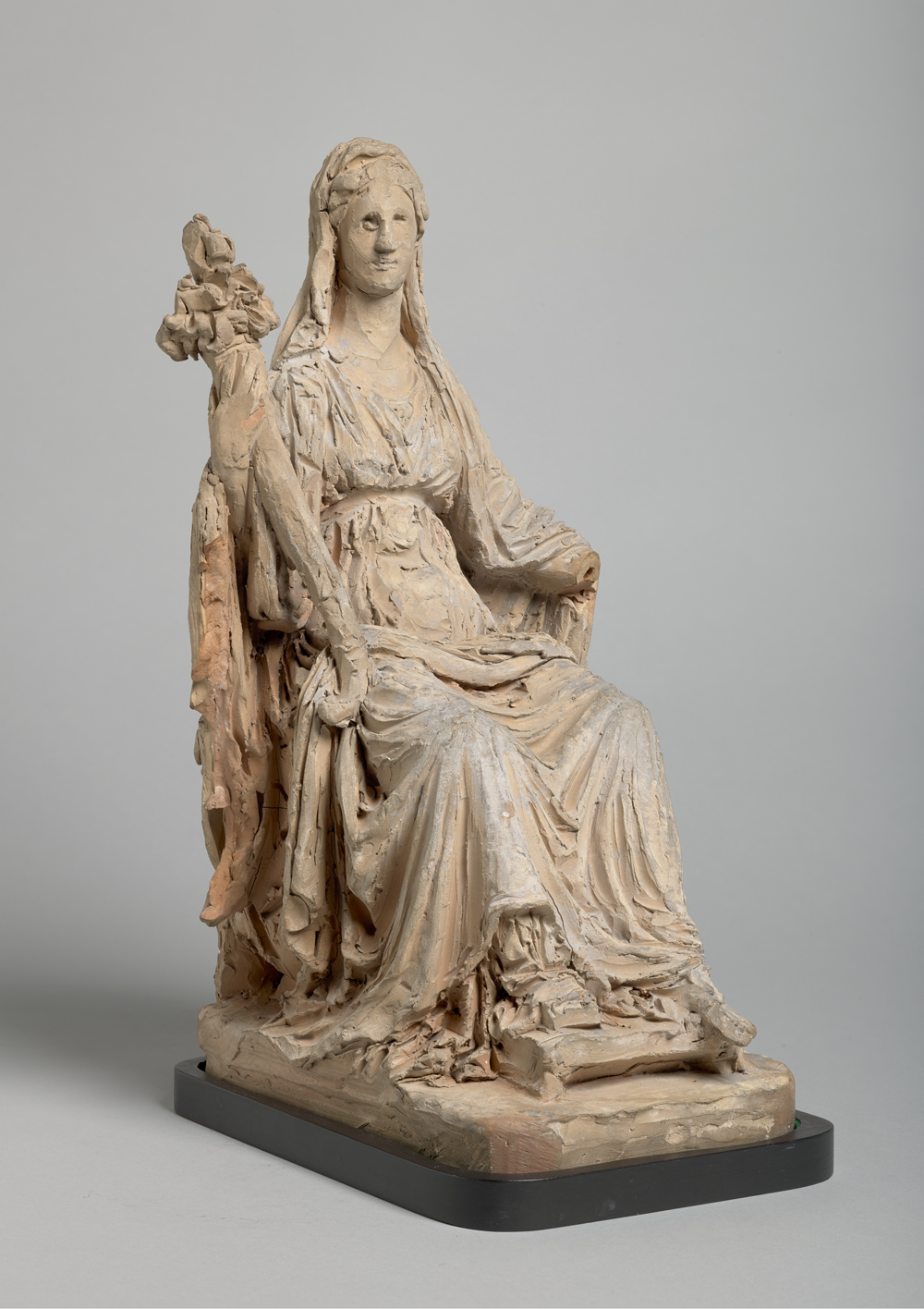
Antonio Canova (1757–1822), Maria Luisa Hapsburg, depicted as Concordia, terracotta. Maria Luisa was the wife of Napoleon Buonaparte, Canova's patron. Concordia was one of the concepts used in the public art and literature of the Roman Empire to sanction imperial rule. The companion piece depicts Pax.

The policy was pursued through many exhibitions, the largest of which was the 1937 celebration of the two thousandth anniversary of the birth of Augustus, the Mostra augustea della romanità. The effect of the exhibition was to present Mussolini's Fascist empire as a modern equivalent to that of Augustus, who was depicted as empire-builder, peacemaker, and warrior and who was paired with Mussolini in the statues at the entrance. The exhibition marked a shift away from Mussolini's earlier emphasis on Julius Caesar, to whom he had erected bronze statues in Rome and in Rimini (from where Caesar had launched his march on Rome after crossing the Rubicon).Footnote 31 An even larger exhibition, the Esposizione universale di Roma, was planned for 1942 to commemorate the twentieth year of the Fascist regime and the fifth year of empire. It was to include temporary exhibitions and permanent monuments such as the Palace of Italian Civilization, a square Colosseum with 216 arches. However, construction was suspended in 1941 because of the Second World War, leaving a marble skeleton which was to be subsequently transformed into offices.Footnote 32
During the 1930s Italian fascism became more closely allied with Nazi Germany, and radical adjustments to the concept of romanità introduced a strong racial component, especially after the war in Ethiopia. Africans and other political opponents were depicted as barbarian or sub-human. In 1938 anti-Semitic racial laws were passed, and the propaganda attacked Jews as barbarians who presented a threat to the neo-Roman Empire. This racialization of romanità was furthered by the film Scipione l'Africano (1937), directed by Carmine Gallforie. The film depicted the Carthaginians as uncivilized in behaviour and Black and Semitic in appearance, and represented the wars between Rome and Carthage as a conflict between authoritarian unity and anarchy. The film was awarded the top prize, the Duce cup, at the 1937 Venice Biennale Film festival but was widely held to be an artistic failure.
Initially, Mussolini's rhetoric of romanità seems to have found some favour in the United States. On 21 November 1934, Hearst Movietone News included footage entitled ‘All Rome Hails City's Rebirth’, with military music and a commentary on the ceremony at which 25,000 Fascist athletes saluted ‘their miracle man Mussolini. They celebrate the rejuvenation of ancient Rome, dug from its ruins, under the direction of Italy's modern Caesar.’Footnote 33 However, the invasion of Ethiopia began to change opinion and allowed the publication of a scathing attack on Mussolini, who was mocked as a ‘Sawdust Caesar’ in a book by the journalist George Seldes.Footnote 34 A production of Shakespeare's Julius Caesar on 11 November 1937 (at the Mercury Theatre, New York), directed by Orson Welles, drew on the association of Julius Caesar with tyranny and presented the play in modern dress, with Joseph Holland as Caesar surrounded by bodyguards, and Welles as Brutus played as a liberal politician in a suit. Press reviews commented on Holland's resemblance to Mussolini in gesture and appearance, and at the start Caesar appeared in Fascist uniform.Footnote 35 Eventually, the coup which deposed Mussolini was presented by Italians as the equivalent of the Ides of March. Hearst Movietone News took up Seldes’ image of the ‘Sawdust Caesar’ in the changed circumstances of 27 July 1943, in which Mussolini was portrayed as a clown. The final irony was delayed until 1945, when Mussolini was killed on 28 April and an undated cartoon was belatedly published which depicted him as Caesar with a clown's nose (designed by T. H. Heine for the Monaco magazine Simplicissimus).
Mussolini's refiguration of romanità had marginalized its Christian elements in order to exploit the iconography and architecture associated with Roman power. Reactions to the Mussolini/Caesar alignment included ridicule as well as focus on the counter-text provided by the historical figure of the tyrannicide Brutus. The selectivity of classical appropriations practised by the Nazi regime in Germany took on some rather different aspects and emphasized racism even more strongly. However, Rome was not the only aspect of the ancient world that attracted Hitler. His sense of the importance of buildings as symbolic statements of power led him to admire the architecture of ancient Greece, and he was said (by his architect and arms factory minister Albert Speer) to have compared himself with Pericles, presumably drawing on the association between buildings, display of power, and lasting reputation which was attributed to Pericles by Thucydides in the Funeral Speech, but neglecting Thucydides’ stress on the Athenians’ inconvenient insistence on Pericles’ accountability to the Assembly.Footnote 36
However, the example of Sparta was more important to Hitler's regime than that of Athens because he thought that it offered a paradigm of the rule by a minority of pure racial descent and high eugenic quality, since its social customs and structure ensured the survival only of the fittest. In April 1945 Hitler Jugend formations, including many fourteen-year-old boys called up for active service and about to be sent on their bicycles to attack Soviet tanks, were lectured by the Nazi youth leader Arthur Axman on the heroism of Sparta.Footnote 37 In the same month Luftwaffe suicide missions were undertaken by the ‘Leonidas squadron’, an allusion to Spartan heroism at Thermopylae in 480 bce against the invading Persians. The appropriation of Sparta in the curriculum and practices of elite schools in nineteenth-century Prussia and in the Third Reich is covered in detail in Helen Roche's publications of her extensive research in the area.Footnote 38
Nevertheless, there was a major shift away from the traditional German emphasis on an idealized Hellenism. Hitler thought that it was the history of Rome which offered the fullest models for the exercise of power and the development of policy. This affiliation has been documented from drafts of his early speeches.Footnote 39 He was impressed with Roman achievements in road building and military discipline and, presumably ignorant of the sources relating to the Romans’ practices concerning cultural exchange and assimilation and religious syncretism, saw the empire as creating a monolithic civilization solely by the exercise of force. Hitler's volume Table Talk suggests that he considered that it was Christianity which brought about the fall of the Roman Empire by ensuring the breakdown of status and citizenship divisions in a kind of pre-Bolshevik solidarity movement.Footnote 40 He also associated the historical fall with the ‘mobilization of the slave masses by the Jews’, which he included in his conspiracy theory to account for the fall of Rome. He clung to history of the Roman ‘example’ right up to the end. His scorched-earth policy was named after Nero, and in March 1945, in an initiative that would seem comic if it were not for the context, he ordered Goebbels, who was in charge of propaganda, to arrange for detailed discussions of the Punic Wars to appear once more in the newspapers. The previous year, in the face of military disaster, the Second Punic War had already been cited as an example of struggle against the ‘Semitic trading people of Carthage’.Footnote 41 The phrase merged Jews and Carthaginians in the service of racist ideology and formed a parallel with the associations made in Scipione l'Africano. Roman experiences in the Punic Wars were seen as a consolatory indication that defeat might eventually be followed by victory.
Nazification of ancient Rome encountered some difficulties not germane to the situation in Fascist Italy, which for geographical and long-standing cultural reasons could look to Rome for foundation myths and continuity of tradition. Indeed, in 1934 Mussolini had expressed a sense of cultural superiority over Germany, which, he said, represented a people which had lacked even literacy at a time when Rome had Caesar, Virgil, and Augustus. This view found some currency in Germany in the 1930s in an influential article, ‘Die Antiker und wir’, by the schoolteacher Walter Eberhardt. This was published in the National Socialist Monthly in 1935 and criticized the Roman claim to world domination from a Germanic point of view: ‘we think of the expeditions of Drusus and Tiberius and the punitive expedition of Germanicus and feel the wall which separates us from Roman cultural ideas’. Eberhardt was shortly afterwards appointed to a chair of classics, so presumably his opinions could be seen as a stimulus towards aemulatio of both ancient Germans and Romans and were not at that time contrary to those of the ruling cadre. His article provoked others, which competed in attempts to demonstrate the importance of classical languages, ancient history, and archaeology for the Third Reich. A volume by the ancient historian Wilhelm Weber contributed to the debate by idealizing the princeps as a kind of Nietzschean superman. According to Weber, the Principate offered a system which not only could demonstrate the will to power but also tried to base itself on the purity of the past.Footnote 42
In terms of race theory, ancient historians outside Germany showed interest in race mixture in the Roman Empire, and some research has rehabilitated the reputations of ancient historians in Germany, especially those exiled to the United States and Britain. Some academics, particularly Hellenists who were less involved in the Nazi stress on Römerwerte (the value of Rome) made a principled decision to leave Germany.Footnote 43 The whole question of the cooperation or complicity of classicists and ancient historians in the appropriation of ancient history and iconography by totalitarian (or indeed other) political regimes is a salutary warning to any who are tempted to selectively emphasize relationships between ancient and modern in the hope of preserving interest in classical subjects, or who allow reception studies to become disengaged from critical enquiry into the relationship between the analogue ancient and modern texts or images.
From the cases discussed in this chapter it is clear that every example of reception has its own history. Furthermore, appropriation of referents or the use of ancient models as exempla may take place in radical and revolutionary, as well as conservative, contexts. In addition, the ways in which Republican and Imperial Rome are characterized vary according to the context of appropriation and the battles for cultural ‘ownership’ as a form of validation for the present. Even the same stereotype may be exploited in different ways in different contexts. The Roman Actor provokes spectators to question whether art actually makes any difference to moral insights or social action. The range of appropriations of Rome in architecture, film, and educational and social policy in the twentieth century shows that the reception of classical material has been integrated as part of both propaganda for and critique about public matters, including debates about national, social, and political identities. Reception of classical material is a constituent part of this field of contest.