Introduction
The world's population is ageing rapidly (United Nations, 2015). This demographic shift can be attributed to the increasing number of people living well into their later years, primarily due to the outstanding medical and health advances we have witnessed since the turn of the century. Despite these progressions, the older adult population still experiences many challenges, including greater incidence of chronic illness (Wolff et al., Reference Wolff, Starfield and Anderson2002), increased potential of developing cognitive disorders (Jorm and Jolley, Reference Jorm and Jolley1998) and increased likelihood of spousal bereavement. This double-edged sword of increased longevity, but greater adversity, suggests that psychological resilience may be a particularly important factor for individuals later in life.
Resilience, broadly defined as a dynamic process resulting in positive adaptation within the context of adversity (Luthar et al., Reference Luthar, Cicchetti and Becker2000), is becoming increasingly important in the study of ageing (Harris, Reference Harris2008; Wild et al., Reference Wild, Wiles and Allen2013). While there is no consistently agreed upon definition of resilience among researchers (e.g. Fletcher and Sarkar, Reference Fletcher and Sarkar2013; Southwick et al., Reference Southwick, Bonanno, Masten, Panter-Brick and Yehuda2014), it is increasingly being viewed as a process that begins with adversity, consists of a number of defining attributes and results in positive adaptation (e.g. Gillespie et al., Reference Gillespie, Chaboyer and Wallis2007; Windle, Reference Windle2011; Niitsu et al., Reference Niitsu, Houfek, Barron, Stoltenberg, Kupzyk and Rice2017).
Although there is now general consensus that resilience is a dynamic process (e.g. Stainton et al., Reference Stainton, Chisholm, Kaiser, Rosen, Upthegrove, Ruhrmann and Wood2019), in the past, researchers have been divided on which components of this process should constitute the primary feature of resilience. Some choose to operationalise resilience as positive adaptation, or the outcome component of the resilience process (e.g. Bonanno, Reference Bonanno2004), while others focus on the defining attributes or protective factors that lead to successful adaptation (e.g. Rutter, Reference Rutter1985; Hjemdal et al., Reference Hjemdal, Friborg, Stiles, Rosenvinge and Martinussen2006). However, an important feature of the resilience process is that the defining attributes or protective factors are not static and can manifest differently across varying domains and contexts and across the lifespan (e.g. Luthar et al., Reference Luthar, Cicchetti and Becker2000; Ungar, Reference Ungar2008). For instance, within the context of a lifecourse approach, Windle (Reference Windle2011) identified individual resources, life experiences and environmental factors as the defining attributes of resilience, which may be experienced differently across the lifespan. Given the dynamic nature of protective factors across time and circumstances, the present study examines which protective factors have been implicated as important for individuals in later life.
The psychological concept of resilience originated in the developmental literature examining how children who faced adversity still managed to thrive (Masten and Garmezy, Reference Masten, Garmezy, Lahey and Kazdin1985; Rutter, Reference Rutter1985); however, given the many challenges associated with ageing, it is also important to understand resilience later in the lifespan. There are currently several models of resilience in the literature with most developed or intended for use with children or young adults (Windle et al., Reference Windle, Bennett and Noyes2011). This study aims to amalgamate qualitative resilience research conducted with older adults to develop a model of resilience protective factors that is relevant and appropriate for older adulthood.
Existing adult resilience models
A number of resilience models resulting in various scales have been developed to describe resilience or resiliency in adults (Prince-Embury et al., Reference Prince-Embury, Saklofske, Vesely, Boyle, Saklofske and Matthews2015), although the majority were not specifically developed for an older adult population (i.e. over the age of 60). One frequently used five-factor model that comprises the Connor–Davidson Resilience Scale (Connor and Davidson, Reference Connor and Davidson2003) was developed to describe stress and coping ability in adult clinical samples. This model consists of the following factors: (a) Personal Competence, Tenacity and High Standards; (b) Tolerance of Negative Emotions, Strengthening Effects of Stress and Trusting One's Instincts; (c) Secure Relationships and Positive Acceptance of Change; (d) Control; and (e) Spiritual Influences. However, previous research examining the use of this model and measure in older adult samples have revealed inconsistencies in the number of factors that are produced in an older sample. While one study indicated the factors were consistent across the lifespan (Liu et al., Reference Liu, Fairweather-Schmidt, Burns and Roberts2015), other studies have found inconsistent factor structures (Lamond et al., Reference Lamond, Depp, Allison, Langer, Reichstadt, Moore, Golshan, Ganiats and Jeste2008; Goins et al., Reference Goins, Gregg and Fiske2013), suggesting that resilience may manifest differently at different ages (Cosco et al., Reference Cosco, Kaushal, Richards, Kuh and Stafford2016).
Another commonly used resilience model reflected in the Resilience Scale (Wagnild and Young, Reference Wagnild and Young1993) was originally developed through qualitative interviews with older women (mean age = 78.1 years) and consists of five themes including: (a) Equanimity; (b) Perseverance; (c) Self-reliance; (d) Meaningfulness; and (e) Existential Aloneness. Despite being the most relevant model of resilience for an older population (Resnick and Inguito, Reference Resnick and Inguito2011; Cosco et al., Reference Cosco, Kaushal, Richards, Kuh and Stafford2016), this model focuses primarily on dispositional resilience and lacks other key external factors of resilience, such as social support.
A less commonly used model is one that comprises the Resilience Scale for Adults (Friborg et al., Reference Friborg, Hjemdal, Rosenvinge and Martinussen2003, Reference Friborg, Barlaug, Martinussen, Rosenvinge and Hjemdal2005) and was developed primarily with younger adults aged 20–50. This five-factor model consists of: (a) Personal Competence; (b) Social Competence; (c) Personal Structure; (d) Family Cohesion; and (e) Social Support. However, to date, this model has yet to be validated with an older adult sample.
Lastly, two models of resilience initially developed with children and adolescents have recently been adapted to be applicable to adults. The Three-factor Model of Personal Resiliency (Prince-Embury, Reference Prince-Embury2006, Reference Prince-Embury, Prince-Embury and Saklofske2014) is theoretically rooted in systems that are fundamental to development and identifies three factors that are consistently indicated as important aspects of personal resiliency. These three factors are: (a) Sense of Mastery (protective factor); (b) Sense of Relatedness (protective factor); and (c) Emotional Reactivity (vulnerability factor) (Prince-Embury et al., Reference Prince-Embury, Saklofske and Nordstokke2017). However, preliminary research examining the Three-factor Model of Personal Resiliency (Prince-Embury et al., Reference Prince-Embury, Saklofske and Nordstokke2017) in an older adult sample suggests that while the factor structure is similar, there is considerable overlap between the protective factors, suggesting that resiliency may reflect differently in older adults (Wilson, Reference Wilson2016). Additionally, the resilience model described by Liebenberg et al. (Reference Liebenberg, Ungar and Vijver2012) which consists of (a) Individual, (b) Relational and (c) Contextual factors was initially developed with children and youth but has recently been adapted to assess resilience in an adult sample (Liebenberg and Moore, Reference Liebenberg and Moore2018). While very preliminary findings indicate it is a potentially suitable model for use with adults (Liebenberg and Moore, Reference Liebenberg and Moore2018), it is limited by its theoretical underpinnings in the child and youth literature.
Given the lack of resilience models specific to later life, the majority of resilience research in older adulthood has been conducted using these aforementioned models that were developed for children or middle-aged adults (Windle et al., Reference Windle, Bennett and Noyes2011). However, this is problematic because different processes may underlie resilience across the lifespan. For instance, Gooding et al. (Reference Gooding, Hurst, Johnson and Tarrier2011) found that older adults with poor physical and mental health reported high resilience, whereas younger adults with poor physical and mental health did not. Further, validations of resilience scales in older populations have revealed differences in the factor structure between the older and the younger samples within which the scales were initially validated (Lamond et al., Reference Lamond, Depp, Allison, Langer, Reichstadt, Moore, Golshan, Ganiats and Jeste2008; Girtler et al., Reference Girtler, Casari, Brugnolo, Cutolo, Dessi, Guasco, Olmi and De Carli2010; Resnick and Inguito, Reference Resnick and Inguito2011; von Eisenhart Rothe et al., Reference von Eisenhart Rothe, Zenger, Lacruz, Emeny, Baumert, Haefner and Ladwig2013). These differences in the factor structures and findings across age groups suggest that resilience factors may present differently across the lifespan, thus supporting the need for age-specific models of resilience.
Resilience from older adults’ perspectives
More recent research is exploring what it means to be resilient from older adults’ perspectives. A number of qualitative studies have examined what it means to be resilient in a variety of samples and contexts. Studies frequently report on samples of community-dwelling older adults (Wagnild and Young, Reference Wagnild and Young1990; Felten, Reference Felten2000; Lou and Ng, Reference Lou and Ng2012; Wiles et al., Reference Wiles, Wild, Kerse and Allen2012; Kwong et al., Reference Kwong, Du and Xu2015); however, a number of diverse samples have also been examined including older gay men and lesbians (Hrostowski, Reference Hrostowski and Li2013; Higgins et al., Reference Higgins, Sharek and Glacken2016), older adults living with HIV/AIDS (Emlet et al., Reference Emlet, Tozay and Raveis2010), hospice patients (Nakashima and Canda, Reference Nakashima and Canda2005), older cancer patients (Pentz, Reference Pentz2005), incarcerated older men (de Guzman et al., Reference de Guzman, Imperial, Javier and Kawasaki2017), and older hurricane survivors (Hrostowski and Rehner, Reference Hrostowski and Rehner2012; Thomas, Reference Thomas2012).
Although previous studies have independently examined resilience from the perspective of older adults, only one study to date has attempted to integrate these findings into a cohesive collection of themes. A qualitative meta-synthesis (QMS) of 12 studies by Bolton et al. (Reference Bolton, Praetorius and Smith-Osborne2016) revealed nine overarching protective factors; these protective factors included: (a) Altruism; (b) External Connections; (c) Grit; (d) Independence; (e) Meaningfulness; (f) Positive Perspective on Life; (g) Previous Experience with Hardship; (h) Self-Acceptance; and (i) Self-care. The meta-synthesis provided valuable initial research for understanding protective factors among older adults; however, the number of qualitative studies examining resilience in an older adult sample has increased substantially in recent years. The present study aims to expand on this earlier meta-synthesis by including the substantial number of contemporary studies that have emerged. Further, the current study aims to expand on previous research by developing a theoretical model of resilience protective factors that extends beyond the descriptive findings in the literature and can be applied specifically to an older adult population.
Study objectives and rationale
Given researchers’ increasing interest in resilience among older adults over the last several decades, there is sufficient qualitative research from older adults’ perspectives to develop a formal model of resilience in older adulthood using QMS (Glaser and Strauss, Reference Glaser and Strauss1967). This method increases the likelihood that the theory being developed is relevant to and appropriate for the population of interest and complements the recommendation by Bowling and Dieppe (Reference Bowling and Dieppe2005) that in order for resilience research to have implications for policy and for older people themselves, it needs to be conceptualised in a way that is meaningful to and for older adults. Therefore, the objectives of this study are twofold. First, this study aims to expand on previous research by reviewing and synthesising the qualitative findings of resilience protective factors from older adults’ perspectives. Second, this study aims to use the QMS findings to develop a model that may provide researchers and practitioners with a general over-arching theory of resilience protective factors in older adulthood.
Method
QMS is a valuable method of secondary data collection that involves collecting, summarising and interpreting qualitative data from a number of studies examining a particular phenomenon (Jensen and Allen, Reference Jensen and Allen1996). The main goal of QMS is to inform theory-building and development (Schreiber et al., Reference Schreiber, Crooks, Stern and Morse1997). QMS is a useful method of theory development, as it draws from multiple studies that have identified themes grounded in data from similar samples of individuals. By combining and interpreting qualitative data from several studies, common themes that exist across studies emerge, resulting in enhanced validity and generalisability of these concepts (Estabrooks et al., Reference Estabrooks, Field and Morse1994).
Synthesis methodology
This QMS utilised a Grounded Formal Theory (GFT) approach to synthesise the findings (Kearney, Reference Kearney1998). The GFT approach was developed specifically for the synthesis of qualitative data by interpreting previously developed substantive grounded theories. By comparing existing context-specific theoretical models, GFT aims to develop a more general, overarching theory for a human phenomenon that is applicable across varying contexts. This is accomplished using the same methods of the original Grounded Theory approach which include theoretical sampling, constant comparison, and developing codes and categories from the data instead of having predetermined hypotheses (Glaser and Strauss, Reference Glaser and Strauss1967; Charmaz, Reference Charmaz and Emerson1983; Strauss and Corbin, Reference Strauss and Corbin1994).
Data sources
Data collection began with broad theoretical sampling of qualitative studies concentrating on resilience among older adults. To ensure the data sources would be wide-ranging enough to capture emerging theory, sampling was not limited to predetermined groups (Kearney, Reference Kearney1998). The following keywords were searched: resilience, resilient, resiliency, older adults, older adulthood, elderly, elder, seniors, qualitative, mixed-methods, interview, focus groups, perspectives. Computer-aided searches were conducted with the following data-sets: PsycINFO, PubMed, SCOPUS, CINAHL, and ProQuest Dissertations and Theses. The references of relevant articles were also reviewed to ensure all relevant literature was included. This search strategy was developed in conjunction with a Research and Instructional librarian.
Inclusion/exclusion criteria
The inclusion criteria consisted of: (a) studies utilising qualitative data collection approaches (including mixed methods); (b) samples defined as, or synonymous with ‘older adults’ (e.g. seniors, elders, elderly, aged); (c) studies written and published in the English language; (d) study methodology that included examining participants’ perceptions of resilience; and (e) studies published prior to April 2019. Studies were excluded if they did not focus on psychological resilience, and if the sample included younger or middle-aged adults. In an attempt to include studies with wide-ranging age groups and to ensure theoretical sampling was achieved, no specific age range was applied, however, studies must have operationally defined their sample as ‘older adults’. Additionally, given that the study of resilience in an older adult population has only relatively recently become a popular area of research, it was anticipated that the total number of studies would not be so large that a limit on the year of publication would be required. Therefore, no limit was applied to year of publication to ensure all relevant studies were examined. Studies that focused solely on resilience-adjacent terms (e.g. successful ageing, wellbeing, healthy ageing) were not included.
Data analysis
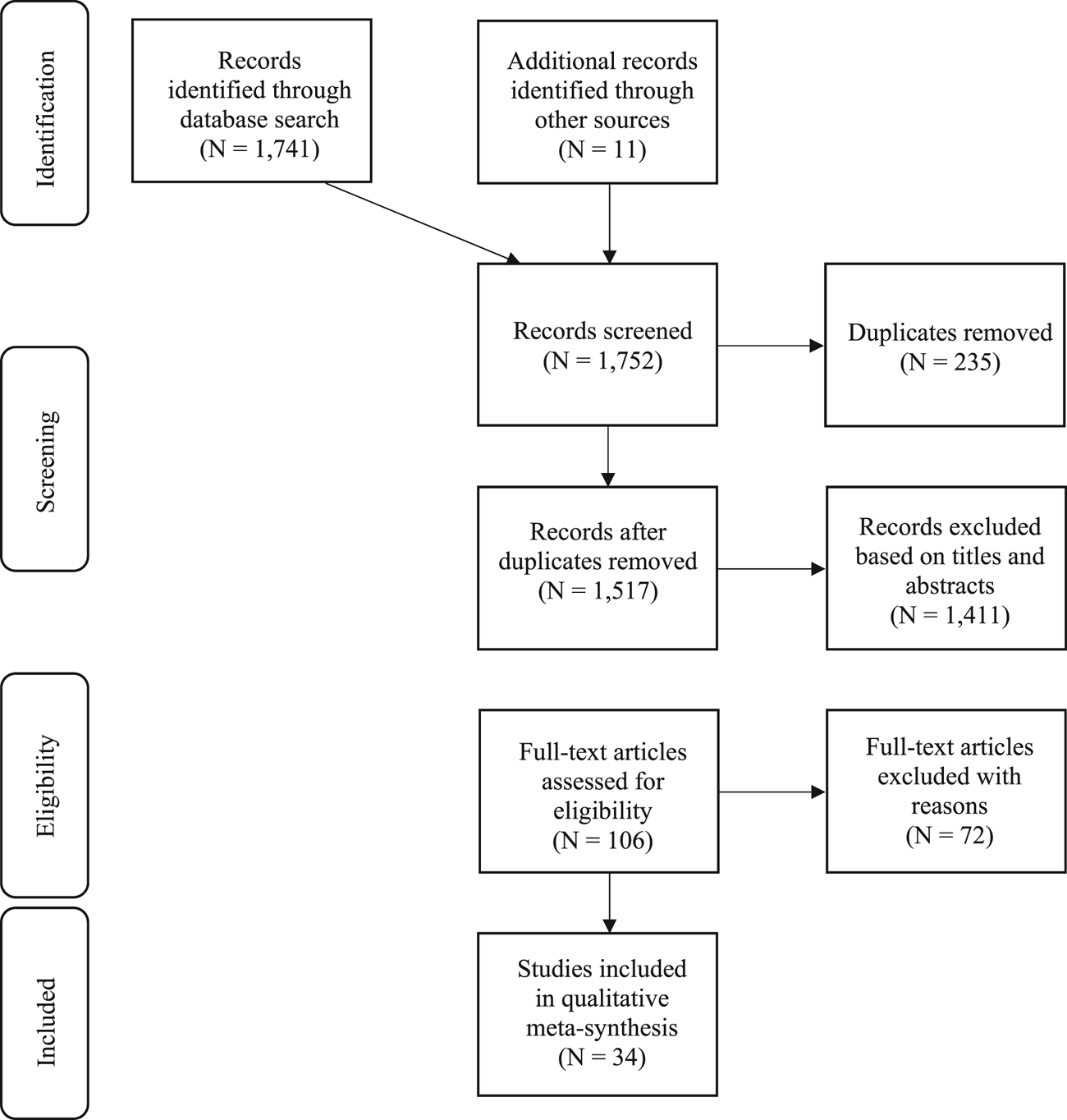
Studies were screened by two independent reviewers. Study title and abstract were screened first, followed by full-text review. Any discrepancies between reviewers were discussed in depth until consensus was reached. As recommended by the Enhancing Transparency in Reporting the Synthesis of Qualitative Research (ENTREQ) guidelines for conducting and reporting the findings of QMS (Tong et al., Reference Tong, Flemming, McInnes, Oliver and Craig2012), a flowchart guided by the Preferred Reporting Items for Systematic Reviews and Meta-Analyses (PRISMA; Moher et al., Reference Moher, Liberati, Tetzlaff and Altman2009) is provided (see Figure 1). A total of 34 articles meeting the inclusion and exclusion criteria were deemed suitable for analysis. The methodological quality of each study was independently assessed by two reviewers. Studies were evaluated using the Critical Appraisal Skills Programme (CASP, 2018) qualitative checklist. The CASP is a widely used method of evaluating the quality of qualitative studies (Hannes and Macaitis, Reference Hannes and Macaitis2012). Each of the 34 studies met the criteria outlined in the CASP and therefore were deemed to be of suitable quality.
PRISMA flowchart for identifying, screening and assessing eligibility of studies.

All of the content in the Results section of each article was extracted and compiled in a single Microsoft Word document. The qualitative data extracted from the studies were analysed independently by two reviewers using Grounded Theory techniques described by Glaser (Reference Glaser1978) and Strauss (Reference Strauss1987). An initial data source was selected (i.e. the oldest article) and line-by-line open coding was performed at the descriptive level. Initial descriptive coding then extended to theoretical coding, resulting in categories. Next, subsequent data sources were coded using constant comparison analysis by returning to previously coded articles and comparing codes and categories resulting in the development of themes. Throughout the coding process, memoing was performed to record theoretical reflections and relationships between the data.
Once the themes were identified, data synthesis began with the process of translation, which maintains the integrity of the original studies, while simultaneously amalgamating similar themes (Noblit and Hare, Reference Noblit and Hare1988). Translation includes comparing central concepts in one study to central concepts in the other studies. Quotes from the original studies are provided herein as one means of maintaining the integrity of the original study (Jensen and Allen, Reference Jensen and Allen1996).
To ensure the trustworthiness of the synthesis, triangulation was performed. According to Patton (Reference Patton2002), the four types of triangulation are: sources, methods, tradition, and analysts. These first three modes of triangulation are inherent in the nature of a QMS, as multiple sources are examined using a combination of methods (e.g. interviews, focus groups), and using a variety of qualitative traditions (e.g. narrative, phenomenology). Analyst triangulation was ensured by having two objective investigators participate in the data analysis process.
Results
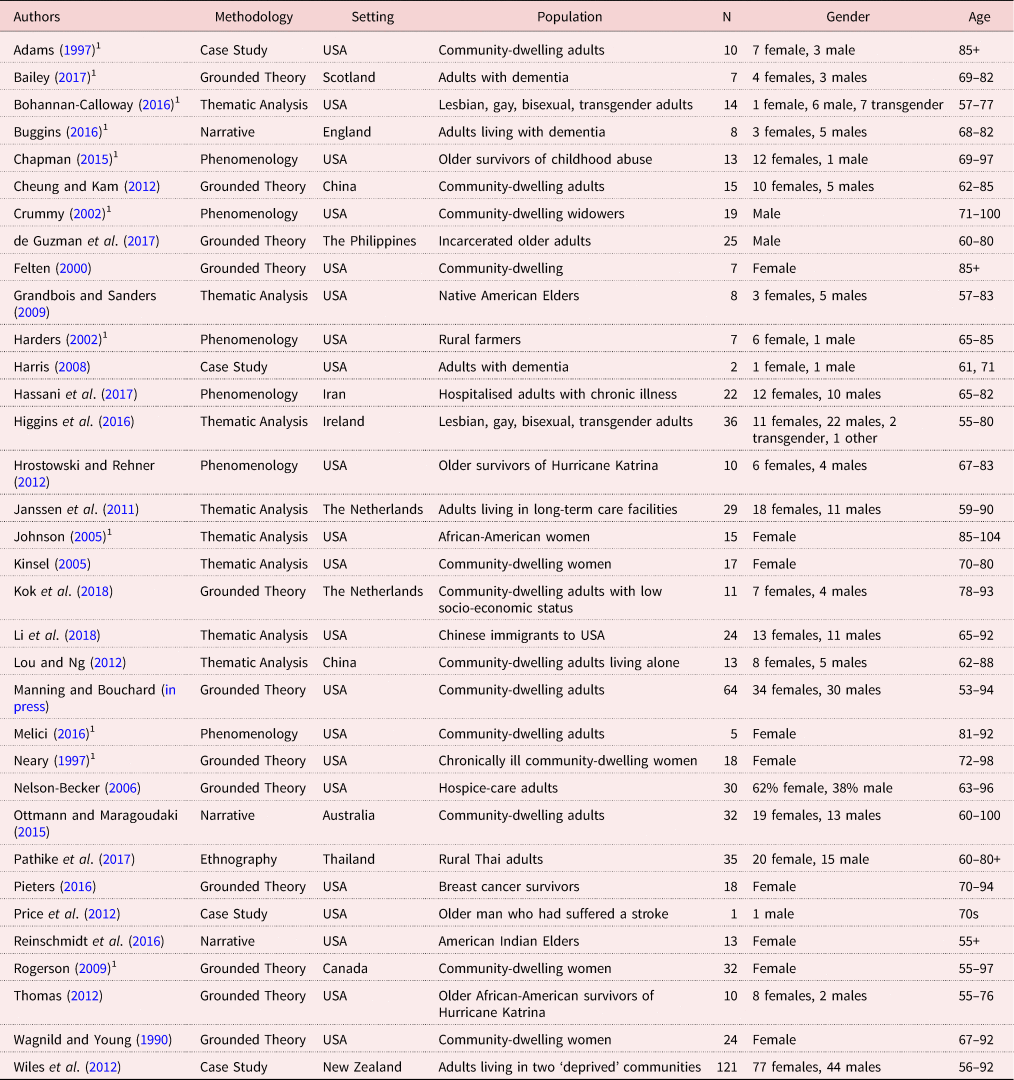
The authors, setting, population, participant demographic information and methodology for each study is summarised in Table 1.
Summary of the demographic and methodological details of the selected studies

Notes: N = 34. USA: United States of America. 1. Doctoral dissertation.
Synthesis output and themes
Theoretical coding revealed eight themes common across the studies: (a) perseverance and determination; (b) self-efficacy and independence; (c) purpose and meaning; (d) positive perspective; (e) social support; (f) faith and prayer; (g) previous experience; and (h) proactivity. Each of these themes serves as a resilience protective factor relevant to older adults.
Perseverance and determination
Perseverance and determination is the overarching theme chosen to describe the drive to move forward despite facing significant challenge or adversity. This was demonstrated in a variety of contexts including perseverance in completing challenging tasks, being determined to do what needed to be done despite experiencing grief and having the will to live or carry on. For instance, one older person who had a stroke said:
You don't have much choice. Determination gets you through. I've got plenty of that. Just keep your nose to the grindstone. (Wagnild and Young, Reference Wagnild and Young1993: 253)
Other individuals who had experienced significant illness indicated that their strength and survival were largely due to their mindset rather than to coincidence or fate. For instance, one woman who experienced physical health problems said:
I just wasn't going to let it defeat me. I had the will to continue on anyway. (Felten, Reference Felten2000: 110)
This internal sense of tenacity demonstrated by individuals across a variety of studies and contexts was key to their successful adaptation in the face of adversity.
Self-efficacy and independence
The theme of self-efficacy and independence describes the belief held by resilient individuals that they are capable of exerting control over their mindsets, behaviours and environments. This is seen in the form of having confidence in their ability to accomplish tasks, as well as being able to successfully adapt and activate resources to achieve desired goals. One man who had recently experienced a challenging life event indicated that:
The ones that are resilient are the ones that realize their capabilities and they will work hard to those capabilities and beyond them if they can, but if they can't move beyond it, they will ask for help. (Ottmann and Maragoudaki, Reference Ottmann and Maragoudaki2015: 2081)
For many participants, maintaining independence was the preferred choice; however, it was not always feasible. When independence was threatened, resilient individuals were able to seek out resources that would allow them to retain some of their autonomy. One individual diagnosed with dementia described his use of technological supports that allowed him to continue living at home:
I have a real problem with remembering appointments. So I bought this small computer … this reminds me that I have an appointment. I set it so the alarm rings to remind me. When it goes off, I check it and it tells me where I need to be … This is the hand you were dealt with, so you learn tricks to help you cope with your problems. (Harris, Reference Harris2008: 55)
Therefore, the belief in oneself and one's ability to accomplish goals, either unassisted or by adapting and mobilising supports, was reflected among resilient older adults.
Purpose and meaning
The theme of purpose and meaning describes one contributing factor that drives older adults to carry on in the face of adversity. Having a sense of purpose, as well as having things to look forward to in the future, is important motivation that protects older adults during difficult times. One man who survived cancer indicated:
It's important to be purposeful. No question, everybody should have distant plans and goals and ends in life. Purposes that they attach themselves to; seek to realize as best they can in their lives and in whatever way they can have extensions beyond their lives to society. (Adams, Reference Adams1997: 123)
Similarly, feeling valued and having a sense of meaning in their lives drives older adults to focus on the future and overcome challenges that they may face in the present. When asked to give advice on how to be resilient, one older adult replied,
I think I'd explore with the person what's meaningful for them … It's tricky really, but I think you've just got to start where a person is and then see what might enrich their lives, to give them meaning … Living in the now, making the most of life. (Ottmann and Maragoudaki, Reference Ottmann and Maragoudaki2015: 2086)
Having a sense of purpose and attributing meaning to one's life protects older adults in the face of adversity by providing them with something future oriented to strive towards.
Positive perspective
Having a positive perspective towards life was a prominent theme across the studies. Resilient older adults described themselves as being optimistic, always trying to make the best out of bad situations, looking on the bright side and generally trying to find the good in life. As one older breast cancer survivor indicated:
It's life … If you don't take what they give you and make lemonade, then you're gonna have some sour mess to deal with. I'd rather make lemonade. (Pieters, Reference Pieters2016: 24)
Having a general positive attitude served as a buffer against adversity, enabling older adults to reframe the situation and look for something more positive. This was sometimes achieved by focusing attention away from the negative situation, and instead focusing on more positive outcomes. As one man with a history of medical problems said:
Ah, once again my positive attitude gets me through lots of things. People say, ‘Well, how did you cope with so-and-so?’ And I say, ‘Well, you've got to, you can't do nothing about it. All you can do is say, ‘Now, how can I get on with my life?’ And that's my attitude to everything that's happened. (Wiles et al., Reference Wiles, Wild, Kerse and Allen2012: 418)
Having a positive perspective is an important protective factor as it prevents older adults from dwelling on the negative, particularly in situations that are beyond their control.
Social support
The theme of social support was crucial for experiencing resilience in older adulthood. Support is obtained from a variety of sources, including family (e.g. spouses and children), friends, neighbours, church communities and health professionals. Social support networks also provided older individuals with the opportunity to support others emotionally, which was mutually beneficial. Having strong social support was not only emotionally beneficial, but also instrumentally important for older adults. As one man with mild dementia said:
My daughter said she would come in and see me after lunch, which is what she often does, pops in, and I'm alright if I know somebody is coming. If I know that I've got somebody to come in at the middle of the day or that, I'm alright. I'm alright on my own then. (Bailey, Reference Bailey2017: 85)
This quote highlights the interconnectedness of social support, self-efficacy and independence. Having strong social support allows older individuals to persist in achieving their goals and maintaining independence when it may be too difficult to do it alone. Feeling a sense of belonging and community was also a key social feature of resilience within this population. One woman living in a retirement home described her feelings of belonging as:
I belong here. I have plenty of friends and love that my children do not have to worry about me. I sing and dance during Jewish services and feel the joy that comes from being a part of something greater than me. (Melici, Reference Melici2016: 40)
While social support is a key feature of resilience across the lifespan, given its close ties with self-efficacy and independence, it appears to be particularly critical during later stages of life.
Faith and prayer
While infrequently mentioned in child resilience literature, the theme of faith and prayer was unmistakable in studies of older adults. These spiritual factors consisted of having faith, trusting in God or a higher power when faced with adversity, and praying as a means of coping. One woman described how her continued faith in God allowed her to see the bigger picture, providing a source of comfort when faced with adversity:
Although at first, I was mad at God. I really was mad at him for doing this to me … I never really lost … my faith, but I really didn't understand why … now I think I do understand. God really does have a bigger plan than we have a clue about, I think. (Kinsel, Reference Kinsel2005: 35)
For older adults, praying was a means of voicing their faith. The following quote exemplifies the power of prayer as a protective factor not only when experiencing hardship, but during good times as well:
I repeat the 23rd Psalm every night. I feel relaxed and at peace. I go to sleep praying for other people. Every morning I ask the Lord to help me accept what is my lot of the day and to keep my spirits as high as possible. (Nelson-Becker, Reference Nelson-Becker2006: 98)
Having a strong faith allows older individuals to remain hopeful in situations that are beyond their control.
Previous experience
Another consistent theme across studies was the relevance of previous experience to resilience in the present. Resilient older adults viewed prior experiences with hardship or adversity as opportunities to learn and grow. The vast number of experiences that older adults have endured throughout their lives have provided them with the knowledge and tools to deal with future challenges. As one woman with cardiac problems described:
My mother had asthma. I was in charge of her medicine and the house as well. Her disease and the hardships of those days have made me strong enough to overcome the hardships now. (Hassani et al., Reference Hassani, Izadi-Avanji, Rakhshan and Majd2017: 63)
By having experienced adversity in the past, individuals felt better equipped to deal with future challenges. For instance, when faced with the loss of power and water, one older hurricane survivor indicated:
We remember what it was like before we had all these things. To us, those lost things were luxury items. To younger people they were necessities. (Hrostowski and Rehner, Reference Hrostowski and Rehner2012: 345)
Having lived a long life allowed these individuals to reflect on their previous experiences, learn from them and be better able to adapt in the face of future adversity.
Proactivity
Closely tied to their previous experiences was the theme of proactivity. The wisdom that develops from previous experience leads resilient individuals to anticipate future challenges and behave proactively so they can mitigate future adversity. One man with early stage Alzheimer's disease said:
Now, I can do one of two things. I can admit I have a problem, or I can moan about it, and cry about it, but it won't go away, it's not gonna make it any better. Therefore, I always consider myself proactive, I say how can you minimize it. So, I lay out strategies and do things that try to make me as efficient as I can be under the circumstances. (Harris, Reference Harris2008: 51)
Similarly, resilient older individuals preferred to approach challenges directly as opposed to passively dealing with consequences. As one woman observed:
People who sit and wait until somethin’ happens to them to do something about it, just kind of has always floored me. (Kinsel, Reference Kinsel2005: 32)
Having an anticipatory mindset and behaving proactively prepared older individuals for future hardship by offsetting some of the potential negative effects of adversity.
Model development
The above-mentioned themes uncovered in the present study can be further organised into four factors that represent different sources or domains of protective factors for older individuals. These four sources are: (a) Intrapersonal Protective Factors; (b) Interpersonal Protective Factors; (c) Spiritual Protective Factors; and (d) Experiential Protective Factors (see Figure 2).
Model of resilience in older adulthood.

The Intrapersonal Protective Factors are similar in that they all occur within the individuals’ mind, or within the self. These include features such as perseverance and determination, self-efficacy, having a sense of purpose and meaning, and having a positive attitude. This factor reflects the resilient personality that many older adults described as part of their successful adaptation. Given that the contributors to this factor are trait-like (e.g. self-efficacy, positive attitude), this group of factors may be seen as consisting of the static, or stable, features of resilience. Another fairly stable factor includes the Spiritual Protective Factors, which consist of having faith and participating in prayer. Many older individuals have maintained their faith throughout their lives and view it as a consistent source of support when faced with adversity.
Conversely, the Interpersonal Protective Factors consist of the external supports that contribute to older adults’ resilience. This includes feeling a sense of community and belonging, and receiving support from others including family, friends, neighbours and health professionals. In contrast to the Intrapersonal Protective Factors, which are fairly stable within the individual, the Interpersonal Protective Factors are dynamic and may be altered. Quantity of support may be increased or decreased as required and when necessary. Lastly, the Experiential Protective Factors, which include previous experiences and being proactive, are another dynamic factor. Exposure to adversity allows resilient older adults to learn from the experience, resulting in increased wisdom and proactive behaviours to counteract adverse outcomes in the future. Together these factors represent four major domains that older individuals can draw upon to improve the likelihood of positive adaptation when faced with adversity.
The interdependence of these factors is a defining feature of this model that is specific to an older population. For instance, many studies indicated that self-efficacy and independence were key features of resilience; however, oftentimes this was dependent on, or relational to, the external supports that allowed older adults to achieve their goals. For example, Kinsel reflected that
Their physical conditions made it difficult for some women to get out of the house or manage many of their favourite pastimes. They were, however, able to mobilise others to aid them in accomplishing desired goals and direct their activities. (Kinsel, Reference Kinsel2005: 32)
Further to this, Adams (Reference Adams1997) remarked that, ‘The participants described the primary importance of self-determinism while at the same time maintaining interdependence within their social support systems’ p, 188. For instance, older adults are confident they are able to achieve their desired goals (e.g. living alone) often because they have social supports in place that can assist them in doing so (e.g. visiting family members).
Interdependence was also seen between aspects of the Intrapersonal Protective Factors and Experiential Protective Factors. For instance, resilient older individuals had dealt successfully with adversity in the past, and this successful adaptation and wisdom contributed to their perseverance, their ability to achieve goals in the present or future, and their increased sense of meaning. For example, Wagnild and Young indicated that
An important aspect of adjustment to loss for these women was the ability to derive meaning from their experiences and renew meaning in life. Major events that at first were deemed quite negative were transformed by some women into opportunities for personal growth and satisfaction (Wagnild and Young, Reference Wagnild and Young1990: 254)
Similarly, Adams (Reference Adams1997) observed the connection between internal factors and those developed from experience, ‘The underlying theme of the participants’ responses was that innate and developmental aspects of resilience were inseparable’ p, 194. Therefore, while these factors are unique, a level of interdependence exists between them and when these factors are drawn upon in unison, the chances of successful adaptation are optimised.
Discussion
The findings of this QMS revealed eight themes that can be organised into the following four-factor model: (a) Intrapersonal Protective Factors; (b) Interpersonal Protective Factors; (c) Spiritual Protective Factors; and (d) Experiential Protective Factors. Together these four overarching factors describe a model of resilience in older adulthood that has been developed from samples described in published research and consists of diverse ages, ethnicities, genders and health statuses, making it applicable to a variety of older adult populations. Further, this model demonstrates consistency within a broader cultural context, reflected in individual accounts of resilience, and the interactive relationship between the static and dynamic protective factors. Although this model may not describe resilience factors unique to idiographic samples of older individuals, it denotes the primary nomothetic protective factors that contribute to resilience across a wide variety of individuals in later life. Lastly, the present model aligns well with conceptualisations of resilience as a process that includes both internal or personal factors as well as environmental factors and life experiences that are drawn upon when faced with adversity (Luthar, et al., Reference Luthar, Cicchetti and Becker2000; Windle, Reference Windle2011). In doing so, this model expands upon previous research to amalgamate resilience protective factors into a cohesive model of resilience in older adulthood.
The findings of this QMS are based on a combined sample size of 715 older adults from 12 countries and from a variety of diverse populations. However, across all of these samples, there were a number of themes that appeared consistently. Many of the overarching themes uncovered in the present study reflect similar findings of quantitative studies examining resilience in older adults. For instance, characteristics such as positive emotionality (e.g. Gooding et al., Reference Gooding, Hurst, Johnson and Tarrier2011) and self-efficacy (e.g. Carstensen and Freund, Reference Carstensen and Freund1994) have all been reflected in older individuals high in resilience. Sense of purpose (Nygren et al., Reference Nygren, Aléx, Jonsén, Gustafson, Norberg and Lundman2005) and spirituality (e.g. Costanzo et al., Reference Costanzo, Ryff and Singer2009; Pierini and Stuifbergen, Reference Pierini and Stuifbergen2010) are also important factors in the quantitative literature. Lastly, factors such as social support (e.g. Lamond et al., Reference Lamond, Depp, Allison, Langer, Reichstadt, Moore, Golshan, Ganiats and Jeste2008; Netuveli et al., Reference Netuveli, Wiggins, Montgomery, Hildon and Blane2008) and previous life experiences (e.g. Hardy et al., Reference Hardy, Concato and Gill2004) are repeatedly recognised as being critical to resilience in older populations. The significant overlap between the resilience factors in the present model and those reflected in the quantitative literature support the validity of the findings in the current study.
The present study revealed that there are a number of older adult resilience factors that are also common to models of resilience in children and young adults. For example, two of the three factors of Prince-Embury's (Reference Prince-Embury2006, Reference Prince-Embury, Prince-Embury and Saklofske2014) Three-factor Model of Personal Resiliency were similar to components of resilience in older adults. Having strong self-efficacy as well as social support were prominent in many of the articles examined and reflect aspects of the related factors of Sense of Mastery and Sense of Relatedness from Prince-Embury's (Reference Prince-Embury2006, Reference Prince-Embury, Prince-Embury and Saklofske2014) model of resiliency. This supports the notion that mastery and relatedness are two features of resilience that stem from developmental systems, but also remain critical across the lifespan (Prince-Embury, Reference Prince-Embury2006; Masten and Wright, Reference Masten, Wright and Reich2009). Further, this model shares some similar features with models developed with young to middle-aged adults. Relationships or social support and personal competence or skills are indicated as being important factors within Connor and Davidson's (Reference Connor and Davidson2003) resilience model, the model conceptualised within the Resilience Scale for Adults (Friborg et al., Reference Friborg, Hjemdal, Rosenvinge and Martinussen2003) and the theoretical model found in the Resilience Research Center Adult Resilience Measure (Liebenberg and Moore, Reference Liebenberg and Moore2018). However, unlike in younger adults, social support appears to be much more interconnected with personal protective factors in an older population. Similarly, although certain contextual factors have been implicated as relevant independent factors in selected young adult resilience models (e.g. Liebenberg and Moore, Reference Liebenberg and Moore2018), some of these contextual components (i.e. community) appeared to align closely with other relational components of resilience in older adult populations, as opposed to being a stand-alone factor.
There were also a number of factors implicated as being relevant to achieving resilience in older individuals that do not appear to be as essential in younger age groups. Spirituality (e.g. Costanzo et al., Reference Costanzo, Ryff and Singer2009) and meaning (e.g. Nygren et al., Reference Nygren, Aléx, Jonsén, Gustafson, Norberg and Lundman2005; Heisel and Flett, Reference Heisel and Flett2008) are examples of two factors that are critical to resilience at a later age, but that are not commonly indicated as necessary for resilience in children or young adults. This aligns with Frankl's (Reference Frankl1979) work that implicates having a sense of meaning as a key contributing factor to resilience in adulthood by serving as a protective factor in the face of adversity. Previous experience with hardship is another theme that was prominent among older adults, and less frequently mentioned in the young adult resilience literature. This is likely due to the larger quantity of experiences older adults have had in their lives, and consequently increased opportunity to grow and learn from past adversity.
While there were many parallels in themes across the studies examined, there were a few instances in which factors were specific to certain populations of older adults and were not widely applicable. For instance, studies examining resilience in Native American Elders indicated that a ‘legacy of survival’ passed down from previous generations (Grandbois and Sanders, Reference Grandbois and Sanders2009) and the experience of ‘historical trauma’ (Reinschmidt et al., Reference Reinschmidt, Attakai, Kahn, Whitewater and Teufel-Shone2016) that stemmed from the distinctive history of this population were factors that contributed to their resilience. Additionally, older carers of individuals with disabilities denoted economic capital and access to services as crucial to their resilience (Ottmann and Maragoudaki, Reference Ottmann and Maragoudaki2015), while this was less frequently mentioned among other older adult populations.
However, even particular sub-groups such as older individuals living with chronic diseases (Hassani et al., Reference Hassani, Izadi-Avanji, Rakhshan and Majd2017) described context-specific factors that at first glance appeared only relevant to their situation (e.g. following a treatment programme), but were actually similar to general themes found across the studies (e.g. being proactive). Similarly, one study of incarcerated older men found that ‘looking forward to new beginnings’ was a key protective factor that contributed to their resilience (de Guzman et al., Reference de Guzman, Imperial, Javier and Kawasaki2017), which echoes the themes of having a positive attitude and a sense of purpose and meaning. Despite there being unique factors that protect against adversity in some populations of older adults and not others, the majority of the studies reflected similar protective factors that were applicable to a variety of older adult populations.
The major themes revealed in the present study reflect many of the themes that Bolton et al. (Reference Bolton, Praetorius and Smith-Osborne2016) described in their seminal meta-synthesis. Our themes of perseverance and determination, self-efficacy and independence, purpose and meaning, positive perspectives, and social support align fairly closely with the themes of Bolton et al. of ‘grit’, ‘independence’, ‘meaningfulness’, ‘positive perspectives on life’ and ‘external connections’. While their theme of ‘meaningfulness’ included factors such as spirituality and faith, the present study separated the themes faith and prayer from purpose and meaning as we found that the themes were not exclusively, nor consistently, related. Lastly, the themes of ‘self-acceptance’, ‘self-care’ and ‘altruism’ proposed by Bolton et al. (Reference Bolton, Praetorius and Smith-Osborne2016) were not as prominent across the greater number of articles examined in the present study to warrant individual categories, but related features are absorbed under our themes of self-efficacy and independence, being proactive and social support. As can be seen, there is considerable overlap between the present study and the earlier investigation of Bolton et al. This overlap is encouraging for the study of protective factors among older adults, as the most prominent factors appear to remain largely consistent, even with the addition of 21 more contemporary studies.
Overall, the present study revealed that while there are common resilience factors across the lifespan, there are also factors and features unique to resilience in an older population, thus lending support to previous findings that have found differences in the factor structures of resilience scales when measured in young and older samples (Lamond et al., Reference Lamond, Depp, Allison, Langer, Reichstadt, Moore, Golshan, Ganiats and Jeste2008; Girtler et al., Reference Girtler, Casari, Brugnolo, Cutolo, Dessi, Guasco, Olmi and De Carli2010; Resnick and Inguito, Reference Resnick and Inguito2011; von Eisenhart Rothe et al., Reference von Eisenhart Rothe, Zenger, Lacruz, Emeny, Baumert, Haefner and Ladwig2013; Wilson, Reference Wilson2016). Therefore, while there are a number of similarities in resilience factors across the lifespan, there are also sufficient differences to warrant development of a resilience model specific to an older population that should be further reflected in the development of assessment measures.
Limitations and future directions
The goal of this study was to develop a model of resilience based on qualitative literature exploring resilience in older adults. While every attempt was made to perform an exhaustive search of the literature, it is possible that there were studies excluded unintentionally, and therefore features of resilience that may not have been examined. Additionally, the samples studied were quite varied in terms of size and demographics. Therefore, features of resilience unique to a particular sample, and not broadly represented across the studies, may not be sufficiently represented in this model. Some features of resilience that were presented in the studies were limited to only one unique sample of individuals and were not seen as a common theme across studies. Further, the studies reflected in this meta-synthesis do not encompass all types of adversity experienced by older adults. This model does not purport to describe resilience in its entirety or across every sample of older individuals, but instead aims to broadly describe the most common features of resilience that are applicable to a wide variety of samples.
The development of this model of resilience in older adulthood is the first step in a series of research studies designed to improve our theoretical understanding and improve measurement and assessment of resilience in an older adult population. The objective of future research is to develop a measurement instrument informed by this model to assess resilience in later life appropriately. Having a theoretically appropriate instrument for measuring resilience in this population will allow clinicians to assess which protective factors are strong and which can be improved to enhance individual resilience. The findings of this study have implications for our understanding of what it means to be resilient in older adulthood, and can assist in informing researchers, clinicians and support workers who interact with older individuals. This model may guide the development of interventions and programmes that are broadly applicable to an older adult population but may also serve as a foundation upon which additional subgroup-specific content may be applied. By improving our understanding of what contributes to resilience in this population, we can improve assessment and intervention programmes designed to enhance resilience among a population that is inherently faced with increased challenges and adversity.
Author contributions
CAW and DW contributed to designing and conceptualising the described study; analysing and interpreting data; drafting, critically revising and editing the manuscript; and approving the submitted version for publication. DHS contributed to analysing and interpreting data; critically revising and editing the manuscript; and approving the submitted version for publication.
Conflict of interest
The authors declare no conflicts of interest.
Ethical standards
Ethical approval was not required for this paper.