It is because there would be telepathy that a postcard can always not arrive at its destination
Jacques Derrida, TelepathyDispatch
He wrote: I also, in the days of what you held to be my backsliding, have obtained Enlightenment, and with Enlightenment has come Power. Then he grew so deeply mysterious that the recipient of the letter could make neither head nor tail of it, and was proportionately impressed; for he fancied his friend had become a fifth-rounder. (Kipling, “The Sending of Dana Da” 63)
Such Enlightenment, the narrator tells us facetiously, is effected by an elastic religion known as the Simla Creed, alive at the edges of the British Empire where he, an unnamed Englishman, is stationed. An amalgam of occult practices, the creed stretched itself and embraced pieces of everything that the medicine-men of all ages have manufactured (63). So Rudyard Kipling mockingly observes in this satire of British Victorian forays into the marginal sciences of occultism, Spiritualism, and Mesmerism.Footnote 1 An early Kipling tale, “The Sending of Dana Da” (1888) is one of Kiplings first engagements with the religions and philosophies of the East; it was published in the Civil and Military Gazette, a provincial newspaper for which Kipling regularly wrote. The infamous Dana Da – whose name, we are told, escapes every ethnological inscription, and who came from nowhere, with nothing in his hands (62) – dispatches a sending on the behalf of (and through) the Englishman. The recipient of this letter, (again) a Lone Sahib, is characteristically armed with scientific naturalism and Christian faith, and therefore refutes the possibilities of ectoplasmic infestation, unseen currents, and the fecund times of reincarnation. Kiplings eloquent exposition on a sending, despite his final rational explanation of this unseemly act, betrays his fascination with such forbidden epistemologies multiplying at the edges of Empire:
Now a Sending is a horrible arrangement, first invented, they say, in Iceland. It is a Thing sent by a wizard, and may take any form, but, most generally, wanders about the land in the shape of a little purple cloud till it finds a Sendee, and him it kills by changing into the form of a horse, or a cat, or a man without a face. It is not strictly a native patent, though some low-caste men, if irritated, dispatch a Sending which sits on the breast of their enemy by night and nearly kills them. (63)
Already, in this early invocation, Iceland and India (where the descriptor low-caste men would have relevance) are adroitly sutured; later in the story, Egyptian religious beliefs are tossed into the mix when the dispatch takes the form of a cat, an animal the narrator cursorily aligns with the Egyptian gods. The sending is thus a thing that belongs nowhere but summons an elsewhere; it belongs to no one culture or individual, resisting any institutional patenting, ownership, and copyright. Neither human nor matter/protoplasm, cognitively the sending appears spectral – the creed of the colonized other blocked and turned monstrous in the rational colonial eye. Since the sending of cats ultimately turns out to be a well-planned hoax perpetrated by the wily Dana Da, in this story the spectral is finally revealed to be a shadow momentarily conjured in a mind unable to fully trust scientific explanation – a mind that must, therefore, turn constantly and consistently to a roster of nativeFootnote 2 beliefs and practices that accommodates the possibility of telepathic transfer through thought and plasma.
The sort of pseudo-ethnographic description found in “The Sending of Dana Da” litters the early fiction and travel sketches penned by Kipling soon after his return to India in 1882, some of which were published anonymously and some co-authored, appearing in news supplements, pamphlets, local gazettes, and Indian newspapers.Footnote 3 Indeed, as Stephen Arata notes, when Kiplings first stories began to circulate in England, many regarded the new voice as a strange and foreign one; Kipling unabashedly incorporated army slang, esoteric native stories, gossip, hearsay, and untranslated Indian vernacular into his literary texts. The proliferation of ethnographic/folkloric data and philosophical speculation that hybridizes Kiplings literary oeuvre – his faithful ventriloquizing of native beliefs – testifies to the young Kipling's desire for communication with the other before his wholehearted endorsement of the imperial project later in his life.
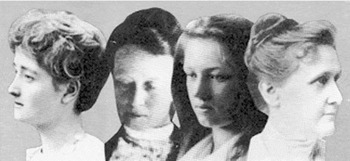
We must remember, too, in the 1880s Kipling had close association with the Society for Psychical Research (founded in 1882): his early work was introduced to the British public by Andrew Lang, a well-known psychical researcher and folklorist, and Kipling's sister, Alice Fleming, performed as medium for the SPR (Figure 1). Hence Kipling was no stranger to telepathy, a theme he pursues with some rigor in his early fiction. Allied with nineteenth-century concepts of sympathy, telepathy offered a controversial theory of communication. Its progenitors proposed direct communication between two or more people could occur without recourse to the five human senses; neither physics nor psychology could rationally explain telepathic phenomena to fully grasp how thoughts flowed across geographically discrete spaces and beyond the temporal physical limit of a life. Since this communication occurred through media whose material existences defied the laws of the natural sciences (ectoplasm, astral forces, and the like), it was closely aligned with colonial experiments in parapsychology (occult, Spiritualism, Mesmerism, and transmigration). More importantly, for postcolonial theory telepathy's closing of physical and psychic distance, promising a menacing immediacy,Footnote 4 has substantial implications for a social history of imagining relations across cultures, races, classes, and religions – radical potentials to which we shall return later in the essay.
Alice Kipling Fleming (extreme left) with three other famous mediums (Margaret Verrall, Helen Verrall, and Leonora Piper), all known to experiment with automatic writing. Reproduced with permission from Troy Taylor, “Cross Correspondences: Spirit Communications – and a Love that Survived Death.” Prairie Ghosts. 22 Nov. 2007.

When we look at colonial fiction on occult practices, written between 1880 and 1920, we see how writers preoccupied with telepathy move well beyond handling it thematically as an excursion into semi- or illegitimate scientific experiments. This essay will treat two writers, Rudyard Kipling and Arthur Conan Doyle, who exemplify British literary meditations on the occult in fiction, but the observations I make on their experiments, wagers, and failures can be generalized to include much British occult fiction written in this period. For Kipling and Conan Doyle, telepathy entailed an epistemological project, as it mandated the interpenetration of colonial epistemic paradigms (legal, medical, political, or religious) by native doxa, semi-legitimate or subjugated knowledge (philosophies, sciences, religions, beliefs).Footnote 5 If telepathy enabled the leaking of psyches into each other, the telepathic mode in colonial occult fiction allowed for a seeping of native philosophies, sciences, and religious beliefs into the literary text.
If we remain with Kipling as our initial example, his predilection to telepathy first comes to light in a group of stories he wrote at the fin de siècle. Notable among them are “The Mark of the Beast” (1890), “The Return of Imray” (1891), and “My Own True Ghost Story” (1888), where the frame narrators are obsessed with doxa gathering at the imperial margins to which they must subscribe in order to solve mysteries, crimes, and sightings. Telepathic fiction not only archives doxai, but it further dramatizes the difficulty of knowing the native other's epistemologies: hence the heavy focus on the narratability of doxa in telepathic fiction, the hesitations and confusions over knowing/telling. As narrators attempt to authorize their tales, their excursions into doxai disseminate the telling, relegating its meanings beyond the frame of the literary text. Circling the problem of doxai that must be used as rational explanation for crimes against the British Empire, narratability becomes the true subject of narration in telepathic colonial occult fiction. By the time Kipling writes “The Finest Story in the World” in 1891, he is in full pursuit of the possibilities of possession and automatic writing that throw the authority of the narrator – and by suggestion literary authority and copyright – into confusion.
Yet such a radical opening to doxa is not always found in colonial occult fiction. For the fullness of epistemological encounter is often blocked: doxa can be entertained but spasmodically, temporarily, before being firmly relegated to colonial difference – irrationality, madness, unnatural native custom and creed. When doxa is not the epistemology on which our comprehension rests, but is merely arraigned to produce effects of horror and monstrosity, when its radical potentials are blocked by an emphatic return to colonial rationality, we might characterize the text as spectral rather than telepathic. A majority of Kiplings fiction tends toward the spectral, often retreating from the full implications of the doxai catalogued in the text – a gesture Peter Morey reads as an essentially conservative containment of potentialities at the margins that threaten the natural order of colonial rule in India.
While I would largely agree with Morey's reading, I am increasingly struck by Kipling's inability to contain the irruption of the supranatural in the rational instrumentality of colonial rule. Weary administrators, policemen, and bureaucrats in Kipling's occult fiction (much like the Lone Sahib in “The Sending of Dana Da”) regularly concede to the power of doxai at the end of the day even as they attempt to dismiss these epistemologies as supranatural, upsetting the natural order of things – one where the British naturally ruled the colonies.Footnote 6 In such scenarios, Gail Ching-Liang Low's sympathetic account is closer to my sense of Kipling's spectrality: she insists the supernatural cannot be entirely reined in, for it leaves a wound gaping in the colonial text. Knowing the ghost prompts a crisis in colonial administrative (and often authorial) authority, Low argues; hence in “The Return of Imray,” for example, Strickland, the Sherlock Holmes of Kipling's fiction, discovers the murder of Imray but cannot punish the native subject for lack of proof. Logical inference can only lead him to the ontological possibility of ghosts, as the story closes, quite softly if eerily, with the idle, empty, ceiling-cloth left trailing on the table in the next room.Footnote 7 We shall return to such openings and to Kipling's telepathic fiction shortly, but first, a detour.
Missive
Almost a hundred years later, other fragments speak (self-consciously and poetically) of a desire for full communicability, for intimacy:
But I see, that's the consciousness I have of it, I see the contours of the abyss; and from the bottom, which I do not see, of my unconscious (I feel like laughing every time I write this word, especially with a possessive mark), I receive live information. Must go via the stars [Faut passer par les astres] for the bottom of the volcano, communication by satellite, and disaster [], without its for all that reaching its destination. For here is my latest paradox, which you alone will understand clearly: it is because there would be telepathy that a postcard can always not arrive at its destination. (Derrida, “Telepathy” 16)
Published as an afterthought, Derrida's “Telepathy” (written in 1979; published in 1981) should have appeared – he muses in a footnote to the essay – in the Envois section of La Carte Postale (1980). These fragments, which Derrida writes as Freud, are love letters whose addressee remains undisclosed; they were rediscovered very close to me, says Derrida, after the proofs for La Carte Postale had been sent back (39). Ventriloquizing Freud, the essay meditates on Freud's turn to (and disavowal of) telepathy between 1922 and 1926,Footnote 8 in a necessary swallowing and vomiting of that foreign body, telepathy, a theory that threatened to disturb the boundaries of the individual psyche and its singular biography so foundational to psychoanalysis. Recounting dreams, Derrida remarks that theorizing the unconscious was, for Freud, a kind of stoppage of a more radical idea: the interpenetration, the leaking, of other psyches into our own, the arrival of ghosts en masse (30).
“Telepathy” follows Derrida's previous reflections on Freuds mystic writing pad, an analogy for the unconscious Freud developed between 1896 and 1925 that has been largely eclipsed in critical conversations on Freud's turn from the topographical to the hydraulic models.Footnote 9 Appearing in Writing and Difference, a volume of pieces Derrida wrote between 1959 and 1966 and first published as a collection in 1967, Derrida's “Freud and the Scene of Writing” fundamentally disagrees with the psychoanalytic nomenclature of harnessing all movements of the signifier by posing the phallus and its lack as the ultimate signified: hence the desire for the phallus motivates all writing. In Derrida's view, Freud does not attend to the materiality of writingFootnote 10 – to what can be lost in any attempt at interpretation, any attempt at decoding what harnesses the movements of the signifier. But this is exactly Freud's project: to develop a master code, his theory of sexuality, that will explain the subject's significations. The code arrests signification via an indivisible transcendental signified where all routes stop: the phallus the subject will hanker after but will always lack. The interpretative gesture, Derrida remarks, is a willful act of knowledge production. For if the psyche is constituted by memory traces or signifiers as the mystic writing pad analogy clearly suggests, there can be no origin to this writing within the individual subject – the traces of signifiers move the psyche into the larger culture and beyond. Psychoanalysis is a deliberate focusing of an optical machine, such as the telescope or microscope, on a particular psychical space, a locality cut off by the birth/death of the individual from the larger system of signification. In this regard, telepathy makes possible the leaking of other psyches into the localized space of the individual psyche, makes possible the erasure of temporal cutting or death as a limit for the subject.
This constraint misconstrues the very nature of writing, and it is with this that Derrida takes exception. If one were to be properly attentive to the literary – and Freud's explications are littered, Derrida argues, with literary reference – then one would immediately grasp the impossibility of harnessing all our signifiers to that secret signified, that fear of death, that motivates life or detour. If one did not treat graphic marks upon the unconscious (memory traces upon the slab of wax in the writing tablet Freud names the mystic writing pad) as simply an analogy, an example for explaining the workings of the psyche, if one were attentive to how all writing refers back to and beyond the localized fragment at hand to a lost origin, the memory traces of the individual would be disseminated into a greater field of forces. The subject of writing, conscious or unconscious, would not be the sovereign author but a system of relations between strata – that is, the Mystic Pad, the psyche, society, the world (Derrida, “Freud” 227). In such dissemination, no unconscious truth would be discovered, Derrida muses, by virtue of having been written elsewhere (211).
But this is precisely what Freud will resist by way of a master code that unlocks the truth of the unconscious: the subject shies away from his mortal shadow, the space beyond life beckons but is blocked, turned spectral. And Jacques Lacan, despite his attention to the materiality of the signifier, will repeat Freud's blockage, as Derrida points out. His celebrated disagreement with Lacan is well known, so I will not belabor it here. Suffice to say, in “The Purveyor of Truth” (1975)Footnote 11 Derrida criticizes Lacan's reading of Edgar Allan Poes short story, “The Purloined Letter” (1845), precisely because Lacan uses the letter simply as an analogy for the phallic signifier, and fails to look beyond the literal to the literary meanings of the story, its frame of reference (Lacan 28–54),Footnote 12 one that jettisons all signifiers in the story well beyond the textual fragment (at least to the two other stories that comprise the trilogy, and most likely beyond to all writing).
In 1979 Derrida returns to these disagreements in “Telepathy,” as he further develops his theories on systems of writing in which our psyches are imbricated – matrices that jettison us well beyond the bounded contexts of our utterances every time we speak or write. We would like to believe there is perfect communication between one monad/psyche and another. Yet the complex nature of pluri-communication belies the possibility of direct address or reception. As multi-directional flow telepathy dramatizes indirection, the deferral and displacement at the heart of all communication. Hence telepathy exemplifies pluri-communications with the radical potential of establishing contact with social others; for Derrida, it soon begins to function as a metaphor for communicative potentialities.
The nineteenth-century excursions into telepathy may have held special interest for Derrida because of their overt emphases on the medium that made the transfer of thoughts possible. For Victorian practitioners of telepathy, the materiality of the medium (voice, gesture, performance) provided surplus affect to messages flowing across times and spaces: the flicker of ectoplasm that could not be grasped by ones five senses brought fear, loathing, and fascination that formidably altered what that apparition sought to convey. For Derrida, quintessentially concerned with the materiality of media – what writing allows or disallows in a bounded context – telepathy offers a theory of communication that recognizes the impossibility of harnessing the message to a single transcendental signifier. If the origins of writing could not be traced, the thoughts of distant others, traces of meaning from a distant time and place, could habitually make their way into the localized space of every text. The earliest hieroglyphics persist in the discrete, stratified, and hierarchized languages of modern philology (critical to colonial world-making), even as the thoughts and emotions of others from times past persist in the (modern) psyche isolated as the object of study by psychoanalysis.
If we acknowledge the critical potential of telepathy, Derrida maintains, no unified message could ever find its way via physically verifiable routes between sender and addressee. The medium would exert its unrelenting power; the postcard would alight in places unmarked by its sender. Hence we can best comprehend the materiality of our psyche (the subject of psychoanalysis), Derrida suggests, in the networks and dispersals of telecommunications where seemingly individuated addresses are opaque and our postcards drift. Telepathy will not go away: it remains with us everyday in the structure of telecommunications, of postal technology, tropes Derrida (“Telepathy” 25), and it makes Freuds postcard not just possible, but inevitable. The presence of the Other, the specter at the door, motivates the postcard whose destination (both time and place) remains unknown. The postcard does not follow recognizable postal routes where signatory and addressee, letter and reply, are stable points in communication; the postcard is the despatch not entrusted to a postal institution (5) but an intimate discourse to the self and beyond.
Colonial Postcards
The late nineteenth- and early twentieth-century colonial meditations on occult – the recognition of other epistemologies of self, community, intimacy, and affect – are perhaps one such postcard that finds reply in vernacularFootnote 13 fiction of the time when the modern ghost (quite distinct from traditional genre-marked specters) emerges in another spectacular instance of hybridization. Where the fiction of literary stalwarts like Arthur Conan Doyle and Rudyard Kipling, the lesser-known fiction of M. R. James, Oliver Lodge, John Lang, and F. W. Bain, and the popular sensationalist fiction of B. M. CrokerFootnote 14 variously featured occult phenomena and tested the epistemological veracities of doxa (particularly those relating to telepathy, transmigration, and ectoplasmic transfers), literary giants and popular writers in the BengaliFootnote 15 modernized traditional spectral presences into ghosts preoccupied with memory, narration, and legacy/property.Footnote 16
It is well beyond the scope of this paper to substantially explore these replies in the vernacular, or even to treat all of the fiction I have mentioned above; here, I restrict myself to a few pieces by Conan Doyle and Kipling, in order to theorize telepathic address. For obvious reasons, I have chosen pieces where Indian philosophies, appearing as doxai in this occult fiction, are archived in the literary text; the historical moment of Indian theosophy with Madame Blavatsky's arrival in India in 1879, not to mention vast Orientalist scholarship on Eastern religions, philosophies, languages, and literatures, had already planted this imperial margin as an abstruse and threatening epistemological other for the British public.
But why speak of colonial telepathic occult fiction as a distinct genre? What are the stakes for postcolonial inquiry? I would argue that genres, as semiotic constructs arising at specific historical junctures, index changing social relations in important ways. In his pursuit of spectral fiction in the Victorian period, Julian Wolfreys explains how the Gothic dies as a distinctive narrative form or genre – a single, identifiable corpus – in 1820, and how its modes are consequently disseminated into other fictive modes (9).Footnote 17 One could extend the argument to our case in point. Colonial telepathic occult fiction arises in the mid- to late 1880s as an identifiable corpus, the literary record of a British critique of Empire and the knowledge hierarchies that gave it political credence and moral clout. (My look at the radical proprietors of telepathy will substantiate the contours of this critique.)
The emergence of a literary genre, especially one marked by radical internal instability such as the Gothic, enables us to delve more fully into the pitched struggles of the particular historical moment: here, a radical questioning of imperial epistemologies by British scientists, writers, journalists, and folklorists, among others. While much postcolonial literary criticism has treated colonial texts as apologia for Empire, on the one hand, and a register of colonial anxiety, desire, and ambivalence, on the other, I would like to suggest that to see the literary as telepathic communication positions colonial fiction a little differently: the literary becomes a site where great wars over history, philosophy, science, technology, and ethnology are waged, often at the cost of aesthetic control and sophistication. In other words, telepathic colonial fiction is often not the best work of even the masterful writer.Footnote 18 Here literature functions like an empty sack that archives ethnographic, sociological, historical, and philosophical inquiries, folding these fragments into narrative form.Footnote 19 Colonial occult fiction translates,Footnote 20 then makes palatable through the affective capacities of literature, those subjugated knowledges (emerging from folklorists, psychical researchers, and Spiritualists, among others) considered doxai by colonial elites. Hence telepathic fiction incorporates factual assemblages of doxai even as it stages effects of its presence upon the colonial subject through figuration: specters that move inward from the imperial margin, whose monstrous forms dissolve when one opens to the possibility of other epistemologies. In other words, the struggle over the systemization of knowledges finds literary reverberation in the opposing logics of the spectral and the telepathic. The word of the native other, doxai, appears spectral, unheimlich, the symptom of colonial blockage; but in full blown telepathic fiction, specters are vanquished in the acknowledgement of other truths.
In short, not only do doxai proliferate in the literary text but, in telepathic colonial occult fiction, the epistemological grounds for understanding the story are the premises of doxai. In Derrida's words, the colonial text opens to full penetration by the Other, radically altering the question of legacy. If we argue that Kipling's and Conan Doyle's debts are to native doxa in their telepathic occult fiction, if indeed we were to read their fiction with the postcolonial omphalos (the ear/mouth of the other), as Derrida challenges us to do,Footnote 21 and, above all, if we follow the logic of telepathy, it would be impossible to pose the unidirectional proceeding of a proper name, to foreclose or align lines of intellectual credit (Derrida, “Otobiographies” 33–36). A properly postcolonial pursuit of telepathy might, in fact, simply alight on a thicket of spectral fragments, colonial and postcolonial, where legacy is automatic writing, where native doxai spur colonial occult fiction, and where hybrid modern ghosts wander through vernacular colonial tales, postcolonial before postcoloniality (an event before its proper time, an event that could not be foreseen [Derrida, “Telepathy” 25]).
Such an imperative emerges from the close alliance between the projects of deconstruction and of telepathy, as so many recent scholars like Nicholas Royle (the translator of Derrida's “Telepathié” [1981]), Patricia Thurschwell, Avital Ronell, and Julian Wolfreys, among others, have recently noted.Footnote 22 The revenant, the thing that returns, notes Royle, “comes to represent familiar Derridean concepts of iteration, trace, and the deferral of presence” (“Telepathy” 11). Telepathy plunges us into the impossibility of singular author, event, or context; telepathy demands moving across discursive realms. (We have seen many such crossings in Derrida's incursions into aesthetics, phenomenology, the literary, virtual and tele-technologies, politics [Wolfreys ix].) My entry into literature as telepathic address deviates from Royle's in one significant respect. While Royle persuasively argues that the telepathic is a general literary condition, I read the telepathic address of the literary as an opening of the literary to discourses beyond the literary frame of reference at particular historical junctures – here fin-de-siècle Britain and the British Empire. Literary fiction, with its archival propensities and affective capacities, can become an intimate embrace of the other's discourse, unraveling established hierarchies when social critique gains momentum. The swell of sympathy for telepathic address in the 1880s is one such phase, where several highly visible British proponents of telepathy variously voice opposition to the hegemonic thrust of Empire.
Telepathic Utopias
In their tele- studies, contemporary scholars like Ronell, Royle, Luckhurst, and Thurschwell present a case for telepathy as the radical underside to telecommunications that is vital to my reading of colonial telepathic occult fiction. They variously argue that if communications technology reorganizes our relations to our minds and bodies, to others, and to time, then this rewiring also creates new desires for the collapse of all distance, for affective proximity and intimacy.Footnote 23 We see this quite clearly in the historical emergence of telepathy, linked as it was to other late nineteenth-century forms of communication that are considered the nerves of empire: the railways, telegraphy, photography, the telephone, and the gramophone. Where Joseph Chamberlain saw in the telegraph – a wire so fine and delicate that a blow might break it – the possibility of consolidating an imperial federation (a thread of union carrying sentiment and sympathy which would be a potent factor in the history of the world [77–78]), William Stead prophesized that electricity had annihilated time, abolished space, and it will yet unify the world (230).
Stead was one among several proprietors of telepathy with high visibility in the 1880s. Writers such as Kipling and Conan Doyle, radical journalists such as William Stead and Andrew Lang, scientists of wireless telegraphy and sound such as Oliver Lodge and Alexander Graham Bell, and many others saw telepathy as a utopian mode of communication with the other, a democratic prosthetic for social justice, an opportunity for stretching the boundaries of Western modern epistemologies. So utopian was this imagination that its memory infuses current scholarship celebrating contemporary new media: for example, Jeffrey Sconces Haunted Media (2000) hearkens back to the mid-nineteenth century to explain present technophilia and its spectral effects, while Joe Milutiss Ether (2006) follows the travails of ether to unearth the lost histories of technological development.
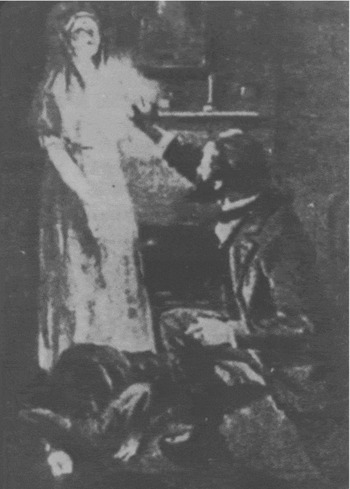
Certainly many of the mid-nineteenth-century thinkers were touched by personal tragedies that underscored their turn to telepathy (popular in psychical research, Spiritualism, and Mesmerism): both Oliver Lodge and Arthur Conan Doyle lost their sons in the Great War, losses that reinforced their philosophies on ectoplasm; the spectroscopist and chemist William Crookes lost his brother in 1867, while laying a cable to Cuba, thereby turning to séances to communicate with the deceased (Figure 2); and, as Avital Ronell has persuasively argued (245), Alexander Graham Bell's séance-going had as much to do with his pact to communicate with his dead brothers as his work on inventing machines for invisible speech (phonautographs) had to do with his deaf mother and his deaf wife. But beyond their personal investments, many of these actors opposed the imperial project, while others lobbied for the utopian potentialities of modernity from the inside. In his book On the Threshold of the Unseen (1917), William Barrett exemplified such an impulse in imagining a telepathic utopia where social justice followed from shared thoughts: “What would be the use of a luxurious mansion at the West End and Parisian cooks, if all the time the misery and starvation of our fellow creatures at the East End were telepathically part and parcel of our daily lives?” (294).
Sir William Crookes (left) with the alleged materialized spirit form of Katie King at one of Florence Cook's séances. Wikipedia Commons. 23 Nov 2007.

Their commitment to networks rather than established routes compelled these thinkers to shuttle between discourse, practices, and institutions. Andrew Lang, for instance, had a bewildering diversity of interests: he was a poet, critic, novelist, classicist, translator, Scottish historian, folklorist, and anthropologist. His hybrid texts foreground the work of mediation that accompanies the purifying logics of being modern, as Bruno Latour has recently surmised; the work of translation that was psychical research, at ease with monsters – the unseemly and the uncanny – suddenly made possible the anthropology of the Western world:Footnote 24
In the eyes of our critics the ozone hole above our heads, the moral law in our hearts, the autonomous text, may each be of interest, but only separately. That a delicate shuttle should have woven together the heavens, industry, texts, souls, and moral law – that remains uncanny, unthinkable, unseemly. (Latour 5)
The disciplinary stratifications that Latour decries were precisely what the proponents of telepathy challenged, executing that delicate shuttle across diverse terrains. Telepathy, as Roger Luckhurst describes it in his meticulous study, The Invention of Telepathy (2002), has always been a hybrid object demanding shuttles, binding together diverse social, cultural, and scientific resources together in a tightly bound knot (3). Telepathy brought together mind-readers, tuning forks, ectoplasm, electricity, reincarnation, neurological synapses, hysteria, anatopic bungalows, ether, and postal delivery, to name but a few heterogeneous objects; it leaked human (social and discursive) into non-human (natural) worlds and vice versa, despite institutions that attempted to stem and block its flows. With telepathy, the past was not surpassed, as Latour notes, but revisited, reshuffled, recombined, reinterpreted.
Frederic Myers provided the first definition of telepathy at a meeting of the Society for Psychical Research in London in December 1882, to cover all cases of impression received at a distance without the normal operation of the recognized sense organs (Barrett, “First Report” 147). Its emergence was epistemologically linked, as Janet Oppenheim's excellent study has demonstrated, to the crisis of Christianity in the Victorian age that underwrote the turn to Spiritualism.Footnote 25 It was equally a critique of dogmatic scientific naturalism: Myers, in fact, saw telepathy as a progressive evolutionary step, not a movement back, a return to atavism (32).
Both Kipling and Conan Doyle were purveyors of tele-technologies, and both – Conan Doyle to a larger measure than Kipling – stage, test, and speculate on theories of psychical transfer in their fiction. In 1902, Kipling wrote “Wireless,” a story where an electrician setting up a wireless Morse conductor picks up astral transmissions from John Keats; the story passes no judgment on the truth or falsity of unconscious channeling but explicitly establishes a structural analogy between séance and science. Yet Kipling's forays into psychical matters, particularly automatic writing, begin much earlier – not coincidentally while he inhabits the imperial margin, immediately after his railway journeys of 1887 and his sojourn in Simla (the British government's summer retreat).Footnote 26 When Kipling began to write his ghost fiction of the late 1880s and 1890s, stationed as a colonial officer, the twenty-something year old retained a critical view on imperial governance sharply present in his satirical sketches (The Departmental Ditties [1886]), even as he posed readily and cheerfully as native informant, gathering gossip, lore, and hearsay from the imperial margin for Anglo-Indian and British metropolitan audiences. What appears as humorous excursions into native doxa in “The Sending of Dana Da” and “My Own True Ghost Story” become troubling crises of colonial authority in “The Mark of the Beast” and “The Return of Imray”; a few years later, these crises become, as I have suggested, a problem of authorship in “The Finest Story in the World,” an exemplary piece of telepathic occult fiction that I will peruse at greater length shortly.
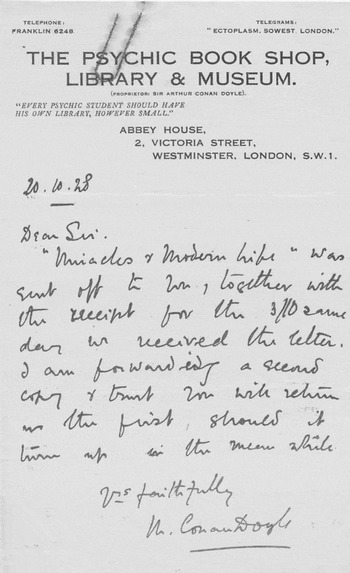
Sir Arthur Conan Doyles many forays into occult, punctuating his more commercially viable Sherlock Holmes stories, are more sustained and his immersion in doxai fuller than that of Kipling's telepathy/spectrality fiction. A doctor by profession, Conan Doyle had occasion to visit the colonies; moreover, he was ever interested in tuning forks, séances, colonial subjects in Britain (he testified in the case against George Edalji, a Parsi lawyer, in 1907Footnote 27), criminality, and magic (he famously befriended Houdini) even before the death of his son, in World War I. After the war, he turned to full-scale psychical research, publishing the philosophical Vital Message in 1919, testifying for William Hope in the 1922 Fairies scandal, writing nonfiction on psychical research (1918–1930),Footnote 28 and opening the Psychic Bookshop in London in 1925 (Figure 3). It is this other, perhaps lesser-known Conan Doyle who is of interest to me, a Conan Doyle who, in many ways, haunts the detective fiction writer of the Holmes successes. Conan Doyles credentials as a writer of ghost fiction, in fact, were rather undervalued even in his time, the radical agendas of opening the literary to doxai perceived as an unnecessary burden on his fiction.Footnote 29
Bill of Sale from the Psychic Bookshop. Irving Hamlin Papers, Special Collections, Leonard H. Axe Library, Pittsburgh State Library. 23 Nov 2007.

Two fictional texts are of particular interest here for their lengthy exposition on Spiritualism: the exchanges on ectoplasm in “The Brown Hand” (published in Tales of Twilight and the Unseen [1922]) written after the Great War, and the novel, The Mystery of Cloomber (1888), written only a year after the first Holmes novel, A Study in Scarlet (1887). Written thirty-four years apart, in both stories something from the edge of Empire – more specifically, from the Northwest provinces of India – returns to trouble the bodies and minds of Englishmen, surfacing in rural England, scarring English bodies, making hysterics of masculine men (the doctor and the soldier, respectively), disrupting transfers of property, ringing astral bells, claiming revenge and/or the return of body parts.
Literary Telecommunications
Kipling's “The Finest Story in the World” (1891)Footnote 30 opens channels of literary communication between the metropolitan world of London and its colonial periphery, India. An exchange between the narrator (a thinly-veiled version of Kipling, he is a writer based in London who once lived in IndiaFootnote 31) and Girish Chunder (a colonial native subject studying law in LondonFootnote 32) attempts to explain the haunting of a young aspiring writer, Charlie Mears. The twenty-year-old Charlie, hapless, loveless, and living with his mother, is given to bloated and vulgar attempts at fiction and poetry which are repeatedly censured by the older, erudite first-person narrator. The fatherless Charlie, whose residence with his mother tags him as an anomaly, is not a fully socialized masculine subject: he has never known love, a lack of masculine desire that registers in his weak, lanky, effeminized body.
But on occasion, when Charlie speaks in a trance or embarks on automatic writing (scratches on paper which the narrator recognizes as the Greek alphabet), he is suddenly authoritative, detailed, and energetic in his prose. The narrator soon realizes that Charlie unknowingly communicates the authentic memories of a Greek galley-slave who accompanied the Viking Thorfin Karlsefne in his discovery of Wineland, America, in the ninth and tenth centuries. Here is the mystic writing pad in its full glory, registering a time beyond the psychical locality of Charlie. Wildly excited at the thought of the revolutionary potential of this true history, the narrator soon realizes that the condition for being a medium is that the subject must never know fully the door through which he has stepped; the knowledge must come to him in half-forgotten dreams, in fragments, amid trances. Since the narrator, well versed in transmigration (True Metempsychosis, he tells us, following Mortimer CollinsFootnote 33), can put his knowledge to use, the doors of life and death remain closed to him.
Indeed, at the moment of his recognition of the other voices disseminated through Charlie, the narrator is seized with an urge to steal Charlies story, to deceive the Gods of Life and Death, to possess the truth of fiction for himself (he does not seem to care about the reading public's possible reception of the saga). Exulting in his find, the narrator wanders through the British Museum in a delirium: “He [Charlie] would supply me – here I capered among the dumb gods of Egypt and laughed in their battered faces – with material to make my tale sure – so sure that the world would hail it as an impudent and vamped fiction” (100). Possessed by Charlie, the narrator loses time and control of his actions, capering like a child in the British Museum, where the gods from the colonies have been safely housed as artifacts. In fact the narrator cannot remember how he got to the museum after tenderly cradling Charlie's scratches on paper between his fingers: “Then . . . but there seemed to be no interval between quitting my rooms and finding myself arguing with a policeman outside a door marked Private in a corridor of the British Museum” (99). Such ellipses, and the narratorial stutters over “I – I alone” (100), increase as the narrator becomes obsessed by the Greek slave's story, typifying as he does the faltering narration delinking authority from authorship we see in all telepathic fiction.
To encourage Charlies remembrances, the narrator must inevitably discourage Charlie's reading of existing English literature:
Again I cursed all the poets of England. The plastic mind of the bank-clerk had been overlaid, coloured, and distorted by that which he had read, and the result as delivered was a confused tangle of other voices most like the mutter and hum through a City telephone in the busiest part of the day. (102)
Here metropolitan telecommunications are structurally analogous to established literary heritage communicated through reading; both destroy telepathic communication or full penetration by the others voice. Legacy is unconventionally true experiences communicated by demonic possession, rather than learned literary craft. Kipling speaks eloquently of such possession in Something of Myself: For My Friends Known and Unknown (1937), his reflections on his own writing: “when your Daemon is in charge, do not try to think consciously. Drift, wait and obey” (qtd. in Bond 11).
Yet controlling Charlie proves impossible – and the finest story in the world is never written – because Charlie falls in love. Entering communion with the domestic other, the door to the Other is now shut, prohibiting telepathy as the boy becomes a man. In his moment of torment, just as the narrator flirts with the idea of taking Charlie to a professional mesmerist, Girish Chunder enters the scene. Positioned as the seer, Girish Chunder is unmistakably racially otherFootnote 34 – a big, black brute repugnant in Charlie's eyes (119). Girish Chunder cautions against revealing what Derrida calls the the web of histories and times to a culture where the self's relation to the world relies on a fear of death (“Telepathy” 21). To be in the Other's time, to remove death as a limit for the psychobiography, would erase the boundary against which subjects, armies, even empires, erect defense. The narrators narrowly conceived project of literary theft, Girish Chunder explains, would fissure the colonial world, removing – as it had for the East – the fear of death upon which so much, certainly Empire and its knowledges, rests.
In a quick aside, as proof of his credentials as translator, the narrator joins Girish Chunder's falling into Indian vernacular as the native informant proceeds with his doxa on transmigration: “The history went forward naturally in the tongue best suited for its telling” (120). Staging a melding of philosophies, languages, and literary legacies, “The Finest Story in the World” becomes a tale about narratability, the ability and disability to narrate (communication and its prohibition, leakage and blockage of doxa), a fundamental sign of telepathic operation in colonial occult fiction. While prohibition renders the presence of the other spectral in much of Kiplings fiction, dotted with fakirs, recalcitrant servants, god men, or lepers, the burden of mediating other epistemologies is everywhere present in fractious narrators who turn to gossip and hearsay but obsessively pursue truth, inference, method, verification, and documentation. Through their unsolved mysteries, Kipling continually underlines how theories must be stretched to explain the unnecessary horrors of life in India (Mark 58), studiously archiving such knowledge in the colonial literary text.
Unmoored Bodies
In his colonial telepathic occult fiction, Conan Doyle betrays his profession as doctor in his fixation on bodies, be they body parts and organs, aging or timeless bodies, racial features and apparel, ectoplasm and astral matter. In “The Brown Hand,” the first-person narrators' (a neurologist interested in psychical research) inherits the estates of Sir Dominick Holden, a comparative pathologist haunted by a LascarFootnote 35 whose hand he had amputated in Peshawar. In violation of native custom, Sir Dominick brought the amputated hand back to England, adding it to his collection of colonial body parts: bloated organs, gaping cysts, distorted bones, odious parasites – a singular exhibition of the products of India (19). Retribution follows in the shape of an ectoplasmic Lascar, until a trick played by the clever narrator puts his ghost to rest. But in The Mystery of Cloomber, retribution cannot be derailed: it emerges in the shape of three Buddhist priests who alight on Scottish shores following a strange shipwreck, and spirit away General Heatherstone, a distinguished soldier who killed a holy man while in the first Afghan war of 1841.Footnote 36 “Ah, you Western scientific men are very much behind the day in some things,” remarks the General somewhere in the middle of the novel to the first-person narrator, a student of law who stands to inherit part of the Generals estate by marriage. “In all that is material and conducive to the comfort of the body you are pre-eminent, but in what concerns the . . . latent powers of the human spirit your best men are centuries behind the humblest coolies of India” (113). These insights find lengthy elaboration throughout The Mystery of Cloomber in long passages on magnetism, matter, and astral transmissions; by contrast, electricity and ectoplasm are under scrutiny in “The Brown Hand.” Not coincidentally, both the first-person narrators willingness to accept doxai earn them the right to property; intellectual legacies underwrite property ownership in both pieces, where the narration begins with confusions over inheritance and anxieties over the genteel penury.
This is not to say that India is not present in the Sherlock Holmes tales: Holmes father, Captain Siger was, we know, in the Indian Army; snakes, treasures, and wiry natives are the source of uncontained evil, greed, or madness in The Sign of Four (1890) and “The Speckled Band” (1892), among othersFootnote 37; and in his adventure fiction, Conan Doyle habitually produces the imperial margin as primitive, atavistic, and anachronistic, as critics such as Patrick Brantlinger and Robert Mighall have variously argued.Footnote 38 But it is in his ghost stories that Conan Doyle is most telepathic, encrypting his literary text with eastern philosophies and psychical research on transferring souls (through sound, ectoplasm, or electricity). Symptoms of colonial blockage – knowledge turned monstrous by denial – specters are visually conjured in colonial occult fiction, but their unseemly presences are rendered seemly through philosophies that explain such presences. The specter vanishes in the face of a desire for full communication, penetration, dissemination by what was once doxai but later becomes the epistemological basis for understanding narrative action. Ram Singh explains to the initially incredulous narrator exactly how the two Buddhist priests, Lal Hoomi and Mowdar Khan, may be in two places at once, still standing on the banks of the Ganges (spirits . . . clothed in a material covering [Mystery 180]) and simultaneously waiting on the Scottish shore to bring retribution to General Heatherstone:
This is accomplished by our power of resolving an object into its chemical atoms, of conveying these atoms with a speed which exceeds that of lightening to any given spot, and of there re-precipitating them and compelling them to retake their original form. Of old, in the days of our ignorance, it was necessary to convey the whole body in this way, but we have since found that it was as easy and more convenient to transmit material enough merely to build up an outside shell or semblance. This we have termed the astral body. (180)
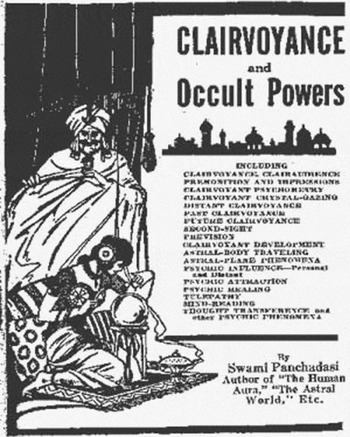
Such explanations abound, stalling narrative action in The Mystery of Cloomber. As the novel proceeds, the narrator begins to rely on them more and more, increasingly convinced of the limited capacities of archives, lists, taxonomies (Figure 4). The narrator's father is a penurious Orientalist, a well-known scholar of Sanskrit, who can quote the Vedas at will; but his knowledge appears esoteric, scattered, and irrelevant to the narrator. Like all telepathic address here, too, narration falters, the rhetoric of linking trembles a little (Derrida, “Telepathy” 26), as the narrator frantically patches together heterogeneous proofs of uncanny events. Betraying his anxieties in opening to the Other, a testimony by the former coachman of Cloomber Hall, an eyewitness account from Heatherstone's doctor, and a verbatim account from the General's journal are all nested within the first-person narration. Troubled by doubt, the narrator – like so many others – cease[s] to believe in the infallibility of his own methods (258–59). He reaches instead toward the East as the novel closes, to a school of philosophers and of savants who, working on different lines from his own, are many thousand years ahead of him in all the essentials of knowledge (259).
Frontispiece, Swami Panchadasi, Clairvoyance and Occult Powers (Chicago: Advanced Thought Pub. 1916), a source for Conan Doyle's investigations in astral matter.

Knots
The utopian will to telepathy, to opening the literary text to native doxai, litters telepathic colonial occult fiction stories with traces of the Other's voice, scarring the body of the text. These scars allow writing “to be led from start to finish and to be driven by a trace, Spur, of a facial wound that I have had since my childhood and that, dont you think, opens the text, holds it open, open-mouthed, the analytic material comes from elsewhere, in my dossier on telepathy, remains epistolary through and through” (Derrida, “Telepathy” 24) A deconstructive postcolonial reading practice would entail picking at the scar, opening the wound to those incalculable epistemological webs generative of colonial occult fiction.
What might this look like as a critical practice? The narrator in The Mystery of Cloomber stages one possibility in the closing pages of the novel where the knowing eye sutures fragments seemingly disjoined from each other. Following the disappearance of General Heatherstone and his astral jailers from Scotland, two fragments appear side by side in The Star of India: one announces the return of three Buddhist priests to India after a short trip to Europe, and the other relays the Major-General Heatherstone's disappearance from his country-house in Wigtownshire. Only a belief in telepathy can establish a liaison between the two news fragments, surmises the narrator, wondering if by chance there was any other human eye but mine which traced a connection between these paragraphs (257).
If we undertake a similar task in analyzing colonial occult fiction, the knowing literary eye might daringly connect fragments, shuttling across the provinces of scholarship. Consider, for example, the discourse on nerves as symptomatic of physical and psychical interpenetration by the other. In the Conan Doyle short story, just returned from India, Sir Dominick Holden is noticeably ill from nerves as his house and psyche are inhabited by a wronged Lascar: he had developed nervous symptoms of a very pronounced character, and so came back, a broken man (10). Holden's condition mirrors anothers attack of paranoia, as General Heatherstone trembles at the thought of incalculable retribution from unseen astral forces: “in these years [that] pass over my head my physical strength decreases and my nerves become less able to bear up against the continual strain” (Mystery 236). Even Kipling's rational Strickland, policeman and detective, succumbs to nerves when confronted with the truths of doxa in The “Mark of the Beast” “He caught hold of the back of a chair, and, without warning, went into an amazing fit of hysterics. It is terrible to see a strong man overtaken with hysteria. Then it struck me that we had fought for Fleetes soul with the Silver Man in that room, and had disgraced ourselves as Englishmen forever, and I laughed and gasped and gurgled just as shamefully as Strickland, while Fleete thought that we had both gone mad” (70).
And before we know it, we are elsewhere. For hypernervous activity in colonial occult fiction is not simply hysteric emasculation. To speak of nerves would be to speak simultaneously of railways and the telegraph, of electricity and psychotherapy. The ever-expanding railways and the telegraph, wires stretching over Empire produced jitters – fears of secret and unseen communications. Within a decade of the Indian Uprising of 1857, Charles Bray despairs of the Hindu Secret Mail: “Important news travels faster in India by Mental Telegraph than by Electric Telegraph. The results of important battles have been known days before the intelligence could arrive by ordinary or official means” (84). Meanwhile, the SPRs First Report on Thought-Reading, explicitly links thought-transference to electricity: There would be nothing inherently impossible in this when we recollect strong similarities exist between nervous and electrical forces (15–16), ran the argument, even as William Stead argued for electrotherapeutics as a cure for hysteria.
And further still, if we were to follow these fragments, we would speak of plasma that closes physical and racial distance between bodies. T. H. Huxley's hypothesis that all biologies derived from the same basic matter, protoplasm, in a uniform and traceable development from simple to complex forms, ratified Darwinian and Spencerian theses, while psychical research privileged ectoplasm that unmoors individual bodies. In 1890, Frederic Myers theorized the telesomatic body in an attempt to describe the transmission of bodies over great physical distance (Proceedings 669). Such thoroughfare is reported by the narrator's gloss on Ram Singh's eclectic theories of astral projection in The Mystery of Cloomber: “In the case of earth-bound spirits, said my authority, some dominant idea obsessing them at the hour of death is sufficient to hold them in this material world. They are amphibian of this life and of the next, capable of passing from one to the other as the turtle passes from land to water” (28).
One could multiply these examples, each discursive fragment demanding a connection with another, dispersing analytic trails, dissolving our master codes.
Postcard
Impossible to follow these knots, they draw us into an incalculable web whose path Derrida entices us to follow:
The conversion is not a resolution nor a solution, it is still the speaking scar of the foreign body half a century already, commemorates the big Turn, its going to go very quickly now. I am going to re-read everything trying out the keys one after the other, but I am not afraid of not finding (or of finding) all alone, of no longer having the time. Will you give me your hand? no more time to lose, Telepathy comes upon us. (Telepathy 38)