Introduction
Kawasaki disease is a condition that causes acute systemic vasculitis, primarily affecting infants and young children. It is the leading cause of acquired heart disease in this age group in the developed world. Reference Newburger, Takahashi and Gerber1,Reference Sun, Zhou and Fu2 The most serious complication of Kawasaki disease is the emergence of coronary artery lesions, including coronary stenosis and aneurysms. These lesions can lead to myocardial ischaemia, infarction, and even sudden death. Reference Kato, Koike, Yamamoto, Ito and Yano3 Despite extensive research, the specific pathogenic mechanisms of Kawasaki disease remain unclear. It is widely accepted that acute inflammation and immune dysregulation are key factors in the onset and complications of Kawasaki disease. Reference Rowley and Shulman4 In addition to the cytokines that are commonly known to be involved in the disease inflammatory response, our previous studies have indicated that Interleukin-35 may also play a role in the development of the disease. Reference Su, Feng, Luo, Liu and Yi5
Interleukin-35 is a cytokine that belongs to the Interleukin-12 family. It is composed of two subunits, Epstein–Barr virus-induced 3 and p35 (Interleukin-12A). Reference Vignali and Kuchroo6 This cytokine is produced primarily during inflammatory responses, particularly by cluster of differentiation 4+ regulatory Treg cells. Reference Li, Mai and Virtue7,Reference Collison, Workman and Kuo8 IL-35 is known for its immunosuppressive and anti-inflammatory effects, and it plays a significant role in various conditions, such as autoimmune encephalomyelitis, Reference Liu, Liu and Zhang9 autoimmune diabetes, Reference Bettini, Castellaw, Lennon, Burton and Vignali10 coronary artery disease, Reference Lin, Huang and Lu11 and atherosclerosis. Reference Kempe, Heinz, Kokai, Devergne, Marx and Wirth12
The p35 subunit, encoded by the Interleukin-12A gene located on chromosome 3q25.33 and consisting of seven exons, has been linked to several diseases. Polymorphisms in this gene are associated with increased susceptibility to Graves’ disease and intracranial aneurysm. Reference Guo, Yang, Liu, Wang, Cui and Ning13,Reference Li, Pan and Sima14 Conversely, the Epstein–Barr virus-induced 3 subunit, encoded by its name gene on chromosome 19q13.3 with five exons, is associated with a reduced risk of premature coronary artery disease through polymorphisms such as Epstein–Barr virus-induced 3 rs428253 and Interleukin-12A rs2243115. Reference Posadas-Sánchez, Pérez-Hernández and Angeles-Martínez15 However, the relationship between Interleukin-12A and Epstein–Barr virus-induced 3 gene polymorphisms and the risk of coronary artery lesions in children with Kawasaki disease remains unexplored.
Our study aimed to investigate the association between Interleukin-35 polymorphisms and Kawasaki disease susceptibility, considering both complete Kawasaki disease and incomplete Kawasaki disease in Chinese children.
Materials and methods
Subjects and data collection
In this study, all Kawasaki disease patients were from the Children’s Hospital of Chongqing Medical University, China. We included a cohort of 94 Kawasaki disease patients, each meeting the clinical diagnostic criteria set by the Japanese Kawasaki Disease Research Committee. 16 The cohort comprised 60 patients with complete Kawasaki disease and 34 with incomplete Kawasaki disease. Complete Kawasaki disease was defined by persistent fever and at least four of the five primary criteria. Reference Newburger, Takahashi and Gerber1 Additionally, 100 healthy children without any known diseases who underwent routine health check-ups in our hospital’s health examination centre were selected as the healthy control group. The study was approved by the Ethics Committee of Children’s Hospital of Chongqing Medical University (Ethical Approval Number: ID245-2024), and informed consent was obtained from the guardians of each child.
The Kawasaki disease patients in our study were categorised into two groups on the basis of the presence or absence of coronary artery lesions: those with coronary artery lesions (n = 68) and those without coronary artery lesions (n = 26). Coronary artery lesions were diagnosed on the basis of specific criteria: an actual internal diameter of 3 mm or more in children under 5 years of age, 4 mm or more in children aged 5 years or older, or if the internal diameter of a coronary segment was at least 1.5 times greater than that of an adjacent segment, as determined by echocardiography. 16,Reference Nakano, Ueda, Saito and Nojima17 Echocardiographic assessments were performed prior to the administration of intravenous immunoglobulin or within two weeks of symptom onset. Additionally, blood samples were collected from Kawasaki disease patients before the initiation of intravenous immunoglobulin therapy, within 10 days of the onset of symptoms.
DNA extraction and genotyping
Genomic DNA was extracted from anticoagulant-containing blood via the Genomic DNA Extraction Kit (TIANGEN, Beijing, China) in accordance with the manufacturer’s instructions and was stored at − 80°C for subsequent experiments. The extracted DNA was subsequently sent to the Huada Gene Research Institute (Wuhan, China) for direct DNA sequencing. Based on previous research and using the MassARRAY system, we selected five Interleukin-35 single-nucleotide polymorphisms for this study: three polymorphisms from the Interleukin-12A gene (rs2243115, rs2243123, and rs583911) and two from the Epstein–Barr virus-induced 3 gene (rs353698 and rs2302164). DNAstar software (DNASTAR Corp, Madison, Wisconsin, United States of America) was used to compare the resulting DNA sequencing diagrams and find related polymorphism sites.
Statistical analysis
Initially, we evaluated the Hardy‒Weinberg equilibrium of the samples. The χ2 test was subsequently used to determine the significance of differences in frequency distributions and genotypes between two groups. The associations of Interleukin-35 polymorphisms with Kawasaki disease susceptibility were quantified via odds ratios and 95% confidence intervals derived from multivariate logistic regression analysis. All the statistical analyses were conducted via Statistical Product and Service Solutions version 18 software (Statistical Product and Service Solutions Inc., Chicago, Illinois, United States of America). We considered a two-sided p value of less than 0.05 to indicate statistical significance.
Results
Clinical characteristics of the study subjects
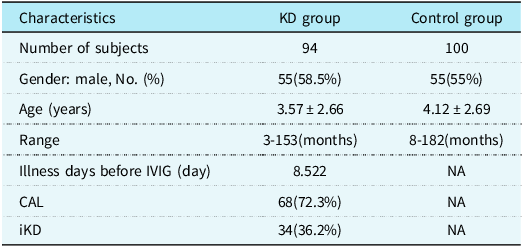
Table 1 shows the characteristics of the subjects. A total of 94 Kawasaki disease patients and 100 controls were recruited for this study. A total of 58.5% of the cases and 55% of the controls were male. The mean ages of the patients and controls were 3.57 ± 2.66 years and 4.12 ± 2.69 years, respectively. Among these Kawasaki disease patients, 72.3% had Kawasaki disease with coronary artery lesions formation, and 36.2% had incomplete Kawasaki disease. The average number of days from the onset of illness to intravenous immunoglobulin treatment in this cohort was 8.522 days.
Basal characteristics of the KD group and the control group

KD = Kawasaki disease; IVIG = intravenous immunoglobulin; No. = number; CAL = coronary artery lesion; iKD = incomplete Kawasaki disease; NA = not applicable.
Interleukin-35 single-nucleotide polymorphisms in the Kawasaki disease and control groups
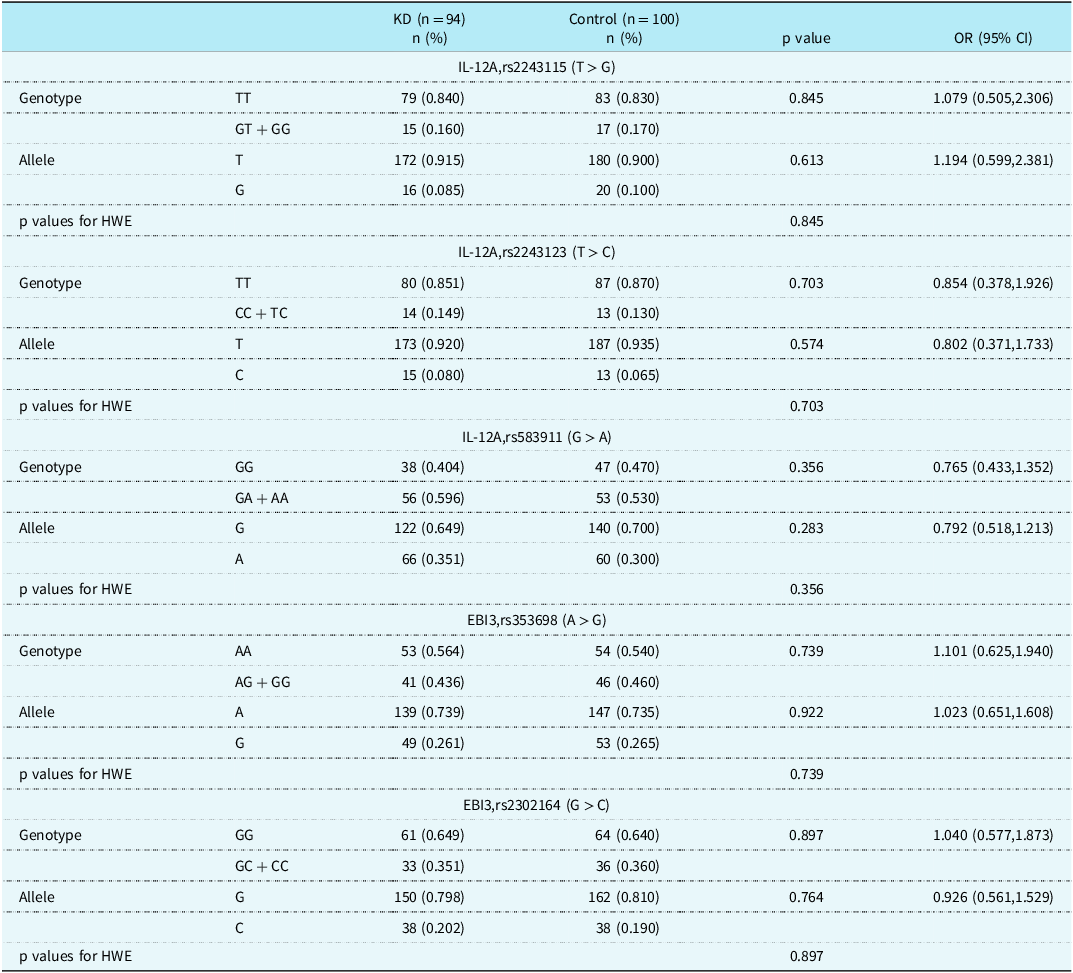
Table 2 presents the allele and genotype frequencies of the five Interleukin-35 polymorphisms in both the Kawasaki disease group and the control group, along with the p-values from Hardy–Weinberg equilibrium testing. There were no significant differences in the allele or genotype frequencies of the Interleukin-35 single-nucleotide polymorphisms between the Kawasaki disease group and the control group. The observed genotype frequencies of all genotyped single-nucleotide polymorphisms in both the Kawasaki disease group and the control group were consistent with the expected frequencies (all p > 0.05).
Genotyping and allele IL-35 SNPs in the KD group and the control group

IL-35, interleukin-35; SNPs, single-nucleotide polymorphisms; KD, Kawasaki disease; IL-12A, interleukin-12A; OR, odds ratio; CI, confidence interval; HWE, Hardy‒Weinberg equilibrium; EBI3, Epstein–Barr virus-induced 3.
Interleukin-35 single-nucleotide polymorphisms in the Kawasaki disease with coronary artery lesions and Kawasaki disease without coronary artery lesions groups
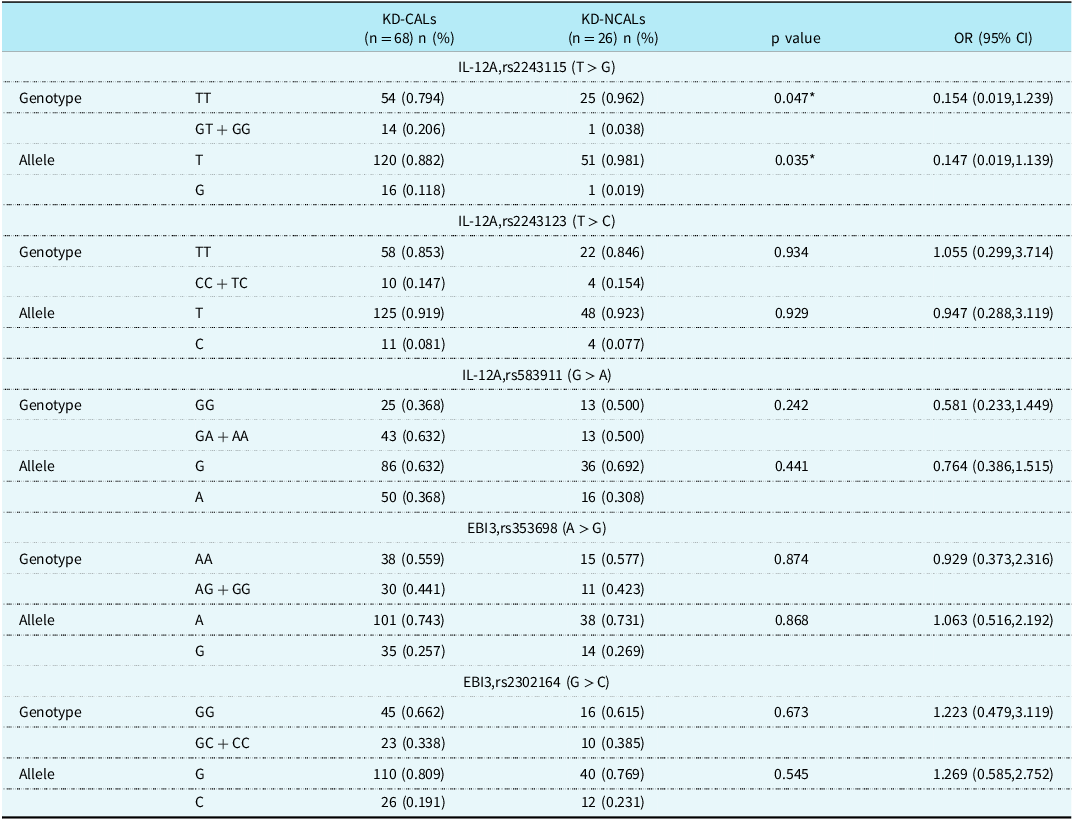
We further assessed whether there were differences in the genotype or allele frequencies of the Interleukin-35 polymorphisms between Kawasaki disease patients with and without coronary artery lesions (Table 3). The frequency of the GT + GG genotype and G allele of rs2243115 (T > G) was significantly greater in the Kawasaki disease with coronary artery lesions group than in the Kawasaki disease without coronary artery lesions group (TT to GT + GG: odds ratio = 0.154, 95% confidence interval = 0.019–1.239, p = 0.047; T to G: odds ratio = 0.147, 95% confidence interval = 0.019–1.139, p = 0.035). These findings suggest that the GT + GG genotype and G allele of rs2243115 might be associated with the risk of developing coronary artery lesions in Chinese children with Kawasaki disease.
Genotyping and allele frequency of IL-35 SNP in the KD-CALs group and KD -NCALs group

IL-35 = interleukin-35; SNP = single-nucleotide polymorphisms; KD-CALs = Kawasaki disease with coronary artery lesions; KD -NCALs = Kawasaki disease without coronary artery lesions; IL-12A = interleukin-12A; OR = odds ratio; CI = confidence interval; EBI3 = Epstein–Barr virus-induced 3. *, p < 0.05.
Interleukin-35 single-nucleotide polymorphisms in the complete Kawasaki disease and incomplete Kawasaki disease groups
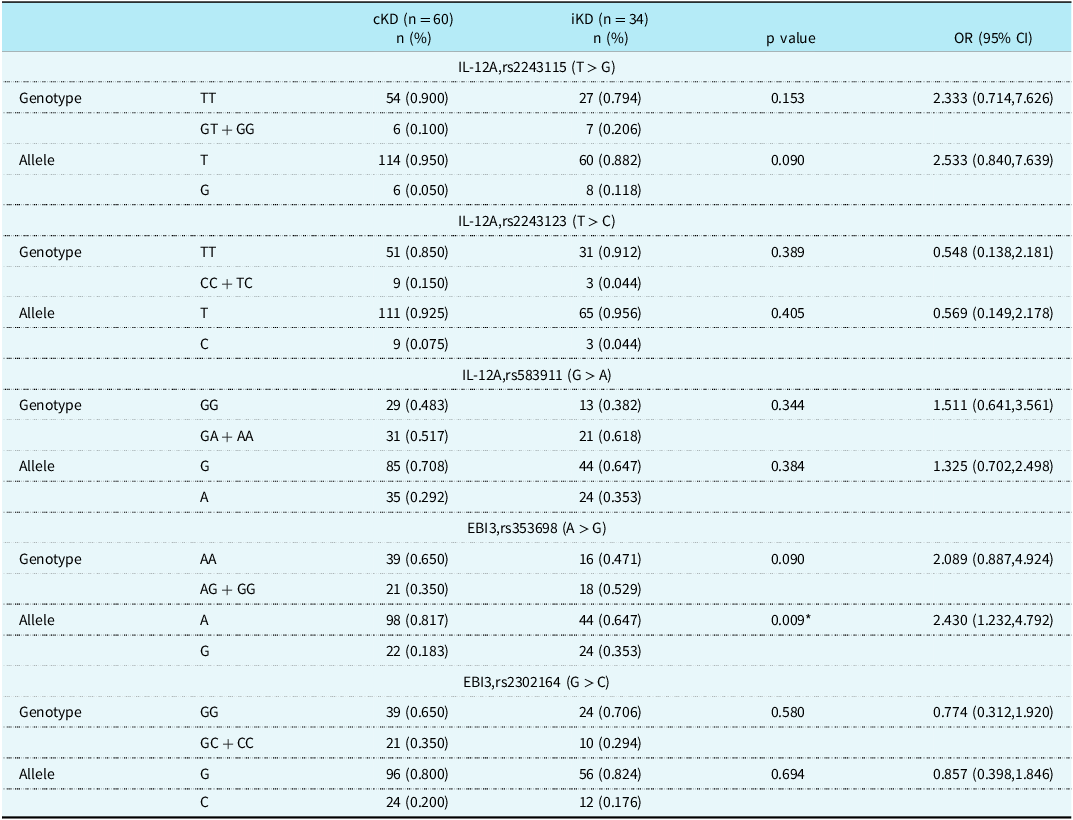
Compared with that in the complete Kawasaki disease group (Table 4), the frequency of the G allele of rs353698 was significantly greater in the incomplete Kawasaki disease group (A to G: odds ratio = 2.430, 95% confidence interval = 1.232–4.792, p = 0.009). This finding suggests that among Kawasaki disease patients, the G allele of rs353698 may be associated with an increased likelihood of presenting with an incomplete phenotype rather than the complete form.
Genotyping and allele frequency of IL-35 SNP in the iKD group and the cKD group

IL-35 = interleukin-35; SNP = singlenucleotide polymorphisms; KD = Kawasaki disease; iKD = incomplete Kawasaki disease; cKD = complete Kawasaki disease; IL-12A = interleukin-12; OR, odds ratio; CI = confidence interval; EBI3 = Epstein–Barr virus-induced 3.* p < 0.05.
Discussion
To our knowledge, this study is an inaugural investigation into the association between Interleukin-35 polymorphisms and Kawasaki disease risk in Chinese children. Our findings revealed (1) no significant differences in Interleukin-35 single-nucleotide polymorphisms between the Kawasaki disease and control groups; (2) a correlation between the GT + GG genotype and the G allele of rs2243115 and an elevated risk of coronary artery lesions; and (3) a significant link between the G allele of rs353698 and an increased likelihood of presenting with an incomplete Kawasaki disease phenotype in Kawasaki disease patients. These results suggest that the GT + GG genotype or G allele of rs2243115 is a potential indicator of Kawasaki disease with coronary artery lesions and may provide insights into the pathogenesis of the disease.
Interleukin-35, an anti-inflammatory cytokine of the Interleukin-6/ Interleukin-12 family, comprises two subunits: one encoded by the Epstein–Barr virus-induced 3 gene on chromosome 19q13.3 and the other by the Interleukin-12A (p35) gene on chromosome 3q25.33. The polymorphisms rs2243115, rs2243123, and rs583911 are located in the Interleukin-12A promoter region, whereas rs353698 and rs2302164 are in the Epstein–Barr virus-induced 3 promoter region. Research suggests that Interleukin-35 polymorphisms (both Epstein–Barr virus-induced 3 and Interleukin-12A) significantly reduce coronary artery disease. Reference Posadas-Sánchez, Pérez-Hernández and Angeles-Martínez15 risk. Interleukin-12A polymorphisms have been associated with various conditions, such as rheumatoid arthritis, Reference Shen, Zhang, Zhou and Liu18 Graves’ disease, Reference Guo, Yang, Liu, Wang, Cui and Ning13 asthma, and atopic dermatitis, Reference Namkung, Lee and Kim19 whereas Epstein–Barr virus-induced 3 polymorphisms are associated with coronary heart disease, Reference Lin, Xue and Huang20 allergic rhinitis, Reference Zhang, Duan, Wei, Zhao, Zhao and Zhang21 and pulmonary tuberculosis. Reference Zheng, Liu and Song22 Several studies have reported an association between Interleukin-35 gene polymorphisms and autoimmune inflammatory diseases (such as systemic lupus erythematosus Reference Guan, Liu and Mao23 ) as well as cardiovascular diseases (such as coronary artery disease). Reference Li, Liu, Huang, Zhu and Wang24 Kawasaki disease is an acute autoimmune vasculitis associated with an increased risk of coronary artery disease. Reference Buda, Friedman-Gruszczyńska and Książyk25 However, to date, no studies have investigated the association between Interleukin-35 gene polymorphisms and Kawasaki disease. In our current hospital-based case‒control study, we explored the associations between Interleukin-35 polymorphisms and coronary artery lesions in Chinese children diagnosed with Kawasaki disease. Our findings revealed no significant differences in Interleukin-35 polymorphisms between the Kawasaki disease and control groups. However, previous studies, include our own, have suggested that serum Interleukin-35 levels are implicated in the development of Kawasaki disease. Reference Su, Feng, Luo, Liu and Yi5,Reference Li and Xing26,Reference Sun and Xing27 These findings imply that Interleukin-35 expression is a multifaceted process influenced by DNA variation and/or other mechanisms and that serum Interleukin-35 levels might not be directly correlated with Interleukin-35 polymorphisms.
In our study, we observed a notably greater prevalence of the GT + GG genotype and G allele of the Interleukin-12A rs2243115 single nucleotide polymorphism in Kawasaki disease patients with coronary artery lesions than in those without coronary artery lesions. This association indicates a potential role for the Interleukin-12A rs2243115 single nucleotide polymorphism in the development of coronary artery lesions in Chinese children with Kawasaki disease. Additionally, recent studies have linked this single nucleotide polymorphism with increased risks of brain tumours and Graves’ disease. Reference Guo, Yang, Liu, Wang, Cui and Ning13,Reference Sima, Xu, Li, Luo, Liu and You28 Interestingly, our results also show that the Interleukin-35 polymorphisms rs2243123, rs583911, and rs2302164 do not significantly differ between patient groups, suggesting that they have little effect on coronary artery lesions development in Chinese children with Kawasaki disease and are not effective in differentiating between incomplete Kawasaki disease and complete Kawasaki disease. These findings highlight Interleukin-12A rs2243115 as a potential risk marker for various diseases and highlight the limited role of some Interleukin-35 polymorphisms.
The cohort in this study exhibited a higher-than-expected incidence of coronary artery lesions in children with Kawasaki disease. Reference An, Kim and Song29 We speculate that this may be attributed to a combination of factors, including 1) The relatively small sample size in this study, which may have led to a higher-than-expected incidence of coronary artery lesions compared to the general population. 2) The longer time from onset of fever to intravenous immunoglobulin treatment in this cohort, with an average delay of 8.522 days. Delayed intravenous immunoglobulin treatment is known to be a key factor in the development of coronary artery lesions. Reference Qiu, He and Rong30,Reference Bal, Prasad, Umali Pamintuan, Mammen-Prasad and Petrova31 This prolonged delay in treatment may have contributed to the increased incidence of coronary artery lesions observed. Therefore, it is likely that these factors played a significant role in the observed findings in our study cohort.
The emergence of the classification of incomplete Kawasaki disease in patients who do not fully meet the Kawasaki disease criteria has been a recent development. Notably, incomplete Kawasaki disease patients have a greater susceptibility to coronary artery lesions. Reference Newburger, Takahashi and Gerber1,Reference Liu, Gao, Huo and Yi32 Early diagnosis of incomplete Kawasaki disease is crucial yet challenging because of difficulties in meeting the full Kawasaki disease criteria. Our study revealed an increased prevalence of the G allele in the Epstein–Barr virus-induced 3 rs353698 polymorphism in incomplete Kawasaki disease patients compared with those with complete Kawasaki disease, suggesting that the G allele of rs353698 is significantly associated with the risk of incomplete Kawasaki disease. However, the G allele of rs353698 should not be considered a diagnostic marker for Kawasaki disease at this stage. Further studies are required, and it may provide insights into understanding the pathogenesis and potential differences between complete and incomplete Kawasaki disease.
It is crucial to recognise certain limitations of our study. First, given our exclusive focus on Chinese children, caution is warranted when these findings are extended to other ethnicities. Second, the sample size was relatively small, necessitating larger studies to confirm and extend our findings.
In summary, our research significantly elucidates the link between the Interleukin-35 polymorphism rs2243115 (T > G) and increased susceptibility to coronary artery lesions in Chinese children with Kawasaki disease. Moreover, our results revealed a notable association between the Interleukin-35 polymorphism rs353698 (A > G) and incomplete Kawasaki disease. These findings provide valuable insights into the pathogenesis of Kawasaki disease, particularly with regard to its incomplete form. However, further research is necessary to explore the potential of Interleukin-35 polymorphisms, including rs353698, as biomarkers or diagnostic tools for Kawasaki disease.
Acknowledgements
None.
Financial support
This study was funded by Chongqing Municipal Science and Technology Bureau Natural Science Foundation project(;CSTB2023NSCQ-MSX0144);.
Competing interests
None.
Ethical standard
The authors assert that all procedures contributing to this work comply with the ethical standards of China guidelines on human experimentation and with the Helsinki Declaration of 1975, as revised in 2008, and has been approved by the Ethics Committee of Children’s Hospital of Chongqing Medical University, with reference number ID245-2024, and informed consent was obtained from the guardians of each participating child.