INTRODUCTION
Because it has the potential to foster deliberative democratic goals (Mutz Reference Mutz2002a; Reference Mutz2006), much has been written on interpersonal political disagreement, and the social loci that may foster such discourse. The workplace has been hailed as a fruitful context for encountering difference (Mutz Reference Mutz2006; Mutz and Mondak Reference Mutz and Mondak2006), but at the same time other prominent institutions of adult life — most notably the church — have been downplayed, as it has been argued that processes of self-selection produce politically homogeneous environments within these settings. However, given the limitations of existing studies of interpersonal disagreement, conventional scholarly treatments of religion, and a sizable body of work demonstrating the potential of churches to generate social capital and teach civic skills (Burns 2002; Burns, Scholzman and Verba Reference Burns, Schlozman and Verba2001; Verba, Brady and Schlozman 1995; Wald Reference Wald, Sigelman, Smidt and Penning1997; Djupe and Gilbert Reference Djupe and Gilbert2006), there is reason to think that scholars frequently under-estimate the amount of disagreement present in interpersonal discussion networks, and have been too quick to dismiss the importance of other organizational contexts — particularly places of worship — as sources of cross-cutting discussion.
In this article, we assess the status of disagreement in (1) networks and (2) organizational contexts to investigate whether the optimistic or pessimistic view of the church has greater empirical support. In contrast with previous studies, we find that the church is indeed a valuable source of political difference. However, we begin our analysis from a unique vantage point that speaks to the broader literature on social influence, looking for interpersonal political disagreement at the very moment when we should be least likely to observe it: Election Day (Berelson et al. Reference Berelson, Lazarsfeld and McPhee1954; Huckfeldt and Sprague, Reference Huckfeldt and Sprague1995). In making our case, we present new, issue-specific measures of political discussion and disagreement, all embedded in the first exit poll study to include detailed questions concerning respondents’ social networks. Thus, we make original empirical contributions to the field while simultaneously raising questions about existing conclusions.
In the following sections, we first discuss conventional measurement strategies, making an argument for why extant scholarship potentially underestimates the amount of political disagreement in networks. We then extend our discussion to the contexts in which such encounters take place, noting the theoretical reasons why churches have traditionally, and unfairly, been labeled as politically homogeneous. In the empirical sections, we present our exit poll data and measures, providing evidence that these religious institutions are valuable sources of cross-cutting discourse. Importantly, we find that looking at issue-specific patterns of conversation does more than introduce additional variance; it reveals insights about how networks are employed during campaigns, and in particular, suggests that when it comes to informing the citizenry, church-related networks may pick up where broader information environments leave off.
THE MEASUREMENT OF NETWORKS
Large-N studies of social influence often include batteries that use a name generator to gain dyadic, or “ego-centric” information on interpersonal networks: a respondent is asked to name the first three or four people (that come to mind) with which she discusses either “important” or “political” matters, and is then asked a series of questions about each named individual. First developed in sociology, this methodology has become common practice, as it is thought to adequately reflect individuals’ core networks (e.g., Marsden Reference Marsden1987). Although the nature of the name generator has previously been the subject of some debate, Rolfe et al. (Reference Rolfe, McClurg and Klofstad2008) demonstrate that “important matters” and “political matters” prompts produce largely similar networks (see also Huckfeldt and Mendez 2008).
The measurement of interpersonal disagreement has also been approached from a number of angles, with various questions embedded in standard discussion batteries; some studies have included more items than others. For example, in the 2000 American National Election Study (Burns et al. Reference Burns, Kinder, Rosenstone and Sapiro2002), the measure of difference is limited to the candidate preference of the discussant versus the main respondent; at the other extreme, the 1996 Spencer Foundation survey (Mutz Reference Mutz2002a; Reference Mutz2002b; Reference Mutz2006; Mutz and Martin Reference Mutz and Martin2001) includes five items, asking respondents about the partisanship and candidate preferences of their network associates, the general strength and frequency of disagreement with their political discussants, and for an overall assessment of the similarity of their political views versus their discussants. Other surveys, whether national or community-oriented (e.g., Huckfeldt and Sprague's (1984) South Bend Study), have included items similar to these, although most have only one or two at a time.
Interpersonal Disagreement and the Survey Response
While measures of difference such as candidate preference, partisanship, and the overall extent/frequency of disagreement have yielded many scholarly insights, in one sense, all such items are fairly blunt, generalizing past the subject of disagreement between a respondent and her discussants. We argue that this has real consequences for the amount of disagreement observed in networks, but equally importantly, for our substantive understanding of how people employ their networks when searching for and processing political information.
Scholars have found that respondents are fairly accurate when reporting on the vote preferences of their discussion partners (Huckfeldt and Sprague Reference Huckfeldt and Sprague1995). But when it comes to reporting on the extent and frequency of disagreement, vague questions lead to imprecision — they require a person to quickly produce an estimate of the frequency of “general disagreement” and map it onto a provided response set. As cognitive tasks involving behavioral frequency can lead to errors in reporting at a number of stages in the response process (Groves et al. Reference Groves, Fowler, Couper, Lepkowski, Singer and Tourangeau2004; Tourangeau et al. Reference Tourangeau, Rips and Rasinski2000), some respondent inaccuracy is inevitable when using any question of this kind.
However, conventional strategies for measuring disagreement in networks likely amplify this error, as items asking about “overall” dyadic disagreement do not prompt respondents to remember the subject matter(s) of cross-cutting discourse. Consequently, impression-based estimation strategies meet with more imprecision, as respondents average their counts across topics (perhaps recalling some subjects of conversation, but not others) (Groves et al. Reference Groves, Fowler, Couper, Lepkowski, Singer and Tourangeau2004). When we combine this psychology of the response process with the more general findings that respondents tend to over-report agreement (Huckfeldt and Sprague Reference Huckfeldt and Sprague1995), and that agreement increases with intimacy (Mutz Reference Mutz2006) — that is, with the very family members and close friends likely to be picked up in conventional, “core” network batteries — we suspect that more often than not the mistake is likely an underestimate of the extent to which disagreement exists in networks, and in the social contexts (such as the church) that play host to such networks.
While by no means a perfect fix, we take a different tack, introducing novel measures designed to tap the frequency of discussion and disagreement with respect to the specific political issues encountered by voters during a campaign season. Our idea is that by decomposing a measure of disagreement into a series of items asking about differences with respect to different topics (e.g., disagreement with respect to “the economy,” with respect to “the war in Iraq,” etc.), we essentially introduce a form of aided recall, which has been demonstrated to produce higher levels of reported behavior by helping “respondents remember events that would otherwise be forgotten” (Bradburn et al. Reference Bradburn, Sudman and Wansink2004, 58; Sudman and Bradburn 1974). With respect to the context of the church, we expect an issue-based strategy to produce more reported disagreement for an additional reason: respondents may be more likely to report such church-based conversations when they interpret them as being about “social issues” rather than “campaigns” or candidates.” Djupe and Gilbert (2009) have found respondents uncomfortable attaching political labels to church, and other scholars have found that little explicit electioneering takes place within such bodies (e.g., Kohut et al. Reference Kohut, Green, Keeter and Toth2000).
We expect such an approach to uncover variance in experienced disagreement that has been hidden by conventional approaches and measures. Of equal importance, however, we note that knowing about the content of political discussion affords us an opportunity to better understand how people use their networks to acquire and make sense of information during an election campaign. That is, if individuals use their discussants as information shortcuts (Downs Reference Downs1957; Huckfeldt and Sprague Reference Huckfeldt and Sprague1995), it makes sense to think that they do so purposively, seeking out conversation on topics about which they are uncertain, know relatively little, or on which less information is readily-available via the media and broader electoral context.Footnote 1
Timing Matters
Our design is also driven by a second concern: time. Standard discussion measures have been included in surveys conducted over multiple-week spans either before or after the votes have been tallied, meaning that respondents were interviewed at various points in time relative to the campaign. However, the first generation of social influence research (e.g., Berelson et al. Reference Berelson, Lazarsfeld and McPhee1954) provided a basic set of hypotheses regarding social networks and electoral contexts: politically charged times — such as during the final stretch of a general election — should ignite political conversation while extinguishing diversity in social circles. The Columbia sociologists argued that interaction over the course of a campaign would induce homogeneity through conformity pressures and lower levels of tolerance for dissonant political views. Recent studies have followed this lead and have generally ratified these conclusions, examining social influence during campaigns (e.g., Mutz (Reference Mutz2002a; Reference Mutz2002b); although see Huckfeldt, Johnson and Sprague (2004) on the survival of political disagreement). Accordingly, if we are going to gauge political disagreement, this extensive body of research suggests that the hardest test remains: we need to measure disagreement across a sample of voters at a single point in time, and at the moment when we should be least likely to observe it. We address both of these points through our exit poll methodology.
Beyond Core Networks: A New Way of Looking at an Old Problem
As noted above, we are not trying to over-claim with respect to our design and measurement — indeed, an exit poll approach has its drawbacks and presents a unique set of challenges. While the methodology provides us with leverage on the important temporal hypothesis, it also imposes substantial constraints, cutting down on the number of items that can be asked (and asked successfully). Given issues of space — our questionnaire was limited, by necessity, to one sheet, front and back — we were unable to include a conventional network battery.
Instead, we followed a different approach, asking respondents to report on how frequently they discussed “the following issues with other people this year.” Following this prompt, eight different issues were listed, and respondents were instructed to circle their frequency of discussion (on the four-point response scale provided) for each issue. This issue-specific battery was then repeated, only the second time asking respondents to report on the frequency of disagreement for each issue. Other major dimensions of social networks — including their political homogeneity, density, levels of political expertise, and the organizational contexts in which they are embedded — were tapped through items adapted to this new, condensed visual mode; all of these items used a similar, but again non-person-specific “issue” prompt (please see Appendix A for the full question wording on all network items).
Although in some ways the inclusion of a standard name generator would have been desirable (to maintain strict comparability with previous studies), we view our solution to these mode-induced constraints as a new, useful approach to an old problem rather than as a weakness or limitation. The existing literature effectively taps core relationships and produces detailed information on dyadic interactions. However, as core networks tend to be filled with social intimates (Mutz Reference Mutz2006), and as vague questions have been used to tease out these social dynamics, we think our set-up can help shed light on the disagreement debate, applying a different perspective to a thorny problem.
Our use of a non-person specific discussion prompt provides a different glimpse of networks — one that likely captures a broader assessment of social dynamics that extends beyond close social ties (for a recent examination of the consequences of employing conventional versus unconventional network measurement strategies, see Eveland et al. (Reference Eveland, Hively and Morey2009)). We acknowledge that answers provided to such a question represent a different kind of impression based-estimation and averaging (specifically, an averaging across dyads). But while information is lost with respect to particular discussants, such a snapshot is valuable in that it may in some ways better represent a voter's overall social experience during an election campaign — perhaps the summary, updated “social impression” that a voter takes into the booth (and only minutes before we interviewed them) (Lodge et al. Reference Lodge, McGraw and Stroh1989). Core networks are important, but many political encounters occur outside of the “first four people that come to mind.” Thus, while our respondents’ reports are likely largely driven by their “close ties,” our approach allows peripheral discussants and discussions to be taken into account — albeit imperfectly — in a way that they simply are not in conventional network batteries. Moreover, while we sacrifice a bit in the measurement of the network, we still gain with respect to the central question at hand: political disagreement.
THE CHURCH AS AN IMPORTANT CONTEXT OF POLITICAL DISAGREEMENT
In their influential work on political participation and tolerance, Mutz (Reference Mutz2006) and Mutz and Mondak (Reference Mutz and Mondak2006) examine the church as a context for political discussion, although more in relation to other institutions of adult life such as the home, workplace, and (other) civic organizations than as an end in itself. Looking at a national Spencer Foundation Survey, Mutz (Reference Mutz2006, 28) writes:
Places of worship and all other voluntary associations combine to account for just under 5 percent of political discussants, thus suggesting that these social contexts are not exactly hot spots for the development of relationships that lead to political discourse.
Although Mutz and Mondak (Reference Mutz and Mondak2006, 141) acknowledge that “politically consequential social interaction does occur within places of worship,” they assert that “the capacity of the church to sustain cross-cutting political discourse is more questionable because one effect of interaction within the church is increasing attitudinal homogeneity.” The authors go on to extol the workplace as the ideal context for cross-cutting political discourse, and conclude that religious institutions lag behind other contexts when it comes to advancing democratic deliberative goals.
Misperceptions of Political Homogeneity and the Case for Re-Examining the Church
While we do not dispute that the workplace is potentially a rich-source of cross-cutting political discourse, we disagree with the characterization of the church as a politically homogeneous institution, and argue that this misperception has been propelled by the aforementioned, core-network measurement strategies, but also by conventional approaches to the study of religion and politics. Comporting with the rise of survey research and the social-psychological, Michigan model of voting behavior (e.g., Campbell et al. (Reference Campbell, Converse, Miller and Stokes1960)), the standard approach to studying religion, at least in the American context, has been largely individualistic, grounded in the notion that understanding what people believe and how people behave within different religious traditions — aggregate categories created by combining different denominations that share common beliefs, practices, and patterns of historical development (Kellstedt et al. Reference Kellstedt, Green, Guth, Smidt, Green, Guth, Smidt and Kellstedt1996; Kellstedt and Green Reference Kellstedt, Green, Leege and Kellstedt1993) — are the key pieces of religious life needed to predict political behavior (Guth et al. Reference Guth, Jelen, Kellstedt, Smidt and Wald1988; Kellstedt Reference Kellstedt and Jelen1989; Leege and Kellstedt Reference Leege and Kellstedt1993; Leege Reference Leege, Smelser and Baltes2001).Footnote 2
However, individualistic measures of religious commitment, by their very nature, exclude the church social context.Footnote 3 After all, “the doctrinal approach seeks to develop mental, rather than social measures of religion” (Guth et al. Reference Guth, Jelen, Kellstedt, Smidt and Wald1988, 367) — thus, religious commitment approaches have largely avoided or assumed away exposure to disagreement altogether. And, this is problematic if we take seriously the arguments that individual religious meaning is largely socially determined (Cavendish, Welch and Leege Reference Cavendish, Welch and Leege1998), or more generally, that religious contexts can have a significant impact upon political behavior (Djupe and Gilbert Reference Djupe and Gilbert2006; Gilbert Reference Gilbert1993; Huckfeldt, Plutzer and Sprague 1993; Jelen Reference Jelen1992; Wald, Owen and Hill Reference Wald, Owen and Hill1988). As Wuthnow (Reference Wuthnow1999, xxxi–xxxii) notes:
Effective religious socialization comes about through embedded practices; that is, through specific, deliberate religious activities that are firmly intertwined with the daily habits of family routines, of eating and sleeping, of having conversations, of adorning the spaces in which people live, of celebrating the holidays, and of being part of the community.
A small but established body of work has focused on the impact of the church context, and more specifically on the potential for influence through the social interaction and activities taking place therein (e.g., Djupe and Gilbert 2002; Gilbert Reference Gilbert1993; Huckfeldt, Plutzer and Sprague 1993; Jelen Reference Jelen1992; Wald, Owen and Hill Reference Wald, Owen and Hill1988; 1990). This prior research points to the clear need to examine the social and communal aspects of religion, as they may provide a better understanding of the conditions under which opinion development, influence, skill subsidization, and mobilization take place (Verba et al. Reference Verba, Schlozman and Brady1995). In addition, work in this vein that has employed national, congregation-level data has found discernable and consequential political heterogeneity within churches (Djupe and Gilbert Reference Djupe and Gilbert2006; Djupe, Sokhey and Gilbert Reference Djupe, Sokhey and Gilbert2007) — something that makes sense as people go to church for many reasons (Trueheart Reference Trueheart1996), and clergy often serve as sources of disagreeable information (e.g., Djupe and Neiheisel Reference Djupe and Neiheisel2008). Thus, although there is a wide-spread perception that churches are dominated by attitudinal homogeneity, the supporting empirical evidence is mixed, with questions lingering about how we should best measure disagreement in networks, few data sets (and analyses) including church-level measures, and those that have such measures demonstrating real diversity.Footnote 4 We take this as sufficient motivation to reexamine the church as a context for cross-cutting political discussion.
EXIT POLL DATA AND DESIGN
The data come from the 2006 Ohio Colleges Exit Poll, a survey of 1,049 voters designed and directed by the authors on Election Day, 2006 in conjunction with the Center for the Study of Elections and Democracy at Brigham Young University. The study was conducted with the help of over 150 student-interviewers who were positioned at 50 sampled polling locations throughout Franklin County, Ohio (the home of Columbus and several large suburbs)Footnote 5 — a county studied by others because of its diversity and generalizability.Footnote 6 Student-interviewers were required to undergo training sessions on professionalism and procedure, and roving teams supervised their performance on Election Day. Interviews were conducted for the duration of the time the polls were open, and subjects were approached using intervals (specific to the polling location) that began on randomly assigned starting numbers. Upon gaining a selected voter's cooperation, interviewers handed the voter a clipboard with the questionnaire, which was then self-administered by the respondent.Footnote 7
Although the number of questions that can be asked in an exit poll is somewhat limited, we were able to include items tapping most of the concepts typically found in longer surveys (e.g., partisanship, ideology, demographics). Moreover, as noted in the previous section, we posed a series of novel questions — to our knowledge, the first to be included in an exit poll — asking for detailed information concerning individuals’ interpersonal discussion networks, and focusing on the issue content of political discussion and disagreement. Because time and space limitations precluded the use of a conventional network battery, we designed new measures to effectively tap the critical dimensions of voters’ networks (again, please see the Appendix for a full description).
COMPETING CONTEXTS
We begin by examining the distribution of voters’ discussants across various institutions of adult life, before highlighting one in particular: the church. After finding evidence that religious bodies provide fertile contexts for political disagreement, we examine issue-specific patterns of agreement and disagreement, before conducting a more systematic test of the church's capacity to foster cross-cutting discourse.
The Church vs. the Workplace
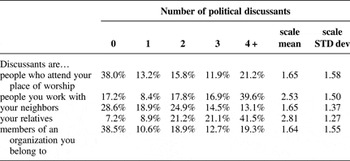
Table 1 presents the number of political discussants reported by individuals across five different contexts: the church, the workplace, the neighborhood, the home/family (relatives), and other voluntary organizations. The church ties for third (behind the workplace and family) in terms of mean number of discussants, as well as the percentage of respondents who have four or more discussants from that particular context; the family leads, suggesting overlap between our general measure of networks and more conventional name generator approaches. In terms of the percentage of respondents having no discussants at all from any given context, the church ranks second to other voluntary organizations. Overall, then, the church appears to be a viable context for political talk, but one unlikely to be the most prolific generator of political discussants.
Voters' political discussion contexts, 2006 election

Notes:Percentages calculated across rows, may not sum to 100% due to rounding; means calculated on 0 to 4 scale.
Data source:2006 Ohio Colleges Exit Poll.
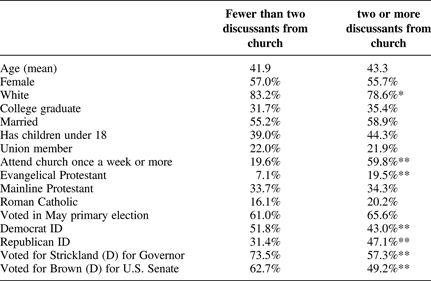
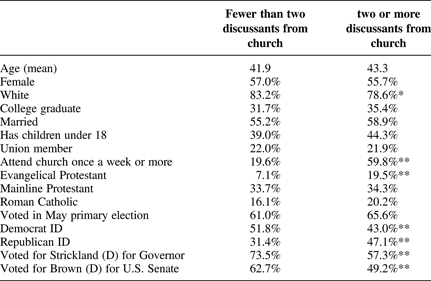
What does our Election Day picture of church-based networks look like? Table 2 presents t-tests of characteristics for individuals with two or more discussants from church versus those with fewer than two church discussants. The demographic profile of those with church-based networks is quite similar in many respects to the profile of those without such networks. There are no significant differences with respect to age, gender, educational attainment, marital and family status, union membership, or affiliation as a Mainline Protestant or Roman Catholic. Nor are there differences in the level of reported participation in the May 2006 primary election. However, compared to individuals with fewer church-based discussants, respondents in social networks with multiple fellow congregants are less likely to be white, attend church more frequently, are evangelical and Republican in higher numbers, and are more likely to have voted for Republican candidates in the 2006 elections. Neither the fact that those with multiple church-based discussion partners are more likely to attend religious services nor the fact that they are more Republican-leaning is unexpected; if anything, one might have expected the magnitude of these differences to be even greater.Footnote 8 What is noteworthy — and perhaps surprising — in Table 2 is the considerable extent to which those with church-based networks have a similar demographic profile to those without such networks.
Profile of voters with discussants from place of worship
**difference across columns statistically significant at p < 0.05.
*difference across columns statistically significant at p < 0.10.
Data source:2006 Ohio Colleges Exit Poll.
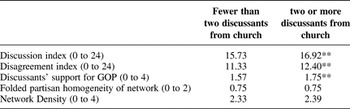
Further description of the nature of church-based discussion networks is found in Table 3, which presents a profile of these networks’ characteristics. Mean differences between those with two or more church discussants and those with fewer than two such discussants are shown for five network variables. The first variable is an additive index measuring the frequency of discussion on eight distinct issues: abortion, corruption in government, the economy, education, gay marriage, health care, taxes, and the war in Iraq. Respondents indicated the level of discussion of each issue, ranging from “never” (0) to “often” (3). These values were then summed over the eight issues to produce an index ranging from 0 to 24 (see Appendix for details of all variable coding). The second indicator is central to our article: the index measuring frequency of disagreement on the same eight issues. The third item is a measure of the partisan leanings of the respondent's discussants that ranges from completely supportive of the Democrats (0) to completely supportive of the Republicans (4). The fourth characteristic is the partisan homogeneity of the network, captured by folding the aforementioned measure of the discussants’ partisan support; the fifth is a measure of network density, tapped by asking the respondent how many of the discussants know each other (none, very few, some, most, or all).
Characteristics of discussion network by church context

Notes:Entries are means; scale range in parentheses.
**difference across columns statistically significant at p < 0.05.
*difference across columns statistically significant at p < 0.10.
Data source:2006 Ohio Colleges Exit Poll.
As noted, recent research by Mutz and Mondak (Reference Mutz and Mondak2006; see also Mutz Reference Mutz2006) has cast doubt on the utility of the church as a generator of relationships that lead to cross-cutting discussions — discussions that expose individuals to various political viewpoints. However, the results in Table 3 paint a different picture of church-based networks. The mean level of political discussion is significantly higher for those individuals with church-based networks than it is for those without discussants from church. Even more importantly, the mean level of disagreement over issues is significantly higher as well. Although church-based discussion networks are, on average, more supportive of the Republicans, there are no differences in the overall partisan homogeneity or density of the networks. This suggests that, contrary to the expectations of Mutz and colleagues, the church context does not appear to be too attitudinally homogeneous to yield cross-cutting political discussions. Importantly, it is worth reiterating that we find this result on Election Day, when theory tells us that individuals should be most likely to downplay political disagreement.
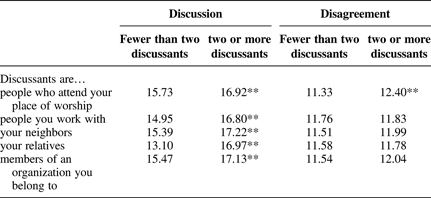
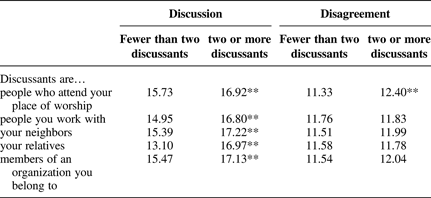
How does the place of worship compare with other institutional contexts in terms of its potential for disagreeable political discussion? Looking at the 1992 Cross-National Election Project, Mutz and Mondak (Reference Mutz and Mondak2006) conclude that the church ranks last among contexts — specifically, behind the workplace, the neighborhood, and “other” — in terms of exposing people to disagreement. However, our data tell a much different story. Table 4 presents tests parallel to those shown in the first two rows of Table 3, but across the five contexts discussed previously: church; workplace; neighborhood; family; and voluntary organizations. Each of the discussion contexts has a statistically significant, positive influence on the frequency of political discussion. The largest mean difference is found for the family context (3.87 scale points), followed by the workplace, neighborhood, voluntary organization, and church (mean differences between 1.2 and 1.9 scale points). However, an important result is found with respect to frequency of disagreement: only the church context produces a statistically significant difference.
Frequency of issue discussion and disagreement by political discussion context
Note: Entries are means calculated on 0 to 24 scale.
**difference across columns statistically significant at p < 0.05.
*difference across columns statistically significant at p < 0.10.
Data source:2006 Ohio Colleges Exit Poll.
Indeed, using a new approach to the measurement of disagreement, we find evidence that stands in contrast to previous findings: the church context appears to be effective — perhaps uniquely so — in generating political discussions that include disparate points of view. The fact that these networks are demographically similar to non-church networks (Table 2) lends support to this finding.Footnote 9
ISSUE-SPECIFIC DISCUSSION AND DISAGREEMENT
Thus far, we have provided preliminary evidence that the church is a context that can bolster political discussion and exposure to political disagreement. But are there issue specific patterns to the political discussion generated in church contexts? And, what might such patterns tell us about the relationship between such institutions of adult life and broader campaign environments?
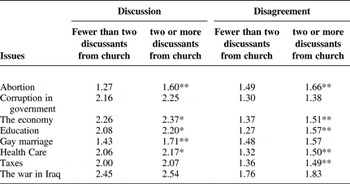
In Table 5, we examine the mean levels of discussion and disagreement — across specific issues — in church-based social networks (again, those with two or more discussants versus those with fewer than two discussants from the church). Looking at political discussion and disagreement, we observe that voters with church-based discussion partners had significantly higher levels of both types of conversation on the issues of abortion, the economy, education, health care, and taxes. Conspicuous is the absence of statistically significant differences — again, both for mean levels of discussion and disagreement — for the issues that dominated the 2006 elections: Iraq and corruption in government. Footnote 10 We take these simple descriptive statistics as suggestive that church-based networks provided voters with links to additional information on issues that were otherwise not receiving much attention given the dominant national- and state-level themes. Set against the broader context of the 2006 election, the patterns of issue-specific discussion and disagreement make sense, and lend our approach to capturing networks additional credibility.
Frequency of discussion and disagreement on political issues by church context

Note: Entries are means calculated on 0 to 3 scale.
**difference across columns statistically significant at p < 0.05.
*difference across columns statistically significant at p < 0.10.
Data source:2006 Ohio Colleges Exit Poll.
PREDICTING DISCUSSION AND DISAGREEMENT
Having observed varying amounts of political discussion and disagreement across different social contexts, and differences in the content of political discussion and disagreement generated in the church context, in this final section, we now examine such levels more systematically in multivariate models. What factors drive exposure to cross-cutting talk, and does the relationship between the nature of one's discussants and the frequency of disagreement hold up once we take into account other individual-level characteristics?
Results: Discussion
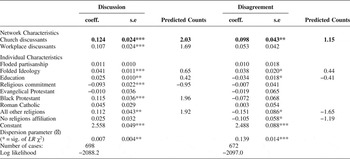
In Table 6, we present models predicting political discussion and political disagreement. The dependent variables in these models are the indexes of issue discussion and disagreement analyzed earlier in the paper; these are regressed on several independent variables that prior research suggests may be related to levels of political discussion and disagreement.Footnote 11 To test the conclusions of Mutz (Reference Mutz2006) and Mutz and Mondak (Reference Mutz and Mondak2006), we include indicators of church-based networks and of workplace networks; these dichotomous measures are coded 1 if the respondent has two or more discussants from the particular context, and 0 if there are fewer than two discussants. Also included in the model are three individual-level characteristics that theory suggests would influence the way a citizen talks about politics: ideological extremity (folded seven-point liberal-conservative scale), partisan extremity (folded seven-point party identification scale), and level of education. The ideology and education variables may partly serve as proxies for political sophistication and/or interest (no direct measures are available from the exit poll questionnaire); both are expected to have a positive relationship to political discussion. Finally, the models contain several commonplace religion variables, including a standard religious commitment scale (formed from questions about frequency of church attendance and the amount of guidance that religion provides), and dummy variables for religious tradition (with Mainline Protestant as the excluded reference category). Importantly, the inclusion of these religion variables allows us to establish that our church network variable is distinct from standard religiosity measures. This is critical if we are to demonstrate that there is something about the context, and not the individual, that produces disagreement.
Models of issue discussion and disagreement

***p <0.01.
**p < 0.05.
* p < 0.10.
Note: negative binomial regression; dependent variables are indices ranging 0–24. Predicted counts are calculated using S-Post, and are presented across the full range of values for dichotomous measures, and across ± ½ STD. deviation for non-dichotomous variables.
Data source:The 2006 Ohio Colleges Exit Poll.
The results for the model of political discussion largely comport with our expectations. Both network variables are positively associated with higher levels of issue discussion. The predicted counts on the discussion index (these are negative binomial regressions; please see footnote 11) indicate that the relative contribution of the church context is somewhat greater than that of the workplace context – a finding that stands in contrast to the literature. As expected, at the individual-level stronger ideology leads to more discussion, as does higher educational attainment (although both are probably picking up political interest to a certain degree).
It is interesting to note that religious commitment has a negative relationship to discussion, all else equal. Also of note are the results for the religious tradition variables. Black Protestants and Catholics have higher levels of discussion than mainline Protestants, but there is no significant difference between evangelicals and mainliners. The results for the religion variables vividly demonstrate the need for a multifaceted approach to capturing religiosity that includes both social and individualistic measures. Had we included only the standard items, we would not have detected the important role of the church as a context for political talk – and in fact may have obtained misleading results.
RESULTS: DISAGREEMENT
The model of political disagreement (on the right side of Table 6) yields results that again question conventional wisdom — the presence of a church-based discussion network is a significant predictor of disagreement, ceteris paribus. Importantly, we find that the workplace is not associated with higher levels of disagreement when other factors are controlled. Among the individual characteristics, ideological extremity is again significant, with a positive relationship to disagreement. And, as in the model of discussion, the results for the standard religion variables are noteworthy. In contrast to the church network variable, the standard religious commitment scale is not a statistically significant predictor of disagreement, evangelical Protestants experience less disagreement than their mainline brethren, and those with no religious affiliation are less prone to encounter disagreement than are mainline Protestants. Taken together, these results again point out the importance of including social measures of religion as well as the distinctiveness of the church network variable – it is clearly tapping something other than individual piety.
DISCUSSION AND CONCLUSION
We believe that this paper answers the recent call by Wald and Wilcox (Reference Wald and Wilcox2006) for scholars of religion and politics to break out of the tendency to speak only to a religion-oriented audience, and instead to produce work that speaks to theoretical issues of interest to the broader discipline of political science. In particular, our findings should serve as further evidence of the utility of developing measures that capture the social dimensions of religion. We asked not only standard religiosity questions such as church attendance, but also items assessing the church as a source of political discussion, and this combination allowed us to generate new understandings of the importance of the church as a vehicle for cross-cutting political discussion — insights that would have remained masked with individualistic religiosity measures alone.
Substantively, the results in this paper suggest that previous research may have erred in assuming that church-based discussion networks would only act as reinforcing mechanisms. To the contrary, we find that on many issues those with discussants from church are exposed to higher levels of discussion and disagreement than are those without church-based networks. And, we have found this evidence of rampant disagreement in networks, and the contexts that play host to them, at the very moment when over fifty years of research — beginning with the community studies of the Columbia school (e.g., Berelson et al. Reference Berelson, Lazarsfeld and McPhee1954) — would tell us that we should be least likely to expect it. Indeed, our assessment of an Ohio “community” indicates that disagreement remains alive and well for many over the course of a campaign, even when the actual moment of decision is imminent.
To close, we note that detecting these relationships would have been impossible without our specialized measures of network context, composition, and issue content. Our data demonstrate the distinctive utility of (new) social network measures,Footnote 12 and that such items can be meaningfully administered through the mode of an exit poll. The results presented here strongly suggest that issue-specific measures of discussion and disagreement should be employed in future surveys, and that there is potentially much to be gained from capturing information beyond core networks. To be clear, we are not in any way arguing that researchers replace name generators, but rather, that using other approaches to measuring discussion networks in electorates may have much to offer. Better measures of disagreement can provide insights into how networks intersect with electoral environments and the institutions of adult life like the church, and gaining leverage over time — whether in a cross-sectional sense, as in this study, or preferably in a panel setting (e.g., Klofstad Reference Klofstad2007; Sokhey Reference Sokhey2009) — is crucial to understanding how individuals acquire and use socially supplied information.
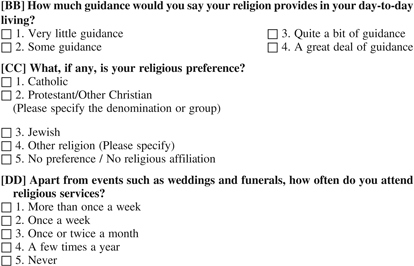
APPENDIX A: SURVEY ITEMS FROM 2006 OHIO COLLEGES EXIT POLL
Discussion Network Items

Religious Commitment and Affiliation
Candidate Traits

Party Identification

Political Ideology

Education

Appendix B: Variable Coding
Note: Variables are listed in roughly the same order as in Table 6.
Issue Discussion Index: An additive index running 0–24 summing over responses to frequency of discussion (0 = never; 1 = rarely; 2 = sometimes; 3 = often) for each of the following eight issues: abortion, corruption in government, the economy, education, gay marriage, health care, taxes, and the war in Iraq. “How frequently did you discuss the following issues with other people this year?”
Issue Disagreement Index: An additive index running 0–24 summing over responses to frequency of disagreement (0 = never; 1 = rarely; 2 = sometimes; 3 = often) for each of the following eight issues: abortion, corruption in government, the economy, education, gay marriage, health care, taxes, and the war in Iraq. “How frequently did you disagree with others on the following issues this year?”
Partisan Homogeneity of Network: A measure running from 0–2, creating by collapsing a five-point measure asking “How would you describe the political views of the people you talked with about this year's candidates and issues?” 0 = equally balanced between the Republicans and Democrats/not supportive of either party; 1 = mostly supportive of one party; 2 = completely supportive of one party.
Network Density: A measure running from 0–4, asking “Which statement best describes the people you talked with about this year's candidates and issues?” 0 = none of them know one another; 1 = very few of them know one another; 2 = some of them know one another; 3 = most of them know one another; 4 = all of them know one another.
Church Discussants: A dichotomous variable. 1 = individual has at least two discussants who attend their place of worship; 0 = individual has fewer than two discussants who attend their place of worship.
Workplace Discussants: A dichotomous variable. 1 = individual has at least two discussants who they work with; 0 = individual has fewer than two discussants who they work with.
Folded Partisanship: A strength of partisanship measure, running 0–3, created by folding a traditional seven-point scale; 0 = pure independent; 1 = independent leaner; 2 = weak partisan; 3 = strong partisan.
Folded Ideology: A strength of ideology measure, running 0–3, created by folding a traditional seven-point scale; 0 = moderate; 2/4 = somewhat moderate; 1/5 = liberal/conservative; 0/6 = extremely liberal/extremely conservative.
Education: “What was the last year of school you completed?” 0 = eighth grade or less; 1 = some high school; 2 = high school graduate; 3 = some college; 4 = college graduate; 5 = post-graduate.
Religious Commitment: A continuous measure running from 0–2 combining items on religious guidance (re-scaled) and religious attendance (re-scaled):
Religious Guidance: “How much guidance would you say your religion provides in your day-to-day living?” 0 = very little; 1 = some; 2 = quite a bit; 3 = a great deal; response are re-scaled (divided by 3) to run from 0–1.
Religious Attendance: “Apart from events such as weddings and funerals, how often do you attend religious services?” 0 = never; 1 = a few times a year; 2 = once or twice a month; 3 = once a week; 4 = more than once a week; responses are re-scaled (divided by 4) to run from 0–1.
Evangelical Protestant; Black Protestant; Roman Catholic; All other religions; No Religious Affiliation: Dichotomous measures. 1 = respondent is classified as part of that religious tradition; 0 = individual is not classified as part of that religious tradition; Mainline Protestant is the baseline (i.e., the omitted dummy) in the multivariate analyses. Respondents are classified into traditions based on their affiliation with a religious denomination or group using a coding scheme similar to that employed by the ANES. Details are available from the authors upon request.