Implications
Lactation lengths differ amongst individual dairy ewes raised in the same flock. Lactations following spring lambings tend to be shorter than those starting in the autumn, especially in the semi-extensive production systems in the Mediterranean countries. In the present study, standardised reference lactation lengths are derived and evaluated for the Chios sheep in Greece. Results can provide useful tools for on-farm management and genetic improvement programmes.
Introduction
Lactation length is one of the main factors affecting milk yield in dairy sheep. Total lactation milk yield has been traditionally used for on-farm management, on-farm selection of ewes, and genetic evaluation and selection of breeding animals at population level (Moioli and Pilla, Reference Moioli and Pilla1994; Barillet, Reference Barillet1997). Although test-day genetic evaluation models are now used frequently in animal breeding instead of lactation models (Schaeffer et al., Reference Schaeffer, Jamrozik, Kistemaker and Van Doornmaal2000; Silvestre et al., Reference Silvestre, Petim-Batista and Colaco2005; Lidauer et al., Reference Lidauer, Mantysaari and Stranden2003; Komprej et al., Reference Komprej, Malovrh, Gorjanc, Kompan and Kovač2013), lactation milk yield continues to provide useful information for management and comparison purposes.
Lactation length may be influenced by several factors, amongst which season of lambing seems to be the most important. When seasonal lambing is practiced, as is the case in most Mediterranean sheep production systems, the lactation length of ewes lambing in spring tends to be shorter compared with ewes lambing in the autumn and winter. The effect of season of lambing on lactation length has already been reported in many dairy sheep breeds such as Chios (Mavrogenis and Papachristoforou, Reference Mavrogenis and Papachristoforou1990), Sarda (Carta et al., Reference Carta, Sanna, Rosati and Casu1998) and Barbaresca Siciliana (Portolano et al., Reference Portolano, Montalbano and Militi2001).
Varying lactation lengths pose a problem when farmers wish to make management decisions regarding management of their stock. Definition of a fixed reference lactation length (also known as standard length) in dairy sheep could provide useful tools for on-farm comparison of animals and overall flock management as well as genetic evaluations in the breeding programme (Basdagianni et al., Reference Basdagianni, Banos, Abas, Arsenos, Sinapis and Zygoyiannis2004).
A reference lactation length of 305 days has been well established and accepted worldwide for dairy cattle. However, reference lactation length in dairy sheep varies according to breed and production system. In literature there are many studies that have aimed to define the best reference length definition for genetic evaluation purposes. Most studies focused on the projection and extension of part lactation (Gabina et al., Reference Gabina, Arrese, Arranz and Beltran de Heredia1993; De La Fuente et al., Reference De La Fuente, Baro and San Primitivo1995; Carta et al., Reference Carta, Sanna, Rosati and Casu1998; Portolano et al., Reference Portolano, Montalbano and Militi2001; Rosati and Fioretti, Reference Rosati and Fioretti2001; Ugarte et al,. Reference Ugarte, Serrano, De La Fuente, Perez-Guzmam, Alfonso and Gutierrez2002; Berger and Thomas, Reference Berger and Thomas2004; Cappelletti et al., Reference Cappelletti, Rozen, De La Fuente and San Primitivo2006; Oravcova et al., Reference Oravcova, Margetın, Peskovicova, Dano, Milerski, Hetenyi and Polak2006; Jonas et al,. Reference Jonas, Thomson, Hall, McGill, Lam and Raadsma2011). Very few studies (El-Saied et al., Reference El-Saied, Carriedo, Baro, De La Fuente and San Primitivo1998a, Reference El-Saied, Carriedo, De La Fuente and San Primitivo1998b; Gutierrez et al., Reference Gutierrez, Legaz and Goyache2007) have used specific criteria to evaluate the length of a reference lactation. The reference lactation length must have certain properties that make it useful and reliable in practical applications, such as being representative of the actual lactation and having a high correlation with milk yield in early lactation (Basdagianni et al., Reference Basdagianni, Banos, Abas, Arsenos, Sinapis and Zygoyiannis2004).
The objectives of the present study were to (i) evaluate different reference lactation lengths for the Chios dairy sheep and (ii) define the most suitable reference length for the breed. Chios is the highest milk producing sheep in Greece and one of the most productive dairy breeds worldwide.
Material and methods
Data
Test-day records and pedigree information were obtained from the database of the Chios Sheep Breeders’ Cooperative ‘Macedonia’, which implements the genetic improvement programme for the breed in Northern Greece since 1997. Lambing is seasonal and occurs either in autumn/winter or in spring. After a suckling period of ~6 weeks, ewes are milked mostly twice daily. Milk recording is performed monthly by trained field officers. The first milk record is collected between 42 and 94 days after lambing and milk yield is measured using the A4 method.
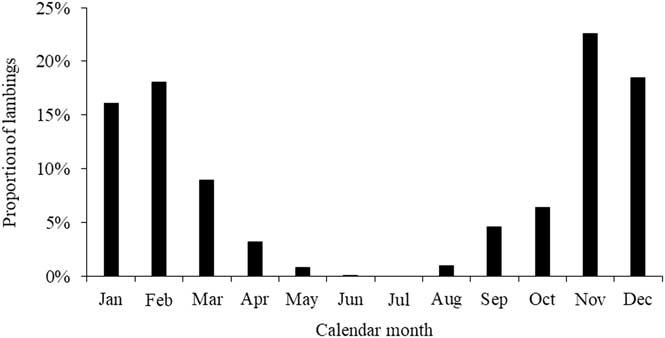
Lactations with at least 2 monthly test-day records that took place between 2003 and 2014 were considered for the present study, following the guidelines of the International Committee for Animal Recording (ICAR, 2017). After these edits the number of remaining test-day milk yield records was 260 042. These were produced from 24 474 ewes during 46 505 lactations in 130 flocks. Ewes were daughters of 2060 sires and 22 482 dams. These data were linked to a breed pedigree file including 87 261 animals spanning 10 generations. Two seasons of lambing (September to February and March to August; Figure 1) and four lactation classes (1st, 2nd, 3rd, 4th or higher lactation) were defined.
Distribution of lambings in the Chios sheep breed.

Actual lactation milk yield was calculated for each animal and lactation using the Fleischmann method (Barillet, Reference Barillet1985). In addition, reference lactation milk yield was calculated for each animal for 15 different reference lengths ranging from 120 to 260 days post-lambing, defined in 10-day interval (i.e. 120, 130, … , 250, 260). In each case, the last monthly test-day record of the ewe had to be no more than 14 days before the corresponding reference length end-date, as required by the Fleischmann method (Barillet, Reference Barillet1985). Lactations longer than 260 days were not considered in the study due to the limited number of data.
In order to evaluate the reference lactation lengths, the following criteria were considered: (a) heritability and repeatability of reference lactation milk yield, (b) genetic correlation of reference lactation milk yield with actual lactation milk yield and yield at first test-day record and (c) correlated response in reference lactation milk yield from selection based on the first test-day milk yield.
Data analysis
Each trait (actual lactation milk yield, lactation yield in 15 reference lengths and first test-day record milk yield) was first analysed separately using the following mixed model:
 $$Y_{{ikjo}} \,{\equals} \, \mu {\plus}{\rm HYS}_{i} {\plus}b{\times}{\rm age}{\plus}{\rm PF}_{k} {\plus}L_{j} {\plus}X_{o} {\plus}P_{o} {\plus}e_{{ikjo}} $$
where Y ikjo is the trait value for animal o; μ the overall population mean; HYS i the fixed effect of herd-year-season of lambing i (i=1 to 3120); b the linear regression coefficient on age at lambing (age); PF k the fixed effect of prolificacy class (number of lambs born alive) k (k=1 to 3+); L j the fixed effect of lactation number j (j=1 to 4+); X o the random additive genetic effect of ewe o including all available pedigree; P o the random permanent environment of ewe o: e the random residual.
In the analysis of actual lactation milk yield, duration of lactation that is, actual lactation length was added as a covariate in Model (1). When the first test-day record milk yield was analysed, days in milk was also included as a covariate in Model (1).
In separate analyses, the ewe effect in Model (1) was replaced by the sire of the ewe random effect, essentially rendering this a sire model.
In all analyses, variance components for each trait were estimated and used to derive heritability and repeatability estimates.
Bivariate analyses based on Model [1] were subsequently used to estimate the genetic correlations between traits.
In further separate analyses, only first lactation milk yield records were considered; in this case, the fixed lactation and the random permanent environment effects were removed from Model (1).
All the above analyses were performed with the ASReml 4.1 (Gilmour et al., Reference Gilmour, Gogel, Cullis, Welham and Thompson2014).
Finally, the correlated response in each reference lactation milk yield from selection based on the first test-day milk yield record was estimated using the following formula (Van Vleck, Reference Van Vleck1981):
 $${\rm CR}_{y}\, {\equals} \, i_{x} \,a_{x} \,r_{{xy}} \,{\rm SD}_{y} $$
where CR y is the correlated response in response variable y (reference lactation milk yield); i x the selection intensity on variable x (first test-day record milk yield); a x the accuracy of selection on variable x; r xy the correlation between variables y and x; SD y the genetic standard deviation of variable y.
As selection intensity and accuracy of selection in equation (2) pertained to the same variable (first test-day record milk yield), evaluation of different reference lactations with this criterion was performed for constant intensity and accuracy of selection; thus the evaluation was practically based on the correlation between first test-day record milk yield and reference lactation yield, and the genetic standard deviation of reference lactation yield.
Results
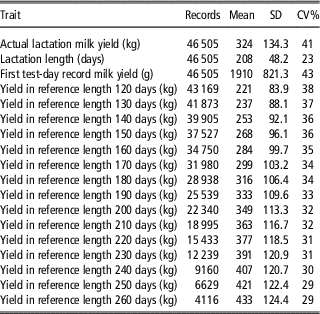
Table 1 summarises the descriptive statistics of all studied traits.
Descriptive statistics for milk yield traits in the Chios sheep breed

The sire model, that is, when sire was included as a random effect in Model (1), yielded the lowest residual variance estimates and, therefore, was deemed to have the best fit. Hereafter, results shown pertain to the sire model but it should be noted that animal model (ewe as random effect in Model (1)) results were very similar (Supplementary Material Figures S1 to S5).
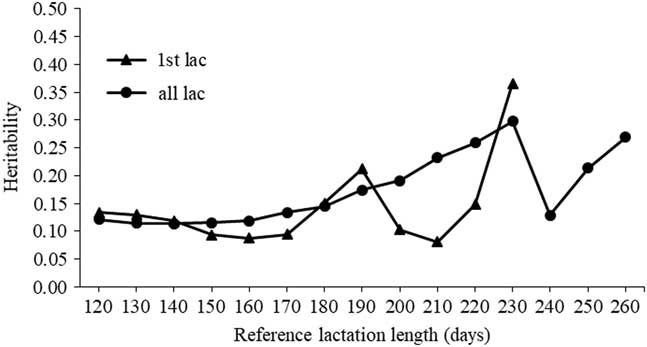
Heritability estimates of milk yield in each reference lactation ranged from 0.12 to 0.30 (standard errors 0.02 to 0.12) (Figure 2). Heritability estimates increased with longer reference lactation, with highest values pertaining to reference length of 200 to 230 days. When the analysis concerned only first lactation records the heritability estimates of reference lactation milk yield were between 0.08 and 0.37 (Figure 2). In comparison, heritability of actual lactation milk yield and first test-day milk yield were 0.15±0.02 and 0.10±0.02, respectively (0.09±0.03 and 0.11±0.03 for first lactation yield).
Heritability estimates of milk yield in different reference lactation lengths in the Chios sheep breed; standard errors range from 0.02 to 0.12 for all lactations (all lac) and from 0.03 to 0.18 for first lactation (1st lac).

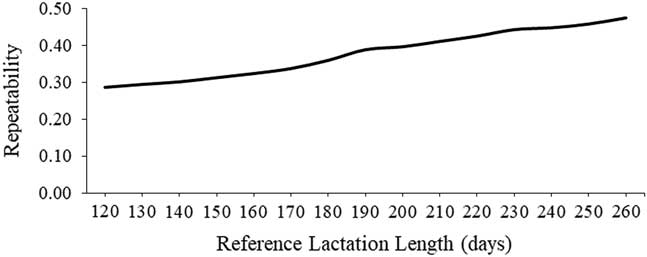
Repeatability estimates of milk yield in each reference lactation ranged from 0.29 to 0.48, and increased with increasing reference length (Figure 3). Repeatability estimates of actual lactation milk yield and first test-day record milk yield were 0.33±0.01 and 0.21±0.01, respectively.
Repeatability estimates of milk yield in different reference lactation lengths in the Chios sheep breed; standard errors range from 0.01 to 0.03.

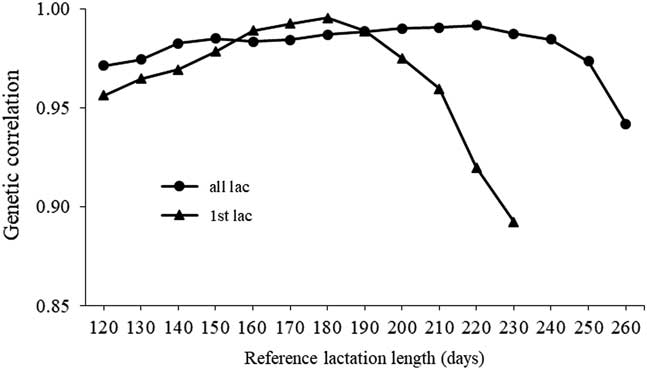
Genetic correlation estimates between milk yield in different reference lactation lengths and actual lactation yield are shown in Figure 4. Reference lactations lengths between 180 and 230 days had the highest genetic correlation values (0.98 to 0.99) and are considered to be the most representative of actual lactation yield in this regard. When considering only first lactation records genetic correlations were also high, with the highest values at reference lactation length of 160 to 190 days.
Genetic correlation estimates between milk yield in different reference lactation lengths and actual lactation yield in the Chios sheep breed; standard errors were lower than 0.02 in all cases (all lac=all lactations, 1st lac=first lactation).

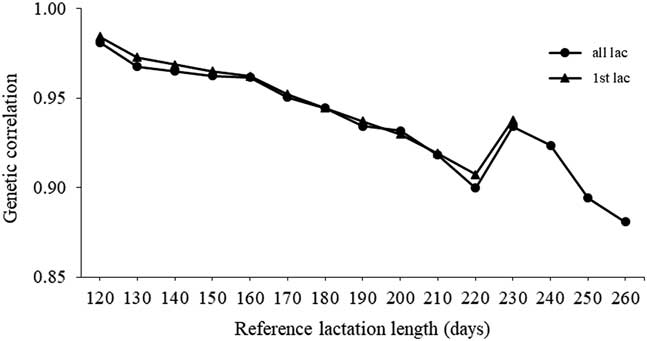
Genetic correlations between reference lactation milk yield and first test-day record milk yield are shown in Figure 5. The estimates of the genetic correlation were particularly high (⩾0.95) for the short lactation periods (120 to 170 days), with a decreasing trend for reference lactations lengths above 180 days. The trend was the same in the analysis of first lactation records only.
Genetic correlation estimates between milk yield in different reference lactation lengths and first test-day record milk yield in the Chios sheep breed; standard errors ranged from 0.01 to 0.10 for all lactations (all lac) and from 0.00 to 0.03 for first lactation (1st lac).

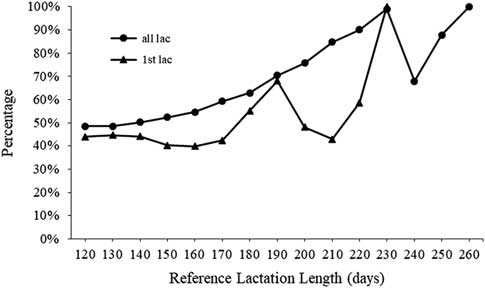
Correlated responses in milk yield achieved in different reference lactation lengths from selection on first test-day record milk yield were increased with increasing reference length and expressed in percentage relatively to the highest reference length of 260 days for all lactation and 230 days for first lactation record analysis (Figure 6). Correlated response (genetic progress) for the shorter reference lactations (120 to 200 days) were 49% to 76% of that achieved in maximum length, while for longer reference lactation this percentage was over 85%. When only first lactation records were considered, reference lactations of 120 to 190 days showed genetic progress 44% to 68% of that at maximum length.
Correlated response in reference lactation milk yield to selection based on the first test-day record milk yield, expressed as a percentage relatively to response in highest reference length of 260 days (230 days for 1st lactation records) in the Chios sheep breed. All lac=all lactations; 1st lac=first lactation.

Discussion
Our goal was to evaluate candidate reference lactation lengths and define a reference lactation length suitable for Chios dairy sheep. Expressing total dairy production at a reference lactation length would facilitate the objective comparison between animals and related on-farm decisions.
The reference lactation length had to be representative of the actual lactation length and corresponding milk yield should have a high correlation with the milk yield of the first test-day record and that of the actual lactation.
Heritability estimates for actual lactation milk yield (0.15±0.02) in the present study was lower than those obtained by Mavrogenis and Papachristoforou (Reference Mavrogenis and Papachristoforou1990) and Ligda et al. (Reference Ligda, Gabreilidis, Papadopoulos and Georgoudis2000) in the same breed (0.23 to 0.33) for animals raised in experimental flocks. However, ours is the first heritability estimate of Chios sheep at population level. Data analysis from experimental flocks often yield higher heritability estimates because of better defined and controlled management conditions. Moreover, low heritability in our study might be also due to relatively low levels of genetic connectedness between flocks as a result of predominantly natural mating with own rams in the Chios ewes; this might also result in lower accuracy of heritability estimates. In other Greek dairy sheep breeds, Kominakis et al. (Reference Kominakis, Rogdakis and Koutsotolis1998) reported estimated heritabilities for lactation milk yield across various models ranging between 0.18 and 0.30 for Boutsiko and Nikolaou et al. (Reference Nikolaou, Kominakis, Rogdakis and Zampitis2004) between 0.16 and 0.20 for Lesbos. In Spanish dairy sheep breeds Carriedo et al. (Reference Carriedo, Baro, De La Fuente and San Primitivo1995) estimated heritability of total milk yield in Churra between 0.15 and 0.29. In the improved Awassi and East Friesian breeds, reported heritabilities were 0.10 and 0.15, respectively (Pollott and Gootwine, Reference Pollott and Gootwine2001; Hamann et al., Reference Hamann, Horstick, Wessels and Distl2004). In the Italian sheep breeds Comisana, Sarda and Leccese, heritabilities of milk yield were 0.25 to 0.28 (Selvaggi et al., Reference Selvaggi, D’Alessandro and Dario2017).
Heritability estimate for first test-day record milk yield in the present study was 0.10±0.02 and was similar to those reported by Oravcova (Reference Oravcova2014) for the Tsigai breed. Heritability is generally lower at the early stages of lactation as a consequence of higher residual variance as reported in several sheep (Kominakis et al., Reference Kominakis, Volanis and Rogdakis2001; Komprej et al. Reference Komprej, Malovrh, Gorjanc, Kompan and Kovač2013) and cattle studies (Rekaya et al., Reference Rekaya, Carabano and Toro1999; Silvestre et al. Reference Silvestre, Petim-Batista and Colaco2005).
Heritability estimates of milk yield in different reference lactation lengths in the present study were higher (0.19 to 0.30) for longer lactations of 200 to 230 days. Legarra and Ugarte (Reference Legarra and Ugarte2001) reported heritability 0.20 for the Latxa breed and Serrano et al. (Reference Serrano, Perez-Guzman, Montoro and Jurado2003), 0.18 in Manchega ewes for milk yield in reference lactation length of 120 days. Gutierrez et al. (Reference Gutierrez, Legaz and Goyache2007) reported heritabilities between 0.13 and 0.18 for 180-day reference milk yield. High heritability facilitates the accurate genetic evaluation and the selection; from this standpoint, our study suggests that longer reference lactations are preferable.
Repeatability estimates for different reference lactation milk yields ranged from 0.29 to 0.48 in the present study. El-Saied et al. (Reference El-Saied, Carriedo, De La Fuente and San Primitivo1998b) reported repeatability 0.38 in 120 days standardised milk yield. In the present study, the repeatability estimates were higher (>0.40) in longer reference lactations (200 to 260 days), which render the latter more suitable for on-farm selection of ewes and flock management.
Estimates of genetic correlation between reference lactation milk yield and actual lactation yield were high and ranged from 0.98 to 0.99, for reference lactation length of 180 to 230 days. These estimates are higher than those reported of Mavrogenis and Papachristoforou (Reference Mavrogenis and Papachristoforou1990) in Chios sheep in Cyprus, for reference length of 60 and 90 days (0.91 and 0.92, respectively). In Churra breed, El-Saied et al. (Reference El-Saied, Carriedo, De La Fuente and San Primitivo1998b) found genetic correlation between actual lactation milk yield and 120-day standardised lactation milk yield 0.99, and Portolano et al. (Reference Portolano, Montalbano and Militi2001) reported similar genetic correlations between total milk yield and milk yield at standard lactation length of 180 and 200 days (0.94 and 0.97) in Valle del Belice dairy sheep. Similar high estimates of genetic correlation (0.99) were also reported in the Spanish Assaf breed by Gutierrez et al. (Reference Gutierrez, Legaz and Goyache2007) considering reference yield at 180 days. Reference lactations lengths with higher genetic correlation are more representative of the actual lactation, which is a desirable characteristic in the choice of the former. Based on this criterion, reference length of 180 to 230 days in the present study would be desirable for the Chios sheep. By the same token, reference lactation length of 160 to 190 days would be preferable for first lactation milk yield (Figure 4). This discrepancy between all and first lactation may be due to the fact that yearling have not had the opportunity to express their full genetic capacity as actual lactations were shorter due to most of them lambing in spring.
Genetic correlations between reference lactation milk yield and first test-day record milk yield favoured short reference lactation lengths in the present study (0.98 for 120 days v. 0.88 for 260 days), with higher values (>0.95) at reference lactations 120 to 170 days. These estimates were similar to those reported by Banos et al. (Reference Banos, Arsenos, Abas and Basdagianni2005) for the same breed and suggest that more accurate predictions of the lactation milk yield from the first test-day record can be achieved for shorter reference length (120 to 170 days). However, even for the longer lactations lengths (180 to 260 days), the genetic correlation is considerably high (0.88 to 0.94), meaning that milk yield at first test-day record can be useful in predicting the total reference lactation milk yield of the ewes in nearly all cases.
Of the above criteria used to evaluate the reference lactation length in the Chios sheep, genetic parameters (heritability, repeatability) of reference lactation milk yield and genetic correlation with actual lactation yield would favour long reference lactations (180 to 230 days), whereas genetic correlation with first test-day record milk yield would advocate for short reference lactations (120 to 170 days). In order to combine the above criteria, correlated responses in reference lactation milk yield to selection based on the first test-day record milk yield were estimated. Selection based on early lactation yield (first test-day record the present study) can facilitate early decisions and enhance the efficiency of on-farm management (e.g. setting up mating strategies). According to our results, correlated response would favour milk yield in the maximum reference lactation length considered in the present study (260 and 230 days for all and first lactation, respectively). This is primarily due to higher genetic variance estimates associated with longer lactation milk yield. However, such long lactations are not representative of the actual length (Table 1) and may not be practical for farm management. Furthermore, prolonged lactations of low milk production would not be beneficial to the overall profitability of the farm (Gutierrez et al., Reference Gutierrez, Legaz and Goyache2007).
Combining all evaluation criteria, it is suggested that a reference lactation length 220 days post-lambing would be most useful for the management of the Chios breed stock. This length is close to the average actual lactation length of the breed (208 days; Table 1); therefore, it can be considered representative for the Chios sheep. Furthermore, milk yield in 220 days had one of the highest heritability estimates and the highest genetic correlation with actual lactation yield amongst all reference lactation yields. In addition, milk yield in 220 days had a reasonable genetic correlation with first test-day record milk yield which amounted to 92% of the most highly correlated reference yield (in 120 days). Finally, selection on first test-day record milk yield would lead to correlated response in reference yield in 220 days equal to 90% of the highest estimate achieved in the maximum (albeit unrealistic) reference length of 260 days.
Following the same reasoning, a reference length of 190 days would be the most suitable for first lactation ewes. These animals may require a separate reference length because they tend to have shorter lactations due to predominantly spring lambings.
Conclusions
Reference lactation length of 220 days post-lambing is recommended for the Chios sheep breed as it gives on balance the best results regarding genetic parameter estimates, genetic correlation with actual lactation and first test-day record milk yield, and correlated response to selection for increased first test-date yield. By the same token, a first lactation reference length of 190 days is recommended. Future research should asses the validity of the recommended reference length for other dairy sheep breeds.
Acknowledgements
This work is dedicated to the memory of our friend and colleague Professor Zafeiris Abas. G. Banos was also supported by the Rural and Environment Science and Analytical Services Division of the Scottish Government.
Declaration of interest
The authors declare no competing interests regarding this publication.
Ethics statement
Data used for this study belong to the Chios Sheep Breeders’ Cooperative “Macedonia”, Greece. Permits for access and use of the data were provided by the Cooperative. The research study was observational and no animal handling or other intervention took place.
Software and data repository resources
No new software was generated as part of the outcomes of this study.
Supplementary material
To view supplementary material for this article, please visit https://doi.org/10.1017/S1751731118000769