Introduction
Elevated levels of depressive symptoms are a serious concern for older adults and have been shown to hasten the progression of a number of health conditions and also, increase the likelihood of hospital admission and nursing home placement (Chapman and Perry, Reference Chapman and Perry2008). One biological intermediary that may help explain the association between depression and these health outcomes is cortisol (Brown et al., Reference Brown, Varghese and McEwen2004). Cortisol, often referred to as the “stress hormone,” is one of the most widely used biomarkers of hypothalamic–pituitary–adrenocortical (HPA) axis activation, and when abnormally elevated (referred to as hypercortisolism), it can be an indicator of stress and potential psychiatric disturbance (Miller et al., Reference Miller, Chen and Zhou2007; Stetler and Miller, Reference Stetler and Miller2011). Although a number of methods have been used to gauge cortisol dysregulation in behavioral health research, numerous studies have found support for the link between flattened diurnal cortisol slopes (that do not sharply decline across the day) and psychosocial/physiological stress (for a review, see Miller et al., Reference Miller, Chen and Zhou2007). Notably, flattened cortisol slopes have even been shown to be associated with all-cause mortality and hastened progression of chronic diseases (Kumari et al., Reference Kumari, Shipley, Stafford and Kivimaki2011).
The association between depressive symptoms and dysregulated cortisol is well established, and dysregulated cortisol patterns are particularly common amongst depressed older adults. A recent meta-analysis of 361 studies showed that older adults with depressive disorders were characterized by greater HPA activation compared to non-depressed controls, more so than for younger adults (Stetler and Miller, Reference Stetler and Miller2011). These findings highlight the relevance of cortisol dysregulation as a crucial biomarker of depression for geriatric populations. Though not all patients with depression have dysregulated cortisol, this finding is robust and highly consistent across 45+ years of active research. Cortisol dysregulation has been shown to normalize with successful treatment (Greden et al., Reference Greden1980; Greden et al., Reference Greden, Gardner, King, Grunhaus, Carroll and Kronfol1983; Liotti et al., Reference Liotti, Mayberg, McGinnis, Brannan and Jerabek2002) and predict future relapses (Zobel et al., Reference Zobel, Nickel, Sonntag, Uhr, Holsboer and Ising2001). Exogenous corticosteroids given over extended periods of time can also directly induce depression (Ling et al., Reference Ling, Perry and Tsuang1981; Brown and Chandler, Reference Brown and Chandler2001). This evidence strongly suggests that cortisol signaling or regulation could be driving depressive symptoms. Both the glucocorticoid cascade theory (Sapolsky et al., Reference Sapolsky, Krey and McEwen1986) and the corticosteroid receptor theory (Holsboer, Reference Holsboer2000) of depression link cortisol production and/or signaling to the etiology of depression through exposure to chronic stress. Given that older adults with depression show particularly high rates of dysregulated cortisol, the present study aims to examine several key psychosocial stress predictors that could prompt dysregulated cortisol among a sample of individuals with geriatric depression.
Although studies generally have observed an association between measures of psychosocial stress and cortisol, correlations have varied drastically, with many studies actually finding null results as well (Hjortskov et al., Reference Hjortskov, Garde, Ørbæk and Hansen2004; Ice, Reference Ice2005; Holland et al., Reference Holland2011). This lack of consistent findings in the literature may result from differences in assessment tools and conceptualizations of stress (Hjortskov et al., Reference Hjortskov, Garde, Ørbæk and Hansen2004; Holland et al., Reference Holland2011). In this study, we hope to explore the contributions of several types of psychosocial stress in the context of geriatric depression by incorporating a broad range of assessment tools that tap into multiple domains of stress and distress. To our knowledge, this is the most comprehensive examination of psychosocial predictors of diurnal cortisol among older adults with depression conducted to date.
Specifically, in this study we examined several potential psychosocial predictors of cortisol secretion including global measures of psychosocial stress (e.g. current/past stressors, subjective stress), current psychiatric symptomatology (e.g. severity of depressive symptoms, current comorbidities), indicators of pervasive distress (e.g. history of past depression, trait anxiety), and protective factors (e.g. social support, resilience, meaning made of stress). Global laboratory measures of psychosocial stress, such as the Trier Social Stress Test, have been shown to affect cortisol secretion in many previous studies (for a review, see Dickerson and Kemeny, Reference Dickerson and Kemeny2004). However, survey studies of more naturalistic life stress have yielded more mixed results, with some studies finding no associations between measures of perceived stress and cortisol (van Eck et al., Reference van Eck, Nicolson, Berkof and Sulon1996; Simpson et al., Reference Simpson, McConville, O’Conner, Stewart-Knox, Coudray and Strain2008). Current psychiatric symptoms, particularly depressive symptoms, have also been closely linked with dysregulated cortisol secretion (for a review, see Stetler and Miller, Reference Stetler and Miller2011). Still, others suggest that trait markers of distress (e.g. history of depression, trait anxiety) may be more closely linked to abnormal cortisol patterns than current levels of psychiatric symptomatology (Polk et al., Reference Polk, Cohen, Doyle, Skoner and Kirschbaum2005; Beluche et al., Reference Beluche2009). Previous studies have also shown that certain aspects of resilience, such as subjective reports of personal strength, appreciation of life, and spiritual growth, as well as strong social support, are predictive of better general health and lower cortisol secretion (Rosal, Reference Rosal, King, Ma and Reed2004; Moskowitz and Epel, Reference Moskowitz and Epel2006).
In the present study, we simultaneously examined these different indicators of stress and distress as predictors of diurnal cortisol in a sample of older adults with a depressive disorder of some sort (e.g. major depression, dysthymia). We hypothesized that more severe psychosocial stress, current psychiatric symptoms, and indications of pervasive distress will be associated with flatter (more abnormal) diurnal cortisol slopes, and the presence of protective factors (e.g. social support, resilience) will be associated with sharper negative (healthier) diurnal slopes. However, given that this is the first study to simultaneously examine these predictors of cortisol in this population, the extent to which any one predictor (or set of predictors) will emerge as being uniquely associated with diurnal cortisol in the statistical model (i.e. in the presence of other variables) is treated as an exploratory question.
Methods
Participants and procedures
Following Internal Review Board approval, participants were recruited throughout the San Francisco Bay Area via radio, newspaper, and Internet advertisements, flyers, free talks in senior centers, and referrals from other professionals. In order to be eligible for the study, individuals had to score 16 or higher on the Center for Epidemiologic Studies Depression Scale (Radloff, Reference Radloff1977) and meet diagnostic criteria for some type of current depressive disorder (e.g. major depression, dysthymic disorder, adjustment disorder with depressed mood), as assessed by the Mini-International Neuropsychiatric Interview (M.I.N.I.; Sheehan et al., Reference Sheehan1998). Those who reported active suicidal ideation or plan to harm themselves, a history of psychosis or mania, or active substance abuse at baseline were excluded from the study, as well as any individual who showed overt evidence of dementia.
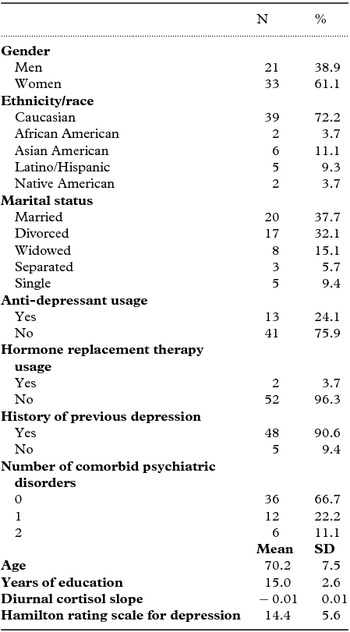
Data were collected from 60 older adults who met these inclusion/exclusion criteria. In the present analysis, 54 participants were included, given that six participants did not provide two or more reliable saliva samples. These six participants who were excluded from this analysis did not significantly differ from the rest of the sample in terms of demographic factors or depressive symptoms. Participants’ demographic and background information are presented in Table 1.
Demographic and background information (N = 54)

Measures
Cortisol
Salivary cortisol was measured by instructing participants to collect saliva using an oral swab kit upon awakening in the morning, at 5:00 PM, and again at 9:00 PM across two consecutive days. Participants were instructed to freeze each sample immediately after collection and return it to research staff at their next appointment, where it was then stored in a laboratory freezer before being assayed. They were also told not to eat, drink, smoke, brush their teeth, or use mouthwash in the 30 minutes before collection and not to drink alcohol during the 8–10 h before collecting samples or during the two days of collection. Participants were asked to record the exact time of saliva collection as well as any events that might have influenced the saliva sample (e.g. recent smoking or alcohol use) in a sample collection log. On average, saliva samples were collected at 7:14 AM (SD = 1.3 h), 5:07 PM (SD = 1.3 h), and 8:12 PM (SD = 3.9 h). Out of the 327 saliva samples that were collected as part of this study, participants reported violating protocol (e.g. drinking, smoking, and/or eating less than 30 minutes prior to using the swab) for 25 of the samples. Samples that were collected improperly were not used in this analysis.
All samples were assayed for salivary cortisol using a highly sensitive enzyme immunoassay (Salimetrics, State College, Pennsylvania, USA). Of note, the test used 25 μL of saliva per determination and had a lower limit of sensitivity of 0.003 μg/dL, standard curve range from 0.012 μg/dL to 3.0 μg/dL, average intra-assay coefficient of variation of 3.5%, and an average inter-assay coefficient of variation of 5.1%. Method accuracy determined by spike and recovery averaged 100.8%, and linearity determined by serial dilution averaged 91.7%. Values from matched serum and saliva samples show the expected strong linear relationship, r(47) = 0.91, p < 0.0001.
To correct for positive skewedness, cortisol values were log transformed prior to conducting statistical analyses. Data collected from the saliva samples across the two consecutive days were combined in order to allow for a more reliable estimate of each participant's typical diurnal pattern. Diurnal cortisol slope was captured by the slope of the best fitting line for the cortisol measurements. Specifically, slope was represented by unstandardized beta coefficients when log-cortisol was regressed onto hours since wake for each participant.
Predictor variables
In addition to examining demographic factors (age, gender, ethnicity/race, years of education, and marital status) and medication usage (antidepressant and estrogen hormone replacement therapy) as predictors of diurnal cortisol slope in the main study analysis, we incorporated several assessments of stress and distress as predictor variables, including global measures of psychosocial stress, current psychiatric symptomatology, indicators of pervasive distress, and resilience/protective factors.
Global measures of psychosocial stress:
Stressful life events in the past year were assessed with the Elders Life Stress Inventory (ELSI; Aldwin, Reference Aldwin, Stephens, Crowther, Hobfoll and Tennenbaum1990), which includes a checklist of 31 common stressors in later-life (e.g. death of a spouse, institutionalization of a spouse/partner, major decrease in activities). The ELSI has demonstrated concurrent validity with self-reported physical health symptoms (Aldwin, Reference Aldwin, Stephens, Crowther, Hobfoll and Tennenbaum1990). A total score was calculated as a count of stressful life events, with higher scores indicating a higher number of current stressors.
The Trauma History Questionnaire (THQ; Hooper et al., Reference Hooper, Stockton, Krupnick and Green2011) was used to gauge previous traumatic experiences. This widely used scale includes 24 yes/no items that assess (a) crime-related events, (b) general disaster and trauma, and (c) physical and sexual experiences. A count of the number of events experienced for each of these three categories of stressors was examined in this study. A recent review of research on the THQ found that this instrument is a reliable (e.g. test-retest) and valid (e.g. positively correlated with distress measures) approach to assessing lifetime trauma history in both clinical and non-clinical samples (Hooper et al., Reference Hooper, Stockton, Krupnick and Green2011).
Subjective perceived stress in the past month was assessed with the four-item Perceived Stress Scale (PSS), which has been shown to perform similarly to the full 14-item version (Cohen et al., Reference Cohen, Kamarck and Mermelstein1983). Higher scores represent higher levels of perceived stress. This instrument has also demonstrated adequate internal consistency, test-retest reliability, and has been linked with depressive symptomatology in previous work (Cohen et al., Reference Cohen, Kamarck and Mermelstein1983).
Current psychiatric symptomatology:
Severity of depressive symptoms was assessed with the Hamilton Rating Scale for Depression (HRSD; Hamilton, Reference Hamilton1960). The HRSD is a well-established interviewer-rated tool composed of 17 questions, with higher scores representing greater severity of depressive symptoms. The HRSD has also demonstrated strong internal reliability and factorial validity (e.g. Hamilton, Reference Hamilton1960).
Post-traumatic symptomatology was also assessed using the Impact of Events Scale – 6 (IES-6; Thoresen et al., Reference Thoresen, Tambs, Hussain, Heir, Johansen and Bisson2010). This brief version has been shown to correlate highly with the full version of the IES-Revised (r = 0.95; Thoresen et al., Reference Thoresen, Tambs, Hussain, Heir, Johansen and Bisson2010). Participants responded to these items with regard to the event that was currently “most distressful” for them. Higher scores indicate greater post-traumatic symptomatology.
We also assessed for the number of current comorbid DSM-IV axis I disorders, beyond a participant's primary depressive disorder as assessed by the M.I.N.I. (Sheehan et al., Reference Sheehan1998). This approach has been shown to increase the precision of the clinical picture beyond distress measures (Sheehan et al., Reference Sheehan1998).
Indicators of pervasive distress:
Neuroticism (a personality trait characterized by worry, moodiness, and negative affect) was assessed using the eight-item neuroticism subscale of the Big Five Inventory (BFI), which has been shown to strongly correlate with self- and peer-ratings of related constructs as well as other established measures of personality (John et al., Reference John, Naumann, Soto, John, Robins and Pervin2008).
Trait anxiety was measured with the Geriatric Anxiety Inventory (GAI), which includes 20 declarative statements (e.g. “I often feel nervous”) to which the participant is asked to agree or disagree that the statement accurately describes them (Pachana et al., Reference Pachana, Byrne, Siddle, Koloski, Harley and Arnold2007). A total score was calculated by summing all of the affirmative responses, with higher scores indicating greater trait anxiety. The GAI has shown excellent internal consistency and concurrent validity with depression and anxiety in normal and psychiatric samples of older adults (Pachana et al., Reference Pachana, Byrne, Siddle, Koloski, Harley and Arnold2007).
As part of the clinical interview, participants were also asked (aside from their present symptoms), “When you think back over your life, are there any periods in your life where you felt depressed?” Responses to this question were used to assess the presence/absence of previous episodes of elevated depressive symptoms.
Resilience and protective factors:
A two-item version of the Connor-Davidson Resilience Scale was used in this study to tap into one's perception of their ability to “bounce back” from illness or hardship, with higher scores representing greater resilience. This two-item version has been shown to perform similarly to the full version of the measure and has demonstrated strong psychometric properties as well (e.g. test-retest reliability, convergent/divergent validity; Vaishnavi et al., Reference Vaishnavi, Connor and Davidson2007).
Meaning made of stress was assessed with the 16-item Integration of Stressful Life Experiences Scale (ISLES), which includes a Comprehensibility (gauging one's ability to make sense of a stressful life event) and Footing in the World (measuring the extent to which one's perception of purpose and meaning in life remain intact following a stressor) subscale (Holland et al., Reference Holland, Currier, Coleman and Neimeyer2010). These subscales were examined separately, and for each, higher scores indicate more adaptive attribution of meaning to a stressful life event. Participants completed this measure with regard to the event that was currently “most distressful” for them. Holland et al.'s (Reference Holland, Currier, Coleman and Neimeyer2010) psychometric evaluation supported this two-factor model for the ISLES as well as internal consistency and concurrent associations with severity of mental and physical problems in two samples.
The abbreviated Duke Social Support Index (DSSI) is an 11-item measure that was used to assess perceived social support (Koenig et al., Reference Koenig, Westlund, George, Hughes, Blazer and Hybels1993). The scale consists of two subscales, social satisfaction and social interaction, which were examined separately in this study. Prior research has demonstrated that this brief version of the DSSI is comparably effective as the original scale in predicting mental and physical health concerns in geriatric samples (Koenig et al., Reference Koenig, Westlund, George, Hughes, Blazer and Hybels1993).
Plan of analysis
We first examined bivariate correlations between each predictor variable and diurnal cortisol slope. Predictor variables that were found to be significantly associated with diurnal cortisol slope in the bivariate analyses (with a two-tailed p < 0.05) were then entered simultaneously into a multiple regression analysis to identify unique predictors of cortisol slope. Four cases had missing data for at least one of the independent variables, and these missing data were handled using multiple imputation. All analyses were performed in MPlus, version 6.11 (Muthén and Muthén, Reference Muthén and Muthén1998–2010).
Results
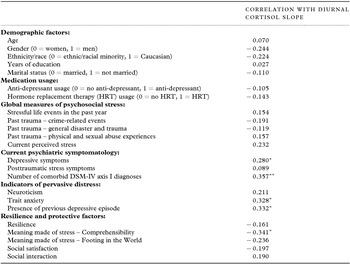
As shown in Table 2, in the bivariate analyses, severity of current depressive symptoms, number of comorbid DSM-IV axis 1 diagnoses, trait anxiety, and history of past depression were significantly associated with flattened (more abnormal) diurnal cortisol slopes. In addition, those who were more able to make sense of their identified stressor (as assessed by the ISLES – Comprehensibility subscale) had significantly steeper negative (healthier) diurnal cortisol slopes. Demographic factors, medication usage (anti-depressants and estrogen hormone replacement therapy), current life stressors, past trauma, perceived stress, post-traumatic stress disorder (PTSD) symptoms, neuroticism, social support, resilience, and Footing in the World were not found to be significantly associated with diurnal cortisol slope.
Bivariate correlations with diurnal cortisol slope (N = 54)

*p < 0.05, **p < 0.01.
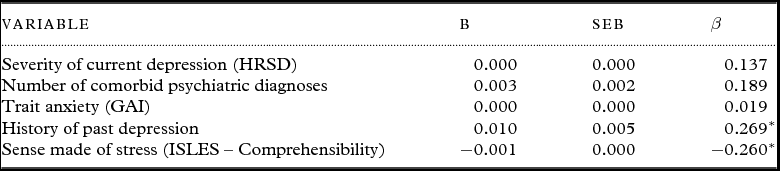
As shown in Table 3, when the five predictor variables that were found to be significantly associated with diurnal cortisol slope were entered simultaneously into a multiple regression analysis, only history of past depression (β = 0.27, p = 0.02) and the ability to make sense of a target stressor (β = −0.26, p = 0.05) remained statistically significant. As a whole, this multiple regression model accounted for 29.2% of the variability in diurnal cortisol slope, which was statistically significant at the p < 0.001 level.
Multiple regression analysis with diurnal cortisol slope as the dependent variable

*p < 0.05.
B = Unstandardized Beta; SEB = Standard Error of Beta; β = Standardized Beta; HRSD = Hamilton rating scale for depression; GAI = geriatric anxiety inventory; ISLES = integration of stressful life experiences scale.
Discussion
In this study we found that (1) none of the global psychosocial stress measures were significantly correlated with dysregulated cortisol patterns; (2) specific assessments of current psychiatric symptomatology (i.e. depressive symptoms and number of comorbid DSM-IV axis I diagnoses), persistent distress (i.e. presence of past depressive episodes and trait anxiety), and resilience (i.e. sense made of a stressful life event) were associated with cortisol in the expected directions; and (3) previous episodes of depression and the ability to make sense of stressful events emerged as the two most robust predictors of cortisol in the statistical model. Several conclusions can be drawn from these results. First, these findings suggest that global assessments of stress, as assessed by checklists of stressful life events, may not be the most robust predictors of diurnal cortisol among depressed older adults. This pattern of results could be due to all of the older adults in this study meeting criteria for a depressive disorder. Most participants may have exceeded a threshold of life stress that is necessary for causing health problems, making the variation in levels of global stress in this sample less meaningful. Of course, it is also notable that many past studies have shown that older adults are often resilient in the aftermath of life stressors (Ong et al., Reference Ong, Bergeman and Boker2009), which could indicate that simple summations of stressful life events may be a relatively poor indicator of one's internal experience of distress.
As hypothesized, high levels of current depressive symptoms, psychiatric comorbidities, past depressive episodes, greater trait anxiety, and poorer ability to make sense of stress were found to be associated with flattened (more abnormal) cortisol slopes. However, when all of these predictor variables were entered simultaneously in a multiple regression model, it appeared that past depression and the ability to make sense of stressful events accounted for the majority of the explained variance in diurnal cortisol. The finding related to previous episodes of depression fits well with a theoretical model of cortisol dysregulation contributing to depression through the accumulation of unmanaged stressors (Sapolsky et al., Reference Sapolsky, Krey and McEwen1986; Holsboer, Reference Holsboer2000). However, it is also possible that past depression contributes independently to current dysregulated cortisol. In particular, individuals with a late-life onset of depression and fewer episodes may be qualitatively distinct from those with a much earlier onset and a greater number of episodes. Specifically, it would seem reasonable to expect that sustained cortisol dysregulation may primarily stem from prolonged and chronic emotional distress. In contrast, depressive episodes that occur with a lower frequency and duration may not last long enough to bring about enduring physiological changes. Past research would seem to generally support this claim (Polk et al., Reference Polk, Cohen, Doyle, Skoner and Kirschbaum2005; Beluche et al., Reference Beluche2009).
With regard to the ability to make sense of stressful events, multivariate results also indicated that persons who had adaptively assimilated their life stressors into current meaning structures were less at risk for cortisol dysregulation. In general, this finding aligns with an extensive literature that has shown that the ability to make sense of loss and other stressful life events can have a variety of physical and mental health benefits (Park, Reference Park2010). Given the link between psychiatric problems and cortisol dysregulation (Miller et al., Reference Miller, Chen and Zhou2007; Stetler and Miller, Reference Stetler and Miller2011), it was particularly notable that this finding emerged in a sample of already depressed older adults. Namely, in considering clinical samples of this sort, it might be equally important to gauge individuals’ ability to make sense of stressful events as it is to assess their current and past history of depressive symptomatology. Further, it may be that individuals who have dysregulated cortisol are less able to make meaning out of stressful events, but a longitudinal investigation would be required to examine the temporal precedence between these variables.
This study is, of course, not without its limitations. In particular, this study is limited by its relatively small sample size, cross-sectional design, and lack of generalizability (e.g. the sample was mostly made up of Caucasian older adults with a fair amount of education). Future studies should attempt to replicate these findings with larger and more diverse samples and use a longitudinal design to better capture the temporal relations among these variables. We could only use the term “predictor” in a statistical sense in this paper and hope that future research will test whether a history of previous depressive episodes and an inability to make sense of stressful life events actually precede dysregulation of cortisol in other samples of geriatric patients. Studies that examine other biomarkers, such as indicators of immune functioning, inflammation, or cell aging, could also significantly advance this line of research in important ways.
Notwithstanding these limitations and possibilities for further study, the present investigation is the first to simultaneously examine a comprehensive range of measures of stress and distress as predictors of diurnal cortisol among older adults with depression. The finding that previous episodes of depression and the ability to make sense of stressful events were the two most robust predictors of cortisol in this sample has important implications for identifying depressed elderly individuals who are most at-risk for health complications. From an intervention standpoint, these findings would suggest that treatments that aim to limit the chronicity of depression and help to increase the ability of clients to make sense of stressful events could potentially have a positive impact on health. For example, meaning-oriented components may be incorporated into traditional cognitive behavioral therapy (CBT) interventions (e.g. “re-authoring” the self-narrative; Neimeyer, Reference Neimeyer2009, p. 97) to help clients make sense of significant stressors and regain a sense of purpose and direction in life.
Conflict of interest
None.
Description of author's roles
J.M. Holland participated in data collection, conducted all statistical analyses, and wrote the majority of the manuscript. J. Rengifo participated in data collection and assisted with the writing of the manuscript. J.M. Currier assisted with the writing of the manuscript. R. O’Hara was the co-principal investigator for the study and assisted with the writing of the manuscript. K. Sudheimer assisted with the writing of the manuscript. D. Gallagher-Thompson was the principal investigator for the study and assisted with the writing of the manuscript.
Acknowledgments
This study was funded by a National Institute of Mental Health (NIMH) exploratory/developmental research grant program (R21 MH091625-01, entitled: Predictors of Positive Outcome in Cognitive Behavior Therapy for Late Life Depression).