Introduction
Adaptive beamforming of phased array antennas is used extensively in radars [Reference Sallam, Abdel-Rahman, Alghoniemy, Kawasaki and Ushio1], cellular communication systems [Reference Lin, Lin, Wang, Huang and Zhu2], and military applications [Reference Li, Wang, Xu and Wang3]. By computing the excitation weights through a real-time process, the adaptive beamforming technique has the ability to steer the main beam toward the desired signal or signal-of-interest (SOI) and to put nulls toward the direction of the interferers or signals-not-of-interest (SNOIs).
The array configuration that is well suited for mobile communication is usually a planar array. The linear array configuration is not as attractive because of its inability to scan in three-dimensional space. On the contrary, a planar array can scan the main beam in any direction of elevation angle θ and azimuth angle ϕ. However, due to the array geometry, two-dimensional (2D) beamforming is more computationally complicated than its linear counterpart.
In order to achieve adaptive beamforming goals, several evolutionary algorithms [Reference Sallam, Abdel-Rahman, Alghoniemy, Kawasaki and Ushio1, Reference Demarcke, Rogier, Goossens and De Jaeger4, Reference Van Luyen and Giang5] have been used to solve the nonlinear beamforming problem, but it is quite time consuming since evolutionary algorithms converge slowly.
For the sake of response instantly to the changing environment with the desired pattern, neural network-based beamformer was applied to emulate the given array beamforming model [Reference Rawat, Yadav and Shrivastava6, Reference Massa, Oliveri, Salucci, Anselmi and Rocca7]. After learning the behavior from a certain number of the input–output pairs, the trained neural network with well generalization ability can predict the output under any input in the domain. The trained neural network can respond in real time, since it has extremely low computation complexity with simple linear and nonlinear transform units.
A three-layer radial basis function neural network (RBFNN) has been used to find the optimum weight vector for a robust and fast beamformer [Reference Sallam, Abdel-Rahman, Alghoniemy, Kawasaki and Ushio1], the autocorrelation matrix of the array is used as the input of the network, the approach shows nearly optimal weight vector of the beamformer with a small dataset. Since the performance of these neural-network-based methods relied heavily on the generalization ability of the network, it is essential to establish a large enough dataset to cover the distributions of different signal directions especially when dealing with 2D arrays. With the limited hidden layers, the generalization ability of the RBFNN for the complex 2D beamforming problem is restricted.
Methods based on deep learning are able to reconstruct the complicated models [Reference Goodfellow, Bengio and Courville8], which has been successfully applied in the one-dimensional (1D) direction of arrival of the antenna arrays with a large dataset [Reference Liu, Zhang and Yu9]. With a high model capacity, deep neural networks can learn a nonlinear function from large quantities of training data and generalize well. A convolutional neural network (CNN) is a variant of a deep network framework and achieves remarkable success on image and face recognition [Reference Fu, Zheng and Mei10–Reference Kim, Yu and Lee13]. It has unique capabilities of extracting underlying nonlinear features of input data. Two advantages, sparse connectivity and shared weights, enable CNNs have small numbers of parameters during learning.
The optimum design of the antenna array is difficult to accomplish because of the array imperfections, such as the amplitude and phase errors, the effect of mutual coupling, etc. [Reference Schmid, Schuster, Feger and Stelzer14, Reference Xu, Shi, Wang and Xu15]. All these uncertainties of the array would result in the increase of the null and sidelobe levels. It will also shift the nulling as well as main beam directions. Generally, the error of the array can be considered as the error in the steering vector. It has been proved that robustness is a fundamental attribute for the well-generalized machine learning model [Reference Xu and Mannor16]. When using the information of the steering vector of the array as the input of the CNN, the CNN-based array beamforming is expected to be robust to the imperfections of the antenna array without using any prior array imperfection information.
Motivated by the inherent advantages of the deep learning, this paper proposes the development of a CNN-based approach to the beamforming of an 8 × 8 phased array antenna with a comparison to a RBFNN. Although a large training pattern set is required for network training, it can be implemented offline. After training, it can be used online for real-time prediction of element excitation amplitude and phase. In this paper, the CNN and RBFNN are trained on the optimum weights of Wiener solution. Besides, the robustness of the proposed CNN array beamforming model is analyzed. The CNN shows an excellent beamforming performance even in the presence of array imperfections.
The Wiener solution
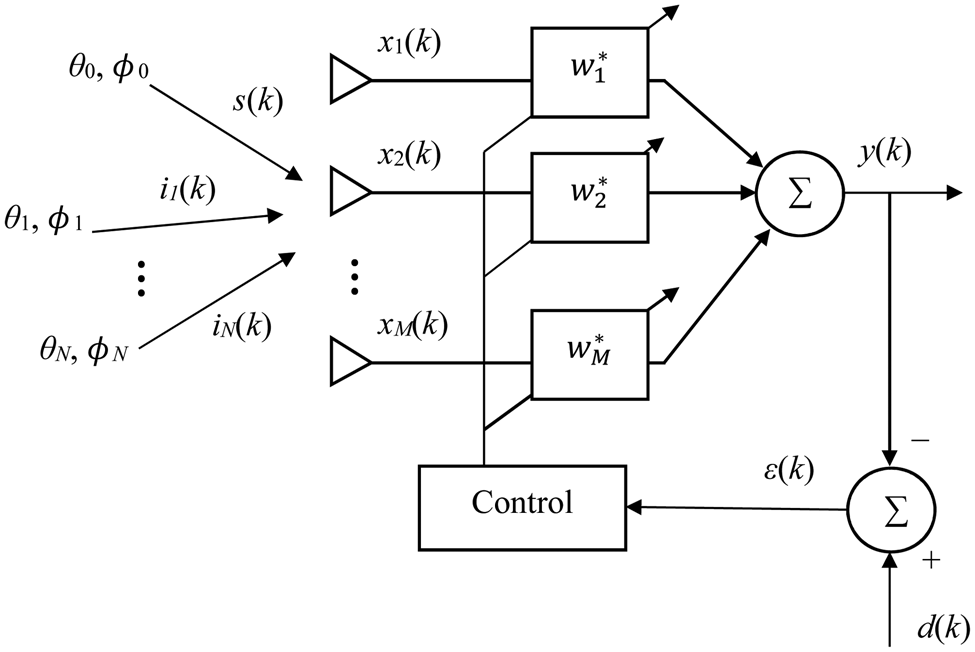
Assume an M-element planar phased array antenna that receives an SOI, s(k), arriving from angles θ 0, ϕ 0, and N SNOIs, in(k), arriving from angles θn, ϕn (n = 1, …, N) (see Fig. 1). The parameter k denotes the kth time sample, each element is considered to be an isotropic source, while all the arriving signals are monochromatic with N + 1 ≤ M. The received signal, xm(k), at the input of mth element (m = 1, …, M) includes additive, zero mean, white Gaussian noise, nm(k), with variance σ 2. Thus, the input vector is

where

is the steering vector at θp, ϕp (p = 0,1,…, N), and

Here, n(k) is the vector of the M uncorrelated noise signals, nm(k), λ is the wavelength, and qx and qy are the spacing between adjacent elements in x and y directions. Finally, the superscript T denotes the transpose operation. The array output is given by

where w = [w 1 w 2 … wM]T is the vector of beamformer weights and the superscript H denotes the Hermitian transpose operation. Referring to Fig. 1, the signal d(k) is the reference signal and ε(k) is an error signal such that $\;\varepsilon ( k ) = d( k ) -{\bf w}^H{\bf x}( k )$ . For the sake of simplification, we will suppress the time dependence notation k. Squaring the error, we get

Adaptive beamformer for phased array antenna system.

Taking the expected value of both sides and simplifying the expression, we get the mean squared error (MSE) as follows:

where

is the cross correlation between the reference and the input signals and ${\bf R}_{xx} = E[ {{\bf x}{\bf x}^H} ]$ is the array autocorrelation matrix. The symbol * denotes the complex conjugate. It should be noted that the cost function (6) is a quadratic function of w in the M-dimensional space. We can find the minimum of (6) by taking the gradient with respect to w and equating it to zero; thus the Wiener–Hopf equation is given as [Reference Balanis and Ioannides17]

The optimum Wiener solution, ${\bf w}_{Wiener} = {\bf R}_{xx}^{{-}1} {\kern 1pt} {\bf r}$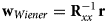 . If we allow the reference signal d to be equal to the desired signal s, and if s is uncorrelated with all interferers, then we may simplify the correlation r. Using (1) and (7), the simplified correlation ${\bf r} = E[ {s^\ast{\cdot} {\bf x}} ] = S\cdot {\bf a}_0$
 , where S = E[|s|2] is the mean power of the SOI. The optimum Wiener weights, in this case, is

Methodology
CNN beamformer
The Wiener weight vector wWiener in (9) is not suitable for real-time implementation in its current format. Therefore, it can be approximated using a suitable architecture such as a CNN. The array outputs are preprocessed, and then applied to the CNN; where Rxx is fed to the input layer of the CNN, and the vector $\hat{{\bf w}}_{Wiener}$ is generated at the output layer as an estimate of the Wiener weight vector. As most neural networks, the CNN is designed to perform an input–output mapping trained with L training samples of elevation and azimuth angles (${\bf R}_{xx}^l ; \;{\bf w}_{Wiener}^l )$
 ; l = 0, 1,…, L – 1 [Reference Sallam, Abdel-Rahman, Alghoniemy, Kawasaki and Ushio1, Reference Du, Cheng and Swamy18].
The CNN model
CNNs have one or more convolutional layers to extract the discriminative features from the input data [Reference Yamashita, Nishio, Do and Togashi19]. The feature maps are required to learn from the amplitude and phase correlation between all the array elements. After all the convolutional layers, these learned features are then aggregated to the vectors by the fully connected layers for the regression task. The CNN architecture for 2D beamforming is shown in Fig. 2.
CNN architecture for 2D beamforming.

After many experimental simulation trials, it is found that the CNN structure which provides the best accuracy is shown in Fig. 3. As shown in Fig. 3, the CNN is composed of three convolutional (Conv) layers. The first convolutional layer comprises of 64 feature maps. The number of feature maps at each convolutional layer is as twice as the previous layer, i.e. there are 128 and 256 feature maps in the second and third layers, respectively. The size of the feature map in each convolutional layer is fixed at 2 × 2. All convolutional layers have a stride of 1 and “same” padding. After the sequence of convolutional layers, there is a single fully connected layer with 128 neurons. In order to avoid overfitting during training, a dropout operation with a rate of 50% is used at the end of the convolutional layers. The activation functions used in the convolutional layers and the fully connected layer are rectified linear unit and exponential linear unit, respectively. Since this is a regression problem instead of a classification problem, no activation is used at the output layer (linear activation).
Proposed CNN structure.

Generation of training data
In order to reduce the training time and complexity of the CNN, either the upper or lower triangular part (excluding the main diagonal) of the correlation matrix Rxx provides enough information for 2D beamforming since Rxx is conjugate-symmetrical with respect to the main diagonal. In this case, an M × M correlation matrix Rxx is rearranged in an M(M − 1)/2 component input vector as

Note that the network needs twice as many input nodes since it does not deal with complex numbers, so the total number of input neurons is M(M − 1). The input vector is then normalized by its norm in order to unify the input parameter space, i.e.

The normalized vector z is then reshaped into the input 2D image of the CNN. This vector is used to develop the required training input/output pairs of the training set, that is, $( {\bf z}^l; \;{\bf w}_{Wiener}^l )$ ; l = 0, 1, …, L – 1. Like it was done to the input vector, the output complex weight vector is normalized by its norm to unify the output parameter space then decomposed into real and imaginary parts (again the network needs twice as many output nodes since it does not deal with complex numbers). It should be noted that the RBFNN has the same pre-/post-processing of input/output data except that it cannot accept an image or 2D input, therefore the input vector in this case is 1D.
Once the CNN is trained with a representative set of training input/output pairs, it is ready to function in the testing phase. In the testing phase, the trained network can be directly used to produce optimum weights for the real-time 2D beamformer.
The Adam (adaptive momentum) optimization algorithm [Reference Kingma and Ba20] is used to update the network weights and the loss function used for this network is the MSE. The initial value of the learning rate is 0.001. During the training, the learning rate is decreased by a rate of 0.1 each 40% of number of epochs.
A large training dataset is necessary to cover different combinations of the SOI directions for 2D beamforming. In the training dataset, the elevation angle of SOI is between 0 and 90° and azimuth angle between 0 and 360°. Both types of angles are selected at random. The spacing of the training samples for all elevation and azimuth angles is 0.5°, and as a result, a training set with 130 501 samples is obtained of which 80% was used for training and 20% for validation. The batch size is 400 and number of epochs is 10.
Testing phase of the CNN
After the training phase is complete, the CNN should have established an approximation of the desired input/output mapping. In the testing phase, the neural network is expected to generalize, that is, responds to inputs that have never been seen before, but are drawn from the same input distribution that is used in the training set. The procedure of the testing phase is summarized in the following simple steps:

Calculation of the array imperfections
The array imperfections typically contain the elements position error, the excitation error of the elements, and the mutual coupling between the elements. All these imperfections can be simplified as the inconsistence of the steering vectors [Reference Xu, Shi, Wang and Xu15]:

where ${\bf \Gamma }$ = I + diag(μ[r 0, r 1, …, rM −1]), I is the identity matrix, and rm are complex random variables with |rm| ≤ 1, the array error tolerance is μ.
To adopt the steering vector with the array imperfections, the correlation matrix ${\bf R}_{xx}^e$ is applied to validate the robustness of the trained CNN model. Now, ${\bf a}_0^e$
 and ${\bf R}_{xx}^e$
 are inserted into (9) to get the Wiener weights in the case of array imperfections. Note that the CNN model does not utilize the prior information of the array imperfections. Although the robustness is measured by the simplified formulation of error imperfection, it is reasonable to verify the robust performance.
Simulation results
To verify the performance of the CNN-based 2D array beamforming, the simulation is carried out on a 64-element (8 × 8) phased array antenna. The signal-to-noise ratio is assumed to be 10 dB and qx = qy = 0.5λ. The performance of the CNN is compared to that of the RBFNN. The CNN and RBFNN are implemented in MATLAB R2020b using Deep Learning and Neural Network Toolboxes, respectively [21]. Both networks have 64 × 63 = 4032 input nodes and 2 × 64 = 128 output nodes (real and imaginary parts of complex weights). Two different sets of SOI and SNOIs are tested, one is without array imperfections and the other is with imperfections. The SOI in either set never appears in the training dataset.
Set1 SOI and SNOIs (without array imperfections)
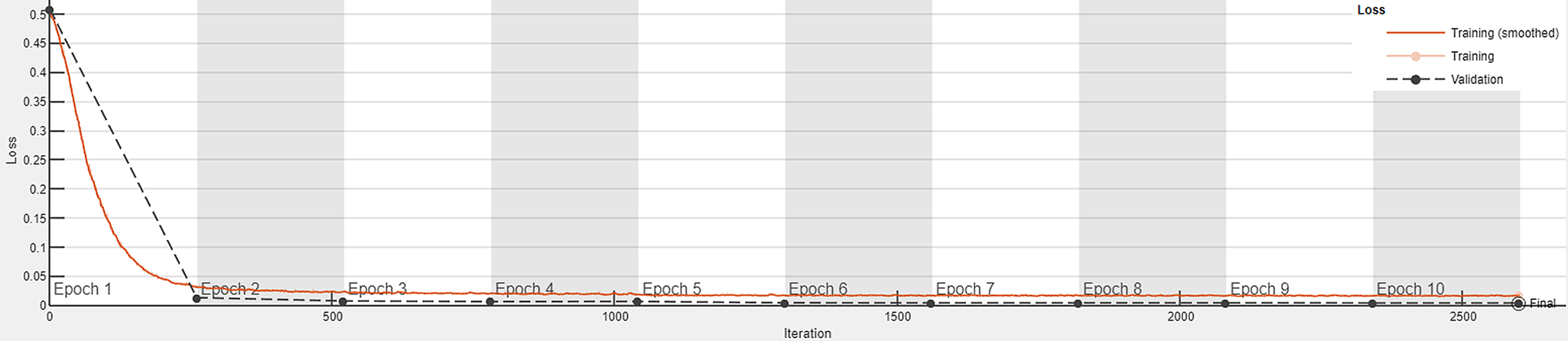
In the first set (set1) of incident signals, the planar array receives a SOI arriving from (θ 0, ϕ 0) = (15°, 50°) and three SNOIs arriving from (θ 1, ϕ 1) = (30°, 50°), (θ 2, ϕ 2) = (40°, 50°), and (θ 3, ϕ 3) = (60°, 50°). Figure 4 is self-generated by MATLAB R2020b using the Deep Learning Toolbox showing the progress of training loss and validation loss of the CNN during the training process. As it can be seen, both losses approaches zero at the end of training which indicates good fitting of data.
Progress of training loss and validation loss of the CNN during the training process for set1 SOI and SNOIs (the figure is self-generated by MATLAB R2020b using the Deep Learning Toolbox).

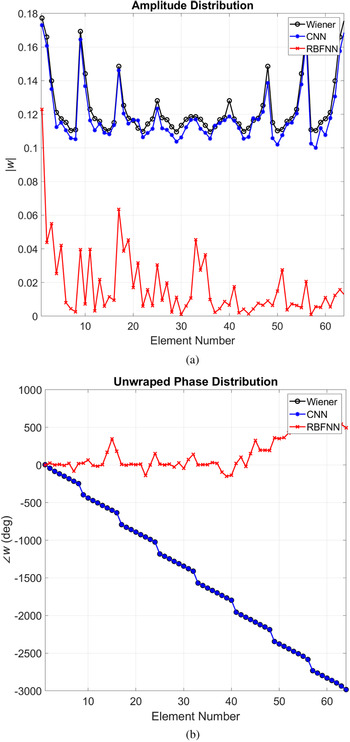
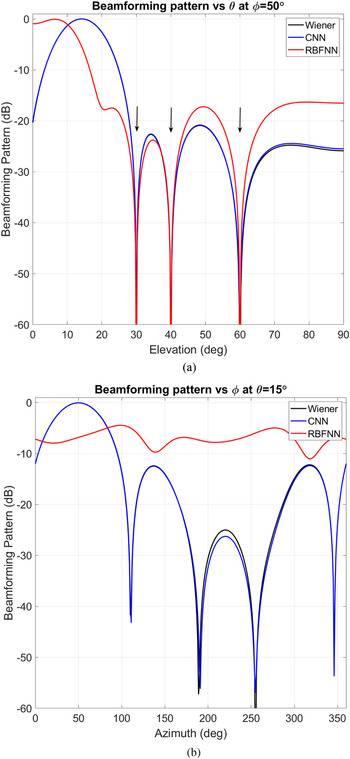
Figure 5 shows the output array weights from CNN and RBFNN beamformers along with the ideal Wiener weights. As shown, the CNN is far better than the RBFNN by leading to the nearly optimal Wiener weights (In Fig. 5(b), the weight phases of CNN and the Wiener solution exactly coincide on each other!) Figure 6 shows the θ- and ϕ-cuts of the array patterns generated by both beamformers compared to the ideal Wiener radiation pattern. It can be noted that the CNN model achieves the desired array pattern with notching in the interference directions under −60 dB level as shown in the ϕ-cut while preserving the desired direction gain as shown in both cuts. Although the RBFNN has 3350 hidden neurons and except for good nulling performance, it does not maintain the desired direction, besides the very high sidelobes (it is almost omnidirectional in the ϕ-cut).
Output beamforming array weights for set1 SOI and SNOIs: (a) amplitude and (b) phase (note that the weight phases of CNN and the Wiener solution exactly coincide on each other).

Beamforming patterns for set1 SOI and SNOIs: (a) ϕ-cut and (b) θ-cut.

Set2 SOI and SNOIs (with array imperfections)
In the second set (set2) of incident signals, the CNN is tested with an SOI arriving from (θ 0, ϕ 0) = (30°, 175°) and three SNOIs arriving from (θ 1, ϕ 1) = (30°, 150°), (θ 2, ϕ 2) = (30°, 250°), and (θ 3, ϕ 3) = (30°, 300°).
In this case, array imperfections are assumed to exist with an array error tolerance μ = 0.1. Since the RBFNN is far from being comparable with the CNN even without array imperfections as shown in Figs 5 and 6, there is no need to test it in the presence of array imperfections.
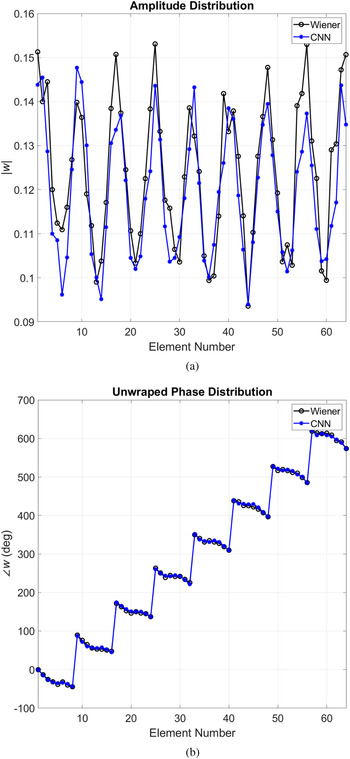
Figure 7 shows the output array weights from CNN beamformer along with the ideal Wiener weights. Again, the CNN estimates nearly optimal Wiener weights even in the presence of array imperfections.
Output beamforming array weights for set2 SOI and SNOIs: (a) Amplitude and (b) Phase.

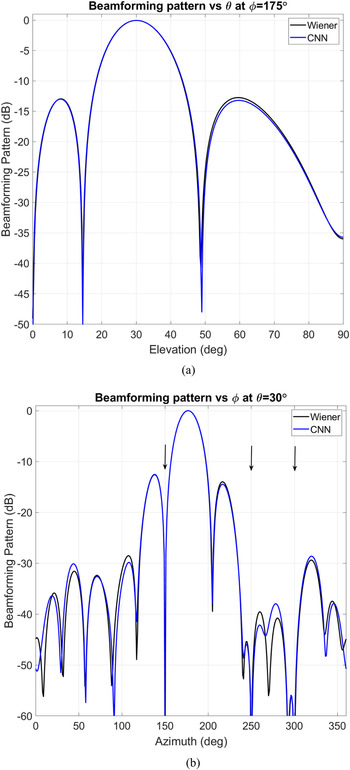
Figure 8 shows the θ- and ϕ-cuts of the array patterns generated by the CNN beamformer compared to the ideal Wiener radiation pattern. The CNN model still forms nulls at the interference directions with a level below −60 dB as shown in θ-cut while maintaining the desired direction gain as shown in both cuts.
Beamforming patterns for set2 SOI and SNOIs: (a) ϕ-cut and (b) θ-cut.

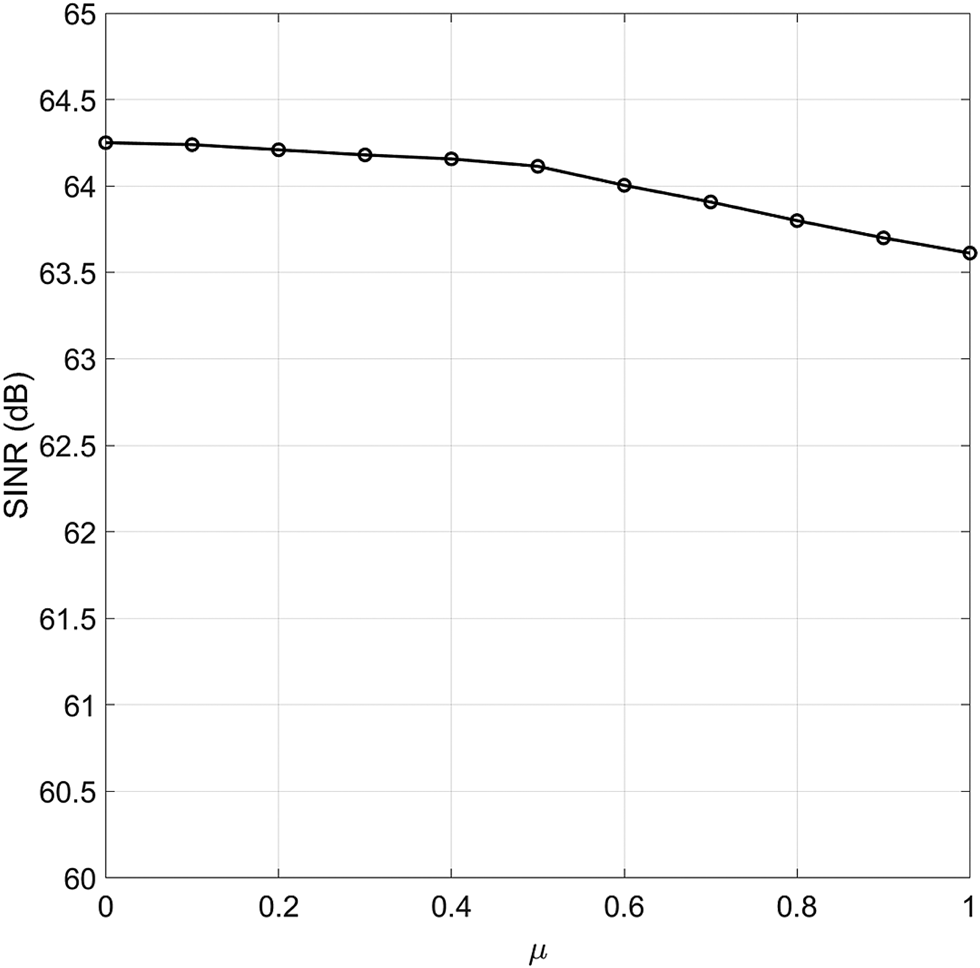
In order to further verify the robustness of the network against array uncertainties, we investigate the performance of signal-to-interference plus noise ratio (SINR) under different values of array error tolerance. As shown in Fig. 9, with the increase of the array imperfection parameter μ, the SINR of the CNN model decreases very slowly (it has <1 dB reduction when μ increases from 0 to 1), which demonstrates that the CNN model adapts well to the array uncertainties.
Output SINR with different array error tolerances.

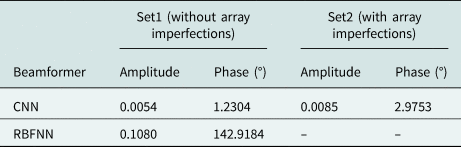
Table 1 summarizes the beamforming amplitude and phase weight root mean square errors (RMSEs) between the optimum Wiener weights and actual weights for different beamformers and different sets of incident angles of SOI and SNOIs. As expected, the CNN-based 2D beamformer highly outperforms the RBFNN-based one in terms of RMSE of beamforming weights in both amplitude and phase. The RMSEs also indicate that the proposed CNN model can effectively solve the real-time 2D beamforming problem irrespective of the existence of array imperfections.
Summary of beamforming amplitude and phase weight RMSEs

Conclusion
In this paper, a CNN is applied to the 2D beamforming of an 8 × 8 planar phased array. The CNN, a deep neural network, is compared to a RBFNN, which is a shallow neural network. Except for its good nulling performance, the RBFNN does not achieve any good beamforming performance in terms of main beam direction or sidelobe levels. On the contrary, the CNN has shown to estimate nearly optimal Wiener array weights, form deep nulls at inference directions, and maintain the gain of the desired direction. Despite the presence of the array imperfections, the CNN has the capability of preserving the desired array pattern properties, which proves the robustness of CNN against array imperfections.
After the training phase, the proposed neural processor does not need any prior knowledge on the direction of arrival of the desired signal or interferes to estimate nearly optimal weight vectors. In addition, it reduces the computational complexity due to its parallel structure. The online 2D array beamforming based on the CNN is efficient in terms of computation time. It takes about 2s with CNN to get the corresponding array element weights on a laptop with 12 GB RAM and Intel(R) Core(TM) i7-3630QM CPU @ 2.4 GHz. Implementing the neural beamformer on a graphical processing unit reduces the processing time further. This demonstrates that the CNN model succeeds in realizing the 2D beamforming in real time. All these properties make the 2D adaptive beamforming based on CNN very useful in practice.
 Tarek Sallam was born in Cairo, Egypt, in 1982. He received his B.S. degree in electronics and telecommunications engineering and his M.S. degree in engineering mathematics from Benha University, Cairo, Egypt, in 2004 and 2011, respectively, and his Ph.D. degree in electronics and communications engineering from the Egypt–Japan University of Science and Technology (E-JUST), Alexandria, Egypt, in 2015. In 2006, he joined the Faculty of Engineering at Shoubra, Benha University. In 2019, he joined the Faculty of Electronic and Information Engineering, Huaiyin Institute of Technology, Huai'an, Jiangsu, China, where he is currently an Assistant Professor. He was a Visiting Researcher with the Electromagnetic Compatibility Lab, Osaka University, Osaka, Japan, from August 2014 to May 2015. His research interests include evolutionary optimization, neural networks and deep learning, phased array antennas with array signal processing, and adaptive beamforming.
 Ahmed M. Attiya received his M.Sc. and Ph.D. in electronics and electrical communications from Faculty of Engineering, Cairo University in 1996 and 2001, respectively. He joined Electronics Research Institute as a Researcher Assistant in 1991. From 2002 to 2004, he was a Postdoc in the Bradley Department of Electrical and Computer Engineering at Virginia Tech. From 2004 to 2005, he was a Visiting Scholar in Electrical Engineering Department in the University of Mississippi. From 2008 to 2012, he was a Visiting Teaching Member at King Saud University. He is currently Full Professor and the Head of Microwave Engineering Department in Electronics Research Institute. He is also the Founder of Nanotechnology Lab. in Electronics Research Institute.