Introduction
Child maltreatment is the term used to describe any harmful behaviour to which a child or young person is subjected by parents, caregivers or older person. It is regarded as actions of commission or omission that cause physical or emotional harm, and the forms of maltreatment are currently categorised as emotional abuse, sexual abuse, physical abuse, neglect and exposure to family or domestic violence (Australian Institute of Family Studies, 2017).
Professional attention to the detrimental effects of child maltreatment has spanned the years, since Dr Kempe and colleagues published their seminal paper ‘The Battered-Child Syndrome’ in 1962. In the early 2000s, child maltreatment was recognised as being ‘responsible for costly long-term psychiatric disabilities, chronic medical problems, drug and substance abuse, learning problems, unemployability, the risk of developing HIV and other serious social and health problems. As Streeck-Fischer and van der Kolk (Reference Streeck-Fischer and van der Kolk2000, p. 917) note, ‘Children with these experiences demonstrate reactions in their affective, cognitive and neurobiological development’. Evidence for the adverse effects of maltreatment continues to grow, thanks to empirical research focused on the continuance of these effects into adulthood (Painter & Scannapieco, Reference Painter and Scannapieco2013) and the increased risk of re-victimisation (Kendall-Tackett, Reference Kendall-Tackett and Conte2014, p. 168).
As well as inflicting direct personal harm, child maltreatment can be conceptualised as an oppression, as it undermines the rights of children and young people to live free and safe lives and robs them of a sense of agency.
Clarity of Definition
While the scope of this paper does not extend to an in-depth discussion of the emergence of childhood or therapeutic terminology, some account of the terms and descriptions employed here is needed in order to explore the evidence gathered (Bradbury-Jones, Reference Bradbury-Jones2014). The types of therapeutic services that this review is concerned with are individual, family and group work services that children and young people are referred to for counselling after the abuse experience.
As Sargeant and Harcourt (Reference Sargeant and Harcourt2012, p. 3) point out, the terms ‘child’ and ‘children’ vary in meaning for people, and the construct of childhood itself is socially determined and changes over time. For the purposes of this study, the individual identified as a ‘child’ is defined as being less than the chronological age of 16, as per the NSW Children and Young Persons (Care & Protection) Act. Correspondingly, a young person is defined as being between the chronological ages of 16 and 18 inclusive, as per the NSW Children and Young Persons (Care & Protection) Act.
In applying these definitions, however, it is important not to lose sight of the selfhood of the children and young people considered here. As McWhorter (Reference Mc Whorter, Taylor and Vintges2004) writes, self is a ‘phenomenon of becoming rather than being . . . a self who will always surpass what I have been, who will never be identical with myself from moment to moment . . . as a being who will always exceed the boundaries of any identity’ (p. 155). The richness of this description of selfhood is implicitly referenced through the use of the words ‘children’, ‘child’, ‘young person’ and ‘young people’, that should be understood as honouring the uniqueness of each person.
The Evidence-Based Practice Debate
There is an ongoing worldwide commitment from therapists to alleviate the suffering caused by the maltreatment and deliver therapeutic services that are effective in reducing suffering. In addition, therapy offers the opportunity for children and young people to thicken the narrative of their experience where their stories show resistance to the impacts of maltreatment. By doing so, therapy provides a platform where children and young people can reclaim aspects of their lost agency, feel visible, be taken seriously and not be demeaned.
It is acknowledged by professionals that children and young people have a right not only to be afforded meaningful interventions that are relevant and effective, but that are also embedded in theoretical frameworks and research. ‘There can be no doubt that, in order to prevent and treat issues related to child maltreatment adequately, increasingly we must adopt empirically supported initiatives’ (Toth & Manly, Reference Toth and Manly2011, p. 635).
In a report jointly issued by the Australian Centre for Posttraumatic Mental Health and the Parenting Research Centre (2014, p. 15), the authors state that, ‘without an evidence base, it is difficult to determine whether practices meet the standards of being safe and effective, while at the same time producing the highest standard of care available’. The report goes on to emphasise that, ‘the implementation of evidence-based approaches helps assure practitioners that they are using strategies that carry the strongest evidence for working effectively with children and families, (p. 16).
The term ‘evidence-based practice’ (EBP) is used to categorise the interventions that are considered to be most effective. However, there are multiple views about what constitutes effective practice, and there is an acknowledgement that service evaluation is not a neutral process. For example, Taylor (Reference Taylor2005, p. 601) stresses ‘the increasing role of evaluation as a political phenomenon [which] can be traced in Britain to the rise of neo-liberalism, public choice theory and new managerialism over the last two decades of the twentieth century’. While the use of evidence-based terminology is promoted as the search for more effective ways to benefit people, it is also synonymous with what are the most efficient ways to work with people. Petersen and Olsson (Reference Petersen and Olsson2015) regard neo-liberalism and EBP as ‘interrelated discourses [that] stress scientific evidence and efficiency’ (p. 1582).
With the rise of new managerialism in human services, measures of efficiency have become associated more closely with the collection of numeric data than qualitative evidence about clients’ welfare. As Head (Reference Head2008, p. 5) cautions, ‘A selection of convenient ‘facts’ may be harnessed to an argument and large areas of other information are then ignored, dismissed as tainted or otherwise deemed as irrelevant’. Some have argued that this selection of facts is at the expense of listening to the lived experiences.
Neylan (Reference Neylan2008) has similarly observed that the language of EBP used to describe ‘good social policy’ is the language of statistics. He writes that the reliance on this measure ‘ignores the sometimes arbitrary choice of which evidence to inject, and it unjustifiably assumes that positivist forms of evidence such as statistical data have a monopoly on useful knowledge’ (Neylan, Reference Neylan2008, p. 13), which, in turn, ‘produces scientific evidence that provides universal truths’, (Petersen & Olsson, Reference Petersen and Olsson2015, p. 1582).
There are also disparities in how the terminology of EBP is understood and applied (Avby, Nilsen, & Dahlgren, Reference Avby, Nilsen and Dahlgren2014). There are dissenting voices that are challenging the notion that EBP is the only means to measure effective practice (Epstein, Reference Epstein2009; Nevo & Slonim-Nevo, Reference Nevo and Slonim-Nevo2011; Petersen & Olsson, Reference Petersen and Olsson2015), and these writers argue for a broadening of the knowledge landscape to include Evidence-Informed Practice and Praxis-based Knowledge that take into account the knowledge that arises from practice and both clients and practitioners contributions. As Nevo and Slonim-Nevo (Reference Nevo and Slonim-Nevo2011, p. 1185) suggest, evidence ought to be considered ‘along with a host of other considerations taken in equilibrium by an experienced and imaginative practitioner . . . thus the wise practitioner, while taking account of evidence, will also rely on other factors, including her own judgement, as well as on her client's perspectives’ (Nevo & Slonim-Nevo, Reference Nevo and Slonim-Nevo2011, p. 1185).
Children and Young People's Place in the Evidence Debate
Critiquing work with men who use violence, Jenkins (Reference Jenkins2009) observes that men are often objectified, and intervention is at risk of replicating the dynamic of abusive and violent behaviour. It is equally important to ask if any aspects of the hegemony of EBP establish a politic that replicates the dynamics of maltreatment. Do adults control the research agenda, as adult perpetrators of violence control children and young people?
Children and young people have experienced the silencing and objectifying dynamics of maltreatment. Therefore, it is vital that all levels of intervention, from initial engagement to evaluation and closure, that they are seen and heard. Australia's status as a signatory to the United Nations Convention on the Rights of the Child (UNCRC) provides a firm political framework for this occur. Article 12 of the Convention is particularly relevant to this argument. It specifies that children and young people have the right to be involved in decisions that affect their lives.
Purpose of this Literature Review
Freire proposed that liberation for oppressed people cannot be done to them, it must instead be achieved through ‘action with them’ (Freire, Reference Freire1970, p. 48). If professional intervention in the lives of children and young people is to avoid replicating the oppressive dynamics of abuse and neglect then children and young people must be seen to be, ‘their own example in the struggle for their redemption’, (Freire, Reference Freire1970, p. 36) and be active participants in the evaluation of services and the debate on effectiveness.
Johnson (Reference Johnston, Percy-Smith and Thomas2010, p. 162) argues for a strong evidence base that includes children's perspectives’, in the hope that this will convince doubting professionals of the value children and young people can contribute to policy and programming.
The purpose of this literature review is to explore who determines what is effective and how this evidence is gathered. In doing so, it will also focus on the current state of children and young people's contribution to the effectiveness debate.
Method
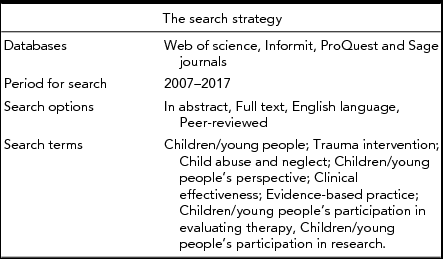
This review utilised a systematic search of peer-reviewed articles, which were retrieved via databases accessed through Sydney University. The search strategy is described in Table 1.
Search strategy for articles.

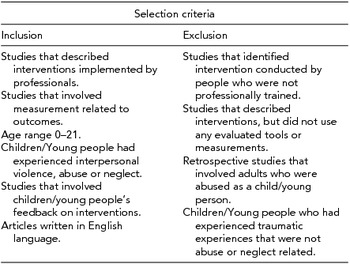
The search strategy returned 1447 articles. These articles were then culled for articles repeated across different databases and non-therapeutic content until a total number of 98 articles remained. A second wave review, using the inclusion/exclusion criteria in Table 2, was conducted based on reading abstracts, and 40 articles were chosen for full-text review.
Selection criteria for literature search.

Results
The majority (N = 32) of the studies favoured a quantitative approach, which was used as either as the sole method (N = 26) or in a mixed methodology (N = 6). The remaining studies (N = 8) used qualitative methods.
Types of Interventions
The interventions covered in this search were categorised as Individual (N = 19), Group (N = 13), Parent and Child (N = 5) or Family therapy (N = 3). A broad range of treatment approaches were used, including Cognitive Behavioural Therapy (CBT); Trauma Focused CBT; Game-Based CBT; Psychotherapy; Play Therapy; Art Therapy; Massage; Trust Based Relational Therapy; Therapeutic Mentoring and Therapeutic Parenting, as well as Solution Focused, Multi-systemic, Community based, Cue centred, Sports, Animal assisted and Adventure therapies.
Some of the articles looked at mixed approaches, and some did not specify the approach that was used. The studies that looked solely at CBT and its variants (Trauma Focused CBT and Game-Based CBT) far outnumbered those focusing on other modalities.
Research Populations
While this review focused on articles printed in English, the review encompassed studies from the USA, UK, Australia, Sweden, Norway, Canada, Brazil, Chile, Ireland and New Zealand. An overwhelming number of the studies reviewed were conducted in the USA (N = 26), meaning there is a North American bias in the results.
Demographic characteristics of the children and young people represented in the studies were not provided in every paper. However, looking at the combined data, the research population can be summarised as being predominantly white, female and mid-adolescent.
This is an important consideration in the EBP debate as the quantitative researcher is ‘usually concerned to be able to say that his or her findings can be generalised beyond the confines of the particular context in which the research was conducted (Bryman, 2012, p. 76). A predominantly white female adolescent research cohort is not representative of every child who receives therapy. While the findings may be helpful in exploring the effectiveness of the therapies researched, the generalisation value is context specific. In reading the results the representative significance to younger children, boys, disabled children and young people, and those from different cultural backgrounds must be kept in mind.
Conceptual Lens Used to Scrutinise the Literature
In keeping with the literature review's intent to explore who determines what is effective and how the evidence is gathered, five specific questions were used when scrutinising the literature:
-
• How is evidence of effectiveness gathered?
-
• What information is gathered and deemed as relevant to academic review and professional interest?
-
• What interventions are currently deemed as effective?
-
• What is the current level of the contribution made by children/young people?
-
• What do children/young people value about current therapeutic interventions?
In order to assess, the extent of children and young people's contribution to these studies, a further conceptual lens was employed based on the work of Harry Shier. Shier's Pathways to Participation model (Reference Shier2001, p.111), evolved through practice with children and young people in England, describes three stages of organisational commitment to children's participation (openings, opportunities and obligations), for which there are five levels of participation to help organisations gauge their participatory practices and make changes. These five levels, described below, were used to assess the extent to which studies incorporated children and young people's contributions:
-
1. Children are listened to.
-
2. Children are supported in expressing their views.
-
3. Children's views are taken into account.
-
4. Children are involved in decision-making processes.
-
5. Children share power and responsibility for decision making.
The examined literature is therefore categorised into studies that excluded and included children and young people's contribution. Those that included their contributions were then examined using Shier's five levels of participation.
Studies that Excluded Children and Young People's Contribution
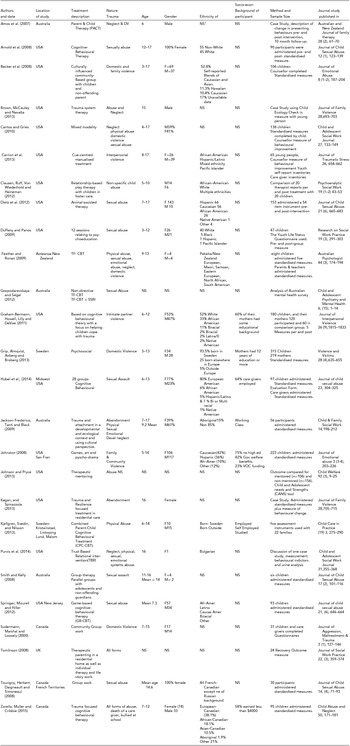
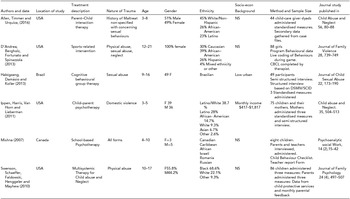
The studies excluding children and young people's contributions generally employed quantitative and mixed method approaches that utilised numeric data collection. A profile of the quantitative studies is found in Appendix I, and the mixed methods studies in Appendix II. Questionnaires, pre- and post-measures, and standardised instruments were the most commonly used forms of data collection. Standardised measures, used alone or as part of mixed methods studies, represented the most common form of data collection. Alongside standardised measures, mixed method studies incorporated reviews of case files, interviews of parents and/or other professionals, and measurements of behavioural change.
In all of the studies, (quantitative and mixed) the therapeutic interventions examined were deemed effective. All data were analysed using statistical analysis as the benchmark for effectiveness.
Carrion, Kletter, Weems, Berry and Rettger (Reference Carrion, Kletter, Weems, Berry and Rettger2013) offered the only comparative study. They compared the wellbeing of children receiving therapy to that of children on a waiting list. This study was, therefore, able to make claims about the effectiveness of therapy based on therapy versus no therapy.
The remaining studies did not offer comparative analyses, making it difficult to conclude which modalities might be most effective. In addition, all studies highlighted limitations for their research, which ranged from the lack of randomised or controlled methodology; reliance on the feedback of individual professionals; small sample sizes; the attrition of participants that resulted in smaller sample sizes post-treatment than pre-treatment, and a lack of comparison groups.
The majority of the quantitative studies were rigorous in their methodological approach, offering structured and reliable data collection and analysis, and limiting researcher basis. These are important considerations when judging the claims of effectiveness.
There was no consistency across the literature regarding the use of terminology or definitions to describe effective outcomes. However, there were some terms that were widely used: trauma symptom reduction, behavioural symptom reduction, reduction in internalising or externalising behaviours. Notwithstanding this lack of consistency the literature highlighted common effectiveness factors, for example, reduction in externalising and internalising behaviours (Amos, Beal, & Furber, Reference Amos, Beal and Furber2007; Becker, Mathis, Mueller, Issari, & Atta, Reference Becker, Mathis, Mueller, Issari and Atta2008; Graham-Bermann, Howell, Lilly, & DeVoe, Reference Graham-Bermann, Howell, Lilly and DeVoe2011; Grip, Almqvist, Axberg, & Broberg, Reference Grip, Almqvist, Axberg and Broberg2013; Hubel et al., Reference Hubel, Campbell, West, Friedenberg, Schreier, Flood and Hansen2014); reduction in PTSD or trauma symptoms (Carrion et al., Reference Carrion, Kletter, Weems, Berry and Rettger2013; Dietz, Davis, & Pennings, Reference Dietz, Davis and Pennings2015; Duffany & Panos, Reference Duffany and Panos2009; Gospodarevskaya & Segal, Reference Gospodarevskaya and Segal2012; Feather & Ronan, Reference Feather and Ronan2009); reduction in mental health symptoms (Clausen, Ruff, Von Wiederhold, & Heineman, Reference Clausen, Ruff, Von Wiederhold and Heineman2012; Johnston & Pryce, Reference Johnston and Pryce2013; Kjellgren, Svedin, & Nilsson, 2013).
These studies show that in seeking an answer to the question of what is effective, a positivist paradigm was clearly privileged, relying on methodologies that are ‘a battery of clinical measures’ (Springer, Misurell, & Hiller, Reference Springer, Misurell and Hiller2012, p. 649). This does not allow children and young people to take their place as ‘important knowledge agents’ (Petersén & Olsson, Reference Petersen and Olsson2015, p. 1588) nor offer them opportunities to thicken the narrative of their self-agency.
When there was an opportunity for children and young people to be involved, it seems to have been missed. In the mixed method studies, for example, interviews were used, but only one study (Jensen, 2010) included children or young people's contribution. This is despite the potential that interviews have ‘as a method of obtaining children's own perspectives’ (Greig, Taylor, & Mackay, Reference Greig, Taylor and Mackay2013, p. 160).
In these very same studies, professionals and parents were afforded the opportunity of giving feedback on children and young people's behavioural changes and symptom reduction. The children and young people who were subjected to the abuse, who hold within them the lived experience of the abuse and recovery experience, were not interviewed.
The completion of some of the questionnaire and standardised instruments by children and young people cannot be regarded as engaging them ‘as experts on their own subjective experience’. The construction of the measures is by adult professionals to gather data on items that adult professionals deem as relevant. Standardised measures, questionnaires, behaviour change measures are all looking for ‘a certain construction of reality and in the process leave little room for clients to negotiate a shared understanding of their individual experience with workers. The subjective, often intangible, nature of human existence is not captured’ (Hodge, Reference Hodge2001, p. 204). As Sargeant and Harcourt note, ‘judgements without including the perspectives of the children can lead to conflict, and disjunction between the lived and the observed’ (Reference Sargeant and Harcourt2012, p. 5).
Studies that Included Children and Young People's Contribution
Of the six mixed methods studies reviewed, one study (Jensen, Reference Jensen2010) did include a child or young person's contribution. This study concentrated on an exploration of the therapeutic relationship between therapist and child. It incorporated both quantitative outcomes, i.e. improvement in children's symptoms using the Child Behaviour Checklist (Achenbach, 1991) and qualitative outcomes, i.e. children and young people's experience of the therapeutic relationship.
A quantitative study by Sudermann, Marshall and Loosely (Reference Sudermann, Marshall and Loosely2000) that looked at community group work for children affected by domestic violence included children's contribution in the evaluation. It not only included children's satisfaction with the groups, but they also integrated children and young people's feedback on the draft questionnaire into the final version.
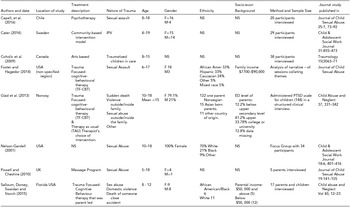
The eight qualitative studies reviewed predominantly favoured interviews (N = 6) as the methodology of choice. One study used focus group and the remaining study analysed the narrative of children's accounts during therapy. A profile of the qualitative studies can be found in Appendix III.
Seven studies of the qualitative studies embraced children and young people's contribution to the evaluation of therapy. This brought the total number of studies to include children and young people to nine; one mixed method study (Jensen, Reference Jensen2010); one quantitative study (Sudermann et al., Reference Sudermann, Marshall and Loosely2000); seven qualitative studies (Capell et al., Reference Capell, Lama, Rodríguez, Beiza, Dussert and Gutierrez2016; Cater, Reference Cater2014; Coholic, Lougheed, & Cadell, Reference Coholic, Lougheed and Cadell2009; Foster & Hagedorn, Reference Foster and Hagedorn2014; Glad Jensen, Holt, & Ormhaug, Reference Glad, Jensen, Holt and Ormhaug2003; Nelson-Gardell, Reference Nelson-Gardell2001; Salloum, Dorsey, Swaidan, & Storch, Reference Salloum, Dorsey, Swaidan and Storch2015).
Some of the qualitative studies included transcripts of slices of conversation with children and young people. In these studies, children and young people were able to clearly articulate what they regarded as an effective therapy. They demonstrated insight into the nature of the therapeutic process and how they experienced it:
You know, you don't want to talk about what happened. And then you feel that you don't want to tell, but then you have to tell, you know. Then it becomes easier to talk to the [counsellor]. (Participant in Cater, Reference Cater2014, p.465)
Just thinking of it hurts, but when you talk about it you really let out your feelings so it hurts a lot worse than just thinking about it. (Participant in Nelson-Gardell, Reference Nelson-Gardell2001, p. 408)
Children and young people were also able to articulate the complexity of the recovery process, a reminder to professionals focused on behaviour reduction measures that children are also ‘active and competent beings and key witnesses to their lives’ (Mayall, 2002 quoted in Sargeant & Harcourt, Reference Sargeant and Harcourt2012, p. 19). Moreover, as a participant in one study indicated, the impacts of abuse and therapy extend beyond what is observable in terms of behaviour: ‘healing to the maximum is not possible. Something always remains’ (Capell et al., Reference Capell, Lama, Rodríguez, Beiza, Dussert and Gutierrez2016, p. 82).
In fact, while the majority of studies that excluded the voices of children and young people described effectiveness as an absence or reduction of behaviours, children and young people themselves predominantly described components of gain, such as
-
• Increased ability to talk about the abuse (Capell et al., Reference Capell, Lama, Rodríguez, Beiza, Dussert and Gutierrez2016; Cater, Reference Cater2014; Nelson-Gardell, Reference Nelson-Gardell2001; Salloum et al., Reference Salloum, Dorsey, Swaidan and Storch2015).
-
• Increased self-esteem (Coholic et al., Reference Coholic, Lougheed and Cadell2009; Foster & Hagedorn, Reference Foster and Hagedorn2014).
-
• Increased self-awareness (Coholic et al., Reference Coholic, Lougheed and Cadell2009; Foster & Hagedorn, Reference Foster and Hagedorn2014).
-
• Increased connection to their feelings (Coholic et al., Reference Coholic, Lougheed and Cadell2009; Nelson-Gardell, Reference Nelson-Gardell2001).
-
• Gaining new coping skills (Coholic et al., Reference Coholic, Lougheed and Cadell2009; Foster & Hagedorn, Reference Foster and Hagedorn2014).
-
• Increased ability to relax (Coholic et al., Reference Coholic, Lougheed and Cadell2009; Salloum et al., Reference Salloum, Dorsey, Swaidan and Storch2015).
-
• Improvement in relationships (Capell et al. Reference Capell, Lama, Rodríguez, Beiza, Dussert and Gutierrez2016; Foster & Hagedorn, Reference Foster and Hagedorn2014).
In addition, some studies found other significant outcomes – an improvement in children's use of imagination outside the group context (Coholic et al., Reference Coholic, Lougheed and Cadell2009), the experience of having the story of abuse believed was enormously helpful (Nelson-Gardell, Reference Nelson-Gardell2001). Other studies identified that children and young people noted the provision of food and a welcoming therapeutic environment was important to them (Salloum et al., Reference Salloum, Dorsey, Swaidan and Storch2015). Capell et al., Reference Capell, Lama, Rodríguez, Beiza, Dussert and Gutierrez2016; Salloum et al., Reference Salloum, Dorsey, Swaidan and Storch2015 study highlighted the greater connection to parents as an outcome of the intervention they evaluated. Children and young people's feedback lifts the discourse on effectiveness factors out of the limits of behavioural and symptom reduction into broader considerations of environment and relationships.
The importance of the therapeutic relationship was the one issue that was common across all the studies. The children and young people spoke of the characteristics of the therapist that they most valued and found effective. They wanted professionals to be trustworthy and to maintain contact with them. They wanted to be listened, believed and not have their views ignored. They wanted to be respected and cared for. They also wanted to be given information about the services they were referred to and be involved in decision making. They did not want to be judged or reprimanded if they gave feedback. In addition, they wanted to have a shared language with professionals that were not adult-centric or laden with technical jargon. Finally, they wanted fun and creative ways to communicate and work together with professionals.
Mudaly and Goddard (Reference Mudaly and Goddard2006) demonstrated that children have a depth of understanding about the purpose of therapy. Their study showed that children felt that counselling had helped in symptoms reduction and behavioural problems. For example, one 11-year-old girl said:
Counselling has helped me, umm, to express my feelings, and that's why I'm not scared or anything. It improved, well . . . helped me understand a lot more things and stuff like that. It's really fantastic.
(Mudaly & Goddard, Reference Mudaly and Goddard2006, p. 115)
They were also able to reflect on the format of counselling and how it might be adjusted or improved:
Just, like, you just have a break sometimes. Ah, like, cut it down to half an hour or something and just play the games, and, take for about 20 minutes and that's the way to do it. (11-year-old male in Mudaly & Goddard, Reference Mudaly and Goddard2006, p. 118)
The limitations of these studies were the lack of randomised or controlled methodologies and the small numbers of participants. In addition some relied on therapists’ reports on their clients’ progress.
The literature that included children and young people's contribution highlights that children and young people are far more than the sum of the abuse experience, the list of symptoms or problematical behavioural descriptors that adults impose upon them. They are active agents in the world, unique individuals in their experiences and ambassadors of knowledge.
Three of Shier's (Reference Shier2001) five levels of participation (‘Children are listened to’, ‘Children are supported in expressing their views’ and ‘Children's views are taken into account’) were evinced by the results of the studies. Shier states that level three (children's views are taken into account) is the minimum practice needed to meet UN requirements. However, it remains unclear if any of the views or suggestions of the children and young people led to changed service delivery. This is noteworthy in light of the findings of a previous literature search done by Worrall-Davis in 2008. This review also highlighted the lack of published literature on children's perceptions of intervention and reported no changes to service delivery as a result of the consultations with them (Worrall-Davis, Reference Worrall-Davies and Marino-Francis2008, p.13).
This current literature search did not uncover any direct evidence of the other levels of participation (‘Children are involvement in decision-making processes’, or ‘Children share power and responsibility for decision-making’). However, Sudermann et al. (Reference Sudermann, Marshall and Loosely2000) incorporation of children and young people's feedback into the final version of their questionnaire could be seen as a form of power sharing.
Discussion
This literature review was conducted to explore the current position on what is considered as effective in therapy with children and young people who have been maltreated, with an emphasis on their contribution. The limitations of this review were the small number of therapy studies produced by the search strategy. However, it did highlight issues that are significant to the discourse about what constitutes evidence of effectiveness, particularly in relation to the issue of how children's and young people's views are represented.
The initial five inquiries that were used to guide the search of the literature indicated that the evidence of effectiveness is predominantly gathered by adults from a positivist paradigm, privileging statistical analysis to determine effectiveness based on the behavioural change or symptom reduction.
A variety of modalities in individual, family and group work intervention was present in the studies reviewed, with CBT interventions being the most widely researched. All of the studies concluded that the intervention was effective despite the different methodological approaches.
These findings are encouraging for clinicians because they suggest clinicians have access to a variety of creative methods to help children and young people heal from the effects of maltreatment. This finding also conveys the dedication of the therapeutic profession to ‘get it right’ for children and young people.
Lack of Inclusion
Despite Sargeant and Harcourt's (Reference Sargeant and Harcourt2012, p.19) contention that ‘children are active and competent beings and key witnesses to their own lives’, the majority of studies did not include children's contributions. Though the interventions reviewed showed efficacy of results, the privileging of data collection that subjects children and young people to a barrage of measures or collects their urine samples (Purvis, et al., Reference Purvis, McKenzie, Becker Razuri, Cross and Buckwalter2014) without otherwise asking for their input, leaves their lived experience ‘dismissed as tainted or otherwise deemed as irrelevant’, (Head, Reference Head2008, p. 5).
The overall results of this review leave one with a sense of the enormity of the exclusion of children and young people from the effectiveness debate. Children and young people were not afforded a proper place at the knowledge table, with only nine out of 40 papers reviewed including their contribution.
Of course, inclusion in the effectiveness debate does not guarantee that the politic of power sharing will automatically happen or children and young people will be the influencers of all evidence-based inquiry. However, it is possible to have methodologies that create ‘pockets of participation’ (Frank, Reference Frank2011) and that ‘[offer] a way of treating children as active subjects and recognis[e] that they may have distinct perspectives on the world’ (Greene & Hogan, Reference Greene and Hogan2005, p. 192).
Social Construction of Age as an Explanation for Exclusion
The substantial amount of literature that focuses on effective therapeutic interventions highlights the concern professionals have for children and young people and their willingness to exercise the adult duty of care and provide protection for them. The lack of children's participation in research cannot, therefore, be attributed to the neglect or lack of will to protect and assist them in recovery. The social construction of age may hold some explanation for exclusion.
In this social construction, children are deemed as incompetent and adults ‘are presumed to be competent unless there is evidence to the contrary’ (Coppock, Reference Coppock and Franklin2002, p. 150). Le Francois (Reference LeFrançois2008) study also highlighted the plight of young people in the mental health system as ‘passive recipients of care from what is essentially a paternalistic service’ (LeFrançois, Reference LeFrançois2008, p.213).
There appears to be a contradictory duality for children and young people in therapy. They are considered capable of engaging in therapy yet not capable of being equal partners with therapists in evaluating it. If children and young people are able to of talk about painful events in their lives, then they are qualified to talk about how they experienced the intervention that invited them into these conversations. The seven studies that included children and young people's contributions demonstrated that they have the capacity for evaluative skills. What the literature review did not reveal was the rationale behind why some therapists co-evaluate with children and young people while others did not. In this paper, it has been hypothesised that the social construction of age and the place of paternalistic service delivery may be the reason for this. However, further investigation into the rationale for excluding children and young people is warranted, which would move the discussion beyond speculating about hypothesises.
The results of the review did, however, uncover the invisibility and silence position of children and young people in service delivery, (Goddard et al., Reference Goddard, Hunt, Broadley, Dibben, Frederick, Mudaly, Newtown and Conte2014, p. 245). If therapeutic intervention into the lives of children and young people affected by maltreatment is to provide a platform for reclaiming some form of self-agency, then it is imperative that children and young people are given an active role in the evaluation of the therapeutic services.
Looking at the research, policy and practice from within Shier's (Reference Shier2001) five levels of participation we can formulate reflective questions at each of these levels that asks
Are we listening to children and young people? Are we supporting them to express their views? Are we taking their views into account? Are we involving them in decision making? Are we power sharing and creating the opportunity for them to take responsibility for decision making?
Recommendations
Winter invites professionals to consider how to create ‘spaces to allow children's perspectives to challenge and inform child-centred research, policy and practice’ (Winter, Reference Winter2014, p. 21). The following contribution adds to the space for children and young people's perspectives.
Research
The review has revealed that there few studies that include the input of children and young people in analyses of therapeutic effectiveness. Although Greene and Hogan (Reference Greene and Hogan2005, p. 253) note that ‘systemic attention to participatory approaches in research began to emerge through the 1990s, prompted in part by increasing awareness about child participation rights’, it would seem that researchers have not pursued the use of these participatory approaches. Consequently, more participatory research with children and young people and their practitioners needs to be undertaken. The act of giving children and young people say about the interventions they undergo also sends implicit messages they are valued so that while research is not therapy, research can have therapeutic benefits.
The narrow range of methodological approaches that emerged from the literature, highlight the need for more creative ways to engage children and young people. The participatory research literature itself suggests a multitude of creative methodologies, especially with young children and children/young people with a disability (Aubrey & Dahl, Reference Aubrey and Dahl2006; Daly, Reference Daly2009; Hill, Reference Hill2015; Luttrell, Reference Luttrell2013; Nic Gabhainn & Sixsmith, Reference Nic Gabhainn and Sixsmith2006; Souza, Downey, & Byrne, Reference Souza, Downey and Byrne2013; Sutherland & Young, Reference Sunderland and Young2014; Watson & Feiler Reference Watson and Feiler2014; Winter, 2012). These include the use of art materials for drawing and constructing boxes, photographs, picture cards and talking mats, which not only lend richness to data collection but give priority to the perceptions and communication preferences of children and youth.
Across the research itself, Beazley's, Bessell, Ennew and Waterson (Reference Beazley, Bessell, Ennew and Waterson2009, p.369) contention ‘that academic theory (an adult social product) tends to be disconnected from children's lives’ is clearly evinced by the use of academic language and writing styles (e.g. APA 6 style) and the modes of disseminating information (e.g., through publication in professional journals). While these support the communication of complex information between professionals, there are also alternatives to ameliorate the disconnection between academic research and children themselves, such as inviting children and young people to review findings or publishing in children and young people's magazines.Footnote 1
Policy
Organisations that provide therapeutic services to children and young people need to have a commitment to participatory evaluation embedded in their procedural guidelines. Part of this commitment may involve training staff and mentoring children and young people to engage in the adult arena of research. For example, Shier, Méndez, Centeno, Arróloga, and González (Reference Shier, Méndez, Centeno, Arróloga and González2014, p. 5) suggest various ways children and young people can engage in the policy arena, by
-
• Being direct participants in a policy-making body.
-
• Acting in an advisory or consultancy role to policy-makers.
-
• Meeting face-to-face with policy-makers, being listened to and taken seriously.
-
• Mobilising a large body of opinion to put pressure on policy-makers, such as organising marches, petitions, etc.
-
• Making use of the mainstream and social media effectively to promote their views.
Practice
Practitioners must seek to balance Rights-Based Practice (Mc Veigh, Reference Mc Veigh2016) with Clinically Informed Practice. Embedded in this Rights-Based Practice is the belief that therapy cannot be done to children and young people but must be enjoyed with them at all levels of the intervention, including evaluation. It is, fundamentally a relational therapy built upon working in partnership with children and young people to harness their wisdom and self-engendered capacity for healing at all stages from initial engagement sessions to closure. Through this relationship, children, young people and the adult are therapeutic activists who together seek to address the effects of maltreatment that objectifies, silences or demeans children and young people. Adult and child partnering to evaluate therapy are, therefore, one of the fundamental steps in doing this therapeutic activism.
Conclusion
To the often asked travel question of children, ‘Are we there yet’? the answer in relation to participatory practices in the research and therapeutic field is, ‘Not yet’!
However, the fact that we are not there yet is not cause for despair. This literature review shows that the therapy field is filled with dedicated and caring professionals in practice and research who seek to improve the lives of children and young people. It is vital that the journey toward participation continues and grows. This requires taking a giant step away from continued reliance on adult-led and constructed paradigms of effectiveness. It requires perhaps not only seeing children and young people as partners in this debate but, indeed, as convenors and leaders.
In this process, children and young people can be given the opportunity to reclaim some of their stolen self-agency and be the source of transformation in their own lives and the lives of other children and people who benefit from the research. They may even be a source of transformation for adult professionals who engage in this process with them.
Key Quantitative Studies Reviewed

Key Mixed Methods Studies Reviewed

Key Qualitative Studies Reviewed