Ever since Marcel Mauss's Essai sur le don (Reference Mauss1967 [1925]), gift exchange has held an esteemed place in scholarship. It is one of anthropology's core themes, in large part because of its common, yet varied, relevance for human solutions to value, sociality and politics across space and cultures. The large ethnographic literature inspired by Maussian perspectives has illuminated how the gifting of material culture generates persons and orients social relations, usually in native, non-monetized and non-capitalist economies (e.g. Gregory Reference Gregory1982; Lévi-Strauss Reference Lévi-Strauss1969; Sahlins Reference Sahlins1972; Strathern Reference Strathern1988; Thomas Reference Thomas1991; Weiner Reference Weiner1992).Footnote 1
The subtitle to Mauss's work in English, ‘Exchange in archaic societies’, signals the antiquity of gift giving, but archaeological treatments have been limited. This can be attributed, at least in part, to archaeology's relative inability to capture what Morris (Reference Morris1986, 2) lamented as an ‘ephemeral phenomenon, archaeologically invisible’, for ‘most social contexts of prestation produce no archaeological residue’.
Despite its vast propensity to harbour material things, the archaeological record is partial and slow to reveal about the desires of exchange partners, hand-to-hand transactions and, crucially, the extended process of gift giving. These, and how they are imbricated in broader institutions, practices and meanings (Mauss's system of ‘total prestation’), may be evidenced more readily through ethnography or history. By the same token, gift exchange has featured productively in the archaeology of other world regions (e.g. Clark Reference Clark1965; Fowler Reference Fowler2004, ch. 3; Morris Reference Morris1986). That comparable studies on the ancient Americas, especially the Andes, have been relatively rare is notable since theorization of ‘gift economies’ often relies on Amerindian practices and ethnography (Graeber Reference Graeber2001; Mauss Reference Mauss1967 [1925]; cf. Oliver Reference Oliver2009).
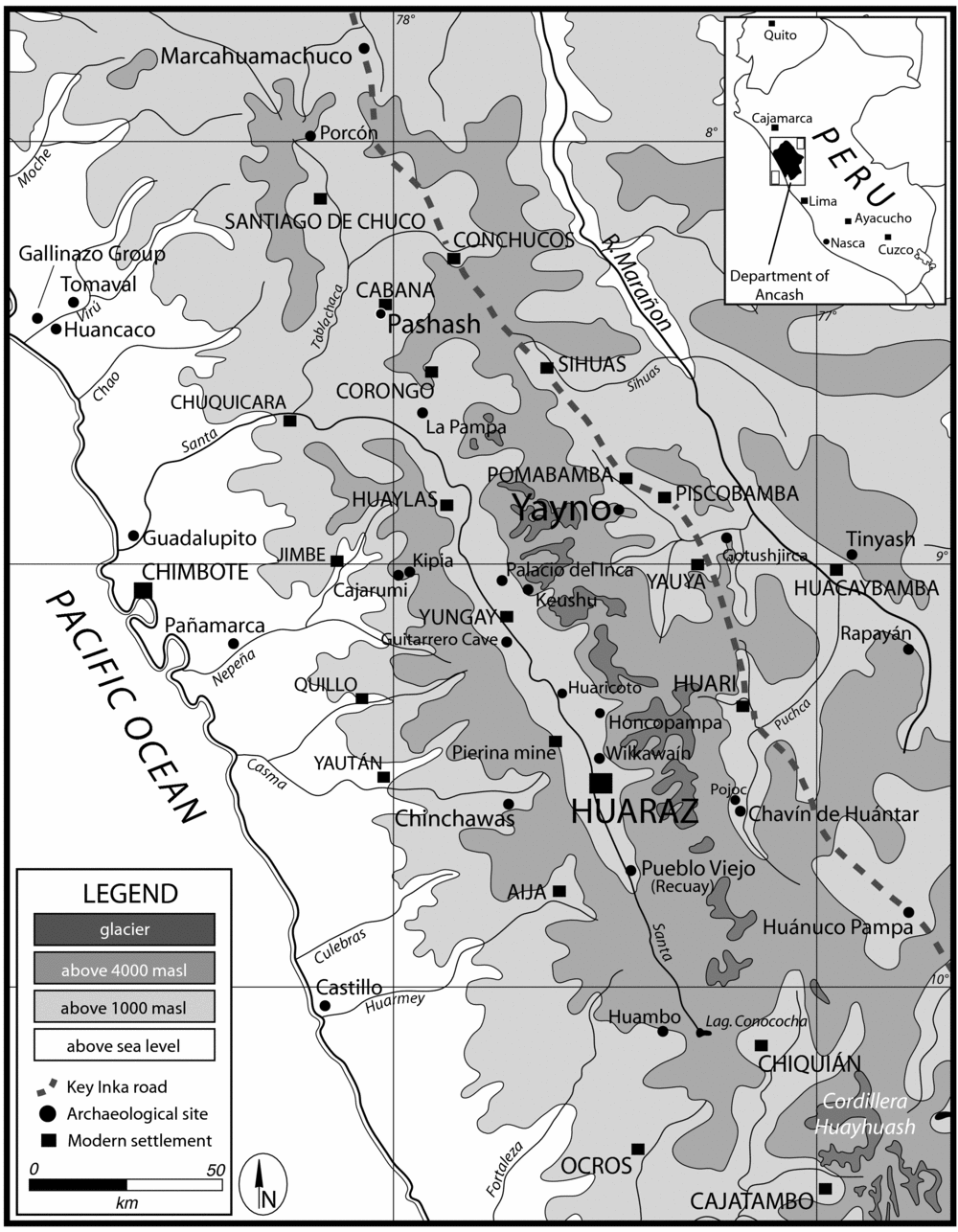
This article examines an archaeological context as a consequence of gift exchange. It treats a secondary burial made during the time of the Inka empire (fifteenth–sixteenth century ad). The offering, dedicated to a sacred place in highland Peru (Fig. 1), was of a young child and contained rarities of foreign derivation and association to different parts and concerns of the realm. The fieldwork and ethnohistoric comparison enable a wider consideration of Inka-period offering traditions, particularly the capac hucha.Footnote 2 Such offerings often involved a human sacrifice, but comprised one component of a larger gifting relationship between the empire and its provinces. The present study finds both similarities and differences to known capac hucha cases. It is argued that the Yayno offering resulted from ceremonial activities that linked the Inka state to village communities and the ancient site, and engaged them in a protracted gift economy.
North-central Peru, locating Yayno and sites mentioned in text. (Map: author.)

Gifting, reciprocity and the ancient Andes
The Central Andes is often seen as exceptional as a heartland for early civilization. State polities and complex arts, technologies and institutions arose without major money- or market-based exchange systems, the wheel or writing. In lieu, gifts and valuables often assumed a central role in spurring economic production. Food and maize beer, given away in feasts, engendered labour obligations (Hastorf Reference Hastorf1993, 219; Morris & Thompson Reference Morris and Thompson1985, ch. 5). When identity, status, or subjecthood needed to be marked, cloth and attire sufficed (Murra Reference Murra1980, 74). Small prestations and acts of hospitality served as a prelude to barter and larger-scale exchanges (Lazzari Reference Lazzari and Meskell2005, 145; Mayer Reference Mayer2002, 156). Portable charms ensured the health and fertility of camelid herds; mummy bundles and ancestor effigies did the same for human groups (Lau Reference Lau2013; Salomon Reference Salomon, Phipps, Hecht and Esteras Martín2004; Sillar Reference Sillar2012). All of these, not surprisingly, are tokens of respect and generosity that figured in reciprocal relations. In no small measure, Andean complexity was made possible by social relations of reciprocity powered by the help of embodied, material things; objects regularly mediated humans, economic production and social differentiation.
Pioneering anthropological work since Mauss has developed three of his original insights: 1) gift exchange as social contract and a system of reciprocity (Lévi-Strauss Reference Lévi-Strauss1969, ch. 5; Sahlins Reference Sahlins1972); 2) gift giving's competitive spirit and self-interest—that in giving, one acquires or keeps (e.g. debts, resources, status, fame, superiority) in relation to another (Graeber Reference Graeber2001; Weiner Reference Weiner1992); and 3) that gifts share in the essence and personhood of the giver, which are partible, circulated or embedded through exchange (Munn Reference Munn1986; Strathern Reference Strathern1988; Thomas Reference Thomas1991). Due to preservation and limitations of the subterranean record, archaeological studies have increasingly studied the third aspect, the partibility of persons—ascribing valued essences (or ‘agency’) of the original to objects, extensions or their fragments (Chapman Reference Chapman2000; Fowler Reference Fowler2004; Oliver Reference Oliver2009). Such studies observe artefactual relations that transcend the merely formal: the agency of the original can multiply and be co-present even if its parts are dispersed across space. Fragments can also be given away, but nevertheless signify or evoke the whole.
Archaeologists may infer ‘gifthood’ or ‘personhood’ from artefacts, but the identification may be synchronically restricted: the item is from a source region, which is often taken, by default, as the donor's region; where it is found, meanwhile, is counted as the recipient's destination and location. The tendency towards normative flattening and palimpsest makes it difficult to reconcile Mauss's basic contention that gift exchange implies mutual obligations and a process of giving, accepting a gift, and reciprocating with a countergift. Thus a cultural biography of gifts/valuables, which has been crucial in ethnographic studies, may be more difficult to reconstruct through prehistoric archaeology.Footnote 3
Archaeology typically addresses gift exchange as a generalized economic practice and rationalizes it as maximizing, accumulative activity and performed by actors as calculated (e.g, self-interested) strategy (e.g. Helms Reference Helms1993, 92–5). Gift exchange is seen as adaptive and more typical of kin-based societies; it promotes cooperation and resource sharing when kinship ties are seen to be weak or non-existent (e.g. Johnson & Earle Reference Johnson and Earle1987, 6–7). Scholars emphasize energetics: gifts and valuables are usually small and portable, and can be ‘converted’ into staple resources or tribute locally, thereby optimizing or obviating labour, storage or transport costs of bulk goods (D'Altroy & Earle Reference D'Altroy and Earle1985). This is consistent with Gregory's (Reference Gregory1982) influential model, which opposes commodities- versus gift-based economies. The former is associated with hierarchical, class-based societies—which thrive from impersonal and market-based forms of exchange and transacted items (‘commodities’). Unlike market economies, which traffic commodities to maximize capital and earnings, gift economies often stress how exchanges of objects are embedded in protracted social relations, enabling certain kinds of persons and overall social reproduction. Gift economies may be privileged in smaller-scale, more egalitarian kin-based societies, where items of exchange are often highly personal, biographical and ‘inalienable,’ retaining something of the giver (an individual or collective ‘moral’ person).
Rare precious items or materials, especially from great distances, frequently hold special value. The ability to acquire long-distance objects is often bound up with access to alterities (foreign and supernatural othernesses), which are particularly desirable to enhance identity, prestige and/or local agency (Goldstein Reference Goldstein2000; Helms Reference Helms1993; Nielsen Reference Nielsen, Nielsen, Rivolta, Seldes, Vázquez and Mercolli2007; Sahlins Reference Sahlins2012). Comprehensive new volumes research the flows of resources, including of prestige items and exotics, to model more fully the array of economic practices and value systems in Pre-Columbian societies (Hirth & Pillsbury Reference Hirth and Pillsbury2013; Mathews & Guderjan Reference Mathews and Guderjan2017; Papadopoulos & Urton Reference Papadopoulos and Urton2012). Yet there remain few case studies focused on gift exchange.
This essay examines how an Andean state system incorporated a form of gift exchange in the political economy (also Morris Reference Morris1986; Oliver Reference Oliver2009). The largest native polity of the Americas, Inka Tawantinsuyu [The four parts united], relied on a long-held value system centred on reciprocity and a multiscalar social network for redistributing key resources. The Inka state intensified festive generosity to garner a vast pool of labour for its projects—construction, warfare, storage, herding and roads (D'Altroy Reference D'Altroy2002; Godelier Reference Godelier1977; Mayer Reference Mayer2002; Murra Reference Murra1980). The infrastructure and activities of empire were, in no small measure, made possible through imperial gifts given in return for the allegiance and labour tribute of their subjects. The best-known prestations to provincial groups, besides formal recognition and privileges accorded by the Inka, were festive meals, plentiful maize beer, coca leaf and rare precious items (e.g. cloth, metal objects and marine shell) (Murra Reference Murra1980; Rostworowski Reference Rostworowski1999; Rowe Reference Rowe and Steward1946). To this, I add the gifting of living subjects, or capac hucha.
Andean prestations
An important native category for assessing and comparing the evidence in this study is capacocha (or capac cocha) or capac hucha (or qhapaq ucha). The Quechua word has been used to describe both the act of sacrifice and the individual sacrificed, usually a child. The term also described the entire ritual cycle (Fig. 2), including presentations, processions, feasts and gift giving, a phase of which culminated in the child's immolation (Besom Reference Besom2009; Reference Besom2013; de Bock Reference de Bock2010; Duviols Reference Duviols1976; MacCormack Reference MacCormack2000; McEwan & van de Guchte Reference McEwan, van de Guchte and Townsend1992; Reinhard & Ceruti Reference Reinhard and Ceruti2010).
Capac hucha ritual cycle, showing flows of gift objects, subjects and reciprocations (denoted by arrows). Capac hucha was a practice inserted (dashed field, top register) between provincial groups and their huaca divinities. The lower register schematizes the physical transformations of the child and her/his ontological trajectory as a gift and subject. (Diagram: author.)

Capac is a Quechua honorific [‘supreme’, ‘royal,’ ‘grand’] and title given to lords and things deserving utmost regard. There is greater uncertainty about the term's second part. ‘Cocha’ usually refers to a lake, sea or body of water (Zuidema Reference Zuidema1973, 28). ‘Hucha’, meanwhile, may mean ‘peccado’ [sin], ‘negocio’ [business/trade] or ‘pleyto’ [plea/dispute/contract] (González Holguin Reference González Holguin1989, 199; Zuidema Reference Zuidema, Collier, Rosaldo and Wirth1982, 425–6). While ‘cocha’ refers to more of a tangible (watery) thing, the semantic field of ‘hucha’ connotes more about social relations, transactions and negotiated activities between people. Scholars thus take capac hucha to mean ‘royal obligation’ (MacCormack Reference MacCormack1991, 104; McEwan & van de Guchte Reference McEwan, van de Guchte and Townsend1992, 359), ‘business’ of the Inka (MacCormack Reference MacCormack2000, 111, 122), or ‘opulent prestation’ (Salomon & Urioste Reference Salomon and Urioste1991, 112). Both ‘cocha’ and ‘hucha’ may have pertinence to the offering in question, but capac hucha may have special relation to its gifted, mediating or exchange quality (see also Bortoluzzi & Martínez Armijo Reference Bortoluzzi and Martínez Armijo2011; Duviols Reference Duviols1976).
Described in various early Spanish accounts (Besom Reference Besom2009, ch. 2), capac hucha featured in the annual ceremonial cycle of Inka sacrifices and prestations, made to shrines in Cuzco, the Inka heartland (Bauer Reference Bauer1998; Farrington Reference Farrington2013) and conquered regions. The rites also marked critical royal events (e.g. succession, war, death) and times of great tumult, such as drought and natural disasters. The annual celebration lavished gifts to the regional gods and their priests, who visited the capital to prophesy the future for the Inka (Besom Reference Besom2009; MacCormack Reference MacCormack2000, 121).
Pedro Cieza de León, a Spanish soldier-chronicler, called capac hucha the ‘gifts and offerings’ made by the Inkas ‘to their idols’ (Reference Brito1985 [c. 1553], 87). The foremost prestations were beautiful children, most aged 4 to 12 years, unblemished and virgin, often born to provincial noble families.Footnote 4 They were first sent to Cuzco for consecration by priests, transforming them, through food and finery, into suitable representatives of the Inka and its solar cult. A girl and a boy could be coupled to form a sacrificial pair, and provisioned with small dedicatory items symbolic of the house, marriage, work and livelihood (McEwan & van de Guchte Reference McEwan, van de Guchte and Townsend1992, 361). Some were then sacrificed in Cuzco. Others were returned to the provinces, occasionally back to their homeland, in group processions with great pomp (MacCormack Reference MacCormack2000, 122). They were then dispatched or buried alive in specially prepared tomb-platforms (Reinhard & Ceruti Reference Reinhard and Ceruti2010, 96–7).
The various nations that made up Tawantinsuyu each worshipped their own pantheon of divinities (huacas or w'akas) (Bray Reference Bray2015; Duviols Reference Duviols1967); capac hucha were Inka-sanctioned gifts to these huacas. Their final destination was usually at a location of the huaca divinity, embodied as an effigy and/or landscape feature. These were often visually impressive locales and greatly esteemed in social memory and local oral histories. Capac hucha themselves became huaca beings and their burial locations served as shrines for subsequent cult activities (e.g. offerings, libations, oracular consultations). They could be worshipped at the spot, or from a distance (Duviols Reference Duviols1976, 38). Provincial groups continued to venerate huacas well into colonial times, making offerings to their tutelary gods in return for their protection, vitality and care; their effigies and shrines were the main targets of Christian anti-idolatry campaigns (e.g. Arriaga Reference Arriaga1999; Duviols Reference Duviols1967).
The processions also engaged the many ethnic groups of the lands traversed en route to the final destination. They obliged hospitality, such as gifting, feasting and provision of shelter (MacCormack Reference MacCormack2000). The ritual complex helped activate the networks of reciprocity that comprised Tawantinsuyu, while marking group boundaries and legitimating the state infrastructure abroad (personnel, roads, installations). The capac hucha cycle thus mobilized and redistributed resources from the entire state network. It also allowed various subjects of Tawantinsuyu, human and non-human, to witness and take part in the proceedings.
By creating gift relations with local divinities, the Inka benefitted because huacas were almost invariably linked to surrounding lands and the water and labour resources which made them productive. The capac hucha ceremonies also recognized territories, settled land disputes and legitimated provincial lordships (MacCormack Reference MacCormack2000; Zuidema Reference Zuidema1973). These were domains for state action that were understood as reciprocity:
. . . no shrine or deity, whether large or small, was forgotten in this empire wide transaction in which the Inca and his subjects gave human victims and other oblations to the deities and guacas, who in return gave to the Inca their benevolence and protection, as well as their hopefully truthful and helpful prophecies . . . (MacCormack Reference MacCormack2000, 124)
The ‘business of the Inka,’ of course, was also to declare that the Inka king and the ‘cosmic polity’ which backed him wielded the power to refashion ancestral bodies/persons and landscapes (for ‘cosmic’, see Sahlins Reference Sahlins2012).Footnote 5 This was not simply ideology masking the practices of exploitation. Capac hucha had great impact because they reinvented provincial histories in a shared idiom of cosmopolitical relations, in which Inka authority, embodied in a living gift-in-process (laden with a future potency), could be inserted as a new, privileged power in regional hierarchies (Fig. 2). Capac hucha thus facilitated Inka intervention into already hierarchically organized, sacred landscapes (Dean Reference Dean2010; Kosiba Reference Kosiba and Bray2015; McEwan & van de Guchte Reference McEwan, van de Guchte and Townsend1992; Meddens et al. Reference Meddens, Willis, McEwan and Branch2014).
Spanish writers observed a wide range of locations and activities associated with capac hucha, particularly as related to the provincial huacas (see Besom Reference Besom2009). The higher-ranking huacas saw grander attention (Bray Reference Bray2015; Duviols Reference Duviols1967). Archaeology has been important in detailing this variability in capac hucha practice (e.g. locations, contents, taphonomy). A few capac hucha are associated with islands and major archaeological sites, such as Túcume (Lambayeque), Pachacamac (Lima) and Choquepukio (Cuzco) (Andrushko et al. Reference Andrushko, Buzon, Gibaja, McEwan, Simonetti and Creaser2011; Besom Reference Besom2009; Bray Reference Bray2009, 360–61; Dorsey Reference Dorsey1901; Narváez Reference Narváez, Heyerdahl, Sandweiss and Narváez1995; Reinhard & Ceruti Reference Reinhard and Ceruti2010). Summit locations and ancient ruins are particularly germane to this study.
The best known cases have been found south of Cuzco, mainly on high peaks above 5000 masl. Because of their remoteness and condition, these are often taken as exemplary (Farrington Reference Farrington2013, 314). In addition to favouring their preservation, the difficulty of access almost certainly limited handling and revisitation after their establishment, not least by Spaniards. Technical studies of human remains (Andrushko et al. Reference Andrushko, Buzon, Gibaja, McEwan, Simonetti and Creaser2011; Reinhard & Ceruti Reference Reinhard and Ceruti2010; Wilson et al. Reference Wilson, Brown and Villa2013) and pottery (Bray et al. Reference Bray, Minc, Ceruti, Chávez, Perea and Reinhard2005) confirm that both humans and artefacts in capac hucha interments originated from different parts of the realm, including local and foreign (including Cuzco) elements. In general, there is much less evidence, documentary or archaeological, about capac hucha locations, after enshrinement.
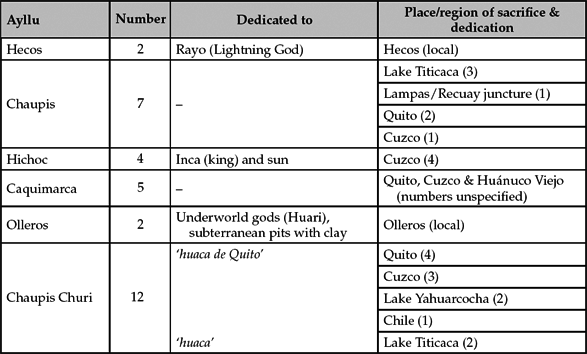
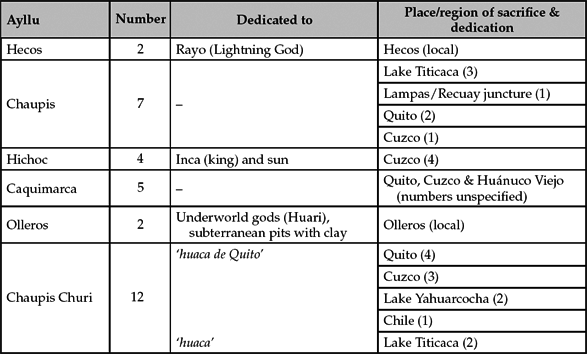
Additional insights can be found in colonial inquisitional documents, which recorded native testimonies of the Christian campaigns against pagan religions, or ‘idolatries’. A 1621–22 account of southern Ancash observed that most kin groupings, called ayllu,Footnote 6 admitted capac hucha in their cult practices (Hernández Príncipe Reference Hernández Príncipe1923). Key details can be gleaned for these groups, who were close cultural and geographic neighbours of Yayno's peoples (Table 1). First, while some ayllu might have (or reported) no capac hucha, other ayllu registered more than one, and up to 12—a substantial total for a small area of southern Ancash. Second, the human sacrifices were sent to significant places throughout the empire. Third, the sacrifices were made for regional divinities, sacred places and ‘amistad’ [friendship, good relations] between rival factions. The ritual also allowed the Inka to reward loyal subjects (Zuidema Reference Zuidema1973; Reference Zuidema, Meddens, Willis, McEwan and Branch2015). Finally, the ayllu groups still very much identified with their capac hucha, and regarded them among their most important cult places and patrimony, nearly a century after the dismantling of the Inka system.
Summary of capac hucha prestations made to Tawantinsuyu by ayllu groups in southern Ancash.
While capac hucha has been studied primarily as state ceremony and human sacrifice, the ethnohistorian Pierre Duviols (Reference Duviols1976, 29) noted its essential redistributive quality and likened it to a ‘circulatory system’ with Cuzco as its ‘heart’. He theorized a series of reciprocal movements and gifts. Some were centripetal, manifested by tribute and resources, including the chosen children, entering Cuzco. Others were centrifugal, when the capac hucha is sent back out to the provinces with return gifts for their local huacas (also Dean Reference Dean2010, 101). Duviols observed, ‘The Inca . . . is implicated in a contract (minka) of the capacocha in which he is recipient, debtor and intermediary, at the same time, and within the relation, so created, of producer and consumer’; just as important, capac hucha intervened in local politics, having ‘the function of settling accounts by means of a complex system of gifts and countergifts’ (Duviols Reference Duviols1976, 31, 34, my translation).Footnote 7
In short, capac hucha formed an integrated social phenomenon, in the Maussian sense. More than a routine transaction between individuals (of alienable objects in regular, forgotten events), the gifting cycle of capac hucha comprised an enduring field of social relations between entire groups which involved ‘institutions [that] find simultaneous expression: religious, legal, moral and economic. In addition, the phenomena have their aesthetic aspect . . . the source of aesthetic emotion and emotions aroused by interest’ (Mauss Reference Mauss1967 [1925], 1, 77). Scholarship has certainly noted the socio-political implications of capac hucha and how it helped integrate different parts of Tawantinsuyu (Besom Reference Besom2013; Duviols Reference Duviols1976; MacCormack Reference MacCormack2000, 120; McEwan & van de Guchte Reference McEwan, van de Guchte and Townsend1992; Reinhard & Ceruti Reference Reinhard and Ceruti2010; Schroedl Reference Schroedl2008). It remains to detail the prestation in this ‘total prestation’ system, particularly its archaeological expressions and variability.
Yayno and the offering context
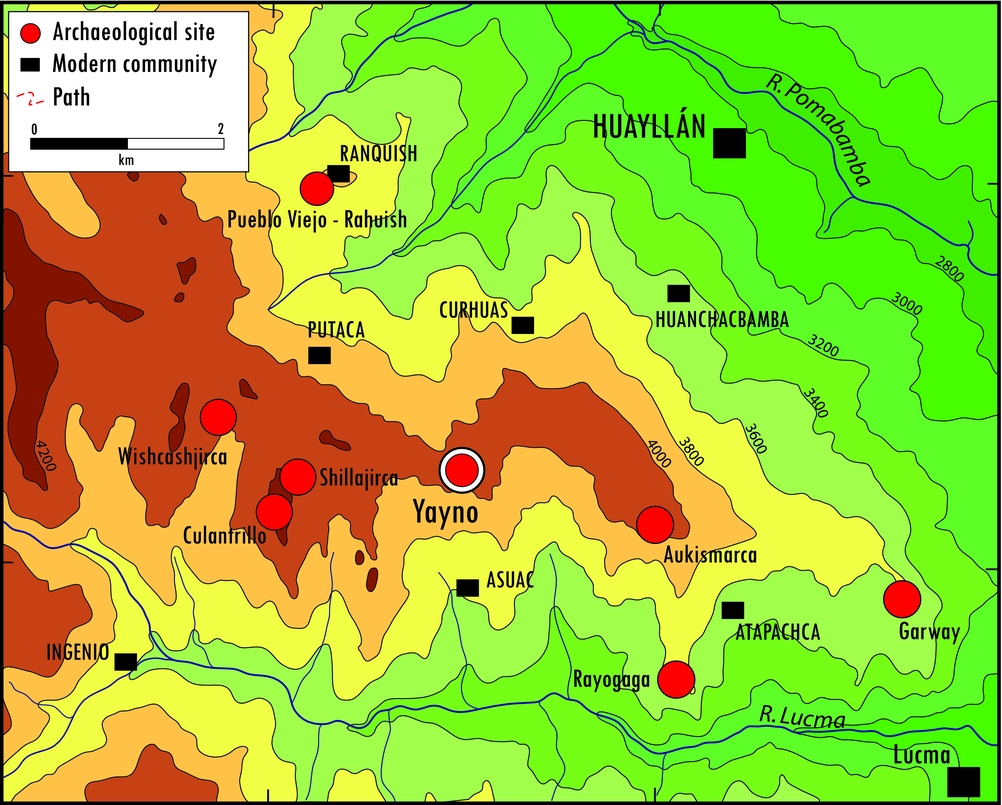
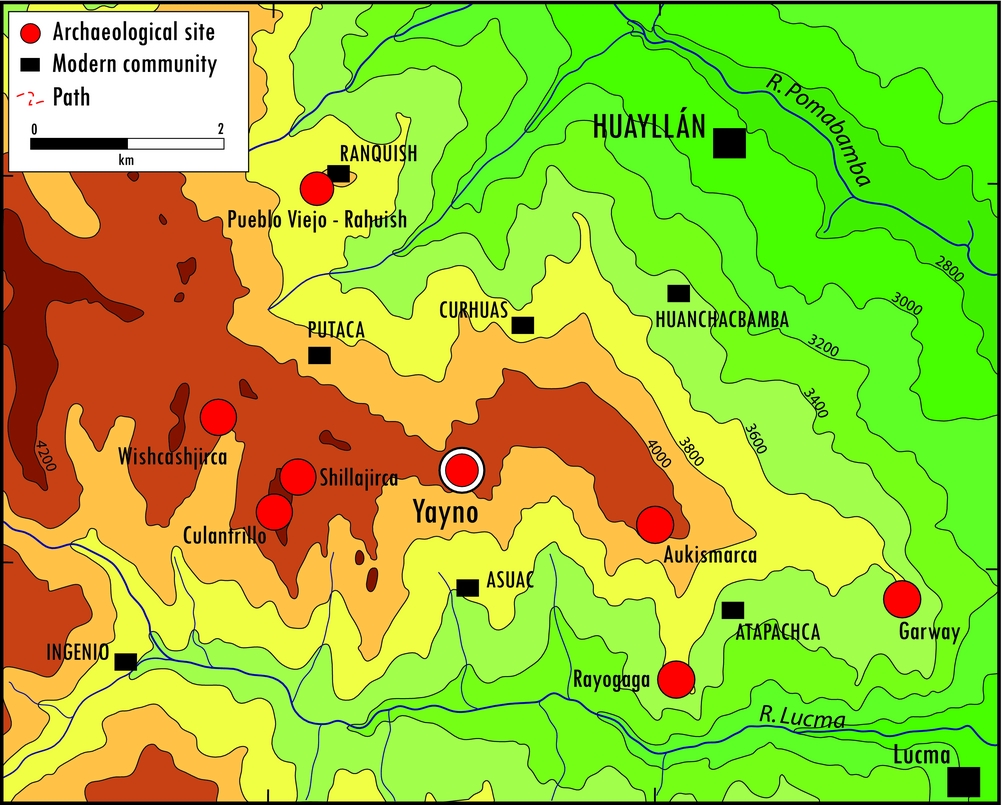
Today, Yayno is the most prominent archaeological site in the region (Pomabamba, Ancash), covering approximately 105 ha of a low mountaintop, Cerro Pañajirca, and adjacent areas (Fig. 3). The site was originally a large fortified village and one of the major centres of Recuay culture, dated to approximately cal. ad 400–800 (Lau Reference Lau2010; Reference Lau2011).
Location of Yayno and surrounding sites and villages with late period (Inka-contemporary) components (Rahuish, Culantrillo, Wishcashjirca, Shillajirca, Rayogaga and Aukismarca). (Map: author.)
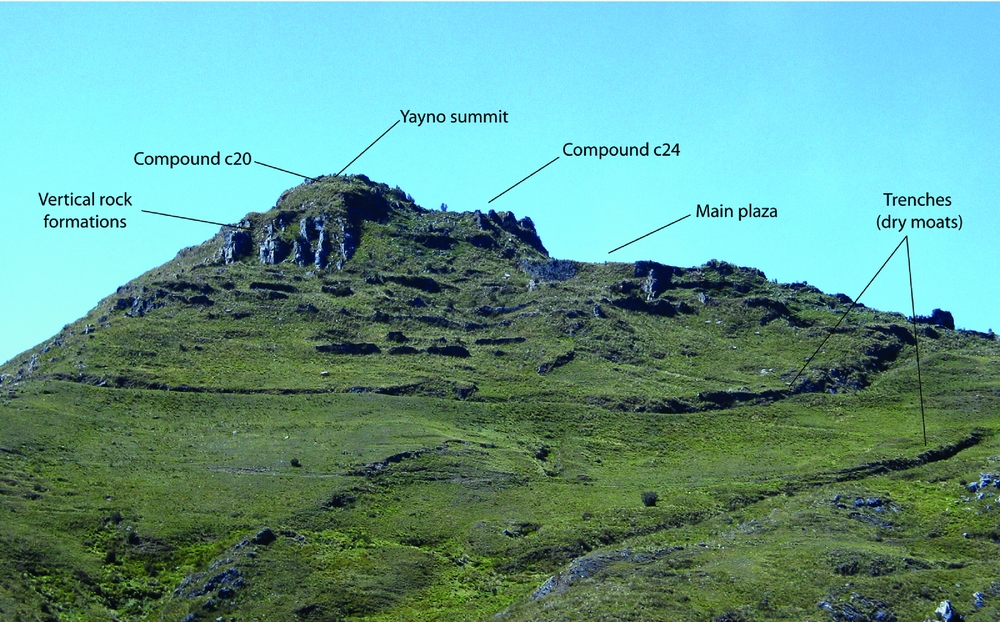
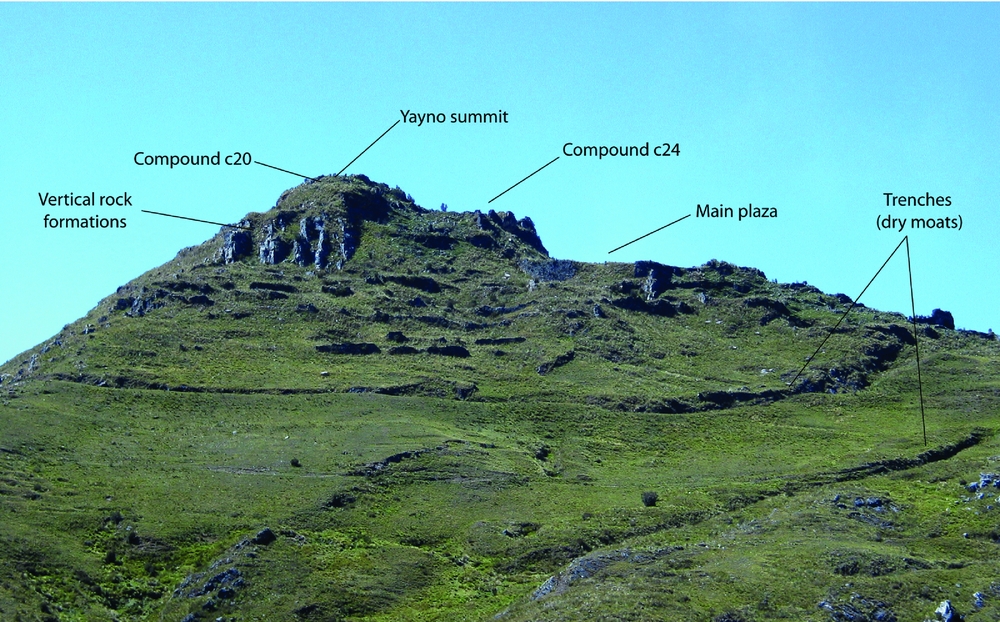
In addition to its strategic location overlooking the confluence of two rivers, Yayno was probably appreciated for a number of prominent visual characteristics, visible from kilometres away. It has a distinctive mound-platform profile (Fig. 4). It is also partly ringed by large erosional channels. Some sections functioned as defences and are walled on the upslope side. Another major feature is a rock formation on the northwest summit face, split into five columns or shallow fins jutting out from the outcrop (for the significance of ‘five’ in Andean thought, see Donnan Reference Donnan, Marcus and Williams2009, 177; Salomon & Urioste Reference Salomon and Urioste1991, 270; Urton Reference Urton1997, 215).Footnote 8 Yayno's western side also affords unobstructed views of the Cordillera Blanca (Apolín G. Reference Apolín2009). The intervisibility between the Yayno's crest and surrounding peaks may have been meaningful in the past, since many oral traditions regard mountains, especially glaciers, as local ‘lithified’ ancestors, with the capacity to see, witness and act (Lau Reference Lau2016; Venturoli Reference Venturoli2011; Yauri Montero Reference Yauri Montero2000).
Northern face of Yayno. Yayno's visual properties (rock formations, terraced profile, vistas, monumental ruins) were important in the past, and continue to distinguish the mountain and its imagination today. (Photograph: author.)
Yayno's main sector was densely built up with over 50 walled compounds used primarily as the house complexes for kin groups or lineages of variable size (Lau Reference Lau2010). The compounds have both round and quadrangular layouts; the largest towered over 12 m tall and had multiple storeys of apartment-like rooms which opened into an unroofed, interior courtyard space. The most monumental compounds have large courtyards, elaborate drainage and visually striking stonework façades. At its height, Yayno was home to approximately 600–900 people (Lau Reference Lau2010, 342), but was largely abandoned by the ninth century ad.
Post-Recuay floors and ceramics, in general, are rare. Any later additions are almost all simple, expedient constructions, probably makeshift shelters and corrals, which robbed stones, incorporated parts of old walls, and rarely employed mortar. More permanent post-Recuay village and hamlet sites occur within a few hours’ walking distance (Fig. 3). Unlike Yayno's discrete compounds, these later villages agglutinated dwellings along the concentric walls that encircled the entire settlement. Late-style pottery and grinding stones are common at these villages and many hilltops in the region, but not at Yayno. With Yayno in ruins, most local groups, by Inka times, appear to have resided in lower-lying villages flanking its mountaintop.Footnote 9
The offering context was found in the courtyard of c20 (circular compound originally of Recuay date), a walled and partly sheltered spot just below the summit (4150 masl) (Fig. 5). The compound sits directly atop the columnar formation previously mentioned; the outcrop is the building's foundation. Locating the burial in c20 protected it from erosion and allowed periodic offerings to pool in the patio.
Layout of Compound c20 and plans of Operation 16 excavations. The burial cist and offerings resulted from Inka-period activities within a circular construction buit by Recuay groups roughly a thousand years earlier. (Author.)

Excavations in c20 included a test pit and a larger exposure, Operation 16 (c. 4×8 m). Immediate signs of unusual deposits were small beads (made out of turquoise- and green-coloured stone), Spondylus sp. shell, obsidian flakes and gold metal foil fragments (láminas). None of this material has been found elsewhere at Yayno, nor is common at other Recuay-period sites. As the excavation progressed, the rare items became more frequent. These were sometimes accompanied by well-preserved, occasionally articulated bones of young camelids. Many complete Spondylus valves also appeared. Two small clusters of whole valves were found atop a hardened earth stratum about 5 cm above bedrock (Fig. 5). The shells were positioned as if originally stacked, and had fallen over. The uneven bedrock resulted in an elevated area (towards the summit), and poorly preserved portions of a beaten dirt floor above it probably served as the main original surface for the offerings. Towards the centre-north, a low hollow was exploited to make a cist. Three flat stone (schist?) slabs, roughly quadrangular in shape, were propped up to form the cist's walls; bedrock formed the remaining side. No mortar was used. The cist, c. 35 cm wide × 30 cm deep, was covered over by a fourth slab.
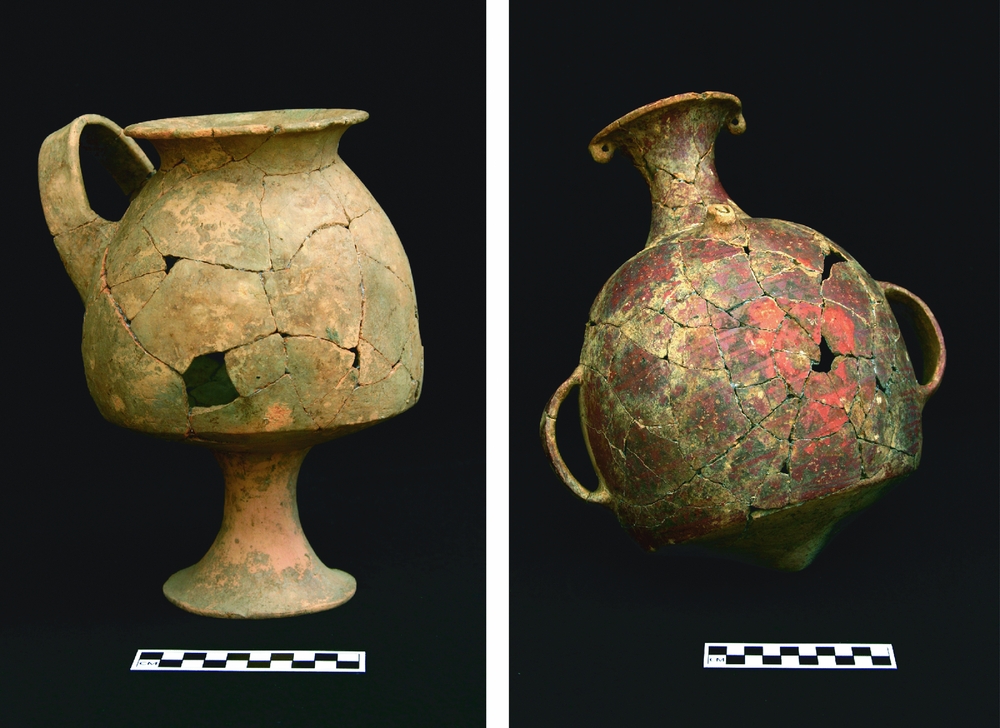
On the cover slab were two shattered, but largely complete Inka-style ceramic vessels (Figs. 5 & 6).Footnote 10 One was a small olla, a wide-mouthed jar (mouth diameter 12 cm; height c. 22 cm), featuring an unslipped light-orange paste, arching strap handle and tall pedestal base (Morris & Thompson Reference Morris and Thompson1985, pl. 7; Reinhard & Ceruti Reference Reinhard and Ceruti2010, fig. 7.23). The other was another distinctive Inka form (‘urpu’), with a tall flaring neck, conical globular body and tapering base (mouth diameter 9 cm; height c. 33 cm). The front body and neck were slipped dark purplish red; the front was painted in dark geometric motifs, mainly rows of triangles within thin bands. The smoothed back side was unslipped and unpainted, but showing light brownish paste and fire clouding. It had two side strap handles, and two perforated nubbins underneath the flaring lip—probably to secure a lid. The front shoulder has a projecting lug, incised with a ‘U’ form. The urpu’s front side was intentionally smashed, perhaps to terminate the vessel and burial ritually.Footnote 11
Inka style ceramic vessels, Operation 16. (Photographs: author.)

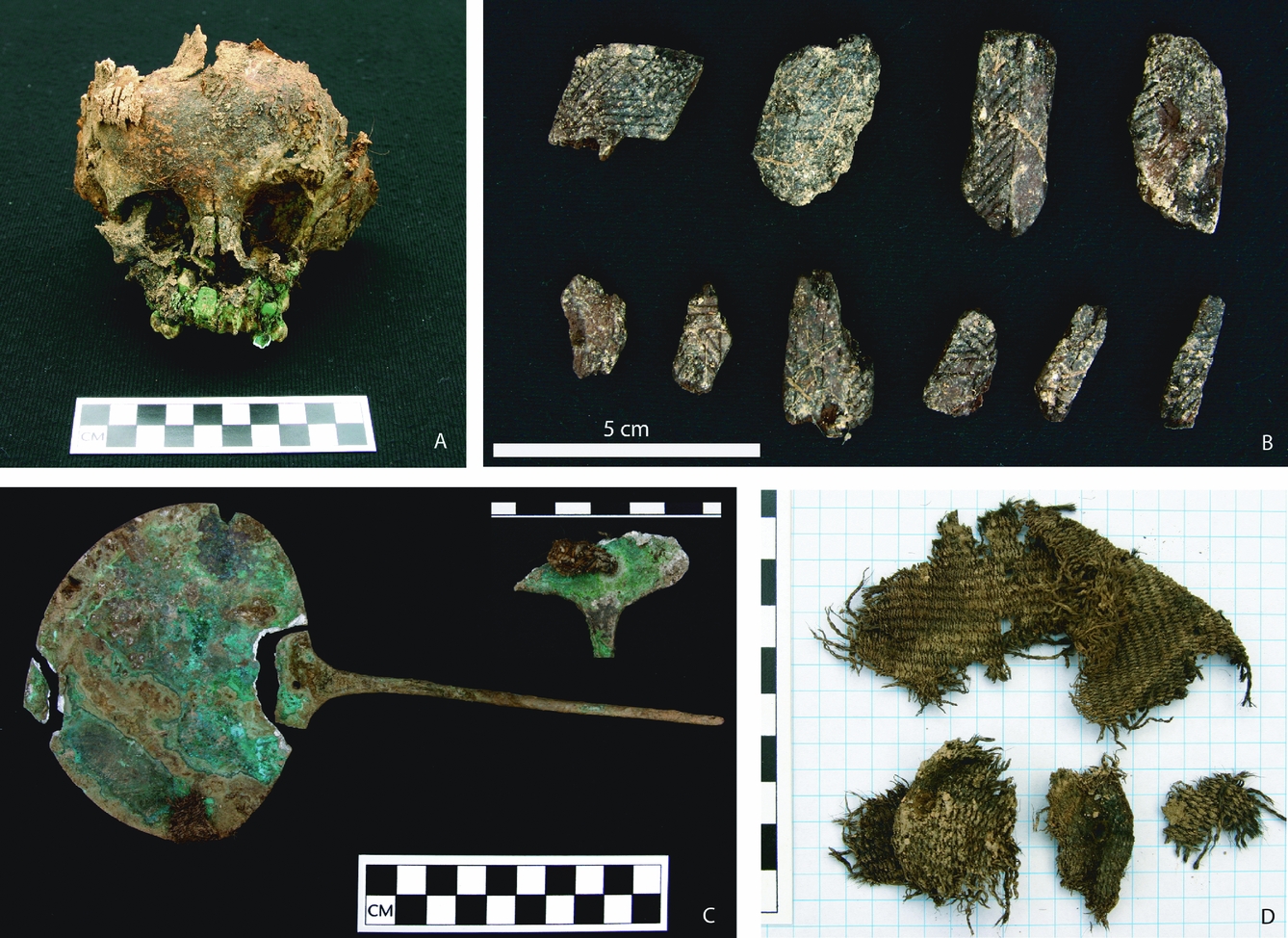
The cist contained heavily eroded fragments of dark brown wood (Fig. 7b). Several featured a concave body and rim, almost certainly of an Inka-style tapered drinking cup, or kero. One fragment shows incision directly below the rim, in triangular pendants filled in with lattices (pointing downwards), alternating with upward-pointing triangular pendants filled in with horizontal hatching. Several body fragments show a chevron design, oriented vertically. The designs are very similar to those on wooden keros found at capac hucha sites (e.g. Reinhard & Ceruti Reference Reinhard and Ceruti2010, fig. 7.30).
Contents of cist: (A) incomplete child cranium; (B) fragments of wooden kero, some with incised geometric designs; (C) tupu pins, showing fragments of cloth; (D) fragments of woven cloth. (Scales in cm.) (Photographs: author.)
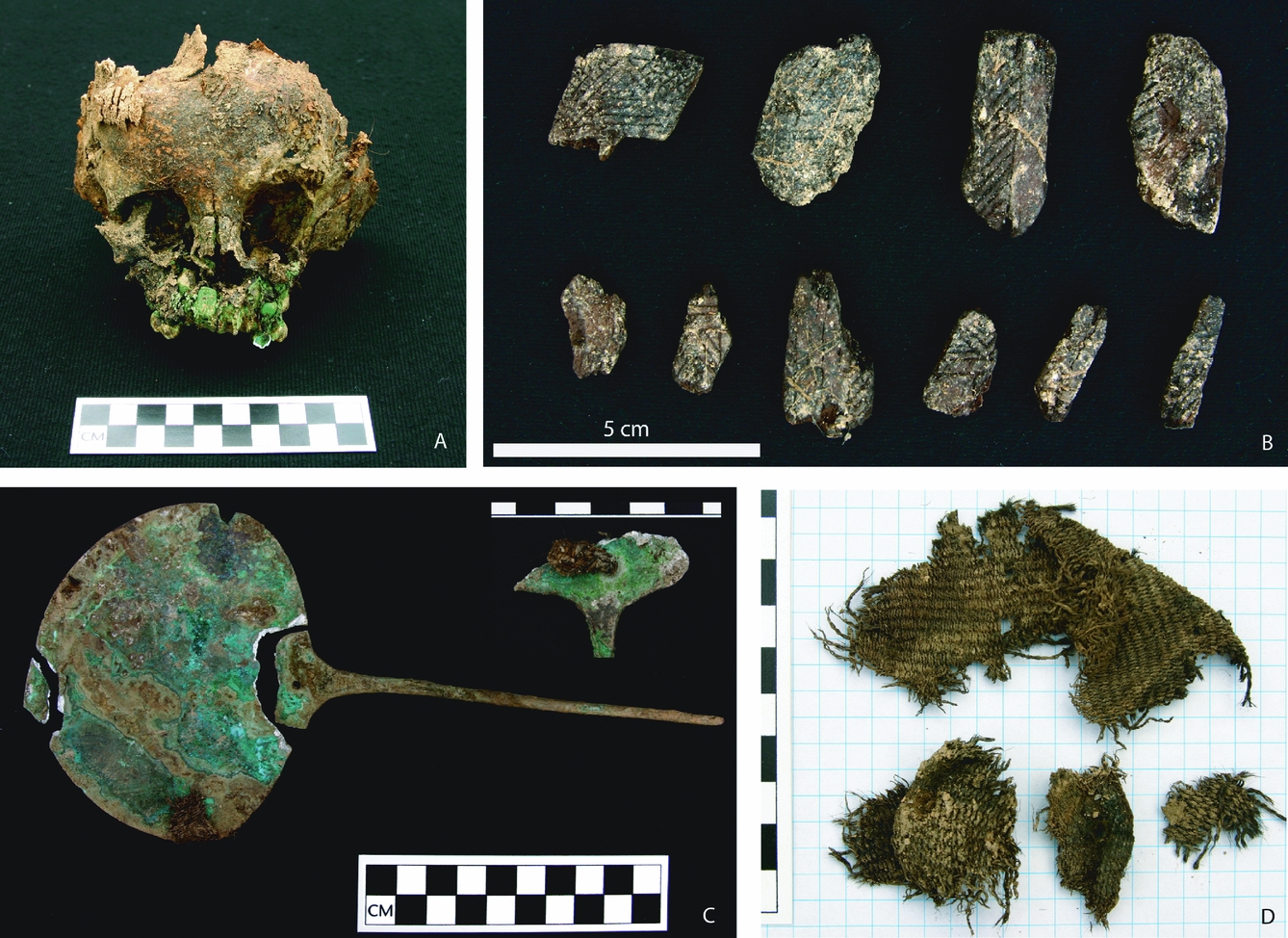
Cloth fragments probably belonged to a mantle or tunic (Fig. 7d). All fragments used a plain-weave technique, featuring camelid warp and weft fibres (Z-spun and S-plied: S(2z)). Despite staining, dark brown, greyish-brown and black colours could be discerned. This kind of cloth is typical of highland Ancash groups of the Late Intermediate Period and Late Horizon (c. ad 1000–1532) (Brito n.d.).
The cist also contained a matching pair of copper and silver metal tupu (pins to adorn and fasten garments). Each has a very large ovoidal disc head of hammered sheet (Fig. 7c), and a hole perforating the disc right above the shaft. Tupu 1 is best preserved (22.9 cm long, disc width 11.2 cm, 42 g). Its disc head has small cloth pieces clinging to it, stuck together with the green corrosion of copper metal. Tupu 2 (35 g) is more fragmented, but features original thread, thickened at the preserved end, running through its hole (Fig. 7c, inset). A cloth fragment with original edge shows a hole, encrusted, through which one of the pin shafts was pushed. The cist also contained a thin gold-metal lámina fragment.
The only human skeletal material was a partial cranium (Fig. 7a), found above the artefacts; mandible and teeth remains were nearby. Age at death was estimated at 4 years (±12 months; sex indeterminate) (Pomeroy n.d.). Tupu pins were vital markers of Inka female identity (Vetter & Carcedo Reference Vetter and Carcedo2009) and it is suggested, tentatively, that the skull was of a very young girl. Mostly the skull's anterior portion survived, with little evidence of pathology. Much of the bone surface was covered in a dark brown deposit, probably preserved soft tissue. The teeth, maxilla and isolated areas of the face were stained green due to contact with a copper-containing metal, probably the tupus. Another copper-bearing object may have been placed in the mouth, given the extent of green staining on the palatine process and teeth.
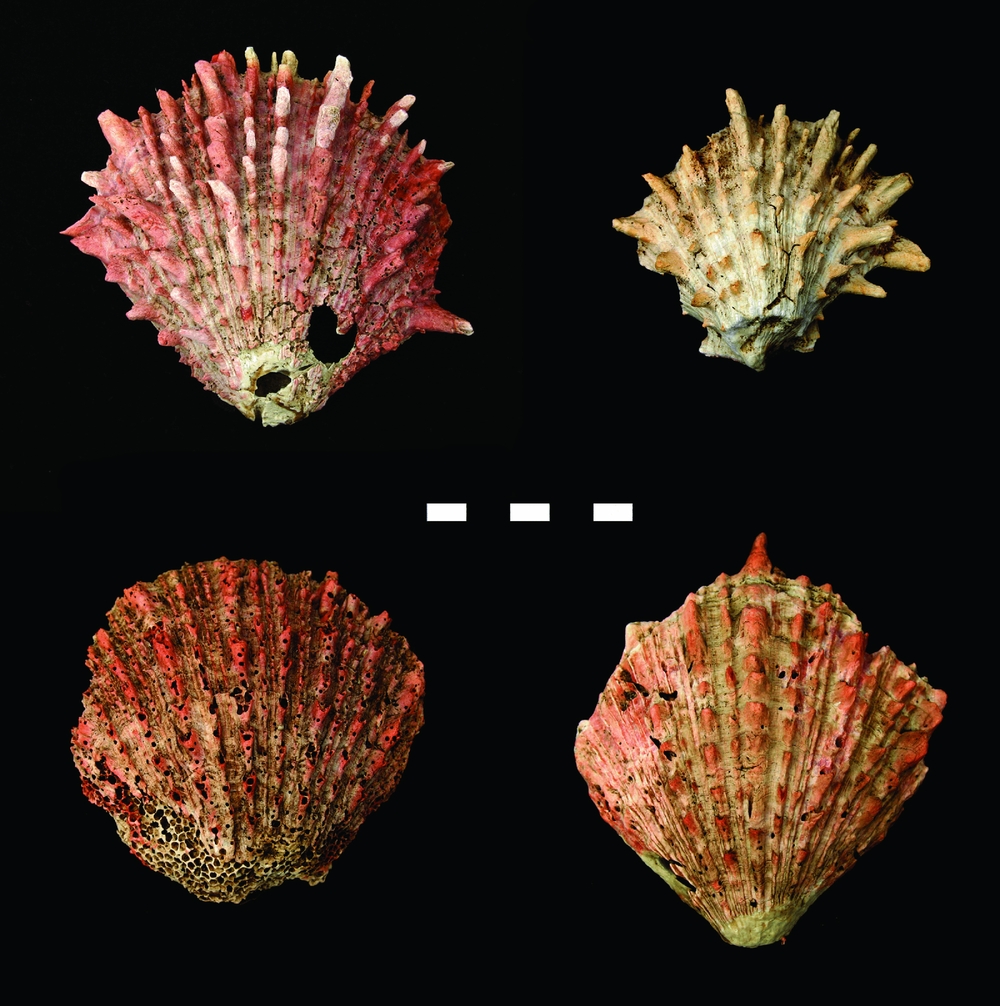
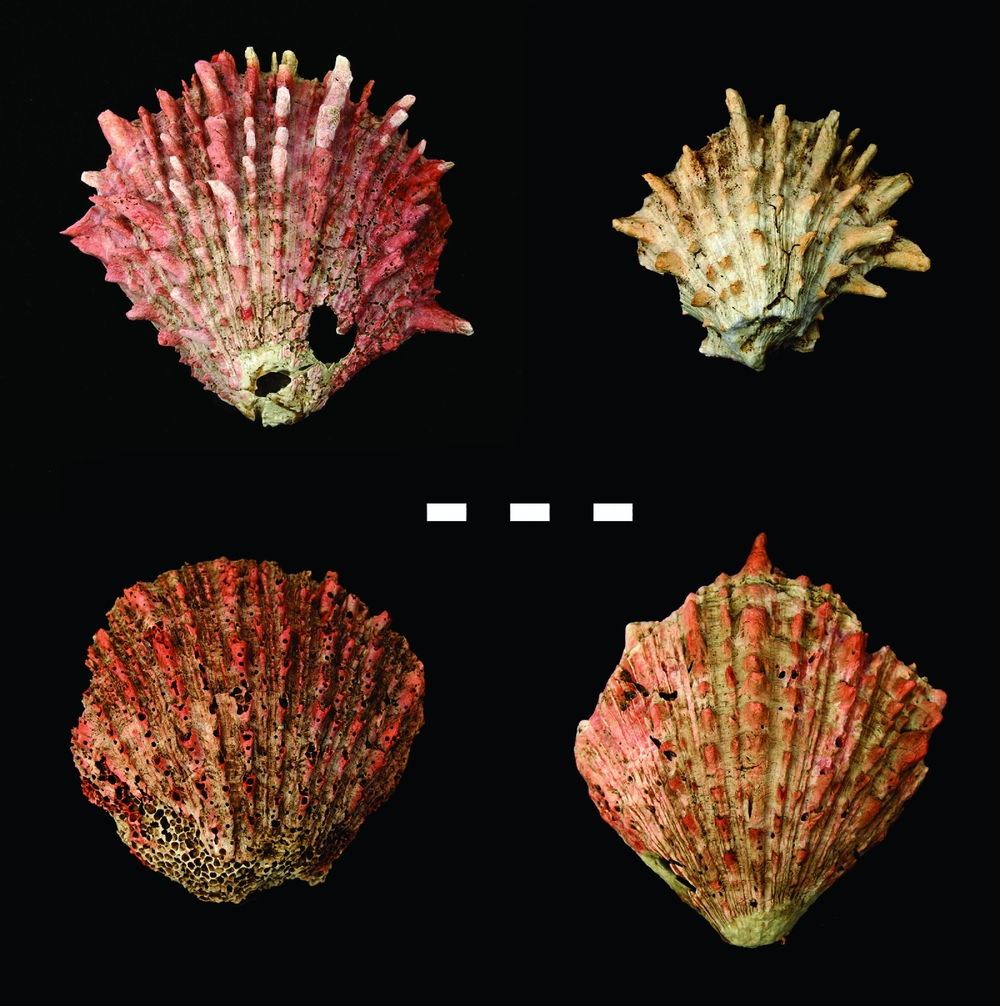
The offering area around the cist, meanwhile, contained impressive quantities of rare precious items. The Spondylus sp. shell represents the largest assemblage known from the sierra of Ancash, if not all of the Peruvian highlands outside of Cuzco. The 861 specimens weighed 10.6 kg, including 79 mostly whole valves and at least 86 other valves (MNI). Most whole specimens measured 8–10 cm (max. dimension) and were largely unworked (Fig. 8), although some had been partially ground down, drilled, or had their spikes removed. On many, the shell colours (red, orange, pink (with white)) have faded, probably due to sun and rain exposure and/or deposition in seasonally wet soil. A trapezoidal shell pendant was also recovered in the find layer.Footnote 12
Spondylus sp. shell valves, offering deposit in Operation 16. (Scale in cm.) (Photographs: author.)
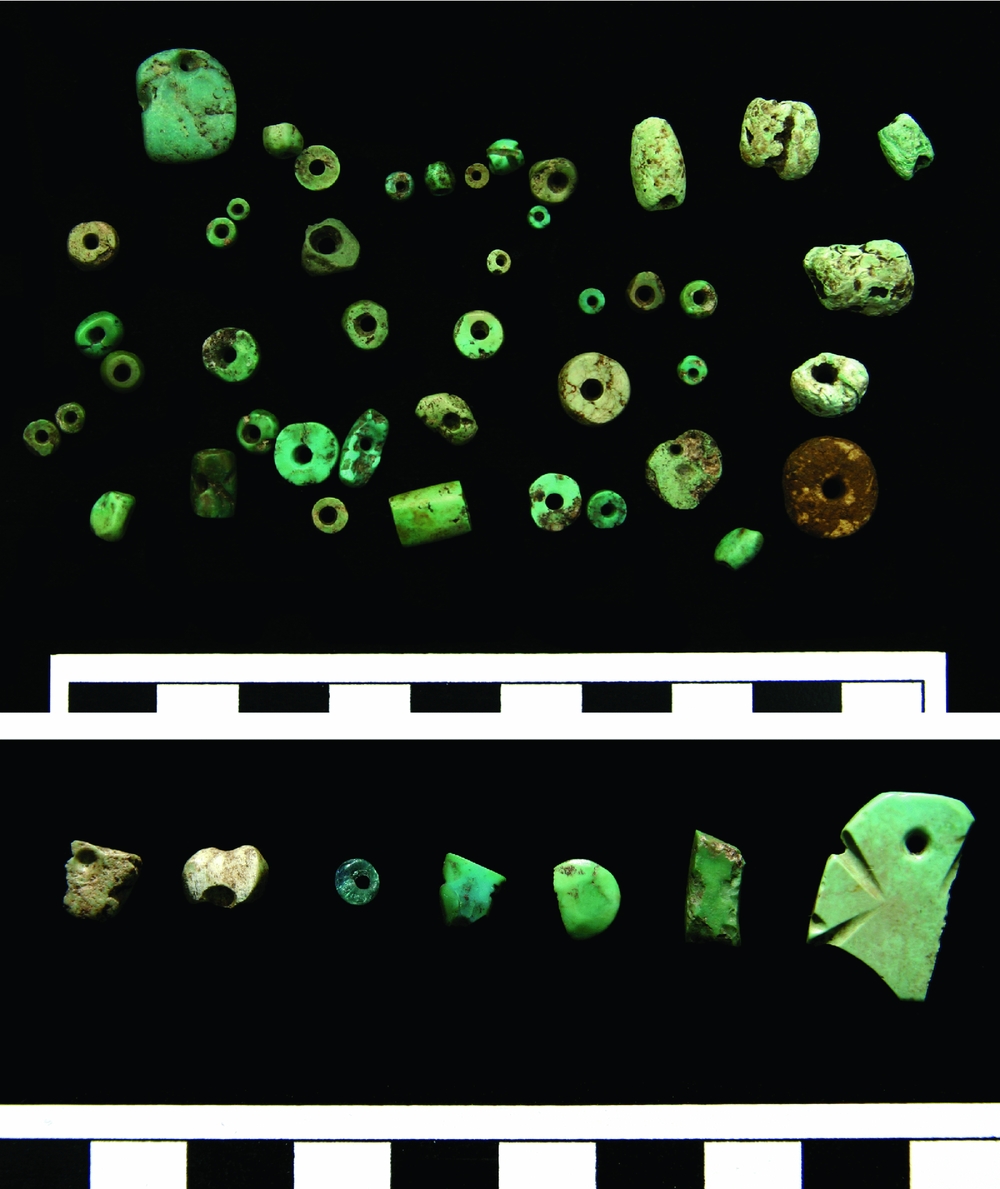
Excavation and fine sieving recovered over 1208 beads (Fig. 9). Most were of green- and turquoise-coloured stone. A few used other materials: stone (red, light brown, dark grey), corroded copper, clear glassy blue stone (quartz?), and maybe shell. Bead size varied greatly, most between 2 and 5 mm; several reached 2 cm. There is no outward standardization in their shape, suggesting they are not mainly from one object (e.g. necklace) or production source. Excavations also encountered some broken beads, pendants, chunks of raw material and four unworked quartz crystals.Footnote 13
Beads and lapidary material in offering deposit. Although green- and turquoise-coloured stone was the most popular material, excavations also encountered beads of red and beige stone, glassy light-blue crystal and metal (copper, silver and gold). Broken and incomplete pieces and raw chunks of semi-precious stone material were also included in the offering deposit. (Scales in cm.) (Photographs: author.)

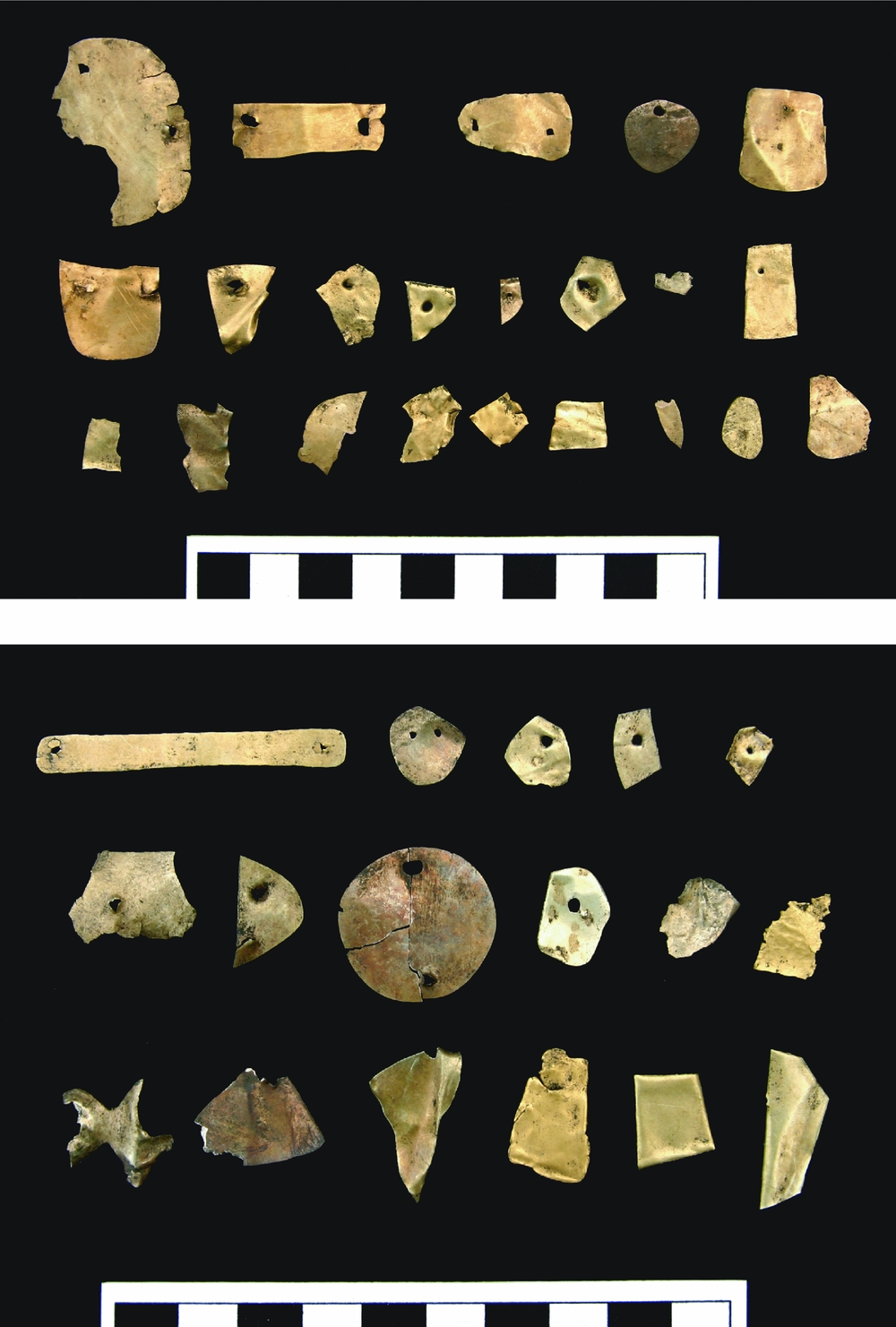
In addition, the deposit contained 142 small hammered sheet artefacts (láminas), almost all gold-coloured metal (Fig. 10); seven were silver metal. These were small and very thin and mainly quadrangular or circular in shape. Many were irregular, folded over, creased, or broken/cut purposefully as fragments. Many were perforated, with one (n=41) or two holes (n=19); occasionally, the position and rough edges of the holes suggest expedient perforations after original production and use. Several showed surfaces with red pigment. A thick lámina (0.95 mm) (Fig. 10) and a solid gold ball resembling small birdshot (d. 5.18 mm) may have been blanks for additional hammering. There were also four hammered sheet-metal beads: one with corroded copper surface, another of gold metal and two of silver metal.
Gold-metal hammered sheet láminas. Note the variability in form, as well as condition. Many are irregularly shaped, cut and perforated expediently, or broken. Top image shows a thicker gold piece, perhaps a small blank for additional hammering (bottom row, second from right). (Scale in cm.) (Photographs: author.)

Ten radiocarbon assays date Yayno's Recuay occupation to approximately cal. ad 400–800 (Lau Reference Lau2010); no samples have yet been tested for the Inka burial/offering. These notwithstanding, historical accounts indicate the region's annexation some time after 1460, when many northern territories were added to the empire, and before its demise in 1532 (Rowe Reference Rowe and Steward1946).
Discussion: ruins, precious items and gifting
The excavation thus revealed two principal features of post-Recuay date: 1) a slab-lined cist containing a child skull and Inka-style artefacts; and 2) an adjacent deposit containing dispersed remains of various small precious items. The burial's intrusive character, placement and long-distance items suggest that the cist and offering were made during Inka times to propitiate the Yayno mountaintop, its ruins and divine aspect, or huaca.
The Yayno case demonstrates similarities to capac hucha practices, but also some notable distinctions. First, most archaeological and textual cases of capac hucha describe Inka child sacrifices as complete individuals and positioned where they were dispatched (Andrushko et al. Reference Andrushko, Buzon, Gibaja, McEwan, Simonetti and Creaser2011; Reinhard & Ceruti Reference Reinhard and Ceruti2010; Wilson et al. Reference Wilson, Taylor, Ceruti, Chávez, Reinhard, Grimes and Meier-Augenstein2007; Reference Wilson, Brown and Villa2013). Ethnohistorical accounts emphasized the body's integrity and condition: selection of unblemished individuals, their involved bodily preparation and manner of immolation; such practices made the offering suitable for the gods (MacCormack Reference MacCormack2000, 130–31; Reinhard & Ceruti Reference Reinhard and Ceruti2010, 125–6).Footnote 14
Although the skull had been removed earlier, not much can be inferred about the intervening time between death and cist placement. Perhaps only the head was significant or retrievable at the moment of acquisition/burial. Only a portion of the courtyard was tested due to time constraints; wider excavation may expose a fuller picture of the offering context (e.g. additional cists, human remains). The child's estimated age at death, 4 years (±12 months), is at the lower prescribed range for selection (Besom Reference Besom2009, 28; MacCormack Reference MacCormack2000, 120); it is not known if the young age may have affected the child's handling or disposition (Wilson et al. Reference Wilson, Brown and Villa2013, 13323). There are no clear signs of how the child died, so whether the death was ‘gentle . . . quiet and peaceful’ cannot be determined (MacCormack Reference MacCormack2000, 132). Bodiless heads have been found with Inka offerings in other imperial provinces (Narváez Reference Narváez, Heyerdahl, Sandweiss and Narváez1995, 113).Footnote 15
Ritual practices to bury children and infants have varied over the long cultural history of the Andes (e.g. Arriaga Reference Arriaga1999; Dillehay Reference Dillehay1995; Farrington Reference Farrington2013; Klaus & Toyne Reference Klaus and Toyne2016). Some practices favoured their rapid disposal, evidently to forget and distance the corpse soon after death. Other traditions sought to memorialize or lavish attention on their remains, despite the young age and potential uncertainty about status (Baitzel & Goldstein Reference Baitzel and Goldstein2014; DeMarrais Reference DeMarrais2013). Like capac hucha more generally, the Yayno burial did not aim to forget the child individual, as much as it sought actively to construct a new identity and celebrate Inka-sanctioned associations.
Because the activities that led to the Yayno context occurred over time, comparison to capac hucha, the best known programme of Inka provincial offering ritual, may help to schematize different stages (Fig. 2) and patterns of its deposition. The extended ritual sequence involved young children who undergo transformations in corporeal form while occupying different subject-object statuses. The initial step (Step A) centres on a human subject, a beautiful child, who is gifted with other objects to the Inka and sent to Cuzco for preparation into a living sacrificial image. This involved a new diet with varied high-status comestibles, including maize, maize beer, coca, meat and other privileged foods (Bray Reference Bray2003; Wilson et al. Reference Wilson, Taylor, Ceruti, Chávez, Reinhard, Grimes and Meier-Augenstein2007; Reference Wilson, Brown and Villa2013). Once refashioned, s/he then becomes a suitable prestation (object) for the pantheon of deities in Cuzco and the provinces (Step B). The return journey involved ritual processions, feasting and consuming the blood of sacrificed Inka-bred camelids, a form of communion with the Inka (MacCormack Reference MacCormack2000, 113, 138). Known child sacrifices also show ingestion of coca and alcohol, both psychoactive substances, during the lead-up to their immolation, perhaps to help their long journey or sedate before killing (Wilson et al. Reference Wilson, Brown and Villa2013). Lastly, enshrinement—of the capac hucha’s expired body in a tomb—precipitated the gift's own divine subjectivity, whose enduring purpose was to give back (Step C) to the provincial communities who received, and venerated, her/him as their own.
Crucially, the oscillation of subject-object statuses follows the different phases, or routing, of the child as a gift. In the transition to becoming divine, the exchanges are synchronized to highly managed alterations of a child's body—from selection and enhancement (through diet, clothing and travel) to its containment and expiration, and ultimately to desiccation, decay and reduction. One hypothesis for the Yayno burial, containing only the cranium, would be that it resulted from an extra bodily change (and movement) occasioned in the extended cycle (Fig. 2). The skull's lone presence is made more marked, even paradoxical, given that the artefacts (kero, pins, cloth, pots) were all intended, notionally, to enhance the trunk portion of an individual's body.
The other notable contrast concerns the forms and disposition of the Yayno offerings. Most archaeological cases of capac hucha feature the grave items within arm's reach of the sacrificed bodies and within the burial space (Reinhard & Ceruti Reference Reinhard and Ceruti2010). At Yayno, the burial compartment is relatively small and contained few items; the Inka pots were on top of the cist.Footnote 16 Abundant precious items, especially beads, gold láminas and Spondylus shell were left above and around the cist. The bones of young camelids (probably food offerings), obsidian and quartz crystals were also found with the other rare materials.
Stratigraphy and artefact patterning indicate that these remains accumulated after the cist interment, probably left intermittently over a period of time, as countergifts to the original cist (gift). The dispersed distribution of the rarities is circumstantial indication for this. Also, most of the lámina items (Fig. 10) do not match or conform to being parts of the same artefact (e.g. headdress, shirt). Many are irregular, cut into expedient and unusual shapes, or broken haphazardly into smaller fragments, then perforated expediently. Formal heterogeneity (e.g. colour, shape), lack of standardization and pieces at different stages of production also characterize the beads. It is reasonable to suggest that the majority were from different sources, probably acquired opportunistically, and deposited as periodic votives.Footnote 17 Spanish accounts observed that the capac hucha shrines saw continued veneration and remembrance long after the sacrifice (Hernández Príncipe Reference Hernández Príncipe1923, 62–3; MacCormack Reference MacCormack2000, 113, 122; Zuidema Reference Zuidema, Meddens, Willis, McEwan and Branch2015, 8–9). The Yayno case may be an archaeological instance of this practice.
In discussing the capac hucha cycle (Fig. 2), the ethnohistoric literature informs especially on steps A, B, C and E. Archaeology, meanwhile, has focused almost exclusively on the behaviours that compose steps A and B, particularly contexts at high mountain locations with child remains and miniature figurines. Although other interpretations cannot be ruled out, the data from Yayno accord well with a scenario that sees the Inka offering context arising due to a huaca’s interaction with local groups (C), post-interment veneration (D) and reception of sumptuaries due to Inka patronage (F).
Regardless of a specific capac hucha identification, the larger issue is to account for an Inka-style offering at Yayno. Not much systematic archaeology has been conducted on the Inka period in the Conchucos region, but the region saw intensive state presence (Herrera Reference Herrera2003; Ibarra Reference Ibarra2009), including in the Pomabamba valley (Vidal Espinoza Reference Vidal Espinoza2014). The Inka incorporated the Conchucos region (east of the Cordillera Blanca and west of the Río Marañon) and its ethnic groups, including Pincos, Piscobamba, Conchucos and Sihuas peoples. These were small lordships, made up of ranked ayllu groups and numbering up to several thousand people (Cook Reference Cook1977; Druc Reference Druc2009; León Gomez Reference León Gomez and Ibarra2003).
Inka presence in the Conchucos is currently best known for a major prehispanic road which connects the provincial centre of Huánuco Pampa, on the southeastern margin of Ancash (Morris & Thompson Reference Morris and Thompson1985), to important northern provinces (e.g. Cajamarca, Quito). Imperial installations, settlement reoccupations and subsidiary roads have been identified (Astuhuamán G. & Espinoza C. Reference Astuhuamán, Espinoza, Herrera, Orsini and Lane2006; Bernabé Reference Bernabé2009; Serrudo Reference Serrudo and Ibarra2003; Vidal Espinoza Reference Vidal Espinoza2014), but none is yet known for the immediate vicinity of Yayno. Various modern towns (e.g. Piscobamba, Pomabamba, Conchucos) were built above Inka settlements. Classic Inka cut stone blocks are found in towns throughout the region, robbed from nearby sites and repurposed for new buildings and other uses (Apolín G. Reference Apolín2009, 38–40).
Although in ruins, it seems likely that Yayno continued to be prominent in the local imaginary during Inka times. Today, the site lies at the crossroads of a half-dozen agro-pastoral villages around the flanks of the mountain. For generations, the footpaths which converge at Yayno have been traversed on a regular basis by the mountain's inhabitants, who see and experience Yayno as the mediating centre (M. Jaramillo pers. comm., 2007). It is also the region's main archaeological landmark and the focus of local cultural identity, folklore and folkloric performances (Apolín G. Reference Apolín2009; Escudero Vega Reference Escudero Vega2007). Yayno's unique geological and visual features, mentioned previously, continue to be prominent as ways to distinguish the mountain and navigate space. Notably, pilgrimages also ascend Yayno today to visit a natural rock formation worshipped annually as an image of the Virgen de Candelaria, ‘Mama Canchi’ (Escudero Castillo Reference Escudero Castillo2007). Finally, historical sources and ethnography in the region relate that ancient hilltop ruins, more generally, are perceived as key physical embodiments of the mythic past, the feats of giants and ancestors (Venturoli Reference Venturoli2011; Walter Reference Walter, Herrera, Orsini and Lane2006). Inka political integration of the Pomabamba area, I contend, entailed physical and symbolic incorporation of the region's most prominent, sacred place.
Other high-altitude ridge-top sites throughout Ancash were reoccupied by the Inkas and may have been places for state-sanctioned offerings (Advincula Z. & Chirinos P. Reference Advincula and Chirinos2000; Herrera Reference Herrera2005; Lane Reference Lane, Lane and Luján Davila2011; Reference Lane2018; Lau Reference Lau2016, 165–77; Reichlen Reference Reichlen1961). Like the Yayno cist, small box-like compartments in these sites almost certainly held high-status human and object offerings: some were hollowed out of living rock or boulders. The practices were implicated in a ‘cult of water’, a concern also visualized in schematic representations of landscape at the sites themselves—carved directly onto bedrock and depicting mountains, canals, rivers and lakes/reservoirs. Relict canals are located near these sites, which are consistent with the mediating role of sacred places (Advincula Z. & Chirinos P. Reference Advincula and Chirinos2000; Herrera Reference Herrera2005; Lane Reference Lane2018). Managing territories, rights to land and water resources, and local abundance, it should be restated, were integral to the Inka logic for capac hucha (Hernández Príncipe Reference Hernández Príncipe1923; Zuidema Reference Zuidema1973).
The precious items are relevant in this respect because of their associations to fertility and cosmological power. The Inka closely monitored the circulation of sumptuaries in Tawantinsuyu, especially gold, silver, metal ore and Spondylus shell (e.g, D'Altroy Reference D'Altroy2002, 255, 298–303). Their release to provinces was limited, and at times very conspicuously as ‘gifts and offerings’ for the huacas. For Andeans, Spondylus shell, or mullu, was among the most valuable of offerings: the preferred food of the gods and given to supplicate them for life-giving water and rain (Blower Reference Blower2001). The nearest source was the warm waters off the Ecuadorian coast; the great quantities at Yayno demonstrate privileged participation in the empire's potent trade network. Gold had been used in earlier Recuay times, but was usually limited to cast objects with gilt surfaces. Spondylus shell and gold láminas have been found in capac hucha contexts elsewhere, but not in this quantity (Andrushko et al. Reference Andrushko, Buzon, Gibaja, McEwan, Simonetti and Creaser2011, 325). Both shell and metalwork were customary offerings to huaca shrines and mountains (Besom Reference Besom2009, 100–103) and in offering caches and burials (Farrington Reference Farrington2013). The large tupu, kero, ceramic forms and obsidian were also intrusive. Finally, the cist feature itself has no precedent at Yayno; no other burial or in situ human skeletal material has been encountered through excavations.
The red-orange bivalve, Spondylus sp., is often linked to female fertility, the ocean and watery abundance (Blower Reference Blower2001; Pillsbury Reference Pillsbury1996). The gold foil láminas, meanwhile, were probably linked to the male, solar brilliance of Inka divine power (Dransart Reference Dransart and McEwan2000; Herring Reference Herring2015). This was complemented by the two female shawl pins; silver was seen as the ‘tears of the moon’, won from ore and mined from the earth (often gendered female). The great bulk of the beads (turquoise- and green-coloured stone) emphasize the colours of water and verdant growth, and have telluric or mountain/underworld associations as mined materials.Footnote 18
Besides the textile's brown-coloured fibres, the other discernible colour was the greenish-blue corrosion of the metal pins and hammered copper beads. The oxidation (due to exposure to air, soil and water) also re-coloured different parts of the skull. It is not impossible that this post-depositional effect had symbolic resonance during the offering process and with the gift's transformation (Blower Reference Blower2001, 215). In the Andes, of course, copper and silver are products of the earth; and ores are said to be like potatoes, which grow in and are harvested from mountains (Helms Reference Helms2012, 107). That many of the precious items were unique, fragmented and unworked is consistent with early Spanish accounts observing that Inka offerings were gifted, at least in part, to assemble tokens of rare, precious materials with pronounced colour, spatial and gender associations (Reinhard & Ceruti Reference Reinhard and Ceruti2010, 143).Footnote 19
The emphasis on material complementarity was also reinforced by paired objects (e.g. copper–silver tupu) or objects with complementary roles, such as the pottery vessels. The urpu featured in the storage and serving of liquids, particularly chicha maize beer, while the pedestalled olla was used for cooking or reheating food, for relatively small personal portions (Bray Reference Bray2003, 11–15). Both vessels, if full, probably required two persons to carry them. The other notable play or disparity with scale concerns the oversized tupu and the small child (for another example, see Besom Reference Besom2013, 79). Future work may help to identify the sources of the child remains and accompanying items (e.g. lapidaries, obsidian, goldwork, camelids). The offering context did not reveal evidence of feathers, guinea pig, coca leaf or maize, the other common gifts for mountain huacas during Inka and colonial times (Besom Reference Besom2013; Reinhard & Ceruti Reference Reinhard and Ceruti2010). Finally, no colonial materials were identified in the offering area, suggesting that colonial items were not part of the veneration activities, or that the activities did not continue long into colonial times.
Overall, the long-distance materials formed part of a series of innovative practices associated with an Inka period intervention at a local sacred place. The range of exogenous items reiterates the redistributive character of capac hucha-like ritual events, which linked valuables, people and resources from different parts of the Inka realm (Duviols Reference Duviols1976). It is also consistent with the timing of a value system, when traditional materials (Spondylus, hammered gold, rare-coloured materials, camelids) were still preferred, precious and accessible in quantity to give back as return gifts to nourish Yayno.
Conclusions
The Yayno investigation helps characterize Inka statecraft in north-central Peru. In addition to heavy investment in roads and buildings, Inka control of the Conchucos region opened up long-distance trade networks and promoted special activities for their use. The Inka also co-opted a key ancient ruin, Yayno, to establish an offering akin to capac hucha known elsewhere. What is most remarkable is the quantity of rare items and the fundamentally special ritual character of the Inka presence. More research is needed, but the record thus far shows no evidence for other kinds of state intervention at Yayno, suggesting that it was the place (the mountaintop and monumental ruins) that inspired gift relations with local groups.
The cist context must have registered as a very small initiative in Tawantinsuyu's vast state project. But it has significant implications for considering its gift economy, not least in relation to Maussian insights introduced earlier (gift giving as social contract; a sequence of exchange stages; the attachment and transformative potency of the ‘total prestation’ for the participants). The most visible production of persons is of the sacrificed individual, a child who underwent a series of corporeal and symbolic transformations. The body's elaborate treatment and alteration, historic texts tell us, precipitated apotheosis at the shrine location. Styled as Inka (vessels, kero, tupus), the offering should be taken as an act of local allegiance to the Inka. While this publicly acknowledged subordinate subjects, it also recognized the agency of local groups in entering and obliging the Inka system. This was the highly bespoke impact of the Inka ‘total prestation’, the aesthetic precision of their provincial relations which inspired their former subjects to recognize and feel indebted to their gift(s) many generations after their demise.
Ultimately, the Yayno case contributes to the variability of offering contexts that have formal resemblances to capac hucha. To date, the record of this empire-wide system of reciprocity and redistribution has focused on patterning on mountain glaciers; Yayno's context adds to the record of related offerings found at major archaeological ruins. The existing record should hardly be seen as a complete sample, however. Additional cases in the future will almost certainly widen the spatial, diachronic and behavioural variability of capac hucha-like ceremonial practices.
A crucial finding is that the Inka offering, once made, became a place itself for repeated visits and additional gifts/offerings. Abundant dedicatory items, their formal patterning and taphonomy indicate an enduring interest in the location after its christening. It has been argued that these offerings were made to the ancient ruin during periodic visits by local peoples who identified with the huaca/shrine. The offering does not seem to have violated or appropriated the huaca, as much as it re-vitalized it or enhanced its prestige and status; subsequent offerings to it, found near the summit, countenanced the huaca as a whole, newly transformed by Inka sanction.
The offering at Yayno, and the gift economy, were not of routinely forgotten transactions, nor of objects liberated from personal connections. A capac hucha sacrifice could neither be a pure gift nor a mere commodity, for it obliged recognition and future reciprocation. Neither was the child stable in its identity during capac hucha ritual: its associations and sponsorship changed. What was important was a set of oscillating statuses, at once biographical and ontological (namely provincial↔Inka and object↔subject), in the passage of a child turning into a prestation, then sacrificial offering and finally enshrined ancestor/huaca. The statuses accrued to the gift over time and coincided with the child's trajectory as a gift. In moving to and from the Other, it was the precisely the gift's protean quality to be remade which ensured its desirability. The child-gift became, endowed and obliged wherever it went.
If the idolatries accounts offer insight into the impact of the Inka empire, what its former subjects stressed in their testimonies is sobering. Of all the empire's doings, it was the capac hucha that lasted in their memory—even nearly a century after the Inka collapse. The splendour and acts of capac hucha resonated much more than the solar cult, feasting, mass resettlement, road system or other monumental constructions—stuff more customarily understood as the key engines and signs of state power. Native Andeans, meanwhile, remembered Tawantinsuyu most for its highly mutable gifts, rather than for the other, more durable residues of conquest.
Acknowledgements
Thanks are owed to the comuneros of Huanchacbamba, Asuac and Putaca, who enabled the excavations, and The British Academy, Sainsbury Research Unit and Peru's Instituto Nacional de Cultura (RDN 1220/INC, 25 Jul 2006), who supported the fieldwork and analysis. I am grateful to Silvia Milla, Italo Sauñe, Martha Bell, Steve Wegner, Nilton Luya, Katy Rodriguez, Alejandro Velasco, Gabriel Ramón, Mariano Jaramillo, Donato Apolín, Julio Escudero and others, who all aided fieldwork at Yayno. I am grateful to Emma Pomeroy and Mirko Brito, who analysed the human and textile remains, respectively, as well three peer reviewers; any errors of interpretation remain my own. This study is dedicated to R. Tom Zuidema (1927–2016), whose work on highland Ancash ancestor veneration and capac hucha continues to inspire.