


1. Introduction
This article takes as its starting point the declaration of the International Court of Justice (ICJ) in the 1996 Nuclear Weapons advisory opinion that the use of nuclear weapons is not per se illegal under jus ad bellum. Since the implications of the advisory opinion have been debated, discussed, and criticized by many, this article does not seek to examine the legality of the threat or use of nuclear weapons generally. This article is concerned, specifically, with the legality of the use of nuclear weapons contemplated by Indian military doctrine.
Academic literature on the use of nuclear weapons has largely shied away from discussing the legality of specific ‘policies of deterrence’ of the nuclear weapon states,Footnote 1 treating them as issues of military strategy that are beyond the realm of international law. This article hopes to challenge that dichotomy.
Though several branches of international law are relevant to a discussion on nuclear weapons, this article shall only examine India’s nuclear doctrine through the lens of jus ad bellum. Specifically, this article shall focus on whether India’s nuclear doctrine constitutes a threat to use force, and if so, whether such threat is lawful.
2. India’s nuclear doctrine: A comparative analysis
The aim of this section is to draw out the aspects of India’s nuclear doctrine that can be tested for legality under jus ad bellum. We shall also examine and compare the corresponding aspects of the other nuclear weapon states’ doctrines, to the extent that they have been made publicly known.
In this Section, three aspects of military doctrine shall be considered: first, the means of an attack (in terms of the weapons used) in response to which the state is willing to use nuclear weapons; second, the effects of an attack in response to which the state is willing to use nuclear weapons; and third, the manner in which the state proposes to retaliate with nuclear weapons. These three aspects shall be referred to collectively as ‘nuclear force doctrine’ or ‘nuclear force posture’. The Indian nuclear force doctrine shall be assessed last, after a brief discussion on the doctrines of each of the other nuclear weapon states.
It is important to provide a caveat at this point – we acknowledge that public commitments to the responsible use of nuclear weapons do not preclude the possibility that the concerned state may nonetheless contemplate blatantly unlawful uses of such weapons. However, an assessment of official rhetoric, publicly released policy documents, demonstrated military capabilities, and threat perceptions provide a fair indication of the actual military policy of a nuclear weapon state. Suffice to say, in the words of Judge Weeramantry, ‘a secretly harboured intention to commit a wrongful or criminal act does not attract legal consequences, unless and until that intention is followed through by corresponding conduct’.Footnote 2
2.1 China
China’s nuclear force doctrine can be assessed from the most recent National Defense White Paper released in 2015.Footnote 3 The paper, titled ‘Chinese Military Strategy’, emphasizes that ‘China has always pursued the policy of No First Use [NFU] of nuclear weapons and adhered to a self-defensive nuclear strategy’. This means that China’s nuclear weapons are not intended to be used against non-nuclear-weapon states or in retaliation to non-nuclear attacks by nuclear weapon states. They are only to deter nuclear threats from other nuclear powers. The 2013 Science Military Strategy further clarifies that nuclear weapons cannot be used in hostile non-nuclear military action,Footnote 4 a position reiterated by state officials recently in 2018.Footnote 5 Its nuclear force is calibrated to survive a first strike and engage in retaliation that would create ‘unendurable damage to the opponent … to avoid creating with an opponent the situation of a nuclear counterattack’.Footnote 6 China is constantly modernizing its early warning systems and rapid reaction systems,Footnote 7 which reflects its intention to initiate a nuclear response only after facing an incoming nuclear attack.Footnote 8
2.2 Pakistan
Pakistan has refrained from officially declaring its nuclear doctrine, favouring the element of ambiguity.Footnote 9 However, key features may be discerned from public statements issued in the aftermath of its nuclear tests in 1998. Indispensable to Pakistan’s nuclear policy is the principle of minimum credible deterrence, as highlighted by Prime Minister Nawaz Sharif in 1999,Footnote 10 and affirmed by the Defense Committee of the Pakistan Government in response to India’s draft nuclear doctrine the same year.Footnote 11 Pakistan’s nuclear deterrence is primarily Indo-centric, since its main concern has always been to offset India’s superior conventional military capabilities.Footnote 12 This strategic vulnerability has influenced Pakistan’s nuclear posture in two ways. First, it has made clear that it does not subscribe to an NFU policy.Footnote 13 Second, it assures massive retaliation against an Indian strike on any sensitive Pakistani targets.Footnote 14 While details are scarce on what, precisely, would trigger such retaliation, Pakistan has not ruled out a nuclear response to a conventional Indian attack on its territory.
2.3 United States of America
The Nuclear Posture Review (NPR) is a legislatively-mandated review that is declarative of US nuclear policy, strategy, capabilities, and force posture.Footnote 15 The latest NPR specifies that while the fundamental role of US nuclear weapons is to deter a nuclear attack on the United States and its allies, deterring nuclear attacks is not the sole purpose of US nuclear weapons.Footnote 16 The US would consider the use of nuclear weapons in extreme circumstances to defend its vital interests, or those of its allies and partners. In addition to nuclear strikes, these circumstances include significant non-nuclear strategic attacks, such as conventional attacks against the civilian population, US or allied nuclear forces, their command and control, or warning and attack assessment capabilities.Footnote 17 These are merely indicative, and it is part of US policy to be ambiguous about the precise situations that would justify a nuclear response. The NPR stresses that the US has never adopted an NFU policy.Footnote 18 Interestingly, it also notes the US’s increased reliance on tactical nuclear weapons as a ‘flexible’ nuclear option. While this is not intended to lower the nuclear threshold or enable ‘nuclear war-fighting’,Footnote 19 it is in line with the US’s stated intention of modernizing its nuclear triad by developing options to counter the coercive nuclear strategies of its adversaries.Footnote 20 One such strategy is identified as Russia’s nuclear posturing and the forward deployment of its offensive capabilities to intimidate its neighbours.Footnote 21
In turn, Russia perceives the development of tactical nuclear weapons as a threat. Responding to the NPR, it notes that such low-yield nuclear weapons are ‘clearly designed as battlefield weapons’, and their availability increases the likelihood of a nuclear first strike.Footnote 22
2.4 United Kingdom
The 2015 UK National Security Strategy and Strategic Defence and Security Review outlines the circumstances in which the UK would resort to the use of nuclear weapons. Similar to the US, the UK contemplates the use of nuclear weapons only in extreme circumstances of self-defence or the defence of NATO allies. Prime Minister Theresa May has stressed that they retain the right to use nuclear weapons as a ‘first strike’.Footnote 23 However, the UK maintains deliberate ambiguity about precisely when, how, and at what scale they would contemplate the use of nuclear weapons.Footnote 24 They assure that nuclear weapons will not be used against non-nuclear weapon states party to the Treaty on the Non-Proliferation of Nuclear Weapons (NPT), as long as they are not in material breach of their non-proliferation obligations under the Treaty.Footnote 25 The UK does not rule out a nuclear response against chemical or biological attacks, although it admits that it is not presently faced with any such threats.Footnote 26
2.5 France
French nuclear policy is traditionally presented through presidential statements on nuclear deterrence.Footnote 27 While President Macron has not yet delivered such a statement, he recognized the need to maintain France’s nuclear deterrence strategy in his preface to the 2017 French Strategic Review of Defence and National Security.Footnote 28 Along with the 2013 French White Paper on Defence and National Security, this document clarifies the official French position on the use of nuclear weapons. France’s nuclear weapons are strictly defensive, to be used only in extreme circumstances of its own legitimate self-defence, or that of its allies.Footnote 29 This envisions the use of nuclear weapons against any threat, of whatever origin, and in whatever form, considered to be ‘under the threshold of our vital interests’.Footnote 30 Consistent with its negative security assurances at the UN in 1987 and 1995, France is therefore willing to consider a nuclear response to conventional attacks by non-nuclear weapons possessing states, if such attacks threaten their vital interests. For instance, in 2006, President Jacques Chirac indicated France’s willingness to consider a ‘nuclear response’ against state-sponsored terrorism.Footnote 31 The 2013 White Paper emphasizes that the integrity of the French territory and the protection of its population is central to its vital interests.Footnote 32 Beyond this broad formulation, no specific clarifications regarding their vital interests have been issued.
2.6 Russia
Russian nuclear policy is often described as an ‘escalate to de-escalate’ strategy.Footnote 33 This means that Russia would be willing use nuclear strikes against conventional attacks that exceed its conventional defensive capabilities.Footnote 34 Therefore, the EU believes that Russia would ‘escalate’ a conflict by launching limited nuclear strikes against an aggressor’s most important facilities in order to ‘de-escalate’ by forcing them to cease hostilities.Footnote 35 In clarifying Russia’s 2010 nuclear doctrine, military officials emphasized that nuclear weapons may be used pre-emptively not only during large-scale wars but even against regional aggression by means of conventional warfare.Footnote 36 As such, scholars argue that Russian nuclear policy prescribes a low threshold for the use of nuclear weapons against adversaries with superior conventional weapons capabilities.Footnote 37 However, Russia’s current conventional capabilities, recent official rhetoric, and its military exercises suggest otherwise.
The low threshold of nuclear combat was introduced in 2000 at a time when Russia could not compete with the US’s conventional weaponry. Therefore, this threshold was introduced as a ‘stopgap measure’ to be relied on until it developed more effective conventional capabilities.Footnote 38 Having since substantially developed its military forces,Footnote 39 Russia is less likely to rely on the use of its nuclear weapons today.Footnote 40 This is confirmed by the official state policy outlined in Russia’s Military Doctrine in 2014. The Doctrine raises the threshold for the use of nuclear weapons from the position taken in 2000, only permitting it in two defensive scenarios.Footnote 41 First, in response to aggression against Russia or its allies with the use of nuclear weapons or any other weapons of mass destruction, and second, in response to non-nuclear aggression that threatens Russia’s survival. It introduces the concept of ‘non-nuclear containment’, which focuses on deterring aggression through conventional forces. The prevailing official policy is, therefore, to prioritize a non-nuclear response to a threat from conventional weapons; as long as the very existence of the state is not at risk. Russia’s lowered reliance on nuclear weapons is further confirmed by its military exercises, which routinely involve nuclear weapons to test strategic readiness, command and control, and interoperability – but not use of the nuclear weapon itself.Footnote 42 In other words, these exercises only test Russia’s ability to deter a strategic attack. For instance, Russia’s recent large-scale military exercise, ‘Zapad 2017’ did not have any nuclear strike component, despite acknowledging a potential conflict with NATO.Footnote 43 This is in stark contrast with Russia’s military exercise ‘Zapad 1999’, where it tested the use of nuclear weapons to ‘win’ a hypothetical conflict, despite there being no threat to the state.Footnote 44
That being said, Russia is substantially upgrading its nuclear capabilities. Reacting to US’s global missile defence system and the threat of its rapidly modernizing nuclear arsenal, President Putin revealed ‘the next generation of missiles’ in his annual state-of-the-nation address in 2018.Footnote 45 These missiles are to have a ‘virtually unlimited’ range and are equipped with cutting edge technology to evade missile defence systems. While the 2014 Military Doctrine indicates that Russia will only use nuclear weapons when faced with a risk to its survival, there is little clarity on what such circumstances could be. For instance, President Putin may consider threats to his rule as equivalent to threats to Russia’s existence.Footnote 46 Further, the possibility of a Russian nuclear first strike cannot be ruled out. Tellingly, Putin has admitted Russia’s readiness to put nuclear weapons on alert over the Crimean situation in 2014 and has also reserved the right to deploy weapons in Kaliningrad.Footnote 47
2.7 North Korea
Very little credible information is available on North Korea’s nuclear weapons or nuclear force doctrine. It is only the Law on Consolidating Position of Nuclear Weapons State, promulgated by the Supreme People’s Assembly in 2013, that offers some doctrinal clarity.Footnote 48 The law provides that the purpose of nuclear weapons is to deter and repel aggression against North Korea by dealing ‘deadly retaliatory blows’.Footnote 49 Interestingly, the law does not permit the use or threat of nuclear weapons against non-nuclear states, unless they join a hostile nuclear weapons state in an attack against North Korea.
In a historic meeting with US on 12 June 2018, North Korea committed to the complete denuclearization of the Korean Peninsula.Footnote 50 Before drawing any conclusions regarding the impact of this declaration on its nuclear posture, it must be noted that North Korea has broken several such commitments in the past.Footnote 51 North Korea had promised to freeze its nuclear program under the Agreed Framework, an agreement signed with US in 1994. This collapsed in 2002 when it was discovered that North Korea had secretly been enriching uranium for nuclear weapons. In 2005 and 2007, it pledged to abandon its nuclear program under the Six-Party Talks. North Korea unilaterally withdrew from the Talks in 2009 in response to international criticism of an attempted satellite launch. The launch was considered to be a violation of restrictions on the launch of ballistic missiles under Security Council Resolution 1718.Footnote 52 Little over a month later, North Korea conducted its second official nuclear test.Footnote 53 More recently, in 2012, it agreed to a moratorium on nuclear testing, uranium enrichment and long-range missile tests, while also allowing inspections by the International Atomic Energy Agency.Footnote 54 Within two weeks, it withdrew from the deal by announcing plans to launch a satellite. Its third nuclear test was conducted a year later in February.Footnote 55
Its latest commitment to the denuclearization of the Korean peninsula is part of a laconic joint statement with US President Donald Trump that outlines no details on its verification process. Fault lines have already begun to show, with North Korea officials balking at the ‘regrettable’ demands made by US officials.Footnote 56 While these negotiations are indeed laudable, what remains to be seen is how it truly impacts its reliance on the nuclear deterrent.
2.8 Israel
Israel’s policy of deliberate ambiguity has been to neither confirm nor deny its possession of nuclear weapons. Israel officially maintains that it will not ‘be the first to introduce nuclear weapons into the Middle East’.Footnote 57 While this may indicate its unwillingness to strike first with nuclear weapons, its ambiguity precludes an exhaustive analysis of its nuclear posture.
So far, Israel’s policy of deliberate ambiguity has been sustained by a global nuclear taboo that strongly deters nuclear warfare. Due to recent nuclear escalation between the US and North Korea, this nuclear taboo may be weakening. Commentators argue that a nuclear strike by either of the two countries would most certainly erase any such taboo and force Israel to end its policy of deliberate ambiguity.Footnote 58
2.9 India
India’s Official Nuclear Doctrine was adopted in January 2003, but its full text has not been shared with the public. Below are certain extracts of the 2003 Press Release from the Prime Minister’s Office:
India’s nuclear doctrine can be summarized as follows:
…
II. A posture of “No First Use”: nuclear weapons will only be used in retaliation against a nuclear attack on Indian territory or on Indian forces anywhere;
III. Nuclear retaliation to a first strike will be massive and designed to inflict unacceptable damage.
…
V. Non-use of nuclear weapons against non-nuclear weapon states;
VI. However, in the event of a major attack against India, or Indian forces anywhere, by biological or chemical weapons, India will retain the option of retaliating with nuclear weaponsFootnote 59
The doctrine emphasizes India’s NFU policy, according to which nuclear weapons will only be used in retaliation to a nuclear attack against Indian territory or Indian forces outside India. At international fora, Indian representatives have consistently maintained the posture of NFU, even expressing their willingness to convert these assurances into legally binding arrangements.Footnote 60 An important caveat to this policy is that nuclear weapons may also be used in retaliation to a major attack on Indian forces by biological or chemical weapons. Thus, India’s policy should more appropriately be termed ‘Limited NFU’. Retaining the ability to use nuclear weapons in response to biological or chemical weapons undermines India’s assurance to not use nuclear weapons against non-nuclear weapon states.
In 2016, Defense Minister Manohar Parrikar commented that India should not ‘bind’ itself to an NFU policy.Footnote 61 While his statement was clarified to be a mere personal opinion, this was not the first time Indian government officials were suggesting a more flexible NFU policy. In 2010, Shivshankar Menon, then National Security Advisor, described India’s nuclear doctrine as one that prescribed ‘no first use against non-nuclear weapon states’.Footnote 62 Later, Menon argued that India’s nuclear doctrine is ‘flexible’, allowing India to strike first where the launch of an adversary’s nuclear weapons is imminent.Footnote 63 If this is indeed the future of India’s nuclear posture, it does not amount to an outright rejection of India’s NFU policy – it only expands its scope to a limited extent.
In response to a first strike, India will retaliate in a manner that is ‘massive and designed to inflict unacceptable damage’. A similar posture of massive retaliation was first adopted by the US in 1954.Footnote 64 This policy also bears resemblance to Russia’s ‘escalate to de-escalate’ posture in the early 2000s. As demonstrated above, both Russia and the US have since adopted more restricted formulations of their nuclear doctrine.
India’s rapid modernization of its nuclear forces is indicative of its ability to retaliate immediately and massively.Footnote 65 India has been working on multiple independently targetable re-entry vehicles (MIRV) for its inter-continental ballistic missile, Agni-V; to ensure second strike capability.Footnote 66 A canisterized version of this ICBM was successfully tested in 2015, demonstrating India’s ability to carry out a nuclear strike at short notice from road mobile launchers.Footnote 67 India’s nuclear weapons are kept at a ‘high level of readiness’, permitting assured retaliation within a matter of seconds or minutes, once alerted.Footnote 68 These developments strengthen India’s NFU policy by enhancing survivability, and also provide greater flexibility to its nuclear force by shortening launch times, increasing targeting options, and providing greater mobility.Footnote 69 Kristensen and Norris estimate that India currently operates seven nuclear-capable delivery systems, with four more in development.Footnote 70 This is far more than the number of delivery systems that are needed to guarantee retaliation against a smaller nuclear power such as Pakistan. As such, India’s nuclear deterrence may be credible but is far from minimum. Consequently, India’s nuclear capabilities are consistent with its declared nuclear doctrine of NFU and assured massive retaliation.Footnote 71
Despite this uncertainty in India’s nuclear posture, three key features of its declared doctrine may be highlighted. First, India has adopted a Limited NFU policy, which authorizes nuclear retaliation in response to a nuclear strike, or a major attack from chemical or biological weapons. Second, India has not identified the threshold amount of destruction that would provoke retaliation with nuclear weapons. It retains the ability to use nuclear weapons in response to any nuclear strike against it, regardless of the effects. Third, India’s official doctrine is one of massive retaliation, designed to inflict ‘unacceptable damage’ to an aggressor.
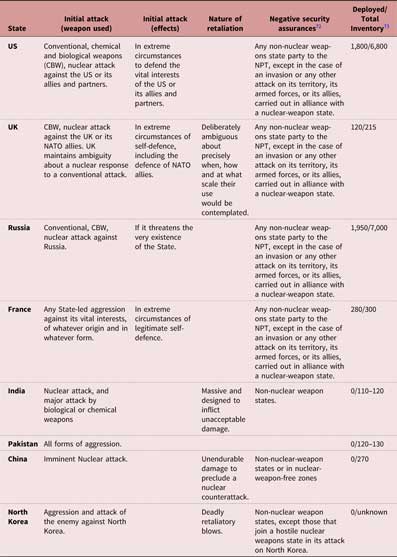
The following is a tabular representation of the key features of the nuclear force doctrines discussed above. The first column lists the nuclear weapon states. The second column indicates the nature of an attack (in terms of weapons used) in response to which the state is willing to use nuclear weapons. The third column lists the effects of an attack in response to which the state is willing to use nuclear weapons. The fourth column mentions the manner in which the state proposes to retaliate with nuclear weapons. The fifth column indicates the details of any negative security assurances, i.e., assurances against nuclear attack, offered by the state. The final column provides current estimates of the number of nuclear weapons in each State’s possession, along with how many of them are deployed.
2.10 Comparative Table
3. The legality of the Indian doctrine under jus ad bellum
The cornerstone of jus ad bellum is the prohibition on the threat or use of force. Today, Article 2(4) of the UN Charter, which reflects customary international law,Footnote 74 is the accepted formulation of this prohibition. Article 2(4) directs member states to refrain from the ‘threat or use’ of force against the ‘territorial integrity or political independence’ of any state. The prohibition on the threat or use of force, being a jus cogens norm, permits of few exceptions, each of limited scope. The exception most commonly cited by states to justify their resort to force is the right to use force in self-defence.Footnote 75 While Article 51 of the UN Charter explicitly recognizes the right of all states to defend themselves against an armed attack, the right also exists in customary international law.Footnote 76 The prohibition on the threat or use of force and the self-defence exception shall be central to the present analysis on the legality of India’s doctrine.
Any consideration of the lawfulness of a state’s nuclear doctrine would be incomplete without an overview of the ICJ advisory opinion on the Legality of the Threat or Use of Nuclear Weapons in 1996. The question that the court was tasked with addressing was whether the threat or use of nuclear weapons was per se unlawful under any branch of international law. The Court found that there was nothing in treaty or custom to suggest a complete prohibition on the threat or use of nuclear weapons in international law.Footnote 77 Any threat or use would be subject to the general restrictions imposed by jus ad bellum.Footnote 78 This opinion continues to reflect the legal position as it stands today.
The most significant development since 1996 has been the adoption of the Treaty on the Prohibition of Nuclear Weapons (TPNW) by the UN General Assembly in 2017. Article 1 of the treaty seeks to prohibit the possession and use of nuclear weapons under any circumstances.Footnote 79 As India has made clear that it has no intention of ratifying the TPNW,Footnote 80 it is not bound by these conventional obligations. More importantly, the strong opposition to the TPNW prevents it from contributing to the development of customary international law on the legality of the threat or use of nuclear weapons. Custom emerges from the widespread and near uniform practice of states that are ‘specially affected’.Footnote 81 Naturally, the prohibition on the possession or use of nuclear weapons would be especially relevant to nuclear weapon possessing states or states that are protected under the nuclear umbrellas of their allies. Each of these countries, including all nuclear weapons possessing states and NATO member states, boycotted negotiations on the TPNW, arguing that its implementation would undermine disarmament efforts under the NPT.Footnote 82 Along with the US, UK, and France, India has also taken the position that the TPNW does not contribute in any way to the formation of customary international law.Footnote 83 This position reflects the consensus among states that rely on the nuclear deterrence as a crucial component of their military strategies. Consequently, the TPNW lacks the requisite support to affect customary international law.
Absent any conventional or customary rules specifically prohibiting nuclear weapons, the short question that this section seeks to answer is this: Is India’s policy of massive retaliation a threat to use force, and if so, is it a lawful threat to use force?
3.1 Does India’s nuclear force doctrine constitute a threat to use force?
Though Article 2(4) in a singular phrase prohibits both the threat and use of force, it is the concept of use of force, alone, that has dominated academic discourse on jus ad bellum. This is despite the fact that the plain language of the Charter, as well as state practice,Footnote 84 demonstrate that the prohibition on the threat to use force operates independently of the prohibition on the use of force. Hence, an attempt shall be made in this chapter to extract a broad understanding of the concept of ‘threat of force’, in order to ascertain whether India’s doctrine can be said to constitute such a threat.
A threat of force, in the simplest of terms, can be understood as an express or implied promise by a government to resort to force conditional on non-acceptance of certain demands of that government.Footnote 85 This intention to use force must be communicated by the threatening state, and must be apprehended as such by the target state.Footnote 86 The unlawfulness of threats is rooted in their coercive nature. However, a threat must carry some credibility in order to be able to influence the behaviour of a target state. In other words, the threatening state should be militarily capable of carrying out its threat.Footnote 87 Finally, a threat must have a degree of specificity – it must be with reference to a particular state, dispute, or issue.Footnote 88
There are, then, broadly two aspects that constitute a threat: first, specific, communicated intent; and second, credibility. These shall be examined in turn, in order to determine whether India’s nuclear force doctrine can be characterized as a threat to use force against Pakistan.
3.1.1 Specific, communicated intent
There is a wide range of opinions on what amounts to the communication of intent to use nuclear weapons. The ICJ in the 1996 advisory opinion acknowledged that even the mere possession of nuclear weapons may justify an inference of preparedness to use them.Footnote 89 The reason for this is that the purpose of possessing nuclear weapons is usually deterrence, and deterrence is premised on the willingness of the state to use its nuclear weapons. If that were to be the standard, then the mere possession of nuclear weapons would be sufficient to establish India’s intent to use them. It is unclear, however, if mere possession could constitute communication of intent to use them. The requirement of communication indicates that certain positive actions need to be taken by the state to make its intent known.
Other authors argue that states may communicate their intent to use nuclear weapons by deliberate undertakings as well as by physical actions.Footnote 90 A willingness to use nuclear weapons that is clearly articulated in a communiqué released by the government would indisputably constitute ‘communicated intent’ to use them.Footnote 91 Both the Draft Report of India’s Nuclear Doctrine released in 1999,Footnote 92 as well as the final version adopted by the Cabinet Committee on Security in 2003,Footnote 93 specify India’s commitment to nuclear retaliation. Statements by the Minister of External Affairs,Footnote 94 as well as by the Chairman of India’s National Security Advisory Board,Footnote 95 have confirmed that the policy of ‘massive retaliation’ is a central tenet of India’s nuclear doctrine. These published military doctrines and official statements cannot but amount to a communication of intent to use nuclear weapons.Footnote 96
Admittedly, India’s official nuclear doctrine does not mention any specific state as the contemplated recipient of the retaliatory force. Nor does it mention any specific dispute as forming the background to such use of force. How, then, can this doctrine be considered a ‘threat’ under jus ad bellum?
We take the position that a degree of specificity regarding the threatenee’s identity, in this case Pakistan, may exist notwithstanding the absence of a formal declaration of the same. This is because the state practice of India and Pakistan over the last few decades has made it clear that, in the context of nuclear weapons, they are each other’s threatener and threatenee.Footnote 97 Statements released by the Foreign Affairs Ministries of both countries have emphasized that the deterrence of armed attack by the other is the primary use of their nuclear weapons.Footnote 98
Further, the outbreak of conflict between India and Pakistan is more than a remote possibility, since the contentious issue of Kashmir shows no signs of peaceful resolution.Footnote 99 In September 2016, an attack by unknown militants on an Indian army base in Uri, Kashmir killed 19 soldiers.Footnote 100 Attributing the attack to Pakistan’s failure to curb terrorist activities from its territory,Footnote 101 India retaliated 11 days later by conducting a ‘surgical strike’ against suspected militants in Pakistan-administered Kashmir.Footnote 102 Following this attack, there have been frequent cross-border skirmishes between the two countries.Footnote 103 In early 2017, following an interview in which the Indian Army chief General Bipin Rawat acknowledged India’s ‘Cold Start doctrine’ (that envisages a rapid-mobilization limited war with Pakistan),Footnote 104 Pakistan responded by pledging to respond with nuclear weapons should India invade its territory.Footnote 105 The fighting has continued well into 2018,Footnote 106 with Union Ministers commenting that India should be prepared for ‘decades’ of conflict with Pakistan along the border in Kashmir.Footnote 107
With this background, it is not a stretch to say that India’s threat of ‘massive retaliation’ is implicitly directed at Pakistan and is understood by Pakistan to be directed at it.Footnote 108 In the context of continuing, albeit low intensity, hostilities between the two countries, there is good reason to treat India’s nuclear force doctrine more seriously than as a general and theoretical allusion to the possibility of use of nuclear force against any attacking state. Read along with the commitment to NFU, India’s doctrine constitutes a threat against a specific actor (Pakistan), to use nuclear weapons on the occurrence of a specific contingency (Pakistan’s use of nuclear weapons against India), in the context of a specific dispute (the ongoing hostilities in Kashmir). This aligns with Myers’ observation that ‘concentrating [military] power [near a foreign nation] and warning the target state that military force will be used, if necessary, in self-defence’ may amount to a threat to use force.Footnote 109
3.1.2 Credibility
The threshold for a threat to use military force to be considered credible is low.Footnote 110 The chance that the target state ‘might incur the penalty of force’ is sufficient to make a threat credible.Footnote 111 There is no requirement of certainty that the threatening state will, in fact, resort to the threatened force. In this context, the fact that India is militarily capable of carrying out a nuclear attack against Pakistan,Footnote 112 and has consistently maintained a posture of retaliation,Footnote 113 is sufficient to make the threat of use credible.
For the sake of clarity, we will return to the definition of ‘threat’ highlighted at the beginning of this section: ‘an express or implied promise by a government of a resort to force conditional on non-acceptance of certain demands of that government’.Footnote 114 Phrased in these terms, it is our conclusion that the Indian State has threatened massive retaliation by way of nuclear attack in response to a nuclear first strike against India. Since this threat can be understood as specifically directed against Pakistan, and is credible, it constitutes a threat for the purposes of jus ad bellum.
3.2 Does India’s doctrine of assured massive retaliation constitute a lawful threat to use force?
Having arrived at the conclusion that India’s doctrine of massive retaliation constitutes a threat of force as specified under Article 2(4) of the UN Charter, we turn now to the legality of this threat. At this juncture, it is necessary to note that the tests for determining the legality of threats of force are far less well-defined than those for determining the legality of uses of force. Accordingly, we will first attempt to identify the most appropriate test to be applied for ascertaining the lawfulness of threats to use force. We shall then proceed to apply the test to India’s threat of massive retaliation.
3.2.1 How should the lawfulness of a threat to use force be ascertained?
The most commonly accepted formulation of the lawfulness of threats is the ‘Brownlie formula’: ‘[i]f the promise to resort to force in conditions for which no justification for the use of force exists, the threat itself is illegal’.Footnote 115
This formulation treats threats of force and uses of force as ‘coupled’. In other words, the legality of a threat to use force is dependent on the legality of the underlying use of force contemplated by the threatener.Footnote 116 This was the test adopted by the ICJ in the Nuclear Weapons advisory opinion.Footnote 117
However, critics of the Brownlie formula suggest that threats should be treated more leniently than actual uses of force under international law. Sadurska, in her article on threats of force, argues for the decoupling of threats and uses of force.Footnote 118 She points out that threats often uphold international security by deterring countries from resorting to force. In this way, they serve the overarching purpose of international law, which is to maintain peace and prevent actual armed conflict. Accordingly, she argues that threats to use force should be lawful if they have the effect of preventing conflict, even if the actual use of such force would be unlawful. There are several problems with this approach. Deterrence is a precarious strategy and there can be no certainty that threats of force will always be effective at preventing conflict. The likelihood that threats will deter the use of force rather than escalate a conflict is dependent on the manner in which such threats are interpreted.
Hayashi argues that threatening force with nuclear weapons in response to a conventional attack may be lawful even where the use of nuclear weapons would be disproportionate, if such threats have the effect of deterring conflict.Footnote 119 However, such a formulation of the legality of threats only makes sense so long as the hostilities between states do not reach the threshold of armed conflict. Since there is no guarantee that threats will in all circumstances be deterrents rather than catalysts to armed conflict, the possibility of escalation always exists.
In conclusion, it would appear that the Brownlie formula is not only the legally correct position for assessing threats to use force but is also the more desirable formulation for the maintenance of international peace and security.
Applying the Brownlie formula, in order for India’s doctrine of massive retaliation to constitute a lawful threat, the underlying use of force contemplated should be lawful. The central question then becomes – would massive nuclear retaliation in response to a nuclear first strike always amount to a lawful use of force?
3.2.2 Would massive nuclear retaliation to a nuclear first strike always amount to a lawful use of force?
As mentioned at the very beginning of this chapter, there are few justifications under international law for the use of force, the most common of which is the exercise of self-defence. Since other legitimate grounds for use of force, such as action under Chapter VII of the UN Charter or (debatably) humanitarian intervention, are irrelevant to the issue at hand, we shall confine our analysis to the question of whether the use of force contemplated by India’s doctrine falls within the boundaries of the right of self-defence.
The broad contours of the self-defence exception, as it exists in customary international law, are as follows:
A state has a right to use armed force in self-defence;
1. This right arises when and if an armed attack occurs against it;
2. The force used in self-defence should be necessary;
3. The force used in self-defence should be proportionalFootnote 120
Article 51 of the UN Charter also lays down additional requirements for the exercise of the right of self-defence, such as the need to report the exercise of this right to the Security Council. However, this shall not be considered for the purpose of this article since India’s doctrine offers no indication of its willingness to comply with this requirement.
The structure of analysis is as follows. The first issue that will be examined is the nature of an armed attack in response to which a right of self-defence arises – and whether the armed attack contemplated by India’s doctrine meets the ‘gravity threshold’. The second issue that will be examined is the temporal scope of the right to self-defence. The right to self-defence arises when an armed attack ‘occurs’ – does it also arise when an armed attack is imminent? The third issue that will be looked into is the fulfilment of the necessity requirement, and whether India’s doctrine confines the use of nuclear weapons to circumstances where it is necessary. The fourth issue that will be looked into is the proportionality requirement, and whether India’s doctrine contemplates a proportionate retaliatory attack. The fifth issue is whether India’s doctrine oversteps the temporal end-limit of the right of self-defence. The sixth and final issue that will be addressed is the concept of armed reprisals and whether the language of India’s doctrine suggests a contemplation of such acts.
3.2.2.1 Armed attack: Gravity
Not all instances of use of force against a state give rise to the right of self-defence. Only the most serious uses of force qualify as ‘armed attacks’ under Article 51 of the Charter.Footnote 121 Thus, an armed attack, contrasted with a mere frontier incident, must be of sufficient scale and effect.Footnote 122 However, India’s nuclear doctrine contemplates nuclear retaliation only to a nuclear, biological, or chemical attack. It is extremely unlikely that such attacks would fail to meet the gravity threshold for it to be considered an armed attack within the scope of Article 51. Thus, India’s doctrine does not fall foul of the gravity requirement.
3.2.2.2 Commencement of the right of self-defence
Article 51 speaks of the right of self-defence arising when an armed attack ‘occurs’ against a state. However, there is no clear point at which an armed attack can be said to have occurred. This has given rise to debate about whether a state may use force prior to the completion of an armed attack against it, i.e., in anticipatory, pre-emptive, or preventive self-defence. Anticipatory self-defence, in the sense of retaliation to an imminent and certain armed attack,Footnote 123 is considered by a substantial body of opinion to be lawful.Footnote 124 This is because Article 51 preserves the ‘inherent’ right to self-defence that existed under customary international law prior to the coming into force of the UN Charter, and pre-Charter state practice indicates a right to respond to even imminent attacks, though they may not have been completed.Footnote 125
Yet, there are authors who argue that the requirement under Article 51 of the Charter that an armed attack should have ‘occurred’ conclusively rules out the right of anticipatory self-defence.Footnote 126 However, this approach is far too technical, since no state should realistically be expected to exercise absolute restraint simply because they have not suffered an attack, even when there is a certain and imminent attack being directed towards them.Footnote 127 Where the position becomes more uncertain, and tilted towards illegality, is in cases of pre-emptive or preventive self-defence, where the armed attack is not even imminent.
In any case, an assessment of the Indian position of NFU indicates that India does not contemplate a nuclear counter-attack prior to an actual, or at the very most, imminent, strike against India.Footnote 128 India’s official doctrine speaks of massive retaliation only in response to a first strike.Footnote 129 India’s doctrine therefore places strong emphasis on the fact that India will not be the first to use nuclear weapons.Footnote 130 Further, a substantial part of its doctrine is focused on the need to ‘survive a first strike’ and ‘strengthen survivability’.Footnote 131 Taken together, these factors indicate that India’s use of retaliatory nuclear force is only contemplated once a nuclear attack actually occurs, or at the very least, is imminent. Thus, India’s doctrine does not appear to unlawfully stretch the temporal limits on the commencement of the right of self-defence.
3.2.2.3 Necessity
The necessity test is simply understood as the requirement that there be no reasonable alternative to using force.Footnote 132 It does not require the exhaustion of peaceful measures,Footnote 133 especially when the attack is imminent or ongoing and there is a need to respond expediently.Footnote 134 However, India’s doctrine of massive retaliation seems to indicates that it will necessarily respond with force to a nuclear first strike against it, eliminating the possibility of any alternative means of repelling the attack. Admittedly, this suggests India’s unwillingness to consider alternatives to using force in response to a nuclear attack. However, it is likely that the grave security threat posed by a nuclear first strike would, in most cases, render resort to defensive force necessary.
3.2.2.4 Proportionality under jus ad bellum
The force used in self-defence must be proportionate to the degree of force necessary to repel or reverse the armed attack, whether or not it is proportionate to the degree of force used in the armed attack itself.Footnote 135 Since India’s doctrine of massive retaliation assures widespread and total destruction in response to a nuclear first strike, it is necessary to examine whether such retaliation would, in all cases, be proportional to the degree of force necessary to repel a nuclear attack.
Francis Grimal, in his article on nuclear weapons and self-defence, offers a hypothetical fact situation to explain the proportionality test:Footnote 136
If the UK were to launch an unprovoked nuclear attack from its Vanguard Trident-Class submarines against State B, this would give rise to right of self-defence to State B. Would State B be constrained into ‘repelling’ a future attack, i.e., defending itself, simply by nullifying the submarines? This would be a perverse, overly restrictive and inaccurate interpretation of proportionality. The key issue vis-à-vis proportionality is really to consider the abatement of a subsequent attack. In this case, a subsequent attack is unlikely to be stopped by a mere responsive attack. Therefore, if the UK’s nuclear strike has inflicted mass destruction on State B, then inflicting similar destruction on the UK may be the only way to convince the UK in refraining from another launch.
Applying this to the Indian situation, it can be argued that India, in response to a massive Pakistani nuclear attack, would not be restricted to only attacking Pakistan’s nuclear weapons capabilities. If a massive nuclear response is the only way to deter Pakistan from another nuclear launch, then India’s position of massive retaliation may be proportional.
However, the Indian position is only conceivably proportional if Pakistan does in fact launch a massive first strike against India. A policy of massive retaliation to any nuclear first strike – including first strikes with tactical, low-yield nuclear weapons, a military option that Pakistan has been actively pursuingFootnote 137 – would be less easy to defend. Would it not be clearly excessive to wipe out a large part of Pakistan in retaliation to a tactical nuclear strike against a sparsely populated province of India?Footnote 138
India’s doctrine provides for the infliction of ‘unacceptable damage’ in response to a nuclear first strike. While there is no clarity on the exact meaning of this term, it could indicate that the retaliatory attack will not be on ‘acceptable’ military targets but would rather be against ‘unacceptable’ targets such as cities and other civilian centres. It could also refer to the scale of the retaliatory attack, in the sense of an ‘unacceptably’ disproportionate retaliation. Either of these constructions suggests a flagrant violation of the limits on the use of lawful armed force, under both jus ad bellum as well as jus in bello.
3.2.2.5 Expiry of the right of self-defence
While considerable attention has been devoted to the issue of when the right of self-defence arises, it is far less clear when this right ends. Obviously, there is a temporal end-limit to the right to use force in self-defence, since a state cannot respond to an armed attack with force even when a substantial amount of time has elapsed and there is no longer a threat that the state needs to ‘defend’ itself from.
In fact, the time within which the state responds to an armed attack is often the primary indicator of whether the retaliatory force is genuinely defensive in nature. Immediacy of response is usually what separates self-defence, that is lawful under jus ad bellum, from armed reprisals, that are unlawful.Footnote 139 The very essence of self-defence is that it is based on genuine defensive motives, while reprisals are punitive or retaliatory.Footnote 140 After the coming into force of the UN Charter, armed reprisals are almost unquestionably unlawful uses of force.Footnote 141
India maintains a recessed deterrence posture, according to which nuclear weapons and weapons delivery systems are kept de-mated and de-alerted.Footnote 142 Since they are not ready for immediate launch,Footnote 143 this further increases the time that India would need to launch a nuclear attack in response to an attack against it.Footnote 144 However, the requirement of immediacy must be interpreted reasonably, and should account for the delay incurred through the mobilization of the responding state’s forces.Footnote 145 In other words, the state should be allowed a ‘reasonable window of time’ within which to respond. Thus, the mere fact that India’s weapons are not ready for immediate launch would not affect the nature of an attack that would otherwise be self-defence.
It is often pointed out that the difference between self-defence and armed reprisals can be difficult to ascertain in the context of continuing hostilities. This is because a reprisal against a first strike may also be characterized as a defensive measure against future attacks.Footnote 146 This amounts to a combination of two controversial claims (reprisals and pre-emptive self-defence) in the hope that together they will form an uncontroversial claim.Footnote 147 In any case, this interpretation is inapplicable, since India’s force doctrine explicitly contemplates nuclear retaliation with reference to the prior first strike and not with reference to any future strikes.
3.2.2.6 The language of reprisals
What is noteworthy about India’s nuclear doctrine, however, is that it explicitly describes the contemplated retaliation as massive and designed to inflict unacceptable damage.Footnote 148 This language is slightly more aggressive in comparison to the nuclear doctrines of the other major nuclear weapon states that tend to emphasize the need to protect their essential interests rather than the need to punish the aggressor. In this context, India’s doctrine tends towards the language of reprisals.
4. Conclusion
In order to justify a policy of deterrence based on threats to use nuclear force disproportionately, it is necessary to consider the consequences that may result when and if the conflict threshold is actually breached. The threatening state could either resort to disproportionate force in keeping with its threat, in which case there is an evident violation of jus ad bellum. Otherwise, the state could use force in a proportionate manner, in which case there is a clear dilution of the credibility of the threats contained in its nuclear doctrine and of the potency of nuclear deterrence generally. Neither of these outcomes are desirable. Rather than locking themselves into ‘commitment traps’ to use nuclear weapons in a manner that is unlawful, nuclear weapon states should limit their threats to uses of force that are reasonable, proportionate, and lawful.Footnote 149
India’s nuclear force doctrine of ‘limited no first use and massive retaliation’ appears to contemplate the use of nuclear force in a form that may fail the test of proportionality under jus ad bellum, specifically because of the assurance of a ‘massive’ and ‘unacceptable’ response to a nuclear first strike against it. In the specific context of continuing tension between India and Pakistan, this doctrine could amount to an unlawful threat to use force. India’s publicly stated doctrine could benefit from being tempered to match the language employed by other major nuclear weapon states. This is because most other nuclear weapon states, particularly the NATO states, have phrased their nuclear force doctrines using the language of self-defence rather than that of retaliation or reprisal. India should be careful not to get locked into a commitment trap of massive retaliation that may be at odds with fundamental norms of jus ad bellum. It must instead emphasize that the primary purpose of any retaliatory nuclear attack would not be to punish the aggressor, but to defend India’s territory and sovereignty within the bounds of the international law restrictions on the use of force.


