Research into the efficacy of clinical interventions has demonstrated that psychological therapies of varying approaches (e.g., cognitive-behavioural, psychodynamic) may help people across a range of clinical conditions to more effectively manage their distress and to live their lives in more meaningful and functional ways (e.g., Baardseth et al., Reference Baardseth, Goldberg, Pace, Wislocki, Frost, Siddiqui and Wampold2013; Chambless & Hollon, Reference Chambless and Hollon1998; Lambert, Reference Lambert and Lambert2013; Shedler, Reference Shedler2010; Steinert, Munder, Rabung, Hoyer and Leichsenring, Reference Steinert, Munder, Rabung, Hoyer and Leichsenring2017; Wampold et al., Reference Wampold, Mondin, Moody, Stich, Benson and Ahn1997). However, when comparing cognitive-behavioural therapy (CBT) to various alternatives, few distinguish themselves as uniquely superior in terms of clinical outcomes, such as symptom reduction and functional recovery (see Wampold et al., Reference Wampold, Flückiger, Del Re, Yulish, Frost, Pace and Hilsenroth2017). This has led a number of psychotherapy researchers to reduce their focus on comparing and contrasting different therapies while increasing their focus towards therapies’ shared features (Laska, Gurman, & Wampold, Reference Laska, Gurman and Wampold2014; Mansell, Reference Mansell2011; Messer & Wampold, Reference Messer and Wampold2002).
Given this shift, attention has returned to the possibility of integration between cognitive-behavioural and psychodynamic therapies specifically (e.g., Arkowitz & Messer, Reference Arkowitz and Messer1984; Birk & Brinkley-Birk, Reference Birk and Brinkley-Birk1974; Dollard & Miller, Reference Dollard and Miller1950; Fonagy, Reference Fonagy1989; Messer, Reference Messer1986; Wachtel, Reference Wachtel1977, Reference Wachtel2007; Wolpe, Reference Wolpe1981). However, while there have been calls for greater interchange and integration between the two modalities, an absence of conceptual coherence and other difficulties remain (Fonagy, Reference Fonagy1989; Kazdin, Reference Kazdin2001, Reference Kazdin2009; Mahoney, Reference Mahoney, Arkowitz and Messer1984). Moreover, although it has long been argued that traditional exposure-based, cognitive-behavioural techniques and psychodynamic techniques (e.g., transference interpretations) evoke similar psychological processes (e.g., Wachtel, Reference Wachtel1977, Reference Wachtel2007), the general features of these processes have yet to be explicated.Footnote 1 This goes to the heart of a unified understanding of how therapeutic interventions promote change.
The conceptual neglect that we allude to may be due, in part, to psychotherapy research being mischaracterised as purely empirical, thereby focusing on the false belief that data accumulation alone is sufficient to formulate adequate conceptions and theories of therapeutic change processes. This characterisation not only misunderstands the scientific process, it has seen the importance of conceptual analysis and model development relegated to a back seat (Gipps, Reference Gipps, Fulford, Davies, Gipps, Graham, Sadler, Stanghellini and Thorton2013; Machado & Silva, Reference Machado and Silva2007; Wachtel, Reference Wachtel1980). We concur with Kazdin (Reference Kazdin2001, Reference Kazdin2009) and Salvatore (Reference Salvatore2011, p. 367) that the advancement of psychotherapy research requires conceptual/theoretical revision before the further development of empirically testable hypotheses and data accumulation. The latter is, of course, essential, but it is not sufficient. Data collection and interpretation presupposes many and various conceptual commitments. If the putative phenomena have not been adequately conceptualised, the data collected may well be beside the point (see also the discussion papers in Applied and Preventive Psychology, issue 1, volume 12, 2007; Bennett & Hacker, Reference Bennett and Hacker2003; Dreher, Reference Dreher2000; Gipps, Reference Gipps, Fulford, Davies, Gipps, Graham, Sadler, Stanghellini and Thorton2013; Hacker, Reference Hacker2004, Reference Hacker2009; Hibberd, Reference Hibberd2014; Leder, Reference Leder2016; Petocz & Newbery, Reference Petocz and Newbery2010).
Our aim here then is to rethink a concept central to the research and practice of clinical psychology that has been represented in a way that conceals rather than clarifies, namely, the ‘exposure’ in exposure therapy. We examine the conceptual underpinnings of exposure and then present an elaborated model of exposure, one that generalises across any specific therapeutic orientation, such as CBT or psychodynamic psychotherapy. We then explore some of the clinical implications of this reconceptualisation. It is hoped that this will advance our understanding of how therapeutic change processes shared across CBT and psychodynamic psychotherapy may, or may not, take place during the clinical exchange.
The Search for Common Factors
The search for common factors across very different therapeutic approaches has primarily involved investigating how psychological therapies bring about clinical improvements — that is, towards understanding the causal processes or ‘mechanisms’ through which various psychological interventions produce their effects (e.g., Barkham, Stiles, & Shapiro, Reference Barkham, Stiles and Shapiro1993; Cooper, Clifton, & Feeny, Reference Cooper, Clifton and Feeny2017; Doss, Reference Doss2004; Gabbard & Westen, Reference Gabbard and Westen2003; Kazdin, Reference Kazdin2007; Kraemer, Reference Kraemer2006; Messer, Reference Messer2013; Ryan, Reference Ryan2005; Wampold & Imel, Reference Wampold and Imel2015).Footnote 2 Importantly, elucidating common causal processes that account for therapeutic change should help to isolate the essential components of clinical treatments, irrespective of the specific model of therapy being used.Footnote 3 This may enrich our understanding of core therapeutic processes — occurring inside or outside the therapy room — as well as guide clinicians towards optimising the effectiveness of their interventions based on that understanding (Mansell, Reference Mansell2011; Wachtel, Reference Wachtel2010). The ‘active ingredients’ can be focused on and intensified, while the ‘inactive ingredients’ can be eliminated. This will be explored in the final section of this article.
Despite much debate and limited agreement on how and why psychotherapy leads to therapeutic change (Wampold & Imel, Reference Wampold and Imel2015), exposure has been nominated by numerous clinicians and psychotherapy researchers as one of those ‘active ingredients’ — as a necessary feature of successful psychotherapy across a range of clinical disorders (e.g., Carey, Reference Carey2011; Cooper et al., Reference Cooper, Clifton and Feeny2017; Foa & Kozak, Reference Foa and Kozak1986; Hofmann, Reference Hofmann2008; Neudeck & Wittchen, Reference Neudeck and Wittchen2012; Richard & Lauterbach, Reference Richard and Lauterbach2007). In the CBT literature (e.g., Hofmann, Reference Hofmann2008; Richard & Lauterbach, Reference Richard and Lauterbach2007), exposure is commonly conceptualised as a treatment method whereby an individual repeatedly approaches fear- or anxiety-provoking stimuli. Under optimal conditions, the outcome of applying this method is that the stimuli are experienced by the person as less aversive than initially predicted, or the person is better able to tolerate the aversiveness of the stimuli. Its effectiveness in the treatment of fear- and anxiety-based disorders has a long history (see Emmelkamp, Reference Emmelkamp and Lambert2004; Hofmann & Smits, Reference Hofmann and Smits2008).Footnote 4 Moreover, ‘exposure therapy’ has been a mainstay of cognitive-behavioural treatments since their inception (Hofmann & Smits, Reference Hofmann and Smits2008; Neudeck & Wittchen, Reference Neudeck and Wittchen2012; Norton & Price, Reference Norton and Price2007).Footnote 5 Yet there remains confusion and ambiguity around how the ‘exposure’ in exposure therapy is characterised. In fact, there is little clarity about what the exposure process really involves.
Conceptual Confusion About What Exposure Is
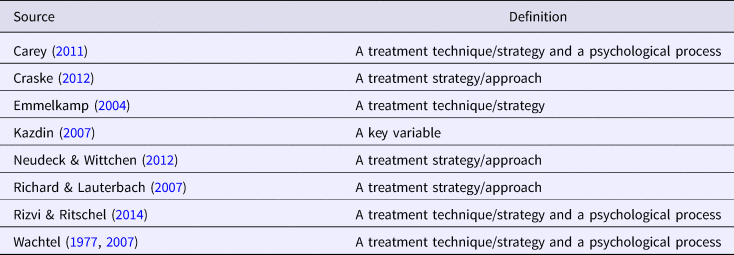
Table 1 offers a representative selection of definitions of ‘exposure’ from the clinical research literature. From this, it can be seen that, Kazdin's (Reference Kazdin2007) definition aside, there are two distinct elements to the concept. On the one hand, exposure is simply a method of psychotherapy, that is, a set of techniques or strategies used to bring about therapeutic effects; Craske (Reference Craske, Neudeck and Wittchen2012), Emmelkamp (Reference Emmelkamp and Lambert2004), Neudeck and Wittchen (Reference Neudeck and Wittchen2012) and Richard and Lauterbach (Reference Richard and Lauterbach2007) characterise exposure as a form of treatment in which people are introduced to situations they fear or experience as aversive in some way. On the other hand, exposure is both a technique or strategy and a psychological process. Carey (Reference Carey2011) and Rizvi and Ritschel (Reference Rizvi and Ritschel2014) define exposure as a technique but also as the psychological process of experiencing and tolerating a feared or anxiety-provoking stimulus in the absence of the expected aversive outcome — a process assumed to be internal to the individual. Clearly, these are contrary accounts of exposure in that they cannot both be true (and may both be false) but they are often used interchangeably, thereby conflating the two distinct meanings. This makes it near impossible to know what exactly is being referred to when exposure is discussed. For example, Carey (Reference Carey2011) explicitly refers to exposure as a ‘… technique that might be part of, or all of, the treatment for anxiety disorders’, and as a ‘… process in learning skills, acquiring knowledge, and resolving problems’ (p. 238). Similarly, Wachtel (Reference Wachtel2007) refers to exposure as a ‘technique’ and a ‘strategy’ on page 204, while on page 206 he defines exposure ‘as a two-person process’. This exemplifies the absence of conceptual coherence noted earlier. Inconsistencies such as these are an obstacle to the identification of commonalities across treatments and treatment procedures.
Definitions of Exposure

In fact, we argue that neither element in the table adequately conceptualises what exposure really is and that this has led to a limited and incomplete appreciation of the ways in which exposure can be facilitated. Our clarification of the exposure process begins with a brief review of its theoretical underpinnings.
Exposure and Learning Theory
Exposure is based on the learning processes of fear conditioning and extinction, first outlined by Pavlov in 1927. In Pavlovian fear conditioning, exposure to a previously neutral stimulus comes to elicit an anxious or fearful response through repeatedly pairing the neutral stimulus with an aversive unconditioned stimulus (US). Following repeated pairings with the US, the neutral stimulus becomes a conditioned stimulus (CS), which signals the onset of the US. For example, when Pavlov repeatedly played the sound of a metronome (the conditioned stimulus — CS) immediately before placing a small amount of sour-tasting diluted acid (the unconditioned stimulus — US) on a dog's tongue, the dog eventually learned the association. The dog began showing a ‘defensive reflex’: it shook its head and moved its tongue as if to eliminate a toxic substance (the conditioned response — CR), even though no acid was present. Formal theories spanning the past 80 years have implicated fear conditioning in the acquisition of many anxiety disorders, including panic disorder, social anxiety disorder, specific phobia, obsessive-compulsive disorder, and post-traumatic stress disorder (e.g., Eysenck, Reference Eysenck1979; Grillon, Reference Grillon2008; Pavlov, Reference Pavlov1927; Pitman & Orr, Reference Pitman and Orr1986).
In Pavlovian fear extinction, when the CS no longer predicts the US, the CR should decline over time. Extinction of the CR does not, however, represent a fading away of the CS–US association. This is demonstrated by the repeated finding that, after the passage of time, the CS can recover the ability to elicit an extinguished CR, viz., the phenomenon of spontaneous recovery (Bouton, Reference Bouton2004; Robbins, Reference Robbins1990). Current understanding of extinction recognises that extinction learning constitutes the creation of a new learning experience (i.e., a CS–no US association) that competes with and inhibits the original learning experience (i.e., the CS–US association; e.g., Bouton & Woods, Reference Bouton, Woods, Menzel and Byrne2008; Myers & Davis, Reference Myers and Davis2002; Rescorla, Reference Rescorla1996). Additional evidence countering the notion that extinction is simply an unlearning or erasure of the original conditioned learning comes from experiments showing renewal — the phenomenon whereby presentation of a CS in a novel context yields reappearance of the formally extinguished CR (e.g., Rodriguez, Craske, Mineka, & Hladeck, Reference Rodriguez, Craske, Mineka and Hladeck1999). Exposure, first proposed as a model of therapy by Wolpe (Reference Wolpe1958) in the form of systematic desensitisation, was derived from the Pavlovian model of extinction learning (Tryon, Reference Tyron2005).Footnote 6
This account makes clear that exposure consists of fear conditioning and may or may not be followed by extinction learning. It goes without saying then that exposure and extinction learning are two distinct processes that are themselves distinct from the therapeutic procedures (i.e., techniques and methods) used to bring them about. Neither exposure nor extinction learning is inherently tied to a particular model of therapy or clinical intervention.
In the following section, we aim to flesh out these two distinct processes, drawing on the field model of causation. We will illustrate how exposure and extinction learning fit within this model. In doing so, we will refer to the exposure process as ‘re-exposure’ because the person is being reintroduced to fearful/anxiety-provoking stimuli (the conditioned stimuli). This includes both traumatic (fear) learning and vicarious learning (e.g., modelling and instruction) as pathways towards the establishment of a CS-US expectancy. In short, ‘exposure therapy’ will be reformulated as a complex causal process that occurs over time and not as a defining feature of any specific model of therapy.
The Field Model of Causation
Identifying the factors that contribute to the occurrence of a phenomenon is to identify its causes — what brought that phenomenon about (Bechtel, Reference Bechtel2005; Machamer, Darden, & Craver, Reference Machamer, Darden and Craver2000; Maze, Reference Maze1983; Valentine, Reference Valentine1992). Identifying causes is central to the study and practice of psychotherapy because it involves elucidating causal processes that reliably bring about therapeutic effects (Borkovec, Reference Borkovec1997; Borkovec & Castonguay, Reference Borkovec and Castonguay1998, p. 136; Petocz, Reference Petocz and Jones2004, pp. 36–37; Shapiro, Reference Shapiro1995, p. 1). However, any two-term, cause-effect model (originally from Hume, Reference Hume and Selby-Bigge1777/1975) — where ‘cause’ is conceived of as a conjunction of events or where the relationship between cause and effect is thought to be nothing more than ‘functional dependence’ — misrepresents the complexity of the causal process.Footnote 7 The field model of causation in Figure 1 goes some way to addressing this misrepresentation (see Anderson, Reference Anderson1938/1962; Hibberd, Reference Hibberd2014; Mackie, Reference Mackie1974). It conceptualises causation as a three-term relation involving triggering causes (the first term, C) acting on a field (the second term, F) to change it in some way, that is, the effect (the third term, E).
The logic of the field model of causation.

A brief, non-clinical example may help to illustrate this causal model. Imagine a person coming into contact with radiation and subsequently developing skin cancer. Using the field model, an abridged causal account would run as follows: the person at time1 is the object acted upon — the field or set of causally relevant conditions (F 1). Here, radiation is the cause (C), and by time2 the person (F 2) has been changed in some respect (i.e., they have developed abnormal cell growth) — that ‘some respect’ is the effect (E). The field (F), then, is a set of relevant conditions which the triggering cause (or causes) act upon and from where an effect (or effects) is produced. In this example, the field might consist of: (a) the person's organic constitution, such as the presence of melanin or certain genes that make them more susceptible to developing skin cancer, and (b) any history of relevant experiences. Here, the cause (C) is distinct from the effect (E) and, importantly, the field (F) is distinct from both.
Why this model of causation? Surely it is not telling psychologists and psychotherapists anything they do not already know? Perhaps not, but it does make explicit a number of key points often overlooked in the psychotherapy research literature. First, the logical independence between F, C, and E. This logical independence enables causal dependence (Hibberd, Reference Hibberd2014). It is a precondition of any causal interaction. Put simply: if a (e.g., a therapeutic technique or instruction) is to cause b (e.g., extinction learning), then logically a must be independent of b. The two cannot be conflated.Footnote 8
Second, this model makes central the role of the field (F) as distinct from triggering causes (C). It accommodates the variability of individual differences in recognising that different antecedent (triggering) causes can produce the same effects on different fields, and the same antecedent causes can produce different effects if interacting with different fields. For example, an intervention provided at the first session (e.g., an instruction to focus on distressing imagery; an interpretation) could be experienced by the patient as intrusive, whereas if provided in a later session it may be experienced as transformative. The patient in the later session is obviously not the same field as s/he was in the first session, having been affected by a myriad of factors, including the history of the relationship between the therapist and patient. Thus, a reliance on the standard two-term, cause-effect model means that the critical distinction between the conditions that act on — that is, cause — and the context-dependent conditions that are acted upon — that is, the field — are set aside. Moreover, the field's complexities can be concealed through statistical analyses where it is often explained away as ‘error variance’ (e.g., Borsboom, Mellenbergh, & Van Herrden, Reference Borsboom, Mellenbergh and Van Heerden2003; Harré, Reference Harré2002).
Third is the dynamic (i.e., time-dependent) nature of the model. Causal interactions occur over time, and time facilitates change processes. While for clinicians this is obvious, it is less often acknowledged that the trajectory of change is seldom constant. Clinical work ordinarily proceeds in a wave-like fashion, with moments of growth and acceleration interspersed with moments of stagnation and stall (Hayes, Laurenceau, Feldman, Strauss, & Cardaciotto, Reference Hayes, Laurenceau, Feldman, Strauss and Cardaciotto2007). A patient's symptoms may quickly decrease early on in therapy and reappear during later critical phases. The field model of causation is consistent with non-linear trajectories of change, accommodating the fact that such trajectories, like those described above, are a defining feature of many therapeutic processes. In summary, the field model of causation presented here makes explicit that logical independence enables causal dependence, and is a precondition of any causal interaction. Furthermore, it brings out the contingent, contextual and non-linear nature of certain causal processes that should be of interest to all psychotherapists, regardless of adherence to a specific therapeutic approach. The question now is: What are its implications for the exposure concept?
Reconceptualising Exposure
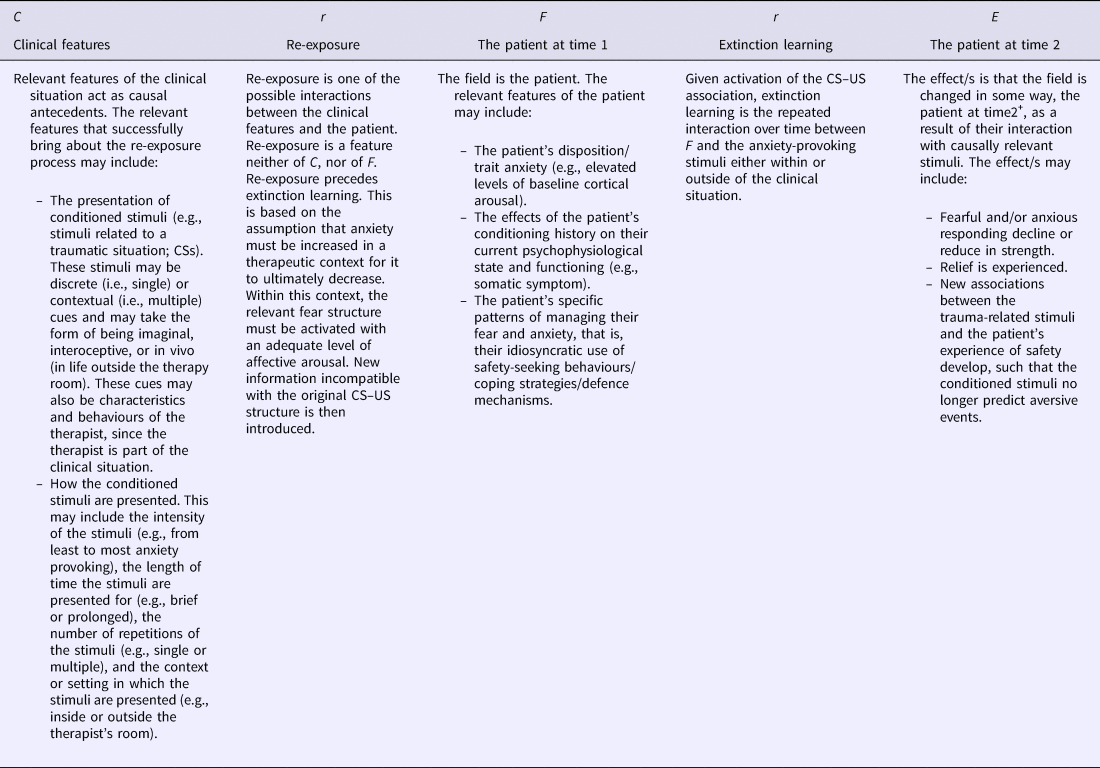
Given the field model of causation, we can reconceptualise exposure, assuming for the moment ‘optimal’ clinical conditions. The process is, more precisely, that of re-exposure-extinction learning, as represented in Table 2. This description of the exposure process is similar to how it unfolds in the context of a CBT intervention for anxiety, for instance.
Unfolding the Re-exposure-Extinction Learning Process

Note: This table is not meant to be an exhaustive account of the re-exposure-extinction learning process but rather exemplary. This is because the way in which the relevant features of the clinical situation combine and interact to bring this process about will be subtle and unique to each person and therapeutic encounter. Nor will the process always be gradual and linear (Hayes et al., Reference Hayes, Laurenceau, Feldman, Strauss and Cardaciotto2007). Nevertheless, while the precise way in which the re-exposure-extinction learning process unfolds may differ depending on the psychological condition being treated (the field), in each case it will generally contain the above elements. The main purpose of this table is to outline the logical structure of the re-exposure-extinction learning process, particularly the logical independence of the different aspects of the model.
First, the clinical features (C, the first term) involve networks of stimuli (i.e., complex situations), some of which act as triggering causes. These include, but are not limited to, a set of stimuli which, given the person's history (that is, given the nature of the field, F), we call ‘conditioned stimuli’. Some within this set of stimuli will, of course, be purposely introduced by the therapist as part of the clinical technique, but not all. The therapist may, for example, unknowingly act in a way that functions as a triggering cause. One can readily imagine a scenario in which, based on a person's implicit model of relationships formed during their upbringing, they experience the therapist's questions and comments as highly intrusive and an invasion of privacy, rather than as signs of genuine interest in and curiosity about them and their situation. Or a therapist's silence is experienced by a patient as a rejection, as indicating the therapist's boredom with them. Aspects of the therapist's office could also act as causal triggers (e.g., artwork on the wall).
Thus, certain clinical features causally act upon the patient (the field, F). The crucial conceptual point here is that the therapist purposively introducing stimuli does not necessarily induce the re-exposure relation. Whether this relation occurs depends on the interaction between features of the field (the patient) and certain clinical features. The relation of re-exposing the patient to X is not a given, it is contingent — it may or may not occur. One cannot say, ‘Here is the CBT technique, therefore exposure’. This means that the specific relation of re-exposure is distinct from or independent of the model of therapy employed. If a CS–US association is activated, this can occur through any number of very different causes.
The patient is then exposed to a range of stimuli, some of which may constitute a re-exposure depending on their history. Where there is re-exposure, a CS–US association is triggered, the expected effect being the activation of fear/anxiety in the patient. It is these trauma-related stimuli that are a necessary precondition of the extinction-learning process. The time that this latter process takes will depend upon the patient, the nature of the therapy, the therapeutic alliance, and so on.
Prior to any re-exposure, the field would consist of, in part, the patient's current physiological state, such as having elevated levels of baseline cortical arousal, in concert with their conditioning history. The patient's characteristic patterns of managing their fear and anxiety through various forms of avoidance and resistance, both adaptive and maladaptive, would also constitute part of the field. It is the presence of the patient's maladaptive coping strategies/defence mechanisms (i.e., their automatic psychological responses to internal and external stressors) that can obscure what is being avoided through, for example, distorting or excluding information or affective experiences (see Lemma, Reference Lemma2003, pp. 200–229; Meuret, Wolitzky-Taylor, Twohig, & Craske, Reference Meuret, Wolitzky-Taylor, Twohig and Craske2012; Perry, Reference Perry2014; Perry & Bond, Reference Perry and Bond2017; Tully, Wells, & Morrison, Reference Tully, Wells and Morrison2017; Wells, Reference Wells1997). Critically, this can make it difficult to identify what exactly the patient needs re-exposure to. The use of maladaptive coping strategies/defence mechanisms may, therefore, prevent or significantly interfere with the all-important re-exposure process.
Assuming the activation of the CS–US association, it does not follow that extinction learning will occur. The patient (the field, F) repeatedly approaches the anxiety-provoking stimulus/stimuli over time, either inside or outside of the therapy room. The logical importance is that following re-exposure, extinction learning is just one of the possible outcomes. And if it does occur, the number of repetitions required for the CS to no longer predict the US (CS–noUS) will depend on various factors, such as the number of triggering causes, the extent and nature of the patient's conditioning history, and their use of coping strategies/defence mechanisms during and after extinction learning.
The patient will have been changed in some way — the effect(s) (E) are the patient at time 2. The effect(s) is the result of the re-exposure–extinction learning process over time. New associations have been established between the trauma-related stimulus/stimuli (CSs) and the unconditioned stimulus/stimuli (USs), such that the cues no longer predict aversive events and thus reduce the strength of fearful and/or anxious responses.
Whether a patient is re-exposed to aversive stimuli is not necessarily a function of any specific therapeutic technique — it is a contingent feature of the C–F interaction. The implication is that the re-exposure–extinction learning process may be facilitated through a variety of factors (interventions, stimuli, strategies, techniques) and may also be enabled via events that occur outside of the clinical situation (e.g., interactions with a spouse, family member, or schoolteacher). Of course, anxiety-provoking situations may be frequently avoided in everyday life, thus preventing exposure from occurring. Moreover, learned fears appear difficult to render extinct, and extinction learning seems highly context-specific (Bouton, Westbrook, Corcoran, & Maren, Reference Bouton, Westbrook, Corcoran and Maren2006). As such, the clinical situation may be more beneficial in modifying ineffective ways of coping, if it allows a sustained focus on fears and anxieties across multiple relevant contexts.
Nonetheless, the key points so far are that the field model of causation makes clear that defining exposure as a treatment technique or defining it as both a treatment strategy and a psychological process is to obfuscate. Whether a treatment technique is re-exposing the patient to aversive stimuli is contingent on the C–F interaction. What we are calling ‘re-exposure’ is not an exclusively clinical phenomenon and neither is extinction learning. And, as the field model of causation shows, extinction learning is a distinct post re-exposure process which, again, may or may not occur.
This echoes Salvatore's (Reference Salvatore2011) position that many causal processes in psychotherapy can best be understood as facilitating particular forms of more generalised patterns of communicational exchange that occur in everyday life (pp. 372–376). For example, it seems to be generally accepted that confronting or elaborating on a psychological difficulty, which typically produces arousal and emotional activation, is a necessary part of working through such difficulties, regardless of whether this happens in the context of a clinical intervention. We think that the re-exposure-extinction learning process exemplifies seemingly very different approaches, such as CBT and psychodynamic psychotherapy, employing ‘product differentiation’ but in fact drawing on the same or similar causal processes.
In what follows, we reinforce this point by providing a counter-example to the received wisdom that ‘exposure therapy’ is exclusively CBT. Our counter-example is the concept of transference. We begin with a brief overview of this concept and then argue that ‘working in the transference’ can be understood as a complementary and effective way of facilitating the re-exposure–extinction learning process. This affords additional insights into how and why psychodynamic therapy might work.
Transference and Working in the Transference
Transference is fundamentally an unconscious process where important and formative relationships, such as with family members, influence how we make sense of and react to present encounters with people, such as romantic partners, leading to well-established patterns of relating and emotional responding (Freud, Reference Freud and Ellman1912; Laplanche & Pontalis, Reference Laplanche, Pontalis and Nicholson-Smith1973). Transference, then, can occur in both everyday life and the clinical setting, but the crucial point is that regardless of context, past relationships can play out or be re-enacted in current relationships (Andersen & Przybylinski, Reference Andersen and Przybylinski2012). McWilliams (Reference McWilliams1994) provides an example from the clinical setting:
… most adults can answer questions about their sexual practices with relative frankness when talking to a professional who is still a stranger. But once the therapist has started to feel like one's prudish mother or moralistic father, the words flow anything but easily. (p. 16)
Psychodynamic practitioners since Freud (Reference Freud and Ellman1912) have regarded this emotional connection between patient and therapist not as distortions to be explained away but as a phenomenon that can be used to facilitate change. The expression ‘working in the transference’ means the therapist actively allowing the transference to unfold followed by their making of transference interpretations so as to explore the patient's here-and-now affective focus. These interpretations make explicit the similarities between the patient's patterns of relating to past significant others and the therapist in the emotional immediacy of the current session. It is a cornerstone of psychodynamic practice, both in classical forms of psychoanalytic therapy and in more contemporary relational (e.g., object-relations) approaches (Clarkin, Yeomans, & Kernberg, Reference Clarkin, Yeomans and Kernberg2006; Gabbard, Reference Gabbard2004; Goldstein & Goldberg, Reference Goldstein and Goldberg2008; Lemma, Reference Lemma2003; Levy & Scala, Reference Levy and Scala2012; Oelsner, Reference Oelsner2013). The point is that transference processes may warrant clinical attention when they are problematic for a person because they provoke conflict in interactions, in personal suffering, and/or maladaptive behaviour. The interpretation explicitly references the patient-therapist relationship and is intended to encourage an exploration of those conflicts, expectations, and feelings regarding the therapist — their ‘internalised object relationships’ — as they manifest in the here-and-now of the session, and may be a productive approach to enhancing self-awareness with regard to interpersonal difficulties.
Any individual may develop a range of transferences, both positive and negative. We argued earlier that the specific relation of re-exposure is distinct from or independent of the model of therapy employed. Similarly, transferences may develop in both psychodynamic and non-psychodynamic therapies. Moreover, even when not intentionally activated by the therapist, the phenomenon appears to be related to the process and outcomes in non-psychodynamic treatments (Gelso & Bhatia, Reference Gelso and Bhatia2012). In the context of psychotherapy, ‘positive’ and ‘negative’ refer to the valence of the affects transferred, not to any favourable or unfavourable long-term effects of the transference on the treatment. The transference of positively valenced feelings may have negative effects. This may occur when, for example, a patient wishes to recreate an all-gratifying relationship with the therapist that inhibits them from exploring the full range of thoughts and feelings they have towards the therapist (e.g., envy). On the other hand, the transference of negatively valenced feelings may have positive effects. For example, a patient is able express their anger (which could not be expressed as a child) towards the therapist without the therapist retaliating against, or trying to minimise the significance of, the patient's feelings. Through this process, the patient may learn that such negatively valenced feelings are, within certain limits, acceptable and tolerable.
The Re-Exposure-Extinction Learning Process and Working in the Transference
How does working in the transference relate to our reformulation of the re-exposure-extinction learning process? Working in the transference is typically anxiety-provoking for the patient. However, it may also give rise to a range of emotions (e.g., relief, anger, annoyance). In this context, relevant clinical features, such as attributes of the therapist, what they do or do not say, their tone, or how else they may respond to the patient, may yield a transference reaction. These features all act upon the patient and may, or may not, trigger the re-exposure process. When this reaction is negatively valenced, by its very nature it is a re-experiencing of something aversive, the CS–US association. Again, we reiterate that whether the relation of re-exposure occurs depends on the interaction between the patient (the field, F) and certain clinical features (the cause/causes, C). The process of re-exposure is not a given, it is contingent — it may or may not occur.
Transference interpretations involve the therapist drawing explicit attention to certain maladaptive aspects of the patient's way of being with them (e.g., non-verbal relational behaviours; see Schore, Reference Schore2011), as well as to, for example, warded-off feelings or motivations that trigger anxiety which is related to how they manage their relationship with the therapist. A series of well-timed interpretations of the negative transference may nevertheless promote a patient's psychological integration and growth. We suggest that this is a part of the extinction learning process. Interpretations invite the patient to examine their emotional reactions, however uncomfortable or distressing, in the immediacy of the therapeutic relationship, and may gradually lead to personal insight (e.g., more realistic and nuanced judgments of oneself and others). The therapist who is able to hear that a patient hates them, for example, is providing that patient with a novel experience that might begin to implicitly disconfirm the patient's negative expectations of others (e.g., ‘No one can handle my hatred’). It shows a capacity by the therapist to manage ambivalence without needing to retaliate when on the receiving end of hostile feelings. Insofar as the patient's fears and anxieties can be contained until they dissipate — which is to say, until they are ‘worked through’ or ‘extinguished’ in the transference situation — an increased capacity of the patient to tolerate reality can develop. Working through the transference involves ongoing interaction to the point where the patient's mental states in relation to the therapist no longer give rise to aversive outcomes in the patient or are at least experienced as tolerable. It is in this way that transference interpretations can facilitate extinction learning: through enabling the patient to repeatedly re-evaluate their fearful expectations (e.g., expectations of being harmed or ridiculed) as they manifest in the context of a safe, trusting, and containing therapeutic relationship. This, we argue, establishes new learning — that is, a reduction in the associative strength between the aversive CS and the US (Bouton & Woods, Reference Bouton, Woods, Menzel and Byrne2008; Pavlov, Reference Pavlov1927).
It is important to note, however, that transference interpretations may not always facilitate extinction learning. This may occur when the transference interpretation is inaccurate, when it is accurate but poorly timed (i.e., too early, that is, before the patient can be emotionally receptive), or when the patient's maladaptive coping strategies/defence mechanisms function to prevent their capacity to experience and tolerate anxiety long enough for extinction learning to occur.
However, when the interpretations do facilitate extinction learning, the patient is changed in some way, that is, the effect (E).Footnote 9 The long-term effect(s) produced by extinction learning would include: a reduction in feelings of distress in relation to the interpersonal situation and the development of new associations about the interpersonal situation, that is, between the anxiety-provoking stimuli and the patient's experience of safety in relation to those stimuli (CS–noUS).
Evidential Bases
We have employed the field model of causation to address what is an obfuscatory characterisation of the concept of exposure in the clinical literature. Specifically, we have argued that the field model requires a distinction to be drawn between re-exposure and extinction learning and that ‘exposure therapy’ is not a defining feature of any one particular therapeutic approach, but a complex causal process contingent on the state of the field (the individual's psychological system) when re-exposed to a myriad of (causal) factors. We have also proposed that this reconceptualisation accommodates working in the transference, a process central to psychodynamic psychotherapy.
Is there an independent evidential basis that can assist here? We think there is. First, recognition of the re-exposure-extinction learning process in the field of psychoanalysis, including its therapeutic potential, is not new. For example, when Melanie Klein (Reference Klein1932) outlined the function of an interpretation, she commented that:
… based on empiric observation … the analyst should not shy away from making a deep interpretation even at the start of the analysis, since the material belonging to a deeper layer of the mind will come back again later and be worked through. As I have said before, the function of deep-going interpretation is simply to open the door to the unconscious, to diminish the anxiety that has been stirred up, and thus to prepare the way for analytic work. (p. 35)
We read Klein as saying that the function of a transference interpretation is to re-expose a patient to anxiety associated with their unconscious thoughts and feelings (a CS–US association). Working through — that is to say, the repeated use of transference interpretations over time in the context of a safe and containing therapeutic relationship — will, under optimal clinical conditions, reduce the patient's need to employ certain coping strategies and defence mechanisms. As was argued in the previous section, working through can be understood as extinction learning. After having first increased anxiety (re-exposure), working through or extinction learning will eventually lead to its decrease as well as to the creation of new learning experiences (i.e., a CS–noUS association) that compete with and inhibit the original learning experiences (i.e., the CS–US association).
Contemporary psychodynamic clinicians such as Richard Gipps (Reference Gipps2017) have made similar observations about the potential long-term, anxiety-reducing effects of working in the transference:
Work in the transference is designed to facilitate a patient's living exposure to their real underlying fears about how they would be seen if they were to allow themselves their own true feelings. The opportunity is thereby provided for a true change of heart — i.e. for emancipation from depressive cognition through an experiential recovery, acceptance and integration of hitherto unconscious emotional experience. (p. 5)
Here, Gipps is in effect describing how working in the transference enables the re-exposure-extinction learning process, as we have argued. Taken together, we think these excerpts from the psychoanalytic literature implicitly reference the re-exposure-extinction learning process as we have conceptualised it.
Evidence for Transference Interpretations
Interestingly, in a series of studies using clinical samples undergoing psychodynamic psychotherapy, researchers sought to examine the influence of transference interpretations on clinically relevant outcomes (e.g., Høglend et al., Reference Høglend, Amlo, Marble, Bøgwald, Sørb, Sjaastad and Heyerdahl2006; Høglend et al., Reference Høglend, Bøgwald, Amlo, Marble, Ulberg and Johansson2008; Ulberg, Amlo, Dahl, & Høglend, Reference Ulberg, Amlo, Dahl and Høglend2017; see Høglend, Reference Høglend2014 for a review). Employing mediational analyses, it was found that transference interpretations can, over time, lead to increased emotional and cognitive insight (including non-aversive emotional arousal), followed by subsequent improvements in interpersonal functioning outside of therapy. Increased emotional and cognitive insight can be conceptualised in terms of the formation of new associations (i.e., new learning), such that the trauma-related CSs no longer predict aversive events, thus establishing a mismatch between expectancy and outcome (i.e., an expectancy violation: Craske, Treanor, Conway, Zbozinek, & Vervliet, Reference Craske, Treanor, Conway, Zbozinek and Vervliet2014, pp. 12–13; Dollard & Miller, Reference Dollard and Miller1950; Rescorla & Wagner, Reference Rescorla, Wagner and Prokasy1972). These studies are consistent with the notion that transference interpretations can facilitate a growth process for the patient, one that may involve, in part, re-exposure to emotionally confronting stimuli followed by a reduction in the associative strength between the same stimuli and an expected feared outcome (i.e., extinction learning). Importantly, this new learning appears to open up the possibility of engaging with others in more realistic and psychologically flexible ways.
In short, working in the transference is an experiential demonstration of the safety of encountering what was previously fearfully avoided by the patient; it constitutes a complementary way of facilitating the re-exposure-extinction learning process. Moreover, it serves as a counter-example to the widely held assumption in the cognitive-behavioural literature that exposure can only occur as part of a cognitive-behavioural approach. Indeed, when the re-exposure-extinction learning process does occur in the clinical setting, it may constitute a particular form of a more generalised process of communicational exchange that can occur in everyday life (Salvatore, Reference Salvatore2011).
Implications for Psychotherapy Practice and Training
Understanding working in the transference as a form of the re-exposure-extinction learning process invites new practices. There is a wealth of systematic empirical research focusing on improving the efficacy of various techniques designed to facilitate the process (e.g., Craske et al., Reference Craske, Treanor, Conway, Zbozinek and Vervliet2014; Vervliet, Craske, & Hermans, Reference Vervliet, Craske and Hermans2013). This research demonstrates that particular strategies and procedures can, under certain conditions, enhance extinction learning by consolidating new learning experiences. One such strategy is ‘expectancy violation’. It involves making conscious the mismatch between one's expectation regarding the frequency and intensity of aversive outcomes, and one's experience. This strategy could be applied to working in the transference by, for example, encouraging patients to reflect on the discrepancies between what they predicted the therapist would do or say (e.g., ‘my therapist will punish me for expressing my dissatisfaction with them’), and what actually occurred (e.g., discussing the fact that the therapist did not, contrary to expectation, become upset when they expressed their dissatisfaction) — in other words, making salient the CS–noUS association. Indeed, bringing this association to awareness appears to play an important role in facilitating therapeutic change through the process of memory consolidation and reconsolidation (Lane, Ryan, Nadel, & Greenberg, Reference Lane, Ryan, Nadel and Greenberg2015).
Framing more traditional exposure-based approaches within the causal model outlined here is also likely to hold advantages for cognitive-behavioural approaches. For example, while strategies designed to bring about extinction learning have been found to be effective, there continue to be a number of patients who do not seem to benefit (Arch & Craske, Reference Arch and Craske2009). One possible reason for this may be due to some aspect of the causal field, particularly the patient's coping strategies/defence mechanisms that resist and hinder the development of the re-exposure-extinction learning process, as discussed above. While cognitive-behavioural models acknowledge the use of maladaptive coping strategies (commonly referred to as ‘safety-seeking behaviours’), psychodynamic practices tend to place greater emphasis on the myriad subtle ways in which people avoid anxiety-provoking stimuli through constricting and misrepresenting experience (e.g., rationalisation, idealisation, projective identification). Therapists applying more traditional re-exposure and extinction learning procedures may benefit from targeting these forms of defence, that is, helping the patient to diminish their use of maladaptive defences. Doing so may help create the conditions in which a patient is more able to successfully engage in the re-exposure-extinction learning process.
Our argument also supports Rosen and Davison's (Reference Rosen and Davison2003) position that the science, training and practice of clinical psychologists is likely to be best served by identifying empirically supported principles and processes of change (ESPs) and learning the range of their application, rather than developing ‘empirically supported treatments’ (ESTs). Indeed, creating ESTs often obscures common causal processes that are facilitated by different treatments through, for example, the use of widely diverging terminologies. Moreover, ESTs imply that the clinical techniques and procedures are exclusive to, and inherent aspects of, the specific treatment model (e.g., Allen, McHugh, & Barlow, Reference Allen, McHugh, Barlow and Barlow2008; Kazdin, Reference Kazdin2007, Reference Kazdin2008; Shedler, Reference Shedler2010; Tryon, Reference Tyron2005; Wachtel, Reference Wachtel2010). This implication is false, and is arguably due to a failure to fully appreciate the causal processes operating independently of surface differences across various types of therapy. As we have found, this can interfere with developing conceptually coherent forms of integration between different therapeutic traditions, or certain aspects of those traditions, and may hamper an appreciation of how different traditions can learn from each other (Castonguay & Beutler, Reference Castonguay and Beutler2006).
Conclusion
The re-exposure-extinction learning process involves the logical independence between the different elements of the clinical situation, that is, the clinical features (the cause/causes, C), the patient (the field, F), and the patient being changed in some way, the effect (E). Critically, it is this logical independence that enables the contingency of certain causal interactions. This means that the relation of re-exposure is not necessitated by any particular technique. In fact, a variety of causal antecedents (e.g., different therapeutic techniques, non-clinical stimuli) can facilitate the same re-exposure-extinction learning process.
Re-exposure, then, is not a set of techniques used to bring about therapeutic change. In fact, re-exposure and extinction learning are two psychological processes distinct from the therapeutic procedures (i.e., techniques and methods) used to bring them about. Furthermore, these processes are not inherently tied to a single model of therapy or clinical intervention. In the clinical context, whether a patient is re-exposed to aversive stimuli and subsequently engages in extinction learning is a contingent feature of the interaction between various clinical features (the cause/causes, C) and that patient (the field, F).
If, as we suggest, these psychological processes can be facilitated through a variety of therapeutic techniques and procedures, we have in effect provided a theoretical rationale for Wachtel's (Reference Wachtel1977, Reference Wachtel2007) integrative approach. This combines both traditional CBT exposure-based strategies with psychodynamic techniques (e.g., interpretations) in a unique and synergistic model. Indeed, we argue that working in the transference can be understood as a complementary and effective way of facilitating the re-exposure-extinction learning process. Thus, in understanding the processes of fear conditioning and extinction learning, some fresh insights on how and why psychodynamic psychotherapy works is possible.
Author ORCIDs
David L. Muir, 0000-0003-4703-9175; Fiona J. Hibberd, 0000-0003-2002-7342.
Acknowledgments
We thank Professor Stanley Messer and two anonymous reviewers for their helpful comments on an earlier version of this article.