Introduction
The Chiroteuthids comprise a group of deep-sea Oegopsid squids that are widely distributed throughout the world’s oceans (Braid et al. Reference Braid, Kubodera and Bolstad2017). They share morphological similarities such as a gladius with secondary conus, the absence of a primary tentacle club and the presence of a secondary tentacle club (Vecchione and Young Reference Vecchione and Young1998). The group is formed by six families: the Chiroteuthidae Gray, 1849, the Mastigoteuthidae Verrill, 1881, the Joubiniteuthidae Naef, 1922, the Promachoteuthidae, the Batoteuthidae Young and Roper, 1968, and the Magnapinnidae (Vecchione and Young Reference Vecchione and Young1998). The family Chiroteuthidae includes four genus Chiroteuthis d’Orbigny [in A. Férussac & d’Orbigny], 1841, Asperoteuthis Nesis, 1980, Grimalditeuthis Joubin, 1898 and Planctoteuthis Pfeffer, 1912. There are 7 valid species reported in Chiroteuthis; C. calyx R. E. Young, 1972, C. imperator Chun, 1908, C. joubini G. L. Voss, 1967, C. mega (Joubin, 1932), C. picteti (Joubin ), C. spoeli (Salcedo-Vargas Reference Salcedo-Vargas1996) and C. veranyi (A. Férussac, 1834). The genus Chiroteuthis is divided into three groups- “C. veranyi group,” “C. joubini group,” and “C. picteti group” (Jereb and Roper Reference Jereb and Roper2005; Roper and Young Reference Roper and Young2013; Sweeney and Roper Reference Sweeney and Roper1998). The C. picteti group includes two species C. picteti and C. mega (Braid Reference Braid2018).The C. picteti an oceanic squid, lives deep in the seas of tropical and subtropical areas and is mostly found in the North Pacific Ocean. Previous studies have reported this species in Japan, Korea, New Zealand, Hawaii, California, and Indonesia (Braid et al. Reference Braid, Kubodera and Bolstad2017; Kang et al. Reference Kang, Choi, Choi, Lee and Kim2013; Mensch Reference Mensch2010). Cephalopod taxonomy mostly relies on morphology, but Chiroteuthids are particularly challenging because they have extremely long tentacles and distinct club morphology which are very fragile and are often lost during capture (Young Reference Young1991). The use of integrative taxonomic methods has been very helpful in identifying the species. This study is the first report of Chiroteuthis picteti from the Andaman Sea.
Materials and methods
Specimen collection
Three C. picteti specimens (dead) were collected from the seashore of Corbyn’s Cove, Port Blair, South Andaman (11° 38′ 41.8554″, 92° 44′ 53.4048″) (Figure 1). The specimens were preserved in ice immediately after collection and transported to the laboratory. In the laboratory, the specimens were identified based on the distinguishing characteristics, including the shape of the mantle, length of tentacle and structure of the tentacular club and structure of arm IV arm (in males only), as outlined by Roper and Voss (Reference Roper and Voss1983) and Clarke (Reference Clarke1986). A small piece of muscle tissue was excised from the mantle and preserved in 100% ethanol for molecular analysis and the animals were preserved in 4% formalin. These voucher specimens have been stored at the PMFGR Centre, ICAR-NBFGR, Kochi, India (voucher no: CHISPIC.1/NBFGR and CHISPIC.2/NBFGR).
Map showing the location of Chiroteuthis picteti collected from the Andaman Sea (Closed circle = present sample, open circle = previous records).

DNA extraction, PCR & sequencing
DNA was extracted from mantle tissue by a standard salting-out protocol (Miller et al. Reference Miller, Dykes and Polesky1988). The mitochondrial COI gene region was amplified with the primers HCO2198–LCO1490 (Folmer et al. Reference Folmer, Black and Hoeh1994) and 16S with primers 16S rRNA F: 5′-CGCCTGTTTATCAAAAACAT-3′ and 16S rRNA R: 5′-CCGGTCTGAACTCAGATCACGT-3′ (Piatkowski and Welsch Reference Piatkowski and Welsch1991). PCR was set up on a total volume of 25 µl with 0.5 µl primer (forward and reverse primer (10 µM), 12.5 µl TaKaRa Emerald Amp GT PCR Master Mix, 1 µl DNA (20 ng/µL) and 11 µl H2O (double distilled). PCR conditions were set as initial denaturation at 94°C for 1 min, followed by 35 cycles of denaturation at 94ºC for 40 s, annealing at 50ºC for 40 s and extension at 72ºC for 1 min, with a final elongation at 72ºC for 10 min for COI gene and initial denaturation at 94°C for 4 min, followed by 35 cycles of denaturation at 94ºC for 30 s, annealing at 52ºC for 40 s and extension at 72ºC for 45 s, with a final elongation at 72ºC for 5 min for 16S gene. PCR samples were sequenced by Sanger sequencing.
Sequence editing & phylogenetic analysis
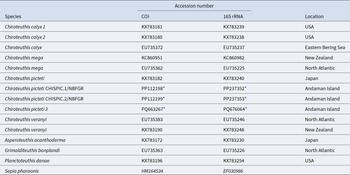
Generated COI and 16S rRNA sequences were trimmed at the 5′ and 3′ ends and aligned using the ClustalW multiple alignment tools implemented in BioEdit (Hall, 2004). For phylogenetic analysis, apart from the sequences we generated available COI and 16S sequences were retrieved from the NCBI GenBank online (Table 2). The sequence data from individual genes were concatenated into a single dataset using MEGA 11 (Tamura et al., 2021). The combined dataset was analysed under Maximum Likelihood method. GTR + G + I model was determined to be the best fit mode for the combined data set. Genetic distances were calculated using the Kimura 2-parameter method in MEGA 11.
Results
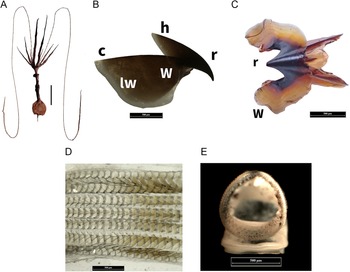
Measurements and indices of the three specimens are given in Table 1. All photographs were taken from Specimen l (Figure 2(A)).
Dorsal view (A) (Scale bar=100 mm), Lateral view of upper beak (B) and top view of lower beak (C) [r: rostrum, w: wing, h: hood, c: crest, lw: lateral wall], Radula (D) and arm sucker (E) of C. picteti from the Andaman Sea (Scale bar=500 µm).

Morphometric measurements and indices of C. picteti from the andaman sea

Species included in phylogenetic analyses, genbank accession number for each mitochondrial gene and their location

* Sequences generated in this study.
Systematic description
Order: Oegopsida
Superfamily: Chiroteuthoidae Grey, 1849
Family: Chiroteuthidae Grey, 1849
Genus: Chiroteuthis d’Orbigny [in A. Férussac & d’Orbigny], 1841
Chiroteuthis picteti (Joubin )
The dorsal mantle length (DML) of the individuals was 165 and 170 mm. Mantle: Short, conical, with weak musculature; terminates in a point posteriorly just beyond the posterior end of fins (Figure 2(A)).
Fins: Almost round inn shape, fin length is 50–60% of DML while width is 40–50% of DML
Head: Elongate, cylindrical and slightly swollen in the region of the eyes. Head length is 44% of DML. Eyes are large.
Arms: Formula is IV > III > II > I. Arms I–III with thick, low keels and with low protective membranes. Arm IV greatly enlarged, with a broad tentacular sheath running along its length. Suckers on Arm IV widely separated in two alternating series, giving the appearance of single row to arm tip. Suckers on all arms reduced in size distally towards arm tip, becoming crowded at distal end (Figure 2(E)).
Tentacles: Long, slender, about 6–7 times mantle length. Small tentacular club suckers of uniform size arranged in four rows. About 30–35 Photophores (purplish dots) are present throughout the length of tentacle. The distance between the photophores increases towards the club.
Club: Flattened, widest at proximal portion, each side bordered by well-developed protective membrane. A thick, ovate dark purple indented photophores, about 2.5 mm long, at tip of club. A spoon-like indentation is visible from the aboral side of the club.
Club suckers: A total of 133–136 suckers in m about 35 tetra serial rows. Suckers set on long lateral and short medial stalks.
Radula: Seven transverse rows of teeth (Figure 2(D))
Chromatophores: Numerous pink-purple chromatophores cover body, fewer on tentacles, absent on club keels.
Beak: Upper mandible with long curved rostrum. Lower mandible with obtuse jaw angle, high wing fold thickened to form a ridge, long wing, short crest; hood long relative to crest and broadly notched in the midline; thickened fold running to lower part of posterior edge of lateral wall(Figure 2(B), (C)). Crest length 1970.24 µm, Hood length 1256.84 µm, wing length 329.98 µm and rostrum length 282.95 µm.
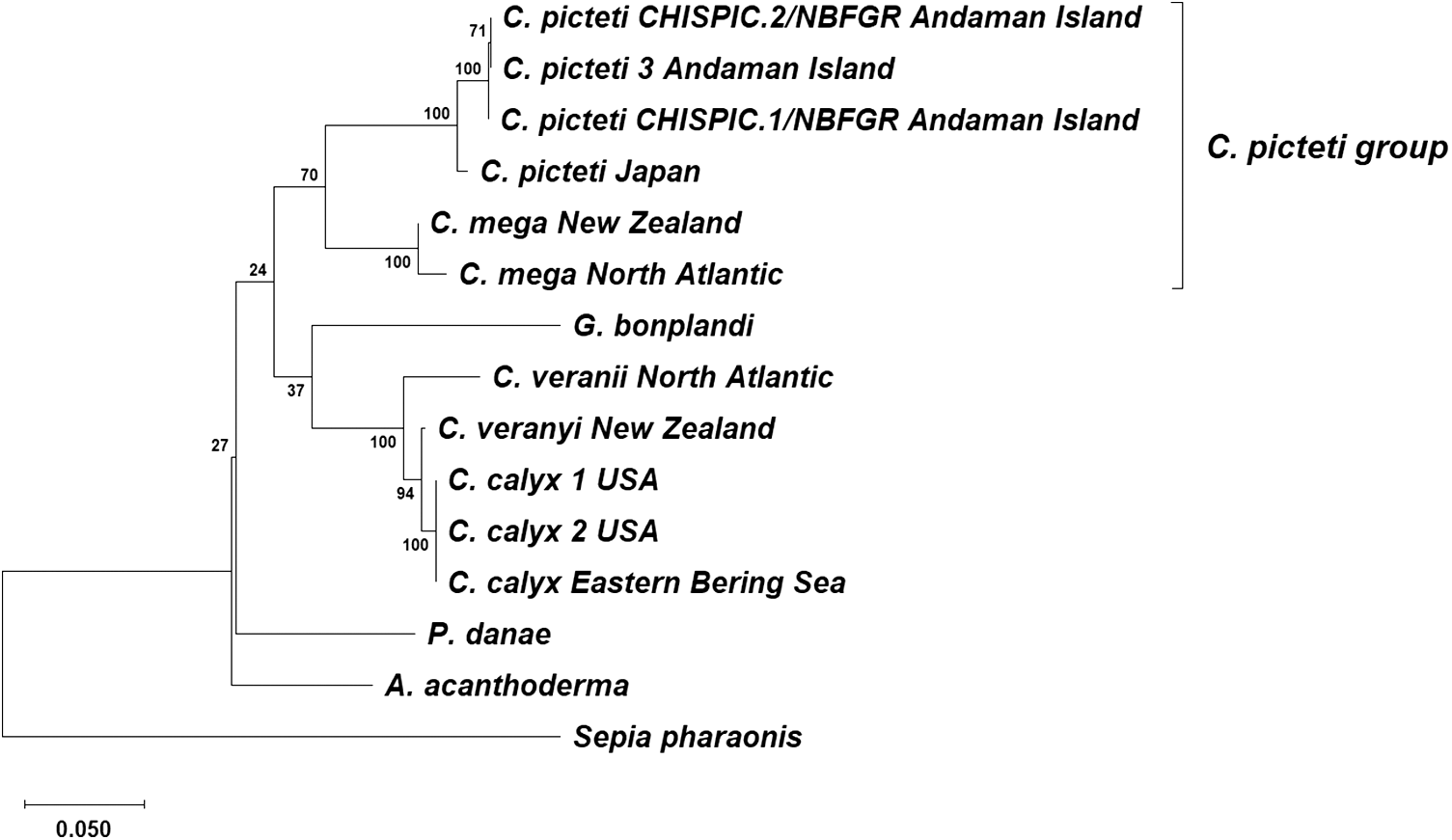
Phylogenetic tree of Chiroteuthis picteti from the Andaman Sea drawn using Maximum Likelihood method with MEGA 11. The bootstrap values are indicated at the nodes.

Molecular analysis
In the phylogenetic analysis, two well supported subclades were observed within C. picteti (Figure 3). Clade A includes species from Japan while clade B includes sequences generated in this study (Andaman Sea). It was noted that the intraspecies distance within C. picteti was 1% while the genetic distance between C. picteti from Japan and Andaman was 2%. Within Chiroteuthidae family, C. mega was more closely related to C. picteti. Newly generated sequences have been submitted to GenBank.
Discussion
This study reports the first occurrence Chiroteuthis picteti from Andaman Sea. Previously many Chiroteuthis species such as C. joubini, C. spoeli, C. picteti somaliensis and C. picteti picteti were reported from Indian Ocean (Nesis Reference Nesis1987; Salcedo-Vargas Reference Salcedo-Vargas1996, Reference Salcedo-Vargas1997). (Piatkowski and Welsch Reference Piatkowski and Welsch1991) report the first record of C. picteti from Arabian Sea. There were numerous ambiguities in the taxonomy of Chiroteuthidae. Studies by (Braid Reference Braid2018; Braid et al. Reference Braid, Kubodera and Bolstad2017; Mensch Reference Mensch2010) gave more clarity to the taxonomic status of this group. Roper and Young (Reference Roper and Young2013) suggested that based on morphology, the genus Chiroteuthis can be divided into three groups – the C. joubini group, C. picteti group and C. veranyi. The C. picteti group is characterised by the eye ball photophores in three series, tentacle club pigmented by chromatophores and tentacle suckers with a single central tooth and based on morphology C. picteti group consists of C. picteti and C. mega (Roper and Young Reference Roper and Young2013). Later, (Braid et al. Reference Braid, Kubodera and Bolstad2017) studied Chiroteuthids in Pacific Ocean using COI, 16S rRNA, and 12S rRNA sequences and observed that Chiroteuthis did not resolve into single clade instead Chiroteuthis includes two separated and well-supported groups – C. picteti group and C. veranyi. Her study also suggested that C. picteti group includes four genetically distinct species- C. picteti, C. mega and two unidentified species. The phylogenetic analysis of present study suggested that the genus Chiroteuthis is not monophyletic. Our study also revealed that C. picteti group includes two distinct species- C. picteti, C. mega. Within C. picteti species two well supported clades were formed. The sequences generated in this study formed clade A (Indian Ocean) while the C. picteti sequences from Japanese waters (Pacific Ocean) formed other one. Additional specimens across the entire range of C. picteti will be needed to confirm the presence of cryptic groups within this species.
Acknowledgements
The authors would like to express their sincere thanks to Director, ICAR-NBFGR, Lucknow and Dr. T. T. Ajith Kumar (Head, PMFGR Centre, Kochi) for providing facilities to carry out this work at PAGR Centre, Kochi. The authors would also like to express their gratitude to Prof. R. Mohan Raju, Pondicherry University- Port Blair Campus and Dr. C. Sivaperuman, ZSI, Andaman and Nicobar Regional centre for their support.
Data availability
The datasets generated during and/or analysed during the current study are available from the corresponding author on request.
Author contributions
Sneha Vargheese: Molecular and phylogenetic analysis, manuscript preparation. K. K. Sajikumar: Morphological analysis. Ameen Ummath: Sample collection. V. S. Basheer: Writing - review & editing, Supervision,
Financial Support
The work was carried out with financial support from Department of Science and Technology, Ministry of Science and Technology, Government of India (DST-INSPIRE fellowship) to Ms. Sneha Vargheese.
Conflict of interest
The authors declare that they have no known competing financial interests or personal relationships that could have appeared to influence the work reported in this paper.
Ethical standards
All three dead specimens were collected from sea shore.