INTRODUCTION
The ‘Production Effect’ (PE) in memory refers to a familiar phenomenon – reading a word aloud improves its memory relative to reading it silently (MacLeod, Reference MacLeod2011). This robust effect is well documented within the recent literature (Forrin, MacLeod & Ozubko, Reference Forrin, MacLeod and Ozubko2012; MacLeod, Gopie, Hourihan, Neary & Ozubko, Reference MacLeod, Gopie, Hourihan, Neary and Ozubko2010; Ozubko, Gopie & MacLeod, Reference Ozubko, Gopie and MacLeod2012).
In a standard PE study, a list of study words is visually presented to the participants to be read. Half of the list is read silently and the remaining half is read aloud. The typical result is enhanced memory for the vocally produced words (the PE). Recent research by MacLeod and his colleagues (e.g. Forrin et al., Reference Forrin, MacLeod and Ozubko2012; MacLeod et al., Reference MacLeod, Gopie, Hourihan, Neary and Ozubko2010; Ozubko, Gopie & MacLeod, Reference Ozubko, Gopie and MacLeod2012) provided a more rigorous definition of the phenomenon and delineation of the conditions under which it does and does not occur. A series of studies designed to investigate the boundaries of the PE confirmed that a wide variety of productions improve memory. Spelling, writing, typing, mouthing, and whispering all enhance memory relative to silent reading. Yet words that were read aloud were remembered better than all other responses. Based on these studies and others (Hourihan & MacLeod, Reference Hourihan and MacLeod2008; MacLeod, Reference MacLeod2011), vocalization stands out as the most pervasive means of improving memory in adults. PE is mainly found in mixed lists, in which some of the study words are vocally produced and the remaining words are silently read (MacLeod et al., Reference MacLeod, Gopie, Hourihan, Neary and Ozubko2010), although a recent meta-analysis (Fawcett, Reference Fawcett2013) showed a PE in pure-lists designs as well.
The theoretical basis of the PE
A key idea driving much of the pertinent research into the PE has been that of distinctiveness: saying a word aloud provides for another process of encoding, making the word distinct against the surroundings of the other, silently read words. Following this, MacLeod and his associates (MacLeod et al., Reference MacLeod, Gopie, Hourihan, Neary and Ozubko2010; Ozubko & MacLeod, Reference Ozubko and MacLeod2010; Forrin et al., Reference Forrin, MacLeod and Ozubko2012; Ozubko, Gopie & MacLeod, Reference Ozubko, Gopie and MacLeod2012) suggest that the main mechanism underlying the PE is the execution of distinct, item-specific responses, vocal as well as non-vocal. According to this encoding distinctiveness approach, the magnitude of the PE is determined by the number of unique encoding processes involved in learning – the greater their number, the larger the memory enhancement. This simple logic explains why memory improves for words read aloud. Silent reading involves one encoding process, whereas oral reading involves an extra pair of processes – articulation (the execution of a motor action) and audition (hearing the word). Other input conditions such as writing or mouthing also augment memory relative to silent reading, because each entails one extra process of encoding (motor action). Again, speaking aloud involves two additional processes, resulting in the largest memory advantage relative to all other methods of production.
The PE in clinical contexts
Although the PE seems like a promising memorization method, hitherto it has been used mostly in the cognitive psychology lab among adults. A pair of studies attempted to generalize the PE into clinical contexts. The first one investigated the PE in older adults (Lin & MacLeod, Reference Lin and MacLeod2012) known to suffer memory deficiencies (such as difficulty using distinctiveness to assist learning). The results showed a PE for this population (however limited in magnitude), and the authors concluded that vocal production can assist older people in remembering. A second applicable study by Ozubko, Hourihan, and MacLeod (Reference Ozubko, Hourihan and MacLeod2012) demonstrated that the PE endures beyond a short session and that memory advantage is evident in a one-week retention interval. Moreover, PE was obtained for more complex material than written words, such as word pairs and sentence stimuli. Finally, the authors examined whether production transfers to educationally relevant tests. Accordingly, essays were read and tested with a fill-in-the-blanks test. Results showed better memory for questions that probed information that had been read aloud relative to information that had been read silently. Ozubko et al., concluded that the PE is enduring and generalizes to text and different test formats, and suggested vocal production as a worthwhile study strategy. Again, note that up till now, in all PE studies the participants were adults.
In the present study, we join this clinical line of research, suggesting the PE as a useful memorizing tool especially for preschool children, as they are intensively involved in learning and in the acquisition of new information (such as vocabulary).
Early memory development: considering the PE as a mnemonic for preschoolers
Many aspects of memory function (including short-term memory and phonological memory) show a significant qualitative change, both in accuracy and strength, from infancy to the early school years (Gathercole, Reference Gathercole1998). For example, traditional verbal memory span (as measured on the Stanford-Binet) increases from about two items at age 30 months to about five items at age seven years (Woodworth & Schlosberg, Reference Woodworth and Schlosberg1954). While recalling the items in a previously presented nine-item list, 30-month-olds recall only about 20%, while four-year-olds recall as much as twice that (Perlmutter & Myers, Reference Perlmutter and Myers1979).
The acquisition and development of memory strategies can (partially) explain such memory development (Wellman, Reference Wellman, Weinert and Perlmutter1988). Young children (before six or seven years of age) do not engage in the specific strategies of verbal rehearsal, categorical clustering, or imaginal elaboration (commonly used by school-aged children and adults). However, they do engage in other memory strategies, including trying, attending, and the use of external memory cues and procedures. Moreover, young children are not limited to a single memory strategy. In fact, several mnemonics can be used by this population.
Mnemonics (memory tools) are techniques for remembering information that is otherwise quite difficult to recall. The idea behind using mnemonics is to encode difficult-to-remember data in a way that is easier to remember (or to retrieve from memory when needed). Mnemonic devices provide a visual or auditory stimulation, encouraging the learner to create a picture, word, rhyme, or sentence that is related to old (already known) information. Many mnemonic devices are verbal, such as a special word or a very short poem used to help one remember specific data, such as a name or a location (Aureli, Reference Aureli2012).
Despite a plethora of proven and well-documented mnemonics, it appears that most of them are not suitable for young (preschool) children. For example, the use of a key word (Uberti, Scruggs & Mastropieri, Reference Uberti, Scruggs and Mastropieri2003) requires high-level semantic skills and lexical knowledge that might be missing among preschool children. The use of acronyms or acrostics (Kleinheksel & Summy, Reference Kleinheksel and Summy2003) requires literacy skills that are not available for kindergarten children that are not fully familiar with the letters of the ABC. Furthermore, young children do not use rehearsal to support recall before a certain age (Flavell, Beach & Chinsky, Reference Flavell, Beach and Chinsky1966), probably around six or seven years (Gathercole, Reference Gathercole1998). Torgesen (Reference Torgesen1977) suggested that older children have learned to plan actively and to organize their processing capacities more effectively than younger children. Can the PE serve as a mnemonic for preschool children? And can this simple technique be used in the context of vocabulary acquisition?
Using the PE in language learning
Current theories suggest that young children learn and understand their worlds in an active fashion (Sameroff & Fiese, Reference Sameroff, Fiese, Shonkoff and Meisels2000), and stress that their active engagement leads to competence and mastery (Odom, Favazza, Brown & Horn, Reference Odom, Favazza, Brown, Horn, Thompson, Felce and Symons2000; Dunst, Herter & Shields, Reference Dunst, Herter and Shields2000). In this respect, a rich language environment and exposure to book reading (both passive in nature) are needed, but may be insufficient for many children, especially children from at-risk background and those with known language difficulties. As they enter kindergarten, children at risk of language and learning difficulties have much poorer vocabulary knowledge than their peers of typical development (Hart & Risley, Reference Hart and Risley1995). This significant difference only grows larger in the early grades (Biemiller & Slonim, Reference Biemiller and Slonim2001). Obviously, it is impossible to teach directly all the words necessary to close this vocabulary gap, of a thousand word meanings (Anderson & Nagy, Reference Anderson and Nagy1992). Yet educators are involved with direct vocabulary instruction in order to introduce children to as many new words as possible. Particularly, for such special populations, explicit and intentional vocabulary learning is required (Coyne, Simmons, Kame'enui & Stoolmiller, Reference Coyne, Simmons, Kame'enui and Stoolmiller2004; Phillips, Clancy-Menchetti & Lonigan, Reference Phillips, Clancy-Menchetti and Lonigan2008). Due to its active and direct characteristics, vocal production may serve as an effective instructional tool reducing children's vocabulary gap.
Vocalization may be a significant tool in vocabulary learning and the acquisition of a second language (L2) as well. Currently, there are two major conflicting approaches to learning second language vocabulary: learning words in context, involving deep semantic processing of target words (e.g. McCarthy, Reference McCarthy1990) vs. learning words out of context, involving only shallow processing (e.g. Oxford & Scarcella, Reference Oxford and Scarcella1994). While this debate has yet to be settled, a third integrated approach has emerged (Nielsen, Reference Nielsen2002). This approach combines decontextualized vocabulary instruction at an early stage of language acquisition, with more context-based vocabulary learning (e.g. contextualized reading) taking place at later stages of language development (Coady, Reference Coady, Coady and Huckin1997; Meara, Reference Meara1995; Nation & Newton, Reference Nation, Newton, Coady and Huckin1997). Such learning was found to result in greater gains in vocabulary knowledge than contextualized learning through reading alone (Paribakht & Wesche, Reference Paribakht, Wesche, Coady and Huckin1997; Zimmerman, Reference Zimmerman1994). In this respect, the PE can serve as a simple decontextualized vocabulary instruction strategy.
Consider conventional vocabulary instruction methods. Analyzing up-to-date consensus documents (Bowman, Donovan & Burns, Reference Bowman, Donovan and Burns2000; Snow, Burns & Griffin, Reference Snow, Burns and Griffin1998) as well as reviews of best practices reveals that effective teaching for preschool children should be systematic and explicit (Pressley, Reference Pressley, Pressley, Allington, Wharton-McDonald, Block and Morrow2001), involving active practice (Beck, McKeown & Kucan, Reference Beck, McKeown and Kucan2002). Yet the specific means of such practices is not fully clear, and concrete recommendations for clinicians are unavailable (possibly lacking). Moreover, most of the practical guidelines are qualitative in nature, and not evidence-based. In this respect, the straightforward PE methodology, that simply requires saying words aloud, seems like a promising vocabulary instruction technique.
As clinicians and educators seek to integrate evidence-based practices into early interventions that accelerate memory and learning attainment for preschoolers, the PE seems particularly suitable. Vocal production can be a useful tool to increase the distinctiveness of an item, hence improving its memory. The PE offers a simple to perform method, which is brief and can be easily used within a clinical or educational context (such as story reading), individually or within small groups. It does not require any special equipment and it can be successfully used among children, as picture naming as well as word imitation are very natural for them.
THE PRESENT STUDY
The main purpose of the present study was to explore the possibility of using the PE as a practical method of improving memory in preschoolers. Hitherto, the PE has been tested solely in adults. Can this simple manipulation serve as a clinical tool for such young children, and not merely as a laboratory phenomenon? If so, the PE can be applied within educational and therapy contexts. The PE relies on a simple, unique (and quite automatic) response to the stimulus. Hence, the act of saying things aloud to provide a boost in memory does not depend on whether stimuli must be elaborated for deep encoding. Consequently, the PE could be a simple task to perform at the time of encoding for populations that have more difficulty in elaboration or in memorizing (e.g. preschool children and people with language, learning, or mental disabilities).
In the current research we conducted a couple of PE experiments, holding two novel aspects: (a) population (we investigated for the first time the PE in young children), and (b) stimuli (using pictures of objects instead of the routinely used written words) (see Fawcett, Quinlan & Taylor, Reference Fawcett, Quinlan and Taylor2012, on recognition; Richler, Palmeri & Gauthier, Reference Richler, Palmeri and Gauthier2013, for a related paradigm in the labelling effect). These two aspects are in fact related, as our young participants could not read written words. The main difference between the experiments was the familiarity of the stimuli. In Experiment 1 we used familiar objects (pictures) to be remembered, and in Experiment 2 we used rare, unfamiliar, objects that permitted new vocabulary learning. If vocally produced words are better remembered than other (heard or silent) words, then the PE can be positively considered as a clinical tool within the fields of (special) education and speech and language therapy, such as (native and foreign) language acquisition, and specifically vocabulary instruction.
We focused on five-year-olds, as typically developed children have already acquired the main phonological structures, segmental as well as prosodic, by this age (Bat-El, Reference Bat-El2009). Furthermore, most of the phonological processes have already disappeared by the age of five years. As (covert) rehearsal is assumed to rely on articulatory processes (among other abilities), the speed with which one can rehearse an item is influenced by his or her articulation rate. Indeed, individuals’ articulation rates are correlated with their verbal short-term memory spans (Baddeley, Thomson & Buchanan, Reference Baddeley, Thomson and Buchanan1975; Schweickert & Boruff, Reference Schweickert and Boruff1986). In other words, individuals who speak more rapidly have larger spans. As the articulation abilities of five-year-old children enable them to speak fluently and in a clear manner, we chose this age group. The age of the participants compelled us to depart from the routine usage of written words (as preschool children cannot read) to using pictures as stimuli.
EXPERIMENT 1
In the present experiment we employed a less common PE paradigm, using pictures of familiar objects as stimuli (see Figure 1). The participants viewed thirty pictures, and learned the appropriate study words by one of three learning conditions: (a) ‘look’ – the participant silently observed the picture; (b) ‘look and listen’ – the participant observed the picture and heard the appropriate word said by the experimenter; and (c) ‘look and say’ – the participant observed the picture and vocally produced the words (said them aloud). Ten different words appeared in each condition, randomly intermixed.
Pictures of familiar objects that were presented in the study phase of Experiment 1 (in the study these were presented in colour).

We expected to find a ‘gradient’ in memory performance between the three learning conditions, based on the number of distinct encoding processes that are involved in each condition (according to the distinctiveness encoding account). The basic learning condition, ‘look’, involves a single encoding process (visual). In the second condition, ‘look and listen’, a pair of encoding processes is involved (visual, auditory). This will lead to better memory performance in the second than in the first condition. Finally, in the third learning condition, ‘look and say’, three encoding processes are involved (visual, auditory, motor/articulatory) alongside an active operation (saying aloud), and we expect it to result in the largest memory advantage relative to the other learning conditions.
METHOD
Participants
A group of 30 five-year-olds (±3 months), 18 boys (mean age: 5·1 years) and 12 girls (mean age: 4·10 years) participated in this study (we limited the age range in order to reduce variance in language and literacy abilities). All children resided in middle- to high-SES homes in two medium-sized cities in the centre of Israel. None of these children attended needs-based preschool programmes and they were recruited from among the general community (e.g. state-education daycares) for research participation. A letter explaining the purpose of the study and inviting participation was sent to parents, and children whose parents had agreed to participate in the study were selected.
To participate in the study, children were required to (a) be native speakers of Hebrew and reside in a home in which Hebrew was the primary language spoken, indicated via parental questionnaire, and (b) be of typical development, and have no history of gross motor, hearing, vision, cognitive, language, behavioural or neurological impairment, as indicated by parental questionnaire. Parental consent was obtained for each child, and all children assented. The study was approved by the local ethics committee.
Apparatus and stimuli
The pool of items consisted of pictures of sixty objects, all bisyllabic nouns (e.g. ‘teddy bear’, ‘boat’, ‘closet’, ‘tiger’, ‘hammer’; see Figure 1). All were of high frequency (Frost & Plaut, Reference Frost and Plaut2005), drawn from the most common children's naming tests in Hebrew (Shemesh Test: Biran & Friedmann, Reference Biran and Friedmann2005; Articulation and Naming Test: Rosin & Yakir, Reference Rosin and Yakir2000). We chose relatively short words, as words of a short spoken duration are more accurately recalled in verbal short-term memory tasks than words of a longer spoken duration (the word length effect; Baddeley et al., Reference Baddeley, Thomson and Buchanan1975). The coloured pictures of the selected objects were printed on medium-sized flashcards (sized 20 × 20 cm).
From this pool, thirty pictures were selected for study, a different sample for each participant. The thirty study pictures were evenly divided into three subsets of ten pictures each, defined by the learning condition: ‘look’ (silent observation of the picture), ‘look and listen’ (observation of the picture and hearing the word said by the experimenter), ‘look and say’ (observation of the picture and producing the word aloud). The three subsets of pictures on flashcards were randomly arranged in three boxes placed on a table in front of the child. Each box was marked with an icon indicating the appropriate condition: an eye (look), an ear (look and listen), and a mouth (look and say). During the study, the experimenter drew flashcards from the boxes at random and presented them to the child. The order of flashcard arrangement as well as their selection was randomized for every child separately.
Design
Study
The thirty study words were randomly divided into three subsets of ten pictures each, defined by the learning condition: ‘look’, ‘look and listen’, ‘look and say’. Each flashcard was pulled out of a random box by the experimenter, and was presented for three seconds.
Filler
The participants were given a short break (approximately 3 min.) between the study phase and the memory test. They were offered a colouring book (of cartoon images) and crayons, and were asked to colour a single page.
Memory – free recall
Each participant was asked to say aloud as many study words as she or he could recall from memory. The experimenter wrote down the words each participant recalled. There was no time limit for this task.
Procedure
The participants were individually tested in their homes or at their daycare centre, in a quiet room. The participant was seated next to a table, in front of the three marked boxes, with the experimenter seated nearby. The participant was told that the goal was to learn and remember as many pictures (words) as possible via the mode signalled by the icon on each box (eye, ear, mouth). Six practice trials were conducted prior to the experiment (a pair of words for each learning condition).
Data analysis
Intrusions
Data analysis revealed a negligible error rate (words that were reported at memory but did not appear at study) lower than 2·5%. Most of the errors were words that appeared in the practice phase. We do not discuss intrusions further in this report.
Gender effect
As the first step of analyses in the current paper, we verified that gender does not impact on memory performance (Lowe, Mayfield & Reynolds, Reference Lowe, Mayfield and Reynolds2003). We used a repeated-measures ANOVA with learning condition (‘look’, ‘look and listen’, ‘look and say’) as a within-participants variable, and gender (boys, girls) as a between-participants variable. Analysis revealed no main effect for gender and no interaction (Fs < 1), with similar averages for boys and girls. Thus, in the following analysis we averaged data across gender groups.
RESULTS
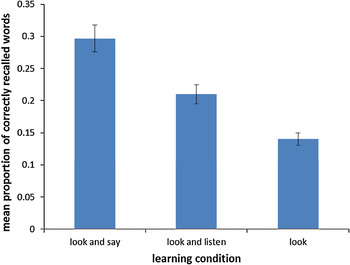
Figure 2 gives the results of the free recall test. Plotted is the proportion of correctly recalled words for all three learning conditions: ‘look’, ‘look and listen’, and ‘look and say’. Statistical analysis supports the conclusions based on the visual inspection of Figure 2. A repeated-measures ANOVA with learning condition (‘look’, ‘look and listen’, ‘look and say’) as a within-subjects variable revealed a significant effect (F(2,58) = 11·6, p < ·001; MSE = 1·593). The difference in memory was significant across the three learning conditions. Participants remembered words that were produced aloud (‘look and say’, M = 29%) better than words which were merely heard (‘look and listen’, M = 21%) (t(29) = –2·702, p < ·05). These words, in turn, were better remembered than words (pictures) that were merely observed (‘look’, M = 14%) (t(29) = –2·39, p = ·011). Obviously, vocally produced words (‘look and say’) had an advantage over words that were merely seen (‘look’) (t(29) = –4·34, p < ·005).
Mean proportion of correctly recalled words in the three learning conditions. The bars signify one standard error around the mean.

DISCUSSION
Analyzing the current data, it clearly demonstrates that young children did benefit from vocal production (measured by free recall), as memory performance was superior in the ‘look and say’ condition, and recall rates were twice the size compared with the ‘look’ condition. Moreover, the present experiment shows for the first time (to our knowledge) a PE in a free recall task using pictorial stimuli (see also Fawcett et al., Reference Fawcett, Quinlan and Taylor2012; Richler et al., Reference Richler, Palmeri and Gauthier2013). These results extend the PE paradigm (from adults to children, from written words to pictures), and suggest new ways in which vocal production may be used in laboratory as well as clinical settings.
Our pattern of results is consistent with the distinctiveness account of the PE, suggesting that saying words aloud enhances the distinctiveness of the aloud items relative to the other silent items. The greater the distinctiveness of a specific item, the better the memory for that item. As we expected, we found a gradient in recall rates between the three learning conditions. This gradient was in perfect harmony with the number of distinct encoding processes that were involved in each of the learning conditions. In the first learning condition, ‘look’, only a single encoding process (visual) was involved. Note that this process in not an active one, but holds a receptive quality. Consequently, memory performance was lowest in this condition. In the ‘look and listen’ condition, two encoding processes were involved – visual and auditory (yet both are not active). The presence of a pair of distinct encoding processes yielded better memory than was obtained in the ‘look’ condition. These results coincide with those of Weismer and Murray-Branch (Reference Weismer and Murray-Branch1989), who demonstrated that multiple auditory presentations of words (modelling) are an effective language intervention method for some individuals with specific language impairment. Yet the best recall was evident in the ‘look and say’ condition that involved three encoding processes, one of which was an active one – visual, auditory, and motor (articulatory). The greater amount of distinct encoding processes along with an active operation resulted in the best memory.
Gender effects
Our findings revealed equal memory performance across gender. This result is in agreement with Lowe et al. (Reference Lowe, Mayfield and Reynolds2003), who evaluated gender differences among children and adolescents on different measures of short-term memory. The overall results (the general memory factor and four specific memory factors) were highly similar for boys and girls.
To recap, the PE appears to be a useful learning strategy even for young children. In fact it is difficult to imagine a simpler technique for improving memory. The advantage of vocal production may seem familiar, predictable, and not surprising. Indeed, saying words aloud is a common mnemonic in adults. Yet the current study is the first to provide empirical evidence for such advantage for preschool children, suggesting the PE as a mnemonic device. In order to offer the PE as a clinical and educational tool, it is important to further explore it using unfamiliar (novel) vocabulary. Does vocal production of novel words improve their acquisition (relative to non-produced words)? Answering this question was the goal of Experiment 2.
EXPERIMENT 2
Suggesting the PE as an effective and valid learning method, we had to demonstrate its occurrence with the acquisition of new words. Hence the main difference between Experiment 2 and Experiment 1 was the use of novel, unfamiliar words (pictures of rare objects) in the study (see Figure 3). The participants learned thirty rare study words by one of two learning conditions: (a) ‘look and listen’, and (b) ‘look and say’, 15 words in each condition, randomly intermixed. We excluded the ‘look’ condition because viewing an unfamiliar object (picture) without knowing its name is rather meaningless.
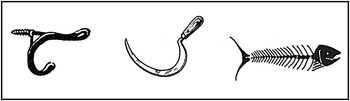
Pictures of rare objects that were presented in the study phase of Experiment 2 (in the study these were presented in colour).

Evaluating new vocabulary learning is best done by associating an object to its name, thus the presentation of novel words imposed a different memory test, that of recognition (instead of free recall). Again, we expected to find a memory advantage for words learned under the ‘look and say’ condition over the ‘look and listen’ condition, according of the logic of the distinctiveness encoding account.
METHOD
Participants
A group of 30 five-year-olds (± 3 months), 13 boys (mean age: 5·1) and 17 girls (mean age: 5) from the same source as in Experiment 1 participated in this experiment. Inclusion criteria were identical to those of Experiment 1.
Apparatus and stimuli
A list of 100 Hebrew words, all bisyllabic nouns of low frequency (Frost & Plaut, Reference Frost and Plaut2005), was given to six experienced speech-language pathologists (SLPs). They were asked to rate the likelihood that a given word appears in the expressive lexicon of five-year-olds (0 – not likely, 3 – very likely). According to this preliminary judgement, we chose sixty rare words, to which there was high agreement (inter-rater reliability: at least four of the six SLPs rated them as ‘0’), e.g. ‘anchor’, ‘manger’, ‘cuff’, ‘pestle’. Next, we chose an appropriate coloured picture for each of the sixty words. These pictures of the sixty rare objects served as stimuli (see Figure 3).
From this pool, thirty pictures were selected for study (a different sample for each participant), and the remaining thirty pictures were used as distractors in a memory recognition test. The thirty study pictures were randomly divided into two subsets of fifteen pictures (a different allocation for each participant), defined by the learning condition: ‘look and listen’ or ‘look and say’.
During the study, each picture was presented singly for view under the control of Direct RT program. The pictures were about 25 cm2, and they appeared at the centre of a 15-inch colour monitor (Compaq laptop computer) against a white background. On each trial, a small icon (4 cm2) appeared approximately 5 cm above the picture. The icon was a small image of an ear or of a mouth. The icon indicated the appropriate mode of learning (production) for that word: the mouth indicated the ‘look and say’ condition, in which the experimenter said the word aloud once, and the participant vocally repeated it. The ear indicated the ‘look and listen’ condition, in which the experimenter said the word aloud twice. We chose this procedure in order to obtain an equal number of exposures of the study words across learning conditions (i.e. each study word was heard twice, either only by the experimenter or by both the experimenter and the participant).
Design
Study
The thirty study words were randomly divided into two subsets defined by the requested mode of learning. One subset was learned by listening (‘look and listen’), in which the experimenter said the word aloud twice. The other subset was learned by vocal production (‘look and say’), in which the experimenter said the words aloud once, followed by the participant who repeated it once. Again, this methodology allowed an even number of exposures (repetitions) of each study word (as each study word was heard twice).
Filler
This phase was identical to that of Experiment 1.
Memory – recognition
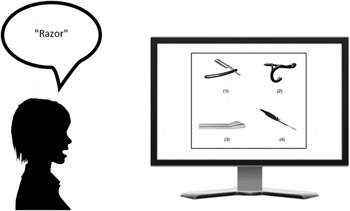
Due to the fact that the participants learned unfamiliar rare words, using a free recall test (that we used in Experiment 1) may not be accurate. Possibly, the participants may recall a study word without correctly relating it to the appropriate object (picture). This may indicate good (phonological) memory, but poor vocabulary learning. Thus, we used a four-alternative forced-choice recognition test. The participants were presented with thirty picture slides (using a Compaq laptop computer, under the control of the Direct RT program). On each slide there were four different pictures – the target word from study and another three distractors. The first distractor was another study word that was learned by the same learning condition as the target word (SL). The second distractor was a different study word that was learned by the other learning condition than the target word (DL). The last distractor was a different word that was not presented at study (new word, N) (see Figure 4). The order of the slides and the arrangement of the pictures were different for each participant.
An example of a test slide, presenting four pictures: the target word (1), and the three distractors – another study word that was learned by the same learning condition as the target word (2), a different study word that was learned by the other learning condition than the target word (3), and a new word that was not presented at study (4). The experimenter, saying the target word, is depicted in the left-hand part of the figure.

At test, the experimenter sat next to the participant, both viewing the computer screen. The experimenter controlled the slide presentation by pressing the spacebar. As a slide appeared, the experimenter said the target word aloud once, and the participant had to point at the appropriate picture. The experimenter marked the participants’ responses on a designated form. Following this, the next slide appeared. There was no time limit for this task (it took approximately 3–4 minutes).
Procedure
Participants were individually tested in their homes or at their daycare centre, in a quiet room. Each participant was seated at a distance of 60 cm from the centre of the screen, next to the experimenter. The participant was told that the goal was to learn some new words via the mode signalled by the icon (ear, mouth) and that a test of memory (‘memory competition’) would follow the presentation of the pictures.
Following a short practice phase (of four trials, a pair of words for each learning condition), the experiment began. Each study picture was presented for 3 s followed by a 1 s blank screen. During presentation, a small icon appeared above the picture, indicating the learning mode: an ear indicated ‘look and listen’ (the experimenter said the word aloud twice), a mouth indicated ‘look and say’ (the experimenter said the word aloud once, and the participant repeat it once).
After the presentation of the thirty pictures, the participants performed a short filler task. A four-alternative recognition test followed, performed by the participant pointing out the appropriate picture (the 30 study words) on the computer screen, without emphasis on speed (which was not recorded).
RESULTS
Figure 5 gives the results of the recognition test. Plotted is the proportion of correctly recognized words (hits) for the two learning conditions: ‘look and listen’ and ‘look and say’. Note that we used a four-alternative forced choice test, resulting in a chance level of 25% (by guessing correctly).
Mean proportion of correctly recognized words in the two learning conditions. The bars signify one standard error around the mean.

Comparing the left-hand part of Figure 5 (‘look and say’) to its right-hand part (‘look and listen’) reveals the superiority of the former (M = 54·2% and 40·4%, respectively). A paired sample t-test supports this conclusion (t(29) = 3.21, p < ·005). Also, two separate one-sample t-tests for both learning conditions yielded significant results (ps < ·0001), indicating that the performance in both learning conditions was well above the chance level (25%). No gender differences were found (Fs < 1).
In order to analyze the error pattern (words incorrectly recognized), we calculated error rates for the various response classifications (type of distractors): same learning condition (SL), different learning condition (DL), and new words (N), separately for ‘look and listen’ and ‘look and say’ target words. The results of the error analysis showed that most of the errors (78%) were of SL and DL types (words that were previously studied), which did not significantly differ (F < 1). Only a smaller portion of errors (22%) was N words (which did not appear at study).
DISCUSSION
The results of the present experiment support these of Experiment 1, and extend them. First, it appears that preschool children better remember produced items than non-produced items (a PE), as the recognition rates were higher for the ‘look and say’ words relative to the ‘look and listen’ words. Second, the PE was again observed using pictorial stimuli (Fawcett et al., Reference Fawcett, Quinlan and Taylor2012; Richler et al., Reference Richler, Palmeri and Gauthier2013). Finally, the innovative finding of the present experiment is that the PE occurs with new, unfamiliar vocabulary. Accordingly, vocal production can be considered a beneficial learning tool for vocabulary acquisition. We will address possible implications of the PE within clinical settings in the next section.
The recognition test results are in agreement with the encoding distinctiveness account. Saying words aloud make them more distinct, hence better recognized. This higher distinctiveness results in produced words likely to be successfully associated with an object (picture). In contrast, words that were merely heard by the participants were less distinctive, thus poorly recognized.
GENERAL DISCUSSION
The main goal of the present study was to determine whether vocal production can benefit memory in young children using pictures as stimuli. We also examined whether the PE occurs for novel words (unfamiliar vocabulary), thus offering this simple technique as a mnemonic for preschoolers. In order to answer our research questions, we performed a pair of experiments, evaluating preschool children's memory with pictures of familiar objects (Experiment 1) and rare objects (Experiment 2). We reported several interesting results, which will be discussed in detail next.
PE in preschool children
First and foremost, we showed a reliable PE in preschool children. In other words, vocal production of words (familiar as well as new) improves their memory relative to other types of learning (e.g. listening to a word) among this population. Second, the PE was successfully obtained for pictures of objects. Thus, pictorial stimuli can be used within the PE paradigm, just as written words (MacLeod et al., Reference MacLeod, Gopie, Hourihan, Neary and Ozubko2010) or auditorily presented words (Mama & Icht, in press). These findings extend the boundaries of the PE phenomenon.
As children's ability to remember verbal information increases across the school-age years through adulthood (Alloway, Gathercole & Pickering, Reference Alloway, Gathercole and Pickering2006) we expected somewhat lower recall and recognition rates than those found in adults. Interestingly, memory performance (recall and recognition rates) was comparable with those reported in other PE studies that involved adult participants (Castel, Rhodes & Friedman, Reference Castel, Rhodes and Friedman2013; Icht, Mama & Algom, Reference Icht, Mama and Algom2014; Lin & MacLeod, Reference Lin and MacLeod2012). A possible explanation may arise from the fact that pictures directly represent features of objects and, as such, meaning can be gained from pictorial stimuli even if one has little experience with the objects depicted, such as in the case of children (Hochberg & Brooks, Reference Hochberg and Brooks1962).
Alternatively, consider an interesting aspect of the PE, the fact that it is self-performed. This characteristic has been addressed by MacLeod (Reference MacLeod2011), demonstrating that the PE was larger when the production was self-performed relative to situations in which another person (an experimenter, or another participant) did the production. Apparently, one pays more attention to one's own productions than to the productions of others (MacDonald & MacLeod, Reference MacDonald and MacLeod1998). As young children are especially self-focused, strongly influenced by their own experience (Sameroff & Fiese, Reference Sameroff, Fiese, Shonkoff and Meisels2000), the PE, a highly self-referential process, may offer a substantial benefit to this population. A child's own actions are more direct and more distinctive, and hence more memorable (due to their uniqueness). In this respect, further investigation of the PE in children is invited.
Offering the PE as a mnemonic
Finally, and most important, Experiment 2 showed that the PE occurs with novel, unfamiliar words. This finding supports the possibility of using the PE paradigm as a clinical or pedagogical tool for memory improvement.
Many types of mnemonic device can be found in the literature; all make the portions of information to be learned more meaningful and facilitate retention (Bourne, Dominowski, Loftus & Healy, Reference Bourne, Dominowski, Loftus and Healy1986). Yet they are based on high cognitive and verbal abilities to create relations that pair up unrelated components. Many mnemonic devices rely on alphabet or number knowledge. Thus these mnemonics may be too complicated for young children. In fact, although the effectiveness of mnemonic devices with regard to learning is well established in various populations of students and adults (see Conroy & Collins, Reference Conroy and Collins2012, for a review; Uberti et al., Reference Uberti, Scruggs and Mastropieri2003), hitherto only limited research was conducted among preschoolers.
Clearly, in order to improve children's memory, less complicated memorizing tools are required. For example, children's spontaneous imitation of new vocabulary has been associated with subsequent learning in both typically developed (Leonard, Schwartz, Folger, Newhoff & Wilcox, Reference Leonard, Schwartz, Folger, Newhoff and Wilcox1979) and language-impaired children (Schwartz & Leonard, Reference Schwartz and Leonard1985). Camarata, Nelson, and Camarata (Reference Camarata, Nelson and Camarata1994) also reported that asking children to imitate (elicited or evoked production) can be used effectively in language intervention. Because vocal production is very simple to execute mnemonically, and because young children tend to have more difficulty generating other mnemonic strategies, the PE seems like a preferred memory strategy.
Note that the type (category) of mnemonic device used is typically determined by the information being taught. Some information can easily be learned with multiple mnemonic strategies. The PE holds an advantage in this respect as well, as it has been found to enhance memory for a variety of stimuli (words, nonwords, and more complex material such as sentences and paragraphs), and for different time intervals (Ozubko, Hourihan & MacLeod, Reference Ozubko, Hourihan and MacLeod2012). Recently, Putnam, Ozubko, MacLeod, and Roediger (Reference Putnam, Ozubko, MacLeod and Roediger2014) extended the PE to paired-associate learning, indicating that production enhances associative information in addition to enhancing item information. Altogether, this evidence supports the advantage of vocal production in memory enhancement in young children.
Clinical implications
The PE methodology can be easily used in educational contexts, as well as in the speech and language pathology clinic, especially as a vocabulary instruction technique, for both first and second language learning. For example, consider the context of storybook reading. Story reading aloud is considered a pleasurable experience, natural and highly beneficial in developing young children's language and literacy skills (Morrow, O'Connor & Smith, Reference Morrow, O'Connor and Smith1990). Many studies that investigated shared book experiences in school environments have pointed to their use as an instructional strategy in the classroom (Flood, Reference Flood1977; Heath, Reference Heath1980; Morrow, Reference Morrow1987, Reference Morrow1988; Ninio & Bruner, Reference Ninio and Bruner1978; Roser & Martinez, Reference Roser and Martinez1985).
Story-reading helps in the development of a sense of story structures (story schema awareness), and as a means for enhancing comprehension (improving children's understanding of narratives) (Bowman, Reference Bowman1981; Gordon & Braun, Reference Gordon, Braun, Niles and Harris1982; Morrow, Reference Morrow1985; Spiegel & Whaley, Reference Spiegel and Whaley1980). Asking the listener to produce (repeat) specific target words from the story is in fact a PE manipulation. A child that may have difficulties in retelling a full story can successfully repeat chosen target words, enhancing their memory on the backdrop of the remaining unproduced words. This simple manipulation may improve memory for these words, and consequently his or her expressive vocabulary. In fact, Ozubko and associates, who presented their participants with a short article to be remembered, have demonstrated a comparable manipulation benefit. Their participants read half of the paragraphs in an article aloud and half silently. In a latter fill-in-the-blanks test there was an advantage for information read aloud relative to information read silently (Ozubko, Hourihan & MacLeod, Reference Ozubko, Hourihan and MacLeod2012, Experiment 3).
Limitations and caveats
This study served as a first step in exploring the PE as a clinical memory tool for preschool children. Our methodology was imposed by few constraints. First, we were interested in preschool children's memory and learning, as such children represent a significant portion of the patient population in the speech and language pathology clinics. But, as young children cannot read, we had to depart from the routine usage of written words as stimuli, to using pictures of objects. Another point we had to attend to is the relation between a person's articulation abilities and speech rate and his or her verbal short-term memory spans (Baddeley et al., Reference Baddeley, Thomson and Buchanan1975; Schweickert & Boruff, Reference Schweickert and Boruff1986). In fact, rehearsal is considered quantitatively more efficient as individuals’ articulation rates increase (Hulme, Thomson, Muir & Lawrence, Reference Hulme, Thomson, Muir and Lawrence1984). Therefore, we had to choose an age group in which the articulatory mechanisms were well developed, and the main structures of the phonological system had already been acquired (Bat-El, Reference Bat-El2009). Five-year-old children seem appropriate in both respects.
Offering vocalization as a mnemonic technique for preschoolers, it is important to note an important distinction. On the one hand, the PE methodology involves only shallow processing and is a type of association learning and recall (in fact, these were probed in the current experiments). On the other hand, lexical (and semantic) acquisition (word learning) involves a deeper semantic processing of target words. Although these are different forms and levels of learning, the PE might be useful in helping to cement memory for new vocabulary, and it can be used within contexts which do allow for deeper semantic learning (e.g. storybook reading). In addition, vocalization can be successfully used within second language learning, mainly at the early stages of language acquisition. In a related review, Nielsen (Reference Nielsen2002) stated that: “Greater amounts of decontextualized vocabulary instruction should be given to beginner-level learners, gradually increasing toward more context-based vocabulary learning as their language ability develops” (p. 6).
Past research has shown that the PE is a robust memory phenomenon in adults, occurring under many different encoding conditions, and with a variety of stimuli (nonwords: MacLeod et al., Reference MacLeod, Gopie, Hourihan, Neary and Ozubko2010; word pairs and sentences: Ozubko, Hourihan & MacLeod, Reference Ozubko, Hourihan and MacLeod2012). Yet it is not fully clear whether the PE is due to increased memory for items read aloud. Instead, it is possible that the benefit of production in mixed lists is due to a memory decrement for silent items. In fact, Bodner, Taikh, and Fawcett (Reference Bodner, Taikh and Fawcett2014) demonstrated that the PE is the result of both a decreased memory to silent items (cost) along with memory enhancement for aloud items (benefit) in mixed lists relative to pure lists, with recognition tests of memory. Clearly, there is a need to further examine this issue, especially in children. If it does indeed turn out that the PE occurs only with mixed lists, it carries practical implications. Specifically, using this methodology in clinical or educational settings requires a mixed list context, in which the target words are to be produced (vocalized) while the remaining words are not to be produced, but merely read silently or heard (such as storybook reading). Again, note that this has not been tested on children yet.
Nevertheless, although PE is typically obtained when the manipulation is within-subject (mixed lists design), there is evidence for a between-subject PE (using pure lists) in adults (Conway & Gathercole, Reference Conway and Gathercole1987; Fawcett, Reference Fawcett2013; Gathercole & Conway, Reference Gathercole and Conway1988; Hopkins & Edwards, Reference Hopkins and Edwards1972). This finding is suggestive, but still needs to be established with children. Altogether, the idea of cost and benefit in the PE, hence the practical use of this manipulation, needs to be tested in future work.
Further research is also needed in order to directly compare the effectiveness of the PE with other mnemonic devices appropriate for preschoolers. Moreover, it is important to compare the efficiency of the PE relative to other mnemonic techniques in older children who can engage these strategies. The current study was conducted under controlled testing conditions rather than classroom conditions. Elaborating testing settings may be revealing. Further research is invited in order to generalize vocalization as a useful mnemonic in special populations (verbal encoding skills of rehearsal and clustering were found to be deficient in disabled children; Bauer, Reference Bauer1979).