In 2012, while living on the Indonesian island of Java, I drove with a friend from Yogyakarta to Semarang to watch the late Ki Slamet Gundono (1966–2014) perform one of his famous adaptations of wayang kulit, the most renowned form of Javanese puppet theatre.Footnote 2 Gundono was surprised to see us. He apologized for having us ride four hours on a motorbike since there wouldn't be any puppets involved in that evening's musical performance. ‘But don't worry,’ he said, ‘I’ll improvise something for you.’ So, in the middle of the music performance he grabbed a piece of wood and turned it, by virtue of staccato movements, into a wayang puppet. The short performance combined humour and philosophical speculation in a candid response to our unexpected arrival. Why was this short performance so compelling? Answering this question invites a broader overview of his work, since this impromptu performance demonstrates key elements of Gundono's theatre: his performances responded to topical events but they were firmly grounded in the wayang puppetry tradition and used everyday objects in innovative ways. His career is full of examples of a constant preoccupation with tradition and a desire to innovate within it.
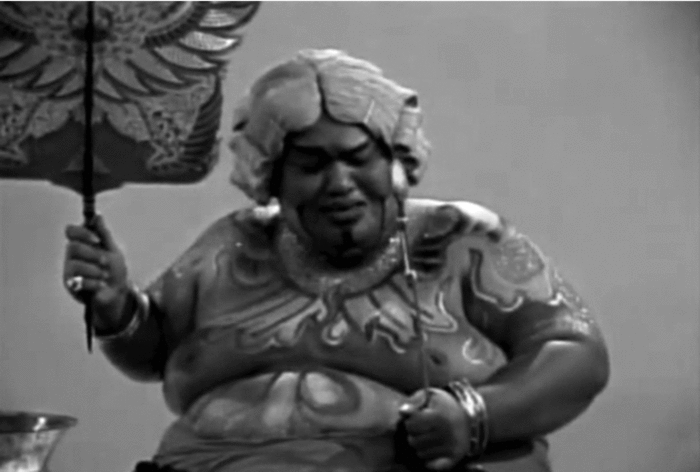
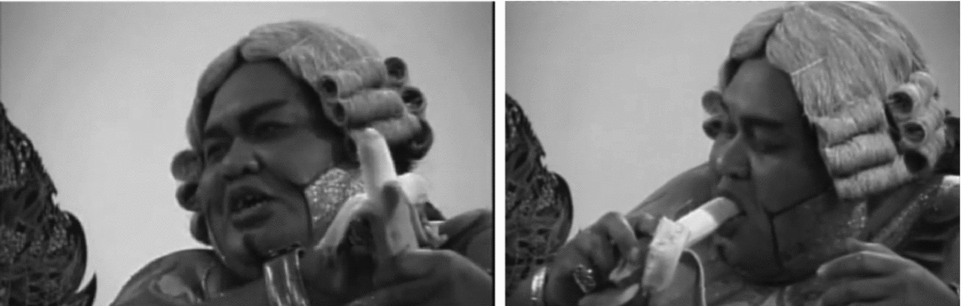
Gundono came from a family of puppeteers from Tegal, in West Java, and was well versed in the art of manipulating carefully carved leather puppets within the constraints of the wayang kulit tradition. In a conventional show, a single puppeteer (the dalang) controls and gives voice to the puppets in all-night performances. Gundono also collaborated extensively with theatre artists, most notably with celebrated choreographer Sardono Kusumo, the members of the theatre collective Teater Garasi, and performance artist Agus Nur Amal. All of these artists have produced interdisciplinary work that combines traditional aesthetics and contemporary experimentation. These collaborations proved influential to Gundono, who was also a versatile theatre performer and a renowned musical composer and interpreter. In the later years of his career, Gundono worked primarily with dried grass, ice, mud and household items. But this exploration began in the 1990s with the integration of puppets made of grass – wayang suket – into his shows. This was not his invention; wayang puppets made of grass are part of village traditions, although their exact origin is not well documented. Nonetheless, as Ganug Nugroho mentions in an article in the Jakarta Post, ‘Slamet is the one who has elevated the straw puppet status to a performing art’, bringing a new sensitivity to the use of grass.Footnote 3 Nugroho continues, ‘Wayang suket allows full freedom for the audience to build on their unlimited imagination. The philosophy of grass as an ever-growing plant needing only water and sunlight represents the spirit of an art that generates pride and strength of imagination’.Footnote 4 As Nugroho notes, Gundono's use of grass can be interpreted in philosophical terms, an observation that can be extended to other everyday materials and household objects. Often Gundono's usage of these objects deliberately transgressed the pakem – the canon of conventional wayang. As an example, we can consider the way he used his body in performance. Wayang kulit is usually described as ‘shadow theatre’, although most people watch the show from the side of the dalang, who faces the screen and has his back to the audience. In contrast, Gundono often faced the audience directly and appeared bare-chested, with his body painted or clad in unconventional outfits. Another example of the ways Gundono transgressed wayang norms is the choice of materials for his puppets. Conventionally, puppets are made of buffalo hide – the word kulit itself means ‘leather’. Gundono used alternative objects, exploring the limits of material performances by creating, destroying and even ingesting the puppets during the course of a performance. In Pertaruhan Drupadi (Drupadi at Stake), for example, he used a banana to represent Drupadi. In order to represent Dursasana's fantasy of possessing Drupadi, he peeled the banana and ate it (Fig. 1).Footnote 5
Slamet Gundono portrays Dursasana, undressing and eating Drupadi, represented by a banana. Still from the recording of Pertaruhan Drupadi. © Contemporary Wayang Archive.
In this respect, Gundono's innovations raise fundamental questions about the relation between puppet and puppeteer that have also been explored in other contexts. For Margaret Williams, the ingestion of a puppet is something of a litmus test for contemporary puppetry:
‘Puppeteer swallows puppet’ would seem to epitomize – depending on how you look at it – either the raison d’être or the reductio ad absurdum of contemporary Western puppetry. It encapsulates the collapsed boundaries between the living and the inanimate that are characteristic of today's puppet stage, where the human performer and inanimate matter are often presented side by side as a composite stage subject . . .Footnote 6
These collapsed boundaries are central to the Western discourse on postmodern puppetry. Indeed, it would seem that Slamet Gundono's material performance had much in common with the work of the European puppeteer Gyula Molnár, who Williams has in mind in her analysis. Williams suggests that postdramatic material performances often take the form of ‘post-puppet puppetry’:
The progression (or regression, some would say) of puppetry . . . might seem to parallel the change from the dramatic theatre to the postdramatic and even to the post-anthropomorphic – from the puppet as a character within its own narrative to a continuous present of interchangeable physical realities, both animate and inanimate, and even to a theatre of interacting material shapes and images with no human reference at all.Footnote 7
In terms of its aesthetics, Gundono's theatre has much in common with the postdramatic theatre performances often seen in advanced industrialized societies, particularly, though not exclusively, in the West. However, Gundono's work also draws heavily on Javanese cultural references. In this sense, Gundono's performances are instances not just of post-puppetry but also, as Matthew Cohen has observed, of post-traditional puppetry in Java.Footnote 8 Gundono's performances are part of the world of wayang kontemporer (contemporary wayang), re-elaborations of the form that challenge the political, philosophical and aesthetic traditions within wayang.Footnote 9
These challenges are still undertaken within the framework of traditional wayang. Many aspects of the tradition are discernible in Gundono's work: his own participation in the performances, as well as his usage of stories and music, conform to wayang convention. For example, in most of his performances, Gundono remained the dalang or puppeteer, the person conventionally responsible for controlling all the puppets, directing the musical ensemble and speaking all the character parts. All of Gundono's performances described in this article were collaborative projects, where he worked with actors, dancers, musicians and writers. But in all cases Gundono was still the central storyteller, controlling the musical accompaniment and speaking most character parts. Likewise, most of the stories come from the traditional narrative cycles of the Mahabharata and the Ramayana, which are used in traditional wayang. Though much of the music he used was of his own devising, Gundono constantly included gamelan instruments, which are also ubiquitous in traditional wayang.
A combination of conventions and new techniques can also be seen in Gundono's use of puppets. Sometimes he used traditional wayang puppets, but strapped other objects (such as condoms) onto them. He also shaped materials such as mud into figures that are reminiscent of the traditional wayang puppet shapes. In other instances, he moved found objects such as cooking utensils according to the rhythmic patterns that denote speech in wayang kulit. In all cases, there is a discernible connection between the objects used and the issues addressed by the performances. The performance that used cooking utensils questioned gendered identities, the performance that used condoms (a controversial object in Indonesia) spoke about challenges to social norms, and the performance that used mud puppets raised environmental concerns. This brings us to two crucial questions: how exactly were everyday objects and materials used in his performance, and to what end?
Academic discourse on material performance offers a partial answer to these questions. As Dassia Posner notes, the objects in material performances ‘bear visual and kinetic meanings that operate independently of whatever meanings we may inscribe upon them in performance’.Footnote 10 This is certainly true for the spoons, the condoms and the mud. But the visual and kinetic aspects are only half the story. All of these objects are part of everyday life in Java and their presence in a performance triggers culturally specific associations. In order to analyse the relationship between these objects and the wider Javanese world, I will treat these objects as a special kind of pusaka, or heirloom.
In Java, objects such as musical instruments, keris (daggers), or personal items that once belonged to famous historical figures are often thought of as pusaka, heirlooms that, as the anthropologist Christina Kreps puts it, ‘are considered sacred and richly endowed with spiritual powers’.Footnote 11 Puppets are sometimes also considered in this category, and, even when they are not expressly referred to as pusaka, they are still accorded special care and attention. They cannot be placed on the floor and they are often given special offerings before each performance. An extreme version of the respect paid to puppets can be seen in the village of Pagung in the Eastern Javanese district of Kediri, where special puppets have their own house and ‘sleep’ in beds.Footnote 12
In contrast, Gundono used everyday objects that have no specific ritual action associated with them. He handled them with extreme respect but did not treat them as part of a sacred or spiritual heirloom. His objects were non-spiritual pusaka that shifted attention away from the spiritual quests that dominate traditional wayang. Gundono used everyday objects to focus on the more mundane, though more urgent, questions of gender inequality, religious intolerance and environmental destruction.
In what follows, I analyse segments from three of his performances, exploring how his focus on everyday objects became a strategy to construct unconventional narratives. Between 2008 and 2014 I saw Gundono perform on numerous occasions. I collected and translated several recordings of his work for the Contemporary Wayang Archive (CWA), an online collection of wayang video recordings supported by the National University of Singapore.Footnote 13 These recordings, as well as multiple conversations I had with Gundono, inform the reflections that follow.
The performances analysed here are presented in chronological sequence and they represent a continuous exploration towards more elemental puppets, from modified objects (spoons turned into puppets or puppets strapped with condoms) to transient puppets made of mud.
Pertaruhan Drupadi: the perspective of women
The first example of Gundono's usage of everyday objects is a performance where puppets made with cooking utensils were used to examine a classical wayang story from the perspective of a female character. Because of this emphasis on a traditionally silent female character, Gundono's Pertaruhan Drupadi (2007) constitutes a special case in wayang. This performance tells the story of Puntadewa's bet, one of the most famous episodes in the Mahabharata. In this part of the story, Puntadewa gambles away his kingdom, his wife Drupadi and even the freedom of himself and his brothers.Footnote 14 Most retellings of this story in wayang focus on Puntadewa's mistakes and his struggle to win back the things he has gambled away. Drupadi is conventionally silent. However, Gundono's version concentrates entirely on Drupadi's point of view (Fig. 2). For example:
Slamet Gundono holds a kayon (conventional wayang kulit puppet) in his right hand and a spoon, representing Drupadi, in his left. Still from the recording of Pertaruhan Drupadi. © Contemporary Wayang Archive.

DALANG: Drupadi cried inconsolably.
DRUPADI: Why did you gamble me away me without telling me, Puntadewa? Where have I failed you? In the mornings, I heat up the water before you awake. I cook the food and clean the bed . . . Then why would you put me up as a stake? You are arrogant, Puntadewa. You are only interested in money.
DALANG: Drupadi cried.
DRUPADI: Please Puntadewa, I am angry with you, really, I am angry. Bastard!Footnote 15
The cooking utensils used to portray the puppets and the domestic references in the dialogue highlight a dimension of everyday experience that is associated with women and often neglected in Javanese public life. Women, who still do most of the cooking, are often hidden from sight. The choice of materials, as well as Drupadi's accusations, emphasize the importance of the domestic realm. Wayang stories are mostly concerned with the spiritual quests and battles of the male protagonists and rarely refer to more familiar realms, such as the one presented here. The spoons (and other cooking utensils, such as sieves) work as modified heirlooms of the everyday because they bring these conventionally overlooked aspects into the performance. It is difficult to see this clearly in the image, but the spoon is attached to a wooden stick. Most wayang puppets are manipulated through control sticks that are attached to the body of the puppet. Puppets such as the kayon (the ‘tree of life’, which Gundono holds in his right hand) only have one of those sticks, but others have up to three. The central stick, called a gapit, allows the puppeteer to control the puppet but also to insert the puppet into the banana trunk, which acts as the ‘stage’ for the characters in use. The banana trunk is an integral part of the stage apparatus in wayang kulit.Footnote 16 During the court scenes, the gapit of each puppet is inserted into the trunk to hold them in static poses. The puppets are also placed in this way for longer conversations or when they prepare themselves for battle. In Pertaruhan Drupadi, the trunk serves a slightly different purpose as it remains in the background. Nevertheless, the spoon in Gundono's hand is also attached to a gapit that enables both functions: the dalang uses it to control the spoon-puppet and to insert it into the banana trunk. Gundono speaks all the character parts in the excerpt above. But the parts spoken by Drupadi are indicated by the motions of the spoon. In a conventional show, the dalang shakes the puppet slightly to emphasize speech. Thus a slightly modified spoon corresponds to a slightly modified version of the story, emphasizing both the everyday realm and the plight of an often neglected female character.
Someone reading the above dialogue from a feminist perspective would probably not be convinced by the performance's dabbling with emancipatory gender politics. After all, Gundono is not questioning assigned gender roles or assumptions about women. Women are still associated with the house, rearing children and taking care of their husbands. Furthermore, Drupadi's problem is not the inherent violence or inequalities of a gendered identity, but rather that she is denied proper recognition for tasks she has successfully completed. However, I would suggest that in the conservative world of traditional wayang, Gundono's attitude is a meaningful attempt to highlight rarely discussed issues. Furthermore, the conclusion of the performance aims at opening up the question of women's participation in society, rather than giving definitive answers. In a plot twist that takes the performance away from the traditional storyline – where Drupadi would just endure her humiliation while her husband Puntadewa and the rest of the Pandawa brothers strive for a solution – Drupadi steps out of the gambling hall and embarks on a journey around the world to try to defend her honor. This quest, which includes a meeting with then-president of the US, George Bush, is a departure from – and challenge to – the way a story should traditionally be presented (the pakem or canon). Both changes of emphasis – in material as much as subject matter – help Gundono engage in a different way of doing wayang: speaking about women's lives in Java through the pusaka of the everyday. The performance ends with a self-reflexive segment. Drupadi, exhausted after her ineffective quest, begs the dalang to change the story:
DRUPADI: I will be raped by the Kurawa. Please change the story, Pak Dalang Slamet.Footnote 17 Please change the story!
DALANG: I cannot change that. People the world over will be angry with me. This is part of the wayang rules. You should just leave the world of wayang and look for a lifestyle that befits you. You will finally be able to determine your own fate. You will not depend on the dalang, you will not depend on the people in power, or on your husband. Go away! Search for by-ways and back routes. It is time for women not to have to depend on anyone.
DRUPADI: All right, Pak Slamet. I will go and look for that.
DALANG: I remember my mother and her disappointment. Could happiness arrive and pain be left behind? . . . [Singing] Sometimes I wish to ask. What are humans in the world for? Is it only for pain? Drupadi, don't give up. When you are suffering like that, you remind me of my mother in the past. She looked after her children every day. Her twelve children were given food: tempe, tahu and sambal.Footnote 18 And the kids were sent away to attend university and get degrees, so that they could escape suffering. My mother didn't ask for anything in return; she really did not ask for anything. She was just proud of her children's success. Sometimes misunderstandings happen. Many children forget their mothers and fathers. Drupadi, don't despair! Look at all the women in the villages, in the town and in the city suburbs. There are many strong and amazing women who did not kill themselves. They did not despair, but faced life. Go there! It is time that you don't depend on any man. And time for men not to depend on women.
In this scene the worlds of the story, the self-reflexivity of the dalang's comments and his reference to his family are intertwined in an ending that is open and hopeful. Gundono says he cannot provide an answer and he cannot change the story, but in saying this he is nevertheless changing the story and providing an answer. The answer is in the invitation to do things differently. This change of emphasis serves as a crack in the wall of pusaka and pakem, through which other voices can be heard and other materials can be used. This crack in voice and matter opens the road for other interpretations.Footnote 19
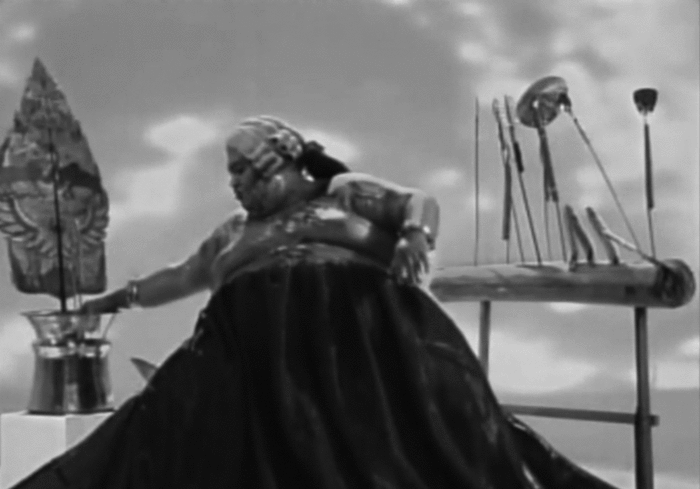
It should be noted that both the pakem and the pusaka work through the logic of combination rather than the logic of substitution. Gundono uses vegetables, spoons and sieves to represent most of the characters, but he uses them in combination with a conventional kayon (Fig. 3). The kayon is a non-figurative puppet that has many important symbolic and dramatic meanings in wayang. Pictorially, the kayon represents a person's spiritual path through the world. In a performance it can represent natural or spiritual forces, or any entity for which there is no puppet available. A special choreography of the kayon separates scenes in wayang and its angle indicates the progression of narrative time.Footnote 20
Slamet Gundono reaches out for a kayon puppet with his right hand. Still from the recording of Pertaruhan Drupadi. © Contemporary Wayang Archive.
Likewise, the puppets are still inserted into a gedebog, or banana trunk, as they would be in a traditional performance. The spatial set-up has been changed (Gundono is facing the audience and there is no screen), but the iconography of wayang is still recognizable. The puppets are also moved according to the conventional manipulation techniques (sabetan). As mentioned earlier, the spoon representing Drupadi is shaken as it speaks in order to emphasize particular words, the way a dalang would do with a puppet in an equivalent situation within a traditional show. In a similar way, the story is changed but it is still an episode from the Mahabharata, the most common source for classical wayang stories. In contrast, the next performance analysed here takes its plot from a source rarely used for wayang shows: the nineteenth-century literary work Serat Centhini. One of the reasons it is rarely performed – and even read – is that it combines spiritual speculation with detailed accounts of the sexual exploits of its main characters. This story provided the ideal starting ground for Gundono's exploration of unconventional spiritual wisdom.
Cebolang Minggat: spirituality and condoms
Cebolang Minggat (The Exile of Cebolang) was a performance by Gundono and French writer Elizabeth Inandiak, performed at the Salihara Cultural Center in South Jakarta in 2009. The performance was based on a chapter in the nineteenth-century literary work Serat Centhini, which was translated into a novel by Inandiak.Footnote 21 Both Inandiak and Gundono were performers in the show, which involved several actors and musicians. The story follows Cebolang, the son of a sheik who embarks on a journey across Java after a disagreement with his father. The young Cebolang wanders around, visiting opium dens, places of spiritual retreat, palaces and brothels. Through his interactions with a wide array of characters, he gains sexual and spiritual knowledge before eventually returning home to his parents. In the performance, Cebolang's first lesson in spiritual matters will come from watching a wayang. In the performance, this ‘wayang-within-the-play’ is presented as a conversation between two religious experts, or kyai, Partodewa and Durna. Partodewa, a young man, represents an unpretentious and syncretic approach to spirituality, whereas Durna, allied to the Kurawa (the antagonists in the Mahabharata), represents organized religion. Durna poses a riddle to the young man, who answers it with a plain and direct explanation of spirituality. Partodewa's answer mocks Durna's attitude, to the delight of Cebolang, who is watching the wayang show:
PARTODEWA: The [answers to the] four riddles you posed, Durna, are the tongue, the eye, the ear and the sense of smell. Those are the gifts of Allah. You must use them wisely to become a good kyai. You must not speak nonsense or bullshit [English in original]. Do everything as said before. If you don't act according to these four things, you will bring on God's anger and this will wreak havoc everywhere.
DALANG: And then Cebolang smiled at the wit of the young kyai. He was different from the old and emotional Durna who had become a government official. Durna was angry.
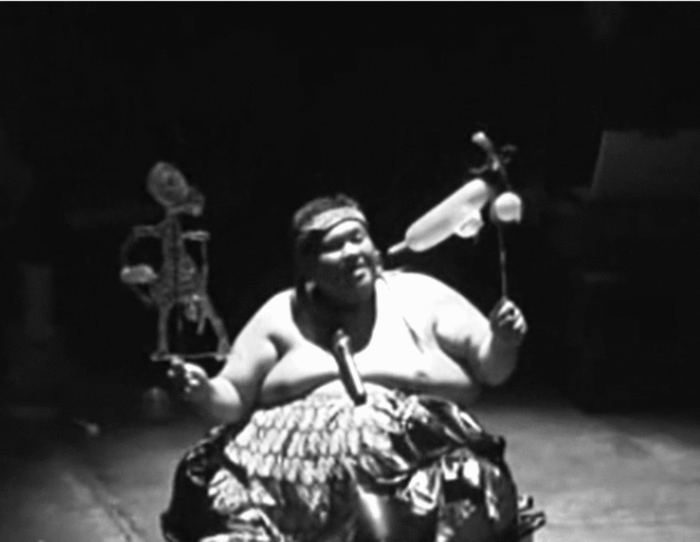
For this scene, the puppets had condoms attached to them (Fig. 4). Condoms are a focus of intense debate in Indonesia. While not officially banned, they are forcefully opposed by many religious organizations. As Sharyn Graham Davies and Linda Rae Bennett note, following public pressure from Islamist anti-condom groups during National Condom Week in July 2013, several campaign activities were shut down by the government.Footnote 22 Gundono told me that he found in the condoms an instance of everyday wisdom – in that they can prevent diseases and unwanted pregnancies – that would not be accepted by conservative religious scholars. Therefore the presence of the condoms in this scene underscores Partodewa's message: spirituality is something to be explored in a personal way. Striving for authenticity in mystic connection is more important than following empty, government-sanctioned rituals. Gundono does not refer to the condoms explicitly and they do not affect the way he manipulates the puppets; he does not explore the specific shape or the material affordances of the condoms. But their significance is not merely semiotic. He could have used depictions of condoms that would not have achieved the same goal. But it is their presence onstage that qualifies the condoms as having a specific kind of agency as an everyday pusaka.
The exchange between Durna and Partodewa. The puppets are partially made from inflated condoms. Still from the recording of Cebolang Minggat. © Contemporary Wayang Archive.
Gundono's performance used Cebolang Minggat to examine the tension between practising ‘true’ spirituality and blindly following the precepts of an older time. By using condoms in connection with this narrative, Slamet Gundono was endorsing an idiosyncratic, syncretic approach to spirituality that could be described within the framework of a Javanist approach to life and mysticism. Javanism is a syncretic spiritual attitude that combines aspects of different religions and local beliefs. Practitioners of Javanism often identify themselves as Muslims (or Christians), but there are some distinctly Javanist practices, such as a belief in a personal contact with God, and the usage of pusaka (for example a keris or dagger) for meditation.
According to Suwardi Endraswara, a wide range of erotic practices native to Java that have been suppressed by current religious discourses are still present in the literary and artistic tradition of Java, as well as in the religious tradition of Javanism.Footnote 23 A conflict between Javanism and formal religion already existed when the Serat Centhini was written in the nineteenth century, and continues today. Currently, the two main strands of Islam in Indonesia view Javanism differently. Muhammadiyah, founded by Ahmad Dahlan in 1912, advocates strict religious observance and is heavily influenced by Middle Eastern Islamist discourses. Nahdlatul Ulama (NU), on the other hand, has traditionally been closer to Javanist thinking and practices. Gundono, a follower of the latter, tacitly supports this strand in the excerpts quoted above. This strand is more amenable to unconventional religious interpretations. The passage that explores this unconventional approach most explicitly in the performance is an episode where Cebolang meets the maverick mystic Gatoloco, an old opium addict who thinks himself an enlightened preacher. This man discusses religious matters with three old kyai and then explains his philosophy of life to Cebolang:
KYAI: We heard that you eat pork whenever you want to and there is an opportunity to do so. Aren't you afraid of committing a sin?
GATOLOCO: What people say is true. I don't only eat pork, I also eat dogs. I look after them from young. I buy them when small and then take care of them, and when they are old I cut them up myself and then eat them. Pork, dog and monkey can be more halal than halal goods, which are stolen . . .Footnote 24
DALANG: When the kyai finally left the house, Cebolang approached the old addict.
CEBOLANG: I was surprised to see you discussing religion in an opium den. What is your religion, actually?
GATOLOCO: I have three religions: three rasa. Body, word and heart.Footnote 25
CEBOLANG: And what about praying?
GATOLOCO: My prayers? My breath is my prayer. Every time I breathe, I worship God. And that is how I show my respect to consciousness. Every time I breathe that is a sign of respect to God. He is the one where the three rasa take shelter and dissolve into each other.Footnote 26
It is not hard to imagine why this Cebolang Minggat excerpt would be controversial in Indonesia. It advocates that people can choose for themselves how to lead a spiritual life. The discussion about halal food states that there is no intrinsically good action: morality depends on how the action is carried out. The same thing applies to sex and other matters. The puppets strapped with condoms signal allegiance to a syncretic, idiosyncratic approach to religion that values purpose over dogma. Although Cebolang Minggat is controversial, in advocating for a combination of modern tools and conventional wisdom, Gundono follows a tradition of syncretism that has been part of Javanese arts and philosophy for centuries.
Java's cultural history has been marked by the influence of different religions. This has led to the development of different attitudes towards spirituality. Hybridization has determined the practice of Javanism and it marks the trajectory of Cebolang's travels. The condom, as used in the performance, becomes a hybrid symbol for practical wisdom and spirituality.
Wayang Tanah: using mud to speak about the Earth
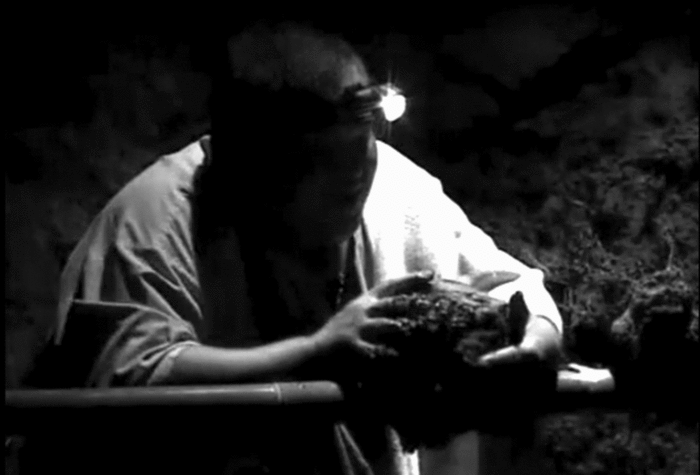
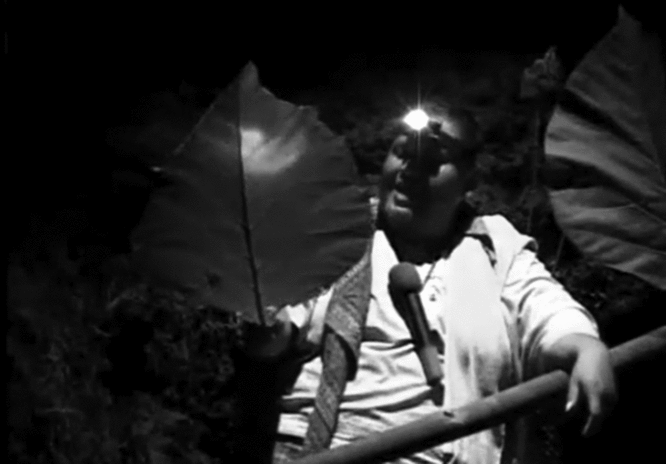
A final example corresponds to a more elemental choice in materials that addresses an increasingly urgent concern. In Wayang Tanah (Soil Wayang) (2010), Gundono used mud puppets to examine the effects of environmental destruction. For the performance, the dalang and his team dug out a trench in the ground in the village of Mojosongo, central Java. To create the puppets, the dalang just reached to the ground to grab lumps of soil and place them on a bamboo trunk that is reminiscent of a traditional gedebog (banana trunk) (Fig. 5). The leaf used by Gundono (Fig. 6) is also reminiscent of the kayon, the puppet that opens and closes the performance and indicates the progression of narrative time in traditional wayang. And the light strapped around his head is reminiscent of the blencong, the lamp used in traditional shows.Footnote 27
Puppets made of mud. Still from the recording of Wayang Tanah. © Contemporary Wayang Archive.
Leaf used as a kayon. Still from the recording of Wayang Tanah. © Contemporary Wayang Archive.
The story depicted is loosely connected to the Ramayana, and adapted to address environmental destruction. The connection between the theme and the materials (mud and leaves) is evident from the onset of the performance. However, this connection is also explicitly explored through the story. Consider, for instance, the following passage from the opening scene of the show:
DALANG: I have seen a woman with a slender waist who can give birth without any help. And she can give birth to many children. Just like a rice field, from which transparent grains are born. She can give food to all of mankind. I have seen a woman with a slender waist who would receive any man. And she would not complain at all. But at the right time, she would talk about the events of life.
After establishing the metaphor of the Earth/soil as a woman, the dalang connects this image to the rest of the narrative, which retells the story of Rahwana, the antagonist of the Ramayana.
DALANG: Tonight, I do not know whether it is fitting to talk about the soil because people don't need the soil any more, except for the farmers who plough the land. It is only my mother who cries for the soil. The soil is broken. Broken soil, fractured land. I do not know why the land is cracked like this. It is said that there was a king in Alengka. A human named Rahwana liked to dig up the soil. Rahwana always dug up holes for everything . . . Togog always reminded Rahwana: ‘Hey, Rahwana, don't just stir up the soil! Don't just force the land.’Footnote 28
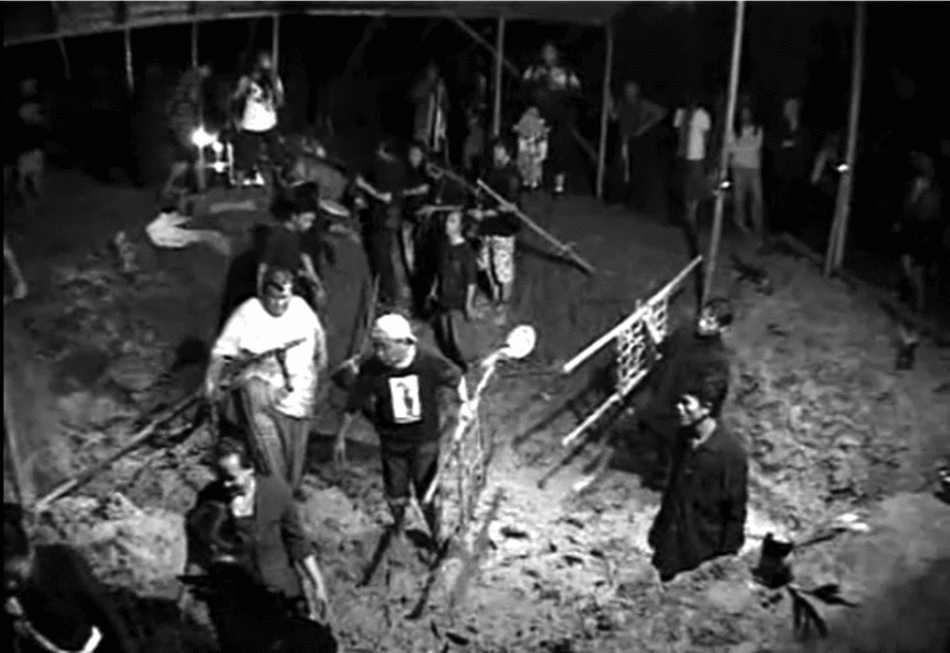
Rahwana is often characterized as a personification of the drive for destruction. In the Ramayana, he is the captor of Sita, Rama's wife. Her kidnapping sets in motion Rama's quest to release her, which constitutes the main narrative thread in the Ramayana's storyline. In Wayang Tanah, Rahwana signifies the human greed that leads to the destruction of the environment. The performance loosely follows the story of Rahwana through songs, poems, dances and dialogues that are not united by a clear progression. In terms of the narrative, this was Gundono's most experimental piece, where the different elements were united into a collage rather than a conventional storyline. However, through this patchwork of songs, dances and words, the story of Rahwana, Sita and Rama becomes an allegory of environmental capture and abuse. Towards the end of the performance, the story fades out of view and the performance becomes a ritual. Wayang Tanah was originally performed during a time of drought and the second part of the performance was merged into a ritual call for rain. The audience members were invited to participate in the ritual. They descended into the trench, followed a procession across it, paid their respects to the dalang and eventually returned to their houses while the music was still playing (Fig. 7).
The audience mingles with Slamet Gundono (in white). Still from the recording of Wayang Tanah. © Contemporary Wayang Archive.
The performance slowly dissolved into the ritual, not unlike the way the ‘puppets’ melted back into the mud throughout the performance. Both the story and the performance emerged from pre-existing material (the Ramayana epic, the soil), took momentary shapes and dissolved into the background from which they had emerged. The ‘puppets’ of Wayang Tanah are the most elemental examples of Gundono's quest for a connection between objects and themes. In this performance, there was a balance in the economy of conservation: the puppets and the space itself were eventually reintegrated into the soil. Wayang Tanah is a performance that produced no waste, an important goal for Gundono's exploration of environmental themes. Although Gundono's critique is social and political, it was not didactic. Perhaps the best way to think about the social effectiveness of this performance is to think about it as a contemporary ruwatan. A ruwatan performance is a traditional wayang performance that aims to cure or prevent an evil.Footnote 29 In this case, Gundono's contemporary sensitivity in the arrangement of the story material is put in the service of a ritual.
In this performance, Gundono stays with the materials longer than in the other plays. The stage itself is made of mud and Gundono examines the materiality of the mud through the narrative and the actions. At the end, everything returns to its former place for the performance to end. As mentioned above, even the spectators returned to their houses while the performance was ongoing (Fig. 7). Likewise, the puppets return to the soil from which they originated. This use of mud constitutes the most powerfully evanescent of all the pusaka explored in Gundono's performances.
A theatre for crazy times?
Wayang Tanah was performed during a time of drought. Throughout his career, Gundono devised performances that were part of village rituals. He was also concerned about the environmental destruction he witnessed in Java. This concern was more than just a theme for performances; it became part of his creative vocabulary. Once I asked him if he liked the term wayang kontemporer, which is often used to describe his work.Footnote 30 I wanted to know if he felt it was an accurate term to describe what he does with wayang. He just smiled enigmatically and said nothing. I thought I might have asked something silly or annoying and did not say anything either; I just kept drinking my tea. We were sitting inside a traditional stage pavilion (pendopo) in front of his house, the place where he usually rehearsed, while his assistant was examining a pile of external hard drives, trying to find a performance video I was interested in watching. ‘Wayang kontemporer is all right,’ he said after several minutes, ‘but you could also talk about it in other ways. Maybe flood wayang [wayang banjir] is better.’ I think I might have looked quite puzzled, for he just laughed again and went on to explain:
In the past there were seasons. Life was organized according to them and so was wayang. You would make a performance for a wedding and for the start of the rainy season. But now nature is not predictable any more. We have long droughts and these awful floods. So now we have to create a wayang that suits these crazy times. A wayang for a world where there is no natural order and no social order any more. If the times are crazy, the dalang must do the same!
In many ways, Gundono's theatre is a crazy theatre for these times: it challenges assumptions about spirituality, gender and environmental attitudes by using puppets made of everyday items and materials. His innovations are guided by a double search for simplicity and effectiveness. Gundono's career was expansive in terms of his choice of media, collaborators, themes and platforms. However, the three performances analysed here demonstrated a concerted effort to develop social commentary through simple objects and materials. His work was inspired by new approaches to material performance and by the cultural context of Java. He looked at social issues from a personal perspective, rooted in a Javanese world view. But these issues – the situation of women, religious intolerance and environmental destruction – are at the forefront of political debates and theatrical explorations around the world. The crazy times are a global concern. The specificity of the problems is Javanese, but the issues are part of complex global conditions and are found in many places, albeit in different configurations. Likewise, the politics and cultural perception of cutlery, condoms and mud might change from place to place. But all of these objects and materials can be found (or at least recognized) around the world, and they trigger powerful associations.
In Gundono's theatre, these associations are triggered when he uses his objects as pusaka. But there is one important way in which these objects are different from sacred heirlooms: after the performances, they return to their original status. They are inverse pusaka, heirlooms of the everyday, heirlooms that leave no trace. They have memory but constitute no heritage. Heirlooms of no transcendence, the objects in Slamet Gundono's performances are discarded tokens from discarded aspects of the world. Hence their effectiveness in performance: their mundane obscurity is what enables Gundono to focus on aspects of traditional narratives rarely considered in traditional wayang. The word pusaka is Javanese, but the strategy of using everyday objects and materials to interrogate social issues is shared by artists and scholars working on material performances around the world. Gundono's career was tragically interrupted by his untimely death in 2014. His legacy now resides in objects, archival records and memories. The onus is on those who were touched by the power of these nondescript pusaka to make good on their heirloom status – to continue to value them beyond their momentary transfiguration in performance.