Introduction
Chronic tonsillar disease is common in children, and frequently leads to specialist consultancy and surgical treatment. However, its pathogenesis is still being studied, with new insights in infectious disease in paediatric otolaryngology being taken into account.Reference Chole and Faddis1–Reference Unal, Cimen, Doğruer and Cevik4 It has been suggested that bacterial biofilms, which are known to be involved in recurrent or chronic upper respiratory tract infections, also play a role in chronic tonsillar disease.Reference Post, Stoodley, Hall-Stoodley and Ehrlich5 Biofilms have been detected in the tonsillar tissue of children with chronic infections or chronic tonsillar hyperplasia, although they are more prevalent in the former.Reference Chole and Faddis1, Reference Al-Mazrou and Al-Khattaf2, Reference Galli, Calò, Ardito, Imperiali, Bassotti and Fadda6
Some authors have investigated the possible involvement of nitric oxide,Reference Wang, Su, Lin and Kang7–Reference Torretta, Marchisio, Esposito, Garavello, Cappadona and Clemente9 a highly reactive biological mediator naturally released by human airways that can be considered a marker of airway inflammation.Reference Baraldi and de Jongste10 However, the findings of such studies are conflicting. Kasperska-Zajac et al. found increased exhaled nitric oxide levels in adult patients with recurrent tonsillitis,Reference Kasperska-Zajac, Brzoza, Czecior, Rogala, Polok and Namyslowski8 but in a recent study, we failed to find any significant increase in exhaled nitric oxide levels in children with chronic adenotonsillitis compared with those with only adenotonsillar hypertrophy.Reference Torretta, Marchisio, Esposito, Garavello, Cappadona and Clemente9
We investigated the possible relationship between mean exhaled nitric oxide levels and the presence of tonsillar biofilm-producing bacteria in children who experience recurrent exacerbations of chronic tonsillitis. We also studied the effect of potential confounders, such as the patients’ demographic and clinical characteristics.
Materials and methods
Study design and setting
This longitudinal pilot study involved planned data collection at a tertiary hospital. It was carried out at the Department of Clinical Sciences and Community Health, and the Department of Physiopathology and Transplantations, of Fondazione IRCCS Ca’ Granda Ospedale Maggiore Policlinico (Milan, Italy). The protocol was approved by our local ethics committee and was conducted in accordance with the standards of good clinical practice. Written informed consent was obtained from the children's parents or their legal guardians.
Participants
Between March 2012 and February 2013, we recruited out-patient children aged 5–10 years who were referred to our Division of Otolaryngology for tonsillectomy because of recurrent exacerbations of chronic tonsillitis. This was defined as severe recurrent tonsillar infections; that is, at least seven episodes of acute tonsillitis in the preceding year, at least five episodes per year for two consecutive years, or at least three episodes per year for three consecutive years or more.Reference Paradise, Bluestone, Bachman, Colborn, Bernard and Taylor11
The exclusion criteria were: parents’ refusal to participate; a child's inability to co-operate; chronic lower airways diseases (e.g. asthma, chronic obstructive pulmonary disease and bronchiectasis); chronic systemic diseases (e.g. cystic fibrosis, primary ciliary dyskinesia, and primary or secondary immunodeficiency); craniofacial, neuromuscular, immunological, syndromic or defined genetic abnormalities; acute febrile illness; upper respiratory tract infection or antibiotic therapy in the previous 30 days; or concomitant systemic diseases.
Interventions
Clinical assessments
The demographic and clinical features of each patient were recorded, including the number of episodes of tonsillitis experienced in the previous 12 months.
Exhaled nitric oxide determination
In accordance with the international guidelines,Reference Baraldi and de Jongste10 exhaled nitric oxide was measured in parts per billion (ppb) by means of a single-breath online method at constant flow. At the parents’ discretion, each child was comfortably seated on a chair or a parent's knees. Each child was encouraged to breathe quietly for a few minutes in order to acclimatise. The participants then orally inhaled nitric oxide free air (less than 5 ppb) to total lung capacity, over a period of 2–3 seconds, from a disposable mouthpiece connected to a dedicated chemiluminescence analyser (model CDL 88 sp; Ecomedics, Dürnten, Switzerland) by means of a two-way valve. Then, without any breath holding, they orally exhaled for more than 4 seconds at a constant flow rate of 50 ml/second through an expiratory resistance valve, while targeting a mouth pressure of 10 cm water in order to close the velum and avoid nasal contamination. The test ended with another oral inhalation.
The children were helped to maintain a constant expiratory flow rate by means of a real-time visual aid. Exhaled nitric oxide was measured when an exhaled nitric oxide plateau of more than 2 seconds could be identified during exhalation. The mean exhaled nitric oxide level in each child was determined after three exhalations, repeated following intervals of more than 30 seconds.
The analyser was calibrated every two weeks using certified 2000 ppb calibration gas. In cases of acute respiratory infection, or the administration of systemic antibiotics, steroids or other medications affecting the airways (e.g. inhaled steroids, nasal steroids or decongestants) during the previous 30 days, the exhaled nitric oxide test was postponed until at least 30 days after medication had been discontinued and clinical recovery observed.
Sampling and microbiological methods
One tonsillar biopsy specimen was taken from each patient during tonsillectomy for a biofilm-producing bacteria search. All of the samples were immediately inoculated into Stuart transport medium tubes (Venturi Transystem, Brescia, Italy), and processed within 2 hours by our clinical microbiology laboratory. The samples were diluted in 1.6 ml and in 0.5 ml of sterile normal saline, and 100 µl of these solutions was plated on mannitol salt agar, chocolate agar, MacConkey agar and tryptic soy agar, with the addition of 5 per cent sheep's blood. The MacConkey agar and chocolate agar plates were incubated at 37°C in a 10 per cent carbon dioxide (CO2) enriched atmosphere for 18 hours; the mannitol salt agar and tryptic soy agar plates were incubated at 37°C in ambient air for 18 hours.
Biofilm formation was evaluated using the spectrophotometric methods of Christensen et al.,Reference Christensen, Simpson and Younger12 as in our previous studies.Reference Torretta, Drago, Marchisio, Cappadona, Rinaldi and Nazzari13–Reference Torretta, Drago, Marchisio, Mattina, Clemente and Pignataro17 In order to ensure biofilm development, after 18 hours’ incubation, 20 µl of the bacterial cultures was added to each well in a 96-well polystyrene tissue culture plate (Falcon, San Jose, California, USA) containing 180 µl of an appropriate growth medium (tryptic soy broth or haemophilus test medium), and incubated for a further 18 hours at 37°C in ambient air or a 10 per cent CO2-enriched atmosphere. After the biofilms had developed, the growth medium was discarded, and each well was washed three times with 200 µl of sterile normal saline to eliminate any unbound bacteria. The adherent organisms were then stained with crystal violet for 15 minutes, after which any excess stain was rinsed off using 200 µl of distilled water.
When the plates had dried, the optical density of the stained adherent bacterial biofilms was read using a microplate reader (model 680; Bio-Rad, Segrate, Milan, Italy) at 595 nm. Adherence was measured in triplicate, and the values were averaged. The biofilm-producing bacteria strains were classified as biofilm producers if optical density was greater than the cut-off optical density value (defined as three standard deviations above the mean optical density of the negative control).Reference Christensen, Simpson and Younger12 The samples were considered positive for biofilm-producing bacteria when at least one specimen per patient was positive.
Statistical analysis
Descriptive statistics were used to interpret the basic characteristics of exhaled nitric oxide levels, and the prevalence and distribution of tonsillar biofilm-producing bacteria. The relationships between median exhaled nitric oxide levels and the presence of biofilm-producing bacteria was tested by means of a one-way analysis of variance (ANOVA) and logistic regression analysis. The effects of potential confounders, such as the patients’ demographic and clinical variables, were tested by means of the Fisher's exact probability test or one-way ANOVA. Statistical significance was set at p < 0.05.
Participant age and the number of reported tonsillar infections in the previous 12 months were analysed as discrete variables. Exhaled nitric oxide was analysed as a discrete and ordinal variable after being classified on the basis of reference values: that is, exhaled nitric oxide levels of less than 8 ppb or more than 8.1 ppb.Reference Buchvald, Baraldi, Carraro, Gaston, De Jongste and Pijnenburg18, Reference Malmberg, Petäys, Haahtela, Laatikainen, Jousilahti and Vartiainen19
A minimum sample size for a preliminary pilot study was determined on the basis of our preliminary experience with exhaled nitric oxide levels in children with chronic adenotonsillar disease,Reference Torretta, Marchisio, Esposito, Garavello, Cappadona and Clemente9 and assuming that up to 50 per cent of patients would drop out (two-tailed test with a mean predicted value of 7 ppb, σ value of 5 ppb, β error margin of 0.20 and α value of 0.05).
The data were analysed using Stata 10.0 software (StataCorp, College Station, Texas, USA).
Results
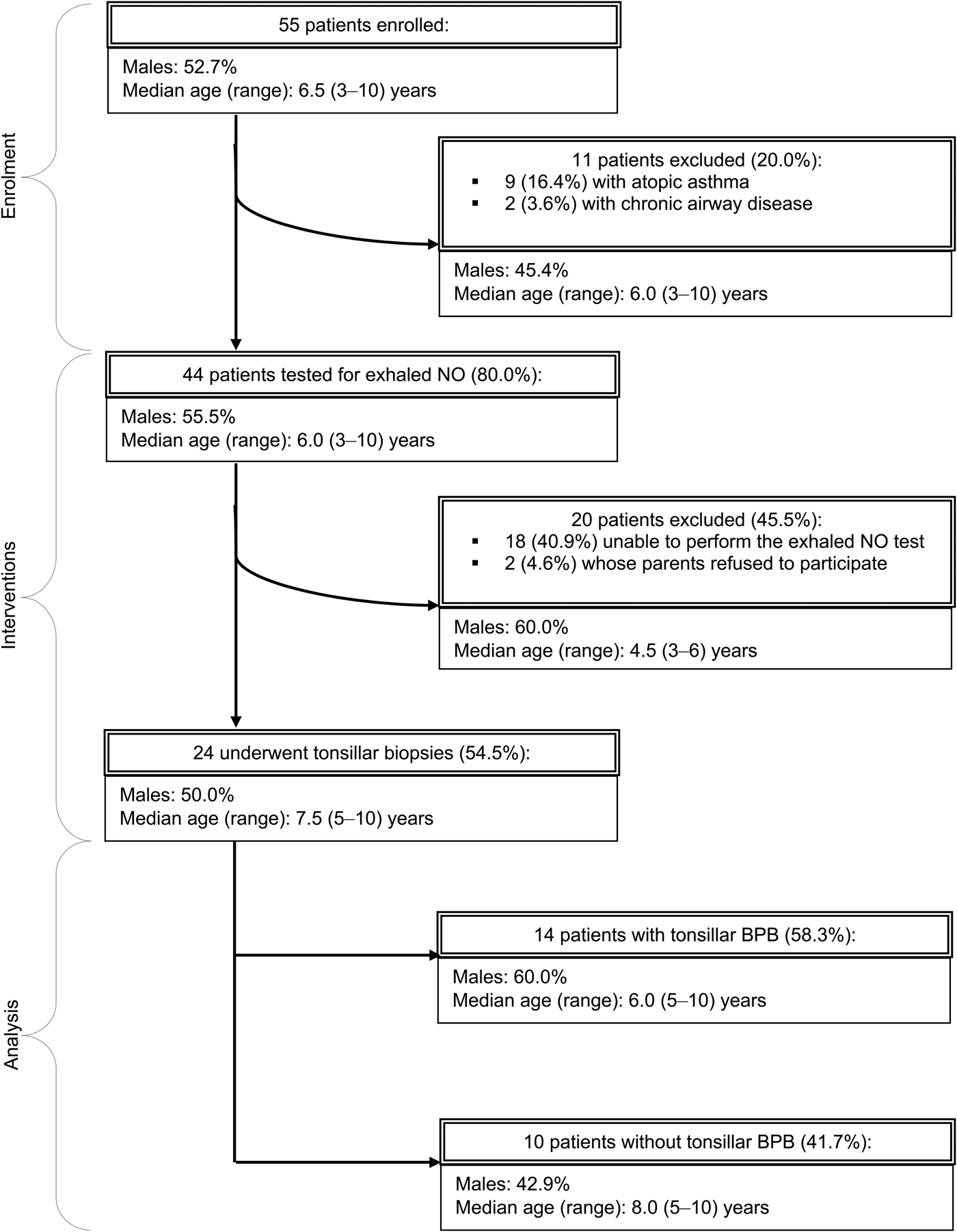
The final analysis was based on the findings of 24 of the 55 enrolled patients (43.6 per cent). These patients had a median age of 7.5 years (range, 5–10 years) and included 12 males (50.0 per cent). Figure 1 shows the study flow chart; the main reason for exclusion (40.9 per cent) was a child's inability to perform the exhaled nitric oxide test.
Study flow chart. NO = nitric oxide; BPB = biofilm-producing bacteria

Biofilm-producing bacteria were detected in 14 (58.3 per cent) of the 24 tonsillar bioptic specimens, with Staphylococcus aureus being detected in most specimens (11 out of 14; 78.6 per cent), followed by Streptococcus pyogenes (2 out of 14; 14.3 per cent); Pseudomonas aeruginosa was found in 1 specimen (7.1 per cent).
There were no significant differences in terms of gender, age and the number of reported tonsillar infections in the previous 12 months between the children with and without tonsillar biofilm-producing bacteria (Table I).
Patients’ demographic and clinical features
*Fisher's exact probability test; †one-way analysis of variance. ‡In the previous 12 months. BPB+ = children with tonsillar biofilm-producing bacteria; BPB− = children without tonsillar biofilm-producing bacteria; ns = not significant; NO = nitric oxide
The median exhaled nitric oxide level was 11.6 ppb (range, 3.2–22.3 ppb) in the patients as a whole, but was significantly higher in the children with tonsillar biofilm-producing bacteria (median of 14.7 ppb and range of 6.8–22.3 ppb vs median of 7.2 ppb and range of 3.2–14.4 ppb; p = 0.01), as shown in Table I and Figure 2.
Box plots of exhaled nitric oxide (NO) according to the presence or absence of tonsillar biofilm-producing bacteria (groups labelled BPB+ and BPB− respectively). The asterisk indicates statistical significance.
The edges of the boxes represent standard deviations, the line inside each box indicates the mean value, and the ‘whiskers’ represent the highest and lowest values.
When exhaled nitric oxide was considered as an ordinal value, there was a significant relationship with the presence of tonsillar biofilm-producing bacteria (p = 0.03). Exhaled nitric oxide levels of less than 8 ppb were found in 6 out of 10 patients without tonsillar biofilm-producing bacteria (60.0 per cent), but in only 2 out of 14 with tonsillar biofilm-producing bacteria (14.3 per cent) (Table I). Children whose exhaled nitric oxide levels were higher than 8 ppb were therefore at three times greater risk of developing tonsillar biofilm-producing bacteria (relative risk = 3.0; standard error = 1.82). Logistic regression analysis confirmed that exhaled nitric oxide levels of more than 8 ppb was the only predictor of the presence of tonsillar biofilm-producing bacteria (odds ratio = 9.0; standard error = 4.9; p < 0.02; RReference Al-Mazrou and Al-Khattaf2= 17.2 per cent).
There was no significant interaction between the number of episodes of tonsillitis in the previous 12 months and the presence of tonsillar biofilm-producing bacteria or exhaled nitric oxide levels.
Discussion
This pilot study, which involved a limited case series of patients, revealed an association between median exhaled nitric oxide levels and the presence of tonsillar biofilm-producing bacteria. Specifically, there was an increased risk of biofilm formation in children with exhaled nitric oxide levels of more than 8 ppb. To the best of our knowledge, no other similar studies have been published. However, the possible involvement of nitric oxide mediated intercellular signalling in biofilm formation, swarming and dispersal has been tested by some authors, with conflicting findings.Reference Schreiber, Beutler, Enning, Lamprecht-Grandio, Zafra and González-Pastor20–Reference Falsetta, McEwan, Jennings and Apicella23
In our study, the presence of tonsillar biofilm-producing bacteria was detected (by spectrophotometric evaluation) in about 50 per cent of tonsillar samples, which is in line with previous reports that suggest the possible involvement of bacterial biofilm in paediatric chronic tonsillar disease.Reference Chole and Faddis1, Reference Al-Mazrou and Al-Khattaf2, Reference Galli, Calò, Ardito, Imperiali, Bassotti and Fadda6, Reference Torretta, Drago, Marchisio, Cappadona, Rinaldi and Nazzari13 Although bacterial biofilm is generally evaluated by means of advanced electron microscopic analysis, such as scanning electron microscopy or confocal laser scanning microscopy, these techniques require costly equipment and extensive sample preparation. Hence, we performed the simpler and more cost-effective spectrophotometry according to Christensen et al.;Reference Christensen, Simpson and Younger12 this technique is frequently used to quantify biofilm formation,Reference Christensen, Simpson and Younger12 as described in our previous studies.Reference Torretta, Drago, Marchisio, Cappadona, Rinaldi and Nazzari13–Reference Torretta, Drago, Marchisio, Mattina, Clemente and Pignataro17
In our case series, S aureus was the most frequently detected biofilm-producing bacteria (78.6 per cent) followed at a considerable distance by S pyogenes (14.3 per cent). This finding confirms the results of previous studies that indicate the predominant involvement of Gram-positive organisms in biofilm-related chronic tonsillar infections.Reference Chole and Faddis1, Reference Al-Mazrou and Al-Khattaf2, Reference Galli, Calò, Ardito, Imperiali, Bassotti and Fadda6, Reference Torretta, Drago, Marchisio, Cappadona, Rinaldi and Nazzari13
Functional nitric oxide synthase (the enzyme capable of synthesising nitric oxide using arginine and oxygen as substratesReference Alderton, Cooper and Knowles24) has been found to be encoded and expressed in some mainly Gram-positive bacteria,Reference Sudhamsu and Crane25 in which it seems to act as an anti-oxidant system by activating redox-based signalling events.Reference Stamler, Lamas and Fang26 It is known that bacterial nitric oxide synthase can provide cytoprotection against oxidative stress, and it may be partially responsible for bacterial protection against some antibiotics inducing oxidative stress.Reference Gusarov, Shatalin, Starodubtseva and Nudler27
In a recent in vitro study, Schreiber et al. confirmed intracellular nitric oxide production via nitric oxide synthase activity by Bacillus subtilis, a common Gram-positive bacterium usually present in the soil, air and water.Reference Schreiber, Loeffler, Polerecky, Kuypers and de Beer21 However, they also found that neither the suppression of nitric oxide formation nor the exogenous addition of nitric oxide by means of nitric oxide donors affected biofilm development, mature biofilm structure or swarming motility. This suggests that nitric oxide may not be involved in B subtilis biofilm formation, swarming co-ordination or biofilm dispersal.Reference Schreiber, Loeffler, Polerecky, Kuypers and de Beer21
The findings of a study by Falsetta et al., which involved an in vitro model using Neisseria gonorrhoeae biofilm, suggest that low concentrations of nitric oxide in the medium can elicit biofilm dispersal, whereas higher nitric oxide concentrations enhance biofilm formation.Reference Falsetta, McEwan, Jennings and Apicella23 Our finding of a correlation between increased exhaled nitric oxide levels and the detection of biofilm-producing bacteria in tonsillar samples taken from children with recurrent exacerbations of chronic tonsillitis is consistent with this. It suggests that the nitric oxide pathway is involved in chronic tonsillar infections sustained by bacterial biofilm.
Limitations of this pilot study include the fact that only a small number of participants were recruited; thus, we cannot draw any definitive conclusions. In addition, patient compliance was required in terms of performing the exhaled nitric oxide test, which could limit the application of this test in routine clinical practice, as previously reported.Reference Torretta, Marchisio, Esposito, Garavello, Cappadona and Clemente9
In conclusion, our results suggest the possibility of discriminating children with recurrent exacerbations of chronic tonsillar infections sustained by biofilm on the basis of exhaled nitric oxide levels. However, despite these encouraging results, our small sample size does not allow us to draw any definite conclusions. This prevents inferences being made and applied to routine clinical practice.
• Exhaled nitric oxide is a reactive gaseous mediator involved in airway inflammation
• The possible role of exhaled nitric oxide and bacterial biofilms in the pathogenesis of chronic tonsillar disease has recently been considered, with conflicting findings
• This study investigated the relationship between mean exhaled nitric oxide levels and tonsillar biofilm-producing bacteria in children
• It may be possible to discriminate children with recurrent exacerbations of chronic biofilm-sustained tonsillar infections on the basis of exhaled nitric oxide levels
If our preliminary results are confirmed in larger case series, clinicians will be able to use a non-invasive test such as an exhaled nitric oxide assessment to predict the risk of biofilm in children with chronic tonsillar infections. This would allow the children to be better stratified and allocated to the most suitable therapeutic protocol, which might include some of the alternative pre-surgical strategies against biofilm or nitric oxide metabolism that are currently being tested.Reference Smith, Buchinsky and Post28