1 Introduction
Question answering forums such as Quora, StackOverflow, and Yahoo! Answers allow communities of users to discuss problems around concrete topics, and to find solutions and answers using collective knowledge. Automatically searching for existing related questions or existing posts that directly answer a newly posed question are challenging tasks that have attracted a lot of attention from the Natural Language Processing (NLP) and Information Retrieval (IR) communities (Qiu and Huang Reference Qiu and Huang2015; dos Santos et al. Reference Santos, Barbosa, Bogdanova and Zadrozny2015; Severyn and Moschitti Reference Severyn and Moschitti2015; Shen et al. Reference Shen, Rong, Sun, Ouyang and Xiong2015; Wang and Nyberg Reference Wang and Nyberg2015; Zhou et al. Reference Zhou, He, Zhao and Hu2015; Lei et al. Reference Lei, Joshi, Barzilay, Jaakkola, Tymoshenko, Moschitti and Màrquez2016).
Apart from the difficulties inherent to the type of language used in open forums (ungrammatical, informal, error-prone, etc.), another challenge is the fact that the most helpful answers to a user question may be buried in long discussion threads associated with one or more similar questions. Moreover, both the questions and the answers can use open language, referring to knowledge that goes beyond traditional factual question answering.
Recently, some English resources have been developed for the NLP community that have helped researchers to train new systems and to compare results under fair experimental conditions (Hoogeveen, Verspoor and Baldwin Reference Hoogeveen, Verspoor and Baldwin2015; Lei et al. Reference Lei, Joshi, Barzilay, Jaakkola, Tymoshenko, Moschitti and Màrquez2016), notably as part of SemEval, the International Workshop on Semantic Evaluation (Nakov et al. Reference Nakov, Màrquez, Magdy, Moschitti, Glass and Randeree2015, Reference Nakov, Màrquez, Moschitti, Magdy, Mubarak, Freihat, Glass and Randeree2016b, Reference Nakov, Hoogeveen, Màrquez, Moschitti, Mubarak, Baldwin and Verspoor2017a). For Arabic, the existing resources and systems for community question answering (cQA) are rather limited. A notable exception is the dataset on medical forums from the SemEval-2016 Task 3 on cQA,Footnote 1 which we describe in detail in this article. Apart from the lack of resources, Arabic cQA has some specific characteristics that make it particularly difficult, e.g., the lack of capitalization in the Arabic script and the use of many dialects in addition to Modern Standard Arabic (MSA) (see Section 3.2 for details).
Here, we present and analyze resources and advanced models for enabling better Arabic cQA. We first describe CQA-MD, a cQA corpus for Arabic in the domain of medical forums. Medical websites attract many users in the Arab world, but the medical domain has been largely ignored in the Arabic question answering literature. The creation of this corpus involved many steps: from crawling and processing the data from the medical websites, to retrieving appropriate question–answer (QA) passage pairs, to annotating them using crowdsourcing to produce training and testing datasets, and finally to documenting and making the corpus available.
In order to promote the Arabic corpus and the exploration of Arabic medical cQA in general, we ran an international evaluation challenge within the framework of SemEval-2016. This is the above-mentioned Task 3 on cQA (Nakov et al. Reference Nakov, Màrquez, Moschitti, Magdy, Mubarak, Freihat, Glass and Randeree2016b). In this article, we describe the most interesting systems, the results and the lessons learned from that evaluation exercise. In doing so, we focus on the two best-performing systems, SLS (Mohtarami et al. Reference Mohtarami, Belinkov, Hsu, Zhang, Lei, Bar, Cyphers and Glass2016) and ConvKN (Barrón-Cedeño et al. Reference Barrón-Cedeño, Bonadiman, Martino, Joty, Moschitti, Al Obaidli, Romeo, Tymoshenko and Uva2016), which present different, complementary solutions both interesting from a modeling and a linguistic viewpoint. SLS implements convolutional and recurrent neural networks relying on textual embeddings, while ConvKN is a kernel-based classifier that uses tree kernels (TKs) (Moschitti Reference Moschitti2006) to inject syntactic and semantic information to compute the similarity between questions and answers.
Additionally, we perform three new studies in order to better understand the advantages and limitations of current Arabic cQA systems. First, we experimented with combining the outputs of all submissions from all participating teams (up to three per team), obtaining substantially better results, i.e., showing that the systems produce complementary errors, and thus there is a large room for improvement in the task. Second, we perform manual analysis of the examples that were difficult to rank for all systems in the competition. We categorize the examples into some prototypical cases, based on which we give general suggestions about how to improve Arabic cQA in the future. Third, we analyze the impact of the syntactic information used by ConvKN, by comparing the output of ConvKN to a version of the same system without TKs. This shows how syntactic TKs can help solving some complex cases.
The rest of the article is organized as follows: Section 2 presents related work on Arabic question answering and on cQA in general. Section 3 describes the CQA-MD Arabic corpus for cQA, which we created. Section 4 presents the shared task we organized on Arabic cQA using CQA-MD, and discusses the systems, the approaches, and the results. Section 5 contains further evaluation, which explores the potential of combining the outputs of the participating systems. Section 6 summarizes the manual analysis done on the systems’ output: we describe the typology of the most frequent errors, and also the contribution of the syntactic information in the TK approach. Finally, Section 7 concludes and discusses some potential lines for future research.
2 Related work
QA systems heavily use techniques from NLP, as well as a lot of resources. The scarceness of the latter has limited the development of QA systems for Arabic, e.g., compared to English. This aspect is illustrated well by Ezzeldin and Shaheen (Reference Ezzeldin and Shaheen2012) and Ray and Shaalan (Reference Ray and Shaalan2016), who conducted surveys of Arabic QA, exploring the challenges, the tasks, the approaches, and the tools. In addition to the scarceness of language resources, corpora, and benchmarks, they pointed out to some Arabic-specific aspects such as its complex and rich morphology, the ambiguity due to the omission of diacritics, and the lack of capitalization for named entities. These aspects highly affect all three basic components of a QA system: question analysis, passage retrieval, and answer extraction. In the following, we report on state-of-the-art QA systems, which provide solutions with respect to the above components.
Question Analysis
Rosso et al. (Reference Rosso, Lyhyaoui, Peñarrubia, Montes y Gómez, Benajiba and Raissouni2005) analyzed Arabic questions by removing the stop words, extracting the named entities, and classifying the questions in four categories: Name, Date, Quantity, or Definition. Subsequent work further extracted question focus (the main noun phrase), and important noun phrases and named entities (Wissal et al. Reference Wissal, Ellouze, Mesfar and Belguith2009; Abdelbaki, Shaheen and Badawy Reference Abdelbaki, Shaheen and Badawy2011; Kanaan and Hammouri Reference Kanaan and Hammouri2009). The latter three studies only used a small number of questions (e.g., hundred questions), which makes it hard to draw any general conclusions.
Passage Retrieval
Benajiba and Rosso (Reference Benajiba and Rosso2007) ranked the retrieved passages according to the relevant question terms appearing in the passage. They assigned a higher rank to passages with a smaller distance between the keywords. Kanaan and Hammouri (Reference Kanaan and Hammouri2009) used stop word removal, root extraction, and term weighting, together with cosine similarity between document words and question words. Abouenour (Reference Abouenour2011) used a three-level approach in passage retrieval based on (i) query keywords, expanded with morphology and semantic concepts from the Arabic WordNet, (ii) n-gram structure to give higher weights to question words closer to each other, and (iii) semantics encoded in concept graphs for passage reranking.
Answer Extraction
Most studies customized manually defined patterns, heuristics, rules, and semantic similarity between question the focus and the retrieved answers using n-grams, e.g., as in (Trigui et al. Reference Trigui, Belguith and Rosso2010) and (Abdelbaki et al. Reference Abdelbaki, Shaheen and Badawy2011).
End-to-end QA Systems
Several complete systems have also been proposed in previous work. For example, QARAB (Hammo, Abu-Salem and Lytinen Reference Hammo, Abu-Salem and Lytinen2002) was one of the early systems for unstructured Arabic QA and was used for the Al-Raya newspaperFootnote 2 in Qatar; however, its evaluation was limited to only 113 factoid questions.
Al Chalabi (Reference Al Chalabi2015) used automatic classifiers of Arabic factoid questions for better identifying the answer to a given question. Their question taxonomy reflected question words, such as who, what, when, how, etc. They built question classifiers using regular expressions, patterns, and a context-free grammar for each interrogative particle, along with 200 training questionsFootnote 3 and tested on another set of 200 questions made available by TREC and CLEF. The reported results were promising also compared to English QA.
Wissal et al. (Reference Wissal, Ellouze, Mesfar and Belguith2009) proposed Question-Answering System for Arabic Language. They used IR and NLP techniques for processing both factoid questions and documents. Question-Answering System for Arabic Language exploits the linguistic annotation system of Silberztein (Reference Silberztein2005) for also dealing with definitional questions.
Trigui et al. (Reference Trigui, Belguith and Rosso2010) proposed a QA system for definitional questions focused on entities. Their system identifies the definitions of entities using Web resources.
Salem et al. (Reference Salem, Sadek, Chakkour and Haskkour2010) built a system for answering why and how questions expressed in the Rhetorical Discourse Structure formalism. The system was evaluated on data extracted from Arabic websites, and demonstrated decent accuracy.
Akour et al. (Reference Akour, Abufardeh, Magel and Al-Radaideh2011) designed QArabPro, which is a rule-based system for reading comprehension tests. Although the system tackled any type of question, the dataset was limited to only seventy-five questions.
Overall, the problems with the aforementioned systems can be summarized as follows: small datasets for testing, and focus on factoid questions, not covering different question types and styles. In contrast, our work is focuses on cQA and enables for the first time (i) the use of large-scale user-created data sets for training and testing Arabic cQA systems, and (ii) studying real-world QA applications and the challenges they pose.
Community Question Answering (cQA) for Arabic
The above section has highlighted the limited development in Arabic QA. Regarding cQA, the situation is even more critical, as this is a much newer research area, also requiring to deal with other challenges such as the use of informal language, typical characterizing forums, and other web-based communities.
For English, several initiatives have been carried out recently. For example, there has been a recent revival of the TREC Question Answering track at TREC 2015 and 2016, as LiveQA (Agichtein et al. Reference Agichtein, Carmel, Harman, Pelleg and Pinter2015), which provided a challenge and data for answering real user questions, posted live to the Yahoo! Answers site. There have been also relevant workshops, e.g., at SIGIR (Moschitti et al. Reference Moschitti, Màrquez, Nakov, Agichtein, Clarke and Szpektor2016). The most relevant initiative was that on cQA at SemEval-2015 and 2016, i.e., Task 3 (Nakov et al. Reference Nakov, Màrquez, Magdy, Moschitti, Glass and Randeree2015, Reference Nakov, Màrquez, Moschitti, Magdy, Mubarak, Freihat, Glass and Randeree2016b), which focused on answering new questions using a cQA forum (Qatar Living). In particular, participants were asked to rerank the results returned by a search engine, and also to select the good answers in the forum. See for example the systems developed in (Barrón-Cedeño et al. Reference Barrón-Cedeño, Filice, Martino, Joty, Màrquez, Nakov and Moschitti2015), (Joty et al. Reference Joty, Barrón-Cedeño, Da San Martino, Filice, Màrquez, Moschitti and Nakov2015; Nicosia et al. Reference Nicosia, Filice, Barrón-Cedeño, Saleh, Mubarak, Gao, Nakov, Da San Martino, Moschitti, Darwish, Màrquez, Joty and Magdy2015; Mihaylova et al. Reference Mihaylova, Gencheva, Boyanov, Yovcheva, Mihaylov, Hardalov, Kiprov, Balchev, Koychev, Nakov, Nikolova and Angelova2016; Nakov, Màrquez and Guzmán Reference Nakov, Màrquez and Guzmán2016a; Joty, Màrquez and Nakov Reference Joty, Màrquez and Nakov2016). The challenge further proposed question–question similarity and answer selection subtasks (Barrón-Cedeño et al. Reference Barrón-Cedeño, Bonadiman, Martino, Joty, Moschitti, Al Obaidli, Romeo, Tymoshenko and Uva2016; Filice et al. Reference Filice, Croce, Moschitti and Basili2016; Lei et al. Reference Lei, Joshi, Barzilay, Jaakkola, Tymoshenko, Moschitti and Màrquez2016).
Regarding cQA for Arabic, we could not find any other research in addition to our SemEval effort in years 2015 and 2016. Thus, the present work both contributes to standard QA research and is foundational with respect to Arabic cQA.
First, as described in Section 3, given an input question, for Arabic we rank pairs of (question, correct answer). In contrast, the closest English cQA subtask at SemEval, subtask B, given an input question asked participants to rank potentially relevant questions, but without the availability of an answer. The difference is because for Arabic, we could exploit the correct answers provided by doctors.
Second, for English, we used Google to retrieve the candidates. This is a reasonable choice as Qatar Living, the underlying website, also uses Google to search in their forum (Hoque et al. Reference Hoque, Joty, Màrquez, Barrón-Cedeño, Da San Martino, Moschitti, Nakov, Romeo and Carenini2016). In contrast, for Arabic we used a local search engine, Apache Solr, which indexed the data we crawled from the target Arabic forums as described in Section 3.1. This choice was driven by our desire to have a better control of the retrieval aspect, even though it was not part of the challenge.
However, this prevented us from exploiting several features of the Google algorithms for Arabic, e.g., their powerful language models (LMs), which could fill the lexical gap between the input question and the retrieved question/answer pairs. A direct consequence was that Solr was not able to retrieve candidates containing relevant QA pairs for many queries, even when using a large number (hundred) of retrieved candidates. To overcome this additional complexity, we needed to generate different query models: selection of medical terms, higher weights to such terms, use of stemming and lemmatization, different term weighting schemes, etc. This process was manual-labor intensive and could be seen as part of our manual selection process. In other words, the selection of the best list of candidates was not supposed to be a fully automatic process.
Note that this does not limit the validity of our findings in any way since (i) our study assumes that a powerful search engine is able to provide an initial set of good candidates and this is exactly what our semi-automatic retrieval approach can generate, and (ii) all the methods of the participants’ systems (and the challenge in general) were specifically detached from the retrieval part as the task consisted in reranking an initial set of candidates. Moreover, note that it is standard in the IR community to provide retrieval benchmarks, e.g., in the TREC QA task, the candidates that are eventually judged for relevance by humans are obtained by merging the top candidates returned by each of the participating systems.
3 Arabic data for cQA
In this section, we first describe the creation of the CQA-MD corpus for Arabic cQA in the medical domain, which to the best of our knowledge, is the first large and annotated Arabic resource for studying cQA problems. Then, we analyze the main characteristics of CQA-MD and the challenges of Arabic cQA in general.
3.1 CQA-MD: a medical arabic corpus for cQA
We used data from the medical domain, which is largely ignored for Arabic.Footnote 4We extracted data from three popular Arabic medical websites that allow visitors to post questions related to health and medical conditions, and to get answers by professional doctors within days for free. In particular, we collected 1,531 QA pairs from WebTeb,Footnote 5 69,582 pairs from Al-Tibbi,Footnote 6 and 31,714 pairs from the medical corner of Islamweb.Footnote 7
In order to generate our collection, we used the 1,531 questions from WebTeb as our original questions, and we looked to find related QA pairs from the other two websites that can answer these questions.
We collected over 100,000 QA pairs in total from the other two websites, we indexed them in Solr,Footnote 8 and we searched them trying to find answers to the WebTeb questions.
We used several different query/document formulations to perform twenty-one retrieval runs, and we merged the retrieved results, ranking them according to the reciprocal rank fusion algorithm (Cormack, Clarke and Buettcher Reference Cormack, Clarke and Buettcher2009). Finally, we truncated the resulting list to the thirty top-ranked QA pairs, which yielded 45,164 QA pairsFootnote 9 for the 1,531 original questions.
Note that the maximum number of candidates to be reranked, namely thirty, does not follow a precise rule or best practice. However, we considered two main factors that led us to select thirty candidates. First, while for the English cQA task, there is a large percentage of questions having at least one correct answer in the first ten candidates retrieved by a search engine, for our Arabic cQA dataset, this percentage was much lower. Second, in the field of passage retrieval, which is similar to our task, it has been observed that even powerful rerankers fail to push relevant candidates to the top if they occur too low in the original retrieval list. Therefore, the number thirty comes from a trade-off between (i) the need to have at least some candidates to rerank (otherwise, the task would not be interesting and the difference between the participating systems would just depend on a small number of questions), and (ii) the awareness that too long lists would have not positively impacted the accuracy of the participating systems. In contrast, having many more candidates would have caused inefficiency for both training and testing. Although, we did not systematically study the distribution of correct questions with respect to the length of the retrieved candidates list, we practically observed that with thirty candidates, we could obtain relevant (Direct and Relevant) answers for most of our questions.
Next, we used the CrowdFlowerFootnote 10 crowdsourcing annotation platform to obtain judgments about the relevance of these QA pairs with respect to the original question using the following labels:
• ‘D’ (Direct): The QA pair contains a direct answer to the original question such that if the user is searching for an answer to the original question, the proposed QA pair would be satisfactory and there would be no need to search any further.
• ‘R’ (Related): The QA pair contains an answer to the original question that covers some of the aspects raised in the original question, but this is not sufficient to answer it directly. With this QA pair, it would be expected that the user will continue the search to find a direct answer or more information.
• ‘I’ (Irrelevant): The QA pair contains an answer that is irrelevant to the original question.
We controlled the quality of annotation using a hidden set of fifty test questions. We had three judgments per example, which we combined using the CrowdFlower mechanism, i.e., using majority voting and annotator confidence to assign the final label. The average inter-annotator agreement was eighty-one per cent.
We should note that the medical domain complicates the annotation task for Turkers, especially with respect to distinguishing between the classes ‘D’ and ‘R’, where the main difference is that the former satisfies the information need completely, while the latter does so only partially. This difference is about understanding the completeness of an answer, and thus can be often detected without a background in the medical domain. Another important factor to consider is that Turkers see the correct answer by a physician during annotation, and thus they can try to match such content. Moreover, the questions are asked by common people, and are about general medical topics, expressed in an informal and colloquial format; so, are the physicians’ answers. Finally, note that ultimately we merge ‘D’ and ‘R’ for the purpose of the challenge and of our study; thus, even if these two classes happen to be confused, this would not really matter.
Finally, we divided the data into training, development and testing datasets, based on confidence, where the examples in the test dataset were those with the highest annotation confidence. A well-trained native speaker of Arabic double-checked and manually corrected some of the annotations for the development and the testing datasets. The objective was to provide higher-quality development and testing datasets for parameter tuning and for testing, respectively.
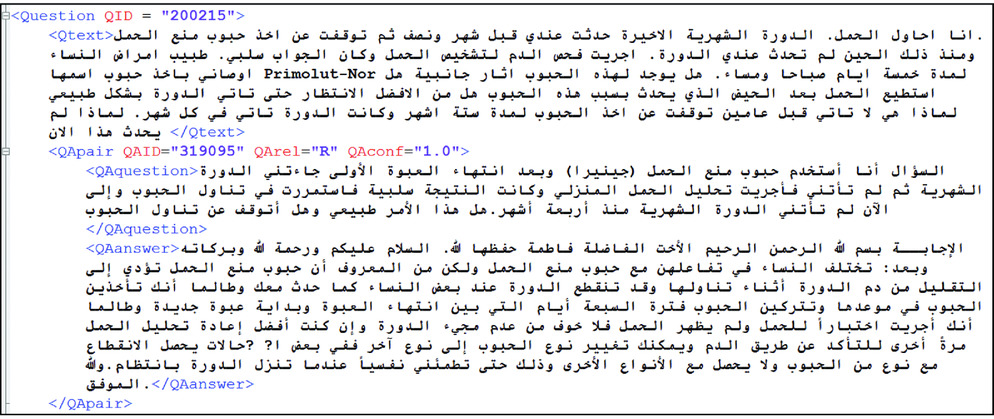
Figure 1 shows part of the XML file we generated. It illustrates some challenges for Arabic cQA, such as long introductions, use of English words for medical terms, lack of capitalization for named entities, sloppy punctuation, spelling mistakes, etc. In the example, the original question is about a desire for pregnancy given menstrual cycle disorders and side effects for a certain medicine. The related question is about the reasons for menstrual cycle disorders in the case of taking contraceptive pills and how this can negatively affect pregnancy. In the related answer, after a long greeting, the physician explains that contraceptive pills can impact women differently, and describes some general effects of such pills on menstrual cycle and pregnancy.
Annotated question from the Arabic CQA-MD corpus.

We can further see that the XML file includes information about the confidence of annotation. This information is available for the training and the development datasets only, but not for the test dataset. It allows systems to trust less training examples with lower agreement.
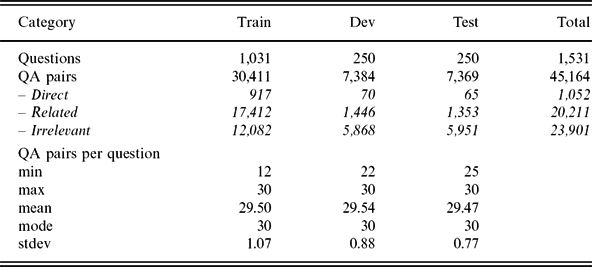
Table 1 shows some statistics about the dataset size and the distribution of the three classes in the CQA-MD corpus.
Statistics about the CQA-MD corpus

3.2 Challenges in arabic cQA
Below, we discuss some characteristics of Arabic online content that make Arabic cQA difficult in general, and we provide some statistics and examples from our CQA-MD corpus.
• Use of dialects: A typical feature of Web forums is the use of dialectal Arabic instead of MSA. In many cases, dialectal words are incorrectly recognized as Out-Of-Vocabulary words by Arabic morphological analyzers, which in turn affects syntactic parsing and general language understanding as most tools for Arabic processing are tailored for MSA. In particular, we calculated that in our test dataset about twenty per cent of the questions contained some dialectal words, while at the same time all answers were in MSA as they were written by professional physicians. This means that there is some mismatch between the language variety (dialect versus MSA) used in the question and in the answer, and this causes further issues when comparing the text of a question to the text of an answer. This is especially important at the syntactic level as most dialectal words are function words. However, in our data this is less important at the semantic level as terminology covering diseases and body parts are in MSA, i.e., word embeddings might be more robust with respect to dialectal variance.
• Sloppy punctuation: The informal, dialectal text in Web forums often neglects punctuation, unlike proper MSA text. Yet, the proper use of punctuation can be crucial for some NLP processing steps such as sentence segmentation and syntactic parsing. In particular, we considered the fact that, on average, the original questions, the related questions, and the related answers have a punctuation mark after every twelve, eighteen, and thirteen words, respectively. Yet, in a proper newswire text, such as a 100M-word 10-year AljazeeraFootnote 11 archive, there is a punctuation mark after seven words on the average.
• Spelling errors: Forum texts are written in an informal setting, and thus are not carefully edited as a newswire text would be; as a result, they often contain spelling errors. Our analysis shows that in our test dataset, eighty per cent of the questions and forty per cent of the answers had at least one typo. Most of these typos consist in omitting the hamza symbols on top and below the bare Alef symbol or missing the dots for the letters ya and ta marbuta, which turns them into alef maqsura and ha, respectively. These problems are somewhat easy to solve using normalization and consulting a large LM to select the best candidate in a given context; yet, this is a bit more complicated for dialectal texts as LMs are not so reliable for them. Other spelling mistakes involve missing letters, swapped letters, or concatenated/split words.
• Long preambles and introductions: It is common in Arabic to start a question with a religious greeting or introduction, and to end it with an acknowledgment or a prayer. Our analysis shows that fifty-eight per cent of the questions and of the answers in our dataset have such starting introductions, e.g., ‘Peace be upon you and God’s mercy and blessings. . .’ and ‘In the name of God the most gracious the most merciful dear brother/sister. . .’Also, fifty per cent of the questions and of the answers end with a salutation or a prayer such as ‘and thanks’, or ‘May God bless/reward you’. This requires extra efforts to recognize the important parts of the questions and of the answers and potentially to ignore such introductory/ending parts.
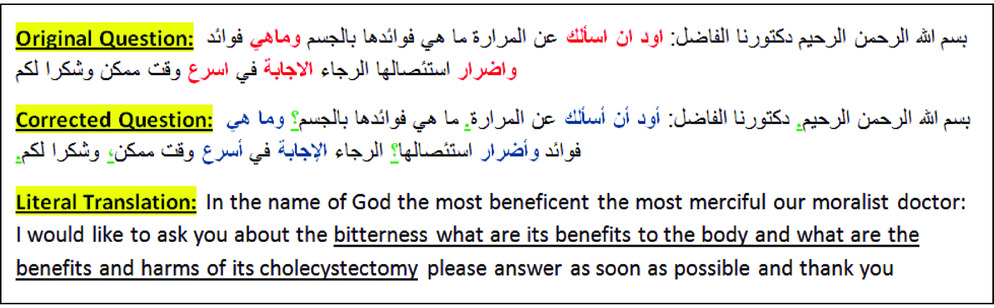
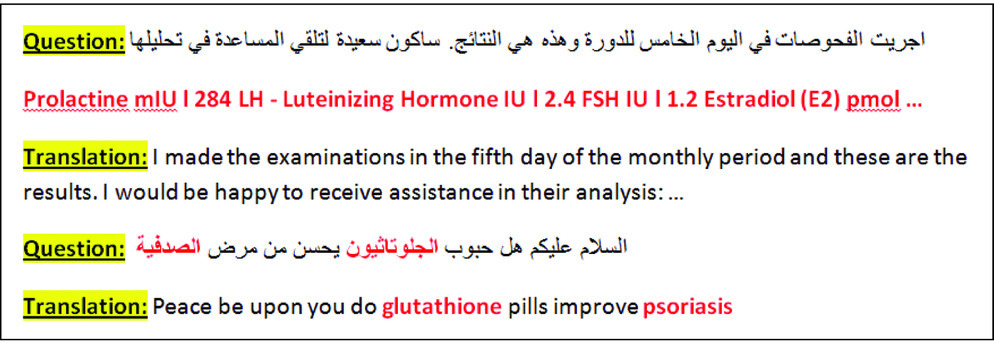
Figure 2 shows an example that illustrates some of the difficulties described above: different types of spelling mistakes, no punctuation marks, as well as long introduction and acknowledgments that surround the core part of the question. Figure 3 shows two other cases: using English words inside Arabic questions, and complex medical terms and medicines. All these difficulties negatively affect automatic parsing and understanding.
Challenges for question analysis: typos, punctuation, and preambles.

More challenges for question analysis: English words and medical terms.

Below are some additional challenges we face that are specific for our particular corpus, mostly due to its medical nature:
• Use of complex medical terms: As our corpus is from the medical domain, it is common to find in the questions and in the answers complex medical terms (e.g., Progesterone in Arabic), names of medicines (e.g., Ortho-Cyclen in Arabic), sometimes even complex medical terms in English, e.g., Keratoplasty and Zyprexa. We found that about forty-one per cent of the questions and seventy-seven per cent of the answers contained complex medical terms (we did not consider as complex terms words such as heart attack and bleeding that are in everyday use or are generally understood by Arabic speakers), while in the remaining cases the users described their cases in a simple language; physicians also tried to simplify their way of expression in order to make their response more comprehensible.
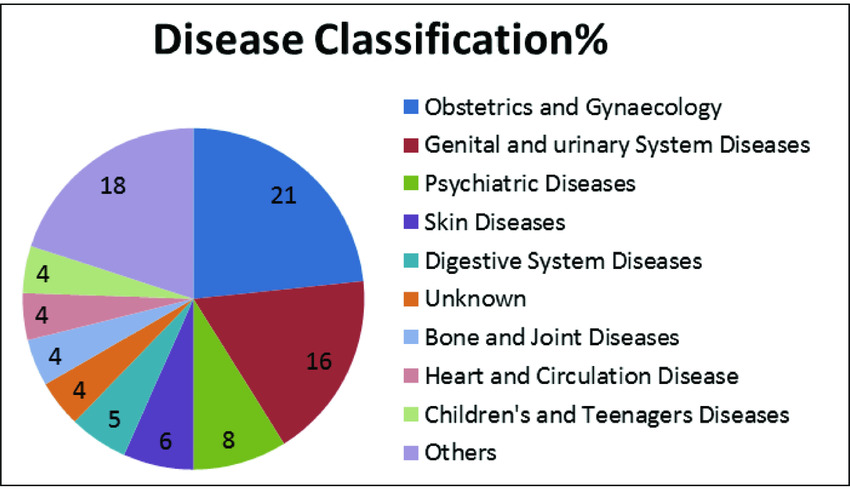
• Sensitive and socially embarrassing medical questions: An important characteristic of our medical data is the abundance of questions that are arguably socially embarrassing. As people feel uneasy to talk about them face-to-face to a physician, they preferred to pose them online, hiding behind the anonymity that an Internet forum seemingly offers. In some cases, users tended to anonymously describe their cases in a lot of detail, using vocabulary that is not known to standard NLP tools, as such terms are not frequent in newswire texts that are typically used to train Arabic NLP tools. Figure 4 shows that, in our test dataset, the two most-commonly mentioned diseases, accounting for thirty-seven per cent combined, are indeed related to obstetrics and gynaecology, along with genital and urinary system diseases.Footnote 12
• Detailed questions and answers: In forty-eight per cent of the questions, people were asking about general issues (e.g., what are the symptoms of a certain disease?), while in fifty-two per cent of the questions, they were asking about very specific cases (e.g., ‘I am xx years old, this is my medical history. I take this medicine and I have certain symptoms, etc.’). Because users want to write everything in one question without knowing exactly what the important details from a physician’s perspective are, they describe their cases with a lot of detail in terms of numbers, treatments, medical history, etc. Also, physicians reply by giving the medical description and analysis of their cases, with general and specific instructions and prescriptions. Some questions are answered by more than one physician, when the question is related to more than one medical specialty (e.g., dermatology and psychology). This makes questions and answers very long and adds extra complexity to the linguistic analysis, but also for manual annotation of the gold labels, as long questions and answers are difficult to understand. For example, the average lengths of the questions and of the answers are 40 and 119 words, respectively.
• Short answers: For some questions, after a long description and lot of detail about a patient’s case, we have short answers like: ‘Yes’, ‘This is normal’, or ‘For two years’, etc. Sometimes, a physician’s reply is not a real answer to the question like: ‘Send more details’, ‘This question was answered before’, ‘Unclear question’, or ‘Consult your doctor’. These kinds of short answers with almost no lexical overlap with the questions are challenging for systems that try to learn from data and to find syntactic or semantic relations between questions and answers. We think of annotating these answers differently in the future.
The most frequently mentioned diseases in our test dataset.

4 SemEval-2016 shared task on arabic cQA
In this section, we describe the SemEval-2016 shared task on cQA, which we organized. The task used CQA-MD as the Arabic dataset (and it also included some English subtasks). Five systems, SLS, ConvKN, Research Development International (RDI), QU-IR, and UPC_USMBA, participated in the challenge with up to three submissions: one primary, and up to two contrastive. Below, we go over the task setting, the participating systems, the main features and techniques used, the evaluation results, and the lessons learned.
4.1 Task setting
The SemEval task can be defined as follows: given an original question q o and k candidate QA pairs 〈q s, a s〉, 1 ⩽ s ⩽ k (retrieved by a search engine), the task is to rank them with respect to their relevance to q o. In our setting, we used k = 30 QA pairs associated with each q o, where a s is the correct answer to q s provided by a professional physician. Operationally, the task can be defined as ranking Direct and Relevant answers above the Irrelevant ones (see Section 3.1). Note that the former two are considered Relevant in terms of the official task evaluation.
Metrics. We used Mean Average Precision (MAP) as the primary metric. MAP is a well-established measure in IR. We further report the results for two secondary ranking measures: Mean Reciprocal Rank (MRR) and Average Recall (AvgRec).
MAP is calculated over a set of query questions Q, as the mean of the average precision (AveP) values computed on all questions:
 $$\mathrm{MAP} = \frac{1}{|Q|}\sum _{q_o \in Q}AveP(q_o)
$$
where AveP(·) is the average of the precision value obtained for the set of the top QA pairs 〈q s, a s〉 computed after each relevant QA pair is retrieved.
MRR is computed as follows:
 $$\mathrm{MRR} = \frac{1}{|Q|} \sum _{q_o \in Q} \frac{1}{rank(q_o)}
$$
where rank(q o) is the position of the first relevant QA pair in the list of candidates for q o.
Computed over a set of query questions Q, AvgRec is the mean of the AveR over all questions q o in the test dataset:
 $$\mathrm{AvgRec} = \frac{1}{|Q|}\sum _{q_o \in Q}AveR(q_o)
$$
where AveR is the mean of the recall values obtained for the set of top questions, computed after each QA pair is retrieved.
4.2 Descriptions of the participating systems
Many methods can be applied to solve a ranking task, which is about defining a scoring function  $r:{\mathcal Q} \times {\mathcal Q}\times {\mathcal A} \rightarrow \mathbb {R}$, for ranking 〈q s, a s〉 pairs with respect to q 0, where
 ${\mathcal Q}$ and
 ${\mathcal A}$ are the set of questions and answers, respectively.
Almost all participating systems, i.e., SLS, ConvKN, RDI, and UPC_USMBA, modeled r as a linear function:
 \begin{equation}
r(q_{o},q_{s}, a_{s})=\vec{w}\cdot \phi (q_{o},q_{s}, a_{s})
\end{equation}
 $\vec{w}$ is a weight vector and ϕ(·) is a feature vector representation of the triple. In particular, they learn $\vec{w}$ using binary classifiers, such as Support Vector Machines (SVM) (Joachims Reference Joachims, Schölkopf, Burges and Smola1999), regression models such as logistic regression (Cox Reference Cox1970), or ranking models such as SVMrank (Joachims Reference Joachims2002). It should be noted that binary SVMs showed comparable results to SVMrank. Note also that QU-IR used different approaches for building r, i.e., Multiple Additive Regression Trees and Random Forest algorithms (Friedman Reference Friedman2001). However, this did not seem to yield a major difference. In fact, the critical aspect was the different approaches to feature engineering.
SLS (MIT-CSAIL)
This SLS system by Mohtarami et al. (Reference Mohtarami, Belinkov, Hsu, Zhang, Lei, Bar, Cyphers and Glass2016) applied SVMs to the following concatenation of a lexical-based and of an embedding-based feature vector:
 $$\phi (q_{o},q_{s},a_{s}) = \left[ \phi _{\mathrm{lex}}(q_{o},q_{s},a_{s}), \phi _{\mathrm{emb}}(q_{o},q_{s},a_{s}) \right]
$$
The feature vector ϕlex(q o, q s, a s) is in turn a concatenation of two feature vectors
 $$\phi _{\mathrm{lex}}(q_{o},q_{s},a_{s}) = \left[ \phi _{\mathrm{lex}}(q_{o},q_{s}), \phi _{\mathrm{lex}}(q_{o},a_{s})\right]
$$
where ϕlex(x, y) is a vector whose coordinates correspond to twenty different types of textual similarity between x and y as described in (Nicosia et al. Reference Nicosia, Filice, Barrón-Cedeño, Saleh, Mubarak, Gao, Nakov, Da San Martino, Moschitti, Darwish, Màrquez, Joty and Magdy2015), including greedy string tiling (Wise Reference Wise1996), longest common sub-sequence (Allison and Dix Reference Allison and Dix1986), and Jaccard coefficient (Jaccard Reference Jaccard1901) over [1,4]-grams.
The vector ϕemb(q o, q s, a s) is a concatenation of two scalar products
 $$\phi _{\mathrm{emb}}(q_{o},q_{s},a_{s}) = \left[v(q_{o}) \cdot v(q_{s}), v(q_{o}) \cdot v(a_{s}) \right]
$$
where the vectors v(q o), v(q s), and v(a s) are embedding representations of q o, q s, and a s, respectively; these question/answer embeddings are the average of the embeddings of the words they are made of
 $$v(X)=\sum _{w \in X} w2v(w)
$$
where w is a word-token from the text of X, and w2v(w) maps w to a word embedding.
The SLS team used two different embeddings trained using word2vec (Mikolov, Yih and Zweig Reference Mikolov, Yih and Zweig2013) on: (i) a raw domain-specific corpus of 26 millions tokens provided with the SemEval task, and (ii) an out-of-domain corpus, Arabic Gigaword,Footnote 13 which includes over a billion words, and 120,000 word types after lemmatization. These two types of embeddings, together with some text shrinking approach using TextRank by Mihalcea and Tarau (Reference Mihalcea and Tarau2004), were used to generate the primary and the contrastive submissions of SLS. More details can be found in (Barrón-Cedeño et al. Reference Barrón-Cedeño, Bonadiman, Martino, Joty, Moschitti, Al Obaidli, Romeo, Tymoshenko and Uva2016; Belinkov et al. Reference Belinkov, Mohtarami, Cyphers and Glass2015).
Another important characteristic of the SLS system is that they used a sentence-level vector rather than a vector based on the entire question or answer text, i.e., they calculated the scalar products for the pair of sentence vectors from q o, q s, and a s (instead of using the entire text), and they retained the highest score only. The idea is that the questions and the answers in our dataset are often rather large and noisy, and thus it makes sense to focus on the best matching pairs of sentences only.
ConvKN (Qatar Computing Research Institute)
This system by Barrón-Cedeño et al. (Reference Barrón-Cedeño, Bonadiman, Martino, Joty, Moschitti, Al Obaidli, Romeo, Tymoshenko and Uva2016) combined different features with complex convolutional kernels such as TKs (Moschitti Reference Moschitti2006). They used the following representation for each 〈q s, a s〉 pair:
 $$\phi (q_{o},q_{s}, a_{s}) = \phi _{\mathrm{lex}}(q_{o},q_{s}, a_{s}) + \phi _{\mathrm{tk}}(q_{o},q_{s})
$$
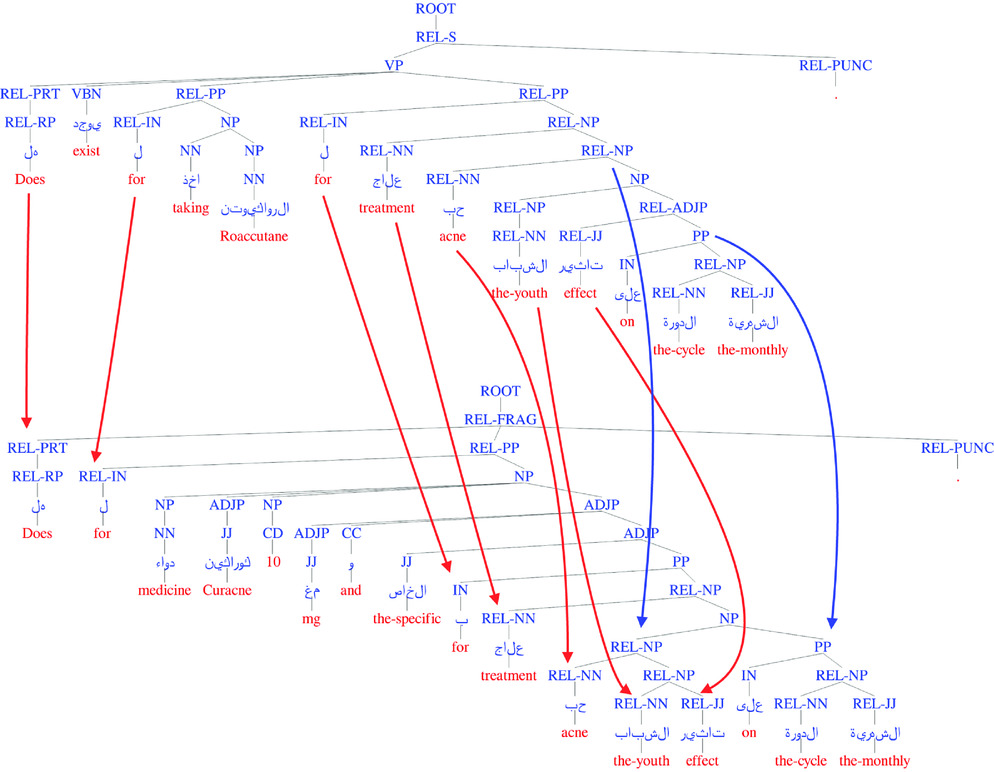
where ϕlex(q o, q s, a s) is the same as in SLS, while ϕtk(q o, q s) is a vector encoding the syntactic structure of the question pairs 〈q o, q s〉, e.g., as shown in Figure 5. Discussion on the use of such syntactic models can be found in Section 6.2 below.
Arabic trees of two questions connected by REL links.

As generating ϕtk(q o, q s) explicitly requires complex feature engineering, ConvKN opted for an implicit representation applying the following kernel to two general examples, 〈q o, q s, a s〉 and 〈q′o, q′s, a′s〉:
 \begin{equation*}
\begin{aligned} K\big (\langle q_{o},q_{s}, a_{s} \rangle, \langle q^{\prime }_o,q^{\prime }_s, a^{\prime }_s\rangle \big ) = \phi (q_{o},q_{s}, a_{s}) \cdot \phi (q^{\prime }_o,q^{\prime }_s, a^{\prime }_s)=\\
& = \phi _{\mathrm{tk}}(q_{o},q_{s}) \cdot \phi _{\mathrm{tk}}(q^{\prime }_o, q^{\prime }_s) + \phi _{\mathrm{lex}}(q_{o},q_{s}, a_{s}) \cdot \phi _{\mathrm{lex}}(q^{\prime }_o,q^{\prime }_s, a^{\prime }_s) \end{aligned}
\end{equation*}
where (TK is a tree kernel function)
 $$\phi _{\mathrm{tk}}(q_{o},q_{s}) \cdot \phi _{\mathrm{tk}}(q^{\prime }_o, q^{\prime }_s) = TK(t(q_{o},q_s),t(q^{\prime }_{o},q^{\prime }_s)) + TK(t(q_s,q_{o}),t(q^{\prime }_{s},q^{\prime }_{o}))
$$
This way, there was no need to extract explicit syntactic feature vectors from the text pairs. The function t(x, y) is a string transformation that returns the syntactic tree from the text x, enriching it with the REL tags (see Section 6.2) computed with respect to the syntactic tree of y. ConvKN used the Arabic Stanford Constituency Parser (Green and Manning Reference Green and Manning2010) for generating the syntactic tree for text x and a simple annotator to mark the tree nodes with the REL tags. The latter were added on the internal nodes each time a terminal node matches a word in the text y. The REL tags were then also propagated to the parent nodes (up to two levels up). See Figure 5 for an example. Finally, the ConvKN team used the partial TK by Moschitti (Reference Moschitti2006), which measures the similarity between trees.
RDI (Research Development International)
The RDI team developed a system (Magooda et al. Reference Magooda, Gomaa, Mahgoub, Ahmed, Rashwan, Raafat, Kamal and Al Sallab2016), which used (i) external corpora (EC) crawled from www.altibbi.com to compute the probability of 〈q s, a s〉 to be relevant to q o, (ii) a LM trained on the annotated CQA-MD dataset; and (iii) the Arabic Wikipedia to boost the weights of medical terms.
RDI did not use supervised learning for modeling the ranking function r, and thus there is no w. Instead, they model the function r directly, which is expressed by a weighted sum of three terms as follows:
 \begin{equation*}
\begin{aligned} r(q_{o},q_{s}, a_{s}) & = \alpha \times {\mathcal P}\Big ( {\phi (q_{o}) \cdot \phi ^{+}_{tf \times idf}(q_{s}, a_{s})},{\phi (q_{o}) \cdot \phi ^{-}_{tf \times idf}(q_{s},a_{s})}\Big )+\\
& + \beta \times \phi _{LM}(q_{o}) \cdot \phi _{LM}(q_{s},a_{s}) + \gamma \times \phi _{wp}(q_{o}) \cdot \phi _{wp}(q_{s},a_{s}) \end{aligned}
\end{equation*}
where α, β, and γ are parameters (tuned on the development dataset), which control the impact of each of the three components.
The first component is the relevancy probability of the candidate pair 〈q s, a s〉 computed by the function  ${\mathcal P}$Footnote 14 using the two scalar products,
 $\phi (q_{o}) \cdot \phi ^{+}_{tf \times idf}(q_{s}, a_{s})$ and
 $\phi (q_{o}) \cdot \phi ^{-}_{tf \times idf}(q_{s},a_{s})$, where
(i) ϕ(q o) is simply a binary vector representing the terms of q o;
(ii)
 $\phi ^{+}_{tf \times idf}$ is a TF×IDF vector of the terms in 〈q s, a s〉 with IDF values computed using a set of pseudo-positive QA pairs extracted from EC;Footnote 15
(iii)
$\phi ^{-}_{tf \times idf}$ is a similar vector as above but using pseudo-negative pairs from EC.


The second component is the scalar product of two embedding vectors, ϕLM(q o) and ϕLM(q s, a s), computed using the LM approach by Mikolov et al. (Reference Mikolov, Kombrink, Burget, Černocký and Khudanpur2011). The latter is applied to a corpus constituted by the candidate pairs, 〈q s, a s〉, augmented by the pairs 〈q o, a s〉, for each q o and its related q s in CQA-MD.
The third component is a scalar product between ϕwp(q o) and ϕwp(q s, a s), where the vectors are constituted by n-grams, whose weights are increased if they match terms in the medical categorization system of the Arabic Wikipedia. The set of used medical terms contains about 250,000 medical subcategories extracted from the main medical category. Matching unigrams has a weight of 1.5, whereas all the other matching n-grams have a weight of 2.
QU-IR (Qatar University)
This QU-IR system by Malhas et al. (Reference Malhas, Torki and Elsayed2016) only used word2vec representations, ϕw2v(q o, q s, a s), computed on (i) the concatenation of q o and q s, (ii) the concatenation of q o and a s, and (iii) the concatenation of q o and 〈q s, a s〉. These representations were used to build three different systems.
Note that, unlike all other teams, QU-IR used these embeddings in Multiple Additive Regression Trees and Random Forest algorithms for training different non-linear ranking functions r.
UPC_USMBA (Universitat Politècnica de Catalunya)
This team used a logistic regression classifier applied to word features derived with a term extractor, and 200 similarity features extracted from the Arabic text, after processing it with the Stanford Core NLP tools (El Adlouni et al. Reference Adlouni, Lahbari, Rodríguez, Meknassi and Alaoui2016). They also used semantically tagged medical terms classified with the categories: Body Parts, Diseases, and Drugs.
Finally, they translated the Arabic data to EnglishFootnote 16 to be able to apply English linguistic modules. Their final system is a combination of four classifiers: two using the Arabic text and two using the English translations.
4.3 System results
The participating teams used the training and the development data to train and to tune their models, and then applied them to the test set (the gold standard labels for which were not available to them). Each team was asked to make one primary submission (to be used for the official ranking), and was further allowed to submit one or two contrastive submissions. All teams but UPC_USMBA made three submissions.
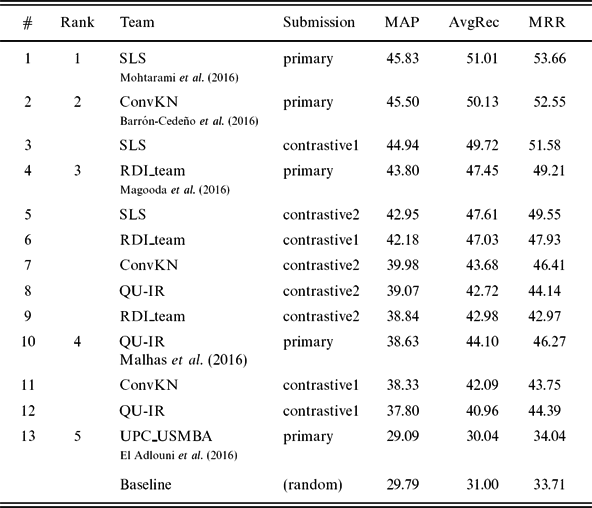
The evaluation results are shown in Table 2. They are ranked in terms of the official evaluation measure, MAP. The first column reports the absolute rank considering both the primary and the contrastive submissions, whereas the second column shows the official system rank in the competition, which is based on the primary submissions only. The columns from the third to the seventh report the team name, the type of submission (primary or contrastive), MAP, AvgRec, and MRR, respectively. The last row in the table reports the results for a baseline that puts the candidate QA pairs in random order.
Reranking the correct question-answer pairs for a new question: results for all submissions for SemEval-2016 Task 3

The first and the second columns show the rank with respect to the official MAP score of all and of the primary runs, respectively. The third and the fourth columns contain the team’s name and its submission type (primary vs. contrastive). The following columns show the corresponding ranking evaluation scores. All numbers are expressed as percentages.
We can see that the primary submission of SLS achieved the highest MAP of 45.83. This suggests that word n-gram similarity and word embeddings are quite important. Indeed, the analysis of Section 4.2 shows that SLS used embeddings more massively and in a more clever way compared to other participating systems. For example, contrastive 1 and 2 of ConvKN, which only used n-gram similarities (syntactic TKs and word embeddings are not used in these contrastive runs), are 6–7 MAP points below the primary submission of SLS, with a MAP of 38.33 and 39.38. Two other important factors for the success of SLS are (i) the use of only the best sentence of the question or answer text (instead of the entire text), and (ii) the use of a combination of four different types of text representations, i.e., all sentence words, all word lemmata, and two other representations where the words are filtered out using TextRank with two different parameterizations. The lemma representation seems to be the most effective as alone it yields a MAP of 44.94. In contrast, TextRank seems not to produce a better outcome (at least alone) as the system using it only achieved a MAP of 42.95.
Next, ConvKN, which used syntactic representation was ranked second with a MAP of 45.50, i.e., only 0.33 points lower than the top system, SLS. This is interesting as both contrastive submissions by ConvKN, which did not use syntactic information, achieved a MAP of only 39.98 or 38.33. These suggests that using syntactic information can yield an absolute improvement of 5.52 MAP points, which is about twelve per cent relative improvement. We speculate that if the SLS feature vectors were jointly used with the TK model of ConvKN, the resulting system would have outperformed the top system with a relatively high margin, e.g., 3–5 points.Footnote 17
Next comes RDI with a MAP of 43.80, which is very interesting as this team did not use any supervised learning algorithm. Their contrastive system 1 only used the Wikipedia module, ϕwp(q o) · ϕwp(q s, a s), achieving a MAP of 42.18, whereas the TF×IDF component that used an external corpus achieved a MAP of 38.84. These results suggest that the use of Wikipedia terms and additional external data can be used to boost both SLS and ConvKN,Footnote 18 which did not use such resources.Footnote 19
Next, QU-IR used basic embeddings, and thus may be compared with the contrastive results of ConvKN, which did not use any embeddings but basic similarity features only. The best MAP of QU-IR is 39.97, whereas the best of ConvKN with no syntactic information is 39.98. This observation may be useful to estimate the impact of using a different class of learning algorithms such as Multiple Additive Regression Trees or Random Forest algorithms. We note that the latter do not yield a boost with respect to the linear models used by ConvKN, i.e., linear models seem to be sufficient to get state-of-the-art results.
Finally, UPC_USMBA used many features extracted using the Stanford Core NLP.Footnote 20 Probably, the use of such a toolkit for Arabic language was not straightforward as the resulting system achieved a very low MAP of 29.09, which is lower than the random baseline of 29.79.
Note that the system rank would not change if we did the ranking not based on MAP but on some of the other two measures, MRR and AvgRec, which suggests that the impact of the features and models proposed by the participants is rather stable, i.e., a better system is built with respect to different viewpoints.
Another interesting note is the larger difference between SLS and ConvKN, which confirms that using syntactic information helps in solving more different cases (achieving a better MAP). In contrast, when word models are effective (for at least one candidate question in the rank they probably are), they are enough to rank the best QA pair on top. This is also suggested by the QU-IR result, which only used embeddings, and achieved an MRR much closer to that of the preceding system.
5 Studying system combinations
In this section, we experiment with combining the outputs of the thirteen submitted runs, in order to see what further improvement can be achieved by combining the strengths of several systems that use different features and different learning methods. The idea is that if the individual runs are complementary to some extent, their errors would be relatively uncorrelated, and thus we should be able to improve over the best individual system.
5.1 Measuring the potential of system combination
In this first experiment, we combine the first n systems, n ∈ {2, 3, . . ., 13}, as ordered in Table 2, in a meta-classifier. The combination approach is very simple: given an original question q o, we compute a score s(q o, q s, a s) for each QA pair 〈q s, a s〉, and then we sum these scores for the n systems being combined as follows:
 $$r(q_o, q_{s}, a_{s}) = \sum _{i=1}^{n} s_i(q_o, q_{s}, a_{s})
$$
where s i(q o, q s, a s) is the score for the ith system in the combination.
We experimented with three versions of s i(q o, q s, a s): (i) reciprocal rank, (ii) arithmetic rank, and (iii) min–max normalized score.
The reciprocal rank score is defined as follows:
 $$s_i^{\mathrm{rr}}(q_o, q_{s}, a_{s}) = \frac{1}{\mathrm{rank}_i(q_o, q_{s}, a_{s})}
$$
where ranki(q o, q s, a s) is the rank that the ith system assigned to the QA pair 〈q s, a s〉 with respect to the original question q o.
We also tried a scoring function based on arithmetic ranks, which do not decrease as fast as the reciprocal rank:
 $$s_i^{\mathrm{ar}}(q_o, q_{s}, a_{s}) = 1 - \frac{\mathrm{rank}_i(q_o, q_{s}, a_{s}) - 1}{30}
$$
but it did not improve over using the reciprocal rank.
We further tried a scoring function based on the actual numerical score, after min–max normalization:
 $$s_i^{\mathrm{sum}}(q_o, q_{s}, a_{s}) = \frac{r_i(q_o, q_{s}, a_{s}) - \min }{\max - \min }
$$
where r i(q o, q s, a s) is the score that the ith system gave to the QA 〈q s, a s〉, and min and max are the minimum and the maximum value of the scores it produced for all pairs 〈q s, a s〉 with respect to the original question q o.
Using this latter score yielded slightly worse results, probably due to the different systems operating on different scales when providing the real-valued scores, which the min–max normalization could not quite fix. In contrast, using the reciprocal ranks works as a simple scale-invariant calibration of the scores of the individual systems (Severyn et al. Reference Severyn, Moschitti, Tsagkias, Berendsen and de Rijke2014).
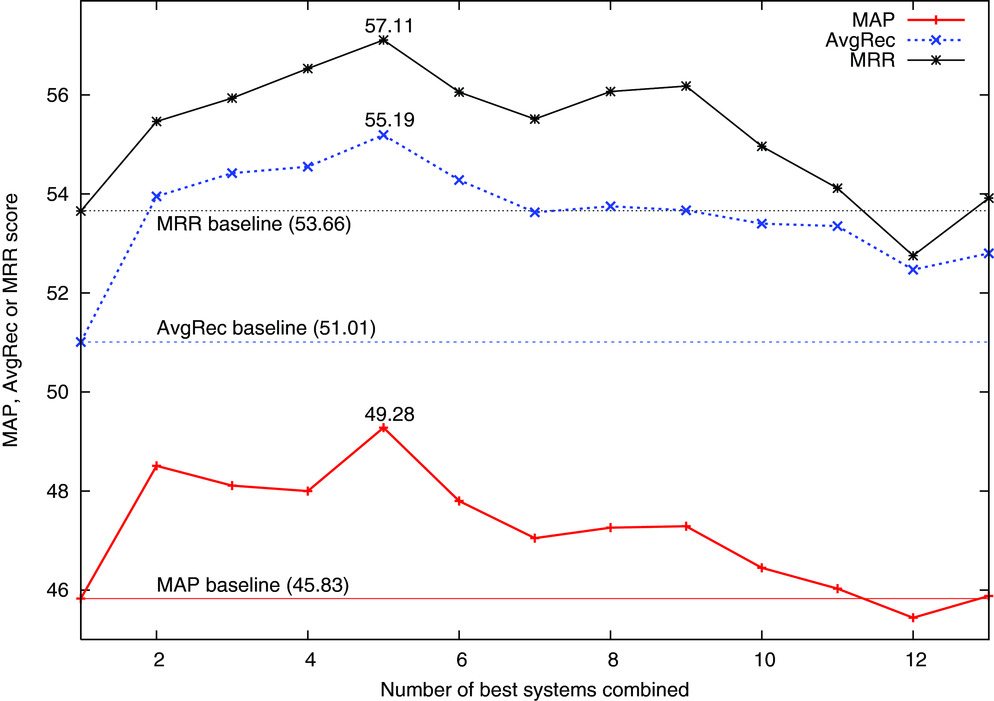
The results for this system combination using the sum of reciprocal ranks are presented in Figure 6. On the x-axis, we show the number of systems combined, and on the y-axis, we show MAP, AvgRec, and MRR scores. We also display, as the baselines for the comparison, the scores of the best individual system on each evaluation measure.
MAP, MRR, and AvgRec for the simple combination of thirteen systems outputs.

We can see that the best results are achieved when combining the top-five systems, where the improvements over the best individual system are sizable: over three points in terms of MAP and MRR, and over four AvgRec points, absolute. In most cases, the combined system performed better than the best individual system, which shows that there is clearly room for further improvement for the individual systems.
Note that this combination uses information about which system performs best in the test set when deciding which n systems to combine. Of course, this information would not be available in a real combination scenario. Consequently, we are not claiming that the best results from Figure 6 can generalize to unseen datasets. This experiment merely allowed us to show that the outputs of the systems are uncorrelated to the extent of allowing sizable improvements when combined appropriately. The next subsection deals with learning a more realistic meta-classifier.
5.2 Tuned combination
The systems that participated in the competition are obviously not equally good, and thus it might be a good idea to learn different weights for different systems. Therefore, we performed another experiment where: (i) we combined all thirteen systems rather than just the top n, (ii) we weighted the relative contributions of each system (we learned the best weights automatically using cross-validation), and (iii) we used both the system’s scores and the corresponding ranks as features (based on the three scores from the previous section).
In particular, we trained a meta-classifier with an SVM-based learning-to-rank algorithm (SVM-rank), which, given two QA pairs that answer the same question, predicts which pair is a better answer, i.e., should be ranked higher. We train and evaluate the model using five-fold cross-validation on the test set. As we do not have access to the individual systems that participated in the competition, we could not generate predictions for the training or for the development datasets. Thus, we opted for cross-validation on the testing dataset, which allowed us to compare our results to those of the participating systems, as well as to the results in the previous experiment. We extracted and used three features from each of the thirteen systems we were combining, namely the three scores from above  $s_i^{\mathrm{rr}}(q_o, q_{s}, a_{s})$,
 $s_i^{\mathrm{ar}}(q_o, q_{s}, a_{s})$, and
 $s_i^{\mathrm{sum}}(q_o, q_{s}, a_{s})$ for each system i. This yields 13 × 3 = 39 features, to which we further add three more features, namely the sums of each of the three scores, calculated over all thirteen systems that are being combined.
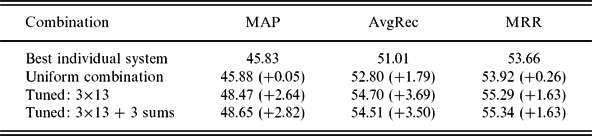
The results are shown in Table 3. The first two lines show baselines: the best individual system, and the simple uniform combination for all thirteen systems from before. The following lines show the results for the tuned combination using (a) the 3×13 features only, and (b) the 3×13 features plus the three sums. We can see 2.5+ points of absolute improvement in terms of MAP, 3.5+ in terms of AvgRec, and 1.5+ in terms of MRR (the three extra sums seem to have minor effect overall).
Results from the tuned system combination experiments

Overall, the results of the above two experiments show that the systems provide uncorrelated scores and rankings, which are in turn based on potentially uncorrelated features and learning algorithms, and thus that there is a large space for further improvement, i.e., the task is far from being solved.
6 Further analysis
In this section, we take a closer look to the output of the systems that participated in SemEval-2016 subtask D. The aim is two-fold: (i) we want to have some more qualitative information about the capabilities and the limitations of the state-of-the-art systems, and (ii) we want to learn important tips for improving them, thus enabling better cQA for Arabic in the future.
The section is divided in two parts. The first part contains manual analysis of the most challenging examples for the participating systems, i.e., examples that were ranked wrongly by most systems. The second part is manual analysis studying the usefulness of syntactic information for the task. In this case, we analyze and compare the results of our ConvKN system (Barrón-Cedeño et al. Reference Barrón-Cedeño, Bonadiman, Martino, Joty, Moschitti, Al Obaidli, Romeo, Tymoshenko and Uva2016), which uses TKs to compare the original question with the related question–comment pairs, to the other systems that participated in the challenge.
6.1 Analysis of difficult cases
We manually analyzed some examples that were especially hard for the individual systems. In order to select the examples, we divided the test cases into positive (i.e., Direct or Related QA pairs, according to the gold standard annotation) and negative (i.e., Irrelevant QA pairs, according to the gold standard). We then sorted all test examples in the positive and in the negative sets by a measure of difficulty, and a native speaker of Arabic who has strong linguistic background studied the top twenty examples in each list. The difficulty measure for a particular example is simply the number of systems, from the set of thirteen in Table 2, that got it wrong. Note that this is not a classification task but a ranking task. Thus, ‘getting a positive example wrong’ means that the system ranked it too low in the list of thirty QA candidates. For a negative example, it is just the opposite, i.e., the system ranked the example too high. The position in the rank that defines the border between low and high is the number of positive examples, according to the gold standard, in the set of thirty QA candidate pairs.
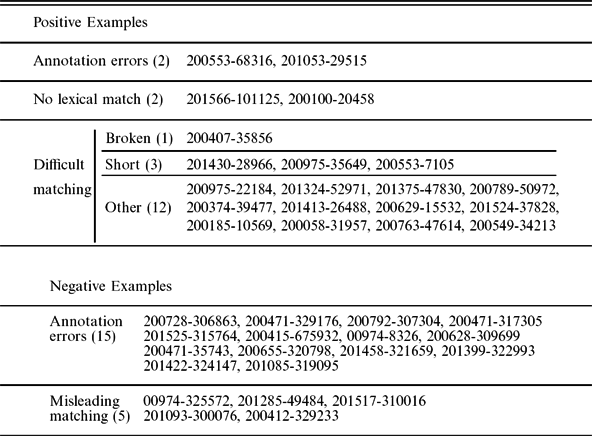
We conducted the analysis separately for the two sets below. For completeness, Table 4 (in appendix) contains the list and the classification of all positive and of all negative examples that we manually analyzed in this study.
IDs of the most difficult examples that were manually analyzed. They are grouped according to the discussion in Section 6

On the positive examples
Annotation errors:
Two out of the twenty examples were ranked low in the rank by all systems because they were indeed negative examples, i.e., they were mistakes by the human annotators that were not detected during the creation of the corpus. It is well known that exploring extreme examples, e.g., those wrongly classified by all systems, can help identify some of the annotation errors in corpora and, thus, it can be a good tool for corpora cleaning.
No lexical overlap:
Two more examples were very challenging for the systems, as they presented no lexical overlap between the two questions and the answer, regarding content words (including derivational and morphological variations). In these examples, making the connection between the original question and the related QA pair requires semantic inference beyond simple synonymy detection, e.g., by connecting parts of the body with certain diseases or symptoms, by connecting technical terms with layperson’s terms to refer to the same medical concept, etc. For the current systems to be able to handle these examples properly, they would probably need more domain knowledge and more structured language representation. In principle, the embedded representations of the texts, computed by the best systems, could help bridge the lexical gap by uncovering such types of semantic relatedness from different words. We speculate that the main reasons for the failure are (i) the limited amount of data available to train the word embeddings, and (ii) the fact that the text representations were simply an aggregation of the word-based representations. Luckily, the number of examples in this category turned out to be low.
Difficult matching:
In the remaining sixteen cases, one can observe some direct relations between the texts of the two questions and the answer, at the level of content words. In principle, identifying them correctly should be within reach for the current systems. However, there are a number of factors that obscure these relations. For instance, one concrete example contains broken text with several control characters. This makes it impossible for the systems to identify and to represent the words correctly. Another three examples contain unusually short answers, which are also very uninformative (e.g., ‘consult your doctor’ or ‘answered before’). For the remaining twelve examples, a diversity of phenomena are observed to various degrees, which could explain why the systems had difficulties ranking them correctly. Among others, we can mention the lack of punctuation, pervasive spelling mistakes, words and expressions written using dialectal Arabic, unknown words, etc. All these factors affect the quality of the linguistic processing of these texts, e.g., syntactic parsing, which in turn affects the representation and the inference process to assess the semantic relatedness between the original question and the QA pair. See, for instance the following example, which contains a variety of such problems:
q 0:
q 0: Is it possible for a woman who suffers from Turner Syndrome to be pregnant with the aid of advanced technology nowadays
q s:
q s: Peace be upon you my dear doctors. . . . . Is there any treatment for Tur ner Syn drome (‘Turner Syndrome’ broken with some special control characters,
) and is there anything (dialectal writing, ) for lengthening tallness other than hormone needles (spelling mistake, ). . . and whether extra weight affects these needles please (spelling mistake and no punctuation, ) reply and if there is any advice (no punctuation) age 13 tallness 143 weight 65—any advice and thaaanks (repeated characters for sound effects)


On the negative examples
Negative examples that were systematically ranked high by all systems were more rare. The number of positive examples in the list of thirty related QA pairs is much smaller than the number of negative cases for the development and the testing datasets, thus having all systems ranking a negative example above this number is really an extreme situation. Indeed, from the twenty selected cases, fifteen were actually annotation errors, i.e., examples that should have been annotated as Related instead of Irrelevant. The remaining five cases were truly difficult as for them there was obvious lexical and conceptual overlap between the original question and the QA pair, but the main topic of the question was not really covered in the QA pair. The systems got confused by the apparent relations at the lexical level, and failed to understand that the new question and the QA pair were about different things. For instance, in one case the original question asked about the treatment for a particular disease, and the QA pair elaborated on the difference between that disease and another one. In another question, the user asked about a treatment for a particular type of depression, while the related question is about a case of social phobia that can bring associated depression symptoms. The answer by the doctor discusses the social phobia problem, but it brings the depression into play, which might be the reason that the systems got confused. See an extended version of this example below:
q 0:
q 0: The diagnostic showed that my husband has partial depression (Dysthymia), and he has had treatment for two months or slightly more using Cipralex. . . (a long question)
q s:
q s: Peace be upon you. I suffer from social phobia and I went to a specialized doctor in behavioral treatment. . . (a long question). . . and sometimes I have depression so what do you think and does social phobia have a treatment
a s:
a s: In the name of God. . . (long greeting and introduction): Regarding behavioral treatment, it has many types. . . (a long description). . . this bad behavior if it was a fear, worry, or even depression is. . .


Discussion
The above manual analysis suggests a number of possible directions for future work aiming to improve Arabic cQA in general. First, it seems that some data cleaning is needed on the SemEval-2016 Arabic datasets as we have identified several cases of noise in the class labels.Footnote 21 Some semi-automatic procedures could be applied to identify the most likely errors and to concentrate the revision efforts on a potentially smaller dataset.
More importantly, we have several identified opportunities for improving the cQA systems in the future. Of course, they are related to the challenges described in Section 3.2 on the SemEval-2016 Arabic datasets, and they represent different levels of difficulty:
• Pre-processing and linguistic analysis should be more robust to face ungrammaticality (lack of punctuation, typos, etc.) and the use of informal language and dialectal Arabic. Reducing the number of unknown words is crucial to get meaningful representations of the texts.
• The questions and the answers in this dataset are very long (e.g., verbose greetings and introductions, long and detailed stories, etc.). The fragments that are really relevant to establish the semantic relations between texts are usually small compared to the full texts. Some focus mechanism is needed in order to concentrate on the important parts and to filter out the irrelevant. This has been the focus of research of some work on English cQA already (Lei et al. Reference Lei, Joshi, Barzilay, Jaakkola, Tymoshenko, Moschitti and Màrquez2016; Barron-Cedeno et al. Reference Barron-Cedeno, Da San Martino, Moschitti, Romeo, Belinkov, Glass, Mohtarami, Hsu and Zhang2016; Da San Martino et al. Reference Da San Martino, Romeo, Moschitti and Barrón-Cedeño2016) and more recently on Arabic (Romeo et al. Reference Romeo, Da San Martino, Belinkov, Barrn-Cedeo, Eldesouki, Darwish, Mubarak, Glass and Moschitti2017).
• Establishing the right semantic connections between questions and answers requires the systems to improve on (i) text representation, in order to identify concepts linked by different expressions; and (ii) language understanding and reasoning at the discourse level, in order to tell whether two texts that are related at the superficial level are really discussing the same topic. The former could be at reach by using more structured domain knowledge representations (diseases, symptoms, body parts, side effects, etc.) or by training more informed specific text embeddings. The latter is much more challenging, as it is at the core of language understanding.
6.2 Contribution of syntactic information
The system results presented in Section 4.3 showed that ConvKN can improve the basic accuracy of word features by 5.52 MAP points using syntactic information (see rows 2 and 7 in Table 4.3). In this section, we analyze and provide an explanation of such remarkable impact on the reranker. For this purpose, we studied correct examples that were ranked in the top position by ConvKN when using TKs, i.e., using the ϕbow(q o, q s, a s) + ϕtk(q o, q s) representation and, at the same time, ranked low by the ConvKN basic system, i.e., ϕbow(q o, q s, a s), which corresponds to the ConvKN Contrastive 1 submission.
Below, we present an example in which the related question q s is correctly ranked on top by ConvKN, but very low by ConvKN contrastive 1(rank position 21). This is the same example displayed in Figure 5

At first glance, the example would not look complicated to be solved with standard BOW-based approaches using lexical similarities, as the two questions share several terms: treatment, acne, effect, monthly, cycle, etc., i.e., all non-stop words are matched except for Roaccutane and Curacne. However, the number of question/answer pairs these words occur in (a sort of document frequency) are very high:  (treatment) 5,996 occurrences,
 (acne) 372,
 (youth) 349,
 (cycle) 4,757,
 (monthly) 3,435, and
 (effect) 841, also relatively to the total number of pairs, i.e., 30,411. Therefore, according to the fundamental findings in IR regarding the low indexing capacity of highly frequent terms, they produce low similarity scores, which are not enough for the ranker to assign a higher position to such an example.
Basically, the learning algorithm will observe that such features have high score for both positive and negative examples, which would preventing it from learning useful model parameters from such examples. In contrast, a syntactic approach can intuitively measure the example similarity in terms of the syntactic structure of the two questions, thus creating precise patterns that can detect the difference between two potentially related questions. In particular, the algorithm can find specific patterns in the related questions that are distributed differently between positive and negative examples even if the terms are uniformly distributed. In the following, we explain in more detail the syntactic model used by ConvKN, analyzing the patterns it can capture to better support our hypothesis above.
Why the syntactic model works
As stated before, Figure 5 shows the syntactic trees of the original and the candidate questions discussed in the previous subsection. These parse trees are automatically obtained with the Stanford Arabic syntactic parser. The red arrows indicate a matching between words from the two questions (e.g., Does, treatment, or effect), whereas the blue arrows are drawn to connect entire noun phrases or clauses that are partially matched (e.g., REL-NP, REL-PP). The labels of these tree constituents are augmented with the prefix ‘REL-’ to mark the connection between the syntactic trees. The two syntactic trees with the links between words and constituents form a directed acyclic graph.
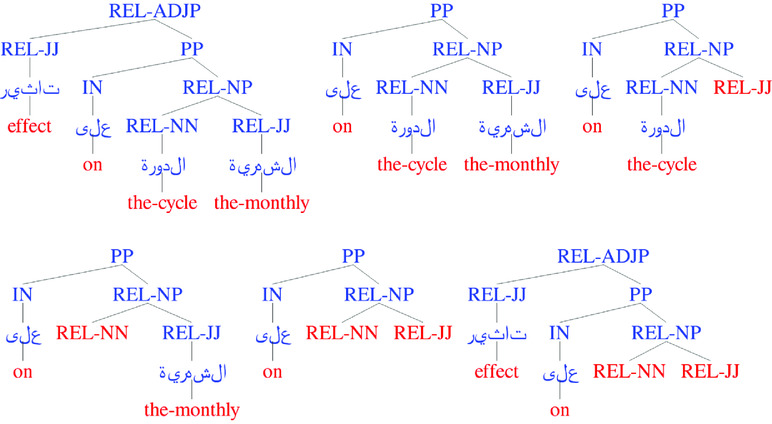
Graph kernels (Vishwanathan et al. Reference Vishwanathan, Schraudolph, Kondor and Borgwardt2010) can measure the similarity between the graph in Figure 5 and any other graph from the training or test pairs. Thus, the kernel can use any subpart of the graph as rich, structured features, e.g., the lexico-syntactic patterns in Figure 7. Note that the structures that result from removing the lexical nodes, as well as any subtree, are more general patterns that are also used by the graph kernel as features. The more general structures help generalize the features, and provide the kernel-based learning with a back-off mechanism, from specific to more general features.
Some patterns extracted from both parse trees of Figure 5: any pair of such fragments is a pattern for a pair of questions.

These structurally-rich features are rather useful to solve the problem of high frequency terms, which are not handled correctly by the non-syntactic version of ConvKN. For example, the following question, which is unrelated to our q 0:
q s:
q s: The question peace be upon you and God’s mercy and blessings. I have read many consultations related to what’s called hirsutism. I suffer from the same problem but lightly. . . But I don’t suffer from acne and my monthly cycle is regular. Please advise for any treatment and thanks

match many terms of q o and q s but they do not have the same syntactic patterns and thus according to the syntactic models are different.
It should be noted that, as explained in Section 4.2, the kernel we used is not a graph kernel, it is a summation of separate TK applied to the original and candidate trees, respectively. We applied this solution because TKs are much more efficient than graph kernels, which are computationally too expensive in our problem setting. As shown in related work on question answering, the ‘REL-’ extended labels can work as a good surrogate of the red and blue edges connecting the two trees in the graph (Severyn and Moschitti Reference Severyn and Moschitti2012, Reference Severyn and Moschitti2013; Tymoshenko and Moschitti Reference Tymoshenko and Moschitti2015). These labels can signal when a node is connected to another node. Although this information does not entirely replace the graph edges between trees, it has been shown to be rather effective. Additionally, TKs were shown to outperform the approximate versions of graph kernels that can be applied in practice, such as incomplete graph kernels (Filice, Da San Martino and Moschitti Reference Filice, Da San Martino and Moschitti2015).
Robustness of the syntactic model
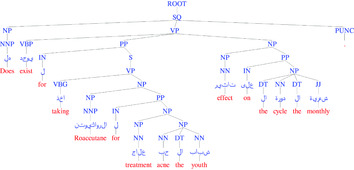
One common concern arising when parsing Web text is the robustness of the parser. Clearly, non-conventional and disfluent language can impact the parser performance dramatically. Indeed, the syntactic trees shown in Figure 5 are only partially correct. For example, the syntactic tree for q o should look like the tree depicted in Figure 8.
Correct parse tree of the question q o in Section 6.2. Compare with the incorrect upper tree in Figure 5.

The main reason for the parser to fail was: (i) the informal language used by the forum users, and (ii) the flexibility of Arabic grammar, which allows free word order. In particular, the word effect, which in English would have been placed close to the auxiliary does, occurs far from it. This makes detecting the syntactic dependencies with the word effect very challenging. Indeed, the dependency was mistaken for both questions, q o, and q s.
The last observation is important as it suggests that the same types of difficult cases, probably occurring in similar sentences, tend to generate the same types of incorrect parse trees. Systematic errors can be still useful for a kernel model as they correspond to patterns that can correctly discriminate related versus unrelated questions. In the example above, effect is mistakenly connected with youth acne, leading to the wrong phrase ‘youth acne effect’, in both trees. Still, the fact that the error is repeated in both trees helps the algorithm to establish that such questions are related. In other words, the syntactic approach used with TKs, which explore all possible patterns, is also rather robust: (i) among many patterns, the learning algorithm can select those that are useful for characterizing positive versus negative examples, and (ii) even if the patterns are not exactly those observed in correct parse trees, the approach is still able to use the information from partially correct parse trees, as similar errors tend to generate similar structures.
7 Conclusion
We have presented an in-depth analysis of resources and models for enabling Arabic cQA, focusing on CQA-MD, a community question answering corpus for Arabic in the domain of medical forums, and on a shared task at SemEval-2016, which used that corpus. We analyzed the systems that took part in the shared task, their features and learning algorithms, and we demonstrated with a meta-classifier that they are largely complementary, thus showing that there is large room for additional improvement. We further analyzed the corpus, which resulted in a critical discussion of what makes the task of cQA for Arabic hard in general (e.g., mixing informal and formal language, use of different Arabic dialects, etc.), and in the medical domain in particular (e.g., use of English, of complex terminology, or of layman’s words to describe a complex medical term).
Moreover, we performed a careful analysis of the most frequent errors common to all systems, categorizing them into prototypical cases, and zooming into the way syntactic information in the TK approach can help solve some of the difficult cases. We believe that our analysis and the lessons learned from the process of corpus creation as well as from the shared task analysis will be helpful for future research on Arabic cQA. In future work, we plan to verify and to clean up some potentially wrong annotations in our corpus based on our analysis above, and based on the failed predictions of multiple independent classifiers, e.g., with cross-validation. We also want to explore the retrieval of potentially related questions and answers, especially on the query formulation given the input question (Monz Reference Monz2011).We further plan experiments with Direct and Relevant answers split into separate classes. Moreover, we would like to combine various information sources in the form of features directly, in a single model, as opposed to using a meta-classifier.
Moreover, given the recent success of deep neural networks, which largely eliminate the need for manual feature engineering, we are interested in exploring various deep neural network architectures, e.g., based on LSTMs, GRUs, CNNs, RNMs, etc., as well as various ways to generate high-quality word embeddings (Mihaylov and Nakov Reference Mihaylov and Nakov2016b) and goodness polarity lexicons (Balchev et al. Reference Balchev, Kiprov, Koychev and Nakov2016; Mihaylov et al. Reference Mihaylov, Balchev, Kiprov, Koychev and Nakov2017), e.g., as was done for SemEval-2016 Task 3 for English. We would also like to compare side-by-side deep neural networks to convolutional syntactic kernels, and to investigate ways to combine them. Furthermore, given the complexity of the questions, we plan to try decomposing them into simpler subquestions, similarly to (Boguraev et al. Reference Boguraev, Patwardhan, Kalyanpur, Chu-carroll and Lally2014). Another promising direction is to apply summarization techniques (Tigelaar et al. Reference Tigelaar, Akker and Hiemstra2010), which could be useful both for the model and when presenting the results to the user. This might involve determining which among several good answers to the target question is the most cooperative one, i.e., correct, useful, and non-misleading at the same time (Mendes and Coheur Reference Mendes and Coheur2013).
Furthermore, given the abundance of data for English, we would like to try cross-language approaches (Chew et al. Reference Chew, Bader, Helmreich, Abdelali and Verzi2011; Da San Martino et al. Reference Da San Martino, Romeo, Barrón-Cedeño, Joty, Màrquez, Moschitti and Nakov2017; Joty et al. Reference Joty, Nakov, Màrquez and Jaradat2017), combining English and Arabic data for both training and testing. Finally, given the recent proliferation of false information online, it might be worth trying to verify the factuality of the answers given in a cQA forum (Karadzhov et al. Reference Karadzhov, Nakov, Màrquez, Barrón-Cedeño and Koychev2017; Nakov et al. Reference Nakov, Mihaylova, Màrquez, Shiroya and Koychev2017b; Mihaylova et al. Reference Mihaylova, Nakov, Màrquez, Barrón-Cedeño, Mohtarami, Karadjov and Glass2018), as well as detecting potential forum trolls (Mihaylov et al. Reference Mihaylov, Georgiev and Nakov2015a, Reference Mihaylov, Koychev, Georgiev and Nakov2015b; Mihaylov and Nakov Reference Mihaylov and Nakov2016a; Mihaylov et al. Reference Mihaylov, Mihaylova, Nakov, Màrquez, Georgiev and Koychev2018).
Appendix
Table 4 shows the IDs of the most difficult examples that we manually analyzed (cf. Section 6). They are split into the Positive set (low-ranked ‘D’ or ‘R’ examples) and Negative set (high-ranked ‘I’ examples). The IDs contain the original question ID and the related question-answer pair, separated by a dash symbol. They are grouped according to the discussion in Section 6. Within each group, they are sorted in decreasing order of difficulty. The complete examples can be downloaded from the SemEval-2016 Task 3 website.Footnote 23