Introduction
The impact of social structure on politics is one of the classic topics of political science. It dates back to Aristotle's reflections on the role of social divisions for the stability of Greek polities. The influence of social characteristics on voting has also been on the agenda of electoral research from the outset. A common assumption in the study of comparative politics up to the 1960s was that social characteristics such as class, religion, regional and ethnic identity are major antecedents of the voting decision in Western Europe. Thus, when Lazarsfeld, Berelson, and Gaudet stated in 1948 that “a person thinks, politically, as he is, socially. Social characteristics determine political preference,” it rang true, especially for Western Europeans.1
Lazarsfeld, Berelson, and Gaudet 1968, 27.
West European parties were often perceived as representatives of certain social strata or interest groups. Social democratic, socialist, and communist parties, for example, were perceived as representing the industrial working class.2
On the other side of the coin, the support of parties by certain social groups was taken for granted. It was assumed, for example, that British workers would rather vote for the Labour Party than for the Tories, while French workers would rather vote for the Parti socialiste or the Communists than the Gaullists. Such commonplace assumptions became standard examples in works on the philosophy of the social sciences.3See for example, Hollis 1994.
Nevertheless, this socio-structural perspective on politics has become outmoded in recent decades. Instead, the finding of Franklin et al. that “almost all of the countries we have studied show a decline during our period in the ability of social cleavages to structure individual voting choice” has acquired the status of a “new conventional wisdom.4
That the earlier stabilizing power of social cleavages has been weakening is now a widely accepted explanation for the increased volatility of electoral results of West European countries.5Dalton 2002a,b; Kriesi 1998; Lane and Ersson 1997; Dogan 1995; Dalton and Wattenberg 1993; Franklin et al. 1992; Dalton, Flanagan, and Beck 1984.
Lane and Ersson 1997.
de Graaf, Nieuwbeerta, and Heath 1995; Nieuwbeerta 1996; Inglehart and Rabier 1986; Inglehart 1984; Dalton 2002a.
Dalton 1984.
Dogan 1995, 536.
The article is organized as follows. In the next section, I argue that even if changes in the relation between class or church attendance on electoral behavior can be observed, it cannot be ruled out that they are attributable to political rather than societal transformations. Then follows a section that considers the empirical evidence regarding changes in the impact of class and church attendance on electoral behavior. I show that although the impact of class has been in decline at least in some of the countries under study, the impact of church attendance has been almost stable. In the next two sections I argue that neither cognitive mobilization nor value change—although important factors according to the “new conventional wisdom”—can adequately explain the observable changes in class voting. Against this backdrop, I conclude that a further decline of social cleavages cannot be taken for granted and that political factors may be accountable for the changes in the structures of electoral behavior in Western Europe.
The Nature of Social Cleavages in Electoral Behavior
Social cleavages have long been viewed as a stabilizing force of electoral outcomes—an influence independent both of parties and of individual voters.11
Rose and Urwin 1969
Franklin et al. 1992, 10, emphasis added.
Lipset and Rokkan 1967.
Ibid., 50
Ibid., 54, 55.
Ibid., 51. For an extensive discussion of Lipset and Rokkan's “freezing hypothesis”, see Mair 1999; Lybeck 1985
While taking the Lipset-Rokkan account as their point of departure, authors like Franklin et al. have a quite different notion of the role of social cleavages. They understand cleavages as “reflecting broadly based and longstanding social and economic divisions within society, and the cleavage structure is thought of in terms of social groups and of the loyalties of members to their social groups.”17
Franklin et al. 1992, 4.
A necessary condition for the existence of a social cleavage in voting behavior is that members of the groups delimited by a social division share characteristics that may become politically relevant. But such a condition may also be satisfied if government policies affect different groups in different ways. For example, cuts in welfare expenditures may specifically harm unskilled workers, who may be more at risk of unemployment than are professionals and managers. But if that is the case, then the electoral relevance of cleavages will depend on the extent to which parties differ regarding the support they give to such policies. Indeed, there have long been systematic differences in this respect between parties from different party families.18
Social democratic parties have typically supported the expansion of welfare states, while liberal and conservative parties (in the European sense) have advocated limitation on welfare expenditures. In so far as party policies conform to the interests of certain social groups, one may say that parties represent these groups, and this conformity may have existed since these parties were founded. This does not imply, however, that parties are constrained to such a degree as to prevent their adaptation to changing societal environments. Quite the contrary. It is a matter of choice for parties either to limit their electoral appeal to their original constituencies or to compete for newly emerging groups of voters. Programmatic changes in social democratic parties after World War II show clearly that they are able to make such choices.19The adoption of the “Godesberger Programm” by the German SPD in 1959, which ended the Marxist orientation of the party, is a notable example, as is the transformation of the British Labour Party to “New Labour” under the leadership of Tony Blair. See also Przeworski and Sprague 1986; Kitschelt 1994.
Thus, one finds at least two variant views on the role of social cleavages in the relevant literature. For Lipset and Rokkan, the origins of party systems from social cleavages of the past serve as a constraint on contemporary party competition. Accordingly, changes in the social structure of contemporary countries may lead to a decline in the electoral relevance of anachronistic social cleavages. Indeed, Lipset24 is one of the supporters of the general decline thesis of class cleavages.20
For Franklin et al., social cleavages are mainly structures of group loyalty. Processes of individualization erode group loyalties, while the success of democratic governments in solving social conflicts tends to blur group divisions.21Franklin et al. 1992, 421.
Ibid., 390.
Social Cleavages and Party Preferences of European Voters: Persistence or Change?
Although Lipset and Rokkan enumerate four different lines of cleavage—the church/state, center/periphery, urban/rural, and owner/worker lines of cleavage—this does not mean that all four types of social cleavages are present in all West European countries. Only the owner/worker line of cleavage has been more or less uniformly present in European party systems. It has become manifest in the competition between labor and all other “bourgeois” parties.23
Lipset and Rokkan 1967, 35.
The remaining lines of cleavages were present during the formation of party systems and mainly prior to the enfranchisement of larger portions of the population.24
Ibid., 35
See e.g., Madeley 1991.
According to Lipset and Rokkan, the expression of social cleavages in party systems is essentially dichotomous. Class cleavages pit labor parties against all other “bourgeois” parties, while religious/secular cleavages set Christian and conservative parties against the remaining parties. On the level of individual voters and their membership in social groups, social cleavages are not strictly dichotomous, but allow for ambiguous positions. For example, class cleavages pit wage-earning manual workers against the self-employed and the service class or salariat, whose members enjoy career opportunities and delegated entrepreneurial discretion and authority over rank-and-file employees and workers.26
See Goldthorpe 1982, 1995. Many earlier studies on class voting are based on a dichotomous class schema, which lumps together routine non-manual, management, and self-employed occupations into a broad “white collar” category. Such a dichotomy may, however, lead to erroneous diagnoses of a decline in class voting if the composition of this “white collar” category changes over time. See Korpi 1974, Heath, Jowell, and Curtice 1985, Nieuwbeerta 1996.
If social cleavages really have become irrelevant for electoral behavior, one will not be able to find any systematic differences between voters from various social groupings with respect to their support for “cleavage-based” parties or party families, that is, for labor parties (social democratic, socialist, and communist parties) or for Christian (denominational and Christian democratic) and conservative parties. In Western Europe, however, this is clearly not the case, as demonstrated in figures 1 and 2.27
The data come from the Eurobarometer, a series of general social surveys conducted on behalf of the Commission of the European Union since 1973. These surveys are especially designed to track over time developments of political attitudes in Western European publics. The seven countries considered in figures 1 and 2 and in the following analyses are those that have been included in the Eurobarometer since its inception in 1973. Details on the surveys and variables used in this article can be obtained from the supplementary material on the author's website (http://webrum.uni-mannheim.de/sowi/elff/) and from the Eurobarometer websites (European Commission: http://ec.europa.eu/public_opinion/; ICPSR: http://webapp.icpsr.umich.edu/cocoon/ICPSR-SERIES/00026.xml; GESIS: http://www.gesis.org/en/data_service/eurobarometer/). Major parts of the pooled data set used in the analyses of this article were compiled by the author during his work on the research project “Political Interest, Engagement, and Affect” at the Mannheim Center for European Social Research (MZES) funded by the German Research Foundation (DFG Grant DE 630/2-1),), see van Deth and Elff 2004. The author thanks Jan W. van Deth, the director of the research project, for allowing to use the data in this publication. Further thanks go to Evi Scholz for assistance in obtaining the data and Peter Kotzian for assistance in constructing the pooled data set.
In four of the seven countries, a majority of the manual workers supported labor parties at the turn of the millennium (see figure 1). In that respect, manual workers differ clearly from the two “bourgeois” classes, the salariat (employed professionals and managers), and the self-employed. The difference in support for labor parties between manual workers and the salariat and the self-employed is at least twenty percentage points in most countries. These differences are both substantial in size and highly statistically significant. Clearly, class cleavages should not be written off as a major factor for voting behavior in European countries.28
All these differences are statistically significant, even if with control variables such as education, income, and gender are taken into account.

Class and support for labor parties, 1995–2002
Even more striking are the differences between voters that reflect religious-secular cleavages (see figure 2). In the 1990s, up to sixty percent or even more of those who attend church at least once a week supported Christian (denominational and Christian democratic) or conservative parties. In the Netherlands, three out of four voters who regularly attend church intend to vote for one of the Dutch denominational or Christian democratic parties. On the other hand, in all seven countries except Great Britain, no more than every fifth, in Belgium and in Italy no more than every tenth, of those voters who never go to church intended to support Christian or conservative parties. The difference between these two groups of voters is some forty to sixty percentage points in five of the seven countries. While one finds lower, but still marked inter-group differences in Denmark, Great Britain seems to be a deviant case with respect to religious/secular cleavages. In contrast to other countries, support for the conservatives is the highest in the middle category, while regular churchgoers' support for the conservatives is only seven percent higher than that of the non-churchgoers. However, given the history of church/state relations in the United Kingdom, the weakness of the religious/secular cleavage is not particularly surprising.29
The opposition between Conservatives and Liberals and British Labour is not so much an expression of cleavages between secular or Protestant nation-building elites and the trans-national Catholic Church as in much of continental Europe, but of a cleavage between an established church and non-established churches, see Madeley 1982, but also see Kotler-Berkowitz 2001. That many of those who attend church weekly are working-class Irish immigrants may also be conducive to this result. All differences in figure 2 are statistically significant, with or without controlling for education, income, and gender.

Church attendance and support for Christian and conservative parties, 1990–1994
That social cleavages are still relevant for electoral behavior does not preclude their decline. Indeed, class cleavages have undergone a decline in some countries during the last couple of decades, as shown in figures 3 and 4. But the trends in percentage differences in these figures are ambivalent with respect to the claim that a general decline of class voting has occurred. First, class cleavages seem to be stable in Belgium, with manual workers failing to become more similar to either the salariat or to the self-employed (with respect to the support for labor parties). Neither a statistically significant trend in the respective percentage differences nor in the respective log odds-ratios can be found for this country (see table 1). Only the expected value of the difference between self-employed and manual workers in France, and only the expected value of the difference between the salariat and the manual workers in Great Britain has declined by more than twenty percentage points. Furthermore, there is no statistically significant downward trend in the difference between manual workers and the self-employed in Italy, while in the Netherlands, the rather slight decline in percentage differences between the salariat and the manual workers fails to attain conventional levels of statistical significance. On the other hand, in Denmark, the decline of the percentage difference between manual workers and the salariat is staggering; from the mid-1970s to 2003, on average it amounts to almost forty percentage points.

Class differences regarding the support for labor parties, working class versus salariat 1975–2002

Class differences regarding the support for labor parties, working class versus self-employed, 1975–2002
Class and support for labor parties, 1975–2002

With regard to a decline in class cleavages, the glass appears to be either half-full or half-empty.30
A referee of an earlier version of this article has pointed me to this interpretation.
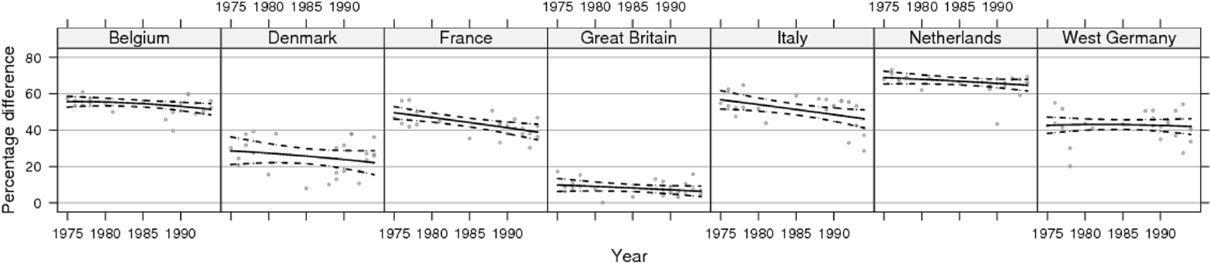
An examination of trends in religious/secular cleavages results in a less ambivalent conclusion. In some of the countries electoral divisions along religious/secular cleavages are not only larger than along class cleavages, but in general they are also more stable. Although statistically significant downward trends of the odds ratios are found in Denmark, France, and the Netherlands (see table 2), the corresponding decline of the corresponding percentage differences are negligible (see figure 5). Only France shows an unambiguous downward trend in terms of both odds-ratios and percentage differences. Italy shows a decline of percentage differences between regular churchgoers and non-churchgoers, but no statistically significant trend in the odds ratios. The support for the Democrazia Cristiana seems to show an overall downward trend. But as support among non-churchgoers was already very low, it cannot have declined as much as it has among regular churchgoers. Thus, the decline in percentage differences found in figure 4 seems to be the result of a bottom effect.

Differences between weekly churchgoers and non-churchgoers regarding the support for Christian parties, 1975–1994
Church attendance and support for Christian and conservative parties, 1975–1994

It is ironic that despite the turmoil in the Dutch party system in the early 1970s and in the Italian party system in the 1990s, religious/secular cleavages appear quite stable. In the Netherlands, the three major denominational parties, the Anti-Revolutionaire Partij, the Christelijk-Historisch Unie, and the Katholieke Volkspartij merged into the Christen Democratisch Appel. As a consequence, differences in voting behavior between Catholics, liberal Calvinist (Hervormde), and orthodox Calvinists (Gereformeerde) evaporated.31
But this occurred mainly because the major denominational parties were superseded by a non-denominational Christian democratic party.32de Graaf, Heath, and Need. 2001. Nevertheless, there are still minor denominational parties like the SGP, the GPV, and the RPF on the Dutch political market.
Morlino 1996.
The conclusions with regard to a decline in the electoral relevance of social cleavages are mixed at best. In the majority of the countries under study, at least one or both aspects of the political divide between manual workers and the “bourgeois classes” of the salariat and the self-employed has weakened. Furthermore, the decline of these divisions has been greatest where they were largest at the beginning of the observation period, in Denmark. This fits well to Franklin et al.'s argument that a decline of social cleavages is a general process that occurs in different countries at different times. Denmark would be a “laggard” in this process, catching up with the other countries that have converged to an average level of twenty percentage point differences between manual workers and the “bourgeois” classes. But if this notion of a general process of decline with different timings and different paces was correct, one would expect to find that if one aspect of the class divide weakens, then so will the other, and that class cleavages are stable only in countries where their impact has already been comparatively low. Neither of these two expectations is completely substantiated. Furthermore, if social cleavages were in general decline, this would also find expression in a weakening of the electoral division along religious-secular cleavages and it would affect especially those cleavages that had been relatively strong. In fact, in two countries where a substantial decline of class cleavages has occurred—Denmark and France—also a statistically significant, though very modest decline of religious/secular cleavages is found. But in terms of percentage differences, the impact of religious/secular cleavages is relatively stable, especially in countries where they have been comparatively strong, such as Belgium, the Netherlands, and West Germany.
While the debate about the decline of social cleavages originally centered on the question of a decline in class voting in single countries, especially in Britain, the debate has taken a different turn in recent decades.34
Manza, Hout, and Brooks 1995, and Evans 2000 give a comprehensive overview of recent discussions about changes in class voting. The volumes edited by Evans 1999, and Clark and Lipset 1991, are notable compilations of contending views on this matter. The discussion about changes in the relation between religion and voting is less heated. A recent compilation of comparative research on confessional and religious/secular voting can be found in Broughton and ten Napel 2000. On social cleavages and voting behavior in the U.S., see Hout, Brooks, and Manza 1995; Brooks and Manza 1997; Manza and Brooks 1997; 1999.
After acknowledging these caveats, an uninvolved observer of this debate may wonder what it is all about now. Can the debate ever by resolved with empirical evidence from several countries? In order to find an answer to this question, it may be worthwhile shifting attention from the occurrence or non-occurrence of changes in the patterns of party preferences to the processes that are held to underlie those changes.
Does Cognitive Mobilization Undermine Cleavage-Based Alignments?
According to several authors, a long-term, large-scale process of change has been taking place in Western democracies, a displacement of old cleavage-based voter alignments by a “New Politics,” which ultimately culminates in the emergence of a “New Political Culture”.36
Clark and Hoffman-Martinot 1998.
According to Dalton, “the increasing sophistication of contemporary electorates may lessen voter reliance on social cues as individuals make their own political decisions.”37
Dalton 2002a, 143.
- The more dependent individuals are on cues provided by social groups, the stronger the impact of social structure on electoral behavior.
- The higher an individual's education, and the easier the access to, and more frequent her use of, mass media is, the more her political decision-making is independent of cues provided by social groups.
- The higher an individual's education, the easier the access to, and the more frequent her use of, mass media is, the less likely her social location is to influence her party preferences.
- Consequently, increasing levels of education and increasing mass media consumption in a country's population lead to a decline of the relevance of social cleavages for electoral behavior in that country. This may be called the scenario of general subversion of cleavage-based alignments by cognitive mobilization.
This seems to rest on findings of Berelson and Lazarsfeld's classic election studies: Social groups are politically homogeneous, which is brought about by interpersonal communications among group members.38
But these findings do not imply that social groups act as unitary actors providing cues for and exerting pressure on individual members. Rather, interpersonal communication within social groups has a specific structure. Politically aware group members influence others either by being asked for advice or by engaging in active persuasion. However, among opinion leaders, the relation between social location and political preference is relatively strong.39Berelson, Lazarsfeld, and McPhee 1954, 109f.
The rise of the mass media, especially of television, may have led to a loss of importance of cues supplied by group opinion leaders, but for reasons other than those envisioned by Dalton. According to Putnam, rising television consumption is one of the factors that have loosened or severed social bonds and have led to a decline in social capital.40
Thus, social isolation inhibits group influence. Conversely, the expansion of mass media need not lead to a higher level of political knowledge if they are used mainly for entertainment.41Prior 2005.
See, however, Norris 2000.
Increasing political awareness will weaken the relevance of voters' social location for party choice only if an orientation to one's social position precludes an orientation to issues and runs counter to an enlightened self-interest. But this is not self-evident. Rather, if labor parties claim to pursue the interests of members of the working class, and if Christian and conservative parties promise to uphold and defend values held dear by traditionally-minded churchgoers, a strong relation between being a member of the working class and voting for a labor party, or a strong relation between going to church at least once a week and voting for a Christian or conservative party is a clear expression of self-interest. This consideration is in fact backed by empirical evidence provided, for example, by Weakliem and Heath.43
Weakliem and Heath 1994.
This scenario seems to be the most plausible one (recalling the findings of the previous section). The absence of a ubiquitous decline of social cleavages contradicts the scenario of a general subversion of cleavage-based alignments. If cognitive mobilization really is a process that has taken place in all advanced industrial or post-industrial societies, then it does not seem to have led to a decline of social cleavages in all of these countries. Nevertheless, the scenario of a varying role of cognitive mobilization may serve to reconcile cognitive mobilization theory with the absence of a universal decline of social cleavages, if cognitive mobilization is accountable for a decline in class voting in those countries. This, however, is not the case (see table 3). The effect of watching news on television upon the levels of class voting does not lead to a prediction of a decline in class voting in any of the five countries that showed such a decline. The effect of education on levels of class voting leads to the prediction of much weaker declines of class voting in Denmark, France, Great Britain, the Netherlands, and West Germany than those that actually have occurred in these countries. But the spread of mass media use and rising levels of education in advanced industrial societies are assumed to be the main driving forces of cognitive mobilization. If cognitive mobilization directly leads to a decline in class voting, or if cognitive mobilization plays at least a moderating role, then predicted changes in the differences between manual workers and the salariat and the self-employed should be close to the changes observed. Even if one considers a more direct indicator for the political consequences of cognitive mobilization, one does not find evidence that cognitive mobilization is accountable for the observed changes in class voting. Hardly any change in class voting can be attributed to the effect of the frequency with which citizens discuss politics with friends on the level of class voting (again, see table 3).
Predicted and observed trends in class voting and associated Cox-test statistics

The two main “New Politics” theories mentioned at the beginning of this section each postulate a displacement of old cleavages based on social structure by new political divisions, but they differ in the postulated causal chain. According to Dalton, the decline of class-based cleavages is a precondition for the emergence of electoral divisions over new political issues, including those over value priorities, whereas the decline of class-based cleavages is driven by the cognitive mobilization of mass electorates.46
According to Inglehart, it is the rise of postmaterialism itself that has caused the decline of class-based cleavages.47 Cognitive mobilization may lead to an increase in the readiness to adopt elite-challenging forms of political behavior, that is, to an increase of “unconventional” forms of political participation, but it is not a precondition for the displacement of class-based cleavages by value-based cleavages.48 Since Dalton's account is not supported by the findings of this section, the explanatory power of value change for observed declines in class voting is examined next.Does Value Change Lead to the Displacement of Class Cleavages?
Ronald Inglehart's theory of value change is a prominent and much discussed attempt to explain and predict longterm changes in the patterns of political behavior that have occurred in Western publics.49
According to Inglehart, rising levels of material security experienced by the population of Western advanced industrial societies have especially led members of the younger generations to de-emphasize materialist values, which were central for a society in an environment of physical and economical insecurity. Inglehart designates those who give non-material values priority over material ones as “postmaterialists”.Inglehart's theory of value change has often been praised for its generality and parsimony. Nevertheless, if the consequences of value change on class voting are considered, its implications are ambiguous. The different priority of economic concerns among materialists and postmaterialists suggests the following line of thought:
- Class cleavages are based on opposing economic interests between the working class and the middle and upper classes.
- For postmaterialists, material concerns, including economic interests, are of lesser importance than for materialists.
- Consequently, postmaterialists are less divided than materialists on contrary economic interests related to class.
- Therefore, an increasing proportion of postmaterialists in the population of a country leads to a decline in class voting, a scenario that may be called the scenario of direct displacement of class cleavages by value-based cleavages.
Inglehart's own account of the consequences of value change for class voting is somewhat different, however:50
Postmaterialists vote for the political left because they favor social change. They support social change because the society in which they live is centered on the priority of materialist values. Since postmaterialists mainly come from social strata that belong to the middle classes (especially the salariat), which were originally supporters of the political right, differences between the middle classes and the working classes lessen. The decline of class divisions may even be reinforced if postmaterialist issues come to dominate the political agenda. In that case, a materialist reaction may be stimulated such that many working-class voters turn to the political right; predominantly materialist, they oppose the changes pressed for by postmaterialists. This leftward movement of postmaterialist members of the middle classes and the rightward movement of materialist members of the working class may also lead to a displacement of class cleavages, but Inglehart adds some qualifications to the political consequences of value change. A leftward movement of middle-class postmaterialists occurs only if parties of the left actually take up the political agenda of postmaterialists or if “New Left” or green parties that act on the postmaterialist agenda emerge.51Inglehart 1997, 243ff, 252.
For example Inglehart 1997, 246.
There is still another possibility. Established parties may choose to ignore the postmaterialist agenda, as they can expect to lose as much as they would gain by adopting it, while hurdles inherent to the electoral system prevent New Left or green parties from gaining electoral relevance. This possibility results in a scenario of electoral irrelevance of value change, in which an increase in the proportion of postmaterialists in a country's population has no consequences for electoral behavior, and thereby no impact on the relationship between class and vote.
While this last scenario seems quite unlikely, it is nevertheless consistent with Inglehart's theory. In fact, according to Inglehart, dissatisfaction of postmaterialists with established parties, which ignored their specific demands, was one of the main reasons for the student protests in the 1960s and for the emergence of new social movements in the 1970s.54
Inglehart 1989; 1997.
If one acknowledges that a rise of postmaterialist value orientations does not determine a decline of class cleavages, but poses instead new risks and opportunities for parties, one finds that Inglehart's theory is rich in interesting implications. The variety of scenarios just presented may serve to reconcile the notion of a general change towards postmaterialist value priorities with the finding of the previous section that there are clear exceptions to a decline in class voting.
Such a reconciliation would be supplied by a finding that declines in class voting, which have occurred in several of the countries under study, can be predicted by the effect of value priorities on the level of class voting. This, however, is not the case, as can be concluded from the results presented in table 3. The actual changes in the log odds-ratios between the salariat and manual workers and between the self-employed and manual workers with respect to the support for labor parties are generally much larger than the ones predicted. Although value priorities fare better in predicting changes in class voting than do the various indicators of cognitive mobilization considered in the preceding section, the differences between predictions and actual changes are in several countries still statistically significant and non-trivial. For example, while the coefficient of change of the log odds-ratio of the salariat versus manual workers is 1.15 in Denmark, the predicted change is only 0.43. Even allowing for changes in the effect of value priorities on the support for labor parties does not lead to better predictions of changes in class voting. Only in cases where actual changes in class voting are merely modest are the differences to the predictions statistically insignificant, such as in the case of the self-employed in Denmark and in the Netherlands. (Note however that the period of observation is different from that of table 1.)
Obviously, a constant effect of value priorities on class voting cannot completely explain changes in class voting, even if one takes into account the possibility that the overall relevance of value priorities for electoral behavior increases. If value change has consequences for class voting, then it is not by way of a direct displacement of old class-based cleavages by new value-based ones.
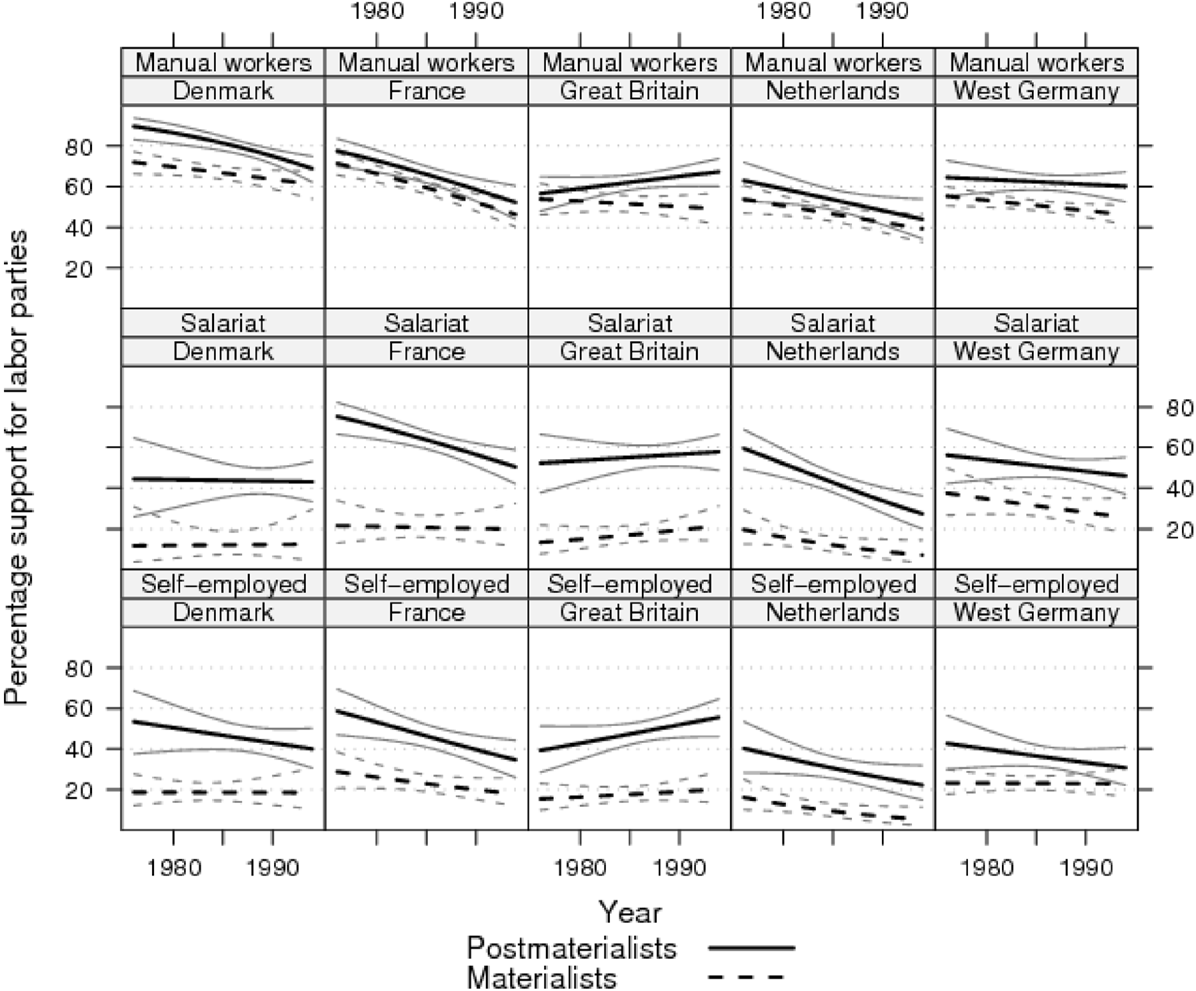
Of course, an adoption of the postmaterialist agenda by left parties may be a process that has been taking place during the period of observation. If the “greening of the Left” just started in the 1970s, then the effect of postmaterialism should not be constant but increasing. In that case, however, the explanatory power of value change cannot be tested by a comparison of predicted changes with observed changes as in table 3. An examination of the changes among materialists and postmaterialists would be more appropriate instead. One should then expect that in countries where class voting has been declining, labor parties have been losing support mainly among materialist workers while simultaneously gaining support mainly from postmaterialist middle-class voters. As figure 6 shows, this type of change does not occur in any of the countries under study.

Class, value priorities, and the support for Labor parties, 1976–1994
In Denmark, France, and the Netherlands, labor parties have lost at least as much support among postmaterialist as among materialist members of the working class. In Great Britain, the labor party has hardly lost support among materialist members of the working class, but has gained support among postmaterialist members. Furthermore, Great Britain is the only country where the support for a labor party has increased among postmaterialist members of the middle classes. Although, consistent with Inglehart's ideas, the support for labor parties is much higher among postmaterialist members than among materialist members of the middle classes, this support has decreased overall in Denmark, France, the Netherlands, and West Germany, with the exception of the Danish salariat. Ironically, the relevance of value priorities for the support for labor parties has decreased in the middle classes of these countries. Furthermore, since in the Netherlands and West Germany the decline in support for labor parties among postmaterialists is stronger in the middle classes than in the working class, class voting has increased among postmaterialists in these countries.
To conclude, neither the direct displacement scenario, nor the greening of the left scenario, nor the split-within-the-middle-classes scenario, nor the irrelevance-of-value-change scenario is borne out completely by the results presented in this section. The changes that have occurred in West European countries may be more complex than envisioned in any of the scenarios discussed thus far. For example, in some countries, a greening of the left may have occurred in the early 1970s, but may have been reversed by the split of the New Left from traditional labor parties and the emergence of green parties, such as in West Germany. Also another type of change, completely independent from the process of value change, may have occurred. Labor parties, realizing that their traditional working class constituency was shrinking, have been moderating their socialist stances and trying to appeal to middle-class voters on materialist grounds. The transformation of the British Labour Party under Tony Blair's leadership is a prime example of this process.
Conclusion
Reports of the death of social cleavages are exaggerated.55
I am indebted to one of the reviewers who coined this phrase.
Those who claim that class voting is in general decline have often been criticized either for ignoring or for too easily writing off the central role of political parties' ideologies and strategies.56
For example, Mair et al. 1999.
Converse 1958, 397.
See also Evans, Heath, and Payne 1999.
My main argument is that changes in the electoral relevance of social cleavages—insofar as they have actually occurred—are unlikely to be aspects or consequences of an irreversible, large-scale, long-term process of social change. Rather, it is only natural to attribute cross-country variations in the development of class and religious–secular voting to contingent political choices of parties about which social groups to appeal to. This seems to be bad news for social science, as it reduces the prospects for any long-term predictions. Alternatively, if political factors play a major role in changing patterns of electoral behavior, this could very well be considered to be good news for political science. Future research on changing patterns in the relation between social structure and electoral behavior should therefore focus on questions such as the identification of those dimensions of issues that are the most effective in producing group differences in electoral behavior.60
There are already examples of such work. Chhibber and Torcal show how electoral strategies of major parties led to the re-emergence of a class cleavage in voting behavior after the end of the Franco regime in Spain.61
Chhibber and Torcal 1997.
Elff 2005.
Appendix: Predicting Changes in Class Voting
Major parts of the argument of this article are based on the comparison of predictions about changes in class voting generated from the effect of cognitive mobilization and of value change on class voting to observed changes in class voting. This appendix briefly describes the method used for this type of analysis.
As a first step, a random-effects logit model of the influence of cognitive mobilization or of value change is constructed and fitted to respondents' vote intentions. Such a model contains, for example, the main effects of class and of value priorities as well as the interaction effect of class and value priorities on respondents' vote intentions. While such a model implies that the effect of value priorities on class voting is constant, it does not imply any restrictions on the over-time development of value priorities—value priorities are an external variable of this model. As a second step, expected vote intentions are computed from such a predictor model. As a third step, a model of change in class voting is fitted to these expected vote intentions. Such a target model contains the main effects of time and of class as well as the interaction effect of both time and class on respondents' vote intentions. As a fourth step, the target model is fitted to the observed vote intentions. Finally, estimates for the target model based on expected vote intentions and on observed vote intentions are compared, by means of Cox's extended Wald-statistics.65
Cox 1961.