Introduction
Care-giving refers to providing unpaid ‘help, support or supervision to family members, friends or neighbours with a range of physical, mental and end of life conditions and disability within the context of a pre-existing relationship, with demands that go beyond what would be normally expected of this relationship’ (Australian Institute of Health and Welfare 2015: 1). Over the past three decades, published empirical research on the relationship between care-giving and labour force participation (LFP) has been primarily oriented to addressing population ageing in Organisation for Economic Co-operation and Development (OECD) countries (Bauer and Sousa-Poza Reference Bauer and Sousa-Poza2015; Lilly, Laporte and Coyte Reference Lilly, Laporte and Coyte2007). Several researchers have in this respect noted the apparent contradiction between policies designed to prolong LFP, on the one hand, and, on the other hand, policies likely to shift the costs of long-term care on to households (Fine Reference Fine2012; Lloyd et al. Reference Lloyd, Tanner, Milne, Ray, Richards, Sullivan, Beech and Phillips2014).
Within this context, the imperative for empirical investigation of the care-giving and LFP relationship is underscored by the scope of theoretically plausible outcomes. Drawing on neoclassical labour market theory, Carmichael, Charles and Hulme (Reference Carmichael, Charles and Hulme2010) distinguished between the ‘substitution’ and ‘income’ effects of care-giving. Assuming the operation of a ‘substitution effect’, individuals who derive more utility from informal caring than they do from paid employment are likely to require a higher reservation wage in order to maintain their LFP. By the same token, the opportunity cost of reducing LFP to provide informal care is greater for individuals with considerable ‘human capital’ and for higher earners. However, assuming an ‘income effect’, individuals who greatly value the wellbeing of family members may choose to increase paid employment in order to finance formal care. As a third possible outcome, individuals deriving relatively little utility from leisure may maintain their time in both employment and in care-giving.
The range of plausible outcomes places greater weight on empirical investigation in explaining the likely effects of policies addressing population ageing. However, the relevant literature has yielded divergent and conflicting results, as indicated in Lilly, Laporte and Coyte (Reference Lilly, Laporte and Coyte2007). This systematic review of empirical studies published between 1986 and 2006 accordingly concluded that uncertainty surrounds key aspects of the care-giving and LFP relationship. Addressing this problem, the authors suggested that future studies consider the age and gender of care-giving sub-populations and a variety of possible labour market outcomes. They noted also the importance of controlling for care-giving intensity, for the labour market behaviours of demographically comparable non-care-givers and for potential endogeneity in the relation between the two key variables.
Considering the suggestions of Lilly, Laporte and Coyte (Reference Lilly, Laporte and Coyte2007), this paper reviews empirical research on the relation between informal care-giving and LFP published between 2006 and 2016. The paper's method has been informed by the Evidence for Policy and Practice Information and Coordinating Centre's guidelines for systematic reviews (Gough, Oliver and Thomas Reference Gough, Oliver and Thomas2013). Literature was sourced from 12 databasesFootnote 1 covering the disciplines of social work, sociology, economics, psychology, medicine, nursing and gerontology. Abstracts of articles published between 2006 and 2016 were retrieved using the following search terms and their affiliated truncations: ‘Care-giving’ or ‘Informal Care’ or ‘Carers’ or ‘Age Care’ or ‘Elder Care’ combined with ‘Labour/Labor Supply’ or ‘Labour/Labor Force’ or ‘Employment’ or ‘Work’. The bibliographies of the sourced material formed the basis of an additional author-based search.
Considering that most of the research on informal care-giving and LFP over the past three decades has taken population ageing as its context, items of the retrieved literature were excluded from the review if individuals providing informal elder care were not at least one of the sub-populations being investigated. Items were excluded also if the relationship between unpaid care-giving and LFP was not a primary focus of research. Additionally, the review is confined to empirical studies with sample sizes larger than 1,000 and to those published in peer-reviewed journals, with several notable exceptions.Footnote 2 Literature using smaller sample sizes has been excluded. For these studies, conclusions pertaining to sub-samples of care-givers and specific types of LFP are likely to be less reliable. Lastly, the review is restricted to research for Canada, Australia, the United Kingdom (UK), the rest of the European Union (EU) and the United States of America (USA). It is so restricted on the grounds that a wider range of cultural and institutional variables may be needed to explain care-giving and LFP in countries with a relatively recent history of industrialisation.
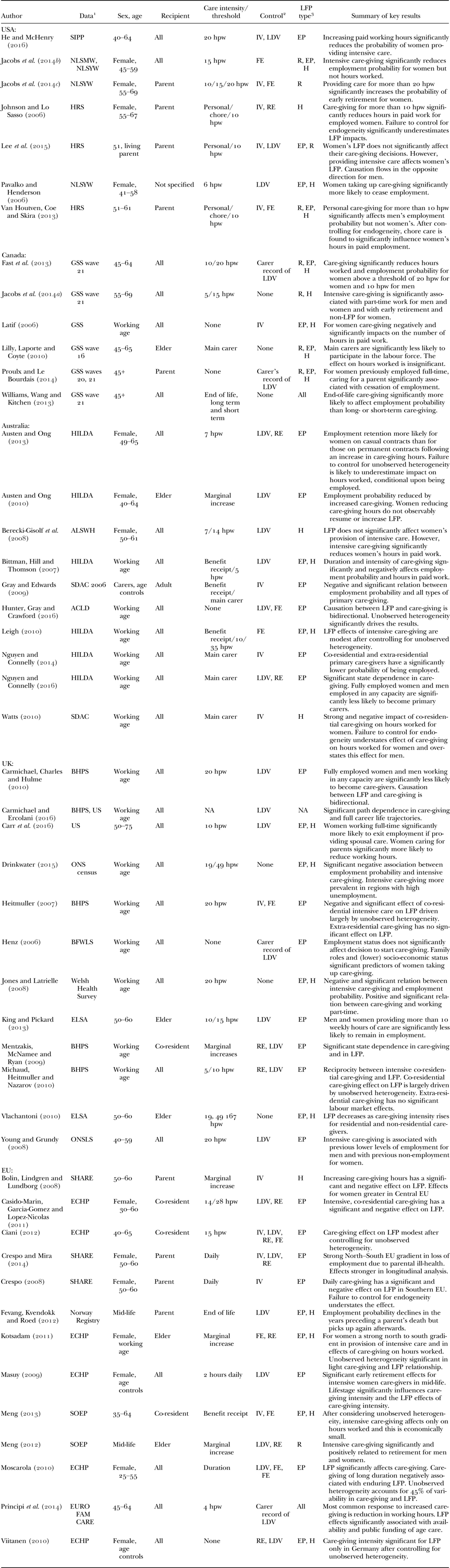
An overview of the 48 studies meeting the inclusion criteria (Table 1) indicates that significant divergence in results has persisted beyond the research reviewed by Lilly, Laporte and Coyte in 2007. Given that all but a handful of the 2006–2016 studies have in some way attempted to address these authors’ concerns (as indicated in Table 1), this persistent divergence suggests the need for further consideration of methods. The next section of this paper undertakes this, focusing on sampling, measures of care-giving intensity and causation. This discussion of method is the basis for a subsequent review of empirical results by country or region.
Studies on informal care and labour force participation, 2006–2016.
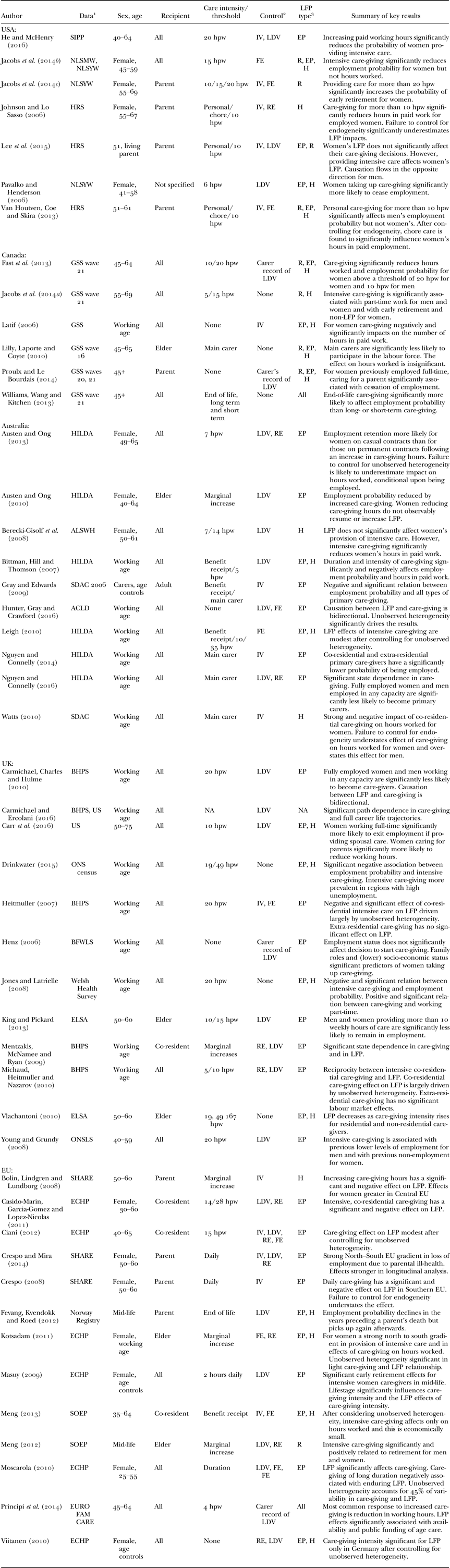
Notes: Unless otherwise stated, conclusions for care-givers are made with reference to comparable non-care-givers. With the exception of Meng (Reference Meng2013), Heitmuller (Reference Heitmuller2007) and Ciani (Reference Ciani2012), all studies distinguish results by gender. USA: United States of America. UK: United Kingdom. EU: European Union. hpw: hours per week. NA: not applicable. 1. Databases: ACLD: Australian Census Longitudinal Dataset. ALSWH: Australian Longitudinal Study of Women's Health. BHPS: British Household Panel Study. ECHP: European Community Household Panel. BFWLS: British Family and Working Lives Survey. ELSA: English Longitudinal Study of Ageing. EUROFAMCARE: Services for Supporting Family Carers of Older People in Europe: Characteristics, Coverage and Usage Study. HILDA: Household, Income, Labour Dynamics in Australia. HRS: Health and Retirement Study. GSS: General Social Survey, Canada. NLSMW: National Longitudinal Survey of Mature Women. NLSYW: National Longitudinal Survey of Young Women. ONS: Office for National Statistics. ONSLS: Office for National Statistics Longitudinal Study. SDAC: Survey of Disability Ageing and Carers. SHARE: Survey of Health, Ageing and Retirement in Europe. SIPP: Study of Income and Program Participation. SOEP: Socio-Economic Panel (Germany). US: Understanding Society. 2. Controls: LDV: lagged dependent variable. RE: random effects. FE: fixed effects. IV: instrumental variable estimates. 3. Labour Force Participation (LFP): EP: employment probability. H: hours in paid work. R: retirement.
Method in the context of policy addressing population ageing
Sampling
Crespo and Mira (Reference Crespo and Mira2014), Van Houtven, Coe and Skira (Reference Van Houtven, Coe and Skira2013) and Johnson and Lo Sasso (Reference Johnson and Lo Sasso2006) have noted that many empirical studies on the relation between care-giving and LFP tend to ‘speak past each other’. These authors in part attribute this problem to the fact that most studies focus on a specific care-giving sub-population or on a particular type of care-giving relationship. Interpretation of the divergence in the empirical literature should accordingly address sample selection.
Considering the articles reviewed in this paper, it is noteworthy that all but two are explicitly concerned with exploring the likely LFP impacts of population ageing. The results of this research should therefore be at least applicable to the working-aged individuals most at risk of experiencing the conflicting demands of elder care-giving and paid employment. In OECD countries, approximately two-thirds of these individuals are currently women in mid-life (Colombo et al. Reference Colombo, Llena-Nazal, Mercier and Tjadens2011). That the recipients of their care-giving are predominantly extra-residential parents or parents-in-law is indicated by Principi et al. (Reference Principi, Lamura, Sirolla, Mesthenous, Bien, Brown, Krevers, Melchiorre and Dohner2014). In this EU six-country study, parents and in-laws were the recipients in 79.9 per cent of cases in which informal care was provided by individuals aged 45–64. This is comparable to the pattern of elder care-giving in the USA. Here 65 per cent of care-givers aged between 50 and 64 years were caring for a parent or in-law in 2014 and 9 per cent were caring for a partner or spouse (National Alliance for Caregiving and AARP 2015).
However, in considering LFP effects, it is relevant that extra-residential care-giving is typically less time-intensive than co-residential care-giving. For example, in the UK and the USA almost all informal, around-the-clock care takes place co-residentially and a greater proportion of co-residential care-giving involves more than 20 weekly hours (National Alliance for Caregiving and AARP 2015; Vlachantoni Reference Vlachantoni2010). The absolute number of working-aged, intensive extra-residential care-givers remains nonetheless considerable. This is indicated, for example, in the 2015 Australian Survey of Disability, Ageing and Carers, where 66.3 per cent of the recipients of informal care primarily live elsewhere than their carers (Australian Bureau of Statistics 2015). It is also significant that the intensity of extra-residential care-giving is predicted to increase with wider implementation of fiscally constrained ‘ageing in place’ policies (Fine Reference Fine2012). This prediction is informed by the relatively greater time intensity of current extra-residential care-giving in OECD countries with relatively low levels of public age care funding (Colombo et al. Reference Colombo, Llena-Nazal, Mercier and Tjadens2011; Rodrigues, Huber and Lamura Reference Rodrigues, Huber and Lamura2012).
Considering that the great majority of working-aged individuals providing elder care are mid-life women and given that most elder-care recipients are extra-residential parents or in-laws, it is noteworthy that 21 of the 48 studies reviewed in this paper have investigated care-givers of working age generally and that 27 have investigated the effects of care-giving to recipients of all ages (Table 1). In most of these instances, sample selection has accommodated the constraints of secondary data. As an example, studies drawing on non-age-restricted household panels have been able to confine analysis to mid-life women only by pooling results across countries (Masuy Reference Masuy2009), by reducing sample sizes (Austen and Ong Reference Austen and Ong2013) or by foregoing controls for care-giving intensity (Viitanen Reference Viitanen2010).
Studies drawing on non-age-restricted household panels also experience sampling constraints when examining causation. For example, unless the researcher is able to draw on a special module, the paucity of information on non-residents in household panel data confines instrumental variable (IV) analysis to co-residential care recipients only. In non-age-restricted household panels, these co-residential recipients are much more likely to be spouses or partners than parents and their care-givers are likely to be past official retirement age.
Considering the policy and demographic context of the reviewed studies, conclusions drawn from analysis of a broad range of care-givers and care recipients should be at least applicable to the LFP of mid-life women providing informal care to an extra-residential parent or in-law. This applicability cannot be assumed, given US and EU research associating the LFP impacts of care-giving with the care-giver's life-stage and relation to the recipient (Dentinger and Clarkberg Reference Dentinger and Clarkberg2002; Masuy Reference Masuy2009).
Care-giving intensity
Observing that different care-giving time commitments appeared to be associated with distinctive types of labour market responses, Lilly, Laporte and Coyte (Reference Lilly, Laporte and Coyte2007) emphasised the need to control for care-giving intensity. The reviewers noted that in lieu of intensity controls, a significant and positive association between LFP and mid-life women's light care provision would most likely mask any negative LFP effects of heavy care-giving for this sub-population. Moreover, cross-region and cross-country studies indicate care-giving intensity as the principle channel through which norms and policy condition the care-giving and LFP relationship (Bolin, Lindgren and Lundborg Reference Bolin, Lindgren and Lundborg2008; Drinkwater Reference Drinkwater2015; Kotsadam Reference Kotsadam2011).
While the demands of care-giving can be emotional, physical and financial, research investigating the LFP effects has generally focused on demands made on the care-giver's time. Most of the studies here reviewed have either examined the LFP effects of marginal increases in care-giving hours or they have grouped results according to thresholds expressed in daily, weekly or annual hours (Table 1). Non-temporal measures of care-giving intensity include care-giver status (primary or secondary), the number of weekly tasks, the type of care (personal or chore), and carer benefit receipt. Two of the reviewed studies have focused on end-of-life care-giving, hypothesising that this activity is inherently demanding (Fevang, Kvendokk and Roed Reference Fevang, Kvendokk and Roed2012; Williams, Wang and Kitchen Reference Williams, Wang and Kitchen2013).
Several of the researchers employing non-temporal categories of care-giving intensity have intended these as proxies or supplements for incomplete or unreliably recorded care-giving hours. As an example, studies drawing on the US Health and Retirement Study (HRS) also specify the type of care, considering that care-giving hours in this study are effectively capped at 10 per week (Johnson and Lo Sasso Reference Johnson and Lo Sasso2006; Lee et al. Reference Lee, Tang, Kim and Albert2015; Van Houtven, Coe and Skira Reference Van Houtven, Coe and Skira2013). As a second example, the Household, Income and Labour Dynamics in Australia (HILDA) survey records weekly care-giving hours in a less-populated section and a significant proportion of the individuals providing this information have patently overestimated their time commitment to various weekly tasks (Watson and Wooden Reference Watson and Wooden2002). Two-thirds of the studies employing these data have accordingly used alternative or supplementary measures of care-giving intensity (Table 1).
Additional to difficulties associated with the design of particular surveys, there is reason and evidence to suggest that recollections of care-giving hours are systemically distorted according to the care-giving context. Specifically, care-givers do not typically record travelling to and from recipients’ homes as part of their effort. Surveys are therefore likely to understate the time intensity of extra-residential care-giving (Nguyen and Connelly Reference Nguyen and Connelly2014; Norman and Purdham Reference Norman and Purdham2013). On the other hand, the time intensity of co-residential care-giving may be overstated, given some overlap between this activity and general household interactions (Wakabayashi and Donato Reference Wakabayashi and Donato2005). That at least some co-residential care-givers are simultaneously meeting other responsibilities is suggested by Vlachantoni's (Reference Vlachantoni2010) finding that one-quarter of UK ‘round-the-clock’ mid-age carers were in paid employment during 2006. However, here it must also be noted that the necessity of simultaneously meeting various responsibilities may itself be a source of care-giver burnout and may thus affect care-givers’ LFP in the long run (Edwards et al. Reference Edwards, Higgins, Gray, Zimjewski and Kingston2008).
Considering these limitations, several researchers have drawn on various non-quantitative indicators of care-giving intensity. Hassink and Van den Berg (Reference Hassink and Van den Berg2011) in this respect suggest personal care as a proxy for intensive care-giving on the grounds that such activity is relatively time bound. However, this analysis has implicitly equated non-personal care with the performance of household tasks. It accordingly fails to address the fact that arranging and meeting appointments, communicating with service professionals, purchasing specialist products and formal care orchestration must typically be undertaken during normal working hours (National Alliance for Caregiving and AARP 2015). Distinguishing personal care as a proxy for intensity is also to some extent undermined by the fact that about a quarter of care-givers provide both types of care, in the USA at least (Johnson and Lo Sasso Reference Johnson and Lo Sasso2006).
Researchers must also exercise caution when using carer benefit receipt as a proxy for care intensity in certain policy contexts. Firstly, means-tested payments imply a possible connection to hours in paid employment. Benefits differ also in their non-monetary requirements. As an example, care-giving hours or carer status are not stipulated for co-residential care-givers receiving Carer's Allowance in Australia. By contrast, qualification for the Australian Carer's Payment is highly stipulated and onerous. A far greater proportion of individuals are paid the former. Considering this, HILDA-based studies using both payments as a proxy for high-intensity care-giving are most likely to have overestimated the actual time involved (Bittman, Hill and Thomson Reference Bittman, Hill and Thomson2007; Leigh Reference Leigh2010).
Considering the post-2006 studies, the most reliable non-quantitative indicators of intensity appear to be carer status and end-of-life care-giving. Use of the former is supported by national care-giver surveys indicating the relatively high number of weekly hours and care-giving tasks carried out by primary care-givers (Australian Bureau of Statistics 2015; Lilly, Laporte and Coyte Reference Lilly, Laporte and Coyte2010; National Alliance for Caregiving and AARP 2015). The study by Williams, Wang and Kitchen (Reference Williams, Wang and Kitchen2013) comparing the weekly hours involved in long-term, short-term and end-of-life care-giving has similarly found the latter to be a good proxy for time intensity.
Finally, investigation of the LFP effects of care-giving should ideally also consider duration, given the positive and significant association between this variable and care-givers’ finances and their emotional and mental health (Edwards et al. Reference Edwards, Higgins, Gray, Zimjewski and Kingston2008; Principi et al. Reference Principi, Lamura, Sirolla, Mesthenous, Bien, Brown, Krevers, Melchiorre and Dohner2014). However, since individuals may provide light care over extended periods, studies using duration as the sole measure of intensity (Moscarola Reference Moscarola2010) are unlikely to be reliable. Moreover, analysis of the effects of duration should distinguish the effects of care-giving per se from state dependency. This is discussed in the following section.
Interpreting causation
Given that intensive care-giving and paid employment make competing demands on time, any detected correlation between them plausibly manifests an underlying causal relationship. On the other hand, a correlation between these variables may signify the influence of a factor other than LFP or care-giving. At any rate, a correlation does not in itself establish the direction of causation. In addressing these problems, the post-2006 empirical literature has focused on detecting state dependence, on establishing the direction of causation and on gauging the extent of endogeneity in the relationship between care-giving and LFP.
State dependence refers to the effect of past activity in the field under scrutiny upon present and future activity in that field (Heckman Reference Heckman and Rosen1981). In principle, state dependence is positively and significantly associated with the initial or fixed costs of undertaking the activity in question. As an example, labour market entrants who have expended considerable effort and income in qualifying or training, re-locating and job-searching are more likely to remain in their current occupations. However, regardless of initial costs, continuing an activity itself gives rise to further inertia. Sovinsky and Stern (Reference Sovinsky and Stern2016), in this respect, specify ‘duration dependence’ as a type of state dependence. Duration dependence in LFP is associated with such factors as on-the-job experience and the maintenance of trade or professional networks (Skira Reference Skira2015). Duration dependence in care-giving is associated with such factors as development of caring skills, carer burnout, habit and the development of personal attachments (Michaud, Heitmuller and Nazarov Reference Michaud, Heitmuller and Nazarov2010; Sovinksy and Stern Reference Sovinsky and Stern2016).
Researchers investigating state dependence must control for rival or additional explanations for the persistence of the activity in question. Considering the six post-2006 empirical studies examining state dependence in LFP and care-giving (Table 1), it is noteworthy that all but one address this issue only for care-giving. This is understandable, given the sheer number of variables potentially influencing persistence in paid employment. In this regard it is interesting to consider the one study that does attempt to address this problem. He and McHenry (Reference He and McHenry2016) take US state-level unemployment rates as a proxy for the wide range of factors that could explain long-term patterns in LFP. However, strategy effectively conflates cause and effect and the resulting conclusions regarding state dependence in LFP are therefore open to question. Considering this, we may conclude that for the research reviewed in this paper, the results of examining state dependence in care-giving are likely to be more reliable than those pertaining to state dependence in LFP.
Explanation of the care-giving and LFP relationship should also, as noted, address the potential for endogeneity. Within a neoclassical framework, endogeneity may here take several forms. Firstly, LFP may itself determine interpretations of the need for care or the amount needed. Alternatively, individuals with weak labour market attachment or relatively low earnings may ‘select’ themselves for care-giving, the required amount of care being determined by factors other than LFP. A third potential source of endogeneity lies in some individuals possessing to a relatively high degree of unobservable attributes which happen to condition both their propensity to engage in paid employment and their inclination to provide informal care.
In panel analysis, the direction of causation between LFP and care-giving may be established by examining these variables in one or a variety of sequences. Panel studies can also detect the influence of unobserved heterogeneity by specifying fixed or random effects. In both longitudinal and cross-sectional analysis, the exogenous demand for care-giving may be gauged using such instruments as the care recipient's health, the existence and proximity of other family members, and the availability of formal care. As noted earlier, the pursuit of these details should not compromise sample selection and the policy relevance of results. However, despite this problem and the reservations of some researchers (Drinkwater Reference Drinkwater2015; Lilly, Laporte and Coyte Reference Lilly, Laporte and Coyte2010), most instruments used in the post-2006 studies have been both empirically applicable and demonstrably strong predictors of women's intensive care-givingFootnote 3 (Bolin, Lindgren and Lundborg Reference Bolin, Lindgren and Lundborg2008; Crespo and Mira Reference Crespo and Mira2014; Jacobs et al. Reference Jacobs, Van Houtven, Laporte and Coyte2014b, Reference Jacobs, Van Houtven, Laporte and Coyte2014c; Johnson and Lo Sasso Reference Johnson and Lo Sasso2006; Nguyen and Connelly Reference Nguyen and Connelly2014; Van Houtven, Coe and Skira Reference Van Houtven, Coe and Skira2013; Watts Reference Watts2010). As exceptions, the very poor health of recipients and a need for constant attendance appear to be weak predictors of care-giving. These variables are more likely to predict a need for high-level institutional care (Crespo and Mira Reference Crespo and Mira2014; Johnson and Lo Sasso Reference Johnson and Lo Sasso2006).
The post-2006 empirical literature has for the most part failed to reject the hypothesis that the demand for care-giving is exogenous with respect to LFP. However, unobserved heterogeneity has been identified as a significant causal factor in 12 of the 19 studies specifying fixed or random effects (Table 1). Nine of these have concluded that failure to control for unobserved heterogeneity is likely to lead to overestimation of the LFP impacts of care-giving. By contrast, the remaining three have concluded that failure to account for unobserved heterogeneity is likely to lead to underestimation of the LFP impacts of care-giving. When interpreting these results, it is enlightening to distinguish care-giving sub-populations, care-giving intensity and types of labour market responses.
Firstly, in the nine studies associating failure to control for unobserved heterogeneity with an overestimation of LFP impacts, it is noteworthy that this conclusion applies only to working-aged co-residential care-givers, most of whom are women (Ciani Reference Ciani2012; Heitmuller Reference Heitmuller2007; Meng Reference Meng2013; Michaud, Heitmuller and Nazarov Reference Michaud, Heitmuller and Nazarov2010). Given that the recipients of intensive co-residential care are typically partners or spouses, women's observed exit from employment may in these circumstances reflect couples’ long-held plans regarding the (mutual) timing of their retirement. Such decisions may be relatively independent of the actual need for informal care. This is suggested by Dentinger and Clarkberg's (Reference Dentinger and Clarkberg2002) analysis of care-giving and retirement in the USA.
Let us now consider the remaining five studies associating overestimation of the LFP impacts of care-giving with a failure to control for unobserved heterogeneity. Here it is noteworthy that Kotsadam (Reference Kotsadam2011) has confined this conclusion to light or secondary care-givers. Kotsadam observed that the majority of these light care-givers are concentrated in countries and regions where formal care services are relatively affordable and available. According to this author, it is plausible that individuals are relatively free to follow their inclinations when the primary responsibility for elder care-giving has been allocated elsewhere.
Kotsadam's (Reference Kotsadam2011) conclusions and observations cast an interesting light on the remaining four studies associating failure to control for unobserved heterogeneity with overestimation of the care-giving impacts on LFP. Two of these eschew intensity controls (Hunter, Gray and Crawford Reference Hunter, Gray and Crawford2016; Viitanen Reference Viitanen2010). The remaining two are likely to have overestimated care-giving intensity for the sub-populations in question, as noted earlier (Leigh Reference Leigh2010; Moscarola Reference Moscarola2010).
Let us now consider the three studies associating failure to control for unobserved heterogeneity with underestimation of the LFP impacts of care-giving. In each of these studies this conclusion applies only to the number of hours mid-life women allocate to paid employment, conditional upon them being employed (Austen and Ong Reference Austen and Ong2013; Johnson and Lo Sasso Reference Johnson and Lo Sasso2006; Van Houtven, Coe and Skira Reference Van Houtven, Coe and Skira2013). Endogeneity in the relationship between mid-life women's care-giving and hours in paid employment has been highlighted also in the IV analysis of two cross-sectional studies (Crespo Reference Crespo2008; Watts Reference Watts2010). These authors also associated failure to control for endogeneity with underestimation of the effects of care-giving on women's labour market hours, conditional upon these women being employed.
The results of these five studies imply that a significant proportion of mid-life women provide intensive informal care at the expense of intensifying LFP or at the expense of developing their careers. This interpretation is supported by the finding of Bittman, Hill and Thomson (Reference Bittman, Hill and Thomson2007) that care-giving women are less likely to increase their paid working hours relative to their non-care-giving counterparts. Following Crespo (Reference Crespo2008), most of the relevant studies have ascribed this second pocket of endogeneity to variations in individuals’ ‘taste’ for activity. However, given the disproportionate representation of mid-life women in formal care-related industries (Austen et al. Reference Austen, Jefferson, Lewin and Ong2015; Young and Grundy Reference Young and Grundy2008), a less atomistic explanation is that the exercise of altruism and devotion is not necessarily confined to the private or domestic sphere.
Considering these observations on causation, as well as the earlier ones on sampling and care-giving intensity, the results of the post-2006 empirical studies are reviewed by country or region in the following section.
Results by country or region
Unless otherwise specified, in this section care-giving is assumed to be intensive and exogenous with respect to LFP.
The USA
The seven US studies have undertaken longitudinal analysis of mid-life men and women. The great majority of the care-givers in these studies provided care to an extra-residential parent. Six of the studies examined the effects of care-giving on LFP. Each found this effect to be negative and significant. Results, however, diverged on the type of labour market impact. After controlling for endogeneity, Johnson and Lo Sasso (Reference Johnson and Lo Sasso2006) found that women's care-giving significantly and negatively affects hours in paid work rather than the probability of them being employed. Van Houtven, Coe and Skira (Reference Van Houtven, Coe and Skira2013) obtained a similar result. This study moreover noted that women's care-giving did not significantly affect their chances of early retirement and only for men does care-giving affect LFP on the extensive margin. By contrast, Jacobs et al. (Reference Jacobs, Van Houtven, Laporte and Coyte2014b) and Pavalko and Henderson (Reference Pavalko and Henderson2006) ruled out any significant care-giving effect on women's hours in paid work, conditional upon these women being employed. Similar to Lee et al. (Reference Lee, Tang, Kim and Albert2015), both of these studies found that women's care-giving significantly affects the probability of them being employed. Also focusing on the extensive margin of the labour market, Jacobs et al. (Reference Jacobs, Van Houtven, Laporte and Coyte2014c) found a significant and negative association between women's care-giving and early retirement.
The following interpretation of these differences excludes the conclusions of Pavalko and Henderson (Reference Pavalko and Henderson2006), since these authors have cautioned that their analysis of care-givers’ hours in paid employment is based on a relatively small sub-sample. Let us compare the results of the remaining five studies. With the exception discussed immediately below, the differences between them are explicable if relatively high-intensity care-givers tend to leave paid employment or retire and moderate- (but not low-) intensity care-givers reduce their working hours and remain employed. This explanation is suggested firstly by the discovery of Jacob et al. (Reference Jacobs, Van Houtven, Laporte and Coyte2014c) of a significant early retirement impact only for women providing more than 20 weekly care-giving hours. The effects of such high-intensity care-giving are likely to be obscured in the HRS-based analysis of Johnson and Lo Sasso (Reference Johnson and Lo Sasso2006) and Van Houtven, Coe and Skira (Reference Van Houtven, Coe and Skira2013). As noted, care-giving intensity thresholds are capped at ten weekly hours in the HRS. By the same token, Jacobs et al. (Reference Jacobs, Van Houtven, Laporte and Coyte2014b) are not positioned to capture any significant association between moderate-intensity care-giving (10–15 weekly hours) and weekly hours in paid employment since they employ a care-giving threshold of only 15 hours per week.
While specifications of care-giving intensity may account for the divergence in these four studies, the apparent incompatibility between Lee et al. (Reference Lee, Tang, Kim and Albert2015) and Van Houtven, Coe and Skira (Reference Van Houtven, Coe and Skira2013) regarding the effect of care-giving on employment probability remains challenging. This is not least because the data-sets and samples for these two studies overlap considerably. Addressing this problem, it is noteworthy that these studies differ mainly in their methods of addressing causation. Lee et al. (Reference Lee, Tang, Kim and Albert2015) have cross-lagged care-giving and LFP, while Van Houtven, Coe and Skira (Reference Van Houtven, Coe and Skira2013) have specified fixed effects. This suggests that explanation of the LFP effects of care-giving may be enhanced by comparing alternate methods of addressing potential endogeneity.
Examining the direction of causation, Lee et al. (Reference Lee, Tang, Kim and Albert2015) have found that labour market status impacts on subsequent care-giving decisions only for men. By contrast, He and McHenry (Reference He and McHenry2016) found a negative and significant connection between women's hours in paid work and the time they subsequently allocate to care-giving. Interpreting these results, it is noteworthy that He and McHenry (Reference He and McHenry2016) drew on the Survey of Income and Program Participation (SIPP). As discussed by Giovenetti and Wolff (Reference Giovenetti and Wolff2010), SIPP defines informal care in a manner which most likely excludes relatively new care-givers. If a significant proportion of new care-givers have been excluded, then SIPP-based studies are not positioned to explain any connection between LFP and subsequent decisions to take up care-giving.
Canada
Each of the six Canadian studies is a cross-sectional analysis drawing on the care-giver modules in Waves 16 and 21 of the General Social Survey (GSS). Since Latif (Reference Latif2006) and Proulx and Le Bordais (Reference Proulx and Le Bourdais2014) do not control for care-giving intensity, we shall focus on results for the remaining four studies. Each of these found a negative and significant association between care-giving and the probability of being employed (Fast et al. Reference Fast, Dosman, Lero and Lucas2013; Jacobs et al. Reference Jacobs, Laporte, Van Houtven and Coyte2014a; Lilly, Laporte and Coyte Reference Lilly, Laporte and Coyte2010; Williams, Wang and Kitchen Reference Williams, Wang and Kitchen2013). Jacobs et al. (Reference Jacobs, Laporte, Van Houtven and Coyte2014a), moreover, found a significant and negative relation between women's intensive care-giving and their early retirement.
Results for the Canadian studies differ, however, with respect to the connection between care-giving and hours in paid employment. Here Lilly, Laporte and Coyte (Reference Lilly, Laporte and Coyte2010) discovered no significant association for women and a significant association for men only at very high care-giving intensity thresholds. This conflicts with the discovery of Jacobs et al. (Reference Jacobs, Laporte, Van Houtven and Coyte2014a) of a significant and negative correlation between women's intensive care-giving and hours in paid work. It conflicts also with the conclusion of Williams, Wang and Kitchen (Reference Williams, Wang and Kitchen2013) that employed women providing informal end-of-life care have significantly fewer paid working hours than non-care-givers and other types of care-givers.
Interpretation of these differences is impeded by the fact that none of the studies in question addresses causation. Lilly, Laport and Coyte (Reference Lilly, Laporte and Coyte2010) have noted this problem, referring to the international literature identifying endogeneity in the relation between women's intensive care-giving and hours in paid work. Since the one Canadian study which does address endogeneity has omitted controls for care-giving intensity (Latif Reference Latif2006), our interpretation of causation in the Canadian research leans heavily on the causal interpretations of care-givers themselves. Fast et al. (Reference Fast, Dosman, Lero and Lucas2013), in this respect, note that a significant proportion of mid-life women providing intensive informal care had reduced their working hours over the past year and most of these had identified care-giving responsibilities as the principle motivation.
These differences in the Canadian studies underscore the necessity of controlling for potential endogeneity in the relation between intensive care-giving and LFP. Given its exclusive dependence on cross-sectional data, large-scale empirical casual analysis of care-giving and LFP in Canada is likely to be enhanced by wider application of IV specifications. As noted earlier, most instruments employed in the international studies of care-giving and LFP have been both empirically applicable and demonstrably strong predictors of care-giving.
Australia
The Australian studies differ, firstly, on the significance of the care-giving and LFP association after addressing endogeneity and, secondly, on the direction of causation. Firstly, Leigh (Reference Leigh2010) and Hunter, Gray and Crawford (Reference Hunter, Gray and Crawford2016) differ from the remaining Australian literature in finding only modest LFP effects. Both studies attribute the negative and significant correlation between care-giving and LFP largely to unobserved heterogeneity. However, interpretation of results for these two studies is complicated by the fact that neither controls adequately for care-giving intensity, as noted earlier.
The Australian literature diverges, secondly, on the direction of causation. On the one hand, Nguyen and Connelly (Reference Nguyen and Connelly2016) found that women working full-time and men employed in any capacity are significantly less likely to become main care-givers. They also noted significant state dependence care in both care-giving and LFP. On the other hand, Berecki-Gisolf et al. (Reference Berecki-Gisolf, Lucke, Hockey and Dobson2008) concluded that previous labour market status has no significant effect on mid-life women's propensity to provide intensive informal care. The difference is most likely explained by sample selection. Berecki-Gisolf et al. (Reference Berecki-Gisolf, Lucke, Hockey and Dobson2008) investigated exclusively mid-life women while Nguyen and Connelly (Reference Nguyen and Connelly2016) examined survey respondents of all working ages. Nguyen and Connelly (Reference Nguyen and Connelly2016) were consequently unable to control for the effects of age or lifestage without sacrificing sample size. Given that almost all of the recent empirical literature on care-giving and LFP is oriented to policies addressing population ageing, the conclusions of Berecki-Gisolf et al. (Reference Berecki-Gisolf, Lucke, Hockey and Dobson2008) in this instance carry greater weight. The results of this study also concur with the conclusions of Lee et al. (Reference Lee, Tang, Kim and Albert2015) regarding the effects of LFP on mid-life women's care-giving in the USA.
Considering the future direction of research on care-giving and LFP in Australia, it must be noted that the sampling problems experienced by Nguyen and Connelly (Reference Nguyen and Connelly2016) are encountered in most of the reviewed Australian literature. Only Berecki-Gisolf et al. (Reference Berecki-Gisolf, Lucke, Hockey and Dobson2008) and Austen and Ong (Reference Austen and Ong2010, Reference Austen and Ong2013) have restricted analysis of mid-life women. Austen and Ong's (Reference Austen and Ong2013) HILDA-based analysis moreover relies on relatively small sample sizes, as the authors themselves acknowledge. This problem in part reflects the absence of a large-scale ongoing age-restricted Australian survey on ageing, health and retirement.
The UK
As for the Australian literature, disagreement between the UK studies revolves on the direction of causation and the significance of the care-giving and LFP association once endogeneity is addressed. Considering the direction of causation, Carmichael, Charles and Hulme (Reference Carmichael, Charles and Hulme2010) and Michaud, Heitmuller and Nazarov (Reference Michaud, Heitmuller and Nazarov2010) observed that future care-givers share many of the labour force characteristics of current care-givers. Both studies also found that individuals working full-time are significantly less likely to take up intensive care-giving. Supporting this, Young and Grundy's (Reference Young and Grundy2008) longitudinal census-based study found intensive care-giving to be significantly associated with previously low levels of employment for men and previous non-employment for women. These three studies also found that care-giving has a significant and negative effect on LFP and each therefore concluded that the lines of causation between the two key variables run in both directions. This conclusion is compatible with Carmichael and Ercolani's (Reference Carmichael and Ercolani2016) and Mentzakis, McNamee and Ryan's (Reference Mentzakis, McNamee and Ryan2009) detection of significant path dependence in care-giving and in full-time labour market career trajectories over the lifecourse. However, this result appears to conflict with Henz's (Reference Henz2006) conclusion that labour market status has no significant effect on subsequent decisions to take up care-giving.
Like Australian studies examining the impact of LFP on care-giving, the UK results on this issue are complicated by problems with sample selection. The conclusions of Henz (Reference Henz2006), Carmichael, Charles and Hulme (Reference Carmichael, Charles and Hulme2010) and Carmichael and Ercolani (Reference Carmichael and Ercolani2016) are based on analysis of individuals of all working ages, as are those of Michaud, Heitmuller and Nazarov (Reference Michaud, Heitmuller and Nazarov2010). For this literature, controls for age and types of care-giving effectively reduce sample sizes and the reliability of results, as Michaud, Heitmuller and Nazarov (Reference Michaud, Heitmuller and Nazarov2010) acknowledge with regards to their analysis of extra-residential care-giving. Young and Grundy's (Reference Young and Grundy2008) census-based study uses reasonably sized samples of working-aged men and women aged 40+ . However, results for this study are complicated by the 20-year gap between records of each individual's past LFP and his or her current care-giving activity. Additionally, lacking direct records of past LFP, Young and Grundy (Reference Young and Grundy2008) have used a range of activities to represent this variable. These authors observed that this reduces the reliability of their inferences.
Given these sampling problems, clarification of the effects of LFP on subsequent care-giving to elders in the UK is likely to be enhanced by studies focusing on mid-life individuals. As noted, the US and the Australian study addressing this question for mid-life women have each ruled out a significant impact.
Examining causation in the opposite direction, considering the LFP impacts of care-giving, all of the relevant UK studies have found negative and significant effects for certain sub-populations and in certain care-giving contexts. These studies differ, however, in their interpretation of causation. In this respect, it is interesting that two of the three studies controlling for unobserved heterogeneity (Heitmuller Reference Heitmuller2007; Michaud, Heitmuller and Nazarov Reference Michaud, Heitmuller and Nazarov2010) have attributed the significant LFP effects of intensive co-residential care-giving largely to unobserved heterogeneity. This is understandable, given our earlier discussion of the presence of endogeneity in the relation between women's spousal or partner care-giving and the decisions of couples regarding the (mutual) timing of their retirement.
Given the policy and demographic context, of greater concern is the divergence in the UK results on the LFP effects of extra-residential care-giving. Three of the four UK studies which have controlled for care recipient residency conclude that the impacts on extra-residential care-giving on LFP are insignificant, regardless of care-giving intensity (Carmichael, Charles and Hulme Reference Carmichael, Charles and Hulme2010; Heitmuller Reference Heitmuller2007; Michaud, Heitmuller and Nazarov Reference Michaud, Heitmuller and Nazarov2010). By contrast, the analysis by Carr et al. (Reference Carr, Murray, Zannitto, Cadar, Head, Stansfeld and Stafford2016) of mid-life individuals has found that for women, the effect of extra-residential care-giving on LFP is both negative and significant.
Explaining these differences, it is noteworthy that only Carr et al. (Reference Carr, Murray, Zannitto, Cadar, Head, Stansfeld and Stafford2016) controlled for different types of LFP impacts. This study found that care-giving above a ten-hour weekly threshold drives both labour market exit for co-residential care-givers and a reduction in working hours for extra-residential care-givers. The conclusions of Carr et al. (Reference Carr, Murray, Zannitto, Cadar, Head, Stansfeld and Stafford2016) are here supported by EUROFAMCARE data indicating that more than one-quarter of UK mid-life women care-givers report reducing work hours to accommodate their care-giving activity (Principi et al. Reference Principi, Lamura, Sirolla, Mesthenous, Bien, Brown, Krevers, Melchiorre and Dohner2014). In these data, reduction in working hours is the most commonly recorded response for mid-life care-givers in the UK.
The results of Carr et al. (Reference Carr, Murray, Zannitto, Cadar, Head, Stansfeld and Stafford2016) and Principi et al. (Reference Principi, Lamura, Sirolla, Mesthenous, Bien, Brown, Krevers, Melchiorre and Dohner2014) suggest that future UK analysis of the impacts of parental care-giving should at least consider a variety of LFP responses with larger sample sizes for mid-life and extra-residential care-givers. Moreover, the results for the USA and for King and Pickard (Reference King and Pickard2013) suggest that such an exercise is likely to be enhanced by applying multiple care-giving intensity thresholds.
EU
The EU research (some of which includes the UK) diverges firstly on the size of the care-giver effect on LFP once the potential for endogeneity is addressed. Five studies have found the care-giving effect to be modest, after controlling for unobserved heterogeneity. As noted earlier, Kotsadam (Reference Kotsadam2011) specifies that this conclusion applies only to the LFP effects of light care-giving. Considering the remaining four studies, two have confined analysis to co-residential care-giving (Ciani Reference Ciani2012; Meng Reference Meng2013), one has used an unreliable measure of care-giving intensity (Moscarola Reference Moscarola2010) and one has altogether eschewed intensity controls (Viitanen Reference Viitanen2010). Our earlier observations on the UK and Australian literature, identifying significant unobserved heterogeneity, apply also to these four EU studies. That is to say, conclusions regarding unobserved heterogeneity drawn from analysis of co-residential or light care-giving are not necessarily applicable to mid-life individuals providing moderate or intensive informal care to an extra-residential parent.
In this respect, it is noteworthy that unobserved heterogeneity has been found to be insignificant in the analysis of intensive co-residential care-givers in Spain by Casido-Marin, Garcia-Gomez and Lopez-Nicolas (Reference Casido-Marin, Garcia-Gomez and Lopez-Nicolas2011). This exception among the studies of co-residential care-givers may be explained by Spain having the highest proportion of co-residing elderly parents and adult children in the EU. Casido-Marin, Garcia-Gomez and Lopez-Nicolas (Reference Casido-Marin, Garcia-Gomez and Lopez-Nicolas2011), moreover, found that care-giving above a 14-hour weekly threshold has a significant and negative impact on subsequent LFP. It is also noteworthy that Crespo and Mira's (Reference Crespo and Mira2014) analysis of care-giving to parents fails to detect significant unobserved heterogeneity, as does Kotsadam's (Reference Kotsadam2011) and Meng's (Reference Meng2012) analysis of co-residential and extra-residential intensive elder care-givers combined. Like Casido-Marin, Garcia-Gomez and Lopez-Nicolas (Reference Casido-Marin, Garcia-Gomez and Lopez-Nicolas2011), these three studies find the LFP effects of intensive care-giving to be negative and significant. This is also the conclusion of the IV-based, cross-sectional analysis of Bolin, Lindgren and Lundborg (Reference Bolin, Lindgren and Lundborg2008) and Crespo (Reference Crespo2008) with respect to mid-life women providing intensive informal care for a parent.
As well as differences regarding the influence of unobserved heterogeneity, the EU studies disagree also about the geographic patterns of care-giving and the LFP impacts by country or region. Kotsadam's (Reference Kotsadam2011) and Crespo and Mira's (Reference Crespo and Mira2014) panel analysis have discovered a distinct north–south EU gradient both in the extent of women's intensive care-giving to parents and in the effects of such care-giving on LFP. By contrast, Bolin, Lindgren and Lundborg's (Reference Bolin, Lindgren and Lundborg2008) IV estimates found no differences between central and south EU women with respect to the LFP effects of this type of care-giving.
Given that Bolin, Lindgren and Lundborg (Reference Bolin, Lindgren and Lundborg2008) and Crespo and Mira (Reference Crespo and Mira2014) draw on the same data and sub-population, the difference in their conclusions is most likely attributable to the choice of method. Undertaking both cross-sectional IV analysis and panel analysis, Crespo and Mira found significant LFP effects only in the latter. Considering this, it is likely that Bolin, Lindgren and Lundborg's (Reference Bolin, Lindgren and Lundborg2008) cross-sectional results may not have captured regional differences in LFP responses to the duration of time-intensive care. Principi et al. (Reference Principi, Lamura, Sirolla, Mesthenous, Bien, Brown, Krevers, Melchiorre and Dohner2014) indeed highlight this factor in their EUROFAMCARE-based analysis of six EU countries. Clarification may here be facilitated by examining LFP and the duration of care-giving in the context of leave entitlements and other country-specific policies. However, as noted earlier, such analysis should also distinguish between the provision of intensive and light informal care.
Conclusions and suggestions for further research
This systematic review of the post-2006 empirical literature examining the relation between LFP and care-giving has taken as its context the coherence and effectiveness of policies addressing population ageing in OECD countries. Of particular interest within this context are the mid-life individuals most at risk of having to meet the competing demands of intensive elder care-giving and LFP. It is this group who are most likely to face increasing demands to provide (extra-residential) parental care, given the projected increase in the proportion of the population aged over 75 and given OECD governments’ implementation of fiscally constrained ‘ageing in place’ policies.
Comparing results across regions and countries, we may draw several key conclusions for this sub-population, the majority being currently predominantly women. Firstly, results for the USA, Australia and the EU indicate that failure to address potential endogeneity is likely to lead to underestimation of the effect of intensive care-giving on the hours this group allocates to paid employment, conditional upon them being employed. Taken together with OECD patterns of LFP over the past few decades, this result suggests that providing intensive care to parents is likely to prevent women from participating in the remarkable LFP intensification experienced by a growing proportion of their non-care-giving age peers (OECD 2016). Longitudinal analysis addressing this question could fruitfully examine the probability of mid-life women care-givers increasing their LFP relative to their non-care-giving counterparts. Among the studies here reviewed, only Bittman, Hill and Thomson (Reference Bittman, Hill and Thomson2007) directly address this question.
In the context of OECD policies addressing population ageing, a second key conclusion is that previous labour market status has no significant impact on the probability of mid-life women providing intensive informal care to a parent. This is the conclusion of the two studies examining causation in this direction for specifically mid-life women (Berecki-Gisolf et al. Reference Berecki-Gisolf, Lucke, Hockey and Dobson2008; Lee et al. Reference Lee, Tang, Kim and Albert2015). Further investigation of this question is needed to determine the extent of this pattern and especially so for Canada, the UK and the rest of the EU.
Piecing together results for the USA, Canada and the UK, a third key conclusion is that different intensities of care-giving appear to be associated with different types of LFP responses. For mid-life women it would appear that medium intensity care-giving (10–15 hours weekly) is likely to result in reduced working hours while remaining in employment. On the other hand, care-giving above 20 hours weekly is significantly associated with mid-life women's labour market exit or early retirement. This is a significant issue in the context of policies addressing population ageing, given that the great proportion of elder care provided by working-age individuals is provided to extra-residential parents and given that primary extra-residential care-giving rarely involves an extremely high number of hours. Direct investigation of this question requires application of multiple care-giving thresholds while simultaneously controlling for various types of LFP effects.
Taken together, these conclusions suggest that fiscally constrained ‘ageing in place’ policies are likely to impede women's capacity to maintain or to increase their hours in paid employment in mid-life. The implications of this for women's financial security in retirement are significant, given that many of these women have exited the labour market to raise children at earlier stages in their lives. These conclusions also support existing analysis highlighting the inconsistency and accordingly the unsustainability of OECD labour market and long-term care policies addressing population ageing. However, as noted, the generality of these conclusions depends on further empirical research, both for the countries considered in this review and for others.
Acknowledgements
This paper has benefited greatly from the suggestions of two anonymous reviewers. The author wishes to thank them. Ethical approval was not required for this paper.