We present new evidence for the use of domesticated amaranth (Amaranthus) seeds at a Chacoan great house site. The Aztec North great house, built by Ancestral Puebloans, is part of a complex of structures at Aztec Ruins National Monument in northern New Mexico, approximately 100 km north of Chaco Canyon. Aztec Ruins was an important site within the Chacoan regional system in the early AD 1100s and likely remained a major political center after the decline of Chaco around 1140. Recent research revealed domesticated amaranth seeds within a layer of ashy trash from a context dating to the mid to late twelfth century AD.
Archaeologists have reported that at least one amaranth domesticate was present in the Southwest prior to European contact (Fritz et al. Reference Fritz, Adams, Rice and Czarzasty2009). However, there has been little documentation of how widespread its use might have been. Data about the morphology of the domesticates and how old they might be in this region have also been limited (Fritz et al. Reference Fritz, Adams, Rice and Czarzasty2009). Our research expands on what is known of domesticated amaranth in this region and presents the first archaeological evidence of it at a Chacoan great house site and possibly the first from an Ancestral Puebloan context in the San Juan Basin. We also present new seed measurement data for a number of modern wild and domesticated amaranths from the American Southwest and Mexico.
Wild and Domesticated Amaranth in the Southwest
The taxonomy of wild amaranth is complex and relatively poorly understood (Kietlinski Reference Kietlinski2012). A number of wild species are native to the Southwest, including Amaranthus powellii and Amaranthus palmeri (SEINet 2020; USDA 2020a). Wild amaranths (Amaranthus spp.) are drought resistant, weedy species that tolerate poor soils and prefer disturbed areas. They were therefore ideally suited to take advantage of cleared agricultural fields and other disturbed locations such as trash heaps. As agriculture intensified, amaranth plants would have thrived as well (Baker Reference Baker2006:11–12; Joshi et al. Reference Joshi, Sood, Hosahatti, Kant, Pattanayak, Kumar, Yadav and Stetter2018; Sauer Reference Sauer1967). Wild amaranth plants grow quickly; the leaves are edible and available for harvest before crops are ripe, and the plants subsequently produce large quantities of seeds (Fritz et al. Reference Fritz, Adams, Rice and Czarzasty2009).
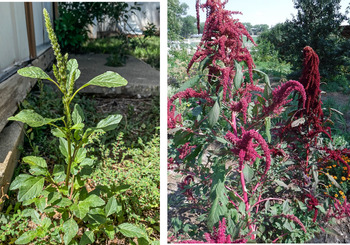
Western agriculture generally views wild Amaranthus species as troublesome weeds that interfere with agriculture (Fritz et al. Reference Fritz, Adams, Rice and Czarzasty2009; USDA 2020b). For example, A. palmeri is spreading rapidly to parts of the United States where it is considered invasive and even noxious. It grows quickly and competes with crops such as maize (corn), cotton, and soybeans, causing significant agricultural losses, and it is increasingly becoming resistant to herbicides (USDA 2020b). Amaranth's common name, pigweed, reflects that it has been viewed as food for livestock but not humans, and perhaps that it can quickly expand to monopolize arable land. Ancestral Puebloan people likely viewed wild amaranth plants very differently. Both the seeds and greens are edible, tasty, and highly nutritious (Figure 1). In the past, farmers probably encouraged these edible weeds as an additional source of food. Indeed, archaeological evidence suggests that as populations increased and people intensified their agriculture, they also increasingly exploited weed species including amaranth (Oas Reference Oas2019:134–135).
(left) Wild amaranth (Amaranthus spp.) that grew on its own in a garden in Cortez, Colorado (photo by Michelle I. Turner); (right) dye amaranth (A. cruentus) in a garden in Aztec, New Mexico (photo courtesy of Vern H. Hensler). (Color online)

Three amaranth species have been domesticated in the Americas, but only one of these, A. hypochondriacus L., is known to have been present in the Southwest prior to the Spanish arrival. That species originated in Mesoamerica and, as discussed below, has previously been identified in deposits in Arizona that clearly predate Spanish contact. Another domesticate grain species, A. cruentus, ranges from southern Mexico to Guatemala, and A. caudatus is from the Andes, but neither of these is known from precontact archaeological assemblages in the Southwest (Fritz Reference Fritz1984; Kietlinski Reference Kietlinski2012:1; Sauer Reference Sauer1950a, Reference Sauer1950b, Reference Sauer1967, Reference Sauer and Simmonds1976). Sauer (Reference Sauer1950b) has suggested the possibility that the introduction of A. cruentus to the Southwest might also have predated European contact. He based this on his examination of an amaranth called komo grown in Hopi gardens and amaranths grown near Santa Ana Pueblo and at San Ildefonso Pueblo, all of which he found to be very similar to A. cruentus from Mexico (Sauer Reference Sauer1950b:414). However, we know of no archaeological evidence for precolumbian presence of A. cruentus in the Southwest.
Amaranth seeds, greens, and inflorescences (flowering stalks) provide a number of nutrients. The greens are high in vitamin C, manganese, magnesium, iron, and phosphorous. They can be eaten raw as salad greens when young (Baker Reference Baker2006:9–10; Whitehead and Flynn Reference Whitehead and Flynn2017:103). The roots are also edible. The seeds have a high protein content and are rich in lysine, an amino acid that is lacking in maize (Baker Reference Baker2006:10–11; Whitehead and Flynn Reference Whitehead and Flynn2017:103; Zheleznov et al. Reference Zheleznov, Solonenko and Zheleznova1997). Amaranth provides much more calcium than other major cereals and is also high in potassium (Joshi et al. Reference Joshi, Sood, Hosahatti, Kant, Pattanayak, Kumar, Yadav and Stetter2018). It has received attention recently as one of the “ancient grains” that have been touted as a healthier alternative to modern plant breeds, as well as a crop that can help to diversify farming in response to a changing climate (Joshi et al. Reference Joshi, Sood, Hosahatti, Kant, Pattanayak, Kumar, Yadav and Stetter2018; Wong Reference Wong2019).
Amaranthus has been taxonomically troublesome for several reasons. Early taxonomists attempted to classify domesticates based on pigmentation and growth form, both of which vary extensively within species. There is also extensive variation within domesticates and a tendency to easily hybridize with wild varieties (Kietlinski Reference Kietlinski2012:2–3; Sauer Reference Sauer1950a, Reference Sauer1967; Stetter et al. Reference Stetter, Müller and Schmid2017, Reference Stetter, Vidal-Villarejo and Schmid2020).
Another source of difficulty in the archaeological study of amaranth is the close resemblance between its seeds and those of another group of plants, the chenopods (Chenopodium spp.). Both produce large quantities of tiny seeds of similar shape and size that can be indistinguishable when charred and damaged in archaeological contexts. Uncharred wild seeds from both genera are black, round to ovate in face view, and elliptical in transverse (cross) section, and they average 1.0+ mm in diameter. Chenopodium seeds often have a more visible “notch” where the ends of the encircling (campylotropous) embryo almost overlap each other, and their surface texture appears lightly “pitted.” In contrast, Amaranthus seeds have less of a visible “notch,” and they have a shiny (nonpitted) surface texture. Charring can not only obscure these surface features but also alter the size of seeds: if burned when fresh, the moisture inside can turn to steam and result in seed enlargement; if burned when dry, seeds can shrink in size. As a result, in archaeobotanical studies, Chenopodium and Amaranthus are often grouped together as “Cheno-ams” because it can be difficult to distinguish one genus from the other when burned and damaged. However, uncharred collections, such as the Aztec North seed deposit discussed here, provide a much better chance to identify the genus correctly.
Western taxonomy has divided amaranth cultivars into grain amaranths and dye amaranths. The distinction is based on their primary uses rather than whether they are edible. The dye amaranths bloom in a variety of red and purple shades, and their flowers are used for dye (Figure 1). The red varieties also became popular ornamentals in European gardens. Both the greens and seeds of the dye amaranths are edible. The grain amaranths are grown for their seeds, and when young, they can also be consumed as greens.
Archaeological Evidence for Amaranth Use in the Southwest
Domesticated amaranth has a long history in Mesoamerica. In Central America, the oldest known amaranth is from a cave in Tehuacan, Mexico, where A. hypochondriacus was dated to 1,500 years ago and A. cruentus was dated to 6,000 years ago (Joshi et al. Reference Joshi, Sood, Hosahatti, Kant, Pattanayak, Kumar, Yadav and Stetter2018). Presumably, these domesticated forms moved northward over ensuing centuries via sharing and trading.
In the Southwest, only a few samples of precolumbian domesticated amaranth are known. Fritz and colleagues (Reference Fritz, Adams, Rice and Czarzasty2009) report on charred amaranth seeds from the floor of a Hohokam house at Las Canopas on the Salt River in Phoenix, Arizona, dating to the late Sacaton phase, AD 1000–1150. They were found in an inverted bowl, along with maize, beans, and cotton seeds. Scanning electron microscope (SEM) analysis, as well as comparison to an assemblage of undated, uncharred, mixed dark and light amaranth seeds from a rock shelter in the Sierra de la Gallina in Sonora, Mexico, suggested that these Las Canopas seeds were domesticated amaranth seeds (Fritz et al. Reference Fritz, Adams, Rice and Czarzasty2009). Fritz (Reference Fritz, Hard and Roney2020) has also reported seeds from a late Archaic or Early Agricultural period site in northwestern Chihuahua that were cultivated and likely domesticated.
Domesticated amaranth seeds have been reported at a number of other sites in Arizona (see Fritz et al. Reference Fritz, Adams, Rice and Czarzasty2009:405, 410–413). At a Salado cliff dwelling in Tonto National Monument in Arizona, uncharred pale amaranth seeds and desiccated inflorescences could be identified with certainty as the cultivar A. hypochondriacus (Bohrer Reference Bohrer and Caywood1962:107–109; Sauer Reference Sauer1950a, Reference Sauer1967:112). Miksicek (Reference Miksicek and Huntington1986:305) identified lumps of charred seeds at the Hohokam West Branch site south of Tucson as A. hypochondriacus due to their large diameter and morphological features such as their “truncate margin” and their distinct ridge. One uncharred pale seed was found in the Pinaleño Cotton Cache (Haury and Huckell Reference Haury and Huckell1993), and one domesticated seed was identified at the Grand Canal site (Fritz et al. Reference Fritz, Adams, Rice and Czarzasty2009; Kwiatkowski Reference Kwiatkowski and Mitchell1989). Fritz and Adams reexamined amaranth seeds collected at Snaketown and determined that they were likely domesticated seeds (Fritz et al. Reference Fritz, Adams, Rice and Czarzasty2009:410). Adams and colleagues (Reference Adams, Fritz, Bostick, Murphy, Kyle Bocinsky and Dockter2019) reported on a bundle full of amaranth seeds from the Dyck cliff dwelling in the Verde Valley. The seeds dated to the eleventh to twelfth centuries, and DNA evidence indicated that they were domesticated seeds.
The co-occurrence of amaranth and maize in storage contexts in several of the above assemblages is significant. As discussed below, the ethnographic record shows that amaranth is one of the highly nutritious seeds that people often use to enrich maize flour. At Antelope House in Canyon de Chelly, coprolites included the co-occurrence of milled maize and amaranth (Oas Reference Oas2019:209; Sutton and Reinhard Reference Sutton and Reinhard1995).
In the Ancestral Puebloan world, Cheno-am seeds are widely found in archaeobotanical samples but are rarely the focus of additional research. Archaeobotanical analysis at Chaco-era (Pueblo II) sites in northern New Mexico suggests extensive use of wild amaranth (also commonly referred to as pigweed) seeds among the many wild plants that people exploited. Wild amaranth has been identified, for example, in archaeobotanical samples from Chaco Canyon (Toll Reference Toll1984, Reference Toll and Mathien1985), and it is often found at Pueblo II and later sites across the Cibola region (Oas Reference Oas2019:Table 5.5). Ancient farmers likely encouraged a number of agrestal (weedy) species, which are essentially wild plants that grew near their villages in disturbed locations (middens, gardens, along pathways, etc.). Such proximity would encourage regular people-plant interactions that could lead to plant management and eventual domestication.
Domesticated amaranth has not been reported at Chaco Canyon or any Chaco outlier (Adams Reference Adams and Reed2006:746–748 [Salmon Ruins], Reference Adams2009 [Cox Ranch and related sites], Reference Adams and Todd2011 [Chimney Rock]; Adams and Rude Reference Adams and Rude2010 [Aztec West fill reduction project]; Bohrer and Doebley Reference Bohrer, Doebley and Reed2006 [Salmon Ruins]; Cummings and Puseman Reference Cummings, Puseman and Cameron2008 [Bluff Great House]; Donaldson and Toll Reference Donaldson, Toll, Breternitz, Doyel and Marshall1982 [Bis sa'ani]; Minnis and Ford Reference Minnis, Ford and Eddy1977:86 [Chimney Rock]; Toll Reference Toll1984, Reference Toll and Mathien1985 [Chaco Canyon]). At Salmon Ruins, two poorly preserved seed coats hinted at the possibility that domesticated amaranth was present, but neither could be definitively identified as domesticated amaranth (Bohrer and Doebley Reference Bohrer, Doebley and Reed2006:739).
The Aztec North Great House
Aztec Ruins National Monument, in northern New Mexico, was a community built by Ancestral Puebloan people. It is the site of the largest known outlier of Chaco Canyon. Like Chaco, it is characterized by monumental structures known as great houses. Unlike Chaco, where people depended mainly on monsoon summer rains and small springs, Aztec lies on the Animas River, a year-round source of water that is fed by snowpack from southern Colorado. It has three great houses. The best-known and largest great house, Aztec West, was extensively excavated by Earl Morris between 1916 and 1928 (Morris Reference Morris1928). The nearby Aztec East great house has also seen some excavation (Richert Reference Richert1964). More recent research has generally focused on architecture at Aztec West and on Aztec West collections and archives (e.g. Baxter Reference Baxter2016; Brown and Paddock Reference Brown and Paddock2011; Brown et al. Reference Brown, Windes, McKenna and Reed2008; Crown et al. Reference Crown, Gu, Jeffrey Hurst, Ward, Bravenec, Ali and Kebert2015; Gruner Reference Gruner and Van Dyke2015; Mattson Reference Mattson2016; Morris Reference Morris1928; Reed Reference Reed2011; Washburn and Reed Reference Washburn and Reed2011; Webster Reference Webster and Reed2008, Reference Webster2011). Here, we report on new evidence from recent testing at a third structure—the previously unexcavated Aztec North great house, LA5603.
Aztec North was the earliest of the Aztec great houses, constructed sometime between AD 1070 and 1110 (Turner Reference Turner2019). There is no evidence for habitation or use at Aztec prior to this period in the late eleventh century, when Chaco's regional system was rapidly expanding. Small room block sites on the terrace around Aztec North appear, from surface pottery analysis, to be roughly contemporaneous with the great house (McKenna Reference McKenna1988, Reference McKenna1998; Reed et al. Reference Reed, Wharton, Adams, Wharton, Reed and Adams2017; Stein and McKenna Reference Stein and McKenna1988; Turner Reference Turner2015, Reference Turner2019).
Unlike other communities involved in the Chacoan system, Aztec survived both the severe drought that began in the mid-1100s and the social upheaval that followed the decline of Chaco. It appears, in fact, to have become a sort of successor to Chaco, a political center in the turmoil of the post-Chacoan world (Brown et al. Reference Brown, Windes, McKenna and Reed2008, Reference Brown, Reed and Glowacki2013; Glowacki Reference Glowacki2015:160–164; Judge Reference Judge, Cordell and Gumerman1989; Lekson Reference Lekson2015:72; Van Dyke Reference Van Dyke2004, Reference Van Dyke2007:209–213, Reference Van Dyke and Reed2008, Reference Van Dyke2009). Although Aztec North's occupation was short lived, Aztec West and Aztec East continued to be occupied until the late 1200s, when people throughout this region migrated away to the Rio Grande Valley and other parts of the Southwest (Brown et al. Reference Brown, Windes, McKenna and Reed2008, Reference Brown, Reed and Glowacki2013; Glowacki Reference Glowacki2015). Aztec West is the largest known great house outside of Chaco Canyon, and its rooms were filled with the same kinds of remarkable objects that were found at Chaco—turquoise and jet ornaments, sacred objects, pottery with traces of cacao from Mesoamerica, and more, much of it indicating a use of the great house for ritual, ceremony, and memory both in the Chacoan and post-Chacoan time periods (see e.g., Crown et al. Reference Crown, Gu, Jeffrey Hurst, Ward, Bravenec, Ali and Kebert2015; Gruner Reference Gruner and Van Dyke2015; Mattson Reference Mattson2016; Morris Reference Morris1928; Reed Reference Reed2011; Washburn and Reed Reference Washburn and Reed2011; Webster Reference Webster and Reed2008, Reference Webster2011).
Aztec Ruins, as a whole, consequently has a two-century history and underwent important changes over time, but Aztec North represents the earlier part of that history. It was built in the late eleventh century and was probably largely in disuse by 1140. Its architecture is unusual, suggesting that it was built by people without full knowledge of Chacoan construction norms. Typical Chacoan walls, including those at Aztec West, follow a “core and veneer” model, with masonry facings on both surfaces but a stone rubble and mortar core. At Aztec North, the idea of core and veneer is present, as are the sandstone facings, but the cores of the walls were packed with adobe rather than with stone (Turner Reference Turner2019).
Despite the unusual architecture, Aztec North's artifact assemblage is highly characteristic of a Chacoan outlier great house. Some 25% of painted white ware pottery at Aztec North, for example, consisted of Cibola tradewares from the Chaco region, and 19% of the gray ware came from the Chuska Mountains. These high proportions of imported pottery suggest that this site was fully incorporated into Chacoan trade networks. Aztec North represents a transitional moment as this community took its first steps to emulate Chaco and then was incorporated into Chacoan relations (Turner Reference Turner2019).
The Ancestral Puebloans of the Aztec community were sedentary farmers, but the plants and animals they used represent a diverse assemblage of wild and domesticated species. Two-thirds of the small faunal assemblage at Aztec North consisted of artiodactyls and lagomorphs, in equal proportions, whereas small birds and rodents made up the remaining third of the assemblage. Turkey bones were present in small numbers. Fish bones identifiable to the Cyprinidae family were also present in a floor context near a fire pit—an important find that contradicts the view that Ancestral Puebloans did not eat fish (Turner Reference Turner2019). Apart from the amaranth discussed here, maize was the only domesticated species in the Aztec North samples. Among the wild species that people used at Aztec North were Indian rice grass, ground cherries, tansy mustard, purslane, pinyon, spurge, prickly pear cactus, hedgehog cactus, and yucca (Turner Reference Turner2019:178–194).
Contexts and Field Methods
The subsurface testing of Aztec North was limited in scope and directed at four primary research goals. These were (1) to date the site, (2) to understand its unusual construction, (3) to explore its relationship to Chaco and other regions, and (4) to learn more about daily life and subsistence.
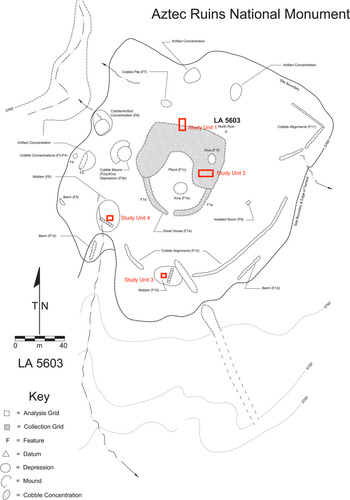
A team from Binghamton University excavated four study units with a total surface area of 18 m2 in 2016. Figure 2 is the National Park Service's official site map of Aztec North, with the great house in gray at the center, and with boxes marking the approximate locations of the four study units. Two of the study units were sited to examine the architecture of the great house. Study Unit 1 was intended to locate the back wall of the great house, whereas Study Unit 2 was in the eastern wing of the structure. Study Units 3 and 4 were in the two midden areas south of the great house. The identified middens of this great house are shallow, and preservation of faunal or archaeobotanical materials was limited (Turner Reference Turner2019). The Amaranthus samples discussed in this article came instead from Study Unit 1, a north-south 1 × 8 m trench perpendicular to the back wall of the great house.
Aztec North site map with study units. Study Units added by author to site map from the National Park Service (2007:14).

Crew members took bulk soil samples for flotation in every cultural level. These soil samples were subsequently floated and analyzed. The six samples that appeared to have the highest concentration of seeds were analyzed by Nikki Berkebile and Karen Adams, and two of those samples included the amaranth seeds discussed here.Footnote 1
The seeds discussed here were found in two samples from Stratum 5, a small stratum in Study Unit 1. Stratum 5 was a thin layer of mixed ashy trash deposits and aeolian deposits above the roof fall in a room at the rear of the great house.
The roof in this area had collapsed or perhaps been knocked down, with no evidence of burning, after which windblown sediments settled on top of the architectural debris. At some point later, someone deposited a thin, ashy layer of trash on top, which was likely a secondary deposit of trash brought from elsewhere at the site and dumped into this abandoned room. Perhaps it had some significance as part of a symbolic closing of this collapsing room. The thin ashy lens is intermixed with aeolian deposits in such a way that the excavators were not able to clearly identify it as a separate stratum or feature as they excavated, so the entire Stratum 5 is actually a mix of aeolian sediments and charcoal. The lens was clearly visible in the profile, however. Sometime after deposition of these materials, the walls collapsed on top of this roof fall.
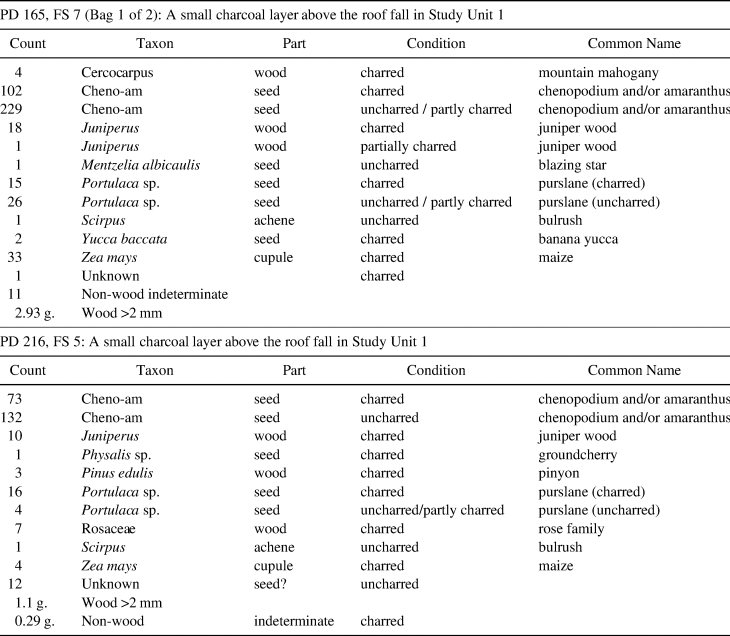
The ashy lens in Stratum 5 was full of artifacts. These included obsidian flakes, faunal remains, corn cobs, an antler tool, a projectile point, and 10 small black shale beads. It was also rich in plant specimens. The full list of plant specimens found in this stratum is listed in Table 1.
Samples from Stratum 5.

Although it lies on top of roof fall, Stratum 5 was buried at about 60 cm. The nature of the artifacts in it indicate that it is contemporaneous with or only slightly postdates the occupation of the rest of the great house. The reuse of great house rooms for middens was very common, including at Aztec West where many rooms built prior to 1140 were later filled with trash (Morris Reference Morris1928:419).
We have three AMS radiocarbon dates specifically for Stratum 5, suggesting that this midden deposit was likely laid down in the mid- to late 1100s AD (Turner Reference Turner2019).Footnote 2 The handful of decorated pottery sherds found in Stratum 5 point to an earlier date, with two Gallup Black-on-white sherds and an Escavada Black-on-white sherd that were made sometime before 1150. Clearly, though, this is a twelfth-century deposit rather than anything significantly later. This is all consistent with data from Aztec North as a whole, which indicates that the great house was built between 1070 and 1110 and was likely no longer in regular use by the 1140s (Turner Reference Turner2019).
A full list of the plant specimens found in the two samples from Stratum 5 is presented below (Table 1). Both samples were particularly rich in Cheno-am seeds. Maize was present but in smaller quantities. Other identified plant specimens include a stickleaf (Mentzelia albicaulis) seed, a groundcherry (Physalis sp.) seed, purslane (Portulaca sp.) seeds, banana yucca (Yucca baccata) seeds, and two bulrush (Scirpus) achenes. Wood species in the same samples included juniper, mountain mahogany, pinyon pine and Rosaceae.
Notably, these two samples included a number of uncharred and partially charred seeds. Although only charred seeds are normally considered prehistoric in open-air sites such as this, we are confident that the uncharred Cheno-am seeds in the Aztec North samples are prehistoric as well. First, these seeds were deeply buried under some 60 cm of collapsed walls and postoccupational deposits, in dry soils that have been associated with extraordinary preservation at Aztec West. More importantly, the presence of partially charred seeds in the same flotation sample as charred and uncharred seeds is evidence that uncharred prehistoric Cheno-am seeds are capable of being preserved in these conditions.
Archaeobotanical Analysis Methods
Distinguishing wild amaranth from domesticated amaranth has been a challenge for archaeologists. Experts have noted that the size of amaranth seeds is not a definitive criterion for distinguishing domesticated from wild seeds, especially when charred archaeological seeds have shrunken to some unknown extent during burning (Fritz et al. Reference Fritz, Adams, Rice and Czarzasty2009). The seeds of other domesticated grains, such as wheat and barley, became significantly larger with domestication and experienced additional distinctive morphological changes. In the case of domesticated amaranth seeds, the changes during domestication have been more subtle and often require confirmation via the use of scanning electron microscopy. Domesticated grain amaranth plants generally produce “an enormous quantity of seeds” (Sauer Reference Sauer1950a:614), but seed size has not significantly changed as a result of domestication (Fritz Reference Fritz1984:559–560; Fritz et al. Reference Fritz, Adams, Rice and Czarzasty2009; Sauer Reference Sauer1950a:614). There are very minute differences in seed shape and the thickness of the testa (seed coat), visible via a scanning electron microscope (SEM; Fritz et al. Reference Fritz, Adams, Rice and Czarzasty2009). Identification of species is not possible without the presence of flower parts, sometimes preserved in cave/rockshelter deposits (Fritz Reference Fritz1984; Sauer Reference Sauer1969).
One important source of information is the seed color. Wild forms of amaranth have black seeds, as do some types of domesticated amaranth. For example, Hopi komo amaranth seeds (A. cruentus) purchased commercially from Native Seeds/SEARCH are entirely black (Native Seeds/SEARCH 2020). The seeds of other cultivars usually occur in shades of white/cream or tan. The light-colored seeds common in domesticates are a genetically recessive trait fostered by human selection (Fritz Reference Fritz1984; Sauer Reference Sauer1969; Stetter et al. Reference Stetter, Vidal-Villarejo and Schmid2020). Moreover, it appears that seed color was at least one of the traits specifically selected by human groups (Stetter et al. Reference Stetter, Müller and Schmid2017, Reference Stetter, Vidal-Villarejo and Schmid2020), although the reasons for doing so are unknown. Dark seeds mixed with light seeds are not necessarily wild contaminants but may be indicative of variation in the domesticate, and some domesticates have black seeds (Fritz et al. Reference Fritz, Adams, Rice and Czarzasty2009:409; Stetter et al. Reference Stetter, Vidal-Villarejo and Schmid2020).
For ancient collections of charred amaranth seeds, burning has obliterated the original color and possibly altered seed size by shrinkage or expansion, dependent in part on seed moisture content when burned. Instead, testa (seed coat) thickness has long been a useful trait to distinguish domesticated seeds from wild ones. Because the Aztec North uncharred seeds were identifiable as domesticated based on their color and size, we did not conduct expensive and time-consuming SEM testa thickness analysis. However, this is a reasonable future line of research that would establish the morphometric parameters of testa thickness among these uncharred Aztec North seeds to provide comparative data to help identify future collections, or perhaps even distinguish any landraces present. Future DNA analyses might also document the species or landraces of amaranth represented by these uncharred Aztec North seeds.
Despite the similarity of their seeds, wild and domesticated plants themselves have very different morphologies. The domesticates are taller, with larger inflorescences (flowering stalks), resulting in much larger seed yields (Fritz Reference Fritz1984; Sauer Reference Sauer1950a). Moreover, the domesticated species have relatively weak bracts that are less prickly when rubbed between the hands (Fritz Reference Fritz1984; Sauer Reference Sauer1950a). The domesticates also have thinner seed coats, which might make them easier to process and cook (Fritz Reference Fritz1984; Fritz et al. Reference Fritz, Adams, Rice and Czarzasty2009), as well as quicker to germinate when planted.
Results
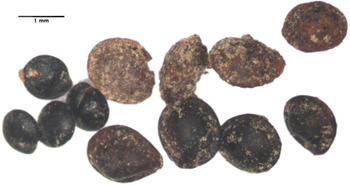
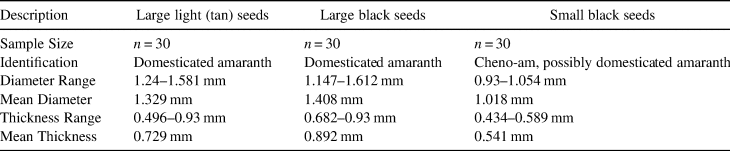
There are 239 whole and uncharred seeds from PD 165 and 73 from PD 216, which we have identified as black and tan amaranth seeds. The tan seeds include both a dark shade and a light shade. These light and dark tan seeds were all within a similar size range, but there are two different size groups (large and small) of black seeds (Figure 3). Of the whole, uncharred Cheno-am seeds that could be clearly identified, 85 (36%) are the large black seeds, 74 (31%) are the large tan seeds, and 80 (33%) are the small black seeds, so the three groups appear in similar proportions in the two Aztec North samples.
Three groups of Amaranthus seeds from Aztec North: (upper right) large tan seeds, (lower right) large black seeds, and (left) small black seeds (photo by Michelle I. Turner). (Color online)

Table 2 summarizes measurements for 30 of each of the three size/color groups at Aztec North. Complete diameter and thickness measurements for those 90 seeds are included in Supplemental Table 1. The large tan and large black seeds were similar in both diameter and thickness, but the other black seeds were smaller on both measures.
Summary of Aztec North Seed Measurements.

Notes: Morphometric data for Aztec North seeds, measured under a Zeiss binocular microscope with an eyepiece micrometer, at 32× magnification. Diameter is the longest dimension of the seed, while thickness is from one face to the other.
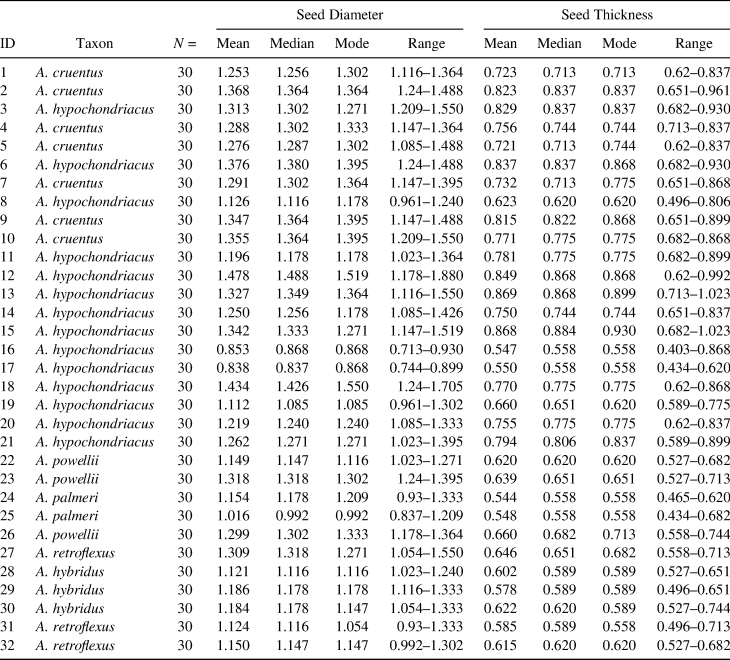
In addition to measuring the Aztec North seeds, we report detailed diameter and thickness measurements on 960 seeds from modern amaranths from the Southwest and Mexico, including both wild varieties and the two domesticated landraces found there—A. hypochondriacus and A. cruentus. Table 3 summarizes the mean, median, mode, and range for each seed variety. Sourcing details about each of the 32 modern seed accessions, as well as the detailed measurement data, are in Supplemental Table 2.
Summary of Modern Seed Measurements.

Note: Morphometric data for 32 modern varieties of Amaranthus, measured under a Zeiss binocular microscope with an eyepiece micrometer, at 32× magnification
The modern seed data confirm that morphometrics are not a reliable indicator of domestication. The mean diameters for the domesticated seeds (IDs 1–21) are mostly over 1 mm, and often as large as 1.3 mm or even 1.4 mm. However, one domesticate (ID 16) has a mean under 1 mm, and a number of other domesticate samples (IDs 8, 17, 19) include seeds under 1 mm. The wild varieties, moreover, all have a mean diameter over 1 mm, and eight of the 10 samples include seeds with diameters of 1.3 mm (IDs 23, 24, 26, 27, 29–32). Indeed, ID 27, an A. retroflexus, has a mean diameter over 1.3 mm. Thickness measurements are similarly mixed and indeterminate. As researchers have previously cautioned, amaranth seed size varies greatly in modern domesticates, likely because farmers selected for seed number rather than seed size (Fritz et al. Reference Fritz, Adams, Rice and Czarzasty2009).
Discussion
We report here on the discovery of uncharred domesticated amaranth seeds at the Aztec North great house. Although domesticated amaranth seeds have been previously reported from Hohokam sites in Arizona that likely predate the seeds from Aztec North, we currently know of no previous reports of this cultivar at other Chacoan outliers or, indeed, at any Ancestral Pueblo site in the San Juan Basin.
The Aztec North seeds include tan varieties, and based on their seed coat color, we identify these tan seeds specifically as domesticated amaranth. The large black seeds are similar in size and shape to the tan seeds. Due to these characteristics and their association with the tan seeds, we identify the large black seeds as domesticated amaranth. The smaller black seeds cannot be identified with certainty as domesticated amaranth, but by association, we consider them “possibly domesticated.”
Notably, the light seeds from Aztec North are two shades of tan (light, dark) as well as black, similar to modern cultivar seeds. The two tan shades are significant in themselves, given that reports of cultivated amaranth in archaeological assemblages have previously referred to their seeds as “white” or “pale” (Fritz Reference Fritz1984; Fritz et al. Reference Fritz, Adams, Rice and Czarzasty2009). The coloring of domesticated amaranth in the past was clearly more varied than previously considered.
As a food source, amaranth is highly nutritious, drought resistant, and relatively easy to grow and harvest. Residents of the Southwest today are familiar with the wild amaranths that thrive between garden rows and in other disturbed soil and that each release hundreds of tiny seeds. Cultivar varieties are also grown successfully in northern New Mexico and other areas of the Four Corners. Although it is perhaps difficult to envision amaranth seeds just over 1 mm in size as a staple food source, the ethnographic evidence makes it clear that amaranth has been a key crop for many people in Mexico as well as at Hopi, Zuni, and other Pueblos of the US Southwest.
There is extensive ethnographic evidence from Mexico on the importance of amaranth. Moctezuma, the Aztec emperor at the time of the Spanish conquest in 1519–1520, reportedly collected nearly as much amaranth as maize for tribute (Sauer Reference Sauer1967). Aztec communities used amaranth in a paste that was used to make idols for household and public rituals, and because of its association with perceived heresy, Christian authorities suppressed its cultivation after the conquest (Sauer Reference Sauer1967:115). That suppression may have led to the decline of amaranth as a food crop in Mexico and perhaps in New Mexico as well.
However, domesticated amaranth continues to both be an important food source in some areas of Mexico and have ritual significance. Confections of popped amaranth known as alegria are popular in some places, especially on saints’ days. Amaranth is also used to make tortillas, cakes, and a beverage known as atole (Baker Reference Baker2006:92–96; Sauer Reference Sauer1950a; Sauer Reference Sauer1967:113–115; Whitehead and Flynn Reference Whitehead and Flynn2017:103). Among the Wixárika people of north-central Mexico, the stories and ritual that surround amaranth rival (and interweave with) those that surround maize. “Amaranth Boy” is an important deity, and he is the one who first found maize (Baker Reference Baker2006:96). Many people, especially women, are named for amaranth, and sweet confections made of amaranth are used in various rituals (Baker Reference Baker2006:59–62, 96–98).
There is also ethnographic and historic evidence for domesticated amaranth among various cultural groups in the American Southwest, including the Paiute and perhaps other groups (Bohrer et al. Reference Bohrer, Cutler and Sauer1969:6–7; Sauer Reference Sauer1967). Despite the apparent connections to Mesoamerica, domesticated amaranth was also present in areas of North America far from the Southwest. In particular, whole plants from undated deposits in a rockshelter in Arkansas have been identified as A. hypochondriacus, the Mesoamerican cultivar (Fritz Reference Fritz1984).
Domesticated amaranth use has been a part of the traditional practices of historic Pueblo people. Stevenson (Reference Stevenson1915:65) recorded that Zuni people grew an amaranth called ku'shutsi, which means “many seeds.” Its seeds were ground and mixed with maize into balls or patties, which were then steamed in pots or used for mushes and other breads (Cushing Reference Cushing1920:253–254; Stevenson Reference Stevenson1915:65). Enriching maize breads with amaranth seeds has the effect of increasing their nutritional value and changing their taste and texture (Oas Reference Oas2019:126).
Dye amaranths have also traditionally been used in the Pueblos. Hopi komo amaranth has dark red leaves, stalks, and flowers. Sauer (Reference Sauer1950b) reported that the flowers and seeds were soaked in water to create liquid food coloring for a red piki bread that Katsina dancers passed out to children during certain ceremonial events. According to Sauer (Reference Sauer1950b), the seeds and leaves of this plant were not eaten, and the dye was not used for coloring fibers (Sauer Reference Sauer1950b). He also recorded the use of amaranth to make a red wafer bread at San Ildefonso in the 1950s (Sauer Reference Sauer1950b). Zuni people also used amaranth as a dye for making a red flatbread called he'we, which was carried by dancers at ceremonial events and distributed to the crowd. Crushed amaranth leaves and blossoms were additionally used as a dye for the cheeks (Stevenson Reference Stevenson1915:83).
Growing amaranth is relatively simple due to its drought tolerance. Among the Wixárika people of north-central Mexico, domesticated amaranth is planted by simply scattering seed on rocky terrain (Baker Reference Baker2006:37, 40). At Zuni, harvesting amaranth was traditionally a matter of setting a tightly woven basket under the plant and hitting the seeds out of their flowering heads (Cushing Reference Cushing1920:244). The Wixárika of Mexico collect the entire flower of their domesticated amaranth and then winnow the seeds by dropping them between baskets in the wind (Baker Reference Baker2006:39).
Coupled with extensive ethnographic evidence of the use of amaranth, this identification of domesticated amaranth seeds in a twelfth-century Ancestral Puebloan assemblage in northern New Mexico indicates long continuity in traditional Indigenous knowledge and practice. Traditional Puebloan agriculture includes this crop that Pueblo ancestors acquired prior to occupation of the Aztec North great house in the twelfth century AD. Eight centuries of traditional knowledge and traditions are exemplified here.
Although amaranth was domesticated in Mesoamerica much earlier, its presence in prehispanic Native American communities is significant to understanding ancient foodways. Many archaeologists and members of the general public are familiar with Indigenous cultivation of beans, squash, and maize, but the importance of other domesticated species such as amaranth has been overlooked. Recent research in the Midwest, for example, has demonstrated the domestication of a whole suite of native crops such as erect knotweed (Polygonum erectum) and maygrass (Phalaris caroliniana), some of which have since been lost (Fritz Reference Fritz2019; Mueller et al. Reference Mueller, Fritz, Patton, Carmody and Horton2017). The discovery of a domesticated grass, little barley (Hordeum pusillum), in the Four Corners region suggests travel, trade, or independent domestication of yet another common central/southern Arizona domesticate whose wild relatives are absent from the region today (Graham et al. Reference Graham, Adams, Smith and Murphy2017).
Domesticated amaranth is far from lost. Puebloan groups have traditionally continued to grow it, and seeds are available today to a broader public interested in heritage seeds from seed-saving organizations such as Native Seeds/SEARCH, which is based in Arizona. But its role as a part of the ancient Ancestral Puebloan world has been previously underappreciated.
The presence of this grain at Aztec North, a Chacoan great house, is significant. The ashy stratum that included these seeds lies atop roof fall, and all of the dating evidence suggests that it is from the mid to late twelfth century, a period that marks the transition from a Chacoan system to one in which Aztec became the new center of power. Aztec North, with walls that were likely quite unstable due to their experimental adobe cores, was perhaps in decline by this time, but it may have continued to play a ceremonial role as the great house on top of the hill (Turner Reference Turner2015, Reference Turner2019). It is entirely possible that domesticated amaranth was quite common in the Chacoan or post-Chacoan world, and that the Aztec North deposit only seems rare because amaranth seeds are generally charred and not easily identified as domesticated. Given that skilled analysts have not previously recognized this domesticate in the region, this deposit at a site of ceremony, in a time when Aztec was becoming the new power center, is significant. We know that amaranth was and is ceremonially important in parts of Mexico, and it is possible that it had special ritual importance here as well. Although there is limited ethnographic evidence from the Pueblos about amaranth use in ritual, the recent discovery of cacao in Chacoan contexts offers another example of a Mesoamerican plant imported with the knowledge to use it—and, perhaps, with its related ritual significance (Crown and Hurst Reference Crown and Hurst2009; Crown et al. Reference Crown, Gu, Jeffrey Hurst, Ward, Bravenec, Ali and Kebert2015).
The ethnographic record suggests that color is an important aspect of Puebloan relationships with this plant, because amaranth flowers were traditionally used to dye red breads. The unusual colors of the seeds reported here might also be culturally significant. Color symbolism plays a central role in Pueblo ritual and life. Colors are associated with cardinal directions (although these associations vary from Pueblo to Pueblo), and plants, minerals, and animals are also associated with certain colors. Genders, moieties, and katsinas all have color associations (Munson Reference Munson, Munson and Hays-Gilpin2020; Ortiz Reference Ortiz1969:18–19; Parsons Reference Parsons1996 [1939]:99; Whiteley Reference Whiteley, King, Carocci, Cartwright, McEwan and Stacey2012). Among the Hopi, for example, black is the color of the zenith and is associated with jackrabbits, jet, and sunflowers, whereas white, the color of the northeast, is associated with elk, juniper, and abalone shell (Teague and Washburn Reference Teague and Washburn2013:66–67; Whiteley Reference Whiteley, King, Carocci, Cartwright, McEwan and Stacey2012). At Zuni and most Pueblos, black is the color of the nadir, of the earth, and of the underworld (Munson Reference Munson, Munson and Hays-Gilpin2020:13–15; Whiteley Reference Whiteley, King, Carocci, Cartwright, McEwan and Stacey2012). Black is also associated with rain clouds (Ortiz Reference Ortiz1969:94; Schaafsma Reference Schaafsma, Munson and Hays-Gilpin2020; Teague and Washburn Reference Teague and Washburn2013:66). Archaeologists have tended to describe this as color symbolism, but it goes far beyond symbolism. Colors, in combination with other colors and with material, can take action in the world, communicating with nonhuman entities such as katsinas or rainclouds. The colors play parts in ceremony as well as in daily life (Munson Reference Munson, Munson and Hays-Gilpin2020:13–15; Plog Reference Plog2003). They are also present in agricultural practices. Hopi people grow maize of six different colors, and cobs of different colors are used in traditional ceremony to represent the six directions (Hieb Reference Hieb, Ortiz and Sturtevant1979:578–579; Plog Reference Plog2003; Stephen Reference Stephen and Parsons1936:354). Hopi beans are also multicolored (Plog Reference Plog2003; Stephen Reference Stephen and Parsons1936:354). Corn colors are fundamental to Tewa ritual and agricultural practices as well (Ford Reference Ford1980). Assuming that similar color symbolism and colorful cultivars existed in the Ancestral Puebloan world, it is possible that the consumption or display of multicolored amaranth seeds had similar significance at Aztec North. Moreover, there is some evidence that the color black might have been particularly important at Aztec Ruins. Mattson (Reference Mattson2016) has found that over 75% of ornaments at Aztec West were made of shale, which is generally black or dark brown, and Reed and Turner (Reference Reed and Turner2018) have discussed the significance of unusual black pottery made at Aztec Ruins. It is possible that farmers at Aztec North intentionally selected for dark seeds or chose to grow seeds in shades of tan and black rather than pale seeds. These ideas are conjectural at this point, but given the genetic evidence that farmers may have intentionally selected for seed color in amaranths (Stetter et al. Reference Stetter, Müller and Schmid2017, Reference Stetter, Vidal-Villarejo and Schmid2020), archaeological and ethnographic research should consider the social significance of color in exploring why they might have done so.
Conclusion
This research reveals the presence of domesticated amaranth seeds at the Aztec North great house in northern New Mexico. Amaranth was domesticated in Mesoamerica, and it has previously been identified within Hohokam sites in Central and Southern Arizona that are slightly earlier than Aztec North. However, we report here the first record of domesticated amaranth seeds at a Chacoan great house. Found in a deposit dating from the mid to late twelfth century, these amaranth seeds correlate to a moment when Aztec was coming into its own as the new, post-Chacoan political center. The idea that Mesoamerican objects made their way up through Hohokam territory and into the Chacoan influence sphere is a familiar one (Mills and Ferguson Reference Mills and Ferguson2008; Nelson Reference Nelson and Lekson2006), and based on the present evidence, it appears that Hohokam groups had access to domesticated amaranth before it arrived in the Ancestral Puebloan world. Further research may reveal more examples of domesticated amaranth in the San Juan Basin. The amaranth seeds from Aztec North also expand what we know about precolumbian domesticated amaranth, adding two new shades of tan (light, dark) and new size variation (large, small) to the known characteristics of the seeds of this crop. This discovery also sheds new light on the deep history of Puebloan agriculture, taking us beyond maize, squash, and beans. The people who lived at Aztec North were keepers of a plant that their descendants at Hopi, Zuni, and other Puebloan communities long continued to grow, demonstrating centuries of continuity in the cultivation of this truly ancient grain.
Acknowledgments
The authors wish to thank Aztec Ruins National Monument and its staff—including Aron Adams, Lori Stephens, Vern Hensler, and Stephen Matt—for their work on and support of this project. We also thank Ruth Van Dyke, BrieAnna Langlie, and members of the field crew (Ruth Van Dyke, Randy McGuire, Kellam Throgmorton, Josh Jones, Lubna Omar, Maxwell Forton, and Sam Stansel) for their contributions to this research. Fieldwork at Aztec North was funded by National Science Foundation Dissertation Improvement Grant #1838474 and by research grants from the Western National Parks Association, the Lewis and Clark Fund for Exploration and Field Research, the Explorers Club Exploration Fund–Mamont Scholars, and the Arizona Archaeological and Historical Society. Michelle Turner's research was also funded by a Dissertation Year Award from the Department of Anthropology at Binghamton University and by her postdoctoral position at Crow Canyon Archaeological Center.
Data Availability Statement
Data from Aztec North reported in this article are archived with Michelle I. Turner's dissertation on tDAR.com and will be on file with Aztec Ruins National Monument. Additional data is in the supplemental materials. The archaeological collections from which the data were developed are curated by Aztec Ruins National Monument. The modern seed measurement data is available from Michelle Turner.
Supplemental Material
For supplemental material accompanying this article, visit https://doi.org/10.1017/aaq.2021.57.
Supplemental Table 1. Detailed Measurements of Aztec North Seeds.
Supplemental Table 2. Detailed Measurements of Modern Southwestern Amaranth Domesticates.