It is almost midnight on a mid-December evening, and the dance floor is full at the Aldahood wedding hall on the outskirts of Kufr Yasif, a Palestinian Arab village just outside Acre, in the Galilee region of northern Israel. Between short improvisations on the violin and qanun, local wedding singer Esam Kadri performs a vocal improvisation from the song “Mudnak Jaffah Murqdah,” originally recorded in 1938 by Egyptian singer Muhammad ’Abd al-Wahab. While ’Abd al-Wahab’s original vocal improvisation was unmetred, performed with light accompaniment by violin and oud which shadow the vocal line, here, a strong rhythmic accompaniment is provided by darbukah, riq, and drum kit. As Kadri’s voice rises in pitch, the volume of the music rises and the tempo gradually increases. Responding to this intensification, the father of the bride raises his hands and increases the energy of his dancing, together with a group of older men who surround him on the dance floor. Meanwhile, two video cameramen move among the crowd and a soundman keeps a careful watch on the musicians. (Fieldnotes 15 December 2016; see YouTube example 1.)Footnote 1
Music accrues meanings as it crosses borders in both time and space: as Palestinian Arab wedding musicians perform nightly across the Galilee region of northern Israel, transnational cosmopolitan music crosses, creates, and reinscribes borders, flowing into and around local geographies in complex ways. In the scene pictured above, some eighty years after international Arab star Muhammad ’Abd al-Wahab recorded this song in Cairo, his music crosses a strained political border into the state of Israel. At the same time, the music also crosses social borders, from urban and cosmopolitan to rural and local, and genre boundaries, from serious tarab music intended for listening to a more popular format intended for dancing.Footnote 2
To date, much research on urban musics in the Arab world has looked from the centre outwards, considering how, for example, new forms of media disseminate the music of Umm Kulthum, ’Abd al-Wahab, and their contemporaries across the Arab world (see for example Lohman Reference Lohman and Nooshin2009; Stokes Reference Stokes and Nooshin2009). The present article reverses this gaze, considering how mainstream urban musics from surrounding Arab cultures are adapted and re-contextualised by professional Palestinian Arab wedding musicians in the Galilee region of northern Israel, serving as an important point of mediation between local and regional identities. Owing to political conflict, the Galilee region has effectively been dislocated from the musical scenes of the surrounding countries since the foundation of the state of Israel in 1948, yet today’s wedding musicians locate themselves within a shared regional acoustic community, in which musical consumption and practice cut across political borders. Regional musics are superimposed on local geographies, and songs made famous by transnational stars are rendered anew by local voices.
Music is a dynamic actor in local identity, evoking relational identities and articulating multilayered processes of placemaking, situating today’s tastes and practices not just within today’s political borders but also within historic Palestine’s long history as a cultural crossroads amidst major powers in the region, and within the history of modern urban life in the region. By the early twentieth century, these musical connections linked Palestinian cities to cosmopolitan regional centres. Such geographies emerge not from formal discourses or maps, but from embodied practices within the auditory environment, realised as local audiences make musical requests, respond to a singer’s choice of music by signalling the need to speed up the music a little for dancing, or tell stories about music. The ability to respond to subtle local differences in musical taste is part of the professional toolkit of a successful musician; in turn, as they travel to perform at wedding parties beyond their own social circles and seek opportunities to widen their own careers, musicians encode and articulate this local knowledge with references to genres, artists, and local narratives.
Drawing upon our research team’s ethnographic fieldwork, and discourse on musical choices and practices generated during thirty extended narrative interviews with wedding musicians in the Galilee region between 2015 and 2019, this article explores how musicians use musical choices to narrate and mediate local, regional, and transnational identities, from social distinctions between Palestinian Arab regions, towns, and villages within Israel, to wider imaginaries about the place of the Galilee within regional Middle Eastern geographies.
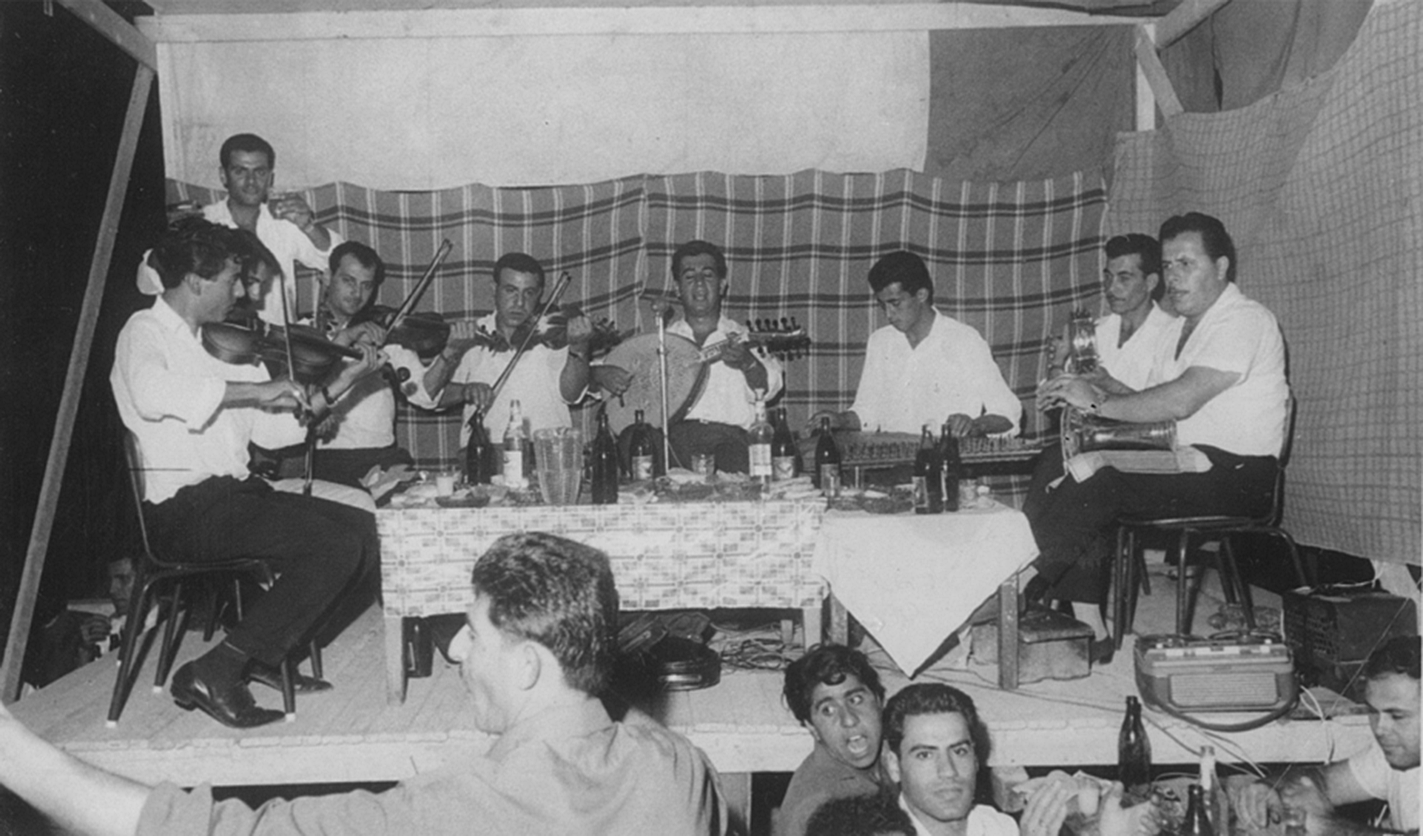
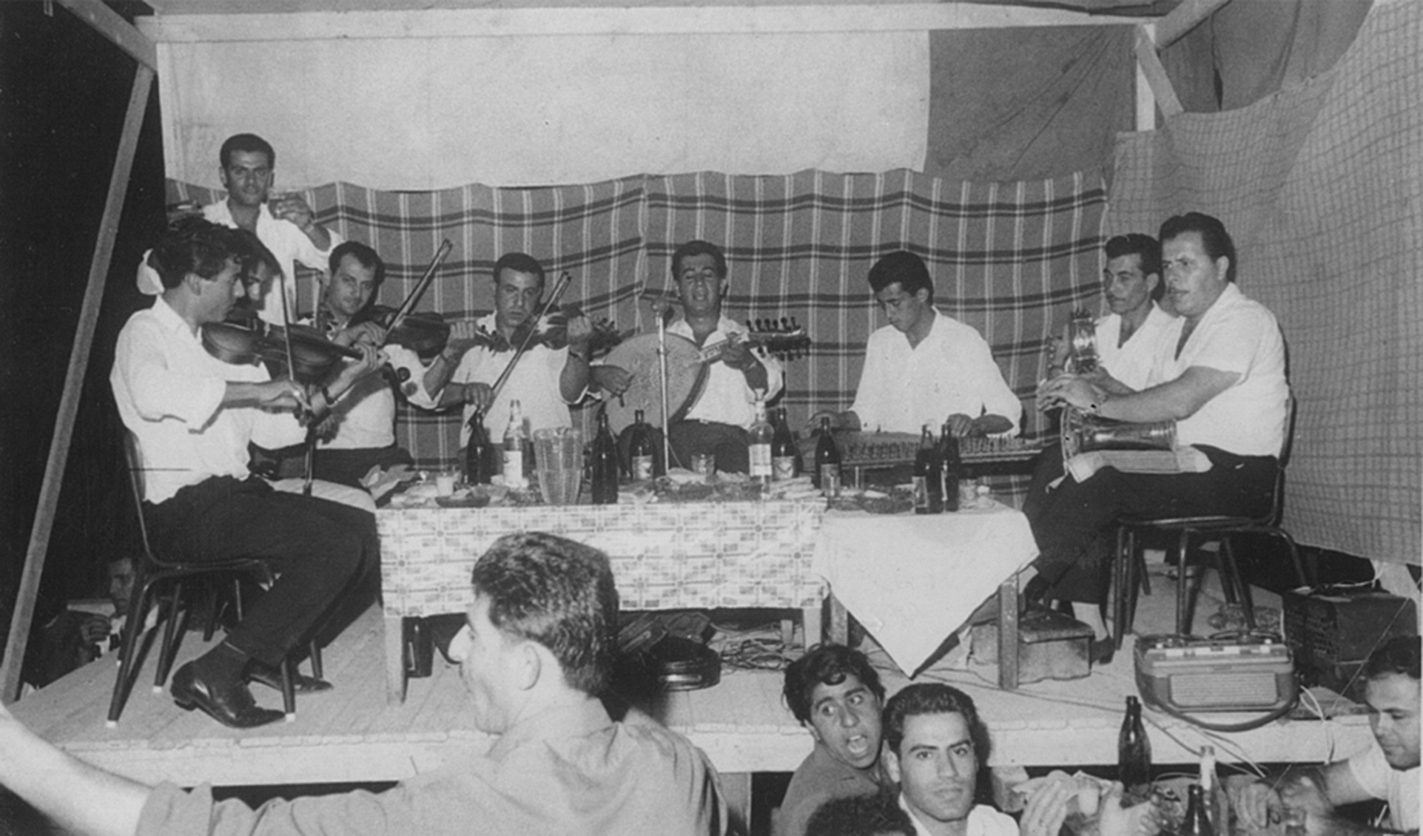
Palestinian Arab citizens of Israel today make up around twenty-one per cent of Israel’s citizens (totalling 1,890,000 people in 2019), and around fifty-one per cent of the population of the Galilee region—a largely rural area dotted with small towns and villages which surround three urban centres: Haifa, Acre, and Nazareth.Footnote 3 Today’s professional Arab music scene in the Galilee can be traced back to the gradual emergence of ensembles in cities and villages during the 1960s that played light Arab music drawn from repertories that circulated widely via the radio and other media (Figure 1; see Cohen and Katz Reference Cohen and Katz2006:14; Regev Reference Regev1993; Brinner Reference Brinner2009). The gradual displacement, since the 1960s, of the rural folk repertories that had previously formed the mainstay of Palestinian wedding music in the Galilee (and continue to do so in other Palestinian regions) by urban musical repertories played by professional musicians parallels wider socioeconomic processes of urbanisation among Palestinians in the Galilee, which serve to differentiate the region from other Palestinian communities both inside and outside the state of Israel.Footnote 4 These changes encompass not only musical taste, but also the economic structures within which music is performed: today, large wedding parties are commonly held in commercial wedding halls located on the outskirts of towns rather than in home weddings and courtyards; many of the bands that are hired to perform at weddings travel throughout Israel and the West Bank to do so.Footnote 5 Today, notwithstanding both the emergence of these professional ensembles within living memory, and the origins of the musical materials in commercial recordings from Egypt, Lebanon, and Syria, many in the Galilee perceive this wedding repertory as an established local tradition.
Bishara Awad and his ensemble at a rooftop wedding in Nazareth in the mid-1960s. Photo courtesy of Bishara Awad.
If at first a small number of singers and instrumentalists were active in the Galilee wedding scene, performing primarily within their own local area, by the 1980s the number of ensembles had greatly expanded, and today tens of musicians make their livelihood playing nightly at wedding halls across the region. Many are young men, taking advantage of the economic opportunity but hoping to develop their musical careers elsewhere; others have built careers primarily on wedding performances. Although there is no formal prohibition on women singing or playing at wedding parties, and those parties which include live music are generally secular affairs with mixed dancing, today’s active Palestinian Arab wedding musicians are almost exclusively male. While numerous professional female singers are active in the Galilee, and several are as well-known as their male counterparts, the macho work environment of wedding performance is not considered culturally appropriate for women performers. Female singers have preferred to develop their careers on artistic and political stages, considered more legitimate since they offer the singer some degree of distance from her audience, and echo the performance contexts of previous generations of respected female singers, including Umm Kulthum, Fairuz, Leila Murad, Asmahan, and others. A female singer will occasionally offer a single waslah at a wedding, or, rarely, may perform as part of an ensemble with male family members. Female instrumentalists are still less common in wedding ensembles, likewise preferring musical roles considered more appropriate, serious, or respectable, such as teaching or concert performance.
Male wedding singers, by contrast, are expected to embody culturally coded masculine behaviour, interacting directly with male guests and descending from the stage to dance or banter with them. YouTube example 2 shows Haifa-based singer Elias Glyanos performing a series of mawaweel (singular mawwal—semi-improvised vocal genre) by the Lebanese singer Wadih el-Safi at a wedding party in Nazareth, while the evening meal is served.Footnote 6 Facing the seated guests, Glyanos begins singing over a rhythmic-melodic accompaniment by his band. At first, the tempo, pitch, and dynamic levels are relatively low. Glyanos then uses an unmetred, higher-pitched section (beginning 1:25) to transition to a louder section, which gradually increases in tempo (1:52). As he continues, he moves among the guests, interacting first with older male guests who offer him their glasses for a toast (1:50). Standing on a chair, he then leads a boisterous performance of camaraderie among younger men, calling out to them to raise their hands (2:10), and interacting with the groom as he rides on a friend’s shoulders. This kind of scene is crucial to the wedding experience. In many cases, the success of a wedding party is judged by how much the singer and the band “put the stage on fire,” and singers will often adapt the original text of a song to toast the bride or groom’s family or one of the guests. While seating at the wedding is mixed, this direct interaction between singer and guests is almost exclusively between men, the women forming a more distant circle behind them.
During the yearly summer season, wedding musicians play for tens of thousands of guests, commanding fees that easily outpace the incomes of other prestigious professions, and shaping musical tastes in the region. The most prominent singers are well-known local stars: wedding dates are often decided according to their availability, and they draw crowds during public performances, whether occasional concert performances of tarab music or popular stages at the Nazareth Christmas Market. Some of the most successful singers, including Zuheir Francis, Mustafa Dahleh and Esam Kadri have amassed YouTube views in the millions.
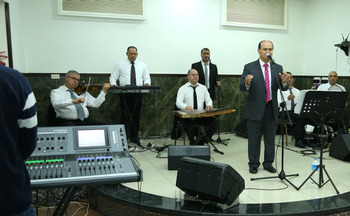
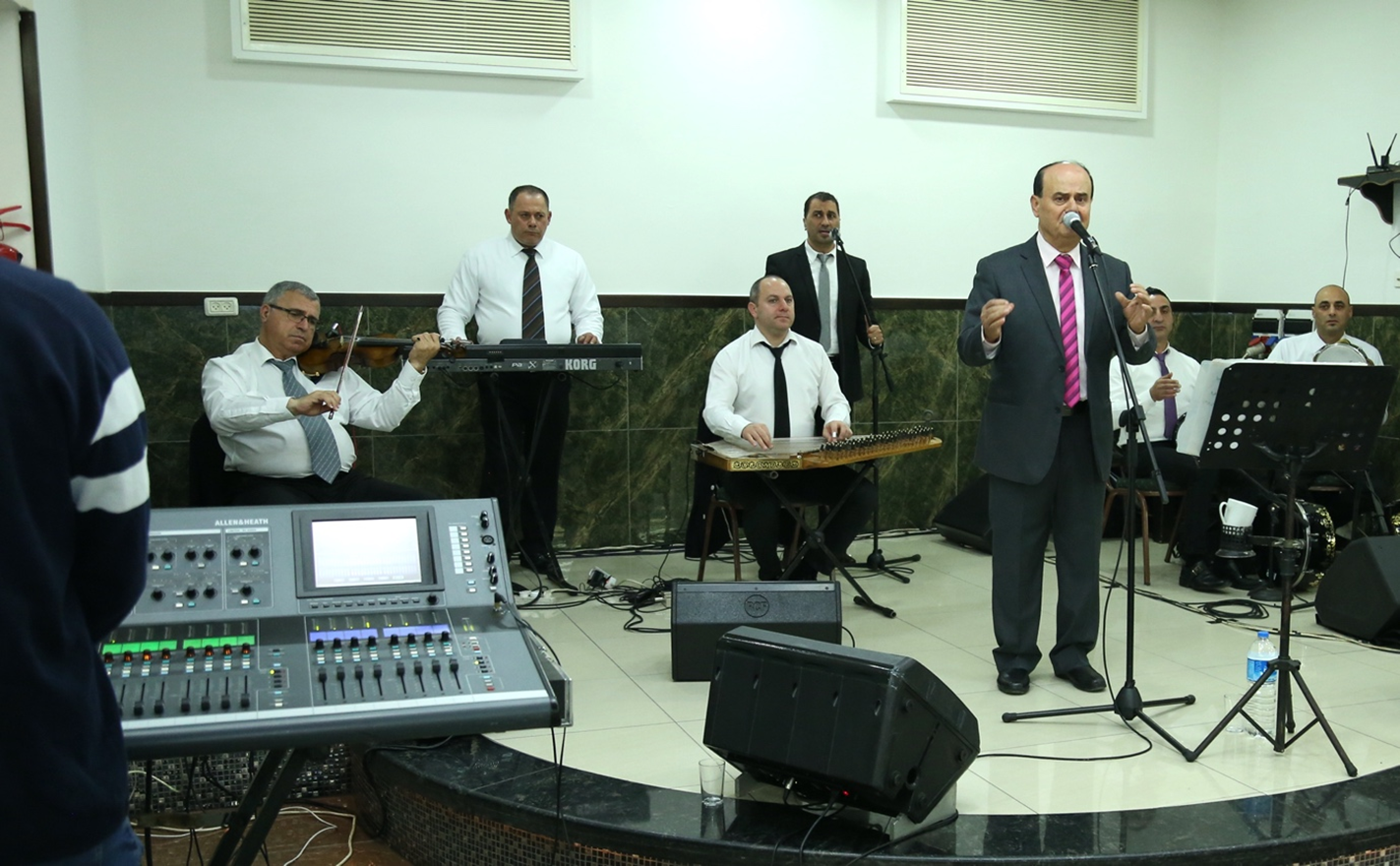
Today, Arab wedding singers in the Galilee are accompanied by small ensembles that build upon the typical composition of the Arab takht ensemble (violin, darbukah, riq, or tar, often with oud, qanun, or nay); since the 1980s, electric keyboards have become ubiquitous and many bands additionally include electric guitar and drum kit (Figure 2). The core repertory of music performed by these singers draws from a consensual urban Egyptian, Lebanese, and Syrian musical mainstream that encompasses heterogenous genres, from heavier art (tarab) music, through lighter art genres from the “Golden Age” of urban Arab music (the 1930s through the 1970s), through popular “franco-arabe” music that combines Arab and Western elements, to some recent pop hits.Footnote 7 While folk music continues to play an important part in wedding celebrations in the home, it has largely been displaced from the main evening party (sahra), during which only a twenty-minute set of dabkeh music at the end of the wedding party is expected.Footnote 8 Nevertheless, this is a diverse repertory. Singer Zahi Ghrayeb commented:
The local audience who come to hear a local singer at a wedding has many demands: in one evening they want to hear songs by Wadih el-Safi [Lebanon, 1921–2013], Melhem Barakat [Lebanon, 1942–2016], Sabah Fakhri [Syria, 1933–], Umm Kulthum [Egypt, c.1904–1975] and even Nancy Ajram [Lebanon, 1983–]—and then they want folklore—and they want to hear all of this from one singer!Footnote 9
Mustafa Dahleh and his ensemble at a wedding in 2018. From left to right: soundman, violin, synthesiser, qanun, backing singer, Dahleh, darbukah, riq. Photo courtesy of Aghsan Khalilih.
While these genres do vary in style, artistic depth, and musical complexity, they share a number of features, including Arabic-language texts, Arab vocal styles, and elements of modal and rhythmic organisation (maqam and iqa’). All are accompanied by an ensemble loosely based on the Arab takht, and together form a mainstream of music broadcast on Arab national radio stations from their foundation in the 1930s until the present day. Different singers may specialise in one or more of these styles and may draw the line regarding what they consider appropriate wedding music in different places; all play a role as arbiters of taste, and even younger singers known for singing pop styles expressed strong boundaries regarding pop songs that they felt were inappropriate for wedding performance.
YouTube example 3 illustrates how tarab music is adapted by singers in the wedding context.Footnote 10 In this, Nahf-based singer Esam Kadri performs a waslat tarab (suite of tarab repertory) at a wedding in Kufr Yasif. This fifteen-minute suite includes excerpts from five longer songs originally performed by well-known Arab singers during the mid-twentieth century. First (0:00–3:07), Kadri performs part of the song “Albi Saeed” by Warda al-Jazairia (1939–2012), an Algerian singer who was born in France and based in Egypt. The music begins in maqam ajam ushrayan (on B flat), moving quickly to bayat (on D), then to rahat al-arwah (huzam on B half-flat, 1:06). Next, Kadri performs part of the song “Ana Albi Elek Mayyal” (3:08–7:05) by Syrian-Egyptian singer Fayza Ahmad (1930–1983), in maqam rast nawa on G. Third, staying in rast nawa, he moves to the song “Samra ya Samra” (7:05–9:44) by the Egyptian singer Karem Mahmoud (1922–1995). The song moves to maqam sultani yaka (nahawand hasas on G, 8:05); at 9:48 he moves to the song “Gameel Gamal” (9:48–12:50) by the Syrian-Egyptian composer, singer, and virtuoso oud player Farid al-Atrash (1910–1974), in maqam bayat on A. At 11:28 the song modulates to maqam hijaz on A. Finally, he transitions to the song “Gana al-Hawa” (12:50–15:11) by the Egyptian singer Abdel Halim Hafez (1929–1977). We hear the prominent role of the synthesiser in the wedding ensemble as the song begins in bayat on A, then modulates to rast on D (14:20) and nahawand on D (15:28). This suite illustrates how wedding singers combine short parts of songs, often moving to a new song that shares the current or a related maqam—and often also shares the same rhythmic mode. In performance, however, the singers adjust the heavier tarab repertory to be suitable for dancing, frequently speeding up the tempo of the slower original songs.Footnote 11 In the final forty seconds of this suite, the singer makes a short improvisation on the words “Ya leil” (O night); during this, there is a question-answer interaction between singer, violin, and qanun, the instruments responding to the singer’s short improvised phrases.
While wedding performances in the Galilee form part of a transnational Arab musical mainstream, they are also shaped by the particular constraints of their location. Notwithstanding shared listening and performance practices with acoustic communities that cross national borders, political borders continue to limit the access of Galilee musicians and audiences to regional music scenes. In contrast to most Arab populations in the region, Palestinian citizens of Israel cannot move freely around the Arab world, since they hold Israeli passports; several Arab countries, including Lebanon and Syria, have been officially at war with Israel since the establishment of the state in 1948. Likewise, most Arab musical stars are unable to perform to Palestinian audiences inside historic Palestine, since to do so would mean crossing Israeli land borders and breaking the strong political anti-normalisation and boycott of Israel in the Arab world. Thus, Galilee audiences wishing to hear stars from neighbouring Arab countries perform live must travel to a mutually accessible third space in order to do so; large concerts in Amman, Jordan, and Taba, Egypt, not far from Israel’s borders, often cater specifically to this audience; recently, some Arab stars have also performed in West Bank towns, including Ramallah, Bethlehem, and Rawabi.
Focusing on the translation of transnational Arab music into a local setting in the Galilee, this article sheds light on regional aspects of Palestinian Arab musical life inside Israel that have largely been overlooked in previous scholarly literature. Recent studies have focused on new, Western-influenced forms of popular music (Karkabi Reference Karkabi2013; McDonald Reference McDonald2013), intersections with Jewish-Israeli musical scenes (Brinner Reference Brinner2009; Belkind Reference Belkind2014), and folk music (Cohen and Katz Reference Cohen and Katz2006), foregrounding the intersection of musical practices with Palestinian national identity, Israeli musical and political institutions, and overt political practices of cultural co-operation and resistance. Nevertheless, in highlighting globalised music flows, declarative politics, and points of intersection between Israeli Jews and Palestinian Arabs, this work often downplays musical practices which complicate the national, political, and sectarian categories that conventionally dominate the discussion of Palestinian identity, musical and otherwise.
Our discussion addresses this complexity by turning to the ways in which musical performance by Galilee wedding musicians serves not only as a field of interface with the wider Arab world, repositioning Palestinian Arab citizens of Israel on the wider Middle Eastern musical map, but also serves to articulate social distinctions among local Palestinian regions and communities. If the urgent political and humanitarian plight of the Palestinians has tended to focus recent scholarly attention on the Palestinian national struggle and resistance to harmful Israeli policies (Furani and Rabinowitz Reference Furani and Rabinowitz2011:481), intra-Palestinian social difference has correspondingly received relatively little attention. It is perhaps precisely because the cosmopolitan, sentimental music that they perform tends to place Palestinian Arab wedding musicians in the Galilee outside conventional discourses of politics and resistance, that the ways in which this music is consumed and debated open up discursive space for the performance of community and difference. Shared musical tastes and practices identified by musicians often unite musicians and audiences across Christian-Muslim-Druze sectarian divides in the Galilee region, yet serve to differentiate the Galilee from other Palestinian regions.Footnote 12 As one of our interviewees noted: “From a historical, national, and cultural perspective, there is brotherhood between Palestinians inside Israel and Palestinians in the West Bank, but musically, they are different” (interview, 2018).
Our discussion focuses on three areas of musical practice and discourse, each of which reflects different ways in which transnational repertories mediate regional and local belonging. First, we turn to the ways in which the Galilee is constructed discursively by wedding musicians as a bounded region of practice, sharply differentiated from neighbouring Palestinian regions. While, on the surface, musicians tend to couch regional distinctions in concrete terms of musical taste, they also invoke both older patterns of geographical distinction, reaching back beyond the 1948 Palestinian Nakba (“catastrophe”) that accompanied the founding of the state of Israel, and contemporary social class distinctions that increasingly differentiate the Galilee from other Palestinian regions within Israel and the West Bank. Second, we turn to the ways in which musical practice articulates fine-grained socio-geographical distinctions between towns and villages within the Galilee region. Here, overlaid on regional physical and social geographies, musical repertories, songs, and artists from the wider Middle East articulate and make legible new, local meanings, and become entwined with local metaphors explaining differences in taste and musical practice. Finally, we consider the ways in which musicians consider their own positionality, and that of the Galilee region, within the wider musical sphere of the Middle East. While travel restrictions and political marginalisation contribute to the construction of the Galilee as a peripheral region distant from the centres of music-making, changing relations between Israel and its Arab neighbours and the transnational possibilities of the Internet have opened up new possibilities for actual and virtual transborder musical interchanges within the wider region.
Locating the Galilee Region Musically
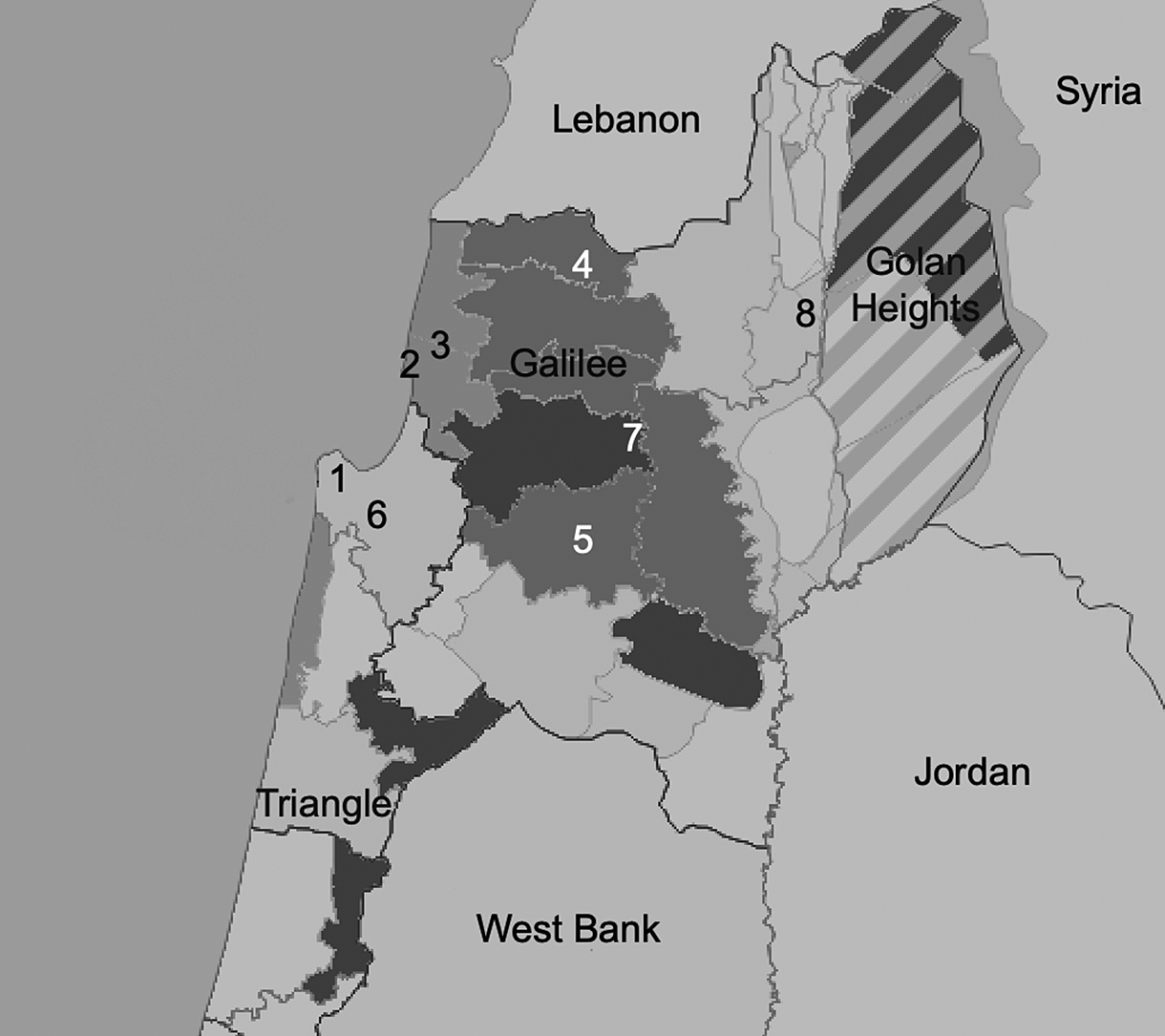
For Palestinian Arab wedding musicians, the Galilee serves not just as a convenient geographical designation, but as a bounded region of musical practice, sharply differentiated from other Palestinian regions within Israel and the West Bank. Most recent academic work on Palestinian music has assumed a Palestinian musical community to be broadly coterminous with the Palestinian national community; nevertheless, in our interviews, it was striking that Galilee wedding musicians primarily described their musical practice as regional, emphasising points of distinction from surrounding communities. The geographical narratives within which they situated their own region likewise differed considerably from conventional ways of describing borders in the region. Notwithstanding the hard political borders between Israel and Lebanon to the north, and Syria to the northeast, Galilee musicians spoke in intimate terms about Lebanese and Syrian artists and music, readily identifying commonalities in taste and practice. By contrast, they emphatically identified Palestinian regions just a short drive to the south—the Triangle region (a string of Muslim-majority Arab towns within Israel adjacent to the western border of the West Bank, from Umm al-Fahm to Kafr Qasim; see Figure 3) and the West Bank—as culturally foreign. “When you leave Haifa heading south,” commented one musician, “you are already in a different galaxy” (interview, 2019).Footnote 13
Palestinian Arab cultural regions in northern Israel/Palestine. Darker colours indicate areas with greater Arab population. Numbers indicate selected locations mentioned in this article: 1: Haifa; 2: Acre; 3: Kufr Yasif; 4: Fassuta and Mi’ilya; 5: Nazareth; 6: Mount Carmel villages; 7: Eilaboun; 8: Tuba.Footnote 14
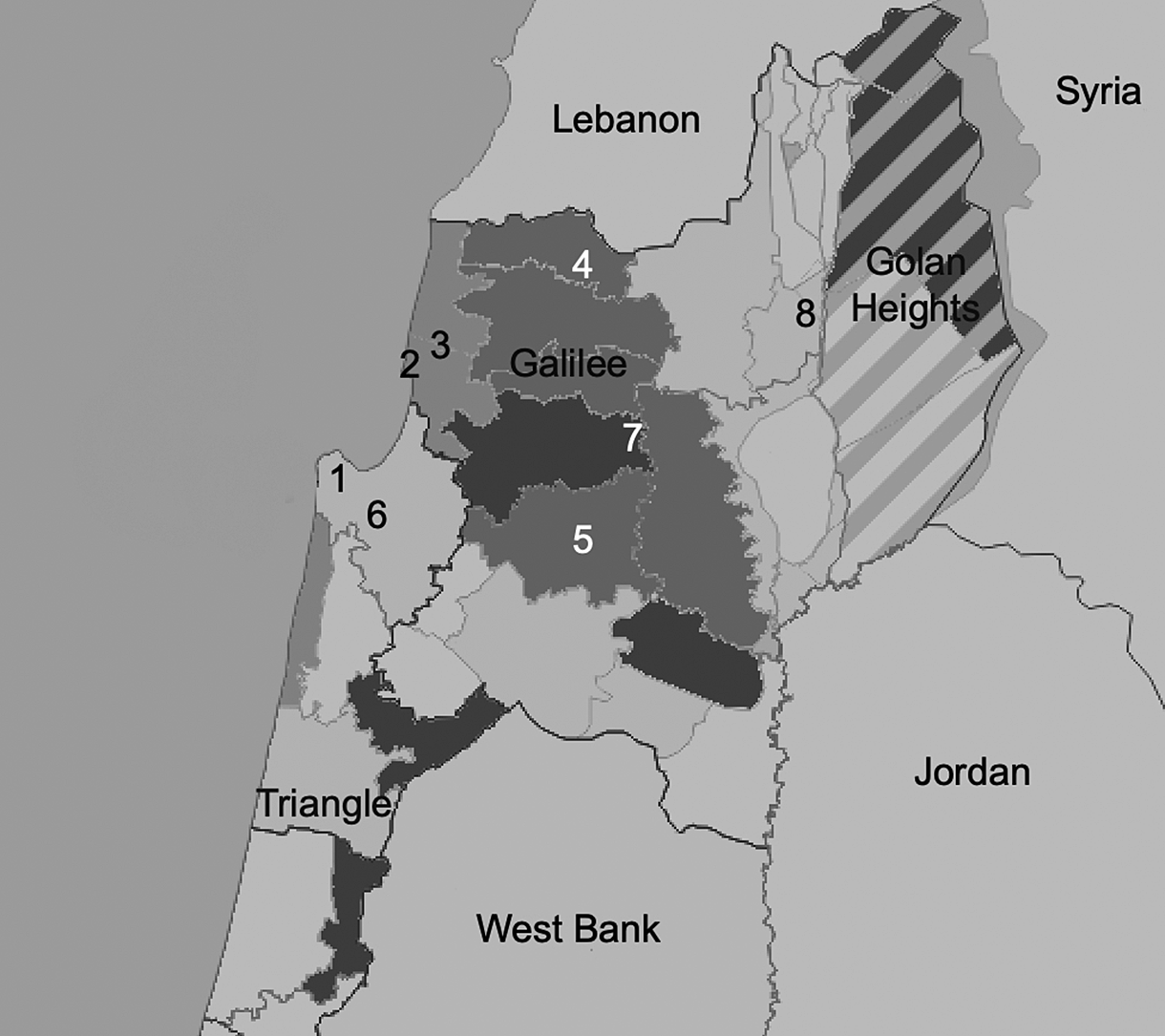
The regional nature of wedding music practice as described by musicians draws upon several interlocking points of musical and social distinction: musical tastes, wedding customs, and the geographical routes traced by musicians themselves as they perform at weddings. While many of the musicians whom we interviewed reported performing in Arab—and occasionally Jewish—communities throughout Israel, as far south as Be’er Sheva and even occasional events in Eilat, the vast majority of their work is concentrated in their “home region,” extending northwards from Haifa, the villages of Mount Carmel, and Nazareth, to the Lebanese border and the Golan Heights (Figure 3).
The Galilee was characterised by many musicians as an ideal ground for the performance of serious Arab music. Musicians cited the presence of skilled musicians, the prominent place of serious music in the local core wedding repertory, particularly Lebanese and Syrian light tarab repertories and qudud halabiya, and the sophistication of local audiences, who included many sami’ah (expert listeners), and continued to insist on tarab repertories that were being overtaken by pop music elsewhere in the Arab world. Musicians saw their affiliation to tarab music as according the Galilee region a place on the musical map of the Arab musical world, despite its physically peripheral position. Percussionist Alaa Sirhan enthused, “[i]n my opinion, the audience in the Galilee is the best and the highest quality audience in the country, and even in the Arab world” (interview, 2019) Musicians and audiences were willing to make great efforts to maintain this connection: qanun player Safi Sweid cited the willingness of Galilee audiences to travel to Jordan or to Taba—just over the Egyptian border—to hear musicians from Arab countries who were not able to perform in Israel: “In my opinion, music alone causes us to be in communication with the Arab world: we go to Egypt or Jordan just to see performances; thousands go to Jordan to see Wadih el-Safi, Marcel Khalife, Fairuz, Julia Boutros or Wael Kafouri” (interview, 2018).
By contrast, if attitudes to tarab music in the Galilee region accorded cultural prestige, in thinly veiled criticism musicians regularly contrasted musical practices within their own region with those of the Triangle region just to the south, which were consistently portrayed as less musically valuable. While musicians were guarded about offering explanations for musical differences that might directly touch on sensitive subjects like political, sectarian, and social class difference, their descriptions of musical practice nonetheless reinforced the social differences between the two regions. Synthesiser and nay player Ahmed ’Abd al-Ghani noted: “Everything is different in the Triangle. There, Palestinian folklore and dabkeh rule the evening” (interview, 2018).
Audiences in the Triangle region were perceived to be distant from repertories considered culturally prestigious in the Galilee: at a wedding, tarab music might be limited to an instrumental version of an Egyptian song at the beginning of the evening, and music in the Triangle was felt to lack saltaneh, the emotional engagement expected of expert listeners to tarab music. Rather, the core repertory played at weddings in the Triangle was Palestinian folkloric music—dabkeh or dehiyyeh—together with fast sha’abi songs from Egypt and Syria. Whereas most audiences in the Galilee felt closest to Lebanese and Syrian music, they noted that audiences in the Triangle preferred Egyptian music, and included Iraqi repertory unfamiliar to Galilee musicians.
Others complained that the repertories performed at weddings in the Triangle did not fully allow musicians to utilise their skills. If the oud was present, its function was to accompany folkloric songs, rather than as a solo instrument, and several musicians noted that the music generally had a faster pace in the Triangle, which limited musical opportunities for players. Percussionist Haiman Suleiman recalled:
I don’t remember where we played in the Triangle, but…all of the songs were uncomfortable to play, very fast, too folky. …It annoyed me to play the same beat for 40 minutes without any changes or ornaments. I would joke around, or change how I held the daf, and sometimes I would go down from the stage to dance the sahjeh with the audience because that was the most important dance of the evening. (interview, 2018)
Similar differences in wedding customs and musical taste and practice between the Galilee and Triangle regions have been noted by previous researchers. Researching Palestinian Arab music in Israel during the 1960s, Israeli ethnomusicologists Dalia Cohen and Ruth Katz noted that,
a distinction should be drawn between two groups within our research area; the population of northern Israel, whose cultural affiliations with Lebanon and Syria are stronger than with the Arabs to their south; and a smaller group in the villages of the Triangle, which were established or repopulated in the past several centuries by villages from east of the area, and whose cultural affiliation is with the people living in the hills west of the Jordan River (the West Bank). (2006:11)
In their comprehensive study of Arab wedding customs in Israel, Adel Manna’ and Kussai Haj-Yehia point to similar regional distinctions. They suggest that the much larger Palestinian Arab population in the Galilee has supported the local development of a wedding industry, including growing numbers of wedding halls, whereas the 1948 borders left the Triangle region isolated from nearby West Bank towns (Reference Manna’ and Haj-Yehia1995:112–114). Further, they note the different sectarian makeup of the regional populations. Like its northern neighbour Lebanon, the Galilee has a mixed Arab population including Muslim, Christian, and Druze communities. Historically, Christian communities have been significantly influenced by the West due to their extensive contact with European missionaries and clergy, who played a dominant role in local educational establishments, and due to the greater presence of Christian communities in cosmopolitan urban settings. The mixed population, suggest Manna’ and Haj-Yehia, has allowed each group the opportunity to learn from the others. By contrast, the population of the Triangle is almost entirely Muslim, and more religious than the Galilee population, especially after the Islamic Revival from the 1980s onwards.
These social and musical distinctions between the Galilee and Triangle regions can also be traced to older patterns of geographical distinction, reaching back beyond the events of 1948 that accompanied the founding of the state of Israel to the rapid demographic and administrative changes that shaped regional geographies within the Levantine (al-Sham) region from the late nineteenth century onwards. The connection of cities in the northern part of historic Palestine to their northern geographical neighbours was cemented by administrative changes in the Ottoman Empire that realigned the northern region of historic Palestine; in 1888, the area north of Jaffa, including the Galilee cities of Haifa, Nazareth, and Acre, was joined into the Ottoman vilayet of Beirut, which stretched north as far as Latakia, separating this region administratively from inland cities, including Jerusalem, Aleppo, and Damascus. Regional ties continued to flourish in the early twentieth century and reinforced connections between Lebanon, Beirut, and the Galilee, including an influx of both workers and wealthy Damascene and Beiruti families to Haifa, drawn by economic growth in the region, and the purchase of large tracts of land in the Galilee region by wealthy Lebanese and Syrians (Seikaly Reference Seikaly1995:31; Abbasi Reference Abbasi2014:4). Meanwhile, a process of modernisation tended to distinguish coastal cities in the Eastern Mediterranean towns from their inland counterparts. During the late nineteenth century, Beirut, Haifa, and Jaffa experienced rapid demographic and economic growth, gaining a cosmopolitan character as a new social class of urban notables emerged (Tamari Reference Tamari2009:23–26; Abbasi Reference Abbasi2014:4). As Manna’ and Haj-Yehia observe, these social changes influenced the surrounding villages, which was not the case for the West Bank cities of Tulkarem, Nablus, and Qalqilya, and the surrounding villages in the Triangle region (Reference Manna’ and Haj-Yehia1995:112–114).
These geographies are regional and relational. In describing today’s musical tastes and practice, musicians emphasised the relationship of the Galilee region to a transnational Arab musical mainstream, and more particularly to Lebanese and Syrian music, downplaying the importance of hard political borders. At the same time, they emphasised social and musical distinction from the Triangle region, asserting the presence of a firm cultural border despite there being no obvious topographical distinction between the regions. While differences in wedding music and customs marked a sharp distinction between the Galilee and Palestinian regions further south, musicians emphasised that a core repertory was common to all parts of the Galilee, based primarily on Lebanese and Syrian music with some Egyptian repertory, and including twenty minutes of northern-style dabkeh (dabkeh shmaliyeh) at the end of the evening, during which a dancer leads a dabkeh line; at parties for the bride, where the primary audience is women and girls, a more contemporary Arab pop repertory would generally be expected.
Microgeographies: Musical Mapping within the Galilee
As part of the regional framework of musical taste described above, musicians described a second layer of relational geographies relating to musical preferences within the Galilee region itself. Musical practices—selecting, listening, performing, and dancing—have inscribed local aesthetic norms across the physical topography of the region. Knowing local audiences and distinguishing between the tastes of different villages is part of the professional toolkit of musicians, and specific musical differences were articulated remarkably consistently among musicians of different generations, reflecting understandings gained as they traverse this topography on a nearly daily basis to play at weddings across the region. The six primary areas of musical taste within the Galilee identified by musicians roughly correspond to a common-sense sociological division of the Galilee region: villages, the Galilee’s three primary cities with a significant Palestinian population, each of which has a different character, and two ethnocultural “others”—Bedouins and Golan Heights Druze—but also draw upon local discourses that use music as a metaphor to reinforce anecdotal or remembered social relations.
According to musicians, residents of Galilee villages, from Mount Carmel to the Lebanese border, were particularly drawn to the jabali (“mountain”) style, a throaty, Lebanese vocal style particularly associated with the iconic Lebanese singer Wadih el-Safi. Hence, synthesiser player Ahmed ’Abd al-Ghani wryly noted that, “if you were to measure the music played at weddings [in the Galilee], you’d find that 70–75% is Wadih el-Safi. If Wadih el-Safi would keep track of his intellectual property rights, he would be a millionaire!” This preference was particularly pronounced in the northern villages near the Lebanese border, such as Fassuta, Mi’ilya and Tarshiha. In those three villages, he noted, “Wadih el-Safi rules, and that’s it!” Within this general characteristic, musicians recognised specific idiosyncrasies of villages with whose customs they were particularly familiar: in Deir al-Asad, audiences were fond of poetic idioms; in Kufr Yasif, parties started particularly late at night.
By contrast, musicians described wedding music in Haifa as “classy” and urbane; while some musicians described musical taste in the city as lacking a particular direction, there was general agreement that listeners generally preferred a younger, contemporary style of music. Audiences expected singers’ stage presence to mirror that of successful pop singers from the region, and appreciated musical innovations, including syncopations. Outside this repertory, musicians noted that “everything goes”: Haifa audiences appreciated Western-style “slow” songs as well as faster music, older listeners in particular enjoyed tarab music, but half a song by Umm Kulthum at the end of the evening was enough: hearing Umm Kulthum was a tacit signal to the audience that it was time to go home.
Acre, by contrast, was frequently described as “Egyptian” in character, both in terms of musical preference and in terms of dancing style. A more limited Lebanese repertory was performed there, but two or three songs by Umm Kulthum were a requisite, together with new songs in popular Egyptian styles that had emerged since the mid-1980s. Violinist Bashir al-Asadi noted that within the Galilee region, the music of some artists, like Warda al-Jazairia an Algerian singer known for performing in an Egyptian style, was played exclusively in Acre. He reflected, “There’s even something Egyptian in their dancing. All along the coast they prefer Egyptian music, even in Gaza.” Al-Asadi’s coastal observation seemed correct, at least locally: al-Mazra’a, a coastal village just to the north of Acre, had similar tastes to Acre, whereas nearby villages further inland, like Kufr Yasif, preferred the Lebanese style.
Nazareth, however, was strongly identified with a specific repertory of songs, designated locally as nasrawiyat (lit. “Nazareth songs”). Named for the city of Nazareth, one might expect the repertory to be of local origin, but, in fact, the nasrawiyat are Syrian in origin: qudud halabiya, a popular song genre associated with the city of Aleppo, and based on a mixed repertory of folk, religious, and secular songs.Footnote 15 Despite these “outside” origins, musicians noted that the waslah (suite) of nasrawiyat was a highlight of wedding performances in Nazareth, eagerly awaited by audiences, who would participate in the performance. The audience would sing along so enthusiastically that the singer could stop and allow them to continue, or dance on their chairs; singer Bishara Deeb, known for his performance of this repertory, noted that the cycle of nasrawiyat could last for an hour or longer. Regarding the name nasrawiyat, nay player Alfred Hajjar reflected:
There’s a debate about the name, because these are songs from Syria, but they are known as nasrawiyat because they’re popular in Nazareth. Nazareth was a kind of capital city with trade connections: traders would come there from Syria and traders from Nazareth would go to Syria, so there was exchange; I think it was important for Nazareth people to connect to this and express their identity. This makes sense to me because we are thought of as a “neighbourhood” of Syria. Forget the political boundaries and the conflict: before all that we were one culture, and that’s not only from the perspective of music, but also food, culture, language and even looks. (interview, 2018)
Outside the nasrawiyat, Nazareth audiences appreciated the Syrian singer Sabah Fakhri, and were recognised as sami’ah, receptive to tarab music and expecting to hear taqasim (extended improvisations) during the evening.
While the above designations covered most of the Galilee region, some musicians noted two other distinct audiences within their “home” region. Bedouins, who form a culturally distinct part of the Muslim population in the Galilee, had different wedding customs and were particularly associated with dabkeh and its Bedouin variant dehiyyeh. The musicians we interviewed did not usually perform for Bedouin communities (one noted that he “didn’t dare” to do so, implying that he was not sufficiently familiar with the required repertory), but percussionist Alaa Sirhan, who had worked with a singer from the northern Bedouin village Tuba, noted, “We used to play a dabkeh song that lasted a whole hour, and not just one dabkeh song during the evening, but many of them: three quarters of the evening was dabkeh, and that’s how people liked it there, that was their musical atmosphere” (interview, 2019). Nevertheless, customs were widely recognised to be changing. Singer Amin Kayouf noted:
Today the Bedouins have already entered the urban lifestyle: it’s different from 20 years ago. Twenty years ago, the Bedouin society wanted to hear Lebanese zajal—long mawwals with love stories and stories about the oldest child: then, they also liked to hear [Jenin-based folk-zajal artist] Musa al-Hafez.Footnote 16 If I would have sung 20 years ago I would have had to know how to perform Bedouin-style in order to sing at their weddings, but today the Bedouins also hold weddings in halls, and even hold mixed weddings, not just for the men. Their style has become closer to that of the Galilee. (interview, 2019)
Finally, many musicians also performed regularly in the Golan Heights. Previously belonging to Syria, this area on the slopes of Mount Hermon was occupied by Israel in 1967. While Israel annexed the Golan Heights in 1981, this status was not accepted by the international community or by Druze residents of the area, most of whom consider themselves Syrian. Musicians noted that residents of the Golan Heights were an easygoing audience who accepted most styles of music, particularly tarab and franco-arabe, and wanted to have fun, dancing in a mixed-gender, mixed-age circle for most of the evening. They enjoyed Syrian folk music and nationalist songs—but not to an extent that the latter would take over the atmosphere of the party. Singer Amin Kayouf noted, “The Golan is occupied territory: they will enthusiastically receive songs with narratives about the homeland, but not all evening, and not with the atmosphere of a demonstration. You can sing ten nationalist songs, but not all at once, you should spread them out during the evening” (interview, 2019).
Musicians agreed remarkably consistently about these geographical divisions, shedding light on local practices of distinction that are barely perceptible to outsiders and which do not directly echo any conventional parameter of social distinction addressed by previous researchers, including accent or sectarian identity. Rather, the discourses in which musicians embedded their own explanations for the particular nature of these local differences draw upon a range of parameters, which reveal interlocking social and topographical understandings of the region. Several explanations focused on physical proximity, both present and historical. Musicians noted the physical closeness of the Galilee to Lebanon and Syria, and the closeness of the accent, food, and even physical appearance of residents in the two regions. Physical proximity was also reflected in radio reception: singer Nasri al-Qot observed that Syrian music had entered the Galilee through the radio; listeners had been exposed to the singer Sabah Fakhri on Radio Tartous. Other explanations drew upon geographical narratives rooted in local histories: in speculating how Syrian music had become known as nasrawiyat, nay player Alfred Hajjar recalled that during Ottoman times the Galilee was considered a “neighbourhood” of Syria, and travel through the region was freely possible. Likewise, reflecting on the “Egyptian” nature of Acre, synthesiser player Ahmed ’Abd al-Ghani noted that, historically, families had migrated from Egypt to Acre and were still identified locally as such.
Other musicians offered sociological explanations for repertory choice. Qanun player Safi Sweid, from Eilaboun, himself named after Wadih el-Safi, suggested that musicians themselves had played a large role in establishing local repertories. The first tarab singer in his own village, Atallah Shoufani, had learned the songs of Wadih el-Safi from the radio and introduced them to the village along with his own original songs: many people had simply assumed that all the songs were Shoufani’s own. At that time, weddings might go on for a whole week, with performances every night, so audiences would get to know the music well. Sweid reflected how, “As a listener, you hear the singer sing all of those songs, and it has an influence. You grow up on those songs, and then you pass them on to your children and grandchildren, and that’s how it happens” (interview, 2018).
Most strikingly, though, singer Amin Kayouf suggested that the musical preferences in regions of the Galilee—including in his own village, Issafiya, located on Mount Carmel—lay not just in physical proximity, but in the Galilee topography itself. He explained:
When Wadih el-Safi sings about a pine tree, or sings a mawwal to an oak tree, Issafiya is full of those trees, so people who live in Issafiya feel like he is singing to them. Or when he sings about a well or a water spring in a grove: that’s also part of our local identity here. Wadih and other singers sang about nature a lot, for example, a song about a bird الشحرور—in the villages in the Galilee there are the same birds. There are also other typical village scenes that you find in Lebanese music, like a woman who is baking bread in the oven; Wadih’s song about the Garden of Eden is very similar to how Horfeish village looks. Without even noticing, Galilee residents are very connected to that genre. That music reminds you of many memories of areas and places in your village, for example, an abandoned house that used to belong to an old man in the village. …It’s something that comes from God, that each geographical area is connected to preferences of words and melody. (interview, 2019)
In this explanation, songs themselves become agents of cross-border connection, overlaying the inaccessible topographies of places located beyond political borders directly onto similar local landscapes, enabling an intimate connection between audiences and the music that they hear as the two places briefly merge into one.
Galilee Musicians and the Region
The previous sections have illustrated some of the complex ways in which, via musical practice, consumption, and discourse, transborder geographies are mapped by local musicians and audiences onto local places. This mapping articulates borders invisible to conventional methods of mapping, and points to historical or imagined connections between physical locations currently separated by hard political borders. While these practices point to a more or less static, consensual map of musical identity in the Galilee region, musicians themselves make this map dynamic. By inhabiting familiar songs made famous by well-known artists, musicians themselves come to embody the sounds of well-known Lebanese and Syrian singers whose voices are accessible via recorded and broadcast media, yet who are not directly accessible to Galilee audiences, because of hard political borders.
While direct contact between Galilee musicians and their counterparts from elsewhere in the Middle East is limited, many have experienced opportunities to meet or work with musicians from neighbouring countries via third spaces. For musicians of earlier generations, this contact often came through working in Arab diaspora communities in Europe or the United States. One of the only female singers somewhat active in the wedding scene, Violet Salameh, lived in the United States for thirty-five years, from the age of sixteen. She recounts:
I lived in New Jersey. There was a large Arab community there and I began to perform here and there.… My most important performance was when I was 18 or 19, when I took part in a performance by Wadih el-Safi during a tour that he did in America. …It felt indescribable: it was like a dream come true and it was also an opportunity to make a name for myself in the Arab community in the USA. …It was amazing that in 2006 when I performed beside him in Amman [Jordan] he remembered me.
While the meeting was in some ways a dream come true, there is also a sense of ambivalence in Violet’s story, perhaps reflecting the fleeting nature of her encounters with Wadih el-Safi: a brief contact with a wider musical world that was ultimately difficult to sustain. Khalil Abu Nikola recounted a similarly ambivalent story about an encounter, via a third party in the Arab diaspora, with Wadih el-Safi:
In the year 1983, the poet Michael Haddad…was on a trip to Paris, and stayed with Wadih el-Safi, who lived in Paris at that time because of the civil war in Lebanon. Haddad told Wadih el-Safi about me, and at the same time, Wadih el-Safi wrote a new mawwal, “Ya Usfor” (“To the birds”). …Haddad returned to Nazareth and told me about their meeting in Paris and that Wadih asked him to record me performing the mawwal and to send it to him; there was a chance that it would be broadcast on Radio Monte Carlo and he might even invite me to Paris.
What I’m going to say now might not sound logical, but I didn’t feel any connection to the mawwal. It didn’t bring me to a state of tarab, because it wasn’t like Wadih’s music that I’m used to hearing. I didn’t like it, and even though I tried, I never succeeded to continue listening to it. Michael Haddad and my father pressured me all the time to record it, but it never happened. Until today, I perform all of the repertory of Wadih el-Safi but not that mawwal.
Whereas these encounters took place via distant third spaces, during and after the Oslo peace process (1993–1995), regional spaces in Middle Eastern countries officially at peace with Israel opened up to Palestinian-Israeli musicians, enabling more substantial creative contact with the wider Arab world. Some Galilee musicians were invited to perform in a series of concerts at the Cairo Opera House in 1994 alongside major figures, including Sabah Fakhri and Wadih el-Safi. This enabled more intimate—and more importantly, sustained—contact with major figures in Middle Eastern music. Qanun player Safi Sweid recalled:
[My father] accompanied Wadih el-Safi in 30–35 performances in Jordan and Taba. His first performance with Wadih was in 1998; I was still small and I remember my father’s excitement when he found out he was going to play with him. They first met in 1994 in Cairo at the opera house when Mustafa Dahleh performed there…. After the performance of Wadih el-Safi, my father initiated a friendship with Wadih’s son George, and invited him to a restaurant in Cairo. It was the first time that my father was photographed with Wadih and it made a big impression in the village and at home. […]
After that, Jamil Shoufani from Nazareth became the main agent for Wadih’s performances in Jordan and Taba for the ’48 [Palestinian-Israeli] audience. Shoufani made an agreement with another agent from Egypt in Jordan, and began to bring musicians from here to play with Wadih el-Safi…. The first two from here to have the privilege of playing with Wadih were my father and the violinist Yousef Makhoul. …Wadih himself began to request Palestinian musicians after he heard how Palestinian musicians know his materials better than those from Lebanon. …When he went into a mawwal, the Lebanese players would sometimes get lost, but not the Palestinians because they had a deep familiarity with his performance style.
For today’s older generation of Galilee musicians, opportunities to meet and sometimes perform alongside stars like Wadih el-Safi were high points of their career, recalled in conversation and immortalised in prominently displayed photographs. For younger musicians, playing in transborder concerts enables new perspectives on their working lives. Percussionist Haiman Suleiman, who accompanied the Syrian singer Shadi Jamil at Taba, reflected:
It was a great feeling and a new experience. …His musical style is like ours in the Aleppo songs, but he works in a more professional way…. The experience of breaking the boundaries was amazing, because the opportunity to perform with a singer who lives in a country that’s considered an enemy country…you begin to think, why are the borders not open?
More recently, the Internet has changed patterns of musical production and consumption, breaking down aesthetic boundaries between Arab populations in an unprecedented way, and remapping musical tastes as audiences access music from across the Arabic-speaking world. Singer Elias Glyanos noted:
The Internet exposed listeners to new types of music and songs from other Arab countries, apart from the Lebanese songs, mawwals and traditional muwashshahat that we were used to hearing, and different from the songs that I grew up with…. The band and I have to adapt to the listeners: because of the Internet, it’s not possible to limit the choice of music because today there are all kinds of styles, also from Tunisia and Morocco. Sometimes the words are unclear because of the different dialect but we make arrangements and perform the songs. (interview, 2017)
The internet is not only a source of new material: it is also a potential vehicle for a singer’s voice to travel more widely in the Arab world, opening up the opportunity to imagine success beyond the wedding stage, and beyond geopolitical horizons. Glyanos continued:
Today, my goal is to go far with my music in the Arab world, particularly in Lebanon. I tried to promote some songs in Lebanese dialect and they were received well, but not so much as I wanted…. I’m preparing to promote a new song with the son of Melhem Barakat with words by the famous poet Nizar Francis, and that song will represent me strongly in Lebanon and the Arab world, because today Facebook and YouTube make it much easier for a singer to publicise himself. (interview, 2017)
Nevertheless, in reality, even in the relatively unrestricted space of the Internet, breaking through geopolitical borders can be challenging. Glyanos’s 2014 song and music video “Sahirna kul al-leyl” shows an ambivalent attitude towards place.Footnote 17 The song is Lebanese in style, beginning with a mawwal by Wadih el-Safi and continuing in Lebanese dialect. The video, however, is more ambiguous: shot in various locations around Haifa, at first glance the visual language seems to call up a generic Eastern Mediterranean location, focusing on generic Arab architecture, market, restaurant, and beach scenes. Active attempts to play down the Haifa location are clear from the deliberate fuzzing out of Hebrew text from some signs and labels in the opening scenes, yet a later shot of the Bahai Shrine firmly locates the protagonists in Haifa, and viewer numbers on YouTube suggest that the audience primarily remained local.
Conclusion
The roots of the musical mobility described above lie well beyond the ethnographic present, arising from the complex intersection of national and regional identities that has characterised modern Arab music since the early twentieth century. Muhammad ’Abd al-Wahab’s music reached historic Palestine well before the current political borders of the State of Israel were drawn: popular art music produced in Cairo and in other urban cultural capitals, including Beirut, Damascus, and Aleppo, during the “Golden Age” of Arab music spread throughout the Middle East via sound recordings and media such as radio, musical films, and television (Farraj and Abu-Shumays Reference Farraj and Shumays2019:2–3). Media practices carved a dual identity for music, mirroring the political interplay between nationalism and pan-Arabism. While individual artists were considered quintessentially to encapsulate Egyptian, Lebanese, or Syrian national identity, they simultaneously became voices of the region, shaping regional tastes throughout the Arabic-speaking world and articulating a centre-periphery relationship between major urban centres and more peripheral regions, including historic Palestine. Meanwhile, star musicians Umm Kulthum, ’Abd al-Wahab, and others performed in Palestine, further strengthening their links with local audiences; the music performed by these artists and those who followed them would later form the backbone of the repertory performed today at Palestinian Arab weddings in the Galilee.Footnote 18
Yet within this broad pattern of shared, regional musical taste, subtle social and musical distinctions among Palestinian-Israelis make legible older patterns of geographical distinction, reaching back beyond the 1948 Palestinian Nakba (“catastrophe”) that accompanied the founding of the state of Israel, to the rapid demographic and administrative changes, including the aforementioned Ottoman realignment of northern Palestine, that shaped regional geographies within the Levantine (al-Sham) region from the late nineteenth century onwards.
For ethnomusicologists this case study echoes Noriko Manabe’s observation that the sites in which politics are enacted in non-Western musics may be overlooked by Euro-American observers seeking the familiar model of a lone musician with a guitar speaking against the hegemony (Reference Manabe2015:6, 12). Rather, as Martin Stokes has suggested, meanings accumulate in versions and interpretations of songs that are reclaimed for new audiences, and whose performances are “conceived in conversation with others and in constantly evolving musical contexts” (Reference Stokes2010:6). Such performances are embedded within local discourses; as Christa Salamandra notes in her landmark study of social distinction in Damascus, identity construction and social differentiation through consumption rely not only on what is consumed, but “the ways in which consumption is discussed and debated” (Salamandra Reference Salamandra2004:2).
These practices and narratives, in turn, complicate the national narratives which have often uncritically been employed to parse contemporary Palestinian musical practices by revealing points of transnational contact and local disjuncture within Palestinian practices, and by reinserting Palestinian-Israelis into the regional music scenes from which they have been systematically excluded for the past seven decades. The marginalisation of Palestinian citizens and cultural production by successive Israeli regimes long shaped the conditions in which music was made, limiting musical education, opportunities for broadcasting (Regev Reference Regev1993:33), and access to the patronage that underpinned the transnational scenes from which Galilee musicians draw their repertory (El-Shawan Reference El-Shawan1980:3). For today’s younger musicians, music education and opportunities have greatly expanded, overlapping with an increasing interest in the performance of Arab music among young Israeli Jews of Middle Eastern origin. The opening in 1995 of the Oriental Music Department at the Jerusalem Academy of Music and Dance, offering degree-level training in Arab classical music, led in turn to a mushrooming of private Arab music schools in the Galilee region, which now feed a number of post-secondary music education programmes. Likewise, performance opportunities outside the wedding context have increased, from the yearly Jerusalem International Oud Festival (founded in 2000 and offering a venue for high-quality concert performance of Arab music) and programmes commissioned by Makan (the Arabic-language channel of Israel’s national broadcaster), to local festivals and popular stages, including the Nazareth Christmas Market, and rare but important opportunities to collaborate with star performers in concerts outside Israel’s borders. Notwithstanding these opportunities, singer Zahi Grayeb summarised the problem: “our people have been through many traumas, and we haven’t developed musically even though there are singers with excellent voices” (interview, 2017). Yet, if particular national songs continue strongly to articulate shared political sentiment among Palestinian citizens of Israel (Rabinowitz and Abu-Bakar Reference Rabinowitz and Abu-Bakar2005:1), at the same time cosmopolitan sentimental songs that on the surface have no concrete political meaning become a powerful tool to articulate the everyday politics of local difference, as musical tastes and divergent dance moves become a metaphor for social class, education, and aspirations.
Acknowledgements
This research was supported by the ISRAEL SCIENCE FOUNDATION (grant no. 1495/16). The authors are grateful to Shvat Eilat, Sarah Goldberg, Amalia Sa’ar, and two anonymous reviewers for their helpful comments on earlier drafts, and to the musicians we cite for their generous sharing of time and expertise.