Introduction
The genus Lysmata Risso, 1816 includes about 50 caridean taxa commonly known as red rock, peppermint and cleaner shrimps, that are distributed in shallow or deep waters of warm, temperate and tropical seas worldwide (Rhyne & Lin, Reference Rhyne and Lin2006; WoRMS, 2022). These species exhibit a wide diversity of lifestyles, colourations and even mating systems (Rhyne & Lin, Reference Rhyne and Lin2006; Baeza et al., Reference Baeza, Bolanos, Hernandez and Lopez2009a), with some species living in crowds or small groups (aggregations) and others in monogamy (pair living) (Rhyne & Lin, Reference Rhyne and Lin2006; Baeza et al., Reference Baeza, Bolanos, Hernandez and Lopez2009a; Alves et al., Reference Alves, López Greco, Barros-Alves and Hirose2019); they furthermore occupy a wide range of ecological niches, dwelling freely among rocks or in sponges and crevices, or even removing parasites from fishes (Rhyne & Lin, Reference Rhyne and Lin2006; Baeza et al., Reference Baeza, Bolanos, Hernandez and Lopez2009a).
In the Mediterranean Sea, the genus is represented by two well-known Atlantic–Mediterranean species, namely L. seticaudata (Risso, 1816) and L. nilita Dohrn & Holthuis, Reference Dohrn and Holthuis1950 (see Zariquey-Álvarez, Reference Zariquey-Álvarez1968; Falciai & Minervini, Reference Falciai and Minervini1992; d'Udekem d'Acoz, 1999), and by three taxa only known on the basis of single records. These are L. kempi Chace, Reference Chace1997 and L. vittata (Stimpson, 1860), alien species from the Indo-Pacific region reported respectively from Turkey and Egypt (Froglia & Deval, Reference Froglia and Deval2013; Abdelsalam, Reference Abdelsalam2018), and L. olavoi Fransen, Reference Fransen1991, a poorly known species described from the Azores and the Savage Islands (eastern Atlantic Ocean) (Fransen, Reference Fransen1991) and rarely reported even near its type localities (see Quiles et al., Reference Quiles, González and Santana2001). This species is only known from the Mediterranean Sea on the basis of a sighting about three decades ago in northern Crete, Aegean Sea (eastern Mediterranean) (Koukouras & Dounas, Reference Koukouras and Dounas2000), which is quite far from the other known localities of occurrence. To further complicate the issue, L. olavoi (or a very similar species) was also recently recorded in the western Atlantic (Olthof et al., Reference Olthof, Becking and Fransen2018; Poupin, Reference Poupin2018), a biogeographic area disconnected from the site of its original description. Such uncertainties and wide, but disjointed, distribution leave doubts as to whether its published presence in the Mediterranean Sea and in the western Atlantic is correct, thus requiring a more solid confirmation.
We hereby report a recent finding of L. olavoi in the Gulf of Naples (Italy, Tyrrhenian Sea, western Mediterranean), which is the first sighting from Italy, fills a wide gap in its published distribution, and confirms with certainty its presence in the Mediterranean Sea. Putative hypotheses for the basis of this late recording of the species are briefly discussed.
Materials and methods
Within a project aiming to evaluate the biodiversity of the Gulf of Naples, on 21 March 2019, a single lysmatid specimen was collected during a transect run from Pozzuoli to Nisida Island (approximate location: 40.8066°N 14.1444°E), carried out at ~75–100 m depth with a commercial vessel equipped with bottom trawl nets (see Crocetta et al., Reference Crocetta, Riginella, Lezzi, Tanduo, Balestrieri and Rizzo2020). The morphology and colouration, but mostly the size of the individual and the depth of collection, raised doubts about its identification as both L. nilita and L. seticaudata, the two species known from Italy (d'Udekem d'Acoz, 1999). Thus, the specimen was measured with a calliper (accuracy 0.1 mm) and later frozen at −20°C. In the subsequent months, the sample thawed and was partially ruined. However, as colouration and morphology were almost intact, it was photographed, fixed in 99.9% ethanol, deposited in the collections of the Laboratory of Benthos-Napoli (Stazione Zoologica Anton Dohrn, Italy) (code SZN_B_1096CR152A), and identified with the help of a Zeiss Axio Zoom.V16 microscope and specialist literature (e.g. Zariquey-Álvarez, Reference Zariquey-Álvarez1968; Fransen, Reference Fransen1991; Falciai & Minervini, Reference Falciai and Minervini1992; Koukouras & Dounas, Reference Koukouras and Dounas2000; Froglia & Deval, Reference Froglia and Deval2013; Abdelsalam, Reference Abdelsalam2018).
To further verify the unusual morphological identification (see below), molecular analyses were performed on it and by adding five specimens of L. seticaudata collected in shallower waters of the Gulf of Naples at Monte di Procida (40.7890°N 14.0551°E) and Nisida Island (40.7992°N 14.1707°E) (Supplementary Table S1). Total genomic DNA was extracted using the DNeasy® Blood & Tissue kit (QIAGEN). Partial sequences of the 16S ribosomal ribonucleic acid (16S rRNA) were amplified, purified, Sanger sequenced and finally checked, assembled and edited as in Tanduo et al. (Reference Tanduo, Osca and Crocetta2021a, Reference Tanduo, Virgili, Osca and Crocetta2021b). They were compared with reference sequences from the NCBI nucleotide database both by using BLASTn (Morgulis et al., Reference Morgulis, Coulouris, Raytselis, Madden, Agarwala and Schäffer2008) and by calculating the genetic P-distances between our samples and the sequences of the two species already deposited. To do so, we used MEGA X v.10.2.4 (Kumar et al., Reference Kumar, Stecher, Li, Knyaz and Tamura2018) with a simple nucleotide model (number of substitutions), a homogeneous pattern among lineages and a uniform rate among sites.
Finally, to further confirm the identification of the samples, unpublished sequences obtained here were also included in a small phylogenetic framework. The NCBI data mining revealed the presence of 339 entries for the 16S rRNA partial sequences of 31 species of the genus Lysmata. They were downloaded, together with sequences of the family Hippolytidae Spence Bate, 1888, used as outgroup based on the phylogeny by Bracken et al. (Reference Bracken, de Grave, Felder, Martin, Crandall and Felder2009). Sequences were aligned using ClustalW 2.1 on the CIPRES Science Gateway (Miller et al., Reference Miller, Pfeiffer and Schwartz2010) using default parameters. The alignment was trimmed in order to avoid ambiguities. Subsequent analyses were carried out after the exclusion of identical sequences as well as of sequences ascribed to L. uncicornis Holthuis & Maurin, 1952, that generated a misalignment, and of L. vittata, that has an insertion of 99 base pairs (bp) in the middle of the 16S fragment (Baeza, Reference Baeza2010). The evolutionary model was selected through the AICc (corrected Akaike Information Criterion) algorithm, implemented in JModelTest 2 v.0.1.10 (Darriba et al., Reference Darriba, Taboada, Doallo and Posada2012). Bayesian Inference (BI) (Rannala & Yang, Reference Rannala and Yang1996) and maximum likelihood (ML) (Felsenstein, Reference Felsenstein1981) analyses were conducted. The former was performed using the software package MrBayes (3.2.7a) (Ronquist & Huelsenbeck, Reference Ronquist and Huelsenbeck2003) on XSEDE through the online CIPRES Science Gateway V.3.3 (Miller et al., Reference Miller, Pfeiffer and Schwartz2010), for 10 million generations, two independent runs, and a sampling interval every 1000 generations while the latter was performed using RAxML v.8.2 (Stamatakis, Reference Stamatakis2014) with 1000 rapid-bootstrap replicates. The trees were visualized in FigTree 1.3.1 and edited in the free software Inkscape 0.92.
Results and taxonomic remarks
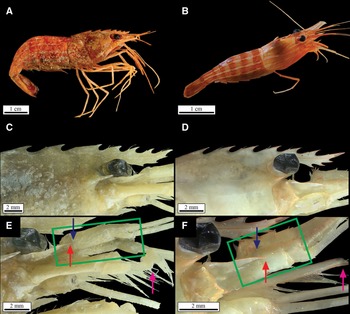
The specimen (Figure 1A, C, E) was an ovigerous female, measuring 24.02 mm in total carapace length (distance from tip of rostrum to posterior margin of carapace) and 16.68 mm in standard carapace length (distance from posterior orbital edge to posterior margin of carapace). It differed from three congeneric taxa already recorded in the Mediterranean in the following major features: (i) L. kempi has a long rostrum, that exceeds the scaphocerite and is slightly shorter than the carapace (Chace, Reference Chace1997; Froglia & Deval, Reference Froglia and Deval2013); (ii) L. vittata has four teeth on the ventral margin of the rostrum and a small acute pterygostomian spine (Abdelsalam, Reference Abdelsalam2018); (iii) L. nilita has the stylocerite that overreaches the basal segment of the antennular peduncle, and is characterized by broad dark orange bands across the entire body and absence of longitudinal white stripes (Dohrn & Holthuis, Reference Dohrn and Holthuis1950; Fransen, Reference Fransen1991), with a bathymetric distribution that usually does not reach 35 m depth (d'Udekem d'Acoz, 2000). The sample showed some similarities, but also differences, with L. seticaudata (Figure 1B, D, F). It had almost the same colouration (Figure 1A vs Figure 1B) and external aspect (Figure 1C vs Figure 1D), but differed in: (i) the stylocerite tapering (Figure 1E, red arrow) not reaching the end of the basal segment of the antennular peduncle (Figure 1E, blue arrow), whereas in L. seticaudata it overreaches the basal segment (Figure 1F, red and blue arrows); (ii) the scaphocerite (Figure 1E, pink arrow) having a similar size as the antennular peduncle (Figure 1E, green square), whereas in L. seticaudata its length can be twice that of the antennular peduncle (Figure 1F, pink arrow and green square) (Dohrn & Holthuis, Reference Dohrn and Holthuis1950; Fransen, Reference Fransen1991). Finally, L. seticaudata also generally inhabits shallower waters compared with L. olavoi, although samples of the former species have been recorded to 60 m, a depth similar to the one investigated here (Dohrn, Reference Dohrn1950; Dohrn & Holthuis, Reference Dohrn and Holthuis1950; d'Udekem d'Acoz, 2000). These morphological features, combined with the depth at which the species was found, suggested its identification as L. olavoi.
Comparative table between Lysmata olavoi and the highly similar Lysmata seticaudata from the Gulf of Naples and nearby areas. A. Lysmata olavoi from Pozzuoli–Nisida Island (thawed and partially ruined). B. Lysmata seticaudata from Nisida Island (live). C–D. Rostrum of L. olavoi (C) and L. seticaudata (D). E–F. Diagnostic characters of L. olavoi (E) and L. seticaudata (F), highlighting stylocerite tapering (red arrow), scaphocerite (pink arrow), antennular peduncle (green square), and end of basal segment of antennular peduncle (blue arrow).

BLAST hits for the sequence (513 bp) of the ‘odd’ Lysmata species yielded a high (99.61%) similarity with the single sequence of L. olavoi (EU861494) deposited by Baeza (Reference Baeza2010) from the type locality, as confirmed by a P-distance value of 0.00390, whereas all the other taxa deposited in GenBank, including L. seticaudata, showed lower similarities (≤87.10%). BLAST hits for the sequences (499 bp) of L. seticaudata, all identical among them, yielded a very high (99.80–100%) similarity with sequences deposited in GenBank as L. seticaudata, as confirmed by a P-distance value of 0.00067 ± 0.00049, and low similarity (≤90.64%) with other taxa. In addition, the P-distance value between grouped sequences of L. olavoi and L. seticaudata was 0.1743 ± 0.0057, thus excluding conspecificity.
Newly obtained sequences were deposited in GenBank under the codes ON303605 (L. olavoi), ON303606 (L. seticaudata from Monte di Procida), and ON303835 (L. seticaudata from Nisida Island).
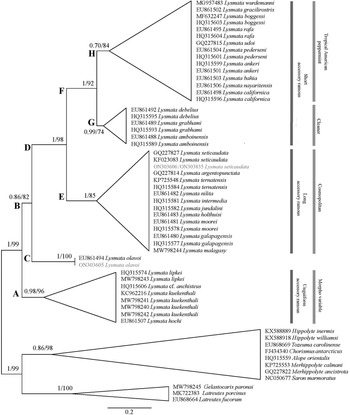
In total, 55 sequences downloaded from GenBank were used for the subsequent phylogenetic analyses (Supplementary Table S2). The final alignment (57 sequences) was trimmed to 595 bp. The DNA substitution model was the GTR + I + G. BI (−lnL = 8681.40 for run 1; −lnL = 8679.75 for run 2) and ML (−lnL = 7679.99) analyses provided congruent tree topologies (Figure 2), dividing Lysmata species worldwide, except L. olavoi, in three major groups (A, E, F). The clade A (posterior probability values, pp = 0.98; bootstrap values, bs = 96) accounts for the ‘unguiform accessory ramous/morpho-variable’ group (Baeza et al., Reference Baeza, Schubart, Zillner, Fuentes and Bauer2009b; Baeza, Reference Baeza2010; Fiedler et al., Reference Fiedler, Rhyne, Segawa, Aotsuka and Schizas2010; Alves et al., Reference Alves, Lima, Hirose, Martinez, Dolabella and Barros-Alves2018; Ashrafi et al., Reference Ashrafi, Baeza and Ďuriš2021). The clade B (pp = 0.86; bs = 82) consisted of a branch (C) in which the two sequences of L. olavoi cluster together (pp = 1; bs = 100) in a basal position with respect to the remaining Lysmata species, and by the clade D (pp = 1; bs = 98). This latter clade is formed by the subclade E (pp = 1; bs = 85), that includes our and GenBank sequences of L. seticaudata in the ‘long accessory ramous/cosmopolitan’ group (Baeza et al., Reference Baeza, Schubart, Zillner, Fuentes and Bauer2009b; Baeza, Reference Baeza2010; Fiedler et al., Reference Fiedler, Rhyne, Segawa, Aotsuka and Schizas2010; Alves et al., Reference Alves, Lima, Hirose, Martinez, Dolabella and Barros-Alves2018; Ashrafi et al., Reference Ashrafi, Baeza and Ďuriš2021), and the subclade F (pp = 1; bs = 92), composed by species that previous phylogenies merge together in the ‘short accessory ramous’ group (Fiedler et al., Reference Fiedler, Rhyne, Segawa, Aotsuka and Schizas2010; Ashrafi et al., Reference Ashrafi, Baeza and Ďuriš2021) or split in two additional subclades (G: pp = 0.99; bs = 74; H: pp = 0.70; bs = 84), the ‘cleaner’ and ‘Tropical American/peppermint’ groups (Baeza et al., Reference Baeza, Schubart, Zillner, Fuentes and Bauer2009b; Baeza, Reference Baeza2010; Alves et al., Reference Alves, Lima, Hirose, Martinez, Dolabella and Barros-Alves2018).
Phylogenetic relationships in Lysmata species based on the 16S rRNA partial sequences downloaded from GenBank (codes in Supplementary Table S2) and the specimen from the Gulf of Naples (highlighted in green). Numbers above/below branches represent values of BI posterior probability and ML bootstrap support. Scale bar represents nucleotide substitution. The green vertical lines show the clades defined by Fiedler et al. (Reference Fiedler, Rhyne, Segawa, Aotsuka and Schizas2010), and the orange ones by Baeza et al. (Reference Baeza, Schubart, Zillner, Fuentes and Bauer2009b) and Baeza (Reference Baeza2010).

Therefore, both the results of the BLAST hits and of all the molecular analyses carried out confirmed the morphological identification of the samples as L. olavoi and L. seticaudata.
Discussion
The marine biota of the Mediterranean Sea has been widely studied over the past centuries and is considered as the best-known worldwide (Bianchi & Morri, Reference Bianchi and Morri2000). However, the Mediterranean's resident biota is continuously enriched in number by the addition of non-indigenous species, arriving in the basin due to several anthropogenic-induced pathways (Zenetos et al., Reference Zenetos, Çinar, Crocetta, Golani, Rosso, Servello, Shenkar, Turon and Verlaque2017), and by Atlantic or even endemic species, that may respectively enter in the Mediterranean Sea in modern times via natural currents or be present but undetected due to cryptic habits, lifestyles strictly connected to unexplored or not-widely monitored habitats, or misidentifications with similar species (Lasram et al., Reference Lasram, Tomasini, Romdhane, Chi and Mouillot2008; Barco et al., Reference Barco, Houart, Bonomolo, Crocetta and Oliverio2013).
The same holds true for the Gulf of Naples, with research on decapods culminating in a review by Moncharmont (Reference Moncharmont1981). However, the subsequent decades have been characterized by the finding of additional species, including some spreading in recent times or only known from the Atlantic Ocean (Tanduo et al., Reference Tanduo, Osca and Crocetta2021a and references therein). All this may suggest that L. olavoi has recently arrived in the western Mediterranean Sea, presumably favoured by the Atlantic and the Tyrrhenian Currents, that allow Atlantic waters to enter the Tyrrhenian Sea (El-Geziry & Bryden, Reference El-Geziry and Bryden2010). Such a hypothesis could be supported by the characteristics of the larval stages of Lysmata species, that possess a high resistance to starvation and continue to develop as plankton for a long time, thus increasing dispersal capabilities (Alves et al., Reference Alves, López Greco, Barros-Alves and Hirose2019). However, the previous record from the eastern Mediterranean in 1992 (Koukouras & Dounas, Reference Koukouras and Dounas2000), one year after its original description (Fransen, Reference Fransen1991), makes it more likely that L. olavoi may have been present in the basin for a long time, but went undetected or misidentified with the more common L. seticaudata.
Whatever is the truth regarding the presence of L. olavoi in the Gulf of Naples, the present finding of an ovigerous female is noteworthy. In fact, Lysmata have a particular reproductive cycle in which juveniles first mature as functional males, and then become functional simultaneous hermaphrodites, capable of reproduction as males or females (Baeza, Reference Baeza2008, Reference Baeza2009; Alves et al., Reference Alves, López Greco, Barros-Alves and Hirose2019). Thus, brooding shrimps are able to fertilize each other, but apparently do not self-fertilize and produce viable embryos by parthenogenesis (Baeza, Reference Baeza2008, Reference Baeza2009; Alves et al., Reference Alves, López Greco, Barros-Alves and Hirose2019). Therefore, the presence of an ovigerous female may suggest that at least another individual has to be present in the area in order to act as a male (Baeza, Reference Baeza2009). Unfortunately, despite further investigations in the same area with the same sampling methods, we have not been able to gain any further specimens, thus suggesting that the species is locally rare or generally rare to sample.
Results from our phylogenetic trees confirm the division of worldwide Lysmata species in major groups, but also uncertainties regarding the correct assignment of L. olavoi to any of these. In fact, they disagree with early phylogenies, placing L. olavoi in a basal position with respect to worldwide Lysmata species (Baeza et al., Reference Baeza, Schubart, Zillner, Fuentes and Bauer2009b; Baeza, Reference Baeza2010), but also with recent ones. Fiedler et al. (Reference Fiedler, Rhyne, Segawa, Aotsuka and Schizas2010) reported this taxon in a basal position with respect to the ‘short accessory ramous/cleaner’ group, while Alves et al. (Reference Alves, Lima, Hirose, Martinez, Dolabella and Barros-Alves2018) and Ashrafi et al. (Reference Ashrafi, Baeza and Ďuriš2021) placed this species outside the ‘long accessory ramous/cosmopolitan’ group. In contrast, both our trees place it in a basal position with respect to three (cleaner, Tropical American/peppermint, cosmopolitan) or two (short accessory ramous and long accessory ramous) groups. Unfortunately, lack of knowledge for this species makes it difficult to discuss and resolve these divergent results.
Summarizing, L. olavoi is still surrounded by a number of open questions that range from its distribution, lifestyle and ecology to its phylogenetic position and even putative generic allocation. An improved and focused sampling effort, flanked by molecular analyses on western Atlantic samples and the usage of multilocus approaches, as well as by in situ observations perhaps carried out with the help of ROVs, may help to finally shed light on some of them.
Supplementary material
The supplementary material for this article can be found at https://doi.org/10.1017/S0025315422000455.
Data
The datasets generated during the current study are deposited in GenBank repository.
Acknowledgements
This study was supported by the projects ABBaCo (C62F16000170001) (F.C.) and ADViSE (PG/2018/0494374) (F.C., V.T.). The Maglione family (Fabrizio, Francesco, Giuseppe, Salvatore and Vincenzo) (‘Giovanni Padre’ fishing vessel) offered the highest possible support during trawling activities. Pasqualina Fiorentino (Stazione Zoologica Anton Dohrn, Italy) provided literature.
Author contributions
Valentina Tanduo: Conceptualization, Methodology, Investigation, Writing – original draft, Writing – review & editing. Riccardo Virgili: Methodology, Investigation, Writing – review & editing. Fabio Crocetta: Conceptualization, Methodology, Investigation, Funding acquisition, Writing – original draft, Writing – review & editing.
Sampling and field studies
No permit is required for sampling of this species.
Conflict of interest
The authors declare that they have no conflict of interests.
Ethical standards
All applicable international, national and institutional guidelines for the care and use of animals were followed.