1 Introduction
Phonological alternations at morphological boundaries often reflect morpheme-internal static phonotactic patterns (Chomsky & Halle Reference Chomsky and Halle1968, Kenstowicz & Kisseberth Reference Kenstowicz and Kisseberth1977, McCarthy Reference McCarthy2002). For example, in Kirundi (Meeussen Reference Meeussen1959, Rodegem Reference Rodegem1970; data from Kenstowicz & Kisseberth Reference Kenstowicz and Kisseberth1977, Reference Kenstowicz and Kisseberth1979), vowels preceding nasal–consonant (NC) clusters are long, as shown in (1).
(1)


At the same time, this static phonotactic generalisation is also enforced across morpheme boundaries by a phonological alternation, vowel lengthening. Underlying short vowels in the prefixes /ku-, ba-, umu-/ lengthen preceding a base containing an initial NC cluster, as in (2a), but not a singleton consonant, as in (b). Thus both the tautomorphemic static phonotactic generalisation and the heteromorphemic dynamic generalisation involving the phonological alternation can be captured using the same rule or constraint.
(2)

These two types of generalisations (static generalisations about the lexicon and dynamic generalisations about phonological alternations) do not, however, always go hand in hand. Morphologically derived environment effects (MDEEs, also known as non-derived environment blocking; e.g. Kiparsky Reference Kiparsky and Fujimura1973, Reference Kiparsky, Hargus and Kaisse1993) are one such example of this mismatch (see Paster Reference Paster2013 for a review of other examples). A textbook example of an MDEE is palatalisation in Korean. At morpheme boundaries, the underlying stem-final coronal stops /t tʰ/ palatalise to [c cʰ] before a suffix-initial /i/, as in (3) (e.g. Kiparsky Reference Kiparsky and Fujimura1973, Reference Kiparsky, Hargus and Kaisse1993, Iverson & Wheeler Reference Iverson, Wheeler, Hammond and Noonan1988, Cho Reference Cho2001).Footnote 1, Footnote 2
(3)

However, palatalisation fails to apply when the target consonant (/t/ or /tʰ/) and trigger (/i/ or /j/) are tautomorphemic, both in native words and in loanwords. Thus /ti/ and /tʰi/ sequences which are repaired at the morpheme boundary are attested within stems, where they surface faithfully, as in (4).
(4)

Patterns such as these have continued to pose a challenge for phonological theory (e.g. Kiparsky Reference Kiparsky and Fujimura1973; for a recent review and proposal see Inkelas Reference Inkelas, Hsiao and Wee2015). Previous analyses of such patterns in rule-based models (Chomsky & Halle Reference Chomsky and Halle1968) and constraint-based models like Optimality Theory (Prince & Smolensky Reference Prince and Smolensky2004) have focused primarily on protecting morpheme-internal non-derived sequences (such as /ti/ in Korean), while ensuring that the same sequences always alternate if they occur due to morpheme concatenation. This is an example of the derived environment condition in (5).
(5)

This has been achieved using various theoretical tools, such as underspecification (Kiparsky Reference Kiparsky, Hargus and Kaisse1993), interleaving morphological and phonological operations (Wolf Reference Wolf2008), conjoined constraints (Łubowicz Reference Łubowicz2002) and reference to new or old input (Comparative Markedness; McCarthy Reference McCarthy2003) and indexed constraints (Pater Reference Pater, Bateman, O'Keefe, Reilly and Werle2007).
A number of authors (e.g. Hammond Reference Hammond1992, Anttila Reference Anttila2006, Inkelas Reference Inkelas, Erguvanlı Taylan and Rona2011), however, have argued that what are often seen as canonical cases of MDEEs do not satisfy (5), insofar as a derived environment (i.e. where the target and environment of a rule are from two different morphemes) does not actually guarantee that a particular process would apply. A derived environment, while a necessary condition for a particular process to apply, is by no means a sufficient condition.
A case that has been examined in detail is Finnish assibilation (Anttila Reference Anttila2006; cf. Kiparsky Reference Kiparsky and Fujimura1973, Reference Kiparsky, Hargus and Kaisse1993, Hammond Reference Hammond1992). Stem-final /t/ in Finnish becomes [s] before /i/. This rule is generally characterised as only occurring across a morpheme boundary, as in (6a); it fails to apply within stems, as in (b).
(6)

However, the reality in the data is more nuanced. Anttila (Reference Anttila2006), citing Karlsson (Reference Karlsson1982), shows that not all /i/-initial suffixes actually trigger assibilation. Assibilation only occurs uniformly with the three suffixes in (7a). Many other /i/-initial stem-level suffixes fail to trigger assibilation, despite satisfying the phonological (and morphologically derived) environment for process application, as seen in (7b) (Kiparsky Reference Kiparsky, Nelson and Manninen2003). In at least one case, the suffix variably triggers assibilation, as in (7c). I refer the reader to Anttila (Reference Anttila2006) for a full analysis of these patterns (all data in (7) are taken from Anttila Reference Anttila2006: 900–901).Footnote 3
(7)

The data from Finnish suggests that an account of its putative MDEE pattern cannot simply appeal to the derived environment condition. While assibilation does indeed only occur in derived environments, as expected under the traditional notion of MDEEs, it certainly does not occur in all possible derived environments where the phonological conditions are met. Even when it does occur, it is not entirely categorical. These patterns argue against a strong interpretation of (5). The generalisation for assibilation then seems to be about the specific triggering morphemes, rather than derived environments more generally.
Apart from the derived environment condition, analyses that aim to capture the fact that morpheme-internal /ti/ sequences surface faithfully in Finnish, for example, also assume that such sequences are phonotactically well-formed, as in (8).
(8)

While having even just one lexical item is sufficient for a particular sound sequence to be attested, phonotactic knowledge, all else being equal, seems not to be purely sensitive to the presence or absence of a particular sequence, but rather to the frequency with which those sequences occur. A large body of evidence has shown that speakers possess gradient well-formedness intuitions based on the statistical properties of attested sequences in the lexicon (e.g. Coleman & Pierrehumbert Reference Coleman, Pierrehumbert and Coleman1997, Bailey & Hahn Reference Bailey and Hahn2001, Frisch et al. Reference Frisch, Pierrehumbert and Broe2004, Coetzee & Pater Reference Coetzee and Pater2008, Daland et al. Reference Daland, Hayes, White, Garellek, Davis and Norrmann2011, Hayes & White Reference Hayes and White2013), and that listeners also use gradient well-formedness constraints in speech processing (Frisch et al. Reference Frisch, Large and Pisoni2000, Kager & Shatzman Reference Kager, Shatzman, Los and van Koppen2007).
With this in mind, what previous analyses of MDEEs ignore is the extent to which sequences which are repaired across morpheme boundaries are attested in the lexicon, and whether these sequences are entirely phonotactically well-formed. For example, Łubowicz (Reference Łubowicz2002), examining Polish velar palatalisation, concedes that the protected stem-internal sequences cited all appear in loanwords. She argues, however, following Rubach (Reference Rubach1984), that these words have been wholly incorporated into the native grammar, since palatalisation applies in these words across morpheme boundaries, arguing against these examples being purely exceptions to the phonological rule. Yet this argument ignores the question of how frequent and, consequently, phonotactically well-formed, such protected sequences actually are in the lexicon. In the same way that these patterns are not as general as was previously thought in derived environments, as is the case for Finnish, it is possible that the static (non-derived) patterns in the lexicon are not as widespread or well-formed as is traditionally assumed. Taking Korean as an example, this would entail not only that a sequence [ti] is repaired at a morpheme boundary (due to a constraint such as *ti), but also that a computational learner, and by implication native speakers, might learn some dispreference for such sequences even when they occur within stems.
In this paper, I address this possibility by examining whether the morpheme-internal sequences involved in the alternations in derived environments are truly grammatical in two well-known MDEE patterns: Korean palatalisation and Turkish velar deletion. In §2 and §3, I present the results of corpus studies and computational phonotactic learning simulations of both Korean and Turkish. In each case, I also provide historical background regarding the MDEE patterns in each language. Then in §4, I discuss how these patterns should be accounted for using indexed constraints. The implications of these results are taken up in §5, where I argue that various examples of MDEEs, while superficially structurally similar, are actually quite different from each other, highlighting the need to subject these cases to closer quantitative scrutiny.
The results will show that non-palatalised sequences in Korean are underrepresented in the lexicon, and that a computational learner learns a phonotactic constraint that penalises such sequences. In Turkish, however, intervocalic velars are not sufficiently underrepresented in the lexicon to be penalised by a computational phonotactic learner. Thus the crucial sequences involved in the alternation across morphemes are phonotactically well-formed in Turkish, but not in Korean. The two putatively similar cases of MDEEs exhibit different morpheme-internal phonotactic generalisations, providing evidence against a unified analysis of these patterns. Instead, Korean palatalisation is an example of exceptional blocking (non-undergoing) of a more general phonotactic constraint, whereas Turkish velar deletion is an example of exceptional triggering specific to individual suffixes.
2 Korean palatalisation
2.1 Further background and historical origins
How did the current mismatch between alternations and phonotactics described in §1 develop historically in Korean? The origin of the ostensible current derived condition on palatalisation dates back to Early Modern Korean (circa early 19th century; Cho Reference Cho2009, Lee & Ramsey Reference Lee and Robert Ramsey2011 and references therein). At the start of the 19th century, palatalisation was an obligatory process that was an across-the-board sound change that neutralised the coronal stops /t tʰ t*/ to their corresponding palatal affricate counterparts /c cʰ c*/ before the high front vowel /i/ and the palatal glide /j/. This was a process that applied both within and across morpheme boundaries. Thus the static phonotactic generalisation about the lexicon and the dynamic generalisation motivating alternations were for a time in agreement.
The current mismatch between the generalisations has the three sources in (9) (examples from Cho Reference Cho2009 and Lee & Ramsey Reference Lee and Robert Ramsey2011). The first is a monophthongisation of /Ɨ̯i/ sequences to [i] which occurred after the sound change involving palatalisation. Consequently, words that had underlying /tƗ̯i/ or /tʰƗ̯i/ became previously unattested [ti] and [tʰi], as in (9a).
(9)

The fact that surface [ti] or [tʰi] was not palatalised is an example of diachronic counterfeeding opacity. In principle, the monophthongisation of /Ɨ̯i/ could have fed the palatalisation process, but this did not occur, resulting in a generalisation that was not entirely surface-true. This same process is also reflected in the synchronic monophthongisation of /Ɨ̯i/ sequences resulting from morpheme concatenation, as in (9b).
The final source of [ti] and [tʰi] sequences are loanwords from English and other European languages, where the target sequences were borrowed faithfully. Examples are given in (9c).
Cho (Reference Cho2009) observes in relation to MDEEs that many putative cases have a similar historical origin to that outlined for Korean: a particular phonological process applied historically across the board, both tautomorphemically and heteromorphemically, but previously unattested sequences were reintroduced through borrowing as well as other independent phonological processes. She points out that this is the case with other well-known examples of MDEEs, such as Chamorro Vowel Lowering (Chung Reference Chung1983), Finnish Vowel Coalescence (Anttila Reference Anttila2009) and Polish First Velar Palatalisation (Łubowicz Reference Łubowicz2002). Cho further suggests that words that are exceptions to the more general palatalisation rule are marginal in the lexicon because of their historical origins. In what follows, I examine Cho's claim about the marginality of [ti] and [tʰi] sequences in more detail by means of a corpus study, before turning to its consequences for phonotactic learning in a computational learning simulation.
2.2 Corpus study
In order to investigate the lexical trends pertaining to [ti] and [tʰi] sequences in Korean, I examined a corpus compiled by the National Academy of Korean Language (NAKL 2003).Footnote 4 The NAKL corpus contains over 50,000 frequently used Korean words (native and Sino-Korean, as well as loanwords), with corresponding frequencies of each word taken from various, usually print, sources. Some of these words contain derivational suffix boundaries. To facilitate analysis, the corpus was first pre-processed, and each syllable block was split up into its component Korean letters or digraphs, using the grapheme-to-phonetic conversion system of Kim et al. (Reference Kim, Lee and Lee2002). The system also applies regular neutralising phonological rules at the appropriate morphological boundaries detected in the process of conversion. The corpus contains lexemes, thus any morphological boundaries would be due to the presence of derivational suffixes.Footnote 5 Note that the conversion system can only apply if there is an orthographic symbol for the resulting sound, so does not capture any purely allophonic changes (such as intervocalic voicing).
2.3 Results
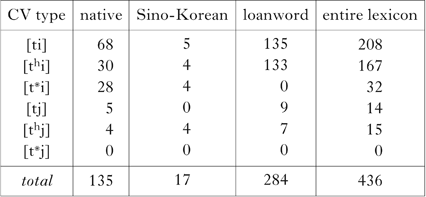
Duplicate items in the corpus were excluded, leaving a total of 53,196 lexical items. The number of words in the corpus containing [t tʰ t*] followed by [i] or [j] was calculated (I will refer to these as [Ti] and [Tj] respectively, and collectively as [TI]). Although there is no overt evidence of /t*/-palatalisation, because /t*/ does not occur word-finally, I treat the coronal stop series here as a natural class, since all members participated in the historical sound change. A count of [TI] entries in the corpus is given in Table I. Out of a total of 53,196 words in the corpus, only 436 contained [TI] sequences, less than 1% of the lexicon. Further, out of these words, 284 (65%) are loanwords (e.g. /tʰim/ team). These sequences are therefore rare in terms of absolute type frequency in the corpus.
Number of words that contain [TI] in the NAKL corpus, by lexical strata.

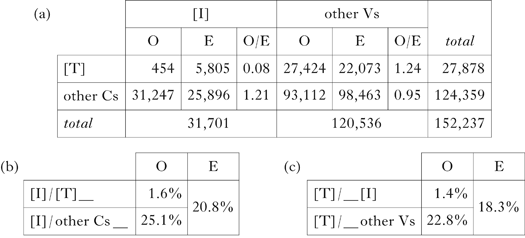
It is possible, though, that the rarity of words with such sequences is merely attributable to either the overall rarity of the coronal stop series or the high front vocoids. To ascertain the extent of the rarity of [TI] sequences, given the independent frequency of its components segments, a two-by-two contingency table was constructed (Table IIa) that compared the frequency of occurrence of these sequences compared to other CV combinations. Observed/Expected (O/E) values were calculated for each cell (e.g. Frisch & Zawaydeh Reference Frisch and Zawaydeh2001, Coetzee & Pater Reference Coetzee and Pater2008). ‘Observed’ (O) values are the total number of sequences of each CV combination found in the corpus. ‘Expected’ (E) values are how frequently each CV combination would be expected if each C and V co-occurred based on chance.Footnote 6 An O/E value of 1 indicates that a particular sequence occurs at the expected rate of occurrence. O/E values above 1 indicate overrepresentation and O/E values under 1 indicate underrepresentation. The percentages in (b) indicate the proportion of vowels found in a particular consonantal context, and the percentages in (c) the proportion of consonants in a particular vocalic context.
(a) Observed and expected occurrence of CV combinations: by consonant type ([T] vs. other Cs) and vowel type ([I] vs. other Vs). (b) and (c): observed vs. expected rates of occurrence of [I] and [T].

While Wilson & Obdeyn (Reference Wilson and Obdeyn2009) argue against the use of O/E values for examining lexical statistics, these are presented here to illustrate the general statistical pattern. Furthermore, since chi-square tests, which are often used to analyse contingency tables, are sensitive to sample sizes where small differences can be significant if the sample is large enough (Lantz Reference Lantz2013), I do not report any p-values here. Instead, the O/E values described below serve primarily to describe the relative underattestation in the data, with more robust evidence to be presented later using a computational phonotactic learner.
What is clear from Table II is that the actual observed number of [TI] sequences in the NAKL corpus is about a tenth of what would be expected due to chance (i.e. randomly combining each C and V). While we expect 18.3% of consonants to be [T], only 1.4% of Cs in the [I] context are [T], indicated by the percentages in italics. Similarly, while we expect 20.8% of vowels to be [I], only 1.6% of [I]’s occur with [T]. [TI] sequences occur at about a tenth of the rate that we would expect, given the independent occurrence of [T] and [I].
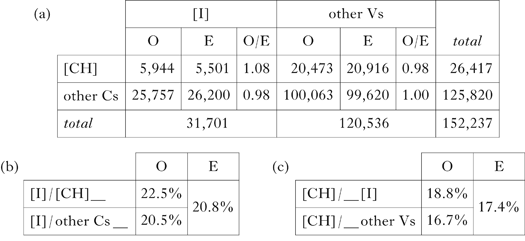
As a comparison, Table III shows the same calculations for [c cʰ c*] and [i] or [jV] sequences ([CHI] collectively). In this case, we see a small overrepresentation of [CHI] sequences in the corpus. This is perhaps expected, given that historically /TI/ sequences palatalised to [CHI] across the board, as discussed above.
(a) Observed and expected occurrence of CV combinations: by consonant type ([CH] vs. other Cs) and vowel type ([I] vs. other Vs). (b) and (c): observed vs. expected rates of occurrence of [I] and [CH].

When each of the strata of the Korean lexicon (native, Sino-Korean and loanword) is examined in more detail, a similar statistical pattern is observed in all three. These statistical trends are further supported in a corpus of child-directed speech (Ryu Reference Ryu2012). Thus the corpus investigation so far supports the hypothesis that [TI] sequences, while attested in the Korean lexicon, are actually exceedingly rare and marginal, with a majority of such words being loanwords (see Chong Reference Chong2017 for full details).
In the next section, I present the results of a computational learning simulation aimed at ascertaining whether there is sufficient evidence for a computational learner to learn a markedness constraint penalising [TI] sequences in Korean.
2.4 Learning a phonotactic grammar of Korean
In the previous section, I presented evidence that [TI] sequences were rare in the Korean lexicon. In this section, I confirm this qualitative observation by examining whether a computational learner – the UCLA Phonotactic Learner (Hayes & Wilson Reference Hayes and Wilson2008) – assigns a penalty to these sequences in a phonotactic grammar. The learning data for the simulation is the entire NAKL corpus, including loanwords, as discussed in the previous section. The motivation for including loanwords here was the fact that I am assuming that the child does not have explicit knowledge of lexical strata in an early stage of phonotactic learning, thus as far as they are concerned there is no difference between native words, Sino-Korean words and loanwords.
The learner was fed a feature system modified from Cho (Reference Cho2012). Following Hayes & Wilson (Reference Hayes and Wilson2008) and Cho (Reference Cho2012), I used both privative and binary features to control for the total number of natural classes. For the three-way laryngeal contrast, only tense stops are assigned [+constricted glottis], while aspirated stops are assigned [+aspirated]. Thus, lax stops are [―aspirated, ―constricted glottis] (Cho Reference Cho2012).Footnote 7 The feature [+spread glottis] is specified only for /h/. For the vowels, I assumed a seven-vowel system, /i e a ʌ o ɨ u/. As /e/ and /ɛ/ have now merged in most speakers’ productions (Shin et al. Reference Shin, Kiaer and Cha2013, Eychenne & Jang Reference Eychenne and Jang2015), these categories were collapsed to /e/. Glide–vowel sequences (diphthongs) were assumed to be two separate segments for the purposes of this simulation: five /j/-diphthongs (/ja jʌ jo ju je), four /w/-diphthongs (/wa wʌ we wi/) and one /ɨ/-diphthong (/ɨi/). Since /wɛ/ is pronounced as [we], these were coded as /we/. The vowels /ø/ and /y/ were coded as /we/ and /wi/ respectively, following Cho (Reference Cho2012).
The phonotactic learner was specified to only find bigram constraints, with the maximum number of constraints set at 180, although the result does not change if it is specified to find trigram constraints. The learner was initialised with the constraint *[–strid] [–high,–back] (i.e. *[TI]); I was interested in whether this constraint was assigned any weight. The O/E accuracy threshold for constraints was set at 0.3, following the simulations of Hayes & Wilson (Reference Hayes and Wilson2008). Since type frequency is typically implicated in the learning of phonotactic constraints over the lexicon (e.g. Pierrehumbert Reference Pierrehumbert2003, Richtsmeier Reference Richtsmeier2011), each input had a frequency of 1. All other parameters were set at default.
2.5 Results
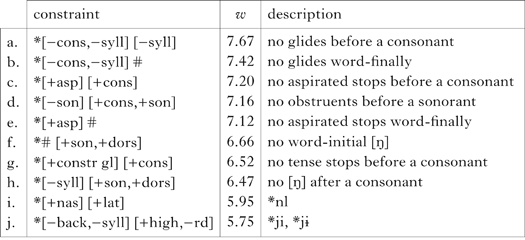
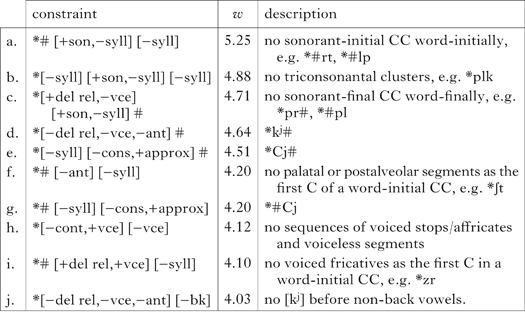
As a first check of the results of the simulations, the highest-weighted constraints were inspected to see if these corresponded to well-known phonotactic constraints in Korean. The ten highest-weighted constraints, which reflect well-known phonotactic restrictions in Korean, are shown in Table IV. For example, [ŋ] can only occur in syllable-final position ((f) and (h) in Table IV). Thus, unsurprisingly, the learner assigns a penalty score of 6.56 to the nonsense form [ŋam], indicating that this is not phonotactically well-formed.
Highest-weighted constraints learned from the NAKL corpus.

Crucially, the learner assigns a penalty score of 1.86 to words like [mati] and [tʰim], but a perfect score of 0 to the comparable palatalised forms [maci] and [cʰim]. That is, while this is clearly not a categorical constraint, the learner nonetheless assigns a non-trivial penalty to forms with [TI] sequences. As a point of calibration, the harmony penalty against [TI] sequences is in the range of the constraint against [θ] and [ð] or [tw] onsets in English (Hayes & Wilson Reference Hayes and Wilson2008: 399), which indicates that these sequences are rare, and that the constraint is violable. In the current case, the ultimate penalty score arises from the prespecified constraint (w = 1.49), in addition to another constraint, [–constr gl] [+high,–back] (w = 0.37), which specifically penalises [ti] and [tʰi] sequences individually. The fact that these were induced in addition to the prespecified constraints provides some further evidence that such sequences are dispreferred.
Using default parameters, I have shown how a probabilistic phonotactic learning model assigns a sizeable weight to a constraint penalising [TI] sequences, despite these forms actually existing in the lexicon of Korean. We can conclude, therefore, that the statistical underrepresentation found does indeed translate into a well-formedness penalty for words with [TI]. This suggests that the implicit assumption in analyses of MDEEs that such sequences occur freely in the lexicon is not supported empirically. In the next section, I examine another well-known example of an MDEE: Turkish velar deletion. I show that the surface similarity in patterns belies some crucial differences.
3 Turkish velar deletion
3.1 Introduction and historical background
Turkish velar deletion (Lees Reference Lees1961, Lewis Reference Lewis1967, Sezer Reference Sezer and Clements1981, Inkelas & Orgun Reference Inkelas and Orgun1995) is another frequently cited case of an MDEE. Velars delete intervocalically at a morpheme boundary, as in (10a), but not within morphemes, as in (b) (data from Inkelas Reference Inkelas, Erguvanlı Taylan and Rona2011, Reference Inkelas, Hsiao and Wee2015).
(10)

Inkelas (Reference Inkelas, Erguvanlı Taylan and Rona2011, Reference Inkelas, Hsiao and Wee2015; see also Sezer Reference Sezer and Clements1981 and Pycha Reference Pycha2008 for further discussion) points out that while velar deletion occurs in native words and loanwords as well as with morphologically simplex and complex stems, it fails to apply to verb roots, although the phonological conditions are met, as in (11). The word /gerek/ can be either a noun or a verb. While the noun in (a) undergoes deletion, the verb in (b) does not, despite satisfying the phonological conditions for velar deletion to occur.
(11)

Furthermore, deletion does not seem to apply when the velar consonant is suffix-initial, as in (12), whereas it does when the consonant is stem-final, as in (10a), despite both contexts being morphologically derived.
(12)

The application of velar deletion seems to be mostly confined to polysyllabic nouns, and is usually blocked from occurring with monosyllabic nouns. Polysyllabic nouns in the Turkish Electronic Living Lexicon corpus (TELL; Inkelas et al. Reference Inkelas, Küntay, Sprouse and Orhan Orgun2001) have an overall deletion rate of over 90%, whereas monosyllables have a deletion rate of only 3% (Pycha et al. Reference Pycha, Inkelas, Sprouse, Solé, Beddor and Ohala2007, Becker et al. Reference Becker, Ketrez and Nevins2011), and Turkish speakers extended this trend to nonce words in a wug test (Zimmer & Abbott Reference Zimmer and Abbott1978, Becker et al. Reference Becker, Ketrez and Nevins2011). Whether a particular lexeme alternates, however, is unpredictable. Becker et al. (Reference Becker, Ketrez and Nevins2011) posit an analysis which relies on a cloned lexically specific faithfulness constraint for each lexical item, where the cloned faithfulness constraint (Max) that blocks deletion is ranked above the markedness constraint *VKV. It should be noted that even in the context in which velar deletion most readily applies, any analysis still necessitates lexically specific constraints. Thus Turkish velar deletion appears to be a less than canonical MDEE, in the same vein as Finnish assibilation, as discussed in §1.
The current pattern has its roots in a historical process which spirantised and then deleted /g/ in intervocalic and postvocalic positions (Lees Reference Lees1961, Halle Reference Halle and Brogyanyi1979, Sezer Reference Sezer, Wetzels and Sezer1986, Inkelas & Orgun Reference Inkelas and Orgun1995, Ünal-Logacev et al. Reference Ünal-Logacev, Żygis and Fuchs2017). /k/, on the other hand, never underwent this change (Inkelas & Orgun Reference Inkelas and Orgun1995; I would like to thank an anonymous reviewer for pointing this out). In Modern Turkish, word-final /g/ (and voiced stops more generally) only occurs in loanwords (Göksel & Kerslake Reference Göksel and Kerslake2005; e.g. /katalog/ ‘catalogue’), although Lewis (Reference Lewis1967: 10) reports that these are often pronounced with final [k], rather than [g]. As with words with final /k/, words with putative final /g/ also show variability with respect to deletion (Inkelas Reference Inkelas, Erguvanlı Taylan and Rona2011; e.g. /katalog/ → [kataloa] (dat), but /patalog/ ‘pathologist’ → [patalogu] (acc)).
So, unlike Korean palatalisation, which historically affected a natural class of coronal stops across laryngeal specification, voiced and voiceless velars underwent different historical changes in Turkish. Interestingly, the morphologically conditioned nature of the alternation in modern Turkish stems seems to have been the case even historically. In Modern Turkish, Sezer (Reference Sezer and Clements1981) points out that /k/-deletion in stems is confined to what was historically a small set of denominal native vowel-initial suffixes, as shown in (13) (from Sezer Reference Sezer and Clements1981: 375).
(13)

Sezer (Reference Sezer and Clements1981) also points out that, although /k/-deletion does occur with some verbal suffixes, these suffixes are phonologically identical to the nominal suffixes which do trigger deletion.
It should already be clear at this point, that although often described as MDEEs, Korean palatalisation and Turkish velar deletion do not evince the same alternation patterns. In Korean, palatalisation is, to the best of my knowledge, productive and general, insofar as it applies to all suffixes which provide the appropriate phonological environment. In Turkish, however, velar deletion is morphologically restricted to certain suffxes. This raises the question of how exactly these languages might differ in terms of their static phonotactic generalisations. In Korean, while there are indeed stem-internal exceptions to the constraint *TI, there is nonetheless a significant enough underrepresentation of such sequences that a reliable phonotactic generalisation could be learned. But how strongly, if at all, is the constraint motivating velar deletion represented in the lexicon of Turkish? In the following sections, I report on the results of a corpus investigation and computational learning simulation of Turkish, complementing the previous examination of Korean.
3.2 Corpus study
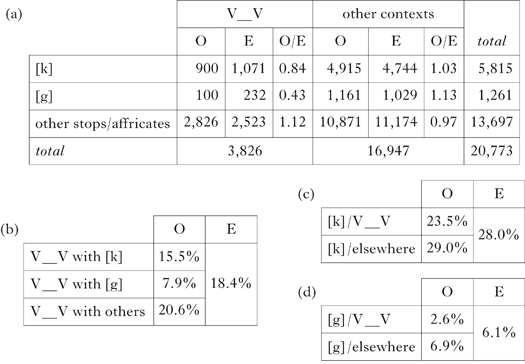
First, I examine the lexical statistics in TELL (Inkelas et al. Reference Inkelas, Küntay, Sprouse and Orhan Orgun2001). TELL contains approximately 30,000 lexemes, compiled from a variety of existing dictionaries. The corpus contains transcribed pronunciations of a large proportion of these lexemes in various verbal and nominal inflected forms from two speakers. For current purposes, I will be examining the transcribed roots in the database. In total, the corpus contained 16,757 transcribed roots.Footnote 8 O/E values were calculated in the same way as in §2.3. In this case, I was interested in comparing velar stops with other stops and affricates in the intervocalic context vs. all other contexts. Given the different historical sound changes affecting [k] and [g], these were examined separately here – Table V shows this calculation. Recall that an O/E value of 1 indicates that a particular combination of segments is observed at essentially an expected rate of co-occurrence given their independent frequency of occurrence; an O/E of 0 indicates that a particular combination does not occur at all. We note that intervocalic [k]’s occur close to the expected rate of occurrence (i.e. O/E is close to 1), whereas intervocalic [g]’s are somewhat underattested, which is not surprising, given that historically [g]’s were lost in this position. This contrasts with Korean, where the O/E value of [TI] sequences was much smaller, in fact close to 0. In §3.3, I examine whether a computational learner assigns any weight to a constraint penalising intervocalic velars in Turkish.
(a) Observed and expected occurrence of [k], [g] and other stops/affricates in intervocalic context. (b), (c) and (d): observed vs. expected rates of occurrence of [k] and [g] in comparison to other stops/affricates.

3.3 Learning a phonotactic grammar of Turkish
The learning data for the stimulation is the entire TELL corpus of roots. The system fed to the learner used both privative and binary features. Palatal stops were included in the segmental inventory, even though they only contrast with velar stops in certain environments. In the simulations, long vowels in the corpus were coded as sequences of two vowels. The features [back], [high] and [round] were used to classify the eight vowels, /i y ɨ u e ø a o/.
The phonotactic learner was asked to find trigram constraints, with the maximum number of constraints set at 180. As with the Korean simulation, the accuracy threshold for constraints was set at 0.3. Unlike in the Korean simulation, I included a vowel-tier projection (Hayes & Wilson Reference Hayes and Wilson2008), to allow the learner to discover constraints on vowel harmony (e.g. Clements & Sezer Reference Clements, Sezer, van der Hulst and Smith1982). All other parameters were set at default. As with the Korean simulation, the learner was initialised with the constraint of interest – *[+syll] [+dors] [+syll] (i.e. *VKV; Inkelas & Orgun Reference Inkelas and Orgun1995) – and I was interested in whether the learner assigns this constraint any weight, penalising words with intervocalic velars.
3.4 Results
As with the Korean simulation in §2.5, the highest-weighted constraints induced by the learner were inspected, to confirm that these conformed to well-known phonotactic constraints in Turkish. The highest-weighted constraints that the learner found (Table VI) were primarily related to well-known restrictions on consonant clusters in Turkish (van der Hulst & van de Weijer Reference Hulst, van de Weijer, Boeschoten and Verhoeven1991). The learner also penalises roots which violate rounding harmony, in particular sequences involving [ɨ]: for example, *[umɨt] is assigned a penalty score of 5.17, and *[tɨfus] a score of 3.60 (forms from Kirchner Reference Kirchner1993). Most importantly, the learner does not assign any weight to the constraint penalising intervocalic velars (*VKV), thus words like [sokak] receive a penalty score of 0, and are predicted to be phonotactically completely well-formed.Footnote 9 Note also that although [VgV] sequences were somewhat underattested compared to [VkV] sequences (Table V), no constraint (e.g. *VgV) was induced that penalised [VgV] sequences, and test items with intervocalic [g] received a penalty score of 0. Thus, under similar modelling assumptions, the learner does not learn a phonotactic constraint against intervocalic velars in Turkish, but does for [TI] in Korean.
Highest-weighted constraints learned from the TELL corpus.

3.5 Island of reliability with polysyllabic nouns?
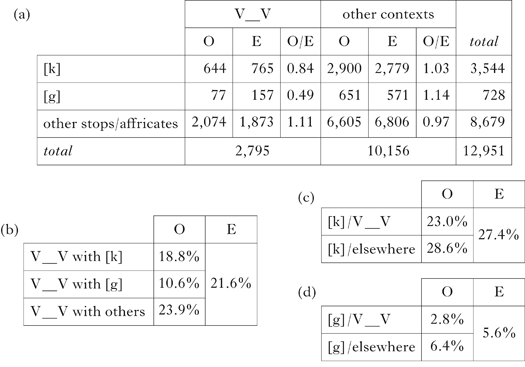
Given the finding that Turkish speakers extend velar deletion to nonce polysyllabic words (Zimmer & Abbott Reference Zimmer and Abbott1978, Becker et al. Reference Becker, Ketrez and Nevins2011), it is possible that there is an ‘island of reliability’ for a phonotactic generalisation (Albright Reference Albright2002). That is, there might possibly be a cophonology (Inkelas & Zoll Reference Inkelas and Zoll2007) or sublexicon (Becker & Gouskova Reference Becker and Gouskova2016) of polysyllabic nouns for which *VKV represents a strong and reliable phonotactic generalisation. To investigate this, I identified polysyllabic nouns in TELL and again calculated the O/E values, given in Table VII. Virtually identical results were obtained as in Table V when the entire corpus was considered. Given the failure to find a phonotactic constraint noted in the previous section, it is unlikely that one would be found here either. Thus it seems that, although Turkish speakers do seem to generalise velar deletion to novel polysyllabic nouns (Zimmer & Abbott Reference Zimmer and Abbott1978), they do not seem to be relying on a general phonotactic generalisation across the entire lexicon or within the sublexicon of polysyllabic nouns.
(a) Observed and expected occurrence of [k], [g] and other stops/affricates in intervocalic context in Turkish polysyllabic nouns. (b), (c) and (d): observed vs. expected rates of occurrence of [k] and [g] in comparison to other stops/affricates.

4 Analysis with indexed constraints
Having established the phonotactic generalisations (or lack thereof) available to a computational learner in both Korean and Turkish, in this section I present an analysis of both the Korean and Turkish cases using indexed constraints (e.g. Itô & Mester Reference Itô, Mester and Tsujimura1999, Smith Reference Smith, Kirchner, Pater and Wikely2001, Pater Reference Pater, Bateman, O'Keefe, Reilly and Werle2007, Becker et al. Reference Becker, Ketrez and Nevins2011, Moore-Cantwell & Pater Reference Moore-Cantwell and Pater2016). The key point of divergence between Korean and Turkish is the locus of exceptionality, in particular whether the alternation is supported by a general markedness (phonotactic) constraint in the language. Korean has a general markedness constraint (induced from phonotactic learning), and the exceptional behaviour of stems is captured by high-ranked indexed faithfulness. In Turkish, however, there is no general markedness constraint, and the exceptional triggering of deletion is the result of a high-ranked indexed markedness constraint. Thus, in order to derive the difference in patterns, we have to utilise indexed markedness (exceptional triggering) and indexed faithfulness constraints (exceptional non-undergoing) (cf. Pater Reference Pater, Bateman, O'Keefe, Reilly and Werle2007).
4.1 Korean
Both the corpus studies and phonotactic modelling simulations for Korean in §2 suggest strongly that there is a general structure-blind (Martin Reference Martin2007, Reference Martin2011) markedness constraint, *TI, which is active in the Korean grammar. Regardless of whether a morpheme boundary intervenes between [T] and [I], the constraint still penalises the sequence. Yet, as we have seen, words with such sequences do exist in the Korean lexicon, e.g. [mati] ‘joint’. An analysis of the Korean palatalisation pattern, therefore, needs to predict that existing [TI] words should surface faithfully, but it should also penalise novel words that do contain such sequences. An analysis of Korean palatalisation should capture the facts in (14).
(14)

To the best of my knowledge, palatalisation across suffix boundaries is general, in that it applies to all suffixes where the phonological conditions are met (see the data in (15)), and also extends to loanwords (Jun & Lee Reference Jun and Lee2007).
(15)

While the computational learner penalises tautomorphemic [TI] sequences by assigning them a non-zero penalty score, the penalty assigned is weaker than would be assigned by a categorical constraint (i.e. completely ill-formed), such as *#ŋ, indicating that this is a gradient restriction (e.g. Coetzee & Pater Reference Coetzee and Pater2008). For current purposes, I set aside this issue of gradience, in order to highlight the most salient difference between the Korean and Turkish cases discussed here. I return to this issue below. While the analysis here is presented using Harmonic Grammar (Legendre et al. Reference Legendre, Miyata and Smolensky1990), its main thrust does not hinge on this analytical choice.
Given that the computational learner penalises [TI] sequences, I propose that the grammar contains the general structure-blind markedness constraint in (16), which penalises [TI] sequences both within a morpheme and across a morpheme boundary.
(16)

This markedness constraint is in competition with a faithfulness constraint that prevent the alternation. Here I assume a general Faith constraint, which encompasses all possible repairs. (17) shows that *TI has a higher weight than Faith, to account for the alternation at the morpheme boundary.
(17)

In order to ensure that existing words like /mati/ surface faithfully, I propose that an additional, lexically specific indexed faithfulness constraint along the lines of Burzio (Reference Burzio, Dekkers, van der Leeuw and van de Weijer2000) prevents palatalisation in such cases (see also the discussion in Pater Reference Pater, Bateman, O'Keefe, Reilly and Werle2007). This constraint is indexed to existing stems that contain [TI] sequences, e.g. [mati] (cf. Moore-Cantwell & Pater Reference Moore-Cantwell and Pater2016), and prevents alternations in existing words, as shown in (18).
(18)

Under the proposed analysis, non-application of Korean palatalisation in specific stems is an instance of an exceptional non-undergoer due to high-ranked indexed faithfulness constraints.
The current analysis predicts that novel words with [TI] should palatalise, although a reviewer points out, as does Cho (Reference Cho2009), that loanwords with [TI] sequences in Korean do not undergo palatalisation. In accordance with this, our corpus investigation above in §2.3 revealed that nearly two-thirds of [TI] words are in the loanword stratum of the lexicon. The analysis here is in principle compatible with these patterns if we assume a faithfulness constraint indexed to loanwords that outranks the general markedness constraint (e.g. Itô & Mester Reference Itô, Mester and Tsujimura1999, Reference Itô, Mester, Miyagawa and Saito2008). An alternative possibility, also raised by a reviewer, is that Korean speakers might simply not be aware of the rarity of /TI/ in the lexicon. If this is true, this would raise a further interesting question of why this should be, given that palatalisation is a phonetically natural pattern (cf. Becker et al. Reference Becker, Ketrez and Nevins2011), and given that we know that speakers can track statistical regularities in phonotactic patterns, and based on these, show gradient well-formedness intuitions regarding novel words in their language (e.g. Frisch & Zawaydeh Reference Frisch and Zawaydeh2001, Hay et al. Reference Hay, Pierrehumbert, Beckman, Local, Ogden and Temple2003, Hayes & White Reference Hayes and White2013). Future experimental investigation of native-speaker knowledge is therefore needed to examine these possibilities.Footnote 10
The analysis also does not address the fact that, while [TI] sequences are systematically penalised by a general markedness constraint, they are not penalised to the same degree as they would be by a categorical phonotactic constraint (e.g. no [ŋ] at the start of a word). This is a case of gradient exceptionality; how this is learned in conjunction with categorical alternations is unclear. Thus, in addition to native-speaker judgements, we would also need a model of how constraint weights are learned in the face of gradient exceptionality in the lexicon, and how this impacts the productivity of a phonological alternation. This is a subject of ongoing research (e.g. Moore-Cantwell & Pater Reference Moore-Cantwell and Pater2016, Zymet Reference Zymet2018), and is beyond the scope of the current paper.
The core claim of the analysis here, based on the results of the phonotactic learning simulation, is that the putative MDEE pattern in Korean palatalisation is an instance of an exceptional non-undergoer, in violation of a more general markedness constraint. The crucial distinction is not simply between a derived and non-derived (stem-internal) environment, since the indexed faithfulness constraints only apply to specific lexical items, not to the stem-internal domain as a whole. In this way, the analysis presented here departs from previous proposals (e.g. constraint conjunction (Łubowicz Reference Łubowicz2002), sequential faithfulness (Burzio Reference Burzio, Dekkers, van der Leeuw and van de Weijer2000), underspecification (Kiparsky Reference Kiparsky and Fujimura1973) and strength scales (Inkelas Reference Inkelas, Hsiao and Wee2015)), and predicts that nonce words with [TI] are less acceptable to native Korean speakers than words with sequences such as [ta] and [ci]. Previous accounts predict that such nonce words should be perfectly acceptable. The claim here, however, is that the stem-internal [TI] sequences are exceptions to the more general markedness constraint that disprefers such sequences. Further confirmation of this prediction awaits future work testing native-speaker knowledge.
4.2 Turkish
Having proposed an analysis using indexed faithfulness constraints of the Korean MDEE pattern in the previous section, I now turn to an account of Turkish velar deletion. As described above and elsewhere, the alternation occurs for the most part only with nominal vowel-initial suffixes (Sezer Reference Sezer and Clements1981, Inkelas & Orgun Reference Inkelas and Orgun1995, Inkelas Reference Inkelas, Erguvanlı Taylan and Rona2011); suffix-initial /k/’s do not delete. Inkelas & Orgun (Reference Inkelas and Orgun1995) account for this by having the constraint against intervocalic velars apply only at a specific morphological level in the derivation. Becker et al. (Reference Becker, Ketrez and Nevins2011) examine the alternation rates for velar-final noun stems in TELL. However, their analysis is restricted to one morphological environment, the possessive (see also Zimmer & Abbott Reference Zimmer and Abbott1978). In their wug study, Turkish participants applied the deletion rule in the possessive context to polysyllabic nonce words, but not to monosyllabic nonsense words, in accord with the trends in the lexicon. The TELL corpus, however, also includes tokens in two other morphological contexts that should trigger deletion: the accusative and the predicative. Two further conclusions can be drawn from an examination of deletion rates in these contexts. Firstly, although deletion is by far the most common pattern, each of the elicited suffixes seems to have its own rate of deletion, in what Zymet (Reference Zymet2018) terms ‘lexical propensities’: 78% for the predicative, 91% for the accusative and 93% for the possessive. Secondly, a given root does not always behave in the same way across morphological contexts. For example, a root that Becker et al. (Reference Becker, Ketrez and Nevins2011) classify as an alternator, /ajak/ ‘foot’, does indeed show the alternation in the possessive form [ajaɯm] and accusative [ajaɯ], but not in the predicative form [ajakɯm].
I assume Becker et al.’s (Reference Bailey and Hahn2011) analysis as a starting point. Given the observations above, and the fact that Turkish does not have a general phonotactic constraint available across the entire lexicon, I propose a small modification to their analysis, to account for the fact that the constraint motivating deletion is only associated with the small set of nominal suffixes in (13). Becker et al.’s (Reference Becker, Ketrez and Nevins2011) analysis uses faithfulness constraints that are lexically indexed to the roots that do not show the alternation, resulting in constraint rankings like Maxi ⪢ *VKV ⪢ Max. The suggestion here is a modest one, and has to do with ensuring that the *VKV constraint in (19) is indexed to specific individual triggering suffixes (Pater Reference Pater, Bateman, O'Keefe, Reilly and Werle2007), where the right edge of this configuration's domain must overlap with an exponent of the relevant morphemes that trigger the alternation (Jarosz Reference Jarosz2018). Given that each suffix shows its own rate of triggering deletion, I suggest there that there is a cloned markedness constraint indexed to each one.
(19)

The constraint is violated only if the right edge of the configuration's domain overlaps with some exponent of the possessive morpheme; otherwise, it does not apply. Thus a root like /ajak/ in the possessive alternates under the constraint ranking *VKVposs ⪢ Maxajak, but not in the predicative under the ranking Maxajak ⪢ *VKVpred. In both cases, the structure-blind markedness constraint *VKV is low-ranked or receives no weight, unlike in Korean.
The approach here captures the idea that that the phonotactic constraint is not a general one within the language. It also captures the observation that the alternation is triggered only by specific suffixes, which seemingly have their own rate of application, while the roots themselves can have various rates of blocking. Whether the suffix-specific rates of trigger deletion hold up once we examine all potential contexts and across a larger corpus of data remains to be determined. Regardless, in Turkish, in contrast to Korean, the markedness constraint has to be indexed to a subset of suffixes only.
Clearly, given the results from both Zimmer & Abbott (Reference Zimmer and Abbott1978) and Becker et al. (Reference Becker, Ketrez and Nevins2011), velar deletion in Turkish is productive in the relevant morphological contexts, since the markedness constraint is indexed to specific triggering suffixes. Turkish speakers’ preferences for novel alternations, in fact, accorded with the statistical trends in the lexicon examined by Becker et al. (Reference Becker, Ketrez and Nevins2011). If the learning of phonotactics both precedes and facilitates the learning of alternations (Hayes Reference Hayes, Kager, Pater and Zonneveld2004, Pater & Tessier Reference Pater, Tessier, Flack and Kawahara2005, Tesar & Prince 2007, Hayes & Wilson Reference Hayes and Wilson2008), then we expect that Turkish velar deletion would be learned later than an alternation that is phonotactically supported, like Korean palatalisation, only once more sophisticated knowledge of morphology and paradigms is in place.
5 General discussion
The present paper set out with the aim of examining in closer detail the quality of the phonotactic generalisations available in languages with derived environment effect patterns. In particular, I have examined whether stem-internal sequences are truly grammatically well-formed in derived environment effect patterns, by comparing stem-internal phonotactic generalisations in Korean palatalisation and Turkish velar deletion, two well-known MDEE cases. While there is a robust, albeit gradient, phonotactic constraint against [TI] that is able to motivate alternations in Korean, no such constraint against intervocalic velars is readily available in Turkish. The languages also differ in the extent to which the alternation is morphologically general: in Korean any suffix that meets the phonological requirements triggers the alternation, while in Turkish only a subset of suffxes does so (Sezer Reference Sezer and Clements1981, Inkelas Reference Inkelas, Erguvanlı Taylan and Rona2011). Here, I discuss the implications of these results for MDEEs, and what they mean for theoretical analyses of these patterns and MDEEs as a unified phenomenon more generally.
5.1 MDEEs with indexed constraints
The analysis presented above utilises both indexed markedness constraints and indexed faithfulness constraints. The use of indexed constraints to account for MDEEs is certainly not new (see e.g. Burzio Reference Burzio, Dekkers, van der Leeuw and van de Weijer2000, Pater Reference Pater, Bateman, O'Keefe, Reilly and Werle2007, Jurgec & Bjorkman Reference Jurgec and Bjorkman2018). Here I am suggesting that both indexed faithfulness and indexed markedness constraints are needed to account for the different patterns. The main difference between the analysis of the patterns in Korean and Turkish is the extent to which a general structure-blind phonotactic markedness constraint is active in the grammar. In the Turkish case, given that the markedness constraint is indexed to specific suffixes (not just suffixes in general), this is an instance of suffix-specific (i.e. exceptional) triggering by a markedness constraint that is not active elsewhere. This analysis is further supported by the learning simulations, which show that a general phonotactic constraint against intervocalic velars is not available. In contrast, the computational learner does assign a non-trivial weight to a general phonotactic constraint against [TI] sequences in Korean. To capture this, I proposed that a structure-blind non-indexed markedness constraint is responsible for penalising [TI] sequences in Korean, but that palatalisation is blocked by a lexically specific faithfulness constraint, to ensure that existing words with [TI] stem-internally surface faithfully.
Unlike traditional accounts of MDEEs, I have not attempted here to provide a unified analysis of the two patterns, reflecting the fact that while superficially similar, the actual phonological patterns in each case are not identical, a point I take up in the next section.
5.2 MDEEs as a unified phenomenon?
A major claim of the current study is that, despite surface similarities, patterns previously described as examples of MDEE are by no means a unified phenomenon. On the surface, both Korean palatalisation and Turkish velar deletion (and in fact, MDEEs in general) are similar in that the phonological process purportedly applies only when the environment involves the concatenation of two morphemes, but not within morphemes. This surface similarity belies major differences once we start looking more closely at the quantitative patterns in the lexicon and with alternations. On the one hand, Korean palatalisation is categorical across a morpheme boundary, and not confined to specific suffixes, while stem-internal forms are rare enough that they receive a well-formedness penalty. On the other hand, Turkish velar deletion, while productive, is confined to specific suffixes, and, unlike Korean, intervocalic velars within stems are entirely phonotactically well-formed, as I showed above.
In fact, while both patterns are traditionally considered to be uncontroversial textbook examples of MDEEs, they do not hold up to scrutiny, especially when one takes into consideration the assumptions laid out above in (5) (the derived environment condition) and (8) (phonotactic well-formedness).
That Turkish fails on (5) has previously been pointed out by Inkelas (Reference Inkelas, Erguvanlı Taylan and Rona2011; cf. Sezer Reference Sezer and Clements1981). Further, as discussed in §1, Finnish assibilation (Kiparsky Reference Kiparsky and Fujimura1973, Reference Kiparsky, Hargus and Kaisse1993, Anttila Reference Anttila2006), perhaps the most-cited example of an MDEE, likewise fails on the derived environment condition. Observations such as these lead Inkelas (Reference Inkelas, Erguvanlı Taylan and Rona2011) to argue more generally that the derived environment condition is neither a sufficient nor a potentially useful diagnostic for putative MDEE patterns. Rather, she conjectures that many cases previously described as MDEEs are in fact just cases of morphologically conditioned phonology.
Korean, on the other hand, does not satisfy (8): stem-internal sequences are not in fact completely phonotactically well-formed.Footnote 11 Thus at least some putative cases of MDEE are instances of lexical exceptionality. Our corpus and phonotactic modelling simulation quantitatively support Cho's (Reference Cho2009) observations on Korean. In Korean, stem-internal [TI] sequences are exceedingly rare, and are found mostly in loanwords. Furthermore, Cho (Reference Cho2009) points out that other cases of MDEEs often involve loanwords (e.g. Finnish Vowel Coalescence (Anttila Reference Anttila2009) and Polish First Velar Palatalisation (Łubowicz Reference Łubowicz2002)). A closer inspection of the lexicon of at least some well-known MDEE cases might well reveal a similar picture to Korean, where we observe a phonotactic dispreference within stems for sequences repaired across morpheme boundaries.
Taken together, the strongest claim that can be made is that MDEEs as a formal category should be dispensed with (for a similar conclusion, see Inkelas Reference Inkelas, Erguvanlı Taylan and Rona2011). Neither of the cases examined in detail here fulfil the traditional criteria for MDEEs, and they fail in different ways, requiring different theoretical treatments. One presents a case of exceptional triggering (high-ranked indexed markedness), and another exceptional non-undergoing (high-ranked indexed faithfulness). The analyses presented above do, however, do not rule out the ‘true’ MDEE cases, where we find categorical alternation at morpheme boundaries, but where stem-internal sequences are entirely well-formed. In principle, a markedness constraint indexed to affixes in general, as suggested by Pater (Reference Pater, Bateman, O'Keefe, Reilly and Werle2007), would be able to account for these patterns. This would not require any theoretical machinery specific to MDEEs, but would fall out from existing theoretical tools of constraint indexation (for a recent extension of indexed constraints, see Jurgec & Bjorkman Reference Jurgec and Bjorkman2018). This might be desirable, since, as a reviewer points out, it is entirely possible that such ‘classical’ cases exist, but have yet to be uncovered. But, these classical MDEEs would be just a specific case of morpheme-specific phonology, alongside the cases discussed above. Ultimately, however, if on further examination more cases end up patterning like the ones observed here, it might be necessary to modify the analysis to rule out classical cases completely.
If MDEE as a notion is to be retained, it certainly cannot be viewed as a unified phenomenon accounted for by a single analysis. This suggests the possibility of a ‘typology’ of MDEE patterns which have in common the fact that a particular phonological process applies in some morphological contexts but not others. An expanded version of this sort is referred to by Jurgec & Bjorkman (Reference Jurgec and Bjorkman2018: 577), who include phonological processes applying ‘only to a subset of morphemes (e.g. to loanwords, or to affixes but not roots)’ as instances of MDEEs. This is already an expansion of the traditional notion of MDEEs. A more in-depth understanding of patterns previously described as MDEEs is required, in order to ultimately provide a better understanding of the extent to which these patterns differ from each other, and to establish whether all putative MDEE patterns reduce to exceptional triggers vs. exceptional undergoers, as is suggested here. If so, this would raise the question of whether it is even useful to consider MDEEs as a special category of morphophonological patterns, distinct from morphologically conditioned phonology or lexical exceptionality more generally.
I leave the answer to these issues open for future examination. At the very least, beyond identifying whether a pattern occurs in some morphological domain but not another (e.g. within stems), we should also examine whether that particular pattern is indeed categorical at all, and if so to what extent. The examination of these patterns in more detail, incorporating acquisition and diachronic perspectives, will also prove fertile ground for investigating the extent to which stem phonotactics and alternations can pull apart over time.