I. INTRODUCTION
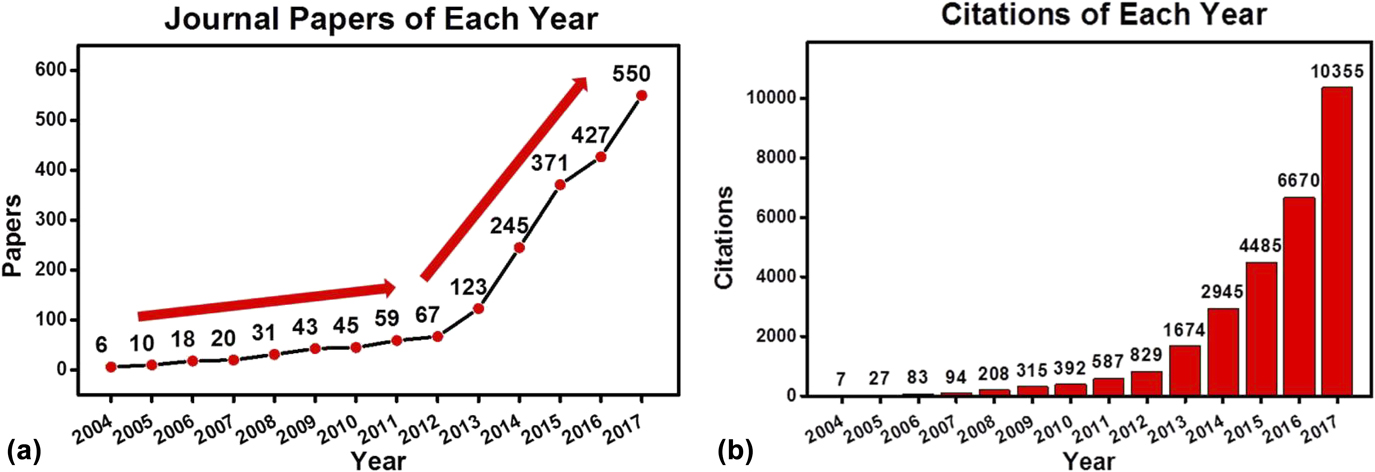
High-entropy alloys (HEAs) have been developed in late 20th century but formally published in the early 21st century.Reference Murty, Yeh and Ranganathan1,Reference Gao, Yeh, Liaw and Zhang2 Two definitions of HEAs were proposed based on composition and configurational entropy, respectively. For compositional definition,Reference Yeh, Chen, Lin, Gan, Chin, Shun, Tsau and Chang3 HEAs are preferentially defined as alloys containing at least five principal elements, each with an at.% between 5 and 35%. The at.% of each minor element, if any, is hence less than 5%. For the entropic definition,Reference Yeh4 HEAs are defined as alloys having configurational entropies at a random state larger than 1.5R, no matter they are single phase or multiphase at room temperature. From the concept of HEAs, the alloy world can be divided as three categories based on configuration entropy: HEAs are those with configurational entropy larger than 1.5R, where R is gas constant; medium-entropy alloys (MEAs) between 1 and 1.5R; and low-entropy alloys smaller than 1R. Furthermore, an extension of HEA concept was soon carried out to ceramics (HECs), polymers (HEPs), and composites (HECOMPs) by changing the at.% in compositional definition into the mole percentage. As for HECOMPs, at least one of the main components should be of HEAs, HECs, or HEPs. As a result, materials world can also be divided into high-entropy, medium-entropy, and low-entropy materials to cover all possible materials. Since conventional materials consist of one or two major components whereas medium-entropy materials (MEMs) and high-entropy materials (HEMs) have more major elements or components, the whole periodic table could become fully activated in the materials design in future. Because the combinations of compositions and processes are countless and lead to a wide range of microstructures and properties of MEMs and HEMs, the world of MEMs and HEMs is full of opportunities both in academic research and applications. Figure 1 shows the growth of journal papers and citations from 2004 to 2017. It is clear that 2013 is the critical year for the rapid growth of journal papers. The yearly number of papers including SCI and EI papers increases to 550 papers in 2017. At the same time, the yearly citation number of SCI papers increases at an increased rate from Web of Science database. To sum up, the total number of papers on HEMs is 2015 and that of citation only for SCI papers is 28,671. Thus, average citation number per paper is higher than 14. This reflects that the field of HEMs has become a new emerging field. The 21st century could be regarded as the new era of HEMs and MEMs. We can foresee the general trends in the near future includingReference Gao, Yeh, Liaw and Zhang2 (i) more fundamental and basic scientific studies; (ii) further development of single-phase HEMs; (iii) more research on computational methods; (iv) more research on performance challenges unattainable by traditional materials; (v) further development of MEAs; and (vi) assessments of existing databases to find possible applications.
(a) Growth of the yearly number of papers, SCI plus EI, on HEMs, and (b) growth of the yearly number of citations for SCI papers from 2004 to 2017.

Many new materials have been designed and studied based on the HEA concept. Among these, special groups of HEMs have been reported including high-entropy superalloys (HESAs), refractory alloys, eutectic alloys, metallic glasses, nanometals, carbides, nitrides, oxides, sintered carbides, cermets, and composites. Although the research on HEMs is still very limited in the HEM field, it has been found that HEMs could have broad potential applications in different areas where conventional materials have been applied for a long time.Reference Gludovatz, Hohenwarter, Catoor, Chang, George and Ritchie5–Reference Shi, Yang and Liaw9 There are many bottlenecks encountered by conventional materials. They include insufficiencies in energy saving, materials saving, performance efficiency, cost reduction, resource reservation, environment, and health. In the authors’ opinion, the mission of HEMs is to overcome the bottlenecks of conventional materials. The promising properties as seen in the literature have indicated that HEMs could take this great mission.
II. POSSIBLE BREAKTHROUGH APPLICATIONS
Among many potential applications, several possible breakthrough applications are pointed out and explained in this article. They include high-temperature turbine blades, high-temperature molds and dies, sintered carbides for cutting tools, hard coatings for cutting tools, hardfacings, and radiation-damage resistant materials. They are described in the following.
A. Turbine blades
Superalloys are critical materials for high temperature applications especially in the hot section of turbine engines. Since the thermal efficiency of an engine can simply be increased by increasing temperature capability of turbine blades and per increase of 40 °C could increase the engine efficiency approximately by 1%, we need materials that can withstand higher operation temperature. Historical development of superalloys started from 1940s. The progress in improving compositions and fabricating technology from wrought (e.g., N80, N80A, N90, waspaloy, N100, N105, and N115) to cast (e.g., IN713C, IN792, MarM200, MarM246, MarM247, TM70, and TM321) to directionally solidified (e.g., MarM200Hf, MarM247, and TMD-5) and finally to single-crystal turbine blades (e.g., PWA1480, CMSX-4, TMS-26, PWA1484, CMSX-10, TMS-75, TMS-82, and TMS-162) effectively raise the temperature capability. The temperature capability in average increases at a rate of 6 °C per year; however, the limit up to 2010 is around 1100 °C.Reference Reed10
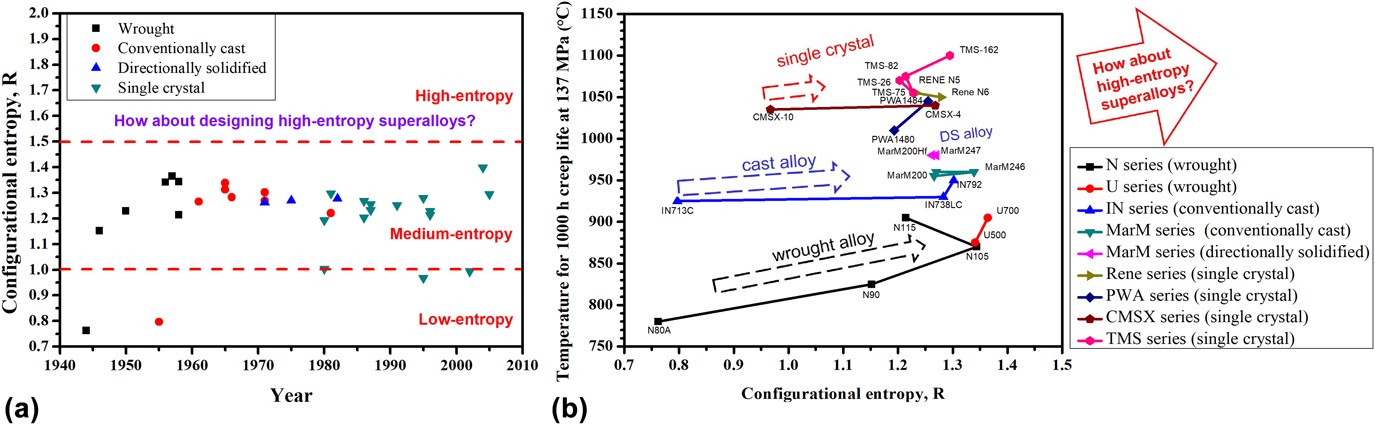
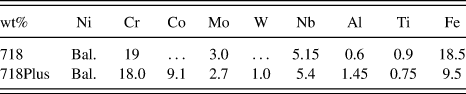
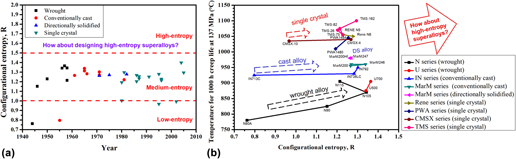
After calculating the configurational entropy of the superalloys,Reference Reed10 we plot Fig. 2(a) showing configurational entropy versus year. Most superalloys are MEAs. Since 1940s, the configurational entropy quickly increased to medium entropy and then fluctuated between 1.2 and 1.4R. It never exceeds 1.5R. It would be curious for us that how about to design HESAs for further improvement in temperature capability. Figure 2(b) shows the effect of configurational entropy on temperature capability. For creep resistance, the grain boundary is a negative factor. So, it is apparent that the decreasing order of temperature capability is single crystals, directionally solidified alloys, cast alloys, and wrought alloys. We find that the general trend is positive for wrought alloy, cast alloy, and single crystal series. This means that the temperature capability generally increases with configuration entropy in each category and also in the same series (N, IN, MarM, TM, PWA, CMSX, or TMS series). We also note that in each category, some alloys have higher temperature capability than other alloys even at the similar level of entropy. This indicates that the selection of suitable element and concentration is also an important factor. Therefore, Fig. 2 tells us that we need to design HESAs with more suitable elements, not merely to increase the entropy, for improving temperature capability in each category. As an example, the most popular Ni-based superalloy Inconel 718 has a new version Inconel 718Plus, which has been commercialized in recent years.Reference Kennedy and Loria11 By replacing half content of Fe by similar amount of Co content, as can be seen in Table I, its configurational entropy increases from 1.26 to 1.46R and temperature capability can be increased from 650 to 705 °C.Reference Shi, Yang and Liaw9
(a) Configurational entropy of superalloys versus year; (b) effect of configurational entropy on temperature capability.

Composition comparison between superalloy 718 and superalloy 718Plus.

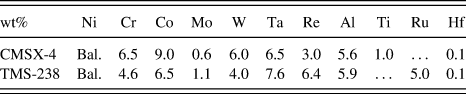
There are two opportunities to overcome the insufficiency of conventional superalloys: developing HESAs and high-entropy refractory alloys (HERAs). Table II shows the composition comparison between second generation superalloy CMSX-4 and sixth generation superalloy TMS-238.Reference Reed10,Reference Kawagishi, Yeh, Yokokawa, Kobayashi, Koizumi and Harada12 Their temperature capability are 1050 and 1150 °C, respectively. It is generally recognized that temperature capability improvement mainly relies on the addition of expensive refractory, Re and Ru. This is why sixth generation superalloy TMS-238 contains 6.4% rhenium and 5% ruthenium. From the view point that HEAs has the sluggish diffusion effect which might be enhanced by adding more cheap refractory elements such as Mo, Nb, Ta, or W, it is very probable to reduce Re and Ru contents of a superalloy while maintaining its temperature capability of 1150 °C. The sluggish diffusion effect has two meanings. One is the reduced diffusion rate caused by severe lattice distortion of the whole-solute matrix. To prove this phenomenon, CoCrFeMnNi FCC-HEA has been verified by nontracer diffusion experimentReference Tsai, Tsai and Yeh13 and tracer diffusion oneReference Vaidya, Pradeep, Murty, Wilde and Divinski14 when homologous temperature scale is based. The other is the reduced phase transformation rate caused by rate-determining species which has relatively low diffusion rate. However, the strategy still requires suitable combination of selected cheap refractory elements by which larger amount of refractory elements could be dissolved in the matrix due to high-entropy effect and the matrix could thus provide higher strength due to solution hardening.
Composition comparison between second generation superalloy CMSX-4 to sixth generation superalloy TMS-238.

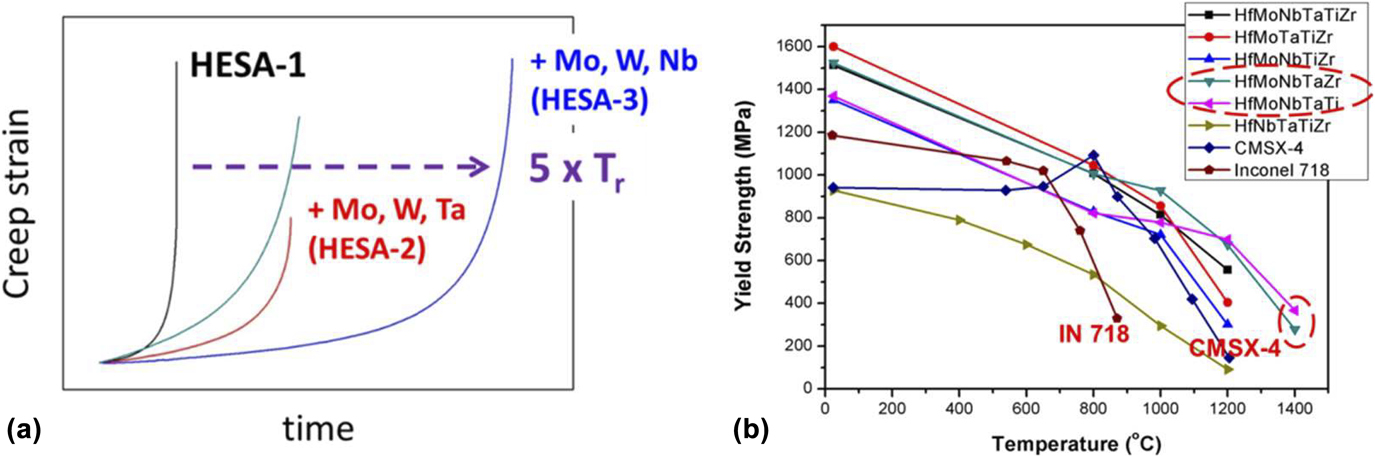
For HESAs, An-Chou’s group has found that, shown in Fig. 3(a), by small additions of cheap refractory elements such as Mo, W, and Nb,Reference Tsao, Yeh, Kuo, Kakehi, Murakami, Yeh and Jian15 the creep resistance of HESA-3 (the same alloy in Ref. Reference Tsao, Yeh, Kuo, Kakehi, Murakami, Yeh and Jian15) can be enhanced and its creep rupture life is 5 times that of HESA-1 which has no such additions. The creep curves were obtained at 982 °C under 159 MPa, by which the creep rupture life of HESA-3 is about 114 h whereas that of HESA-1 is about 22 h.
(a) Effect of small additions of cheap refractory elements such as Mo, W, Ta, and Nb on creep resistances of HESA-3 and HESA-2 as compared with HESA-1 which has no such additions; (b) yield strength as functions of temperature for six equiatomic HERAs and two conventional superalloys, IN718 and CMSX-4.

The second opportunity is HERAs which consist of major refractory elements. The lowest-melting-point (1660 °C) element among these refractory elements is titanium. Thus, by utilizing higher melting points of all constituent refractory elements and the sluggish diffusion effect, the single-crystal refractory alloy is expected to have temperature capability up to 1300 or even 1400 °C. Figure 3(b) shows the yield strength as functions of temperature for six HERAs and two commercial superalloys: Inconel 718 and CMSX-4. It can be seen that five refractory alloys are stronger than superalloys at above 1000 °C. Among these, the HERA HfMoNbTaTi could have the strongest yield strength of 367 MPa at 1400 °C. However, their creep resistance needs to be verified and oxidation resistance needs to be improved before their applications in turbine engines. That is, more research studies are required to attain the goal.
B. Thermal spray deposition
HEMs have many opportunities in the field of thermal spray technology. The protection layer could improve corrosion, oxidation, thermal, and/or wear resistance of structure parts.
A turbine blade in a turbine engine rotates under the action of hot gas stream around 1500 °C and requires internal cooling channels and thermal barrier coating on the surface to guarantee that the blade substrate temperature is below its temperature capability. A bond coat is the necessary bond layer between the superalloy substrate and top coat of thermal barrier Y-stabilized zirconium oxide, providing good bonding and oxidation resistance.Reference Padture, Gell and Jordan16 Table III shows the comparison between the HEA bond coat of NiCo0.6Fe0.2Cr1.5SiAlTi0.2 and commercial bond coat alloy 30Ni33.5Co21Cr15Al0.5Y (in wt%), both fabricated by the spark plasma sintering technique.Reference Hsu, Murakami, Yeh, Yeh and Shimoda17 From this table, we can see that the density of HEA is 20% lower, room temperature hardness is 2.3 times high, 1100 °C-hardness is 4 times high, oxidation resistance is same, thermal conductivity is 33% lower, and thermal expansion is 17% lower. All these indicate that the HEA bond coat have smaller centrifugal force, higher wear resistance, better heat resistance, and thermal expansion compatibility between substrate and top coat. Thus, this HEA bond coat is expected to have higher performance than bond coat alloy NiCoCrAlY. It might also be applied as a single layer providing both higher wear and thermal resistances when Zr oxide thermal barrier is not needed.
Property comparison between HEA bond coat NiCo0.6Fe0.2Cr1.5SiAlTi0.2 and commercial bond coat alloy 30Ni33.5Co21Cr15Al0.5Y (in wt%).

C. Molds and dies
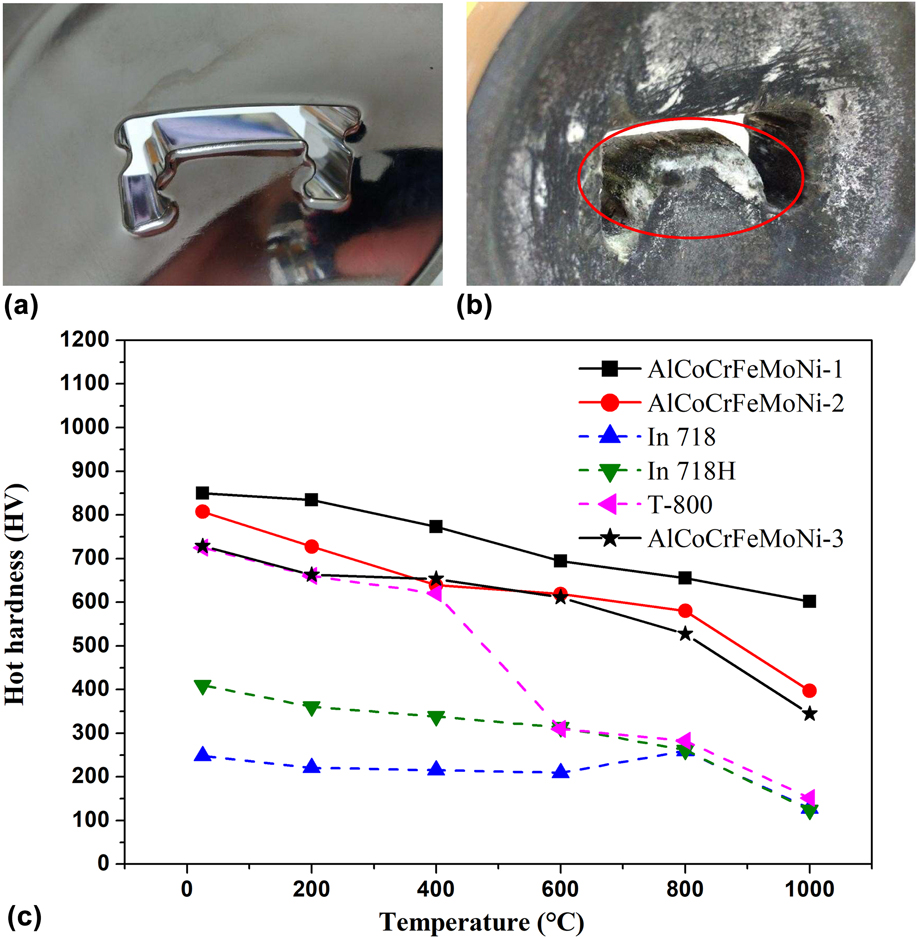
One important application is HEA hot working dies which can sustain the extrusion temperature of 1200 °C. For Al alloy extrusion, the maximum extrusion temperature is 500 °C. But, for steels, the typical extrusion temperature is around 1200 °C. Figures 4(a) and 4(b) show the SKD61 die (made in Japan, machined and heat-treated in Taiwan) before extrusion and the die after extrusion for low carbon steel, respectively. It can be seen that the die hole was worn out only after one extrusion although the die is initially at room temperature. This is reasonable since the SKD 61 steel could remain its hardness up to 550 °C but become significantly soft at temperatures above 600 °C. This means, SKD 61 steel dies could satisfy the extrusion of Al alloys but far from the requirement for steel extrusion. Thus, the success of HEAs for this usage would let the extrusion of steels become more popular to produce various cross sections for numerous structural and architectural shapes. Figure 4(c) shows the curves of hot hardness versus temperature for six alloys including three HEAs and commercial alloys IN718, IN718H, and T-800. It can be seen that three HEA candidates could remain their hardness over HV 400 at 1000 °C. This shows the potential applications of HEAs for such dies for high-temperature extrusion of steels.
SKD61 die (a) before extrusion and (b) after extrusion for low carbon steel at 1200 °C. Areas indicated by red lines are those received very large stress; (c) curves of hot hardness versus temperature for six alloys including three HEAs and commercial alloys IN718, IN718H, and T-800.

D. Sintered carbides for cutting tools
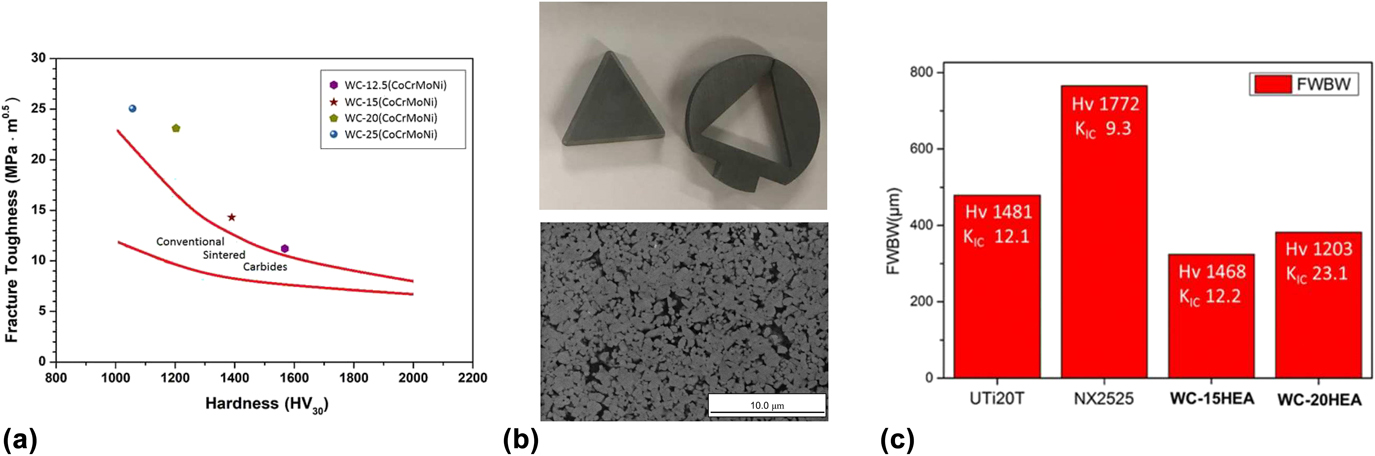
High-entropy carbides have the important application for cutting tools. Cutting tools used in machining demand less flank wear and longer lifetime for dry cutting and high-speed cutting. The combination of higher hardness and fracture toughness, K IC, often has better cutting performance. The two curves shown in Fig. 5(a) are the typical boundaries of the distribution region of (K IC, HV) data of conventional sintered carbides which use Co as the main bonding agent. The four data points indicated in the figure are those carbides sintered and bonded with different amounts of HEAs. They locate at above the conventional scattering band and show their potential in cutting tools. Figure 5(b) shows the pictures of the throw-away insert and its microstructure obtained from the sintered carbide bonded with 15% HEA. Figure 5(c) compares the flank wears between two commercial inserts and two inserts bonded with 15 and 20% HEAs after dry-cutting 304 stainless steel for a distance 314 m at the cutting speed of 94 m/s, the depth of cut 0.2 mm, and the feed rate of 0.3 mm/rev. Their flank wear was observed with SEM and measured for comparison. It is apparent that high-entropy inserts have much lower flank wear. This indicates that suitable high-entropy composition could improve the lifetime of a cutting tool.
(a) Typical scatter band of fracture toughness versus hardness for conventional sintered carbides; (b) pictures of sintered carbide bonded with 15 wt% HEA and its microstructure; and (c) comparison of flank wear band width between two commercial inserts and two inserts bonded with two different amounts of HEA.

E. Hard coatings for cutting tools
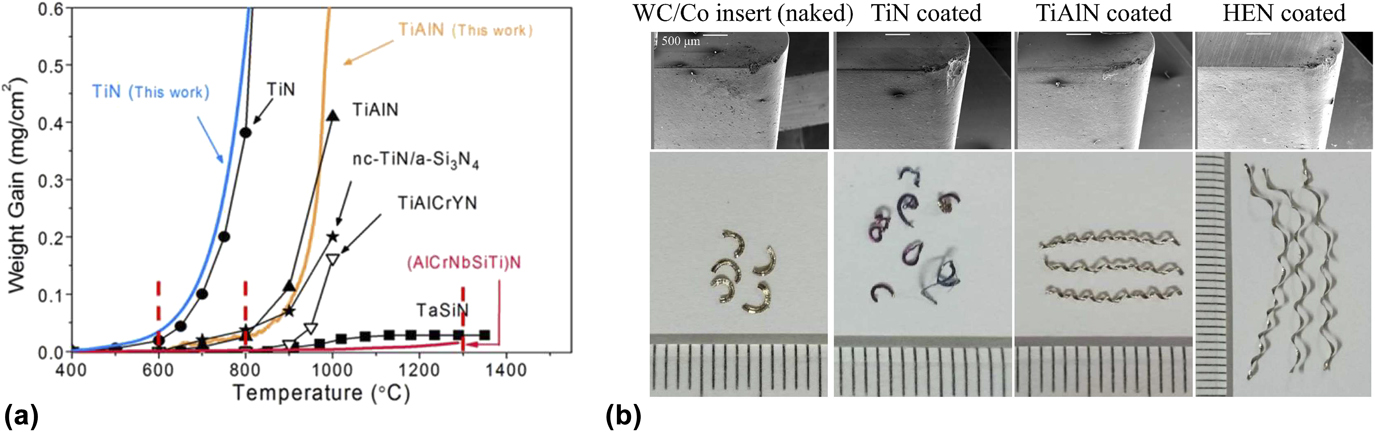
Cutting tools’ life could also be improved by hard nitride coatings. High-entropy nitride (HEN) coating could have very good performance. As oxidation of coatings will yield loose and softer oxide layer which are easily removed by the friction between chips and rake face and also between flank face and machined surface of workpiece, it is important to improve the oxidation resistance of a hard coating in addition to increase its hardness and toughness. Higher oxidation resistance will enhance the cutting performance. We measured weight gains for TiN, TiAlN, and HEN (Al0.34Cr0.22Nb0.11Si0.11Ti0.22)50N50, which are shown as the three colored curves and compared with the reported data in Fig. 6(a).Reference Shen, Tsai, Tsai, Juan, Tsai, Yeh and Chang18 TiN and TiAlN curves match very well with the reported curves. It is apparent that TiN and TiAlN are severely oxidized at above 600 °C and 800 °C, respectively. But very small weight gain is detected in the curve of HEN coatings until 1300 °C at which weight gain is only 0.015 mg cm−2. Figure 6(b) compares the cutting performance of the naked insert, TiN-coated insert, TiAlN-coated insert, and HEN-coated insert. After dry-cutting the workpiece of 304 stainless steel (made in Japan, machined and heat-treated in Taiwan) for a distance of 361.5 m at high cutting speed 321.6 m/s, the depth of cut 0.1 mm, and the feed rate of 0.28 mm/rev, only the HEN-coated insert could produce long curled chips as can be seen in the figure. This indicates that the cutting edge of the HEN-coated insert is still very sharp which is strongly related to its superior oxidation resistance mentioned above.
(a) Weight gains of TiN, TiAlN, and HEN (AlCrNbSiTi)N as functions of temperature, shown as the three colored curves. Black curves are the reported data for comparison; (b) chips produced after cutting 304 stainless steel for 361.5 m by the naked insert, TiN-coated insert, TiAlN-coated insert, and HEN-coated insert, respectively. Reproduced with permission from Ref. Reference Shen, Tsai, Tsai, Juan, Tsai, Yeh and Chang18.

F. Hardfacing HEMs for wear resistant parts
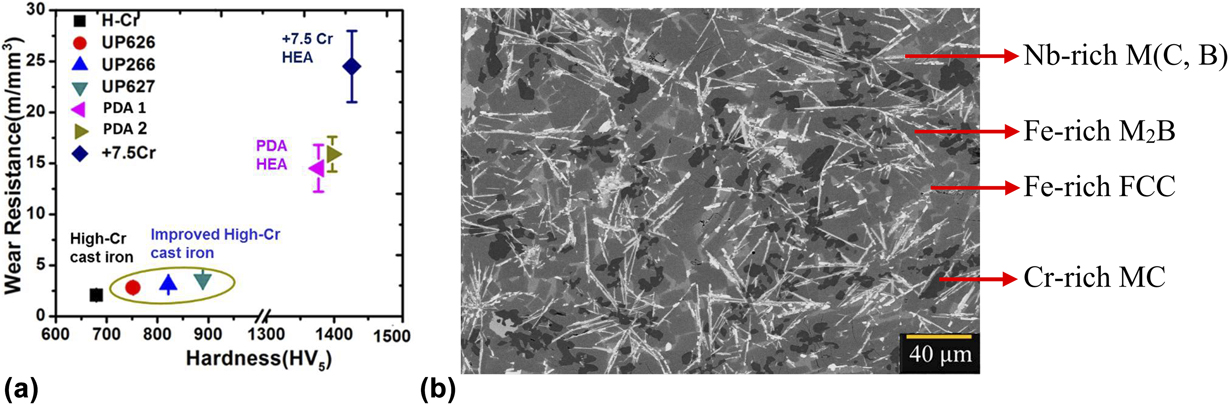
Hardfacing materials could extend the lifetime of wear resistant plates, rolls, excavator buckets, etc. In addition, the worn out hardfacing could be repaired for saving time and overall cost. Figure 7(a) shows the abrasion wear resistance versus hardness for various alloys. High-chromium cast iron is the typical wear resistant alloy for hardfacing. The three alloys circled are improved versions of high-chromium cast irons. However, we have developed boron-bearing hardfacing HEAs. PDA HEA, which is a HEA having a plenty amount of carbides and borides, could have wear resistance seven times that of high-chromium cast irons. In addition, +7.5Cr HEA, which is further modified with more addition of Cr, has twelve times resistance. It contains lots of hard borides and carbides as shown in Fig. 7(b).
(a) Comparison of wear resistance and hardness between various alloys: high-chromium cast iron, its three improved versions, PDA HEA, and +7.5Cr HEA; (b) SEM microstructure of the +7.5Cr HEA.

G. Structure parts for the 4th generation nuclear reactor
The 4th generation nuclear reactor emphasizes highly economic operation, enhanced safety, minimal waste, and proliferation. For example, the helium gas-cooled fast reactor is one candidate for 4th generation reactors. The operation temperature is about 850 °C. Commercial realization will be in 2030.Reference Abram and Ion19 However, no suitable materials have good high-temperature properties and well radiation-damage resistance yet.Reference Murty and Charit20 To ensure the safe operation of nuclear reactors and maintain a sustainable energy supply, new and advanced nuclear materials are highly demanded.
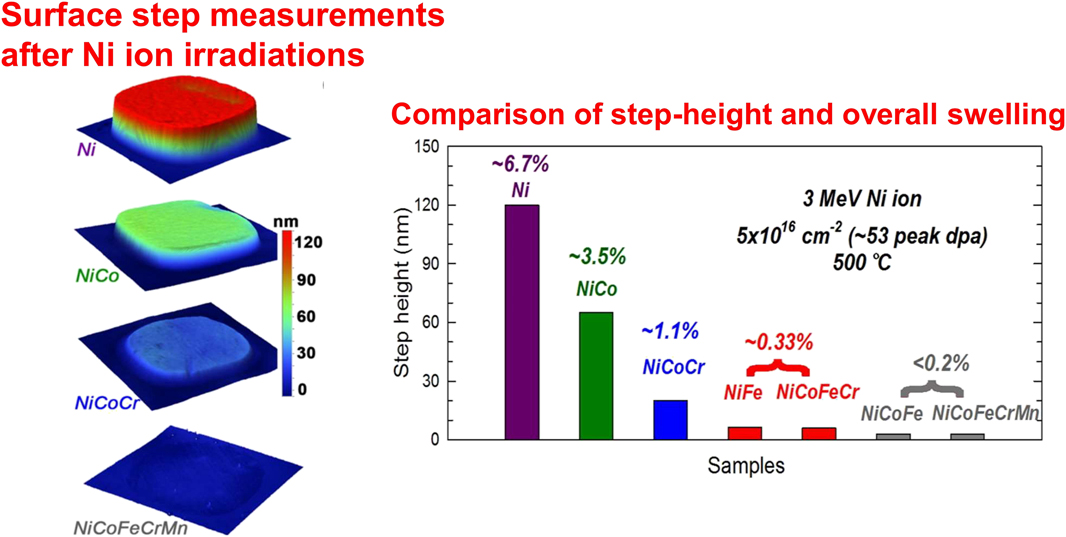
Oak Ridge National Laboratory has published a series of papers on radiation damage of Ni-containing concentrated solid solutions.Reference Zhang, Zhao, Weber, Nordlund, Granberg and Djurabekova21–Reference Kumar, Li, Leonard, Bei and Zinkle23 They found the interesting trend that radiation-damage resistance in general increases with the number of components in the Ni-containing FCC system, as shown in Fig. 8. Low defect formation, low surface step, and small swelling were found in high-entropy solid solution alloys after Ni-ion radiation.Reference Jin, Lu, Wang, Qu, Weber, Zhang and Bei22 In addition, Kumar et al. reported that the radiation-damage changes at elevated temperatures (400–700 °C) generally displayed less radiation degradation in the examined FCC Fe–28%Ni–27%Mn–18%Cr (in wt%) HEA compared to conventional austenitic Fe–Cr–Ni or Fe–Cr–Mn alloys.Reference Kumar, Li, Leonard, Bei and Zinkle23 Irradiation on HEA showed evidence of relatively sluggish solute diffusion with limited solute depletion or enrichment at grain boundaries. The main microstructural feature at all temperatures was high-density small dislocation loops. Voids were not observed at any irradiation condition. Therefore, all these results demonstrate that suitable HEAs might have excellent irradiation resistance. This is very important for further alloy design of components for advanced nuclear reactors. If high-temperature strength and toughness, high oxidation resistance, and low absorption cross section for neutrons are also achieved, such HEAs would have broader applications in the 4th generation nuclear power plants.
Surface step height and overall swelling after 3 MeV Ni-ion radiation. Reproduced with permission from Ref. Reference Jin, Lu, Wang, Qu, Weber, Zhang and Bei22.

H. Other possible breakthrough examples
Besides the above examples, there are other possible breakthrough examples requiring HEMs. They include the following:
(i) Eutectic HEA AlCoCrFeNi2.1 having excellent cast ability and corrosion resistance for ship propellers and that in the wrought state having ultrahigh strength equivalent to maraging steel for structural applications (for commercialization).Reference Lu, Dong, Guo, Jiang, Kang, Wang, Wen, Wang, Jie, Cao, Ruan and Li24,Reference Bhattacharjee, Wani, Sheikh, Clark, Okawa, Guo, Bhattacharjee and Tsuji25
(ii) TRIP-dual phase HEA Fe–Mn–Co–Cr having larger combination of strength and ductility for high-damage-tolerant structures (for commercialization).Reference Li, Pradeep, Deng, Raabe and Tasan26,Reference Li, Tasan, Pradeep and Raabe27
(iii) Low TCR (temperature coefficient of resistivity) HEA thin-film resistors for wide temperature range −40 to +120 °C (commercialized).Reference Lin, Lee, Wu and Lee28
(iv) Anti-stick HEN coatings for glass lens molding operating at the temperature up to 750 °C (for commercialization).
(v) Anti-stick HEN coating for injection molding, compression molding, and transfer molding of polymers (for commercialization).
(vi) Diffusion barriers with thermally stable amorphous HEAs or HEN films (for commercialization).
(vii) Low Co-content HEAs having properties equivalent to the stellite-6 Co alloy for electric pump bearings used in oil wells (for commercialization).
(viii) Nonsparking tools using Cu-rich MEAs in place of toxic and expensive Cu–Be alloys (for commercialization).
(ix) Worm gears made of Cu-rich MEAs for the precision fourth-axis work piece tables of the CNC machines (installed at least in 4000 sets of CNC machines).
(x) Superionic conductivity for the solid-state battery such as (MgCoNiCuZn)1−xLixO showing ionic conductivity at least two orders larger than glassy lithium-phosphorus oxynitride electrolyte (LiPON) and among the largest ever observed in oxides (to be further modified).Reference Bérardan, Franger, Meena and Dragoe29
(xi) Room temperature superconductors (to be explored).
III. CONCLUSIONS
By the end of 2017, there has accumulated 2092 journal papers about HEMs. Although the overall research studies only occupy a very small portion of HEMs yet, they have covered many aspects of important academic issues and application possibilities. In other words, they have provided a good database for selections of suitable materials or for further improvement in both composition and process towards target applications as exemplified in this article. From this understanding, HEMs are expected to be able to overcome many bottlenecks encountered by conventional materials and thus have many possible breakthrough applications. We might start the assessment to find suitable materials from the current database of HEMs for applications and try to carry them out with industrial collaborations. This effort towards commercialization will be beneficial for one to check the insufficiencies of the lab research and modify the research to fit the real requirements of an application. In future, more discoveries of outstanding phenomena and properties will be reported and more breakthrough applications will be developed as technologies and products for the higher standard of living in our sustainable society.
ACKNOWLEDGMENT
This work was financially supported by the “High Entropy Materials Center” from the Featured Areas Research Center Program within the framework of the Higher Education Sprout Project by the Ministry of Education (MOE) and from the Project MOST 107-3017-F-007-003 by Ministry of Science and Technology (MOST) in Taiwan.