INTRODUCTION
Richard Neustadt made this observation when the prospect of electing a woman president was rarely imagined. Forty years later, the possibility of a female president of the United States is a topic of frequent discussion in the media and a burgeoning research area (Clift and Brazaitis Reference Clift and Brazaitis2003; Cox-Han and Heldman Reference Cox-Han and Heldman2007; Duerst-Lahti Reference Duerst-Lahti, Carroll and Fox2006; Lawless Reference Lawless2004; Watson and Gordon Reference Watson and Gordon2003). Though at the time of this writing the outcome of the 2008 Democratic nomination is still in doubt, it is clear that Hillary Clinton has already come closer in her pursuit of the White House than any other American woman candidate.Footnote 1 As a result, the question “Will America elect a female president?” is everywhere and answers are largely mixed.Footnote 2 While a female president of the United States remains hypothetical, women are shattering the executive glass ceiling in places as diverse as Liberia (Ellen Johnson-Sirleaf), Germany (Angela Merkel), and Chile (Michelle Bachelet). Their examples facilitate further speculation by political observers about a woman's chances in the United States, leading many to ask: “If there, why not here?” Such events cause one to ponder the circumstances under which women become presidents and prime ministers around the world.
Women's rise to power in such varied contexts poses a two-part puzzle: How do they enter executive office where women are generally afforded few political, social, and economic opportunities? Why have women in countries where their status is generally higher not broken through these barriers? To answer these intriguing questions, a comparative gender analysis assessing the general obstacles to women's executive representation is necessary. A major argument of this article is that gender affects access to executive office in all countries, as politics is reinforced as a masculine domain with men depicted as the norm or “natural” leaders. This phenomenon is not relegated to the developing world, but also is prevalent where women are generally afforded a higher status. Perhaps a more appropriate question, then, is not why women have broken the executive glass ceiling in developing countries but, rather, why they have they done so anywhere.
Using both qualitative and quantitative techniques, this article compares nearly all cases of women executives, defined as presidents and prime ministers, from 1960 through 2007. Potential explanations for women's ascent to executive leadership in various contexts are explored. I focus on the ways in which women acquire their positions, the type of executive authority exercised, and the impact of various institutional and structural factors on their acquisition of power and their leadership, drawing links to male executives in similar contexts throughout. Using logistical regression, I analyze executive representation between 1996 and 2006 in 132 countries. Seldom the subject of comparative research today, information on women in executive positions is invaluable. However, understanding the positions and authority that both women and men wield takes this research a crucial step further to a comparative gender analysis.
I find that women are more likely to hold executive posts when they share power with men and are relatively constrained. Women also gain control in politically unstable contexts and in countries lacking political institutionalization, frequently as members of privileged groups. This explains how some women rise to executive office where the overall status of women appears low, demonstrating that women are never wholly advantaged or disadvantaged in power relationships. Though women executives hail from elite backgrounds, particularly in terms of class and education, this does not necessarily comport with women's general status within a country. Overall, political institutions and structures are most critical for understanding women's executive advancement.
Women's executive representation is seldom the subject of academic research. This article helps fill a significant research gap on women leaders, shedding light on institutions and structures related to their rise to national posts. Most studies of women executives concentrate on their behavior once in office and are generally case studies (Everett Reference Everett and Genovese1993; Genovese and Thompson Reference Genovese, Thompson and Genovese1993; Saint-Germain Reference Saint-Germain and Genovese1993; Thompson Reference Thompson and Genovese1993; Weir Reference Weir and Genovese1993) or collections of biographies (Liswood Reference Liswood1995; Opfell Reference Opfell1993), though larger area studies exist (Hodson Reference Hodson, Borelli and Martin1997; Richter Reference Richter1991). In contrast, this article investigates nearly all women executives, hailing from a variety of geographical areas, levels of development, and cultures, thoroughly examining paths to leadership, positions, powers, and the importance of institutional forms and rules (see also Jalalzai Reference Jalalzai2004).
The current lack of comparative analysis limits the formation of general conclusions about women national leaders, especially in developing and non-Western countries. With the concentration on paths to power instead of behavior in office, the conditions fostering women's executive representation are clearer, particularly institutional and systemic factors. Understanding circumstances that foster executive representation can aid women's advancement. Lastly, existing work on this subject is heavily qualitative. Though still relatively rare, the ever-increasing number of women executives now makes this research area suitable for quantitative analysis. Combining qualitative and quantitative techniques, this study makes a new and valuable contribution to the sparse literature on women executives.
At the same time, comparing women executives poses a number of challenges, including potential charges of essentialism, that is, the “assumption that members of certain groups have an essential identity that all members of that group share and of which no others can partake”(Mansbridge Reference Mansbridge1999, 637). A related issue is reconciling “women and politics” and “gender and politics” research. While concentrating primarily on women, I do not assume that women are a monolithic group, possessing uniform identities and beliefs. The various hypotheses under consideration demonstrate the many differences among leaders. However, women remain political minorities and have not yet received adequate attention in scholarship. Executive leadership research has principally studied men (Blondel Reference Blondel1987; Neustadt Reference Neustadt1990). The focus on men as the primary reference group generally lacks explicit gender analysis, but has reinforced the ideal of men as leaders. Incorporating women provides an opportunity to challenge these conventions. This article thus recognizes the need to study women heads of state or government given deficiencies in knowledge but also the importance of placing findings in a gendered perspective.
Gender is defined as “the socially constructed meaning given to biological sex, especially sex differences. Gender is how we come to understand and often magnify the minor differences that exist between biological males and females” (Duerst-Lahti and Kelly Reference Duerst-Lahti and Kelly1996, 13). As a category, gender is a “multidimensional mapping of socially constructed, fluid, politically relevant identities, values, conventions, and practices conceived as masculine and/or feminine” (Beckwith Reference Beckwith2005, 131). As a process, gender encompasses “behaviors, conventions, practices and dynamics engaged in by people, individuals, institutions and nations” (2005, 132). Both components are important to this study and provide a mechanism for analyzing women executives.
HYPOTHESES AND VARIABLES
The main hypothesis of this study is that women are more likely to be executives when their powers are relatively few and generally constrained. The political systems in which they lead generally feature fragmented executive power arrangements: a mix of parliamentary and presidential structures or a pure parliamentary system. While power configurations in which women share duties with other political actors, presumably men, are more common, women presidents in presidential systems are rare. Women also routinely enter office during political transitions and contexts featuring instability, low levels of political institutionalization, and high degrees of patronage.
Institutional factors are of central importance for understanding women executives. Institutional explanations are common in the women's legislative representation literature and illustrate that some arrangements are more beneficial to women than others (Darcy, Welch and Clark Reference Darcy, Welch and Clark1987; Duverger Reference Duverger1955; Kenworthy and Malami 1999; Lovenduski and Norris Reference Lovenduski and Norris1993; Matland Reference Matland1998a; Reynolds Reference Reynolds1999; Siaroff Reference Siaroff2000). Comparative studies on gender representation in cabinets reinforce the importance of political institutions (Davis Reference Davis1997; Reynolds Reference Reynolds1999; Siaroff Reference Siaroff2000).Footnote 3 Thus, rules and procedures for presidential and prime ministerial selection are essential to understand.
Arguably, the most masculine position is executive office. According to Georgia Duerst-Lahti:
Executive power is characterized by unity of command, hierarchical arrangements, and – with centralized control – a capacity to act quickly and decisively when circumstances dictate. These factors create circumstances in which women are understood as “other” in contrast to a masculine norm, and they do so in a way that is predictable inside gender ideology. (1997, 18)
Accordingly, women will be less represented in powerful executive posts and more in functional areas associated with women (Borrelli Reference Borrelli2002; Duerst-Lahti Reference Duerst-Lahti, Borelli and Martin1997, 19). Executive office is often considered synonymous with masculinity, particularly as one moves up the hierarchy. With the chief executive at the apex, it is seen as most resistant to women's leadership.
Women have made relatively more inroads within legislatures, which may be related to the fact that their power structures are more fragmented and evenly distributed. Moreover, because of the deliberative nature of legislatures, decision-making processes are slower. Women are less hampered by perceptions of their abilities to collaborate and deliberate than their capacities to lead quickly, decisively, and independently (Duerst-Lahti Reference Duerst-Lahti, Borelli and Martin1997). Executive positions vary, depending on political systems. Generally, presidents are associated with presidential systems and prime ministers with parliamentary systems. Two basic differences are their relative independence and modes of entrance. Prime ministers are selected by parties, share power with other elites, and are responsible to the legislature, whereas presidents are elected nationally and are independent of the legislative branch (Kesselman, Krieger, and Joseph Reference Kesselman, Krieger and Joseph2004). Popular elections and less party control over candidate selection and the executive once in office may present particular obstacles to women. Presidential terms in office are fixed, although presidents may be impeached in cases of serious offense. A woman prime minister sharing power with a party, one who is responsible to the parliament and has the possibility of being removed, is often seen as more tolerable than a woman president exercising independent power without the possibility of recall until the next election. Prime ministers, like legislators, need to negotiate, collaborate, and deliberate with cabinet and party members. I therefore expect women to occupy the office of prime minister more often than that of president.
These positions vary tremendously worldwide, however. Some systems are semi-presidential: The president and prime minister share in the administration of the state, and the cabinet, while appointed by the president, is answerable to the legislature. Alan Siaroff (Reference Siaroff2003) considers semipresidentialism a flawed concept because of the extreme diversity in powers. Comparing political arrangements, he assesses executive selection, responsibility to the legislature, and specific powers, proposing three mixed systems featuring dual executives.Footnote 4 Due to the lower concentration of powers, I expect that women will lead more often in mixed systems. Additionally, because two positions are available, the odds of women assuming executive office increase. As power imbalances are the norm in dual systems, women's representation will be more common in weaker positions.
Using Siaroff's (2003) coding as a template, I categorize presidential and parliamentary systems as follows: 1) Unified Presidential, where there is a president elected in some fashion, not answerable to a legislature; 2) Unified Parliamentary, where there is a prime minister, appointed in some fashion, answerable to a legislature; 3) Parliamentary-Presidential dominance, where power is distributed between a prime minister and a dominant president; 4) Parliamentary-Presidential corrective, where the president is not dominant but possesses considerable powers, while the prime minister is more influential; and 5) Parliamentary, with weak or figurehead presidents, where presidents have no or very limited powers but a decidedly dominant prime minister.Footnote 5 Power is strongest for presidents in presidential systems and weakest for figurehead presidents in parliamentary systems. Women will also be more represented as prime ministers in unified systems because they are appointed, share power with the cabinet, are responsible to the legislature, and lack fixed terms. Finally, women will be least represented as presidents in unified systems.
I further devise five positions based on autonomy and executive powers: 1) president with full executive powers; 2) president sharing executive powers with a prime minister he or she appoints; 3) prime minister only removable by the legislature; 4) prime minister removable by a president; and 5) president with minimal powers.Footnote 6 Overall, I expect women to have little independence, possess few powers, and rarely be elected as strong presidents.
I also anticipate that several women presidents may bypass popular election as interim leaders and through succession. As temporary replacements, women's representation may not be as threatening because they are seemingly ephemeral. Though generally confined in their ability to reach national leadership positions, a large portion of women executives may only serve temporarily, often during political transitions. Along with interim leaders and political successors, others will likely come to power during political transition. I assess whether a political change was in process when women first entered office, such as a transition to independence or democratic governance, governmental seizure, or the opening of political opportunity due to the sudden removal, resignation, or death of an executive. Related to this, political instability may coincide with increased opportunities for women. Turnover does not exclusively benefit women, but is an outcome of the greater number of openings.
Upon embarking on political sovereignty, various ethnic and religious factions suppressed during colonialism become salient. Frequent regime change transpires and is attributable to assassinations and repeated coups, resulting in low levels of political institutionalization. I therefore analyze whether a country has a history of power disruptions and military coups to determine if women are more prone to lead in unstable contexts and more vulnerable to military takeovers than men.Footnote 7 Using Polity IV data, I assess institutionalization of executive selection and political participation procedures.Footnote 8 Less regulation of both allows for factors like kinship, ethnicity, or charismatic leadership to play a greater role in politics, occasionally promoting women to power.
Instability and low levels of institutionalization also increase the relevance of other factors, such as group affiliation for political success, particularly where patronage reigns. As Richard Matland points out:
In a patronage based system, there are far less likely to be clear rules and even when they exist there is a distinct possibility that they are not carefully followed. Authority is based on either traditional or charismatic leadership, rather than legal-rational authority. Loyalty to those in the party is paramount (1998b, 70).
Women may rise to power through dominant group affiliation, possessing familial ties to politics, defined as blood or marital connections to a former executive, opposition leader, or member of the military. While ties also benefit men, this may be the only way women assume power in some countries.
Understanding the gendered ideologies at play is also important. Due to prevailing gender norms, women are more appropriate “heirs” than male relatives since they are deemed natural representatives of men, uncontaminated by their own political ambitions. They may be expected to lead temporarily or be controlled behind the scenes, yielding power to men. As political outsiders, women are typically portrayed as untainted by corruption and less likely to abuse power. Finally, particularly in war-torn contexts, the belief in the female nurturer and family unifier may politically benefit some women. Therefore, women are likely to enter positions on a temporary basis, through succession, during times of transition and in contexts lacking institutionalization, sometimes as members of preferred groups.
While these hypotheses form the crux of the argument, it is essential to examine the relationship between women's general status in the population and their executive representation. Political participation requires educational and economic resources (Inglehart and Norris Reference Inglehart and Norris2003). Women comprise two-thirds of the world's illiterate population (Staudt Reference Staudt1998). Economic and physical well-being are also crucial. The Gender Related Development Index (GDI) calculated by the United Nations Development Programme assesses women's parity to men in education, health, and income. Coded on a scale of 0 to 1, 1 indicates complete equality.Footnote 9 The conventional expectation is that as women achieve parity with men, executive representation is more likely, as is the case for women in legislatures (Reynolds Reference Reynolds1999). Representation of women in other offices may also correspond with women executives. Higher percentages of legislators or cabinet ministers indicate a larger pipeline of qualified women who can successfully compete for political office, be tapped for temporary appointments, or succeed men if an opening presents itself (Davis Reference Davis1997; Reynolds Reference Reynolds1999; Siaroff Reference Siaroff2000). Greater numbers of women also reflect the general openness of a political system to women's participation.
On a related note, some argue that the longer women have basic political rights, the greater their subsequent representation in political office (Reynolds Reference Reynolds1999; Siaroff Reference Siaroff2000). Historical admission corresponds to future political representation, signifying a cumulative effect. However, the processes of extending rights to groups diverge throughout the world. Obtaining suffrage had involved prolonged and intense struggles in the West. In these cases, enfranchisement has been incremental, first providing some men suffrage, followed by all men, and women only afterward (Caraway Reference Caraway2004, 454).Footnote 10 In contrast, in Africa and Asia, suffrage was granted to women and men simultaneously, coinciding with the dismantlement of colonial governments. Women in these areas may have benefited from this pattern.
Although these factors need consideration, as mentioned, women executives hail from a number of contexts, some where women have made great strides professionally, economically, educationally, and politically, and many others where women's status in general sharply lags behind men. I thus expect to have mixed findings in this regard.
FINDINGS
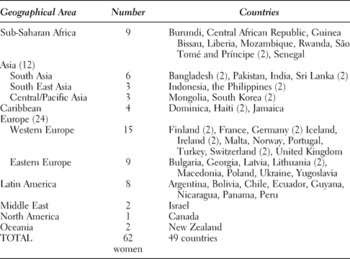
To explore these hypotheses, I analyze women prime ministers and presidents in office from 1960 (the year the first female executive, Sirimavo Bandaranaike of Sri Lanka, came to power) through June 2007 (See Table 1).Footnote 11 Sixty-two women have served as national leaders.Footnote 12 They hail from 49 countries, 13 of which witnessed the executive glass ceiling shattered by two different women.Footnote 13 Few women around the world made inroads into executive positions until the 1990s. In fact, those breaking through from 1990 onward represent the vast majority of the sample (74%). Between 2000 and June 2007, 21 new women came to power. Clearly, women's success in obtaining national leadership has improved. The total sample indeed includes several temporary appointments: seven presidents and six prime ministers.Footnote 14
Women Executives 1960–2007

Women Executives (1960–2007)
As projected, women lead in geographically diverse locations. While some are from Europe, many are from places where women generally have limited opportunities and rights. Asia, Africa, and Latin America follow Europe with the most women executives. The Middle East has witnessed only two women leaders, both from Israel, one of whom served only on a temporary basis. Overall, more women are prime ministers than presidents (37 and 25, respectively) which can be anticipated given that prime ministers generally have less autonomy and security from dismissal, and are appointed to positions rather than popularly elected. Predictably, most women national leaders (40% and 65%, respectively) are from dual executive systems, and thus share power with another executive, confirming that powers are less concentrated when women hold positions as head of state or government.
I now present findings regarding women executives’ paths to power and their powers. I also compare lengths of tenures of women, as well as circumstances leading to the end of their terms to the men they succeeded. After this, I analyze several other variables in relation to women's rise to power, focusing within and across geographical areas. I limit analysis to the 49 nonacting leaders, 31 prime ministers, and 18 presidents.Footnote 15
Presidents
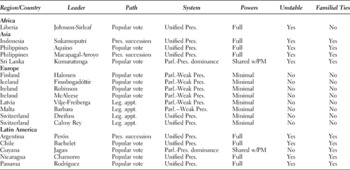
Organized by region, Table 2A presents women presidents, initial paths to power, executive arrangements, and other variables detailed earlier.Footnote 16 Obstacles to women's advancement to presidential office are clearer. Only 11 (61%) initially came to power through popular election. Several bypassed the public: Three were vice presidents who succeeded male presidents when the position suddenly opened up, and four were selected by legislatures. Ten operated within unified systems, which typically corresponds to possessing strong executive powers. This indeed was the case for eight women. However, because both presidents of the Swiss Confederation only have the power of chairing cabinet meetings, I consider them presidents with minimal powers. Only five presidents with full powers were initially elected by the public. Eight others shared authority with a prime minister, six possessing minimal powers.Footnote 17 Finally, two dominant presidents split power with a much weaker prime minister.
Presidents

Note: The president of Guyana is elected by popular vote, but candidates are the leaders of party list in parliamentary elections.
It is also instructive to analyze tenures in office. Iceland's Vigdís Finnbogadóttir (Iceland) remained in office for 16 years and the length of her tenure remains unsurpassed. Countries may place limits on presidential reelection, such as maximum years, terms, or consecutive terms, making it difficult to compare tenures across countries. Presidential term stipulations vary from one year in Switzerland (though subsequent nonconsecutive terms are permitted) to seven years in Ireland (limited to one reelection). Longer tenures are possible in countries where terms are shorter but void of reelection restrictions. Term limits are the norm for presidents in this sample and exist for all but Finnbogadóttir, explaining her long run. However, she was essentially a figurehead. Finally, although several Latin American countries do not restrict total reelections, consecutive terms are often prohibited, in effect limiting the number of years ultimately served. In order to determine whether women presidents are disadvantaged in their ability to stay in power, I compare them to the men who held the same position in the country prior to their tenure. Generally, women serve as long as, and in 10 cases longer than, their male predecessors.Footnote 18
Understanding why presidents leave office is also helpful in determining their degree of independence. Among women, only Isabel Perón was forcibly removed from office, although Corazón Aquino and Gloria Macapagal-Arroyo faced several coup attempts. In contrast, two male predecessors were impeached or removed from power, allowing for the women's ascension. While some have been investigated for corruption or abuses of power, this has not yet led to a woman president's removal from power. Like men, several women did not seek reelection because of term limits or various personal reasons. Thus, as presidents, women's tenures in office appear secure in practice, though various term restrictions prevent many from holding power for lengthy periods of time.
Although women do not appear more vulnerable to ouster, dominant women presidents number only 10 to date. Moreover, powerful women presidents elected by the public are even rarer: only seven thus far. Overall, women continue to lag behind men in obtaining powerful presidential office and, in particular, being elected to these posts, confirming expectations. Furthermore, the sheer dearth of women reinforces the masculinity of the presidency.
Prime Ministers
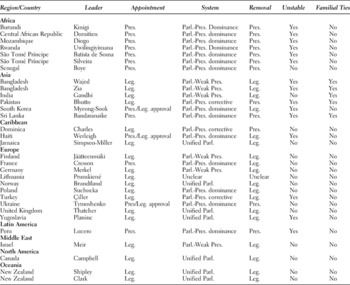
Among the 31 prime ministers, 23 share authority with a president, once again affirming that women wield fragmented executive power (see Table 2B). In countries featuring dual executives, presidents may possess broad appointment powers, including prime ministerial selection. Eleven women prime ministers were appointed by presidents, eight of whom were able to bypass parliamentary approval.Footnote 19 In these cases, prime ministers are often highly dependent on presidents and can be particularly vulnerable if subject to unilateral presidential dismissal. Of the remaining prime ministers sharing powers, 12 were appointed by the legislature. The powers of prime ministers in mixed systems are often much weaker than those of presidents. In fact, 13 women prime ministers were in presidential dominant systems.Footnote 20 As prime ministers, their influence was very limited. Three were from systems with a presidential corrective. Though stronger, two of the three female prime ministers are in systems where they can be dismissed by the president, which is a major vulnerability. Six women prime ministers are clearly positioned as the dominant executive in systems featuring weak presidents. The remaining prime minister from a dual executive system (Kazimira Prunskiené) led during a transitional period, and the nature of the executive arrangement remains unclear. Finally, eight female prime ministers are found in unified executive systems, and are appointed through parliamentary procedures.
Prime ministers

One of the major arguments proposed is that women are more likely to become prime ministers, who enjoy less security than presidents. Do women prime ministers have shorter overall tenures than presidents? Sirimavo Bandaranaike was in office for 17 years, slightly surpassing President Finnbogadóttir's presidential record. An additional six prime ministers have served 10 years or more as prime ministers, though removable at any time and not constrained by term limits. Their ability to stay in power, however, is heavily influenced by executive arrangements, which vary considerably in dual executive systems. For example, 11 prime ministers are removable by the president, which is how six women ultimately left office.Footnote 21 Generally, women with longer tenures are protected from presidential removal.Footnote 22 Though many women presidents stay in office for lengthy periods of time, nine (29%) were in power less than one year, including several who were subject to parliamentary discharge. In contrast, no women presidents have remained in office for such a short period.
To determine whether women have shorter periods in office than men in the same countries, I compare 25 women's tenures as prime ministers to the tenures of the men they succeeded.Footnote 23 Overall, there appears to be no apparent advantage for either sex. In fact, 10 women prime ministers served longer than their male predecessors.Footnote 24 Few differences surfaced in how each left office. Like women, many men left after electoral or party defeats, or simply retired. A few men and women were involved in scandals during their tenures, which hastened their resignations. Finally, some died of natural causes or were assassinated while in office. It may be most instructive to compare men and women in systems where presidents have the authority to remove prime ministers. Are women more likely to be dismissed by presidents than the men they succeed? This does not appear so. Several male predecessors were dismissed by presidents, indicating that men are also constrained in power relationships as prime ministers working with stronger presidents. However, the fact that these presidents are almost exclusively men signifies gendered authority patterns.
Overall, the vast majority of women (63%) share power with other executives. Among mixed systems, most women assume office where presidents prevail, and as anticipated, seldom hold the upper hand in these power arrangements. Several also occupy office in systems with weak presidents but hold the stronger position of prime minister in half the cases. A substantial number are also prime ministers in unified parliamentary systems. Few women exercise full executive powers as presidents. Finally, women holding considerable power are rarely popularly elected as presidents, once again, confirming expectations.
Political transition and instability have coincided with women's ascension to executive office all over the world.Footnote 25 Ten entered during political transitions, several while shifts to democratic governance were in process in places as diverse as Bangladesh, the Philippines, and Lithuania.Footnote 26 At least 23 came to power in contexts with histories of instability, 21 where military takeovers had occurred. Histories of political instability and military takeover is common in nearly all African, Latin American, and Asian countries in which women have risen to executive power. One effect of the instability is that women occasionally enter executive office while, for the most part, men are the main leaders.
As expected, women's status in society and politics varies considerably throughout the world. Several hail from countries where women's status is low.Footnote 27 The Gender Related Development Index is lowest in Africa (typically under .3) and Asia (between .3 and .4 in South Asia, and .6 in Southeast Asia), and highest in Western Europe (generally over .9). Women's legislative representation at the time women first entered office varies considerably, ranging from 0% (Central African Republic) to 37% (Finland).Footnote 28 Generally, women's legislative representation is higher in Western Europe and New Zealand than in other parts of the world in cases where women have entered executive office. However, many executives entered office where women's legislative representation was low. This was also the case for women in ministerial positions. Women received voting rights at different points throughout history, earliest in New Zealand (1893) and most recently in Central African Republic (1986). Women's suffrage generally overlapped with the dismantlement of colonial governments in Africa and Asia and where suffrage was provided to both men and women simultaneously. This may have aided women's executive representation.
African countries in this sample often have unregulated executive selection processes and histories of forceful seizures of power. Political participation is largely organized around specific leaders. While women are occasionally promoted to posts, the limits on their power in Africa is apparent. This region established strong presidential traditions resulting in gendered consequences. With two exceptions, all women executives have been prime ministers.Footnote 29 These positions are very limited in decision-making capacities and have little autonomy. Not only do most prime ministers receive appointments directly from presidents, but they are nearly all susceptible to unilateral presidential removal, which has been exercised frequently. Thus, women in Africa are extremely limited in their political influence. Only Liberia has a woman exercising full executive authority. As the sole popularly elected woman executive of any African country, Ellen Johnson-Sirleaf signifies an important departure. She also holds the distinction of being the only popularly elected female president with significant powers who lacks political familial ties. In fact, no African woman executive has had familial ties to political power, though several rely on close connections to male leaders for appointments, including Elisabeth Domitien (Central African Republic).
Although processes for selecting executives in Asia and Latin America are more regulated than in Africa, these areas still have problems forming stable groups competing for power beyond regional, kinship, or ethnic interests. While African women generally lack strong executive authority, several women in Asia and Latin America have held positions of significant power, many as presidents in unified systems. However, women's leadership is generally limited to those with familial ties. In fact, no woman holding dominant executive power in Latin America or Asia has ever come to power absent these connections. Moreover, popular election is limited to women from political families. Do men in these same contexts also benefit from family associations, or is this unique to women? Male executives also have had familial ties to power in many countries, including Argentina, Panama, India, South Korea, and Sri Lanka. However, while men occasionally have familial connections to power, nearly all women in Latin America and Asia do, often as members of influential political dynasties. Representing 13 cases overall, this dynamic suggests that women's paths to power are heavily dependent on kinship connections. The high levels of political instability and lack of political institutionalization have benefited select women in their rise to power.
In contrast to the examples previously outlined, women in most European countries have achieved near parity with men. Several became prime ministers by working their way up the ranks. However, they are not insulated from political turnover and their powers do not rival presidents in unified systems. Also, though four were elected president, they possess relatively fewer powers than the prime minister. Finally, there appears to be a divergent pattern among women in Eastern Europe. Whereas several women have entered executive posts in this region, most have been temporary leaders, likely due to recent transitions to democracy. A lower degree of institutionalization in executive selection and participation is also apparent. While this provides women with opportunities to lead, most of these countries have instituted dual executive structures that place dominant powers in the hands of male presidents. Overall, the findings confirm the importance of several factors in women's ascension to executive office, but also demonstrate the large degree of diversity among regions.
Logistical Regression Model
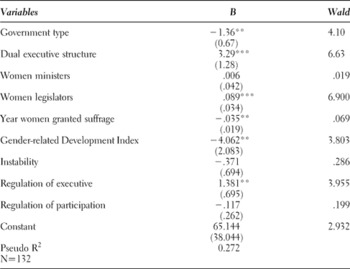
Keeping in mind what has been borne out in the analysis thus far, I conclude by running a statistical model related to women's executive representation (Table 3). A more rigorously quantitative analysis provides a variety of benefits, such as an opportunity to analyze countries where women have not led. Though much important data related to women's executive representation have been discussed thus far, statistical significance of variables has yet to be assessed.
Logistical Regression Model

Note: Standard errors are in parentheses. *** p < .01 ** p < .05.
The unit of analysis in this statistical model is no longer the woman executive; rather, it is the country, and 132 countries are analyzed. Countries are excluded for one or more of the following reasons: They are not politically independent, they do not hold elections for executive office (whether direct or indirect), or data are unavailable and cannot be easily estimated. The time frame examined is 1996 through 2006. Focusing on only one year severely undercuts the diversity of countries where women have come to power. However, extending farther back makes it is difficult to control for a number of changes that have occurred within countries over time. There is also much more data available for later periods, particularly for non-Western countries.
Although coding was detailed earlier, not all variables are included in the regression model and some changes have been made to coding schemes, warranting a brief description. The dependent variable is the sex of the executive, coded 1 if the country has a woman president or prime minister in power during this time period and 0 otherwise. Acting or interim leaders are excluded because they tend to serve very short periods of time. Since the dependent variable is dichotomous, I use a logistical regression model. Independent variables include Government type, coded on a 3-point scale (1 = unified presidential; 2 = unified parliamentary; 3 = parliamentary-presidential dominance, parliamentary-presidential corrective, parliamentary-weak or figurehead presidents). I expect women to come to power most often in mixed systems, followed by unified parliamentary, and finally presidential. Dual Executive measures whether the country has a dual executive structure (1 = Dual, 0 = Unified). Women will benefit from dual executive arrangements.
Women's representation in the legislature is based on the percentage of women in the lower house in 1995. Women's representation in ministerial positions assesses the percentages of women in 1996, the first year comparative statistics are available. I use data from these earlier time periods since there is likely a lagged rather than immediate effect of women's representation in lower levels of office on executive positions. The year in which women were granted suffrage in a country is also included in order to assess whether longer histories of enfranchisement are related to women executives. I do not, however, include the year of independence since this is often identical to the year women were granted suffrage. The Gender Related Development Index from 1995 is utilized. As before, I expect mixed findings regarding women's social, economic, and political representation at lower levels and their executive representation.
Political Instability measures whether a country has undergone a major political transition between 1990 and 2003 (1= yes, 0 = no). This is based on Polity IV annual reports. Regulation of the executive assesses whether there are open, established, and constitutional modes of executive selection that are respected, and is coded 1 to 3. Regulation of participation measures the manner in which political groupings are arranged on a 5-point scale. For both scales, scores of 1 indicate lower levels of political institutionalization. I calculate the average regulation of the executive and regulation of participation score for each country from 1990 through 2003 (the last year data are available) to assess the long-term trend.Footnote 30 I expect countries that have undergone a major transition and with less-regulated executive selection and participation processes to have women executives.
Between 1996 and 2006, only 25 countries in the model have women executives.Footnote 31 The Pseudo R2 is .272, explaining approximately 30% of the variance. Overall, 84% of the cases are correctly predicted. Most of the variables reach statistical significance, except for instability, regulation of participation, and women in ministerial posts.
As expected, systems with dual executives are associated with women. This indicates that women are more likely to come to power when they share it with someone else. Women's legislative representation is also positively associated with their executive representation. Countries with longer histories of granting women political rights are more likely to have women in power. GDI is also significantly related to women's executive representation. However, instead of greater parity associated with women prime ministers and presidents, results show the opposite relationship: Lower parity is linked to women executives. While this may seem counterintuitive, it reinforces findings from the qualitative analysis. Simply put, women's higher social and economic status in the larger population does not correspond with their holding positions of national leadership.
Statistically significant variables running counter to expectations are government type and regulation of the executive. Women executives are associated more with presidential systems. Countries with institutionalized leadership-selection processes are more likely to have women executives. Variables failing to reach significance are the percentage of women in ministerial positions, regulation of participation, and political instability. It is unclear why some variables failed to perform as expected. Possible reasons are that it is very difficult to measure instability, political institutionalization, and systems of participation, as well as the nuances among governmental types. However, findings do verify the importance of institutional mechanisms like dual executive structures on women's representation. Moreover, a larger pool of women in legislative office and longer histories of suffrage are important for women who become national leaders.
CONCLUSION
Although strides have been made in women's attainment of positions of national leadership, executive office remains a male bastion. As expected, women are more likely to be executives when their powers are relatively few and generally constrained. The political systems in which they lead generally feature fragmented executive power arrangements including a dual executive. Women also enter office in politically unstable contexts and in countries lacking political institutionalization, frequently as members of privileged groups.
The main implication of this work is that women's status in the general population is a poor indication of women's success in securing executive office. I do not suggest that striving for economic and social equality is unimportant. Instead, gender equality is neither a sufficient nor a necessary condition for shattering the executive glass ceiling. Moreover, a country with a woman leader does not signify the end of gender discrimination. Only when women are equally represented in all facets of society and when elected officials support and promote issues that help combat inequality is this possible. Overall, gender politics research needs to better understand the gendered connections between executive positions in terms of authority, power, and independence. Not all positions are created equal. Mary Robinson as president of Ireland has different implications than does a madame president of the United States.
Do findings suggest anything about the possibility of an American woman president? While a full discussion of this topic is beyond the scope of this work, the greatest challenges appear to be institutional. The United States has a unified presidential system, relying on a form of popular vote. Presidential powers are strong and have grown over time. However, despite political stability and high degrees of institutionalization, politically prominent families continue to hold an important place in the American system. Though women have benefited from family connections for lower levels of office, the extension of familial ties to the presidency may result in a woman's most plausible chance for becoming president of the United States.