


1. INTRODUCTION
The onset of the phenomenon known as the second globalisation led financial specialists and investors to show increased interest in Latin American countries. However, from an academic point of view such increased interest has not generated greater retrospective studies of those countries’ capital markets, especially their stock exchanges. We know little about the birth and functioning of such exchanges in Latin America, except for the cases of Havana, Santiago de Chile and Rio de Janeiro, and only for very specific periods (Levy Reference Levy1977; Couyoumdian et al. Reference Couyoumdjian, Millar and Tocornal1992; Moreno Lázaro Reference Moreno Lázaro2013). Furthermore, the role played by the stock exchange in the recent development of other emerging economies has been extensively studied, whereas there have been few studies of this nature in the case of Latin America and such studies have not been widely read.
This article will centre on one particular stock exchange: that of Mexico City. The Mexican Stock Exchange is the most recent to be created in Latin American countries, finally emerging in 1895 (after Sao Paulo in 1850, Buenos Aires in 1854, La Habana in 1859 and Lima in 1863). As was the case with the banking system, institutional obstacles, along with the financial weakness of the federal government and poor development in the country delayed its creation (Maurer Reference Maurer1932; Coatsworth Reference Coatsworth1990, pp. 95-106, Reference Coatsworth1978; Haber Reference Haber1991, pp. 566-567, 1998, p. 157; Marichal Reference Marichal1993, p. 118; Del Ángel Reference Del Ángel2002). The Mexican Stock Exchange has also had a stormy history since then, especially during the Revolution years.
However, this study deals exclusively with the period when that political movement had ended. In fact, the period chosen for the study is that which runs from the aftermath of the 1929 crisis until the 1973 oil crisis. It was a growth period in an interventionist economy governed by the principles of corporatism, disdain for the free market and the need to proceed with import substitution to become an affluent society; hence, our interest from the financial point of view.
The article therefore studies the role played by the stock exchange in this exaggerated intricate economic network designed by the Institutional Revolutionary Party (PRI from its initials in Spanish) over those years in which the party enjoyed complete political hegemony and absolute control over Mexican society at all levels. The analysis from an institutional point of view can help us better understand the unique evolution of the Mexican economy over this period. In this sense, our purpose is to clarify the role that the PRI (a chameleonic and pragmatic party) attributed to it in the articulation of economic policy.
The working hypothesis used here is that the contribution of the Mexican Stock Exchange to the economic modernisation of the country during the period studied was minimal because public authorities imposed functions upon it that had nothing to do with the normal working of an exchange. It appears that the exchange fitted well into the prevailing corporatism due to the absolute control the government had over it through an institution called NAFINSA, thus adulterating its entire operation and mission. We intend to show here that the stock market, instead of being an instrument of corporate financing separate from the state, became a mere mechanism for the financial control of large companies by the PRI, another piece of the powerful patronage network woven by this party.
In addition, the hypothesis is based on the fact that the absence of a clear definition of property rights in financial matters (and even more so where the stock market is concerned) further weakened this institution, which was already in itself a mere instrument in the hands of the state. This article also deals with how banks and big businessmen adapted to this radical and exceptional change in the operating conditions of the capital market and in the financing of investment. The hypothesis here is that business owners willingly accepted this adulteration of the stock exchange due to the market entry barriers it created.
To summarise, in this study we examine the attitude of the authorities in Mexico to the stock market during the years of the so-called golden age of capitalism. It appears that the state completely eclipsed the exchange to enable it to control the market in order to meet its own financing needs and as a mechanism to generate political support among large corporations.
In the following pages, we will try to prove these assertions based on our own calculations as well as on previously unpublished ones. Indeed, the study hinges on the evolution of an index that has been especially prepared for it, having been properly contextualised for the political and economic changes experienced by the country.
2. THE CREATION OF A STOCK INDEX
The Mexican Stock Exchange has little statistical history. This lack of data is not an accident: opacity shielded it from greater state control (Haber Reference Haber2008, p. 14). It was not even the stock exchange itself that developed its first index (see Haber 2005, p. 159). Instead, the first index was created by the League of Nations in 1937, but only for industrial values and only from 1929 up to the year in question (League of Nations 1937, p. 249). A much more sophisticated index was constructed by the newspaper El Excelsior from 1956 onwards, inspired by the NASDAQ in New York, and which included the stocks of eleven industrial companies, something which was immediately taken as a reference by investors. Given the obvious public statistical service of this index, Nacional Financiera S.A. (NAFINSA), an institution that we examine below, quickly set up a rigorous retrospective index in 1960 that began in 1950 and included all types of equities (NAFINSA 1977, pp. 340-348). Meanwhile, the stock exchange did not yet provide its own calculations, leaving the powerful instrument of information to third parties (Caso Reference Caso1971, p. 7). Finally, in 1978, it solved the problem and since then, the management of the stock exchange has continuously drawn up an Index of Prices and Values (IPC from its initials in Spanish), including the thirty-five companies with the highest market liquidity.
The gaps are greater in fixed-income instruments, in securities issued both by the Treasury and by private companies. For example, there was absolute silence on bond prices from 1937 to 1978. In this case, the NAFINSA calculations are not very precise. Another issue was external debt, the market value of which ceased to be published in 1933, which may have been due either to the government’s wish to hide information on the country’s limited solvency from the general public or perhaps because it had been repudiated.
An additional problem limits the possibility of giving information series: the destruction of the archives and with it the loss of information, which is extremely difficult to rebuild from stock exchange yearbooks, publications, which appeared late on and lacked complete and systematic information on listed companies.
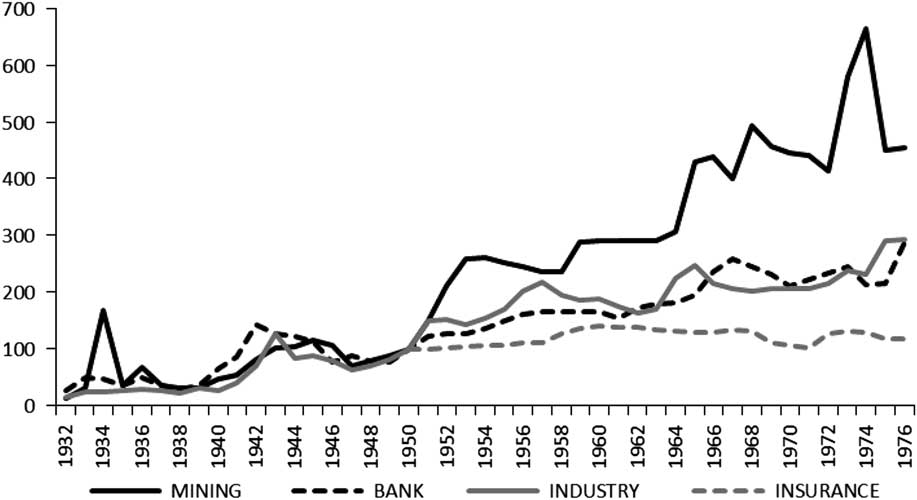
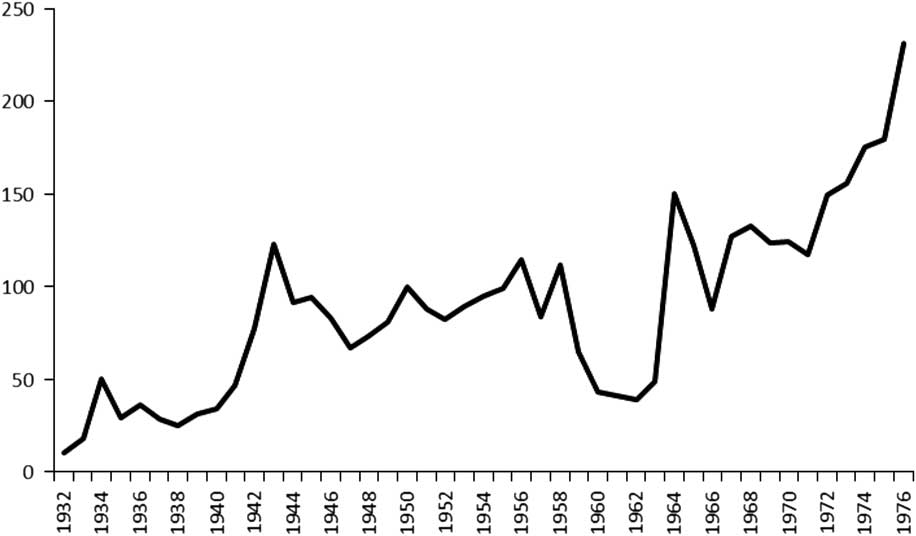
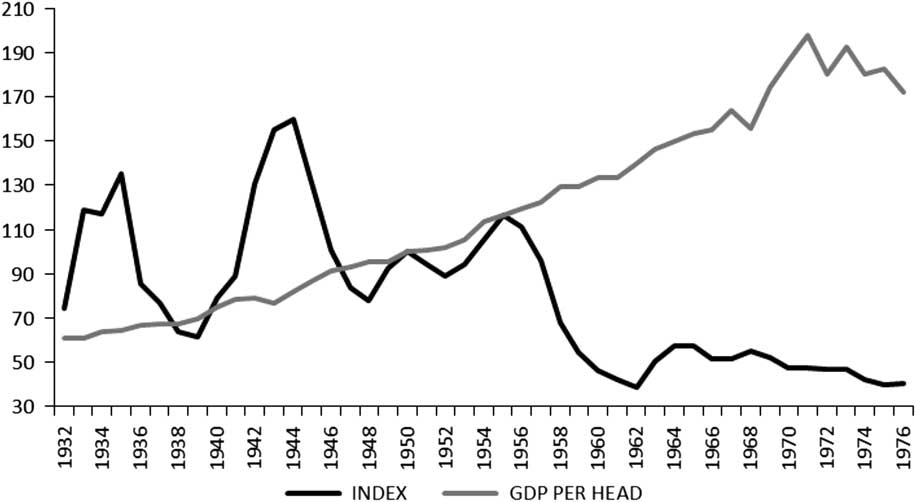
We have thus had to develop our own series based on data of thirty industrial, banking and mining companies, based on the most elementary requirements needed in making these calculations (Dimson et al. Reference Dimson, Marsh and Staunton2002). All of them were listed in the period under study and most were also listed at the beginning of the XXI century. With their value (excluding dividends) a Laspeyres index was created. Three sectorial series were made using the average value provided by Lagunilla (Reference Lagunilla1973) and by the press at the time, weighted by the company’s capital value given the lack of information on trading volume (Figure 1). The weighting of these sub-indexes in building an overall index is more rigorous thanks to NAFISA, which published these data for each sector (Figure 2). The data built go up to 1950, after which NAFINSA data are used. This year was chosen as a base year to avoid problems in the splicing of both series, perfectly assembled in our calculations. The implicit GDP deflator was used to express the series in real terms as appropriate in these cases (Figure 3).
SECTORIAL STOCK PRICE INDEX ON THE MEXICO CITY STOCK EXCHANGE, 1933-1976 (IN CURRENT PESOS, BASE INDEX NUMBERS FOR 1950)
Source: El Economista Mexicano, City of Mexico, various dates, El Excelsior; City of Mexico, various dates (both available in the Hemeroteca Nacional de México); NAFINSA (1977, pp. 340-348); Lagunilla (Reference Lagunilla1973).

STOCK PRICE INDEX ON THE MEXICO CITY STOCK EXCHANGE, 1933-1976 (IN CURRENT PESOS, BASE INDEX NUMBERS FOR 1950)
Source: El Economista Mexicano, City of Mexico, various dates, El Excelsior; City of Mexico, various dates (both available in the Hemeroteca Nacional de México); NAFINSA (1977, pp. 340-348); Lagunilla (Reference Lagunilla1973).

STOCK PRICE INDEX ON THE MEXICO CITY STOCK EXCHANGE AND GDP PER CAPITA IN REAL TERMS, 1933-1976 (BASE INDEX NUMBERS FOR 1950)
Sources: See Figure 1 and Noriega and Rodríguez (Reference Noriega and Rodríguez2011); http://dgcnesyp.inegi.gob.mx/cgi-win/bdieintsi.exe/NVO

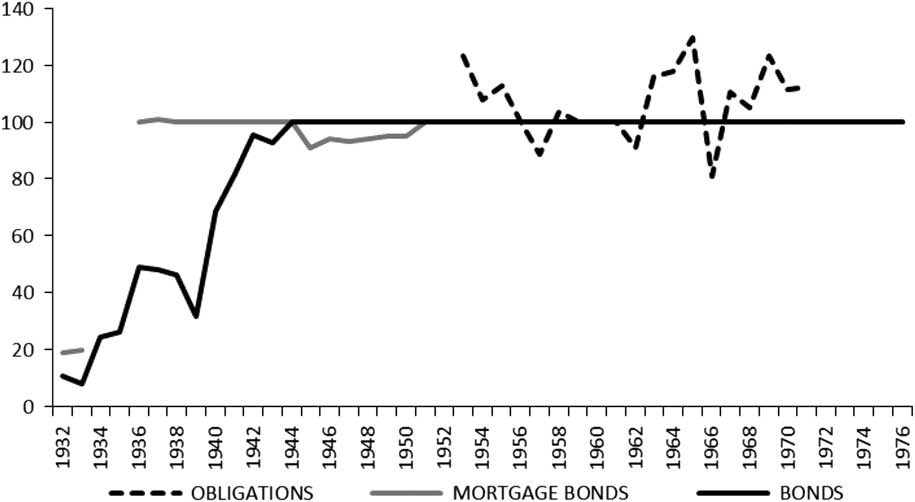
Despite the huge financing needs of the state (or perhaps because of them) information on the price of fixed-income investments is scarce and fragmentary. Actually, we are only able to provide regular information on bonds (Figure 4).
BOND PRICE INDEX ON THE MEXICO CITY STOCK EXCHANGE IN NOMINAL TERMS, 1933-1976 (IN CURRENT PESOS AND BASE INDEX NUMBERS FOR 1960)
Sources: El Excelsior, City of Mexico, various dates; NAFINSA (1977, pp. 340-348).

As well as the statistical gaps indicated, we must also highlight the lack of accounting information from listed companies. Only for a few years during the 1960s did the exchange publish results for listed companies. This makes it difficult to measure its contribution to the economic modernisation of the country through increased investment in gross capital in the long run.
3. BACKGROUND: THE EXCHANGE DURING THE PORFIRIATO PERIOD AND THE REVOLUTION (1885-1932)
Since the mid-19th century in the city of Mexico purchase transactions between brokers in mining stocks were undertaken although in hiding. They were first organised in Zócalo and then at the headquarters of the Gas Company. Only after the 1884 crisis did Porfirio Díaz, president of the Republic, approve the creation of a stock exchange for the purpose of placing public debt (Lagunilla 1981, pp. 41-42; Costeloe Reference Costeloe1993; Marichal Reference Marichal1997, pp. 129-130; Maurer, 2002, pp. 24-25; Cárdenas and Del Ángel Reference Cárdenas and Del Ángel2011, pp. 31-32). As in the rest of Latin America, the Mexican Stock Exchange originated not with the main objective of contributing to the financing of business, but for the purpose of placing bonds on the secondary market in a fast and easier way. Thanks to these investors, trade began in the shares of approximately fifty mining companies held by foreigners (Haber Reference Haber1989, pp. 79-80). These operations were carried out in an atmosphere of real euphoria, thanks to rising silver exports (Solís Reference Solís1997, p. 97).
The spread of the Argentinean 1890-1891 crisis aborted the first attempt to create a stock exchange. In 1895, it was reconstituted but without the cooperation of mining companies that preferred to negotiate their shares on the stock exchanges in New York and London since they distrusted the economic and political situation in Mexico (Lagunilla 1981, pp. 41-44; Ludlow Reference Ludlow1990). This was not a surprise since the exchange returned to its lethargy once again as a result of the 1907 financial crisis, a lethargy that lasted until the outbreak of the Revolution in 1910 (Cavazos Reference Cavazos1976, pp. 59-63; Cárdenas and Manns Reference Cárdenas and Manns1989; Haber et al. Reference Haber, Razo and Maurer2003, pp. 93-123; Paz Reference Paz2006). Its leader, Francisco Madero, a moderate of excellent education, was well received by the capital market. The situation, however, changed radically after Victoriano Huerta’s coup in 1913. The repudiation of foreign debt and the abandonment of the gold standard by the new president scared off investors.
Venustiano Carranza, president from July 1914, sanctioned the moratorium on the payment of external debt. On 6 June 1916, he closed the stock exchange, blaming it for the «rampant speculation» that threatened the success of the Revolution. This decision was accompanied by a temporary closure of banks, which had already essentially been seized (Reina Reference Reina1946, p. 26). The institution was reinstated after a month, now under tight state control and scorned by investors. The importance of this reform was more than merely circumstantial. Carranza’s concept of the stock exchange as a dangerous financial intermediary, and only useful if it served the interests of the state, continued under subsequent Mexican presidents, heirs to the revolution, for decades.
Pani, the finance secretary appointed by President Plutarco Elias Calles in 1924, renegotiated foreign debt repayments and handed the issuing monopoly to the Banco de México, which gave some impetus to transactions on the exchange (Tedde and Marichal Reference Tedde and Marichal1994; Oñate Reference Oñate2000). However, the outbreak of the Cristera War in 1927 (religious in nature) miscarried his financial legacy.
Although the country, in economic terms, seemed to have reached the bottom, it suffered the 1929 crisis with greater intensity than the rest of Latin America. Securities on the Mexican Stock Exchange during 1930 had fallen 17.6 per cent, compared with 6.9 per cent in Santiago de Chile and 15.8 per cent in Bogota (League of Nations 1937, pp. 248-249). In 1931, a series of bank failures occurred, starting with the bankruptcy of the Sonora bank.
4. THE STOCK EXCHANGE AND THE NEW PRI ORDER (1932-1958)
Pani’s return to the ministry of finance, under President Adelardo Rodríguez, brought peace to the Mexican economy after the devaluation of the peso and the new bank rearrangements that included the creation of Nacional Financiera (NAFINSA) as a bank regulator and a public holding company that took over failed banks. These measures brought some ease to a stock exchange that had lived through one shock after another since its birth.
The coming to power of President Lázaro Cárdenas in December 1934 dispelled all hopes of maintaining monetary orthodoxy due to his clear desire to introduce a growth policy using import substitution and the creation of a public business sector. The stock exchange as an institution was formally limited since Cárdenas attributed responsibility for the crisis to it. In his eyes, it was a body owned by spurious foreign interests (Otero De La Torre Reference Otero De La Torre1935). In his distinctly nationalist and statist ideology the stock exchange had no place.
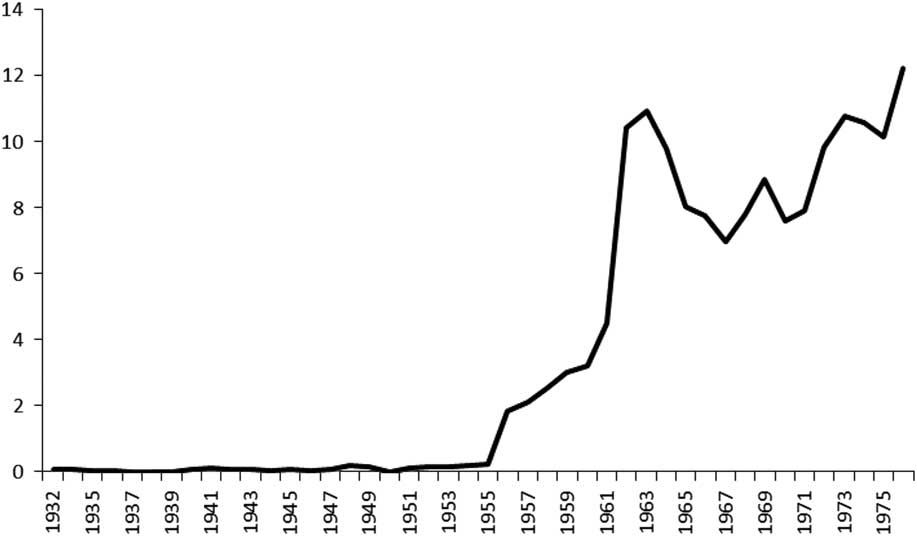
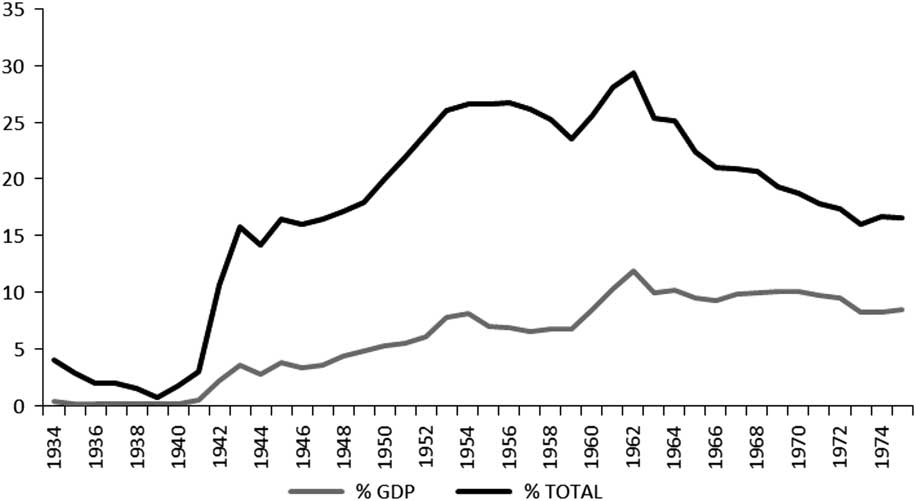
Cárdenas’ prejudice towards the exchange was unfounded given the limited quantitative importance of the operations performed there in relation to GDP (Figure 5). In fact, some counsellors advised him to do quite the opposite; that is, to encourage investment in the stock market, an organisation following the same socialist path that he had initially intended to lead the Mexican economy along (Otero De La Torre 1935).
VOLUME OF DEALING ON THE MEXICAN STOCK EXCHANGE, 1932-1976 (AS A PERCENTAGE OF GDP)
Source: NAFINSA (1977, pp. 340-348).

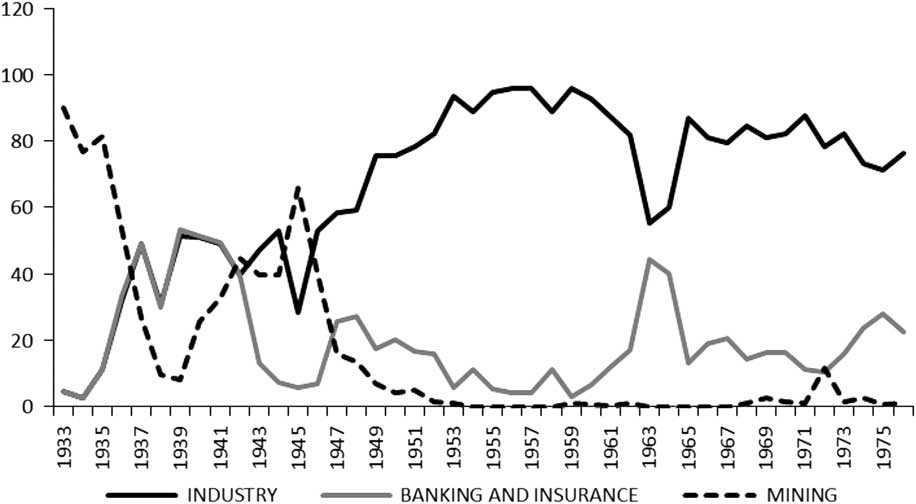
However, Cárdenas was much more worried about healing public finance. To solve this problem he used NAFINSA, conceived now as an agent serving the Treasury, to buy bonds (Aubey Reference Aubey2005; López Reference López2012, p. 131). Cárdenas made sure this function was carried out by ordering the Banco de México to buy all securities issued by the stock exchange and other public banks in 1936 and 1938. Thus, Cárdenas’ coming to power led to a sharp fall in share prices (Figures 1 and 2) while government bond values rose, endowed now with greater solvency (Figure 4).
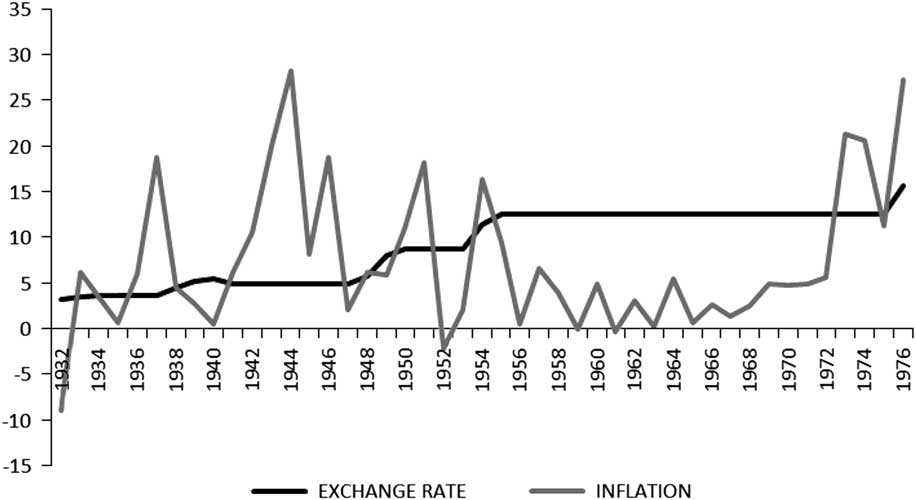
During the first years of Cárdenas’ term in office there was considerable macroeconomic stability, with low inflation and a stable peso (Figure 6). However, the departure from Pani’s policies and the president’s Keynesian tendencies caused unease among investors (Torres Gaytán Reference Torres Gaytán1980, pp. 228-240; Cárdenas Reference Cárdenas1994, pp. 70-89). This sensation was justified; in 1938, Cárdenas nationalised the petrol companies prompting an immediate fall in the price of securities, both fixed-income instruments and equities (Figures 2 and 3). Cárdenas also insisted on extending the moratorium on external debt repayment, which isolated the country from foreign financing.
Inflation and the peso/U.S.$ exchange rate, 1933-1976 (expressed in percentages and pesos per U.S. dollar) Source: INEGI (2009).

The result of such a policy could only cause the weakening of the capital market, as calculations in Table 1 indicate, drawing on those by Rajan and Zingales (Reference Rajan and Zingales2003). It is true that this weakening was common in developed economies studied by these authors. However, in the case of Mexico, the effect was much more intense and, more importantly, the result of action by the state. The stock exchange, that financial intermediary viewed as hostile in Cárdenas’ ideology, lost out more than any other. Its contribution to economic growth in Mexico, in itself previously at minimum levels (in 1930 this ratio stood in the U.S. at 1.0) thus sank to irrelevant values. The fall in the number of listed companies with respect to the population reveals the extent to which Cárdenas had literally annihilated the exchange, which was wilfully trying to catch up after the Revolution to match those in Buenos Aires and Sao Paulo.
MEXICAN CAPITAL MARKET DEVELOPMENT INDICATORS, 1930-1975

Notes:
(1), Evolution of the ratio of deposits over GDP (%); (2), Evolution of stock market capitalisation over GDP (%); (3), Evolution of listed market companies per million people; (4), Evolution of fraction of gross capital to fixed capital raised via equity (%).
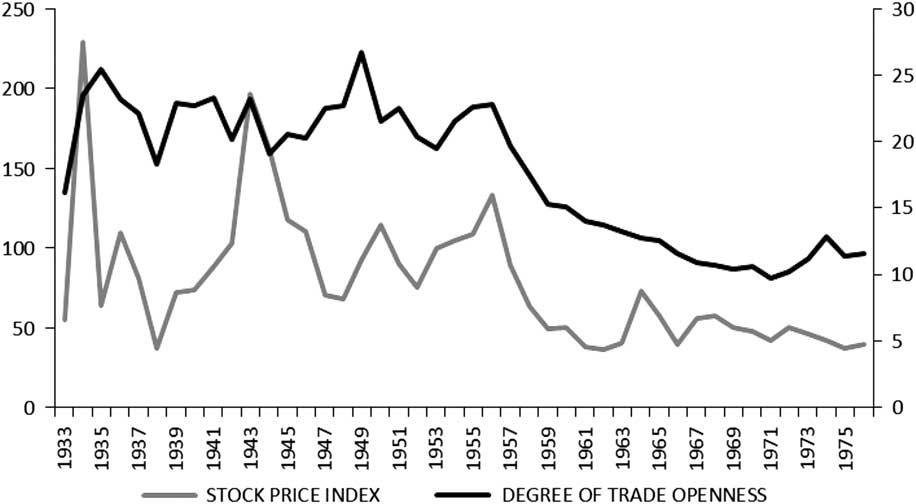
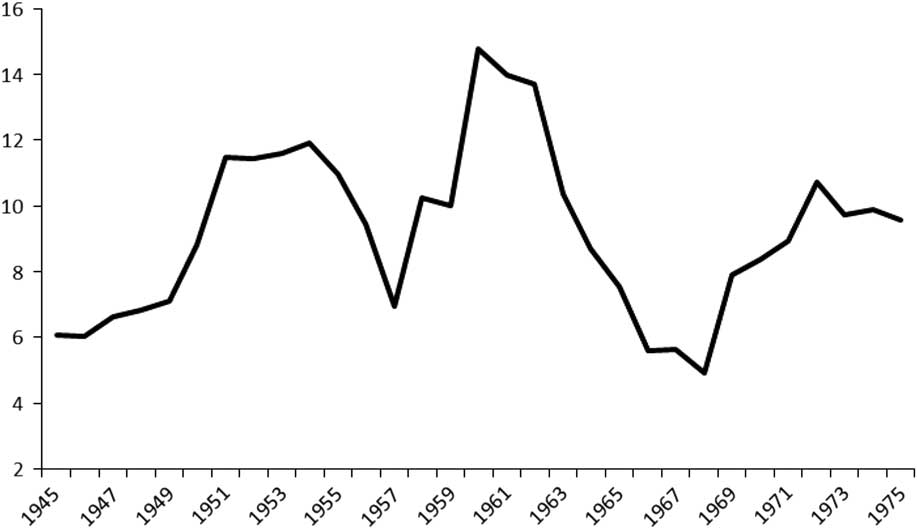
The recognition of the external obligations of the country in 1941 by his successor Ávila Camacho was a great relief for investors. At the time, the supply demands of the United States during World War II led to growing exports, which were reflected in the stock indices (Figure 7). Investors considered it was beneficial to return to the stock exchange, which was offering more than generous dividend payouts (Figure 8). They even trusted equities once again (Figure 3). In such a situation, those particularly favoured were the mining companies, which had lived through great suffering during the Great Depression (Figure 9).
Degree of Mexican economic openness and the stock price index of the Mexican Stock Exchange in real terms, 1933-1976 (in percentages and base index numbers for 1950)(*) (*): Volume of foreign trade with respect to GNP.Sources: see Figure 2 and Kunzt (Reference Kunzt2007, pp. 72-73).

Dividends paid out on the Mexican Stock Exchange, 1945-1975 (in moving averages and percentages of the nominal stock value) Sources: see Figure 2.

Sectorial distribution of shares quoted on the Mexican Stock Exchange, 1933-1976 (in percentages) Sources: NAFINSA (1977, pp. 340-348).

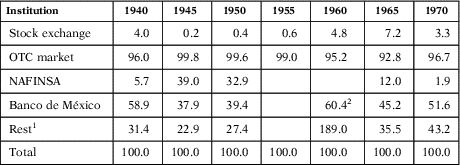
However, Ávila Camacho caused an authentic shock in the capital markets in 1940 by entrusting NAFINSA with industrial financing, completely eclipsing the stock exchange (Table 2; López Reference López2012, pp. 132-133). The president worked under the assumption that Mexican entrepreneurs could not undertake the country’s industrialisation due to their ongoing preference for investing in real estate (Hernández Reference Hernández1988, pp. 45-47). Instead the state would have to invest, channelling private savings into the secondary sector. NAFINSA was used for this task thus solving the conflict of interest between the development of the stock exchange and the government in terms of fundraising (Haber Reference Haber2008, p. 14).
INSTITUTIONAL PARTICIPATION IN SECURITY OPERATIONS IN THE SECONDARY MARKET IN MEXICO, 1945-1970 (IN PERCENTAGES)

Notes:
1 Private banks, insurance companies, savings institutions, and financial societies.
2 Includes NAFINSA.
Source: Quiroz (Reference Quiroz1952, pp. 40-50); Comisión Nacional de Valores (1955-1979).
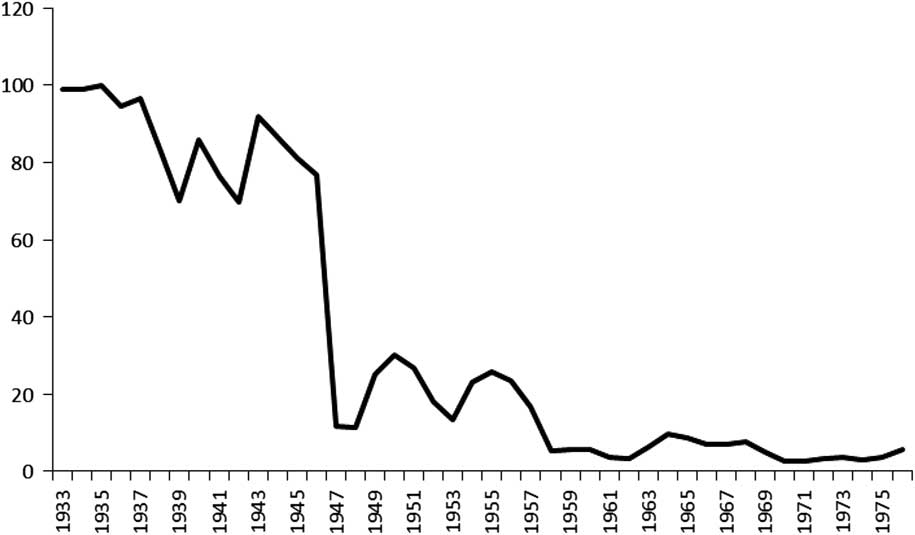
Ávila Camacho turned the institution into one that caused financial havoc of enormous proportions, which completely eclipsed the capital market. From 1944 onwards, NAFINSA raised funds by issuing fixed-income instruments, which were very attractive to investors. NAFINSA used these resources to award credit to industrial companies and to buy the equities they issued. Following this change in its objectives, the loan amounts issued by NAFINSA grew significantly and were issued under very generous terms. (Figure 10).
Equity trading on the Mexican Stock Exchange, 1933-1976 (in percentages of the total amount of private instruments traded) Source: NAFINSA (1977, pp. 340-348).

Furthermore, NAFINSA took control of the Mexican Stock Exchange. Its directors decided which companies could or could not be traded. NAFINSA was not a public holding similar to those created at the time in Europe; rather, it was a financial instrument organised by the Mexican government to support its client network in the business sphere. NAFINSA in practice therefore replaced the Banco de México and the stock exchange since it was trusted with financing the accelerated industrialisation in place of the other two intermediaries (Aubey Reference Aubey2005, pp. 36-40).
There is no institution in the economic history of Latin America of a similar character and size. Nor is it comparable — as previously stated — to European public holdings such as the Spanish INI or Italian IRI, since these institutions did not have the mission attributed to NAFINSA on the stock exchange and they received financing through other means.
In short, Ávila Camacho completed Cárdenas’ work regarding the capital market. True to Carranza’s revolutionary convictions, he completely nullified the exchange, which was considered an enemy in his economic project for Mexico.
Under such circumstances, the functioning of the stock exchange was completely abnormal. The distancing of its values from those in New York shows this because up to that point they had developed similarly (Figure 12). The Mexican Stock Market was almost exclusively dedicated to trading fixed-income securities issued by NAFINSA (Table 2). Development banking also contributed to this rapid growth; hence, the growth seen in the degree of development of the financial system in the period while the exchange was idle (Table 1). Investors limited their contribution to growth so that it was almost symbolic, mainly through import substitution, by following the dictates of the government and purchasing industrial shares.
Furthermore, the conditions under which shares were traded from then on had nothing to do with the normal characteristics of such an institution. The Mexican Stock Exchange had no proper, open and competitive auctions, as was the case in the rest of the continent, an element not solely due to the intervention of NAFINSA. Groups of investors trading directly with the company, with close links to its owners, made up the clientele of the stock exchange and carried out occasional operations at the behest of its managers (Caso Reference Caso1971, pp. 33-34). In 1941, Ávila Camacho himself decreed the legality of the bodies known as «Financial Groups» (Grupos Financieros) and their operations (De la Fuente Reference de la Fuente1993, p. 97). The banks (especially Financiera Banamex, a division of Banco Nacional de México) also bought large packages of shares that were then resold to their clients as credit. Thus, a genuinely Mexican form of an «over-the-counter» (OTC) market was born: «counter sales» («operaciones de mostrador» in Spanish), not subject to any registration or control (Caso Reference Caso1971; Hernández Reference Hernández1988, p. 153; Ramírez Reference Ramírez2007, p. 43). Thus, NAFINSA and the large financial groups took over the stock exchange.
In order to finance their investments, entrepreneurs preferred to borrow from NAFINSA rather than reinvest their own profits. Instead of speculating on the Mexican Stock Exchange, they chose to do so in New York (Hernández Reference Hernández1988, p. 153; Haber Reference Haber1997). The government’s financial architecture satisfied entrepreneurs due to the low costs of borrowing. The high rate of indebtedness they accumulated guaranteed their loyalty to the PRI, given the impassivity of employees due to the sedative effects of monetary illusion and the populist messages of the party in government (Caso Reference Caso1971, p. 7). However, the powers NAFINSA had moved Mexico and its companies away from the global capital market. Additionally, restrictions on capital movements following the signing of the Bretton Woods agreement were also partly responsible for this. However, of course the withdrawal of Mexican securities from the European and New York exchanges, of a voluntary nature and consistent with Mexican commercial isolation, reduced funding possibilities for large companies (not just mining companies), which had until then obtained resources for larger investments abroad.
Obviously, the stock index recorded losses year after year, completely distancing itself from the development of the Mexican economy (Figure 2). The result was a denaturalised stock exchange, whose priority was securing funds for NAFINSA and where only twenty-five equity instruments were traded. The stronger growth experienced by Argentina, whose Buenos Aires Stock Exchange was much more powerful and not subject to such severe state control, reveals, in a very rough approximation to the phenomenon in the absence of figures to undertake more sophisticated calculations, the damage in terms of economic development caused by NAFINSA’s power.
Its position was even more marginal after the approval of the Havana Charter in 1947, a prelude to the first GATT round. Miguel Alemán, the new president, and his minister for finance and public credit, Ramón Beteta Quintana, a zealous follower of the autarchic growth path, considered that the generalisation of the most-favoured nation status included in the agreement harmed the country’s interest (Riguzzi Reference Riguzzi2003). Therefore, Mexico did not join the treaty, reinforcing its international isolation.
In this new scenario, the stock exchange was only useful for the state in financing its discretionary and selective industrial policy. NAFINSA fulfilled this mission with issues of new equity. To avoid any competition, the National Securities Commission (Comisión Nacional de Valores) tightened the access criteria for firms wanting to enter the stock exchange, arguing that this restriction was necessary to avoid penetration by foreign capital, which was more demonised than ever before. The number of equities traded, as well as their trading volume, returned to insignificant levels (Figure 9).
Only large corporations with financial subsidiaries could obtain resources on the stock exchange by issuing mortgage bonds. This financing strategy was adopted by the members of the so-called Monterrey Group (Lagunilla 1977, vol. II, p. 77; Cardero Reference Cardero1984, pp. 120-121; Ejea et al. Reference Ejea1991, pp. 30-31; Cárdenas and Del Ángel Reference Cárdenas and Del Ángel2011, p. 23). The group was created by entrepreneurs from that part of northern Mexico and even had its own stock exchange from 1950 onwards. This policy received the full backing of both this and other large corporations. NAFINSA’s brokering assured them a very easy way of funding, avoiding the risk involved in using the exchange. But above all, in exchange for their loyalty to the PRI, NAFINSA guaranteed the existence of tough entry barriers to new investors, especially foreigners, who could alter the status quo.
In sum, this point in the interventionist and autarchic Cárdenas project carried out by Alemán was reached through the creation of this monopoly, which integrated financial and industrial activities vertically, not as a result of strategic decisions, as was the case in the United States, but due to the stimuli described and with some excess and in a «feudal» sense (Caso Reference Caso1971, p. 66). The stock exchange was, paradoxically, the instrument used in achieving this goal (Castañeda Reference Castañeda2010).
The opportunities to export to the United States provided by the Korean War (1950-1953) and the anti-inflationary policy followed by Adolfo Ruiz Cortines, elected president in 1951, slightly revived share trading (Figure 10; Cárdenas Reference Cárdenas1996, pp 41-46). Share prices and dividends grew significantly thanks to this increased openness of the Mexican economy (Figures 2 and 7).
However, as soon as the conflict ended, apathy returned to the capital markets. The government, under the strain of runaway inflation and employer pressure, had to approve a significant devaluation of the peso on Easter Saturday 1954 (Figure 6). The measure had dramatic effects on the exchange, from which it was, however, able to recover in the short term. However, the stop and go abuse of Keynesian policies once again had its vitriolic effects on the stock market later on. Ruiz Cortines used the policy, which had been so unpopular in 1958, once again at the end of his term in office. The stock exchange bid him farewell with the now renowned drop in dividends (Figures 2 and 8). The PRI government’s economic policy once more drove private securities out of the exchange, submitting it again to NAFINSA’s impulses.
5. THE STOCK EXCHANGE AND THE MEXICAN ECONOMIC MIRACLE (1959-1967)
Although his predecessor had done the dirty work, the new president, Adolfo López Mateos, was faced with a desolate economic outlook when sworn into office at the end of 1958: inflation was over 40 per cent, the peso was in free fall and GDP growth had slowed down due to the decline in exports. In response to this situation, the new minister of finance and public treasury, Antonio Ortiz Mena, designed a new model of «stabilizing growth» (crecimiento estabilizador). The new priorities were now creating a stable currency (forgetting about the idea of competitive devaluations), reducing inflation, creating a balanced budget, and financing investment through resources obtained from abroad (Ortiz Mena Reference Ortiz Mena1970, pp. 417-441).
With this new growth strategy, which was far from the most entrenched tenets of the Revolution, and with significant achievements in growth and prosperity, the government wanted to assign a greater role to the stock exchange in corporate financing. This philosophy underlay the new law regulating its activity, which was approved in 1960. Further protection was awarded by the regulations signed into law in 1963, which declared stock exchange activity «public», with the aim of removing all obstacles set up by prior presidents. Additionally, the first investment funds, financial hybrids that up to that time had been unknown in Mexico, were created and traded by brokerage firms and mutual funds, whose activities were encouraged. The government even allowed the opening of a new stock exchange in Guadalajara in 1963.
However, index growth (very modest) and dividends distributed are very misleading in assessing the actual effectiveness of these measures (Figures 2, 8 and 10). In practice, the results of this opening up were very limited, despite this much awaited financial modernisation (Caso Reference Caso1971, p. 20; Solís Reference Solís1979; Del Ángel Reference Del Ángel2010). In fact, the contribution of the exchange to economic growth in the country, according to the estimator used to measure it, may be divided in two since Ortiz Mena gave priority to banking in this new financial direction of economic policy (Table 1); hence, the rise of bank values on the exchange and the sudden interest of investors in securities issued by banks (Figure 1).
It is true that the number of publicly traded companies grew. Throughout 1963, 356 companies joined the stock exchange, the majority from the industrial sector (Caso Reference Caso1971, p. 21). However, only fifty-four were regularly traded. The owners of the rest entered the stock market to facilitate collateral loans from banks and the sale of their shares to NAFINSA (Caso Reference Caso1971, p. 21).
The stock market did not gain popularity among the middle class even though the Mexican telephone company (Telmex) demanded that its clients buy its shares to obtain a line (Eiteman Reference Eiteman1966, p. 12). In fact, the creation of the National Association of Stock Exchange Brokers (Asociación Nacional de Corredores de Bolsa) in 1966 contributed in practice to the creation of new barriers to market entry by banning individual operators from the stock market (Cárdenas and Del Ángel Reference Cárdenas and Del Ángel2011, p. 34). The clients of the stock exchange, in effect, did not change much. The usual buyer was a member of the «Financial Group» with a minimally diversified portfolio who was only willing to speculate on the New York Stock Exchange (Caso Reference Caso1971, p. 19).
However, above all, as denounced by the stock exchange brokers themselves in 1963, the negligible scale of equity securities trading held back stock market development in the country (Figure 10; Lagunilla Reference Lagunilla1973, vol. II, p. 156). In 1964, shares represented 5 per cent of the total trading volume on the Mexican Stock Exchange compared with 92.2 per cent in Rio de Janeiro and 45.5 per cent in Sao Paulo (61.2 per cent on average for Brazil as a whole; Eiteman Reference Eiteman1966).
It is true that NAFINSA’s control over trading activity diminished (its instruments went from making up 80 per cent of trading volume in 1960 to a meagre 19 per cent) in favour of Financiera Banamex and Telmex (Comisión Nacional de Valores 1969, pp. 35-37; Figure 11). However, the damage done by NAFINSA went beyond the stock exchange: in 1965, it lent to companies and underwrote activities to the value of 10.62 billion pesos, of which at least 46.4 per cent went to listed companies. Furthermore, NAFINSA bought shares on the primary market to the value of 2.24 billion pesos. In all, transactions driven away from the stock exchange in share trading can be estimated at 7.71 billion pesos. Altogether, the activity of NAFINSA diminished the size of the equity market by a factor of five (Nacional Financiera 1965, pp. 248-250).

Furthermore, OTC sales, now known as the «free market» and at that time already officially recognised, gained extraordinary importance at the expense of stock market trading, while the government actually claimed it was pursuing the opposite goal (Table 2). The insignificant size of stock exchange trading was also due to investors avoiding it as a result of the lack of incentives and the legal uncertainty that existed. Not even property rights were properly defined, as indicated previously (Caso Reference Caso1971, p. 19). On the Mexican Stock Exchange, as opposed to the rest of Latin America, not even registered shares were issued or exchanged; it was the most archaic, cumbersome and slowest stock market in the Americas (Eiteman Reference Eiteman1966, pp. 12-14). «Silent auctions» were not implemented despite the signing of a computerisation contract with IBM for this purpose (Lagunilla Reference Lagunilla1973, vol. II, p. 173). Furthermore, trading was subject to significant tax pressure, which could be avoided by leaving the stock exchange.
In such circumstances, the stock index fell over this period due to lower gold prices and, above all, cheap oil (Figures 2 and 12), along with a fall in exports caused by foreign trade restrictions established by U.S. President Johnson’s administration from 1964 onwards.
Stock price index of the Mexican Stock Exchange and crude oil barrel price in the united states, 1933-2012 (in index numbers based on 1950 dollars)(*) (*) 1933-1944 U.S. average. 1945-1983 Arabian Light posted at Ras Tanura. 1984-2012 Brent dated. Sources: See Figure 2 and http://www.bp.com/en/global/corporate/about-bp/statistical-review-of-world-energy-2013.html

In fact, from the mid-1960s onwards shares almost completely lost their attractiveness to investors (Table 3). Inflation, despite being moderate, decreased the equity return, which now stood at values much higher than those registered before the 1958 currency devaluation. Return on investment in Mexico was different from the rest of the world. While equity return multiplied in the U.S. and Europe, in Mexico its value fell. What is more important, investment in the country in bonds was extremely attractive when the Western world was offering near zero returns (Dimson et al. Reference Dimson, Marsh and Staunton2002, pp. 275-310). The increase in equity returns in 1967 is not misleading since the changes in economic policy in the United States drove investors away from the stock market, where only a handful of large companies stayed on. The economic miracle, if it had ever existed, was over as seen from the perspective of the capital markets.
RETURN ON INVESTMENT INDICATORS FOR MEXICO (1957-1967)

Notes:
(1), Profit index (base 1963=100); (2), Equity return (nominal terms); (3), Equity return (real terms); (4), Bond return (real terms).
Source: Comisión Nacional de Valores (1955-1969), Lagunilla (Reference Lagunilla1973) and INEGI (2009).
6. THE STOCK EXCHANGE, RETURN TO AUTARCHY AND SHARED DEVELOPMENT, 1968-1976
The exchange could not remain indifferent to the 1968 student revolts, which were bloodily suppressed, and the political uncertainty caused by them (Figure 2). By keeping inflation below 5 per cent and minimising corporate borrowing, Ortiz Mena managed to tackle the crisis in a year during which Mexico, with the Olympics, had to show the world it was a developed country. However, despite the confidence that Ortiz Mena generated among businessmen, the price index fell, also driven down by the decline in oil prices (Figure 12). Investors fled from shares even more (Figure 11). This forced companies to offer generous dividends (Figure 8) at the expense of reinvestment, which had lethal short-term effects on competitiveness.
Things grew worse under Luis Echevarría’s presidency, starting in 1971. Mena’s replacement could not have come at a more inconvenient moment, in the middle of the confusion caused by the abandonment of the gold standard by the United States. With Ortiz Mena’s appointment as president of the Inter-American Development Bank, the PRI lost its most qualified leader in economic policy. Echevarría squandered his legacy; inflation increased five-fold in just 1 year while foreign debt also increased (Figure 6).
The new executive allowed the move into a statist, populist and autarchic drift starting with the nationalisation of Telmex (Cárdenas Reference Cárdenas1996, pp. 93-94). Income from growing oil exports was insufficient and Echevarría’s industrialisation project had to be financed through NAFINSA’s intervention on the stock exchange, which once again became an instrument that served government needs (Cypher Reference Cypher1990, pp. 96-107). Moreover, inflation significantly reduced the real value of NAFINSA’s debt, its shareholders thus becoming victims in this lenders’ euthanasia, giving further impulse to the statist project (Figure 4).
Indeed, the new president got rid of the small reforms made on the exchange during the 1960s to regain Cárdenas’ financial interventionist policy. Echevarría expressed his intention of doing away with what he called the «private investment strike» by using a stock exchange reform law in 1975, now considered an instrument vital to the «shared development» strategy (crecimiento compartido). Echevarría did not hide his intentions; in the preamble to the Act itself, it clearly expressed the will to achieve «development and full control of the stock market». Furthermore, the law repudiated the market as a tool for stock market performance, which should be governed by a superior mechanism: the state. Thus NAFINSA’s control over the institution was brought back once more, raising its intervention to the highest degree. The nationalisation of the stock exchange was such that it was considered a precedent for the nationalisation of banks in 1984 (León Reference León1984).
What is true is that the privileges of financial institutions in stock trading suffered no alteration whatsoever; despite the announcements of his intentions to do so, Echevarría did not go so far. In the status quo that was maintained, the «financial groups» recognised by Ávila Camacho continued their activities without changes except slightly greater control in having to register their operations, something which was in fact only anecdotal.
The new law, in a misleading gesture towards openness, permitted the activity of brokerage houses (Casas de Valores). Theoretically, the aim was to spread the business among the middle classes. According to the official rhetoric, Echevaria aimed to open the institution to new investors who would share his goal of «Mexicanizing the industry» (Tello Reference Tello1979, Reference Tello2007, p. 581; Ejea et al. Reference Ejea1991, pp. 33-37; Kessler 1999, p. 42-43). However, this so-called democratisation was pure rhetoric since the new regulations completely abolished the rights of small shareholders, namely the benefits of the «tag along» and «drag along» clauses. Banking houses (including Merrill Lynch) and mutual funds could capture very few clients due to the lack of legal guarantees (Cárdenas and Del Ángel Reference Cárdenas and Del Ángel2011, p. 35). In 1968, they handled only 1.4 per cent of the value of stock traded (Caso Reference Caso1971, p. 35). Brokers (82 in 1969) confined themselves to reluctantly executing orders from their clients (never more than fifty on average), never really developing their bidding skills, due to the limited incentives they had to do their job compared with other countries (Caso Reference Caso1971, p. 30). In these circumstances, the trading volume never exceeded 0.1 per cent of GDP.
Even more fallacious was the alleged Mexicanisation of the Mexican economy given that external debt grew enormously, being used for the nationalisation of some 300 companies in 1974. Once more, the autarchic economic policy led to chaos. Inflation and artificial overvaluation of the peso led to massive capital flight from the country. The Mexican economic situation was so tragic that it could not even take advantage of the sudden rise in oil prices (Figure 12). It was in such circumstances that the stock market index reached its lowest values since the 1929 crash (Figure 2).
In 1976, inflation grew exponentially, while public deficit exceeded 10 per cent of GDP (Hernández Reference Hernández1988, p. 41; Cárdenas Reference Cárdenas1996, pp. 86-106; Kessler 1999, pp. 42-43). The strong devaluation of the peso that year, with which Echevarría ended his term in office, led to inevitable drops in stock prices and dividends (Figures 2 and 8; Tello Reference Tello1979, pp. 146-182; Torres Gaytán Reference Torres Gaytán1980, pp. 340-358).
Measuring the impact of Echevarría’s policy on the capital markets yields devastating results (Table 1). The setback suffered by the financial system is indisputable. The increased volume of shares traded on the stock exchange was but the sad result of the growth of public sector debt. In fact, large companies abandoned the exchange, deterred by state intervention. The stock market lost any contribution it could make to the modernisation of a country, which was deeply afflicted.
In short, the attempt to accommodate and extend to the stock exchange the workings of a fully intervened economy, eliminating its normal operational mechanisms, had again failed.
7. CONCLUSIONS
The stock exchange has had a residual role in the economic development of Mexico. This does not imply that the country’s backwardness was due to such ineffectiveness, but rather that Mexico grew in spite of it. This was due to the disdain, which politicians felt for the exchange. Porfirio Díaz’s «scientists» viewed it with suspicion, whereas governments that ruled the country since the Revolution adulterated its mission entirely. Since Cardenas’ coming to power, it became an instrument serving the financial needs of the state. Additionally, the exchange was the means by which the state financially supported its network, offering resources — through NAFINSA — to large corporations that were inefficient due to the low risk they faced. All PRI governments made use of the stock market for this non-economic purpose, providing resources or privatising companies. NAFINSA, a completely abnormal institution in a modern capital market in a democratic country, both in nature and in its operations, is the best evidence in the Mexican case that a bad and rigid definition of property rights in the financial system facilitates state abuse (Kessler 1999, p. 19; Tello Reference Tello2007, p. 755; Haber et al. Reference Haber, Kieff and Paredes2008, pp. 216-217).
If, in a country like Mexico where there was no effective competition between political parties until 2000, the modernisation of the financial system was inconceivable, much more inconceivable was a change in the structure of the stock exchange (Haber Reference Haber2008, p. 12). The democratisation of investment (seen as increasing the number of those operating in capital markets), the publicity requirements of listed companies and of the financial situation of the state itself, speculators’ freedom of action and anonymity in transactions, are all hard to find in authoritarian regimes. Mexico went through such a situation during the rule of the PRI, even though such a statement may seem reductionist and controversial. Violence and a delay in the country’s democratisation hindered its growth (Haber Reference Haber2008, p. 48).
It is not surprising that small savers avoided investing on the stock market. Given the prevailing uncertainty and favouritism they preferred to keep their wealth as it was rather than try to increase it. Such investment behaviour is not inherent to Mexican culture; it is the logical consequence of the inefficiency of political institutions.
Additionally, the small number of agents dealing, with the support of the state, facilitated the creation of a few large fortunes and the integration of business corporations. Apart from the obvious expertise of the managers involved, such growth could only have taken place on a tightly controlled, intervened stock exchange, which offered limited access and was governed by public authorities. Thus, this study of the Mexican case suggests that state intervention, cooptation and the small size of the exchange facilitated the creation of very large, vertically integrated companies. Their creators were the «financial groups», leading players on the market who handled it at will and with full public support almost from the very outset of the Revolution.
State submission attenuated cyclical price fluctuations, fluctuations that had a decreasing tendency (Reinhart and Rogoff Reference Reinhart and Rogoff2008, pp. 281-286). However, at the same time such dependence led the exchange to face critical situations due to the stubborn policy of Mexican governments in ignoring public debt and linking the fate of its economy to the price of oil. In the case of a market like the Mexican one, which was intervened and under state control, Minsky (Reference Minsky1982) and Kindleberger’s (Reference Kindleberger1978) model of financial crises is not entirely applicable. In Mexico, the crises were the result of political contingencies and excessive public debt (Newell and Rubio Reference Newell and Rubio1984; Cárdenas Reference Cárdenas1996, pp. 203-208, 2013, p. 212; Tello Reference Tello2007).
Judged from the perspective of financial orthodoxy, the history of the Mexican Stock Exchange was a failure due to its almost negligible participation in corporate financing. However, we must examine it from the corporatist point of view since it was under such principles that it was set up. Seen from this alternative perspective, its achievements are undeniable given that it strengthened the PRI network, offered financial support for its political dominance through NAFINSA, aided the public treasury and facilitated the creation of large monopolistic corporations. In fact, what the PRI achieved through the exchange and NAFINSA, was to institutionalise a secular practice in the economic history of Mexico, as correctly indicated by Coatsworth (Reference Coatsworth1978) and Haber (1998): the politicisation of property rights and contracts and the creation of hegemonic positions on the market.
Appendix
STOCK PRICE INDEX IN THE STOCK EXCHANGE IN MEXICO CITY IN REAL TERMS, 1931-1976 (IN CURRENT AND REAL TERMS, BASE INDEX NUMBERS AND PESOS FOR 1950)

SECTORIAL STOCK PRICE INDEX IN THE STOCK EXCHANGE IN MEXICO CITY, 1931-1976 (IN CURRENT TERM, BASE INDEX NUMBERS FOR 1950)