Introduction
The care of individuals with advanced chronic disease is an important strategic target for healthcare policies. In developed countries, three of every four deaths are attributed to advanced chronic illness (Gómez-Batiste et al., Reference Gómez-Batiste, Martínez-Muñoz and Blay2014). In the coming decades, the prevalence of chronic illnesses—most of which have high comorbidity rates—is expected to increase exponentially due to population aging and increasing life expectancy (Amblàs et al., Reference Amblàs-Novellas, Espaulella and Rexach2015).
Given this epidemiological reality and the implications for healthcare policy—particularly considering the multiple needs of patients with advanced chronic illnesses and/or those who are near the end of life (EOL) —the priority for policy makers should be to focus on developing integrated healthcare models that combine diverse characteristics and strategies (Ham, Reference Ham2010). An example of this approach would be an integrated model that coordinates the provision of both healthcare and social services (Blay et al., Reference Blay, Limón and Meléndez2017). Other approaches would include comprehensive, person-centered models based on the early identification of individuals with advanced chronic disease and/or at end of life (Gómez-Batiste et al., Reference Gómez-Batiste, Martínez-Muñoz and Blay2013). All of these models should be based on multidimensional, multidisciplinary approaches to address the needs of the patient, caregivers, and families. Necessarily, these needs will involve—to a greater or lesser degree—both clinical and care complexity.
In this context, decisions are often uncertain and, in some cases, may fail to fully consider the patient's own values and desires. Therefore, patient participation in the decision-making process about his or her own health and treatment is an important component of the quality of the healthcare process.
The implementation of a comprehensive (integral and integrated) care model requires the full development of concepts such as advance care planning (ACP). ACP, understood as the process for planning future medical (or nonmedical) care when the patient is unable to make his or her own decisions (Emanuel et al., Reference Emanue, von Gunten and Ferris2000), is a key component of comprehensive care that emphasizes shared decision-making, in which the individual is the main focus of care. A range of skills—including clinical, ethical, and communication skills—as well as organizational competencies are necessary to implement ACP (Altisent & Judez, Reference Altisent and Judez2016). Moreover, implementing ACP requires collaboration and coordination at all levels of care, including both social and healthcare.
The concept of ACP, as such, first emerged in the early 1990s in the United States. The Study to Understand Prognoses and Preferences for Outcomes and Risks of Treatments (SUPPORT) provided valuable data demonstrating the low level of patient involvement in decision-making about their own health, despite the numerous laws designed to support individual autonomy that were passed at that time (SUPPORT Principal Investigators, 1995; Teno et al., Reference Teno, Nelson and Lynn1994). Since then, the number of ACP projects implemented around the world has gradually increased. Perhaps the most important of these projects is the Respecting Choices experience in Wisconsin, initiated in the mid-1990s (http://www.gundersenhealth.org/respecting-choices/). The Respecting Choices program has achieved outstanding results: 85% of that community have a written advance directive (AD), 95% of all medical records include an AD, and 98% are compliant with the established AD (Biondo et al., Reference Biondo, Lee and Davison2016; Hammes & Rooney, Reference Hammes and Rooney1998). These achievements have paved the way for various international proposals in numerous countries, including Australia, Canada, Germany, and Singapore (https://respectingchoices.org/about-us/history-of-respecting-choices/).
International experience has shown that implementation of an ACP program requires a combination of several key elements (Baughman et al., Reference Baughman, Ludwick and Palmisano2015; De Vleminck et al., Reference De Vleminck, Houttekier and Deliens2016; Street & Ottmann, Reference Street and Ottmann2006), as follows.
Institutional support
Institutional support, whether local or national (or both), combined with the commitment of healthcare professionals, is essential to ensure broad implementation of the ACP. “Branding” to clearly identify the ACP model also appears to be important. A development strategy that takes into account all levels of care, the pertinent institutions, and all relevant stakeholders should be defined and included. In addition, it is essential to identify leaders capable of mobilizing the necessary resources to assure sufficient support for the ACP. The particular characteristics of each region should be considered. The starting point for developing an ACP begins with general proposals, with each institution or region identifying and defining their own needs. Likewise, an implementation calendar should be established, including a pilot program to identify good praxis and to detect areas in need of improvement. Finally, institutional support should ensure that patient medical records included a dedicated place to record ACP-related data, and these data should be accessible by practitioners at all levels of care. In addition, the patient should have access to all ACP documents and medical records for review if necessary (Gilissen et al., Reference Gilissen, Pivodic and Smets2017).
Conceptualization
The definition of ACP has received broad international acceptance (Emanuel et al., Reference Emanue, von Gunten and Ferris2000; Mullick et al., Reference Mullick, Martin and Sallnow2013). Two recently published studies used a Delphi methodology to develop international consensus definitions of ACP and its key components. The first study was led by the European Association for Palliative Care through a multicentric working group (Rietjens et al., Reference Rietjens, Sudore and Connolly2017). The other study was conducted by the School of Medicine at the University of California (Sudore et al., Reference Sudore, Lum and You2017). Those studies established the conceptual framework for the development, the goals, key elements, and best strategies to support adults in ACP. Additionally, numerous projects have been carried out in Spain to develop ACP concepts (Carrero Planes et al., Reference Carrero Planes, Navarro Sanz and Serrano Font2016; Simón Lorda et al., Reference Simón Lorda, Tamayo Velázquez and Esteban López2013).
Development and implementation of training programs
Training needs for ACP have been identified in a wide range of contexts and professional groups (Abad-Corpa et al., Reference Abad-Corpa, García-Palomares and Martínez-Rodríguez2006; In der Schmitten et al., Reference In der Schmitten, Rothärmel and Mellert2011; Seymour et al., Reference Seymour, Almack and Kennedy2010). Before implementing a new ACP program, it is imperative to establish a hierarchy of training levels based on the specific needs of the target. Informational campaigns designed to widely disseminate the ACP concept are important, as is proper implementation of the ACP, which should be accessible to both health and social care professionals. Reasonably, not all professionals will require the same level of knowledge and skills about ACP, and therefore differentiated training strategies will be necessary (Flo et al., Reference Flo, Husebo and Bruusgaard2016), with a special emphasis on targeting professionals who play a specific role in the care of people with advanced illness (Baron et al., Reference Baron, Hodgson and Walshe2015).
Community involvement
Because the aim of any ACP is to benefit the community in a context of person-centered approaches, citizen participation is essential. For this reason, it is important to create spaces for consultation and education that allow people to discuss any difficulties that may arise (Sudore et al., Reference Sudore, Knight and McMahan2014; Tamayo-Velázquez et al., Reference Tamayo-Velázquez, Simón-Lorda and Villegas-Portero2010). In this context, several international and national programs have created valuable educational materials that can serve as reference material, including the National Council for Palliative Care available (http://www.dyingmatters.org/), the PREPARE website (https://prepareforyourcare.org/), and the Spanish Program Kayrós (http://adpsalud.es/conversacioneskayros/). In the Basque country of Spain, the Community Shared Care Planning Program has beem implemented since 2014. This program promotes to involve citizens into an ACP conversation mainly with their primary care team.
Development of the ACP in Catalonia
Catalonia is a region within Spain with a population of 7,483,761 inhabitants (2016 data). It is estimated that at least 5% of its population have some type of complex chronic illness and 1% has palliative care needs (Ledesma et al., Reference Ledesma, Blay and Contel2015). This last group of patients is identified as advanced chronic patients who are at risk of dying within the following 12 months.
The Catalan health system receives funding from several different sources: public resources cover 80% of primary care centers and 20% of hospital care; by contrast, 20% of primary care and 80% of hospital and intermediate care are covered by private funding through contracts with the public health system. In addition, there are several fully private centers. Social care centers, mainly nursing homes and hospices, are also funded with public, private, and mixed funding.
The health system has approximately 100,000 healthcare professionals (physicians and nurses) and 5,000 social care workers. Healthcare resources are managed by the Catalan Ministry of Health (CMH) and social care resources by the Catalan Ministry of Welfare and Family.
Between 2011 and 2015, the CMH has promoted health policies aimed at improving the care of advanced chronic patients. This has led to the following.
• A critical reflection about the population aging rate, use of medicines, and the concepts of “frailty” and “early identification.”
• Development of people-centered models of care, requiring a complete integration between social and healthcare. ACP is the key element for these models of care.
• Development and implementation of the Necesidades Paliativas [Palliative Needs]) Programme to promote early identification of people with palliative care needs.
• Creation of specific codes to identify patients with advanced chronic conditions and complex needs and incorporation of that coding system into the clinical record system.
• Development of new tools to register individual intervention plans and make these accessible to all healthcare providers in the entire public health system. Such registries include a specific section for ACP applicable to all advanced chronic patients.
To implement these key elements, the CMH has promoted the creation of several advanced chronic care programs. These include: (1) the Program for Chronic Care launched in 2012 and updated in 2017 as the National Strategy of Integrated and Chronic Care (http://salutweb.gencat.cat/ca/ambits_tematics/linies_dactuacio/estrategies_salut/cronicitat/); (2) the Interdepartmental Plan for Health and Social Care and Interaction launched in 2014 and promoted by the Presidency of Catalonia (http://presidencia.gencat.cat/ca/el_departament/plans_sectorials_i_interdepartamentals/PIAISS/); and (3) the development of the NECPAL (Palliative Needs) program (Gómez-Batiste et al., Reference Gómez-Batiste, Blay and Martínez-Muño2016) by the Qualy Observatory-World Health Organization Collaborating Center for Public Health Palliative Care Programs and the Chair of Palliative Care (CPC) at the Catalan Institute of Oncology and the University of Vic. All of these proposals focus on the early identification of individuals with palliative care needs and seek to promote a comprehensive care model. These three programs were merged to develop a national health plan that includes ACP as a key component. Initially, the project was fully sponsored by the CMH.
Objective
The objective of this program develop and implement the Catalan ACP program for patients with chronic conditions and complex needs in all health and social services. The present article describes the development process of the ACP program in Catalonia and the preliminary results of its implementation.
Methods
The process of developing the Catalan ACP Program began in March 2014. The first step was to contact the leaders of the Respecting Choices program to obtain more information about that program. They provided us access to their educational materials and we thoroughly reviewed all aspects of that initiative. Other international programs, including the Australian (https://www.advancecareplanning.org.au/), British (http://www.goldstandardsframework.org.uk/advance-care-planning/), Canadian (http://www.advancecareplanning.ca/), and New Zealand (http://www.advancecareplanning.org.nz/) programs were also reviewed. A member of the Steering Committee for the Catalan ACP actively participated in all international ACP seminars held since 2012.
Considering the unique sociocultural, demographic, epidemiological, and political characteristics of our region, a proposal adapted to the needs of the Catalan context was constructed. In the current article, we describe how the project was carried out to best suit the needs of the Catalan population.
The process was initially divided into four phases.
Phase 1: Design and organization of the project
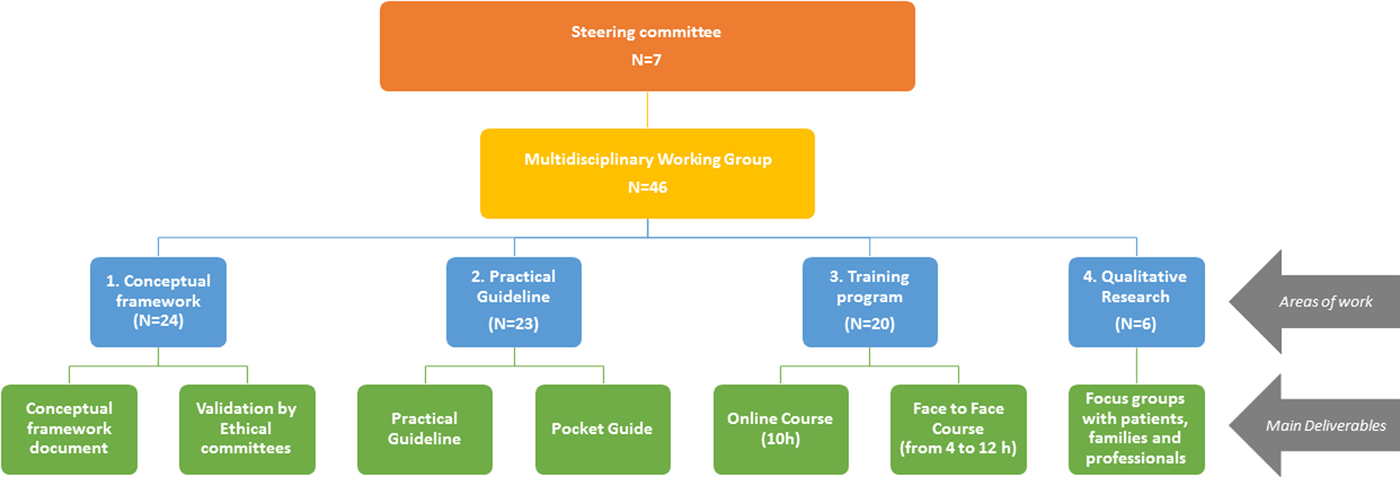
As shown in Figure 1, a steering committee, composed of members from the CMH and the CPC-University of Vic, defined the areas of work to be performed and the materials to be created, including a preliminary calendar. The committee agreed on the following deliverables: (1) development of a conceptual framework document, (2) development of practical guidelines, (3) creation of a training program, and (4) development of focus groups to obtain input from patients and family members to validate the ACP approach. The steering committee established the following fundamental criteria for the program: (1) patient-centered, (2) based on a review of existing international ACP programs, (3) citizen involvement, and (d) strong representation of professionals from all areas and levels of health and social care, and congruence with existing care policies for patients with advanced chronic conditions and complex needs in Catalonia.
Implementation process of the Catalan advance care planning program.

Phase 2: Select professionals and creae multidisciplinary working group to define the project deliverables
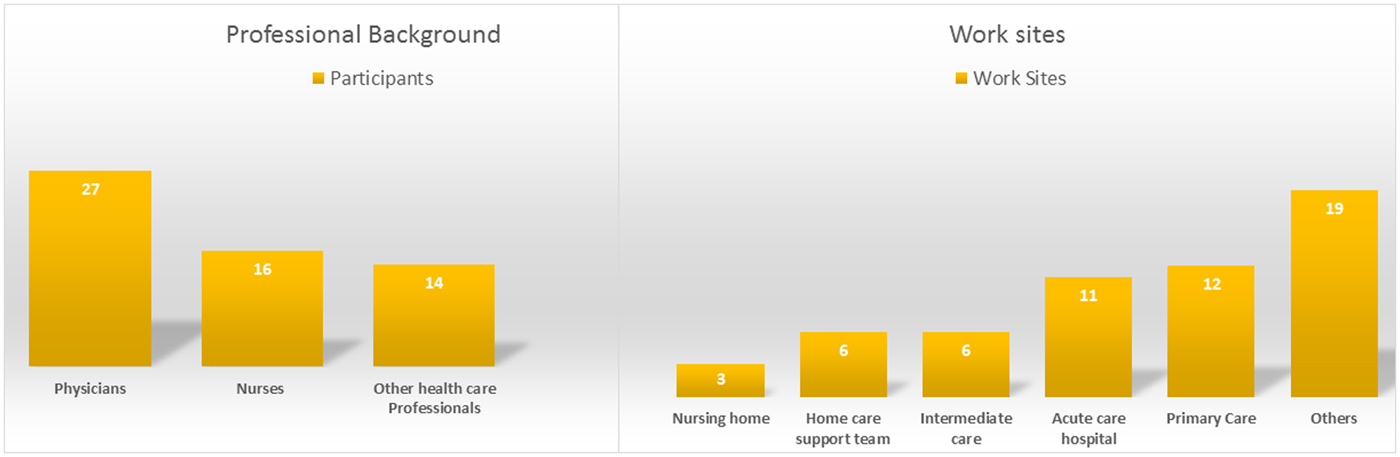
Members of the working group were selected according to the following criteria: (1) extensive professional experience; (2) representative of the entire region of Catalonia; and (3) professional qualifications and experience in a related field. Initially, a working group of 57 professionals from a wide variety of fields were identified (Figure 2), including medicine, nursing, social work, academics, bioethics, psychology, law (recognized experts in legal and end-of-life processes), philosophy, and anthropology.
Professional background and workplaces of the healthcare professionals in the advance care planning working groups.

All of the selected professionals were invited to participate in the working groups and to attend the official presentation of the project (held April 2, 2014), where the project aims were presented.
Phase 3: Create four working subgroups to carry out the project deliverables
1) conceptual framework document, 2) practical guidelines, 3) training program, and 4) description of the qualitative research to be performed with focus groups of patients and caregivers. First, all 57 professionals of the working group were surveyed to determine their area of interest and then assigned to a subgroup based on their responses. All of these professionals were assigned to at least one of the four working subgroups (some professionals members asked to be assigned to more than one group). The distribution of these professionals is shown in Figure 2. A total of 46 professionals were finally included in the program. The remaining eleven professionals were excluded for failing to respond to the survey or failing to participate in any of the groups.
Phase 4. Development and implementation of project-related deliverables and actions
In each subgroup, one or two members were asked to serve as internal coordinators. The coordinators attended all working sessions and ensured that the minutes of the meetings, including all key points and decisions made, were recorded. They also reported on any agreements reached and progress made in developing the deliverables. All subgroups combined face-to-face meetings with online work. The meetings were based on open discussion and deliberative processes. Various web-based tools were used for communication and collaborative work on the documents. The coordinator was responsible for producing a consensus-based document from the contributions of all group members. After the final deliverables were completed and approved by the group, they were shared with professionals external to the project for an objective evaluation and to determine the feasibility of implementing the proposals in real-world clinical practice. The input from all participating professionals was considered, thus helping to improve the final documents.
Finally, two of the deliverables—the conceptual framework document and the practical guidelines—were submitted to the regional Bioethics committee and to the Social Services Ethics committee for formal evaluation and approval. Validation by the committees was considered essential. Both committees approved the proposal at a joint meeting held in June 2015. At that meeting, committee members specifically emphasized that the ACP must avoid any financial incentives or management agreements to ensure that the aim of the ACP—to improve healthcare—was respected and maintained through strong guarantees of ethical integrity.
Results
Here we provide the results for three of the four working groups. Outcomes of the focus groups will be reported in a future publication.
Conceptual framework document
The working group spent 6 months to develop the conceptual framework document. This process involved four face-to-face meetings and online contributions from all members of the working subgroup.
After careful deliberation and reflection, the proposed consensus of the Catalan definition of ACP is the following:
Advance care planning is a deliberative, structured process whereby a person expresses his/her values and preferences and, in accordance with these values, defines and plans—in collaboration with family members and health care professionals—the type of treatment he or she wishes to receive when faced with clinical complexity or a serious illness that is expected to occur within a specified and relatively short period of time, or at the end of life, especially in circumstances where the person is unable to make this decision.
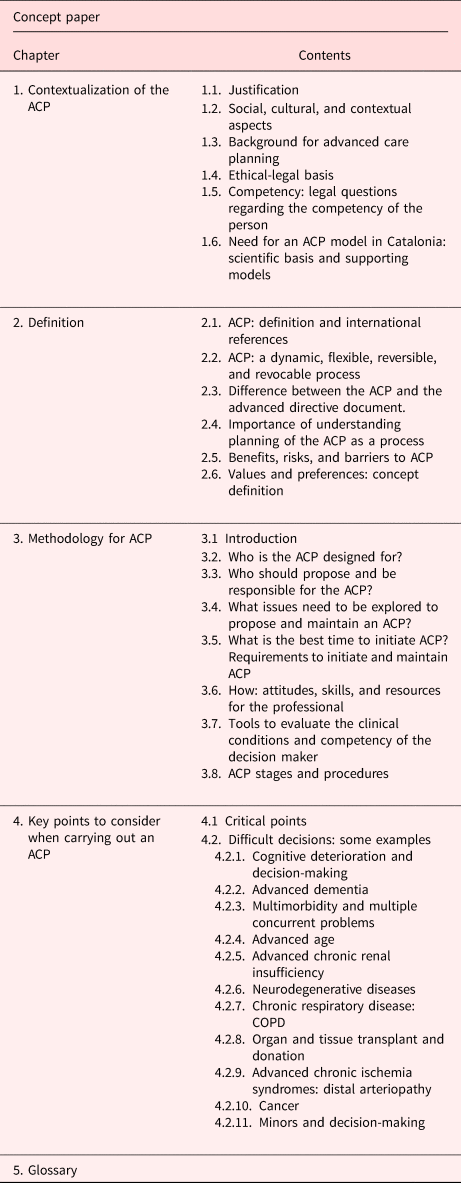
Once the document was finalized and evaluated by external reviewers, the Catalan version was published on the website of the Catalan Department of Health (http://salutweb.gencat.cat/web/.content/home/ambits_tematics/linies_dactuacio/model_assistencial/atencio_al_malalt_cronic/documents/model_pda_definitiu_v7.pdf). The contents of the full document are provided in Table 1.
Contents of the Catalan ACP conceptual framework document

ACP, advance care planning; COPD, chronic obstructive pulmonary disease.
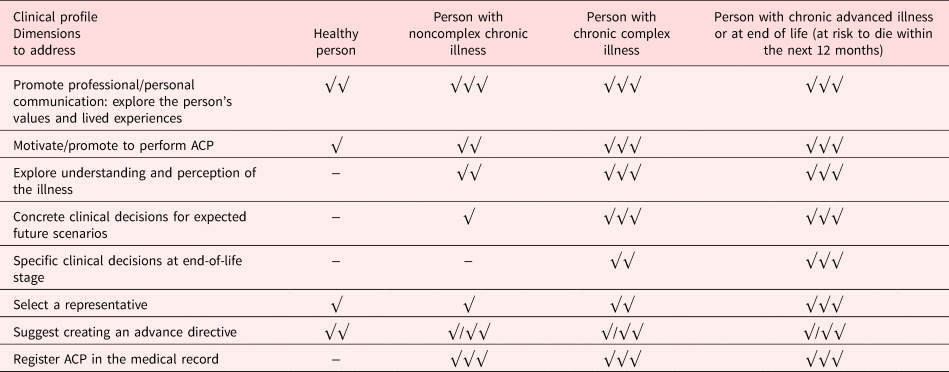
The conceptual framework document includes a table to define which dimension should be emphasized in the ACP approach according to patient's clinical profile. For example, AD are highly recommended in early stage disease but not in advanced cases (Table 2).
Dimensions of the ACP and level of recommendation by clinical profile

ACP, advance care planning; √, introduce the topic; √√, recommended; √√√, highly recommended
The figure of the “facilitator” is internationally recognized as the person responsible for initiating and conducting ACP conversations. However, the presence of such a person did not fit the Catalan model of care provision, which is why this figure was not included in the definition of the model. This decision generated much debate among members of the working group.
Practical guidelines for application of the ACP
The main objective was to create a practical document to guide ACP implementation. The guidelines were based on international programs and models and on the conceptual document. Six working meetings were held, in addition to online collaborations. The approach to developing these guidelines was similar to that used to develop the conceptual framework document, including validation by external reviewers (http://salutweb.gencat.cat/web/.content/home/ambits_tematics/linies_dactuacio/model_assistencial/atencio_al_malalt_cronic/documents/arxius/guia_pda_definitivav11.pdf).
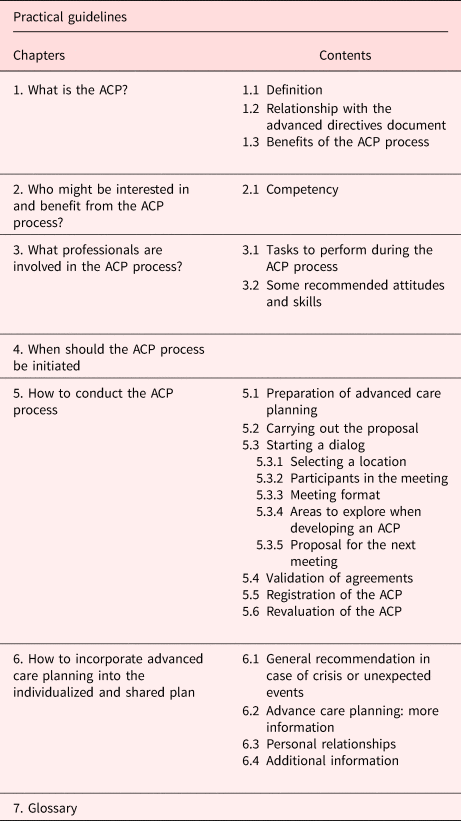
The contents of the Practical Guidelines are shown in Table 3. These guidelines define the ACP as a six-step process, as follows: (1) preparation for the ACP process, (2) proposal, (3) initiation of dialog, (4) validation, (5) registration (in the clinical records), and (6) reevaluation.
Practical guideline for the application of ACP

ACP, advance care planning.
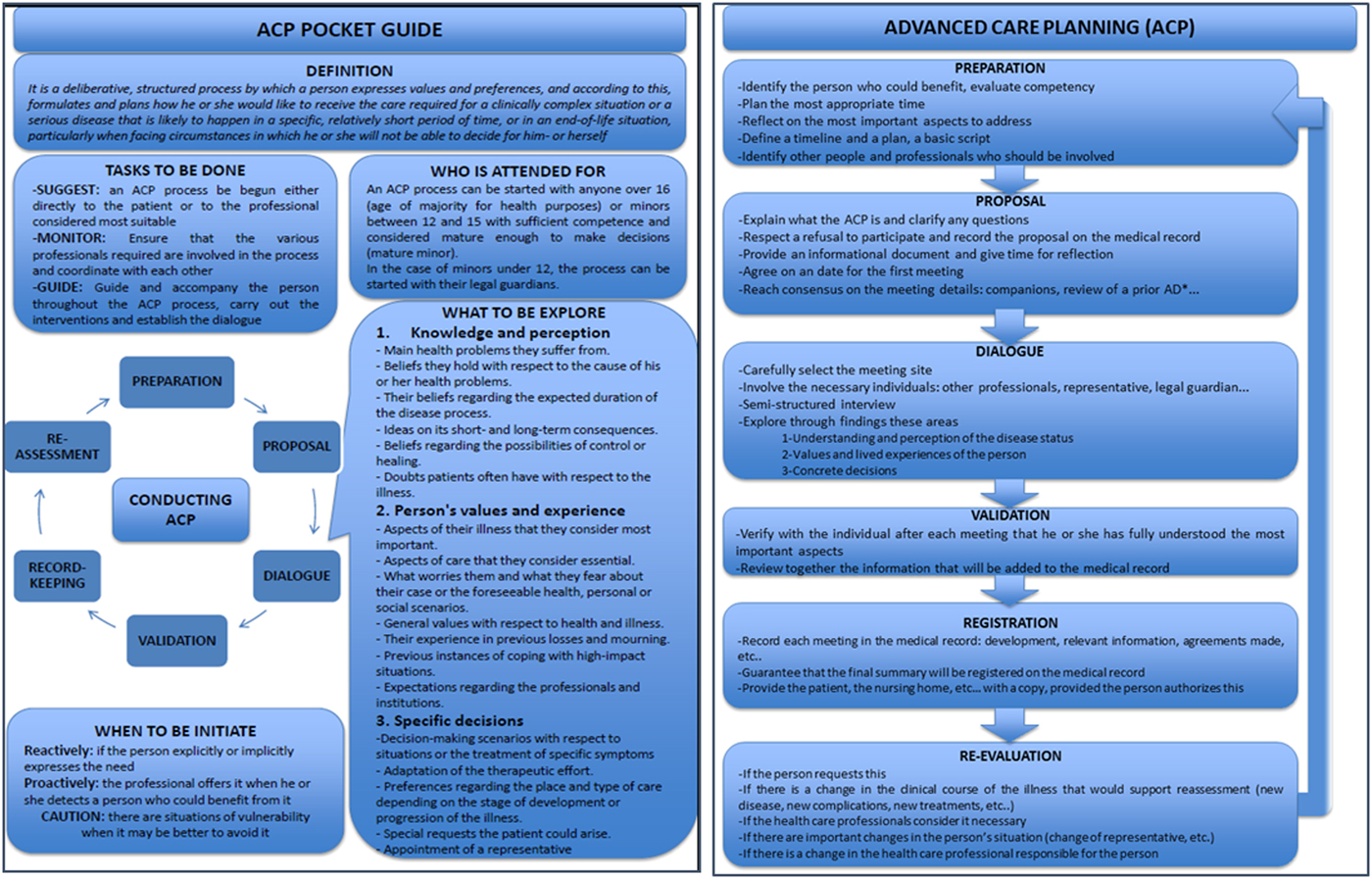
To simplify and better structure the content of the ACP and to facilitate dissemination, an abbreviated pocket version of the ACP process has also been created (Figure 3). This brief version includes all the main aspects of the ACP, including the ACP cycle (the six-step process) and the dimensions to be explored during the dialog phase.
Advance care planning pocket guide.
Training program
After the conceptual document and the practical guidelines were completed, the working group tasked with developing and delivering the ACP training program followed the same methodology as the other working groups. The main objectives of the training subgroup were: (1) to develop a training proposal consistent with the ACP definition, (2) define the most appropriate methodology to carry this out, (3) cover all ACP-related training needs identified, (4) identify the professionals who should receive training, and (5) define the appropriate training levels according to the distinct roles and tasks of the professionals involved in the ACP process.
The learning objectives identified in the ACP training program were as follows:
• To identify the basic aspects of ACP: definition, concept, and ethical and legal aspects
• To reflect on the importance and/or benefits of ACP
• To identify opportunities and challenges in implementing ACP
• To understand effective communicative strategies to initiate ACP
• To appropriately register the relevant data obtained from ACP
Two types of training programs (i.e., online and classroom-based) were developed to provide different options to meet the main objectives of the training program and to suit the varying needs the different professional groups. The online course provides a general introduction to the concept of ACP and was recommended for all professionals. Classroom-based training, by contrast, was designed for professionals with a specific clinical role with advanced chronic patients. The online course is a part of the strategic implementation of ACP.
Online training
A web-based course (10 contact hours) was created. This course includes theoretical contents as follows: the ACP definition; ethical and legal aspects; barriers and opportunities to ACP and the ACP process (which are well-described in the Pocket Guide). The course also includes audiovisual materials with several simulated clinical cases (i.e., case studies) depicting common clinical scenarios encountered in patients with advanced chronic diseases; this part of the course also describes how to introduce a discussion of ACP with these patients in routine clinical practices. This open-access training is offered to primary care professionals (physicians, nurses, psychologists, and social workers) and to professionals working in nursing homes, intermediate care facilities, and hospital care (public-private collaborative institutions). To encourage professionals to become involved in training, specific economic incentives, which were directly related to the National Plan Strategy 2016–2010, were established between the public and the private collaborative institutions and the CMH.
The aim of the online training program is primarily to provide a basic understanding of the key components of the ACP. The materials are based on training needs identified in international and national publications (Carrero Planes et al., Reference Carrero Planes, Navarro Sanz and Serrano Font2016; Detering et al., Reference Detering, Silvester and Corke2014; Granero-Moya et al., Reference Granero-Moya, Frías-Osuna and Barrio-Cantalejo2016). The course is accredited by the Catalan Council for Continuing Education of Healthcare Professionals, a nationally recognized body.
The online course started in October 2016. At the end of 2017, a total of 3,763 professionals had completed the course. Data on the professional profiles of the participants are not fully available, but the following estimates are listed:
• 94% were nurses and doctors;
• 6% were social workers, mostly from social services
• 66% were employed in primary care services
• 44% were employed at intermediate care or hospital services
The initial participant evaluations of the online course (obtained through an ad hoc posttraining satisfaction survey) were encouraging (mean score, 8.4 of 10), especially for the audiovisual contents and case studies. One area for improvement noted by some participants was the lack of visual examples for difficult-to-manage cases. Qualitative evaluations indicate that the contents are adequate and explain the ACP concept well, thus establishing a baseline level of knowledge of the subject while motivating participants to learn more (Box 1).
Qualitative evaluations about the ACP taining program
• “The course has been very useful to clear up some doubts that I had, especially in terms of questions about the legal aspects. It offers a very practical overview of the steps involved in the ACP. I would recommend it to anyone who is interested in this new model of care, which focuses on the care of chronic patients.”
• “I think it is essential to receive ongoing training in order to make the ACP useful for patients. I loved the material”
• “All professionals should take this course. It provides an overview of the ACP, making us aware of its importance and motivating us to implement it”
• “The course was well-organized, and the method made it easy to understand the course contents, motivating me to want to learn more than just the basic material provided in the course. In addition, it made me think a lot about the type of patients in my area of work that could benefit. Some of the things that I did not understand before are now much clearer.”
ACP, advance care planning.
According to projections developed in the Health National Plan (2016–2020), by the end of 2020, most health and social care professionals in Catalonia will have completed the online course.
Classroom-based training
The suggested number of contact hours for this course ranges from 4 to 12 hours, combining the contents acquired in the online course with an eminently practical classroom methodology that includes: (1) communication skills, (2) ethical aspects, and (3) barriers to ACP implementation. The methodology of the course is based on open discussion, theoretical review of the online content, and simulation of clinical-based scenarios (case studies). As of December 2017, the CPC had organized a total of two 12-hour courses and four 4-hour workshops in Catalonia, and two four-hour workshops in other regions in Spain. These brief training sessions are not considered a formal part of the implementation process, but rather were developed at the specific request of some institutions.
In general, with regards to the classroom-based training, ACP is welcomed as a necessary and useful process, but one that requires good training and a clear explanation of how it will be implemented. The many doubts and concerns of the professionals responsible for implementing the ACP process are addressed in detail in the training sessions.
Other ACP-related training and dissemination activities
After the initial rollout of the Catalan ACP program, several additional actions have been carried out. In 2016, the Catalan Institute of Health—a public institution—encouraged primary care teams to help promote awareness of ACP in primary care centers. A wide range of additional activities were also undertaken, including media interviews, informational and educational presentations, and dissemination of informational materials.
The CPC has organized three one-day symposiums about ACP, the first of which took place in 2014. Professionals from around Europe shared their initial experiences in implementing an ACP. Diverse models of integrated palliative care were described and several different ideas on how to develop a comprehensive palliative care approach were presented (Gómez-Batiste et al., Reference Gómez-Batiste, Murray and Keri2017). The second meeting was held in February 2017, with a focus on the specific experiences in implementing the ACP at the national level. More than 200 people attended, mostly from Catalonia but also from the rest of Spain. Participant satisfaction was high (4.5/5). This meeting demonstrated a strong, broad-based interest in ACP, underscoring the need for training as the ACP becomes more widely known. A third meeting was organized in June 2017 in southern Catalonia by request from a local institution that wanted to introduce the ACP to the health and social care professionals.
Finally, the Spanish ACP working group was created in November 2017. Several leaders of the Catalan ACP program are involved in that group.
Discussion
Development of the Catalan ACP program began in 2014, part of a broader process aimed at caring for people with chronic conditions and complex needs. The ACP project integrated international recommendations for successful ACP implementation, taking into account the need to incorporate ACP within the existing model of care framework, which already included health policies that defined ACP as central to the model.
One of the particularities of the program was to integrate ACP into different levels of care, mainly primary care, as a population strategy to provide coverage to all advanced chronic care patients. One the most successful international program—the Respecting Choices program—is a good example of how an ACP can be integrated into the existing healthcare and social care systems. The success of that program is, at least in part, due to the role of the facilitator. However, given our local context, this figure was not considered appropriate in Catalonia. Moreover, it is important to note that the Respecting Choices program has not been compared with other international programs (MacKenzie et al., Reference MacKenzie, Smith-Howell and Bomba2018), and there are no references about similar experiences in non–Anglo-Saxon countries. However, other experiences in large health systems that target specific pathologies (Biondo, Reference Biondo, Lee and Davison2016; Schellinger et al., Reference Schellinger, Sidebottom and Briggs2011;) or in specific settings such as nursing homes or residences (In der Schmitten et al., Reference In der Schmitten, Rothärmel and Mellert2011; Overbeek et al., Reference Overbeek, Korfage and Jabbarian2018) have been reported. The Catalan model is a comprehensive ACP proposal that includes a systematized process in which data are collected and registered in the clinical records to make these data visible for all healthcare professionals at all levels of care in Catalonia; however, this is part of the complexity of this program.
The main outcomes of ACP programs are positive in terms of improving awareness of the ACP, concordance with EOL wishes, and understanding of EOL preferences. As Weathers et al. (Reference Weathers, O'Caoimh and Cornally2016) stated “more discussions regarding EOL care took place as a consequence of ACP interventions.”
An important aspect of ACP implementation identified in international studies is to understand ACP as a dynamic process (Fried et al., Reference Fried, Bullock and Iannone2009). The aim of the ACP is not only to explore a person's preferences and values to develop a care plan for the future (when the person can no longer decide for him or herself), but also to promote a change in the healthcare culture in the present, so that the individual feels listened to and respected in their most relevant beliefs and preferences (Sudore et al., Reference Sudore, Lum and You2017). Most of the time, more than one meeting is required to explore these aspects. The Catalan ACP program has always been centered on this premise, which explains the community focus (primary care teams and nursing homes) of the ACP, where the continuum of care is easier. In 2011, Busquets et al. (Reference Busquets i Font, Hidoine de La Fuente and Lushchenkova2014) conducted a survey of 1,400 Catalan citizens to assess their knowledge of AD. The respondents in that survey considered the ACP to be a highly important (8.4 on a 10-point scale) to care for people at the EOL. That study is important because it revealed what citizens think about the shared decision-making process. The main axis of the ACP is to change the culture of healthcare delivery. This implies the need for a multilevel strategy that includes not only current participants, but also the general population. For this reason, the focus must be on training and education to promote engagement with the ACP process among professionals, patients, and families.
A key to successful implementation of the ACP is to develop quality training programs focused on developing communication skills and shared decision-making. Such training programs should emphasize the management of complex ethical–clinical situations in routine clinical practice and be specifically adaptable to the role of the professionals involved. Most of the international programs have developed different levels of training adapted to the varying roles of the professionals involved. Similar to the Catalan ACP, these other ACPs seek to involve patients in the development of the ACP as much as possible (Duckworth & Thompson, Reference Duckworth and Thompson2017). The preliminary outcomes of training implementation in Catalonia are consistent with other previously reported international experiences.
Finally, we believe that leading healthcare and social institutions have a responsibility to promote and lead this change, and these institutions should help to facilitate implementation of the ACP at both the macro and micro levels. Although quality professional training is important, it is not enough; we need to develop models of care that are responsive to the ACP, to promote changes in the organization of services and teams that facilitate care coordination, to develop tools to make the ACP-related data accessible to all professionals involved in the ACP but also to the patients themselves. To assure optimal implementation of the ACP, it is essential to establish both quantitative and qualitative evaluation indicators, which should adhere as closely as possible to standard ACP indicators (Biondo et al., Reference Biondo, Lee and Davison2016).
After three years of work in Catalonia, awareness of the ACP has grown tremendously, along with the realization that all professionals involved in the ACP need specific training. The broad-based approach described in this document should be the starting point to implement any ACP program.
To conclude, we highlight the most important aspects of the Catalan ACP program discussed in the present document, as follows:
• The multidisciplinary perspective in building the ACP program, including social aspects
• Collaboration among health and social care professionals, academic researchers, and other disciplines
• ACP as a key element of the patient-centered care model of the Catalonian National Health Service (Catalan Ministry of Health, 2016)
• Evaluation and validation of the ACP definition by ethics committees
• Qualitative approaches of ACP perceptions through focus groups consisting of citizens, patients, and caregivers.
• Systematic registration of the ACP process in patients with chronic conditions and complex needs, with all information included in the patients’ medical l records and accessible to all public health system professionals.
• A willingness to assess the impact of the program on professionals, patients, and caregivers.
All of these elements have been reinforced by the support of the CMH, which has instituted policies to guide the development and implementation of the ACP. This implementation framework has proven valuable to other institutions in the process.
Awareness of ACP is still relatively limited around the world, and many professionals are unsure of how to talk with patients about EOL. However, because of the initiatives described in this paper, most professionals in Catalonia—especially those working in community services—are now aware of the existence of the ACP. Moreover, as the Catalan ACP program has been rolled out, these professionals are more willing to initiate ACP conversations with their patients. However, efforts are needed to accurately measures the outcomes related to ACP implementation in order to refine the ACP program in the coming years.
Limitations
The Catalan ACP model was developed in 2014. After two international consensus meetings (Sudore et al., Reference Sudore, Lum and You2017, Rietjens et al., Reference Rietjens, Sudore and Connolly2017), the definition of ACP has become clearer and widely accepted. After an initial evaluation of the Catalan ACP program, it is clear that the program will need to be improved by integrating recent findings on best practices for ACP implementation in multilevel systems.
Implementation of the ACP depends on many factors and participants, as our experience has shown. The aim is to achieve a broad-based implementation of the ACP in the region. The CPC-University of Vic has coordinated the development of the basic materials for this implementation; however, from this point on, the responsibility for implementing the ACP now lies with the institutions. In Catalonia, the wide variability of healthcare resources has proven to be a barrier to developing the Catalan ACP program; this variability also poses difficulties in defining the optimal indicators to assess quality. At present, data are not yet available regarding the implementation status of the Catalan ACP, nor do we know if the steps taken to date have improved quality of care. Based on preliminary data, most of the professionals who took the online course are primary care professionals.
Small regions, or regions in which resources for healthcare delivery are homogeneous (only public or a few private collaborative resources), may be able to achieve a more controlled implementation process. However, large, heterogeneous regions such as ours will require many more specific strategies. In this sense, a broad range of general qualitative and quantitative indicators are needed to assess the impact of the ACP program, particularly the impact of the training program, data registration on electronic records, and improvements in quality of life among patients and families.
Acknowledgments
This article describes the initial process of preparing the basic materials needed to implement the Catalan advanced care planning (ACP) program and to generate proposals to apply ACP based on varying levels of patient complexity. The main challenge for the future is to integrate ACP for patients with advanced chronic conditions and complex needs into routine clinical practice and to assess the impact of a cultural change on health and social care professionals and on the general population. We thank all the members of the Working Group of the Catalan ACP program for their participation and commitment to carrying out this project; all of the people that reviewed and validated its content; these institutions for their support in the implementation of the program: the general management of the Catalan Institute of Oncology and the Catalan Ministry of Health; all the participants regarding elaboration of the training materials, especially the online course: Assumpció González, Laura Vila, Paloma Amil, Bernabé Robles, Dolors Torremorell, Begoña Román, Joaquim Julià, Pilar Loncán, Sonia González, Francisco Cegrí, Esther Limón and Raquel Paz; Memora, a funeral services company, for its commitment to help with the development of training at all levels, especially in organizing academic conferences; and Bradley Londres for translating and editing this document.
Conflict of interest
The authors have no conflicts of interests to declare.