A defining debate between empiricist and nativist researchers is whether grammatical knowledge is exclusively the product of lexical development or whether there exist innate grammatical constraints, independent of the lexicon, that are respected in children's language from the earliest point at which they can be measured. Correlations between lexical development and grammatical development have been well documented and must be part of the explanation of how children develop language (Bates, Bretherton, & Snyder, Reference Bates, Bretherton and Snyder1988; Bates & Goodman, Reference Bates and Goodman1997; Fenson et al., Reference Fenson, Dale, Reznick, Bates, Thal and Pethick1994). As has been noted elsewhere (e.g., Grinstead, Reference Grinstead2000), however, this does not necessarily mean that grammatical development consists of lexical development only, with no independent role for grammar, because, among other things, most approaches to generative grammar (e.g., Bresnan, Reference Bresnan2000; Chomsky, Reference Chomsky1995; Pollard & Sag, Reference Pollard and Sag1994) assume that critical elements of the grammar exist in the lexicon, even in open class elements. For this reason, independent measures of grammar and lexicon are difficult to disentangle. In contrast, approaches to generative grammar also standardly assume that there are linguistic constraints that constitute a limiting function on the kinds of constructions that can be composed from the lexicon. Such constraints, at least on some accounts, are not viewed as part of the lexicon, but rather are assumed to be independent components of grammar that govern the computational system and should therefore be in effect from the earliest point at which they can be measured.
We will explore what 3-, 4-, and 5-year-old English-speaking children know about the relationship between verb finiteness and the case of pronouns that occur in subject position. As we will see, the elements in the scenario are lexical. Children must develop a lexical representation of the pronominal paradigm of English in this instance. Further, they must develop a lexical representation of verbs and of the finiteness morphemes with which they concatenate. To anticipate our conclusion somewhat, we will also argue that it is likely that not all of the apparently finite verbs in children's grammars are compositional, but rather that some are memorized unitary forms, and that some of these forms may be nonfinite.
In contrast, there is also a grammatical element in the scenario, which is the contingency between finite verbs and nominative case pronouns in subject position. This contingency was first expressed as the case filter in work by Jean Roger Vergnaud in Rouveret and Vergnaud (Reference Rouveret and Vergnaud1980) and in Chomsky (Reference Chomsky1981). The idea is that there is a grammatical principle that requires all noun phrases to receive case and that subjects must receive it from finiteness marking on verbs. Turning to developmental linguistics, the operation of the case-finiteness contingency obviously cannot be observed until children know something of the finiteness marking and pronominal case forms of their language, acquired through lexical development. Consequently, in the experiments reported on in this study, we will try to measure whether children respect the principle, originally embodied in the case filter, even before they have acquired adult like knowledge of verb finiteness. If they do, it will be evidence that the principle is in effect, independently of having developed such lexical knowledge. An important conceptual advantage of this view, over a more atheoretical view, is that the development of pronominal case marking is viewed as a function of the development of verb finiteness. As pronominal case marking in subject position is theoretically a reflex of the case features associated with verb finiteness markers, the development of adult like subject pronouns can be parsimoniously derived as a function of verb finiteness development. This explains why the development of case marking is gradual, as it reflects the development of finiteness marking, which is also gradual.
An important advance in our understanding of how case develops in child English has been Rispoli's (Reference Rispoli2005) observation that children's knowledge of the pronominal paradigm interacts with their knowledge of verb finiteness. In particular, he shows that before they mark finiteness correctly at least 60% of the time, their grasp of the pronominal paradigm matters for how many case errors they make and that after this point, it does not. Following Rispoli, we investigate children who are predominantly beyond the 60% correct finiteness level to determine whether case and finiteness are linked at this level. Rispoli's spontaneous production data suggest that they are. In this study, we attempt to cross-validate this finding using a receptive, grammaticality judgment measure. If children are shown to obey the constraint at this level, in the absence of independent lexical growth in the pronominal paradigm, it will be consistent with the hypothesis that the principle underlying case theory is active. Finally, if such a constraint appears active in children with less than adult like judgments of verb finiteness, it will be consistent with the hypothesis that this constraint is active independently of the lexical development that must underlie children's eventual acquisition of adult like verb finiteness and pronominal case marking.
THE PUZZLE
Some child English speakers produce nonnominative pronouns in subject position, as has been noticed at least since Gruber (Reference Gruber1967), illustrated by the following “b” subentries examples, from the speech of Mackie, between the ages of 2 years, 2 months (2;2) and 2;5 (Gruber, p. 53).
-
(1) a. I wanna.
-
b. Me wanna truck.
-
(2) a. He take the wheel, fire engine.
-
b. Me take the wheel.
-
(3) a. I show you?
-
b. Me show you?
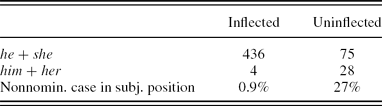
However, the optionality of the nonnominative case marking on these pronouns, illustrated by the “a” subentry examples taken from the same recording sessions, does not appear to be random but rather appears to follow a pattern. Such a pattern is illustrated in Table 1, in data from seven of the eight typically developing children reported on in Loeb and Leonard's Reference Loeb and Leonard1991 study, compiled by Schütze (Reference Schutze1997, their table 6, p. 222).Footnote 1
Finiteness versus case for seven of Loeb and Leonard's (Reference Loeb and Leonard1991) normal subjects

As the second column of the table shows, nonnominative subject pronouns him and her occur rarely with “inflected” or finite verbs in the speech of typically developing English-speaking children, while nominative case pronouns he and she may occur with either inflected or uninflected verbs. A range of empiricist and nativist theoretical proposals have been put forth to explain these patterns. The main goal of this paper is provide a different kind of empirical evidence for evaluating these theories.
CASE THEORETIC APPROACHES AND THE AGREEMENT TENSE OMISSION MODEL (ATOM)
For those familiar with generative syntactic theory, the first explanation for this pattern that likely leaps to mind is the connection between verbal finiteness marking and subject (nominative) case, proposed in Rouveret and Vergnaud (Reference Rouveret and Vergnaud1980), formalized by Chomsky (Reference Chomsky1981) as the case filter, and further developed as case theory by, for example, Marantz (Reference Marantz1991), Chomsky and Lasnik (Reference Chomsky, Lasnik, Halbband and Vennemann1993), Harley (Reference Harley1995), and Jonas (Reference Jonas1995), among many others. This conclusion has been pursued by multiple researchers working in the generative developmental linguistics tradition (e.g., Aldridge, Reference Aldridge1989; Guilfoyle & Noonan, Reference Guilfoyle and Noonan1992; Radford, Reference Radford1990; Vainikka, Reference Vainikka1993–1994). The fundamental idea is that a grammatical property of all noun phrases requires that they must receive abstract case in order to occur. In this theory, the way that subject noun phrases, including pronouns, receive abstract case is by virtue of their relationship with the finite properties of the verb (tense and/or agreement) with which they co-occur. In this way, case theory attempts to account for patterns of subject occurrence such as the following:
-
(4) He left early.
-
(5) * Him left early.
-
(6) For him to leave early would be a good idea.
-
(7) * For he to leave early would be a good idea.
By case theory, (4) is grammatical because the nominative case subject co-occurs with the finiteness features of the finite verb “left.” In contrast, (5) is ungrammatical because the nonnominative case pronoun him does not need to co-occur with a finite verb for case checking, but rather must co-occur with a preposition, which can check its oblique case features, as in (6). Notice that in (6), the nonfinite verb to leave would appear to lack the finiteness features necessary to make a nominative subject, such as he, grammatical. As a consequence, the sentence is only grammatical because the preposition for checks the oblique case features of the oblique case pronoun him. In (7), the nominative case pronoun he cannot get its nominative case features checked, because it is not in a structural relationship with a finite verb, resulting in the ungrammaticality of the sentence.
In summary, case theory was designed to explain, among other things, the co-occurrence patterns of nominative case subjects with finite verbs, as in (4), and the occurrence of nonnominative subjects with nonfinite verbs, as in (6). Because child English speakers pass through a stage known as the optional infinitive stage (cf., Wexler, Reference Wexler, Lightfoot and Hornstein1994, Reference Wexler1998), in which children optionally mark finiteness on verbs, generative syntactic theory predicts that children's grammars should require nominative case pronouns when they produce finite verbs, but not require them when they produce nonfinite verbs.
This does not explain, however, why nonnominative pronouns should be able to occur with nonfinite verbs, in the absence of a preposition. To answer this question, for situations in which pronouns occur without an obvious case assigner in adult English, Akmajian (Reference Akmajian1984) suggests that languages have a default case that is assigned when no case assigner is present. Researchers have taken this to mean that in the absence of a case assigner, such as verb finiteness or a preposition, adults will produce pronouns in this default case. Examples are usually given from pronouns that occur in isolation or with no potential adjacent case assigner.
Examples such as (8a) are sometimes referred to as “Mad Magazine Sentences.” These contain no finiteness marker on the verb and are most similar to child English nonfinite sentences. There are other contexts as well, however, that lack any obvious case assigner, such as those illustrated in the sentences in (9) and (10). Notice that default case can vary across languages, and while the default appears to be the accusative in English, it appears to be the nominative in, for example, Spanish,Footnote 2 as illustrated in the “b” subexamples in the following sentences.
-
(8) a. What, me worry?
-
b. ¿Qué? ¿ Yo preocuparme?
-
(9) a. Who took the cookies from the cookie jar? Me!
-
b. ¿Quién se llevó las galletas? ¡Yo!
-
(10) a. Her in a karaoke bar is what we have to avoid.
-
b. Ella en un bar de karaoke es lo que tenemos que evitar.
Part of Schütze and Wexler's (Reference Schütze and Wexler1996) ATOM hypothesis, then, is that default case steps in to assign default accusative case to subjects, when finiteness is not sufficient (i.e., does not contain agreement, for ATOM) to get the job done.
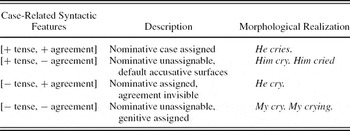
This, of course, raises the question of what a finite and a nonfinite verb look like in child language. Many constructivist studies, for example, do not assume that verbs marked for finiteness are necessarily finite in the adult sense (e.g., Pine, Lieven, & Rowland Reference Pine, Lieven and Rowland1998; Rojas-Nieto Reference Rojas-Nieto and Grinstead2009), but rather may be “frozen forms” or holophrases. Child language researchers working in the generative paradigm have made similar suggestions (e.g., Sano & Hyams, Reference Sano and Hyams1994). ATOM makes a particular set of claims about what a finite verb consists of by virtue of its assumptions regarding the correspondence of syntactic case-related finiteness features to morphological features, illustrated in Table 2.
Possible correspondences between case-related syntactic features and morphological representations of pronouns

Note: Compiled from Schütze and Wexler (Reference Schütze and Wexler1996, pp. 678–679).
The highlights of the ATOM theory could be summarized as follows: it assumes that finiteness and case are linked, following case theory, that some finiteness markers represent agreement while others represent tense and that the presence of third-person singular –s marking on a verb makes co-occurrence with a nonnominative subject impossible. In response to Schütze and Wexler's (Reference Schütze and Wexler1996) proposal, a series of constructivist studies have attempted to empirically falsify it, fundamentally by attempting to show counterevidence to the third premise of ATOM, that third singular –s may not occur with nonnominative pronominal subjects.
SPONTANEOUS PRODUCTION DATA, THIRD-PERSON SINGULAR –S AND NONNOMINATIVE PRONOMINAL SUBJECTS
According to most of the constructivists who have argued against ATOM (Ambridge & Pine, Reference Ambridge and pine2006; Pine, Joseph, & Conti-Ramsden, Reference Pine, Joseph and Conti-Ramsden2004; Pine, Rowland, Lieven & Theakston, Reference Pine, Rowland, Lieven and Theakston2005), the main obstacle to showing counterevidence to ATOM's claim, that nonnominative subject pronouns should not occur with finite verbs, seems to be that not all children produce enough nonnominative subject pronouns in the spontaneous data they consider to be able to test the claim. Pine et al. (Reference Pine, Joseph and Conti-Ramsden2004), for example, examine the transcripts of four English-speaking children with specific language impairment, from the Manchester SLI Corpus (Joseph, Serratrice, & Conti-Ramsden, Reference Joseph, Serratrice and Conti-Ramsden2002), to determine whether any of the children use nonnominative subject pronouns with third-person singular verbs significantly less than chance. One child (Bonnie) uses no nonnominatives at all and is excluded. Another (Harry) uses fewer than chance, but he uses very few overall tokens of nonnominative pronouns, even with nonagreeing verbs (n = 3), so his data is also not informative. The two children who do use some number of nonnominative pronouns with third-person singular verbs, Dan (n = 2) and Nathan (n = 10), actually use them significantly less than chance, as ATOM would predict. Looking in greater detail, however, Pine et al. show that the nonnominative pronouns that occur with finite verbs in the speech of Nathan and Dan both occur with uncontracted verb forms.
Pine et al. (Reference Pine, Rowland, Lieven and Theakston2005) examine the data of the 12 children from the Manchester Corpus (Theakston, Lieven, Pine, & Rowland, Reference Theakston, Lieven, Pine and Rowland2001), to test a similar question and find that only 3 of them produce enough nonnominative case subject pronouns to be considered and that they use them at rates lower than 10%, as ATOM would predict. They then show, however, that while masculine nonnominatives with third-singular present verbs are not used significantly above 10%, feminine nonnominative pronouns are, for Gail (9/23 = 39.1%), Becky (13/39 = 33.3%), and Anne (4/12 = 33.3%), which they take to be counterevidence to ATOM. As in Pine et al. (Reference Pine, Joseph and Conti-Ramsden2004), they also find that two of the children use nonnominative pronouns with uncontracted verbs significantly more than 10%, for Anne (3/4 = 75%) and Becky (6/19 = 33.3%).
Ambridge and Pine (Reference Ambridge and pine2006) use an elicited imitation task to test children's accuracy at repeating nominative case pronouns with agreeing verbs to determine if they will produce more than 10% with nonnominative case pronouns and agreeing verbs. Of the 24 children they initially test, 5 produce nonnominative case pronouns with agreeing verbs. The remaining 19 produce no nonnominative case pronouns with agreeing verbs, which would appear to constitute support for ATOM. Ambridge and Pine, however, continue to test the 5 children who did produce nonnominatives with agreeing verbs with the rationale that only those children who produce nonnominatives can be further tested for nonnominative subject pronoun use with third-singular verbs. On this variant of the same test used for screening, they find that three of the five children use more nonnominative pronouns with agreeing verbs than predicted by chance, which they take to be evidence against ATOM.
It is interesting to note that the choice to work only with the children who produced nonnominative pronoun subjects in the screening procedure would seem to imply that the other 19 children (79%) did not have a grammatical option to use nonnominatives with agreeing verbs. A similar tacit assumption would appear to be at work in Pine et al. (Reference Pine, Rowland, Lieven and Theakston2005), where the longitudinal transcripts of 9 of the 12 children (75%) could not be studied because their spontaneous data did not contain sufficient (or any) tokens of nonnominative subject pronouns. This assumption fundamentally seems to imply that because a child does not produce a form in a set of spontaneous production recording sessions, that child cannot produce the form because he or she lacks the grammatical competence that underlies it. We will argue that this assumption and its implication are unwarranted.
Further, we note that a consequence of choosing the spontaneous production methodology is that the inferences that can be drawn from their conclusions are limited by the small number of subjects whose data is considered and by the small numbers of relevant tokens collected. Kirjavainen, Theakston, and Lieven (Reference Kirjavainen, Theakston and Lieven2009), for example, argue that children's production of finite verbs + nonnominative pronouns is a lexically dependent phenomenon that results from children hearing adults say things like “Let me do it,” which the children transform into “Me do it” in their production. Kirjavainen et al. demonstrate a degree of input dependence in the spontaneous production data of 17 children, studying their production as well as that of their adult interlocutors. In this study, 17 children are studied, but 4 of them produce no nonnominative subjects whatsoever. However, it was even more problematic that 14 of the 17 use 5 nonnominative subjects or less, leaving only 3 who use relatively larger numbers of the construction of interest (18, 30, and 211 nonnominative subjects). Thus, only 3 children in the sample provide substantial amounts of data. We will attempt to circumvent this limitation of spontaneous production data for studying this question by asking a larger number of children (N = 49) for their grammaticality judgments of nonfinite versus finite verbs and of nominative versus nonnominative subject pronouns. Finally, a common conclusion to the constructivist studies is that nonnominative forms appear to occur with uncontracted verbs but not with contracted forms. Because the contracted forms seem more likely to be lexicalized constructions, with uncertain finiteness properties, we will limit our experimental sentences to uncontracted verbs.
PRONOMINAL PARADIGMS, FINITENESS, AND CASE
Matthew Rispoli offers a different proposal for why children produce nonnominative pronouns and what this might have to do with finiteness marking, in a series of studies (Rispoli Reference Rispoli1994, Reference Rispoli1998a, Reference Rispoli1998b, Reference Rispoli1999, Reference Rispoli2005). In early work (e.g., Rispoli, Reference Rispoli1994), he proposes the paradigm building hypothesis, which hypothesizes that children fail to produce nominative case pronouns in subject position because they have not yet developed a complete morphological representation of the pronoun paradigm. The basic idea is that because the pronoun her occurs twice in the pronoun paradigm, as a genitive and as an accusative, it will be more likely to occur when children make errors. On its face, the proposal has merit in that there is evidence from adult language processing that shows that adults treat, for example, nominative versus nonnominative case pronouns differently (Feldman & Fowler, Reference Feldman and Fowler1987; Kostic, Reference Kostic and Feldman1995; Lukatela, Carello, & Turvey, Reference Lukatela, Carello and Turvey1987), which suggests that different “cells” in the pronoun paradigm may have different properties. In particular, nominatives are processed more quickly than nonnominatives. That pronouns of different cases have been shown to behave differently in adult English (and German), together with the traditional assumption in theoretical morphology that morphological entries are most likely structured in paradigms (e.g., Aronoff, Reference Aronoff1994; Stump, Reference Stump1993; Zwicky, Reference Zwicky1985), lends plausibility to this proposal.
Rispoli (Reference Rispoli1994) focuses on the internal dynamics of how the pronoun paradigm is learned and says little about the role of finiteness in the explanation of pronoun case phenomena. In later work, however, he addresses this possibility directly. In Rispoli (Reference Rispoli1999), it is demonstrated that subject pronominal case marking proficiency and verb agreement proficiency correlate in spontaneous production. It is interesting that failures to mark third-singular present agreement marking (regular third-singular -(e)s, irregular has, does, says, and auxiliary and copular is) are shown to correlate with masculine errors (him for he), but not with feminine errors (her for she). Although these findings seem to corroborate those of Loeb and Leonard (Reference Loeb and Leonard1991) and Schütze and Wexler (Reference Schütze and Wexler1996), the agreement measure included contracted auxiliaries, which could have impacted the results. In particular, since Pine and colleagues have shown that nonnominative errors occur mostly with uncontracted auxiliaries (though this was not known at the time of publication of Rispoli, Reference Rispoli1999), it seems likely that an actual grammar is not consistently reflected in contracted auxiliary constructions, but rather that they are unitary, grammaticalized lexical units, as suggested by Tomasello (Reference Tomasello2003), Culicover and Nowak (Reference Culicover and Nowak2003), and others. The effect of including these items in the measure of agreement could have been to inflate this variable. In short, while Rispoli (Reference Rispoli1999) appears to give evidence of a correlation between finiteness and case, the inclusion of possibly holophrastic contracted constructions raises doubts about the nature of this evidence.
In Rispoli (Reference Rispoli2005), however, likely contractions are not included in the measure of finiteness. In this study, it is shown that finiteness as well as SDpro, a measure of the dispersion of attempts at producing pronominal forms within the paradigm, correlate with case errors. He hypothesizes that both the development of finiteness and the development of pronominal case paradigms determine children's case error rates, and that they do so interactively. Specifically, he shows that at lower levels of finiteness proficiency, below 60% correct, the children who make the most errors are those who have the lowest SDpro ratings, which means that they were the ones who were attempting to use the widest variety of pronouns. Children with scores above 60% correct for finiteness marking made levels of case errors that were unrelated to the dispersion of their variety of pronoun attempts (i.e., their SDpro score). What this seems to imply is that above a certain level of finiteness proficiency, only finiteness matters, a conclusion consistent with case theory, while below it, both finiteness and the lexical learning involved with constructing a pronominal paradigm in the lexicon matter.
In summary, Rispoli's earlier work was chiefly concerned with illuminating the nature of the relationship within the lexicon of pronouns of different cases. In later work, he considers the relevance of finiteness for pronoun case errors and finds an interaction. This work will serve as a starting point for our study in that we will concern ourselves primarily with children who are above the 60% correct level on finiteness marking. Working with children at this stage of development should allow us to see the clearest interaction of case with finiteness, without the possible confound of lexical development of the English pronominal paradigm. If Rispoli is correct, we should find no lexically specific effects at this level of finiteness proficiency, such as the gender asymmetry in pronominal errors (i.e., more feminine than masculine) that he has consistently observed in children with lower levels of verb finiteness proficiency. Further, we take seriously the finding of Pine and colleagues to the effect that nonnominatives occur with uncontracted auxiliaries and not with contracted expressions, which are likely to be holophrastic, at least some of the time. We will address this in our experiments by only using uncontracted forms. In addition, following insights gleaned from the work of Pine and colleagues, we will not use spontaneous production data, as many children do not happen to produce nonnominative case pronouns in recording sessions. We depart from Pine and colleagues by assuming that though children's productive language may not include case errors in particular samples, their grammars may still produce them and they may still judge them to be grammatical receptively. Instead, we will use the receptive grammaticality choice task (GCT) of Pratt and Grinstead (Reference Pratt, Grinstead, Belikova, Meroni and Umeda2007), which allows a larger sample of children to give their judgments of the grammaticality of the constructions in question.
RESEARCH QUESTIONS
-
1. The first question we ask is whether the contingency between finite verbs and nominative case pronouns observed by Loeb and Leonard (Reference Loeb and Leonard1991), Schütze and Wexler (Reference Schütze and Wexler1996), Wexler, Schütze and Rice (Reference Wexler, Schütze and Rice1998), and Rispoli (Reference Rispoli1999, Reference Rispoli2005) in spontaneous production can be cross-validated in a receptive task, with children with levels of finiteness marking over 60% correct, which, as Rispoli has shown, appears to make knowledge of the pronoun paradigm irrelevant to the determination of case error rates.
-
2. If there is a threshold of finiteness marking above which knowledge of pronoun paradigms does not matter, then what is the relationship of masculine and feminine gender pronoun errors above this threshold? Are they asymmetrically feminine, as they are below this level, or does the “double cell” effect, observed by Rispoli (Reference Rispoli1998a, Reference Rispoli1998b, Reference Rispoli1999), Pine et al. (Reference Pine, Joseph and Conti-Ramsden2004), and Pine et al. (Reference Pine, Rowland, Lieven and Theakston2005) disappear?
-
3. Last, we ask whether receptive tasks show evidence that children accept verb forms inflected for third-person singular –s with nonnominative pronouns, contra ATOM.
METHOD
The GCT
This study consists of two receptive tasks. Both use the GCT format (Pratt & Grinstead, Reference Pratt, Grinstead, Belikova, Meroni and Umeda2007), which presents children with an image on paper. The image is then commented on by two puppets, one of which uses the adult form of the construction under study and the other of which uses a form of the construction that has been attested in children's grammars. We use this variant of the grammaticality judgment task because we have found in previous work (Pratt & Grinstead, Reference Pratt, Grinstead, Belikova, Meroni and Umeda2007) that children tested on the same construction appear to score higher on the GCT than on the standard grammaticality judgment task, and that attrition rates appear to be lower. We suspect that the memory and other processing demands of the task are lower, given that children are simply asked to choose between two sentences that have been presented to them. This contrasts with the more standard grammaticality judgment task format in which children hear one sentence and are asked to render a judgment of its grammaticality. To do this, as pointed out by Chierchia, Crain, Guasti, Gualmini, and Meroni (Reference Chierchia, Crain, Guasti, Gualmini and Meroni2001), following insights from Reinhart (Reference Reinhart2004), it would seem that they have to first implicitly generate a comparison sentence from their own grammars and only then make a comparative judgment. Further, the grammaticality judgment task has been cross-validated using both spontaneous production and elicited production data. In Grinstead, De la Mora, Vega-Mendoza, and Flores (Reference Grinstead, De la Mora, Vega-Mendoza, Flores, Crawford, Otaki and Takahashi2009), the GCT task was administered to a sample of Spanish-speaking children (N = 22) who also took an elicited production measure of tense marking and the results correlated (r = .652, p = .001, two tailed). Further, in Baron, Grinstead, De la Mora, Vega-Mendoza, and Flores (Reference Baron, Grinstead, De la Mora, Vega-Mendoza and Flores2011), a sample of 46 Spanish-speaking children took a GCT of tense and also gave a spontaneous speech sample. Their results correlate with six different spontaneous production measures including mean length of terminable unit (r = .491, p = .001); mean length of utterance, calculated in words (r = .498, p < .001); mean lengths of utterance, calculated in morphemes (r = .504, p < .001); mean length of utterance, calculated in words over the verb phrase only (r = .499, p < .001); number of different words (r = .542, p < .001); and the subordination index (r = .508, p < .001). Finally, Ricci (Reference Ricci2009) shows that GCT measures of finiteness marking show an order of acquisition of morphemes that is identical to that found in classical spontaneous production studies measuring the same phenomena (e.g., Brown, Reference Brown1973; de Villiers & de Villiers, Reference de Villiers and de Villiers1973), further cross-validating the technique.
The first experiment in this study tests children's judgments of verb finiteness. All sentences on this task have nominative case pronouns. The verb finiteness marking morphemes are past tense –ed and auxiliary be. The second task tests children's judgments of pronoun case in subject position. All sentences on this task have finite verbs. By using only finite verbs on the pronoun case task and only nominative case pronouns on the verb finiteness task, we seek to hold these dimensions of grammar constant and obtain independent measures of case and finiteness, in a way that is not possible in spontaneous production data.
To assure that co-occurrence or priming in the child-directed input could not be responsible for any correlation that might obtain between these two tests, the verb finiteness marking morphemes used on the pronoun case task were copula be or third-person singular –s and thus do not overlap with the finiteness morphemes used on the verb finiteness task. Thus, on the verb finiteness task, children choose between He painted a fence. and He paint a fence., for example, while on the pronoun case task, children choose, for example, between He loves the puppy. and Him loves the puppy. All verbs on both tests are uncontracted in order to reduce to the greatest degree possible any confounds between “frozen form” and grammatically productive constructions.
The verb finiteness task features verbs with past and present inflections. In order to dispel any unnecessary confusion, these items are divided into separate sections. The present tense items are presented first. When the past tense section is reached during testing, the researcher then says to the subject, “Now the puppets are going to talk about things they remember doing yesterday, things that they've already done.” This helps to ensure the subject's understanding of the change in verb inflection. The orders of presentation within the present and the past sections are counterbalanced. The pronoun case task only uses items in the present tense.
VERB FINITENESS MARKING AND PARADIGM REGULARITY
Rice, Wexler, and Hershberger's (Reference Rice, Wexler and Hershberger1998) and Rice, Wexler, and Redmond's (Reference Rice, Wexler and Redmond1999) longitudinal studies of typical and atypical child English finiteness marking demonstrated, through spontaneous production and elicited production data and receptively through traditional grammaticality judgment tasks, that multiple markers of finiteness have correlated growth curves between roughly 3 and 6 years of age. Although the growth of these markers, including third singular –s, regular past tense –ed, have, do, as well as copula and auxiliary be, is correlated, differing degrees of proficiency are found for each marker.
The finding that their growth correlates, even with varying degrees of proficiency for each marker, makes sense if one assumes that a single underlying knowledge construct, tense, is largely responsible for their growth, while other factors involved in their use, such as processing and memory demands as well as the degree of regularity of the paradigm, scatter the resulting proficiencies, though in consistent proportions, to different levels. Along these lines, Yang (Reference Yang2002) argues that the regularity of morphological paradigms should matter for how quickly children learn to use them. For example, past tense –ed is more regular than auxiliary be, in that it is simply added to all regular past tense verbs. To use auxiliary be, however, the child must memorize the five forms of the verb be (is, am, are, was, were), which are completely irregular, and additionally must add –ing as a discontinuous morpheme to the lexical verb that it co-occurs with, which may be separated from the form of be by negation, adverbs, and other intervening constituents.
-
(11) He walk-ed fast.
-
(12) He talk-ed fast.
-
(13) He is walk-ing fast.
-
(14) He is not walk-ing fast.
-
(15) He is almost always walk-ing fast.
-
(16) He is really never quite walk-ing fast.
These kinds of differences explain differing levels of proficiency for each morpheme type, but they do not predict that the different levels of proficiency should not correlate. As mentioned, it has been demonstrated that they do correlate, though at different levels of proficiency, a finding that we will attempt to validate in our first study.
EXPERIMENT 1: THE VERB FINITENESS TASK
In this experiment, our goal is to determine the degree to which children judge sentences with verbs ending in either past tense –ed or with auxiliary be to be grammatical. All sentences contain a subject pronoun and all subject pronouns are in the nominative case. In this way, subject pronominal case is held constant in the experiment, as verb finiteness will be in the next experiment. We note that although we could have used full noun phrases instead of pronouns (e.g., the boy, instead of he), doing this would have introduced another variable relating to frequency in the input of these nouns, which is controlled for here by using the same subjects in both the verb finiteness task and the pronoun case task.
Participants
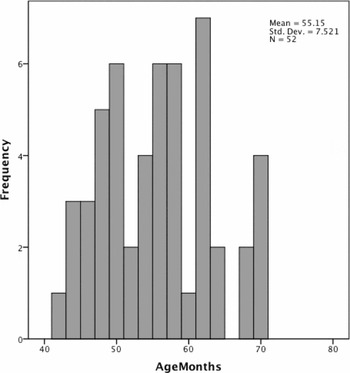
The participants in this task were 62 monolingual child speakers of midwestern US English in Columbus, Ohio. African American English and varieties of English spoken in the southern Ohio region of Appalachia, which are spoken in Columbus, Ohio; were not spoken by the children in the daycare centers and preschools from which this sample was recruited, who were overwhelmingly European American, from upper middle-class families. Fifty-seven children passed the filler items (at least four out of five correct), described below, which ensured that they understood the format, were paying attention and were not answering according to a number of strategies we observed, detailed below. Fifty-two children passed these fillers on both experiments reported here, and their mean age was 4;7 with an age range of 3;6–5;9 (SD = 7;52 months). The rest of the study will center on the results of these 52 children. All children were given each of the two tests on different days. Their distribution is illustrated in Figure 1, which shows that they are primarily 3- and 4-year-olds.
Distribution of the children in the sample, given in age in months, by frequency.

It is important to note that the age range of the children who participated in these experiments begins at 3;6 (42 months) when Rice et al. (Reference Rice, Wexler and Hershberger1998) report that the mean composite tense score of the longitudinally studied 30 typically developing children in their language control group was just above 60% correct. This means that at this age, children are likely to not be at ceiling on a measure of verb finiteness, but are also likely to be above Rispoli's 60% correct threshold for knowledge of the pronominal case paradigm. As a consequence, there should be variation in their scores, which can be analyzed in a correlation test.
Procedures
Children were introduced to three puppets: a dog and a cat (who were both identified as male) and a turtle (who was identified as female). The animals were identified to the children as very young, and consequently as needing help to learn how to talk. It was emphasized that sometimes they would “talk like grown-up, big kids, like you” and that other times they would say things that were not right. For this reason, children were urged to pay close attention so that they could help the young animals learn to speak better by telling them who had said the sentence best.
On each item, children were shown a picture in which one of the three puppets appeared performing an action (Figure 2). Then, each puppet would utter a sentence relating to the picture, and the child was encouraged to decide who had said the sentence best. For example, after being shown the following picture, one puppet would say, “He kicked a ball.” Then, the other puppet would say, “He kick a ball.” The child was then asked who said it better. If children said that they were both good, they were told that they had to choose one or the other. Whether the first or second sentence was correct was counterbalanced and showed no effect (p > .05) and the animal that presented the correct sentence was also counterbalanced and showed no effect (p > .05). We observed these two strategies at play in pilot work and actively discouraged them in our warm-up items. Finally, the order of presentation within both present and past tense was counterbalanced and also showed no effect, for either present (p > .05) or past (p > .05) tense.
Verb finiteness sample picture.

The task consisted of 6 practice items to introduce children to the format of the experiment, 16 experimental items, and 5 filler items. The filler and warm-up items tested constructions that have been shown to be mastered much earlier than the lower bound of our age range (cf. Rice et al., Reference Rice, Wexler and Redmond1999; McDaniel & Cairns, Reference McDaniel and Cairns1990), namely, noun plurals and –ing marking of present progressive participles, illustrated in (17) and (18).
-
(17) a. The turtle wants two cookies. versus *The turtle wants two cookie.
-
b. The dog had two books. versus *The dog had two book.
-
(18) a. The turtle is dancing. versus *The turtle is dance.
-
b. The turtle was using a pencil. versus *The turtle was use a pencil.
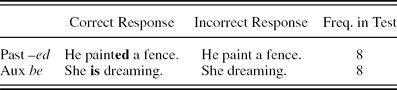
During the warm-up phase of the experiment, children were corrected if they chose the nonadult like noun plural or present progressive form and complimented if they chose the adult like form. No differential feedback of this kind was given after the warm-up period. Rather, they were complimented, regardless of correctness. The warm-up items were configured so that neither the first item nor the second item was always correct, nor was it the case that any particular animal was always correct. The absence of these patterns and the need to listen carefully to what each animal said was emphasized. The experimental items are described in Table 3. See Appendix A for the complete list of experimental items.
Example sentences from the verb finiteness task

Results
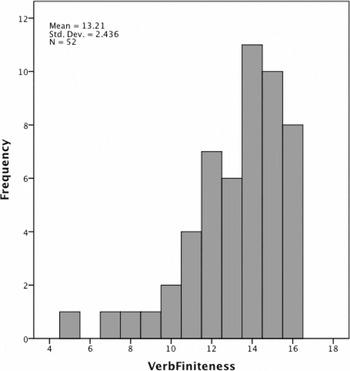
The overall mean percentage correct for the sample was 82.56% correct (“correct” will be used to indicate a choice of the adult like value). Further, the children did not appear to be guessing, as the mean correct (11.54) was statistically greater than chance (p < .001), which is 50%, or 8 items correct out of 16 possible in our design. The histogram in Figure 3 illustrates that the great majority of the children in the sample (48 of 52) scored above Rispoli's 60% correct (10 or more correct) threshold.
The distribution of verb finiteness scores (100% correct = 16) by frequency.

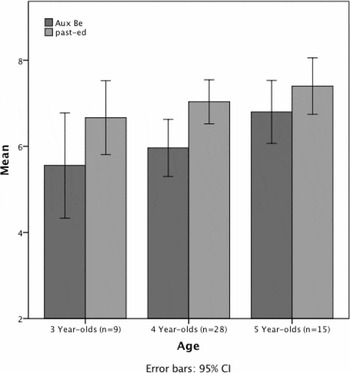
The results of the verb finiteness task were submitted to an arcsine transformation, upon which a mixed effects analysis of variance (ANOVA) was performed with age and morpheme as fixed factors and child as a random factor. The results of this ANOVA were that there was a main effect of morpheme, f (1, 49) = 18.518, p < .001. There was no effect for age, f (2, 49) = 3.029, p = .058, and there was no interaction of age and morpheme, f (2, 49) = 0.112, p = .894. Pairwise comparisons showed that –ed was significantly better than auxiliary be (p < .001). Subscores for –ed and auxiliary be nonetheless correlated (r = .430, p = .001). The children's scores by age group are graphically represented in Figure 4.
Mean correct judgments of auxiliary be, past –ed and combined verb finiteness items, across three age groups.

Discussion
Regarding the validity of using the GCT to measure child English speakers’ knowledge of verb finiteness, we see that this task found children's proficiency with past tense –ed to be significantly better than their proficiency with auxiliary be. This is consistent with classic findings showing the same asymmetry longitudinally in Brown (Reference Brown1973) and cross-sectionally in De Villiers and De Villiers (Reference de Villiers and de Villiers1973), which substantiates the GTC as a valid means of measuring grammatical competence (for similar findings, see Ricci, Reference Ricci2009). Further, we see that while scores on –ed and auxiliary be were significantly different from one another, possibly as a function of processing or memory demands being greater with the discontinuous morpheme in auxiliary be, they nonetheless correlated across a range of proficiencies, cross-validating the earlier longitudinal work of Rice et al. (Reference Rice, Wexler and Hershberger1998) and Rice et al. (Reference Rice, Wexler and Redmond1999).
Perhaps more important for the main purpose of the study, we see that children in our sample vary as to their proficiency on our task and that this proficiency, as measured by these two morphemes, is above 60% (Rispoli's threshold) for both of them. This means that the children being studied are likely to be in a stage of development during which the relationship between finiteness and case can be most clearly viewed. Below we will test whether the variation we have measured is associated with the variation in the same children's judgments of pronoun case in subject position.
EXPERIMENT 2: THE PRONOUN CASE TASK
In this experiment, our goal was to determine the degree to which children judge sentences with feminine and masculine third-person, singular pronominal subjects, in nominative and accusative case, to be grammatical. It is important to note that nonnominative subject pronouns frequently do not manifest themselves in child English spontaneous production data. Our position, following case theory, is that they occur as a function of optional syntactic finiteness on verbs. Thus, nonnominative subject pronouns should be as acceptable as nonfinite verbs are, with the caveat that children, following Rispoli (Reference Rispoli2005), have learned the English pronominal paradigm. In this view, the reason that there is not a total correlation of the two constructions (nonfinite verbs and nonnominative subject pronouns) in spontaneous production data is that not all apparently finite verbs are actually finite. Some of them are holophrases, which appear to be finite, but they lack underlying syntactic finiteness features. This explains why researchers have been able to show that nonnominative subject pronouns sometimes occur with third-singular –s (Ambridge & Pine, Reference Ambridge and pine2006; Pine et al., Reference Pine, Joseph and Conti-Ramsden2004, Reference Pine, Rowland, Lieven and Theakston2005), contra the basic intuition of case theory and the specific predictions of ATOM. In sum, testing children's knowledge of pronominal subjects receptively allows us to overcome the empirical difficulty posed by the scarcity of nonnominative subjects in production data.
All sentences on the pronoun case task contain an uncontracted finite verb, marked with either copula be or third person singular –s, neither of which was used in the first experiment. In this way, verb finiteness is held constant and the lack of overlap between this experiment and the verb finiteness task allows us to test the two variables independently. An additional consideration pointed out in two studies by Pine et al. (Reference Pine, Joseph and Conti-Ramsden2004, Reference Pine, Rowland, Lieven and Theakston2005) is that nonnominatives occur with uncontracted verbs. We follow their lead and assume that any relationship between nonfinite verbs and nonnominative pronouns is best measured using uncontracted verbs. Only the latter are used in our experimental sentences. To our knowledge, this is the first time that a receptive task has been used to measure children's knowledge of nonnominative pronominal case.
Participants
Sixty monolingual, English-speaking children took this test; 55 passed the fillers (at least 4 out of 5 correct); 52 passed the fillers on this test and passed the fillers on the verb finiteness test, and they were retained in the sample. These are the same 52 who were considered in the previous experiment. Again, the age range for the sample is between 3;6 and 5;9, and the mean age is 4;7 (SD = 7;52 months).
Procedures
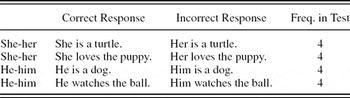
As in the previous experiment, GCT was used to assess children's judgments of pronominal case in subject position. Also as in the previous experiment, it consisted of 6 practice items, 16 experimental items, and 5 filler items. As before, correction was provided in the warm-up period, but none thereafter. Half of the 16 experimental items used third singular –s, whereas half used copula be. Similarly, half of the 16 items used a masculine pronoun (him vs. he), and half used a feminine pronoun (her vs. she). We again note that these finiteness markers are distinct from those used in the verb finiteness task, in order to maintain the independence of the case variable. Table 4 summarizes the item types used. See Appendix B for the complete list of experimental items.
Example sentences from the pronoun case task

Results
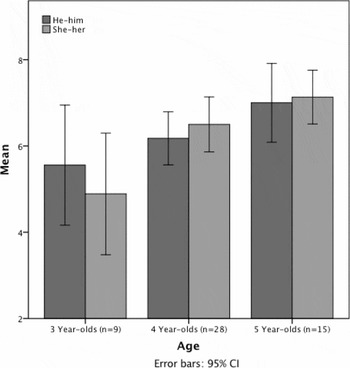
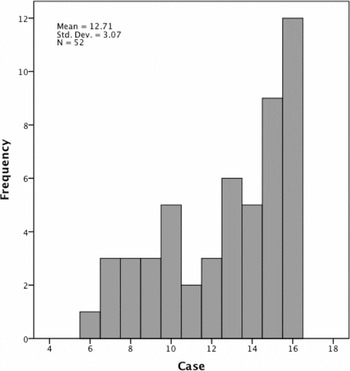
The overall mean percent correct for the sample was 79.43%. Further, the children were not guessing, as the mean correct (12.71) was statistically greater than chance (p < .001), which is 50%, or 8 items correct out of 16 possible, in our design. The results of the pronoun case task were submitted to an arcsine transformation, upon which a mixed effects ANOVA was performed with age and pronoun gender as fixed factors and child as a random factor. The results of this ANOVA showed there was no main effect of pronoun gender, f (1, 49) = 0.242, p = .625. There was an effect for age, f (2, 49) = 4.523, p = .016, and there was no interaction of age and pronoun gender, f (2, 49) = 1.821, p = .173. Pairwise comparisons showed that the scores of the 5-year-old group were significantly higher than those of the 3-year-old group (p = .004), but that there were no significant differences either between the 3-year-olds and the 4-year-olds (p = .078) or between the 4-year-olds and the 5-year-olds (p = .081). Subscores for masculine and feminine pronoun judgments correlated (r = .648, p < .001). The children's scores by age group are graphically represented in Figure 5.
Mean correct judgments of he-him, she-her, and combined pronoun case items across three age groups.

In addition, in contrast to the findings of Pine and colleagues, the majority of the children in our sample accepted at least some nonnominative pronominal subjects as grammatical, as illustrated in Figure 6.
The distribution of pronoun case scores (100% correct = 16) by frequency.

There were 16 experimental items on the pronoun case task. Figure 6 shows that 12 children made all 16 case judgments in an adult like fashion. It also shows that the remaining 40 (77%), of the 52 children who took the test, chose a nonnominative case pronoun as grammatical at least some of the time. Case errors, then, are widely distributed across a great majority of the participants in the study, contrary to what has apparently been assumed in the majority of studies of this phenomenon.
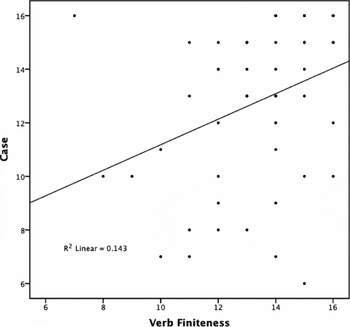
Turning to the main goal of the study, we find that children's judgments on the pronoun case task correlate with those of the verb finiteness task (r = .375, p = .006, N = 52). This effect is illustrated in Figure 7.
Judgments of verb finiteness and pronoun case in subject position correlate (some data points overlap).

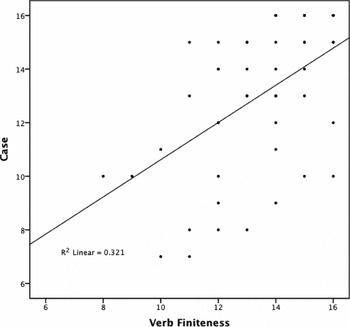
The alert reader will note that there are a small number of outliers in Figure 7. In correlational analyses, which are maximum likelihood statistics, even small numbers of outliers can be influential and mask important tendencies. Because there are myriad nonlinguistic factors (e.g., distractedness, lack of sleep, hunger, not feeling well) that could have produced the results of this small number of outliers, I will remove the three whose results are greater than 2 SD from the mean. Removing the results of these 3 children, leaving 49 children still in the sample, increases the correlation coefficient by almost .2 (r = .549, p < .001, N = 49). Thus, with the removal of a very small number of cases, an already significant relationship becomes much more so. Consequently, we will consider the results without the influential outliers to be most representative of the relationship between case and finiteness under consideration. Contrast the difference between Figure 7 and Figure 8.
Judgments of verb finiteness and pronoun case in subject position correlate, with three influential outliers removed (some data points overlap).

Discussion
Most importantly, the correlation shown between children's judgments of finiteness and their judgments of pronoun case constitutes a unique, receptive cross-validation of the findings in Loeb and Leonard (Reference Loeb and Leonard1991), Schütze and Wexler (Reference Schütze and Wexler1996), and Rispoli (Reference Rispoli2005) to the effect that there is a contingency between verb finiteness and pronominal case, which is consistent with the predictions of case theory. In the same way that this earlier work took children's spontaneous utterances to be data reflecting their grammatical competence, we take their receptive judgments to be data reflecting their grammatical competence, and where they found an utterance-by-utterance contingency, we have found an overall contingency of grammatical judgments of the two independent grammatical dimensions of case and finiteness, measured independently. Note that such a correlation is entirely accidental on a constructivist explanation of co-occurrence in the input, as distinct verb finiteness markers were used on each test.
An alternative constructivist explanation could be that the use of overlapping individual verbs on each test could be responsible for the correlation. As one can see from Appendixes A and B, the 9 verbs from the pronoun case task and the 16 verbs from the verb finiteness task have 2 overlapping verbs: watch and play. If we remove children's judgments of these two verbs from the results, the correlation is unchanged (r = .549, p < .001, N = 49). Furthermore, when age is partialed out as a possible source of the correlation between the two scores, the correlation persists (r = .525, p < .001, N = 49). Hence, it would seem that there is a link between judgments of finiteness and case that is neither a function of lexically stored, memorized verbal finiteness markers, nor of stored lexical verbs repeated on the two tests, nor of age. Rather, the correlation is consistent with the hypothesis, posited on independent grounds to explain adult language data, that the architecture of the grammatical system includes a link between subject pronominal case and verb finiteness, much as posited in Chomsky (Reference Chomsky1981). Although causation cannot be attributed on the basis of correlation, the association is nonetheless consistent with this hypothesis and is otherwise mysterious.
With respect to the gender asymmetry reported in Pine et al. (Reference Pine, Joseph and Conti-Ramsden2004, Reference Pine, Rowland, Lieven and Theakston2005) and Rispoli (Reference Rispoli1998a, Reference Rispoli1998b, Reference Rispoli1999), we find that there is no significant difference between children's levels of acceptance of masculine versus feminine nonnominative pronouns occurring with uncontracted finite verbs, in this case, copula be and third person singular –s. Thus, at least for sentences occurring with finite verbs, marked by these two finiteness markers, it appears that children with above 60% proficiency on verb finiteness marking do not show an asymmetry of pronominal case errors as a function of gender. If the predominance of feminine gender errors is a sign that the pronominal paradigm is still being constructed in children's lexicons, perhaps the lack of such an asymmetry could be taken as a sign that children are only considering the connection between finiteness and case.
Finally, with respect to the criticism leveled at the ATOM model's claim that verbs marked for third-singular –s should not co-occur with nonnominative subjects, we find that ATOM's claim is not supported, even with children of relatively high proficiency verbal finiteness judgments, but rather add our receptive findings to the existing expressive findings with younger children that such a co-occurrence is possible. Although 80% of the children's judgments showed a preference for –s with nominative, 20% showed a preference for –s with a nonnominative. Of the 16 items that allowed children to choose between accusative and nominative subjects with finite verbs, 8 of them were verbs marked for third singular –s. Following the 10% acceptability criterion, which is the threshold used by Pine and colleagues to constitute a nonnegligible proportion of counterexamples to ATOM's prediction, we see that of the 49 children in the no-outlier sample, 16 of them chose the accusative form with the third singular –s form on at least 1 of the 8 opportunities available to them (10% of 8 choices = .8). Thus, these 16 would constitute counterexamples to ATOM's prediction.
GENERAL DISCUSSION
In summary, we have provided evidence that case and finiteness, as dimensions of grammar that can be measured receptively, are linked in development, cross-validating the production data results in the work of Loeb and Leonard (Reference Loeb and Leonard1991), Schütze and Wexler (Reference Schütze and Wexler1996), and Rispoli (Reference Rispoli2005). We have extended the work of Rispoli by showing that, above the 60% finiteness marking level, there is no gender distinction among case errors. Finally, we have shown that children will allow third-person singular –s with nonnominative case forms in subject position.
The most prominent conclusion of our study is that case theory appears active in child language. Children whose grammars were not yet adult like in their finiteness marking or in their case marking properties were shown to nonetheless constrain their use of these constructions in the way that case theory would predict. If case theory acts as an innate grammatical constraint, this is the kind of interaction that would be predicted: adult like obedience to the constraint, in spite of nonadult like proficiency with each construction. We believe that Rispoli's (Reference Rispoli2005) results support a similar conclusion, with the additional observation that, in his data, the interaction between case and finiteness can be seen to interact with lexical development of the pronominal paradigm.
Under the assumptions of case theory, we argue that the gradual improvement observed in case marking in our sample is a function of the gradual improvement of the case-related features of syntactic tense on verbs. As verbs increasingly become marked less optionally and more obligatorily for tense, case should be increasingly marked as nominative, which is consistent with our data. While most research on this phenomenon has taken spontaneous production data to be reflective of children's grammars or other cognitive functions responsible for finiteness and case marking, in this study we take the judgments that children provide to be reflective of their grammars. Our conclusion is that their grammars of verb finiteness and case are linked by case theory, and that this explains why the variance in case judgments found in our cross-sectional sample of 3- to 5-year-olds correlates with the variance in their finiteness judgments.
Misparsing, priming, and the independence of case and finiteness measures
Though constructivist language development proposals assert that children's language abilities reach an end state that includes abstract schema with properties that linguists might call a grammar, it is important to point out that there are differences between constructivist proposals and the nativist proposal put forward here, which assumes that the raw material for a grammar is always present and that some of its properties, the case filter, for example, are not gradually developing co-occurrence tendencies. Constructivist exemplar accounts of the development of verb finiteness and of the optional infinitive phenomenon put misparsing of adult utterances (e.g., such that Does he go there? becomes He go there.) at the core of their proposals (e.g., Theakston & Lieven, Reference Theakston and Lieven2008; Theakston, Lieven, & Tomasello, Reference Tomasello2003). These proposals assert that adult questions such as Does he go there? prime children's nonfinite utterances. We note in what follows that priming cannot equal learning, for logical reasons, that there is no empirical basis for claiming that priming produces long-term learning outcomes and that in the case of verb finiteness, there is empirical evidence that supports exactly the opposite conclusion regarding the relationship between child-directed input and nonfinite utterances in child English. We note that priming could not have been an issue between our two experiments and add that computational implementations of the misparsing analysis suffer from insurmountable empirical problems.
Constructivist proposals for why child English speakers use nonnominative pronouns with nonfinite verbs (e.g., Kirjavainen et al., Reference Kirjavainen, Theakston and Lieven2009; Theakston et al., Reference Theakston, Lieven and Tomasello2003; Theakston & Lieven, Reference Theakston and Lieven2008) assert that children build schema that include a pronoun of a particular type and a verb with a particular type of ending. They propose that this begins as lexically dependent information and that it then becomes more abstract and expands in scope, so as to apply to all elements of the categories involved. Theakston et al. (Reference Theakston, Lieven and Tomasello2003) and Theakston and Lieven (Reference Theakston and Lieven2008) argue that adult questions of this type actually prime children's nonfinite utterances and that this priming of nonfinite utterances constitutes learning of them. This is problematic for a number of reasons. To begin with, as noted by Jeffrey Lidz (personal communication), there is a logical, conceptual problem inherent in this view, in that priming is generally thought of as a process by which preexisting structures are activated to the degree that they are more likely to be used than they would have been, had they not been activated. Notice that this presupposes that they already exist, which is a problem for the constructivist account as it aspires to use priming as an ontogenetic mechanism and not simply as a means of showing that children's syntactic structures can be primed in the same way that those of adults can be (for a review of adult priming research, see McNamara, Reference McNamara2005). Thus, the contention that priming equals learning as a cornerstone of the constructivist exemplar theory is conceptually incapable of overcoming the logical problem of language acquisition in that it cannot explain how linguistic knowledge arises in the mind of a child, without assuming the preexistence of such knowledge. In our particular case, then, the proposal that priming nonfinite utterances promotes their learning presupposes that children are already able to produce nonfinite utterances, which is the problem that the account is proposed to solve in the first place.
Beyond this apparently intractable conceptual barrier, however, there also appears to be no empirical proof to the effect that priming produces long-term (longer than a month) learning outcomes. Theakston et al. (Reference Theakston, Lieven and Tomasello2003), for example, show that children who were presented with novel verbs in yes–no questions such as “Will it tam?” were more likely to use nonfinite verbs than were children who were presented with novel verbs in declaratives, such as “It tams.” These results show that they have primed a nonfinite verb, which, as demonstrated in this study, is a grammatical option for children. This may or may not have anything to do with language development, however. There is no necessary connection between priming and learning unless one shows that the construction that has been primed persists over time, which they do not. The study does not, for example, show any longitudinal outcomes. Newport, Gleitman, and Gleitman (Reference Newport, Gleitman, Gleitman, Ferguson and Snow1977), in contrast (which is cited nowhere in this paper or in Theakston & Lieven Reference Theakston and Lieven2008), do show that the syntactic position of finiteness markers in the input matters to long-term growth of children's finiteness representations and their conclusions are exactly the opposite of what Theakston et al. (Reference Theakston, Lieven and Tomasello2003) and Theakston and Lieven (Reference Theakston and Lieven2008) show. In particular, they show that there is a high correlation (r = .88, p < .001, n = 15; Newport et al., p. 132) between the mothers’ tendencies to ask yes–no questions and the children's tendencies to produce auxiliary verbs in declaratives, in a longitudinal study that observed mother and daughter interactions at both an initial recording session as well as at a second recording session, 6 months later.
Similarly, Theakston and Lieven (Reference Theakston and Lieven2008) show priming between auxiliary be in parental input and children's production. Their first experiment shows priming of are, which is roughly successful, as in Theakston et al. (Reference Theakston, Lieven and Tomasello2003). It also attempts to show priming of am, but compares contracted I'm (in declarative sentences) with uncontracted Am I (yes–no question). It is important to point out that contracted and uncontracted auxiliaries are traditionally treated very differently in developmental studies (e.g., Brown Reference Brown1973; De Villiers and De Villiers, Reference de Villiers and de Villiers1973). Further, constructivist studies, as noted above, have shown that contractions have different syntactic properties in child language than uncontracted forms. As mentioned earlier, Pine et al. (Reference Pine, Rowland, Lieven and Theakston2005) and Pine et al. (Reference Pine, Joseph and Conti-Ramsden2004) show that contracted auxiliaries tend to occur with nominative pronouns, while uncontracted auxiliaries tend to allow nonnominative pronouns. This makes the contracted forms very good prima facie candidates for holophrastic or unitary lexical forms, as proposed by Wilson (Reference Wilson2003), Childers and Tomasello (Reference Childers and Tomasello2001), Abbot-Smith, Lieven, and Tomasello (Reference Abbot-Smith, Lieven and Tomasello2001), and Akhtar (Reference Akhtar1999). Given the likelihood that I'm and Am I are categorically different linguistic objects, it is highly questionable to directly compare their occurrence in child-directed speech and their production in child speech as examples of one phenomenon. In particular, one might imagine that I'm, as a unitary lexical item, would be primed as a single unit, which may or may not be finite, much more easily than Am I, which would be primed as separate lexical items, only one of which represents finiteness. On the constructivist account, I'm should be a lexically dependent item, while I am is likely to consist of two, nonlexically dependent items. It is obviously much more probable that the uncontracted form would be omitted. Finally, the novel verbs they compared in a second experiment did not show a significant difference for declarative versus interrogative input, even for are.
In sum, priming seems unlikely to play any role in actual learning of nonfinite utterances; however, it could have short-term effects that might impact the results of two experiments, given in relatively close temporal proximity. Because our tests were administered on different days, and because it is unclear how long the effects of priming could last, it is critical that there be nothing in either of our tests that could potentially prime the other, if we are to have independent measures of case and finiteness, which is our goal. We have attempted to control for this concern in this study in two ways. First, the verbal finiteness morphemes used on the verb finiteness task (auxiliary be and regular –ed) were not present on the pronoun case task, which used a different set of verbal finiteness morphemes (third-person singular –s and copular be). In this way, any tendency toward matching a particular pronominal form with a particular finiteness marking form, based on co-occurrence in the input, should have been prevented by no verb finiteness marking form occurring on both tests. Second, neither of the tests had any examples of the contingency found in the spontaneous data, consisting of a nonnominative pronoun co-occurring with a nonfinite verb. As a result, the measures of children's knowledge of finiteness and pronominal case were independent of the co-occurrence of these forms in the input. To us, it seems highly unlikely that these forms occur in child-directed input in any way that would lead to their acquisition, in any event, but even if they did co-occur in the input, nonnominative pronominal subjects and nonfinite verbs do not co-occur in our stimuli, so that not even priming of stimuli on one test by stimuli on the other should have been possible in our design.
The result is that the pronoun case task gives us information about which pronominal case forms children were willing to accept with apparently finite verbs and the verb finiteness task gives us information about what verb forms children were willing to accept with nominative case pronouns in subject position. Even though children seem to mostly hear nominative case pronouns in subject position with finite verbs, they were nonetheless willing to accept accusative case pronouns with them some of the time. Similarly, although children would seem to almost exclusively hear finite verbs with nominative case subject pronouns, they were still willing to accept nonfinite verbs with them some of the time. Another possible concern regarding the correlation found could be that the same lexical items were used on the two tests and could have primed each other. As we have shown, there were only two lexical items that overlapped on the two tests, and when the four experimental items that used these verbs (watch and play) were removed, the correlation persisted. The question, then, is why the variance in their acceptance of these two nonadult like forms should correlate, unless case theory were responsible.
Independently of the priming experiments that are argued to show how children misparse pieces of clauses in the input, the misparsing model has been computationally modeled. The MOSAIC model of Freudenthal, Pine, and Gobet (Reference Freudenthal, Pine and Gobet2006) suggests that children selectively pay attention to the ends of utterances, which allows them to parse only the ends and ignore the beginnings of sentences. This proposal, however, is fraught with unresolved problems. To begin with, as we have illustrated in this study, nonfinite verbs occur with particular types of subjects, so an utterance-final bias is not sufficient. Does he sleep? does not become Him sleep., with an accusative subject pronoun, by simply cutting off does in the adult input. Presumably in response to such objections, Freudenthal, Pine, and Gobet (Reference Freudenthal, Pine and Gobet2010) propose that children's competence should be modeled as also having an utterance-initial bias. Such a move is problematic in that it should allow for the deletion of constituents in utterance-medial position, which most transitive verbs occupy and should consequently result in a large number of verbless utterances with only subjects and objects (e.g., He caught the ball. should become He ball.), a phenomenon which is unattested, to our knowledge. Perhaps more problematically, there is no mechanism in the misparsing approach to explain the occurrence of nonnominative pronouns that occur with apparently finite verbs, such as Him goes. (a sentence which children accepted in our pronoun case task). That is, there is no plausible adult sentence that could be truncated by the child to produce such an utterance, and yet, as demonstrated by multiple constructivist studies in their arguments against ATOM (Ambridge & Pine, Reference Ambridge and pine2006; Pine et al., Reference Pine, Joseph and Conti-Ramsden2004, Reference Pine, Rowland, Lieven and Theakston2005), as well as by children's acceptance rates of these utterances in the current study, they are a real grammatical option for children.
The problem faced by such an exemplar approach is not limited to English, however, as there are an array of child languages, including at least Spanish and Swahili, that use nonfinite verb forms that do not form part of a compound tense and consequently could not be misparsed by children exposed to adult input. In Swahili, the form children appear to use is a root subjunctive verb form, illustrated in example 19, from Deen and Hyams (Reference Deen and Hyams2006, p. 92, ex. 18).
-
(19)
-


According to Deen (personal communication), the subjunctive is not part of a compound tense in the adult language.
In Spanish, as another example, children use bare stem forms that are homophonous with third-person singular present tense forms such as duerme. or “sleeps.” Such forms have been documented in spontaneous production occurring with non-third-person subjects, as in the following from Grinstead (Reference Grinstead1998):
-
(20) bare stems
-
Carlos – 3;3.28
-
Yo pone.
-
I-nom put (root + “e” theme vowel)
-
“I puts.”
-
(21) Eduardo – 3;0.28
-
Yo quiere hacerlo.
-
I want (root + “e” theme vowel) do-inf cl-acc-sg-masc
-
“I wants to do it.”
-
(22) Graciela – 2;6.5
-
Hace esto yo.
-
do (root + “e” theme vowel) this I-nom
-
“I does this.”
Similarly, forms such as these are produced in elicited production studies in which a non-third-person singular pronoun is part of the prompt, including Bedore and Leonard (Reference Bedore and Leonard2001, Reference Bedore and Leonard2002), Sanz-Torrent, Serrat, Andreu, and Serra (Reference Sanz-Torrent, Sellabona, Andreu and Serra-Raventos2008), and Grinstead et al. (Reference Grinstead, De la Mora, Vega-Mendoza, Flores, Crawford, Otaki and Takahashi2009). Finally, child Spanish speakers accept bare stem verbs such as these as grammatical when they occur with first-person singular pronouns (e.g., Yo abre la boca. “I open my mouth.”) in GCTs (Grinstead et al., Reference Grinstead, De la Mora, Vega-Mendoza, Flores, Crawford, Otaki and Takahashi2009; Pratt & Grinstead, Reference Pratt, Grinstead, Belikova, Meroni and Umeda2007; Vega-Mendoza, Reference Vega-Mendoza2010). Thus, though a constructivist proposal has been made to account for learning the adult system as well as the errors that children make, it faces as yet unsurmounted empirical obstacles. As a consequence, our data, and the central data from other studies considered here, is better explained by a case-theoretic account than by an exemplar account.
In summary, Theakston and colleagues have a theory of learning, which is based on priming of nonfinite verbs in children's speech by the bare verbs that form the ends of questions in adult speech. This view of priming as bringing grammatical constructions into existence, when priming is the process of activating already existing grammatical constructions, is incoherent as a learning theory. Theakston's studies provide no evidence of lasting learning outcomes, while actual studies of lasting learning outcomes of finiteness in children's declaratives as a function of their mothers’ use of question-initial auxiliaries (e.g., Newport et al., Reference Newport, Gleitman, Gleitman, Ferguson and Snow1977), show exactly the opposite of what constructivists argue for, in exactly the same constructions. Further, the constructivist proposal has no hope of explaining documented nonfinite verb forms in child Spanish and child Swahili, which do not form part of any compound tense. The computational implementations of this approach by Freudenthal and colleagues also leaves a great deal to be desired in that they predict the production of large numbers of subject–object sentences, with transitive verbs being deleted, and fail to explain how forms such as Him leave. and Him sleeps., which are attested in child English, could be produced by misparsing sentence-initial constituents. Finally, the correlation between the two stimuli sets used in our experiments could not be susceptible to a priming explanation.
In contrast, a case-theoretic explanation, rooted in the principle that nominative pronominal subjects co-occur with finite verbs and that nonnominative pronominal subjects co-occur with nonfinite verbs, supplemented with a theory of default case, captures the systematic nature of children's judgments of the data presented here and elsewhere. Further, it has the advantage of explaining children's linguistic behavior in the same terms as those used to explain the adult behavior, upon which case theory is based. These terms include, as we shall see in the next section, noncompositional forms. This obviates the necessity of positing two linguistic systems, one for children using one kind of representation and another for adults using a second, and undefined, kind of representation. As a simpler theory, it seems more likely, by Occam's razor, to be on the right track.
Noncompositional forms
Pine et al., (Reference Pine, Rowland, Lieven and Theakston2005), among others, demonstrate that third-person singular –s may occur with nonnominative case subject pronouns, contra the predictions of ATOM. We have substantiated this finding here. However, does this imply that there is no connection between case and finiteness? Obviously we have tried to argue that it does not. If it does not, then what does it mean that these apparently finite forms may occur with nonnominative pronouns?
It has been argued in construction grammar (e.g., Goldberg, Reference Goldberg1995) that to know grammar is to have an immense repertoire of lexical items, some of which are traditional words and others of which are sentence-length constructions with more or less open slots, or “typed variables” in them. Thus, dog is a lexical item, plural -s is a lexical item, but so is kicked the bucket. The latter lexical item, however, has two typed variable slots: one for subject position and the other for the inflection associated with the verb. The view that all of grammar consists of these constructions contrasts with the view that all of grammar consists of rule-generated, combinatorial structures (e.g., Yang, Reference Yang2002). Somewhere in the middle is the view that language must consist of both. Jackendoff (Reference Jackendoff1997), who assumes that there is combinatoriality in language, nonetheless argues that there must be at least as many constructional idioms like “kick the bucket” in English as there are adjectives. Thus, the conclusion that noncompositional forms larger than a word exist and are legitimate linguistic objects in adult natural languages seems inevitable. If this is true, following the continuity assumption of Macnamara (Reference Macnamara1982), we should also expect such objects to be part of children's grammatical competence, all else being equal. Perhaps, as suggested by Tomasello (Reference Tomasello2003) and Culicover and Nowak (Reference Culicover and Nowak2003), children use noncompositional forms as an intermediate step between knowing an inflected verb form as a “frozen form,” which may or may not have syntactic finiteness properties, and a compositional form that does have these properties on inflectional morphemes affixed to the verb.
On this basis, it seems to us at least possible that in the grammars of young children learning English, verbs marked with –s may be syntactically finite some of the time but may also be nonfinite some of the time. Perhaps the distinction between the two cases is that the finite -s is the result of compositional morphosyntax, along the lines of Chomsky (Reference Chomsky1995), and that the nonfinite –s is noncompositional, as suggested by Tomasello (Reference Tomasello2003) and Culicover and Nowak (Reference Culicover and Nowak2003). We obviously have no overt indicator of which is which, except, by hypothesis, that the nonfinite version allows nonnominative case pronouns, while the finite version does not, as ATOM might predict. Such a view of noncompositional forms is not, in our view, contradictory with the tenets of generative grammar. If correct, it would explain why there is a contingency between finiteness and case, in general, and also why there may be exceptions to this general case, as in the co-occurrence of apparent third-singular –s or other apparently finite verb forms with nonnominative case pronouns.Footnote 3
That said, why does third-singular –s appear to be most resistant to co-occurrence with nonnominative pronouns? This is, after all, the observation that motivated Schütze and Wexler's (Reference Schütze and Wexler1996) proposal. Following Yang (Reference Yang2002, Reference Yang2005), we observe that of the English finiteness markers, third-singular –s is the most regular, in the sense that it suffers the fewest nonlinguistic barriers to general application. Contrast –s with past –ed, which competes with an irregular paradigm of suppletive past tense forms (e.g., ate, spoke, thought). Similarly, learning copular be must be a function of memorizing its five forms (am, are, is, was, were), while auxiliary be requires the same memorization, combined with the extra language processing difficulty associated with affixing the discontinuous –ing morpheme to the lexical verb. Nonlinguistic cognitive processes, then, including memory capacity, language processing and lexical interference from suppletive forms all conspire to make markers of finiteness in English, other than –s, less general. If such barriers to morphological generalization make it more likely that children will use nonfinite versions of these forms to express their intent, then they will be more likely to co-occur with nonnominative case pronouns than will –s, which moves more quickly out of the optional infinitive stage than do the other markers. Although this account is admittedly speculative, it could explain why –s co-occurs with nonnominative forms less than do the other finiteness markers.
Developmental linguistics and spontaneous production data
In a methodological sense, we reiterate the claim, substantiated here, that because children do not produce forms such as pronominal case errors in spontaneous production does not mean that their grammars do not allow them. As noted, Pine and colleagues failed to find errors in 75% and 79% of their study participants, but this would not appear to have been an accurate measure of the availability of the option of using nonnominative pronominal subjects in their grammars, judging by the frequency of acceptance of them in our sample. In our sample, we found roughly the opposite situation: 77% (40/52) of the children accepted case errors at least some of the time. Given that our children are older than those studied by Pine and colleagues, it seems likely that a larger percentage of them than 75% would have produced case errors, had more data been collected. In spite of its importance for studying child language development, this is one of the drawbacks of relying exclusively on spontaneous production data to determine children's grammatical capabilities.
Our hope in this study has been to provide some compelling evidence to the effect that basic properties of syntax can be investigated in child language and that this can be accomplished without the limitations of spontaneous production data. Perhaps in future work, other receptive methods can be used to learn more about the interaction of case, finiteness, and other dimensions of grammar in child language.
APPENDIX A
Stimuli sentences from the verb finiteness task
Practice
-
1a. The cat sees two birds.
-
1b. The cat sees two bird.
-
2a. The boy is wash the animals.
-
2b. The boy is washing the animals.
-
3a. The dog wants two carrots.
-
3b. The dog wants two carrot.
-
4a. The cat is smile.
-
4b. The cat is smiling.
-
5a. The girl is feed the dog.
-
5b. The girl is feeding the dog.
-
6a. The dog sees two elephants.
-
6b. The dog sees two elephant.
Filler items
-
4a. The turtle wants two cookies.
-
4b. The turtle wants two cookie.
-
8a. The turtle is dance.
-
8b. The turtle is dancing.
-
12a. The turtle was using a pencil.
-
12b. The turtle was use a pencil.
-
16a. The dog had two book.
-
16b. The dog had two books.
-
20a. The turtle was drinking.
-
20b. The turtle was drink.
Experimental sentences
-
1a. He is holding the hat.
-
1b. He holding the hat.
-
2a. He dancing.
-
2b. He is dancing.
-
3a. He laughing.
-
3b. He is laughing.
-
5a. She eating food.
-
5b. She is eating food.
-
6a. She is dreaming.
-
6b. She dreaming.
-
7a. He is writing.
-
7b. He writing.
-
9a. He is running.
-
9b. He running.
-
10a. She is playing soccer.
-
10b. She playing soccer.
-
11a. He painted a fence.
-
11b. He paint a fence.
-
13a. He color a picture.
-
13b. He colored a picture.
-
14a. She opened her mouth.
-
14b. She open her mouth.
-
15a. She watched a cat.
-
15b. She watch a cat.
-
17a. He hug a teddy bear.
-
17b. He hugged a teddy bear.
-
18a. He kicked a ball.
-
18b. He kick a ball.
-
19a. He looked at the turtle.
-
19b. He look at the turtle.
-
21a. She opened a box.
-
21b. She open a box.
APPENDIX B
Stimuli sentences from the pronoun case task
Practice
-
1a. The girl is feeding the dog.
-
1b. The girl is feed the dog.
-
2a. The cat is wear shorts.
-
2b. The cat is wearing shorts.
-
3a. The cat wants two apples.
-
3b. The cat wants two apple.
-
4a. The dog sees two elephant.
-
4b. The dog sees two elephants.
-
5a. The boy is wash the animals.
-
5b. The boy is washing the animals.
-
6a. The dog wants two carrots.
-
6b. The dog wants two carrot.
Filler items
-
4a. The cat has two balls.
-
4b. The cat has two ball.
-
8a. The dog has two balloon.
-
8b. The dog has two balloons.
-
12a. The turtle is eating.
-
12b. The turtle is eat.
-
16a. The dog plays with block.
-
16b. The dog plays with blocks.
-
20a. The dog is drawing.
-
20b. The dog is draw.
Experimental items
-
1a. He is a dog.
-
1b. Him is a dog.
-
2a. Him is a cat.
-
2b. He is a cat.
-
3a. Her is a turtle.
-
3b. She is a turtle.
-
5a. Him is orange.
-
5b. He is orange.
-
6a. She is green.
-
6b. Her is green.
-
7a. He is angry.
-
7b. Him is angry.
-
9a. She is tired.
-
9b. Her is tired.
-
10a. She is happy.
-
10b. Her is happy.
-
11a. He plays with friends.
-
11b. Him plays with friends.
-
13a. Him sleeps.
-
13b. He sleeps.
-
14a. He holds a camera.
-
14b. Him holds a camera.
-
15a. She loves the puppy.
-
15b. Her loves the puppy.
-
17a. Her eats the food.
-
17b. She eats the food.
-
18a. He watches the ball.
-
18b. Him watches the ball.
-
19a. Her sings loudly.
-
19b. She sings loudly.
-
21a. She cleans the car.
-
21b. Her cleans the car.
ACKNOWLEDGMENTS
This study was supported by an undergraduate research scholarship to the second author from Ohio State University. We gratefully acknowledge comments and suggestions from participants in the Ohio State University Language Acquisition group; helpful discussions with Laura Wagner, Jeffrey Lidz, Peter Culicover, Kamil Ud Deen, and Nina Hyams; and substantial help from Michael Edwards, Patrick Obregon, and Steven Naber. We especially acknowledge Carson Schütze's generous help and advice.