Immigrants were at the base of America’s twentieth-century urban machines.Footnote 1 In the familiar story, “bosses,” usually of Irish extraction, met the needs of recent immigrants, shepherded them to naturalization and then to the ballot box.Footnote 2 To understand urban machines, we have to learn how bosses held immigrant voters’ loyalty.Footnote 3
For cities that experienced consolidation of political factions into machines, this issue becomes particularly important. In those cities, competing faction leaders reduced political competition by consolidating their power into a centralized organization, exchanging autonomy for security.Footnote 4 In managing that consolidation, leaders had to retain and transfer the loyalties of their immigrant factions to the more distant, consolidated machine. As Oscar Handlin noted in his classic work on immigration, the most successful ethnic leaders “expanded their roles beyond the little group within which they had grown to power.”Footnote 5
This article explores that bond in the case of a Russian Jewish, Chicago ward and its leader, Jacob M. Arvey, in the era of the consolidation of that city’s powerful machine. The literature on urban machines stresses the importance for them of ethnic voters, but we lack a compelling explanation for how machines maintained immigrants’ loyalty.Footnote 6 Clarence Stone writes that the machine had to grow resources to maintain the organization “while providing enough benefits to maintain” a loyal electorate.Footnote 7
Scholars identify three kinds of exchanges that machines traded for votes. The first was material, bread, and jobs.Footnote 8 The second was individually affective; machine workers offered a “localized network of intimacy” to immigrants.Footnote 9 A third was symbolic, language and behaviors through which leaders identified with immigrants’ identity.Footnote 10 This exchange model presumed immigrants were materially deprived and culturally isolated, hungry for the machine’s help, and swayed by superficial symbols. In one description of the relationship: “Poor voters mostly needed help coping: insurance against unemployment, bad health, and scrapes with the law; direction to housing; assistance with forms; and the like.”Footnote 11 Yet the reality of most immigrant communities was different than that caricature.
Immigrant life was communal; immigrants depended on one another and were conscious of their distinctiveness in a new land.Footnote 12 William Dean Howells praised the cooperation among Manhattan’s Lower East Side tenement residents.Footnote 13 The historian Edward Kantowicz describes Chicago’s Poles promoting their cultural identity against outside institutions.Footnote 14 Louis Wirth’s portrait of Chicago’s Jewish immigrants sees them in a self-imposed “ghetto.”Footnote 15 We have given little attention to how different ethno-religious communities bonded to machines. These groups varied greatly in their values and institutions. Italian immigrant communities were “colonies,” in effect, satellites of the mother country to which most Italians planned to return.Footnote 16 Poles resisted Americanization because they also envisioned a return to the homeland.Footnote 17 By contrast, Eastern European Jews lacked positive identity with the countries from which they emigrated.Footnote 18 Given such cultural differences, we should expect immigrant groups to bring distinct needs and expectations to exchanges with political machines. In what follows, I shall pursue that insight through the case of one immigrant ward in one machine city.
Chicago’s “House of All Peoples”
Anton Cermak used the enmities of non-Irish Chicago ethnics to build a “house of all peoples,” joining central and east European immigrants with one of several feuding Irish factions.Footnote 19 His 1931 mayoral victory made his Democratic coalition dominant, but Cermak could not have accomplished this with only material incentives. Local government lacked sufficient patronage to satisfy expanding immigrant populations.
Individual affectual exchanges were an alternative to material incentives. Precinct workers have been described as proto social workers, exchanging advice for votes. However, in big-city wards, precinct workers were responsible for hundreds of voters, allowing only minimal contact. Furthermore, to focus only on interpersonal relations overlooks a cultural dimension wherein leaders connected to ethno-religious communities. Observers since Gosnell and Handlin have described politicians invoking ethnic identity and symbols to attract immigrant voters.Footnote 20 But the examples usually observed were superficial, wearing national colors and eating ethnic foods.
Chicago’s Russian Jewish ward examined here, however, reveals a deeper merger of political leadership and ethno-religious authority than such trivial behaviors. Not every ethnic community’s experience with machines would mimic this case. The norms and practices of different communities should lead to distinctive expressions in public life. The anthropologist Clifford Geertz writes that cultures have norms and expectations through which they replicate their leadership and public institutions. He likens these to the cultural DNA of a community, constituting a “template in terms of which processes external to themselves can be given a definite form. As the order of bases in a strand of DNA forms a coded program . . . so culture patterns provide such programs for . . . the social and psychological processes which shape public behavior.”Footnote 21 The methodological barrier to investigation of this article’s subject is the dearth of information about the interactions of machines and ethno-religious communities. Machine politicians did not leave abundant evidence of their work. Their operational code, as one historian writes, was “never write when you can say it, and never say it when you can nod.”Footnote 22 Fortunately, Jacob M. Arvey was an exception to that code. He did “write it,” enabling our close investigation of the relationship of his Russian Jewish community to Chicago’s machine.
A Different Kind of Machine Politician
Arvey was a child of Russian Jewish immigrants. In 1923, at the age of twenty-seven, he was elected alderman of Chicago’s 24th Ward and added the job of ward committeeman in 1934. Holding no public office higher than alderman, Arvey reached the top of the machine, becoming “the most influential local Jewish machine leader in American politics.”Footnote 23 He mastered the mundane transactions of machine politics, advising, “Put people under obligation to you. Make them your friends.”Footnote 24 But Arvey’s leadership also included a rich repertoire of Jewish communal engagement, appealing to his ethnic voters and their collective anxieties through substantive as well as descriptive representation.
The Jewish tradition combines community and synagogue; “religion is not a separate compartment . . . religion separated from daily life would be a self-contradiction,” writes Rabbi Albert Gordon.Footnote 25 For leaders to imbibe Jewish ethno-religious authority, their public behavior and agenda must reflect the community’s values. By that standard, machine politicians held low status in Jewish communities, because, as Henry Feingold observes, they “possessed none of the virtues Jews sought in leaders.”Footnote 26
Jacob Arvey stood quite apart from the typical Jewish machine politician of his era. Consider Moe Rosenberg, the 24th Ward’s Democratic committeeman until 1934. He left grade school for work in his father’s junkyard, subsequently serving a prison term for receiving stolen goods. He was an overbearing ward leader. One of his precinct captains admitted, “Moe didn’t want anyone to get any place.”Footnote 27 At Rosenberg’s death in 1934, he was under indictment for evading income tax on more than half a million dollars.Footnote 28 Or take Abe Ruef, San Francisco’s Republican boss who grew wealthy by protecting gambling and prostitution. Reuf’s greed ultimately gained him a nine-year prison sentence. Then there was Jack Pollack, a leader in Baltimore’s Democratic machine from the 1920s into the 1950s. A grade-school dropout with a long arrest record, Pollak was a bootlegger before turning to politics. A businessman for whom Pollack reduced property tax in trade for bribes said of him, he “did nothing for nothing.”Footnote 29 In contrast to these leaders, Arvey cultivated “virtues that Jews sought in leaders.”
I will examine the 24th Ward’s political life in three dimensions. First, I profile its demographic and electoral characteristics. Second, I examine Alderman Arvey’s interlocking roles across three arenas: Jewish communal affairs, the political machine, and city government. Third, I interrogate the crisis of Arvey’s leadership in the 1936 Democratic gubernatorial primary and describe the ethno-religious appeal through which he addressed its challenges. I conclude with some implications of this case study for the study of urban machines.
“The Most . . . Democratic Ward in the City”
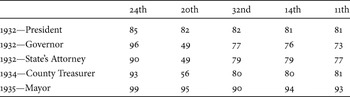
During the 1930s, the 24th Ward produced the largest Democratic majorities in Chicago. The Daily Jewish Courier wrote that it is the “most important Democratic ward . . . even better than the [heavily Irish and Polish] stockyards areas.”Footnote 30Table 1 below displays the city’s five most Democratic wards for several offices in the 1932, 1934, and 1935 elections. In each race in each year, the 24th Ward led all others in the proportion of Democratic votes.
Democratic percentage of the two-party vote

Source:
Wesley Skogan, Chicago Since 1840: A Time-Series Data Handbook (Urbana: Institute of Government and Public Affairs, University of Illinois, 1976), table 5e; for the gubernatorial race, see The Daily New Almanac and Year Book, 1933 (Chicago: Daily News, 1933), 727; The Daily News Almanac, 1934, 835; and The Daily New Almanac, 1936, 823.
Voter turnout also indicates the 24th Ward’s organization’s efficiency. The 1935 city mayoral election had no state or national offices on the ballot. Nor was there a strong challenger to Mayor Edward Kelly. Yet the 24th Ward turned out 93 percent of its registered voters, while the 14th turned out 85 percent, the 20th turned out 82 percent, the 11th turned out 81 percent, and the 32nd turned out 78 percent.Footnote 31
Might the 24th Ward’s performance be just an artifact of political realignment rather than evidence of Arvey’s hold on his voters? As with Jewish Americans nationally, North Lawndale realigned between 1928 and 1936.Footnote 32 Before that, in spite of the Rosenberg’s Democratic ward machine, substantial numbers of the district voted Republican. In the 1923 city election, Arvey won his first aldermanic race with 5,558 votes, but the Republican drew 2,199 votes and a Socialist had 1,436 votes.Footnote 33 In the 1924 presidential race, the 24th Ward gave Republican Calvin Coolidge 4,902 votes to the Democrat John Davis’s 4,567 and Progressive Robert La Follette’s 2,832 votes.Footnote 34
The 1928 election, with New York’s Democratic Governor Al Smith against Republican Herbert Hoover, saw the ward’s voters break toward the Democrats. Smith had 73 percent of the votes to Hoover’s 25 percent.Footnote 35 But earlier, in the April 1928 city election, a large partisan split occurred with the Democratic Dever winning 8,174 votes and the Republican challenger, William Thompson gaining 5,361 votes. Yet, hinting at a coming Democratic dominance, in that election Arvey won overwhelmingly.Footnote 36
The 24th Ward’s voters behaved somewhat differently during the 1930s than other Jewish voters. Lawrence Fuchs notes that Jewish voters were generally more likely than others to split tickets, particularly to choose third-party (usually socialist) candidates.Footnote 37 Yet the 24th Ward’s voters gave few votes to third-party candidates in 1928 and after. And in comparison to other heavily Jewish districts in Chicago, the 24th was even more Democratic. Edward Mazur’s study of Chicago’s Jews identifies precincts outside the 24th that were predominantly Jewish, allowing comparison between their voting performance and Arvey’s virtually all Jewish ward.Footnote 38Table 2 compares the 24th Ward’s performance to predominately Jewish precincts in other wards.
Democratic percentage of the vote in Jewish precincts for president, 1936

Source:
Mazur, Minyans, table 30, 345. Jewish voters in the 4th, 5th, and 20th Wards were primarily German-Jewish and more Republican than their Eastern European co-religionists.
Might the 24th Ward’s electoral performance be explained by the Democratic organization’s use of patronage and favors? The ward organization distributed jobs, rent money, and food baskets, but such benefits could reach only a small proportion of the ward’s roughly seventy thousand residents.Footnote 39 Moreover, the residents were largely working and lower middle class, most not needing the machine’s food baskets and coal deliveries. In the mid-1930s, the ward’s average rent was in the mid-quintile of the city’s rents.Footnote 40 In 1935, Alderman Arvey said of the ward, “We have a lower percentage of people on relief than any similar district in Chicago . . . most of them are working, I am happy to say.”Footnote 41 Also signifying its well being, the ward had the lowest infant mortality rate of all the city’s wards.Footnote 42
Arvey had only a limited supply of patronage jobs to distribute, and these could not cover even all of those in his organization. In 1934 his ward’s workers held 284 city, county, and state jobs.Footnote 43 Additional private-sector jobs were available to him through his capacities to favor or penalize businesses. For example, one of his constituents related that in 1938: “I applied for a job with Sears, Roebuck . . . whose headquarters was . . . in the Twenty-Fourth Ward . . . The employment office refused to give me an application. My precinct captain then secured a letter from Alderman Jacob M. Arvey. . . . Upon presentation of the Alderman’s letter, the Sears employment office promptly produced a job application for me.”Footnote 44 Sears, Roebuck was the ward’s largest employer. Its decentralized hiring procedures during the 1930s allowed Arvey to insert his influence into the process.Footnote 45 But while Arvey’s private-sector patronage supply was sure to be larger than his supply of public patronage, it would have been small in relation to the ward’s population.
Perhaps vote fraud determined the 24th Ward’s performance. Fraud and campaign-related violence were infamously common in Chicago during the 1920s and 30s, and there were instances of both in the 24th.Footnote 46 For example, in machine wards, the Republican election judge was often appointed by the Democratic ward organization, enabling collusion. Colorfully illustrating that practice, in 1923 workers in a precinct of the 27th Ward discarded the legally voted ballots and marked 335 ballots for the local faction’s candidates.Footnote 47
However, occasional fraud in one or another of the 24th Ward’s fifty-four precincts cannot explain its outsized Democratic majorities. There is no evidence that Jacob Arvey encouraged fraud. The primary motivation for fraud was intense pressure on precinct captains to perform, particularly for local offices.Footnote 48 As Jacob Arvey said of his precinct workers, “They would have . . . two swords hanging over their heads . . . the axe may fall from either direction,” either they could lose a job because of poor electoral performance in the precinct or for inadequate performance in their patronage job.Footnote 49
That there was not a high incidence of vote fraud in the ward is revealed by a 1938 report of the County Board of Election Commissioners. It listed all the cases of election fraud indictments and their court disposition, by precinct and ward, for 1934 through 1937. There were eighty-two cases from the city’s fifty wards, and only one of those was from the 24th ward.Footnote 50 Undoubtedly there were instances of fraud in the ward that went undiscovered. But the fact that its arrests for fraud were far lower than other machine wards implies fraud was not a major factor in its performance. There were a few notorious cases of political violence in the 24th Ward during Arvey’s career, triggered by factional struggles before the machine’s consolidation. The most prominent instance was the bombing of the ward’s headquarters on November 9, 1926, following upon the bombing of the home of Morris Eller, the Republican 20th Ward committeeman. With Michael Rosenberg, the 24th Ward committeeman, Eller was a trustee of the county Sanitary District. It was reported that the cause of the bombings was Rosenberg’s falling out with Eller over candidate endorsements in the just completed election.Footnote 51
“A City in Itself . . . the largest Ghetto in the world”
Ninety-one percent of the 24th Ward’s residents were immigrants or children of immigrants, virtually all Eastern European Jews.Footnote 52 The ward contained the largest proportion of foreign-born residents of any Chicago ward, and a third of the city’s Jewish population were resident in the ward.Footnote 53 These immigrants had left Europe’s oppression only to find discrimination here as well.Footnote 54 It was not yet clear if Jews would discover “here in America the safety that had eluded them everywhere else in their wanderings?”Footnote 55 Illustrating the threatening environment perceived by this population, during the 1930s every issue of Chicago’s Jewish Sentinel headlined threats to Jews in the United States as well as Europe.
Eastern European Jewish immigrants settled first in Chicago’s Maxwell Street area, and about 1914 began migrating to North Lawndale, three miles west. Louis Wirth described the migrants bringing with them “the anxieties that plagued the old ghetto.”Footnote 56 The historian Jonathan Sarna, describing Jewish-American communities of the period, wrote that they “gave every appearance of being ‘at home’ in America but . . . actually inhabited a . . . self-contained subculture, a parallel universe.”Footnote 57 Yet, while marginalized, these immigrants naturalized and then voted at a significantly higher rate than other immigrant groups of the era.Footnote 58
In a mid-1934 speech, Jacob Arvey defiantly described his ward as the “ghetto.” He spoke of his constituents’ social isolation and the prejudice they encountered. But, he continued, the ward was also a place of safety. Its ethnic cohesiveness, fortified by political strength, was its protective wall. This new ghetto, he said, was a consequence of “the natural urge of the heart of the Jew to be with his co-religionists. . . . It is a subconscious mind of the Jew which tells him that the Jew is always in a Ghetto, surrounded by the invisible wall . . . of intolerance, prejudice, bigotry and hatred.”Footnote 59 In this remarkable speech, Arvey described his political organization as a force protecting the ghetto. Therein was an allusion to the legend of the Golem as a metaphor for the Democratic machine. In the legend, a righteous person could create from clay a powerful, artificial being, the Golem, to protect the ghetto’s Jews.Footnote 60
Arvey called his ward “a Jewish city . . . in itself . . . the largest Ghetto in the world.”Footnote 61 The political scientist Benjamin Ginsberg observes: “Everywhere that a sizeable Jewish community has existed, Jews have also established a complex of religious, education, and communal institutions that collectively serve as a Jewish government in exile.”Footnote 62 North Lawndale’s “Jewish city” began with the erection in 1913 of the great Romanian Synagogue on its central boulevard, the sanctuary seating thirty-five hundred. In 1921, the Hebrew Theological College established a campus nearby, and a large community center, the Jewish People’s Institute, was built across from the college. Mount Sinai hospital was founded to be the only Chicago hospital observing Jewish dietary laws. Two Jewish orphanages and homes for the elderly, Jewish labor unions, the Yiddish-centric Workmen’s Circle, Yiddish theaters, and the Midwest office of The Daily Forward, America’s largest Yiddish paper, were all within the ward. By 1930, the community contained forty synagogues.
Leadership Across Three Arenas: Community, Machine, and City
Effective leadership requires a balance between the leader’s self-interest and the interests of the led.Footnote 63 At best, that interaction heightens the leader’s power while enhancing the led. As we shall now see, Jacob Arvey was virtually an alchemist in transforming attentiveness to his community’s values and interests into enormous personal authority and power.
“An Unflinching Champion”
In the spring of 1929, the Arvey family occupied a new home in North Lawndale. Celebrating with them, Jewish religious leaders including “the dean of the Chicago Orthodox rabbinate, Rabbi Azriel Epstein and . . . Abba Goldblatt, president of the Union of Hebrew Orthodox Congregations . . . expressed the gratitude of the community to the alderman and his wife for the humanitarian work they have been doing.”Footnote 64 The respect paid to the alderman was unusual and followed no conventional religious ritual. It was, rather, a public signal of respect by authoritative religious leaders for a community leader. About such public displays among Jewish immigrants, the historian Arthur Goren observes that they “promoted the movement for communal collaboration and the demand for a publicly recognized leadership.”Footnote 65
Arvey left school at the age of thirteen, after his father’s death. He later continued education in night school, eventually earning a law degree. Arvey began precinct work while a law student, inspired by the judicial career of a professor. He also volunteered with Jewish community organizations, which distinguished him from other candidates in his first campaign for alderman. In that race the Jewish Sentinel praised Arvey for his “social welfare work.” He had been president of the Young Man’s Hebrew Association and of the Mount Sinai Hospital Workers as well as an officer or director in eight other Jewish organizations, all situated in the 24th Ward.Footnote 66 Later Arvey said about his own ward organization, “Every man had to belong to a church, a lodge, some other group . . . where he could spread the word about the Democratic Party.”Footnote 67 Beyond “spreading the word,” the worker also conveyed dedication to the community through such memberships, just as Arvey had done in his North Lawndale neighborhood while a law student.
Arvey continued full engagement with Jewish organizations as his political career progressed, Jewish education attracting his greatest interest. He became a trustee of the Jewish Theological College in 1929 and was elected to its executive committee shortly afterward. In 1931, he had to decline the vice presidency of the board because of his work as chair of the city council’s finance committee.Footnote 68 He was also a trustee of the Associated Talmud Torahs, the organization of religiously Orthodox primary and secondary schools. He annually chaired a bazaar for the Talmud Torahs, and he was an organizer of the association’s annual flower day. In 1932, the association honored Arvey as “an unflinching champion for Jewish education.”Footnote 69
These educational institutions were religiously traditional (Orthodox), which most of Arvey’s constituents would have identified as authentic Judaism.Footnote 70 Speaking at a Talmud Torah fund-raising bazaar, he extolled the values of Orthodox education: “Children are taught traditional Judaism . . . the Torah, Jewish tradition, Jewish ideals of honesty and justice. There is no excuse . . . to abstain from doing something for the spiritual life of the Jewish youth . . . a few thousand Jewish children are in danger of being cast out on the street because the Hebrew schools are about to be closed, to save the situation . . . I ask you . . . that you should help make the Bazaar a success.”Footnote 71
As the Depression brought financial crises to the Talmud Torahs, Arvey was their advocate within the larger Jewish community. In its annual allocation of charitable funds, the Chicago Jewish Federation gave money to the Board of Jewish Education, sponsoring Reform and Conservative Hebrew and Sunday schools, but not to the Orthodox schools. That bias reflected a gulf between German and assimilating Jews, on the one hand, and the more recently immigrated Eastern European Jews, on the other. The federation claimed its commitment to “modern school methods” in Jewish education required denying the Talmud Torahs. The federation’s executive director explained modern methods aimed to benefit all Jewish children, but “the masses of Orthodox adults have not made possible” modern Jewish education.Footnote 72
In 1930, the federation disbursed $132,763 to the Jewish Board of Education. As the Depression cut into contributions to the federation, the Board of Education remained a high priority, receiving $99,750 in 1932.Footnote 73 But by the mid-1930s, the weakened federation could only give $35,000 to the board. At the same time, Talmud Torahs’ teachers went unpaid. The Jewish Chronicle criticized the federation for favoring the schools of affluent, established synagogues while disregarding the poorer Orthodox community.Footnote 74 In that crisis, Arvey appealed to the federation’s Goldsmith for emergency aid.Footnote 75
Arvey was also director of the Jewish People’s Institute, the Marks Nathan Home for Orphans, the Boys’ Brotherhood Republic, and he was an officer in several of North Lawndale’s synagogues. Beyond the ward he became a board member of the Jewish Federation and of a new Orthodox synagogue in downtown Chicago. At a national level, he was a delegate to the annual conferences of the American Jewish Congress and an early activist in the Zionist movement for a Jewish homeland in Palestine.Footnote 76 In 1931, Arvey initiated an annual Chanukah festival, drawing thousands to downtown Chicago’s opera house to raise money for the Zionist Organization of Chicago.Footnote 77
Arvey framed his political activities in terms of Jewish values to merge his political and Jewish communal roles. In a notable example, he reorganized as a charity the distribution of machine favors to voters. The ward organization had routinely distributed food baskets to needy residents at Passover and Chanukah.Footnote 78 After Michael Rosenberg’s death in 1928, Arvey established the Rosenberg Charity Fund to conduct that function but also to provide for Jews in need beyond the ward. To support the charity, he ran fund-raising events such as weekly boxing matches and an annual gala performance with prominent Jewish entertainers.Footnote 79 That translation of machine political exchanges into charitable giving invoked a primary Jewish religious responsibility to help the poor.
The reframing of politics with religious values served Arvey’s political interests, but he was adamant about not admitting a distinction between his political interests and his religious values. In an interview at the end of his life, he explained that his political career was motivated by “what I learned from Isaiah: . . . You please the Lord by feeding the hungry . . . and doing justice to your fellow man.Footnote 80 Arvey maintained the marriage of politics and Jewish values in a document even more likely to attest to his veracity. In 1958, he wrote an ethical will to be read by his family after his death (which occurred in 1977). In it he said: “The asset for which I worked the hardest to attain and leave to you [is] a good name. . . . I have had . . . opportunities to bring service to my community and to my fellow man. . . . It is important for me to have you know that in these endeavors I gave my energy and attention in far greater measure than in the task of building a fortune for you.”Footnote 81
Whatever image of himself Arvey projected, it is clear that at the prime of his career many constituents saw him as a man who did politics to further Jewish values. At Passover 1936, the Jewish Express called him “the most active Jewish worker” in feeding the hungry. “Last year on the eve of Passover, the Alderman distributed 60,000 pounds of Matzos to a total of 2,400 Jewish families. . . . [He] is regularly among the leading contributors himself in behalf of all the local and national Jewish enterprises.” The editorial continued; at one time rabbis raised money for the poor. But here in Chicago, “these exalted gentlemen see fit to brush their responsibility aside and so are content with the aid rendered . . . by the efforts of one man who happens to be politically influential and a good soul.”Footnote 82
Jewish Boss
The 24th Ward was drawn in 1921 to be the city’s one majority Jewish ward. Jacob Arvey then made it the most Democratic ward in the city and indispensable to the Chicago machine’s consolidation and durability. Beyond producing huge margins of victory for machine candidates, Arvey wielded those totals as a proof of his importance. After each election he informed the winning Democrats of the ward’s contribution to victory through a letter listing the winner’s total votes in the 24th Ward and the opponent’s paltry number of votes. Not to overlook the opportunity to benefit his law firm, successful judicial candidates received letters on the firm’s letterhead.Footnote 83 In a typical response, a successful candidate wrote back to Arvey, “The remarkable vote cast in your Ward . . . is surely living up to all traditions and continues to be the leading Democratic Ward of the City.”Footnote 84 The ward was not Arvey’s only instrument for leveraging Jewish influence within the machine. The Progressive Democratic League of Chicago was established in the late 1920s by Cermak’s Jewish allies. Arvey made it his vehicle for leadership of the machine’s Jewish workers and officials. He motivated them with pep-rally-like meetings and competitions to choose Chicago’s “best Jewish precinct captains.”Footnote 85 The league, as well, was a forum in which to press Jewish concerns on city officials and party leaders as they appeared at its meetings.Footnote 86
This case reveals that the Chicago machine was not simply an organization of top-down power. Rather, it was a system of transactions through which the fruits of electoral power at the bottom were exchanged for the fruits of official power, city resources, and position, from the top. In these transactions, Arvey’s currency was his ward’s astounding electoral performance, his citywide organization of Jewish political workers and officeholders, and his prestige within Chicago’s Jewish community. In return, he gained position and power in the party and city and the means to draw from the city resources to benefit his community. He was a member of the slate-making committee, deciding who would receive official approval as a “regular” Democrat and allocating that benefit among the machine’s ethnic factions. In 1938, he became associate chairman of the Democratic county committee. When illness sidelined Chairman Pat Nash, Arvey replaced him. Without the power he had assembled in his ethno-religious community, there could have been no path for him to the machine’s summit.
The Jewish Alderman
The city council Arvey entered in 1923 was infamous for its “grey wolves,” aldermen for whom governance and theft were synonymous. Corruption was an open activity, but Arvey understood that “honest graft,” legal fees, investment opportunities, and patronage were in the long term more profitable than outright theft.Footnote 87 Besides, Arvey was genuinely interested in governance. He joined the city council’s education and transportation committees and, although a new member, became floor leader for William Dever, the reform-oriented mayor elected in 1923 with strong endorsements from Jewish newspapers.Footnote 88 On the education committee, Arvey supported new professional standards for schools against alderman for whom the schools were extensions of neighborhoods’ parochialisms.Footnote 89 On the transportation committee, he pushed for improved rapid-transit service to west-side neighborhoods and safety for pedestrians and auto traffic at grade-level rail crossings.
Jewish newspapers described Arvey as both a Jewish leader and political leader. the Jewish Chronicle wrote that he is “a leading force” on the city council and an “an indefatigable worker in . . . the many religious and philanthropic organizations in Lawndale.”Footnote 90 Just as he entered the city council, a controversy over Christian missionaries in Lawndale gave Arvey the opportunity to use his official role to pursue ethno-religious concerns. In 1923, the Chicago Church Federation founded a mission in North Lawndale, deploying street preachers to spread the “good news” among Jews. The Sentinel complained that they “have made extensive inroads in the Lawndale district.”Footnote 91 Looking back at the affair, the Jewish Chronicle described the community’s inability at the time to stop the preachers as “a symptom of its weakness.”Footnote 92 Entering the council, Arvey ended the weakness. He demanded that police stop the preachers, but the superintendent explained that he was powerless to interfere with their freedom. Arvey countered that freedom was not the issue; they threatened public order and were a danger to themselves and others.Footnote 93
The new alderman proposed that because the preachers used the public right of way they be required to have permits, and these should be denied. Arvey won his point, and the police halted the preachers. That new policy brought angry letters to the newspapers from the head of the mission, C. P. Meeker, and others. Meeker accused Arvey of violating America’s Christian values.Footnote 94 Arvey could not have gained a better endorsement. The Sentinel lauded him for a “war on the missionaries,” writing that they “are going to have rough sledding in Alderman Arvey’s bailiwick as long as the alert Lawndale representative has a seat and a say in the Council.”Footnote 95
Arvey brought to the city council matters of general importance for Chicago’s Jews. Threatening to close the open door for immigrants from Eastern Europe, the 1925 Johnson Immigration bill imposed low national quotas on Eastern Europe. The Daily Jewish Courier headlined its account of the bill as “persecution of immigrants.”Footnote 96 Arvey attacked the bill, sponsored a city council resolution condemning it, and led an official delegation to Washington, D.C., to lobby against it.Footnote 97 He also played an ombudsman role for the city’s Jews. Whether it was an anti-Semitic broadcast on local radio, licensing problems for a Jewish businessman, or a Jewish physician seeking employment at the county hospital, Arvey sought solutions.Footnote 98 The role he fashioned as the Jewish alderman drew support for him from across the Jewish community’s internal divisions. For example, in 1929, when Arvey campaigned for reelection as alderman, Julius Rosenwald, wealthy, Republican, and German Jewish, joined those endorsing him.Footnote 99
Prior to 1931, multiple political factions fought to control Chicago. Cermak’s 1931 victory put a new coalition into power. However, in February 1933, while meeting with President-elect Franklin Roosevelt, the new mayor was killed before he was able to consolidate his victory. The machine’s consolidation was subsequently completed through selection of Cermak’s successor.Footnote 100 His allies put the coalition’s Irish faction in control of the city and party, Edward Kelly becoming mayor and Patrick Nash the Democratic county chairman. Under the new Kelly-Nash machine, Alderman Arvey became the city council’s president pro tempore and chair of its finance committee.Footnote 101
It might seem that Arvey subordinated his constituency’s interests while enhancing his position in the consolidated machine. After all, the Cermak coalition had pushed aside the formerly dominant Irish Democrats and opened city government for other ethnics. But that resulting coalition was unstable. Its constituent groups, Poles, Bohemians, Jews, and Lithuanians had conflicting interests, while the Irish leaders within Cermak’s coalition were above that ethnic fray.Footnote 102 At the same time, no other group in the coalition was close in size to Chicago’s Irish population. Kelly and Nash were to maintain stability in the “house of all nations” while also assuring the city’s Irish voters with the appearance of power and the distribution of city jobs.Footnote 103
Jacob Arvey entered the city council in 1923 as its only Jew. A decade later he was the council’s most powerful member. As his power grew Arvey continued to place his Jewish community’s concerns foremost in his public work and discourse. A consistent theme of letters Arvey received from Jewish Chicagoans, from the ward and outside it, was pride in him as someone who, in the words of one writer, “served not only the party, but our people.”Footnote 104 No event portrays the stature he achieved and use of it for Jewish concerns better than his remarks to the council in 1939, memorializing the late George Cardinal Mundelein. He said of the church leader:
Great . . . is the loss . . . to the Catholic Church. No less shocking is the news of his death to men and women of all other creeds. . . . We have too few men who have the courage, the intelligence, the tolerance and the will to speak out in this disordered world . . . where brute force has supplanted reason. . . . It was refreshing to find in our midst, a man at the head of his Church . . . yet not too busy to speak out his mind in a clarion call . . . and especially did he speak out for the rights of minorities.
Arvey said Jews are “a race which has been oppressed . . . [and] suffered humiliation and degradation. . . . And this man . . . dared to speak in the face of the greatest disciple of brute force history has recorded.”Footnote 105
The 1936 Primary: The Machine vs. Governor Horner
It is a commonplace of urban scholarship that machine politicians were disinterested in public policy and focused, rather, on material rewards. It was supposed to be middle-class reformers, not machine politicians, who pursued policy solutions to urban problems.Footnote 106 Yet Alderman Arvey’s representation of his Jewish constituents entailed substantive work at a policy level as much as it did descriptive representation. He worked for better transportation to his district, to improve public schools, to oppose objectionable national immigration policy, and, as we shall see now, to gain desperately needed funds for the city’s poor relief, even when it led to a break with a Jewish governor popular in his own ward.
Nominated by Cermak’s organization, in 1932 Henry Horner was elected Illinois’ first Jewish governor. Chicago’s leaders expected Horner to ease the city’s fiscal woes with state aid. The Depression, along with a corrupted tax assessment system, cut the city’s property tax revenues in the face of increased demands for relief.Footnote 107 During 1933 and 1934, federal relief money helped fund the state’s relief commission, which in turn passed money to the city. However, the city’s needs were greater than available federal money, and the fiscally conservative Horner decided to repair the state’s budget by curbing its role in relief. In the resulting crisis, Alderman Arvey proposed to Mayor Kelly the creation of a city emergency relief committee with the Jewish Federation’s Samuel Goldsmith as chairman. Kelly complied, appointing Arvey as a member of the Mayor’s Committee on the Relief Problem along with Goldsmith as chair.
That committee worked with county, state, and federal officials to patch together funds to meet the city’s needs. Then Horner escalated the crisis by ordering the Illinois Relief Commission to cease distributing state monies to localities as of mid-1936. That decision, in turn, stymied the city’s ability to administer its relief program. Chicago was allowed to use a portion of sales tax revenue for relief, but state law prohibited those funds covering the administrative overhead of relief distribution. Arvey appealed to Horner to continue funding administration, but Horner was adamant that state support would end. Mayor Kelly advised Arvey: “Go ahead raise money any way you can.”Footnote 108 In desperation, Arvey successfully solicited contributions from fellow political leaders and businessmen to cover immediate overhead for distributing relief checks.
The city’s hoped-for solution for its fiscal crisis was state legislation legalizing horse-racing books within Chicago, licensing fees and taxes to provide a new revenue stream. That solution also reflected the longtime alliance of Chicago’s machine politicians to organized gambling. The Illinois legislature passed the city’s bill, but Horner called gambling immoral and vetoed it.Footnote 109 Chicago Democrats countered by refusing to support Horner’s renomination in 1936, choosing instead Dr. Herman Bundesen, the city’s health commissioner.Footnote 110 Bundesen was known locally but was unknown outside the city. As if denying support for Horner was not sufficiently troubling to Chicago’s Jews, in the climate of the 1930s it was an additional insult that Bundesen was of German birth.
The Horner-Bundesen primary race was a crisis for Arvey’s leadership and his authority. Horner had won 96 percent of the 24th Ward’s vote in 1932, while Roosevelt had only 86 percent, and he remained very popular in 1936. To reject Horner undermined Arvey’s premise that Jewish concerns were compatible with the machine’s interests. He sought to finesse the issue by convincing Horner, a former Cook County judge, to accept a federal judgeship offered by President Roosevelt.Footnote 111 But Horner pursued reelection.
The Jewish press denounced the machine, and Arvey, for dumping Horner. The Sentinel editorialized: “Failure . . . of the Democratic organization to stick to Gov. Horner . . . can only . . . mean that the party in this state has sunk to the lowest depths of political depravity.”Footnote 112 In each issue, from March 5 until Election Day, the Sentinel’s editorial page had Horner’s photo and an endorsement. Despite his constituents’ sympathies, Arvey could not break with the machine. To do so would end the patronage sustaining his organization and cost him his ward committeeman post, his influence within the machine, and perhaps his city council seat.
Rabbis and constituents appealed to Arvey.Footnote 113 An old friend, Julius Klein wrote: “Horner . . . is a credit to our race. . . How will you explain this to Chicago and American Jewry? Do you realize what will be the effect all over the world if Dr. Herman N. Bundesen, born in Berlin, Germany should defeat the Jew, Horner?”Footnote 114
The campaign distressed Arvey. A local newspaper reported, erroneously, that he would resign as ward committeeman.Footnote 115 His challenge was to explain to his voters and party workers why they should oppose Horner and support Bundesen. The workers got a primarily material explanation. Judge Harry Fisher told the Progressive Democratic League the stakes are “the jobs of thousands of Jews in public life.” But he added, “What a terrible thing it would be if the Democratic party turned against us Jews.”Footnote 116
To his voters, Arvey used an ethno-religious appeal. He described his organization, within the machine, as a protective fortress for Jews. Before the election he spoke on “The Jewish Hour” broadcast explaining that rejecting Horner was a matter of policy, not religion. Referring to criticism of himself, he said, “[I am] jealous of my standing as a Jew” and would not let critics “tear down a reputation gained by twenty years of faithful service. . . . Long before I aspired to public office I was actively participating in Jewish activities, and upon my election to office, I felt I ought to use the prestige and influence of my position . . . for the benefit of the people from whom I spring.” Then he stressed that Jewish security was ensured by inclusion in the multi-ethnic, Irish-led Democratic party: “We Jews, as a minority group, could not elect our men to office unless we belonged to a party, and that only by staying with the party could we hope for political success. When the Democratic Organization . . . decided that the present Governor should not be endorsed . . . it was my duty . . . to support that man . . . endorsed by the party organization—the present governor knew that.”Footnote 117
Recall Arvey’s 1934 “ghetto” speech. He had urged his voters to “Vote consciously . . . and have in mind the preservation of Jewish ideals.” He said that the Jewish elected official is their best protector; “the more Jews there are in high public office . . . the stronger is our line of defense.”Footnote 118 Now he urged his constituents to abandon the Jewish governor. Arvey weighed the benefits for the community of a Jewish officeholder on the one hand against the dangers arising from widespread hatred of Jews. North Lawndale’s residents were a small minority, but Arvey explained that through his organization his voters became an important bloc in a powerful machine and nationally dominant party. Jewish safety, he argued, required that Horner be abandoned.
The machine secured winning vote totals for Bundesen in Chicago, but Horner won statewide. Arvey carried Bundesen to victory in the 24th Ward with 11,897 votes against Horner’s 6,785.Footnote 119 Horner’s 35 percent was a poor performance compared to his 1932 vote, but he sharply reduced the ward’s usual total for the machine’s candidate. Still, Arvey could claim success in containing Horner.Footnote 120 Pat Nash, the county party chairman, praised Arvey’s performance, writing, “You may have forfeited some admirers, you have more than earned the respect of most of your fellow Committeemen for the courageous stand you took.”Footnote 121
But the 24th had produced a win primarily for its own leader. Arvey had convinced his voters of a Jewish interest in backing his candidate. In his biography of Horner, Thomas Littlewood describes Arvey meeting an elderly Jewish man on primary day. The man said, “You did a terrible thing to me today. . . . You made me vote against . . . our Henry Horner.”Footnote 122 Littlewood interprets this as evidence for voter coercion. But it was persuasion, not force, loyalty to Arvey and not a material benefit, that forced that man’s vote. A precinct worker wrote to Arvey, “The campaign was not between Horner and Bundesen. It was between Horner and Arvey and the . . . votes cast . . . were cast for you.“Footnote 123
In 1940, at the age of forty-five, Jacob Arvey left politics for a captain’s commission in the U.S. Army Judge Advocate General’s Corps. In a radio address before leaving for training, Arvey spoke of his decision for military service. He said, “History is . . . marching backward, and the days of barbarism and darkness can be reenacted in our days. . . . I shall leave my home, my family, my friends. . . . I go with the proud resolve to serve under any conditions—with gratitude for that opportunity.”Footnote 124 Later, from training camp, he wrote to the Yiddish Forward’s Chicago editor, who was his friend and frequent critic: “Feeling that I may be contributing toward a better day for the people from whom I spring makes me contented.”Footnote 125
Attuned as Alderman Arvey had been to his constituent’s values and culture, so his enlistment reflected their anxieties about the world. In July 1941, the Chicago Tribune polled readers, asking if the United States should enter the war against Hitler? Seventy-eight percent of Chicago’s respondents said no, but one ward supported war. The Tribune wrote: “In the 24th Ward . . . presided over by J.M. Arvey, now with the army . . . a majority vote is being cast . . . for intervention.”Footnote 126
Arvey returned from war in 1946 and regained the chairmanship of the Democratic county committee. The machine had weakened greatly during the war, and Mayor Edward Kelly’s support had eroded in the city’s white ethnic neighborhoods, in part because he had attempted some measure of racial justice in postwar housing policy.Footnote 127 Arvey’s challenge was to revive the machine, and he set out to do so by remaking it in the image of New Deal liberalism.Footnote 128 He chose a clean, civic-minded businessman, Martin Kennelly, to be mayor and promoted the liberals Paul Douglas and Adlai Stevenson, the former for the U.S. Senate seat and the latter for the governorship. But Arvey’s hold on the machine was short lived. He resigned as county chairman after promoting a flawed and losing candidate for county sheriff in 1950. Subsequently, County Clerk Richard J. Daley led a movement to return the machine to Irish control. Daley became county chairman in 1953 and Chicago’s mayor in 1955. Arvey, meanwhile, was shunted onto Chicago’s Park District board and semiretirement.
Conclusion
This article problematizes what has been assumed to need no further examination—the loyalty of immigrants to urban machines. I argue that the widely accepted material, affective, and symbolic exchange explanations for that loyalty are inadequate, primarily because they rest on a mischaracterization of immigrants and their communities. I proposed an alternative way of thinking about the relationship of immigrants to urban machines, suggesting the relationship was likely to be shaped by ethno-religious norms that Clifford Geertz describes as cultural DNA.
This article’s theoretical insight is not novel. Rather, my approach here extends and deepens that aspect of exchange theory that hypothesizes politicians used culturally symbolic appeals to attract ethnic voters. Where my analysis differs from conventional applications of that idea is in conceptualizing the potential depth and complexity of the cultural relationship between the leader and the led and in finding support for that conception in this single case.
Chicago’s 24th Ward presents a strong case through which to examine the logic and utility of this cultural explanation of immigrants’ bond with machines. Investigating that case, I showed that the community’s political life was complexly related to its cultural characteristics and anxieties. Its machine boss, Jacob Arvey, contributed mightily to communal activities, and his political discourse with constituents hewed closely to the language and values of Jewish life. In effect, Arvey presented his political leadership as an instrument for promoting his community’s cultural well-being and safety. That blending of roles and the invocation of particularistic communal anxieties was most vivid in his assurance to constituents that the Democratic machine was a bulwark for their security in a dangerous world.
This article examines one case of an immigrant community to address a general theoretical question about the relationship of immigrants to machines. What can we say about the general question on the basis of one case? The findings here support the utility of the proposition that deep cultural politics can be engaged to bind immigrants to machines. But, while this case fits the intuition with which we began, one cannot generalize from the political life of North Lawndale in the 1930s to the experiences of other immigrant communities in Chicago and elsewhere. The cultural style of leadership Alderman Arvey pursued in his ward was quite specific to his Eastern European Jewish community. That community’s situation, the detachment of its members from places of origin, the rife anti-Semitism of the era, and the community’s cultural homogeneity, all suggest that this case is best described methodologically as a “most-likely” fit for my initial theoretical formulation about cultural politics.Footnote 129
Other immigrant communities, with different cultural characteristics, would likely manifest different relations to machines than we observe in the case of Chicago’s 24th Ward. However, the larger importance of this single case is that it demonstrates the utility of studying cultural politics in the history of urban machines. Whatever variance we find across different immigrant communities in various cities, the enterprise of studying cultural politics in the machine will move us beyond stylized concepts of urban machines and their exchanges to consider more fully their social foundations and the forces binding voters to them.