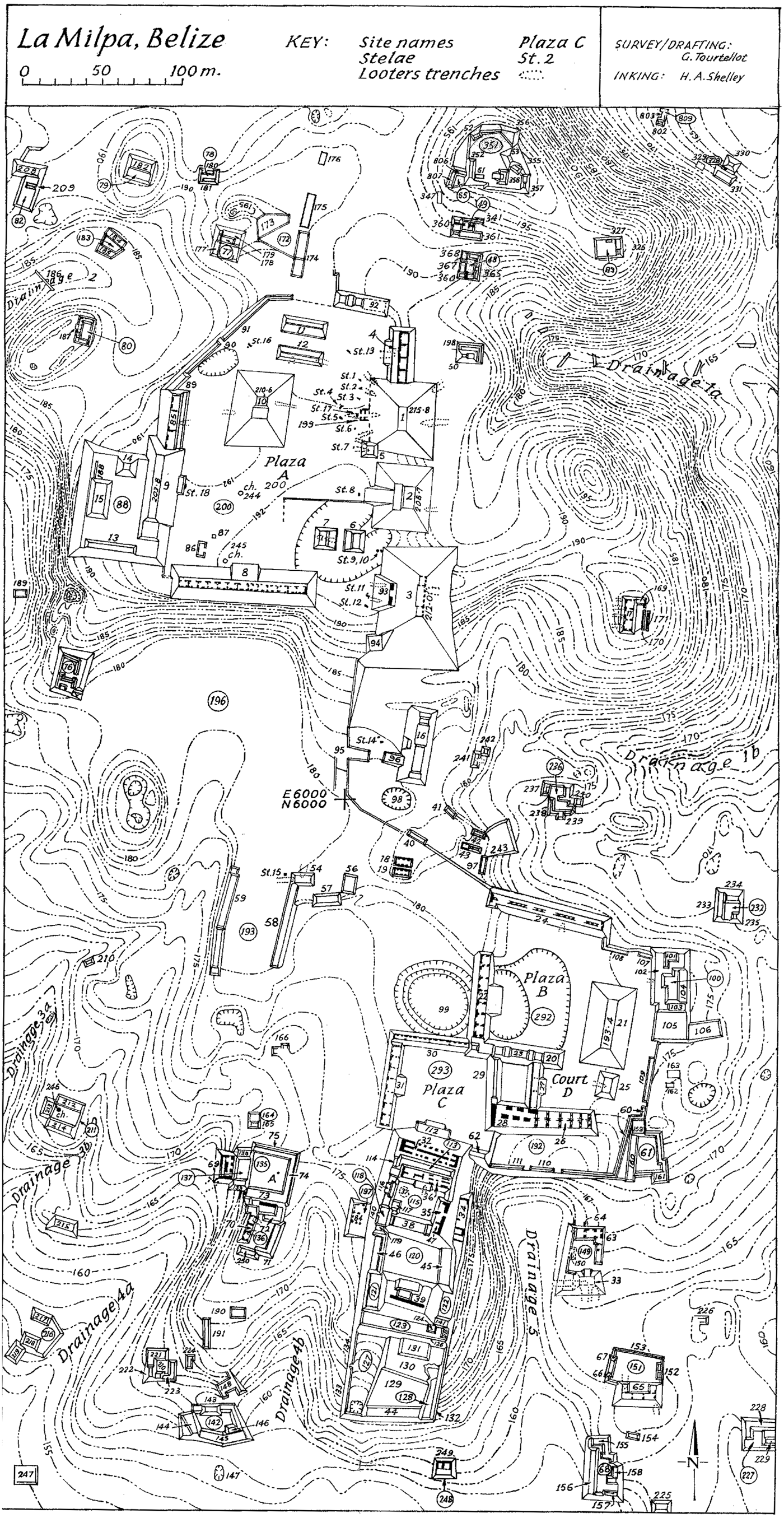
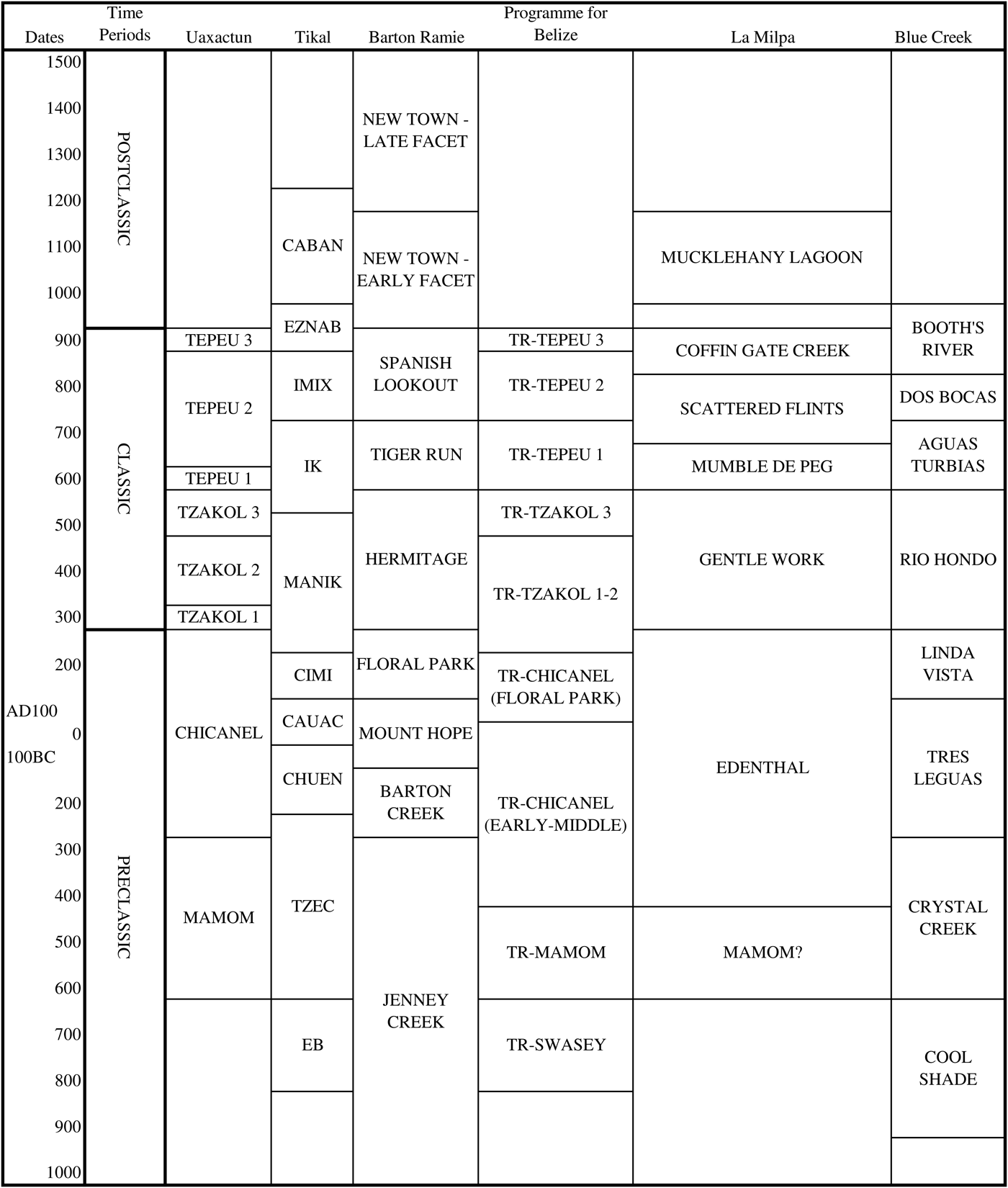
Archaeological research at La Milpa (Figure 1) has revealed that it had an occupation history extending from the Late Preclassic to the Terminal Classic period with limited reoccupation in the Postclassic (Figure 2). Based on initial excavations and preliminary ceramic analysis, however, the principal investigators asserted that La Milpa “attracted heavy population only periodically rather than continuously” (Tourtellot et al. 2003:50). Tourtellot (Reference Tourtellot1997:2) has even stated that Early Classic and Late/Terminal Classic La Milpa were so different that, “In effect, we are dealing with two different sites, from two different periods of time, which just happen to occupy the same space.” Hammond and Tourtellot (Reference Hammond, Tourtellot, Demarest, Rice and Rice2004:Figures 13.3–13.5) have presented graphs of rather large swings in occupation at La Milpa based on: (1) changes in the percentage frequencies of sherds by time period; (2) changes in raw counts of sherds by time period; and (3) changes in the number of peripheral excavation units with presence of sherds dated to each time period. This and earlier publications and papers on La Milpa's occupation were based on excavations and ceramic analyses conducted through the 1996 field season. The present article contains revised occupation graphs based on the ceramic analysis completed by the author for her dissertation (Sagebiel Reference Sagebiel2005a), which includes additional seasons of excavation through 2002.
Map of La Milpa site center. Map by Gair Tourtellot III; drawing by H. A. Shelley.

Ceramic chronology chart (after Culbert Reference Culbert1993; Gifford Reference Gifford1976; Kosakowsky and Lohse Reference Kosakowsky and Lohse2003; Sagebiel Reference Sagebiel2005a; Smith and Gifford Reference Smith and Gifford1966; Sullivan and Sagebiel Reference Sullivan, Sagebiel, Scarborough, Valdez and Dunning2003).
Hammond and Tourtellot proposed that La Milpa had a Late Classic occupation history of near abandonment in Late Classic I (Tepeu 1 phase) (2004:297) and rapid abandonment before a.d. 830, if not earlier (2004:289). In addition, earlier ceramic publications were able to report very little information about the Late Classic I ceramics and conflated the Late Classic II and Late Classic III ceramic complexes (Kosakowsky and Sagebiel Reference Kosakowsky and Sagebiel1999; Sullivan and Sagebiel Reference Sullivan, Sagebiel, Scarborough, Valdez and Dunning2003). This article provides a full description of the ceramics of the three Late and Terminal Classic complexes upon which the revised occupation graphs presented here are based. The term “occupation history” is used here in order to clarify that this is not a paper with the goal of providing estimates of actual population numbers, nor is the goal to present the spatial settlement history of La Milpa. The goal is to update the original occupation graphs using the same or similar methods as previously employed (Hammond and Tourtellot Reference Hammond, Tourtellot, Demarest, Rice and Rice2004:Figures 13.3–13.5). A second goal is to present a full description of the Late and Terminal Classic ceramics of La Milpa, clarifying that La Milpa does have fully developed Late Classic I and Late Classic III ceramic complexes.
BACKGROUND, CONTEXTS, AND METHODS
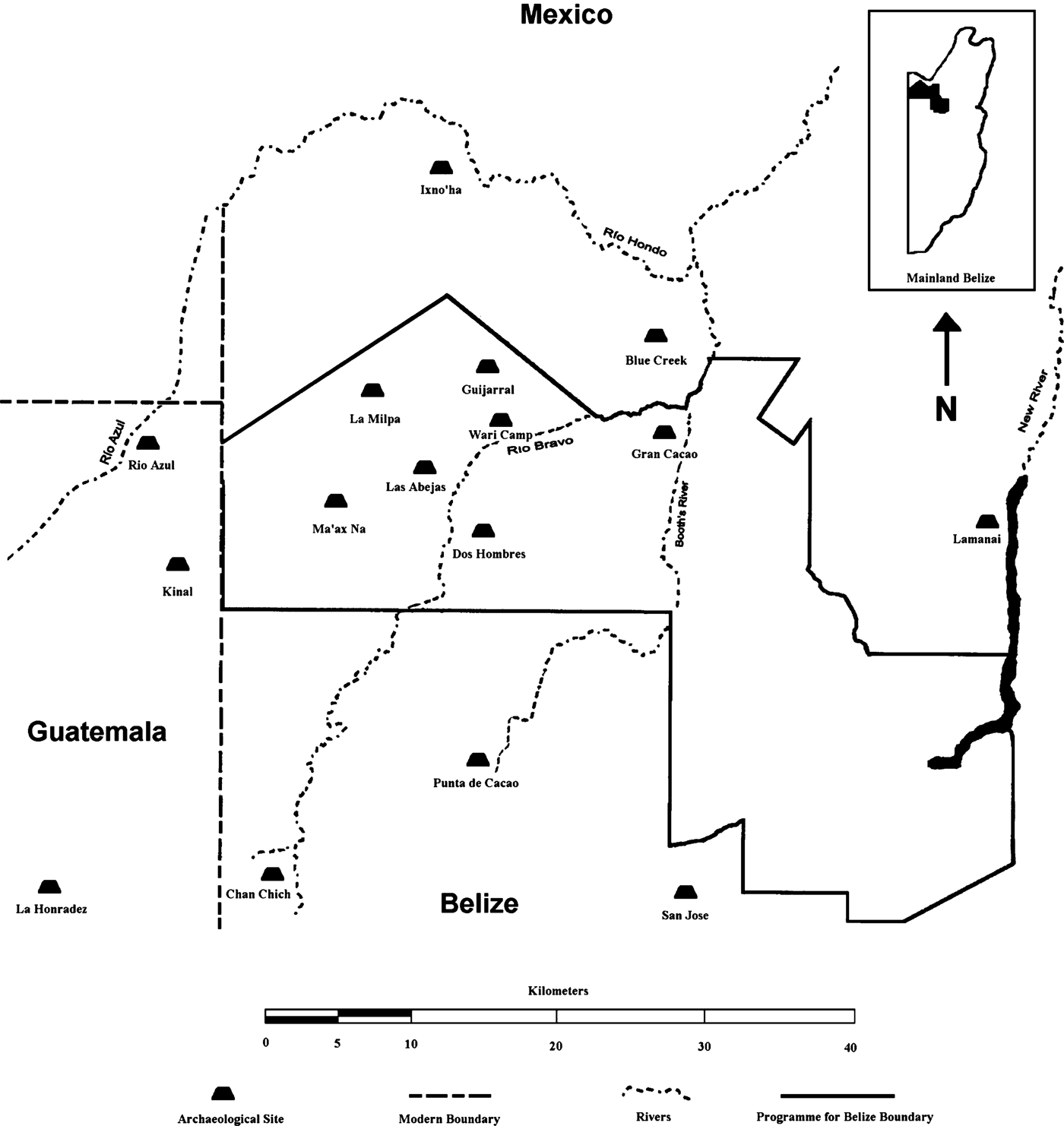
The La Milpa Archaeological Project (LaMAP) was conducted between 1992 and 2002 under the direction of Norman Hammond and Gair Tourtellot of Boston University. The investigations encompassed the La Milpa site center along with land within a 6-km radius surrounding the site center. La Milpa is located in the northwest corner of Belize within property owned and administered by the Programme for Belize, which borders Guatemala to the west and is near the border of Mexico to the north (Figure 3). The LaMAP targeted four areas for survey and excavation: the La Milpa site center (consisting of a 650 × 400 m area of ritual architecture and elite residences), three radial transects leading out from the site center (the East Transect was surveyed and mapped out to 6 km, the South Transect to 3.8 km, and the North Transect to 1 km [Estrada Belli et al. Reference Estrada Belli, Tourtellot and Hammond1999]), four minor centers (located approximately 3.5 km in each of the cardinal directions from the site center), and 15 randomly chosen 250 × 250 m survey blocks located within 3.5 km of the La Milpa site center (Rose Reference Rose2000:52). In the periphery, excavations were conducted at the four minor centers (Tourtellot et al. Reference Tourtellot, Belli, Rose, Hammond, Scarborough, Valdez and Dunning2003a, Reference Tourtellot, Everson, Hammond, Iannone and Connell2003b), in the 250 × 250 m survey blocks (Rose Reference Rose2000), and along the East Transect (Everson Reference Everson2003; Gonzalez Reference Gonzalez2012). In addition, the Ancient Maya Land and Water Use Project conducted by Vernon Scarborough and Nicholas Dunning of the University of Cincinnati and by Fred Valdez Jr. of the University of Texas at Austin conducted limited excavations of structures and water control features in an area known as the Far West Bajo (located 3 km northwest of the site center) and along the drainages leading from the site center (Dunning and Beach Reference Dunning, Beach and Lentz2000; Dunning et al. Reference Dunning, Scarborough, Valdez, Luzzadder-Beach, Beach and Jones1999, Reference Dunning, Luzzadder-Beach, Beach, Jones, Scarborough and Culbert2002; Scarborough Reference Scarborough, Scarborough and Isaac1993; Scarborough et al. Reference Scarborough, Becher, Baker, Harris and Valdez1995). Kunen (Reference Kunen2001, Reference Kunen2004) also conducted excavations of structures near the Far West Bajo. Additionally, Estella Weiss-Krejci of the Universidade do Porto, Portugal, and Thomas Sabbas of the University of Vienna excavated structures and water control features at the minor center of La Milpa East (3.5 km east of the site center) (Weiss-Krejci and Sabbas Reference Weiss-Krejci and Sabbas2002). The ceramics from all of these investigations were examined by the author for her dissertation (Sagebiel Reference Sagebiel2005a).
Map of Northwestern Belize.
Defining the three Late and Terminal Classic ceramic complexes at La Milpa was a difficult task, primarily because of the different types of contexts excavated by the projects contributing sherds to the ceramic analysis. Although the collection of ceramics is quite large (n = 222,119), it is very eroded, and only one-third could be assigned to type. Therefore, in addition to Type-Variety and mode classification (Gifford Reference Gifford1960, Reference Gifford1963; Smith et al. Reference Smith, Willey and Gifford1960), an attribute analysis—with particular emphasis on formal modes—was employed using a relational database that also contained stratigraphic information. Unfortunately, relatively few contexts pertain to large-scale excavations of site-center structures or plazas. Most of the excavations in the center of La Milpa consisted of clearing operations to expose the latest construction of buildings, clearing of looters' trenches for profiling, and fairly small-scale excavations into structures and courtyards. In the hinterlands of La Milpa, we confined excavations mostly to small-scale testing of small structures, water control features, and agricultural features. This meant that both good stratigraphic contexts, useful for developing chronologies and typologies, and large, horizontal excavations, useful for functional analysis, were not available in the quantity they usually are for major projects at sites the size of La Milpa. But, we partially remedied this problem through the application of single-context planning, Harris matrices, and the use of professional artists experienced in archaeology to draw stratigraphic profiles at La Milpa. This, combined with an analysis focused on forms and supplemented with a relational database, allowed the author to define painstakingly the La Milpa ceramic complexes. (For a full discussion of the methods used in the analysis and for additional information about the contexts that produced ceramics, see Sagebiel [2005a].)
Assignment of types and dates relied heavily on ceramic cross-dating. This task included examination of comparative collections at the Field Museum in Chicago and at the Peabody Museum at Harvard from many Maya sites including Barton Ramie, San Estevan, and San José, Belize, as well as Altar de Sacrificios, Loltun, and Uaxactun. Ceramics from several sites, including Río Azul, were examined at the Ceramoteca at the Museo Nacional de Arqueología y Etnología in Guatemala. The Ka'xob, Belize, ceramics were examined at Boston University. Collections housed at the University of Arizona, including those from Barton Ramie and Tikal, were also consulted. Collections consulted in Belize included those housed at Lamanai as well as collections at the Institute of Archaeology in Belmopan, especially those from Cuello and Gran Cacao. The author was also the ceramic analyst for several other projects and sites while working on her dissertation. This included work on the Late and Terminal Classic ceramics at San Bartolo, Guatemala (Rivera and Sagebiel Reference Rivera, Sagebiel, Urquizu and Saturno2003), analysis of ceramics from sites in the Blue Creek area and the site of Gran Cacao in the Programme for Belize (Sagebiel Reference Sagebiel, Lohse and Sagebiel2005b, Reference Sagebiel and Lohse2006), as well as analysis of ceramics from the site of Louisville, Belize (Runggaldier and Hammond Reference Runggaldier and Hammond2000). In addition, a small number of radiocarbon dates from ceramic contexts and dated stelae associated with ceramic caches were used to assign ceramic dates. The type names used at La Milpa are borrowed from neighboring regions, and new type names were created only if no previous examples of the type could be found in the literature or comparative collections. For any single complex, type names were borrowed to the greatest extent practicable from whichever complex from an adjoining region was judged to be most similar stylistically and technologically, with additional type names borrowed from elsewhere if necessary. Most Late Classic types are borrowed from the Tepeu complexes of the central Peten (Smith and Gifford Reference Smith and Gifford1966). Belize River Valley type names (Gifford Reference Gifford1976; Willey et al. Reference Willey, Bullard, Glass and Gifford1965), however, have also been used for many Late Classic I types, and type names from the Yucatan peninsula have been used for some of the Late Classic III types (Brainerd Reference Brainerd1958; Smith Reference Smith1971). The rationale is that the use of familiar type names allows other researchers to key into similarities between complexes. This should not be taken to imply that, for example, Tinaja Red at La Milpa is the same in all its attributes as Tinaja Red at Tikal. Rather, that they are both Late Classic red-slipped types that share more attributes with one another than they do with Late Classic red-slipped types from other areas.
THE LA MILPA CERAMIC COMPLEXES
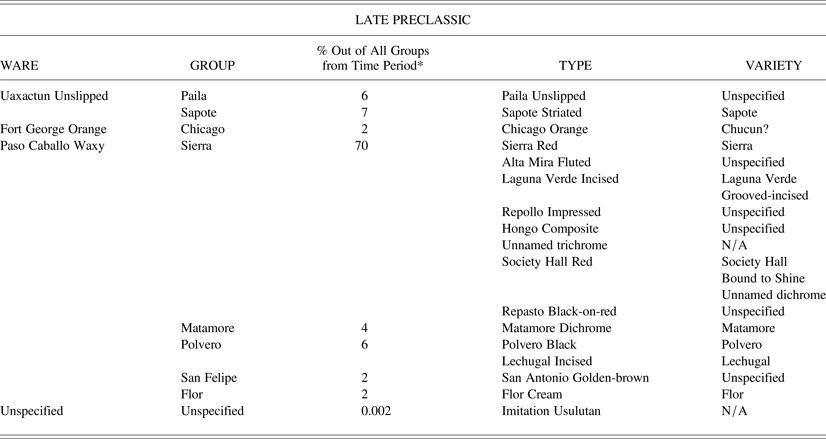
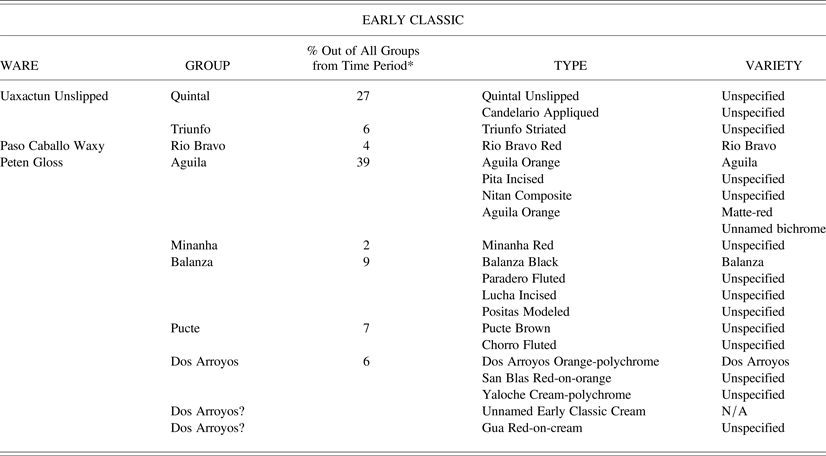
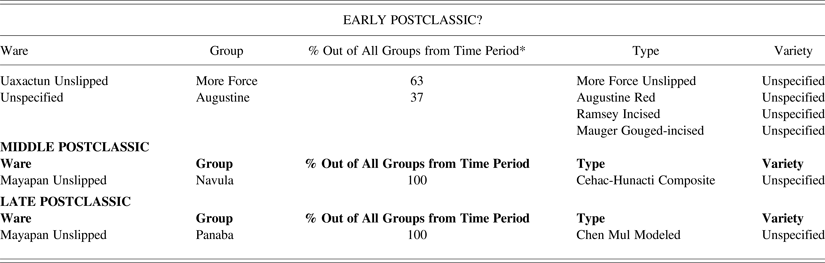
The Late and Terminal Classic sequence is the focus of this paper, but a few words should be said about earlier periods and the subsequent Postclassic period. The Preclassic ceramics of La Milpa are within the Chicanel ceramic sphere. Many of the types are the same as those defined in the Peten (Smith and Gifford Reference Smith and Gifford1966), although a number of types have been defined at other sites, particularly from northern Belize (Table 1) (Kosakowsky Reference Kosakowsky1983, Reference Kosakowsky1987; Pring Reference Pring1977). Similarly, the Early Classic ceramics are part of the Peten-centric Tzakol ceramic sphere (Table 2) (Smith and Gifford Reference Smith and Gifford1966), although the Terminal Preclassic and the early facet of the Early Classic include several newly defined transitional types that blend Preclassic and Early Classic attributes (Kosakowsky and Lohse Reference Kosakowsky and Lohse2003; Sagebiel Reference Sagebiel2005a; Sullivan and Sagebiel Reference Sullivan, Sagebiel, Scarborough, Valdez and Dunning2003; Sullivan and Valdez Reference Sullivan and Valdez2006; Valdez and Houk Reference Valdez, Houk and Houk2000). The later facet of the Early Classic period includes modes, such as Teotihuacan-style cylinder tripod vases and bright orange slips that are also typical of the Peten. Reoccupation by nonelites during the Early or Middle Postclassic was exceedingly light (Hammond and Bobo Reference Hammond and Bobo1994). Although tentatively placed in the Belize Valley New Town sphere (Table 3) (Gifford Reference Gifford1976; Sagebiel Reference Sagebiel2005a), the Postclassic ceramics are currently being reevaluated. The only definitive Middle and Late Postclassic activity consists of stelae resetting and dedicatory offerings of Yucatecan-style ceramic censers (Hammond and Bobo Reference Hammond and Bobo1994; Tourtellot et al. Reference Tourtellot, Rose, Grube, Donaghey and Hammond1994:122).
La Milpa Late Preclassic ceramic types
*Based on rim sherds
La Milpa Early Classic ceramic types
*Based on rim sherds
La Milpa Postclassic ceramic types
Late Classic I Mumble de Peg Complex (a.d. 550/600–650/700)
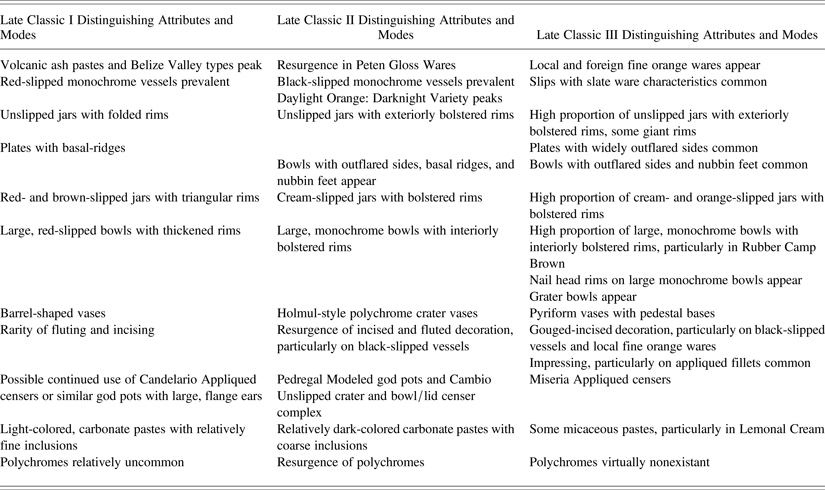
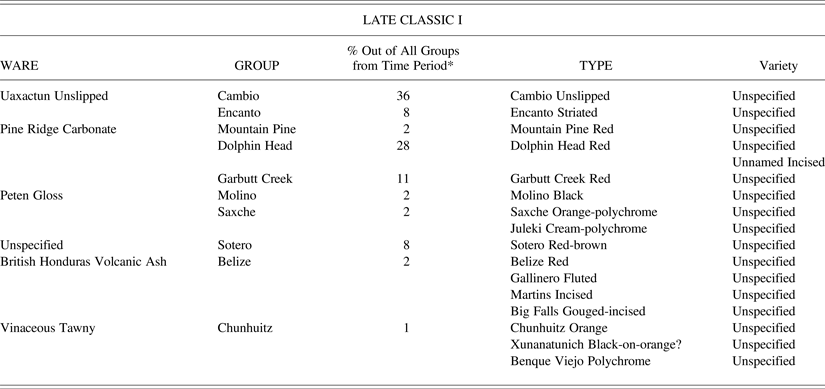
The Late Classic I ceramic repertoire at La Milpa has several outstanding characteristics (Table 4), these include the predominance of red-slipped monochrome vessels, particularly plates, large bowls, and jars; unslipped jars with folded rims; and the appearance of probable volcanic ash pastes and associated Belize Valley types. Diagnostic forms are plates with basal ridges; red or brown slipped jars with small, triangular rims; red slipped, large bowls with thickened rims; and barrel-shaped vases. Surface manipulation, such as incising and fluting, is rare. Late Classic I carbonate pastes are similar to Early Classic pastes, as they are generally a light color (orange, pink, brown, or yellow) with fine opaque calcite and iron nodule inclusions common.
Distinguishing attributes and modes of Late Classic I, II, and III ceramics
Carbonate Paste Slipped Wares
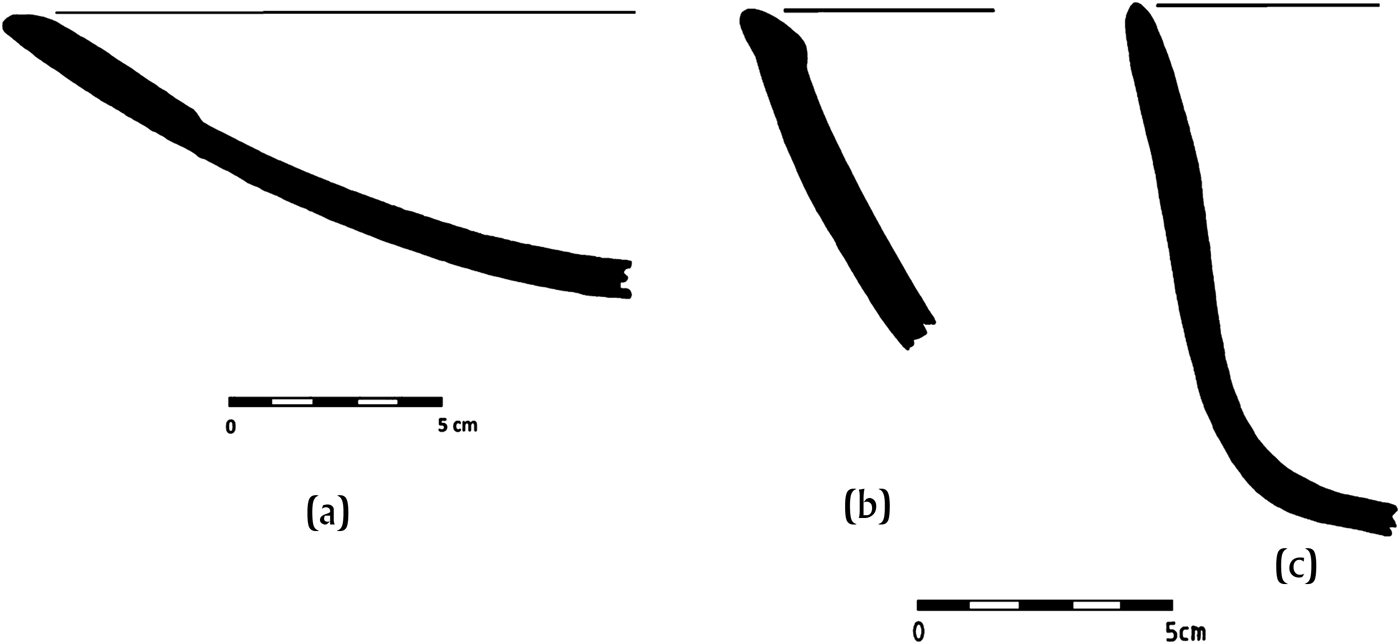
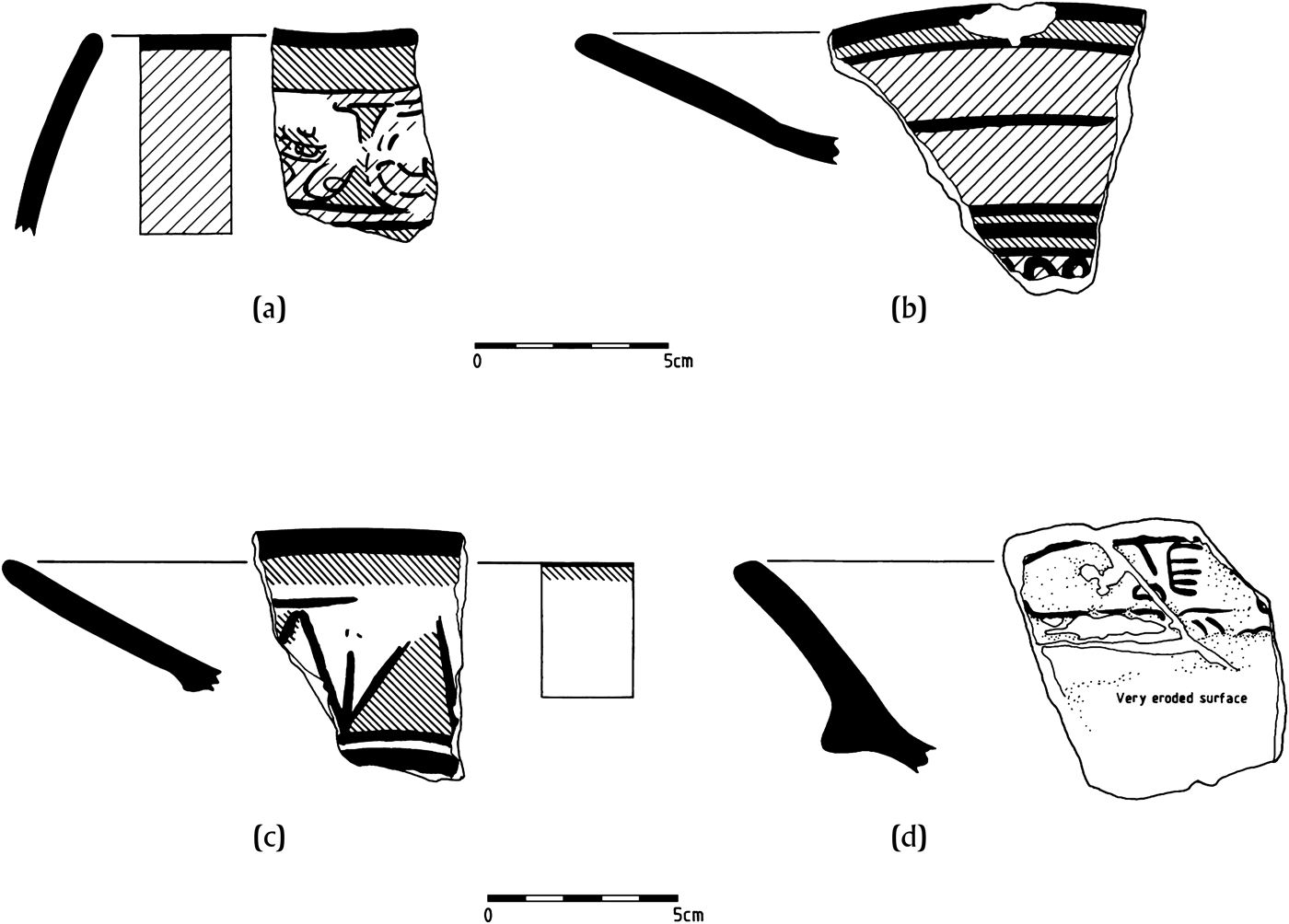
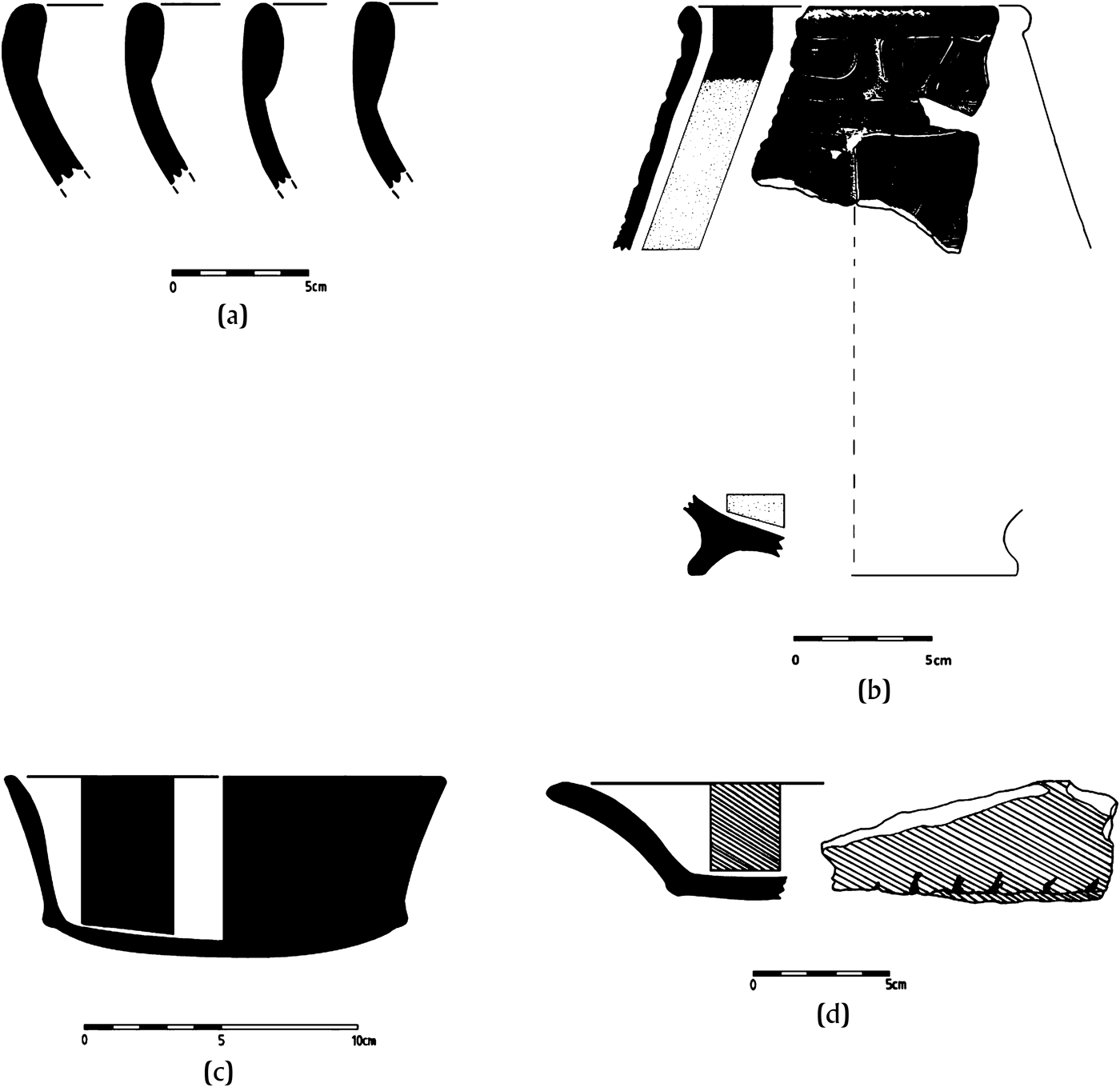
Monochrome red vessels are the predominant slipped type. Following Willey et al. (Reference Willey, Bullard, Glass and Gifford1965:Figure 220) and Gifford (Reference Gifford1976:Figure 13), they are placed in Pine Ridge Carbonate Ware under three groups: Mountain Pine, Dolphin Head, and Garbutt Creek (Table 5), but they could easily be considered part of the same group, as the primary difference among them is shape (Sagebiel Reference Sagebiel2005a:342, 348). Mountain Pine Red consists of outflared plates with basal ridges. Dolphin Head Red consists of outflared plates with interior breaks (Figure 4a), jars with tall necks and small triangular rims or direct rims with round lips, round bowls with thin walls and direct rims, and barrel-shaped vases. Garbutt Creek Red consists of round or incurved bowls with thick walls and thickened rims with small, round, interiorly bolstered or beveled rims (Figure 4b). For all of the groups, the slip is red (Munsell 10R 4/6, 4/8), thin, and glossy, although it is less glossy than later slips and does not preserve well. Plates and bowls are usually unslipped on the exterior. When present, exterior slips are matte. The only incised type is Dolphin Head Red: Unnamed incised, which consists almost exclusively of jars with tall necks that have horizontal or oblique rows of pre-slip incisions, striations, or small punctations on the neck.
Late Classic I slipped ceramics: (a) Dolphin Head Red plate; (b) Garbutt Creek Red bowl; (c) Sotero Red-brown bowl.
La Milpa Late Classic I ceramic types
*Based on rim sherds
The second most common slipped group is Sotero; it also has carbonate paste, but the ware remains unspecified (Gifford Reference Gifford1976:Figure 13; Willey et al. Reference Willey, Bullard, Glass and Gifford1965:Figure 220). The slip is brown (10YR 3/2, 3/3), reddish brown (5YR 3/2, 3/3), or orange-brown (7.5YR 4/6, 5/6) with a semi-burnished, velvety gloss or matte finish; the latter is most common on jars. Slip colors are uneven, fire clouds are common, and the rims are often redder than the body, particularly on small bowls. Both the interiors and exteriors of bowls and plates are slipped. The most common forms are bowls of various shapes (Figure 4c); jars with triangular or round rims; outflared plates with basal ridges; and both barrel-shaped and vertical-sided vases.
The Peten Gloss wares include the Molino and Saxche Groups (Smith and Gifford Reference Smith and Gifford1966:172). The Molino Group only makes up four percent of the slipped rims, but it can be difficult to differentiate from both Early Classic and other Late Classic blacks and is likely underrepresented in the analysis. The slip is hard, glossy, and consistently black with occasional red or yellow fire clouds. The only forms securely identified are plates with basal ridges and barrel-shaped vases.
The Saxche Group includes Saxche Orange and Juleki Cream Polychromes (Smith and Gifford Reference Smith and Gifford1966:172), both of which have a general palette, design style, and motifs that are more similar to Early Classic than succeeding Late Classic polychromes. Saxche Orange Polychrome consists of bright, glossy, red and black designs on orange slipped plates with basal ridges, round and incurved bowls, and barrel-shaped vases (Figures 5a–b). Geometric and curvilinear designs and glyph elements are common. On both the interior and exterior of all forms, lips are painted either red or black and are often followed by one or more bands of the opposite color. The interiors of barrels and bowls have solid orange bodies. The exteriors have either rim bands of glyph elements or geometric and curvilinear designs on the body. The interiors of plates have single, large bands of glyph elements or geometric designs. About half of the exteriors are unslipped; when slipped, they are matte. Juleki Cream Polychrome has glossy red and black designs on a cream background. Barrel-shaped vases and plates with basal ridges are common forms (Figure 5c). Barrel interiors have a single lip or rim band in red or black with solid cream bodies. Exteriors have complex series of rim bands. Geometric designs and glyph bands are common on barrel exteriors and plate interiors.
Late Classic I polychrome ceramics: (a) Saxche Orange Polychrome barrel; (b) Saxche Orange Polychrome plate; (c) Juleki Cream Polychrome plate; (d) Benque Viejo Polychrome plate.
Volcanic Ash Wares
British Honduras Volcanic Ash Ware is represented by the Belize Group (Gifford Reference Gifford1976:Figure 13; Willey et al. Reference Willey, Bullard, Glass and Gifford1965:Figure 220). Although not tested for volcanic ash, these ceramics have all the other attributes typical of the Belize Group as described here. (Lauren Sullivan [personal communication 2011] has examined a small sample of probable ash wares from the Programme for Belize Archaeological Project using hydrochloric acid and a microscope and has determined that they do contain volcanic glass.) The four types represented are all red slipped. The paste is very fine and lacks inclusions or has very fine (<1 mm), opaque calcite inclusions. It is invariably well fired and lacks unoxidized cores. The paste is a distinctive yellow, light brown, or buff color (10YR 8/4, 7/4, 7/6). The slip is thick and highly glossy and is bright red (10R 4/8) or dark red with black mottling (10R 3/6). The slip erodes easily, and eroded sherds may have a gray “ghost slip” of fine dirt and clay adhering to the surface. In Belize Red, plates with basal ridges and bowls of various forms are common.
All three of the decorated types in the Belize Group are restricted to vases with vertical walls. Exteriors are slipped, and interiors are generally unslipped or washed orange-red. The most common decorative motif in Gallinero Fluted is two or three horizontal grooves around the rim followed by oblique or vertical flutes on the body. Martins Incised consists of fine line, pre-slip incisions in geometric and curvilinear designs. Big Falls Gouged-incised consists of pre-slip gouged-incised designs.
Vinaceous Tawny Ware consists of the Chunhuitz Group, and, although the paste is the same and there is overlap of both slips and forms with British Honduras Volcanic Ash Ware, it remains a separate ware following Willey et al. (Reference Willey, Bullard, Glass and Gifford1965:Figure 220) and Gifford (Reference Gifford1976:Figure 13). It consists of three types: Chunhuitz Orange, Xunantunich Black-on-Orange, and Benque Viejo Polychrome. Chunhuitz Orange has an orange (5YR 6/6) to reddish orange slip (2.5YR 4/8) that is thinner and more matte than Belize Red. Predominant forms are bowls and vases. Vase interiors are washed or left matte. Xunantunich Black-on-Orange has black rim bands and glyph-like elements. A few sherds also have incised decoration. Forms include barrels and vases with vertical walls. Benque Viejo Polychrome has surfaces that are glossy, although the orange background may be less so than the red and black painted designs. Interiors are orange with red lips or rim bands. Exteriors are orange with red and black rim bands. Curvilinear and geometric designs (circles, squares, and diamonds) as well as glyph-like elements are used on the interiors of plates with basal ridges (Figure 5d) and the exteriors of bowls, which are the primary forms. Two bowls also have vertical flutes on the exterior (see Gifford Reference Gifford1976:Figure 173h).
Uaxactun Unslipped Ware
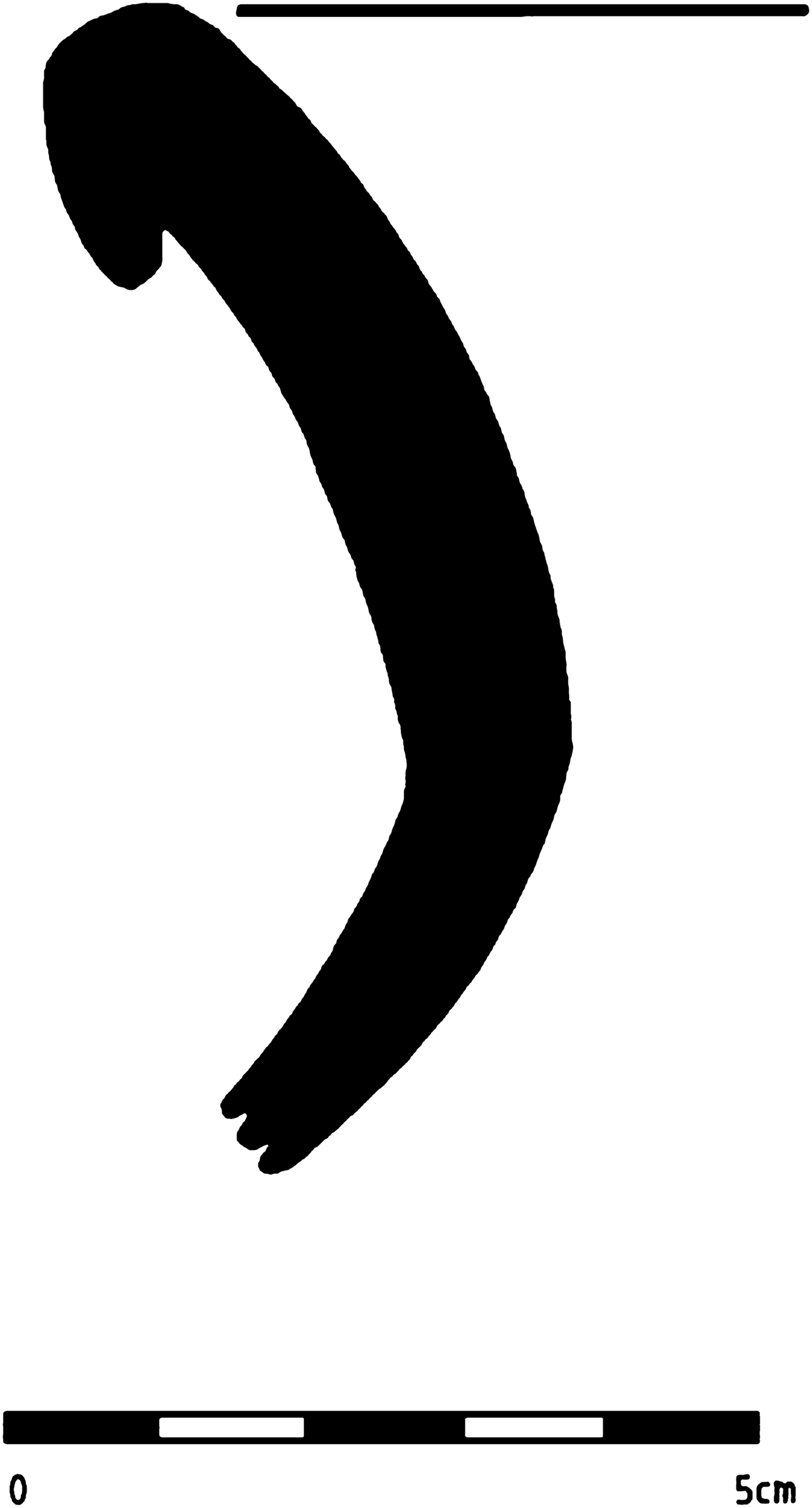
All Late Classic (I–III) unslipped vessels belong to Uaxactun Unslipped Ware (Smith and Gifford Reference Smith and Gifford1966:173). The unslipped group is Cambio and the striated group is Encanto. In Late Classic I, both consist exclusively of jars with rims that are folded to the exterior (Figure 6). Rims are exteriorly everted, and necks are outflared or outcurved. Throughout the Late Classic period, Encanto Striated has horizontal striations on the neck and/or shoulders followed by oblique to vertical striations on the body.
Cambio Unslipped jar.
The Late Classic I rim form of Cambio Unslipped and Encanto Striated at La Milpa is most similar to Cambio Unslipped: Folded Rim variety at Río Azul (Adams Reference Adams1999:211–212), which is very similar to both Alexanders Unslipped (Cayo Group) at Barton Ramie (Gifford Reference Gifford1976:283–286) and Xunantunich (LeCount Reference LeCount1996:369), as well as Zibal Unslipped (Zibal Group) at Barton Ramie (Gifford Reference Gifford1976:222–225), Chan Chich (Valdez and Houk Reference Valdez, Houk and Houk2000:136), and Nohmul (Kosakowsky and Pring Reference Kosakowsky and Pring1985).
Late Classic I Overview
The Late Classic I ceramic complex is difficult to distinguish from the Early Classic complex. The problem of separating Late Classic I from the Early Classic is not unique to La Milpa; for example, it is also problematic at Barton Ramie (Lincoln Reference Lincoln, Willey and Mathews1985:61–63). At La Milpa this difficulty arises from the rarity of unmixed Late Classic I contexts (Sullivan and Sagebiel Reference Sullivan, Sagebiel, Scarborough, Valdez and Dunning2003:27), which is likely due to three factors: the lack of large construction in the site center, the relative brevity of the period, and excavation bias, particularly the focus on later construction episodes. Issues related to the pottery include overlap in paste and form attributes with the Early Classic period and the possible continued use of Early Classic pottery alongside Late Classic I types. The predominance of undecorated red and brown vessels and the paucity of polychromes also make the complex artistically unremarkable. What does stand out is the appearance of probable volcanic ash wares and carbonate tempered types that are more similar to the Belize Valley than to the Peten, although the use of some Peten types continues.
Late Classic II Scattered Flints Complex (a.d. 650/700–780)
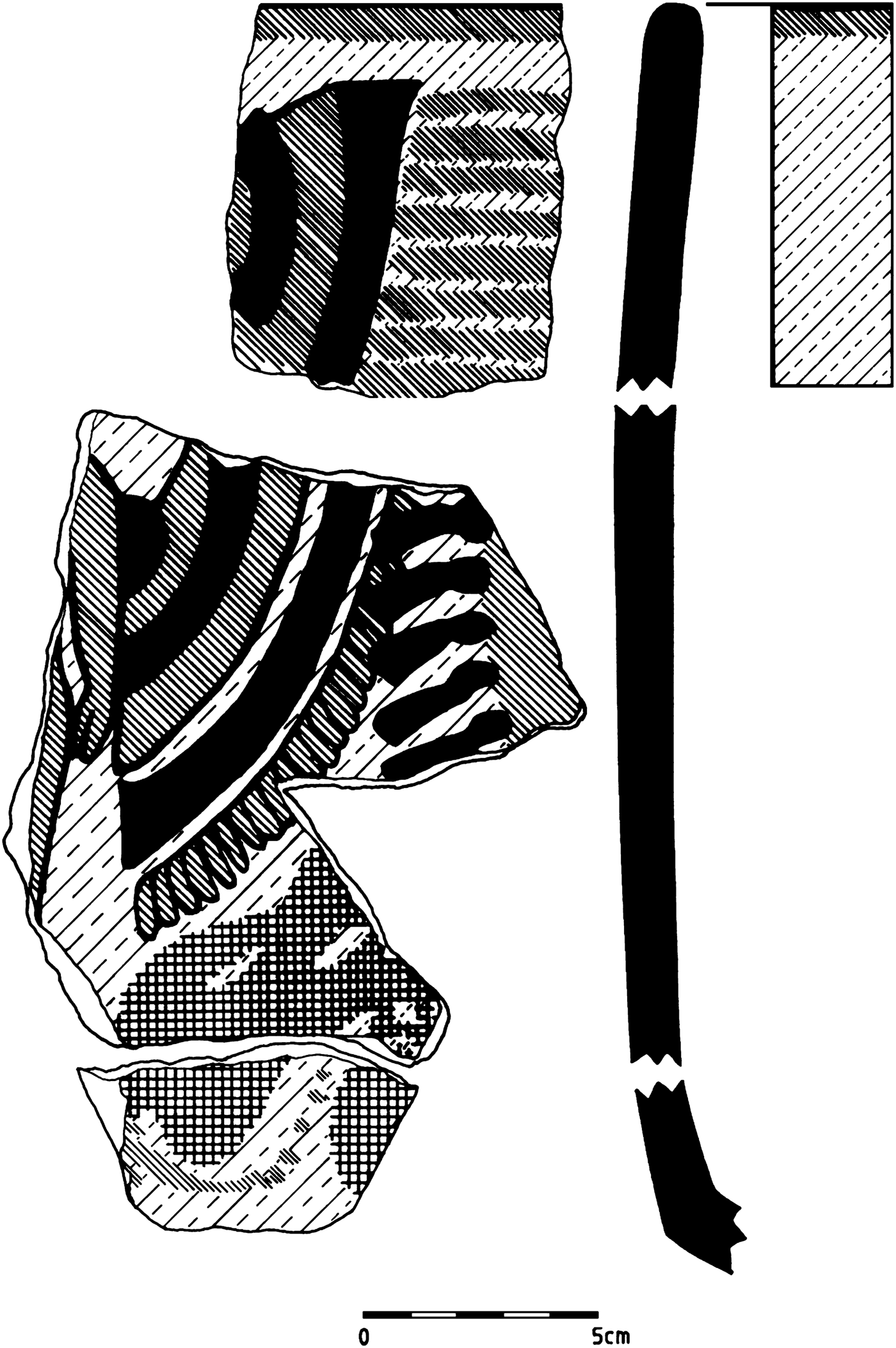
The distinguishing characteristics of Late Classic II pottery (Table 4) are the predominance of Peten Gloss Wares, the large increase of monochrome black relative to monochrome red slips, the resurgence of incised and fluted designs on carbonate paste vessels (especially on monochrome black vessels), the appearance of Daylight Orange: Darknight Variety, the use of “Holmul-style” crater vases (Figure 7), the use of Pedregal Modeled “god-pot” censers and censer plate/lids, the prevalence of interiorly bolstered rim bowls in a variety of slip colors, the appearance of cream slipped jars, and the use of exteriorly bolstered rims on unslipped jars. In general, Late Classic II pastes are darker than Late Classic I pastes and are yellow, light brown, or orange-brown. Inclusions are somewhat coarser with fine to medium (1–2 mm) opaque calcite common, whereas iron nodule inclusions are less common than previously. Polychrome pastes are yellow or light brown with very fine to fine (<1 mm) opaque calcite inclusions prevalent and are better fired than monochrome vessels.
Palmar Orange Polychrome crater vase.
Peten Gloss Wares
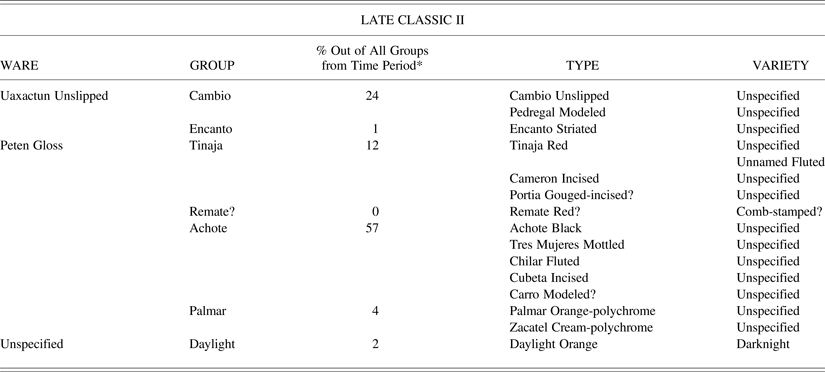
Nearly all of the slipped types identified in Late Classic II are Peten Gloss wares (Table 6), and the most common group within the ware is the Achote Group (Smith and Gifford Reference Smith and Gifford1966:173). The prevalent type is Achote Black, which consists of semi-glossy to glossy, black or very dark brown slip. It often has reddish to yellowish blotchy fire clouds and some red to orange mottling. Bowls of various shapes are the dominant form. Bowls with outflared walls, direct rims, and flat bases are the most common (Figure 8a). Those with basal ridges and nubbin feet become increasingly common into Late Classic III. Bowls with round or slightly incurved sides, direct rims, and round bases are the second most common bowl shape. Both bowl shapes are slipped on the interior and exterior. The third most common bowl shape has round or slightly incurved sides with an interiorly bolstered rim; thick, round lip; and round base. Unlike the previous two bowl shapes, the walls are quite thick. These are slipped on the interior but are left unslipped on the exterior 60% of the time. This form also appears frequently in a variety of other slip colors described below. Plates are the second most common form. The most frequently occurring plate shape is characterized by outflared walls, direct rim, and flat base. The second most common plate shape has outcurved walls, direct rim, and flat base. Outcurved plates become more common into Late Classic III. Both plate shapes are usually slipped on both the interior and exterior with 25% left unslipped on the exterior. Two other fairly common Achote Black forms include vertical-walled vases and jars with tall necks. Rare forms include drums, cups, miniature vessels, and lids.
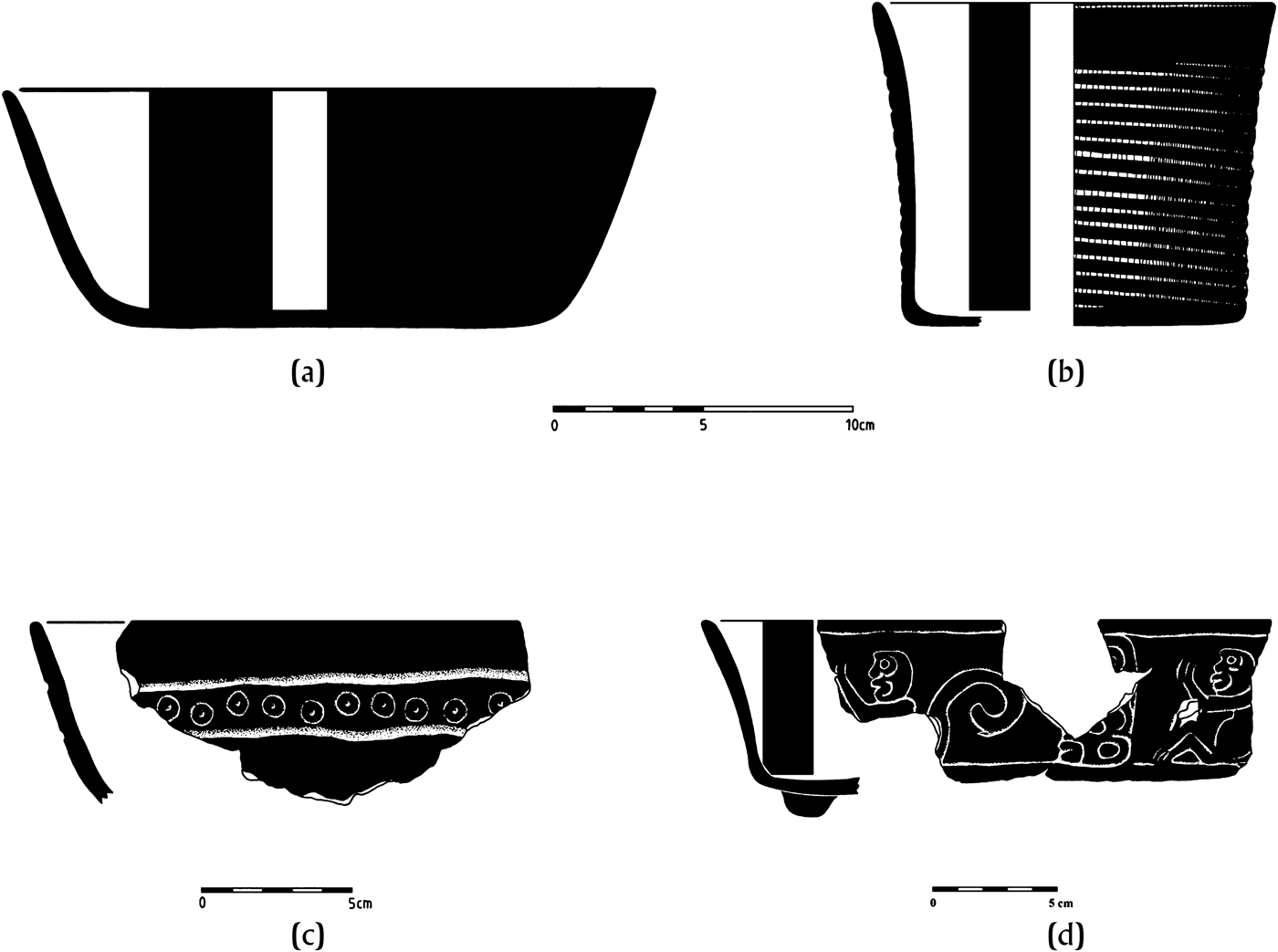
Late Classic II black-slipped ceramics: (a) Achote Black bowl; (b) Chilar Fluted vase; (c–d) Cubeta Incised bowls.
La Milpa Late Classic II ceramic types
*Based on rim sherds
Tres Mujeres Mottled: Unspecified variety is essentially the same as Achote Black; however, the slip has prevalent red to orange-red mottling. It is common enough that those of us who work in northwest Belize have given it a separate type name (Kosakowsky and Lohse Reference Kosakowsky and Lohse2003:11; Sagebiel Reference Sagebiel2005a:433–439). The forms overlap with Achote Black, but the proportion of thick-walled bowls with bolstered rims is notably higher in Tres Mujeres Mottled. The significant difference between Achote Black and Tres Mujeres Mottled does not appear to be in paste composition or slip but in firing. The larger number of unoxidized cores (one-third in Achote Black versus two-thirds in Tres Mujeres Mottled) suggests that the vessels were underfired, either intentionally or unintentionally. Tres Mujeres Mottled also becomes more frequent into Late Classic III times.
The decorated types in the Achote Group include Cubeta Incised, Carro Modeled (Smith and Gifford Reference Smith and Gifford1966:173), and Chilar Fluted (in the Infierno Group at Uaxactun [Smith and Gifford Reference Smith and Gifford1966:172]). Chilar Fluted vessels are decorated with pre-slip vertical, horizontal, and oblique grooves or flutes that are sometimes combined with incised decoration. About 80% of Chilar Fluted vessels feature simple horizontal grooves starting near the rim and continuing to the base (Figure 8b). About 15% of the vessels have oblique or spiral flutes from the rim to the base. On about half of those, incised lines run parallel to the flutes. The remainder consists mostly of vessels with one to three horizontal incised lines near the rim that are followed by oblique or vertical flutes down the body. Vases and bowls with outflared walls are the only forms identified.
Cubeta Incised is decorated by preslip incising of lines, geometric patterns, and glyph-like elements. About 50% of the designs are simple horizontal and/or vertical or oblique parallel lines. Of these, some have only one or two horizontal lines around the rim, and some have lines from the rim to the base similar to Chilar Fluted. About 30% have curvilinear and/or geometric designs, and roughly half of those have simple dot-in-circle motifs (Figure 8c). About 20% have some kind of punctate design using reeds or fingernails; usually these are combined with other linear designs or framing devices. Less than 5% have glyph-like elements (Figure 8d). Bowls and vases are the most common forms, but plates and drum fragments have also been identified.
Several Carro Modeled sherds were identified, but the specific decoration was not ascertainable. The sherds may be from bowls, vases, and effigy vessels.
The Tinaja Group (Smith and Gifford Reference Smith and Gifford1966:172) has a medium to high gloss red (10R 4/6, 4/8) to dark red (10R 3/6) slip that has fire clouds of yellow or black occasionally. As in Achote Black, bowls are the most common form, and they overlap considerably in form and proportion with the Achote Black shapes. The second most common form is jars, which also overlaps considerably with the Achote Black jar shape. Red-slipped plates, so common in Late Classic I, become far less common but also overlap Achote Black in form. Rare forms include vases, miniatures, and drums. Also rare but notable are thick-walled craters with vertical sides, direct rims, square lips, and large diameters that are slipped on the interior and exterior. These are very similar to the Cambio Unslipped and Palmar Orange polychrome “Holmul-style” craters of this time period (see Figure 7), which are described below.
The relatively rare decorated varieties of the Tinaja Red Group include Tinaja Red: Unnamed fluted, Cameron Incised, and Portia Gouged-incised (Smith and Gifford Reference Smith and Gifford1966:172). Tinaja Red: Unnamed fluted has pre-slip oblique or vertical flutes, stylistically similar to Chilar Fluted. Bowls and vases are the major forms. Cameron Incised has pre-slip fine-line incising. Decoration tends to be simple horizontal or vertical parallel lines along with geometric forms, stylistically similar to Cubeta Incised. Bowl forms predominate, although vases and plates are also represented. A few sherds of what is likely Portia Gouged-incised have naturalistic and glyph-like designs. Predominant forms are probably bowls and vases.
The Palmar Group consists of two types: Palmar Orange and Zacatel Cream Polychromes (Smith and Gifford Reference Smith and Gifford1966:172). Palmar Orange Polychrome vessels have red and black designs on an orange background. Bowls are most common but vases, plates, and drums also are represented. The most common bowl shape is a bowl with outflared walls, direct rim, and flat base. As with Achote Black, basal ridges and solid nubbin feet become increasingly common through time. Bowls with round or incurved sides, round bases, and direct rims are the second most common bowl shape. About 60% of bowl interiors simply have a lip/rim band (two-thirds are red and one-third are black) and an orange body. About 30% have multiple alternating red and black rim bands. About 10% have horizontal rim bands followed by oblique or vertical lines of red, orange, or black, and 20% of bowl exteriors simply have one or more rim bands with the rest having more complicated designs. About 60% of these are geometric, including circles, diamonds, squares, ovals, and “C” shapes (called the fat “C” design at Uaxactun [Smith Reference Smith1955:Figures 62:1b–5b]). About 20% have glyph-like designs. More than 10% have floral or kin glyph signs, and slightly less than 10% have vertical to oblique lines or “trickle” designs.
Palmar Orange Polychrome vases can be divided into two shapes: small diameter vases (median = 15 cm) with various designs and large diameter (median = 40 cm) “Holmul”/eastern Peten-style (Reents-Budet Reference Reents-Budet1994:179–186) crater vases with figurative designs. The former have thin, vertical walls; direct rims; round lips; and are made of the relatively fine paste used for polychrome wares. Interiors are commonly slipped orange with red lip/rim bands. Exterior designs are usually geometric with the fat “C” design common. Floral or kin glyphs, figurative, and pseudo-glyph motifs are less common. The latter vase shape has thick, slightly insloped walls; direct rim; square lip; and is made of coarser paste that is similar to that of the unslipped wares (see Figure 7). Interiors are slipped orange with red lip/rim bands. Exteriors usually depict male dancers with large feathered headdresses and/or backracks, often standing over captives. The Holmul style likely begins in Late Classic I and ceases by Late Classic III at La Milpa.
Palmar Orange Polychrome plates have outflared walls, direct rims, and flat bases. Plate exteriors are unslipped 60% of the time, otherwise they are slipped orange. About one-third of the interiors each have either simple rim bands, rim bands followed by simple oblique lines, or rim bands followed by geometric designs on the body.
Zacatel Cream Polychrome is best described as having red, orange, and black designs on a cream background. Red and black are always present, and orange is usually, but not always, present. Other colors that can be described as brown, gray (perhaps was green), purple, yellow, blue, and specular hematite red are rarer. Bowls are the most common form, but vases, plates, jars, and drums occur, too.
As in Palmar Orange Polychrome, bowls with outflared walls are most common followed by bowls with round or incurved sides. About 25% of bowl interiors have black and red lip/rim bands on orange, and about 20% have either simple orange interiors or red lip/rim bands on orange. Less than 15% have red lip/rim bands on cream, less than 10% have black lip/rim bands with oblique red lines on orange on the body, and about 5% have either black lip/rim bands on orange, or red and black lip/rim bands on cream. Therefore, the base color on the interior is usually orange with only about 20% having cream as an interior base color; whereas, exteriors always have cream backgrounds. More than 60% of bowl exteriors have geometric motifs. Common geometric designs include triangles, step-frets, scrolls, diamonds, and fat “C” shapes. These types of geometric designs are similar to those found at Uaxactun (Smith Reference Smith1955:Figures 62a 1–7, 63a 1–15). The “Anonal Polychrome” design is perhaps the most frequent. This motif features resist-looking dot-in-circle elements running vertically, usually contained within a rectangle. Although Anonal Polychrome often has resist designs (Adams Reference Adams1971:39), it is positive painted at La Milpa; not usually the major motif but used to divide space. Over 15% of bowl exteriors have naturalistic designs, such as jaguar pelts, scorpions, and plants. About 10% have simple vertical or horizontal lines as decoration, and about 10% have figurative and/or glyph-like designs.
Zacatel Cream Polychrome vases are exclusively small diameter with thin, vertical walls; direct rims; round lips; and are made of the paste common to polychrome wares. About 60% of vase interiors are unslipped, 30% are slipped orange, and about 10% have black lip/rim bands on cream. About 30% of vase exteriors have either geometric designs (including “pinwheels”) or figurative designs. The remaining 70% are evenly divided between those with naturalistic designs, glyph-like designs, and simple vertical or horizontal stripes.
Zacatel Cream Polychrome plates are the same shape as those in Palmar Orange Polychrome but are less common and were too eroded to get much information on design styles. Jars are also rare, but the form is similar to that of monochrome slipped jars.
The Daylight Group
The Daylight Group (Ware Unspecified, following Gifford [1976:Figure 14] and Willey et al. [1965:Figure 247]) consists of one type at La Milpa, Daylight Orange: Darknight variety (Gifford Reference Gifford1976:Figure 14; Willey et al. Reference Willey, Bullard, Glass and Gifford1965:Figure 247). Although placed in the Early Postclassic New Town complex at Barton Ramie (Gifford Reference Gifford1976:300–304), it is dated as early as Tepeu 1 at Uaxactun (as unnamed type [Smith Reference Smith1955:Figure 35b21]) and anywhere from Tepeu 1 to Tepeu 3 at many other sites (see, for example, Awe and Helmke Reference Awe, Helmke, Morris, Jones, Awe and Helmke2007:36; Ball Reference Ball1977:82; Kosakowsky and Lohse Reference Kosakowsky and Lohse2003:10–11; Kosakowsky and Pring Reference Kosakowsky and Pring1985; Sagebiel Reference Sagebiel and Lohse2006; Thompson Reference Thompson1939:Figures 12b, 8–10; Valdez Reference Valdez1987:207–208, Reference Valdez and Houk1998:81; Valdez and Houk Reference Valdez, Houk and Houk2000:136). This resist type has an orange to reddish-orange base slip (2.5YR 4/6, 4/8) and a black, dark brown, or dark red (sometimes with a purplish hue or sheen) resisted slip. The slip is very glossy, and occasionally one side of the vessel is distinctly better oxidized. The paste is light brown, yellow (10YR 7/3, 7/4, 7/6), or light pink (7.5YR 6/6, 7/6) and almost exclusively has fine (1–2 mm), opaque calcite inclusions. It is hard fired and breaks angularly. The paste often has a semi-vitrified appearance in cross-section, and yet two-thirds of the sherds have a distinct gray or black core. Bowls and plates with outflared walls and beveled-in lips are the most common forms, although there are also vases.
The resist decoration is on both sides of the vessel two-thirds of the time and on only one side a third of the time. Half of the undecorated sides are interiors and half are exteriors. About three-fourths of the vessels have random blotchy decoration over the entire surface to the rim. Only about one-fourth appear to have a true design. Most of the designs are vaguely geometric such as dots, stripes, and loops. Several vessels have distinct rim bands where the underslip must have been covered so that the rim was left reddish orange. Two rim sherds of an unknown form have shallow grooves or flutes on the exterior along with resist decoration (see White Creek Incised [Gifford Reference Gifford1976:Figure 200b]).
Other Slipped Types
Large-diameter bowls with round or incurved sides, large interiorly bolstered rims, round or beveled-in lips, and round bases begin in Late Classic II and increase in popularity into Late Classic III. Because of their prevalence in Late Classic III, they are described further below. Similarly, Lemonal Cream (originally defined as a type in Sagebiel Reference Sagebiel2005a:541–550) jars with small, exteriorly bolstered rims begin in Late Classic II but become quite prevalent, along with other “slate” wares during Late Classic III and are described below.
Uaxactun Unslipped Ware
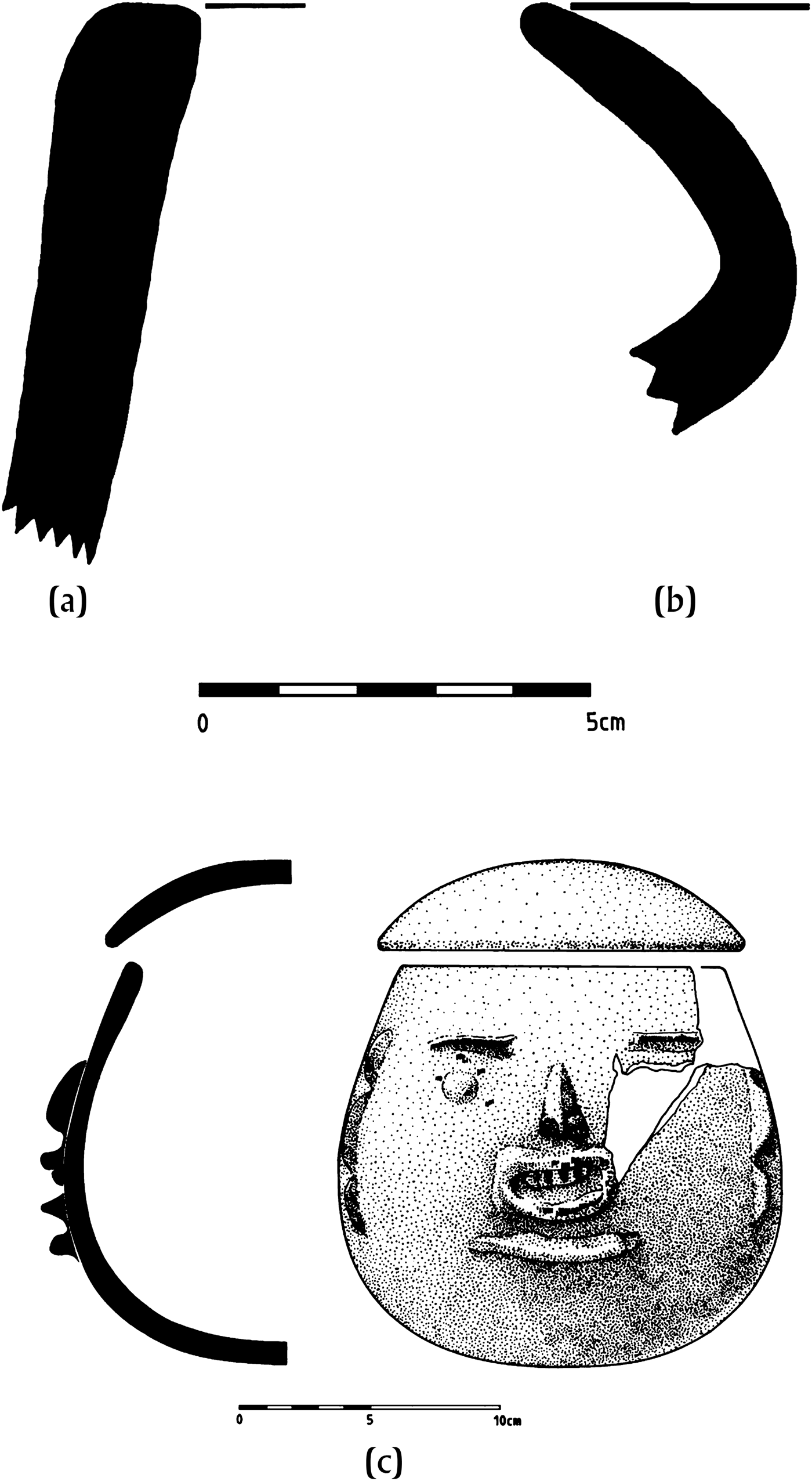
The most common Cambio Unslipped forms are very widely outflared plates or lids (censers), jars, craters (censers), bowls, and utilitarian plates. Widely outflared to flat plates or lids have direct rims and wide variation in lip shape. The interiors are well smoothed and unslipped. The exteriors are unslipped and are usually left rough. Nearly 20% have evidence of burning. These may have been used for cooking, like comals; but more likely, they were used with craters as part of a censer complex. The craters have insloped, vertical, or slightly incurved walls and round or flat bases. Rims are direct with lips that are square, round, or beveled-in (Figure 9a). Interiors are well smoothed, but exteriors may be left rough. About half are unslipped, and the rest have a matte orange wash, creamy self-slip, or a matte red rim. About 15% have evidence of burning. Median diameter is 30 cm, and one reconstructible vessel has a height of 25 cm.
Late Classic III unslipped ceramics: (a) Cambio Unslipped crater vase; (b) Cambio Unslipped jar; (c) Pedregal Modeled censer.
A fair amount of similarity occurs between the crater forms described here and Cambio Unslipped: White Wash variety at Seibal (Sabloff Reference Sabloff1975:Figure 216). Sabloff (Reference Sabloff1975) notes that others (Rands Reference Rands1959; Smith Reference Smith1944) have suggested that these forms go with Pedregal Modeled vessels as part of a censer complex and that they may have served as chimneys or as pot stands. This author also suggests that the widely flared plates or lids described here sat on top of the craters or modeled effigy bases to hold incense (see Rice Reference Rice1999:Figures 2c, 2d, 5c, 5e. See also Graham [Reference Graham, Rice and Sharer1987:85] for a parallel discussion of the use of handled “frying pan” censers). A large proportion was associated with eastern shrines and burials at La Milpa, which indicates their use in ritual contexts.
Cambio Unslipped and Encanto Striated jars have everted rims with round or pointed lips, short to medium necks, restricted orifices, and globular bodies with round bases (Figure 9b). Both occasionally have an orange wash. Toward the end of Late Classic II and into Late Classic III, jars with large, exteriorly bolstered rims and round lips become the dominant form as described below.
The most common, utilitarian (noncenser) bowl shape consists of outflared bowls and basins with direct rims and flat bases. The second most common bowl shape is a bowl with round or incurved sides, a direct rim, and round base. Lips are interiorly bolstered or round. On both forms, the interiors are generally well-smoothed, and the exteriors are often left rough with drag marks visible. Occasionally they have an orange or red wash. Utilitarian plates are outflared or outcurved with direct rims and flat bases. The interiors are generally well smoothed. Exteriors are generally well smoothed but may be left rough.
Pedregal Modeled: Unspecified variety (Smith and Gifford Reference Smith and Gifford1966:173) is a censer ware with paste that is the same as that of the unslipped types. The censers are usually large, bowl-shaped vessels with high walls that are vertical, insloped, or slightly incurved so that they could alternately be termed vases, craters, or tecomates. Bases are round or flat, and rims are direct with round or square lips. Surfaces are generally unslipped and semi-smoothed. None of the interiors and only one of the exteriors has signs of burning. Walls are of medium thickness, the median diameter is 20 cm, and heights taken on four vessels range from 10.5–33 cm.
These censers are distinctively decorated by one or more of several methods—modeling, appliqué, incising, striating, and post-fire painting. Two sherds also have circular “reed” impressions. Geometric cutouts for ventilation also are present. The most common modeled and appliquéd designs are of gods' heads (Figure 9c), most often the GIII/Sun God/Fire God/Jaguar God. The entire vessel is the face of the god with modeled/appliquéd eyes, nose, mouth, ears, and sometimes cheeks, chin, and eyebrows. Earflares, nose plugs, feathers, “Ceiba thorns,” buttons, and other iconographic elements may be added to identify which god is represented. Small amounts of post-fire paint may be added to highlight the features, such as red on the lips, black on the eyebrows, or blue on nose plugs and earflares. Surfaces are not well smoothed, and the post-fire paint is matte with a chalky look and is quite fugitive. Some were left unslipped and plain and overlap significantly with Cambio Unslipped craters; in turn, some vessels classified as Cambio Unslipped may have been painted at one time.
Most censers probably had lids that could be easily mistaken for shallow bowls, again overlapping with Cambio Unslipped. The lids are bowl-shaped with direct rims and a variety of lip shapes. The interiors are usually unslipped and semi-smoothed, but one has an orange wash, one has a pinkish brown paint, and one has traces of black paint. The exteriors also tend to be unslipped and semi-smoothed, but one has hematite, one has blue paint, and one has traces of red and black paint. Nearly half have evidence of burning on the interior or exterior. It seems likely that the lids were often the actual receptacle for the incense. Their interiors are more often burned than the interiors of the bowls. Also, the bowls often lack vent holes to allow adequate ventilation. The lids may have been turned over and set on the top of the bowls so that incense could be burned on their interiors. Alternately, the blackening on their interiors could have occurred when they were placed “upside-down” on the bowls to snuff out the fire. Several long handles were found and probably attached to some of the bowls/lids in a “frying pan” style. Several of the censers were cached, and many come from eastern shrine contexts. They were also found scattered around the stela at the minor center of La Milpa East.
Rice (Reference Rice1999:26) notes that linguistically there are non-image censers often glossed as “clay plates” and image censers often glossed as “god pots.” She also notes that modern Lacandon censers have dome covers to collect soot from burning incense because it represents the sky and clouds (Rice Reference Rice1999:28). Rice (Reference Rice1999) makes the case that image censers were related to kingship because they are typically found in association with funerary ritual in the Peten. Chase and Chase (Reference Chase, Chase, Robertson and Fields1994:60), however, note that at Caracol all levels of society had access to the “cult of the dead” and related paraphernalia, including censers. This is the case at La Milpa where image censers are most commonly found in hinterland shrines and cached under house floors.
Late Classic II Overview
In general, the Late Classic II ceramic assemblage continued to derive influences from both the Belize Valley and the central Peten with a shift in influence back to the latter. In particular, there was a resurgence of polychromes that are stylistically similar to those of Tikal, Uaxactun, and Holmul. But, they never make up more than about 10% of the average household assemblage. As at Río Azul, there is a lack of the codex style pottery manufactured at Nakbe and found throughout the Calakmul regional state (Adams Reference Adams1999:87–88). Influence from the south is most evident in the prevalence of “god pot”-style censers and their use by all segments of society (Chase and Chase Reference Chase, Chase, Robertson and Fields1994). Towards the end of Late Classic II, some Yucatecan influence begins to assert itself as the use of vessels with slate ware characteristics increases.
Late Classic III Coffin Gate Creek Complex (a.d. 780–850/900)
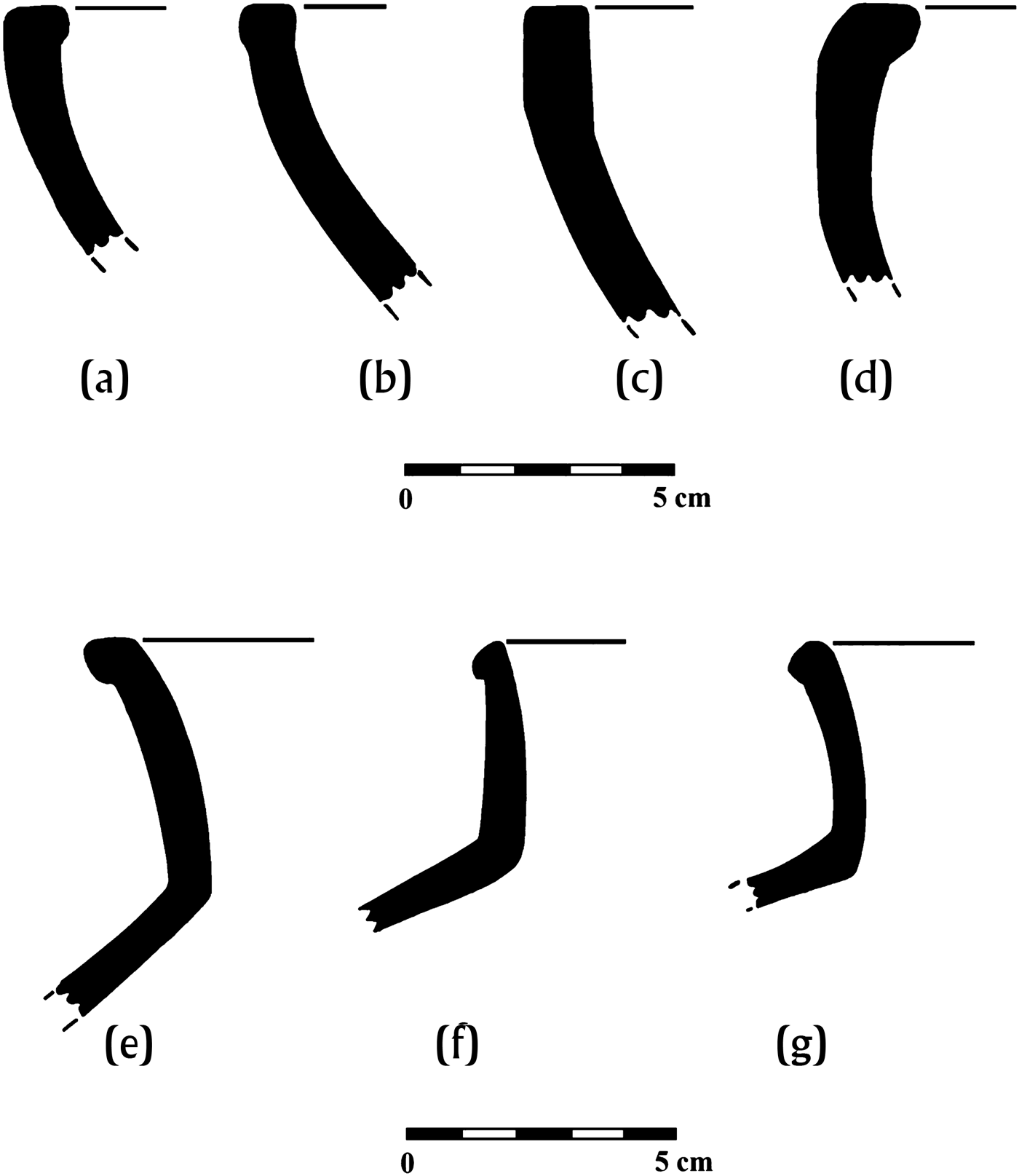
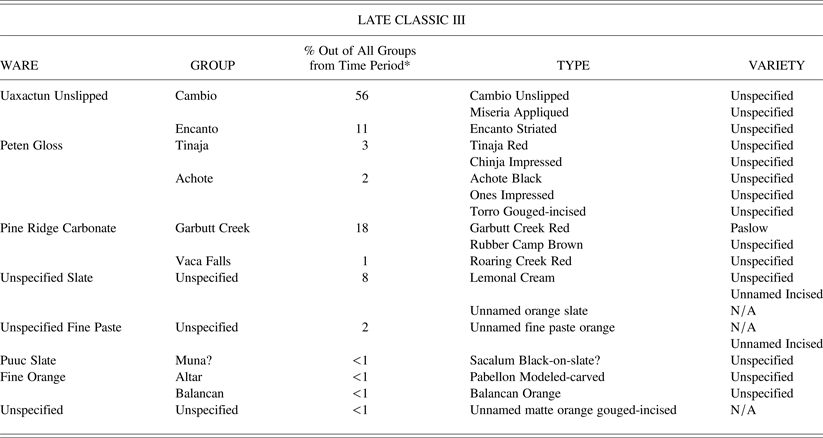
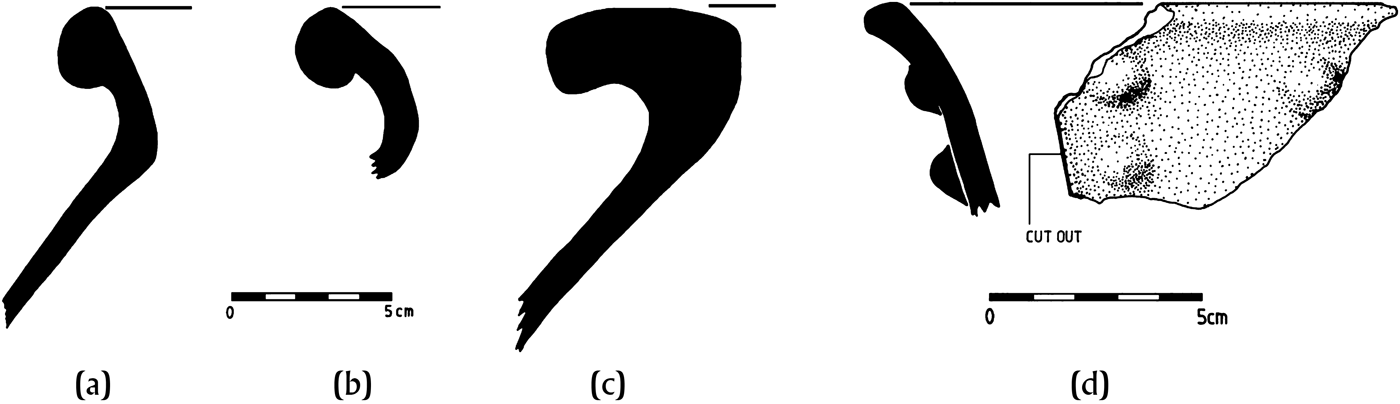
Late Classic III is marked by the use in quantity of large-diameter, bolstered rim, monochrome-slipped bowls; cream jars with small bolstered rims; and unslipped and striated jars with large, bolstered rims (Table 4). All three of these suites of vessels are commonly used in Late Classic II but are quite prevalent in the latest deposits at La Milpa. Late Classic III is also marked by the addition and prevalence of “nail head-shaped” rims on monochrome bowls (Figures 10a–b), gouged-incised decoration and impressing, widely outcurved monochrome plates, and pyriform vases with pedestal bases. Types that can be described as locally made “imitation” slate wares and fine orange wares also appear, along with small amounts of imported slate and fine orange wares (Zaro and Houk Reference Zaro and Houk2012). Polychromes are virtually nonexistent. At least in the site center, god pot and crater-with-lid censers are largely replaced by bowl- and vase-shaped censers on pedestal bases with “Ceiba thorn” appliqued decoration. Carbonate pastes are unchanged from Late Classic II. Two notable paste changes are the appearance of micaceous inclusions in a small percentage of Lemonal Cream and the use of fine orange-colored pastes similar to fine orange pastes elsewhere.
Lemonal Cream: (a–d) bowls; (e–g) jars.
Monochrome Slips
Large-diameter (median = 40 cm), monochrome bowls with interiorly bolstered rims are associated with both Late Classic II and III deposits but are particularly common in Late Classic III contexts. These bowls have round or slightly incurved sides; thick, interiorly bolstered rims; round lips; and round bases with slightly flattened bottoms (Figure 11a). About 17% of the bowls have direct rims and thickened, beveled-in lips. Some bowls (usually with small bolstered rims) have such widely outflared sides that they are almost plates. All bowls are slipped on the interior; but 80% are unslipped on the exterior. Unslipped exteriors are semismoothed with drag marks visible on occasion. By Late Classic III, this is the most common bowl form in Tinaja Red, Rubber Camp Brown, Garbutt Creek Red: Paslow Variety, and Lemonal Cream. It is also common in Achote Black and Tres Mujeres Mottled, and there is also one example of each in Palmar Orange and Zacatel Cream Polychromes.
Late Classic III slipped ceramics: (a) Rubber Camp Brown bowls; (b) Torro Gouged-incised vase; (c) Achote Black bowl; (d) Roaring Creek Red plate.
Monochrome slipped pottery is represented by several wares (Table 7). The first of these is Peten Gloss ware, which continues to be represented by the Tinaja and Achote Groups. Late Classic II forms continue in Tinaja Red, particularly the large, interiorly bolstered rim bowls. New forms include “nail head” rim bowls, large tecomates, and pyriform vases. Nail head rim bowls are similar to bolstered rim bowls in that the sides are round or slightly incurved, diameters are large, interiors are slipped, and exteriors are usually unslipped and semi-smoothed. It is the rim and lip treatment that varies. In nail head rim bowls, along the wall where the rim and body join, the sides are grooved or indented on one or both sides so that the rim sits up; lips are square or round (Figures 10 a and 10b). The large tecomate-like bowls are incurved with a rim that is everted toward the interior with a thick, round lip (Figure 10d). Interiors and exteriors are usually both slipped. The pyriform vases have insloped sides, a direct rim, a round base, and sit on a pedestal base (Figure 11b). They are slipped on the exterior, but only half are slipped on the interior. Chinja Impressed (Smith and Gifford Reference Smith and Gifford1966:1972, in the Nanzal Red Group at Uaxactun) is the only new Tinaja Group decorated type. It consists of vessels with finger-impressed decoration that is either directly impressed into the vessel wall or on a horizontal appliquéd fillet. The most frequent form is a large bowl with round or incurved sides and impressing near the rim. A less common form is a bowl with outflared walls and an impressed basal ridge, which is most common as Ones Impressed in the Achote Group (Smith and Gifford Reference Smith and Gifford1966:173). Jar necks with finger impressing are also represented.
La Milpa Late Classic III ceramic types
*Based on rim sherds
Achote Black also continues to be represented by Late Classic II forms, along with some new forms. Both large, interiorly bolstered bowls and bowls with outflared walls, flat bases, direct rims, basal ridges, and nubbin feet continue to be common in Late Classic III (Figure 11c). As with Tinaja Red, nail head rim bowls and pyriform vases are added to the repertoire. Additional forms include jars with tall necks and small, exteriorly bolstered rims, which is most common in Lemonal Cream (Figures 10e–g), and plates with widely outcurved sides, which is most common in Roaring Creek Red (Figure 11d). Both forms are described below in association with those types. Ones Impressed is a fairly common type that is the same as the bowl with outflared walls, a basal ridge, and nubbin feet common in Late Classic II but with the addition of a finger-impressed appliqued fillet at the basal ridge. Cubeta Incised and Chilar Fluted continue to be very popular decorated types but are joined by Torro Gouged-incised (Smith and Gifford Reference Smith and Gifford1966:173). Torro Gouged-incised consists of vases and bowls with pre-slip gouged-incised decoration, usually either repeating glyph designs (bat or Zotz glyphs and peccary/rat/rabbit animal-like glyphs are common) or glyph-like, complex curvilinear designs (Figure 11b). The curvilinear designs include half-moons, dots, circles, oblique gouges, scrolls, cross-hatching, and “mat” designs. In most cases, different designs or glyph elements are separated by vertical and horizontal framing or cartouche-like lines. The designs may be enhanced (20% of the vessels) by red to purple hematite rubbed into the gouged-incised areas.
Pine Ridge Carbonate Ware makes up the majority of the Late Classic III slipped rims. The two groups are Garbutt Creek and Vaca Falls (Gifford Reference Gifford1976:Figure 13; Willey et al. Reference Willey, Bullard, Glass and Gifford1965:Figure 220). Rubber Camp Brown (Gifford Reference Gifford1976:Figure 13; Willey et al. Reference Willey, Bullard, Glass and Gifford1965:Figure 220) is a very common type by Late Classic III and makes up the great majority of large-diameter, interiorly bolstered rim bowls (Figure 11a), but a few plates and craters are also represented. The slip is usually orange-brown to dark chocolate brown (10YR 3/2, 4/2) but can range through reddish brown, grayish brown, and nearly black. Rims are often redder than the body. Garbutt Creek Red: Paslow variety (Gifford Reference Gifford1976:Figure 13; Willey et al. Reference Willey, Bullard, Glass and Gifford1965:Figure 220) is very similar to Rubber Camp Brown except for having an orange slip that often has a pinkish cast. These occasionally feature black rims. The Vaca Falls Group contains one type, Roaring Creek Red: Unspecified variety (Gifford Reference Gifford1976:Figure 13; Willey et al. Reference Willey, Bullard, Glass and Gifford1965:Figure 220). The slip is a dark red (2.5YR 4/6, 4/8) that can have a purplish sheen and is often heavily fire-clouded black. Exteriors are often a lighter color and tend to be reddish brown, orange-brown, or yellowish brown. Surfaces can be quite glossy, especially on interiors. They have a “slate ware” quality in that they often have a purplish hue, rootlet marks, crazing, and may have a waxy feel. The predominant form is plates with widely outcurved sides, beveled-in rims, and a strong angle or break at the flat base. The basal angle sometimes has gouges or fingernail-impressions (Figure 11d). A few bowls are in the sample, too.
Unspecified Slate Ware
Unspecified Slate Ware slip is often mottled, variegated, fire-clouded, and/or has purple rootlet marks. The paste is yellow (10YR 7/6, 8/6), light brown (10YR 7/3, 7/4), pink (7.5YR 6/6, 7/6), or gray (10YR 7/2). Fine to medium-sized (1–2 mm) opaque calcite inclusions are predominant. About 5% have micaceous inclusions. About 45% have a very distinct, gray, unoxidized core. The most common of the three types is Lemonal Cream: Unspecified variety (Sagebiel Reference Sagebiel2005a:541–553). The slip is glossy white (10YR 8/3, 8/4), light brown, yellow, gray, pinkish, or even slightly olive green in color. It is often variegated to several of these colors on one vessel. The most common form is a jar with a tall, vertical neck and an exteriorly bolstered rim (75%) (Figures 10e–g) or a direct rim with round lip. Exteriors are slipped, and interiors are almost always unslipped. Bowl forms include interiorly bolstered rim bowls; nail head rim bowls; small-diameter, thin-walled bowls with round or incurved sides, direct rims, and round lips; and plates with outflared or outcurved sides. Lemonal Cream: Unnamed Incised is decorated with pre-slip incised, grooved, or gouged-incised decoration on bowls, vases, and jars.
Unnamed Orange Slate: Unspecified variety (Sagebiel Reference Sagebiel2005a:554–557) is very similar to Lemonal Cream in paste, forms, and slip qualities. The major difference is that it is consistently orange to reddish orange (2.5YR 4/8, 5/8) and becomes matte when eroded. Jars are the most common form; however, in contrast to Lemonal Cream, only 35% have exteriorly bolstered rims, and the remainder has direct rims and round lips. Also, 57% of the jars have unslipped interiors, 30% are slipped on the interior, while the remainder have a matte wash. Rare forms include bowls, plates, and miniature jars.
Unspecified Fine Paste Ware
Unspecified Fine Paste Ware (Sagebiel Reference Sagebiel2005a:557–561) has a fine paste that is similar to Fine Orange and Gray wares elsewhere (Adams Reference Adams1971; Ball Reference Ball1977; Brainerd Reference Brainerd1958; Dominguez-Carrasco Reference Dominguez Carrasco1994; Sabloff Reference Sabloff1975; Smith and Gifford Reference Smith and Gifford1966). The paste is very fine with a sandy feel, and very fine to fine (<1 mm) opaque calcite inclusions are common. The paste color ranges from orange, reddish, pink, light brown, brown, to gray. About one-third of sherds have unoxidized cores. The color of both the paste and slip are quite variable on any one vessel. Like Unnamed Orange Slate, the slip is glossy when well preserved but matte when eroded. Mottling, variegation, fire clouds, and rootlet marks are also common. The primary slip color is orange to reddish orange (2.5YR 5/6, 5/8), but it usually has splotches or fire clouds of brown, black, pink, and cream. The most common bowl shape is a small-diameter, thin-walled bowl with round or incurved sides, direct rim, and round lip. The second most common bowl shape has outflared walls, direct rim, round lip, and flat base with nubbin feet. The third most common bowl shape is a unique form with upper walls that are outflared or slightly outcurved with an angle at the slightly round base. These usually sat on large, hollow, round feet, and some have “grater” type incising on the interior bases. The rims have small exterior bolsters that may be slightly everted with round lips. Interiors and exteriors are slipped. This form is similar to that of Tres Naciones Gray at Seibal (Sabloff Reference Sabloff1975:Figures 406 and 407). Vases with vertical sides, plates with outflared walls, pyriform vases, and jars are also represented.
The Unnamed Fine Paste Orange: Unnamed Incised Variety (Sagebiel Reference Sagebiel2005a:561–563) has fine-line incising or groove incising. The fine-line incising consists of simple parallel, curvilinear, or glyph-like designs on the exteriors of bowls or “grater”-type cross-hatch incising on the interior floors of bowls of the same three shapes described above. Vases with vertical sides and jar sherds are present, too. These same types are represented along with what are likely imported, true Fine Orange types in the problematic deposit excavated behind Structure 21 in Plaza B at La Milpa by Brett Houk and Gregory Zaro (personal observation 2011).
Other, possibly imported Fine Orange wares, include one probable sherd of Pabellon Modeled-carved: Unspecified variety (Altar Group) (Smith and Gifford Reference Smith and Gifford1966:173) with a modeled-carved face or pseudo-glyph on its exterior. It has fine orange, inclusion-free paste with a reddish orange slip. Two other similar sherds are likely local products. All three come from either vases or bowls. Nineteen sherds of Balancan Orange: Unspecified variety (Balancan Group) (Smith and Gifford Reference Smith and Gifford1966:173) have inclusion-free, fine orange paste with a distinctive white opalescent, micaceous slip. No forms were definitively identified, but they are likely from an array of jars, plates, and vases.
Puuc Slate Wares
Possible imported Puuc Slate Wares include 22 sherds of what may be Sacalum Black-on-Slate: Unspecified variety (Muna Group) (Brainerd Reference Brainerd1958). These sherds have reddish brown “brick” paste with very fine or fine opaque calcite and translucent calcite or quartz inclusions. The slips are glossy cream with a pinkish cast from the reddish paste underneath. Purple rootlet marks are common. The designs consist of examples of both broad and fine-line linear or geometric designs. Both vases and jars are represented.
Uaxactun Unslipped Ware
Beginning in Late Classic II and growing in frequency into Late Classic III are three Cambio and Encanto Group jar rim forms that are similar to rim varieties described at Río Azul in the Encanto Group (Adams Reference Adams1999). The most common rim form (nearly 93% of Cambio Unslipped: Unspecified variety) is similar to Encanto Striated: Rolled Rim variety at Río Azul (Adams Reference Adams1999:212). It consists of jars and bowls with thick, exteriorly bolstered or rolled rims and round lips (Figures 12a and 12b). The most common bowl shape has round or incurved sides; less common are bowls with outflared or outcurved walls. About 10% of the vessels have an orange to reddish orange matte wash on their exteriors. In some cases, the wash is present only as a band around jar rims or necks.
Late Classic III unslipped ceramics: (a–c) Cambio Unslipped jars; (d) Miseria Appliqued censer.
Making up almost 7% of Cambio Unslipped: Unspecified variety is a form that corresponds to Encanto Striated: Giant Rim variety at Río Azul (Adams Reference Adams1999:212) and Chan Chich (Valdez and Houk Reference Valdez, Houk and Houk2000:136). The rims are everted to the exterior so that they are horizontal, making the rim appear to be a wide ledge (Figure 12c). The edges of the lips are round with the tops flattened so that there is a fairly sharp angle on the interior where the rim and wall meet. Necks are short to virtually nonexistent. A few bowls with outflared walls also occur in the sample.
Making up less than 1% of Cambio Unslipped: Unspecified variety is a form that corresponds to Encanto Striated: Piecrust Rim variety at Río Azul (Adams Reference Adams1999:212). These jars and bowls are similar to the Rolled Rim variety except for the addition of “pie crust” type finger impressing along the lips.
A new incense burner form is introduced in Late Classic III. It is Miseria Appliqued: Unspecified variety (Cambio Group) (Smith and Gifford Reference Smith and Gifford1966:173) and consists of incense burners that are either vase-shaped with vertical or slightly insloped walls or bowl-shaped with outflared or slightly outcurved walls (Figure 12d). Both forms have everted rims with flattened tops and round lips. These usually sat on pedestal bases and occasionally had flanges. Surfaces are semismoothed, and they are usually decorated with “Ceiba thorn” appliqués and geometrically shaped smoke vents. Vents are circles, ovals, squares, or rectangles. Matte, rather fugitive, post-fire paint in red, white, blue, and black (and occasionally green and orange) was often used to highlight appliqués and the edges of vents.
Late Classic III Overview
Ceramicists in northwest Belize have had a difficult time separating out Late Classic II and III ceramic complexes (Kosakowsky et al. Reference Kosakowsky, Sagebiel, Hammond, Tourtellot, Laporte and Escobedo1998; Kosakowsky and Sagebiel Reference Kosakowsky and Sagebiel1999; Sullivan and Sagebiel Reference Sullivan, Sagebiel, Scarborough, Valdez and Dunning2003). This is to be expected because originally at Uaxactun, Tepeu 3 was based on the subtraction of previously recognized Tepeu 2 types from the surface collections (Smith Reference Smith1955:13), which leaves open the possibility that many Tepeu 2 types were still in use during Tepeu 3 at Uaxactun. More recently, Rice and Forsyth (Reference Rice, Forsyth, Demarest, Rice and Rice2004:32) define a Terminal Classic Peten supercomplex that consists of “large bowls/basins, tripod dishes, and tall-necked jars, all usually red slipped with fairly standardized but minimal decoration.” The La Milpa Coffin Gate Creek complex does not fit well into this supercomplex. Large bowls and basins are common but occur in a wide range of slip colors. Tripod dishes of typical Peten form are not found; instead, there is a similar “grater bowl” form slipped either black or red that sat on large, hollow, round feet. Red tall-neck jars, although common in Late Classic I–II at La Milpa, are replaced by Lemonal Cream jars with slate ware-like attributes. Finally, black rather than red is the predominant slip color.
Overall, the size of bowls and jars increased, although small serving bowls, particularly in Achote Black and unnamed slate ware types, were also common. The larger size of bowls could be an indication of increased communal food sharing or feasting, and the increased size of storage jars may indicate the need for additional food and water storage. Although plates were less common than in earlier periods, they are large with quite outcurved sides (for example, Roaring Creek Red), which may have made them more conducive to food sharing. Possible evidence that a Yucatecan cuisine was being adopted is the appearance of grater bowl forms and the large quantity of Lemonal Cream slate ware-like jars. Adams (Reference Adams1999:147) has suggested that the Yucatecan slate ware jars of Río Azul may represent “the importation of a product from that region—perhaps honey or the prehistoric fermented drink made from it, balche.”
Also during Late Classic III, black-slipped pottery with incising, gouging, fluting, and/or grooving (Cubeta Incised, Chilar Fluted, and Torro Gouged-Incised) was the predominant serving ware of local elites, almost completely replacing polychromes. At Río Azul, Adams (Reference Adams1999:89–90) states that “[c]arved pottery, with an emphasis on hieroglyphs and geometrics … makes a strong appearance. Much of this material seems to come from centers in the east in what is now Belize.” These black-slipped types filter down the social ladder more than earlier polychromes. In fact, polychromes were always relatively rare at La Milpa, and nonelites never seem to have had much access to them, unlike in the Peten.
A REVISED CERAMIC PERSPECTIVE ON LA MILPA'S OCCUPATION HISTORY
The merits of graphing temporal changes in occupation based on counts or percentage frequencies of sherds or of counts of excavation units dated by ceramics can be debated. All of these proxy measures have inherent weaknesses: for example, time periods are not of equal length, some ceramic types are used longer than others, the quantity of sherds that survive per time period may depend on formation processes (including how quickly they are buried), there may be biases in the excavation strategy (particularly toward later time periods), and so on. The purpose here is not to debate the merits of these proxy measures. It is simply to update the original occupation graphs presented by Hammond and Tourtellot (Reference Hammond, Tourtellot, Demarest, Rice and Rice2004) with more recent ceramic data from more excavation units. For the new graphs, the number of site center excavation units is 173 and the number of peripheral excavation units is 315. These include the units used by Hammond and Tourtellot (Reference Hammond, Tourtellot, Demarest, Rice and Rice2004) in their analysis.
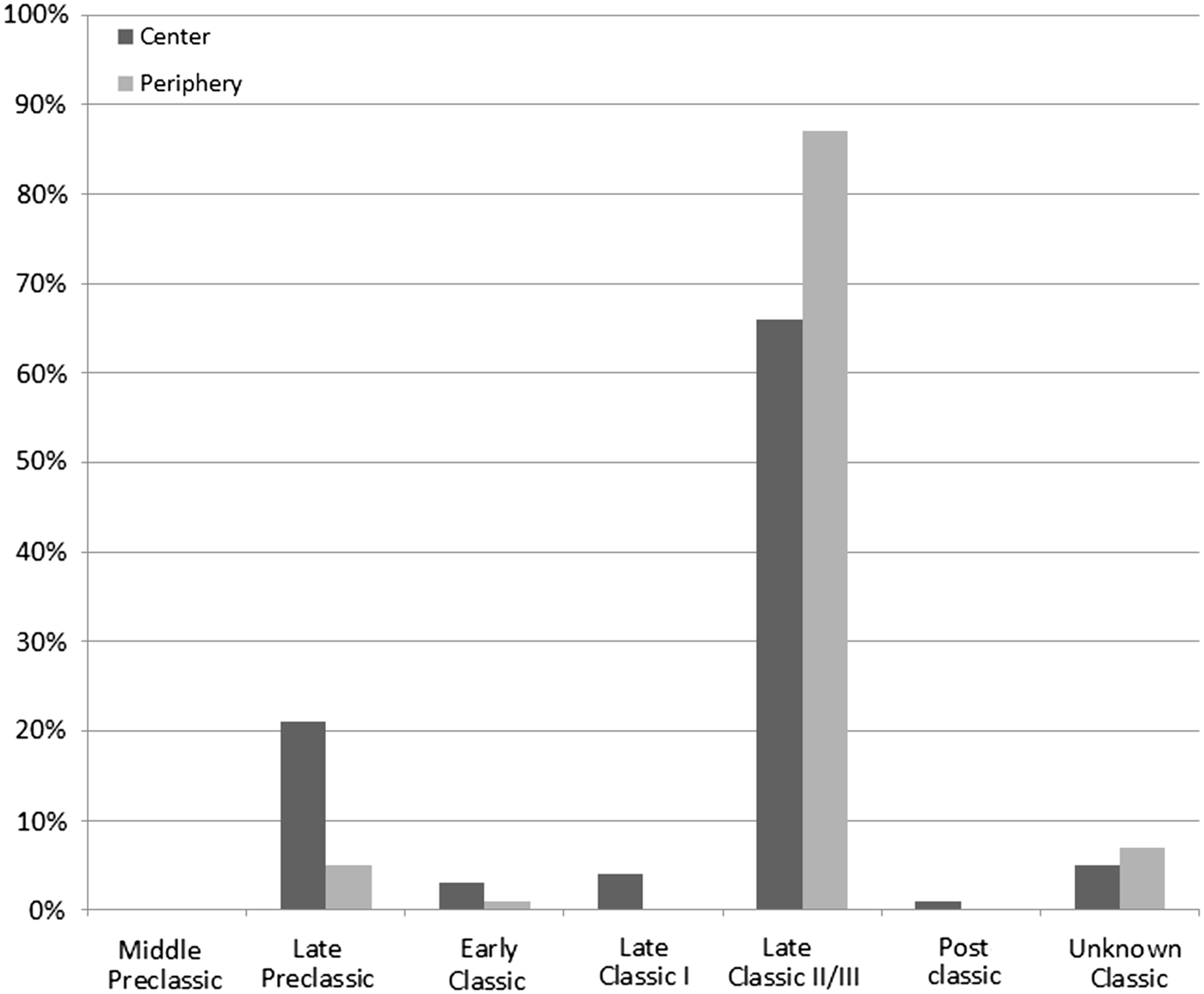
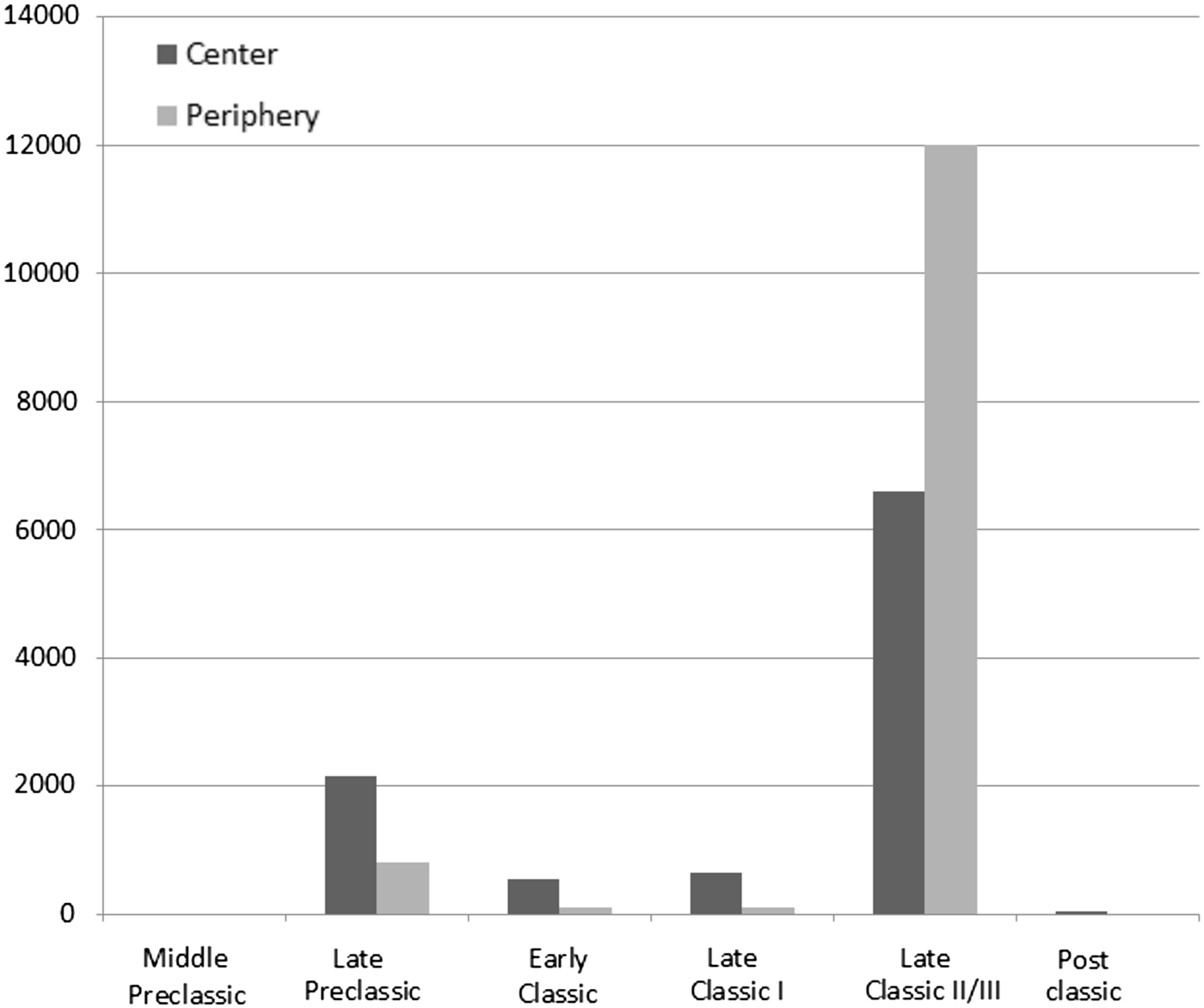
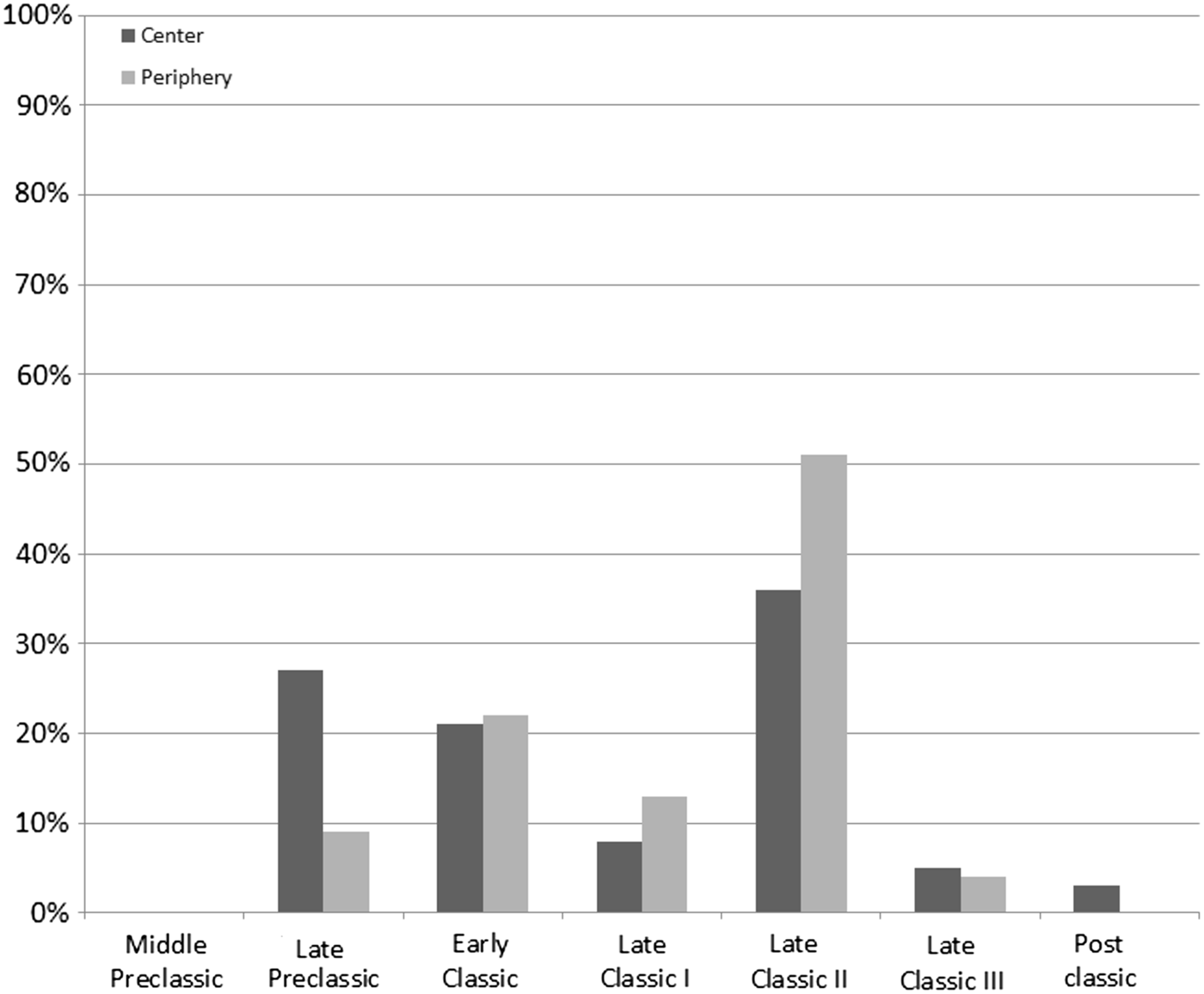
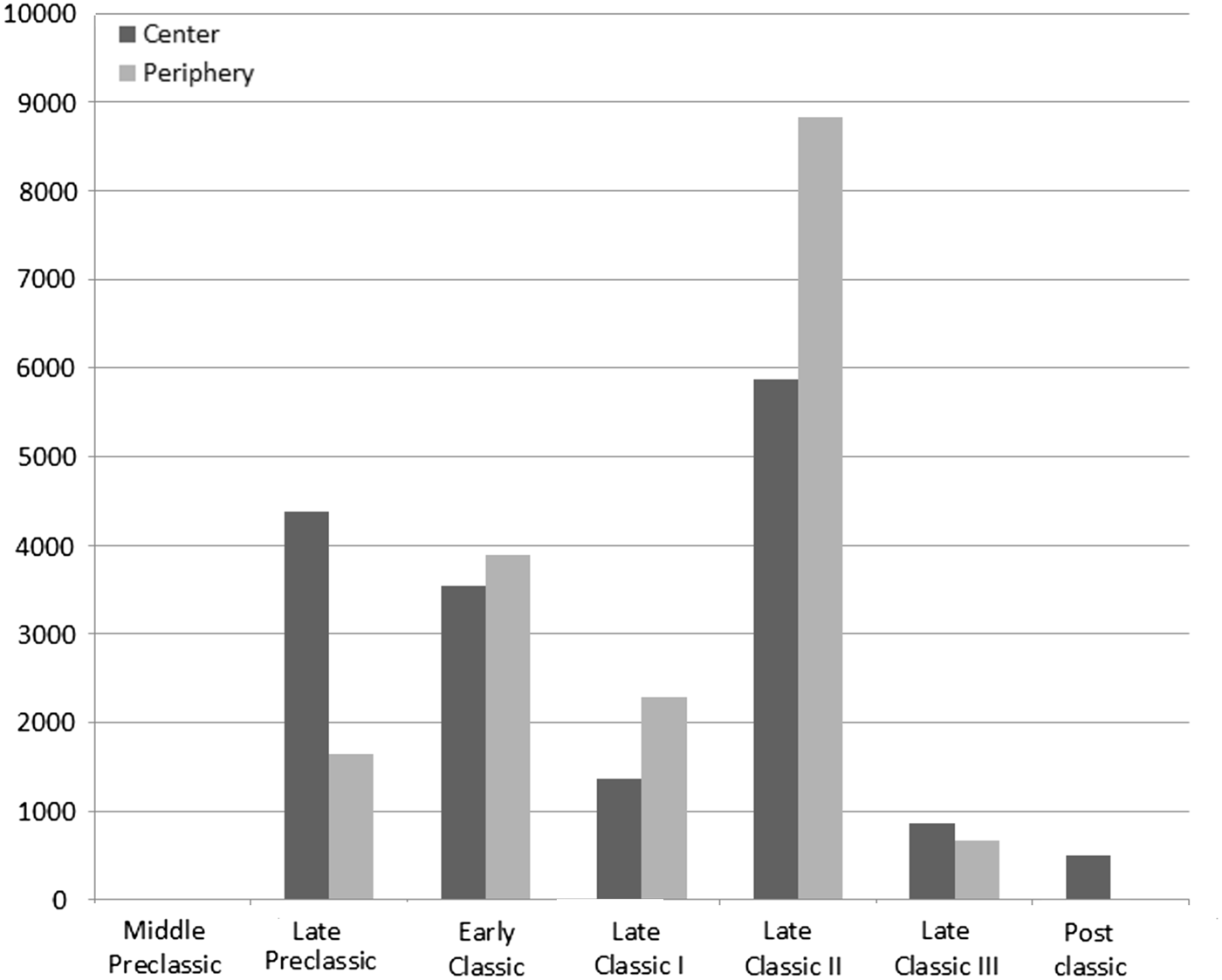
Hammond and Tourtellot's (Reference Hammond, Tourtellot, Demarest, Rice and Rice2004) graph of percentage frequencies of typed sherds per time period in La Milpa's site center (Figure 13) posits an initial, modest occupation during the Late Preclassic followed by a dramatic decline in occupation in the Early Classic (21% versus 3%). Their graph of raw counts of sherds depicts a similar change (Figure 14). In the revised graph presented here, the percentage frequencies of typed sherds dating to the Late Preclassic in the La Milpa site center is 27% versus 21% for the Early Classic (Figure 15), and the new graph of raw counts of sherds shows similar results (Figure 16). As a proxy for occupation, it would appear that all of the graphs show some loss of site center occupation between the Late Preclassic and Early Classic periods, although Hammond and Tourtellot's graph (Figure 13) depicts an 18% drop of typed sherds, as opposed to the 6% change depicted in the revised graph (Figure 15).
Percentage frequencies of typed sherds per time period at La Milpa. Adapted from Hammond and Tourtellot (Reference Hammond, Tourtellot, Demarest, Rice and Rice2004:Figure 13.3).
Counts of typed sherds per time period at La Milpa. Adapted from Hammond and Tourtellot (Reference Hammond, Tourtellot, Demarest, Rice and Rice2004:Figure 13.5).
Revised percentage frequencies of typed sherds per time period at La Milpa.
Revised count of typed sherds per time period at La Milpa.
Perhaps more telling is the comparison between the graphs of percentage frequencies of typed sherds by time period in La Milpa's periphery (defined as the settlement outside the regal/ritual center out to 6 km). Hammond and Tourtellot's graph depicts a decrease from 5% of sherds in the Late Preclassic to 1% in the Early Classic (Figure 13). Their graph of raw counts of sherds per time period depicts an even larger change (Figure 14). In contrast, the revised graph presented here shows an increase from 9% to 22% (Figure 15), and the revised graph of raw sherd counts presents a similar result (Figure 16). If a valid proxy for occupation change, the revised graphs appear to indicate that some of the population loss in the site center may be the result of movement from the center to the periphery. Indeed, a change from nucleated communities to a more dispersed settlement pattern for the La Milpa area has been previously hypothesized by the principal investigators (Hammond et al. Reference Hammond, Tourtellot and Rose1995:8; Tourtellot Reference Tourtellot1997:7–8).
Hammond and Tourtellot's graph of percentage frequencies of typed sherds in the site center indicates a slight increase from the Early Classic to Late Classic I (3% to 4%) (Figure 13); a comparable change is indicated in their graph of raw sherd counts (Figure 14). The new graph of percentage frequencies of typed sherds from the site center indicates a decrease between the Early Classic and Late Classic I (21% to 8%) (Figure 15), with a somewhat more dramatic decline reflected in the revised raw sherd count (Figure 16). For the periphery, Hammond and Tourtellot's graph depicts a change from 1% to no typed sherds (Figure 13), with the count of raw sherds very low but nearly identical for both periods (Figure 14). The revised graph of the percentage frequencies of typed sherds for the periphery also indicates a drop (22% to 13%) (Figure 15), with a similar change visible in the revised raw sherd count graph (Figure 16). In general, both the original graphs and the revised graphs indicate a decline in occupation in Late Classic I in both the center and periphery. The revised percentage frequency graphs, however, indicate that La Milpa was not virtually abandoned in Late Classic I, as previously thought. Some occupation remained both in the site center and in the periphery. Interestingly, as indicated by the revised graphs, occupation may have declined less in the periphery than in the site center.
Hammond and Tourtellot's graph of percentage frequencies of typed sherds in the site center depicts an enormous increase from 4% to 66% between Late Classic I and Late Classic II/III (Figure 13); the graph of raw sherd counts shows a similarly dramatic increase (Figure 14). The new graph of percentage frequencies of typed sherds in the site center indicates an increase from 8% in Late Classic I to 36% in Late Classic II (Figure 15); and the revised graph of raw sherd counts depicts a similar increase (Figure 16). For the periphery, Hammond and Tourtellot's graph of percentage frequencies of typed sherds shows a dramatic change from 0 to 87% between Late Classic I and Late Classic II/III (Figure 13), and the change in the raw count of sherds is similarly dramatic (Figure 14). The revised graph of the percentage frequencies of typed sherds for the periphery shows an increase from 13% to 51% between Late Classic I and II (Figure 15); and the revised graph of raw sherd counts has a similar increase (Figure 16). Both the original and revised graphs demonstrate a large increase in occupation at La Milpa between Late Classic I and Late Classic II. Both sets of graphs also show that the increase in occupation occurred both in the site center and in the periphery. But, the increase appears to be more dramatic in the original graphs for at least two reasons. One, the starting point for Late Classic I is much lower in the original graphs; and two, the original graphs conflate Late Classic II and III sherd counts. These two factors alone contribute much to the seemingly astounding increase in occupation at La Milpa between Late Classic I and Late Classic II/III.
Similar issues partially explain the equally dramatic changes depicted in the original graphs for the Late Classic II/III and Postclassic. Hammond and Tourtellot's graph of percentage frequencies of typed sherds by period depicts a decrease in site center from 66% to 1% and in the periphery from 87% to 0 (Figure 13). The graphs of raw sherd counts show much the same (Figure 14). The new graph of percentage frequencies of typed sherds separates Late Classic II and III and shows a decline in the site center from 36% to 5% and in the periphery from 51% to 4% between those time periods (Figure 15). Again, the revised raw sherd counts show much the same trend (Figure 16). In the revised graphs, the change from Late Classic III to the Postclassic in the site center is 5% to 3% and in the periphery it is 4% to none (Figure 15). The revised raw sherd count graphs are very similar (Figure 16). Although both the original and revised graphs show precipitous decline at La Milpa between Late Classic II and the Postclassic, the dramatic changes shown in the original graphs are ameliorated by separating out Late Classic III. The separation of Late Classic III sherds indicates a likely small but continuing occupation of La Milpa in both the site center and in the periphery in Late Classic III followed by abandonment, with little occupation in the Postclassic period.
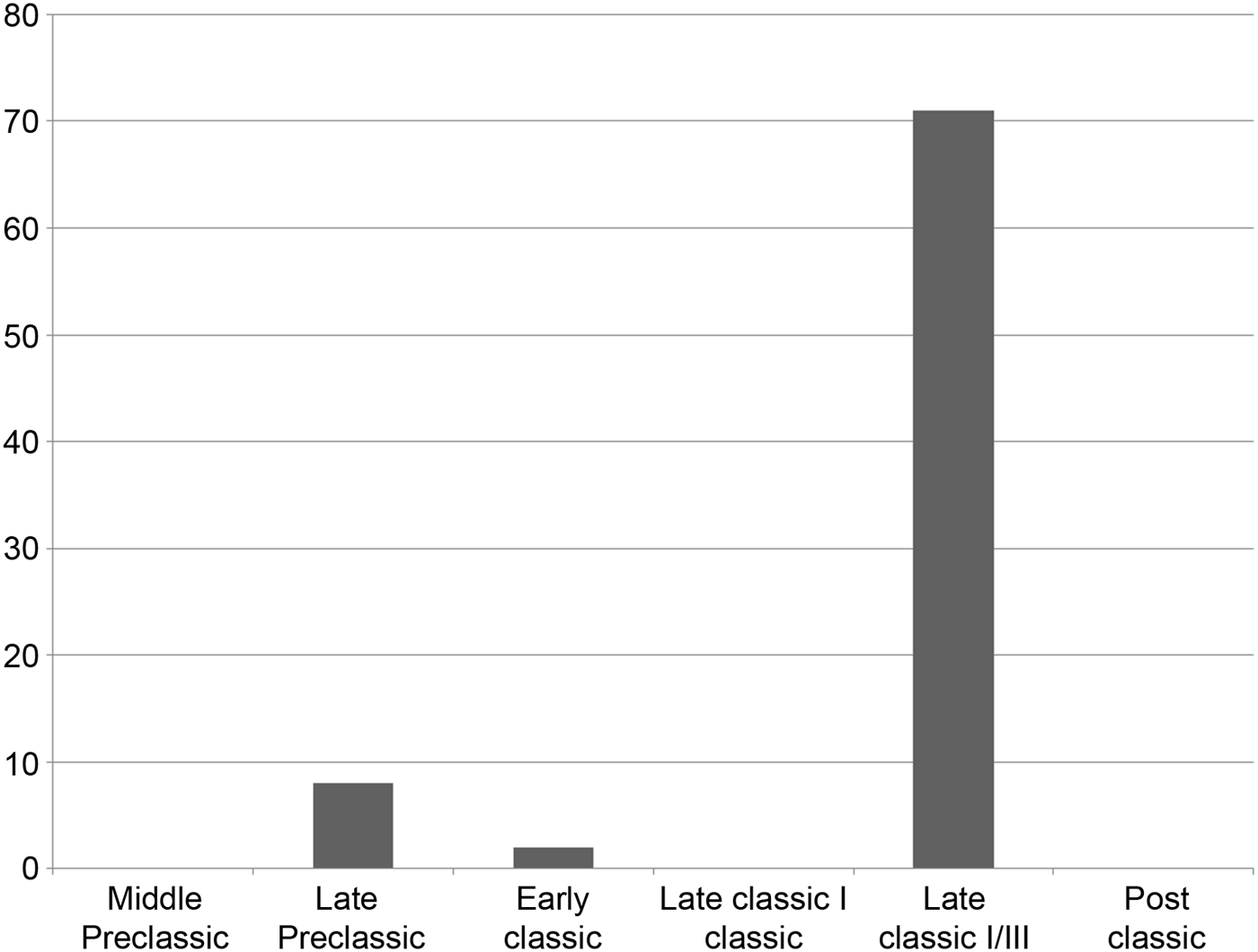
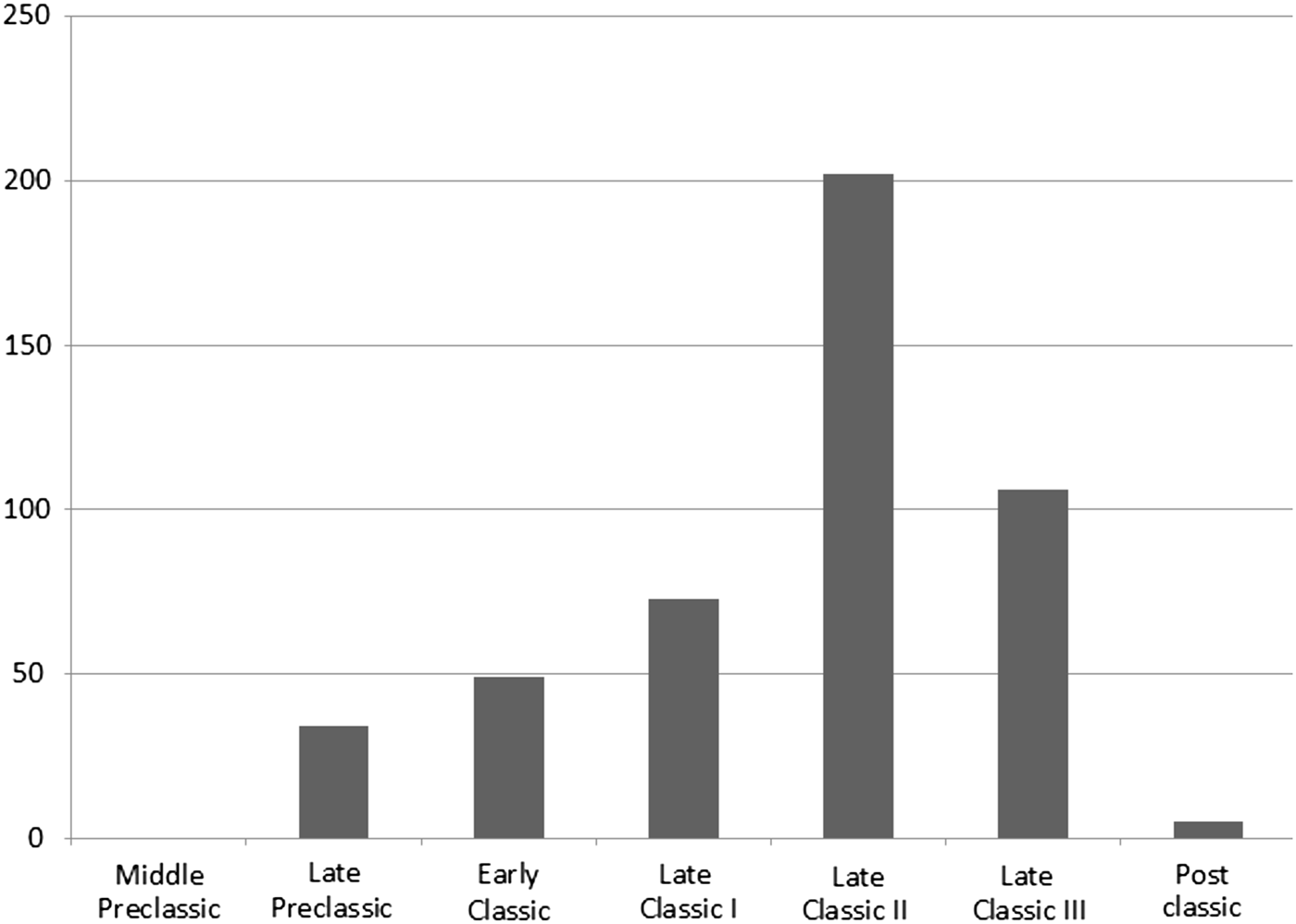
Perhaps the more telling graphs concerning occupation are based on contexts dated with ceramics rather than on percentage frequencies or counts of sherds by time period. Hammond and Tourtellot's graph estimated change in occupation by charting the presence/absence of sherds dating to each time period in the 77 peripheral units excavated through 1996. The number of units with at least one sherd dating to each time period was as follows: 8 Late Preclassic, 2 Early Classic, no Late Classic I, 71 Late Classic II/III, and no Postclassic units (Figure 17). This appeared to confirm the occupation curves in their other graphs. The new graph presented here is based on the number of excavated peripheral units that have at least one excavated context (either natural or arbitrary) dated to each time period. The number of units with at least one context dated to each time period is as follows: 34 Late Preclassic, 49 Early Classic, 73 Late Classic I, 202 Late Classic II, 106 Late Classic III, and 5 Postclassic units (Figure 18). The graph of this measure depicts a gradual, steady increase in dated contexts from the Late Preclassic through Late Classic II, followed by a halving of contexts in Late Classic III and a large decrease by the Postclassic. This new measure presents a more gradual increase in occupation from the Late Preclassic through Late Classic II, as well as a less dramatic decline from Late Classic II through the Postclassic than any of Hammond and Tourtellot's original graphs. It also depicts a more normal curve than do any of the original or revised graphs that are based on percentage frequencies or raw counts of sherds per time period.
Counts of peripheral excavation units with at least one sherd dated to time period. Adapted from Hammond and Tourtellot (Reference Hammond, Tourtellot, Demarest, Rice and Rice2004:Figure 13.4).
Counts of excavation units with at least one context dated by ceramics to time period.
So what are some of the possible factors that account for the differences between the original and revised La Milpa occupation curves? The earlier apparent gap in occupation during Late Classic I was mostly because Late Classic I ceramics were not identified until after 1996. The reasons for that oversight include the difficulty of separating them from Early Classic ceramics typologically, the possible continued use of Early Classic ceramics into Late Classic I, and the lack of well-preserved archaeological contexts containing Late Classic I sherds (Sullivan and Sagebiel Reference Sullivan, Sagebiel, Scarborough, Valdez and Dunning2003:27). The latter may be tied to a decline in occupation as well as a lack of construction and other deposits (caches, burials, and so on) by those remaining (meaning fewer sealed contexts) as well as a possible decline in ceramic production and quality. Excavation bias may also be a contributing factor. Similarly, the rapid abandonment originally posited for La Milpa may be an artifact of like factors. Most of the Late Classic III types were not identified until after 1996. It is also likely that Late Classic II types continued to be used during Late Classic III. Also, the preservation of Late Classic III ceramics is an issue because they are from the last years of occupation at La Milpa and generally were not preserved through incorporation into fill or other sealed contexts; rather they were on or near the surface and were quite eroded (see Sagebiel [2005a] for more discussion of these issues).
The exact time of La Milpa's final abandonment is still under investigation, but increasing evidence suggests that it was probably later than originally surmised. Hammond and Tourtellot (Reference Hammond, Tourtellot, Demarest, Rice and Rice2004:297–299) state that the lack of Plumbate and Fine Orange wares indicates minimal post-a.d. 830 occupation at La Milpa, and it was likely completely abandoned by a.d. 850. They note, however, that at Tikal and Lamanai these ceramic wares also appear rarely, although they are supposedly more common at Río Azul and Altun Ha (Hammond and Tourtellot Reference Hammond, Tourtellot, Demarest, Rice and Rice2004:298). But, the amount and contexts of Fine Orange wares at La Milpa, particularly if Unspecified Slate and Unspecified Fine Orange wares are also considered, are probably not significantly different from that of Tikal, Lamanai, or Río Azul (Adams Reference Adams1999:212–213). The current lack of Plumbate may not be unusual, as Adams states that Plumbate is rare at Río Azul (Adams Reference Adams1999:212). Furthermore, although no Fine Orange or Plumbate wares occur at Blue Creek, Kosakowsky and Lohse (Reference Kosakowsky and Lohse2003:11) state that occupation may continue to a.d. 1000. Finally, it is increasingly clear that Fine Orange wares are likely earlier than Plumbate wares (Cobos Palma Reference Cobos Palma, Demarest, Rice and Rice2004) and that Fine Orange wares may come from elite and/or ritual restricted contexts (Chase and Chase Reference Chase, Chase, Demarest, Rice and Rice2004; Ringle et al. Reference Ringle, Bey, Freeman, Hanson, Houck, Smith, Demarest, Rice and Rice2004:504); thus, they may not serve as very accurate chronological markers for the Terminal Classic. Certainly, Fine Orange is restricted to the site center at La Milpa, as none has been found outside of the regal/ritual part of the site center. Overall, the lack of Plumbate and the rarity of Fine Orange do not necessarily imply that La Milpa was completely abandoned by a.d. 850. Indeed, new radiocarbon dates and a deposit with true Fine Orange Wares from excavations at La Milpa (Zaro and Houk Reference Zaro and Houk2012) lend additional evidence that the site was likely occupied beyond a.d. 850 (see also Sagebiel Reference Sagebiel2005a:756, 762).
In conclusion, La Milpa's occupation history is not as unusual vis-à-vis other lowland Maya sites as previously thought. It was likely first occupied in the Late Preclassic and grew steadily in the Early Classic period with some population likely relocating from the site center into the periphery as the site center changed from a village into a regal-ritual center. Population may have declined during Late Classic I, perhaps in response to the Tikal and Calakmul conflict, but it is unlikely that either the center or periphery were completely abandoned. Population did increase significantly in Late Classic II, although not as dramatically as previously thought. Finally, La Milpa did indeed go “out with a whimper” rather than a bang, as population gradually declined in Late Classic III. Whether occupation ended as early as a.d. 800 or as late as a.d. 1050 (Zaro and Houk Reference Zaro and Houk2012), La Milpa ultimately was abandoned and would never regain its status as a Maya city.
RESUMEN
Las interpretaciones anteriores de la historia de la ocupación de La Milpa, Belice, basados en parte en datos preliminares de cerámica, han sugerido que la ocupación fluctuó dramáticamente desde el preclásico tardío hasta el clásico terminal (400 a.C–850 d.C). Se determinó que la pequeña aldea del preclásico tardío se convirtió en una gran ciudad del clásico temprano, con una arquitectura regia-ritual y monumentos tallados. Sin embargo, en el clásico tardío I, parece que la ocupación se redujo drásticamente sólo para ser seguida por un crecimiento exponencial durante el clásico tardío II. Finalmente, el sitio se derrumbó de repente antes del final del clásico terminal. Un nuevo análisis de cerámica utilizando análisis de atributos con énfasis en los modos formales ha aclarado la secuencia y, a su vez, ha suavizado las curvas temporales de la ocupación. En este trabajo se ofrece una descripción de la cerámica del clásico tardío I, II, III, junto con las gráficas revisadas de la historia de la ocupación de La Milpa, basadas en el trabajo del Proyecto Arqueológico La Milpa (1992–2002).
Basado en el nuevo análisis de la cerámica, las cerámicas del preclásico tardío de La Milpa son parte de la esfera Peten, pero influenciadas también por estilos cerámicos del noreste de Belice. En el clásico temprano, La Milpa se convirtió en una gran ciudad con cerámica casi idéntica a la de los de los grandes sitios como Tikal y Uaxactun en el Peten. Sin embargo, durante el clásico tardío I, la ocupación no disminuyó tan severamente como se había sugerido anteriormente. Aunque hubo cierta disminución de la ocupación, hay otras explicaciones posibles para la disminución de la ocupación que se percibe, como la falta de construcción en el centro del sitio, el sesgo de la excavación, la brevedad del período de tiempo, la reducción en el uso de los tipos cerámicos del Peten (sobre todo los policromos), y el uso continuado por los plebeyos de los tipos del clásico temprano. Además, durante el clásico tardío I las cerámicas del sur de Belice comienzan a aparecer en la colección cerámica de La Milpa.
A finales del clásico tardío II La Milpa resurge y la cerámica, en particular la polícroma, indica que los contactos con el Peten se reafirmaron. Sin embargo, conforme pasa el tiempo, La Milpa desarrolla su repertorio de cerámica propio. Esto incluye grandes cuencos monocromos con bordes reforzados interiormente; vasijas con engobe crema, en particular jarras; vasijas de engobe negro con decoración de manipulación de la superficie; y grandes jarras sin engobe con bordes reforzados exteriormente. Al final del clásico tardío III, La Milpa comienza a absorber algunos de los estilos y las tecnologías de la península de Yucatán, incluyendo vajillas de “imitación” pizarra y anaranjado fino. En este momento los tipos polícromos se dejan de emplear.
La fecha de la desaparición final de La Milpa es aún incierta, pero tanto la cerámica como las nuevas fechas de radiocarbono (Zaro y Houk Reference Zaro and Houk2012) sugieren que fue después del año 850 d.C, como se supuso con anterioridad. En su lugar podría haber ocurrido tan tarde como el año 1100 d.C, aunque es más probable que sucediera en algún momento entre los años 900 d.C a 1000 d.C. El sitio fue reocupado por campesinos yucatecos en algún momento durante el posclásico temprano o medio. Sin embargo, aún por cuanto tiempo estuvo abandonado el sitio antes de que fuera reocupado es algo que todavía se desconoce.
ACKNOWLEDGEMENTS
Many thanks go to Norman Hammond and Gair Tourtellot for allowing me to work on the La Milpa Archaeological Project ceramics and for their advice and support. Thanks also to the Programme for Belize (PfB) and the Institute of Archaeology of Belize, especially John Morris, Jaime Awe, and Brian Woodye for permitting and facilitating the work of LaMAP. Financial support included Sackler Scholarships awarded through the Department of Archaeology at Boston University and the Stanley R. Grant Scholarship, Comins Fellowship, Emil W. Haury Educational Fund for Archaeology, and the William Shirley Fulton Scholarship through the Department of Anthropology at the University of Arizona. Many thanks to Vernon Scarborough and Nicholas Dunning of the University of Cincinnati and Fred Valdez Jr. of the University of Texas at Austin for allowing me to analyze the ceramics from the Ancient Maya Land and Water Use Project. Gloria Everson, Jason Gonzalez, Julie Kunen, John Rose, and Estella Weiss-Krejci also were very gracious in allowing me to use data from their projects. Heartfelt thanks goes to T. Patrick Culbert and Laura Kosakowsky of the University of Arizona for their excellent ceramics training and intellectual support. Special thanks to Candida Lonsdale for her wonderful illustrations. Additional thanks also to Fred Valdez for allowing me to stay at the PfB Archaeological Project camp and use of the laboratory as well as to Lauren Sullivan for her many years of advice and friendship. Thanks to the Field Museum and Peabody Museum, Harvard staff as well as Elizabeth Graham, Lisa LeCount, Jon Lohse, Patricia McAnany, Astrid Runggaldier, and William Saturno for allowing me to work on their collections, consult their collections, or solicit their advice. Thanks to two anonymous reviewers and Terry Powis for their thoughtful reviews of this paper; their critiques greatly improved it. Any errors or omissions are solely those of the author. Thanks to Liwy Grazioso Sierra for her help with the Spanish translation. Finally, my husband and colleague John T. Murphy deserves much credit for his work on the relational database and other technical support.