Because patients harboring potentially infectious microorganisms are cared for within healthcare facilities by overlapping groups of healthcare personnel and undergo a variety of medical treatments and procedures that can increase both their vulnerability to healthcare-associated infections and their potential for disseminating these organisms, hospitals can serve as epicenters for the spread of infectious agents from patient to patient.Reference Archibald and Jarvis 1 Despite the critical importance of timely identification, investigation, and response to limit intrahospital transmission of microorganisms, there are currently no standardized methods that are used by hospitals’ infection prevention and control teams for cluster detection. Delays in recognizing these transmission events can lead to larger outbreaks that are more difficult to contain and incur additional morbidity and mortality.Reference Epstein, Hunter and Arwady 2 – Reference Maragakis, Cosgrove and Song 4
METHODS
We designed a 20-question survey that was distributed to a convenience sample of directors of infection prevention programs and infection preventionists subscribing to the SafetySurveillor infection prevention module of Premier (survey provided in online Appendix). The survey requested facility characteristics such as bed size, type of facility (eg, community hospital, teaching hospital, level I/II trauma facility, and acute rehabilitation facility) and size of the infection prevention program. Most survey questions focused on current outbreak detection practices at the healthcare facility. Questions assessed whether the facility had a fixed definition of a cluster or outbreak, whether specific organisms were targeted for assessing outbreaks, and whether outbreaks were documented at each facility. The survey also assessed satisfaction with current outbreak detection practices, confidence that outbreaks were being identified, and the extent to which an automated outbreak detection system would improve the comprehensiveness of the program. Respondents were asked to comment on their role and experience in infection prevention. The survey was pilot tested at 2 sites. Questions were refined for clarity and then distributed to potential participants by email.
This study was approved by the Partners Human Research Committee.
RESULTS
Surveys were distributed to 44 healthcare facilities, including 1 long-term acute care facility, 1 rehabilitation hospital, 1 psychiatric hospital, and 41 acute care hospitals. Completed surveys were received from 33 geographically diverse facilities (response rate, 75%). Respondents consisted of 13 academic acute care hospitals (mean bed size, 530; annual admission, 23,491), 19 community acute care hospitals (mean bed size, 139; annual admission, 5,660), and 1 long-term acute care hospital (bed size, 230; annual admission, 1,193). Twenty-five surveys (76%) were completed by a respondent with at least 5 years of experience in infection prevention and control, and 18 respondents (55%) had been in their position as an infection preventionist or hospital epidemiologist for at least 5 years. All 13 academic hospitals and 10 (53%) of the 19 community hospitals had an infectious disease physician overseeing infection prevention.
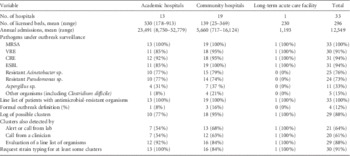
Outbreak detection methods reported by survey respondents are found in Table 1. For all hospitals, outbreak detection was limited to a narrow set of mostly antimicrobial-resistant pathogens. In addition, only 4 (12%) used a specified definition of a cluster or outbreak. All hospitals relied upon a line list of patients with microbiology tests positive for antimicrobial-resistant organisms to help identify outbreaks on the basis of visual recognition of unusual clustering. In addition, many hospitals were occasionally notified of possible outbreaks by their microbiology laboratory (21 [64%]) or clinicians (20 [61%]). Twenty-nine hospitals (88%) reported keeping a log of possible clusters or outbreaks.
Current Outbreak Detection Practice in 33 Hospitals

NOTE. Data are no. (%) of hospitals unless otherwise indicated. CRE, carbapenem-resistant Enterobacteriaceae; ESBL, extended-spectrum beta-lactamase; MRSA, methicillin-resistant Staphylococcus aureus; VRE, vancomycin-resistant enterococci.
Despite the fact that all hospitals reported that outbreak detection was limited to no more than 9 prespecified pathogens, 17 programs (52%) reported that they were confident or very confident that all clusters were being identified by their current methods. Thirty hospitals (91%) were able to obtain strain typing to confirm clonality of an outbreak.
Overall, while 18 programs (55%) reported satisfaction with their current outbreak detection practices, nearly all of the programs (32 [97%]) reported that they felt that an automated outbreak detection system for hospital-associated infections would improve the comprehensiveness of outbreak detection.
DISCUSSION
From the perspective of patient safety, timely detection of transmission of microorganisms between hospitalized patients is critically important in order to identify potentially modifiable risks and rapidly implement interventions to prevent further spread. In a convenience sample of 33 hospitals across 8 states, we found that methods used for outbreak detection were nonstandardized and limited to a small set of targeted organisms. All relied on visual inspection of line lists to detect outbreaks, and only 4 had a formalized definition of what constituted an outbreak. In light of the impact of hospital-associated outbreaks on morbidity and mortality, improving outbreak detection should be an important patient safety goal.Reference Archibald and Jarvis 1 – Reference Maragakis, Cosgrove and Song 4
Many of the limitations in the outbreak detection methods currently used by the surveyed hospitals stem from the intensity of resources required for manual review of microbiology data and the lack of statistically based methods for identifying clustering of events across a broad range of organisms. Large hospitals may have multiple infection preventionists, and given that patients frequently move within the hospital, it may be less apparent that an outbreak is occurring when cases occur in multiple wards covered by different infection preventionists. Furthermore, although there are hundreds of medically relevant pathogens that can be transmitted in healthcare settings,Reference Archibald and Jarvis 1 , Reference Magill, Edwards and Bamberg 5 all surveyed hospitals monitored at most 9 pathogens. For the most part, hospital surveillance for outbreaks focused solely on multidrug-resistant pathogens or Clostridium difficile, microorganisms that are not necessarily the most likely pathogens to produce outbreaks.Reference Hansen, Stamm-Balderjahn and Zuschneid 6 , Reference Gastmeier, Stamm‐Balderjahn and Hansen 7 For example, none of the surveyed hospitals monitored methicillin-susceptible Staphylococcus aureus or relatively antimicrobial-susceptible gram-negative bacilli despite the fact that these organisms have been associated with many hospital-associated outbreaks.Reference Romano-Bertrand, Filleron and Mesnage 8 , Reference Mermel, McKay, Dempsey and Parenteau 9 Even when focusing on the few pathogens that were under surveillance, relying on fairly arbitrary rules or identifying clustering of isolates on the basis of review of line lists of microbiology results by infection preventionists means that there is no process for accounting for the baseline prevalence of organisms within the healthcare facility. These methods have been found to be neither sensitive nor specific for outbreak detection.Reference Huang, Yokoe and Stelling 10
Our finding that approximately half of the hospitals surveyed thought that their outbreak detection was comprehensive despite their narrow surveillance focus was concerning. The emphasis by infection prevention programs on C. difficile and multidrug-resistant organisms and general disregard of other clinically relevant pathogens make it nearly impossible to quantify the true burden of outbreaks in healthcare settings. More comprehensive outbreak surveillance data would improve our understanding of transmission dynamics and our ability to prevent hospital outbreaks.
Ideally, cluster detection in hospitals would use automated, statistically based methods to identify clusters across all healthcare pathogens, locations, and services, taking into account antimicrobial susceptibility patterns while accounting for background rates of occurrence.Reference Huang, Yokoe and Stelling 10 – Reference Curran, Benneyan and Hood 12 For instance, the minimum number of new isolates that might indicate ongoing hospital transmission would be substantially larger for an organism with relatively high baseline incidence compared with other organisms that are less frequently identified. In addition, the thresholds for detection should take into account hospital-specific baseline microbiology data to identify clustering of organisms that are statistically unusual compared with that hospital’s historical data. Other critical elements of an outbreak detection tool would include timely identification of possible outbreaks, the ability to track containment and resolution, and ease of use. Ideally, a statistically based method for identifying possible outbreaks would be implemented in conjunction with an outbreak response plan that could involve enhanced surveillance, assessment of adherence to hand hygiene and appropriate isolation precautions, assessment of the adequacy of environmental cleaning, and consideration of the need for cohorting of patients or staff.
An automated, statistically based detection system would greatly improve current outbreak detection practices by facilitating and standardizing outbreak detection and expanding outbreak detection beyond a very small subset of organisms or specific locations.
ACKNOWLEDGMENTS
We thank Premier, Christiana Care Health System, Fairview Health Services, HealthEast Care System, Meridian Health, Mountain States Health Alliance, Summa Health System, Texas Health Resources, University of California, Irvine, and University Hospitals for their collaboration in this research.
Financial support. Centers for Disease Control and Prevention Epicenters Program (grant 1U54 CK000172-01).
Potential conflicts of interest. S.S.H. reports that she is conducting clinical studies in which participating hospitals and nursing homes receive contributed product from Sage, Molnlycke, 3M, and Clorox. All other authors report no conflicts of interest relevant to this article.
SUPPLEMENTARY MATERIAL
To view supplementary material for this article, please visit http://dx.doi.org/10.1017/ice.2015.325