INTRODUCTION
Faecal egg counts are widely used to estimate the relative susceptibility of infected sheep to nematode infection (Bisset et al. 2001; Woolaston and Windon, 2001). In cool, temperate climates such as the UK, the dominant nematode is Teladorsagia circumcincta (Stear et al. 1998), and faecal egg counts following natural infection are used to guide selection decisions when breeding sheep for nematode resistance. Faecal egg counts following natural infection are very variable both within and between populations (Stear et al. 1995) but several issues remain unresolved. Faecal egg counts in some sheep populations show a good fit to the negative binomial distribution while others do not (Stear et al. 1995). However, the reasons for this are unclear. The lack of consistency hinders the application of general linear mixed models for data analysis. The variation among populations has not been quantified yet an assessment of variation would assist the design of selection schemes that use several different farms. Further, some populations show much higher levels of variation among animals than others. Understanding the reasons for this variation would lead to better characterization of resistant animals and could help to identify the mechanisms underlying resistance.
The aim of this paper is to investigate the poor fit of the negative binomial to egg counts in lambs, to quantify the variation in faecal egg counts among populations and to examine the sources of this variation.
MATERIALS AND METHODS
Animals
The sheep came from 2 upland farms in Scotland; one in west central Scotland and one in the Borders region in southeast Scotland. The sheep were all straightbred Scottish Blackface. The lambs were born in a 3-week interval in late spring (April to early May) and weaned at 3 or 4 months of age. The management regime on the first farm has been previously described (Stear et al. 1995). On this farm, the lambs were sampled every 28 days from 8 to 16 weeks of age from 1990 to 1992. Lambs born in 1992 were sampled every 28 days from 4 to 24 weeks of age. Lambs born in 1993 to 1995 were sampled every 28 days from 4 to 28 weeks of age while those born in 1996 were sampled every 28 days from 8 to 28 weeks of age. The sampling pattern was changed as knowledge of the epidemiological variation became apparent. Over half the animals were necropsied at 30 or 31 weeks of age. All lambs were given a broad spectrum anthelmintic (albendazole sulphoxide) according to the manufacturer's recommendations immediately after sampling faeces every 4 weeks from 4 to 24 weeks of age. On the second farm, lambs were weaned at 4 months of age and sampled in August, September and October 2001 to 2003. Anthelmintic treatment was given at each sampling either ivermectin (Oramec drench, Merial Animal Health) or levamisole (Nilverm, Schering-Plough Animal Health), which were rotated between years. Each of the 7 cohorts from the first farm consisted of 200 lambs while each of the 3 cohorts from the second farm had approximately 250 lambs. Only 70–95% of lambs were sampled on most occasions due to deaths, missing records, lost tags and insufficient faeces in the sample. As the 4 populations sampled at necropsy contained fewer lambs than the other populations they were not included in the initial assessment of means and variances.
Parasitological methods
A 3 g sample of faeces was examined with a modified McMaster method (Gordon and Whitlock, 1939; Bairden, 1991). Each egg counted represented 50 eggs per gram (epg). Replicate aliquots from the same faecal preparation were counted in September 1993, October 1993, October 1994, and all samples from 1995 onwards.
Standard parasitological procedures were used at necropsy to identify and count all nematodes present in the abomasum and small intestine (Armour, Jarrett and Jennings, 1966; Stear et al. 1998) in lambs from the first farm. The large intestine was not examined as the frequency of anthelmintic treatment would prevent any large intestinal parasites surviving to the egg-laying stage (Stear et al. 1998).
Statistical analysis
The SAS suite of statistical programs version 9.1 was used for all analyses (SAS Institute, Cary, N. Carolina). The univariate procedure was used to estimate means, variances, standard deviations and ranges for each population sampled on each occasion. When replicate aliquots were counted only the first aliquot was used to estimate means, variances and the mean-variance relationship. There was an outlying population with a relatively low mean egg count of 201 epg but a high variance of 831550 eggs per gram2. This sample was taken in May 1994 and comprised only 88 lambs. All other samples had over 140 animals. This outlying population was discarded from further analyses. The distributions of means and variances were both skewed to the right. Gamma and lognormal distributions were fitted to the data with the Capability procedure in the SAS/QC suite of programs. The gamma and lognormal distributions have 3 parameters: threshold, scale and shape. Initial analyses indicated that the gamma distribution gave a better approximation of the data than the lognormal. For the gamma distribution, the threshold parameter was set to zero while maximum likelihood estimates of the scale and shape parameters were calculated iteratively by the Newton-Raphson approximation. Goodness of fit was tested by the Anderson-Darling statistic; this test belongs to the quadratic class of empirical distribution function statistics (D'Agostino and Stephens, 1986).
The relationship between the mean and variance was estimated by fitting a regression line between log-transformed variance and log-transformed mean: log(variance)=α+β*log(mean) (Gordon and Whitlock, 1939; Perry, 1981). This regression was fitted with the GLM procedure in SAS. When back-transformed, this gives a power relationship of the form: variance=a*meanb.
Among nematode eggs, only Nematodirus spp. are counted separately. Eggs from the other species cannot be distinguished from each other and their eggs are counted together. Multiple regression with the SAS GLM program was used to examine the relationship between the non-Nematodirus egg count and the number of nematodes present from the 5 common taxa: Teladorsagia circumcincta, Cooperia spp., Trichostrongylus vitrinus, Trichostrongylus axei and Haemonchus contortus.
There is a non-linear relationship between the number of adult T. circumcincta in the abomasum and the number of eggs produced by this species (Stear and Bishop, 1999; Bishop and Stear, 2000). The egg output depends upon the number of adult nematodes and their mean egg output. The mean egg output is strongly associated with the mean length of the adult female worms (Stear and Bishop, 1999). The mean egg output per worm was estimated as worm length to the power 0·4 multiplied by 1·12; one was subtracted from the sum. The predicted egg output was then calculated by multiplying the total number of adult worms by the mean egg output per worm. The predicted egg count for T. circumcincta was subtracted from the observed egg count to create a residual egg count. Multiple regression was then used to examine the relationship between the residual egg count and the number of nematodes from the 4 taxa: Cooperia spp., T. vitrinus, T. axei and H. contortus. Due to the presence of negative numbers 1000 was added to all residual counts prior to log transformation.
Generalized linear modelling was carried out with the GLIMMIX macro in SAS (Littell et al. 1996).
RESULTS
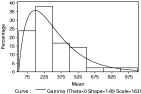
Fig. 1 shows the distribution of mean egg count among the populations sampled. Each of the 42 populations sampled represents the mean egg count for a particular cohort on 1 farm at a single date. The distribution was right skewed with a mean of 305 and a median of 255 epg. The data appeared to follow a gamma distribution (Anderson-Darling statistic P>0·50). Maximum likelihood estimates for the scale and shape parameters were 163 and 1·89. The gamma distribution with these parameters has been superimposed onto the histogram (Fig. 1).

Fig. 1. The distribution of mean egg counts.
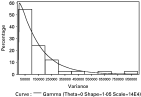
The distribution of the variances of the egg counts is presented in Fig. 2. This distribution was also right skewed. Most populations had relatively small variances but a small number had relatively high variances. The median variance was 89890 and the mean variance was higher at 162743 eggs per gram2. As with the distribution of means, the distribution of variances among the sampled populations appeared to follow a gamma distribution (Anderson-Darling statistic P=0·169). Maximum likelihood estimates for the scale and shape parameters were 139462 and 1·05. The gamma distribution with these parameters has been superimposed on the histogram (Fig. 2).

Fig. 2. The distribution of egg count variances.
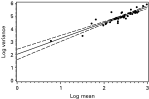
Regression analysis (Fig. 3) demonstrated that the variance=120*(mean epg)1·23+0·08. The 95% confidence limits on the scalar term were 39 and 372. Fig. 3 illustrates this relationship between the mean and the variance. The R-square value was 0·84, indicating that variation among populations in their variances largely reflected variation among populations in their mean egg counts.

Fig. 3. The relationship between transformed egg count mean and variance. Means and variances were transformed by taking logarithms to the base 10. The solid line represents the regression and the dotted lines represent 95% confidence limits.
An additional 4 populations from Farm 1 were examined at necropsy. Table 1 presents the mean egg count and variance for these 4 populations as well as the number of species present. As the numbers of fourth- and fifth-stage larvae do not influence the egg count they have not been included in Table 1. Larvae were found only for T. circumcincta, Cooperia spp. and T. vitrinus. Most fourth-stage larvae will be inhibited but a small number may arise from recent infection. In 1992, the mean numbers of fourth-stage and fifth-stage larvae in each lamb were respectively 5738 and 574 for T. circumcincta, 2 and 7 for Cooperia spp. and 4 and 5 for T. vitrinus. In 1993, mean numbers of fourth-stage and fifth-stage larvae were respectively 528 and 100 for T. circumcincta, 18 and 19 for Cooperia spp. and 1 and 1 for T. vitrinus. In 1994 and 1995 all recovered larvae were T. circumcincta. There were 705 and 31 fourth and fifth-stage larvae in 1994 and 3221 and 82 respectively in 1995.

Table 1 demonstrates that the variance increased as the egg count increased in line with the previous analysis. The interesting feature of Table 1 is that high egg counts and high variances are not due to high numbers of adult nematodes per se but to high numbers of species other than T. circumcincta. For example, the lowest egg counts (87 epg) occurred in 1992. This year had the second highest total of nematodes (6860) but over 95% of these were T. circumcincta. In contrast, the mean egg counts were much higher in 1993 (317 epg) and 1994 (494 epg) but the number of adult nematodes was much lower at 3309 and 2336 respectively. However, the proportion of T. circumcincta was lower at 84% in 1993 and 66% in 1994. Together, these results suggest that high means and variances in faecal egg counts in October at the end of the grazing season are not due to high intensities of infection but to the presence of species other than T. circumcincta.
Multiple regression was used to examine the relationship in these lambs in October between the total faecal egg count and the number of adult parasites of the 5 taxa (T. circumcincta, Cooperia spp., T. vitrinus, T. axei and H. contortus). Both faecal egg count and adult parasite numbers for each species were transformed by log 10(x+1). The initial analysis showed a negative relationship (−0·23±0·09; P<0·05) between faecal egg count and transformed number of T. circumcincta and positive relationships between transformed egg count and transformed number of Cooperia spp. (+0·33±0·03; P<0·001) and the transformed number of T. axei (+0·15±0·07; P<0·05). The relationships between faecal egg count and the transformed numbers of T. vitrinus and H. contortus were not significant (P=0·21 and P=0·50) respectively.
As the relationship between egg count and number of adult T. circumcincta is non-linear, the T. circumcincta egg count was predicted from the number of adult T. circumcincta. This predicted egg count was then subtracted from the actual egg count and the residual egg count transformed by log 10(residual+1000). Multiple regression analysis demonstrated highly significant effects between transformed residual egg count and the transformed numbers of Cooperia spp. (+0·07±0·01; P<0·001), T. axei (+0·04±0·01; P<0·05) and T. vitrinus (+0·03±0·01; P<0·001). The relationship between faecal egg count and the transformed number of H. contortus was not significant (P=0·64), possibly because only 8 of 483 lambs examined were infected with this parasite.
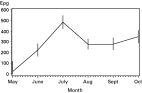
Generalized linear modelling with a gamma distribution and a reciprocal link function was used to test the relationship between mean egg count and farm, year and month. Three separate univariate analyses were carried out and each variable was fitted separately as a fixed effect. These analyses showed that there were no significant differences in mean egg count between the 2 farms (P=0·455), an inconclusive result for year (P=0·053) and significant differences among months (P=0·024). Egg counts were low in May, rose in June, peaked in July, fell in August, remained stable in September but rose again in October (Fig. 4). The highest July mean egg counts occurred in 1993 (572 epg).

Fig. 4. Egg count means plus standard errors by month of sampling. Lambs were born in a 3-week interval then sampled every 28 days. All lambs were treated with anthelmintic at each sample date.
DISCUSSION
There was considerable variation among the populations sampled in faecal egg count means and variances. The distribution of means and variances were both skewed. Most populations had relatively low means and variances but a small proportion had high means and variances. The variance was related to the mean to the power 1·23; this exponent was significantly greater than 1·0 and significantly less than 2·0. Analysis of necropsy data suggested that high means and variances were not simply due to high intensities of infection but to the presence of species other than T. circumcincta, particularly Cooperia spp., T. axei and T. vitrinus.
The contribution of other nematode species to high egg counts is consistent with previously published reports on the density-dependent regulation of fecundity in T. circumcincta (Bishop and Stear, 2000). As the intensity of infection with T. circumcincta increases, an increasing number of larvae arrest development (Stear et al. 2004) while those that do develop into adults produce fewer eggs per day. We used previously published results to predict egg output from the number of adult parasites (Stear and Bishop, 1999; Bishop and Stear, 2000). After subtracting this predicted output from the observed egg count, multiple regression analysis on the transformed residual egg counts gave highly significant positive relationships with the numbers of Cooperia spp., T. axei and T. vitrinus. Care is needed in interpreting these results because the residual egg count is an imprecise estimate of the egg count due to species other than T. circumcincta. Nonetheless, the conclusion that the egg count is influenced by all nematodes present is plausible. Although T. circumcincta is the predominant species, the egg count does not necessarily reflect this. Indeed lambs with many adult T. circumcincta produce fewer nematode eggs than lambs with moderate infections (Bishop and Stear, 2000).
There was no significant difference in mean egg counts between the 2 farms sampled. However, the mean egg counts varied with the month of sampling. Egg counts rose to a peak in July then declined before rising again in October. A similar bimodal pattern with slightly earlier timings was reported previously for untreated lambs (Thomas and Boag, 1972). Our research was carried out under commercial conditions with regular anthelmintic usage; therefore the values observed each month represent independent infections and are not influenced by pre-existing infections derived from previous months.
The decline from the first peak has been explained by the onset of immunity in lambs (Stear, Strain and Bishop, 1999). However, part of the peak could be contributed by time-dependent variation in other nematodes such as Cooperia spp. Necropsies of large numbers of infected lambs at regular intervals during the grazing season are needed to clarify the contribution made by different species of nematodes.
Faecal egg counts in sheep are not particularly well-described by the negative binomial distribution (Stear et al. 1995). This lack of fit is surprising because the negative binomial distribution is a flexible distribution that is widely used to describe parasite distributions among hosts (Hunter and Quenouille, 1952; Bliss and Fisher, 1953). The poor fit of the negative binomial distribution may be explained by the observation that several species contribute to the egg count. The dominant nematode is T. circumcincta but other species can contribute to the egg count. If each species egg counts follow a negative binomial distribution, the combined distribution would not conform to a negative binomial (Grafen and Woolhouse, 1993). In addition, males have higher egg counts than females and this too could lead to departures from the negative binomial distribution (Stear et al. 1995).
There was a strong relationship between the mean and the variance for egg counts. This relationship followed Taylor's Power law (Taylor, 1961). We have previously used Taylor's Power law in a subset of these data (Stear et al. 1998). Then the regression line was drawn through the origin but visual examination of the larger data set analysed here suggested that an intercept was more appropriate. Estimating the slope of the regression line is subject to error (Perry, 1981; Boag, Hackett and Topham, 1992) because both the mean and variances are estimates of the true values. However, there is no agreement on the best way to avoid this problem (Sokal and Rohlf, 1995). A coefficient of 1 is consistent with a Poisson distribution and implies a square root transformation while a coefficient of 2 implies a logarithmic transformation is most appropriate. Here the estimate lay between 1 and 2, implying that neither transformation is ideal.
Taylor's Power law has been widely used to describe the relationship between variability in population size and mean abundance of a species over space and time (Anderson et al. 1982; Keeling, 2000). Taylor (1961) considered the scalar to be of less importance than the exponent that generally lies between 1 and 2. Mathematical modelling suggested that the value of the exponent is determined by relative magnitude of birth, death, immigration and emigration rates (Anderson et al. 1982; Kilpatrick and Ives, 2003) while Kilpatrick and Ives (2003) argued that negative interactions among species could produce exponents between 1 and 2.
In conclusion, faecal egg counts vary in naturally infected sheep and mean egg counts vary among different populations and among the same population sampled at different times. The variance was strongly associated with the mean. High means are not necessarily due to high intensities of infection but probably reflect the contribution of species other than T. circumcincta.