

Introduction
The 5SM is neither right, nor left-wing, it is on the side of the citizens. Fiercely populist. If a law is good we vote it, if it is bad we do not vote it (…).Footnote 1
Italian electors are increasingly disillusioned towards the political system, and this opens a space for anti-system and anti-establishment parties.Footnote 2 In this context of growing dissatisfaction, the Five Star Movement (5SM) obtained an outstanding result at the national elections in 2013, collecting 25.6% of the votes at the Low Chamber (Camera dei Deputati). Since that moment, many observers have tried to explain 5SM’s appeal among such a widespread constituency (Woods and Lanzone, Reference Woods and Lanzone2015). It is possible to argue, in line with Pettit (Reference Pettit2004) and Mair (Reference Mair1997), that modern politics no longer relies on solid constituencies, and this might move towards a depoliticized or even party-less and post-ideological democracy where movements such as 5SM thrive.
The movement, often described as populist (Biorcio and Natale, Reference Biorcio and Natale2013; Corbetta and Gualmini, Reference Corbetta and Gualmini2013; Woods and Lanzone, Reference Woods and Lanzone2015), has refused to form alliances with any other party, coherent with its message that mainstream political actors form a corrupt casta that defends its own privileges at the expense of ordinary citizens (Natale and Ballatore, Reference Natale and Ballatore2014).Footnote 3
Flamboyant and unpredictable (Cosenza, Reference Cosenza2014), the party’s message manages nonetheless to gain a large share of the votes for two reasons: on the one hand, the party attracts disillusioned or alienated voters (Biorcio, Reference Biorcio2014; Orazi and Socci, Reference Orazi and Socci2014) by claiming to bring the citizens back to the centre of the decision-making process and the political system by introducing tools for direct and participative democracy (Natale and Ballatore, Reference Natale and Ballatore2014); on the other hand, a post-ideological approach to politics allows a high degree of strategic flexibility and attracts disillusioned voters from both the mainstream right-wing (Go Italy and Northern League) and the left-wing (Democratic Party), as explained in Russo et al. (Reference Russo, Riera and Verthé2017).
This study focusses on the latter element, and its goal consists in determining to what extent different elements of the party’s discourse are salient over time in order to determine its ideological flexibility. Although this is a case-study, and despite the existence of specific (national) opportunity structures for populist parties to thrive, this case is relevant because any populist party in Europe might try to replicate 5SM’s success by adopting a similar discourse in order to exploit the growing disillusionment among the electorate (Ceccarini and Bordignon, Reference Ceccarini and Bordignon2016).
The study analyses the salience of topics over time in order to determine which is the core political message of the party and which topics, on the contrary, have been raised strategically according to the changing political and social context. This is investigated through an automated content analysis of the English version of the blog of the movement.
Populism in its purest form
This paper aims at contributing to the vast literature about democracy and populism through the analysis of the discourse of a party which seems to fully exploit the ideological flexibility of populism. Populism is here defined as ‘an ideology that considers society to be ultimately separated into two homogeneous and antagonistic groups, “the pure people” vs. “the corrupt elite”, and which argues that politics should be an expression of the volonté générale’ (Mudde, Reference Mudde2004: 543). Laclau (Reference de la Torre2005) highlights how the ‘people’ is represented as an excluded and underprivileged mass which claims to be the only legitimate community, thus corresponding to 5SM’s message.
Populism is considered by Canovan (Reference Canovan1999) as the redemptive and Jacobin face of democracy presenting itself as the embodiment of the vox populi and as a corrective of the excess brought about by pragmatism (the ‘ballots, not bullets’ approach). As a consequence, in a ‘populist democracy’ (Dahl, Reference Dahl1956) the majority is supposed to have unlimited power since populism ‘aspires to construct a political model in which representative institutions are not necessary’ (Rovira Kaltwasser, Reference Rovira Kaltwasser2012: 188). Indeed, while the aim of liberal democracy is to ‘construct the “them” in such a way that it is no longer perceived as an enemy to be destroyed, but as an “adversary”, that is, somebody whose ideas we combat but whose right to defend those ideas we do not put into question’ (Mouffe, Reference Mouffe2000: 102), the populist idea of power consists in delegitimizing any other political opponent and constructing an ‘us vs. them’ opposition in a Manichean way.
Empirically, according to Mudde (Reference Mudde2004: 544), as populism is a thin-centred ideology, ‘it can be easily combined with very different (thin and full) other ideologies, including communism, ecologism, nationalism or socialism’.Footnote 4
However, we argue that 5SM should be defined as a ‘purely’ populist party, with no thick ideologies attached to its thin ideological core.Footnote 5 This is in line with Tarchi’s (Reference Tarchi2015) definition of 5SM as the ‘purest form’ of populism. We believe that populism being the main component of the party’s political message, 5SM can articulate an ideologically flexible discourse and catch voters with diametrically opposed political attitudes and beliefs.Footnote 6
The opposition between the pure people and the corrupt elites is not articulated along ideological lines: in 5SM’s worldview the ‘people’ is not presented in national, cultural, or economic terms, but rather as a homogeneous and compact entity with no further qualifications (Zanatta, Reference Zanatta2013).Footnote 7 As opposed to the demos, there is a broad group of elites: corrupt politicians, biased journalists, and the leaders of supranational institutions such as the European Union and the European Central Bank.Footnote 8
The party’s message focusses on the necessity of implementing a participative decision-making process rather than on clear positions on relevant issues. This is reflected in the composition of 5SM’s electorate: at the 2013 national elections it was composed, in three almost equal parts, of former left-wing and right-wing voters as well as persons who had not voted in the previous election.Footnote 9
This characteristic is rather unique within the varied world of European populism: in fact, other populist parties that define themselves as ‘neither right nor left-wing’, such as the French Front National or the British UKIP, actually propose an idea of the people along cultural and nationalist lines. Conversely, 5SM takes its position on an issue-by-issue basis, and on particularly sensitive issues it avoids directly positioning itself by delegating the decision to an online vote among its activists.Footnote 10
Another peculiar characteristic of 5SM vis-à-vis other populist parties consists in the fact that beside proposing a political system based on direct democracy, 5SM actually tries to implement these ideas through an extensive system of web tools that allow grassroots participation – although, as we explain in the next section, with severe limitations due to the very structure of the party (Corbetta and Gualmini, Reference Corbetta and Gualmini2013).
Other populist parties, such as Podemos in Spain, make use of several tools for online participation in order to implement the populist ideal of unrestricted popular sovereignty. Podemos’ ideological approach, however, is clearly left-wing and not post-ideological (Kioupkiolis, Reference Kioupkiolis2016).
In the next section, 5SM’s approach towards direct democracy is discussed and placed in the context of the existing literature highlighting its contradictions. We then discuss the party’s focus on different issues over time. Then, a section is devoted to the formulation of our expectations about the salience of several issues over time, followed by the presentation of the methodology employed for the analysis and a discussion of the results.
Direct democracy beyond ideologies: problems and contradictions
5SM’s approach to the populist idea of unmediated popular sovereignty is characterized by the implementation of online tools for direct democracy combined with a post-ideological approach which defines political parties and classical forms of representation as antithetical to the common good. This innovative approach explains the party’s success but also triggers two main contradictions. First, the system of web tools for the implementation of participatory democracy seems at odds with the pyramidal structure of the party. Second, the role of experts as post-ideological savants helping the citizens in their decisions seems at odds with the essentially populist ideology of the party.
First, Online devices have been developed in order to allow several functions typical of direct democracy, such as voting for candidates and representatives, conducting consultations on issues such as the expulsion of party members, determining the party’s position on specific issues, and performing ad hoc referenda. In 2016, the party launched a new platform called Rousseau, allowing the activists – among other things – to vote on draft laws, participate in fund raising, share information about the legislative actions of the party, and learn about the bureaucratic functioning of the legislative mechanism.
However, despite the effort to implement tools for participative and direct democracy, the decision-making process is still highly influenced by top-down decisions. What seems to be far from resolved, in particular, is the conflict between ideas of direct democracy and the internal vertical structure of the party: indeed, ‘the “proprietary” and top-down management of the Five Stars symbol makes elected members subordinate to non-appealable sanctions (expulsions) from the central node of the membership network, which is in Grillo’s hands’ (Bordignon and Ceccarini, Reference Bordignon and Ceccarini2013: 438). Also, Orazi and Socci (Reference Orazi and Socci2014: 75) highlight contradictory elements such as participation and centralization, e-democracy and control over the copyright. More generally, it seems that the contribution from the bottom is relegated to a marginal role and employed only when compatible with the directions from above.
As Béja (Reference Béja2013: 102) noted the structure of the party is pyramidal, not horizontal nor rhizomatic as it is usually presented by its members and leaders. At the bottom of the structure there are millions of voters, then the tens of thousands who animate the discussions on the blog, above come the members of the movement, local and national elected officials, and – on top – Beppe Grillo.Footnote 11 Rather than the bottom-up movement that it claims to be, 5SM often looks like a top-down structure based on tele-plebiscitarian mechanisms. As Bordignon and Ceccarini noted ‘In spite of insistence on the “shared” nature of the political action carried out by the [5MS], its organisation is strongly conditioned by Grillo’s “ownership” of the brand name, which gives him considerable room for manoeuvre in making decisions and in managing internal dissent’ (Reference Bordignon and Ceccarini2014: 62).Footnote 12
Inevitably, the situation is particularly problematic when it comes to members of parliament, since the role of MP is understood in terms of an imperative mandate (Diamanti, Reference Diamanti2013). According to the internal rules of the party, every autonomous decision can be interpreted as a betrayal of the mandate and may entail immediate expulsion from the party. Between 2013 and 2016, 19 Senators and 18 Deputies have left or have been expelled from 5SM, in accordance with the party’s idea that politicians are mere ‘employees’ with a temporary mandate, and who are continually monitored by their employers: the people.Footnote 13
Second, the unmediated implementation of the people’s will is problematic not only because it is constantly limited and shaped by the leadership of the party. Indeed, there is a further problematic aspect: according to 5SM’s guidelines, the common good cannot be defined in ideological terms, only as an objective condition. In case the decision to be taken is particularly complex – for example, the possible withdrawal from the Eurozone – it is the duty of neutral experts to inform the people about the different options at stake. In a second stage, after a process of collective deliberation, a purely majoritarian approach is followed and the will of the people consists in the decision expressed by the majority.
De la Torre (Reference Laclau2013: 33) describes Ecuadorian President Rafael Correa as a techno-populist since he shows a ‘special concern for the poor and marginalized’ while at the same time his populism has ‘a curiously elitist and technocratic bent’. 5SM also seems to combine populist rhetoric with top-down technocratic policies, although less systematically. Indeed, 5SM postulates that decisions about the common good should not be taken according to different political affiliations or special interests, but only according to the informed deliberation of the citizens who discuss among themselves the information provided by experts. However, 5SM’s technocratic approach is spurious compared to the one described by de la Torre for two reasons. First, only the people can have the last word and give legitimacy to any choice. Second, only one expert is generally allowed to present his or her position to the party’s members without being counterbalanced by other experts’ opinions, and ultimately the people’s choice tends to coincide with the option endorsed by Beppe Grillo. Floridia and Vignati (Reference Floridia and Vignati2014) highlighted this paradox and concluded that the experts are positively considered only when they endorse the proposals of the blog. However, as soon as their opinions differ from those expressed by Grillo, they are labelled as ‘alleged experts’ subservient to lobbyists and big business.
Following Caramani’s (Reference Caramani2017: 58) work on the relationship between populism and technocracy, it appears that 5SM’s techno-populist approach is consistent insofar as the critique concerns the form of representation of party government since parties are ‘non-credible both from a populist and a technocratic perspective’. In particular, both forms of power share the idea of a unitary and general common good, a non-pluralistic view of society and politics, the idea that the relationship between people and elite should be unmediated, and the absence of accountability.
However, populism and technocracy crucially diverge when it comes to establishing what the objective interests of society are. In this regard it seems that, by pointing at the people as the only and ultimate source of legitimacy, 5SM does not implement a technocratic idea of power, but rather a two-step approach which might start with the opinion of experts but ultimately gives the word to the people in a purely populist fashion.
Ideological flexibility
The elements mentioned in the section above illustrate three key features at the origin of 5SM’s flexibility. First, the post-ideological approach guarantees that the party can express the most advantageous position depending on the context. Second, direct and participative forms of democracy ensure that people at least appear to decide on every issue according to their own preferences, and therefore the political line of the party is ideally defined as a bottom-up process. Third, the experts are functional in identifying the common good beyond ideologies, thus allowing the party line to remain flexible.
On the other hand, over time several different issues have constituted the main focus of the party’s discourse. The evolution of these issues bears witness to the transformation process of 5SM from environmental movement to ‘catch-all’ party (Bordignon and Ceccarini, Reference Bordignon and Ceccarini2013; Diamanti, Reference Diamanti2014).Footnote 14 When it started in 2005 as a grassroots movement, several central topics were borrowed from the movements against globalization, which failed to express a coherent programme after the major mobilizations in Seattle (1999) and Genova (2001). Many activists, mainly linked to left-wing associations, collectives, and NGOs, found in Grillo’s movement a way to keep supporting some of the causes of the so-called ‘anti-globalization’ movement.
Indeed, the five stars of the name refer to the five core areas of interest during the phase of creation of Grillo’s movement through the Meetup platform for online deliberation: public water, sustainable transport, sustainable development, right to free internet access, and environmentalism.
In 2007, the first V-Day, a public show in Bologna, intended to give visibility to the collection of signatures for a law of popular initiative concerning the mechanisms of candidates’ selection for the Parliament. In 2008, the topic of the second V-Day was the role and structure of mass media and newspapers. Other major campaigns conducted by 5SM concerned the issue of the national telecommunications provider (Telecom) and the support to the No TAV movement which opposes the construction of a speed railway line between Turin and Lyon.Footnote 15
The party’s programme, published in 2013, summarizes 5SM’s areas of interest, combining the ‘five stars’ with other broad topics such as information, economy, education, and health. According to the Manifesto Project Database, 5SM’s is the most left-wing manifesto presented in Italy since 1945, but, as mentioned earlier, one-third of the party’s voters are former right-wing voters.Footnote 16 This speaks volumes about 5SM’s ability to adapt its discourse and propose a post-ideological vision of politics by addressing issues which do not follow previous social cleavages, but rather unite different types of voters.Footnote 17
Pedrazzani and Pinto (Reference Pedrazzani and Pinto2015) show how between 2012 and 2013 the percentage of former right-wing voters inclined to vote for 5SM increased from 27.6 to 42.1%, and Diamanti (Reference Diamanti2014) observed that 5SM can be imagined as a bus which first took on board left-wing supporters and then stopped to open the doors to right-wing voters, thus becoming a vehicle for anti-political protest.
The ability of 5SM to capture the most salient issues during the campaign for the 2013 elections has been described by Conti and Memoli (Reference Conti and Memoli2015: 523). Considering the five issues that a survey revealed as the most salient for the electorate at the time, 5SM ranked first in addressing environmental protection, welfare expansion, and market regulation, and second in political corruption. Revealingly, 68.4% of 5SM’s programme was dedicated to four of the five most relevant issues.
As an example of this strategic adaptability of the party’s discourse, this quote from Grillo about the necessity of a referendum about the permanence of Italy in Europe is significant: ‘As it has no doctrine, as it’s not supported by any ideology (…) the position of the 5 Star Movement is very clear and adaptable: we can stay in the Euro and defend it or we can break with it and leave, depending on the interests of the nation. (…) it has an extremely important value as a means of consulting the wishes of the people’.Footnote 18
To what extent 5SM strategically adapts its political discourse to changing socio-political situations is one of the two key issues of the following analysis. The other aspect that will be investigated concerns the consistency of the party’s approach to direct democracy as a source of political legitimacy. Both elements are investigated through an automated content analysis of the party’s online communications.
Expectations about the topics’ salience
The aim of the analysis is to understand which topics remain salient over time in 5SM’s discourse and which, on the other hand, have been raised in a more strategic way. This allows us to determine how flexible the party’s discourse is. In particular, the paper analyses the saliency of six topics that have been raised by the party over time, and the salience of the meta-topic ‘direct democracy’.
The idea is that the meta-discourse about direct democracy constitutes the main (‘thin’) pillar of the party’s discourse and acts as a glue for both left-wing and right-wing voters, while specific topics are strategically addressed by the party over time according to two factors: changing socio-political scenarios, and the necessity to attract voters with different political backgrounds. We could conclude that 5SM’s discourse is ideologically flexible and strategically adaptable as long as the salience of the meta-topic of direct democracy remains foremost while the salience of other topics fluctuate, as explained below.
The topic ‘direct democracy’ includes discussion of the necessity to implement tools for direct and participative democracy, the importance of online deliberation, the function of 5SM as embodiment of the popular will, and theoretical and empirical discussions about the inconsistency of representative compared to direct-democratic models.
The salience of the meta-discourse about democracy being the first axis of the analysis, the salience of specific and concrete topics over time represents the second axis. Six such topics will be considered, and we expect their saliency to fluctuate over time according to the context.Footnote 19
First, the analysis will focus on the five stars – in other words, the backbone of the party programme: public water, sustainable transport, sustainable development, right to free internet access, and environmentalism. Due to the methodological difficulty in distinguishing between very similar topics, we decided to merge three topics which bear strong similarities and are thematically intertwined: environmentalism, sustainable development, and sustainable transport. We also calculated them separately, but the measurements in those cases are less accurate, therefore we preferred to build a macro-topic we labelled as ‘environment’. To sum up, the five stars will be grouped as follows: ‘free internet’, ‘public water’, and ‘environment’.
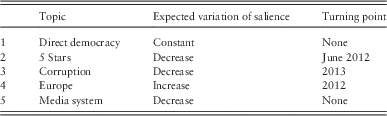
These topics have always constituted the raison d’être of the movement, and a recent analysis of the votes of 5SM in the European parliament shows that in the period 2014–2015, 5SM has remained consistent with its original pro-environmental and libertarian/post-ideological roots (Franzosi et al., Reference Franzosi, Marone and Salvati2015: 122). However, the programme of a party does not necessarily coincide with its political discourse. Moreover, as mentioned above, we expect the saliency of different topics to fluctuate over time in order to transform 5SM into a catch-all party by strategically raising different issues at different times. Therefore, we expect the saliency of the ‘five stars’ to decrease over time, in particular after June 2012, when the party announced it would participate in the forthcoming national elections.
Additionally, we introduce a third group of topics that are partly derived from the literature about 5SM but also from the first step of our analysis (unsupervised topic modelling). This group includes ‘corruption’, ‘Europe’, and ‘media system’.
The corruption of the political system has been addressed by 5SM in various forms over time in terms of corrupted casta of politicians pursuing their own interest at the expense of the people. According to the analysis offered by Conti and Memoli (Reference Conti and Memoli2015: 528), however, we expect this issue to lose its salience over time. Indeed, they found that 5SM progressively de-emphasized it. Moreover, it could be that 5SM – with hundreds of representatives from the local to the European level – strategically decided not to emphasize this issue due to the possibility of being involved in similar scandals in the future.
A different situation characterizes the position of 5SM vis-à-vis the topic ‘Europe’, here broadly understood as a set of sub-issues related to the single currency, the European integration process, national sovereignty, the role of European institutions, and the opacity of their democratic procedures. As Corbetta and Vignati pointed out, ‘Grillo’s Euroscepticism does not stem from deeply rooted ideological motivations; rather, it feeds on the gravity of the current crisis and the fears that this arouses in the public’ (Reference Corbetta and Vignati2014: 56).
This seems to represent a perfect example of a strategically raised issue. It does not belong to the core of 5SM’s programme, but it became highly salient because of its prominence in the national debate. Indeed, according to Franzosi et al. ‘only in the months preceding the Italian general elections of 24-25 February 2013, did Beppe Grillo begin to speak out against the EU’ (Reference Franzosi, Marone and Salvati2015: 113). Moreover, there is a large literature concerning the links between populism and Euroscepticism, and Herkman (Reference Herkman2017) highlights how the link became even stronger after 2008. For all these reasons, it seems safe to expect 5SM to have addressed the topic increasingly often over time.
The last topic concerns the role of the media system, which constitutes one of the main targets of 5SM’s critique of the status quo. Indeed, it represents both a personal issue for Beppe Grillo, who worked on national television before being ostracized, and a typically populist theme, since the media are seen as a tool by which mainstream political parties control public opinion.
The relationship between 5SM and the mainstream media system is twofold, since on the one hand, the party refuses to be part of the media system and communicates mainly online, but on the other hand, it exploits the visibility offered by traditional media, especially television, in a more or less direct way. As noted by Diamanti Grillo ‘exploits television to his own advantage, pushing the lever of communication to “full on” when an election is in sight’ (Reference Diamanti2014: 11).
Given the necessity for the party to remain in the media spotlight, we expect 5SM to find it increasingly difficult to criticize the media system. Moreover, in March 2015 Grillo opened up the possibility for 5SM’s activists to take part in TV shows, admitting that he may have been wrong on this issue. Therefore, it is possible to expect 5SM’s discourse to focus less on the critique of a system which is essential for the survival of the party itself (Table 1).
Summary of the expectations on topics’ salience

Research design and methodology
The best way to analyse the political discourse of 5SM is presented by the large archive of all the articles that appear on a daily basis on the official blog of the movement (http://www.beppegrillo.it/en/). One could argue that it represents the point of view of a single individual, Beppe Grillo, but Grillo is the megaphone, founder, guarantor, and (charismatic) political leader of 5SM. Moreover, according to the ‘non-statute’ of the party (or ‘non-party’, as it is described in the document), the blog represents the legal headquarters of 5SM. Therefore, we claim that Grillo’s and the party’s official positions overlap. Another critique could relate to the guest bloggers whose articles often appear on the blog. However, we can once more argue that all the published material coheres with the political line of the party.
The blog’s articles constitute a particularly interesting unit of analysis because of three additional features. First, the blog itself is considered as highly influential (in 2008 it ranked 9th of the 50 most powerful blogs, according to The Guardian).Footnote 20 Second, 5SM constitutes a rare example of a party with a relevant parliamentarian role which communicates almost exclusively through an online tool, relinquishing traditional media. Third, almost every day a new article is published, making it possible to track the party’s discourse on a daily basis over a time span of 10 years.
This paper analyses the English version of the blog in order to address an international audience, but the Italian version is extremely similar.Footnote 21 However, two caveats must be mentioned. First, a category of very short articles called ‘miniposts’ is not translated into English. This, rather than constituting a weakness, can be seen as an advantage because the texts in English are more comparable in form and length. Second, while the Italian version is constantly updated as of April 2017, the last article translated into English dates back to November 2015. This means that the corpus used in this study covers every article ever published in the English version of the blog.Footnote 22
Assembling the corpus
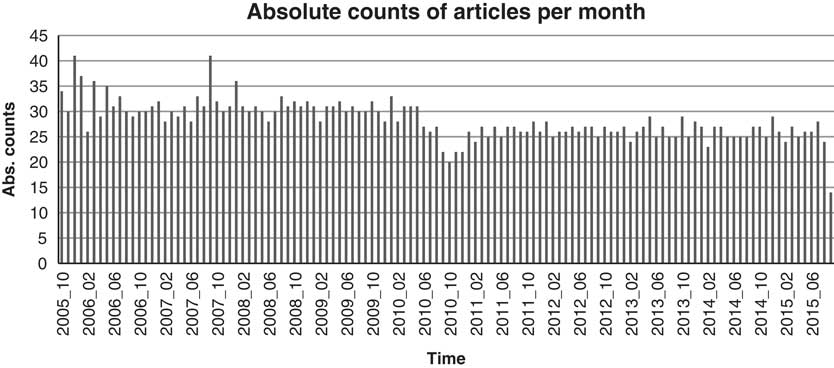
In a first step, we automatically download all the (monthly) overview sites from the blog.Footnote 23 In a second step we parsed the HTML source code and extracted the most important metadata, such as the date of the blog entry as well as the title and the text for the blog articles. This task was far from trivial in the sense that we also had to take changing and partly erroneous HTML source code into account (Figure 1).
Absolute counts of articles per month.

The corpus in its present form consists of 3404 articles from the blog, stemming from between October 2005 and November 2015.Footnote 24 In a next step we applied natural language processing to the retrieved articles using the parser ‘spacy’.Footnote 25
Topic detection
As a first step we applied unsupervised topic modelling, using the Latent Dirichlet Allocation (LDA) algorithm (Blei et al., Reference Blei, Ng and Jordan2003) and the Non-negative matrix factorization (NMF) (Stevens et al., Reference Stevens, Kegelmeyer, Andrzejewski and Buttler2012). Both algorithms are able to create topics from a given collection of texts which then are interpretable via the most important words for the topics (the importance is the probability of the words occurring within the topics).
For this first explorative phase, we produced yearly topic models consisting of 50 topics. It must be mentioned that those algorithms also tended to produce some topics which semantically do not make much sense if given a high number of occurring topics in the first place (although we ran the experiment with an adaptive prior alpha). Since we want to have as many insights as possible into the possible breadth of topics, we started with a high number of topics, which we then filtered manually. Below a small selection of the 50 topics identified in 2012 is presented.
Topic #7:
Greece, European, Europe, Euro, European Union, Greek, Union, pig, country, EU, trip, bond, Spain, Germany, Italy, market, financial, crisis, currency, happen.
Topic #44:
Law, electoral law, electoral, premium, party, coalition, porcellum, election, PDL, new electoral law, new electoral, majority premium, exactly, UDC, majority, parliament, constituency, PDminusL, possible, PDL PDminusL.
Topic #50:
Democracy, referendum, party, direct, popular, parliament, candidate, law, democratic, election candidate, direct democracy, direct election candidate, direct election, hunt, initiative law, popular initiative law, popular initiative, people, nuclear, constitution.
After a short analysis of the 50 topics identified for 2012, it is possible to understand that many core topics have been raised. There is the idea of 5SM as a tool for citizens to implement participative democracy (topic 50); the reform of the electoral law (topic 44); and the economic crisis in Europe (topic 7).
Repeating the same procedure for the articles published in 2014, it can be noted that some topics identified in 2012 are still present, while others gained relevance: there is a reference to the electoral law (topic 3) and the economic crisis in Europe (topic 15); the elections for the European Parliament and the alliance with the British party UKIP, unsurprisingly, are present as well (topic 40).
Topic #3:
Electoral, electoral law, law, porcellum, premium, candidate, court, majority premium, coalition, unconstitutional, constitutional court, list, party, majority, constitutional, seat, voter, election, attorney, porcellum electoral.
Topic #15:
Euro, exit, exit euro, Italy, referendum, monetary, currency, monetary sovereignty, eurozone, party, mark, government, Greece, Italian, opposition, fuoridalleuro, stay euro, possible, monetary union, France
Topic #40:
Committee, UKIP, chair, vice, European, group, European Parliament, marco, m0, democracy, position, parliament, TTIP, triple alliance, constituency, affronte, eleonora, EVI, triple, m0 candidate
After this preliminary phase, which allowed us to identify the 50 most important topics for each year between 2005 and 2015, we manually interpreted the results. In this way, it has been possible to gain an initial idea of the fluctuations of the topics addressed in the blog across the whole time span, even if this method is unsupervised and therefore is not able to provide a refined topic modelling.
However, it provided important insights for two reasons: first, it allowed us to identify, among the long list provided automatically, some of the topics we were looking for, thereby confirming their salience; second, it provided a first impression about the expectations formulated. Moreover, this preliminary analysis allowed us to identify prototypical articles that we used for the second step of our analysis, which adopts a more sophisticated approach.
Semi-supervised topic detection
While some of the topics detected by the unsupervised method match with the deductively derived topics mentioned earlier, the conceptualization and detection of others must be accomplished in another fashion. We tried an approach in which we leveraged prototypical articles for certain topics. As a first step, we identified a few documents in the corpus for which we assume they are as typical as possible for the given topic. This is necessarily a qualitative approach, based on the manual analysis of the articles, selected as a random sample of the whole corpus, in order to identify items that can be defined as prototypical relative to a certain topic.
In the next step, we modelled the documents in the vector space, and applied a tf–idf weighting (which reduces the dimension in the vector space to the presumably most distinguishing and important ones).Footnote 26 Additionally, we focussed on nouns and adjectives since they carry more information if modelling is conceptualized at the word level. Then, for each topic we created a centroid – that is, given the annotated documents per topic, we created a prototypical representation of this topic as a single point in the vector space. For this purpose we use the machine learning framework scikit-learn (Pedregosa et al., Reference Pedregosa, Varoquaux, Gramfort, Michel, Thirion, Grisel, Blondel, Prettenhofer, Weiss, Dubourg, Vanderplas, Passos, Cournapeau, Brucher, Perrot and Duchesnay2011) (Table 2).
Evaluation and measurement of the nearest centroid model

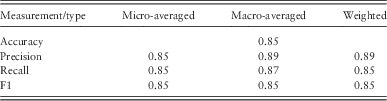
In the third step, we were able to compare all the non-labelled documents to the existing centroids and calculate the nearest centroid, using cosine distance as a measurement for the comparison of the weighted document vectors. This provides the possibility to determine the similarity of any document in the corpus to the given topics.Footnote 27 We used a fivefold cross-validation for evaluation, which gave us results of 0.85 accuracy for seven topics, while having only 96 annotated documents overall.
Results and discussion
The measurement of the frequency of different topics over time allowed us to establish the correctness of the expectations formulated beforehand, and to determine which topics remained at the centre of 5SM’s discourse and which, on the other hand, have been raised more or less frequently within the party’s official communication tool. This, in turn, allows determining of the extent to which the party’s discourse is flexible and adaptable.
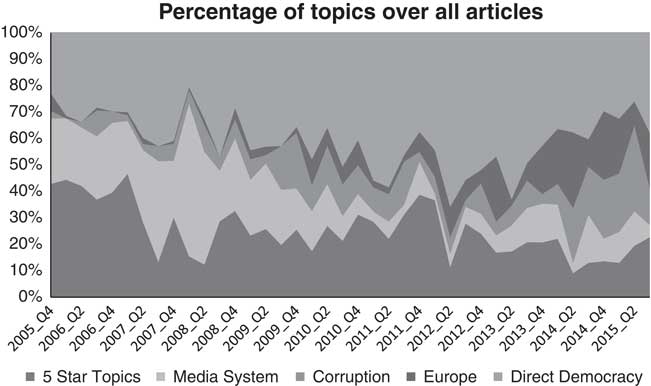
As shown in Figure 2, the five topics we intended to test are more or less salient over time, and while some of them have a particular salience others constitute only a small percentage of the party’s discourse. Overall, however, they are all present, thus confirming their relevance for 5SM’s discourse.Footnote 28
Overview topics relevance.

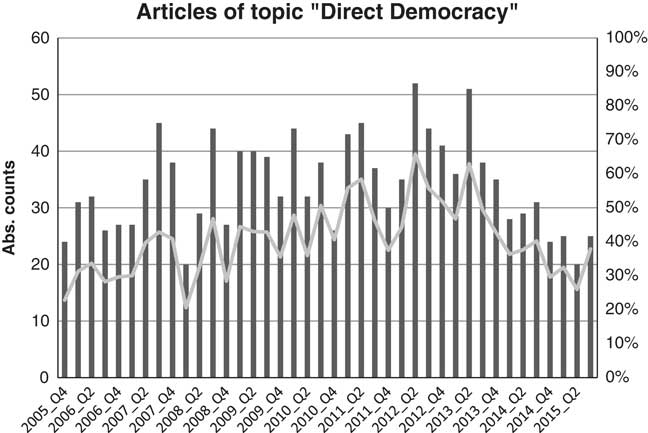
The topic ‘direct democracy’ represents the most central element in the blog’s message for the whole period. Specifically, between 2011 and 2013 it is present in more than half of the posts published on the party’s blog. We expected the salience of this topic to remain constant over time. The findings confirm that expectation. Direct democracy is indeed the core topic of 5SM’s discourse (Figure 3).
Salience ‘direct democracy’.

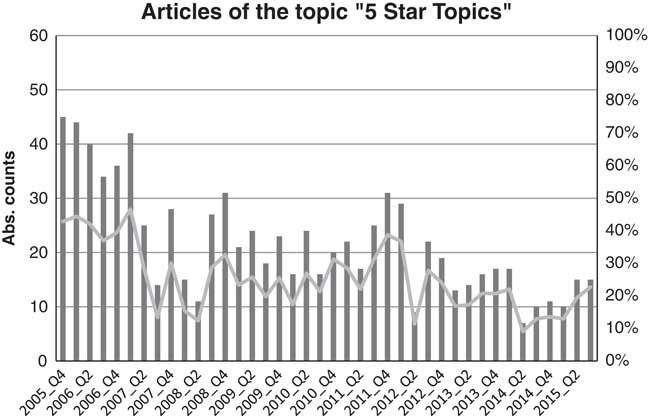
The topics aggregated under the umbrella term ‘5 Star topics’ (environment, public water, and free internet)Footnote 29 constituted a pivotal element of Grillo’s blog during the first phase of its existence, in particular in 2006. For more than a year, these issues characterized around 40% of the blog’s entries. Again, between the second half of 2011 and the first quarter of 2012 they gained salience, going over 30% (Figure 4).
Salience ‘5 Star Topics’.

In general, however, these topics lost salience over time. In particular, disentangling the data it is possible to observe that the topic ‘free internet’ almost disappeared, and the salience of environmental issues gradually declined over time. As expected, mid-2012 represents a crucial point in the decrease of the salience of the ‘5 Star topics’. All in all, the expectation can be confirmed.
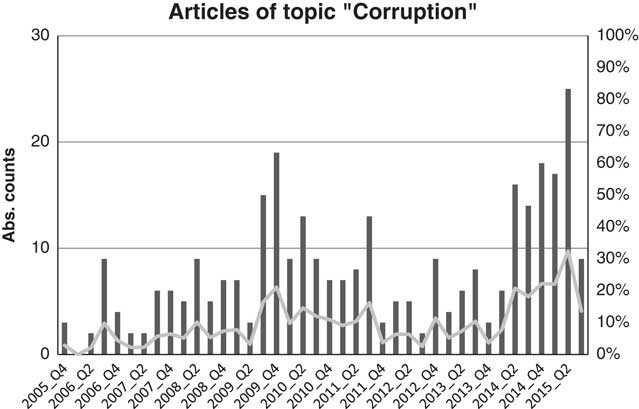
The results for the topic ‘corruption’ are the most surprising. Indeed, its salience appears to be erratic, and in general it is possible to identify four phases: in two of them the topic is extremely relevant (from Q3-2009 to Q3-2011, and from Q2-2014 to Q3-2015), while in the other two it is hardly present at all (from Q4-2005 to Q2-2009, and from Q4-2011 to Q1-2014) (Figure 5).
Salience of corruption.

This extreme variability might be explained in two ways: either our centroid for ‘corruption’ must be refined in order to provide a better example of articles about this topic, or the party raised the topic during major corruption scandals. In the latter case, the timing of those scandals should be assessed with precision in order to determine the presence of any correlation. Either way, the results go against our expectation.
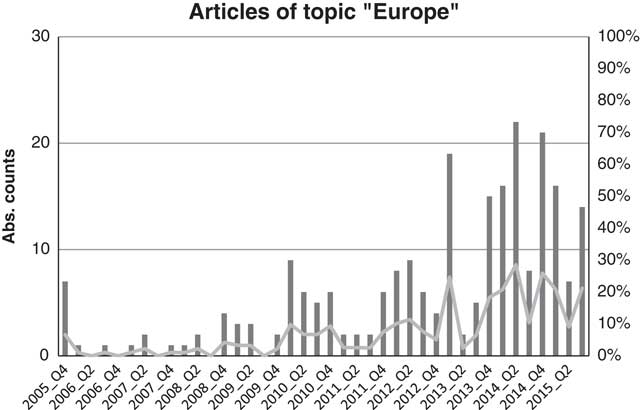
The topic ‘Europe’, which refers to a set of issues linked to the process of European integration, the political and economic institutions, and the common currency, was not a particularly relevant topic in the party’s discourse until 2013 (previously, it never reached 20% of the space on the blog) and it was almost completely absent until 2010 (Figure 6).
Salience of Europe.

This trend is understandable considering that the party participated at the European elections for the first time in October 2014. From our measurement, one can conclude that 5SM started campaigning for the elections of the European Parliament already at the beginning of 2013, almost 2 years in advance. From that moment on, the topic ‘Europe’ constitutes around one quarter of the blog’s entries, with the peak reached in the second quartile of 2014, right before the elections (over 28%). During the 2009 European elections, for example, the topic was almost completely absent. Moreover, Euroscepticism became a predominant issue and a source of electoral consensus for populist parties (Ivarsflaten, Reference Ivarsflaten2005; Van der Brug et al., Reference Brug, Fennema and Tillie2005; Arzheimer, Reference Arzheimer2009; Rooduijn, Reference Rooduijn2015), especially after 2008 (Herkman, Reference Herkman2017), and this can help explain why the topic became increasingly salient in the party’s discourse. In Taggart’s words ‘the portrayal of elites (…) as distant, faceless and invidious is an essential part of populism. In contemporary Europe, the denomination of “Eurocrats”, “party hacks” and “spin-doctors” is indicative of this trend’ (Reference Taggart2004: 74).
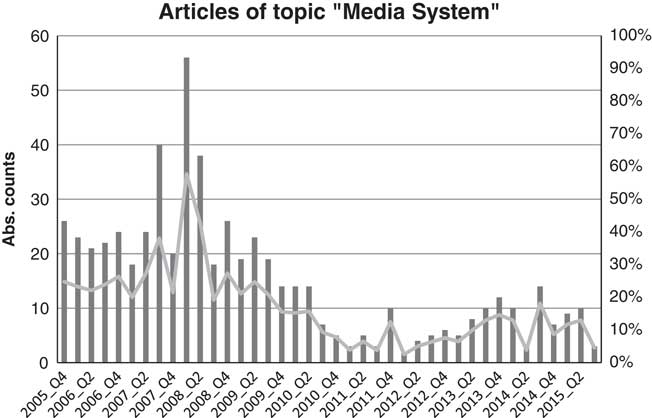
The topic ‘media system’, which concerns a set of issues around the role of TV and newspapers in the public debate, the collusion between the media and political elites, and the importance of free information, follows a pattern similar to that of the ‘5 Star Topics’: its salience decreased over time. However, in this case, the decline in the salience of the issue is even more noticeable.
In particular, after having been extremely relevant in the period 2005–2009, when it stably represented more than 20% and in certain cases even more than 50% of the total of the published articles, it became a rather marginal topic from 2010, mainly remaining below 10%. A partial exception is represented by the period 2013–2014, in particular after the national elections. In this period 5SM probably emphasized the allegedly negative coverage it received from traditional media (Figure 7).
Salience of media system.

On the other hand, the moment of highest salience for the topic ‘media system’ is unsurprisingly associated with the second V-Day, when the party collected signatures for three referenda aiming at a radical transformation of journalism.
After that moment (Q2-2008) the issue became less and less salient in 5SM’s discourse. It is possible to conclude that the expectations can be confirmed, since the topic ‘media system’ became decreasingly relevant in the party’s discourse.
Conclusions
We want 100% of Parliament, not 20% or 25% or 30%. When the movement gets to 100%, when the citizens become the state, the movement will no longer need to exist.Footnote 30
The 5SM, through its official channel of communication – the blog of its leader, Beppe Grillo – articulates a political discourse which represents an element of disruption of the ‘old politics’ and the mainstream parties. Our analysis reveals, first of all, that 5SM’s discourse is essentially a meta-discourse. At the core of its online communication, the party positions the active participation of the citizens, the role of the representatives as spokesmen of the people, the idea of political activity as based on morality rather than competence, and the construction of a bottom-up model which is supposed to replace the old partitocracy. In other words, the party mainly proposes a different idea of democracy, a different way of taking decisions and – as a consequence – making them more legitimate in the eyes of the people. The outcome of this process is secondary compared to the process of deliberation.
This ideological flexibility allows the party to address different topics in a strategic way according to changing socio-political situations. Even the ‘five stars’, which are supposed to represent the five pillars of the movement, were salient during the initial phase of the movement to attract disillusioned voters of left-wing parties and former activists from the anti-globalization movement, but became increasingly more marginal elements of the party’s discourse. On the other hand, Europe was not a salient topic for the party until it participated in the elections for the European Parliament in 2014. From that moment, a large proportion of the party’s message was oriented towards European issues. These findings confirm the ideological flexibility of 5SM and its ability in strategically raising different topics at different times in order to remain constantly attuned to the people’s mood and the outcome of the latest polls.
One can conclude that 5SM does not articulate any ‘full’ ideology, but rather expresses a purely (‘thin’) populist ideology. This represents the main feature of the party compared to most of the other populist parties present in Europe: not only is unrestricted popular sovereignty combined with strong anti-elitism an important feature, it basically represents the core of its political message, while the salience of other topics is secondary and fluctuates over time depending on the socio-economic and political conditions.
In conclusion, we maintain that 5SM’s success derives from its ability to strategically interpret the social and political Zeitgeist of the country, adapting its discourse over time in order to remain popular and obtain electoral consensus. However, it would not be possible to draw conclusions about the nature of this adaptability. It could derive from the constant link of the party with its constituency, but also from the ability of the leaders in directing the agenda in response to indications derived from surveys and other instruments.
5SM’s discourse, which proposes a new idea of politics which refuses representation and limits itself to the implementation of the people’s will, seems to be effective and able to mobilize many disillusioned citizens from different ideological backgrounds.
Acknowledgements
The authors would like to thank for the precious advice on previous versions Eri Bertsou, Chris Bickerton, and Evren Balta from the ECPR General Conference 2015, Dario Quattromani for his knowledge of the topic and valuable suggestions about the relevant literature, as well as the three anonymous reviewers for their helpful suggestions.
Data
The replication data set is available at http://thedata.harvard.edu/dvn/dv/ipsr-risp
Supplementary material
To view supplementary material for this article, please visit https://doi.org/10.1017/ipo.2017.23
Appendix
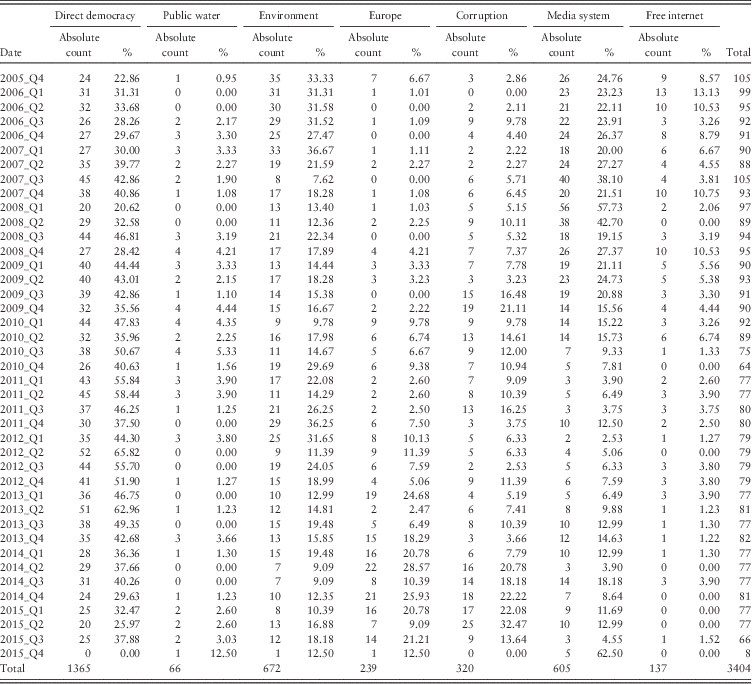
Overall data disentangled by topic