Introduction
Within Australia. . . there is mounting domestic concern about the implications for livelihoods and environmental management of continuing on the current path of competitive productivism. The idea that agricultural products can be produced at the lowest cost without regard for adverse consequences, and for the social and environmental benefits actually or potentially derived from the presence of farmers in the landscape, is increasingly challenged by various stakeholders and academic commentators. (Dibden et al., Reference Dibden, Potter and Cocklin2009: 305)
This paper will analyse the history of agricultural development in South Australia before explaining the current situation in terms of agricultural policy and practice. It will use a range of sources to describe how South Australian agriculture has progressed, setting the scene for a discussion of recent economic, political, social, and environmental outcomes of agricultural practice. The primary research question addressed relates to how lessons learnt from productivist agricultural development in the past can be applied to improve the overall sustainability of the South Australian agricultural sector into the future. A focus on productivity is argued to be essential for the economic sustainability of the agricultural industry, but greater emphasis must be placed on the social, political and ecological outcomes of agricultural practice if the sector is to increase productivity in the long term. Rethinking the capitalist socioeconomic system in regard to the agricultural industry, under which there are serious contradictions in overall aims, is also recommended.
From an Actor Network Theory perspective, any potential transition away from capitalism would also involve shifting South Australian world views in relation to agricultural production from the heavily ‘anthropocentric’ position of today to one that considers all local social and ecological impacts of agricultural land use (Latour, Reference Latour2005; Law, Reference Law1999). In the context of this paper, an anthropocentric world view involves first and foremost considering the outcomes of human actions on their own species (social networks), as opposed to focusing on detrimental consequences to other life forms. It is also assumed that anthropocentric world views have led to the productivist agricultural regime, which in turn has been influenced by neoliberal policy, meaning productivism, neoliberalism and anthropocentricism are all connected in a network which primarily serves the human interest. The following sections chronologically report the various historical components of agricultural development in South Australia, before the findings influence original South Australian agricultural policy suggestions which are introduced in the final sections of the paper in an effort to address the primary research question.
The ‘early’ years of settlement: 1836–1962
South Australia is the agricultural colony of the continent. . . pre-eminent in wheat.
1884 Official Directory and Year Book of Australia cited in Kelly (Reference Kelly1962: 23)
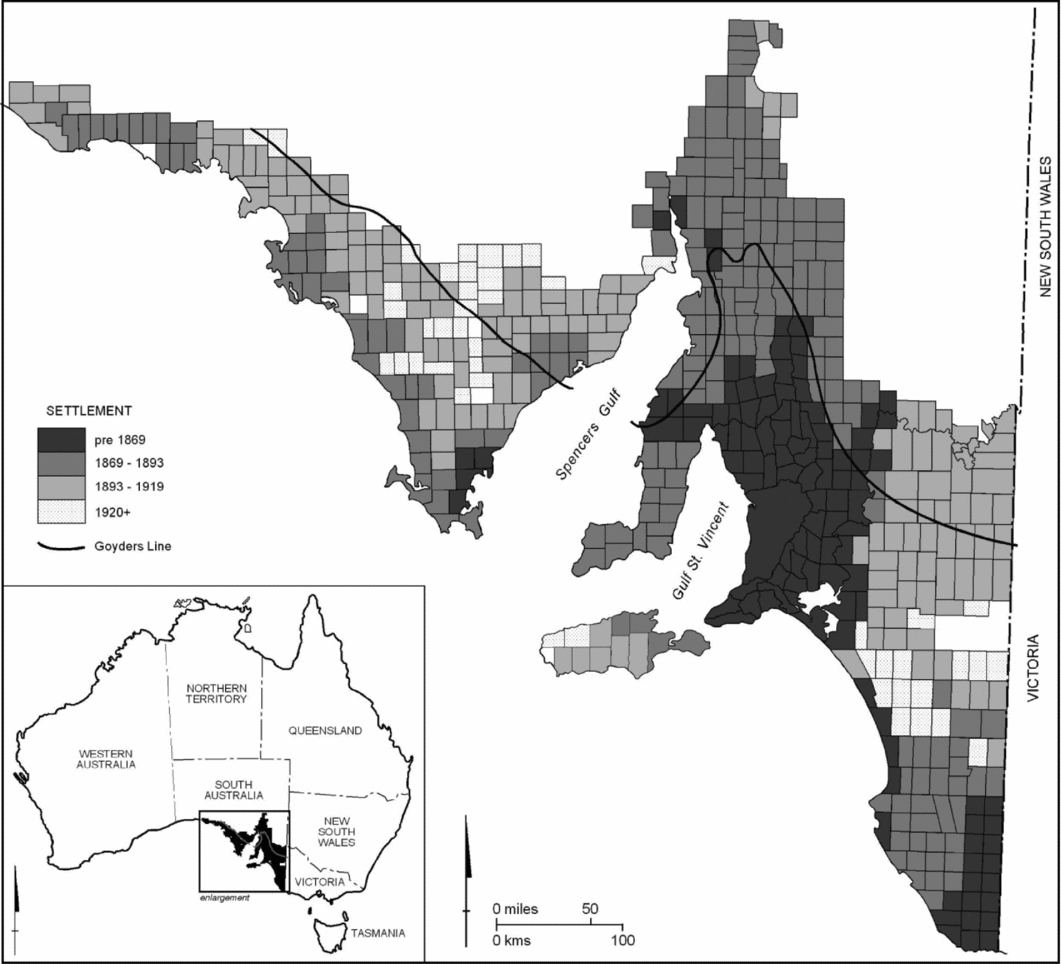
South Australia was proclaimed by Captain John Hindmarsh on 28th December 1836 (Kelly, Reference Kelly1962). Unlike other regions of Australia that were settled as convict colonies, South Australia was populated entirely by free immigrants (Williams, Reference Williams1977). The pioneers first settled areas that would now be referred to as urban or peri-urban, due to the resemblance of these regions to the green fields of Britain. Unimpeded by any major mountain ranges, the new farmers managed to clear land rather quickly and by 1850 over 40,000 acres had been sown to wheat (Wadham, Reference Wadham1967). This meant that wheat was soon being exported to Britain and other parts of Australia with the advent of American ships reducing freight costs, highlighting early signs of a globalised economy. These ‘exports from family farms in settler colonies’ were incipient of the first international food regime, when colonies were extended in an effort to increase their population and resources/assets (Robinson, Reference Robinson2004: 43). Over the next few decades the demand for wheat increased, due to an influx of migrants who sought their fortune in the goldfields to the east, and settlers began to clear land further north. Goyder's Line was drawn in 1865 to distinguish the area to the south that was suited to agricultural pursuits from land to the north that was not (Figure 1). However, the pressure of a growing population, which went from 185,626 in 1871 to 279,865 in 1881, increased the demand for land which meant the Government decided to break through Goyder's Line in 1874, allowing cropping activity to extend further north (Figure 1) (Glantz, Reference Glantz1994; Griffin and McCaskill, Reference Griffin and McCaskill1986; Williams, Reference Williams1977). For almost a decade this decision seemed to be justified, with consecutive exceptional seasons meaning that the agricultural frontier was thrust over 240 kilometres north of Goyder's Line in some places, and nearly two million acres were under cultivation by the time severe droughts hit in 1881 and 1882 (Kelly, Reference Kelly1962). To put this in perspective, by 1884 South Australia had 1.9 million acres of the 3.4 million acres sown to wheat in the whole of Australia, a remarkable feat considering the machinery that was available at the time.
Map of South Australian settlement over time including Goyder's Line.

After this ‘wheat boom’, problems began to appear. A combination of drought, pests, disease, and rapidly deteriorating fertility caused problems for farmers (Malcolm et al., Reference Malcolm, Sale and Egan1996). State Government assistance was afforded to drought affected farmers from 1882 to 1913 in the form of direct payments (Heathcote, Reference Heathcote2002). Meanwhile, the price of wheat began to fall and was extremely low by 1895. At this point ‘most farmers were heavily in debt’, with many subsisting off what they produced (Kelly, Reference Kelly1962: 25). It was in these lean years that the idea of educating farmers about applying advances in agricultural science to their farming practice was eventually embraced, after years of effort. In 1894 the Department of Agriculture was formed when the Minister for Agriculture took charge of: the Agricultural College at Roseworthy which was opened in 1884 and is now part of the University of Adelaide; the Inspector of Stock and Brands; and, all other allied activities (Ashton and Blackmore, Reference Ashton and Blackmore1987; Wadham, Reference Wadham1967).
Artificial fertiliser technology was introduced and extended to farmers to help solve soil fertility problems and in the next twenty years work was also done to improve the strains of wheat sown in the area so that they resisted rust and were viable under varying conditions (Malcolm et al., Reference Malcolm, Sale and Egan1996). ‘Pickling’ and ‘grading’ were also a means to protect seeds from disease and remove those that would not germinate (Kelly, Reference Kelly1962: 42). These scientific advances meant that despite the First World War and the drought of 1914, which saw the state government include additional material assistance to drought affected farmers in their drought policy (Heathcote, Reference Heathcote2002), there was great ‘revival in the agricultural area of South Australia over the first two decades of the century’ (Kelly, Reference Kelly1962: 43). When soldiers returned home from the First World War they were allocated land in particular regions of the state. Advances in irrigation systems allowed new agricultural endeavours to be pursued, such as horticulture in the Riverland region.
The 1930 financial disaster showed South Australian agriculture's strong interdependency with the global economy. A low wheat price put pressure on farmers who turned to the State Government for support (Wadham, Reference Wadham1967). Although the majority were bailed out by the Government of South Australia, over 3,000 South Australian wheat farmers went bankrupt (Kelly, Reference Kelly1962). Their properties were not abandoned, however, with other farmers purchasing this land through a federal government subsidised Marginal Lands Scheme aimed at increasing economies of scale, meaning the area sown to wheat was maintained at over four million acres (Beaumont, Reference Beaumont1989). After World War Two the Australian Wheat Board was formed and the federal government Wheat Stabilisation Act 1948 was introduced in order to stabilise the price of wheat (Kelly, Reference Kelly1962; Lawrence, Reference Lawrence1987; Wadham, Reference Wadham1967).
When issues began to arise over farmers managing crop rotations unsustainably, the South Australian Government introduced the Soil Conservation Act 1939 to recognise the public interest in the use of private land (Roberts, Reference Roberts1992). The Department of Agriculture and the Rural Reconstruction Commission of 1944 also provided valuable advice to farmers. Stubble retention was increasingly encouraged, due to benefits in terms of nitrogen fixing and reduced topsoil loss, and a consistent rise in the popularity of sheep grazing meant that farmers were widening rotations and encouraging the growth of pasture. Sheep became a much more important part of farming because they provided another source of income which during the ‘wool boom’ of the 1950s shifted farmers’ priorities (Kelly, Reference Kelly1962). The sheep flock in South Australia doubled from 1945 to 1962 (Malcolm et al., Reference Malcolm, Sale and Egan1996). Both beef and dairy cattle also became more abundant with the shift to longer crop rotations (Wadham, Reference Wadham1967). As irrigation technology improved, related land uses including pasture, orchards and vineyards also became more plentiful (Leeper, Reference Leeper1970).
The early 1960s were critical in terms of the Australian international export trade. Australia lost Britain, its traditional colonial export market, to the European Common Agricultural Policy, as Britain reduced avenues of international trade (McMichael, Reference McMichael1994b). As a result, Australia economically realigned itself with the United States of America in order to find alternative buyers for produce, a decision which would shift the direction of Australian agriculture dramatically in subsequent international trade negotiations.
It is important to note that, during these formative years, agriculture paved the way for much of the development that occurred in South Australia by being the primary source of income for many citizens. This economic development came at a cost to South Australian land, however. The loss of soil fertility, widespread clearing of land, and application of European farming methods that were not suited to the environment, cost the state in terms of soil degradation and loss of biodiversity. On top of these environmental issues, settlers also failed to recognise the important existing cultural heritage of the indigenous peoples of South Australia, who were shown little respect (Government of South Australia, n.d.; Lawrence et al., Reference Lawrence, Furze and Vanclay1992). These detrimental environmental and cultural outcomes were borne out of a colonial ‘world view’ that settlers could dominate the ‘unoccupied’ land (Curry, Reference Curry2000; Hage and Rauckiene, Reference Hage and Rauckiene2004; Howden and Vanclay, Reference Howden and Vanclay2000). While this ‘anthropocentric’ world view helped set up the state in economic and political terms, the next two decades saw some fundamental changes in ideology which planted an alternative ‘ecocentric’ seed that would eventually challenge this paradigm.
Conventional farming dominates despite environmental recognition: 1965–80
Since 1966 there have been more tractors than permanent agricultural workers in South Australia. (Williams, Reference Williams1977: 56)
South Australian agricultural ‘good times’ were over by the mid 1960s when serious droughts occurred and terms of trade for agriculture began to decline (Malcolm et al., Reference Malcolm, Sale and Egan1996: 394). Feed shortages and a drop in the prices of wool, wheat and beef in the early 1970s exacerbated problems for farmers (Malcolm et al., Reference Malcolm, Sale and Egan1996). In response to the oil crises of the mid 1970s, prices for superphosphates increased rapidly meaning many farmers could no longer afford to buy sufficient quantities (Campbell, Reference Campbell1980). A lack of fertiliser and animals to graze, due to the drought conditions, allowed weeds to flourish in pastures and reduced pasture quality throughout the 1970s and 1980s (Malcolm et al., Reference Malcolm, Sale and Egan1996). The state drought assistance also altered from economic and material assistance to ‘carry on finance’ or interest rate subsidies (Heathcote, Reference Heathcote2002).
South Australian farming had changed radically since the late nineteenth century when over half the population were farmers. Farmers were now considered ‘managers’ because technological developments meant farmers required more capital, including labour capital, financial capital and physical capital in the form of equipment (Campbell, Reference Campbell1980). The industrialisation of agriculture and the harnessing of oil power, in what Robinson (Reference Robinson2004) refers to as the ‘intensive’ second international food regime, pushed productivity to a new level. With tractors, implements, harvesters and trucks, physical capital reduced the reliance on hard manual labour as a means of production (Hettne, Reference Hettne2008). These changes also made the South Australian farmers more dependent on the world around them, embedding them into the global market. The rapid growth of the mining sector and tariff protection in the manufacturing industries also put pressure on Australian agricultural exports to remain viable throughout this period (Campbell, Reference Campbell1980). As a result of the ensuing ‘cost-price squeeze’, where the rising cost of agricultural inputs exceeded the return for produce, many farmers were forced off of their land (Barr and Cary, Reference Barr and Cary1992; Bowler, Reference Bowler1992). This ‘cost-price squeeze’ is reflected in the fact that only 6.7% of the Australian workforce was employed in rural industries in 1976 compared with 23.6% in 1901 (Campbell, Reference Campbell1980). Farmers had to change the ‘highly independent manner’ in which they had behaved in 1901, to fit into the ‘complex diversified economy’ of which agriculture was now a part (Campbell, Reference Campbell1980: 247). The reliance on global markets is evident in the fact that fifty per cent of Australian agricultural commodities were exported in 1980 (Campbell, Reference Campbell1980).
The 1960s and 1970s also saw the environmental impacts of human development more widely recognised, with books such as Silent Spring (Carson, Reference Carson1962) and The Population Bomb (Ehrlich, Reference Ehrlich1968) increasing awareness of the negative impacts of the rapid industrialisation that had been occurring since the turn of the century. It did not take long for this awareness to penetrate global governance, with the United Nations holding the first conference that recognised the negative effect that humans were having on the planet on which they relied on for their subsistence in Stockholm in 1972 (Bayliss and Smith, Reference Bayliss and Smith2005). While globally the ‘environment’ was being brought back into the debate and people were beginning to recognise the role of ecological services, in the South Australian agricultural sector this was not necessarily the case. It was, however, the period that instigated a split in farmers’ world views. The seeds planted by the ‘environmental movement’ of this era changed the way some people perceived the world around them and resulted in the introduction of the Department for the Environment and the Environmental Protection Council in 1972, who were given the power to investigate, advise and report on the condition of the South Australia environment (Gilpin, Reference Gilpin1980). In 1978 the South Australian Heritage Bill was also introduced to protect the physical, social and cultural heritage of the state (Gilpin, Reference Gilpin1980). In the following sections the repercussions of natural resource recognition and management are reported and subsequent impacts on an increasingly interconnected South Australian agricultural sector are examined.
‘Sustainable agriculture’ is introduced to South Australia: 1981–2001
While conventional agriculture has led to remarkable productivity increases in the past, it is becoming increasingly clear that it also has a number of drawbacks, both for farmers and for society as a whole.
(Wynen and Fritz, Reference Wynen and Fritz1987: 87)
The ‘environmental movement’ gathered support in the early 1980s and by 1987 the United Nations recognised the need for ‘sustainable development’, that is development that meets the needs of current generations without compromising the chances of future generations meeting their own needs (World Commission for Environment and Development, 1987). Because agriculture relies so heavily on environmental services to create produce, it was not long before agricultural land use that considered overall economic, social, and environmental outcomes was being discussed. A rethink of conventional practices, which in South Australia had always been accepted, was required. Questions were raised in relation to: the effects of the continual application of pesticides, insecticides, herbicides and artificial fertilisers to the soil in the long term; why salinity was affecting some areas of dryland and irrigated properties; the consequences of losing topsoil each year due to soil erosion; the effects of the chemicals used in ‘pickling’ grain and treating livestock on animals and the consumers of the produce; the cumulative effects of creating produce in the conventional manner and the causes of the rapid decline of certain rural populations. These were amongst the questions that began being asked when the consequences of agricultural production over the last fifty years were seriously looked at from ecological and social angles. Concerns over the inability to answer many of these questions on an individual scale saw the advent of what was referred to as ‘sustainable agriculture’ (Pawlick, Reference Pawlick2006). In 1987, the National Association for Sustainable Agriculture in Australia published a discussion paper that highlighted some of the benefits of ‘sustainable agriculture’ as this became a global phenomena (Wynen and Fritz, Reference Wynen and Fritz1987). It encouraged farmers to farm utilising natural methods to promote soil fertility as well as manage pests, weeds and disease. While environmental issues became more important in the 1980s, many studies show that less than one per cent of farmers in the developed world practised ‘sustainable agriculture’, although traditional farmers worldwide had been subsisting with the help of these agricultural practices for millennia (Conacher and Conacher, Reference Conacher and Conacher1981; Vine and Bateman, Reference Vine and Bateman1981; Wynen and Fritz, Reference Wynen and Fritz1987).
Lawrence (Reference Lawrence1987) also published an eye-opening book in 1987 that addressed the issues facing rural Australia. The book highlights some of the social and environmental consequences of capitalist agriculture and Australia's extreme neoliberal stance, explaining that the capitalist conception that ‘associates progress with profits is unlikely to provide any long-lasting solutions to problems generated by the growth of capitalism on a world scale’ (Lawrence, Reference Lawrence1987: 3). The high levels of debt experienced by Australian farmers meant that their average income was negative, which resulted in many farmers exploiting their land because they were ‘victims of circumstance’ (Lawrence, Reference Lawrence1987; Vanclay and Lawrence, Reference Vanclay and Lawrence1995). The growing corporate dependency of Australian agriculture as a result of pervasive export oriented, neoliberal, capitalist productivism also contributed to these increased levels of debt within the farming community, further exacerbating social and environmental problems. Lawrence (Reference Lawrence1987) suggested some alternatives that, once applied, may have increased the overall sustainability of agriculture in Australia, but the relationship between Australian agriculture and the dominant capitalist model was already a cause for concern over two decades ago (McMichael and Raynolds, Reference McMichael, Raynolds and Sklair1994).
State drought policy also reverted back to economic and material assistance in 1982 to 1983 as federal support for overstretched state finances was passed on to suffering farmers (Heathcote, Reference Heathcote1983, Reference Heathcote2002). Federal drought assistance, however, began to be phased out as the Drought Policy Review Task Force reported in 1990 that there was a need to reduce dependence on relief through improved on-farm drought management strategies, a theme that persisted throughout the subsequent twenty years (Heathcote, Reference Heathcote2002). The ideology behind this move was that droughts were a ‘normal’ feature in long-term planning and should therefore be considered within farm business models (Botterill, Reference Botterill, Botterill and Wilhite2005; Mercer, Reference Mercer2000). Both state and federal governments had been trying to balance the correct level of drought support, from welfare support through to free market exit grants, throughout the history of South Australian agricultural development (Botterill and Fisher, Reference Botterill and Fisher2003). As new technology allowed farmers to gather more knowledge about climatic conditions and assisted planning, however, it was hoped the risk of drought would be reduced, in turn minimising public assistance costs (Heathcote, Reference Heathcote1994; Wilhite, Reference Wilhite, Wilhite, Easterling and Wood1987).
In 1989 the South Australian Government introduced the Soil Conservation and Land Care Act of South Australia which resulted in farmers who breached certain regulations paying the cost of soil rehabilitation (Lawrence et al., Reference Lawrence, Furze and Vanclay1992). This policy was a way of punishing the farmer for the incorrect use of land. In the Australian context, soil degradation and other environmental issues that were arising from inappropriate agricultural land use were addressed by the neoliberal Australian Government introducing ‘market orientated initiatives’ (Maye et al., Reference Maye, Holloway and Kneafsey2008). In an effort to deal with the need to incorporate sustainable land management and viable rural communities into the liberalised economy, the grant-based National Landcare Program was also introduced in 1989 (Maye et al., Reference Maye, Holloway and Kneafsey2008; Roberts, Reference Roberts1992; C. Williams, Reference Williams2004). This programme aimed to involve the community in the management of natural resources and increase participation in conservation activities at the regional level by providing government funding for projects that citizens themselves may not have been able to afford (Australian Government, 2011b).
In the Uruguay Round of the international General Agreement on Tariffs and Trade negotiations, which began in 1986, the future of international agricultural trade was being contested between the ninety-five participating countries (Hart, Reference Hart and Bowler1992). On one side were the European Union and their allies suggesting that certain regional agricultural subsidies would continue to be necessary, and on the other were the United States and the Cairns Group (of fourteen agricultural exporters including Australia) who were pushing for liberalised trading movements (Vail, Reference Vail1994). By 1992 it seemed the major issues had been resolved in favour of the increasingly free trade of all goods and services regulated by the supranational World Trade Organisation, which was subsequently established in 1995 (McMichael, Reference McMichael and McMichael1994a, Reference McMichael, Burch, Goss and Lawrence1999). Negatively, neoliberal trade has been argued to undermine current cultural farming practice by allowing global corporate strategies, rather than national economies, to dictate the direction of agricultural development (McMichael, Reference McMichael and McMichael1994a). The actual outcomes of the General Agreement on Tariffs and Trade negotiations for Australian agriculture meant the: reduction of import tariff levels; freeing of interest rates; deregulation and privatisation of state monopoly control in primary industries; reductions in public sector and welfare spending; and, the identification of statutory marketing authorities, established to protect family farms from commodity price fluctuations, as a hurdle to the profitability of private corporations (Vanclay and Lawrence, Reference Vanclay and Lawrence1995). Despite the perception of free trade, many signatories to the General Agreement on Tariffs and Trade found ways to assist farmers economically that were exempt from the definition of ‘farm subsidies’, and in 1995 developed countries paid 182 billion dollars, the equivalent of forty-one per cent of the value of production, in some form of agricultural support to farmers (McMichael, Reference McMichael, Burch, Goss and Lawrence1999).
By 1997 South Australian agriculture had changed dramatically since European settlement. Farmers were diversifying and the value of the agricultural sector was approximately three billion dollars for the 1997 to 1998 financial year, comprised of three general industries: cropping (1.2 billion dollars); livestock (0.9 billion dollars); and horticulture (0.8 billion dollars) (Australian Government, 2009b). The land use pattern for the state in 1997 was reported by the Australian Government (2009b):
Cropping is mostly of cereal crops wheat, barley and oats. Crop yields depend on the adequacy of seasonal rains and can fluctuate dramatically. In the south-east and northern agricultural districts, a range of other field crops including oilseed and grain legume crops are grown. A wide range of temperate vegetable and orchard crops are grown in the Adelaide Hills, the northern Adelaide Plains, the south-east and the Riverland. South Australia has the highest proportion of Australia's vineyards with most of the grapes used for wine making. Major wine growing areas are located in the Barossa, Clare, Riverland, Southern Districts and Coonawarra.
Despite the federal and state government support for more sustainable agricultural practice, for example the National Landcare Program and legislation to improve biodiversity and natural resource management, there were still issues with the neoliberal economic foundation on which South Australian agriculture was based and the subsequent reality that long-term returns to producers would be low (McMichael, Reference McMichael1994b). The Australian Government, however, used their liberal trade stance to highlight how important agricultural exports were to the Third World in terms of ensuring food security (Haldane, Reference Haldane1996). The perceived importance of agricultural exports became part of a broader push for increased productivity which began in the 1980s (Potter and Tilzey, Reference Potter and Tilzey2007). While the Australian Government spent more money on agricultural research and development and the marketing of agricultural products during this period in an effort to find technological methods of increasing productivity in order to sell surplus produce overseas, there continued to be negative consequences for many producers (Alston et al., Reference Alston, Pardey and Smith1999). The neoliberal, capitalist productivism encouraged by federal government continued to ‘squeeze’ farmers off the land and into rural towns and cities (Hugo and Smailes, Reference Hugo and Smailes1992; Smailes, Reference Smailes1996) with fewer than ever before increasing annual production (Malcolm et al., Reference Malcolm, Sale and Egan1996; Pierce, Reference Pierce1990). Although this was cause for concern, there were some positives in the fact that volume and activity in the ‘organic’ industry was increasing (Burch et al., Reference Burch, Goss and Lawrence1999) and there had been a major move to integrated pest management (Malcolm et al., Reference Malcolm, Sale and Egan1996), meaning some farmers’ world views were at least beginning to be influenced by the repercussions of unsustainable land use. Academics also began to recognise a shift in farming priorities, dividing producers into farming sub-cultures or modes depending on their production methods and beliefs (Howden and Vanclay, Reference Howden and Vanclay2000; Vanclay and Lawrence, Reference Vanclay and Lawrence1995).
Whether it was federal government supported market oriented initiatives, the brewing environmental movement, the potential repercussions of inappropriate land use, or a combination of these factors, for some South Australian farmers the purpose of their agricultural pursuit was changing. By 2000 the environmental and social impacts of agriculture were important to consider for many farmers and agricultural land occupied fifty-one per cent of South Australia (Australian Bureau of Statistics, 2008; Young, Reference Young2000). The economic outcomes, however, were essentially still the priority as Malcolm et al. (Reference Malcolm, Sale and Egan1996: 436) state: ‘the family farm has survived because it is an efficient business organisation’.
Relying on science and technology to increase productivity: 2001 to the present
Significant technical advances will help ensure efficient production in Australia and in countries where food security is of critical concern. (PMSEIC, 2010: v)
While the advent of ‘sustainable agriculture’ in the 1980s shifted the perceptions of some farmers, the vast majority continued farming in a conventional manner due to the government using a range of powerful underlying mechanisms to support productivist ideology. At the beginning of the twenty-first century the Australian government funded research and development that was commercially based, supporting the dominant neoliberal philosophy, and more importantly conventional production practices (Halpin and Guilfoyle, Reference Halpin and Guilfoyle2005). It was reported that each year more than five million tonnes of fertiliser were added to agricultural soils in Australia and that the use of nitrogenous fertilisers had almost doubled since 1990 (National Land and Water Resources Audit, 2002). Much chemical nutrient application was noted, however, to cause soil acidity, which along with soil erosion were described as problems that would require a ‘balanced approach’ to land use in the future (National Land and Water Resources Audit, 2002). There was also a more detailed study of peri-urban agricultural regions, that cover only three per cent of Australian agricultural land, yet account for twenty-five per cent of agricultural production value (Houston, Reference Houston2003). When the state Natural Resources Management Act 2004 was established more provision was made for each South Australian region to manage their natural resources independently (Government of South Australia, 2004b). While individual regions retained the capacity to communicate with stakeholders and advise how agricultural land and natural resources should be managed, federal agricultural research and international trade and food security policies made it hard to diverge from the dominant productivist pathway (Cocklin and Dibden, Reference Cocklin, Dibden, Cocklin and Dibden2005a).
Cocklin and Alston (Reference Cocklin and Alston2003) took a more social approach as editors of a book examining a group of rural communities in Australia and what has helped make them ‘sustainable’. In their case study on the Gilbert Valley in South Australia, Smailes and Hugo (Reference Smailes and Hugo2003) highlight the importance of ‘place’ to the rural community and explain how the ‘social capital’ that is formed by living in communities contributes to the sustainability of this region. Work was also done on the changing population distribution of rural South Australia, with attractive rural areas prone to counter urbanisation, whilst agricultural crises exacerbated urbanisation and the restructuring of less appealing rural communities as farmers moved into nearby towns and major centres (Smailes, Reference Smailes1996, Reference Smailes1997, Reference Smailes2002). The importance of local government was also noted to be a major factor in terms of the long term social sustainability of rural regions (Cocklin and Alston, Reference Cocklin and Alston2003). Along with the scientific auditing and social research that was occurring in rural areas, the National Landcare Program was now well established, with 4,000 different community Landcare groups in Australia which reportedly involved forty per cent of all farmers (Williams, Reference Williams2004). From the bottom up, volunteers were working to rebuild degraded private land, as well as contributing to the many other tasks for which the National Landcare Program was responsible. While some of the developments that have been discussed paint a relatively positive picture of the future of Australian, and consequently South Australian agriculture, there was one important factor of historical rural development which was absent that meant this was not the case: politics.
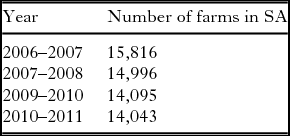
The neoliberal model that aimed to increase agricultural productivity by removing inefficient farmers, as they could not remain viable if they did not create enough produce, had two inherent flaws (Halpin and Guilfoyle, Reference Halpin and Guilfoyle2005; Lawrence, Reference Lawrence1987). Firstly, the ‘cost price’ squeeze was forcing farms out of business at a rate that dramatically affected the well being of farming families and altered rural communities (Andrée et al., Reference Andrée, Dibden, Higgins and Cocklin2010; Dibden et al., Reference Dibden, Potter and Cocklin2009; Higgins et al., Reference Higgins, Dibden and Cocklin2008b; Lockie and Higgins, Reference Lockie and Higgins2007; Muenstermann, Reference Muenstermann2009; Smailes, Reference Smailes1995, Reference Smailes2002; Smailes et al., Reference Smailes, Argent and Griffin2002). The actual decline in South Australian farms since 2006, when the current Australian Bureau of Statistics farm measurement model began, is shown in Table 1. Secondly, the neoliberal model removing these ‘inefficient’ farms was changing the entire political structure of South Australian governance, adding another threat to rural sustainability. The spatial distribution of the South Australian population had changed remarkably since European settlement, when farming and rural communities made up a substantial proportion of citizens. Decades of ‘technological change, out-migration, loss of markets, rising indebtedness and so forth’ meant that the rural society ‘no longer carried the political weight it once did’ (Cocklin and Dibden, Reference Cocklin and Dibden2005b: 247). Despite the fact that approximately eighty per cent of Australian agricultural produce was being exported, with over forty per cent of all exports by value accounted for by wheat, beef, wool and wine in 2002 (Halpin and Guilfoyle, Reference Halpin and Guilfoyle2005), the lack of residents in regional communities meant there were proportionally fewer rural votes or voices to be heard (Robinson, Reference Robinson2004). Australia's neoliberal stance meant that rural producers were also among the most vulnerable to the increasing interconnectedness or ‘globalisation’ that was occurring, as most were exporters out of necessity (Murray, Reference Murray2006). All Australian farmers were at least influenced by global market prices which were at the mercy of a myriad of factors, affected by events such as oil price fluctuations, natural disasters, wars, policy changes and political unrest in other regions of the world (Lawrence, Reference Lawrence1987). Economic pressure on farmers was exacerbated with the federal government recommending current Exceptional Circumstances financial support should be terminated for individual producers to absorb drought risk into their planning (Australian Government, 2009a). The removal of Exceptional Circumstances support was also encouraged by the National Rural Advisory Council, a body which requires just one of its eight members to be a representative of the National Farmers Federation, the only member who is currently a primary producer (Australian Government, 2010b, 2012b). Subsequently, automatic Exceptional Circumstances financial support ceased in 2012 and is now provided on a case-by-case basis (Australian Government, 2012a).

While research and development, and the resulting scientific and technological advancement, have allowed some problems to be highlighted, monitored, and even rectified, the ongoing neoliberal focus of Australian agriculture has meant that this is generally aimed at commercial scale producers (Halpin and Guilfoyle, Reference Halpin and Guilfoyle2005). South Australian farms must continue to increase productivity in order to remain viable in the current policy environment. This has meant smaller scale farmers continue to be ‘squeezed’ off the land unless they can find other avenues to market their produce away from dominant wholesale and retail markets (see Table 1).
Alternative food networks are an example of smaller scale producers finding niche markets and cutting out the ‘middle’ man. In South Australia arguably the most developed form of alternative food network is the farmers’ market (Fielke and Bardsley, Reference Fielke and Bardsley2013). These markets, eight of which are officially recognised in South Australia (Australian Farmers’ Markets Association, 2010), provide opportunities for the sale of more sustainable produce, in the form of locally grown, organic, and other environmentally beneficial products which allow farmers to charge a premium price (Feenstra and Lewis, Reference Feenstra and Lewis1999). These markets also create social capital between producers and the consumers of their product (Hinrichs et al., Reference Hinrichs, Gillespie and Feenstra2004; Macias, Reference Macias2008; Putnam, Reference Putnam1995). Farmers’ markets are one example of a positive, multifunctional outlet that can coexist with neoliberal, capitalist productivism as most of the producers still rely on wholesale sales (Fielke and Bardsley, Reference Fielke and Bardsley2013). Various other forms of direct marketing have also thrived with the advent of online communication making it much easier for farmers to share their produce personally with interested consumers. The South Australian Food Plan 2007–2010 (Government of South Australia, 2007) also highlights the need for those involved in the food industries to cooperate in order to reach the goal of increasing the value of finished food products by eight per cent annually. The food plan recognises the importance of value-adding industries and the important role of agriculture in South Australia. This recognition is echoed in legislation to protect peri-urban agricultural areas in the Barossa Valley and McLaren Vale regions from urban sprawl and development pressure (Government of South Australia, 2011).
From a brief look at some literature devoted to the last two centuries of agricultural development, it is evident that farmers in South Australia now face similar and very different challenges to those of the first European settlers farming the same land. As Cocklin and Dibden (Reference Cocklin and Dibden2005b: 247) explain ‘the malaise afflicting many of Australia's rural communities is deeply rooted in history’. The pressure of farming on relatively infertile land has been a problem since settlement, and it could be argued that these problems will be overcome in time with scientific and technological advancement. It is worth quoting Barr and Cary (Reference Barr and Cary1992: 283) at length here, who argue:
We have solved some problems and have adapted ourselves to live with others. Some problems, particularly those where human settlement is locked into a given form of land use, have proven more intractable. Some human settlements may eventually fail. Despite these mistakes, we should not condemn Australia's agricultural land use experiment as a failure. There have been major gains. Perhaps the most obvious is that seventeen million non-native people now live in the country. Nearly all of the flora and fauna of agricultural production, on which modern settlement and development of country depended, and still depends, were introduced species: grain varieties; Spanish merino sheep, all other domestic sheep, cattle and horses, pasture species, cane sugar, rice, potatoes, tobacco and vines. While some of the current research evidence, including some of our own, may engender pessimism about farmers’ stewardship of the rural environment, we are optimistic rather than pessimistic about the longer term health of the rural environment. With the notable exceptions of the irrigated agriculture in the Murray-Darling Basin, Western Australia's dryland salinity and the, yet to be solved, problem of acid soils, the prognosis for rural land is much better than for some of the earlier periods in Australian agriculture. Much of the current, conditioned reaction to problems of land degradation does not take adequate account of the sum of human experience in these matters. The store of science and technology has continued to grow since Europeans have come to Australia. There were many cases where land use that at one time was unsustainable has subsequently become more sustainable because of the advances in science and technology.
These views, that scientific and technological research and development will continue to solve the socio-environmental problems associated with agriculture in Australia, and therefore South Australia, are echoed in proposed solutions to current productivity concerns (Australian Government, 2010a). This anthropocentric world view will only temporarily solve the issues surrounding the need constantly to increase productivity as it neglects the basic relationship between each community and the agricultural production they require to survive. Malcolm et al. (Reference Malcolm, Sale and Egan1996: 376) support the argument that science and technology can help solve future problems but also recognise the need for social responses:
A student of history will note all farming systems developed so far to produce higher grain yields on Australian cropping land have not been sustainable. Agricultural scientists in the future need to be very aware of this pattern over the last 150 years; it is highly likely that the pattern will continue and there will be a continuing need to devise new farming practices to overcome biological, economic or social problems that occur on Australian cropping farms.
When holistically examined, two of the key historical components of Australian agriculture are in fact the social structures of agricultural communities and the political drive behind the decisions that shape the agricultural sector (Powell, Reference Powell1988). The social and political aspects of Australian agriculture are as vitally important to the industry as agricultural science and, if anything, have been greatly neglected in terms of their contribution to the overall sustainability of the sector.
The future of South Australian agriculture: Two potential pathways
It will be necessary to move towards the evolution of a non-polluting, non-destructive system of food and fibre production in Australia, one providing the basis for socially meaningful and economically important work, one offering a democratic alternative to ‘bigness’ in a world dominated by corporate capital and state bureaucracy. (Lawrence, Reference Lawrence1987: 297)
This section follows the historical analysis of South Australian agriculture with an explanation of two of the potential pathways into the future. The first explains what may continue to occur if South Australia accepts productivist dictation from the Australian Government and other more powerful states. The second highlights an alternative model which optimistically argues that South Australia has the potential to become an agriculturally progressive exception of multifunctionality, despite being bound by productivist federal interests. This multifunctional option applies lessons learnt from the past to offer an original and sustainable, community and policy driven, agricultural future.
Business as usual
South Australia always has been, and continues to be, a region where the economic returns from agriculture are the highest priority, as produce has been exported to other areas since European settlement. In order to address the social and environmental problems caused by agriculture, the Australian Government has favoured the use of market oriented initiatives, such as the previously discussed National Landcare Program, as potential solutions. This governmental ideology effectively relies on neoliberal, capitalist productivism to solve problems caused by that very paradigm's reliance on free markets and infinite economic growth. When farmers are affected by price shocks or natural disasters they look to their government to bail them out of their predicament (Campbell, Reference Campbell1980; Kelly, Reference Kelly1962; Wadham, Reference Wadham1967). Evidence of farmers using both federal and state governments as a safety net is not hard to find, from the South Australian wheat growers bailout in 1930 to the Exceptional Circumstances relief handed out in the last decade in the wake of drought, floods and cyclones (Australian Government, 2011a; Botterill, Reference Botterill2000; Kelly, Reference Kelly1962). While this may seem justified, it further cements the ‘productivist’ ideology into Australian culture. Proportionally low public spending on agricultural production until it has been essential for farmers to survive embeds into society the premise that farmers are only of value when they are producing, meaning their role as ‘environmental stewards’ is neglected in some ways. Productivist policy frees farmers up to follow high-risk strategies. These policies compound farmers’ world views that they own the land, that it is ‘their source of wealth’, and therefore they own the right to produce in any way they see fit, sometimes at the expense of the long-term environmental and social common good (Campbell, Reference Campbell1980: 36).
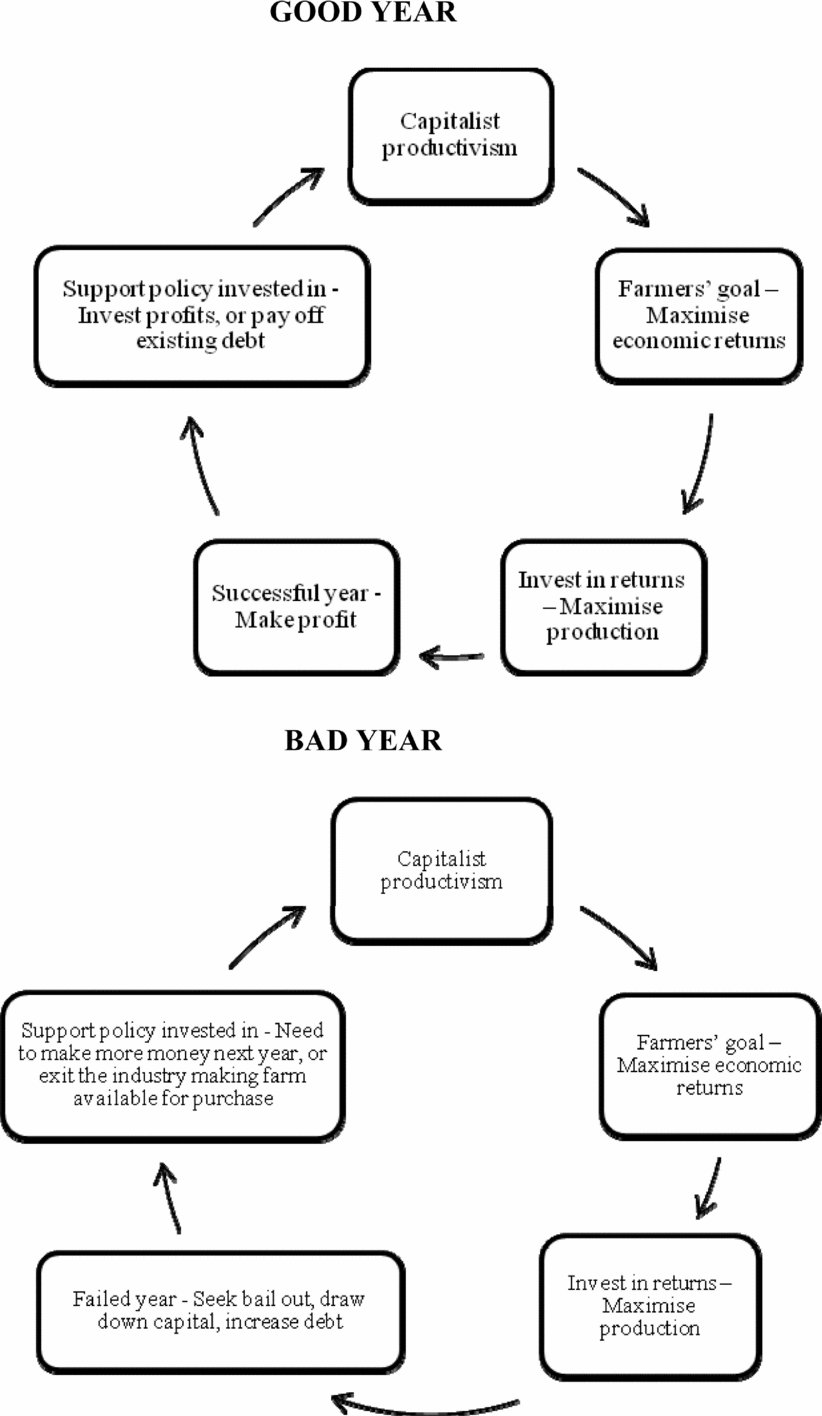
Adding to this psychological conundrum (Bates et al., Reference Bates, Leviston and Price2011; Burton and Wilson, Reference Burton and Wilson2006), is the fact that the dominance of a productivist ideology is of a cyclical nature, exacerbating the problem of increasing the environmental and social values of land use. As shown in Figure 2, capitalist productivism determines that rational producers would prioritise economic returns, meaning they use their land to maximise profits thus contributing to the continuation of productivist policy. In the past, capitalist productivism has contributed to the ‘mechanisation’ of agriculture and increased productivity and fertility with artificial fertilisers and various chemical additives. It has also meant that fewer farmers are needed to create produce that can support the rest of modern society (McMichael and Raynolds, Reference McMichael, Raynolds and Sklair1994). It has also, however, fostered increasing inequality on various scales (Lawrence, Reference Lawrence1987; Sklair, Reference Sklair1994); the homogenising of separate farming cultures and beliefs (Faulconbridge and Beaverstock, Reference Faulconbridge, Beaverstock, Clifford, Holloway, Rice and Valentine2009; Murray, Reference Murray2006; Robinson, Reference Robinson2004); a reliance on economic returns at the expense of society and the environment (Fensham et al., Reference Fensham, McAlpine and Seabrook2007; Ikerd, Reference Ikerd2008; Schumacher, Reference Schumacher1973; Schweickart, Reference Schweickart2009); and, a shift in society's attitude towards natural resources due to the complexity involved in their economic valuation (Bramley and Kirsten, Reference Bramley and Kirsten2007; Goodstein, Reference Goodstein2008; Ikerd, Reference Ikerd2008).
Diagram showing the historically cyclical nature of capitalist productivism in both good and bad years.

In terms of Australian agriculture, there is one very important contradiction in the current capitalist productivist system. As Lawrence et al. (Reference Lawrence, Furze and Vanclay1992: 80) recognise, the purpose of agrarian production (to create healthy food for society) and the capitalist goal of the ‘private accumulation of profit’ can be in direct contrast. There are issues with the ‘rationality of the marketplace’ and the reliance of farmers on nature to provide the base from which they can compete (Lawrence et al., Reference Lawrence, Furze and Vanclay1992: 80). Essentially, at the same time as Australian farmers are competing in the global market, institutionalising non-responsibility, there are socio-environmental responsibilities of providing healthy food and conserving the ecological balance to consider (Lawrence, et al., Reference Lawrence, Furze and Vanclay1992; Schumacher, Reference Schumacher1973).
Due to the previously discussed ‘anthropocentric’ orientation of the capitalist productivism, when it comes to this contradiction it is usually the social and environmental pillars of agricultural production that end up losing out to increasing economic returns. The lack of responsibility means inappropriate agricultural land use will continue to occur unless either market mechanisms are put in place to increase the economic value of ‘social’ and environmental capital, or there is a fundamental change in the dominant global socio-economic system (Cocklin and Alston, Reference Cocklin and Alston2003; Lawrence, Reference Lawrence1987; Putnam, Reference Putnam1995). Redclift (Reference Redclift1987) argues that the ‘environmental contradiction’ is the central contradiction of advanced capitalism because the future of advanced societies is premised on the transformation of the natural environment, but this is currently occurring in a manner which is detrimental to long term productivity. Capitalist productivism has resulted in many of the causes of environmental crises being ‘structural’, and analyses which do not include ‘social, economic and political factors lack credibility’ (Redclift, Reference Redclift1984: 1–2). The environmental, social, economic and political aspects of agricultural production are all related and to date this paper has shown that each of these factors, as well as their relationships to one another, need to be holistically examined in order to determine the total impacts of agricultural land use.
If South Australia continues down the federal path of capitalist productivism, corporate farms that can more efficiently exploit economies of scale will increase in size and number. The state will continue to lose agricultural producers, the farming way of life, and various forms of environmental stewardship. Unappealing rural communities will continue to shrink, and marginal regions will be bought out by stakeholders who can more easily absorb the risks associated with agricultural production. While this may seem inevitable, there are alternative options if strong multifunctional policies are enacted which recognise the multiple benefits of maintaining farming communities embedded in the South Australian landscape.
Imagining a multifunctional future
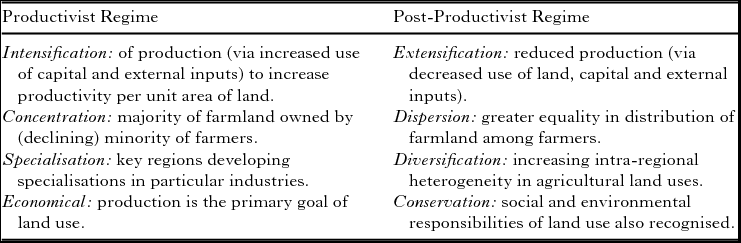
Whilst it has been reported that South Australian agricultural policy has historically been dominated by capitalist productivism, in many countries this is changing as the consequences of this approach and the value of other aspects of land use have been recognised more readily since the third ‘indeterminate’ international food regime of ‘corporate environmentalism’ began in the 1990s (Robinson, Reference Robinson2004). The post-productivist paradigm recognises other values of agricultural systems and landscapes such as healthy environments, ecosystem services, and cultural heritage (Mather et al., Reference Mather, Hill and Nijink2006; Wilson, Reference Wilson2004). Table 2 has been adapted from a paper by Argent (Reference Argent2002, p. 99) and highlights some of the important elements of productivist and post-productivist regimes. In response to criticism of both the post-productivist and productivist agricultural regimes, a ‘multifunctional’ agricultural paradigm was argued to better encapsulate the varying diversity, non-linearity and spatial heterogeneity of modern agriculture (McCarthy, Reference McCarthy2005; OECD, 2001, 2003; Otte et al., Reference Otte, Simmering and Wolters2007; Potter and Tilzey, Reference Potter and Tilzey2007; Wilson, Reference Wilson2001, Reference Wilson2007). Multifunctional agriculture moves away from the primacy of commercial production (productivism), to incorporate both commodity production and non-commodity (post-productivism) values of agricultural land use, so that future policy can protect the vast array of land use values (Amekawa et al., Reference Amekawa, Sseguya, Onzere and Carranza2010; Bjorkhaug and Richards, Reference Bjorkhaug and Richards2008; Cocklin et al., Reference Cocklin, Dibden and Mautner2006; Holmes, Reference Holmes2006). While most other countries in the Organisation for Economic Cooperation and Development have implemented policies that are explicit in their support for multifunctional agriculture, Australia remains extremely productivist in comparison (Potter and Tilzey, Reference Potter and Tilzey2007).
Key structural elements of productivist and post-productivist agricultural regimes.

Source: Adapted from Argent (Reference Argent2002, p. 99)
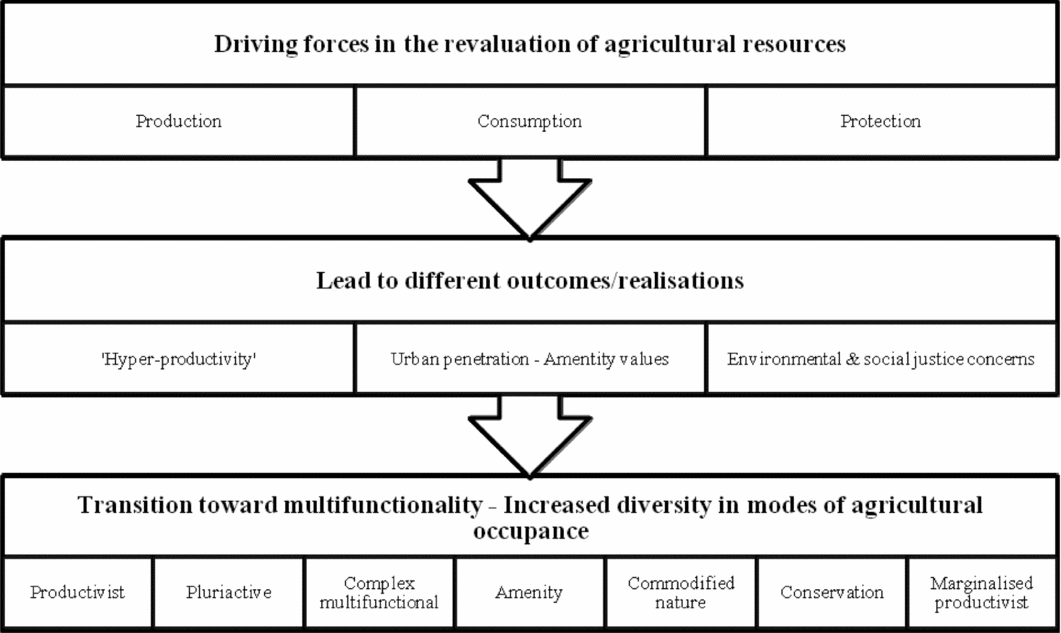
There are, however, a number of factors contributing to Australian producers initiating a movement away from productivism. A sixfold increase in farm debt from 1994 to 2009, along with adverse environmental outcomes noticed by both producers and consumers leads the way for a multifunctional movement (Dibden et al., Reference Dibden, Potter and Cocklin2009: 306). Other factors such as the growing importance of the ‘amenity’ of rural land (Argent et al., Reference Argent, Smailes and Griffin2007), an increasing feeling of responsibility within the farming community and a coincidental non-market related shift toward more sustainable practice (Higgins et al., Reference Higgins, Dibden and Cocklin2008a; Holmes, Reference Holmes2002) are also evidence that the productivist regime of the past is being broken down without widespread governmental support. Figure 3 has been adapted from a paper by Holmes (Reference Holmes2006) and shows the different driving forces for change and the seven outcomes that will lead to increased diversity within Australian agriculture and allow small scale farmers to find a niche market to increase their chances of survival. For many reasons, savvy farmers are recognising the uncertainties and risks of farming within the realm of the dominant agricultural regime and are reacting by attempting to minimise the risks to their enterprise (Campbell, Reference Campbell1980). An example of outlets for farmers looking to move away from a production oriented farming system can be found in alternative food networks such as farmers’ markets. In the final section on the historical foundations of South Australian agriculture, farmers’ markets were recognised as mechanisms that support certain groups of farmers who were indeed incorporating multifunctional ideals into their practice whilst remaining viable, without as greater reliance on productivist ‘wholesale’ sales (Fielke and Bardsley, Reference Fielke and Bardsley2013). These ‘multifunctional’ farmers fit into one of the modes of agricultural occupancy other than ‘productivist’ at the bottom of Figure 3, with various ratios of production evident, but are an example of producers able to incorporate the pursuit of more ‘sustainable agriculture’ into their land use. There are also producers marketing and communicating directly with consumers through the internet (Adams, Reference Adams2010), community supported agriculture programs which require consumers to subscribe to help producers spreads the cost and risks of production (Jupiter Creek Farms, 2012), and the Permaculture Association of South Australia (2013) is working to promote more socio-ecologically sustainable agriculture. All of these mechanisms help connect producers and consumers, increasing knowledge and understanding of the agri-food system, and provide forums to discuss issues facing the South Australian agricultural industry.
The transition to multifunctional land use in Australia, driving forces, outcomes and modes of agricultural occupancy.
Source: Adapted from Holmes (Reference Holmes2006: 144)

If South Australian agriculture is to become truly sustainable then the social and environmental outcomes of land use need to be considered at least comparably to the economic returns from agricultural production, and under the Natural Resources Management Act 2004 each region has the right to manage their natural resources in the manner which they see fit (Government of South Australia, 2004b). Examples such as the Government of South Australia legislating a moratorium on genetically modified crops, and attempting to preserve the agricultural character of the Barossa Valley and McLaren Vale, already exist (Government of South Australia, 2004a, 2011). This is despite the fact that South Australia is hard to define independently in terms of a specific agricultural policy focus, as under Australian jurisdiction the federal government has the greatest influence on the agricultural sector's continuing reliance on mass production and exportation (Alston et al., Reference Alston, Pardey and Smith1999). There is an opportunity for South Australia to recognise more explicitly the multiple values of agriculture, in regard to culture, heritage, environmental services, high quality food production, and export earnings, which would allow the state to show that it is more agriculturally progressive than the rest of Australia. It is suggested here that policies which more thoroughly support alternative food networks, protect other valuable food production regions from development, and value the stewardship roles of farmers, would be further steps toward a more socio-environmentally positive agricultural future.
While further research is required to determine which mechanisms have the best outcome on the various pillars of sustainability, there are a number of policies that could be pursued to encourage both consumers and producers to learn more about where their food comes from and what the consequences of their everyday decisions may be. To address the initial research question and contribute something beyond a review of historical literature, some policy suggestions for state government priorities beyond increasing yield and value in the export oriented South Australian agricultural industry follow. By explicitly providing support for alternative food networks such as farmers’ markets, community supported agriculture programs, permacultural properties and urban farming projects, links between rural producers and consumers will increase. Linkage programmes could also be funded to enable farmers in specific industries or regions to deal specifically with consumers interested in specific sector processes and areas. By creating these ‘agri-food linkages’, consumers would come to value the role of South Australian farmers and the ‘human fuel’ they produce more highly, building social capital, trust, and the sense of community within the State. Supporting local food based connections would empower consumers with a greater knowledge of food production, nutritional value and health. This support would also allow producers to gather more information about their local customer base, as they make ‘friends’ that regularly support, and offer suggestions for improvement to, their agri-businesses. By increasing the vertical integration of their agri-business in the market, producers will be able to buffer their risks more effectively with direct feedback impacting their business decisions, increasing their adaptive capacity, and collectively shaping the future of agriculture in South Australia. By creating new agricultural paths and increasing the adaptive capacity of individual agri-businesses, the South Australian agricultural sector may then be able to move past the recurring economic, social and environmental crises of past capitalist productivism and into a more sustainable, community-oriented, produce/producer valuing, and multifunctional future (Marsden, Reference Marsden2012; Tonts et al., Reference Tonts, Argent and Plummer2012).
Conclusion
This paper has examined the historical impact of South Australian agricultural land use highlighting lessons that have been learnt from previous agricultural development, in an effort to increase the likelihood of a sustainable agricultural sector in the future. While capitalist productivism is deeply entrenched within Australian agricultural ideology, there are alternative options for individual South Australia producers, and more importantly, South Australian agricultural policy. As a result of the introduction of ‘sustainable agriculture’ in South Australia in the late 1980s, groups of ‘multifunctional farmers’ have been found. These groups of farmers are already considering the multiple values of their land use, despite the fact that there is no serious economic incentive to do so at present, minimising risk to themselves and their businesses. Further state government support and recognition for the ‘alternative’ social and environmental values of local food production has the potential to set South Australia up as a more progressive, diverse, multifunctional region of productivist Australia. Original policy that encourages and builds agricultural community capacity would facilitate the future sustainability of agriculture in South Australia.
Acknowledgements
We would like to acknowledge financial support from the University of Adelaide and the CSIRO Sustainable Agriculture flagship, which made this research possible. Thanks must go to Chris Crothers for producing the map, as well as Rhiannon Niven and the anonymous reviewers, whose comments helped improve the paper dramatically.