Introduction
There have been numerous reports of high rates of schizophrenia and other psychoses in the Black Caribbean population in the UK (Sharpley et al. Reference Sharpley, Hutchinson, McKenzie and Murray2001). In the AESOP (Aetiology and Ethnicity in Schizophrenia and Other Psychoses) study, we found rates of schizophrenia and manic psychosis in this group to be around nine times greater than in the White British population (Fearon et al. Reference Fearon, Kirkbride, Morgan, Dazzan, Morgan, Lloyd, Hutchinson, Tarrant, Fung, Holloway, Mallett, Harrison, Leff, Jones and Murray2006). There has been considerable speculation about the reasons for these repeated findings, much of it centring on the possible role of socio-economic disadvantage and racial discrimination (e.g. Cooper, Reference Cooper2005). However, there have been few empirical studies that have systematically examined these factors.
In a small case-control study of first-episode schizophrenia, Mallett et al. (Reference Mallett, Leff, Bhugra, Pang and Zhao2002) found that being unemployed was associated with psychosis, particularly in their Black Caribbean sample. Karlsen & Nazroo (Reference Karlsen and Nazroo2002), in an analysis of data from the UK Fourth National Survey of Ethnic Minorities, found that both socio-economic position and the experience of discrimination were independent predictors of psychosis in Black and Minority Ethnic groups. Boydell et al. (Reference Boydell, van Os, McKenzie, Allardyce, Goel, McCreadie and Murray2001), in an incidence study in south London, found that risk of schizophrenia increased for Black Caribbeans as they formed a decreasing proportion of the local population, a finding that hints at a role for social and cultural isolation. Selten & Cantor-Graae (2005) have hypothesized that the experience of chronic social defeat, indexed by variables such as unemployment and social isolation, provides the underlying mechanism increasing rates of psychosis in migrant and ethnic minority populations.
There remains, however, a lack of comparative data on the social circumstances of patients with a first episode of psychosis and population-based controls from different ethnic minority groups. Gaining a fuller understanding of associations between social circumstances and psychosis at first presentation may help to identify potential risk factors contributing to the high rates in the Black Caribbean and other populations, both in the UK and elsewhere. Using data from a large case-control study of first-episode psychosis, AESOP (Kirkbride et al. Reference Kirkbride, Fearon, Morgan, Dazzan, Morgan, Tarrant, Lloyd, Holloway, Hutchinson, Leff, Mallett, Harrison, Murray and Jones2006), we set out to compare the prevalence of specific indicators of current and long-term social disadvantage and isolation, and variations by ethnicity, in subjects with a first episode of psychosis and a series of population-based healthy controls. Where possible, we took account of the potential confounding effects of pre-morbid characteristics and the temporal relationship between social disadvantage and illness onset.
Method
Sample 1: cases
The inclusion criteria for cases were: age 16–64 years; resident within defined catchment areas in south-east London and Nottingham; presence of a first episode of psychosis (ICD-10 F20–F29, F30–F33; WHO, 1992a) within the time-frame of the study; and no previous contact with health services for psychosis. Exclusion criteria were: evidence of psychotic symptoms precipitated by an organic cause; and transient psychotic symptoms resulting from acute intoxication as defined by ICD-10.
Case-finding procedures were based on those used by the World Health Organization (WHO) in its multi-country studies of schizophrenia (Jablensky et al. Reference Jablensky, Sartorius, Ernberg, Anker, Korten, Cooper, Day and Bertlesen1992). A team of researchers regularly checked all points of potential contact with specialist mental health services in the catchment areas. All potential cases were screened for inclusion using the Screening Schedule for Psychosis (Jablensky et al. Reference Jablensky, Sartorius, Ernberg, Anker, Korten, Cooper, Day and Bertlesen1992). Each patient meeting inclusion criteria over a 3-year period was approached and informed consent sought.
Sample 2: controls
A random sample of population-based control subjects, aged 16–64 years, was recruited. The sampling procedure was adapted from that used by the Office of Population and Census Statistics Psychiatric Morbidity Survey (Jenkins & Meltzer, Reference Jenkins and Meltzer1995). The small users Postal Address File (PAF) was used as the sampling frame. For each case ascertained, 10 addresses within the same electoral ward were randomly generated from the PAF. This ensured broad comparability between cases and controls by neighbourhood. Each address was contacted three times (morning, afternoon, evening); if an eligible control was not recruited the procedure was repeated with another set of 10 addresses. All adults in each household were invited to take part, and where more than one occupant was willing to participate a modified Kish grid was used to randomly select one member of the household. To ensure a sufficient number of Black Caribbean controls was recruited, we purposefully oversampled this population by continuing recruitment for a longer period. The Psychosis Screening Questionnaire (Bebbington & Nayani, Reference Bebbington and Nayani1995) was administered to all eligible controls; if screened positive, the subject was excluded.
Data collection
Social disadvantage and isolation
We collected data on indicators of subjects' current and past social circumstances using the Medical Research Council (MRC) Sociodemographic Schedule (Mallett et al. Reference Mallett, Leff, Bhugra, Pang and Zhao2002). In analyses presented in this paper, we included a series of indicators in six domains (Morgan et al. Reference Morgan, Burns, Fitzpatrick, Pinfold and Priebe2007a): (1) education; (2) employment; (3) living arrangements; (4) housing; (5) relationships; and (6) social networks. With regard to employment, we distinguished between those who were employed, those who were unemployed, and those who were economically inactive (i.e. students, house-persons) (Bivand, Reference Bivand2005). With regard to social networks, we focused on the frequency of contacts with friends and with family separately, and included a variable on whether subjects considered themselves to have one or more supportive other in whom they could confide. Where possible, we distinguished between current and long-term (>1 year) circumstances. Each of the indicators were, to varying degrees, correlated with each other. To assess the impact of linked and cumulative disadvantage, we created indices of current and long-term social disadvantage and isolation using, where possible, one indicator variable from each of the domains noted above. We dichotomized these variables to indicate the presence or absence of an indicator, with a score of 1 for present (e.g. unemployed) and 0 for absent. This produced a potential range on the current index of 0 to 6 and on the long-term index of 0 to 4.
Other sociodemographic characteristics and ethnicity
Data on ethnicity, gender, age, highest parental social class during childhood (defined according to the Office for National Statistics Socio-economic Classification; ONS, 2002) and receipt of special needs education before the age of 16 years were collected using the MRC Sociodemographic Schedule. Ethnicity was based on subject self-ascription using 2001 Census categories. In the analysis of social disadvantage and isolation by ethnicity, we compared subjects from the two main ethnic groups comprising our sample: (1) White British; and (2) Black Caribbean.
Pre-morbid and clinical data
Pre-morbid IQ was estimated using the National Adult Reading Test (NART). Symptom data were collected using the Schedules for Clinical Assessment in Neuropsychiatry (SCAN; WHO, 1992b). ICD-10 (WHO, 1992a) diagnoses were determined using the SCAN data on the basis of consensus meetings involving one of the AESOP study's Principal Investigators (J.L., R.M., P.J.) and other members of the research team (Kirkbride et al. Reference Kirkbride, Fearon, Morgan, Dazzan, Morgan, Tarrant, Lloyd, Holloway, Hutchinson, Leff, Mallett, Harrison, Murray and Jones2006). Full details on how mode of onset (i.e. length of prodrome) and duration of untreated psychosis (DUP) data were collected can be found in Morgan et al. (Reference Morgan, Abdul-Al, Lappin, Jones, Fearon, Leese, Croudace, Morgan, Dazzan, Craig, Leff and Murray2006).
Analysis
Logistic regression was used to analyse the relationship between indicators of social disadvantage and case-control status, and to test for interaction effects, while controlling for potential confounders. In all multivariable analyses, the following variables were controlled: age, gender, ethnicity (except in analyses stratified by ethnic group), and study centre.
We conducted analyses first for the full sample, second stratified by diagnosis and a short prodrome (i.e. acute mode of onset, symptoms emerged over a period of ⩽1 month) and DUP, and third stratified by ethnic group (White British and Black Caribbean subjects only). For the data to be consistent with a role for disadvantage and isolation in increasing rates of psychosis in the Black Caribbean population, one of two patterns would be expected: either the effect of these variables would be stronger in the Black Caribbean group; or social disadvantage and isolation would be more prevalent in this group. In calculating odds ratios (ORs) for the full, non-stratified sample, we weighted the data to take account of the oversampling of Black Caribbean controls. We assigned Black Caribbean controls a weight based on the proportion of Black Caribbeans in the populations of the two study catchment areas (estimated using 2001 Census data). All other controls and cases were assigned a weight of one (Morgan et al. Reference Morgan, Burns, Fitzpatrick, Pinfold and Priebe2007b). Analyses were conducted using Stata version 9 (Stata, 2005).
Results
Sample
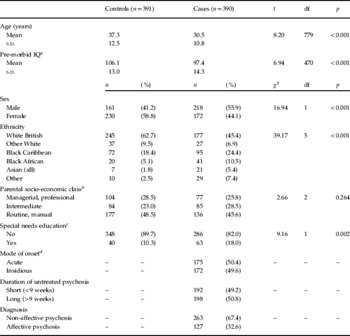
We identified 469 cases of first-episode psychosis during the study period, of whom 79 (17%) refused to participate or could not be contacted. Therefore, 390 (83%) cases were included in the case-control analyses. Those cases who were not included were more likely to have an initial diagnosis of non-affective psychosis than those included (86% v. 67%, p<0.01); otherwise there were no differences between the two groups in basic sociodemographic characteristics. During the same time-period, 391 community controls were recruited. Gender, age, ethnic and pre-morbid differences between cases and controls reflect well-established associations with psychosis (Table 1).
Basic sociodemographic and other characteristics by case-control status

s.d., Standard deviation; df, degrees of freedom.
a Pre-morbid IQ, assessed using the National Adult Reading Test (NART), was available only on a subsample of 472 subjects (220 cases, 252 controls).
b Not classifiable (i.e. house-persons, non-classifiable occupations, not known): 118 (15%).
c Missing values: 54 (7%).
d Missing values: 43 (11%).
Social disadvantage and psychosis
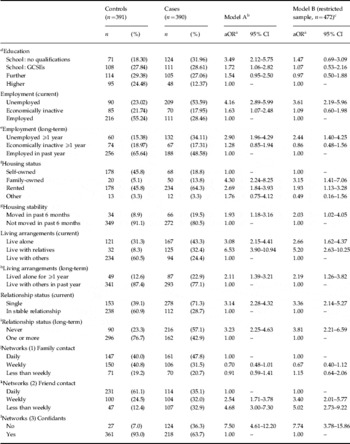
Across all the domains considered, cases were more likely to be socially disadvantaged and isolated than were controls. These associations held after account was taken of age, gender, ethnicity, and study centre (Table 2, Model A). When further adjusted for parental social class, special needs education before the age of 16, and pre-morbid IQ, using the reduced sample for which these data were available (Table 1), all associations held, with the exception of education (Table 2, Model B).
Indicators of social disadvantage and isolation by case-control status

aOR, Adjusted odds ratio; CI, confidence interval.
a ORs are weighted.
b ORs are adjusted for age, gender, ethnicity and study centre.
c ORs are adjusted for age, gender, ethnicity, parental social class, special needs education and pre-morbid IQ.
Missing values (full sample): d 5 missing; e 4 missing; f 28 missing; g 60 missing; h 11 missing; i 17 missing; j 76 missing; k 78 missing; l 61 missing.
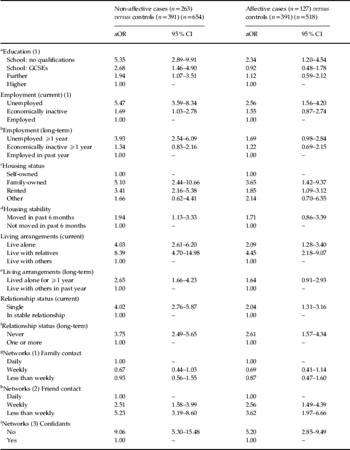
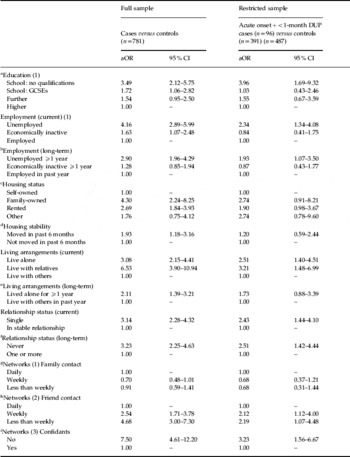
We repeated these analyses by diagnosis and using a restricted sample of cases with a short prodrome (acute onset) and very short DUP (1 month). First, more or less across all indicators, we found that associations were significant both for non-affective psychosis cases versus controls and for affective psychosis cases versus controls. The effect was generally stronger in the non-affective group, suggesting more marked social disadvantage and isolation in this group. However, associations were still robust in the affective group (Appendix, Table A1). Second, a similar pattern was observed in the restricted sample. That is, associations held, with some attenuation, when only those cases with a short prodrome and short DUP were compared with controls, including associations with long-term indicators of social disadvantage (Appendix, Table A2).
Social disadvantage, ethnicity and psychosis
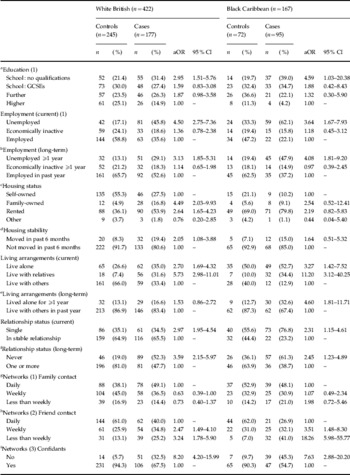
The associations between indicators of social disadvantage and case-control status were broadly similar for White British and Black Caribbean subjects (Table 3). In other words, both White British and Black Caribbean cases, relative to their respective controls, experienced similarly raised levels of social disadvantage and isolation. In relation to most indicators, the ORs for each ethnic group ranged between 2 and 4. For example, White British cases were 4.5 times more likely to be unemployed than White British controls; Black Caribbean cases were 3.6 times more likely to be unemployed than Black Caribbean controls. There was, then, no strong evidence that the effect of social disadvantage and isolation was more pronounced in Black Caribbean cases, relative to their controls, than in White British cases, relative to their controls.
Indicators of social disadvantage and isolation by ethnicity and case-control status

aOR, Adjusted odds ratio (adjusted for age, gender and study centre); CI, confidence interval.
Missing values:
a 5 missing; b 3 missing; c 18 missing; d 32 missing; e 5 missing; f 12 missing; g 48 missing; h 49 missing; i 29 missing.
However, there was evidence that, on a number of indicators, social disadvantage and isolation were more prevalent in the Black Caribbean population. Considering control subjects only, this was the case for current unemployment [17% White British versus 33% Black Caribbean, adjusted OR (aOR) 2.1, 95% confidence interval (CI) 1.06–4.04], living in rented housing (36% White British versus 69% Black Caribbean, aOR 5.4, 95% CI 2.70–10.76), living alone (27% White British versus 50% Black Caribbean, aOR 3.9, 95% CI 2.05–7.29), being single (35% White British versus 56% Black Caribbean, aOR 2.1, 95% CI 1.19–3.77), and never having had a long-term relationship (19% White British versus 36% Black Caribbean, aOR 2.4, 95% CI 1.17–4.74). The ORs are adjusted for sex, age and study centre. The corollary of this is that Black Caribbean cases, across the same markers, were more socially disadvantaged and isolated than White British cases (Table 3). The indicators that were not more prevalent in the Black Caribbean group were: long-term unemployment, housing stability, long-term living alone, network contacts and having close confidants.
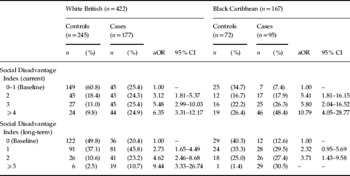
Indices of social disadvantage and isolation by ethnicity and case-control status

aOR, Adjusted odds ratio (adjusted for age, gender and study centre); CI, confidence interval.
Cumulative impact of social disadvantage
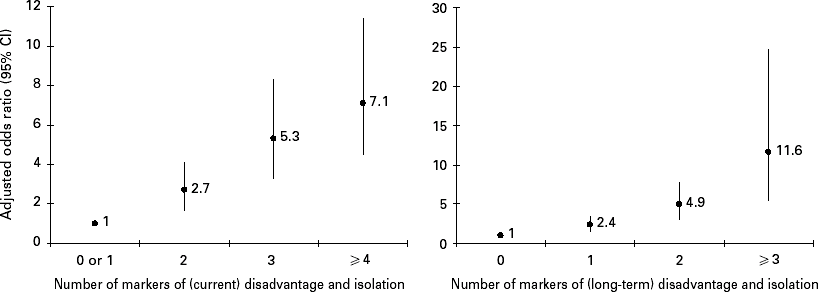
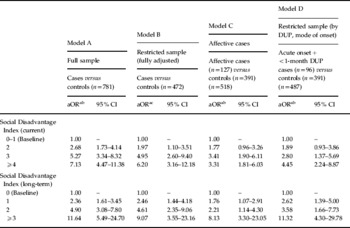
From the indicators used in this study, we constructed straightforward indices of current and long-term social disadvantage and isolation (see above). There was a clear linear relationship between case status and social disadvantage, operationalized in this way (Fig. 1). At each level, cases were progressively more likely to be disadvantaged and isolated. Only 19% of cases did not have at least one indicator of disadvantage, compared with 54% of controls. By contrast, 34% of cases had four or more indicators compared with only 13% of controls. This pattern was also evident for the long-term index (Fig. 1). Further adjusting for parental social class, receipt of special needs education and pre-morbid IQ did not significantly affect the strength of these associations, for either the current or long-term indices (Appendix, Table A3, Model B). When the analyses were repeated by diagnosis (Model C) and using the restricted sample of cases with a short prodrome and short DUP (Model D), the associations again held.
Adjusted odds ratios for each level of social disadvantage and isolation (current and long-term).
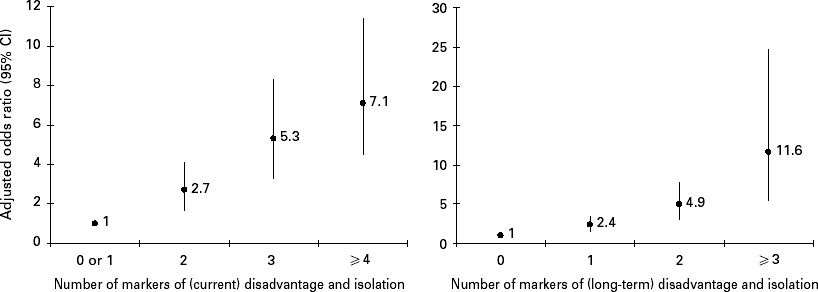
When considered by ethnicity, once again the patterns of associations between case status and the indices were similar in both the main ethnic groups (Table 4). However, the greater prevalence of social disadvantage and isolation in the Black Caribbean control sample became yet more evident: 49% of Black Caribbean controls scored 3 or above on the current index compared with 21% of White British controls (aOR 3.5, 95% CI 1.93–6.33). On the long-term index, the respective percentages of controls scoring 2 or above were: 26% Black Caribbean and 13% White British (aOR 2.7, 95% CI 1.31–5.53). Again, the corollary of this is that Black Caribbean cases were substantially more socially disadvantaged and isolated at first presentation than White British cases, who themselves experienced relatively high levels of disadvantage and isolation.
Discussion
This is the largest study to date to investigate the relationship between social disadvantage, both current and long-term, and psychosis in different ethnic groups at first presentation to services. Three notable findings have emerged. First, all the indicators of social disadvantage and isolation considered, both current and long-term, were more prevalent in cases than in controls. Second, using an index of social disadvantage and isolation, there were clear linear relationships for both current and long-term indices; that is, the odds of being a case increased in line with increasing number of indicators present. These associations held independently of potential confounders, including markers of pre-morbid cognitive impairment, and were evident in those with an affective psychosis and in those with a short prodrome and very recent onset of psychosis. Third, these associations were broadly similar in both the ethnic groups considered, White British and Black Caribbean. However, most indicators were more common in Black Caribbean controls than White British controls; correspondingly, they were more common in Black Caribbean cases than White British cases.
Methodological issues
We recruited control subjects from the same geographical areas as cases, our aim being to assemble as representative a comparison group as possible of the population from which our cases came. Levels of social disadvantage and exclusion were relatively high in our control group, and it may be that our approach oversampled those who were unemployed, single, living alone and relatively socially isolated. However, the effect of any such sampling bias would be to reduce the size of the effects observed. Alternatively, it is possible that levels of disadvantage in the local population were underestimated, given that those who agree to take part in such a project may well be more socially integrated and advantaged than those who decline. However, if the levels of exclusion in the local population were over- or underestimated, it seems this was similar for both White British and Black Caribbean subjects. It is now well established that the Black Caribbean population in the UK is one of the most socially disadvantaged, on a range of indicators, including unemployment, income, housing and education (Modood et al. Reference Modood, Berthoud, Lakey, Nazroo, Smith, Virdee and Beishon1997). The 2001 UK census, for example, again suggested that rates of unemployment were around two times greater in the Black Caribbean than the White British population, this difference being particularly marked for Black Caribbean men (Dobbs et al. Reference Dobbs, Green and Zeeley2006). These population figures reflect the magnitude of differences observed in our study between White British and Black Caribbean controls.
We were able to adjust for a number of factors pre-dating the onset of psychosis that may have confounded the relationship between indicators of disadvantage and psychosis (e.g. parental social class, pre-morbid IQ). However, we cannot rule out the possibility of confounding by other unmeasured factors, including substance use and parental history of mental illness, and this urges caution in interpreting these data.
In this study, as in others (e.g. Webber & Huxley, Reference Webber and Huxley2004), we used indicators rather than direct measures of social disadvantage and isolation. There are several limitations to this approach. Most importantly, the indicators used are often only proxies that may or may not, in individual cases, index disadvantage and exclusion from participation in the wider social environment. Being employed, for example, does not necessarily denote inclusion, if the job is low paid, low status and if an individual is marginalized by work colleagues. Conversely, many who are unemployed and actively seeking work link into vibrant informal social networks centred around, for example, job centres or child-care activities. However, when a series of indicators such as those used in this study are brought together into an index, such markers do seem to distinguish groups known to be disadvantaged and marginalized in mainstream society. This is borne out in our data by the numbers of cases for whom multiple indicators are present. Furthermore, the use of concrete indicators, although limited, reduces the likelihood of recall bias and is more practicable with large data sets.
Comparisons with previous research
There is a long history of research documenting the over-representation of those with schizophrenia and other psychoses in the most deprived sections of the population and the most socially fragmented areas (e.g. Faris & Dunham, Reference Faris and Dunham1939; Hollingshead & Readlich, Reference Hollingshead and Redlich1958; Harrison et al. Reference Harrison, Barrow and Creed1995; Allardyce et al. Reference Allardyce, Gilmour, Atkinson, Rapson, Bishop and McCreadie2005). Much of this research has been ecological, studying variations in hospital admission rates by local area characteristics, for example the proportion living alone (Hare, Reference Hare1956). There is also a wealth of evidence showing that those with long-standing psychotic mental disorders experience very high rates of unemployment (in some studies >90%; Thornicroft et al. Reference Thornicroft, Strathdee, Phelan, Holloway, Wykes, Dunn, McCrone, Leese, Johnson and Szmukler1998), more often live alone (Harvey et al. Reference Harvey, Pantellis, Taylor, McCabe, Lefevre, Campbell and Hirsch1996), and fail to establish long-term relationships (Walsh et al. Reference Walsh, Leese, Taylor, Johnson, Burns, Creed, Higgit and Murray2002), the consequence being social isolation and exclusion (Social Exclusion Unit, 2004).
There has been less research on the social circumstances of first-episode samples. What there is, however, does suggest high levels of disadvantage and isolation. For example, in a review of studies of employment and schizophrenia, Marwaha & Johnson (Reference Marwaha and Johnson2004) found that more recent studies of first-episode psychosis in the UK invariably reported rates of employment at <40%. Relevant data are also to be found in reports from recent first-episode studies that are primarily focused on other issues, such as DUP and the effectiveness of early intervention. For example, in Barnes et al.'s (Reference Barnes, Hutton, Chapman, Mutsatsa, Puri and Joyce2000) study of DUP in a small sample of first-episode cases in west London, 66% were unemployed. In the Lambeth Early Onset study, a trial of early intervention for those with first-episode psychosis, levels of unemployment of >60% were reported (Craig et al. Reference Craig, Garety, Power, Rahaman, Colbert, Fornells-Ambrojo and Dunn2004). Furthermore, in a study of Danish register data, Agerbo et al. (Reference Agerbo, Byrne, Eaton and Mortensen2004) found that, compared with controls, those who subsequently developed schizophrenia were more frequently unemployed and living alone for as long as 19 years before first hospital admission. These findings resemble ours, and together point to there being marked current and long-standing social disadvantage and isolation at first presentation to services. It is notable that our findings extended to those with an affective psychosis, albeit the associations were less strong. This is in contrast to some previous reports (Jones et al. Reference Jones, Bebbington, Foerster, Lewis, Murray, Russell, Sham, Toone and Wilkins1993).
The social circumstances of White and Black Caribbean cases with psychosis have not been the primary focus of many studies. In a small case-control study carried out in London, Mallett et al. (Reference Mallett, Leff, Bhugra, Pang and Zhao2002) found that cases were approximately two times more likely to be unemployed than controls in both their White and Black Caribbean subjects. However, in line with what we found, rates of unemployment were higher in Black Caribbean controls (43%) than White controls (23%) and higher in Black Caribbean cases (86%) than White cases (58%). In a study in Nottingham, Harrison et al. (Reference Harrison, Holton, Neilson, Owens, Boot and Cooper1989) found that Black Caribbean cases with a first episode of psychosis were more likely than a comparison first-episode group to live in rented accommodation and to have never been employed. McGovern et al. (Reference McGovern, Hemmings, Cope and Lowerson1994), in a first-episode sample in Birmingham, found that Black cases were more likely to live alone (40% v. 13% for Whites) and to have been employed for less than 50% of the time since leaving school (51% v. 27% for Whites). There are, as far as we are aware, no comparable data on social networks in these groups. These limited findings nonetheless support what we found and point to there being higher levels of social disadvantage in Black Caribbean cases at first presentation than White cases (against higher base levels of deprivation in the Black Caribbean population).
Social adversity, ethnicity and psychosis
The questions are consequently posed of: (1) whether current and long-standing social disadvantage and isolation can, directly or indirectly, increase risk for psychosis; and, from this, (2) whether these are potentially contributing to the high rates of psychosis observed in the UK Black Caribbean population (and indeed in other migrant and ethnic minority populations in the UK and other countries).
There is an intrinsic difficulty in the study of social risk factors for psychosis in disentangling cause from effect, particularly within a case-control design. It is well established that psychotic disorders, particularly schizophrenia, are accompanied by a marked decline in social functioning, even during the early stages of the illness (Hafner et al. Reference Hafner, Loffler, Maurer, Hambrecht and der Heiden1999). This may extend back further, with some studies suggesting marked social underachievement well before onset in those who develop schizophrenia (e.g. Jones et al. Reference Jones, Bebbington, Foerster, Lewis, Murray, Russell, Sham, Toone and Wilkins1993). Such findings have usually been interpreted within a neurodevelopmental framework, as reflecting the impact of subtle neurological insults on both social development and risk of schizophrenia.
However, other processes may be operating. For example, there is increasing evidence that adverse social experiences, both in childhood (e.g. Morgan & Fisher, Reference Morgan and Fisher2007) and in adulthood (e.g. Myin-Germeys & van Os, Reference Myin-Germeys and van Os2007), can increase risk of psychosis, particularly in the presence of other known risk factors (e.g. genetic risk). Innovative study designs have shown that adult stressors can precipitate the onset or recurrence of psychotic symptoms (Myin-Germeys & van Os, Reference Myin-Germeys and van Os2007). Furthermore, urban birth and upbringing, and changes of school during childhood, have been associated with an increased risk of psychosis (Pedersen & Mortensen, Reference Pedersen and Mortensen2001). Hutchinson et al. (Reference Hutchinson, Mallett and Fletcher1999) have speculated that urban living may impact on risk by isolating individuals, a process compounded for those whose social development is disrupted by frequent moves, leading to a loss of potentially protective factors, such as social supports. From this perspective, social disadvantage and isolation may contribute to risk of psychosis, across diagnostic boundaries, through increased exposure to social stress and life events, including experiences of discrimination (Gilvary et al. Reference Gilvary, Walsh, Samele, Hutchinson, Mallett, Rabe-Hesketh, Fahy, van Os and Murray1999; Karlsen & Nazroo, Reference Karlsen and Nazroo2002), in the absence of the potential buffer of social support. It is notable that the majority of the Black Caribbean population in the UK is based in the major urban centres, particularly London. This further ties in with Selten & Cantor-Graae's (Reference Selten and Cantor-Graae2005) theory of social defeat, a theory that also draws on animal studies that suggest social defeat is associated with sensitization of the dopaminergic system, particularly if followed by social isolation.
In our study, at least three intriguing observations point away from an explanation of associations solely in terms of the effects of (developing) psychosis. First, when we adjusted for indicators of pre-morbid cognitive deficits known to be associated with psychosis, and when analyses were repeated for those with a short prodrome and very short DUP (1 month), the associations with deprivation and isolation held, with some attenuation, even for long-term indicators. This was also the case when analyses were repeated for the affective psychosis group, a group with a short average DUP and generally less pre-morbid functional decline (Jones et al. Reference Jones, Bebbington, Foerster, Lewis, Murray, Russell, Sham, Toone and Wilkins1993; Morgan et al. Reference Morgan, Abdul-Al, Lappin, Jones, Fearon, Leese, Croudace, Morgan, Dazzan, Craig, Leff and Murray2006). This suggests that the associations observed in this study are only partly due to the confounding effects of pre-morbid characteristics and the effects of (developing) psychosis on social circumstances. Second, there was a clear linear relationship between indicators of deprivation and isolation (including long-term) and odds of psychosis, in all analyses. In other words, cumulative social disadvantage was associated, in linear fashion, with increased odds of psychosis, even when account was taken of markers of pre-morbid deficits and when analyses were restricted to those whose illness onset post-dated the occurrence of, at the very least, long-term disadvantage. Third, these findings held and were broadly similar for both of the two main ethnic groups. However, the Black Caribbean subjects were much more likely to be socially disadvantaged and isolated, at least on these indicators, reflecting what is known about high levels of social adversity in the UK Caribbean population. What is particularly intriguing about this latter finding is that this is precisely the kind of pattern that would be expected if social disadvantage and isolation were contributing to the high rates of psychosis observed in this population. It is notable that we have previously reported similar patterns of associations between indicators of early adversity and psychosis for these ethnic groups (Morgan et al. Reference Morgan, Burns, Fitzpatrick, Pinfold and Priebe2007b). The task of future research is to further examine these patterns and relationships, using more direct measures of adverse social experiences, both in childhood and in adulthood, and using designs that can more fully disentangle cause and effect. Before that, our findings may have immediate implications for clinical practice. At the very least, they suggest greater attention needs to be given to the social needs of patients at first contact, particularly those from migrant and ethnic minority groups.
Acknowledgements
We thank the AESOP researchers who helped with data collection. We are grateful to mental health services and patients in Bristol, Nottingham and south-east London, UK for their cooperation and support with this study, and to the UK Medical Research Council and the Stanley Medical Research Institute for funding. We acknowledge financial support from the Department of Health through the National Institute for Health Research (NIHR) Specialist Biomedical Research Centre for Mental Health award to the South London and Maudsley National Health Service (NHS) Foundation Trust (SLaM) and the Institute of Psychiatry at King's College London.
Declaration of Interest
Robin Murray is an editor of Psychological Medicine.
Appendix
Indicators of social disadvantage and isolation by diagnostic group

aOR, Adjusted odds ratio (weighted and adjusted for age, gender and study centre); CI, confidence interval.
Missing values:
>a 5 missing; b 4 missing; c 28 missing; d 60 missing; e 11 missing; f 17 missing; g 76 missing; h 78 missing; i 61 missing.
Adjusted odds ratios (aORs) for each indicator of social disadvantage and isolation using only acute onset and short DUP cases (alongside aORs for full sample)

DUP, Duration of untreated psychosis; CI, confidence interval.
aORs weighted and adjusted for age, gender and study centre.
Missing values (full sample):
a 5 missing; b 4 missing; c 28 missing; d 60 missing; e 11 missing; f 17 missing; g 76 missing; h 78 missing; i 61 missing.
Indices of social disadvantage and isolation, additional models

DUP, Duration of untreated psychosis; aOR, adjusted odds ratio; CI, confidence interval.
a ORs are weighted.
b ORs are adjusted for age, gender, ethnicity and study centre.
c ORs are adjusted for age, gender, ethnicity, study centre, parental social class, special needs education and pre-morbid IQ.