Cultural connections between Indigenous groups and the archaeological record can be a fraught topic. Frameworks steeped in nineteenth- and twentieth-century nationalism and colonialism frequently led to stories of fragile ancient accomplishments disconnected to nearby societies as described by colonizers (Trigger Reference Trigger2006). Fortunately, scholars now look at relationships between past and present people using more inclusive frameworks and integrating multiple lines of evidence. Consider two examples from the Northwest Mexico / Southwest United States (NW/SW). In Arizona, multisource studies have ascertained connections between the contemporary Akimel O'odham and the fourteenth-century Classic Hohokam irrigation communities (Hill Reference Hill2019; Loendorf and Lewis Reference Loendorf and Lewis2017). These studies draw on oral history, documents, and careful appraisals of the archaeological record—such as commonalities in artifacts, trade networks, and settlement systems—to connect contemporary Indigenous people with the ancient Hohokam. Comparing ancient southern Colorado with the Tewa-speaking pueblos of northern New Mexico, Ortman (Reference Ortman2012) has drawn on oral history, linguistics, human biology, and cultural practices—from prosaic to profound—connecting the Mesa Verde area Ancestral Pueblos with modern Pueblos. These reconstructions of cultural connections gain authority and detail by including Indigenous viewpoints.
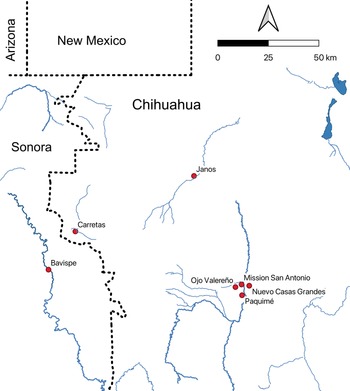
Our study builds on these approaches but differs in considering a group with no recognized contemporary descendants. Specifically, we consider the origins of a group labeled “Suma” by the Spanish in the Casas Grandes Valley (CGV), Chihuahua, Mexico (Figure 1); no endonym was recorded. The CGV Suma are known through sparse colonial documents and a limited contemporaneous archaeological record (Griffen Reference Griffen1979). Despite the Suma living near a renowned NW/SW ruin, Paquimé, also called Casas Grandes, which was abandoned in the fifteenth century, prominent scholars have declared the Suma unrelated to the ancient people of the CGV (Bandelier Reference Bandelier1890–1892; Di Peso Reference Di Peso and Charles1974). Instead, Naylor (Reference Naylor1969) and Di Peso (Reference Di Peso and Charles1974) have the Suma originating from nomadic groups from the lower Río Grande Valley, whom the Spanish also labeled “Suma.” Naylor and Di Peso treat the Suma as a single far-ranging group. For brevity, we reserve “Suma” without a qualifier for the people of the CGV, adding geographic labels when referencing other groups. The distinction is found in some Spanish documents and is acknowledged by several ethnohistorians (Bandelier Reference Bandelier1890–1892; Griffen Reference Griffen1979).
Key localities in the research area.

In this article, we first review CGV geography, settlement, and the Spanish accounts of the Suma. Next, we look at the material culture and associated behaviors found in the archaeological records of Paquimé and the Mission, searching for cultural continuities. Finally, we critically examine previous studies, illuminating significant issues concerning standard anthropological approaches to Indigenous people at European contact. We conclude that the Suma were long-time CGV residents who engaged in behaviors likely linked to the inhabitants of Paquimé.
Geography and Settlement
The CGV is a fertile basin bisected by a north-flowing perennial river, Río Casas Grandes, with headwaters in the Sierra Madre Occidental, ending in an inland basin to the northeast (Figure 1). It is situated between rugged mountains and modestly watered grasslands. Observers have long stressed the agricultural and ranching potential of the CGV (Bandelier Reference Bandelier1890–1892; Di Peso Reference Di Peso and Charles1974; Obregón Reference Obregón and Bravo1997 [1584]).
Not coincidentally, CGV supported large communities. The largest, Paquimé, with a population of around 2,000, dominated the local landscape with multistoried structures, 1,100 rooms, and an elaborate ceremonial precinct (Di Peso Reference Di Peso and Charles1974; Whalen and Minnis Reference Whalen and Minnis2001a; Whalen and Pitezel Reference Whalen, Pitezel, Minnis and Whalen2015; Whalen et al. Reference Whalen, MacWilliams and Pitezel2010). Radiocarbon evidence indicates that the community was at its height between AD 1200 and AD 1430 (Phillips and Gamboa Reference Phillips, Gamboa, Minnis and Whalen2015).
From Paquimé's abandonment until the beginning of missionization, there are no known archaeological or Spanish references to Indigenous settlements, except for a mention of straw huts (bohíos de paja) in the earliest Spanish account (Obregón Reference Obregón and Bravo1997 [1584]).
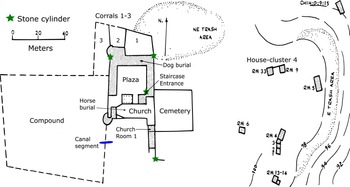
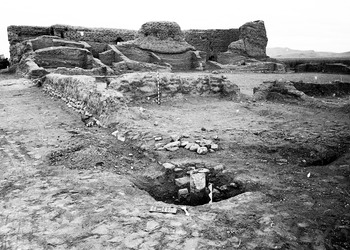
In 1664, Mission San Antonio de Padua de Casas Grandes, also referred to as the Convento site (CHIH:D:9:2) by archaeologists, was founded. Located 5 km north of Paquimé on the west bank of the Río Casas Grandes (Di Peso Reference Di Peso and Charles1974), the compact and defensive structure defined the colonial landscape (Figures 2 and 3). It is the only interpreted settlement from the period. This brief sketch of CGV human geography serves as background to exploring the relationship between the Suma who lived in colonial times and the ancient occupants of Paquimé. We begin by critically evaluating the written record for evidence of Suma lifeways and language.
Map of Mission San Antonio (after Di Peso et al. Reference Di Peso, Charles, Rinaldo and Fenner1974:5:Figure 245-5).

Mission San Antonio church walls with a cached large cylinder stone exposed at the northeast corner of the foundation. These stones are an artifact type known from Paquimé. (Courtesy of The Amerind Foundation, Dragoon, Arizona. Photo by Tommy Carroll, negative CG/273-34F.)

Contextualizing the Documents
In this section, we explore Suma lifeways by investigating relevant documents by Baltasar de Obregón, Spanish secular and religious authorities, and scholars identifying Suma linguistic affiliation against the context of Spanish colonial history and recent scholarship.
Obregon's Report
The sole sixteenth-century European account of the CGV is incorporated in Obregón's report, submitted to the Crown in 1584. Obregón was a soldier between 1564 and 1565 in the Francisco de Ibarra expedition, a group that entered the CGV (Carte Reference Carte2015; Di Peso et al. Reference Di Peso, Charles, Rinaldo and Fenner1974; Mecham Reference Mecham1927; Obregón Reference Obregón and Cuevas1924 [1584], Reference Obregón, Hammond and Rey1928 [1584]). It was only when Mariano Cuevas published an imprecise transcription in 1924 with the title Historía de los Descubrimientos de Nueva España (Obregón Reference Obregón and Cuevas1924 [1584]) that Obregón's status was elevated to a writer of colonial history. In 1928, George P. Hammond and Agapito Rey annotated and translated Obregón's report, calling it Obregon's History of 16th Century Explorations in Western America (Obregón Reference Obregón, Hammond and Rey1928 [1584]). That translation is still cited (see Minnis and Whalen Reference Minnis and Whalen2015), although it is unsatisfactory (Carte Reference Carte2015; Sauer Reference Sauer1932). In 1997, Eva María Bravo published an authoritative transcription of Obregón's report.
Obregón (Reference Obregón and Bravo1997 [1584]:181–182) provides the first written description of Paquimé and the inhabitants of the CGV in just three paragraphs. He finds Paquimé spectacular: “the houses are of great size” (casas de mucha grandeza), they include “beautiful patios” (hermosos patios), “beautiful pillars of heavy timbers” (hermosos pilares de gruesa madera), and durable walls “whitewashed and painted many colors” (enjalbegadas y pintadas de muchos colores). He suggests that the buildings appeared to be founded by a Roman general (que parecen fundados de antiguos romanos, donde estuvo el general y su campo).
In contrast, Obregón described “nearby” (cerca de) Indigenous people as “rustic, wandering, forest people” (gente silvestre, rústica y advenediza). Furthermore, he states that “the men go about naked; the women wear skirts of tanned deer skin or cowhide” (andan desnudos; ellas traen faldellines de cuero de venado adobado y algunos de las vacas); “they are hunters” (son cazadores; Carte [Reference Carte2015:97] for most translations). His narrative creates a stark contrast between an amazing past and a small-scale present.
As a foundation, we need to look at Obregón's text critically. First, there is a time lapse of about 20 years from his observation to his writings. Second, interactions with the people of CGV occurred near the end of their travels, after the expedition translator, Lucia, a multilingual Native American, ran away (Naylor Reference Naylor, Wilcox and Bruce Masse1981). Limited to gestures, Obregón understood that the builders of Paquimé had lost a battle and had moved northward. Third, what values and beliefs did Obregón express? Carte (Reference Carte2015:8) notes that Obregón's personal goal was to curry favor from the Spanish bureaucracy, seeking a commission to conquer lands farther north, a position ultimately awarded to Juan de Oñate. To display his qualifications, Obregón provided a practical guide to mining, ranching, farming, and conversion opportunities found in northern New Spain alongside a moral “textscape,” starkly dividing people and lands into the “good” and the “bad”—with substantial, permanent structures indicating praiseworthy groups (Carte Reference Carte2015:96).
As Carte (Reference Carte2015) notes, no wonder Paquimé captured Obregón's imagination. The reference to a Roman general is noteworthy; this Eurocentric comparison was commonplace in Colonial Latin America for esteemed accomplishments. Some writers went further, claiming that the Romans had conquered the Americas (Lupher Reference Lupher2003). It is impossible to know whether Obregón meant to only praise Paquimé or if he was indulging in the colonial practice of falsely assigning elaborate structures in the Americas to ancient Europeans (que parecen fundados—“that seemed founded”—is ambiguous).
Counterpoising amazing ruins against the simplicity of contemporary Indigenous people, whom he never identifies with a name, fits a standard European trope. Yet, the text does not consistently support the metanarrative of fleeing Paquimeños replaced with naked hunters. After discovering adobe houses along the river extending eight leagues north, Obregón states that “most of” the houses (la mayor parte) were collapsed and eroded (caídas, gastadas de las aguas y desbaratadas; Obregón Reference Obregón and Bravo1997 [1584]:182) . The word “most” could indicate that not all rooms were abandoned a century earlier. Perhaps after hearing of the pitched battles between the Ibarra expedition and other Indigenous groups, the farming population in the CGV fled, abandoning villages. Finally, in discussing their straw huts, Obregón specifies that the people he met had “stopped living in houses of such grandeur” (dejaban de habitar en casas de tanta grandeza; emphases added; Obregón Reference Obregón and Bravo1997 [1584]:182). Missing from Hammond and Rey's translation (Obregón Reference Obregón, Hammond and Rey1928 [1584]), the verb dejar suggests a change from a sedentary lifeway. Obregón's allegation of a transformation conflicts with later researchers.
Perhaps these subtleties were missed because the shifts in Indigenous mobility during colonial contact in the NW/SW have only recently been recognized as pivotal to Indigenous resistance and accommodation (Carte Reference Carte2015; Deeds Reference Deeds2003; Radding Reference Radding1997; Wilcox Reference Wilcox2009). Movement between aggregated towns, isolated farming communities, and hunting and gathering were adaptive and widely employed when faced with external threats to group sovereignty, individual freedom, and—not infrequently—basic survival. Obregón's narrative suggests no farming for the CGV, but what he observed could have been affected by Spanish activities. Even if farming along the Río Casas Grandes had halted for other reasons, his statements cannot be generalized to the decades before or after his visit or to the upland margins of the CGV.
Yet, this motif of an absolute, and ultimately moral, disconnect between the living and ancient people of the CGV has stood for 450 years. Given the criticisms of Obregón and the uncertainties of his visit, caution is warranted before accepting his narrative. We turn to later Spanish documents.
Records of the Spanish Secular and Religious Authorities
The Spanish identified the “Suma” as the Indigenous people of the CGV during the Mission period, between 1650 and 1730. The documents from this era are meager (Griffen Reference Griffen1967:101); however, they are the principal sources used by later regional scholars (Bancroft Reference Bancroft1884; Bandelier Reference Bandelier1890–1892; Deeds Reference Deeds2003; Di Peso Reference Di Peso and Charles1974; Griffen Reference Griffen1967, Reference Griffen1979; Naylor Reference Naylor1969, Reference Naylor, Wilcox and Bruce Masse1981; Sauer Reference Sauer1934). In turn, for our discussion, we rely on these scholarly works.
In the 1650s, Jesuits from Bavispe, Sonora, established a visita to the east, a settlement they visited to render religious ministrations to the Indigenous people. The Jesuits called them “Suma.” The visita was about six leagues from Mission San Miguel de Bavispe and was located within the Carretas Basin, part of the Río Casas Grandes drainage (Figure 1; Griffen Reference Griffen1979:35), although the exact location is unknown. In 1653, some 60 baptized families lived at this settlement (Bannon Reference Bannon1955:105). The Jesuits indicated that these Suma were more settled than the Suma groups outside the CGV to the east and north (Griffen Reference Griffen1979:35). This is the only statement of Suma social organization before the missions were built.
In the 1660s, mission-building expansion in northwest Chihuahua by the Franciscans was undertaken. In 1663, planning was underway for building Mission San Antonio in the central part of the CGV; it was completed in 1664 (Di Peso Reference Di Peso and Charles1974:865). No documents record day-to-day life, but wider scholarship clarifies the conflicts, hardships, and violence triggered by Spanish activities on their northern frontier (Deeds Reference Deeds2003; Radding Reference Radding1997; Wilcox Reference Wilcox2009). Two rebellions and one planned uprising at the Mission in 18 years signal a conflict-ridden relationship between the Suma and the Spanish authorities.
The first rebellion took place in 1667, resulting in the killing of a priest's Afro-Spanish servant and the Suma fleeing the Mission (Forbes Reference Forbes1960:162). In 1684, another outbreak of violence occurred, led by a multiethnic force from outside the CGV and joined by some Suma (Di Peso Reference Di Peso and Charles1974). This was part of a larger, partially coordinated, 1684 revolt in northern Mexico, encouraged by the Pueblo revolt centered on the Northern Río Grande in 1680 (Griffen Reference Griffen1979). The attack on the Mission buildings failed, but Suma houses burned, and stored grains and stock were seized (Di Peso Reference Di Peso and Charles1974; Griffen Reference Griffen1979). A year later, in 1685, another uprising was planned, but the scheme was thwarted by the Spanish authorities. Confessions from the “rebels” were made under torture, and 43 Suma men were executed by clubbing (Di Peso Reference Di Peso and Charles1974:874).
The Spanish-Indigenous conflicts of 1684 were discussed by the Spanish Commander at Casas Grandes, Francisco Ramírez, who placed some blame on Spanish settlers, who “not only planted on Indian lands but also moved into Indians’ houses” (Griffen Reference Griffen1979:10). The Suma in 1687 worked within the Spanish civil framework to write a petition to secure a homeland, requesting the enforcement of treaty rights (Griffen Reference Griffen1967). The Suma speak for themselves:
These lands and waters which at present are subject to dispute (partes) used to be ours, of our fathers and ancestors, on which we have been born and raised, and we request as loyal vassals of His Majesty that they be given and granted to us by the Justices in His Name [Griffen Reference Griffen1979:88].
The document details a treaty dividing the CGV at the spring supplying water to Paquimé and, later, the Mission. The treaty gave Suma land north of the spring, including a league of river farmland, along with areas for grazing and firewood collection.
This petition was reported by Griffen (Reference Griffen1967) and is widely cited (Di Peso Reference Di Peso and Charles1974; Griffen Reference Griffen1979; Naylor Reference Naylor1969), but its significance is unexplored. Presumably, the property incursions by Spanish settlers documented by Ramírez in 1684 (Griffen Reference Griffen1979:10) had continued, giving context to the petition. The Suma claim to have lived in the CGV “since time immemorial” (Naylor Reference Naylor1969:8) is important evidence of their origins and agricultural focus.
After that, the documentary record for the Suma dwindles. Administrative power struggles, the rising success of Apache-led raids, and the relocation of Spanish colonists out of the CGV loosened Spanish control. Mission and garrison operations were abandoned sometime around 1688–1690 (Di Peso Reference Di Peso and Charles1974:1002). At an unrecorded date, the original Mission buildings were burned, presumably by Indigenous people (Di Peso Reference Di Peso and Charles1974; Sánchez Reference Sánchez, Antillón and Maxwell2017). Still, the Mission existed in official records and was reestablished nearby in the early eighteenth century, only to be quickly abandoned and later officially decommissioned in 1758 (Griffen Reference Griffen1979). The last Mission census, in 1728, identified only 26 Native Americans, including six Suma (Griffen Reference Griffen1979). The Suma fate mirrors other groups in Chihuahua who slipped from administrative recognition in the eighteenth century (Deeds Reference Deeds2003; Griffen Reference Griffen1979). Some Suma merged with the Apache (Gerald Reference Gerald and Gerald1974; Sauer Reference Sauer1934). Those in the Spanish sphere presumably contributed to the mestizo population of northern Mexico. Apache incursions were disruptive to all sedentary groups in the region; a lightly populated CGV was still evident in the 1880s (Bandelier Reference Bandelier1890–1892).
Although mission-era descriptions of the Suma are vague, they do not align with the interpretation that they were a recent nomadic group, as suggested by Di Peso (Reference Di Peso and Charles1974). The Sonoran Jesuits in the 1650s ministered to a ranchería of 60 families within the CGV drainage and identified them as comparatively settled. In 1684, Ramírez reported that Suma-built houses were worth appropriating by Spanish colonists, and further indicated that the Suma were sufficiently tied to horticulture that rebellion followed the seizing of farmlands. In 1687, the Suma claimed long-term ownership of the CGV, centered on agricultural land. It appears that the Suma were similar enough to other semisettled ranchería farming groups populating the northern Sierra Madre that their lifeways did not elicit specific mention from the authorities.
Identifying Language Affiliation through Documentary Evidence
Suma words were rarely transcribed by the Spanish. A few known words from Spanish texts were the basis of Kroeber (Reference Kroeber1934) and Sauer (Reference Sauer1934) suggesting that the Suma were Uto-Aztecan speakers. Later, Forbes (Reference Forbes1959) proposed that they were Athapaskans. He distrusted the weak direct linguistic evidence, instead surmising an Athapaskan language based on the coordination between Athapaskan-speaking Apache, Suma, and other groups reported by later Spanish documents (Forbes Reference Forbes1960).
Forbes's (Reference Forbes1959) argument for Athapaskan-speaking Suma is discredited by most scholars, who believe that the alliance of Suma and Apache groups reflects political linkages after the Apache became the dominant openly rebellious Indigenous people (Lockhart Reference Lockhart1997; Naylor Reference Naylor, Wilcox and Bruce Masse1981). Initially, Naylor (Reference Naylor1969) agreed that the Suma language was not Uto-Aztecan but rejected an Athapaskan affiliation. Later, Naylor organized regional language specialists to examine the surnames of the 43 Suma men executed for sedition in 1685. These specialists concluded that the names were Uto-Aztecan (Naylor Reference Naylor, Wilcox and Bruce Masse1981). Uto-Aztecan is an enormous family, but the affiliation fits with neighboring agricultural groups (Kroeber Reference Kroeber1934).
The Archaeological Record of Mission San Antonio
Above, we sought to understand Suma lifeways and affiliations through a critical review of the written record and linguistic inferences. Here, we turn to the archaeological record to test our hypothesis that the Suma may have been ranchería-based agriculturalists with deep roots in the CGV. Although other Suma settlements are noted in the documentary record, archaeologists have excavated one: Mission San Antonio, also known as the Convento site. Because missionaries gather individuals from many cultural traditions and actively seek to modify lives, missions are not an easy place to identify ethnicity based on material culture remains.
Mission Excavations and Their Interpretation
The Mission is on the west terrace of the Río Casas Grandes (Figures 1 and 2). Excavations were conducted as part of the Joint Casas Grandes Expedition (JCGE), carried out between 1958 and 1961 by the Amerind Foundation and the Instituto Nacional de Antropología e Historia. The site was excavated from September 21 through December 9, 1959, with a 15- to 20-person crew. They excavated five areas: (1) the church, including the baptistry and sacristy; (2) the walled cemetery (or campo santo) in front of the church; (3) the patio (garth) attached to the north wall of the church, lined with rooms including the rectory, kitchen, and storerooms; (4) activity areas such as corrals and a trash midden; and (5) 11 scattered, likely contemporaneous, Suma houses to the east, near the terrace edge (Figure 2).
The excavations were initiated largely to build a CGV-wide chronology. Not only did JCGE uncover the Mission buildings, labeled the Españoles period, but under the Suma houses, a village that began a millennium earlier was documented, labeled the Viejo period. Table 1 outlines the major JCGE temporal units referenced here.
Casas Grandes Valley Periods, Defined by Di Peso (Reference Di Peso and Charles1974), with Current Date Estimates.

Beyond chronology, the JCGE looked for evidence that the Suma might originate from Medio period populations, primarily Paquimé. This goal was articulated in a field meeting months before the Mission excavations: “We want to know if a remnant of the people of the Casas Grandes were around here when the Spanish came” (Amerind Foundation Archives [AFA], Daily Field Log, June 18, 1959, JCGE). Frontier missions frequently were built at existing Indigenous communities, making the Convento site a good place to look for continuity. During fieldwork, proof seemed in reach: underneath the mission-era Suma houses was an adobe room block with associated European goods, surmised to be evidence of a Tardio village (AFA, Daily Field Log, November 5, 1959, JCGE). However, a radiocarbon assay returned a Viejo date from isolated Room 30, about 13 m south of this structure, and thought to be coeval; furthermore, most ceramics did not match expectations for a contact-era community. In response, Di Peso reinterpreted all these structures as Viejo:
This village contained a certain amount of intrusive objects which belonged to the later Spanish occupation . . . which suggested that the village was built by the Suma Indians sometime around A.D. 1660. Fortunately, with a close laboratory check and C-14 dating the falseness of this association was brought to light [Di Peso et al. Reference Di Peso, Charles, Rinaldo and Fenner1974:4:179].
This analytical turn did not disprove regional continuity. Nonetheless, Di Peso ultimately concluded that the Mission was built on an “unpopulated river terrace” (Reference Di Peso and Charles1974:882) and that the Suma were “wanderers” from the east (Di Peso Reference Di Peso and Charles1974:840).
We revisit the question of regional continuity Di Peso raised in 1959 using a different approach but with the same dataset. Artifacts, features, and behaviors from the Españoles period are evaluated against Medio period characteristics. A suite of similarities would indicate knowledge of Medio culture by the Suma. There are limitations to this method: similarities also can be generated by coincidence, transmission between contemporaneous groups, and observation of the archaeological record. These alternatives are considered in the “Results” section.
We draw on five levels of documentation of the JCGE excavations, most found in the Amerind Foundation Archives. The first is the single day-to-day field notebook, kept by the excavators. The second is the typed field log, a project-level document written by Di Peso. The third is the master report for the Españoles period, a second Di Peso typed field manuscript, which interprets the features and annotates photographs. Fourth are the published technical volumes (Di Peso et al. Reference Di Peso, Charles, Rinaldo and Fenner1974), which add artifact analyses. Fifth is Di Peso's (Reference Di Peso and Charles1974) published narrative. Generally, these documents provide a unified picture, with relevant exceptions noted.
Architecture and Construction Techniques
Although Roman Catholic churches and mission buildings are created within a Western tradition, Indigenous labor and expertise produced these structures in the Spanish Colonial world (Kubler Reference Kubler1940). Native workers, willing or enslaved, introduced Indigenous elements and construction techniques. The JCGE recognized this: “The donor . . . priest and the native recipient together conceived and built the missions” (Di Peso et al. Reference Di Peso, Charles, Rinaldo and Fenner1974:5:882); however, they did not identify Indigenous design at the Mission.
The form and scale of Mission San Antonio suggest a skilled construction crew. Built primarily with adobe blocks, a Spanish technique, the church is unusually tall for its time (Sanchez Reference Sánchez, Antillón and Maxwell2017:260). The outer wall of the Mission incorporated round defensive towers on the west, an engineering challenge compared with common rectilinear mission buildings. The uniformity in wall thickness and overall care in construction sets the Mission apart from some contemporaries (cf. Kubler Reference Kubler1940:32).
This sophistication compares favorably to the mission buildings created by Pueblo people. Strikingly, the six missions that Di Peso and colleagues (Reference Di Peso, Charles, Rinaldo and Fenner1974:Figure 246-5) chose to compare with San Antonio were constructed by Puebloan groups. The scale and expertise shown at Mission San Antonio suggest familiarity with lasting architecture and weaken the notion that the Suma previously built only brush structures.
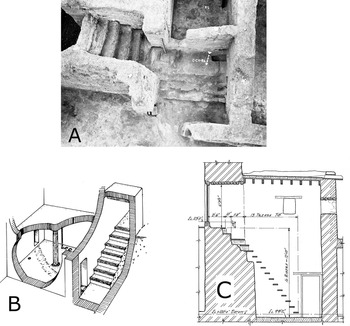
There are specific connections between Paquimé and the Mission architecture, beginning with the choir loft staircase (Figure 4). Like most New Spain churches, San Antonio incorporated a choir loft above the entrance (Kubler Reference Kubler1940:57); burned vigas confirmed its construction (Di Peso Reference Di Peso and Charles1974:891). Most northern frontier churches accessed the loft by ladder, but a few accessed it by stairs (Kubler Reference Kubler1940:48), including Mission San Antonio and the Mission San Éstaban del Rey at Ácoma Pueblo, New Mexico. San Éstaban, larger and about 25 years older, shares orientation, design, and other details with San Antonio, suggesting that it served as inspiration for the latter (Di Peso et al. Reference Di Peso, Charles, Rinaldo and Fenner1974:5:883). Notably, both churches feature a northwest corner staircase leading from the mission patio to the choir loft.
Comparison of staircases: (A) San Antonio stairs (Courtesy of The Amerind Foundation, Dragoon, Arizona. Tommy Carroll, Photographer, negative CG/261-22F); (B) Paquimé stairs (Unit 8, Plaza 3; Di Peso et al. Reference Di Peso, Charles, Rinaldo and Fenner1974:4:Figure 314-4); (C) San Éstaban choir stairs (HABS NM-5, sheet 20, detail).

However, the San Antonio staircase is unlike San Éstaban's cramped, straight accent of planks across an open stairwell. Instead, a wide staircase was created out of massed adobe, with squared timber steps socketed to the adobe walls, and a landing where the stairs change direction 90°. The San Antonio staircase shares two features with the ritually important walk-in well at Paquimé (Di Peso et al. Reference Di Peso, Charles, Rinaldo and Fenner1974:4:246): the wooden treads and a landing with a 90° direction change. Thinner than those at the Mission, socketed timbers creating step edges occurred regularly at Paquimé. Finally, the choir staircase was constructed from poured adobe, “a rather unusual method of stair construction used by the Spanish and the fill technique resembled more closely the stairwells found in association with . . . Paquimé” (AFA, “Convento site [CHIH:D:9:2] Historic Horizon,” p. 80).
Use of this ancient tamped or “puddled” adobe as a substitute for Spanish adobe blocks occurs elsewhere at the Mission. These include the east wall of Corral 3, an oven-like feature in Church Room 10, almost all the floors of Suma habitation structures, and the walls of one dwelling. Specifically, Room 33 was constructed from post-reinforced puddled adobe. It faces Room 9, constructed with adobe blocks; these rooms are connected by a block wall to create House-cluster 4 (Di Peso et al. Reference Di Peso, Charles, Rinaldo and Fenner1974:5:923). This cluster may have a unique history. The field notebook indicates that the Room 9 block wall was built on a puddled wall stub, which served as a foundation. Inside, a central round fireplace had been sealed and replaced with a corner fireplace, characteristic of the Españoles period. The notebook labels the early floor “Suma” and the upper floor “Spanish” (AFA, field notebook, “CHIH:D:9:2, The Convento,” October 15, 1959, p. 81), indicating that a pre-Mission structure was remodeled during the Españoles period. Subsequent summaries state only that the puddled adobe construction was confusing, overlooking this field interpretation.
Other features connecting the Mission with Paquimé relate to water control. A segment of a canal was intercepted just south of the church; its source is Ojo Vareleño, 3 km away. A similar canal runs from this spring to Paquimé. Furthermore, the patio and Corrals 1 and 2 incorporate drainage ditches. Discussing the courtyard feature, the JCGE noted, “This drainage canal was not unlike those utilized by the inhabitants of CHIH:D:9:1 [Paquimé] to drain their enclosed plazas save this one was much cruder” (AFA, “Convento site [CHIH:D:9:2] Historic Horizon,” p. 94). Ancient drains had flagstone linings and covers; at the Mission, the collapse of the “gate room” (Church Room 9) protected an impression of a wooden ditch cover. Uncovered ditches would be a livestock hazard; at the Mission, as at Paquimé, ditches were likely covered. Finally, both drainage systems included passageways directing ditches under walls. In brief, the canal and drains have precedence at Paquimé and do not fit a pattern with other Spanish frontier missions.
Finally, four large cylinder stones, built into the foundation, link the Mission to Paquimé. Three matching cylinders were found at Paquimé, where these tapered, “symmetrical and well-finished” stones average 18 cm in diameter and up to 87 cm long. The Paquimé specimens, found in fill, served an unknown function (Di Peso et al. Reference Di Peso, Charles, Rinaldo and Fenner1974:7:234). At the Mission, two large cylinder stones were collected (Di Peso et al. Reference Di Peso, Charles, Rinaldo and Fenner1974:7:492) and two others field recorded (Figures 2 and 3). The larger recovered stone (diameter = 19 cm, length = 62 cm) was placed below the northeast foundation corner. Two others stood upright at the northwest and southeast building corners. A cylinder in the southwest corner, which would complete a four-corner pattern, was not found, but that area was disturbed, and testing was limited (Di Peso et al. Reference Di Peso, Charles, Rinaldo and Fenner1974:4:916). The final cylinder stone (broken, diameter = 23 cm, length = 32 cm) was positioned horizontally beneath an interior plaza wall foundation between the Church Room 8 door (a possible habitation room) and the Church Room 6 door (the choir staircase).
The JCGE suggested that ancient artifacts had been reused as construction markers: “The NE corner of this room was the corner which the engineer marked out with a prehistoric green stone cylinder” (AFA, master report, “Convento site [CHIH:D:9:2] Historic Horizon,” p. 106). Not only is the reuse of a rare relic for a prosaic function surprising, but engineers were not available on the northern frontier (Kubler Reference Kubler1940:7). Additionally, the horizontal cylinder stone does not mark a corner. However, the placement of valued objects near building corners, doorways, and stairs follows the pattern of Mesoamerican dedicatory caches (Mock Reference Mock1998). Assuming that a southwest marker was missed or destroyed, the stones likely outline the five sacred dimensions in Mesoamerican societies, with the cylinder near the stairs marking the vertical axis mundi. This cache pattern occurs in Mesoamerican buildings, symbolically transforming structures into a cosmogram of the universe (Mathews and Garber Reference Mathews and Garber2004). It appears the Mission builders were knowledgeable about Mesoamerican practices (as Paquimé inhabitants were) and accessed an artifact type known only from Paquimé. Indigenous meanings seemingly were encoded in the foundation of a building whose construction, ostensibly, proclaimed Western religious beliefs.
In concept and execution, Mission San Antonio and Paquimé represent distinct traditions of monumental architecture. Yet, we have identified five shared characteristics: (1) skilled, large-scale construction; (2) the staircase design; (3) the use of tamped or poured adobe; (4) canal construction and covered drainage ditches; and (5) evidence of Mesoamerican religious beliefs and directionality, expressed at the Mission with a Paquimé-specific artifact type—cylinder stones.
Bioarchaeology and Burial Practices
A potential way to assess population connections between Paquimé and the Mission is through evidence of biological continuity. Mission excavations uncovered skeletal remains of about 105 individuals: 28 from the cemetery, 17 beneath the earthen floor of the church, and perhaps 60 from a mass grave. Because of local concerns about disturbing human remains from consecrated ground, the JCGE removed only 27 individuals for analysis and none from the mass burial. In contrast, at Paquimé, skeletal remains representing hundreds of individuals were removed.
Through cranial and dental traits, Butler (Reference Butler1971) considered the biological similarities between individuals recovered at Paquimé and the Mission. These biodistance techniques still hold validity (Waller Reference Waller2017), but the Mission remains were fragile and fragmentary, leaving 11 partial skulls for study. These were statistically different from those recovered at Paquimé, a finding highlighted by Di Peso and others (Reference Di Peso, Charles, Rinaldo and Fenner1974:8:413). However, Butler refused to interpret the results, citing “the poor sample size” (Reference Di Peso, Charles, Rinaldo and Fenner1971:184).
Turning to Mission burial practices, most followed Christian conventions: individual interments, extended supine position, and an eastward orientation; additionally, three burials incorporated rosaries. Occasionally, possible Indigenous jewelry was included: in one case, shell and glass beads; in the other, glass-bead pendant earrings strung on copper wire. Furthermore, occipital modification was found on two of six skulls sufficiently preserved (Di Peso et al. Reference Di Peso, Charles, Rinaldo and Fenner1974:8:413). This modification occurs on 50% of the skulls from Paquimé (n = 167; Butler Reference Butler1971:159) but is unusual for the NW/SW (Di Peso Reference Di Peso and Charles1974:642).
In addition, there are three interments that we—and at times the JCGE—interpret as indicative of an Indigenous revival occurring after the Spanish withdrawal, estimated between 1688 and 1690. These interments resemble Paquimé practices, although the incredibly varied and complex Paquimé burials are difficult to characterize. Scholars who interpret Paquimé bioarchaeology (Casserino Reference Casserino2009; Di Peso Reference Di Peso and Charles1974; Rakita Reference Rakita2009; Ravesloot Reference Ravesloot1988; Waller Reference Waller2017) view many of these practices as marking and maintaining a powerful elite. After 250 years, we would not expect precise replication, yet some characteristics are reminiscent of Medio period burials.
At the Mission, there are two articulated animal burials. The ritual use of articulated animal burials at Paquimé is extensive, often employing immature individuals and commingling them with human burials. The animals are usually turkeys and macaws, but they include a newborn pronghorn and a headless dog (Di Peso et al. Reference Di Peso, Charles, Rinaldo and Fenner1974:8:267). Similarly, a headless dog burial was found in a Mission storeroom bin (Plaza Room 13, AFA, field notebook, “CHIH:D:9:2, The Convento,” December 9, 1959, p. 154). The other Mission animal burial is a complete horse, one to two years old, placed before the main altar, “the most honored position in the church” (AFA, field notebook, “CHIH:D:9:2, The Convento,” December 1, 1959, p. 142). Di Peso sought Iberian-Catholic symbolism for this unique feature, but he found nothing convincing (Di Peso Reference Di Peso and Charles1974:959).
Indigenous practices are also likely displayed in the mass grave in Church Room 1, located next to the baptistry but accessed from the cemetery. The room's original function is unknown—a mortuary chapel is possible (Di Peso et al. Reference Di Peso, Charles, Rinaldo and Fenner1974:5:913)—but its last use is obvious: the room contained the remains of “60-plus” individuals (AFA, field notebook, “CHIH:D:9:2, The Convento,” October 7, 1959, p. 34). Cleaned for photography, the bone mass was left unexcavated. The remains were unarticulated, heaped with animal long bones, and covered by “big metate fragments” (AFA, field notebook, “CHIH:D:9:2, The Convento,” October 7, 1959, p. 32). However, nine human skulls were aligned against the north wall “with no body bones nearby” (AFA, field notebook, “CHIH:D:9:2, The Convento,” October 7, 1959, p. 33). The room also held a bit of ornamental cloth that incorporated copper threads—likely a vestment or altar cloth—a glass bead, two Majolica sherds, and 71 San Antonio Red sherds.
The excavators thought the deposit represented Native American activities after the Franciscans abandoned the Mission:
All the evidence points to a re-burial theory. It is possible that an Indian attack (perhaps the uprising of 1684) killed these people and drove off the other defenders. The survivors may have later returned, gathered up the decaying bodies, and given them honored burial in this sealed up room adjacent to the abandoned church [AFA, field notebook, “CHIH:D:9:2, The Convento,” October 7, 1959, p. 33].
However, Di Peso ultimately published a different interpretation, identifying the grave as the remains of the 43 Suma clubbed to death for sedition in 1685. He supports this scenario by indicating the following:
The excavators . . . found the remains of these bodies, which had been laid like cordwood, one on top of the other, with their heads all oriented to the north. The facial bones of these supine bodies were smashed beyond repair [Di Peso Reference Di Peso and Charles1974:874–875].
The statement contradicts the project's field drawings and photographs (Di Peso Reference Di Peso and Charles1974:Figure 129-3). Except for the aligned skulls, skeletal material was in a heap; there is no evidence of bodies “laid like cordwood.” There is no osteological analysis showing perimortem facial trauma; alternatively, Butler (Reference Butler1971) documented extensive postmortem damage at the Mission. Finally, the mixing of animal and human remains is omitted, a characteristic difficult to reconcile with Spanish activities.
We are in closer alignment with the excavators’ original assessment. Association with a Native revival is strengthened by the fragment of ecclesiastical cloth, given the prominent role Spanish vestments held during the Great Pueblo Revolt to the north (Gruner Reference Gruner2013). Additionally, the deposit suggests a shared heritage with Paquimé. Massed human remains at Paquimé are common. Their interpretation is evolving, with likely multiple behavioral patterns involved (Waller Reference Waller2017). Specifically, Room 23-16 at Paquimé included six skulls given special treatment, scattered human remains, and many animal long bones, some split into wands. The six “trophy skulls” became the well-known identifier for Unit 16, “The House of the Skulls” (Ravesloot Reference Ravesloot1988:37). Waller (Reference Waller2017) suggests that these may represent nonlocal, high-status individuals. We would not apply this interpretation to Church Room 1, but the reuse of architectural space as a charnel house, the inclusion of animal long bones with human remains, and the isolation of human skulls follow patterns seen at Paquimé.
Artifacts
Artifacts from mission communities have a high potential to explicate Indigenous continuities and Spanish impacts. Unfortunately, the San Antonio assemblage suffers from several limitations. A few artifacts, previously discussed, are associated with burials. A small number were recovered on floors, but most were recovered from fill and trash deposits. There is also demonstrable temporal mixing. The adobe blocks at the Mission incorporate Medio period sherds, the result of adobe sourced from a ruin 300 m away (AFA, JCGE master report, “Convento site [CHIH:D:9:2] Historic Horizon,” p. 11). The Viejo occupation levels beneath the Suma structures were another source of ancient artifacts. Finally, some of the structures east of the church were excavated while Di Peso was away; he was dissatisfied with the work and supervised new fieldwork and mapping to reevaluate the area (AFA, Daily Field Log, November 5, 1959, JCGE). How the gap in professional supervision affected contextual recording is impossible to say.
The recognized Indigenous pottery types—San Antonio Plain, Red, and the rare Red-on-brown—constitute the largest artifact category for the Españoles period, totaling 730 sherds and two partial vessels. San Antonio ware shares many characteristics with the regional colonial style found in northwest Chihuahua and southeast Arizona. These are characterized by thick walls; porous paste; a high frequency of carbon core firing; a limited range of vessel forms; and European-influenced vessel shapes (Di Peso et al. Reference Di Peso, Charles, Rinaldo and Fenner1974:6:327; Gerald Reference Gerald1951; Seymour Reference Seymour2011). The porosity and carbon core likely reflect the addition of manure temper. This style horizon is thought to be transmitted through the blending of Indigenous groups at missions, the limited availability of resources, and shared accommodations to European tastes (Fratt Reference Fratt1981; Seymour Reference Seymour2011).
Strikingly, San Antonio Plain sherds were identified only within the Mission buildings; around the Suma structures, plain ceramics consistently were labeled Convento Plain, the Viejo type. Although some of these recovered plainware sherds must date to Viejo, an absence of contemporary utilitarian pottery is highly unlikely for Suma households preparing meals. Instead, plainware pottery production during the Españoles period likely included a type resembling ancient plainware, unrecognized by the JCGE. Whalen and Pitezel (Reference Whalen, Pitezel, Minnis and Whalen2015) predicted that Tardio ceramic assemblages would superficially mimic pre-Paquimé assemblages, strengthening this inference.
The early date of San Antonio ware has received scant consideration. The known Janos materials (Gerald Reference Gerald1951) are eighteenth century; Seymour (Reference Seymour2011:90) argues that the southeast Arizona wares, especially Sobaipuri Red and Plain, are eighteenth century. The Di Peso and colleagues’ (Reference Di Peso, Charles, Rinaldo and Fenner1974:6:326) conjecture that San Antonio ware originated in southeast Arizona, with either vessels or potters imported, inverts this temporal pattern. The style could originate with the Opatas of northeast Sonora, as suggested by Seymour (Reference Seymour2011:96), but her argument is circumstantial, lacking dated Opata ceramics. Regardless, the San Antonio pattern may be an early stage in Indigenous colonial ceramic change because the pottery manufactured for Spanish preferences is deposited primarily in mission buildings, whereas Suma households maintained a local style. These observations strongly argue for continuity in regional ceramic making.
Beyond pottery, other Indigenous artifacts may have Medio period origins. A tubular pipe from a Suma room follows a shape found at Paquimé (Di Peso et al. Reference Di Peso, Charles, Rinaldo and Fenner1974:7:492). Two vermetid-shell beads associated with a burial, and a Glycymeris shell bracelet from room fill represent NW/SW jewelry forms common at Paquimé (Di Peso et al. Reference Di Peso, Charles, Rinaldo and Fenner1974:6:526).
There are two copper objects of Indigenous design. One is a Spanish kettle fragment modified into a pendant with a suspension hole; it “was of a design known to the … occupants of the valley long before the coming of the Spaniards” (Di Peso Reference Di Peso and Charles1974:921). The other is a copper tube bead associated with a glass bead and cotton string, which was preserved by the copper's antimicrobial properties. The bead, a rolled sheet of copper, is indistinguishable from a common Medio type. Furthermore, there is evidence of copper remelting and casting, but those artifacts are either European in nature or amorphous (Di Peso et al. Reference Di Peso, Charles, Rinaldo and Fenner1974:8:214–218).
Results
In the previous sections, we reevaluated much of the available evidence for Suma origins. Here, we summarize how these data lead to an interpretation of the Suma as a horticultural group established in the area over a long time, likely linked to the Medio period of ancient Paquimé.
Our reevaluation began with Obregón's early description of the CGV. There, he claimed that the Indigenous people of the CGV were exclusively hunter-gatherers, a statement that shaped scholarly thought in the twentieth century. We developed a different perspective, establishing that Obregón's middle-aged retelling of his visit to the CGV could be an agenda-driven tale of a glorious past and fallen present. Undoubtedly, not having a translator in the CGV severely limited Obregón's regional understanding. Obregón also hints at a more dynamic settlement landscape than his principal storyline suggests: he noted that not all structures along the Río Casas Grandes appeared to be long abandoned, and he stated that the “rustic” Indigenous group he met had stopped living in the grand buildings he admired.
Once Obregón's narrow perspective and the potential effects of European incursion are considered, his report cannot be taken as proof that the CGV was dominated by hunter-gatherers after Paquimé. Later documents, therefore, become critical for understanding Suma lifeways. These documents include the 1650s description of the Jesuit visita, with 200 or more Suma at a single Carretas Basin settlement; Ramírez's indication that the Suma created labor-intensive homes; the Suma claim to local origins in a legal document; the importance of farmlands in Spanish–Indigenous conflicts; and the Uto-Aztecan surnames recorded by the Spanish execution list. These records reinforce that the Suma may have been a long-present horticultural group with, at least, partial residential stability.
The reevaluation of Mission San Antonio archaeology further supports the inference that the Suma were a local farming village group. The sturdy homes east of the Mission, the construction skills expressed in the church complex, the canals and drains, and the local ceramic production suggest that it is the work of Indigenous people who were not hunter-gatherer immigrants. Furthermore, the Mission may have been founded at an existing Suma village. House-cluster 4, identified in the field as a remodeled structure predating the Mission, constitutes the primary evidence. That apparent continuity strengthens the potential for the structures underneath the Mission village being Tardio. The JCGE interpreted those buildings as contact-period in the field, but a problematic 14C date led to their reinterpretation as from the late Viejo period. Misidentifying structures and ceramics by approximately 500 years may appear far-fetched, but after production ceased for the fine ceramic types associated with Paquimé and other large settlements (“Horizon B”), Whalen and Pitezel (Reference Whalen, Pitezel, Minnis and Whalen2015) predicted that small post-Paquimé sites would be misidentified as Viejo.
Turning to more specific patterns at Paquimé and Mission San Antonio, our comparisons suggest that the Suma were knowledgeable about Medio-period practices and likely were participants in the Paquimé regional system. We base this conclusion on five observations: (1) the construction of a staircase using techniques found at Paquimé; (2) the caching of an unusual Paquimé artifact type—large cylinders—following a Mesoamerican tradition; (3) continuity in occipital bone modification; (4) the burial of articulated animals and the deposition of conspicuously separated skulls with massed human remains and animal long bones within architectural space; and, (5) continued regional traditions, especially ceramic production, but including smoking pipes, copper ornaments, and marine shell.
Alternative explanations must be evaluated before continuity is securely accepted. Copying archaeological examples is possible; for example, exposed Paquimé stairs could have served as a “blueprint.” Other actors might be implicated—native Central Mexicans accompanying the Spanish could have looted cylinder stones to build the “cosmogram.” The use of marine shell ornaments is widespread in the NW/SW. The Suma could have been opportunistic looters of Paquimé copper items, suggested by Epstein (Reference Epstein1991).
However, the range of practices (some rather specific, such as occipital modification and animal burials) and several striking similarities in material culture (such as the stairs) are inadequately explained by a patchwork of scenarios. Given the proximity to Paquimé, it is more reasonable to assume that Suma ancestors participated in the Medio period and maintained ancient knowledge. The use of copper ornaments, for example, results not only from the discovery of ancient pieces (Epstein Reference Epstein1991) but also from the continuation of ancient values coupled with some ongoing manufacture. That these patterns come from a mission, where the pressure for culture change is intense, makes this persistence more remarkable. At present, it is impossible to say how Suma ancestors fit into the Paquimé realm, which was multiethnic (Morales-Arce et al. Reference Morales-Arce, Snow, Kelley and Anne Katzenberg2017; Offenbecker Reference Offenbecker2018) and ranked (Rakita Reference Rakita2009; Ravesloot Reference Ravesloot1988; Whalen and Minnis Reference Whalen and Minnis2001b). However, the evidence suggests that the Suma were knowledgeable about ancient construction techniques, rituals, and prestige goods.
Suma and the Anthropological Imagination
The goal of this article is to build a new understanding of Suma origins, constructed around contemporary approaches and multidisciplinary data. Before turning to conclusions, we examine the broader significance of our results for the study of ancient cultural connections by examining CGV Suma research and the assumptions past researchers brought. This inquiry situates our study within larger discussions of how to understand early Native American–European interactions (Lightfoot Reference Lightfoot1995; Scheiber and Mitchell Reference Scheiber and Mitchell2010; Wilcox Reference Wilcox2009).
Despite the Suma 1687 proclamation that “these lands . . . used to be . . . our fathers and ancestors,” for 130 years, anthropologists have either failed to engage in the question of Suma origins or argued that they were outsiders. Scholarly interpretation of the Suma begins with the 1890–1892 report from the Hemenway Southwestern Archaeological Expedition. Bandelier had read the available documentary history, especially the Sonoran Jesuit description indicating that the CGV Suma were settled. Therefore, he did not view them as nomads: “It seems as if there had been more stable settlements of theirs around the important ruins appropriately called ‘the Great Houses’” (Bandelier Reference Bandelier1890–1892:1:90). Ultimately, though, he rejected the Suma (and the Janos people immediately north) as descendants of the Paquimeños. To do so would “attribute to the tribes a greater degree of culture than we are authorized to allow them according to the Spanish authorities” (Bandelier Reference Bandelier1890–1892:2:535). With the Suma rejected as insufficiently complex, Bandelier promoted the Opata of eastern Sonora as the probable architects of Paquimé (Reference Bandelier1890:66, Reference Bandelier1890–1892:1:59).
Forty years later, Sauer was perplexed by the excellent agricultural potential of the CGV alongside the identification of Suma groups as nomads. He thought it more likely that the CGV was inhabited by the Concho, a farming group known to the southeast; the Suma would have been brought to the Mission by the Spanish (Sauer Reference Sauer1934:62). However, this conflicts with colonial records, especially the Jesuit documentation that the CGV Suma preceded the Mission.
Scholarship changed after World War II, with less focus on extracting an Indigenous past and more interest in Spanish–Indigenous interaction. In the process, the recognition of “branches” of the Suma (Bandelier Reference Bandelier1890–1892:2:87) across Chihuahua was largely lost. The new approach was heralded by Gerald (Reference Gerald1951) and Forbes (Reference Forbes1959, Reference Forbes1960), who mixed documentary references from the Río Grande and the CGV to paint an amalgamated picture of a bellicose, nomadic Suma aligned with the Apache. In contrast, Griffen (Reference Griffen1967, Reference Griffen1979) interpreted crucial colonial records for the province of Nueva Vizcaya, including the CGV. Griffen singularly continued to recognize the CGV Suma as separate from those in the Río Grande Valley, but his scholarship was cautious.
Naylor's article, “The Extinct Suma of Northern Chihuahua: Their Origin, Cultural Identity, and Disappearance” (Reference Naylor1969), distilled Suma studies. His summary of the Suma as warrior-nomads scattered across a desolate Chihuahua follows Gerald (Reference Gerald1951) and Forbes (Reference Forbes1960). Additionally, he explicitly considers a Paquimé to Suma connection; like Bandelier, he suggests that the Suma were too simple:
Sumas were found by Ibarra slightly more than one hundred years later to be living in the area that had been the focal point of the Casas Grandes culture. It might seem then that the Suma were the actual remnants of this earlier population. For this to have been the case, then the downfall of the Casas Grandes culture must have been complete for the Suma show no vestiges of a sophisticated life style. It is highly unlikely that this is what happened. It would be more logical for a people in a slowly dying system to migrate in hopes of retaining something of their accustomed way of living [Naylor Reference Naylor1969:8].
Naylor then suggests the Suma arrived in the CGV after Paquimé: “It is not difficult to imagine some of these nomadic peoples moving north/west to fill in the void” (Reference Naylor1969:9). After the JCGE failed to find unambiguous evidence of the Tardio period, Di Peso (Reference Di Peso and Charles1974) embraced this interpretation, elaborating on Suma as a pan-Chihuahua ethnicity and recent CGV immigrants. Archaeology played no part; those data were relegated to acculturation studies (Di Peso Reference Di Peso and Charles1974:916–919).
Underpinned by 80 years of previous scholarship, the scenario Di Peso (Reference Di Peso and Charles1974) expounded illustrates the magnet-like attraction Euro-Americans have for tales of glorious ancient pasts and impoverished and “uncultured” historic and modern Native Americans. From the lower Scioto Valley of Ohio to the Petén lowlands of Guatemala, the issue is familiar, but the Suma illustrate how this bias can continue in plain sight. To be clear, we accept that mid-fourteenth-century CGV populations shrank and reorganized, and that most elite practices ended (Philips and Gamboa Reference Phillips, Gamboa, Minnis and Whalen2015). However, those critical changes do not make the Suma disconnected outsiders.
Naylor (Reference Naylor1969) and Di Peso (Reference Di Peso and Charles1974) take Obregón's account as the fundamental statement for Indigenous social organization, ignoring the Suma's petition and its land claim. Sauer had identified Obregón as an agenda-driven, unreliable chronicler in 1932. In the 1960s, Obregón's dichotomy between ancient and living CGV people was challenged by recognition of the Suma petition (Griffen Reference Griffen1967). Yet, Obregón's description continued to be accepted at face value.
Why privilege a Euro-American voice above Indigenous voices? Bandelier's assessment that the CGV Suma lacked “the degree of culture” (Reference Bandelier1890–1892:2:535) necessary to be heirs of Paquimé reverberates into the twentieth century. The road from nineteenth-century social evolutionism is obvious; for Bandelier, Lewis Morgan was his “revered teacher” (Hodge Reference Hodge1914). Naylor (Reference Naylor1969) builds on this intellectual history, using a “logic” based on an essentialist view of societies to define the Suma. That approach contrasts with the one taken here, which rejects traditional evolutionary frameworks that place societies into tight patterns of scale, technology, and knowledge that slowly change across centuries. A large archaeological literature demonstrates the category-defying flexibility that challenged societies can exhibit (cf. McAnany and Yoffee Reference McAnany and Yoffee2010), flexibility seen in contact period societies in northern Mexico (Deeds Reference Deeds2003; Radding Reference Radding1997).
Once Di Peso (Reference Di Peso and Charles1974) identified the Suma as immigrants, he turned to ad hoc explanations for the archaeological finds. These scenarios include cylinder stones as the engineer's markers and the mass burial connected to an event that the Spanish documented. In fitting archaeological data to documentary evidence, archaeology was relegated to being “the handmaiden to history” in Hume's (Reference Hume1964) maligned phrase. This privileging of documentary history is typical among midcentury archaeologists researching Indigenous cultures (Lightfoot Reference Lightfoot1995:205).
Ultimately, Di Peso's and Naylor's limitations match their milieu. More surprising is how this fragile model has remained unquestioned for 50 years. For example, Riley reconsidered many aspects of Paquimé's legacy but accepted the “Suma as latecomers” narrative (Reference Riley2005:118). The failure to revisit Suma history illustrates the need to contextualize documents carefully, employ multiple lines of evidence, and, not least, be aware of the cultural biases in our narrative arcs (Lightfoot Reference Lightfoot1995; Scheiber and Mitchell Reference Scheiber and Mitchell2010).
Conclusions
This article presents a reevaluation of the origins of the CGV Suma, who received official recognition over roughly 75 chaotic years in the New Spain province of Nueva Vizcaya. We began by isolating Suma history in the CGV from other areas, because the Spanish applied that label to diverse groups with unknown relationships. After critically reviewing the scholarship generated by the documentary evidence and reconsidering the material culture recovered from Mission San Antonio, we draw two substantiative conclusions. First, the CGV Suma were a horticultural group with long ties to the area. The evidence includes the initial Jesuit report on a substantial Suma settlement in the Carretas Basin; Suma language affiliation; the architectural skills shown during the Mission's rapid construction; apparent continuities with the regional ceramic tradition; and the Suma reaction—through rebellion and petition—to Spanish appropriation of houses and farmlands, claimed as birthrights.
Second, we conclude that Suma ancestors may have participated in the Paquimé regional system, based on comparisons between Paquimé and the Mission. These include continued occipital modification; the revival of animal and mass burials after the missionaries departed; similarities in staircase, canal, and drain constructions; the caching of a possible Paquimé-specific artifact type; and certain continuities in ceramic and copper artifacts. Additionally, the excavator's field notes include evidence that House-cluster 4 spans the Tardio-Españoles boundary, contradicting Di Peso's (Reference Di Peso and Charles1974) assertion that the community was de novo. Altogether, a “dashed line” between Paquimé and the Mission is indicated, contrasting with the cataclysmic end of Paquimé followed by the immediate outmigration that Di Peso (Reference Di Peso and Charles1974) envisioned. A Suma link to ancient Paquimé provides historical specificity to newer scholarship suggesting that ritual activities may have continued after Paquimé rooms were abandoned (Casserino Reference Casserino2009) and that a Tardio period occupation might be ascertainable through fresh appraisal of the area's archaeology (Phillips and Gamboa Reference Phillips, Gamboa, Minnis and Whalen2015; Whalen and Pitezel Reference Whalen, Pitezel, Minnis and Whalen2015).
The conclusions reached here help clarify Suma origins, but they raise many questions, primarily because an archaeological record is unrecognized between the collapse of Paquimé and the founding of the Mission—the AD 1430–1663 Tardio period. Further archaeological research is needed. One approach is outlined by Whalen and Pitezel (Reference Whalen, Pitezel, Minnis and Whalen2015): excavate and date smaller ancient sites in the CGV in search of post-Paquimé occupations. Additionally, the direct historic approach pioneered by Di Peso at the Mission could yield new insights. This might include assessing the ceramics in Españoles contexts collected by the JCGE, comparing them against ancient assemblages, and confirming the Mission-era ceramics with thermoluminescence dating (TL). New excavations at the Mission would be helpful. Given the extensive JCGE mechanical excavation east of the church, we would favor testing to the south. Near the canal is a likely location of Tardio activity, yet there was only limited trenching along Mission walls there (Di Peso et al. Reference Di Peso, Charles, Rinaldo and Fenner1974:5:916). More broadly, investigating locations other than the Mission is crucial to understanding Suma colonial experiences. Future research could include locating and excavating Suma houses appropriated by the Spanish colonists and the village where the Jesuits established their visita.
Another approach is to extend aDNA and bone chemistry studies from the Medio period to the Españoles to test for biological continuities, although technical and ethical hurdles exist. Interpretation must account for Paquimé as a multiethnic community, as demonstrated by aDNA (Morales-Arce et al. Reference Morales-Arce, Snow, Kelley and Anne Katzenberg2017) and bone chemistry (Offenbecker Reference Offenbecker2018). Furthermore, the small sample from the Mission may include nearby Indigenous people, central Mexicans, Africans, and Europeans. Ethically, Di Peso faced serious Catholic Church opposition to research on Mission human remains over a half-century ago. Additionally, genetic research holds the ethical imperative to find agreement with descendants—an unclear charge here. We reject the oft-used adjective “extinct” for the Suma (Griffen Reference Griffen1979) because official status and survival are frequently not isomorphic, but we can go no further.
Finally, an assessment of the Paquimé legacy and Suma origins has ramifications beyond northern Chihuahua. As part of a pattern of large communities dissolving and populations declining sharply across the southern NW/SW in the mid-1400s (that is, the Casas Grandes, Trincheras, Salado, and Hohokam regions), the CGV is vital for the comparative study of NW/SW societies (Plog et al. Reference Plog, Fish, Glowacki and Fish2015:18). Further work requires detailed knowledge of Tardio population dynamics, subsistence systems, and more. New comparative studies must also consider the social continuities crossing the upheavals of the fifteenth century. The potential for comparisons with the Hohokam Culture and their Phoenix Basin descendants, the Akimel O'odham, is particularly thought provoking.
Acknowledgments
We thank President Eric Kaldahl and former President Christine Suzter for giving John the opportunity to be a visiting scholar at the Amerind Foundation, where our research benefited greatly. John Ravesloot generously shared his knowledge about JCGE and provided invaluable feedback on our analysis. Kathryn Kemp, A. C. MacWilliams, Meradeth Snow, and the three anonymous reviewers provided excellent suggestions. We would like to thank Patricio Gutierrez Ruano who kindly provided the Spanish abstract.
Funding Statement
This research received no specific grant from any funding agency.
Data Availability Statement
No original data were used.
Competing Interests
The authors declare none.