Implications
Game meat has gained consumers’ attention in recent years for several reasons: its particular taste and flavour, the absence of drug residue, and the attraction some people have for new foods. Game meat usually comes from hunting, but according to our results, hares farmed for restocking purposes may be used for meat production due to their favourable slaughter results (high dressing percentage) and carcass traits (high proportion in hind legs and loins), as well as the high nutritional value of meat and favourable fatty acid composition. This fact would offer additional commercial opportunities, in addition to restocking, to hare farmers.
Introduction
Game meat has gained consumers’ attention in recent years for several reasons: its particular taste and flavour, the absence of drug residue, and the attraction some people have for new foods (Fajardo et al., Reference Fajardo, González Isabel, Rojas, García and Martín2010; Santos et al., Reference Santos, Melo, Amaral, Estevinho, Oliveira and Mafra2012). Game meat usually comes from hunting, but animals reared for restocking purposes could also be used, thus offering additional commercial opportunities to farmers as well as meeting the demand of consumers who are against hunting. The brown hare (Lepus europaeus Pallas) is one of the most popular small game species (Fettinger et al., Reference Fettinger, Smulders, Lazar, Omurtag and Paulsen2010) and is reared all over Europe for the restocking of hunting and protected areas (Strauß et al., Reference Strauß, Grauer, Bartel, Klein, Wenzelides, Greiser, Muchin, Nösel and Winter2008; Sánchez-García et al., Reference Sánchez-García, Alonso, Díez, Pablos and Gaudioso2012; Rigo et al., Reference Rigo, Trocino, Poppi, Giacomelli, Grilli and Piccirillo2015). Some authors have investigated the potential of adding hare meat from hunting into the human diet for its favourable sensory characteristics, high protein and low fat content (Škrivanko et al., Reference Škrivanko, Hadziosmanovi, Cvrtila, Zdolec, Filipovic, Kozacinski, Florijancic and Boskovic2008; Mertin et al., Reference Mertin, Slamečka, Ondruška, Zaujec, Jurčík and Gašparík2012). These traits, however, cannot be easily guaranteed in game meat procured from hunting because there is very little control of ante-mortem and postmortem factors. To the best of our knowledge, there is little available information, studying low numbers of animals, that has been collected on the effect of the age and gender of farmed hares on their slaughter traits, carcass traits and meat quality (Vicenti et al., Reference Vicenti, Ragni, di Summa, Marsico and Vonghia2003; Vizzarri et al., Reference Vizzarri, Nardoia and Palazzo2014). Under farming conditions, these factors could be controlled to guarantee product quality and farmers’ income. Accordingly, the purpose of this study was to characterize carcass quality and meat traits in adult and sub-adult farmed hares of both genders.
Material and methods
Animals and housing
The hares were reared in a big commercial farm located in the province of Venice (Municipality of Santa Maria di Sala) at 13 m a.s.l. The farm housed a total of 720 outside roofed cages (1.0×1.60×0.75 m high), with wooden sides and back walls and a wire-net front side and floor, over an area of 4500 m2. A total of 320 cages were for reproducing animals with their litters; the remaining cages were for growing hares (from weaning until 60 days) and sub-adult hares (from 61 days until release). The cages were equipped with feeders for the manual distribution of feed and automatic nipple drinkers. The reproducing hares were kept in pairs from the pair formation until their release for restocking purposes; the growing and sub-adult hares were housed collectively (three hares/cage) from weaning at 25 days of age until their release.
During 2014, 36 reproducing pairs at their first year of reproductive activity were identified by ear marks and monitored from the group formation until the end of their first reproductive period to measure reproductive performance. At the end of their reproductive cycle (October 2014), 24 adult reproducing hares (510±9.4 days of age) (12 males and 12 females) were randomly selected to be slaughtered in a commercial slaughterhouse. The cage feed intake of the pairs was measured from the kindling of the first litter until the weaning of the third litter. Moreover, 72 leverets of both genders, born towards the end of July, were weaned, weighed, identified by ear marks and housed in groups of three animals in 24 collective cages. At the age of 73 days (±1.5 days), 24 sub-adult hares (12 males and 12 females) were weighed and submitted to commercial slaughter. The cage feed intake was measured from weaning until slaughter.
All animals were fed a commercial pelleted diet (dry matter: 89.9%; CP: 16.6% DM; ether extract: 3.3% DM; crude fibre: 21.9% DM; starch: 10.9% DM) ad libitum. The diet contained robenidine hydrochloride as coccidiostat.
Commercial slaughter and carcass and meat quality recordings
The hares (24 adult and 24 sub-adult hares) were slaughtered in a commercial rabbit slaughterhouse. The animals had free access to feed and water until they were individually weighed at the experimental farm, put into individual boxes, and transported for ~1 h to be processed at the slaughterhouse. At their arrival, the animals were weighed and stunned by electro-anaesthesia, which was followed by jugulation according to the current practice of the slaughterhouse. The skin, fore and hind distal legs, intestinal organs and bladder were removed to obtain the commercial carcass, which included the head, the thoracic organs, the liver and the kidneys. After 2.0 h cooling at 3°C to 4°C, the commercial carcasses were weighed to measure the individual dressing out percentage (commercial carcass/live weight at slaughterhouse×100). The carcasses were transported to the laboratory and stored at 3°C to 4°C until dissection, 24 h after slaughter.
The reference carcasses were obtained by removing the head, the thoracic organs, the kidneys and the liver according to harmonised procedures for meat rabbits (Blasco and Ouhayoun, Reference Blasco and Ouhayoun1996). The pH of the Longissimus lumborum (LL) and Biceps femoris (BF) muscles were measured in duplicate by a pH meter (Basic 20, Crison Instruments Sa, Carpi, Italy) equipped with a specific electrode (cat. 5232, Crison Instruments Sa). The L*a*b* colour indexes (Commission International de l’Eclairage (CIE), 1976) were measured in duplicate in the same muscles using a Minolta CM-508 C spectrophotometer (Minolta Corp., Ramsey, NJ, USA). The dissectible fat (perirenal, periscapular and external depots) was removed and weighed as an indicator of carcass fatness (Blasco and Ouhayoun, Reference Blasco and Ouhayoun1996). The hind legs and LL muscles were separated to measure their relative proportion on the carcass weight. The meat of the right hind leg was separated from the bones to measure the meat-to-bone ratio, as an indicator of carcass muscularity (Blasco and Ouhayoun, Reference Blasco and Ouhayoun1996).
The left hind legs and LL muscles were vacuum-stored in plastic bags at -18°C for a few days until analyses. Thawing and cooking losses were measured in both cuts. After thawing, the hind legs and LL were put into plastic bags and cooked for 2.5 and 1 h, respectively, in a water bath until an internal temperature of 80°C was reached. After 1 h cooling, three parallelepiped meat portions (4×2×1 cm) were separated from the lateral and hind parts of the hind leg, whereas the LL was cut into three parts (length: 4 cm; thickness: 1.0 to 2.5 cm). In these cooked cuts, the shear force was measured by TA-HDi dynamometer (Stable Micro System Ltd, Godalming, Surrey, UK) using the Allo-Kramer probe (10 blades) (load cell: 100 kg; distance between the blades: 5 mm; thickness: 2 mm; cutting speed: 500 mm/min).
Proximate analysis and fatty acid profile of meat
The meat of the hind leg and LL was minced by a Grindomix GM 200 (Retsch GmbH, Haan, Germany). Individual samples of the minced meat were freeze-dried, re-ground and analysed to determine the content of dry matter (934.01), ash (967.05), CP (2001.11) and ether extract (991.36) (AOAC, 2000). Individual samples of fresh minced hind leg and LL meat were analysed for fatty acid composition. The fat was extracted by accelerated solvent extraction (Application Note 334; ASE®, Dionex, Sunnyvale, CA, USA) using two extraction cycles, with petroleum ether as a solvent, at a temperature of 125°C, a pressure of 10.3 Mpa, a 6-min heating phase, and a 2-min extraction phase. The extracted lipids were initially trans-methylated as fatty acid methyl esters (FAMEs), using a solution of 1 M sodium methoxide in methanol (1 vol), and a solution of oxalic acid in diethyl ether (Christie, Reference Christie1982). An internal standard (13 : 1 methyl ester) was added to the extracts before methylation. After centrifugation, the surnatant was submitted to two-dimensional gas chromatography (GC×GC) by using an Agilent 7890 A Gas Chromatograph (Agilent Technologies, Santa Clara, CA, USA), with the split to 40 ml/min and rate set at 160 : 1. Supelco SP 2560 (Sigma-Aldrich, St. Louis, MO, USA) was used as the first capillary column (75 m×0.18 mm internal diameter, 0.14 μm film thickness), with hydrogen as carrier at 0.25 ml/min. J&W HP 5 ms (Agilent Technologies) was used as the second capillary column (3.8 m×0.5 mm internal diameter, 0.25 μm film thickness), with hydrogen as the carrier at 22 ml/min for 2 min and then 0.18 ml/min to 35 ml/min. The oven temperature was 45°C, held for 2 min, raised to 170°C at the rate of 50°C/min, held for 25 min, raised at 240°C at the rate of 2°C/min and held for 16 min, while the injector and the detector temperatures were set at 270°C and 250°C, respectively. The fatty acids were identified by comparing the retention time of 52 standard FAMEs mixture (GLC reference standard: 674; Nu-Chek Prep Inc., MN, USA). Individual FAMEs were expressed as the percentage of the total area of eluted FAMEs.
Statistical analyses
The individual data of sub-adult performance were analysed by ANOVA with gender as the main effect. The individual data of carcass traits and meat quality of adult and sub-adult hares were analysed by ANOVA with age, gender and their interaction as factors of variability. The PROC GLM of the Statistical Analysis System (SAS, 2013) was used for all analyses. Differences between the means, with P⩽0.05, were accepted as statistically significant differences. The probability of the interaction age×gender never reached the statistical significance and is this not provided in the tables.
Results and discussion
Performance results
The reproducing pairs monitored during their first year of production gave birth 4.50±2.31 times, produced 10.9±6.5 live leverets and weaned 7.00±5.46 leverets (average data of 36 pairs; data not reported in tables). These data are consistent with previous results recorded in the same farm during 2010 to 2011 on all fertile pairs (4.8 kindling, 11.4 live leverets, 8.4 weaned leverets per fertile pair per year) (Rigo et al., Reference Rigo, Trocino, Poppi, Giacomelli, Grilli and Piccirillo2015). In the present trial, the feed intake of the reproducing hares (including the intake of the litters when present) from the first kindling until the third weaning was 578±82 g/day per pair (average data of 36 pairs; data not reported in tables). The live weight of leverets was not affected by gender (P>0.05), and averaged 855±121 g at weaning and 2054±237 g at slaughter (average data of 24 hares; data not reported in tables). The feed intake averaged 128±22 g/day per hare from weaning to slaughter (average data of 24 collective cages; data not reported in tables).
Slaughter results, carcass and meat quality
Effect of age
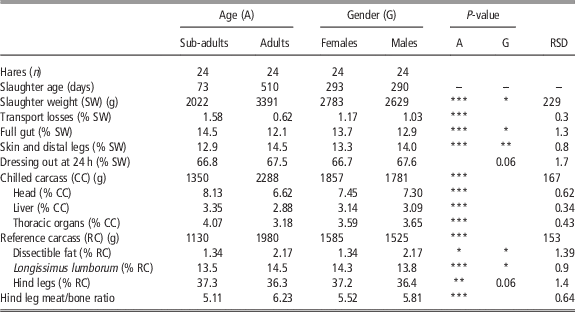
As expected, the live weight at slaughter and commercial carcass weight were significantly (P<0.001) lower in sub-adult hares compared with adult hares. No differences in dressing out percentages were measured because the full gut proportion was higher (+2.4 percentage points), and the skin and distal leg proportion lower (−1.6 percentage points) in the sub-adult hares compared with the adult hares (P<0.001) (Table 1). At dissection of the chilled carcass, the proportion of head, liver and thoracic organs decreased from the sub-adult to the adult hares (Table 1). At dissection of the reference carcass, the proportion of dissectible fat (P<0.05) and LL (P<0.001), and the meat-to-bone ratio of hind legs (P<0.001), increased with age, whereas the hind leg proportions decreased (P<0.01) (Table 1).
Effect of age and gender on slaughter traits and carcass quality in 24 h chilled carcasses of brown hares

*P⩽0.05, **P⩽0.01, ***P⩽0.001.
To our knowledge, there is no available data on the effect of age on carcass traits in hares. There are some data showing that when slaughter age increased, meat rabbits showed improved dressing out percentage, increased proportion of LL and decreased proportion of hind legs (Parigi-Bini et al., Reference Parigi-Bini, Xiccato, Cinetto and Dalle Zotte1992; Gondret et al., Reference Gondret, Juin, Mourot and Bonneau1998a; Hernández et al., Reference Hernández and Dalle Zotte2004), as found in the present trial. In black-tailed jack rabbits (Lepus californicus), the post-natal development of the locomotor system at the hind leg is achieved early and the hares are effective at escape when they reach only 20% of adult body size (Carrier, Reference Carrier1983). This fact may explain the higher hind leg proportion and the lower LL proportion that we observed in sub-adult hares compared with adult hares.
The average dressing percentage we measured in farmed hares was consistent with previous data recorded both in hunted (66.5%; Škrivanko et al., Reference Škrivanko, Hadziosmanovi, Cvrtila, Zdolec, Filipovic, Kozacinski, Florijancic and Boskovic2008) and farmed hares (62.8% to 68.3% in Vicenti et al., Reference Vicenti, Ragni, di Summa, Marsico and Vonghia2003; 63.7% to 66.9% in Vizzarri et al., Reference Vizzarri, Nardoia and Palazzo2014). In farmed hares slaughtered at 118 days and an average live weight of 2088 g, Vicenti et al. (Reference Vicenti, Ragni, di Summa, Marsico and Vonghia2003) found that hind legs accounted for 38.5% of reconstituted carcass, consistent with our results and loins for 18.65%. The lower value for loins observed in our trial depended on the different dissection method used by Vicenti et al. (Reference Vicenti, Ragni, di Summa, Marsico and Vonghia2003) that included bones. The average dressing out percentage was considerably higher in hares (67.2%) than in rabbits (55% to 61%), and similarly, the proportions of LL and hind legs were more favourable in the former than in the latter (Dalle Zotte, Reference Dalle Zotte2002; Xiccato et al., Reference Xiccato, Trocino, Filiou, Majolini, Tazzoli and Zuffellato2013).
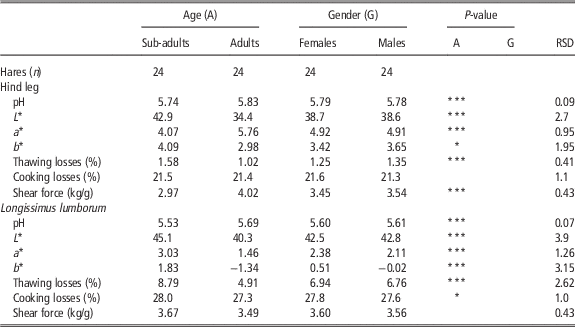
Concerning hare meat quality, all of the traits changed significantly according to age: meat pH raised both at BF (P<0.001) and LL (P<0.001), and L* index decreased (−8.5 units at hind leg and −4.8 units at LL; P<0.001). Conversely, Mertin et al. (Reference Mertin, Slamečka, Ondruška, Zaujec, Jurčík and Gašparík2012) did not report significant differences in meat lightness and final pH in young or old shot hares. In our trial, from sub-adult to adult hares, the yellow index decreased in the two cuts (−1.11 units and −3.17 units, respectively; P<0.05 and <0.001); the redness index increased at the hind leg (4.07 to 5.76; P<0.001), while it decreased at LL (3.03 to 1.46; P<0.001) (Table 2). The high redness value of hare meat likely depends upon hare muscle fibre characteristics, since their fast fibres have a biochemical and histochemical enzyme pattern typical of slow red muscles (Bass et al., Reference Bass, Gutmann, Melichna and Syrovy1973). Nevertheless, the differences in redness with age may be explained by the differentiation of muscle fibres during growth, similar to rabbits. Slow fibres (largely present at the hind leg) are already oxidative at birth and increase their oxidative metabolism during growth, thus increasing the redness of the meat index (Gondret et al., Reference Gondret, Mourot and Bonneau1998b). Otherwise, fast fibres (prevalent in LL) move from oxidative to glycolytic metabolism from birth until adult age, thereby reducing the redness index (Gondret et al., Reference Gondret, Mourot and Bonneau1998b).
Effect of age and gender on rheological traits of hind leg meat and Longissimus lumborum of brown hares

*P⩽0.05, **P⩽0.01, ***P⩽0.001.
In our study, the meat thawing losses (for hind leg and LL) and cooking losses (for LL) decreased from sub-adult to adult hares, whereas the shear force increased for hind leg meat (P<0.001) (Table 2), consistent with the changes in meat pH (Hulot and Ouhayoun, Reference Hulot and Ouhayoun1999). When age raises, the shear force may increase because of the change in protein quality and the increase and change in connective tissue. In a small set of hunted hares (eight young animals and four old animals), however, Slamecká et al. (Reference Slamecká, Palanská, Jurčík, Hell and Mojto1997) did not measure significant differences in collagen content according to hare age and found a decrease of meat shear force in older animals.
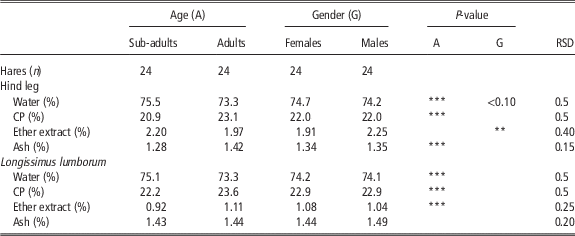
Concerning the effect of age on the meat chemical composition, water and protein contents of both hind leg and LL decreased (P<0.001) in the adult compared with the sub-adult hares (Table 3). Ether extract content was not affected at the hind leg, whereas it increased at LL even though it was in a very narrow range (Table 3). Other authors (Slamecká et al., Reference Slamecká, Palanská, Jurčík, Hell and Mojto1997; Mertin et al., Reference Mertin, Slamečka, Ondruška, Zaujec, Jurčík and Gašparík2012) did not find significant differences in the chemical composition of hunted hares according to their age. Differently, the fat content of LL in rabbits slaughtered at 11 and 18 weeks of age (Gondret et al., Reference Gondret, Mourot and Bonneau1998b) and the protein and fat contents of hind legs in rabbits slaughtered at 9 and 13 weeks of age (Hernández et al., Reference Hernández and Dalle Zotte2004) increased with age.
Effect of age and gender on chemical composition of hind leg meat and Longissimus lumborum of brown hares

*P⩽0.05, **P⩽0.01, ***P⩽0.001.
On average, in our trial, hare meat exhibited 74.3% water, high crude protein content (22% and 23% in hind leg and LL, respectively), and low ether extract content (2.1% and 1.0% in hind leg and LL, respectively), with ash content averaging 1.35% in the hind leg and 1.44% in LL (Table 3). These values are consistent with previous reports by Škrivanko et al. (Reference Škrivanko, Hadziosmanovi, Cvrtila, Zdolec, Filipovic, Kozacinski, Florijancic and Boskovic2008) in hunted hares (water: 75.3%; protein: 23.2%; ether extract: 1.12%; ash: 1.16%).
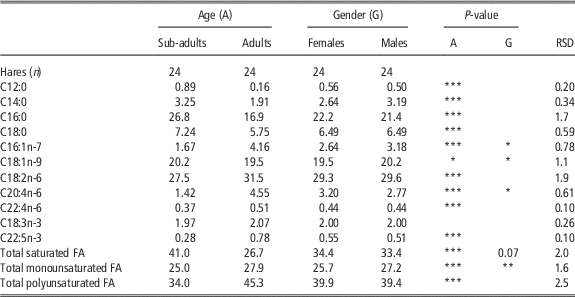
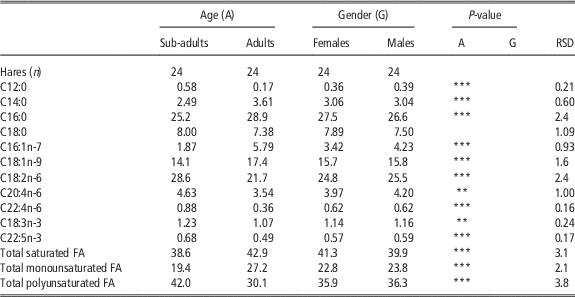
In our trial, the fatty acid composition was also significantly affected by hare age with a different pattern in the two cuts: in the case of the hind leg, the rate of saturated fatty acids (SFA) decreased (P<0.001), whereas the rates of monounsaturated fatty acids (MUFA) and polyunsaturated fatty acids (PUFA) increased (P<0.001) from sub-adult to adult hares (Table 4); in the case of LL, the rates of SFA (P<0.001) and MUFA (P<0.001) increased, whereas the rate of PUFA decreased (P<0.001) (Table 5). The differences in muscle fibres between the two cuts and the differentiation of muscle fibres with age likely accounted for these results. In fact, lipids within slow and oxidative fibres (hind leg muscles) are generally less saturated than those within fast and glycolytic fibres (LL) (Alasnier et al., Reference Alasnier, Rémignon and Gandemer1996; Realini et al., Reference Realini, Pérez-Juan, Gou, Díaz, Sárraga, Gatellier and García-Regueiro2013). As observed by Gondret et al. (Reference Gondret, Mourot and Bonneau1998b), in rabbits, from sub-adult to adult hares, the differentiation of slow fibre muscles towards oxidative metabolism and of fast fibre muscles towards glycolytic metabolism determined the corresponding changes in FAs composition at the hind leg and LL. However, in rabbits from 35 to 90 days of age, other authors have observed that the FAs composition of total intramuscular lipid and phospholipids changed coherently in loins and hind legs muscles (Xue et al., Reference Xue, He, Lu, Tao, Zheng, Xie, Xiao, Peng and Li2015). Further studies on the characterization, biochemical and histochemical enzyme patterns of muscle fibres in hares would be necessary to clarify our results and differences with rabbits.
Effect of age and gender on fatty acid (FA) profile (% total FAs) of hind leg meat of brown hares

*P⩽0.05, ***P⩽0.001.
Effect of age and gender on fatty acid (FA) profile (% total FAs) of Longissimus lumborum of brown hares

**P⩽0.01, ***P⩽0.001.
A few studies on the fatty acid profile of hare meat are available that have evaluated the effect of diets, the rearing system and gender in farmed hares (Vicenti et al., Reference Vicenti, Ragni, di Summa, Marsico and Vonghia2003; Vizzarri et al., Reference Vizzarri, Nardoia and Palazzo2014). Literature data are consistent with those recorded in the present trial and show the prevalence of unsaturated fatty acids (ranging from an average value of 57.3% to 65.7% total FAs in Vizzarri et al., Reference Vizzarri, Nardoia and Palazzo2014 and Vicenti et al., Reference Vicenti, Ragni, di Summa, Marsico and Vonghia2003, respectively) over SFA (ranging from 42.7% to 32.3% total FAs), with also a large variability in the rate between PUFA and MUFA. This variability likely depends upon the cuts analysed in the two studies (homogenized meat from hind legs, loin and lean part in Vicenti et al., Reference Vicenti, Ragni, di Summa, Marsico and Vonghia2003; only LL in Vizzarri et al., Reference Vizzarri, Nardoia and Palazzo2014) as well as upon the FAs composition of diets fed to hares in the different studies. As in our trial, Vicenti et al. (Reference Vicenti, Ragni, di Summa, Marsico and Vonghia2003) found that C16:0 (on average 19.8% total FAs) and C18:0 (11.0% total FAs) among SFA, C18:1n-9 (12.3% total FAs) among MUFA, and 18:2n-6 (34.7% total FAs) and C20:4n-6 (8.4% total FAs) among PUFA, were the most represented FAs. These latter authors also found that the activity level of hares in different housing systems affected the SFA (lower in pens than in cages) and MUFA (higher in cages than in pens) rates. The FA profile of hare meat is also consistent with that measured in rabbits for the main FA classes (SFA, MUFA, PUFA, n-3 PUFA, n-6 PUFA) and single FA (Hernández and Dalle Zotte, Reference Hernández, Aliaga, Pla and Blasco2010).
Effect of gender
Gender affected slaughter results and carcass traits (Table 1), whereas rheological meat quality traits were similar in the two genders (Table 2). In details, the females were heavier (P<0.05), showed higher full gut (P<0.05), lower skin and distal legs proportions (P<0.01), and lower dressing out percentage (P=0.06) than the males (Table 1). At the dissection of reference carcasses, the females exhibited lower dissectible fat (P<0.05) and higher LL and hind legs proportion (P=0.06) than the males (Table 1). Finally, meat rheological traits were not affected by gender (Table 2), whereas females showed lower meat ether extract content at the hind leg (P<0.01) (Table 3). Similarly, differences in FA composition were limited to a lower monounsaturated FA content (P<0.01) in meat hind leg of the females compared with the males (Tables 4 and 5).
A few literature data are available about the effect of gender in brown hares and have not reported any differences in slaughtering data or carcass dissection between females and males slaughtered at 118 days of age (Vicenti et al., Reference Vicenti, Ragni, di Summa, Marsico and Vonghia2003). In fact, in the wild, male and female hares (Lepus europaeus) are not distinguishable on the base of their weight or body traits (Trocchi and Riga, Reference Trocchi and Riga2005). Otherwise, the hare BW is affected by individual, geographical and seasonal factors (with a reduction of fat depots during the reproductive season in both genders and an increase during autumn), in addition to their health status (Trocchi and Riga, Reference Trocchi and Riga2005). On the other hand, despite the genetic variability of the different crossbreeds (Pla et al., Reference Pla, Guerrero, Guardia, Oliver and Blasco1998), in growing rabbits at commercial slaughter, the final live weight is usually lower and dressing out percentage less favourable in females than in males because of the higher full gut proportion in the former than in the latter ones (Parigi-Bini et al., Reference Parigi-Bini, Xiccato, Cinetto and Dalle Zotte1992; Petracci et al., Reference Petracci, Capozzi, Cavani, Cremonini and Minelli1999; Trocino et al., Reference Trocino, Xiccato, Queaque and Sartori2003; Lazzaroni et al., Reference Lazzaroni, Biagini and Lussiana2009).
In hares, other authors did not find significant differences in meat rheological traits (Tărnăuceanu et al., Reference Tărnăuceanu (Frunză), Pop and Boişteanu2015), protein and fat contents (Slamečka et al., Reference Slamecká, Palanská, Jurčík, Hell and Mojto1997; Vicenti et al., Reference Vicenti, Ragni, di Summa, Marsico and Vonghia2003; Mertin et al., Reference Mertin, Slamečka, Ondruška, Zaujec, Jurčík and Gašparík2012) or FA profile (Vicenti et al., Reference Vicenti, Ragni, di Summa, Marsico and Vonghia2003) according to gender. In farmed rabbits, some minor differences in meat colour were reported between males and females (Carrilho et al., Reference Carrilho, Campo, Olleta, Beltrán and López2009; Lazzaroni et al., Reference Lazzaroni, Biagini and Lussiana2009, whereas water losses during storage or cooking showed similar results (Petracci et al., Reference Petracci, Capozzi, Cavani, Cremonini and Minelli1999).
Conclusion
Farmed hares may be used for meat production because of their favourable slaughter results (high dressing percentage) and carcass traits (high proportion in hind legs and loins), as well as the high nutritional value of meat and favourable FA composition. Among ontogenetic factors, the increase in age improves both the slaughter results and carcass quality, even if meat tenderness decreases in adult hares compared to sub-adult ones. Gender affected only slaughter results and carcass traits. A sensorial evaluation of hare meat quality would be necessary to complete the evaluation of hare meat from the consumer’s perspective.
Acknowledgements
This study was funded by Veneto Region (PSR 2007-2013 Mis. 124 – Reg. CE 1698/2005 – DGR 1604 31/07/2012) (CUP: C58C12000240002).