Introduction
Arthropods are popular target organisms in environmental assessment studies (Kremen et al. Reference Kremen, Colwell, Erwin, Murphy, Noss and Sanjayan1993; McGeoch Reference McGeoch1998; Taylor and Doran Reference Taylor and Doran2001; Langor and Spence Reference Langor and Spence2006). However, the natural history and habitat associations of most species remain poorly known, reducing capacity to provide a clear species-level picture of biodiversity variation on the scale of natural landscapes and in a way that parallels normal expectations for work with vertebrates. A crucial step towards such knowledge is to combine the results of local studies assessing species distribution in different habitats with the broader literature about natural history to provide the most complete information possible about all species considered, including those that are uncommon, locally restricted, and most in need of high priority attention (Nichols and Williams Reference Nichols and Williams2006). In biodiversity monitoring, using species as working unit, instead of morphospecies or lower taxonomical resolution, supports development of relevant ecological knowledge that may be effectively used in applied conservation strategies, and provides more accurate and comparable analyses of biodiversity patterns in terms of species richness and composition (Spence et al. Reference Spence, Langor, Jacobs, Work and Volney2008). Identification to species level also allows comparison of conservation status with wider historical and geographical accounts. Without such data it is difficult to assess subtle change and biodiversity monitoring is somewhat pointless as a preemptive conservation strategy.
McGeoch (Reference McGeoch1998) and Jonsson and Jonsell (Reference Jonsson and Jonsell1999) suggest that combining data about many taxa yields a more accurate representation of the environment, and therefore provides more sensitive indicator value. Because the ecological niche of some species may overlap, studying a wide range of taxa at the species and higher taxonomical levels provides more opportunities for ecological complementarity in species assemblages. In a pooled analysis of carabid beetles, staphylinid beetles, and spiders, for example, Buddle et al. (Reference Buddle, Langor, Pohl and Spence2006) found clearer patterns of arthropod response to disturbance than in singular considerations of each taxon. Thus, in order to support conservation strategies and biodiversity monitoring, it seems useful to identify indicator species from these three taxa.
Populations of these ground-dwelling arthropod taxa are easily and simultaneously well sampled using pitfall traps (Marshall et al. Reference Marshall, Anderson, Roughley, Behan-Pelletier and Danks1994), making them especially appealing as operational indicators of ecosystem response. Furthermore, these three taxa comprise a high proportion of epigaeic biodiversity in northern ecosystems. Epigaeic organisms are an excellent choice to monitor system recovery after disturbance because ground and litter habitats of some sort remain, even after the most severe disturbances. Thus, the response of epigaeic arthropods, including both specialist and generalist taxa (Niemelä et al. Reference Niemelä, Langor and Spence1993), can be studied across any gradient of broad habitat change.
Useful association of ground-dwelling arthropod assemblages with different habitat types requires special attention to the sampling technique employed (Spence et al. Reference Spence, Langor, Jacobs, Work and Volney2008). Pitfall traps, despite being well suited and widely employed for sampling epigaeic arthropods, provide biased estimates of species composition and population sizes because rate of capture depends on behaviour that varies among species, sexes, life history stages, physiological states, and habitat conditions (Greenslade Reference Greenslade1964; Uetz and Unzicker Reference Uetz and Unzicker1976; Adis Reference Adis1979; Topping and Sunderland Reference Topping and Sunderland1992; Spence and Niemelä Reference Spence and Niemelä1994; Esch et al. Reference Esch, Jacobs, Bergeron and Spence2008). Overall, pitfall catches yield a measure representing some combination of animal activity and population density (Thiele Reference Thiele1977; Franke et al. Reference Franke, Friebe and Beck1988). In addition to intrinsic trap and species specific factors (Luff Reference Luff1975; Waage Reference Waage1985; Halsall and Wratten, Reference Halsall and Wratten1988; Morill et al. Reference Morrill, Lester and Wrona1990; Lemieux and Lindgren Reference Lemieux and Lindgren1999; Work et al. Reference Work, Buddle, Korinus and Spence2002; Koivula et al. Reference Koivula, Kotze, Hiisivuori and Rita2003), stand characteristics such as canopy openness (temperature, moisture; Briggs Reference Briggs1961; Honek Reference Honek1997; Esch et al. Reference Esch, Jacobs, Bergeron and Spence2008), vegetation structure (Greenslade Reference Greenslade1964; Koivula et al. Reference Koivula, Kotze, Hiisivuori and Rita2003; Phillips and Cobb Reference Phillips and Cobb2005), and forest floor characteristics (Greenslade Reference Greenslade1964) may all affect the catch of arthropods at the individual and species level.
Although largely unstudied, variation in trap placement affects which exact level of the forest floor is sampled. The organic soil layer (LFH horizons in the Canadian Soil Information System; Agriculture Canada Expert Committee on Soil Survey 1983) of coniferous, mixed, or broadleaved deciduous stands is characterised by quite different surface litter layers, originating from accumulation of curled leaves or needles, combined with feather mosses or sphagnum in lowlands. Such variation in organic soil layer provides different microhabitats for prey items, refuges from predators, and microclimatic variation that may drive differential behaviour of ground-dwelling arthropods and composition of their assemblages. Furthermore, the three-dimensional structure of the organic soil layer provides habitats beneath the surface in certain stands and thus trap depth may alter pitfall trap catches. This particular problem has not been addressed, even though it may influence attempts to establish associations between ground-dwelling arthropods and ecological land classification systems.
In this study, we simultaneously investigated habitat associations of ground-dwelling spiders (Araneae), staphylinid beetles (Coleoptera: Staphylinidae), and carabid beetles (Coleoptera: Carabidae) in three different forest habitats. We first considered differences in number of species and individuals among different stand types, and then further examined arthropod species-level associations within these habitats by comparing our results with studies conducted more broadly in the boreal forest. We also studied the effect of pitfall trap depth on catch by comparing assemblages from traps with the upper lip at the surface of the organic soil with those having the lip situated at the top of the mineral soil.
Methods
Study area
The study was conducted at the Ecosystem Management Natural Disturbance (EMEND; Spence et al. Reference Spence, Volney, Lieffers, Weber, Luchkow and Vinge1999) research site in the boreal forest of northwestern Alberta, Canada. The study area is located in the Lower Foothills forest region on the border of the mixedwood forest region (Rowe Reference Rowe1972). The forest communities of the Lower Foothills natural subregion reflect the transition between the boreal mixedwood forest and the Rocky Mountain cordilleran ecosystem. Upland forest at EMEND is dominated by a mixture of Picea glauca (Moench) Voss (Pinaceae), Populus tremuloides Michaux (Salicaceae), and Populus balsamifera Linnaeus (Salicaceae) and the poorly drained sites by Picea mariana (Miller) Britton, Sterns, and Poggenburg (Pinaceae) and Larix laricina (Du Roi) Koch (Pinaceae). In this subregion, the ecosystem classification scheme developed by Beckingham et al. (Reference Beckingham, Corns and Archibald1996) employs 14 types of ecosites based on soil nutrients and drainage characteristics, and subdivides these ecosites into 30 ecosite phases based on canopy cover. A number of understorey plant community types are also associated with this classification system. However, despite work with a few carabid beetle species (Bergeron et al. Reference Bergeron, Blanchet, Spence and Volney2012), there is no well-integrated information about association of arthropods with any of these ecosystem classes.
The forest habitats types selected for this study comprise three ecosite phases as described by Beckingham et al. (Reference Beckingham, Corns and Archibald1996): low bush cranberry (Vaccinium oxycoccos Linnaeus; Ericaceae)-aspen dominated (e4; canopy cover >80% P. tremuloides), low bush cranberry-white spruce dominated (e2; canopy cover >80% P. glauca), and tree bog (k1; canopy cover >80% P. mariana). We selected these three ecosite phases (e4, e2, and k1), drawn from two ecosites (low bush cranberry (e) and bog (k)), in order to investigate whether data about arthropod assemblages reflects the hierarchical nature of the classification system. The low bush cranberry ecosite is the reference site for the Lower Foothills subregion and typically has a mesic moisture regime and a medium nutrient regime (Beckingham et al. Reference Beckingham, Corns and Archibald1996). The bog ecosite develops thick organic soils composed of slowly decomposing peat. It is characterised by poor nutrient regimes and drainage (Beckingham et al. Reference Beckingham, Corns and Archibald1996). The location of ecosite phases across the study sites at EMEND was obtained from a map generated by Nielsen et al. (Reference Nielsen, Coenen and Beckingham1999).
Sampling design
Three replicated groups of six pitfall traps were installed in each of the three ecosite phases designated above, for a total of 54 traps spread over nine sites. Each trap was a plastic cup with an opening diameter of 11 cm and a depth of 13 cm, containing a plastic inner cup and a wooden roof supported over the trap by two large nails driven through opposite corners (see Spence and Niemelä Reference Spence and Niemelä1994). A 2 × 3 grid of six traps was laid in the ground at each site with an inter-trap distance of 5 m. Three randomly chosen traps were positioned in the grid with the lip flush with the forest floor (hereafter called surface traps) and the remaining three were set deeper, with the lip at the mineral soil level (hereafter called deep traps). Deep traps were set between 15 and 25 cm below the surface in ecosites e2 and e4 and between 20 and 25 cm below the forest floor surface in ecosite k1. Most black spruce sites (k1) had more than a metre of vertical sphagnum accumulation, but the deep traps were set higher in order to position them above the water table. About 150 mL Ethylene glycol (GM Dex-Cool®, Danbury, Connecticut, United States of America) was added to each trap as a preservative and traps were serviced every third week between 24 May and 20 August 2005, giving a total of 89 trapping days. Replicates were located at least 4 km from each other and the three sites within replicates were <1 km apart to minimise concern about spatial effects.
Specimens were collected by decanting the trap contents into a piece of cheese cloth in the field. Carabids, staphylinids, and spiders were subsequently sorted from the samples and identified to species in the laboratory. Aleocharinae (Coleoptera: Staphylinidae) (excluding specimens from the genus Lypoglossa Fenyes) could not be identified to the species level, given the time and resource constraints of this study. Thus, the 215 individuals placed in this subfamily were not considered in the following analyses. Voucher specimens are deposited in the Invertebrate Ecology Laboratory (Department of Renewable Resources, University of Alberta, Edmonton, Alberta, Canada) collection for further reference.
Statistical analysis
Data about abundances and number of species were pooled from the three traps run at the same depth in each site. These numbers were divided by the total number of trap days for these particular traps to adjust the data for differences in sampling effort resulting from trap disturbance. The following analyses were computed using R 2.15.0 (R Development Core Team 2012) using functions developed by authors as cited below.
Composition of ground-dwelling arthropod assemblages was compared among habitat types and between trap depths using a canonical analysis of principal coordinate (CAP) ordination (Anderson and Willis Reference Anderson and Willis2003) calculated using the function “capscale” from the vegan package for R (Oksanen et al. Reference Oksanen, Blanchet, Kindt, Lanegendre and O'Hara2012). The Bray–Curtis dissimilarity measure was used to build the dissimilarity matrix.
A permutation test for constrained analysis of principal coordinates (perCAP), calculated using the “anova.cca” function from the vegan package for R (Oksanen et al. Reference Oksanen, Blanchet, Kindt, Lanegendre and O'Hara2012), was used to assess differences in arthropod composition among habitats, trap depth and the interaction between these two factors. Each test was based on 4999 permutations. PerCAP was conducted on the three taxa separately as well as on the pooled data.
In order to evaluate potential effects of habitat and trap depth on the number of individuals and species, a two factorial permutational analysis of variance (ANOVA) (Anderson and Legendre Reference Anderson and Legendre1999) was performed on each taxon separately, as well as on the pooled data for all three taxa using the standardised data as described in the first paragraph of the “statistical analysis” section. Because estimates of species richness are sensitive to sample size (Buddle et al. Reference Buddle, Beguin, Bolduc, Mercado, Sackett and Duncan Selby2005), species richness was compared among depths, habitats, and taxa, using individual-based rarefaction curves (Simberloff Reference Simberloff1979). Individual-based rarefaction was preferred because we asked if the differential number of individuals collected with a balanced sampling design within each categories (taxa, trap depth, and habitat) had an effect on the number of species. Furthermore, the traps within each site could not be considered as strictly independent (they were installed 5 m apart; see Digweed et al. Reference Digweed, Currie, Carcamo and Spence1995). A sample based rarefaction using the site as sampling unit would preserve the bias induced by differential sampling effort related to trap disturbance, yielding an inaccurate representation of species accumulation as a function of the number of sites. This analysis, calculated using the function “rarefaction” (Jacobs Reference Jacobs2012), was based on the raw data as the goal is to standardise the number of species by the number of individuals collected.
Species-specific associations with habitat types and trap depths were investigated through indicator species analysis (Dufrêne and Legendre Reference Dufrêne and Legendre1997) using the “indval” function from the labdsv package for R (Roberts Reference Roberts2012). The probability of obtaining an indicator value as high as the observed one after randomisation of sites between groups was calculated using 999 permutations. Species with a probability <0.05 were considered significant indicators.
Results
Taxa
A total of 1740 adult individuals belonging to 101 species of the Carabidae (n = 454, 16 species), Staphylinidae (n = 1042, 40 species), or Araneae (n = 244, 45 species) were collected, identified, and subjected to analysis (Supplementary Appendix 1, available at http://dx.doi.org/10.4039/tce.2013.38). Comparison of rarefaction estimates revealed that among these three groups, spiders had the highest species richness when standardised for the number of individuals sampled. The rarefaction curves clearly reached asymptotes for carabid and staphylinid beetles but the accumulation rate for spider species remained high, even at the maximum sample size (Fig. 1).
Individual-based rarefaction for three arthropod taxa sampled by pitfall traps in the boreal mixedwood forest.

Habitat
The assemblages of ground-dwelling arthropods from the three habitat types were quite distinctive with respect to species composition (Fig. 2), and these differences were significant when assessed using a perCAP analysis (P < 0.001; Table 1). Furthermore, centroids of the samples from habitat groups classified as the same ecosite (low bush cranberry Aw (e2) and low bush cranberry Sw (e4)) were closer in ordination space than either was to the tree bog ecosite (k1).
Canonical Analysis of Principal (CAP) coordinates ordination of 18 sites sampled for forest dwelling arthropods in three habitats of the boreal mixedwood forest. Circles: low bush cranberry aspen dominated (aspen; e2), triangles: low bush cranberry white spruce dominated (white spruce; e4), squares: treed bog black spruce dominated (black spruce; k1), empty symbols: deep traps, filled symbols: surface traps, cross: centroids of each habitat. The codes correspond to the ecophase according to Beckingham et al. (Reference Beckingham, Corns and Archibald1996).
F and P values of the permutation test for constrained analysis of principal coordinates calculated for habitat, depth, and the interaction.

Note: *Significant value.
df, degree of freedom; res, residuals.
Overall, consistently fewer individuals and species were collected at both depths (analysis of depth effects below) in black spruce stands than in aspen and white spruce stands (Figs. 3, 4). Separate analyses for carabid and staphylinid beetles showed the same pattern as did the overall assemblages but no differences were found among habitats for either the number of individuals or species of spiders (Figs. 3, 4). On average, carabid beetles were more abundant in white spruce forests, while staphylinid beetles were more abundant in aspen forest (Fig. 3), but this pattern was less apparent in the data about species richness (Fig. 4). The fewest individuals and species were collected in black spruce stands, but rarefaction shows that the tree bogs had the highest species richness, when adjusted for sample size at 245 individuals (Fig. 5), presumably because this habitat was more poorly sampled by pitfall traps.
Average number of individuals caught per trapping day among habitats and trap depth. P values for habitat, trap depth, and the interaction after permutational ANOVA are given. *P < 0.05, **P < 0.01, ***P < 0.001. S, surface trap; D, deep trap; Aw, low bush cranberry aspen dominated; Sb, treed bog black spruce dominated; Sw, low bush cranberry white spruce dominated.
Average number of species caught per trapping day among habitats and trap depth. P values for habitat, trap depth, and the interaction after permutational ANOVA are given. *P < 0.05, **P < 0.01, ***P < 0.001. S, surface trap; D, deep trap; Aw, low bush cranberry aspen dominated; Sb, treed bog black spruce dominated; Sw, low bush cranberry white spruce dominated.
Individual-based rarefaction for the three habitats studied. Black spruce: treed bog black spruce dominated, white spruce: low bush cranberry white spruce dominated, aspen: low bush cranberry aspen dominated. The codes correspond to the ecophase according to Beckingham et al. (Reference Beckingham, Corns and Archibald1996).
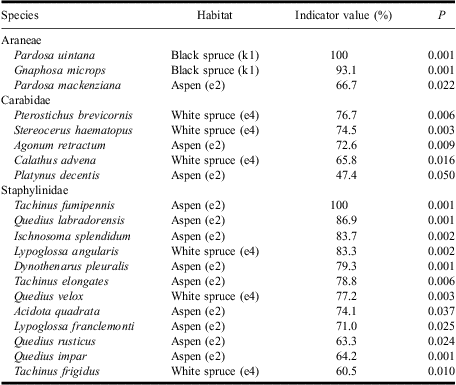
Of the 101 species identified, 20 (12 staphylinid beetles, five carabid beetles, and three spiders) had significant indicator value for one of the three habitats sampled (Table 2). Twelve indicator species were associated with aspen forest, six with white spruce forest, and two with black spruce forest. Species from all three taxa were indicators of aspen stands but only spider species were indicators of black spruce stands. The 12 species indicating the aspen-dominated ecosite phase included nine staphylinid beetles, two carabid beetles, and one spider. Three staphylinid beetles and three carabid beetles were significant indicators of the white spruce-dominated ecosite phase.
Taxa having a significant affinity for certain habitat according to indicator species analysis.
Note: Code for habitat type as in Beckingham et al. (Reference Beckingham, Corns and Archibald1996).
Trap depth
There was no statistically significant overall effect of trap depth on beetle assemblages when using multivariate procedures, suggesting that most species sampled were largely epigaeic, with their main activity on the surface of the forest floor (i.e., capture of organisms using lower soil layers did not influence catch of deep traps to the point of yielding different species assemblages). CAP ordination (Fig. 2) did not clearly separate the arthropod assemblages collected in surface and deep traps, even when compared within habitat. Furthermore, trap depth did not significantly affect assemblage composition in the perCAP analysis (Table 1).
The overall number of individuals captured was not consistently affected by the depth at which the trap was installed. However, the interaction of habitat and depth did significantly affect trap captures (permutational ANOVA all taxa, P = 0.02, F (2,12) = 5.33; Fig. 3). The surface traps in aspen understorey collected more individuals than did deep traps, but this pattern was reversed in white spruce habitat. Staphylinid beetles were captured more frequently in surface traps of the aspen stands and spiders were the only taxa consistently collected in higher number in the surface traps of all habitats (Fig. 3). Across all habitats, surface traps collected more species than deep traps but when looking at the taxa separately, this pattern was significant only for spiders (Fig. 4).
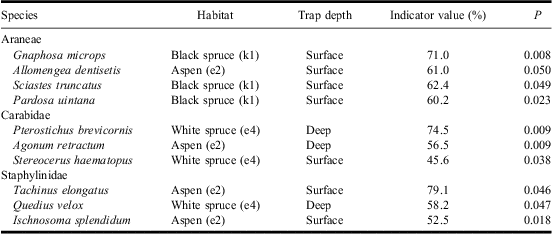
No species were significant indicators of the depth at which pitfall traps were installed (i.e., surface versus deep). However, 10 species were indicators of a certain trap depth within a specific habitat. Three beetle species, two carabids and one staphylinid, significantly indicated deep traps (Table 3). These species are Agonum retractum LeConte (Carabidae) in aspen forest, and Pterostichus brevicornis (Kirby) (Carabidae) and Quedius velox Smetana (Staphylinidae) in white spruce forest. As listed in Table 3, one carabid species indicated surface traps in white spruce forest, two staphylinid species in aspen forest, two spider species in black spruce forest, and one spider species in aspen forest.
Taxa having a significant affinity for certain trap depth according to indicator species analysis.
Note: Code for habitat type as in Beckingham et al. (Reference Beckingham, Corns and Archibald1996)
Discussion
Habitat
Pitfall catches of the dominant taxa of litter dwelling arthropods varied among forested habitats in parallel to the ecosite classification system as applied to the Lower Foothills Ecoregion (Fig. 2, Table 1). The arthropod community further reflected the hierarchical nature of the classification system by grouping the habitats (ecosite phases) belonging to the same ecosite more closely than to the habitat belonging to a different ecosite. The moisture-nutrient gradient used to define the different ecological classes (ecosites) in Beckingham et al. (Reference Beckingham, Corns and Archibald1996) and the further refinement into ecosite phases based on canopy cover thus provide a reasonable surrogate for describing ground-dwelling arthropod assemblages.
Use of the Canadian Forest Ecosystem Classification (CFEC) as habitat-based surrogate for arthropod associations may be advantageous because this system is becoming a standard for forested land classification in Canada and is becoming widely used in land management (Natural Resources Canada 2006). Similar land classification systems are being developed and used in forest ecosystem management elsewhere (e.g., United States: Comer et al. Reference Comer, Faber-Langendoen, Evans, Gawler, Josse and Kittel2003; United Kingdom: Pyatt et al. Reference Pyatt, Ray and Fletcher2001; Germany: Barnes Reference Barnes1984; Russia: Gaston et al. Reference Gaston, Bradley, Vinson and Kolchugina1997; Northwestern Europe: Ahti et al. Reference Ahti, Hämet-Ahti and Jalas1968) and emerging international effort will soon provide a way to consistently use this tool for biodiversity conservation in forest management across the world (Grossman et al. Reference Grossman, Faber-Langendoen, Weakley, Anderson, Bourgeron and Crawford1998; Olson et al. Reference Olson, Dinerstein, Wikramanayake, Burgess, Powell and Underwood2001; Rodwell et al. Reference Rodwell, Schaminee, Mucina, Pignatti, Dring and Moss2002). The close association observed between arthropod assemblages and the CFEC supports an important step towards developing strategy to facilitate widespread, efficient and effective biomonitoring (Langor and Spence Reference Langor and Spence2006; Spence et al. Reference Spence, Langor, Jacobs, Work and Volney2008; Bergeron et al. Reference Bergeron, Blanchet, Spence and Volney2012). Our results reinforce the idea that such biodiversity “surrogates” can provide a framework for a coarse filter approach to conservation in forested land management.
Interestingly, despite the fact that effect of habitat on species assemblages was significant for each separate taxon (Table 1), only two spider species were indicators of the black spruce-dominated tree bogs (Table 2). Furthermore, analysis of the number of species and individuals (Figs. 3, 4) suggest that spiders react differently to habitat characteristics than do carabid and staphylinid beetles. Using ecologically complementary indicator taxa in environmental assessment may reveal patterns that are hidden with use of only one focal taxon (Buddle et al. Reference Buddle, Langor, Pohl and Spence2006). Thus, using a wide range of indicator taxa in biodiversity monitoring is essential to more completely and accurately understand biodiversity response to environmental changes. Based on these and other related findings (e.g., Buddle et al. Reference Buddle, Langor, Pohl and Spence2006), we conclude that a wider range of indicator taxa will give a more robust representation of biodiversity as is appropriate for monitoring programmes, especially when sampling effort is limited because of extraneous factors.
The low individual and species abundance of arthropods in the black spruce lowland forest (tree bog ecosite phase; k1) when compared with that in the low bush cranberry aspen (e2) and white spruce (e4) ecosite phases was also noted for carabid beetles by Langor et al. (Reference Langor, Pohl and Hammond2006) in corresponding ecosite phases of the Upper Foothills natural subregion. Other studies about habitat associations of arthropods in boreal forests have also noted fewer individuals and species of Carabidae in black spruce forests compared with deciduous forest (Niemelä et al. Reference Niemelä, Spence and Spence1992; Pearce et al. Reference Pearce, Venier, McKee, Pedlar and McKenny2003). Niemelä (Reference Niemelä1993) suggested that coniferous boreal forest is a less suitable environment for carabid beetles. The acidity, high water table, absence of mineral soils, and low decomposition rate in black spruce-dominated peatlands (Vitt Reference Vitt1994) further increase the adversity of these sites for ground-dwelling beetles. In their review of insect biodiversity in boreal peat bogs, Spitzer and Danks (Reference Spitzer and Danks2006) also mentioned that bog arthropod faunas are generally composed of species also performing well in adverse environments such as arctic, subarctic, or alpine ecosystems.
Although fewer individuals and species were collected in the tree bog compared with other ecosite phases, it does not mean that this ecosite phase is of lower importance for biodiversity. When correcting species richness for the sample size using rarefaction, in fact, this forest habitat type has the most diverse fauna (Fig. 5, see also Langor et al. Reference Langor, Pohl and Hammond2006). Even if this ecosite is not directly targeted for forest harvest in western Canada, it is indirectly affected by harvesting through effects on the water table that influence biodiversity. Black spruce bogs are also under pressure from mineral exploration, management of beaver dams, and oil sands extraction in Alberta. Because biodiversity is a landscape feature, it is important to monitor biodiversity in ecosites that are not directly affected by disturbances of particular interest, such as forest harvesting. In our study, this pattern of lower abundance and species richness in bogs held for carabid and staphylinid beetles but not for spiders.
Spiders
We collected as many species and individuals of spiders in the black spruce-dominated site as in the upland sites dominated by either aspen or white spruce (Figs. 3, 4). Many ground-dwelling beetles rely on the presence of soil for hibernation, oviposition, and larval and pupal development (Thiele Reference Thiele1977) and, during these more immobile stages (Loveï and Sunderland Reference Loveï and Sunderland1996) they are subject to frequent flooding and freezing of the high water table in the tree bog. In contrast, spiders of the common forest-dwelling family Lycosidae (wolf spiders) carry their eggs and juveniles, and can therefore avoid effects of frequent water table rises. Young spiders are active and also capable of ballooning (Decae Reference Decae1987), behavioural traits that may reduce mortality related to flooding. Wolf spiders clearly dominated the black spruce lowland forest community (over 51% of the spider individuals) in this study, while they accounted for a smaller percentage of individuals captured in aspen (13.6%) and white spruce (2%) stands. Both Uetz (Reference Uetz1976) and Pearce et al. (Reference Pearce, Venier, Eccles, Pedlar and McKenny2004) also remarked that wolf spiders frequently dominate in areas subject to flooding. Lycosid spiders, thus, use a niche that other litter dwelling predatory arthropods caught in pitfall traps less readily occupy.
Only two spider species (Pardosa uintana Gertsch (Araneae: Lycosidae) and Gnaphosa microps Holm (Araneae: Gnaphosidae)) were significant indicators of the bog ecosite dominated by black spruce (Table 2). Pardosa uintana has been previously recorded in spruce-fir forests, sphagnum bogs, lichen mats, alpine tundra, and harvested coniferous forest (Dondale and Redner Reference Dondale and Redner1990; Pearce et al. Reference Pearce, Venier, Eccles, Pedlar and McKenny2004; Work et al. Reference Work, Shorthouse, Spence, Volney and Langor2004; Pinzon et al. Reference Pinzon, Spence and Langor2011, Reference Pinzon, Spence and Langor2012). Buddle et al. (2000, 2006) found P. uintana in recently burned deciduous stands but suggested that the species recolonised the stand from a nearby patch of wet coniferous forest. The habitat of G. microps is described as characteristic of willow thickets, under stones, in moss, meadows, and moors (Platnick and Dondale Reference Platnick and Dondale1992) and previous authors have noted its affinities for wet environments with thick moss/lichen layer, such as peatlands, arctic-alpine tundra, and many white spruce stands (Aitchison-Benell Reference Aitchison-Benell1994; Koponen Reference Koponen1994; Pinzon et al. Reference Pinzon, Spence and Langor2012). Another lycosid, Pardosa hyperborea (Thorell) (Araneae: Lycosidae) (Supplementary Appendix 1), although uncommon, was collected only from the tree bog in our study and has been previously associated with coniferous forest, peatlands, bog, tundra environment, and harvested conifer forest (Dondale and Redner Reference Dondale and Redner1990; Aitchison-Benell Reference Aitchison-Benell1994; Nordstrom and Buckle Reference Nordstrom and Buckle2002; Pinzon et al. Reference Pinzon, Spence and Langor2011, Reference Pinzon, Spence and Langor2012). Koponen (Reference Koponen1994) noted that both G. microps and P. hyperborea are northern species found mainly in bogs in more southern localities, a phenomena also characterising other species inhabiting peat bogs (Spitzer and Danks Reference Spitzer and Danks2006). Koponen (Reference Koponen1987) suggested that these open bog habitats offer more favourable microclimate on sunny days or that prey availability is more suitable for particular species. Trees in bog ecosites are generally smaller and more sparsely distributed than in the low bush cranberry ecosite and this allows more light to reach the ground and more opportunity for the wolf spiders to regulate temperatures experienced by their eggs.
Pardosa mackenziana (Keyserling) (Araneae: Lycosidae), significantly indicated the low bush cranberry aspen-dominated ecosite (Table 2). This species is among the commonest spiders of the Canadian boreal forest (Pearce et al. Reference Pearce, Venier, Eccles, Pedlar and McKenny2004; Work et al. Reference Work, Shorthouse, Spence, Volney and Langor2004; Pinzon et al. Reference Pinzon, Spence and Langor2011, Reference Pinzon, Spence and Langor2012) and may be found in many different habitats such as salt marshes, beaches, and deciduous forest (Lowrie Reference Lowrie1973; Dondale and Redner Reference Dondale and Redner1990; Buddle et al. Reference Buddle, Spence and Langor2000; Nordstrom and Buckle Reference Nordstrom and Buckle2002). Pardosa mackenziana could be considered as generalist but in our study and the studies by Work et al. (Reference Work, Shorthouse, Spence, Volney and Langor2004) and Pinzon et al. (Reference Pinzon, Spence and Langor2012) conducted at the same site in northwestern Alberta, this species appears to be more common in deciduous forest than in coniferous forest and bogs. Buddle (Reference Buddle2000), who worked on the life history of P. mackenziana in central Alberta, noted that this species prospers in warmer microclimates where females can bask their egg sacs in the sun (see also Buddle et al. Reference Buddle, Spence and Langor2000). Our conifer-dominated sites were darker than our deciduous stands, which may explain why we collected a highest abundance of this species in the deciduous forest. However, factors other than temperature are involved as P. mackenziana is not common in the more open tree bog habitats.
Allomengea dentisetis Grübe (Araneae: Linyphiidae), Bathyphantes pallidus (Banks) (Araneae: Linyphiidae), Diplocentria bidentata Emerton (Araneae: Linyphiidae), and Cybaeopsis euopla (Bishop and Crosby) (Araneae: Amaurobiidae) were also collected in high abundance in the low bush cranberry aspen-dominated ecosite relatively to the other habitats (Supplementary Appendix 1). Among these, only C. euopla is recognised as being associated with deciduous stands (Aitchison-Benell and Dondale Reference Aitchison-Benell and Dondale1990; Pinzon et al. Reference Pinzon, Spence and Langor2012). Published accounts about the other species do not directly associate them with deciduous forest (Ivie Reference Ivie1969; Millidge Reference Millidge1984; Aitchison-Benell and Dondale Reference Aitchison-Benell and Dondale1990); however, A. dentisetis and B. pallidus represented a major component of the catches in other studies conducted in deciduous forest (Koponen Reference Koponen1987; Buddle and Draney Reference Buddle and Draney2004; Work et al. Reference Work, Shorthouse, Spence, Volney and Langor2004; Pinzon et al. Reference Pinzon, Spence and Langor2012). In contrast, Koponen (Reference Koponen1994) and Aitchison-Benell (Reference Aitchison-Benell1994) reported these two species from bogs in Québec and Manitoba, Canada. This discrepancy among studies about the ecology of A. dentisetis and B. pallidus may be related to the fact that the peatland invertebrate fauna generally reflects the arthropod assemblages of the surrounding forest (Marshall and Finnamore Reference Marshall and Finnamore1994), and species habitat preference must be assessed on a landscape basis across a range of potential habitats. Finally, Zornella armata (Banks) (Araneae: Linyphiidae), the second most abundant spider collected in our study, was found mostly in low bush cranberry-white spruce-dominated ecosite phase (Supplementary Appendix 1). Little is known about the ecology of Z. armata, but it has been previously collected from the floor of deciduous, coniferous, and mixed forest stands (Koponen Reference Koponen1987; Work et al. Reference Work, Shorthouse, Spence, Volney and Langor2004; Marusik et al. Reference Marusik, Buckle and Koponen2007; Pinzon et al. Reference Pinzon, Spence and Langor2011).
Carabid beetles
Three carabid beetle species were significant indicators of the low bush cranberry ecosite dominated by white spruce (Table 2): P. brevicornis, Stereocerus haematopus Dejean (Coleoptera: Carabidae), and Calathus advena (LeConte; Coleoptera: Carabidae). Pterostichus brevicornis and S. haematopus are characteristic of the northern boreal forest (Lindroth Reference Lindroth1963), and have been suggested as indicators of sustainable forest management (Pearce and Venier Reference Pearce and Venier2006). Calathus advena has affinity for shady closed forest (Lindroth Reference Lindroth1963). In other work at EMEND (Work et al. 2004, Reference Work, Koivula, Klimaszewski, Langor, Spence and Sweeney2008; Jacobs et al. Reference Jacobs, Work and Spence2008) S. haematopus and C. advena were most often collected in sites dominated by white spruce and the highest abundances of A. retractum and Platynus decentis (Say) (Coleoptera: Carabidae) were found in deciduous forest. These latter two species were significant indicators of the low bush cranberry ecosite dominated by aspen in our study. Langor et al. (Reference Langor, Pohl and Hammond2006) also reported similar associations in the Upper Foothills ecoregion, with P. brevicornis being indicative of conifer mesic ecosites and A. retractum and P. decentis indicative of mesic deciduous ecosites. Other carabid species, including Trechus chalybeus Dejean (Coleoptera: Carabidae), Pterostichus adstrictus Eschscholtz (Coleoptera: Carabidae), Calathus ingratus Dejean (Coleoptera: Carabidae), and Patrobus foveocollis Eschscholtz (Coleoptera: Carabidae), are frequently collected in low bush cranberry ecosite, regardless of the canopy type (ecophase), but these generalist species are almost absent from the bog sites (Supplementary Appendix 1). This seems to be a common pattern in mixed forest (Lindroth Reference Lindroth1961, Reference Lindroth1963; Niemelä et al. Reference Niemelä, Spence and Spence1992; Pearce and Venier Reference Pearce and Venier2006; Bergeron et al. Reference Bergeron, Spence and Volney2011).
No carabids were significant indicators of the black spruce forest. Stereocerus haematopus, Carabus chamissonis Fischer von Waldheim (Coleoptera: Carabidae), and Pterostichus punctatissimus Randall (Coleoptera: Carabidae) were, however, caught in relatively high abundance in the bog ecosite in comparison to other carabid species (Supplementary Appendix 1). Larochelle and Larivière (Reference Larochelle and Larivière2003) note that these species occur often in lowland coniferous forest and that S. haematopus has a special affinity for spruce-bogs, and Paquin (Reference Paquin2008) lists S. haematopus as a strong indicator of black spruce bogs in eastern Canada. Although these three species are not necessarily more abundant in bogs than elsewhere, they are the only carabid beetles that are reasonably common in the black spruce-dominated bog ecosites.
Staphylinid beetles
Three (Lypoglossa angularis Mäklin (Coleoptera: Staphylinidae), Q. velox, and Tachinus frigidus Erichson (Coleoptera: Staphylinidae)) of the 12 significant staphylinid beetle indicators species indicated white spruce-dominated habitat (Table 2). In a study conducted in upland coniferous forest of western Alberta (Pohl et al. Reference Pohl, Langor and Spence2007), T. frigidus was the most common species collected and both T. frigidus and Q. velox were classified as specialists of mature coniferous forest. Lypoglossa angularis has been collected in many different types of litter (Hoebeke Reference Hoebeke1992) but was most common in coniferous forest in our study.
The nine other staphylinid beetle species with indicator status were most strongly associated with aspen-dominated habitat (Table 2), a pattern not surprising given that more specimens and species of staphylinid beetles were caught in this latter habitat (Figs. 3, 4). The overall strong association of staphylinid beetles with aspen stands may be related to the leaf litter input there being greater than in coniferous stands and the deciduous matter decomposes faster than coniferous matter (Polyakova and Billor Reference Polyakova and Billor2007). Thus fungal populations are likely higher, attracting more staphylinid species that are strongly associated with fungi and decomposing matter (Klimaszewski, Reference Klimaszewski2000). Tachinus fummipennis (Say) (Coleoptera: Staphylinidae) was the strongest indicator of aspen-dominated forest (Table 2) and it is common in other deciduous forests (Klimaszewski et al. Reference Klimaszewski, Langor, Work, Hammond and Savard2008). In our study, Acidota quadrata (Zetterstedt) (Coleoptera: Staphylinidae) also significantly indicated aspen-dominated forest and was caught there in overwhelming numbers compared with white and black spruce-dominated habitats.
For some staphylinid beetles, old forest may be more important than canopy type. For example, A. quadrata has been classified as an indicator of mature stands in other studies of both deciduous (Buddle et al. Reference Buddle, Langor, Pohl and Spence2006) and coniferous (Pohl et al. Reference Pohl, Langor and Spence2007) forests. In fact, five staphylinids (Quedius labradorensis Smetana, Ischnosoma splendidum (Gravenhorst), Dinothenarus pleuralis (LeConte), Tachinus elongatus Gyllenhal, Quedius rusticus Smetana, and Quedius impar Smetana, (Coleoptera: Staphylinidae)) significantly indicated aspen-dominated forest in our study (Table 2), were all collected by Pohl et al. (Reference Pohl, Langor and Spence2007) in coniferous forest. Many of these species were also commonly collected in the coniferous habitats of our study (Supplementary Appendix 1) but the catches were always higher in deciduous-dominated forest. Pohl et al. (Reference Pohl, Langor and Spence2007) found that I. splendidum is indicative of young, regenerating coniferous stands, perhaps reflecting that harvested coniferous sites tend to regenerate with aspen and deciduous shrubs.
None of the staphylinid beetles species in our study were recognised as significant indicators of black spruce forest, because most also occurred elsewhere. However, among staphylinids, Eucnecosum brunnescens (Sahlberg) (Coleoptera: Staphylinidae), A. quadrata, and Quedius brunnipennis Mannerheim (Coleoptera: Staphylinidae) were collected in relatively high abundance in the black spruce bog (Supplementary Appendix 1). Eucnecosum brunescens is known to occur in moist leaf litter and can be found in any type of cool moist habitat (Campbell Reference Campbell1984). Many paleoenvironmental studies of insect fossils in peat stratigraphy have included E. brunnescens (Nelson and Carter Reference Nelson and Carter1987; Short and Elias Reference Short and Elias1987; Miller and Morgan Reference Miller and Morgan1991; Cong et al. Reference Cong, Ashworth and Schwert1996; Lavoie et al. Reference Lavoie, Elias and Payette1997) and it is often one of the abundant species. Acidota quadrata is also one of the most ubiquitous species found in quaternary peat deposit (Elias Reference Elias1992) and is known to be a boreal species common in alpine tundra environment (Campbell Reference Campbell1982). Quedius brunnipennis was common in “fire skips” of the coniferous boreal forest, which were most commonly wetter areas less susceptible to fire (Gandhi et al. Reference Gandhi, Spence, Langor, Mortantini and Cryer2004). Thus, our results combined with evidence from the literature, show that these three species of staphylinid beetle frequently use bogs as habitat, and underscore the importance of the tree bog ecosite as a landscape component supporting biodiversity.
Trap depth
The depth at which the lip of the pitfall trap is placed in the forest floor had no discernible effect on the overall composition of boreal arthropod assemblages in our study (Fig. 2, Table 1). A trap positioned at the top of the mineral soil layer (between 15 and 25 cm below the soil surface) caught basically the same species assemblage as a trap set flush with the litter surface. These results suggest that pitfall trap data are robust for general comparisons of epigaeic arthropod composition among different sites in the boreal mixedwood forest and that variation in installation does not influence the overall composition of the catch in a way that affected the outcomes of our multivariate analyses.
Nonetheless, trap lip depth did significantly affect the number of species and abundance of arthropods collected (Figs. 3, 4), with generally more species caught in surface traps than in deep traps. A likely hypothesis to explain this difference is that many surface-active individuals escaped, perhaps during the initial fall into deep traps (e.g., Morrill et al. Reference Morrill, Lester and Wrona1990; Topping Reference Topping1993). Given the 15–25 cm of organic soil above the trap lip of deep traps, there are more opportunities for arthropods to catch themselves and climb out of a trap than when they immediately encounter the plastic side wall of a surface trap. This is especially true for spiders that are able to use web anchors. In fact, the spiders are the only group having a constant higher number of species and individuals in surface traps (Figs. 3, 4).
Although spiders were indicators for surface traps only, two carabid beetle species (A. retractum and P. brevicornis) and one staphylinid beetle species (Q. velox) indicated deep traps (Table 3). Interestingly, Spence and Niemelä (Reference Spence and Niemelä1994) report that A. retractum was more commonly recovered from aspen litter samples than from pitfall trapping in aspen-dominated stands. Based on this result, Larochelle and Larivière (Reference Larochelle and Larivière2003) wrote that A. retractum is found in areas with thick leaf litter and that both A. retractum and P. brevicornis take shelter during the day in the leaf litter, moss, and humus portion of the forest soil. The results of this study lead us to suggest that these two species not only rest in the humus and leaf litter, but also move actively beneath the soil surface. Our results suggest that Q. velox also exhibits the same behaviour in the white spruce-dominated ecosite phase (Table 3). Because these three species are strong indicators of the habitats in which the effect was significant, it appears that each is characterised by significant subsurface activity in the indicated habitat. In fact, in the white spruce-dominated ecosite phase, most of the carabid beetle species were more abundant in deep traps (Supplementary Appendix 1) and with the addition of the overwhelming abundance of the staphylinid beetle Q. velox in deep traps, overall abundance of arthropods in deep traps was higher than in the surface traps (Fig. 3).
Conclusion
We have demonstrated that ecosite classification system used for the Lower Foothills Natural Subregion (Beckingham et al. Reference Beckingham, Corns and Archibald1996) provides a reasonable surrogate measure for the ground-dwelling forest arthropod assemblages in northwestern Alberta, Canada. The congruence of our results with those of Langor et al. (Reference Langor, Pohl and Hammond2006) for corresponding ecosites of the Upper Foothills Natural Subregion suggest that the CEFC system (Natural Resources Canada 2006) may be used in a coarse filter biodiversity conservation strategy. Furthermore, we suggest that ecosite classification provides a scientifically credible template for large-scale biodiversity monitoring programmes.
Surface-dwelling arthropods are present and generally abundant in any terrestrial habitat and, furthermore, much accumulated evidence suggests that these assemblages are sensitive to cover changes because individual species respond to fine-grain habitat variation. However, despite these advantages for sensitive biomonitoring, the challenge of accurately surveying and identifying every arthropod species so that the above advantages may be realised is frequently daunting and requires resources beyond those available. Thus, landscapes must be managed in relation to data collected in a coarser manner. Our study suggests that an approach of maintaining the full naturally occurring range of ecosites, ecophases, and successional stages would be useful and effective. Furthermore, biomonitoring schemes that are organised according to strict spatial guidelines but do not consider habitat variation will provide only a distorted picture of epigaeic biodiversity.
Arthropod assemblages, as characterised here, can then be periodically assessed in representative ecosites and ecosite phases to ensure that associations between arthropods and their habitats remain as close as possible to the state observed in unaffected “control” sites as landscapes change under human influence (Spence et al. Reference Spence, Langor, Jacobs, Work and Volney2008). Consistent departures from expectations would provide cause for concern, and the identity of missing species would suggest alterations of management regimes in relation to understanding of the habitat requirements of these species.
We also found that use of multiple indicator taxa in biodiversity studies provides a more robust picture of the whole forest environment. For example, our analysis shows that number of species and abundance of ground-dwelling beetles are drastically lower in black spruce-dominated bogs but that spiders do not differ much from upland ecosites and constitute an important part of the ground-dwelling fauna in black spruce bog ecosites. The main species inhabiting peat bogs have northern distribution and are adapted to climatic and edaphic factors prevalent in arctic, subarctic, and alpine environments. Black spruce-dominated lowlands support a distinctive and rich arthropod community and should therefore not be ignored when planning biodiversity monitoring in managed forested landscapes.
Finally, our study suggests that pitfall trapping is an effective method for evaluation of ground-dwelling arthropod assemblages in boreal mixedwood forest. Differentiation of arthropod assemblages across habitats can be reliably assessed with pitfall traps set at the surface. Careful attention to consistency in setting these traps is required, however, because some species (e.g., A. retractum, P. brevicornis, and Q. velox) are disproportionately active in or beneath the litter layer. Traps carefully set with the lip flush with the surface of the forest floor should maximise the catches and give the most reliable information to characterise the assemblages. This is especially true for spiders where installation irregularities resulting in a lower trap may significantly lower both number of species and abundance of spiders collected.
Acknowledgements
The authors thank E. Esch and J. Jacobs for their help in the field. Discussions with M. Koivula and T. Cobb greatly contributed to the development of ideas presented in this paper. Greg Pohl helped with staphylinid identification. The work was supported financially by our industrial forestry partners, Canadian Forest Products Ltd., Daishowa-Marubeni International Ltd., and Manning Diversified Forest Products Ltd., as well as Alberta Sustainable Resource Development, the Sustainable Forest Management Network, the Canadian Forest Service and the Natural Sciences and Engineering Research Council of Canada (NSERC).