Introduction
Schizophrenia is a complex psychiatric disorder in which both genetic and environmental factors play important roles (Murray & Lewis, Reference Murray and Lewis1987; Tsuang et al. Reference Tsuang, Stone and Faraone2001; Abel, Reference Abel2004; Zondervan & Cardon, Reference Zondervan and Cardon2007). Accumulating evidence indicates that fetal development is associated with later disease (Lucas, Reference Lucas1991; Abel, Reference Abel2004; Kuh & Ben-Shlomo, Reference Kuh and Ben-Shlomo2004; Gluckman et al. Reference Gluckman, Hanson, Cooper and Thornburg2008) and specifically vulnerability to schizophrenia in youth and adulthood (Susser et al. Reference Susser, Hoek and Brown1998; Jones, Reference Jones, Gattaz and Hafner1999; Khashan et al. Reference Khashan, Abel, McNamee, Pedersen, Webb, Baker, Kenny and Mortensen2008). Two mechanisms, not mutually exclusive, have been postulated: (1) early environmental insults disrupt brain development and thereby predispose to psychosis later in life (Susser et al. Reference Susser, Hoek and Brown1998; Jones, Reference Jones, Gattaz and Hafner1999; McClellan et al. Reference McClellan, Susser and King2006); and (2) the risk of schizophrenia is linearly related to the degree of fetal growth restriction (Wahlbeck et al. Reference Wahlbeck, Forsen, Osmond, Barker and Eriksson2001; Abel, Reference Abel2004; Nilsson et al. Reference Nilsson, Stalberg, Lichtenstein, Cnattingius, Olausson and Hultman2005; Abel et al. Reference Abel, Wicks, Susser, Dalman, Pedersen, Mortensen and Webb2010). This study addresses the second hypothesis directly. Under this hypothesis, increased risk is not confined to babies with the most severely restricted growth, but extends to the large proportion of babies who experience some degree of restricted growth. Fetal growth restriction modifies fetal neuroendocrine development (Dunger & Ong, Reference Dunger and Ong2005), and thereby increases susceptibility to psychiatric disorder (Ellison, Reference Ellison2010). This may be mediated by an increased vulnerability to other genetic or environmental factors in the context of hypothalamic–pituitary–adrenal (HPA) axis dysregulation.
To our knowledge, no previous study has had sufficient data and statistical power to examine the second mechanism directly. To do so requires both reliable data on the full continuum of restricted fetal growth and ascertainment of schizophrenia within a large population. Previous studies have evaluated this pathway indirectly by using the continuum of birth weight as a crude indicator of fetal growth. The largest and most recent study has provided compelling evidence that excess risk of schizophrenia is not confined to low birth weight babies, but is spread linearly across the birth weight distribution (Abel et al. Reference Abel, Wicks, Susser, Dalman, Pedersen, Mortensen and Webb2010). In the present study, we gauged the degree of fetal growth restriction using z scores [standard deviation (s.d.) units] of ‘birth weight for gestational age’ and ‘birth length for gestational age’, that is measures of fetal growth independent of gestational age. In contrast to the classical approach dichotomizing fetal growth into presence/absence of ‘low birth weight’, ‘short birth length’ or ‘small for gestational age’, this design enabled us to investigate fetal growth across the range of deviance in growth from the mean within a large national cohort, taking into account a range of potential confounders. We also examined the corollary hypothesis that fetal exposure to maternal pre-eclampsia is associated with schizophrenia. This is important because it has implications for the mechanisms by which restricted fetal growth could be related to schizophrenia. Placental function is essential to fetal growth and placental dysfunction is a key component of altered fetal programming (Abel & Allin, Reference Abel and Allin2006; Jansson & Powell, Reference Jansson and Powell2007). Pre-eclampsia occurs in 3–5% of pregnancies. The pathophysiology of pre-eclampsia has been investigated in some detail (Roberts & Cooper, Reference Roberts and Cooper2001). It is secondary to the interactions of reduced placental perfusion with diverse maternal factors that alter endothelial function (Roberts & Lain, Reference Roberts and Lain2002), and is related to altered trajectory of growth and development of the fetus; placentae tend to be small and infants' growth restricted. Previous studies of maternal pre-eclampsia and schizophrenia have been consistent in finding an association (Dalman et al. Reference Dalman, Allebeck, Cullberg, Grunewald and Koster1999; Byrne et al. Reference Byrne, Agerbo, Bennedsen, Eaton and Mortensen2007) but limited by very small numbers; the study with the largest number of cases to date (Dalman et al. Reference Dalman, Allebeck, Cullberg, Grunewald and Koster1999) comprised only 11 exposed cases.
Using the records of all liveborn infants in the Medical Birth Registry of Norway (MBRN) between 1967 and 1982, we followed individuals up to adult life by linkage with the Norwegian Insurance Scheme (NIS) and other Norwegian national registries.
Method
Study population
Since 1967 the MBRN has, by compulsory notification, collected data on all births (including stillbirths) from 16 weeks of gestation (Irgens, Reference Irgens2000). From 1967 to 1982, 906 808 singleton live births were registered in the MBRN. In this birth cohort, 5438 (0.6%) died before 18 years of age, 21 821 (2.4%) emigrated and 5937 (0.7%) were untraceable. Those who were alive and resident in Norway at the age of 18 years comprised the study cohort (n = 873 612; 96.3% of the total birth cohort).
By the national identification number, data from the MBRN were linked with (1) data including diagnoses on disability benefits from the NIS, (2) data on mortality from the Cause of Death Registry, and (3) data on the highest attained parental educational level (completed years), from Statistics Norway. Data from the NIS were updated through 2004.
Variables
All Norwegian residents are insured by the NIS, which provides benefits for people who have medical conditions that are of sufficient severity to be an economic burden (Moster et al. Reference Moster, Lie and Markestad2008; Norwegian Ministry of Labour, 2010). Individuals are entitled to benefits for a disability that involves significant expenses, or reduces working capacity by at least 50%. These benefits are provided without regard to income or wealth, based on physician diagnosis, with diagnoses registered according to the standard International Classification of Diseases (ICD). We defined schizophrenia as registered in the NIS by at least one of the following ICD codes: 295, 297, 298.3–298.9 (ICD-9) and F20–F29 (ICD-10). Thus, we included closely related diagnoses in addition to schizophrenia diagnosis per se. We examined whether the same pattern of results pertained when the outcome was restricted to schizophrenia diagnoses alone. In a previous study that assessed the validity of NIS diagnoses among 27 children with cerebral palsy, the specificity of an NIS diagnosis of cerebral palsy was 99% (Moster et al. Reference Moster, Lie, Irgens, Bjerkedal and Markestad2001). Although there are no similar direct studies of NIS diagnoses of schizophrenia, it is reasonable to asssume that schizophrenia diagnoses are also dependable, based on studies that examined schizophrenia diagnoses in other Scandinavian registries and on the careful assessment required for receipt of NIS benefits in Norway.
Data on birth weight (g), birth length (cm), gestational age (weeks) and year of birth, along with data on maternal and paternal age (years), maternal marital status (married or unmarried), parity (number of previous births, including stillbirths) and pre-eclampsia (yes/no), were obtained from the MBRN. Data on birth weight, birth length, gestational age and parity were missing for 1614 (0.2% of the study cohort), 9803 (1.1%), 36 715 (4.2%) and 1688 (0.2%) births respectively. Data on paternal age were missing for 72 193 (8.3%) births. Data on year of birth, maternal age and marital status were complete. Data on maternal and paternal educational level obtained from Statistics Norway were missing for 9331 (1.1%) and 17 613 (2.0%) births respectively.
Gestational age was estimated from the reported last menstrual period and analysed as completed weeks of gestation. Gestational age <37 weeks was defined as preterm (23–33 weeks as early preterm and 34–36 weeks as moderately preterm), 37–41 weeks as term and 42–44 weeks as post-term. Sex-specific z scores (s.d. above or below the mean) for birth weight by gestational age were calculated using Norwegian population standards (Skjaerven et al. Reference Skjaerven, Gjessing and Bakketeig2000). z scores were categorized according to conventional practice, that is by s.d.s of ⩽ − 3.00, −2.99 to −2.00, −1.99 to −1.00, −0.99 to 0.00, 0.01–1.00, 1.01–2.00, 2.01–3.00 and >3.00. We also computed gestational age and sex-specific z scores for birth length, using the same approach. Births with a gestational age <33 weeks and a z-score value outside 4 s.d. were excluded according to the standard protocol of the MBRN; such extreme scores most probably reflect misclassification of gestational age. To facilitate comparison with previous studies, in corollary analyses of absolute birth weight and birth length, we used for birth weight the categories 500–2499 g (i.e. <mean – 2 s.d.), 2500–4499 g (i.e. normal birth weight range) and ⩾4500 g (i.e. mean + 2 s.d.), and for birth length the categories ⩽49, 50–52 and ⩾53 cm.
Pre-eclampsia was defined as an increase in blood pressure to at least 140/90 mmHg after the twentieth week of gestation, an increase in diastolic blood pressure of at least 15 mmHg from the level measured before the twentieth week, or an increase in systolic blood pressure of at least 30 mmHg from the level measured before the twentieth week, combined with proteinuria (at least 0.3 g/24 h) (Skjaerven et al. Reference Skjaerven, Wilcox and Lie2002). A diagnosis of pre-eclampsia in the medical record is entered routinely on the MBRN notification form as a specified diagnosis by the midwife or obstetrician. A validation study has shown that registered pre-eclampsia diagnoses correspond well with medical records (Vestrheim et al. Reference Vestrheim, Austgulen, Melve, Roten, Tappert and Araya2010).
Maternal age was categorized into three groups (⩽19, 20–34, ⩾35 years), paternal age into three groups (⩽23, 24–34, ⩾35 years), marital status as married or unmarried, and parity into 0, 1 and ⩾2. Birth year was categorized as 1967–1970, 1971–1974 and 1975–1982. Maternal and paternal educational level (completed years) were classified into low (<10 years), medium (11–14 years) and high (>14 years).
Statistics
Crude odds ratios (ORs) for schizophrenia were calculated and logistic regression analysis was used to assess and adjust for potential confounders. In these models, all independent variables were treated as categorical variables. All tests were two-sided, and p < 0.05 was chosen as the level of statistical significance. SPSS version 14.0.1 (SPSS Inc., USA) was used for statistical analysis. Interactions were evaluated in stratified analyses and with specific interaction terms in the logistic models.
The study was approved by the Norwegian Directorate of Health, the Norwegian Labour and Welfare Organization, the Office of the National Registrar, the MBRN and the Norwegian Data Inspectorate.
Results
The NIS had registered 2207 persons (0.24% of the total birth cohort) with a diagnosis of schizophrenia as defined above. When the diagnostic criteria were confined to ICD-9 295 and ICD-10 F20 only, 1583 persons (0.17%) were identified with these diagnoses in the NIS; confining the analyses to this narrower outcome did not materially change our results.
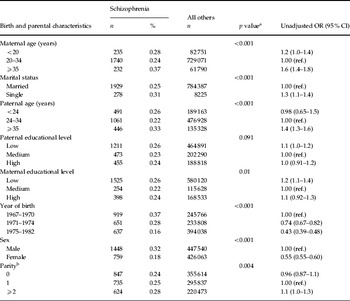
The associations of potential confounders with schizophrenia are shown in Table 1. As expected, schizophrenia risk was associated with year of birth because individuals born in earlier years had passed through more of the age of risk for schizophrenia; the risk was 0.37% for the earliest birth year periods (1967–1970) compared with 0.28% and 0.16% in the later ones (1971–1974 and 1975–1982 respectively). Schizophrenia was also associated with male gender. There was no statistical evidence of interaction between gender and birth year period as determinants of schizophrenia (p = 0.4). Other factors associated with schizophrenia included having a single mother, low maternal age (<20 years), high maternal age (>34 years) and high paternal age (>34 years). Very small associations were observed for high parity, and for low maternal and paternal education, although these associations were statistically significant in this large sample. Except for paternal age and paternal education, all these variables were included as potential confounders. Paternal age and education were highly correlated with maternal age and education; additional inclusion of paternal age or paternal education, or adjusting for the highest education in the family (maternal or paternal), did not change any of the reported results.
Birth and parental characteristics among people with schizophrenia. Data from the Medical Birth Registry of Norway (MBRN), 1967–1982, linked with the National Insurance Scheme (NIS) and Statistics Norway

OR, Odds ratio; CI, confidence interval; ref., reference.
a χ2 test (in a 2×x table, testing whether proportion of schizophrenia distributes differently by each of the listed characteristics).
b Number of previous births, including stillbirths.
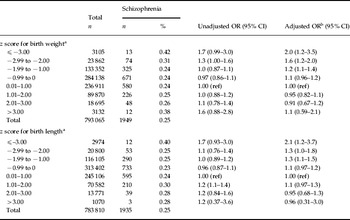
In the main analyses, to separate the effects of growth restriction from the effects of prematurity, preterm births were excluded in analyses of z score for birth size and schizophrenia. Consequently, in Table 2, the low z-score categories are growth-restricted term babies. The ORs for schizophrenia consistently decreased by increasing z scores for birth weight for gestational age from below −3.00 up to 2.00 in both unadjusted and adjusted analyses. Thus, the adjusted ORs decreased from 2.0 (95% CI 1.2–3.5) for z scores less than −3.00 down to 0.95 (95% CI 0.82–1.1) for z scores between 1.01 and 2.00 (p value for trend = 0.005). If preterm births were included in this analysis, the risk was further increased; for example, the adjusted OR was 2.3 (95% CI 1.5–3.6) for birth weight z scores below −3 (data not shown). A similar pattern was observed for birth length for gestational age z scores (p value for trend = 0.02). In a post-hoc analysis we estimated the reduction in risk of schizophrenia for a 1-s.d. increase in birth weight or birth length to be 12% or 11% respectively among term babies with a z score <1.00.
Odds ratios (ORs) and 95% confidence intervals (CIs) of schizophrenia in term births (gestational age ⩾37 weeks) by z score for birth weight and birth length, for persons liveborn 1967–1982 and resident in Norway at age 18 years. Data from the Medical Birth Registry of Norway (MBRN), 1967–1982, linked with the National Insurance Scheme (NIS) and Statistics Norway

a Gestational age and sex-specific z score (standard deviations above or below the mean) for birth weight (recorded in g) and birth length (recorded in cm).
b Adjusted for the following categorized factors: maternal age (years): <20, 20–34, ⩾35; maternal education (years): <11, 11–14, ⩾14; parity: 0, 1, ⩾2; marital status: unmarried, married; sex: male, female; year of birth: 1967–1970, 1971–1974, 1975–1982.
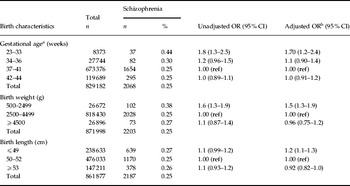
For completeness and by way of comparison with previous studies, ORs for schizophrenia by gestational age and birth size are shown in Table 3. Compared with those born at term, early preterm infants had an adjusted OR for schizophrenia of 1.7 (95% CI 1.2–2.4), whereas the OR for moderately preterm infants was 1.1 (95% CI 0.9–1.4). For post-term infants the adjusted OR for schizophrenia was not increased (1.0, 95% CI 0.9–1.2). For infants with a birth weight <2500 g, the adjusted OR for schizophrenia was 1.5 (95% CI 1.3–1.9) compared to infants with birth weight 2500–4499 g (reference group), whereas the risk was not increased for infants >4500 g (1.0, 95% CI 0.8–1.2). For term births, the adjusted OR for infants <2500 g increased to 1.8 (95% CI 1.4–2.5) (data not shown). Overall, infants with birth length <50 cm had an adjusted OR for schizophrenia of 1.2 (95% CI 1.1–1.3), compared to those with a birth length between 50 and 52 cm, whereas the risk was not increased for infants with a birth length >53 cm (OR 0.9, 95% CI 0.8–1.0).
Odds ratios (ORs) and 95% confidence intervals (CIs) of schizophrenia by gestational age and size at birth, for persons liveborn 1967–1982 and resident in Norway at age 18 years. Data from the Medical Birth Registry of Norway (MBRN), 1967–1982, linked with the National Insurance Scheme (NIS) and Statistics Norway

ref., Reference.
a z > 4 excluded for gestational age <33 weeks.
b Adjusted for the following categorized factors: maternal age (years): <20, 20–34, ⩾35; maternal education (years): <11, 11–14, ⩾14; parity: 0, 1, ⩾2; marital status: unmarried, married; sex: male, female; year of birth: 1967–1970, 1971–1974, 1975–1982.
Among 15 622 term births in which the pregnancy was complicated by pre-eclampsia, 49 (0.31%) individuals with schizophrenia were identified. The OR for the association between maternal pre-eclampsia and schizophrenia was 1.3 (95% CI 0.96–1.7) in unadjusted and 1.3 (95% CI 1.0–1.8) in adjusted analyses with term births and no pre-eclampsia as reference.
We explored potential interactions between fetal growth restriction, preterm birth and pre-eclampsia (pairwise) as determinants of schizophrenia. These results should be interpreted with caution because our study had low statistical power for these analyses, and testing for interactions was not our primary aim. Although we did not detect significant interactions in most of these analyses, we did find an indication of a stronger effect of pre-eclampsia on schizophrenia risk among preterm (OR 2.0, 95% CI 1.0–4.0) than term (OR 1.3, 95% CI 1.0–1.7) births, which might provide a clue for further studies.
Discussion
The results from a national cohort in Norway provide evidence of a graded association between degree of fetal growth restriction and risk of schizophrenia. Deviance in growth from population-based centiles was linearly related to increased risk. We examined fetal growth restriction in terms of a gradient of z scores for birth length and birth weight, with consistent results for each of these measures. The results were also consistent for analyses of term births only. Thus, an increased risk of schizophrenia extended to the large proportion of babies with some degree of fetal growth restriction.
This study provides compelling evidence for a graded association between risk of schizophrenia and suboptimal fetal growth. The graded association favors an interpretation that pertains across a spectrum, rather than one confined to the extremes of fetal growth. It is consistent with a long-term biological effect of fetal programming in which neuroendocrine and related systems of the fetus shift their ‘norm of reaction’ in response to the conditions encountered in the in utero environment (Lucas, Reference Lucas1991; Gluckman et al. Reference Gluckman, Hanson, Cooper and Thornburg2008; Ellison, Reference Ellison2010). However, several other mechanisms remain plausible, and we cannot rule out the possibility that the association reflects confounding by unmeasured genetic or environmental factors that affect fetal growth and also the later development of schizophrenia. In some instances, for example, studies of siblings discordant for prenatal exposures have not validated results from unrelated full population cohorts, suggesting that the population results may have been confounded by family-level effects (Donovan & Susser, Reference Donovan and Susser2011). In Norway, however, a high-quality sibship study did reproduce the results from a population study of the relationship between birth weight and intelligence scores (Eriksen et al. Reference Eriksen, Sundet and Tambs2010). The authors also showed that controlling for maternal education and parity was sufficient in the Norwegian context to address family-level confounding. It is likely that unmeasured family-level confounders of the relationship between fetal growth and intelligence largely overlap with those that are of concern for the relationship between fetal growth and schizophrenia. Moreover, in a same-sex twin study of the relationship between birth weight and schizophrenia, the association remained within twins discordant for birth weight (Nilsson et al. Reference Nilsson, Stalberg, Lichtenstein, Cnattingius, Olausson and Hultman2005).
A second result from this study is the association between maternal pre-eclampsia and increased schizophrenia risk in offspring. We conducted by far the largest study to date of this association. Pre-eclampsia features prominently in the literature on prenatal complications and schizophrenia because it has delivered some of the highest excess risk estimates in studies to date. However, these have been based on very small numbers (Dalman et al. Reference Dalman, Allebeck, Cullberg, Grunewald and Koster1999; Byrne et al. Reference Byrne, Agerbo, Bennedsen, Eaton and Mortensen2007). Even with the large sample size in this study, the association is not sufficiently robust to be conclusive, although such an association was also reported in the previous largest study of pre-eclampsia and schizophrenia (Dalman et al. Reference Dalman, Allebeck, Cullberg, Grunewald and Koster1999). If confirmed in subsequent studies, this result could provide an indication of the underlying biological processes that link fetal growth to schizophrenia. Pre-eclampsia is strongly related to abnormal placentation, small placentae and placental dysfunction early in pregnancy, and with an altered nutritional and immune environment for the fetus (Roberts & Cooper, Reference Roberts and Cooper2001; Roberts & Lain, Reference Roberts and Lain2002; Jansson & Powell, Reference Jansson and Powell2007).
A third notable result is that we found no association between macrosomia and the risk of schizophrenia. Neither very high birth weight for gestational age nor high birth weight alone was associated with excess risk. The result for high birth weight was consistent with a large study of birth weight and schizophrenia that combined cohorts from Sweden and Denmark (Abel et al. Reference Abel, Wicks, Susser, Dalman, Pedersen, Mortensen and Webb2010). This is important because of the public health concerns about increasing maternal obesity, particularly in mentally ill mothers and women taking psychotropic medication (Boden et al. Reference Boden, Lundgren, Brandt, Reutfors and Kieler2012). Both maternal body weight and pregnancy weight gain are associated with fetal macrosomia (Ludwig & Currie, Reference Ludwig and Currie2010), and in some studies both low and high birth weights have been associated with poor neurodevelopmental outcomes (Jarvis et al. Reference Jarvis, Glinianaia, Torrioli, Platt, Miceli, Jouk, Johnson, Hutton, Hemming, Hagberg, Dolk and Chalmers2003). Thus, although the offspring of women with high maternal body weight may have increased risk of schizophrenia (Jones et al. Reference Jones, Rantakallio, Hartikainen, Isohanni and Sipila1998; Schaefer et al. Reference Schaefer, Brown, Wyatt, Kline, Begg, Bresnahan and Susser2000), the increased birth weight of their offspring is unlikely to mediate this relationship.
To facilitate comparisons with previous studies that were not designed to detect a gradient in risk, we also report results for other measures. Many previous studies examining the association between fetal growth and schizophrenia have used low birth weight as the main exposure variable. Although we report a significant result for low birth weight, our main finding relates to the degree of growth restriction, as indicated by the gradient of the z score. It should also be noted that there is some inconsistency in the results from earlier studies on birth weight, birth length, gestational age and schizophrenia that may be explained in part by wide variation in sample sizes and by the use of different measures across studies (Rifkin et al. Reference Rifkin, Lewis, Jones, Toone and Murray1994; Sacker et al. Reference Sacker, Done, Crow and Golding1995; Jones et al. Reference Jones, Rantakallio, Hartikainen, Isohanni and Sipila1998; Dalman et al. Reference Dalman, Allebeck, Cullberg, Grunewald and Koster1999; Hultman et al. Reference Hultman, Sparen, Takei, Murray and Cnattingius1999; McNeil et al. Reference McNeil, Cantor-Graae and Ismail2000; Smith et al. Reference Smith, Flynn, McCarthy, Meistrich, Ehmann, MacEwan, Altman, Kopala and Honer2001; Gunnell et al. Reference Gunnell, Harrison, Whitley, Lewis, Tynelius and Rasmussen2005; Byrne et al. Reference Byrne, Agerbo, Bennedsen, Eaton and Mortensen2007).
The strengths of this study lie in the use of a well-established and high-quality national medical birth registry with data on the exposures (and potential confounders) examined (Irgens, Reference Irgens2000; Skjaerven et al. Reference Skjaerven, Gjessing and Bakketeig2000, Reference Skjaerven, Wilcox and Lie2002; Moster et al. Reference Moster, Lie and Markestad2008; Eriksen et al. Reference Eriksen, Sundet and Tambs2010). The data on exposures were registered prospectively before outcome was ascertained, which precludes recall bias. The MBRN was linked to another national register that includes all persons with schizophrenia receiving disability payments in Norway. Because of the extensive evaluation required to receive financial support, false-positive diagnoses are unlikely. Thus, the results of the study derive from systematic and nearly complete ascertainment of exposures and of a clearly defined outcome in a national sample. In addition, we were able to study a wide range of z scores to assess a possible gradient in the association between fetal growth restriction and schizophrenia.
The main limitation of this study is the restriction to individuals who received disability payments for schizophrenia. In Norway, these individuals encompass the great majority who have a long-term disorder, but those who were able to support themselves or recovered over a short time period will not be included. Therefore, we cannot assume that these findings pertain to all individuals diagnosed with schizophrenia. However, a history of hospital admission is not required to establish disability, so that unlike most previous large studies, ours was not limited to hospital admissions (Hultman et al. Reference Hultman, Sparen, Takei, Murray and Cnattingius1999; Gunnell et al. Reference Gunnell, Harrison, Whitley, Lewis, Tynelius and Rasmussen2005; Nilsson et al. Reference Nilsson, Stalberg, Lichtenstein, Cnattingius, Olausson and Hultman2005; Byrne et al. Reference Byrne, Agerbo, Bennedsen, Eaton and Mortensen2007).
A second limitation is that we have only looked at the association between fetal growth and schizophrenia. The previous large study that found a linear association between birth weight and schizophrenia also found associations between birth weight and other psychiatric disorders (Abel et al. Reference Abel, Wicks, Susser, Dalman, Pedersen, Mortensen and Webb2010). It would be of interest to know whether the association we detected for schizophrenia also holds for less severe psychiatric disorders. However, case ascertainment in the NIS is probably higher for schizophrenia than for less severe psychiatric disorders because the NIS does not release financial support to a person who has received a given diagnosis unless the functional capacity of the person is substantially reduced (Moster et al. Reference Moster, Lie and Markestad2008). The high specificity reported for cerebral palsy (Moster et al. Reference Moster, Lie, Irgens, Bjerkedal and Markestad2001) may not apply directly to schizophrenia because of the difference in time of age at diagnosis, although, as noted earlier, we have other reasons to believe that the schizophrenia diagnoses were dependable.
Low weight at birth referenced to population norms is generally used as a proxy for growth restriction. We used z-score indices that allow gestational age and gender effects to be removed and are a better measure of the deviance in growth from the norm within the population than a crude birth weight measure. Nevertheless, they remain somewhat imprecise as they will tend to include not only pathological growth restriction but also constitutional smallness (Jacobsson et al. Reference Jacobsson, Ahlin, Francis, Hagberg, Hagberg and Gardosi2008). In addition, the birth weight distribution in our study population is slightly shifted towards the left compared to the population used to calculate the z scores (Skjaerven et al. Reference Skjaerven, Gjessing and Bakketeig2000). Misclassification due to this difference in distribution, however, would be small, and would tend to deflate rather than inflate our results.
Birth weight and birth length are highly related dimensions of growth and it is often difficult to determine whether they have independent effects. To address this issue, we excluded the lowest z-score values (⩽ − 2.00) of birth length in analyses of birth weight, and vice versa. These restricted analyses gave unchanged point estimates, suggesting that birth weight and birth length may each have an independent impact on risk of schizophrenia.
To reduce potential confounding, all analyses were adjusted for maternal age, education, parity and marital status, and for sex and year of birth of the child. Paternal age and education were potential confounders not included in the final analyses; the additional inclusion of these variables did not influence the results because of their close association with maternal age and education. Nevertheless, residual confounding might remain because of factors we could not adjust for, such as maternal psychiatric illness and maternal smoking. In the largest previous study, however, adjustment for both maternal psychiatric illness and maternal smoking did not materially alter the association between birth weight and schizophrenia (Abel et al. Reference Abel, Wicks, Susser, Dalman, Pedersen, Mortensen and Webb2010). In addition, as noted earlier, a previous study showed that, in Norway (unlike some other countries), adjustment for maternal education and parity was sufficient to control for unmeasured family-level confounding in a study relating birth weight to intelligence scores (Eriksen et al. Reference Eriksen, Sundet and Tambs2010).
Conclusions
Our results provide evidence of a graded association between fetal growth restriction and risk of schizophrenia, with the increased risk extending to the large proportion of babies with some degree of fetal growth restriction. Fetal growth restriction is associated with a range of childhood neurodisabilities, along with intelligence, in a linear or J-shaped pattern. Fetal growth is controlled by a range of genetic and environmental factors that may act through maternal, placental or fetal mechanisms to influence early brain development. Our data cannot clearly differentiate the contributions of these factors, but do offer some support for an influence of abnormal placentation or placental function on offspring schizophrenia. Future studies that can make more explicit links between the control of fetal growth and neurodevelopmental outcomes may provide promising pathways towards prevention.
Acknowledgments
This work was funded by the Norwegian Institute of Public Health and supported by the Department of Obstetrics and Gynecology, Haukeland University Hospital, Norway.
Declaration of Interest
None.