Significant outcomes
-
∙ In our sample, hyperhomocysteinaemia was associated with a progressively worsening course of schizophrenia, characterised by poor social and relational functioning.
-
∙ No statistically significant difference was found between the homocysteine levels of patients and controls.
-
∙ Hyperhomocysteinaemia in our schizophrenia patients could represent an effect of altered lifestyle due to psychosis, especially in chronic course of illness, but not a specific marker.
Limitations
The main limitations of this study are as follows:
-
∙ Our sample of schizophrenia patients was not homogeneous for duration of illness.
-
∙ The folate/vitamin B12 levels of schizophrenia patients were not compared with control group levels.
-
∙ Due to the broad range of schizophrenic disorders, our sample was too small to draw definitive conclusions.
Introduction
The link between homocysteine (Hcy) levels and psychiatric disorders is represented by the discovery of ‘homocystinuria syndrome’, characterised by mental retardation and high haematological levels of Hcy, induced by cystathionine-β-synthase genetic deficiency (Reference Carson and Neill1).
Homocysteine: biochemical pathways
Hcy is a sulphur-containing amino acid formed by the demethylation of nutritional methionine. In normal conditions, probably due to its toxic effect, Hcy blood levels are maintained below a certain level through two major metabolic pathways: (1) re-methylation to methionine, which is catalysed by a vitamin B12-dependent enzyme (methionine synthase) and requires 5-methylentetrahydrofolate, activated by methylentetrahydrofolate reductase (MTHFR), as methyl donor; (2) trans-sulphuration to cystathionine, which is catalysed by cystathionine-β-synthase and requires pyridoxal-5'-phosphate (Reference Finkelstein2). The brain is particularly vulnerable to hyperhomocisteinaemia, as Hcy, which is rapidly taken up by neurons through a specific membrane transporter, is metabolised in small quantities due to limited central nervous system pathways (Reference Griffiths, Grieve, Allen and Olverman3).
Hyperhomocysteinaemia
Severe hyperhomocysteinaemia is due to rare genetic defects resulting in deficiencies in cystathionine β synthase, methylenetetrahydrofolate reductase, or in other enzymes involved in methyl-B12 synthesis and homocysteine methylation. The polymorphic variant of the methylenetetrahydrofolate reductase gene (C677T) is responsible for hyperhomocysteinaemia due to a 70% reduction of enzyme activity (Reference Muntjewerff, Kahn, Blom and Den Heijer4). Some authors have hypothesised that this condition may represent a risk factor for schizophrenia (Reference Joober, Benkelfat and Lal5–Reference Wei and Hemmings7), although others have not confirmed this (Reference Vilella, Virgos and Murphy8–Reference Garcìa-Miss mdel, Pérez-Mutul and Lòpez-Canul10). According to Vares et al. (Reference Vares, Saetre and Deng11), the C677T genetic variant could be responsible for an earlier onset of schizophrenia in selected populations. The associated polymorphic variants of catechol-O-metil-transferase (COMT 324AA) and methylentetrahydrofalote reductase (MTHFR 677TT) genes, which are both responsible for hyperhomocysteinaemia, could increase the vulnerability for schizophrenia (Reference Muntjewerff, Gellekink and Den Heijer12) and could represent predictors of psychotic negative symptoms (Reference Roffman, Brohawn, Nitenson, Macklin, Smoller and Goff13). Moreover, the MTHFR and/or COMT polymorphic variants could represent a risk for the development of a metabolic syndrome concomitant with anti-psychotic drug use (Reference Van Winkel, Rutten, Peerbooms, Peuskens, Van OS and De Hert14–Reference Vuksan-Cusa, Sagud and Jakovljevic16). The increase in body mass index (BMI), which is one of the sub-component of metabolic syndrome, was related to hyperhomocysteinaemia in patients with schizophrenia and bipolar disorder, but not in the non-psychiatric population (Reference Vuksan-Cusa, Sagud and Jakovljevic16).
Mild hyperhomocysteinaemia observed in fasting conditions is due to impairment in the methylation pathway – that is, folate or B12 deficiencies or methylenetetrahydrofolate reductase thermic instability. Other causes such as alcohol (Reference Sakuta and Suzuki17), caffeine (Reference Panagiotakos, Pitsavos and Zampelas18) and nicotine abuse (Reference Chrysohoou, Panagiotakos and Pitsavos19); anti-convulsant drugs or other therapies; and different chronic diseases (rheumatoid arthritis, obesity, diabetes, etc.) induce hyperhomocysteinaemia (Reference Schwaninger, Ringleb and Winter20). On the contrary, female gender, vegetarian diets and physical exercise can decrease the blood levels of Hcy (Reference Prolla and Mattson21).
Hyperhomocysteinaemia and degenerative processes
The WHO has identified hyperhomocysteinaemia as an important risk factor for cardiovascular and cerebrovascular diseases (Reference Fruchart, Nierman, Stroes, Kastelein and Duriez22). Many studies have pointed out that Hcy levels increase during ageing (Reference Elias, Sullivan and D’Agostino23), and may be correlated to multiple age-related diseases, as this amino acid can promote DNA damage due to impaired methyl donor pathways (Reference Selhub24–Reference Kruman, Culmsee and Chan25).
Hyperhomocysteinaemia was identified as a strong and independent risk factor for both vascular and Alzheimer’s dementia (Reference Seshadri, Beiser and Selhub26), was related to white matter hyperintensities in the brain (Reference Wright, Paik and Brown27) and was associated with cognitive impairment in the elderly (Reference Seshadri, Wolf and Beiser28). The correlations between hyperhomocysteynaemia and Parkinson’s disease (Reference O’Suilleabhain, Sung and Hernandez29), tardive dyskinesia or severe extra pyramidal symptoms induced by neuroleptic drugs (Reference Lerner, Miodownik, Kaptsan, Vishne, Sela and Levine30) have been explained as a special vulnerability of D2-dopamine receptors to the toxic effect of Hcy (Reference Agnati, Ferré and Genedani31).
Several mechanisms explaining how Hcy promotes neurodegenerative processes were suggested: increased oxidative stress due to the production of superoxide and hydrogen peroxide from the oxidation of its sulphhydryl group, compromised activity of glutathione peroxidase or decreased availability of nitric oxide (Reference Upchurch, Welch and Fabian32). In any case, many authors have identified the Hcy excitatory action as agonist of both mGlu1 and N-methyl-d-aspartate (NMDA) glutamatergic receptors and partial agonist of glycine receptors as its main neurodegenerative mechanisms. This could explain the induction of epileptic seizures in homocystinuria syndrome, apoptotic damage to the brain in dementia and negative symptoms in schizophrenia (Reference Shi, Savage and Hufeisen33–Reference Coyle and Tsai35).
Hyperhomocysteinaemia during the third trimester of pregnancy can be a risk factor for schizophrenia in the offspring, probably due to vascular damage to the placenta or a defect in the development of NMDA receptors (Reference Brown, Bottiglieri and Schaefer36–Reference Kochunov and Hong37).
Hyperhomocysteinaemia and schizophrenia
The first few studies evidenced an elevated frequency of schizophrenia in homocystinuria syndrome patients (Reference Spiro, Schimke and Welch38–Reference Freeman, Finkelstein and Mudd39). Other authors (Reference Pollin, Cardon and Kety40–Reference Cohen, Nichols, Wyatt and Pollin42) noted that ingestion of 10–12 g of methionine, the precursor of homocysteine, exacerbated psychotic symptoms in chronic schizophrenia patients. Successively, other studies have suggested that hyperhomocysteinaemia is often associated with schizophrenia (Reference Muntjewerff, Kahn, Blom and Den Heijer4,Reference Regland, Johansson, Grenfeldt, Hjelmgren and Medhus43–Reference Fisekovic, Serdarevic, Memic, Serdarevic, Sahbegovic and Kucukalic51), although not all the studies confirmed these findings (Reference Virgos, Martorell and Simó52–Reference Wysokinski and Kloszewska54). Levine et al. (Reference Levine, Stahl, Sela, Gavendo, Ruderman and Belmaker45) have found that hyperhomocysteinaemia is related to the male gender in young patients with schizophrenia admitted to a psychiatric ward. A meta-analysis (Reference Muntjewerff, Kahn, Blom and Den Heijer4) has shown that a 5 µM/l increase of Hcy levels, in comparison with normal levels, may represent a 70% risk of developing schizophrenia. A correlation between hyperhomocisteinaemia and negative psychotic symptoms has been the only significant association highlighted by a more recent study (Reference Petronijević, Radonjić and Ivković50).
High blood levels of Hcy could represent a biological marker for oxidative stress (Reference Dietrich-Muszalska, Malinowska and Olas55), or a signal of activated pro-inflammatory pathway characterised by an increased expression of nitric oxide synthase and cyclo-oxygenase, as evidenced in the peripheral mononuclear blood cells of patients affected by their first psychotic episode (Reference García-Bueno, Bioque and Mac-Dowell56). According to the most recent view, hyperhomocysteinaemia could induce alteration in DNA methylation in peripheral leucocytes (Reference Kinoshita, Numata, Tajima, Shimodera, Imoto and Ohmori57), although these data have not been confirmed by subsequent studies (Reference Bromberg, Levine, Nemetz, Belmaker and Agam58).
The correlation between Hcy and folate/vitamin B12 levels in schizophrenia patients has been studied, with controversial results. Some studies have shown that folate and vitamin B12 deficiency or nicotine and alcohol use in schizophrenia patients could be responsible for a small increase in blood Hcy levels (Reference Stahl, Belmaker, Friger and Levine59). Another study has found high levels of Hcy not related to gender or folate/vitamin B12 levels in 136 chronic schizophrenic patients (Reference Haidemenos, Kontis, Gazi, Kallai, Allin and Lucia48). Other authors, who observed reduced blood levels of folate and vitamin B12 with normal blood Hcy levels in schizophrenia patients, hypothesised that an alteration in the folate pathway could represent an independent risk factor for schizophrenia (Reference Muntjewerff, Van Der Put and Eskes60). Levine et al. (Reference Levine, Stahl and Sela61) have shown that the administration of folate may improve chronic schizophrenia with hyperhomocysteinaemia, in accordance with previous studies (Reference Godfrey, Toone and Carney62). In many different populations, such as Arabian (Reference Akanji, Ohaeri, Al-Shammri and Fatania63), Chinese (Reference Ma, Shek and Wong64), Indian (Reference Narayan, Verman, Kattimani, Ananthanarayanan and Adithan65), Japanese (Reference Nishi, Numata and Tajima66) and Korean (Reference Kim and Moon67), increased blood Hcy levels have been observed in schizophrenia patients, although significant associations with clinical variables have not been regularly and consistently registered.
Aims
To evaluate the following aspects in a population of exacerbated schizophrenia patients recently admitted to the hospital:
-
1) the blood Hcy levels in comparison with a non-patient control group,
-
2) the correlation between blood Hcy levels and the selected variables.
Methods
This study was conducted in accordance with the principles of the Declaration of Helsinki and good clinical practice and was approved by the Institutional Review Board of Az-USL–Modena, as authorised by the local Ethical Committee (9 February 2010) and by the Department of Mental Health (Act no.96, 2 April 2010).
The sample and the control group
Our study sample was chosen from patients suffering from schizophrenic disorders in an exacerbated clinical phase, who had been admitted to an acute psychiatric ward, Servizio Psichiatrico di Diagnosi e Cura, located in a General Hospital (NOCSAE in Baggiovara, Modena), from 15 April 2010 to 31 December 2010. All the patients of our sample agreed to participate in this study. We excluded patients affected by other psychotic disorders, such as delusional disorders, and all schizophrenia patients with organic, neurological or substance abuse co-morbidity, in order to avoid other possible causes of hyperhomocysteinaemia. We included 100 inpatients affected by schizophrenia (paranoid S. N=58, schizophreniform disorder N=13, unspecified S. N=6, schizoaffective N=6, disorganised S. N=5, undifferentiated S. N=3, simplex S. N=3, residual S. N=4, catatonic S. N=2), according to the International Classification of Diseases-9th revision-Clinical Modification (68). In our sample, we evaluated Hcy, folate and vitamin B12 haematological levels. The blood tests were carried out on the second day of admission in fasting patients who had already given their informed consent.
We reported a higher percentage of smokers among our patients (81%) in comparison with controls (34%). The BMI of patients and controls was in the normal range (18.5–24.99) (69). The control group comprised 110 healthy individuals matched for age and gender, and were mainly healthcare professionals who agreed to participate in this study and signed their informed consent. From the final control group, we had previously excluded individuals with organic, endocrine, neurological, substance abuse diseases and/or those undergoing chronic drug therapies (e.g. anticonvulsants, contraceptives, etc.). We did not analyse the daily coffee intake due to its frequent use in both the groups.
Blood tests
Blood samples were collected in vacutainers containing 1 ml 1% Ethylenediaminetetraacetic acid and kept on ice for 6 h maximum before being centrifuged and analysed.
The blood samples were analysed using Fluorescence Polarized Immuno Assay (Axis, on the Abbott IMx System; Abbott Laboratories, Abbott Park, IL, USA) (Reference Refsum, Smith and Ueland70) to determine total blood Hcy levels and using Microparticles Enzyme Immuno Assay (Abbott AxSYM, Immuno Chemical analyzer; Abbott Laboratories, Clermont, FL, USA) to determine folate and vitamin B12 haematic levels. The analysis was carried out in the Toxicology Laboratory of our General Hospital (Reference Flare, Mitchell and Doan71).
Statistical analysis
We compared the haematological levels of Hcy in our sample to that of the control group (t-test).
We analysed the correlation between Hcy levels and the following variables: gender, age, years of illness, number of previous psychiatric admissions, duration of drug intake before the Hcy test and the prescribed psychiatric drugs at the time of admission. Concomitantly to the Hcy test, we administered the following tests to our patient sample: Brief Psychiatric Rating Scale (BPRS) (24 items) (Reference Overall and Gorham72), Positive Negative Syndrome Scale (PANSS) (Reference Kay, Fiszbein and Opler73) and Global Assessment Functioning (GAF) (Reference Endicott, Spitzer, Fleiss and Cohen74), and successively we correlated the test scores to the blood Hcy levels (Spearman’s, Kendall’s correlation, χ2 test, linear regression test). We analysed the statistical correlation between Hcy and folate and vitamin B12 levels (Spearman’s and Kendall’s correlation).
The data were statistically analysed using STATA-12 programmes (75).
Results
Blood Hcy levels in the schizophrenia and control groups
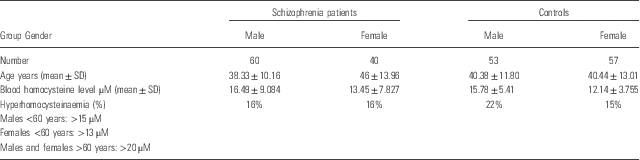
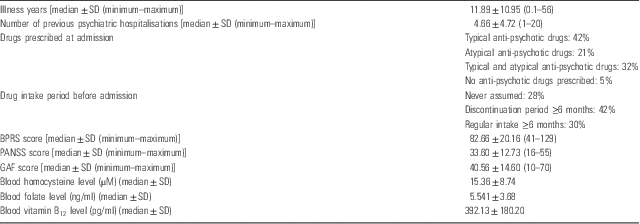
As shown in Tables 1 and 2, we observed higher blood Hcy levels than the normal range levels established according to literature data (Reference Szőke, Dolci, Russo and Panteghini76) by our hospital laboratory, with an increase of 7.84 µM on average per patient in 32% of the patients, reduced (<3 ng/ml) folate levels in 12% and reduced (<200 pg/ml) vitamin B12 levels in 10% of patients in comparison with the normal range values of our hospital laboratory, established according to literature data (Reference Szőke, Dolci, Russo and Panteghini76). Hyperhomocysteinaemia was associated with reduced folate levels in 9% of our sample population and was concomitant with reduced levels of vitamin B12 in 5%. Only two patients in our sample presented hyperhomocysteinaemia with concomitant reduction of both folate and vitamin B12 levels. We highlighted that the levels of Hcy were negatively correlated to folate (Spearman’s ρ=−0.4636, p<0.001; Kendall’s score=−1632, SE=330.676, p<0.001) and vitamin B12 (Spearman’s ρ=−0.2506, p=0.0124, Kendall’s score=−801, SE=330.755, p=0.0156).
Schizophrenia patients and controls divided by gender

Clinical variables and blood levels of homocysteine, folate and vitamin B12 in schizophrenia patients (N=100)

BPRS, Brief Psychiatric Rating Scale; GAF, Global Assessment Functioning Scores; PANSS, Positive Negative Syndrome Scale.
We did not find any statistically significant difference between the Hcy levels of schizophrenia patients and the control group.
Blood Hcy levels and the variables analysed
We highlighted a positive statistically significant correlation between Hcy and years of illness (Spearman’s ρ=0.2866, p=0.0004; Kendall’s score=940, SE=330, p=0.0045). On the contrary, we evidenced that Hcy presented a negative, statistically significant, correlation with GAF score (Spearman’s ρ=−0.3551, p=0.000634; Kendall’s score=−1079, SE score=313.812, p=0.0006). Moreover, the simple linear regression test confirmed that the blood level of Hcy was statistically significantly related to years of illness (p<0.047, 95%CI: 0.0024782 to 0.3209989, SE=0.0802325) and GAF score (p<0.007, 95%CI: −0.2736559 to −0.0441809, SE=0.0577949).
We have shown evidence that we did not find any statistically significant correlation between Hcy levels and both the schizophrenia patients and the control group; furthermore, we did not find any statistically significant correlation between age and Hcy levels of the both control and the patient groups.
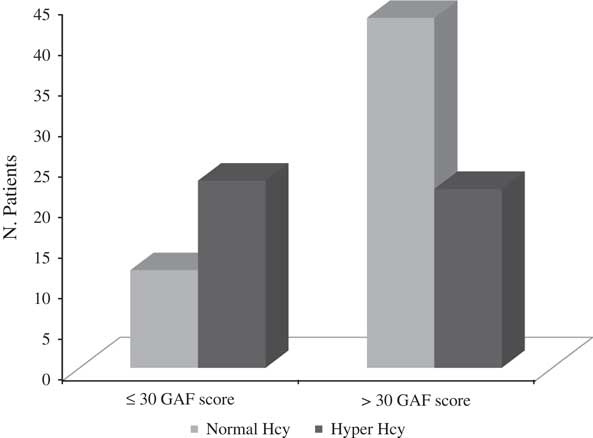
In order to further analyse the association between hyperhomocysteinaemia and period of illness, we divided our sample into two groups: patients with schizophrenia for ≤1 year and others with illness for >1 year, and evidenced that hyperhomocysteinaemia was statistically significantly more frequent in the group with schizophrenia for >1 year in comparison with the other group (χ2 test, p=0.023404) (Fig. 1). Similarly, we divided the sample into two groups according to the GAF score median (M=30): patients with ≤30 GAF score and others with >30 GAF score. We evidenced a statistically significant higher frequency of hyperhomocysteinaemia in the group with ≤30 GAF score, as shown in Fig. 2 (χ2 test, p=0.000144).
The normal vs hyper Hcy levels in the sample divided into two groups according to the year of illness: ≤1 and >1 year illness (
 $$\chi^2$$
test, p=0.023404).

The normal vs hyper Hcy levels in the sample divided into two groups according to the median GAF score: ≤30 and >30 GAF score (
 $$\chi^2$$
test, p=0.000144).
We did not find any statistically significant correlation between blood Hcy level and other variables in our patient group (gender, number of previous psychiatric hospitalisations, therapy prescribed or period of drug intake before the Hcy test) or between blood Hcy level and global or single item scores of BPRS or PANSS scale for negative or positive symptoms (Table 2).
Discussion
Our data evidenced that 32% of our schizophrenia patients had high blood levels of Hcy, with an increase of Hcy level per patient (7.84 µM) superior to that (5 µM) indicated as risk factor for schizophrenia in the only meta-analysis carried out regarding this topic (Reference Muntjewerff, Kahn, Blom and Den Heijer4). Only a minority of our patients presented an associated reduction in folate and vitamin B12 levels, which is negatively related to Hcy level, in accordance with most studies (Reference Stahl, Belmaker, Friger and Levine59). In any case, blood Hcy level of our schizophrenia sample did not statistically significantly differ from the non-patient control group. This data could cast doubt on the specificity of the association between hyperhomocysteinaemia and schizophrenia and could indirectly support the dissimilar and controversial results of other studies on this issue (Reference Vilella, Virgos and Murphy8,Reference Virgos, Martorell and Simó52). One explanation of this result could be represented by the variability of our sample: it was bigger than other studies (Reference Petronijević, Radonjić and Ivković50–Reference Fisekovic, Serdarevic, Memic, Serdarevic, Sahbegovic and Kucukalic51,Reference Wysokinski and Kloszewska54–Reference Dietrich-Muszalska, Malinowska and Olas55), relatively homogeneous both for diagnosis – restricted exclusively to schizophrenic disorders – and for blood test conditions, but it was quite variable for the duration of illness as it included patients affected by schizophrenia from <1 to 50 years. At the same time, this broad range of illness duration permitted us to suggest that hyperhomocysteinaemia could more frequently occur in chronically ill patients, as we highlighted a positive relationship between duration of illness and Hcy levels. In this regard, we have to point out that none of our patients affected by schizophreniform disorder presented elevated Hcy levels, although the number of this sub-group of patients was too small to draw conclusions.
Hcy haematic level did not appear related to the single item or global score of both the symptomatic scales (BPRS, PANSS) we administered, in accordance with most studies on this topic, but it was negatively related to GAF scores. All our patients presented normal IQ before suffering from schizophrenia. However, most of them developed poorer social and relational functioning closely related to schizophrenia, as evidenced by the low GAF scores, which, in our study, were correlated to high Hcy levels. These data are in accordance with all the studies that evidenced an association of hyperhomocisteinaemia with negative symptoms (Reference Petronijević, Radonjić and Ivković50) and suggest that hyperhomocysteinaemia, in accordance with the hypothesis of its role in many degenerative processes, may represent a generic biological indicator of the neurodegeneration progressively induced by schizophrenia, but not a pathognomonic alteration of this disease. In fact, also in other neurological and psychiatric diseases, such as neurocognitive impairment, especially in old people (Reference Fruchart, Nierman, Stroes, Kastelein and Duriez22) and in patients affected by Alzheimer’s disease (Reference Seshadri, Wolf and Beiser28), hyperhomocysteinaemia has been identified as a marker of neurodegeneration (Reference Mattson and Shea34).
These data taken together suggest that hyperhomocysteinaemia could play a final and non-specific role in many degenerative processes and favour an accelerated ageing process of the brain. Hyperhomocysteinaemia might contribute to the pathogenesis of schizophrenia, as in other neurodegenerative diseases, through its neurotoxic effects due to the activation of NMDA receptors, which leads to an increase in apoptotic processes (Reference Coyle and Tsai35). This, in turn, may be responsible for subtle changes in neuron structure following the onset of psychosis responsible for progressive clinical deterioration.
Finally, we conclude that hyperhomocysteinaemia did not represent a specific marker for schizophrenia, as no statistically significant difference was found between patients and controls. Nevertheless, in our sample, we observed high Hcy levels associated with a progressively worsening course of schizophrenia, characterised by poor social and relational functioning. Therefore, we can infer that hyperhomocysteinaemia in schizophrenia could simply represent a generic effect of altered lifestyle due to psychosis, especially in chronic course of illness, or deleterious brain effects of chronic schizophrenia. In this regard, high blood Hcy levels in schizophrenia patients might support, from a biochemical point of view, Kraepelin’s definition of schizophrenia, ‘dementia praecox’, which, in a pre-pharmacological era, identified this disease by means of its negative prognosis. Nevertheless, we have to provide evidence that also in other chronic psychiatric diseases, such as bipolar disorders, hyperhomocysteinaemia has been related to poor neuropsychological performances (Reference Dittmann, Seemüller and Schwarz77,Reference Moustafa, Hewedi and Eissa78). Therefore, we hypothesise that hyperhomocysteinaemia could represent a final common pathway to cognitive deterioration in many chronic psychiatric diseases. Hyperhomocysteinaemia could be only a consequence of a chronic mental illness rather than that of any positive causal significance, although it could affect the cognitive decline in a way that needs further exploration.
Further research is needed to investigate the association between hyperhomocysteinaemia and schizophrenia in larger samples, with the support of neuroimaging, genetic and cognitive assessments. Hyperhomocysteinaemia should be compared between schizophrenia and other chronic diseases that could affect cognitive decline, in order to assess whether hyperhomocysteinaemia is more pronounced in schizophrenia. More biochemical and epidemiological studies are necessary to highlight the pathogenesis of schizophrenia, which appears conditioned by multifactorial causes and, to date, cannot be identified by a simple haematological marker.
Acknowledgements
We express our gratitude to all patients and health professionals for their participation in this study and acknowledge the Department of Mental Health of Modena for its support to this research. Authors’ contribution: The corresponding author constructed the design of this study and statistically analysed the data. All the authors contributed to collect the sample and to write the article.
Financial Support
This study was not sponsored by any pharmaceutical company and was funded by the Department of Mental Health (Act no.96, 2 April 2010).
Conflicts of Interest
The authors report no actual or potential conflicts of interest.
Ethical Standards
The authors assert that all procedures contributing to this work comply with the ethical standards of the relevant national and institutional committees on human experimentation and with the Helsinki Declaration of 1975, as revised in 2008.