Introduction
Discrimination has been defined as ‘a behavioural manifestation of a negative attitude, judgment, or unfair treatment toward members of a group’ (Pascoe and Richman Reference Pascoe and Richman2009: 533). The workplace is one of the areas in which discrimination most frequently occurs (De Castro, Gee and Takeuchi Reference De Castro, Gee and Takeuchi2008). Workplace discrimination refers to differences in treatment based on personal characteristics (e.g. age, race, gender, religion, sexual orientation, disabilities, political affiliation, and national or social origin), which impairs or nullifies fairness of treatment or opportunity in the workplace (e.g. Colella and Stone Reference Colella, Stone, Dipboye and Colella2005; McMahon and Shaw Reference McMahon and Shaw2005; Ragins and Wiethoff Reference Ragins, Wiethoff, Dipboye and Colella2005; Tomei Reference Tomei2003). Discrimination in the workplace occurs at various levels and takes various forms. At the institutional level, discrimination against individuals can be found in hiring, training, promotion and firing (e.g. Cohen Reference Cohen2000; Roessler et al. Reference Roessler, Neath, McMahon and Rumrill2007). At the interpersonal level, individuals may be subjected to micro-aggression, which includes prejudicial attitudes, affect and discriminatory behaviour in daily social interactions (Roberts, Swanson and Murphy Reference Roberts, Swanson and Murphy2004; Swim and Stangor Reference Swim and Stangor1998).
Most of the research on the discrimination experienced by older workers has focused on hiring, training and retention. Studies show that because of employers' stereotypical beliefs and attitudes about older workers' abilities and performances, older workers have often been discriminated against in hiring and retention (Altschuler Reference Altschuler2004; Henkens Reference Henkens2005; Malul Reference Malul2009; Marshall Reference Marshall1996; Roscigno et al. Reference Roscigno, Mong, Byron and Tester2007). Research also indicates that older workers are disadvantaged in training (Simon Reference Simon1996) and advancement opportunities (RoperASW 2002; Taylor and Urwin Reference Taylor and Urwin2001). Workers between 55 and 64 years of age were offered training opportunities only a third as frequently as workers between 35 and 44 (Simon Reference Simon1996). In an AARP survey of 2,518 workers aged 45–74, RoperASW (2002) found that 9 per cent of the respondents had been passed over for a promotion due to age.
Workplace discrimination, however, extends beyond hiring, training, promotion and retention. A review of the literature indicates a dearth of knowledge on other types of discriminatory treatment, e.g. sexual harassment, receiving unfair work assignments and being monitored more closely on the job than others. In addition, there is a lack of knowledge on the prevalence of workplace discrimination experienced by older workers at the national level. It is not clear to what extent older adults are discriminated against in the United States of America (USA) as a whole. It is also not clear the degrees to which older workers in different age, gender, racial/ethnic, educational, and wage groups encounter discrimination. Moreover, there is scant information on discrimination perceived by older workers in various occupations, although studies suggest that different occupations are differentially associated with discrimination in non-age-specific populations. For example, overweight women reported receiving less pay in sales and services occupations, but not in others (DeBeaumont Reference DeBeaumont2009); pregnant women are more likely to be regarded as warm but incompetent and experience more discrimination in masculine types of occupations (e.g. newspaper journalist) than in feminine types of occupations (e.g. newspaper editor) (Masser, Grass and Nesic Reference Masser, Grass and Nesic2007).
One of the important issues in perceived workplace discrimination concerns factors contributing to experiencing discrimination. The extant literature contains some information for the general (i.e. non-age-specific) population in this regard. In a national study of 1,728 Americans aged 18 years or older (Roberts, Swanson and Murphy Reference Roberts, Swanson and Murphy2004), respondents were asked whether they felt discriminated against at work due to race or ethnicity. Results showed that minority group statuses (e.g. Blacks and Hispanics) were related to higher levels of perception of discrimination. Likewise, in a study on workers of all ages in the United Kingdom (Wadsworth et al. Reference Wadsworth, Dhillon, Shaw, Bhui, Stansfeld and Smith2007), respondents were asked about being unfairly treated on the basis of age, gender, race or ethnicity. Results indicated that minority group status (African Caribbean and Bangladeshi) was associated with work discrimination.
Nevertheless, there has been little attention on sociodemographic factors (e.g. gender, age, race/ethnicity, education and wages) associated with workplace discrimination among older workers. Only two studies have touched on some of these factors in the context of older workers. RoperASW (2002) reported that Africans, Hispanics, blue-collar workers and less-affluent workers were more likely to feel vulnerable to job losses than their counterparts of Whites, white-collar workers and more affluent workers. In a study of 7,225 working women in the USA, Gee, Pavalko and Long (Reference Gee, Pavalko and Long2007) found perceived age discrimination peaked around age 55 and declined afterwards.
Social support constitutes a potentially important issue in workplace discrimination. Although previous research has paid little attention to how social support at work can affect perceived workplace discrimination, providing support at work has been recommended time and again as a way to address workplace discrimination (e.g. Allan, Cowie and Smith Reference Allan, Cowie and Smith2009; Carr et al. Reference Carr, Palepu, Szalacha, Caswell and Inui2007). It is understandable, as an antithesis to discrimination, workplace support may be able to prevent or reduce the occurrence of discrimination in the first place. Support at work can also help individuals to confront or resolve discrimination issues and prevent their re-occurrence. Still, support at work in the form of consultation may also assist individuals to gain different perspectives and reduce the possibilities of mistaking non-discriminatory incidences as discriminatory.
To bridge the gap in the extant literature, the present research has two objectives: (a) to investigate the prevalence of discriminatory treatment experienced by older workers in the USA based on a national data set, and (b) to examine the correlates of workplace discrimination, including sociodemographics and social support. The study is significant in several ways. First, workplace discrimination is an issue of individual rights and social justice (Wood, Wilkinson and Harcourt Reference Wood, Wilkinson and Harcourt2008). Perceptions of workplace discrimination allow assessments of the degree to which individuals feel being treated fairly (Gee, Pavalko and Long Reference Gee, Pavalko and Long2007). Second, workplace discrimination is negatively related to employment outcomes. Workers who experienced age discrimination were less likely to remain employed than their non-discriminated counterparts (Cunningham and Sagas Reference Cunningham and Sagas2007; Johnson and Neumark Reference Johnson and Neumark1997). Third, workplace discrimination is linked to adverse physical and psychological health outcomes. De Castro, Gee and Takeuchi (Reference De Castro, Gee and Takeuchi2008) found that exposure to racial discrimination at work predicted health conditions among Filipino Americans; Krieger et al. (Reference Krieger, Smith, Naishadham, Hartman and Barbeau2005) reported that racial discrimination was associated with psychological distress among low-income workers. Finally, recent years have witnessed an increase in older adult workforce participation. Between 1985 and 2004, older workers increased from 10.8 to 14.5 per cent of the labour force (Michello and Ford Reference Michello and Ford2006). There are 26.1 million working adults aged 55 and older (US Bureau of Labor Statistics 2007) and baby boomers (i.e. those born between 1946 and 1964) now constitute 40 per cent of the US workforce (Russell Reference Russell2007). Two-thirds of older adults intend to continue to work after retirement age (AARP 2003), and 70 million baby boomers will make up about 20 per cent of the entire population by 2020 (Butler Reference Butler2002). Given the importance of workplace discrimination as an issue of human rights and social justice, the employment and health outcomes of workplace discrimination, the rising ageing workforce, and the lack of a comprehensive understanding of workplace discrimination among older adults, the present study is timely and will increase our understanding of older adults' work experience.
Conceptual framework
In studying ageing workforce (including workplace discrimination), different researchers have conceptualised older workers differently. Older workers have been defined as those age 45+ (Berger Reference Berger2009; RoperASW 2002), age 50+ (Malul Reference Malul2009; Mor-Barak Reference Mor-Barak1995; Smyer and Pitt-Catsouphes Reference Smyer and Pitt-Catsouphes2007), and age 55+ (Kaye and Alexander Reference Kaye and Alexander1995; Noonan Reference Noonan2005; Taylor Reference Taylor2007). Different industries also seem to have different ideas about what constitutes an older worker. Workers over 40 may be considered old in advertising (Duncan and Loretto Reference Duncan and Loretto2004); workers over 30 may be thought so in information technology (BNET 2009). Typically, however, older workers are referred to as individuals age 50 or over (BNET 2009; International Labour Office 2008), and this is thus how older workers are defined in this study.
The study's conceptual framework is based on the above-discussed literature on sociodemographics and support at work as well as two competing theories. Social barriers theory contends that minority members (e.g. racial minority group members) perceive more discrimination because they experience more social barriers, i.e. actual practices and prejudice. For example, compared with non-Hispanic whites, Hispanics attempting to purchase a house were 11–33 per cent less likely to receive help with mortgage from real estate agents (Zhao, Ondrich and Yinger Reference Zhao, Ondrich and Yinger2006). For African American defendants in the criminal justice system, the bail is usually set 35 per cent higher than their white counterparts, controlling for the risk of fleeing and the severity of the crime (Free Reference Free1996). The social barriers theory postulates that experiencing discriminatory treatment should make members of minority groups more inclined to perceive discrimination than their majority counterparts. Previous studies (e.g. Schultz et al. Reference Schultz, Williams, Israel, Becker, Parker and James2000; Weitzer and Tuch Reference Weitzer and Tuch2004) have rendered support to this theory.
Attributional ambiguity theory, on the other hand, contends that when low-status group members are uncertain about whether discrimination is the cause of negative performance feedback, they are less likely to attribute their failures to discrimination because they are accustomed to negative reactions. Instead, it is higher-status group members, such as men and members of higher socio-economic status, who are inclined to attribute personal failures to external factors, including discrimination (Rodriguez Reference Rodriguez2008; Ruggiero and Major Reference Ruggiero and Major1998). An experimental study by Ruggiero and Taylor (Reference Ruggiero and Taylor1995) provided support to this theory with findings that men are more likely than women to attribute their test failures to discrimination.
While attributional ambiguity theory focuses on explanations of failures in performance, not all perceived discrimination at work is necessarily related to performance, e.g. sexual harassment or racially condescending comments. It seems possible that individuals with higher socioeconomic status may be more sensitive to non-performance-related discrimination, as evidenced in Shaffer et al. (Reference Shaffer, Joplin, Bell, Lau and Oguz2000), which discovered that workers with higher education were more sensitive to gender discrimination at work. In the present study, therefore, we incorporated both attribution and sensitivity into an ‘attribution–sensitivity theory’, which contends that, due to attribution and/or sensitivity, individuals with higher social status will be more inclined to perceive workplace discrimination. To distinguish between higher and lower social status among older workers, this study conceptualises ‘lower status’ as indicated by advanced age, being female, being a member of a minority racial/ethnic group, having lower education, and receiving lower wages.
Research questions and hypotheses
Based on the social barriers and attribution–sensitivity theories and the literature on sociodemographics and support at work, this study examines the following research questions and hypotheses: RQ1: What is the prevalence of perceived workplace discrimination among older workers? Under this research question, we further investigated the prevalence of discrimination in different groups defined by age, gender, race/ethnicity, education, wage, and occupation. RQ2: What sociodemographic factors are associated with workplace discrimination? We proposed two competing hypotheses based on aforementioned theories and empirical findings. Hypothesis 1: Perceived workplace discrimination is positively related to advanced age, being female, being a member of a minority racial/ethnic group, lower education, and lower wages. Hypothesis 2 (counter hypothesis): Perceived workplace discrimination is positively related to younger age, being male, being a member of the majority group, higher education, and higher wages. RQ3: What is the relationship between support at work and perceived workplace discrimination? We hypothesized that support at work will be negatively associated with perceived workplace discrimination (Hypothesis 3).
Methods
Data and sample
Data were derived from Midlife in the United States II (MIDUS II), a follow-up study of MIDUS I. Conducted in 1995, MIDUS I was based on a random national random digit dialling (RDD) sample of 3,487 non-institutionalised, English-speaking adults age 25–74 in the 48 contiguous states (Brim, Ryff and Kessler Reference Brim, Ryff, Kessler, Brim, Ryff and Kessler2004). Of those, 2,257 were successfully contacted to participate in the MIDUS II study. Conducted between 2004 and 2006, MIDUS II included a telephone interview and two self-administered questionnaires (SAQs), with an overall response rate of 81 per cent for the SAQs (University of Wisconsin Institute on Aging 2007). Details about the sampling design and methods and the interview format were presented in Brim, Ryff and Kessler (Reference Brim, Ryff, Kessler, Brim, Ryff and Kessler2004). Among the 2,257 MIDUS II RDD sample, 1,457 were age 50 or above. Among them, 420 were working for pay for an employer, and they constituted the sample of the present study.
Measures
Workplace discrimination
This variable was measured by the aggregate score of a scale of six items, representing six types of workplace discrimination. The respondent was asked how often he or she had experienced the following: (a) unfairly given jobs no one else wanted, (b) watched more closely at job than others, (c) boss uses ethnic/racial/sexual slurs, (d) co-workers use ethnic/racial/sexual slurs, (e) ignored/not taken seriously by boss, and (f) co-worker with less experience and qualifications promoted before you. Each item was measured on a five-point Likert-type scale (1=never, 2=less than once a year, 3=a few times a year, 4=a few times a month, 5=once a week or more; Cronbach's alpha=0.74). This measure was used as a continuous variable in the regression analysis. For the prevalence analyses, we created two types of dummy variables: (a) a dummy variable for each of the six types of workplace discrimination experienced within a year (0=never experienced this specific type of workplace discrimination; 1=ever experienced this specific type of workplace discrimination) and (b) a dummy variable for ever experienced any type of workplace discrimination within a year (0=never experienced any type of workplace discrimination; 1=ever experienced any type of workplace discrimination).
Age
Age was measured in years for the regression analysis. For the prevalence analysis, it was divided into two groups: (a) 50–64 and (b) 65+.
Gender and race/ethnicity
Gender was male (1) or female (2); and race/ethnicity was non-Hispanic White (1) or all others (0).
Education
For the regression analysis, education level was measured with a scale (1=no school or 1–6 grades … 12=PhD or other doctoral-level degrees). For the prevalence analysis, it was divided into three groups: (a) high school or below, (b) some college or college graduate, and (c) some graduate education or a graduate degree.
Occupational category
MIDUS II contains nine occupational groups for the respondents' main jobs: (1) executive, administrative, and managerial; (2) professional specialty; (3) technician and related support; (4) sales occupation; (5) administrative support, including clerical; (6) service occupation; (7) farming, forestry, and fishing; (8) precision production, crafts, and repair; and (9) operator, labourer, and military. Based on the types of work, occupational groups were further clustered into three categories in this study: (a) executive, managerial, and professional (original groups 1 and 2), (b) technical, clerical, service and sales (original groups 3–6), and (c) crafts, labour, and military (original groups 8 and 9).
Wage at last calendar year
For the regression analysis, two types of wage were used: actual wage and dummy wage variables. Actual wage in the analysis was converted into the unit of $1,000. To create the dummy variables, wage was divided into three groups: wage group 1=$1,000 (the lowest wage in the sample) to $22,499; wage group 2=$22,500–49,999; wage group 3=$50,000+. Wage-Dummy1=0, if wage group=1; Wage-Dummy1=1, if wage group=2 or 3. Wage-Dummy2=0, if wage group=1 or 3; Wage-Dummy2=1, if wage group=2.
Support at work
Two types of support at work were included. Supervisor support was measured by a five-point Likert-type scale of three items, including: ‘How often do you get the information you need from your supervisor or superiors?’, ‘How often do you get help and support from your immediate supervisor?’ and ‘How often is your immediate supervisor willing to listen to your work-related problems?’ (1=never … 5=all of the time) (Cronbach's alpha=0.88). Co-worker support was measured by a five-point Likert-type scale of two items, including: ‘How often do you get help and support from your co-workers?’ and ‘How often are your co-workers willing to listen to your work-related problems?’ (1=never … 5=all of the time) (Cronbach's alpha=0.61).
Control variables
Number of work hours per week at main job and number of work hours at other jobs were included as control variables, because correlation analyses (Table 1) indicate positive relationships between hours of work and perceived workplace discrimination. Since occupational category was found to be significant (Table 2), two dummy variables were created: Occupation 1 (0=executive/managerial/professional or technical/clerical/service/sales, 1=crafts/labour/military); Occupation 2 (0=executive/managerial/professional, 1=technical/clerical/service/sales or crafts/labour/military). Marital status was used as a control variable, because individuals with a spouse or partner may have better support in addressing issues of workplace discrimination and thus reduce its reoccurrences or they may be in a better position to acquire different perspectives on incidents at work.
Correlation of study variables

Significance levels: * p<0.05, ** p<0.01.
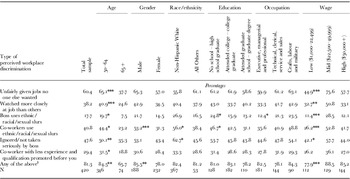
Prevalence of perceived workplace discrimination among older workers

Notes: Prevalence of each type of workplace discrimination indicates the percentage of individuals who have ever perceived the specific type of workplace discrimination within a year. 1. Prevalence indicates the percentage of individuals who have ever perceived any of the types of workplace discrimination within a year.
Significance levels: In subgroup differences (e.g. between 50–64 and 65+), significance levels based on chi-square tests: * p<0.05, ** p<0.01, *** p<0.001.
Analysis
To examine the prevalence of various types of workplace discrimination, we conducted both univariate frequency analyses and bivariate chi-square tests between and among various sociodemographic groups. Prevalence was defined as the percentage of individuals who have ever experienced a specific type (or any type) of workplace discrimination, ranging from less than once a year to once a week or more. For hypothesis testing, we first performed a correlation analysis of continuous variables (Table 1). Results showed r=0.44 between age and hours of work at main job as the highest correlation, indicating no multicollinearity among the study variables. We then conducted ordinary least squares multivariate regression analyses with the workplace discrimination as the dependent variable. MIDUS II individual sample weights were used for all analyses in this study so that the results could be generalised to the US workforce.
Results
Sample characteristics
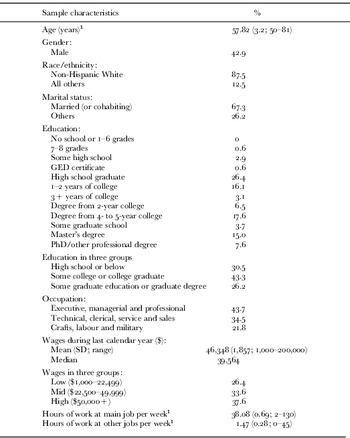
As shown in Table 3, respondents had a mean age of 57.8 (range: 50–81 years; standard deviation (SD)=3.2). More than half (57.1%) were female. The majority (87.5%) were non-Hispanic White, and the rest (12%) included African, Hispanic, Asian, and Native Americans, and native Hawaiians or Pacific Islanders. The majority were married or cohabiting (73.8%). When respondents were grouped into three broad educational levels, 43.3 per cent had some college or are college graduates, followed by those with high school education or below (30.5%) and those with some graduate education or graduate degree (26.2%). In terms of occupation, 43.7 per cent of the respondents were from the executive, managerial, and professional category, 34.5 per cent from the technical, clerical, service and sales category, and 21.8 per cent from the crafts, labour, and military category. Hours of work per week at main job ranged from 2 to 130 hours, with a mean of 38.1 hours (SD=0.69).
Sample characteristics and subsample differences

Notes: 1. Values are mean (standard deviation (SD); range). GED: General Educational Development. A GED certificate indicates the equivalent of a high school diploma. N=420.
Hours of work per week at additional jobs ranged from 0 to 45 hours, with a mean of 1.47 (SD=0.28). Wages during the last calendar year ranged from $1,000 to $200,000, with a mean of $46,348 (SD=$1,857) and a median of $39,564.
Prevalence of workplace discrimination
The second column of Table 2 displays the prevalence of ever perceiving each type of workplace discrimination and the prevalence of ever perceiving any type of workplace discrimination. Prevalence ranged from a high of 60 per cent for being unfairly given jobs no one else wanted to a low of 18 per cent for boss using ethnic/racial/sexual slurs. More than 81 per cent of the respondents reported having experienced any type of workplace discrimination at least once within a year. The remainder of Table 2 shows the prevalence of workplace discrimination among age, gender, race/ethnicity, education, occupation, and wage groups or categories. For each type of the perceived workplace discrimination and for perceiving any type of workplace discrimination, the age gradients are constantly negative, with the 50–64 group reporting higher prevalence than the 65+ group. A significantly higher proportion of men than women reported that ‘co-workers use ethnic/racial/sexual slurs’. Men had a higher frequency of experiencing any type of workplace discrimination. Interestingly, a significantly higher proportion of non-Hispanic White than minority groups reported that ‘co-workers used ethnic/racial/sexual slurs’ and that they were ‘ignored/not taken seriously by boss’. Educational difference was significant in the prevalence of ‘boss uses ethnic/racial/sexual slurs’ and ‘co-workers use ethnic/racial/sexual slurs’. Occupational difference was also significant in the prevalence of ‘boss uses ethnic/racial/sexual slurs’, with the executive, managerial and professional category having the lowest and the crafts, labour, and military category the highest. Wage differences were significant for the most part. It appears that respondents with last year's wages between $22,500 and $49,999 reported the highest prevalence of all types of perceived workplace discrimination (except ‘co-worker with less experience and qualification promoted before you’) and for experiencing any type of workplace discrimination within a year; those with last year's wages between $1,000 and $22,499 reported the lowest.
Correlates of workplace discrimination
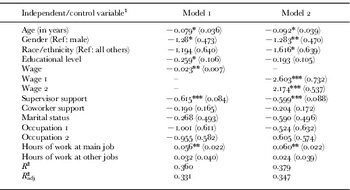
Table 4 presents findings from regression analyses for hypothesis testing. Results from Model 1 indicate mixed support for Hypotheses 1 and 2. Lower education, racial/ethnic minority status and lower wages were associated with higher prevalence of perceived workplace discrimination, controlling for marital status, occupational categories, and hours of work at main job and other jobs. Such finding rendered partial support to Hypothesis 1. Younger ages and being male, on the other hand, were associated with higher prevalence of perceived workplace discrimination and therefore Hypothesis 2 (counter hypothesis) was partly substantiated. Hypothesis 3 also received mixed support. Individuals with higher supervisor support perceived less workplace discrimination, but co-worker support made no difference.
Correlates of perceived workplace discrimination among older workers (based on regression analyses)

Notes: 1. Dependent variable: perceived workplace discrimination. Ref: reference category.
Significance levels: * p<0.05, ** p<0.01, *** p<0.001.
The prevalence analyses discussed above indicated the mid-range wage group had the highest prevalence in perceived workplace discrimination, suggesting a non-linear relationship between wages and perceived workplace discrimination. To capture such potential non-linear relationship, we created Model 2 by replacing the wage variable with two dummy variables (see Methods section). Results from regression analysis confirmed that mid-range wage ($22,500–49,999) was positively associated with perceived workplace discrimination, controlling for other study variables.
Discussion
Although the Age Discrimination in Employment Act of 1967 aims to protect individuals age 40+ from employment discrimination based on age, the present study shows that as high as 81 per cent of workers 50+ still experienced discrimination in multiple areas in the USA. For each type of the perceived workplace discrimination, the age gradients were constantly negative, with the 50–64 group reporting higher prevalence than the 65+ group (Table 2). Such finding coincides with Gee, Pavalko and Long (Reference Gee, Pavalko and Long2007), which shows among older workers age discrimination peaks in the fifties and declines afterwards. The fact that the 50–64 group experienced more workplace discrimination than those age 65+ may reflect an effect of self-selection on the part of older workers, because discriminated workers at retirement age would be more likely to retire than non-discriminated retirement-age workers and discriminated pre-retirement-age workers. To look for other possible reasons for the age difference in perceived workplace discrimination, we conducted chi-square tests and t-tests to compare these two age groups. Results (not shown) indicate that the 50–64 age group was more likely to be male, having mid-range wages, and having longer hours of work. Since these characteristics were positively associated with workplace discrimination (Table 4), it is understandable that the 50–64 age group would have a higher level of perceived workplace discrimination.
Gender difference was significant in only one type of workplace discrimination, with men more frequently reporting ‘co-workers use ethnic/racial/sexual slurs’. Such finding contradicts Rospenda, Richman and Shannon (Reference Rospenda, Richman and Shannon2009), which discovered higher prevalence of sexual harassment among women in a non-old-age-specific population. Since encountering racial, ethnic and sexual slurs was asked in the same question in the MIDUS II survey, it is impossible to compare sexual harassment alone. Further study is needed to delineate the gender differences in racial/ethnic and sexual mistreatment.
Educational gradients were found to be negative for the most part. Workers with the lowest education reported the highest prevalence of perceived workplace discrimination and those with the highest education reported the lowest. Such finding is similar to RoperASW (2002), in which 25 per cent of all the respondents aged 45–74 reported that having higher education resulted in better treatment from employers, whereas 53 per cent of those with a post-graduate education reported receiving preferential treatment. How does higher education lead to less workplace discrimination? Multiple pathways are possible. As a form of human capital (Sullivan and Sheffrin Reference Sullivan and Sheffrin2003), education provides more resources for better job performance and therefore highly educated older adults may be less likely to be discriminated against. Older adults with higher education may also occupy higher positions and command more respect. In addition, due to the self-selection process, they may also be more likely to work, or continue to work, in settings in which old age is viewed more positively, e.g. executive, managerial or professional jobs. More research along these lines is needed to fully comprehend the role of education in perceived workplace discrimination among older workers.
As hypothesised under the social barriers theory, lower education and racial/ethnic minority status were positively related to perceived workplace discrimination. As counter-hypothesised under the attribution–sensitivity theory, younger ages and being male were positively associated with perceived workplace discrimination. These findings suggest that both theories are limited and neither can fully explain perceived workplace discrimination among older workers.
Although it is intuitive that support at work should lessen perceived workplace discrimination, this study is the first we know of that actually observes such a relationship. It is understandable that workplace support, which represents an antithesis to workplace discrimination, may prevent or reduce the latter in the first place. Workplace support can also assist individuals in resolving discrimination issues and prevent their re-occurrences. Still, support at work in the form of consultation may also enable individuals to acquire different perspectives and reduce the likelihood of mistaking non-discriminatory incidents as discriminatory.
Findings revealed that supervisor support was more essential than co-worker support in alleviating perceived workplace discrimination. Due to the lack of similar previous research, it was impossible to make comparisons. However, such results are in line with the job satisfaction literature, which demonstrates the important role of supervisor support in enhancing job satisfaction (e.g. Chou and Robert Reference Chou and Robert2008). It is understandable that supervisors, with their power and authority in the work setting, are more critical than co-workers in reinforcing the rules of employment equality and in shaping a more positive organisational climate. Although not a focus of the study, the relative importance of correlates of perceived workplace discrimination was also assessed (analysis not shown). In terms of absolute effect size, supervisor support has the strongest effect on perceived workplace discrimination, followed by wage, hours of work at main job, gender (male), age, and race/ethnicity. Such findings again attest to the importance of supervisor support. Due to the lack of related information in the MIDUS data, it is impossible to examine the mechanisms with which supervisor support influences workplace discrimination. Nevertheless, this is a topic worth pursuing.
The present study discovered a non-linear relationship between wages and perceived workplace discrimination, with individuals with mid-range wages ($22,500–49,999) experiencing more discrimination than the other two wage groups. This finding was not predicted by either hypothesis. It is plausible that mid-range wage earners may have the ‘worst’ of both worlds, in the sense that they may experience more social barriers than the high wage earners (based on the social barriers theory) but they may also be more inclined to attribute failures to discrimination and are more sensitive to discrimination than the low-wage earners (according to the attribution–sensitivity theory). Future research should help to identify the causes behind such a nonlinear relationship.
An alternative approach to examining the role of mid-range wages on perceived workplace discrimination is to look at the polarisation of the labour market. In the past two decades, due to technological changes, international trade, and the off-shoring of jobs, the USA and other industrialised nations (e.g. members of the European Union) have experienced a decline of middle-skill occupations, such as sales, office and administrative workers, operators and production workers (Autor Reference Autor2010). Is it possible that mid-wage (middle-skill) employees encounter or perceive higher levels of workplace discrimination than employees at the high and low ends of wages or skills because their job market is shrinking? If so, to what extent and through what mechanisms? These intriguing questions have not been answered in the current literature, and await future exploration.
The study has several limitations. First, in the MIDUS II survey, encountering ethnic, racial and sexual slurs was included in the same question, thus precluded distinctions among them in the analyses. Second, although the study sample was nationally representative, the sizes of the minority group (N=53) and age 65+ group (N=74) were small, which might have caused limited within-group variations. Third, the dearth of detailed information on the supervisor organisational conduct and interactions with employees in the MIDUS data precluded further analysis on how supervisor support affects perceived workplace discrimination.
Despite these restrictions, this study represents a first comprehensive study of the prevalence and correlates of discrimination against older workers in the USA. The study showed that the majority of older workers experienced workplace discriminatory treatment in multiple domains. As older adults are increasing their workforce participation, how to change the organisational climate, enhance organisational justice and reduce workplace discrimination against older workers deserve more attention.
Finally, results from the present study are also significant from a cross-national or cross-cultural perspective, given that workplace discrimination against older workers exists in many countries: from developed countries, such as the United Kingdom, Canada, Germany, Japan and Australia to developing countries, such as India, China, Peru, Bangladesh and Uganda (Chou forthcoming). Societies not only differ in cultural values, which affect the patterns of discrimination at work (Marshall and Walker Reference Marshall and Walker1999; Wu, Lawler and Yi Reference Wu, Lawler and Yi2008), but also vary in legislative protections against such discrimination. Findings from the present study provide a stepping stone towards a global understanding of workplace discrimination against older workers.
Acknowledgements
The John A. Hartford Foundation is acknowledged for partially funding this paper via a Hartford Geriatric Social Work Faculty Scholar Award to the first author. The authors would like to thank the anonymous reviewers and the editors for their thoughtful comments.