INTRODUCTION
Populations of many island endemic species are threatened by human-induced environmental changes. The challenge confronting island ecologists is to clearly identify causal mechanisms and unambiguous metrics to measure and document changes in population viability. The unintentional introduction of alien species to insular areas is one means by which human activity disrupts ecological processes, and small oceanic islands are exceedingly vulnerable to these disruptions. Specialist arthropod herbivore invaders are particularly threatening to plants in insular areas because the native plants lack a shared evolutionary history with the invader (Elton Reference ELTON1958), and the invaders are not constrained by the natural pressures of their native range (Keane & Crawley Reference KEANE and CRAWLEY2002).
The armoured specialist scale Aulacaspis yasumatsui was described from collections in Thailand (Takagi Reference TAKAGI1977) and is known to attack several cycad genera. It was unintentionally introduced into southern Florida about 20 y ago (Howard et al. Reference HOWARD, HAMON, MCLAUGHLIN and WEISSLING1999). Florida was a major producer and exporter of Cycas revoluta Thunb., an economically significant landscape standard globally. Exportation of C. revoluta resulted in the sequential dispersal of A. yasumatusi in numerous settings globally. Aulacaspis yasumatsui was documented in Hawaii in 1998 (Heu et al. Reference HEU, CHUN and NAGAMINE1999), in Guam in 2003, and its dispersal from the initial outbreak site within urban landscapes into native limestone forest habitat was confirmed in early 2005 (Terry & Marler Reference TERRY and MARLER2005).
The endemic range for Cycas micronesica (Hill 2004) extends from some islands in the Republic of Palau as the southern boundary through Yap State in the Federated States of Micronesia, Guam, and Rota in the Marianas as the northern boundary. Forest inventories in 2002 revealed C. micronesica was the most abundant tree species in Guam's various habitats (Donnegan et al. Reference DONNEGAN, BUTLER, GRABOWIECKI, HISEROTE and LIMTIACO2004). Cycas micronesica is the only native host of A. yasumatsui on Guam, raising concerns about a possible decline of the cycad and its mutualists, as well as potential negative cascading ecosystem responses (Moir et al. Reference MOIR, VESK, BRENNAN, KEITH, MCCARTHY and HUGHES2011). The unique attributes and dominant status of this cycad validate the prediction that its removal from native forests will exert manifold ecological changes. These changes require experimental and conceptual effort to be fully understood.
Demographic studies are an important tool for evaluating the condition of plant populations and monitoring changes in population status over time (Schemske et al. Reference SCHEMSKE, HUSBAND, RUCKELSHAUS, GOODWILLIE, PARKER and BISHOP1994). Our objective in this study was to assess recent changes in the demography of Guam's C. micronesica population, monitoring what started as a healthy, stable cycad population. We quantified size-based patterns of mortality and changes to the demography and allometric traits of this population after successive migrations of A. yasumatsui. Long-term infestations of this armoured scale lead to sequential defoliation events with each successive flush of leaves generating fewer and smaller leaves, a process that ultimately results in plant death (Terry & Marler Reference TERRY and MARLER2005). The roots and pachycaul stems of healthy cycads are comprised mostly of live parenchyma tissues containing abundant starch (Marler et al. Reference MARLER, LINDSTRÖM and FISHER2010, Norstog & Nicholls Reference NORSTOG and NICHOLLS1997). Therefore, our hypothesis was the initial pool of non-structural carbohydrate as dictated by size of the plant correlates with length of time from initial infestation until plant death. Our results will inform ecological principles of rare plant populations in small islands and fragmented continental populations.
METHODS
Study site
Following the 2003 unintentional introduction of A. yasumatsui to Guam, we scouted various native forest habitats to locate a representative study site where we could determine population-level responses to anticipated migrations of A. yasumatsui. We selected a high-density, healthy population in western Guam where Cycas micronesica stem density was in excess of 3500 plants ha−1. This site resides within the federally managed Guam National Wildlife Refuge, centred at 13.645278°N, 144.858333°E. The complex of soils is dominated by a clayey-skeletal, gibbsitic, non-acid, isohyperthermic Lithic Ustorthents (Young Reference YOUNG1988). This soil supports most of the highest-density cycad habitats on Guam. The C. micronesica population is the most genetically isolated population on Guam, and deserves paramount conservation efforts (Cibrián-Jaramillo et al. Reference CIBRIÁN-JARAMILLO, DALY, BRENNER, DESALLE and MARLER2010). Several ecological studies have been conducted at this site, providing a more robust understanding of the site than many other candidate sites. Its vegetation is classified as secondary limestone forest, with Aglaia, Ficus, Meiogyne, Macaranga, Neisosperma, Ochrosia, Pandanus, Premna and Pisonia being the common native genera. In addition to invasive insects, this habitat is severely threatened by two feral ungulate species and invasive plants.
Plot establishment and multi-trophic developments
We established four belt transects with a width of 4 m and an average length of 120 m (range 102–142 m) in October 2004. The initial number of plants within the transects was 687. We re-visited the study site weekly thereafter to ensure accurate assessment of the initial dispersal of A. yasumatsui within the study site. This occurred in January 2005. We purposely introduced the armoured scale predator Rhyzobius lophanthae Blaisdell (Coleoptera, Coccinellidae) to Guam in November 2004, and made a release at the study site in February 2005 (Moore et al. Reference MOORE, MARLER, MILLER and MUNIAPPAN2005). We also discovered Chilades pandava Horsfield, a Cycas-specific butterfly that feeds on young, expanding tissues, in the study site in 2005 (Moore et al. Reference MOORE, MARLER, MILLER and MUNIAPPAN2005). Its discovery validated yet another problematic alien introduction to Guam. An ephemeral irruption of Dihammus marianarum Aurivillius (Marler & Muniappan Reference MARLER and MUNIAPPAN2006) occurred within the study site in late 2007. This native longhorn beetle is a borer that feeds on C. micronesica stems, primarily on stressed plants. A temporary decline in the R. lophanthae population occurred in late 2008, which initiated a secondary irruption of A. yasumatsui. This epidemic was also short-lived.
Measurements and data analysis
We visited the site approximately annually to conduct a type I right-censoring approach (Pyke & Thompson Reference PYKE and THOMPSON1986) in which we documented plant mortality to January 2011. Plants in the initial census were tagged to ensure accuracy during subsequent data collection. In addition to the survival data, we measured stem height, basal diameter and leaf number for each individual plant. As an estimation of reproductive effort, sex was assigned to each individual using any signs of reproductive structures. This approach included documenting any persistent reproductive structures from past reproductive events, not just the current season's structures.
We calculated the density of plants from each census within height categories. The data were organized as a two-factor (height category × month of census) ANOVA using SAS Proc GLIMMIX with AR(1) covariance structure, with month treated as a repeated-measures variable. In addition, we organized juvenile plants less than 100 cm in height into four size categories then recorded the number of months required for each height category to reach 100% mortality. A single-factor ANOVA was performed using SAS Proc GLM. We compared 2004 and 2011 frequency data among various size categories for stem height, stem diameter and leaf number with the Wilcoxon rank-sum test (Wilcoxon Reference WILCOXON1945) using SAS Proc NPAR1WAY. For describing size distributions, we calculated the skewness and kurtosis (Groeneveld & Meeden Reference GROENEVELD and MEEDEN1984, Joanes & Gill Reference JOANES and GILL1998) then employed the Lilliefors goodness-of-fit test for normality (Lilliefors Reference LILLIEFORS1967). For allometric relations, we used log10-transformed data to determine log-log linear relationships between stem height and diameter, stem height and leaf number, and stem diameter and leaf number for the 2004 and 2011 data. First we determined the slope of each regression for each transect. Thereafter a dataset was created with the slope as the response variable and a single-factor ANOVA was performed using SAS Proc GLM.
RESULTS
Population demography
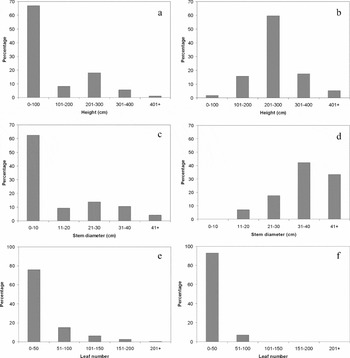
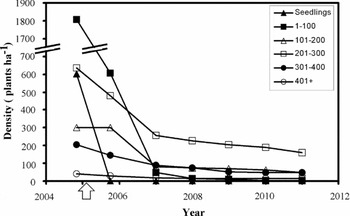
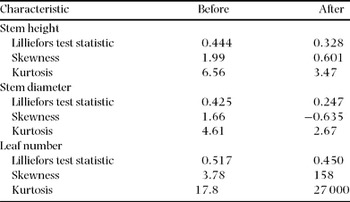
The 2004 C. micronesica population presented a left-skewed frequency distribution for stem height, stem basal diameter and total leaf number (Figure 1, Table 1). The degree of skewness and kurtosis was greatest for leaf number. Variation in plant density over time revealed the main effects of height category (F = 31.0, df = 5,126, P ≤ 0.0001) and census date (F = 128, df = 6,126, P ≤ 0.0001) were significant, as was their interaction (F = 40.1, df = 30,126, P ≤ 0.0001). The initial decline in density of seedling and juvenile plants 1–100 cm in height was extreme, whereas the decline in density of plants above 100 cm in height was more gradual (Figure 2). All seedlings within the transects were killed within 9 mo after the initial A. yasumatsui infestation.
Demographic characteristics of Guam's Cycas micronesica population in October 2004 (left column, n = 687) 4 mo prior to the establishment of the invasive Aulacaspis yasumatsui in the study area and in January 2011 (right column, n = 57) after 72 mo of scale infestation. Percentage of individuals within height categories in 2004 (a) and 2011 (b). Percentage of individuals within stem diameter categories in 2004 (c) and 2011 (d). Percentage of individuals within total leaf number categories in 2004 (e) and 2011 (f).

The influence of plant height size categories (cm) on survival of Cycas micronesica following the establishment of Aulacaspis yasumatsui in western Guam. The x-axis refers to January of each calendar year. Arrow on x-axis marks the initial infestation of A. yasumatsui in the study habitat.

Characteristics of frequency distributions among size categories for Cycas micronesica stem height, stem diameter and leaf number in October 2004, 4 mo prior to the establishment of Aulacaspis yasumatsui in the study area (Before) and in January 2011, 72 mo following the invasion event (After).

Timing of juvenile mortality
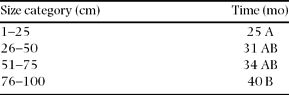
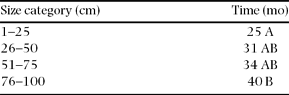
The number of months required for juvenile plants to reach 100% mortality differed among four 25-cm height increments (F = 6.4, df = 4,15, P ≤ 0.0033). Mortality of the 1–25-cm category required about 2 y, while that of the 76–100-cm category required a mean of more than 3 y (Table 2). The census confirming ultimate loss of the final juvenile plant was the January 2010 census. At this stage when all of the juvenile plants had been killed, the mature plants above 100 cm in height were at 73% mortality.
Time required for juvenile Cycas micronesica plants to suffer 100% mortality following Aulacaspis yasumatsui establishment, as documented by 25-cm-increment height categories, P ≤ 0.0033, n = 4 transects. Least square means with the same letter are not significantly different.
Allometric patterns
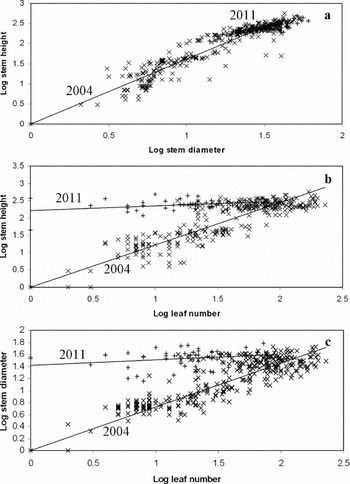
Differences in the slope of the 2004 versus 2011 populations of C. micronesica were apparent for stem height versus diameter (F = 55.9, df = 1,6, P ≤ 0.0003), stem height versus leaf number (F = 130, df = 1,6, P ≤ 0.0001) and stem diameter versus leaf number (F = 143.3, df = 1,6, P ≤ 0.0001). The 2011 population exhibited a slope for height versus diameter that was 40%, a slope for height versus leaf number that was 10%, and a slope for diameter versus leaf number that was 13% of that for the 2004 population (Figure 3). Additionally, the range of the data for all three regressions in 2011 was severely constricted by the plant mortality after 6 y of A. yasumatsui infestations.
Allometric relations of Guam's Cycas micronesica population in October 2004, 4 mo prior to the establishment of the invasive Aulacaspis yasumatsui in the study area and in January 2011, after 72 mo of scale infestation. Height versus diameter slope was 1.62 for 2004 and 0.65 for 2011 (a). Height versus leaf number was 1.28 for 2004 and 0.11 for 2011 (b). Diameter versus leaf number was 0.71 for 2004 and 0.09 for 2011 (c).

Population trait changes
The distribution of size categories in the 2004 population differed significantly from that in the 2011 population for stem height (Wilcoxon statistic = 37, P ≤ 0.0301), stem diameter (Wilcoxon statistic = 40, P ≤ 0.0061), and leaf number (Wilcoxon statistic = 36, P ≤ 0.0453). Following 6 y of A. yasumatsui damage this population of C. micronesica exhibited a unimodal pattern for stem height (Figure 1). The degree of skewness declined to 30% of the 2004 values, and the degree of kurtosis declined to about half of the 2004 values (Table 1). The left-skewed 2004 distribution of stem diameter was reversed by 6 y of damage to become a right-skewed pattern (Table 1, Figure 1). The left-skewed 2004 distribution of leaf numbers was retained in the 2011 population (Figure 1). In fact, this skewed pattern was magnified by the response to years of A. yasumatsui damage as evidenced by a 42-fold increase in skewness (Table 1). The lowest leaf number category increased from c. 75% of the 2004 population to more than 90% of the 2011 population. Furthermore, the three largest leaf number categories from the 2004 census declined to zero by the 2011 census. The lowest leaf number categories in 2004 were due to the prevalent seedling and juvenile populations. In contrast, the 2011 data did not include any plants less than 100 cm in height, so the trend of declining leaf number per plant occurred within a remaining population exclusively comprised of mature plants. Lilliefors test statistic revealed strong evidence against normality for every population test (Table 1). The 2011 results portray the absence of seedling and juvenile plants and predict imminent population decline.
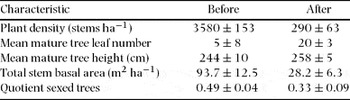
In order to increase our understanding of how 6 y of A. yasumatsui attack changed the C. micronesica populations, we calculated mean ± SE for several before–after variables (Table 3). Total plant density declined to 8% of initial plant density, and mean leaf number for mature plants declined to 24% of initial leaf number. Range in leaf number for mature plants was 21–229 in 2004 and 1–72 in 2011. These characteristics of changes in leaf number explain the drastic changes in the regressions of height versus leaf number and diameter versus leaf number (Figure 3). In 2004 all of the individuals with few leaves were seedlings and small juveniles, so the y-intercept was near the origin as both factors scaled together. In contrast, the y-intercepts for both height and diameter were quite large for 2011 plants because all of the individuals with few leaves were large mature specimens.
Characteristics of Guam's Cycas micronesica population in October 2004, 4 mo prior to the establishment of Aulacaspis yasumatsui in the study area (Before) and in January 2011, 72 mo following the invasion event (After). n = 4 transects, mean ± SE.

Mean height of mature trees exhibited a non-significant increase following 6 y of A. yasumatsui damage, while total stem basal area declined to 30% of the initial basal area during the same period (Table 3). About half of the mature tree population could be sexed in 2004, but only about a third of the 2011 population could be sexed (Table 3), indicating a decline in reproductive effort among the few remaining C. micronesica plants on Guam. The male/female quotient among these sexed individuals was 0.73 in 2004 and 0.63 in 2011, signifying an increase in the ability to identify signs of female plants relative to that of male plants.
Recruitment
This site contained C. micronesica seedlings at the density of 602 ha−1 in 2004. These were all killed within 9 mo of scale infestation, and the census in 2005 revealed a complete lack of seedlings. As the R. lophanthae predator began to exert some biological control of the damage by A. yasumatsui, but before the mature plant health declined substantially, a few new seedling recruits were apparent in this habitat. This was revealed as 118 seedlings ha−1 in January 2007 and 28 seedlings ha−1 in January 2008. All of these seedlings were killed by direct A. yasumatsui damage before the three-leaf stage. As mature plant health continued to decline with each passing year, seed production and quality declined. As a result, no new seedlings have been observed persisting in this habitat since 2008.
An unusual increase in recruitment into the 1–100-cm height category occurred in 2010. This was not the normal growth increment increase that promoted a cohort of individuals from the seedling category into the juvenile category. Instead, it occurred because many mature plants lost most of their stem height due to the D. marianarum tunnelling that peaked in 2007–2008. This is the typical historical response to this pest where the entire upper portion of the stem and leaves dies back to about 1 m height. The phenomenon decreased calculated plant density within some of the taller categories, but not due to mortality. It also increased plant density in the 1–100-cm category, but not due to normal growth increment recruitment. This also partly explains the atypical height versus diameter slope for the 2011 population by constricting the height range without a parallel constriction of the diameter range (Figure 3).
DISCUSSION
We present a north-western Pacific island case study describing the consequences of a predicted invasion that empirically supports the contention that island-endemic plant populations are acutely susceptible to invasive herbivores (Meyer & Butaud Reference MEYER and BUTAUD2009). This is also a classic example of the enemy release hypothesis (Elton Reference ELTON1958, Liu & Stiling Reference LIU and STILING2006, Norghauer et al. Reference NORGHAUER, MARTIN, MYCROFT, JAMES and THOMAS2011). First, A. yasumatsui populations within the scale's native range co-occur with healthy native Cycas populations that exhibit scale infestations but are not severely threatened (Tang et al. Reference TANG, YANG and VATCHARAKORN1997). Second, many mature C. micronesica trees died during less than 1 y of A. yasumatsui infestation before R. lophanthae became well-established, but after its effective establishment the R. lophanthae predator has allowed many trees to survive 6 y of A. yasumatsui infestation. Third, C. micronesica plants growing in ex situ plantings in Thailand where A. yasumatsui is controlled by various natural enemies do not exhibit greater susceptibility to A. yasumatsui infestations than other congeneric plants (A. J. Lindström, unpubl. data). Our results empirically validate the designation of endangered status for C. micronesica by the International Union for Conservation of Nature and Natural Resources.
Initial establishment of A. yasumatsui in the study site preceded that of R. lophanthae. This enabled a brief period of A. yasumatsui infestation without biological control. Unfortunately the size differential between R. lophanthae and A. yasumatsui limits ongoing efficacy of biological control, as the scale is able to find locations on the Cycas plant body that the predator cannot access (Marler & Moore Reference MARLER and MOORE2010). Regardless, the long-term protection afforded by this predator is undoubtedly responsible for the mature trees that are still alive today.
Size-related impacts
The first year of C. micronesica mortality following A. yasumatsui infestation was comprised primarily of seedlings. As time passed the loss of seedlings was sequentially followed by 100% mortality of plants within the height range 1–25 cm, 26–50 cm, 51–75 cm, and finally 76–100 cm. These results for seedling and juvenile plants up to 100 cm in height were consistent with our hypothesis. Moreover, they lend evidence for the hypothesis that carbon limitations and starvation are universal mechanisms of tree decline following biotic or abiotic stresses (McDowell et al. Reference McDOWELL, POCKMAN, ALLEN, BRESHEARS, COBB, KOLB, PLAUT, SPERRY, WEST, WILLIAMS and YEPEZ2008).
Unlike juvenile plant mortality, the mature plants appeared to exhibit no overt relationship of size category to survivorship. First, the mean height of mature trees did not change during the time frame of this study (Table 3), despite mortality and removal from the population of 75% of the mature trees. Second, 19% of the mature trees in excess of 100 cm in height died within 9 mo of A. yasumatsui infestation, and these plants were distributed randomly among mature size categories rather than showing a left-skewed trend whereby the smallest mature trees were preferentially killed. Third, although we cannot determine the timing of 100% mortality for any of the mature tree size categories to date, we can determine the time to reach 50% mortality. The transition to at least 50% mortality occurred in the January 2007 census for 101–200-cm, 201–300-cm and 401+ cm categories. This level of mortality for the 301–400-cm category was evident in the January 2009 census. Therefore, the benefits of being large are very clear for juvenile plants, but less clear for mature plants. Other factors may explain which mature trees are most susceptible to A. yasumatsui damage, such as the available pool of carbon reserves at the time of initial infestation (Galiano et al. Reference GALIANO, MARTÍNEZ-VILALTA and LLORET2011).
Determining the influences of climatic, edaphic, biotic and demographic factors on stand-level die-back may aid in understanding the underlying causes of tree death (Mueller-Dombois Reference MUELLER-DOMBOIS1986, Reference MUELLER-DOMBOIS1987). Mortality of the mature plants in our study appears to conform to Manion's conceptual model of tree disease (Manion Reference MANION1981). This model posits that pre-disposing factors render an individual more or less vulnerable to subsequent stresses, which then decrease vigour and increase vulnerability prior to imposition of the next stress. Ultimately a newly imposed stress can cause a final vigour decline and subsequent death. The chronic attack by A. yasumatsui imposed the major stress factor that contributed to this ongoing phase of mature C. micronesica plant mortality. However, other biological factors contribute to the compilation of stressors.
Contributing factors adding to the A. yasumatsui pressure include the chronic pressure of Chilades pandava (Moore et al. Reference MOORE, MARLER, MILLER and MUNIAPPAN2005) and Erechthias sp. (Marler & Muniappan Reference MARLER and MUNIAPPAN2006) infestations. The combination of these three alien arthropod pests, all of which are very recent unintentional introductions on Guam, does not allow C. micronesica plants the time to adequately recover carbon from the naturally long-lived leaves following initial leaf construction. This forces the plant into a chronic state of carbon deficit. In addition to these leaf feeders, the stem borer D. marianarum (Marler & Muniappan Reference MARLER and MUNIAPPAN2006) is a native longhorn beetle that preferentially attacks stressed plants, a behaviour common among other Cerambycidae stem borers. Feral ungulates are also threatening the health of remaining plants, as the pig (Sus scrofa L.) consumes stems and the deer (Cervus mariannus Desmarest) consumes leaves and reproductive organs, adding to the multiple compounding insults from alien pests to this island endemic.
Stand structure
Understanding the structure of a plant population enables the assessment of regeneration processes and reflects on the population health. The left-skewed size structure of Guam's C. micronesica population prior to A. yasumatsui damage is often called reverse-J shape, conforming to a Type III curve according to Deevey (Reference DEEVEY1947) or Type I curve according to Bongers et al. (Reference BONGERS, POPMA, MEAVE and CARABIAS1988). This structure suggests copious fecundity and favourable site conditions for establishment and survival of seedlings. Indeed, only one-third of the 2004 population was comprised of mature trees greater than 100 cm in height. The leaf number size class distribution exhibited more asymmetry and a broader peak in the distribution curve than did the stem height or stem diameter size class distribution, as evidenced by the extent of skewness and kurtosis (Groeneveld & Meeden Reference GROENEVELD and MEEDEN1984, Joanes & Gill Reference JOANES and GILL1998).
The ability of larger plants to delay mortality following A. yasumatsui infestation generated extreme changes in population structure. Therefore, only 6 y after A. yasumatsui migrated into the study site a left-skewed C. micronesica population exhibiting healthy trees with bountiful active recruitment, this same population was transformed into a unimodal stem height structure and a right-skewed stem diameter structure comprised of unhealthy trees exhibiting no recruitment.
Although the general trend of the 2004 population was clearly left-skewed, this cycad population exhibited more than twice as many trees within the 201–300-cm height category than within the 101–200-cm height category (Figure 2). This anomaly in what would have otherwise been a smooth curve may signify an ephemeral pulse in recruitment at some historical period that enabled the greater number of 201–300-cm trees, or alternatively a more recent decline in recruitment that resulted in the smaller number of 101–200-cm trees. Perhaps habitat destruction during establishment of copra plantations in the 20th century and as a result of military operations and construction during and following World War II, or the cumulative impacts of these events combined with natural climatic events may explain these results. Alternatively, the extent of ecosystem destruction during the direct hit of several major typhoons striking Guam in the past century may partly explain the anomaly. Unfortunately, no reliable historical records are available that permit us to definitively establish any single cause or any series of events that influenced C. micronesica demography or the subsequent recovery of this habitat.
Death of a portion of juvenile C. micronesica plants shortly after the A. yasumatsui invasion caused significant changes on allometric relations for the juvenile survivors (Niklas & Marler Reference NIKLAS and MARLER2008). Here we have extended the results to include the changes in allometry for the entire population after 100% removal of the juveniles and 75% removal of the mature plants. The slope and range in data were severely decreased by the selective removal of C. micronesica plants by the invasive pest.
Other cycads
Cycads are the most threatened group of plant species on Earth (Hoffmann et al. Reference HOFFMANN, HILTON-TAYLOR, ANGULO, BÖHM, BROOKS, BUTCHART, CARPENTER, CHANSON, COLLEN, COX, DARWALL, DULVY, HARRISON, KATARIYA, POLLOCK, QUADER, RICHMAN, RODRIGUES, TOGNELLI, VIÉ, AGUIAR, ALLEN, ALLEN, AMORI, ANANJEVA, ANDREONE, ANDREW, ORTIZ, BAILLIE, BALDI, BELL, BIJU, BIRD, BLACK-DECIMA, BLANC, BOLAÑOS, BOLIVAR-G., BURFIELD, BURTON, CAPPER, CASTRO, CATULLO, CAVANAGH, CHANNING, CHAO, CHENERY, CHIOZZA, CLAUSNITZER, COLLAR, COLLETT, COLLETTE, FERNANDEZ, CRAIG, CROSBY, CUMBERLIDGE, CUTTELOD, DEROCHER, DIESMOS, DONALDSON, DUCKWORTH, DUTSON, DUTTA, EMSLIE, FARJON, FOWLER, FREYHOF, GARSHELIS, GERLACH, GOWER, GRANT, HAMMERSON, HARRIS, HEANEY, HEDGES, HERO, HUGHES, HUSSAIN, ICOCHEA, INGER, ISHII, ISKANDAR, JENKINS, KANEKO, KOTTELAT, KOVACS, KUZMIN, LA MARCA, LAMOREUX, LAU, LAVILLA, LEUS, LEWISON, LICHTENSTEIN, LIVINGSTONE, LUKOSCHEK, MALLON, MCGOWAN, MCIVOR, MOEHLMAN, MOLUR, ALONSO, MUSICK, NOWELL, NUSSBAUM, OLECH, ORLOV, PAPENFUSS, PARRA-OLEA, PERRIN, POLIDORO, POURKAZEMI, RACEY, RAGLE, RAM, RATHBUN, REYNOLDS, RHODIN, RICHARDS, RODRÍGUEZ, RON, RONDININI, RYLANDS, DE MITCHESON, SANCIANGCO, SANDERS, SANTOS-BARRERA, SCHIPPER, SELF-SULLIVAN, SHI, SHOEMAKER, SHORT, SILLERO-ZUBIRI, SILVANO, SMITH, SMITH, SNOEKS, STATTERSFIELD, SYMES, TABER, TALUKDAR, TEMPLE, TIMMINS, TOBIAS, TSYTSULINA, TWEDDLE, UBEDA, VALENTI, VAN DIJK, VEIGA, VELOSO, WEGE, WILKINSON, WILLIAMSON, XIE, YOUNG, AKÇAKAYA, BENNUN, BLACKBURN, BOITANI, DUBLIN, DA FONSECA, GASCON, LACHER, MACE, MAINKA, MCNEELY, MITTERMEIER, REID, RODRIGUEZ, ROSENBERG, SAMWAYS, SMART, STEIN and STUART2010). Despite this unfortunate conservation condition and the importance of demographic studies to assess population status, only a few of the c. 300 described cycad species (Donaldson Reference DONALDSON2003) have been the subject of demographic studies. Merely one of these focused on a congeneric of our study species, when Keppel (Reference KEPPEL2001) determined height class distribution of one Cycas seemannii population. Other relevant studies included Ceratozamia matudae (Pérez-Farrera & Vovides Reference PÉREZ-FARRERA and VOVIDES2004a, Reference PÉREZ-FARRERA and VOVIDES2004b), Ceratozamia mirandae (Pérez-Farrera & Vovides Reference PÉREZ-FARRERA, VOVIDES and Lindström2004b, Pérez-Farrera et al. Reference PÉREZ-FARRERA, VOVIDES, OCTAVIO-AGUILAR, GONZÁLEZ-ASTORGA, DE LA CRUZ-RODRÍGUEZ, HERNÁNDEZ -JONAPÁ and VILLALOBOS-MÉNDEZ2006), Dioon edule (Vovides Reference VOVIDES1990), Dioon merolae (Lázaro-Zermeño et al. Reference LÁZARO-ZERMEÑO, GONZÁLEZ-ESPINOSA, MENDOZA, MARTÍNEZ-RAMOS and QUINTANA-ASCENCIO2011), Zamia debilis (Negron-Ortiz & Breckon Reference NEGRON-ORTIZ and BRECKON1989) and Zamia soconuscensis (Pérez-Farrera & Vovides Reference PÉREZ-FARRERA, VOVIDES and Lindström2004b).
Without exception, these studies revealed populations that generally conformed to the classic left-skewed size class structure. Our report, therefore, stands out as the first to describe a unimodal population status for a cycad habitat as evidence of a severely threatened population. Furthermore, ours is the first study to our knowledge that has quantified the size-structure response of a cycad population to a biotic or abiotic disturbance by comparing pre- and post-disturbance status within the same habitat.
Prognosis
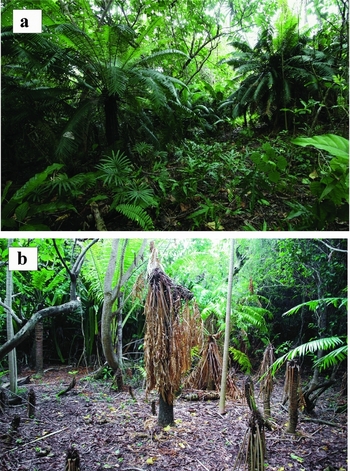
Our results provide empirical evidence that supports the endangered status of C. micronesica and highlight concerns about ecosystem processes that will be impacted by the loss of this native cycad. Gestalt comparison of a Guam forest before and after the consequences of this invasion (Figure 4) reveals immeasurable changes to biotic and abiotic characteristics. An immediate research focus on changes to habitat- and ecosystem-level processes that result from the epidemic mortality of this species is warranted, as the changes in population density are of such great magnitude and speed. The window of opportunity to quantify these rapid changes has already been compromised for this island population, highlighting the importance of securing data prior to predicted disturbances to serve as benchmarks.
General appearance of a high density Cycas micronesica habitat prior to the invasion of Aulacaspis yasumatsui (a). General appearance of the same habitat 29 mo after the initial infestation of A. yasumatsui (b).

Compounding negative impacts visited on this and other native plant communities are anticipated with future waves of biological invasions associated with the nascent military build-up on Guam (Marler & Moore Reference MARLER and MOORE2011). Guam's dominant native trees are ecologically well adapted to local soils and climate, and have fundamental cultural and economic significance. The continued loss of ecologically significant plants and habitat will continue to be disastrous for the island, underscoring the importance of empirical studies to inform conservation decisions.
The surviving C. micronesica population on Guam is rooted in an expiring timer to a bomb of unknown ecological impacts, with a short but uncertain amount of time left on the timer. If the ongoing negative population density trajectory established over the past 4 y is sustained, extirpation will occur in 2019. However, an increase in biotic disturbances would likely reduce this time frame, an outcome that may materialize as the invasion of yet another Cycas pest or as another irruption of one of the existing pests. Abiotic disturbances that may similarly shorten the time frame include damage by a tropical cyclone or a severe dry season. Concerns about the threat of tropical cyclone damage are especially warranted for Guam habitats, as the average return time for typhoons over a 54-y monitoring period was 4.7 y (Guard et al. Reference GUARD, HAMNETT, NEUMANN, LANDER and SIEGRIST1999). Endemic species such as C. micronesica cannot escape damage during the more powerful typhoons (Marler & Hirsh Reference MARLER and HIRSH1998). However, in the absence of subsequent disturbances a healthy C. micronesica plant is resilient to typhoon damage (Hirsh & Marler Reference HIRSH and MARLER2002). Guam has not experienced a major typhoon since the unintentional introduction of A. yasumatsui in 2003, so probability predicts a typhoon event will occur prior to the predicted 2019 extirpation. The poor health status of remaining trees indicates that the natural resilience of this taxon to typhoon damage has been decreased by the chronic A. yasumatsui damage, a contention that has yet to be tested.
In contrast to these factors that may increase mortality rate, a factor that has the potential to ward off extirpation is the purposeful introduction of a second and hopefully more effective biological control agent. A parasitoid would be a better candidate for a second biological control agent, as a second predator species may be impaired by the same limitations that prevent R. lophanthae from being completely effective.
During the time frame of this Guam study, A. yasumatsui invaded Rota in 2007 and Palau in 2008. Our striking results serve as a benchmark for comparative purposes as the influence of this pest on the C. micronesica populations in Rota and Palau should be determined in the future.
ACKNOWLEDGEMENTS
This project was made possible in part by National Science Foundation SGER No. 0646896, USDA CSREES Project No. 2003-05495, US Forest Service Project No. 06-DG-11052021-206, No. 09-DG-11052021-173 and No. 10-DG-11059702-095 to TEM. This material was made possible, in part, by a Cooperative Agreement from the United States Department of Agriculture's Animal and Plant Health Inspection Service (APHIS). It may not necessarily express APHIS' views.