1. Introduction
The Japanese economy has been closely related to the South Korean (hereafter, Korean) economy since South Korea (hereafter, Korea) and Japan resumed diplomatic relations in 1965. Japan's successful economic growth in the 1950s became a role model for Korea's economic growth. In addition, the Korean government has made an effort to catch up with the Japanese economy as part of the long-term plan of Korean economic growth. Government and firms tried to extract lessons from the experiences of economic growth in Japan and from Japanese firms, and apply these lessons to the early process of Korean economic growth in the 1960s and 1970s. When Korean manufacturing became more developed and competitive in the international market from 1990s, the research focus seemed to shift to the high-technology and innovation activities of Japanese firms. In these circumstances, there has been considerable motivation for Korean students to study at Japanese graduate schools, to learn economics and business studies, and to become experts in the Japanese economy and business. When they returned to Korea, they would obtain employment at a university, public and private think tanks, or firms. Their research activities have been revealed in the publications of various academic societies and think tanks, which represented the main interest and issues of Korean society and academics in the Japanese economy and business. The two main avenues in Korea for the study of Japan's economy and business were research institutes (government and private think tanks) and individual researchers (mostly working at academic institutions). The early research motivation for the study of Japan's economy and business was initiated by government research institutes in the 1970s. It was their main motivation to analyze the experience of Japanese economic growth and thus to extract and provide proper and timely economic policy recommendations for the Korean economy. Among the government research institutes, the Korea Development Institute (KDI), the Korea Institute of International Economic Policy (KIEP), and the Korea Institute of Economic and Technology (KIET) publish a great deal of research every year. KDI has been researching mainly broad macroeconomic issues for the Korean economy. KIET has been researching the competitiveness and comparability of Korean manufacturing industries. Meanwhile, KIEP has been studying international economic issues, such as free trade areas (FTA), foreign direct investment (FDI), economic integration, and international trade friction in the international market. KIEP and KIET have special research sections and experts on the Japanese economy, while KDI does not have such a special section. KIET and KIEP have been producing important Korean experts on the Japanese economy.
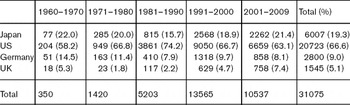
The objective of this study is to review studies in Korea on the Japanese economy and business and to show the main trends of Korean studies on the Japanese economy and business. I aim to show what issues are of most interest to the Korean society. The trends among Ph.D. holders will indicate the potential for Japanese studies in Korea. A majority of Korean scholars have been studying in the US. The US produced 66.6% of Korean Ph.D. holders, while Japan produced about 19%. When focusing only on Japan, compared with the majors in engineering and Japanese literature, the number of Ph.D. holders in economics and business was 193 in 2009: ranked fourth among all majors considered.Footnote 1 The percentage of Ph.D. holders in economics and business studies from Japan represented only 3.2% of the entire number of Ph.D. holders from Japan. Nearly 28% of Korean graduate students in the Japanese universities are studying engineering or Japanese literature. The trend of studying economics and business in the Japanese universities has been unchanged since the financial crisis of 1997. Studying economics and business at the Japanese graduate level seems to be not so attractive to young Korean students. On the Korean academic side, there were few universities which offered courses on the Japanese economy until in the 1980s. In the 1990s, there was a boom in the new graduate schools of international regional studies. All graduate schools of international regional studies included a Japanese section as one course of study. I found that 26 universities opened courses on the Japanese economy or similar subjects in 2010. These academic institutions would send out future economists majoring in the Japanese economy and business.
I consulted 271 publications (articles and books) for this study. Academic and individual publications made up 69.7% (189 papers) of the total; public and corporate research institutes constituted 30.3% (82 publications). Hence, individual researchers comprised a majority of the publications. I classify these papers into six different categories: macroeconomics, microeconomics, macro-finance, international economics, business administration, and the labor market. When looking into the contents of the publications, I find some trends and characteristics in the study of Japanese economics and business studies in Korea. Individual researchers have been focusing mainly on the field of Japanese business management: the Japanese corporate governance, accounting system, and labor market. These issues have not been a main interest for public think tanks. Some private think tanks, such as Korea Economic Research Institute (KERI), Samsung Economics Research Institute (SERI), and LG Economic Research Institute (LGERI), have researched these issues from the perspective of corporate firms. Government think tanks have mostly analyzed the Japanese economy in the areas of macroeconomics, microeconomics, and international economics. As a result, purely business administration issues have not been their main focus of interest. The most pressing issues for Korea are those of business administration such as Japanese corporate governance, Zaibatsu, and firms, studied mainly by individual researchers. The second most important issues were those of international economics such as FTA, FDI, and the trade deficit between Korea and Japan, investigated mainly by government think tanks and individual researchers.
Bae (Reference Bae2007) published a similar article to this study which surveyed research trends in Korea into the Japanese economy and business.Footnote 2 He was concerned that the Korean academic society did not provide notable academic output in the study of the Japanese economy, and research effort seemed weakened. He mentioned that government and private research institutes showed a declining interest in the Japanese economy in the 2000s. However, this study could not find such a declining trend in the research activity in either think tanks or individual researchers. It is my view that the quality of research is more important. My empirical results reveal that articles on the Japanese economy or business comprise only a small percentage in the major journals of academic associations in business and economics. Articles researching the Japanese economy represented only 1.6% out of the total number of papers published in the two main journals of the Korean Economic Association (KEA). The Korean Academic Society of Business Association (KASBA) showed a little higher, 3.0%. As Bae (Reference Bae2007) indicated in his paper, there are few scholars receiving Ph.Ds. from Japan who publish their papers in the major economics and business journals. Without doubt, these major journals require that papers should have both theoretical and empirical excellence.
For individual researchers, there are a few who focus on particular issues. Most researchers have changed their focus repeatedly; this harms the depth and quality of research. The other point is about government think tanks. The role of government think tanks in Korea is crucial and will continue to be in the future. The concern is that the output of government think tanks is quite a similar between them. Therefore, it is very difficult to expect some uniqueness and creativeness from their outputs. Fortunately, the Korea-Japan Economics and Business Association (KJEBA) has been actively working for the place of research activities for Korean scholars. Research output has been increasing and was continuously published throughout the 1990s and the 2000s. The important thing for KJEBA is how to enhance the quality of its journal (Han'ilkyŏngsangnonjip-KJEBJ), if improvement in the quality of Japanese studies in Korea is a goal.
This study is composed of five sections. Section 2 will report statistics on Ph.D. holders, publications, and research institutions. Section 3 will introduce briefly the main topics of publications cited in this paper. Section 4 will focus on selected Korean scholars who have contributed significantly to the academic society. Section 5 will conclude.
2. The current pool of researchers and research institutions
Future scholars researching the Japanese economy and business will be directly related to the numbers of scholars who receive a Ph.D. from Japanese universities. Table 1 shows the statistics for Ph.D. holders in Korea for the period 1960–2009. It illustrates the numbers of Ph.D. holders from four countries, the US, Japan, Germany, and the UK. The majority of Korean scholars have studied in the US, which has produced 66.6% of Korean Ph.D. holders. Japan produced about 19% of the total. There was an increasing trend in US Ph.D. graduates till 1990. The increasing trend in US Ph.D. graduates declined from 74.2% in the 1980s to 66.7% in the 1990s. This decreasing trend might be related to the Asian financial crisis in 1997. Korean students seem to go to Japanese graduate school more than in the 1990s. From the turn of the century, Ph.D. holders from Japan increased to 21.4%. This trend may show Korean students’ increased interest in studying in Japan.
Ph.D. Holders from Japan, the US, Germany, and the UK

Source: National Research Foundation of Korea, http://www.nrf.go.kr/
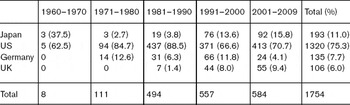
Table 2 reports the number of Ph.D. holders in economics and business studies. The majority of Ph.D. holders of economics and business studies are from the US. Thus, it represents about 75% of the total in 2009. Contrasted with the US, the number of Ph.D. holders of economics and business studies from Japan is 11.0% in 2009. The trend of Japanese Ph.D. holders increased but is not remarkable.
Ph.D. Holders of Economics and Business

Source: National Research Foundation of Korea, http://www.nrf.go.kr/
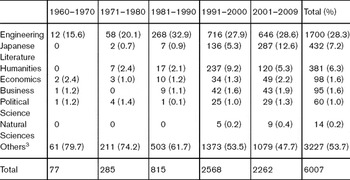
Table 3 depicts the trends in Ph.D. holders from Japan in various majors. Most Ph.D. holders from Japan major in engineering and Japanese literature. Engineering has been the most attractive major for Korean students. The main reason is that Japanese universities are highly competitive in engineering, even compared with the US and European countries. Japanese literature is the other big reason for Korean students studying in Japan. In addition, the high percentage of people studying engineering and Japanese literature seems to show their high expectation of finding jobs at universities and research institutes in Korea. By contrast, the percentages of Ph.D.s in economics and business studies is very small: for economics it was only 1.6% of the total, for business studies 1.5%. The trend of studying economics and business studies at Japanese graduate schools does not seem to be changing. This implies that studying economics and business in Japan is not as attractive as other majors, such as engineering and Japanese literature.
Ph.D. Holders of Economics and Business from Japan

Source: National Research Foundation of Korea, http://www.nrf.go.kr/
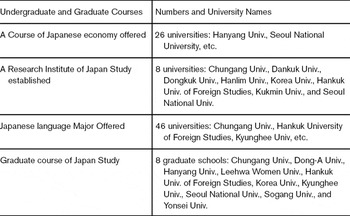
Here, I survey the data of Korean universities with Japan studies in Table 4. There are 26 universities that offer courses on the Japanese economy. There are eight universities which have Japanese research centers; 46 universities have Japanese language departments in their educational system. In the 1990s, the Korean government initiated a globalization of the economy and academic society. At that time, several graduate schools concentrating on regional studies were established.Footnote 4 As a result, there are eight universities with graduate schools of regional studies. Contrasted with Japanese languages offered, courses teaching the Japanese economy are extremely limited. However, this may represent average academic interest in Japan and Japanese studies in Korea.
Undergraduate and Graduate Courses of Japan and Japanese Studies

Source: Gathering data from internet.
3. Trends in research activities on the Japanese economy and business
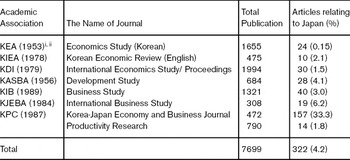
Here, I collect the publication data of major academic associations and think tanks. These data will show the trends in the main issues of concern in the study of the Japanese economy and business in Korea. First, I investigate the publication numbers of main academic journals of economics and business. These data represent purely academic and individual researches. Regarding economics, there is one main economics association: the Korean Economic Association (KEA). KEA produces two academic journals: the Economics Study in Korean and the Korean Economic Review in English. Table 5 shows the percentage of papers in several journals which research the Japanese economy and business. The papers focusing on the Japanese economy published in the two journals of KEA constituted a very small percentage of 1.6% of the total publications. Those published in the journal of the Korean Academic Society of Business Administration (KASBA) was also small, 3.0%. When I consider all publications focusing on the Japanese economy and business in Table 5, they represent only 4.2% of the total publications. The only exception is the Korea-Japan Economy and Business Journal (hereafter, KJEBJ) published by the Korea-Japan Economy and Business Association (KJEBA). Research articles containing the issue of the Japanese economy and business seize 33.3% of total publications in the KJEBJ. KJEBA focuses mainly on the Japanese economy and business and has been a place of research presentation and discussion for Korean scholars who are interested in the Japanese economy and business since 1984.
Journals of Japanese Economy and Business Studies (2010 present)

Notes: i) The year in the parenthesis is the year of establishment.
ii) See Appendix for the full name of association.
Source: Korean Studies Survey System (KISS), http://kiss.kstudy.com/
As Bae (Reference Bae2007) indicated in his paper, there are few Ph.D. scholars from Japan who published their papers in the major journals of economics and business. Those major journals no doubt require that the paper should have both theoretical and empirical excellence. However, there are a few papers that I consulted which had used such an excellent level of empirical and theoretical investigation. At this point, I present a different perspective to Bae (Reference Bae2007) as to why there were few papers published in the major journals of economics and business by current Korean scholars graduated from Japanese universities. There were some systemic problems in the Japanese graduate school system. In particular, Japanese graduate school systems of economics have not established a unified course work system, but rather a complicated and ineffective one. The Japanese graduate school system has depended overly on individual faculty member's guidance but lacks in a systematic and well-organized course work system of modern economics for students; something which is well established in the graduate school systems of the US. There were few graduate schools in Japan which established a standardized course work system by 20 years ago. Recently, we see an increasing number of graduate schools which have established such systematic course work for students such as the University of Tokyo, the University of Tsukuba, Hitotsubashi University, and Osaka University. We find that the number of Korean students studying economics and business seems to be very small and unchanged, contrasted with other majors. This maybe related to the ineffectiveness of the Japanese graduate school system, contrasted with globalized educational systems. I recommend that the Japanese graduate school system of economics and business studies should be reformulated to reflect the globalized competition in the educational market. In particular, the subject of economics is extremely globalized, as we see in the use of text books having similar contents and research methods.
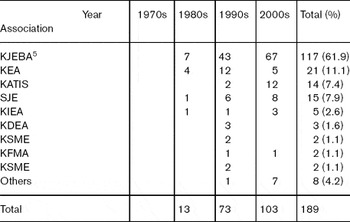
Table 6 shows the research trends for academic publications consulted for this paper. A total of 189 academic papers were consulted for this study. Individual and academic researches on the Japanese economy and business started almost from the 1980s. Out of a total of 189 papers, 61.9% or 117 papers were published in the journal of KJEBA; 11% or 21 papers of the total were published in the two journals of KEA. Journals such as KATIS (Korean Association of Trade and Industry Studies), SEJ (Seoul Journal of Economics), and KIEA (Korean International Economic Association) seem to have published more papers focusing on the Japanese economy since the 1990s, although those papers in the journal of KEA have decreased. In particular, SJE has published more papers since 1990s.
Research Trend of Individual Research

Source: References in this study.
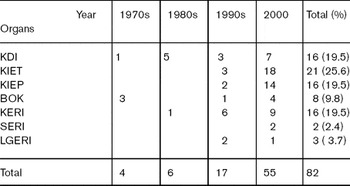
Table 7 indicates research trends of publications from public and private research institutes. KDI has focused on macroeconomic policies and KIET has researched the competitiveness and productivity of Korean manufacturing in the international market. Meanwhile, KIEP established in 1991 has been researching international trade and FTA. BOK (the Bank of Korea) is a central bank and has determined monetary policy. In private research organizations, KERI is a think tank of the Federation of Korean Industries (FKI), which consists of most big firms in Korea. In this context, KERI has been very active in the research of the Japanese economy and business because large firms in Korea have been competing with Japanese firms in the world market. Other private organizations such as SERI and LGERI produce myriads of weekly and monthly reports on the Japanese economy and business. The total number of publications listed in Table 6 is the same as the number of publications consulted. KDI, KIET, and KIEP have consistently produced publications on the Japanese economy. Each of three main think tanks has their own research interests and utilizes their excellent researchers to provide timely and in-depth research on the policy issues of the Japanese economy. The three think tanks represent almost 53% of total publications.
Research Trend of Public and Firm Research Institutions

Source: References in this study.
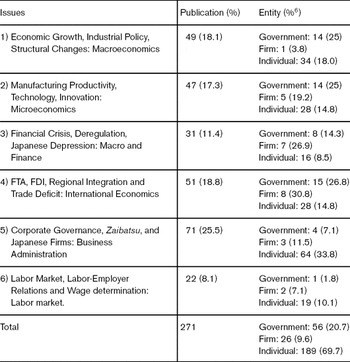
Let us now summarize the main issues and trends of Korean studies on the Japanese economy and business. There are three research institutions for the study of the Japanese economy and business in Korea: public research institutes, corporate research institutes, and academic and individual researchers. Those topics are classified by my own research experience in the Japanese economy. We can divide the Japanese studies into three groups: economics, business, and labor market. And I can further divide economics into macroeconomics, microeconomics, macro-finance, and international economics. I follow these classifications and select several important issues which have been investigated by research institutes and individuals. Table 8 shows six main topics for the Japanese economy and business studies in Korea. First, Japanese economic growth, Japanese industrial policy, and its structural changes have been important issues for the Korean government and academic society. Public research institutes such as KDI and BOK have studied the Japanese economy and industries for this purpose. Second, the comparative advantage and competitiveness of manufacturing industries is a crucial issue for the Korean economy to compete with Japanese products in the export market. Third, the bubble economy, Japan's long-term economic depression, and deindustrialization are researched. Fourth, FTA, FDI, economic integration, and trade deficit are researched. FTA has become a really important issue for Korea. Fifth, the studies on corporate firms and governance of Japan have been hot issues from academic and individual perspectives. Sixth, the studies on the labor market, wage system, and the relationship between labor and employers are important issues from the academic perspective.
Research Issues of Research Institutions and Individuals

Source: References in this study.
Table 8 shows statistics for six topics for the Japanese economy and business studies, covering all sources of this study. There were 271 publications consulted, including books and articles. Nearly 70% of publications were produced by individual researchers. Public research institutes contribute 21%, while private research institutes contribute only 9%. The highest share of publications is for the subjects of corporate governance and business management by 26%. The second important issue is that involving FTA, FDI, and the trade deficit of the area of international economics by 19%. The third is Japanese economic growth and industrial policy studies in the area of macroeconomics by 18%. The fourth is studies of manufacturing productivity, technology, and innovation studies in the area of microeconomics by 17.3%. The fifth-ranked research issue is for Japan's bubble economy, financial crisis, depression, and deregulation polices by 11.4%. The last is the study of the labor market, labor–employer relations, and wage determination by 8.1%.
In addition, Table 8 seems to indicate a different pattern of research activities depending on different entities. From an individual research perspective, the issues of business, such as Japanese corporate governance, Japanese firms, and Zaibastu, seized the highest percentage of 33.8%. The second important issues for individual researches are those of microeconomics (14.8%) and international economics (14.8%) such as manufacturing productivity, technology, FTA, and the trade deficit. In addition, research on corporate firms and the labor market has been done mostly at the individual level and from a purely academic perspective. When we take a look at the research output from government think tanks, the highest interest was given to FTA and other issues of international economics between Korea and Japan by 26.8%. The second important issues for government research institutes are shared equally by those of macroeconomics (25%) and microeconomics (25%) such as Japanese economic growth, industrial policy, technology, and productivity. In this respect, government research institutes have investigated mainly the issues of Japanese macro-, micro-, and international economics in relation to the Korean economy. The four categories of issues other than corporate governance and labor markets have been researched by both public research institutes and individual researchers. Private research institutes seized the lowest percent of the all research outputs.
4. Main research topics on the Japanese economy and business
I will now review the articles and books consulted for this study. The six topics involving the Japanese economy and business studies in Table 8 are applied to classify all publications. There are 271 articles and books consulted for this study. I do not review all publications in depth, but I summarize the focal points succinctly.
Economic growth, industrial policy, and structural changes of Japan
Korea started its new economic growth from 1953 and has experienced rapid economic growth since 1960s. National think tanks such as KDI have researched mainly the long-term economic growth plan and growth strategies of the Korean economy comparing those with the Japanese economy. Kim and Roemer (Reference Kim and Roemer1979) summarized the lessons of Korean economic growth since 1953 and compared her experiences with Japanese economic growth before WWII (1905–1940). They reported that when they evaluated the two countries’ initial conditions in the early year of 1905 for Japan with that of 1953 for Korea, the Korean economy had less similarity with Japan: lower initial income level, lower saving and investment rates, larger shares of agriculture, and smaller exports shares in manufacturing. Kim (Reference Kim1984) provides a new perspective on economic cooperation between Japan and Korea. There has been a chronic trade deficit for Korea. Korea expects Japan, as an advanced and rich country, to be able to open her domestic market more and provide technology transfer to Korea. BOK (1976) reported the lessons and problems of Japan's rapid economic growth experience. This report pointed out the problems of the Japanese society and economy, revealed in the process of Japan's rapid economic growth: an aging society, seniority society, high educational society, and the rising cost of living. Yoo (Reference Yoo1985) conducted a comparative study on the Korean and Japanese economies from 1954 to 1981. Lee and Lee (Reference Lee and Lee1995) investigated the macroeconomics’ shock from Japan and the US to the Korean economy. They reported that overall the Korean macroeconomy was more vulnerable to the US macroeconomy, while the business cycle of the Korean economy is more closely related to the Japanese economy than the US. Domestic price changes are more affected by the US than by Japan. Do Hyung Kim (Reference Kim1996) reviewed the Korea-Japan economic relationship and forecasted future cooperation in new industries. Lee (Reference Lee1986) criticized Korea-Japan economic cooperation since the 1960s: Korea-Japan diplomatic and economic cooperation since 1965 made a constant path to adopt Japanese technology and resulted in a chronic trade deficit.
Industrial policy has been recognized as a main source of successful Japanese economic growth during the nation's rapid growth era. Korean economists and think tanks have focused on the Japanese industrial policy in order to find policy implications and its practical applications. This study aimed to provide policy lessons from Japanese industrial policy, which could be applied to Korea for free trade and liberalization. Cho and Lee (Reference Cho and Lee1996) conducted a rigorous comparative research on the industrial policies of Korea and Japan. They reported several common points between the industrial policies of two countries. Korea started to push its heavy industry in the 1970s, similar to Japan in the 1960s. The functions of government authorities for economic growth were very similar between the two countries. Shin (Reference Shin1995) reported on the comparison of competition policy between the US, Japan, and Germany.
The Japanese economy has experienced a bubble economy since the early 1990s. During this period, Japan experienced rapid structural changes, with deindustrialization, economic depression, and financial crisis. Japanese firms moved their factories to other developing countries such as China, after losing the price competition in the international market. As a result, the unemployment rate has increased, and there has been deindustrialization demonstrated through the decreasing manufacturing shares and increasing service sectors. It was no longer a successful economy. Therefore, Korean economists and research institutes investigated the cause and aftermath of Japanese economic depressions, deindustrialization caused by the bubble economy, and policy mistakes in the 1990s. Kim et al. (Reference Kim, Jang and Kim1991) studied the effect of the current account surplus on asset prices and wealth in Japan, Korea, and Taiwan. Su Yong Kim (Reference Kim1997) investigated the economic reasons behind Japan's recession and located several economic factors: a low rate of return to capital, lowered investment rates, low population growth with an aging society, and decreasing manufacturing shares. Kyung Hun Lee (Reference Lee1998) investigated Japanese manufacturing growth and industrial changes and recommended that Korea should develop her industrial structures towards high technology ones in order to grow faster and reduce trade deficits. Huh and Nam (Reference Huh and Nam2000) analyzed Japanese structural changes after the bubble economy and suggested policy implications to Korea. Kang (Reference Kang2001) studied economic policies behind the Japanese long-term stagnation in the 1990s and suggested policy implications to the Korean economy. Shin et al. (Reference Shin, Sagong and Hwang2002) researched the impact of the Japanese long-term depression on the Korean economy. Kang et al. (Reference Kang, Park, Jong Wang, Ryu, Lee, Lee, Lee and Im2002) conducted a comparative analysis of deindustrialization between Korea and Japan. They reported that the factors of Korean deindustrialization were very similar to those of the Japanese in the 1980s.
Japanese manufacturing: productivity competitiveness, innovation, and technology
Korea has followed very similar manufacturing structures to Japan since she started to industrialize in the 1960s. Therefore, manufacturing competitiveness in various directions, such as technology, R&D, and innovation, has been constantly a very important policy issue for the Korean economy because Korea needed to increase foreign exports and to compete with other export goods in the international market. Im (Reference Im1986) investigated the technological backwardness of Korea compared with Japan. He was concerned about the technology gap between the two countries, and recommended an increase in the degree of utilization of current technology. Decreasing the technology gap would help reduce the trade deficit. Kang (Reference Kang1987) investigated the productivity of Korean manufacturing compared with that of Taiwan and Japan during the period 1964–1983. He found that Korea followed a labor intensive and capital saving production technique, while Japan and Taiwan adopted a labor saving and capital intensive technique. Jang (Reference Jang1986) investigated the employment and technological changes between Taiwan, Japan, and Korea. He found that the US had been more active than Japan in FDI involving technology transfer. Lee (Reference Lee1992) analyzed the productivity and competiveness of manufacturing between Korea and Japan, and Im (Reference Im1993) researched the trend of technology transfer from Japan and its policy implications. Kong and Kim (Reference Kong and Kim1993) studied the productivity of Korea and Japan's auto companies by using the DEA method.Footnote 7 They found that US auto companies achieved the highest efficiency ahead of Japanese. Lee (Reference Lee1994) conducted a research into the effect of the Japanese steel industry on her industrial growth, Jae Wu Lee (Reference Lee2000) on the Japanese anti-trust law and limited competition between companies, and Chang Nam Kim (Reference Kim2001) on the R&D experiences of Japan's small and medium-sized firms, and they provided policy implications for the Korean firms. Seung Rok Park (Reference Park2001) investigated the R&D spillover effect of the US and Japan on Korean manufacturing. He noted that Japan's R&D had a decreasing effect on the average cost of Korean light industry, while the US R&D had the same effect on Korean heavy industry. These cost effects seemed to point to Korea's heavy dependence on capital and material imports from two countries. Hwang and Wang (Reference Hwang and Wang2004) reviewed the effect of openness to trade on total factor productivity (TFP) growth using 35 sectors of Japanese manufacturing data, Ahn et al. (Reference Ahn, Fukao and Ug Kwon2004) researched the internationalization and performance of Korean and Japanese firms, and Kim and Suh (Reference Kim and Suh2006) compared the Korean steel industry with the Japanese.
Lee (Reference Lee2007) examined the trade patterns of Korea and Japan and their competitiveness in export markets. Korea's export goods are very similar to those of Japan and Korea therefore had to face a severe competition with Japan in 2000s. Lee and Shin (Reference Lee and Shin2007) evaluated the comparative advantages of export products depending on the technology intensity between Korea, Japan, and China. Jung et al. (Reference Jung, Chul Lee and Ahn2006) investigated the competitiveness between Korean and Japanese autos. Hwang (Reference Hwang2009) researched the sources of urban growth in Japan. He found that the ethnic diversity contributed significantly to urban growth in Japan. Ito et al. (Reference Ito, Jung, Kim and Tuan2008) conducted a comparative analysis of productivity growth and productivity dispersion for Japan, Korea, and China. Miyagawa and Kim (Reference Miyagawa and Kim2008) measured the contribution of Japanese organizational capital to conventional TFP growth. They found that the growth of organizational capital did not have significant effects on productivity growth. Sagong (Reference Sagong2010) drew an attention to the recent weakened Japanese manufacturing industries and their competitiveness with Korean manufacturing, while Choi (Reference Choi2009) examined the input–output tables of China, Japan, and Korea and demonstrated the production externality effect between the three countries.
Japanese bubble economy, long-term recession, and financial crisis
The Japanese economy entered a long depression after the bubble economy collapsed in the early 1990s. Korean economists and research institutes investigated the causes and aftermath of the bubble economy. Later, the Korean economy encountered the Asian financial crisis and entered the IMF bailout program during 1997–1998. This experience helped to rehabilitate the structures of the Korean economy and made it more mature and stable, in particular in the finance sector. Korean researchers have focused on the Japanese bubble economy and how it collapsed; they expected that since Japanese and Korean economic structures were so similar, the same situation might happen to the Korean economy in the future. Ahn (1992, 1994) studied the main factors of the Japanese financial system and its changes as well as the trends in the financial administration of Japan, and Cho (Reference Cho1995) analyzed the saving patterns of Japan and Korea. Jung (Reference Jung1996) investigated the relationship between the finance sector and Japanese industrialization, showing that early financial development had supported Japanese industrialization, arguing that competition between banks would be helpful for early Japanese industrialization. Jung et al. (Reference Jung, Ryu, Kim and Min Shim1998) reported on the economic lessons from the Asian financial crisis, Hwang (Reference Hwang1999) analyzed the problems of Japanese non-performing loans and researched the land price and domestic credit of Japan and Korea, and Young Il Park (Reference Park2000) evaluated the role and responsibility of Japan during the Asian financial crisis of 1997. Choi et al. (Reference Choi, Han and Jun2001) investigated the role of Japanese bank loans in the Korean financial crisis and found that the Japanese bank suspension of rollover to Korea directly caused the liquidity shortage and triggered the currency crisis in Korea. Yang (Reference Yang2002) conducted a research on the economic treatment of non-performing banks between Japan and Korea, KDI (2002) on the lessons of the Japanese depression in 1990s, and Cho and Lee (2003) on the Japanese bubble economy. Choi (Reference Choi2004) examined the aging society and its economic impact on the Korean economy compared with the US and Japan. Wu (Reference Wu2008) reviewed Japanese corporate system changes since the long-term depression of the 1990s. Further research was conducted by Jun and Han (Reference Jun and Han2003) on the spatial allocation of public capital stock and its productivity before and after the Japanese bubble economy, Huh (Reference Huh2009) on labor market adjustment and the status of business after the global financial crisis in 2008, and Otsu and Pyo (Reference Otsu and Pyo2009) on the effects of financial frictions in Japan and Korea during the recent recession.
FTA, FDI, international trade, and trade deficit with Japan
Since the 1990s, FTA and economic integration have become the main issues for the Korean economy and have been studied mainly by KIEP. Korea is a small peninsula with limited natural resources. The geographical characteristics of Korea have forced the nation to join international trade, and it has been successful in cultivating a domestic manufacturing industry by utilizing the advantages of international trade. The EU and NAFTA are examples of where world economies have integrated with foreign countries in order to take advantage of intra-regional trade with no tariffs and no trade barriers. Korea made its first FTA with Chile, and it was extremely successful. Following success with Chile, Korea made FTAs with other countries and is currently having discussions with more countries. In this respect, Japan is identified as a very important target country for FTA.
Park (Reference Park1991) studied European Community integration and the counter-acts of the US and Japan, Shim (Reference Shim1992) discussed the roles of Korea and Japan in the era of North Asian economic integration, and Lee et al. (Reference Lee, Kang and Jun1995) investigated Japan's strategy towards Asian countries and Korea's interaction. Further research was conducted by Yun (Reference Yun1995) on Japan's foreign trade policy, in particular FDI, Lee (Reference Lee1999) on the Free Trade Zone and cooperation of Korea and Japan with East Asian countries, Im and Lee (Reference Lee1997) on Korea-Japan cooperation for East Asian structural changes, and Ko et al. (Reference Ko, Cho, Kim, Im and Lee2000) on the FTA effect on production diversification of Asian manufacturing markets. Jung (Reference Jung2000) examined Japanese foreign direct investment in overseas manufacturing, Im (2001) reviewed Japanese FDI for Korea, and Kim (Reference Kim2001) evaluated the effect of Asian financial integration before and after. Sung Hun Park (Reference Park2001) researched Asian regionalism and regional integration, while Lee (Reference Lee2001) studied the role of the interest rate in the integration of capital markets between the US, Japan, and Korea. Yun et al. (Reference Yun, Jung and Park2004) examined the FTA between Korea, China, and Japan and its resulting impact on product diversification. Hong (2005) reported on the economic impact of the North Asian FTA agreement in the electronics industry, Jong Geol Kim (Reference Kim2008) on the FTA between Korea and the US, and Song (Reference Song2009) on the East Asian countries’ trade patterns and their implications for the economic integration.
In addition to FTA, international trade and trade imbalance between Korea and Japan have long been a critical issue for researchers. Hwang (1988) studied comparative advantage and diversification of the export market between the US, Japan, and Korea. There were studies by Song (Reference Song1990) on the trade policy of Korea and Japan under rapid economic growth, Kyun Lee (Reference Lee1990) on fair trade under the trade imbalance between the US, Japan, and Korea, and BOK (1995) on the trade imbalance between Korea and Japan. Hong (Reference Hong1995) analyzed the problem of the trade imbalance between Japan and Korea and provided policy implications; Sung (Reference Sung1995) suggested policy recommendations to improve the trade imbalance; Sung Chul Kim (Reference Kim1997) focused on intra-industry trade and investigated comparative advantages between Korea and Japan; and Kim and Kim (Reference Kim and Kim1999) studied the exchange rate of dollar and yen in the international financial market.
Japanese firm analyses: corporate governance, zaibatsu, and corporate finance
Among the main issues discussed in Table 8, Japanese firm analyses focusing on corporate governance and firm behavior have attracted the highest interest from academic and individual researchers. Although public and private research institutes contributed little to this research activity as a whole, Korean entrepreneurs have been making efforts to extract lessons from the experiences and performances of Japanese companies. In particular, Japanese economic growth has been represented and evaluated by successful corporate culture and governance such as Keiretsu. Therefore, many individual researchers have reviewed the characteristics of Japanese corporate governance, Zaibatsu, and corporate finance. This research has been conducted, mostly, from individual and academic perspectives.
Hong (Reference Hong1984) studied the corporate management systems of Japan and Korea from the perspective of cost management in manufacturing. Ko (Reference Ko1989) provided a management comparison between the US, Japan, and Korea, Im (Reference Im1992) analyzed the competitiveness of Japanese auto-makers and their parts companies, Kong (Reference Kong1994) examined the ownership structures in Japan and business groups in Korea, and Lee and Kim (Reference Lee and Kim1994) discussed company succession between Japan and Korea. Further studies were conducted; Tae Su Ryu (Reference Ryu1998) reviewed cultural similarities between Korea and Japan from the perspective of Confucian tradition; Bae (Reference Bae2001) discussed the philosophy of the chief executive officer (CEO) between the US, Japan, and Korea during the Asian financial crisis in 1997; and Choi and Yun (Reference Choi and Yun2002) compared the corporate governance system of Japanese − Keiretsu with that of Korean – Chaebol. Dong Ryung Shin (Reference Shin2002) analyzed the differences in corporate governance systems of Korea and Japan and their impact on financial operations and profit structures. Park and Yun (Reference Park and Yun2002) conducted a comparative analysis between Korean and Japanese firms on their corporate value, Han and Jun (Reference Han and Su Jun2004) on the lending policy of Japanese banks to foreign firms, and Lee (Reference Lee2004) on the management of the Japanese business groups (Mitsubishi, Hitachi, and Sony). Jung and Lee (Reference Jung and Lee2009) examined Japanese hostile M&As and their implications; Jung (Reference Jung2006) discussed the Japanese government and firm's property rights and their implication; and Han (2009) studied the strategy of the Korean software firms to enter the Japanese market.
Among Japanese firm research, there are continuing efforts to analyze Japanese conglomerate groups, Zaibatsu compared with Korean Chaebol. Jang Chul Shin (Reference Shin1999, Reference Shin2002) investigated Japanese Keiretsu and Zaibatsu systems, and Kong (Reference Kong1994) evaluated the ownership structures in Japan and business groups in Korea. Also, there has been never-ending research on Toyota and its production system: for example, Young Rare Kim (Reference Kim, Kwan and Won2010) on the Toyota's production system and its administrative characteristics, and Yang (Reference Yang2000) on the Toyota's production system. Lee and Lee (Reference Lee and Lee2004) reviewed the successful technology transfer of parts industries of Korea and Japan under Toyota's production system. In addition, small and medium-sized firms, venture companies, and property rights have been studied. Anh (1995) reviewed the relationship between small, medium, and large firms in the US, Japan, and Korea; Lee (Reference Lee1998a) studied the Japanese innovation and its implications; and Lee and Han (Reference Lee and Han2005) investigated the Japanese firms’ entry modes into the Korean market. Lee and Oh (Reference Lee and Oh2006) reviewed the strategic alliance between Korean and Japanese firms. Furthermore, the Japanese corporate finance and accounting system has been studied. Kuh (Reference Kuh1994) investigated the risks of corporate finance and its impact to Korean firms compared with Japanese firms, and Seol and Suh (Reference Seol and Suh2008) evaluated the corporate payout policies of Korea, Japan, and the US.
Labor market, labor–employer relations, and wage determination
The Japanese labor market and labor–employer relations were studied earlier than any other field. Korean labor–employer relationships and traditions have many aspects similar to those of Japan, rather than to the US. Korean scholars have studied labor issues always in comparison with the Japanese system. Ahn (Reference Ahn1982, Reference Ahn1999) published a comparative study of the permanent employment system in Korea and Japan and studied the job ability grading systems in Japanese firms. Furthermore, Ahn (Reference Ahn2004), by investigating the characteristics and changes in Korean firms’ personnel administration, found that, after the IMF financial crisis, Korean firms’ expectations on new employment changed. Korean firms typically employed first year college graduates but changed their stance in order to be flexible for their needs. Document screening was decreasing but interviews were increasing. Firms put more importance on individual personality. Jung (Reference Jung1988) reviewed a partial adjustment model of interrelated prices and wages with their applications to Korea and Japan, Lee et al. (Reference Lee, Na and Lee1991) estimated the short-run employment functions for the Japanese, Korean, and Taiwanese industries, and Dong Gil Choi (Reference Choi2002) studied the wage systems of small and medium-sized firms in Japan and Korea. Kim (Reference Kim1995) conducted a research on the relationship between Japanese employers and employees, Ok Am Kim (Reference Kim1998, Reference Kim2009) on Japanese wages and the employment system, and Won Wu Lee (Reference Lee2000) on the labor−management bargaining system in Japan. Ko (Reference Ko2002) studied retirement benefits and taxation in Japan; Lee (Reference Lee2002) reviewed the employment and unemployment policies of Japan; Sam Su Kim (Reference Kim2009) discussed the youth labor market in Japan under long-term depression; Shin (Reference Shin2009) studied the changes in Japanese employment and management after the global financial crisis; and Lee (Reference Lee, Kwan and Won2010) evaluated recent severe labor market conditions and changes in the wage system.
5. Selected Korean scholars for the Japanese economy and business
Here, I select several important researchers among all the authors consulted for this paper that have published more than two papers and contributed to studies on the Japanese economy and business. This selection is based only on the publications I consulted and, therefore, it may not reflect all important scholars in the field. First of all, Chun Sik Ahn (Reference Ahn1982, Reference Ahn1999, and Reference Ahn2004) is a pioneer in the study of the labor–employer relationship. He studied at Keio University and introduced the Japanese employment system of life time tenure to Korea. Currently, he is an emeritus professor at Hanyang University and has published a pioneering work on the relationship between labor and employers in 1982. He compared Korean labor–employment relationship in the 1960s and the 1970s with the Japanese in the Taisho period and early Showa period. His investigation found that the life time employment system could be established in Korea, to some extent, but having several different aspects from the Japanese system. His work provided a crucial understanding about the micro-process of the labor–employment relationship which had supported the rapid growth of Korean economy. His work gave a new and challenging pathway for Korean scholars in this field. Byung Ho Kong (1993, 1994) studied the Japanese auto industry and corporate governance. He received a Ph.D. from Rice University, has published many books relating to corporate governance, and investigated how to apply the Japanese corporate governance system to the Korean economy (Kong, Reference Kong1994). He indentified several important policy implications of the Japanese style of corporate governance, with the considerations of stock holdings between owners, corporate firms, employees, and cooperating parts. He expected that this kind of multiple stock holding system of corporate capitalism would provide some tension and equilibrium to the existing corporate governance system. Chang Nam Kim (Reference Kim1994, Reference Kim2001) focused on Japanese technology innovation and development. He graduated from the University of Tsukuba, worked at the Institute of Economic Development, and is now a professor at Dong-A University. He reviewed the process of technology innovation and its impact on the comparative advantage between Korean and Japanese manufacturing industries (Kim, Reference Kim1994). He found that Japan invested greatly in R&D, including in research personnel, adopted many new technologies in 1960s, and thus could experience technological progress in manufacturing which enhanced the TFP level and therefore kept a comparative advantage. Korea showed a different pattern of technological progress, being highly biased towards labor intensive industries, which gave them a comparative advantage in such industries but not in capital and technology intensive ones. Capital and technology intensive industries thus showed very low technological growth.
Chun Suk Im (Reference Im1992, Reference Im1993) has studied the Japanese auto industry and economic cooperation between Japan and Korea. He graduated from Hitotsubashi University, worked at KIEP, and is now a professor at Kunkuk University. His main interests are the Japanese auto industry, FDI, technology transfer, and economic cooperation. His study in 1992 investigated the competitiveness of Japan's auto industries, including the auto parts industry. He applied the famous development model of flying geese to the Japanese auto industries, explaining the process of how Japan was successful in the auto industry from the developing stage of no technology to the advanced stage of high technology and becoming a major auto exporting country. He compared the Japanese autos with the Korean and found that the Japanese autos have been successful in the world market because Japan adopted and developed new technology and cultivated the auto parts industries together with competitive and high technology. Do Hyung Kim (Reference Kim1996, Reference Kim2005) received a Ph.D. from Hitotsubashi University, worked at KIET, and is currently a professor at Kemyung University. His main interests are manufacturing industry, international trade, technology cooperation, and FTA. He published a book in 2005 which overviewed the industrial structures and policies of the Japanese economy, Japanese corporate management system, the direction of Japanese deregulation, and Japanese oversea expansion strategy. He predicted that the Japanese economy would be in bad shape if it could not accommodate international cooperation which could induce domestic consumption. Also, he provided similar policy implications for the Korean economy. His policy implications focused on enhancing corporate competitiveness. Dong Ryung Shin (Reference Shin2002, Reference Shin2003) received a Ph.D. from Seoul National University and is now a professor at Dankuk University, his main interests being labor–employer relations and corporate governance. He studied also the impact of corporate governance differences on the financial behavior and operating performance of Korean and Japanese firms (Shin, Reference Shin2002). Duk Hun Lee (Reference Lee1994, Reference Lee1997) researched the Japanese steel and auto industries. He received a Ph.D. from Keio University, studied industrial policy and entrepreneurship in Japan, and is currently a professor at Han-nam University. He investigated the industrial polices for the Japanese steel industry and found the following main characteristics of Japanese industrial policy for the steel industry (Lee, Reference Lee1994). Firstly, it has a long-term plan for industrial development which prioritizes the benefits to the nation. Secondly, it wisely encourages cooperation between government and private firms. As a result, Japanese firms can interact efficiently and with flexibility to industrial policy and laws.
Du Yong Kang (Reference Kang2004, Reference Kang2007) studied the deindustrialization of Japanese manufacturing. He received a Ph.D. from Seoul National University and has worked at KIET. His main interests are Japanese economy and manufacturing industries. In particular, in his publication in 2004 concerning the problem of Korean deindustrialization, he estimated an index of deindustrialization and compared Korea's case with the Japanese. His empirical results showed that Korean manufacturing deindustrialization started in 1994, and the level of Korean deindustrialization rose to one third to the level of the Japanese in 2001. In addition, he found that there were differences in the progress of deindustrialization between manufacturing industries. Home electronics, apparel, foot wear, and electronic parts showed the highest level of deindustrialization. His index and empirical findings have given important economic meaning to international economics and industrial economics, which need to be investigated using cross-country data. Eung Seon Kang (Reference Kang1996, Reference Kang2001) received a Ph.D. from University of Hawaii and majored in international economics. After working for the Korean government as an official of the economic planning section, he works at Mae-Kyung Business News as a senior editor. He has studied Japanese macroeconomic policy, corporate governance, and the business strategy of firms, and investigated the causes and results of Japanese long-term stagnation in the 1990s, the so-called lost decade (Kang, Reference Kang2001). He concluded that the most decisive factor for Japanese long-term stagnation is the failure of financial policy and provided several policy implications for the Korean economy: strong political leadership, structural reformulation of banks and firms, risk management of global finance, and effective government policy with the effective control of financial debt. Hun Jung (Reference Jung2000, Reference Jung2002) has researched Japanese FDI policy and economic cooperation between Japan and Korea. After receiving a Ph.D. from Hitotsubashi University, he worked at KIEP, and is currently a professor at the University of Incheon. His main interests are Japanese FDI and economic cooperation between Korea and Japan, and his paper in 2000 analyzed the factors behind Japanese FDI for the determination of the locations of oversea manufacturing industries during 1978–1990. He applied statistical analysis and employed several policy variables which would affect the decision of Japanese FDI such as labor costs, the level of safety, trade friction, average human capital, and per capita infrastructures. Labor costs had a negative effect on FDI. Safety produces a positive factor to increase FDI. If a country increases trade barriers, it will induce FDI. In particular, a country of large scale will likely have more motivation to increase FDI in order to offset rising costs.
Hyung Oh Lee (Reference Lee2004; Lee and Han, Reference Lee and Han2005; Lee and Oh, Reference Lee and Oh2006) received a Ph.D. from the University of Tokyo and taught at Hitotsubashi University. He is now a professor at Sookmyung Women's University. His main study interests are venture and high-tech companies and Japanese corporate governance. He investigated the behavior of Japanese firms entering the Korean markets (Lee and Han, Reference Lee and Han2005). He showed that Japanese firms’ behavior might be explained by two hypotheses, either the importance of the customer in the world market or the technological interdependency between the company and the customer. Jang Chul Shin (Reference Shin1999, Reference Shin2002, Reference Shin2009) got a Ph.D. from the University of Tokyo and is now a professor at Soongsil University. His main interest is the connection and differences between Japanese Zaibatsu and Korean Chaebol. He examined the effects and limitations of Japanese Zaibatsu and Keiretsu and indicated that Japanese firms’ relationships, represented by the Japanese Keiretsu system, are one reason for the current long-term Japanese depression (Shin, Reference Shin2002). Jang Keun Nam (Nam and Sagong, Reference Nam and Sagong2000; Sagong and Nam, Reference Nam and Sagong2004) received a Ph.D. from Kobe University and has researched at KIET. His main areas of research are the chemical industry, high-tech material industry, and IT industry. He reviewed the action plan of the new high technology industry of Japan (Nam, 2004). Ji Pyung Lee (Reference Lee1998a, Reference Lee1998b) works at the LG Economic Research Institute and has published various papers on Japanese manufacturing, technology innovation, and corporate firms, (Lee, Reference Lee1998a). He focused on the Japanese depression in the 1990s and found several economic reasons: weakened corporate finance system and stock management, and failure in developing new technology and industry. Jin Do Park (Reference Park1998, Reference Park and Park1999) graduated from the University of Tokyo and is currently a professor at Chungnam National University. He has published papers on the Japanese Zaibatsu and small high-tech firms as well as the economic meaning of the dissolution of Japanese Zaibatsu by General Head Quarters after WWII (Park, Reference Park1998). The dissolution of Japanese Zaibatsu disconnected the political relation between firms and politics, and established a Japanese style of corporate governance system, so-called corporate governance through mutual stock holdings. By the way, this Japanese corporate governance was maintained by employees’ sacrifice, which has harmed worker motivation and spirits. Jong Geol Kim (Reference Kim1999, Reference Kim2008) received a Ph.D. from Keio University and is a professor at Hanyang University. He has researched Japanese deindustrialization, FTA, and APEC and evaluated the relationship between long-term recession and the hollowing-out of the Japanese economy by way of Japanese FDI in Asian countries and international trade (Kim, Reference Kim1999). In order to prevent the further hollowing-out of the Japanese economy, he suggested that Japan should create new high tech industry as soon as possible. Jong Hun Lee (Reference Lee1986, Reference Lee1990) received a Ph.D. from University of Tokyo and is currently an emeritus professor at Chung-Ang University.
Jong Yun Lee (Reference Lee1989, Reference Lee1999) received a Ph.D. from Hitsotsubashi University and is a professor at Hankuk University of Foreign Studies. He has studied economic development and economic cooperation between Japan and Korea. In his early publication of 1989, he researched the labor division pattern between Korea and Japan followed by economic development and international trade. Korea and Japan have very similar industrial structures because Korea has followed a similar industrial policy and export-oriented growth strategy like Japan. His finding is that Korea and Japan will move from vertical labor division to horizontal labor division. He expects that Korea and Japan will increase free trade zones which can maximize total benefits. Jun Ho Bae (2001a, 2001b, Reference Bae2007) has studied Japanese corporate governance and corporate cooperation between Korea and Japan. He studied at Hitotsubashi University and is a professor at Hanshin University. In particular, his paper in 2001 investigated the philosophy and the attitudes of CEOs between Korea, Japan, and the US about the Asian financial crisis in 1997. His motivation was to show how to cultivate a mature and successful CEO morale and attitude for not only firms but also society as well. He insists that CEO and corporate firms’ efforts to adopt an open and clean corporate governance system is much more important than government's establishment of new rules. This kind of corporate governance research focusing on the CEO will be a pressing and attractive subject from now on. Jung Pyo Choi (Reference Choi1996; Choi and Yun, Reference Choi and Yun2002) received a Ph.D. from State University of New York at Binghamton and majored in microeconomics. He is currently a professor at Kunkuk University and taught at University of Tokyo as a visiting professor in 2001. His main interests are industrial policy, corporate governance, and business groups. He conducted a comparative analysis on the international competiveness of autos and electronics in Korea, the US, and Japan and concluded that Japanese autos and electronics had reached the limitation point of potential competitiveness compared with Korea and the US (Choi, Reference Choi1996). Without further productivity enhancement and industrial deregulation, he predicted that Japanese industries could not maintain current productivity leadership in the international market. Mok Sagong (Sagong et al., Reference Sagong, Ju, Park and Kim2009, Reference Seol and Suh2010) studied at Keio University and has been researched at KIEP, his main interests being Japanese manufacturing, FTA, market structure, and Japanese management. He studied the new trends of Japanese export market expansion to newly developing countries such as China and India and forecast high price competition between Korean and Japanese goods in these markets (Sa, 2010).
Kwan Young Ryu (Reference Ryu1998; Ryu and Sagong, Reference Ryu and Sagong2005) works at KIET and has produced several works on the Japanese manufacturing industry. He studied the recent strategy of strengthening Japanese industrial competitiveness after the long-term recession in the 1990s (Ryu, Reference Ryu1998). Kyung Yeol Park (Reference Park1999, Reference Park2000) received a Ph.D. from Osaka University and is currently a professor at Dongshin University. He has researched small and medium-sized firms and venture companies of Japan as well as the R&D and knowledge productivity of Japanese firms, and aimed to provide the characteristics of Japanese R&D of small and medium sized firms (Park, Reference Park1998). He found the R&D of small and medium-sized Japanese firms showed a pattern of cooperative development not independent development. Ok Am Kim (Reference Kim1998, Reference Kim2009) received a Ph.D. from Chuo University and is now a professor at Andong University researching the Japanese labor market and labor–employer relationship. He investigated the relationship between the elasticity of employment and labor market deregulation and predicted that Japanese deregulation would increase flexibility in labor with increasing instability of employment (Kim, Reference Kim1998). Also, he reported that the Japanese wage−employment system would follow the job−ability system like western countries. As Japan accelerates its deregulation, labor unions will lose their traditional function for negotiation with the employer. At this point, he becomes worried about the instability of the labor market. But Japanese firms had resolved to minimize layoffs and to keep current jobs by way of flexible working hours, minimizing new employment, using contract workers, and outsourcing. He recommended these kinds of corporate firms’ efforts to Korean government. Sam Su Kim (Reference Kim1995, Reference Kim2009) received a Ph.D. from the University of Tokyo and is a professor at Seoul National University of Technology, researching the Japanese employment system. His study in 1995 revealed the historical process and mechanism of the cooperative relationship between labor and employer in Japan and reported that the Japanese cooperative relationship mainly resulted from the special meaning of the Japanese working group in the company and the style of labor union dependent on different jobs.
Seong Rok Park (Reference Park2001, Reference Park2007) received a Ph.D. from Northern Illinois University and works at KERI. He is an expert in productivity analysis of Korean manufacturing industry and firms. He investigated firms’ competitiveness between Korea, China, and Japan (Park, Reference Park2007). He suggested that Korean firms needed to be deregulated and restructured to increase productivity and to added value. The reason is that Japanese firms are maintaining a higher productivity level and China can catch up with Korean firms easily by their privatization of public firms. He also placed a great emphasis on firms’ innovation efforts to increase total factor productivity. Seung Hee Ko (1993, 2001, 2002) received a Ph.D. from Osaka University and is currently a professor at Dankuk University studying the Japanese accounting system; he introduced this to the Korean economy, including the accounting rules of deferred corporate tax in Japan by an historical approach (Ko, Reference Ko2001). Seung Jin Shim (1992; Shim and Kim, Reference Shim and Kim2009) received a Ph.D. from Keio University, majored in international economics, and is currently a professor at Kyungbuk National University. His main interests are Japanese macroeconomic policies, regional integration, and international public goods. He investigated the effects of industrial cluster on the exports of Korea, Japan, and the US and found that the only factor having a positive effect on Korean exports was R&D investment, while business service input and networking did not show any impact on Korean exports (Shim and Kim, Reference Shim and Kim2009). Sung Chun Jung (Reference Jung2006, Reference Jung2009) studied various issues of economic policy between Japan and Korea: structural changes, Japanese M&A, and environmental issues. He graduated from Hitotsubashi University and currently works at KIEP, his main interests being environmental issues, property rights, and FTA. Sung Hwi Lee (Reference Lee1996, Reference Lee1990) received a Ph.D. from Columbia University and is a professor at Seoul National University. He investigated the macro rational expectation hypothesis for the high growth period of Japan and Korea and found that the rational expectations hypothesis is not rejected even under the rapidly changing circumstances of high economic growth (Lee, Reference Lee1996).
Won Keun Song (Reference Song2009, Reference Song2010) received a Ph.D. from the University of Illinois and currently works at KERI. His main interests are international trade and FTA. Wu Kwan Lee (Reference Lee1995, Reference Lee2001) received a Ph.D. from Northwestern University and is a professor at Hansung University. His main areas of study are the Japanese main bank system and corporate governance. He researched the Japanese corporate governance system under the financial crisis (Lee, Reference Lee2001). Since the bubble economy collapsed and the continuation of depression, Japanese banks encountered serious financial troubles. The recent changes in the accounting system require that the assets be evaluated by market prices. It has fundamentally changed the behavior of banks. Yang Hee Kim (Kim et al., Reference Kim, Chung, Jung and Lee2008, Reference Kim2010) received a Ph.D. from the University of Tokyo and has been researching at KIEP. He has been studying labor markets, FTA, and Japanese economic stagnation. He examined the Japanese trade barriers to logistics and explored the implications for a Korea-Japan FTA and applied competition policy to Japanese logistic markets, because logistics barriers have been one of important non-tariff barriers to Korean firms (Kim et al., Reference Kim2008). In order to process FTA between Korea and Japan successfully, the cooperation and coordination in competition policies would lower non-tariff barriers and be very important and recommended. Young Rae Kim (Reference Kim1997, Reference Kim2010) received a Ph.D. from Waseda University and is now a professor at Chungbuk National University. He has studied Japanese management systems and the Toyota production system, investigating the characteristics of Toyota's organizational capability stemming from its production system (Kim, Reference Kim, Kwan and Won2010). In a nutshell, he reported that the capability of the Toyota company stemmed from a habitual way of thinking based on the Toyota production system.
6. Concluding remarks: limitations and future prospects
This paper has summarized and discussed the trends and main features of Korean studies on the Japanese economy and business since the 1960s. I consulted 271 publications for this study and there were three main groups for research: public research institutes, corporate research institutes, and individual researchers. Academically and individually researched papers were represented by 189 (69.7%) papers out of a total of 271. The left 82 (30.2%) publications were from public and firm research institutes. This implies that the majority of researches have been done by individuals at the academic level. The most crucial issues for Korea are those of business administration, such as Japanese corporate governance, Zaibatsu, and firms, which have been mainly studied by individual researchers. The second pressing topic is that of international economics such as FTA, FDI, and the trade deficit between Korea and Japan. The third one is Japanese economic growth and industrial policy studies in the area of macroeconomics. The fourth is studies of manufacturing productivity, technology, and innovation studies in the area of microeconomics. The fifth-ranked research issue is Japan's bubble economy, financial crisis, depression, and deregulation polices. The last research issue is the study of labor market, labor–employer relation, and wage determination.
This study found that different patterns of research emerged depending on different entities. Research on corporate firms and the labor market has been conducted mostly at the individual level and from a purely academic perspective. Individual researchers are targeting Japanese corporate governance, firms, and labor markets which are less researched by government think tanks. The hottest topics for individual researchers are business administration issues such as corporate governance, Japanese Zaibatsu, and firms. On the other hand, few researchers concentrated on focused issues which required in-depth study. Most changed their foci by turns. This harms the depth and quality of research. When we take a look at the research activity on the public side, government think tanks showed the highest interest in the issues of international economics such as FTA and other areas of international economics between Korea and Japan. Public research institutes have constantly investigated the issues of Japanese macroeconomics, microeconomics, macro-finance, and international economics in relation to the Korean economy. The shortcomings of this research by think tanks are several: less creativity, duplications, and less depth of research.
Nearly 30% of Korean graduate students in Japanese universities were studying engineering or Japanese literature. The study of economics and business in Japanese universities by Korean students has been unchanged and keeping very small percentage since the Asian financial crisis in 1997. The study of economics and business at Japanese graduate schools seems not so attractive for young Korean students. This may be related to the educational system and the competitiveness of the Japanese graduate school system contrasted with the globalized educational system. Here, I recommend that Japanese graduate school systems for economics and business should be reformulated to reflect this globalized competition and the educational market. Then, Japanese universities might be able to provide more competitive researchers for the Korean society, who can contribute more significantly to the Korean academic society and to the study of Japanese economy and business. Fortunately, the Korea-Japan Economics and Business Association (KJEBA) has been actively working on behalf of research activity among Korean scholars of the Japanese economy and business. Research output has been increasingly and continuously published in the 1990s and the 2000s. The important thing for the Korea-Japan Economics and Business Association will be how to enhance the quality of its journal if we expect to increase the quality of the Japanese studies in Korea.
About the author
Insang Hwangis currently a senior associate professor of economics at the economics and business department of International Christian University (BA (1986), Hanyang University in Korea; Ph.D. (1998), University of Tsukuba, Japan). Before his joining at International Christian University, he taught at Hitotsubashi University as an assistant professor for the period 1998–1999. He spent one year of research at Vanderbilt University as a visiting scholar for the period 2005–2006. His main research interests are several issues of economic growth, economic development, international economics, Korean economy, and Japanese economy such as human capital, export driven growth and productivity analysis, TFP growth and technology transfer, innovation and R&D, corporate governance, and regional integration.
Appendix: Research organizations and academic journalsFootnote 8
- BOK:
Bank of Korea
- FKI:
·Federation of Korean Industries
- KAPS:
Korean Association for Public Studies.
Han'gukŭi Gonggongchŏngch'aek (Korean Public Policy)
- KASBA:
Korean Academic Society of Business Administration)
Kyŏngyŏnghakyŏngu (Business Study)
- KATIS:
Korean Association of Trade and Industry Studies
Kukjetongsangyŏngu (International Trade Research)
- KDI:
Korea Development Institute
Narakyŏngche (National Economy)
- KDEA:
Korea Development Economics Association
Kyŏngchebalchŏnyŏngu (Economics Development Study)
- KEA:
Korean Economic Association
The Korean Economic Review (English)
Kyŏngchehakyŏngu (Economics Study: Korean)
- KJEBA:
Korean–Japanese Economics & Business Association
Han'ilkyŏngsangnonjip (Korea-Japan Economy and Business Journal-KJEBJ).
- KERI:
Korea Economic Research Institute (a think tank of FKI)
- KFMA:
Korean Financial Management Association
Jaemukwanriyŏngu (Finance Management Study)
- KIEA:
Korea International Economic Association
Kukjaekyŏngcheyŏngu (International Economics Study)
- KIEP:
Korea Institute for International Economic Policy
- KIET:
Korea Institute for Industrial Economic and Trade
SanŏpKyŏngcheyŏngu (KIET Industrial Economic Review)
- KPC:
Korea Productivity Center,
Saengsansŏngyŏngu (Productivity Research)
- KSME:
Korean Society of Mechanical Engineers
Daehangigyehakhoeji (Korean Mechanical Journal)
- KSIME:
Korean Society for Innovation Management and Economics
Gisulhyŏkshinyŏngu (Technology Innovation Study)
- LGERI:
LG Economic Research Institute
- NRFK:
National Research Foundation of Korea
- SERI:
Samsung Economic Research Institute