1. Introduction
In 2017, Congress passed the Tax Cuts and Jobs Act (TCJA), a complex tax reform that included tax cuts for individuals and businesses and other provisions with the potential to have large effects on investment and output. In this paper, I study the macroeconomic effects of the tax reform using a dynamic general equilibrium model that incorporates key elements of the tax legislation and the tax reform. In particular, I model interest deductibility and accelerated depreciation of capital, two features of the tax code that, combined, play a key role for the effects of business tax cuts on investment. While in standard models business tax cuts stimulate investment, in models with interest deductibility and accelerated depreciation, a business tax may reduce the user cost of capital and act as an investment subsidy, so cuts in the business income tax rate may decrease investment [Fullerton (Reference Fullerton and Fullerton1999)].
In this paper, I examine the effects of seven key TCJA provisions:
-
1. Permanent tax cuts for C corporations. The income tax rate for C corporations was reduced from 35% percent to 21%. The net operating loss deduction is now limited to 80% of taxable income. Net operating losses can be carried forward to be deducted from future income, but cannot be carried backward anymore.
-
2. Provision on corporate earnings held overseas. The tax system for C corporations changed: C corporations are now taxed on their domestic income, while they were previously taxed on their worldwide income. Before the tax reform, foreign corporate earnings were taxed at the time of repatriation. To transition to the new tax system, foreign corporate earnings held overseas became subject to a one-time tax (15.5% on liquid assets and 8% on illiquid assets) payable in installments over 8 years.
-
3. Temporary tax cuts for individuals. Individual income tax rates were reduced. Barro and Furman (Reference Barro and Furman2018) estimate a cut in the average marginal income tax rate of about 2.3 percentage points. These tax cuts will expire in 2026.
-
4. Temporary tax cuts for pass-through businesses. Income tax rates for pass-through businesses (sole proprietorships, partnerships, and S corporations) were reduced similarly to the income tax rates for individuals, since pass-through businesses are taxed as individuals. In addition, pass-through businesses can now deduct 20% of their income (subject to an income limit). These provisions will also expire in 2026.
-
5. Temporary 100% bonus depreciation for equipment and software. The bonus depreciation of investment in equipment and software was extended over time and expanded from 50% to 100%. This provision will be phased out between 2023 and 2026. The bonus depreciation has been at least 50% since 2003.
-
6. Starting in 2022, 5-year amortization of R&D expenses. Before the tax reform, R&D expenses could be immediately expensed, that is, they could be treated as an expense and immediately deducted from income. Starting in 2022, businesses need to amortize their R&D expenses over 5 years.
-
7. Permanent limits on interest deductibility. The tax reform limited interest deductibility. Until 2021, the limit was 30% of earnings before interest, taxes, depreciation, and amortization (EBITDA). Starting in 2022, the limit became 30% of earnings before interest and taxes (EBIT), so it became more stringent.
The paper examines the effects of these TCJA provisions on several macroeconomic variables, including aggregate output, investment, welfare, and government debt.
According to the model, the tax reform raised investment by only 0.2% in 2018. The immediate effect on investment was small because the various provisions worked in opposite directions: While the bonus depreciation of equipment, the income tax cuts for individuals, and the provision on corporate earnings held overseas worked to stimulate investment, the amortization of R&D expenses, the income tax cuts for businesses, and the limits on interest deductibility worked to depress investment. In the medium term, the effect of the tax reform on investment will turn negative, mainly because of the switch from expensing to amortizing R&D expenses and the stricter limits on interest deductibility. After 2026, investment will be about 1.6% below steady state. While the effect of the tax reform on investment in equipment and structures will be negligible, the tax reform will persistently depress investment in R&D, largely because of the amortization of R&D expenses.
As to the effect on aggregate production, the tax reform raised business output by 0.8% and GDP by 0.6% in 2018, mainly because of the stimulative effect of the tax cuts for individuals on the labor supply. In the medium term, however, the expansionary effect will diminish. After 2026, when the individual income tax cuts are set to expire, business output will be only 0.2% above steady state.
As a result of the tax reform, tax revenue plunged in 2018. Tax revenue will remain below steady state until 2026, raising the ratio of government debt to GDP by 20 percentage points. After 2026, when income tax rates are set to increase, tax revenue will return close to steady state, but government debt will continue to rise because of the interest expenses.
The estimates of the welfare and distributional effects of the tax reform depend on the assumption about how the tax reform will be financed. My baseline assumption is that the tax reform will be financed by future cuts in the government transfers to households. Under this assumption, the tax reform lowered the welfare of households and raised the welfare of business owners. By strengthening the balance sheets of businesses, the tax reform reduced the financial frictions and the credit spreads faced by businesses. The aggregate welfare effect was positive (equivalent to a 0.22% permanent increase in aggregate consumption) because the tax reform lowered the tax distortions and reduced the financial frictions faced by businesses. An alternative assumption would be that the tax reform will be financed by cuts in the government transfers to businesses. Under this alternative assumption, the tax reform decreased the welfare of business owners and worsened the financial frictions faced by businesses to the point that the estimated aggregate welfare effect was negative.
This paper is most closely related to the literature that uses dynamic general equilibrium models to study the macroeconomic effects of tax changes [e.g. House and Shapiro (Reference House and Shapiro2006), Fernández-Villaverde (Reference Fernández-Villaverde2010), and Sims and Wolff (Reference Sims and Wolff2018)]. What distinguishes this paper is the attention to key elements of the tax legislation and the tax reform that play a crucial role for the macroeconomic effects of the tax reform. In particular, this is the first dynamic general equilibrium model that features both interest deductibility and accelerated depreciation of capital. The combination of these two features makes a difference for the effects of business income tax cuts. Also, the effects of the bonus depreciation of equipment, the amortization of R&D expenses, and the limits on interest deductibility are key parts of the overall effect of the tax reform on investment and output.
There is a vast empirical literature that uses regressions and vector autoregressions to estimate the macroeconomic effects of tax changes.Footnote 1 Relative to this literature, my study models various provisions that distinguish the TCJA from past tax changes and tax reforms, including the corporate income tax cuts, the bonus depreciation of equipment, the amortization of R&D expenses, the provision on corporate earnings held overseas, and the limits on interest deductibility. I will show that these provisions make an important contribution to the overall effect of the tax reform.
Finally, this paper is complementary to Barro and Furman (Reference Barro and Furman2018): While sharing the same attention to the details of the tax legislation and tax reform, this paper adopts a general equilibrium approach and focuses on the short-run and medium-run dynamics. In the general equilibrium model of this paper, a TCJA provision that directly affects one sector of the economy also affects other sectors via the state variables (including capital and business debt), the wage rate, and the interest rates. For instance, the corporate tax cuts affect not only corporations but also households and pass-throughs by affecting capital, debt, wages, and interest rates. These effects are not present in the Barro-Furman model. Also, my paper estimates the short-run and medium-run dynamics, while Barro and Furman (Reference Barro and Furman2018) focus on the long-run steady state. They derive the long-run effects of the tax reform using a cost of capital neoclassical framework: First, they estimate the effects of the tax reform on the user costs of capital in the long run, and, then, they translate the long-run changes in user costs into long-run changes in capital-labor ratios and levels of real GDP, using a neoclassical model of production and investment. After estimating the long-run effects, they derive the transition path simply based on existing estimates of convergence rates toward long-run steady states. The short-run and medium-run dynamics that I estimate are very different from a smooth convergence path to the long-run steady state, mainly because the settings of the TCJA provisions tend to be more expansionary in the earlier years than in the later years, so the expansionary effects and the fiscal costs of the tax reform tend to be front-loaded.
In the rest of the paper, Sections 2, 3, 4, and 5 describe, respectively, the model, calibration, results, and sensitivity analysis, while Section 6 concludes.
2. Model
To capture the different effects of the tax reform on the different sectors of the economy and types of capital, I model an economy with four sectors (households, C corporations, pass-throughs, and the government) and three types of capital (equipment, structures, and R&D). The category labeled equipment in the model includes not only equipment but also intellectual property products other than R&D (mainly software).
There is a continuum of representative households, C corporations (corporations for short), and pass-throughs. The measure of households is equal to one. The measures of corporations and pass-throughs are, respectively,
 $\omega ^C\in (0,1)$
and
 $\omega ^P \equiv 1-\omega ^C$
, so the total measure of businesses is equal to one, and there is one business per household.
Corporations and pass-throughs are owned by agents that are distinct from households and maximize their own utility function. Also, corporations and pass-throughs borrow at an interest rate that is an increasing function of their aggregate leverage, as described in Section 2.2. These assumptions allow to capture in a tractable way the long-lasting effects of the tax reform on the debt levels (which are state variables in the model), balance sheets, cost of external funds, and discount factors of businesses.
Let
 $P_t$
denote the price level in period
 $t$
, and let
 $\pi _t \equiv P_t/ P_{t-1} - 1$
be the inflation rate. The inflation rate is assumed to be positive and constant over time. The level of the inflation rate has some effects on the taxes that households and businesses pay.
2.1. Corporations
2.1.1. Economic and accounting depreciation
A key feature introduced to study the effects of the tax reform is the difference between economic and accounting depreciation. Economic depreciation refers to the way physical capital depreciates over time, while accounting depreciation refers to the way accounting capital is depreciated for tax purposes.
Let
 $E$
,
 $S$
, and
 $R$
denote, respectively, equipment, structures, and R&D. For
 $i=E,S,R$
, let
 $k^i_t$
be capital of type
 $i$
, and let
 $x^i_t$
be investment in type-
 $i$
capital. Capital depreciates at the constant economic depreciation rate
 $\delta ^i\gt 0$
. Its law of motion is
 \begin{align} k^i_{t+1} & = (1-\delta ^i) k^i_t + x^i_t - \frac{\psi }{2} \left (\frac{k^i_{t+1} - k^i_t}{\bar{k}^i}\right )^2 \bar{k}^i\qquad \mathrm{for}\ i=E,S,R, \end{align}
where the last term is a capital-adjustment cost, with
 $\psi \gt 0$
, and
 $\bar{k}^i\gt 0$
is the steady-state level of type-
 $i$
capital.
Accounting depreciation is modeled differently from economic depreciation. For tax purposes, a fraction
 $\chi ^i_t \geq 0$
of investment can be immediately depreciated, and the remaining part can be depreciated at the rate
 $\tilde \delta ^i\gt 0$
. I assume that
 $\tilde \delta ^i\gt \delta ^i$
, to model the fact that the tax system allows the use of an accelerated depreciation method to depreciate assets. In addition, to replicate the half-year convention, accounting capital is assumed to begin depreciating in the middle of the year in which investment occurs. Then, the fraction of investment that is depreciated in the year in which investment occurs is:
 \begin{align} \kappa ^i_t & \equiv \chi ^i_t + (1-\chi ^i_t)\frac{1}{2}\tilde \delta ^i\qquad \mathrm{for}\ i=E,S,R. \end{align}
Because of the difference between accounting depreciation and economic depreciation, we need to keep track of accounting capital separately from physical capital. Let
 $\tilde{K}^i_t$
be the nominal accounting capital available at the beginning of period
 $t$
, before accounting depreciation is subtracted and investment is added. Then, nominal accounting depreciation is
 \begin{align*} Z^i_t & = \tilde \delta ^i \tilde{K}^i_t + \kappa ^i_t P_t x^i_t\qquad \mathrm{for}\ i=E,S,R, \end{align*}
and the law of motion of nominal accounting capital is
 \begin{align*} \begin{split} \tilde{K}^i_{t+1} & = \tilde{K}^i_t + P_t x^i_t - Z^i_t \\[3pt] & = (1-\tilde \delta ) \tilde{K}^i_t + (1-\kappa ^i_t) P_t x^i_t\qquad \mathrm{for}\ i=E,S,R. \end{split} \end{align*}
Dividing the previous equations by the price level
 $P_t$
, we obtain
 \begin{align} z^i_t & = \tilde \delta ^i \frac{\tilde{k}^i_t}{1+\pi _t} + \kappa ^i_t x^i_t\qquad \mathrm{for}\ i=E,S,R, \end{align}
 \begin{align} \tilde{k}^i_{t+1} & = (1-\tilde \delta ^i) \frac{\tilde{k}^i_t}{1+\pi _t} + (1-\kappa ^i_t) x^i_t\qquad \mathrm{for}\ i=E,S,R, \end{align}
where
 $\tilde{k}^i_t \equiv \tilde{K}^i_t/P_{t-1}$
is real accounting capital, and
 $z^i_t \equiv Z^i_t/P_t$
is real accounting depreciation.
2.1.2. Taxable income
Production is a function of the three types of capital and labor demand
 $l_t$
:
 \begin{align} y_t & = A^C f(k^S_t,k^E_t,k^R_t,l_t), \end{align}
where
 $A^C\gt 0$
,
 $f(k^S,k^E,k^R,l) \equiv (k^S)^{\alpha ^S} (k^E)^{\alpha ^E} (k^R)^{\alpha ^R} l^{1-\alpha }$
,
 $\alpha \equiv \alpha ^S+\alpha ^E+\alpha ^R$
,
 $\alpha ^S\gt 0$
,
 $\alpha ^E\gt 0$
,
 $\alpha ^R\gt 0$
, and
 $\alpha \lt 1$
. Revenue is equal to production,
 $y_t$
, while wages are equal to the product between the wage rate,
 $w_t$
, and labor demand,
 $l_t$
. Earnings before interest and taxes,
 $\textrm{EBIT}_t$
, are equal to revenue minus wages and accounting depreciation:
 \begin{align} \textrm{EBIT}_t & = y_t - w_t l_t - \sum _{i=E,S,R} z^i_t \nonumber \\ \textrm{EBIT}_t & = y_t - w_t l_t- \sum _{i=E,S,R}\left ( \tilde \delta ^i \frac{\tilde{k}^i_t}{1+\pi _t} + \kappa ^i_t x^i_t \right ), \end{align}
where the last step uses (3).
Let
 $B_t$
be the nominal level of corporate debt issued in period
 $t-1$
, let
 $b_t \equiv B_t/P_{t-1}$
be the corresponding real level, and let
 $r^C_{t-1}$
be the nominal interest rate on the corporate debt. Then, in period
 $t$
, the nominal level of interest expenses is
 $r^C_{t-1} B_t$
, and the real level is
 $r^C_{t-1} B_t/ P_t = r^C_{t-1} b_t/ (1+\pi _t)$
.
Let
 $\zeta _t \in (0,1]$
denote the fraction of interest expenses that can be deducted for tax purposes. Then, taxable income,
 $\mathcal{I}_t$
, is equal to the difference between EBIT and the amount of interest expenses that can be deducted:
 \begin{align} \mathcal{I}_t & = EBIT_t - \zeta _t \frac{r^C_{t-1} b_t}{1+\pi _t} \nonumber \\ \mathcal{I}_t & = y_t - w_t l_t - \sum _{i=E,S,R}\left ( \tilde \delta ^i \frac{\tilde{k}^i_t}{1+\pi _t} + \kappa ^i_t x^i_t\right ) - \zeta _t \frac{r^C_{t-1} b_t}{1+\pi _t}, \end{align}
where the last step uses (6). Corporate income taxes are
 $\tau ^C_t \mathcal{I}_t$
, where
 $\tau ^C_t \in (0,1)$
is the corporate income tax rate.
2.1.3. Optimization problem
Corporate income and newly issued debt are used to pay taxes, repay existing debt, and distribute dividends. The corporate budget constraint is
 \begin{align} d_t + \frac{(1+r^C_{t-1})b_t}{1+\pi _t} + \tau ^C_t \mathcal{I}_t & = y_t - w_t l_t - \sum _{i=E,S,R} x^i_t + b_{t+1} + T^C. \end{align}
On the right-hand side, the first three terms represent revenue minus wages and investment expenses, the next term is newly issued debt, and the last term,
 $T^C$
, is a constant lump-sum government transfer that may be positive or negative (introduced to calibrate the steady-state level of corporate debt). On the left-hand side, the first term is dividends,
 $d_t\gt 0$
, the second term is gross-of-interest debt repayments, and the last term represents corporate income taxes.
Corporate owners receive dividends,
 $d_t$
, pay dividend taxes at the rate
 $\tau ^d_t\in (0,1)$
, and consume the rest:
 \begin{align} c_t & = (1-\tau ^d_t) d_t. \end{align}
The corporate owners’ optimization problem is:
 \begin{align} \begin{split} & \max _{\left \{c_t,d_t,y_t,l_t,b_{t+1},\mathcal{I}_t, \{x^i_t,k^i_{t+1},\tilde{k}^i_{t+1}\}_{i=E,S,R} \right \}_{t=0}^{\infty }}E_0 \sum _{t=0}^{\infty } (\beta ^C)^t u(c_t)\\[3pt] & \mathrm{subject\ to}\ (1), (4), (5), (7), (8)\ \mathrm{and}\ (9), \end{split} \end{align}
where the utility function is such that
 $u^{\prime }(c) \equiv c^{-\gamma }$
,
 $\gamma \gt 0$
, and
 $\beta ^C\gt 0$
.
2.1.4. First-order conditions
We now derive an equivalent optimization problem and the first-order conditions. Substituting the expression for
 $\mathcal{I}_t$
from (7) into (8), we obtain:
 \begin{align*} d_t + & \frac{(1+r^C_{t-1})b_t}{1+\pi _t} + \tau ^C_t \left \{ y_t - w_t l_t - \sum _{i=E,S,R} \left ( \tilde \delta ^i \frac{\tilde{k}^i_t}{1+\pi _t}+ \kappa ^i_t x^i_t \right ) - \zeta _t \frac{r^C_{t-1} b_t}{1+\pi _t} \right \}\\[3pt] & = y_t - w_t l_t - \sum _{i=E,S,R} x^i_t + b_{t+1} + T^C \\[3pt] d_t + & \sum _{i=E,S,R} (1- \tau ^C_t \kappa ^i_t) x^i_t + \frac{(1+r^C_{t-1}-\zeta _t\tau ^C_tr^C_{t-1}) b_t}{1+\pi _t} \\[3pt] & = (1-\tau ^C_t) (y_t - w_t l_t) + \tau ^C_t \sum _{i=E,S,R} \tilde \delta ^i \frac{\tilde{k}^i_t}{1+\pi _t} + b_{t+1} + T^C. \end{align*}
Then, substituting the expression for
 $y_t$
from (5), we obtain:
 \begin{align} d_t & + \sum _{i=E,S,R} (1- \tau ^C_t \kappa ^i_t) x^i_t + \frac{(1+r^C_{t-1}-\zeta _t\tau ^C_tr^C_{t-1}) b_t}{1+\pi _t} \nonumber \\ & = (1-\tau ^C_t) [A^C f(k^S_t,k^E_t,k^R_t,l_t) - w_t l_t] + \tau ^C_t \sum _{i=E,S,R} \tilde \delta ^i \frac{\tilde{k}^i_t}{1+\pi _t} + b_{t+1} + T^C. \end{align}
Finally, substituting the expression for
 $c_t$
from (9), the corporate owner’s optimization problem (10) can be restated as:
 \begin{align} &\max _{\left \{d_t,l_t,b_{t+1}, \{x^i_t,k^i_{t+1},\tilde{k}^i_{t+1}\}_{i=E,S,R} \right \}_{t=0}^{\infty }} E_0 \sum _{t=0}^{\infty } (\beta ^C)^t u((1-\tau ^d_t) d_t)\\[3pt] &\mathrm{subject\ to}\ (11), (1),\ \mathrm{and}\ (4). \nonumber \end{align}
Let
 $\lambda _t$
,
 $\mu ^i_t$
and
 $\nu ^i_t$
be the Lagrange multipliers associated, respectively, with the constraints (11), (1), and (4). The first-order conditions with respect to
 $d_t$
,
 $l_t$
,
 $b_{t+1}$
,
 $x^i_t$
,
 $k^i_{t+1}$
, and
 $\tilde{k}^i_{t+1}$
are, respectively:
 \begin{align} (\beta ^C)^t u^{\prime }(c_t) (1-\tau ^d_t)& = \lambda _t \end{align}
 \begin{align} A^C \frac{\partial f(k^S_t,k^E_t,k^R_t,l_t)}{\partial l_t} & = w_t \end{align}
 \begin{align}\lambda _t & = E_t \frac{\lambda _{t+1}(1+r^C_t-\zeta _{t+1}\tau ^C_{t+1}r^C_t)}{1+\pi _{t+1}} \end{align}
 \begin{align}\lambda _t (1-\tau ^C_t\kappa ^i_t) & = \mu ^i_t + (1-\kappa ^i_t) \nu ^i_t \end{align}
 \begin{align} \mu ^i_t \left (1 + \psi \frac{k^i_{t+1} - k^i_t}{\bar{k}^i}\right ) = &E_t \left \{\lambda _{t+1} (1-\tau ^C_{t+1}) A^C \frac{\partial f(k^S_{t+1},k^E_{t+1},k^R_{t+1},l_{t+1})}{\partial k^i_{t+1}} \right .\nonumber \\ & \left. + \mu ^i_{t+1} \left (1-\delta ^i + \psi \frac{k^i_{t+2} - k^i_{t+1}}{\bar{k}^i}\right ) \right \} \end{align}
 \begin{align}\nu ^i_t & = E_t \left \{ \lambda _{t+1} \tau ^C_{t+1} \frac{\tilde \delta ^i}{1+\pi _{t+1}} + \nu ^i_{t+1} \frac{1-\tilde \delta ^i}{1+\pi _{t+1}} \right \}. \end{align}
From the first-order conditions, one can derive the following Euler equation relating the corporate owners’ consumption,
 $c_t$
and
 $c_{t+1}$
, to the interest rate,
 $r^C_t$
:
 \begin{align} 1 & = E_t \left \{ \frac{\beta ^C u^{\prime }(c_{t+1}) (1-\tau ^d_{t+1})}{u^{\prime }(c_t) (1-\tau ^d_t)}\;\frac{1+(1-\zeta _{t+1}\tau ^C_{t+1})r^C_t}{1+\pi _{t+1}}\right \}. \end{align}
2.2. Financial frictions
The tax reform affected the balance sheets, credit risk, and cost of external funds of businesses. To capture these effects, I model the credit spread in a reduced form. Credit risk creates a spread between the interest rate faced by the borrower and the one faced by the lender. While the borrower faces the lending rate, the lender faces a lower interest rate, since the lender takes into account the default probability of the loan. Approximately, the lender faces an interest rate equal to the difference between the lending rate and the default probability. When the balance sheets of businesses weaken, credit risk increases and the credit spread widens. To replicate these features, I introduce a spread between the interest rate paid by businesses and the interest rate received by households, and I assume that the spread is an increasing function of business leverage.
More specifically, I introduce a financial frictions wedge,
 $\xi _t$
, between the bond payoff paid by corporations in period
 $t$
,
 $1+r^C_t$
, and the bond payoff received by households,
 $1+\tilde{r}^C_t$
:
 \begin{align} 1+\tilde{r}^C_t & \equiv \frac{1+r^C_t}{1+\xi _t}. \end{align}
The wedge is approximately equal to the difference
 $r^C_t-\tilde{r}^C_t$
, which in equilibrium is equal to the spread between the corporate bond yield and the government bond yield. With a larger wedge, corporations have to offer households a higher interest rate in equilibrium, which makes the cost of external funds higher and investment lower. (To be clear, both
 $r^C_t$
and
 $\tilde{r}^C_t$
are endogenous and vary with the wedge.)
I assume that the wedge,
 $\xi _t$
, is an increasing function of the aggregate leverage of corporations,
 $h_t$
:
 \begin{align} \xi _t & = \tilde A^C h_t^\rho \end{align}
 \begin{align} h_t & \equiv \frac{(1+r^C_t)b_{t+1}/(1+\pi _{t+1})}{k_{t+1}}, \end{align}
(with
 $\tilde A^C\gt 0$
and
 $\rho \gt 0$
), so corporations face a higher cost of external funds when their aggregate leverage is higher.
To close the model, I assume that the difference between what is paid by corporations and what is received by households,
 $(r^C_t-\tilde{r}^C_t) b_t/(1+\pi _t)$
, is transferred to the households in a lump-sum way. With this assumption, the budget constraints of households and corporations are the same as the ones in a frictionless model with an interest rate equal to
 $r^C_t$
. Alternatively, one could assume that the difference, or part of it, is transferred to the corporations. The model results, however, would be very similar. Quantitatively, the main effect of the wedge is the one on the first-order conditions, not on the budget constraints.
2.3. Pass-through businesses
Pass-throughs are modeled in the same way as corporations, except for the following: there are no dividend taxes, so
 $\tau ^d_t$
is set equal to zero in the optimization problem for pass-throughs; the values of
 $A^P$
,
 $\tilde A^P$
,
 $\beta ^P$
,
 $\tau ^P_t$
, and
 $T^P$
are different from the values of
 $A^C$
,
 $\tilde A^C$
,
 $\beta ^C$
,
 $\tau ^C_t$
, and
 $T^C$
, as described later in the section on calibration, and the equilibrium values of
 $r^P_t$
may be different from the equilibrium values of
 $r^C_t$
(while
 $\tilde{r}^P_t=\tilde{r}^C_t$
in equilibrium).
In what follows, the values that solve the optimization problem for corporations are denoted by the superscript
 $C$
(for example,
 $\{c^C_t,x^{S,C}_t\}$
), while the values that solve the problem for pass-throughs are denoted by the superscript
 $P$
(for example,
 $\{c^P_t,x^{S,P}_t\}$
).
2.4. Households
Households consume
 $c^H_t$
and lend
 $\tilde{b}^P_{t+1}$
to pass-throughs,
 $\tilde{b}^C_{t+1}$
to corporations, and
 $D_{t+1}$
to the government. They receive a constant endowment of goods,
 $y^H$
; supply labor,
 $n^H_t$
; receive wages,
 $w_t n^H_t$
; and receive gross-of-interest debt repayments from pass-throughs, corporations, and the government. They pay personal income taxes on wages and interest at the individual tax rate
 $\tau ^H_t$
and receive lump-sum government transfers,
 $T^H_t$
. They receive a lump-sum transfer,
 $\mathcal{H}_t$
, equal to the difference between the bond payoff paid by businesses and the bond payoff received by households:
 \begin{align} \mathcal{H}_t & \equiv \omega ^C (r^C_{t-1}-\tilde{r}^C_{t-1}) \frac{b^C_t}{1+\pi _t} + \omega ^P (r^P_{t-1}-\tilde{r}^P_{t-1}) \frac{b^P_t}{1+\pi _t}. \end{align}
Then, the households’ budget constraint is:
 \begin{align} \begin{split} c^H_t + \tilde{b}^C_{t+1} & + \tilde{b}^P_{t+1} + D_{t+1} = y^H + (1-\tau ^H_t) w_t n^H_t + \frac{1+(1-\tau ^H_t)\tilde{r}^C_{t-1}}{1+\pi _t} \tilde{b}^C_t \\ &+ \frac{1+(1-\tau ^H_t)\tilde{r}^P_{t-1}}{1+\pi _t}\tilde{b}^P_t+\frac{1+(1-\tau ^H_t)\tilde{r}^G_{t-1}}{1+\pi _t}D_t+ \mathcal{H}_t+ T_t^H. \end{split} \end{align}
The households’ optimization problem is:
 \begin{align} \begin{split} \max _{\left \{c^H_t,n^H_t,\tilde{b}^C_{t+1},\tilde{b}^P_{t+1},D_{t+1}\right \}_{t=0}^{\infty }} & E_0 \sum _{t=0}^{\infty } (\beta ^H)^t [u(c^H_t) - v(n^H_t)] \\ &\mathrm{subject\ to}\ (24), \end{split} \end{align}
where the utility function
 $u(c)$
is the same as the one for corporations and pass-throughs,
 $v(n) \equiv \Phi n^{1+1/\varphi }$
,
 $\Phi \gt 0$
,
 $\varphi \gt 0$
, and
 $\beta ^H\gt 0$
.
The first-order conditions are:
 \begin{align} \frac{v^{\prime }(n^H_t)}{u^{\prime }(c^H_t)} & = (1-\tau ^H_t) w_t \end{align}
 \begin{align} 1 & = E_t \left \{\frac{\beta ^H u^{\prime }(c^H_{t+1}) }{u^{\prime }(c^H_t)}\;\frac{1+(1-\tau ^H_{t+1})\tilde{r}^j_t}{1+\pi _{t+1}}\right \}\qquad \mathrm{for}\ j=C,P,G. \end{align}
2.5. Government
The government receives a constant endowment of goods,
 $y^G$
, issues debt,
 $D_{t+1}$
, and collects tax revenue,
 $\mathcal{T}_t$
(net of taxes on government debt interest) from corporations, pass-throughs, and households:
 \begin{align} \mathcal{T}_t & \equiv \omega ^C \tau ^d_t d^C_t + \omega ^C \tau ^C_t \mathcal{I}^C_t + \omega ^P \tau ^P_t \mathcal{I}^P_t + \tau ^H_t w_t n_t + \tau ^H_t \frac{\tilde{r}^C_{t-1}\tilde{b}^C_t + \tilde{r}^P_{t-1} \tilde{b}^P_t}{1+\pi _t}. \end{align}
It uses the proceeds to finance government spending,
 $G$
; distribute lump-sum transfers to corporations, pass-throughs, and households; and repay gross-of-interest debt to households:
 \begin{align} G + \omega ^C T^C + \omega ^P T^P + T^H_t + \frac{1+(1-\tau ^H_t)\tilde{r}^G_{t-1}}{1+\pi _t} D_t & = y^G + \mathcal{T}_t + D_{t+1}. \end{align}
I assume that the lump-sum transfers to households,
 $T^H_t$
, respond to changes in government debt and adjust so that government debt is stationary and an equilibrium exists. Provided that an equilibrium exists, the timing of the adjustment in
 $T^H_t$
affects only the evolution of government debt and does not matter for the dynamics of the other variables. Ricardian equivalence applies because households hold all the government debt.
Assuming that the government transfers to households adjust to make government debt stationary amounts to assuming that the tax reform will be financed by cuts in the government transfers to households. Alternatively, one could assume that the tax reform will be financed, at least in part, by cuts in the lump-sum transfers to businesses or by future increases in distortionary taxes. Under these alternative assumptions, the model results would be different. In particular, because households hold all the government debt, the size and the timing of the cuts in the transfers to businesses would have distributional effects, with implications for the financial frictions, and would matter for the equilibrium values of the aggregate variables. I will explore the sensitivity of the welfare and distributional effects to this assumption in Section 5.2.
2.6. Equilibrium
Let business output,
 $y^B_t$
, be the sum of corporate and pass-through output:
 \begin{align} y^B_t \equiv \omega ^C y^C_t + \omega ^P y^P_t, \end{align}
and let GDP be the sum of the household endowment, business output and the government endowment:
 \begin{align} \textrm{GDP}_t \equiv y^H + y^B_t + y^G. \end{align}
Since
 $y^H$
and
 $y^G$
are constant over time, percent changes in GDP are proportional to percent changes in business output, scaled by a factor equal to the ratio of business output to GDP.
The equilibrium condition for the goods market equates the demand for private consumption, government spending, and investment to GDP:
 \begin{align} c^H_t + \omega ^C c^C_t + \omega ^P c^P_t + G + \omega ^C \sum _{i=E,S,R} x^{C,i}_t + \omega ^P \sum _{i=E,S,R} x^{P,i}_t & = \textrm{GDP}_t. \end{align}
The other equilibrium conditions equate demand and supply in the labor market, in the market for corporate debt, and in the market for debt of pass-throughs:
 \begin{align} \omega ^C l^C_t + \omega ^P l^P_t & = n^H_t \end{align}
 \begin{align} \tilde{b}^C_{t+1} & = \omega ^C b^C_{t+1} \end{align}
 \begin{align} \tilde{b}^P_{t+1} & = \omega ^P b^P_{t+1}. \end{align}
An equilibrium is a set of sequences of quantities, prices, and Lagrange multipliers that satisfy:
-
1. The constraints (1), (4), and (11) and the first-order conditions (13)–(18) of the corporate owners’ optimization problem (12), together with the additional equations (5), (7) and (9), which determine, respectively,
 $y_t$
,
$\mathcal{I}_t$
and
$c_t$
.
-
2. The constraints, first-order conditions, and additional equations for pass-through owners analogous to the ones for corporate owners.
-
3. The definitions (20), (21), and (22), which model the financial frictions for corporations, and the analogous definitions that model the financial frictions for pass-through businesses.
-
4. The constraint (24) and the first-order conditions (26)–(27) of the households’ optimization problem (25).
-
5. The tax revenue definition (28) and the government’s budget constraint (29).


2.7. Why a tax cut can decrease investment
As we will see in Section 4, while most TCJA provisions have an intuitive effect on investment, the tax cuts for corporations and pass-throughs have the somewhat surprising effect of decreasing investment. I explain why in this section.
The reason why a cut in the business income tax rate decreases investment is that, in the presence of interest deductibility and accelerated depreciation, the tax acts as an investment subsidy, so a tax cut reduces the subsidy.
To understand why a business income tax can act as an investment subsidy, let’s begin with a standard model of investment and let’s add accelerated depreciation and interest deductibility. As is well known, in a standard model of investment without accelerated depreciation and interest deductibility, a business income tax raises the user cost of capital and acts as a tax on investment. There are two ways to mitigate or solve this problem. First, allowing businesses to deduct their investment expenses early on (through accelerated depreciation, bonus depreciation, or other forms of depreciation faster than the economic depreciation of capital) creates a tax shield that mitigates the contractionary effect of the tax on investment. In the limit, if all investment expenses can be immediately deducted (full expensing of investment), the business income tax can become neutral, as can be shown in standard models of investment. Second, allowing businesses to deduct their interest expenses creates an additional tax shield that lowers the cost of funding investment and can, by itself, make the business income tax neutral. The combination of the two tax shields (interest deductibility and some form of accelerated depreciation) can make the tax act as an investment subsidy.Footnote 2
The just-described relationships between taxes and investment depending on interest deductibility and accelerated depreciation can be illustrated with a variety of models. In Appendix A in Supplementary Material, I illustrate these relationships with a partial-equilibrium, simplified version of the model used in this paper. Fullerton (Reference Fullerton and Fullerton1999) is the standard reference that shows how interest deductibility and accelerated depreciation allowances can lead to negative effective marginal tax rates on investment.
The result that a tax cut decreases investment can be mitigated or overturned in models with additional features. For instance, if businesses were subject to financial frictions, a tax cut would mitigate these frictions and would reduce the cost of external funds, thereby encouraging investment. Also, in a general equilibrium model, the interest rate on borrowed funds would respond to the tax cut and would decline as investment decreases, mitigating the decrease in investment.
In the end, whether a tax cut increases or decreases investment depends on the overall features and parameter values of the model. In the general equilibrium model used in this paper, which features interest deductibility, accelerated depreciation, financial frictions, and an endogenous interest rate, the combination of the two tax shields makes the tax on business income act as an investment subsidy for both corporations and pass-throughs. Since the business income tax acts as a subsidy, a tax cut decreases investment by decreasing the subsidy.Footnote 3
3. Calibration
In this section, first, I describe how parameters are set to model the steady state that was prevailing before the tax reform (Section 3.1), and, then, I describe how the policy parameters are changed to model the tax reform (Section 3.2).
3.1. Parameters and steady-state values
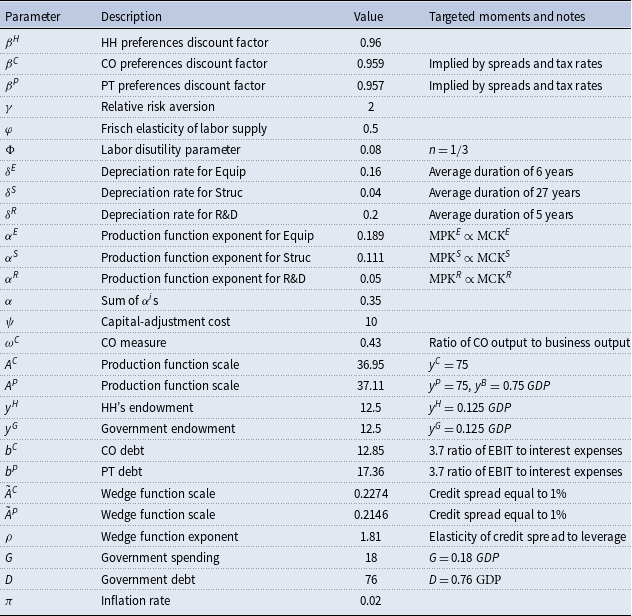
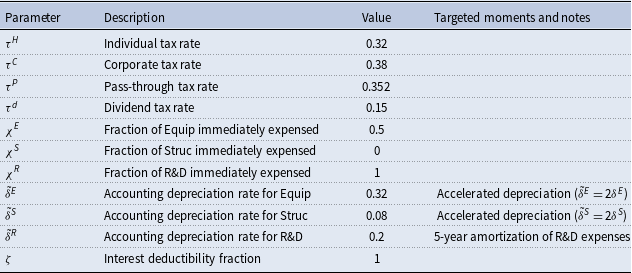
The parameters and steady-state values are listed in Tables 1 and 2.
Parameters and steady-state values

Note: The length of a period is 1 year.
Policy parameters

One period corresponds to 1 year. A few parameter values are set in line with the literature. The households’ preference discount factor is set to
 $\beta ^H=0.96$
, the relative risk aversion parameter is set to
 $\gamma =2$
, the Frisch elasticity of labor supply is set to
 $\varphi =0.5$
, and the parameter
 $\Phi$
is set so that the labor supply
 $n$
is equal to
 $1/3$
.
The tax rates for corporations and pass-throughs are set to
 $\tau ^C=0.38$
and
 $\tau ^P=0.352$
, following the estimates (comprehensive of federal and local taxation) by Barro and Furman (Reference Barro and Furman2018). The tax rate for households is set to
 $\tau ^H=0.32$
, the sum of 29%, the effective marginal federal tax rate on labor income estimated by CBO (2018), and 3%, the average state income tax. The dividend tax rate is set to
 $\tau ^d=0.15$
. All interest expenses are deductible in the steady state, so
 $\zeta =1$
. The inflation rate,
 $\pi$
, is equal to 2%.
The parameters of the wedge function are set to approximate moments of the corporate bond spread [Flannery et al. (Reference Flannery, Nikolova and Öztekin2012), Table 1]. The scale parameters,
 $\tilde A^C$
and
 $\tilde A^P$
, are set so that the financial frictions wedge is
 $\xi =0.01$
, and the credit spread (1%) is, approximately, equal to the average corporate bond spread. The exponent,
 $\rho$
, is set so that the credit spread increases by 0.80 percentage points (equal to one standard deviation of the corporate bond spread) when leverage,
 $h$
, increases by 44% (equal to the ratio of the standard deviation to the mean of corporate leverage).
The values of
 $\tilde{r}^C$
,
 $r^C$
, and
 $\beta ^C$
for corporations are determined by the steady-state versions of the households’ first-order conditions (26), the equation defining the financial friction wedge (20), and the corporations’ first-order conditions (19):
 \begin{align*} \begin{split} 1 & = \beta ^H \frac{1+(1-\tau ^H)\tilde{r}^C}{1+\pi } \\ 1+\tilde{r}^C & = \frac{1+r^C}{1+\xi } \\ 1 & = \beta ^C \frac{1+(1-\tau ^C)r^C}{1+\pi }. \end{split} \end{align*}
The values of
 $\tilde{r}^P$
,
 $r^P$
, and
 $\beta ^P$
for pass-throughs are determined in the same way. The resulting values for the preferences discount factors for owners of corporations and pass-throughs are, respectively,
 $\beta ^C=0.959$
and
 $\beta ^P=0.957$
.
The economic depreciation rates of equipment, structures, and R&D are, respectively,
 $\delta ^E=0.16$
,
 $\delta ^S=0.04$
, and
 $\delta ^R=0.2$
, to match, approximately, the BEA estimates of the average age of the three types of capital (6 years for equipment, software, and originals; 27 years for structures; and 5 years for R&D).
The fractions of initial investment that can be immediately depreciated are set as follows: for equipment,
 $\chi ^E_t=0.5$
, to replicate that a 50% bonus depreciation was allowed before the tax reform; for R&D,
 $\chi ^R_t=1$
, to replicate that investment in R&D could be fully expensed before the tax reform, and for structures,
 $\chi ^S_t=0$
, to replicate that the bonus depreciation was not allowed for structures.
The accounting depreciation rates for equipment and structures are set equal to double the economic depreciation rates,
 $\tilde \delta ^E=0.32$
,
 $\tilde \delta ^S=0.08$
, to approximate the fact that most businesses use accelerated depreciation (double declining balance method changing to straight line method at the point at which depreciation deductions are maximized). The accounting depreciation rate for R&D,
 $\tilde \delta ^R$
, does not play any role in the steady state because investment in R&D can be fully expensed (that is,
 $\chi ^R_t=1$
).
The exponent of the production function is set to
 $\alpha =0.35$
, in line with standard values in the literature. To set
 $\alpha ^i$
, for
 $i=E,S,R$
, I follow a procedure similar to the one used in the literature to set
 $\alpha$
. Consider the following steady-state first-order conditions for the economy without taxes and financial frictions:
 \begin{align*} {MPK}^i \equiv \alpha ^i \frac{y}{k^i} & = \frac{1}{{\beta ^H}} - (1-\delta ^i) \qquad \mathrm{for}\ i=E,S,R, \end{align*}
where
 $MPK^i$
is the marginal product of capital. Assuming that taxes and financial frictions raise the marginal product of capital proportionally for the three types of capital,
 \begin{align*} {MPK}^i \equiv \alpha ^i \frac{y}{k^i} & \propto \left ( \frac{1}{{\beta ^H}} - (1-\delta ^i) \right )\qquad \mathrm{for}\ i=E,S,R, \end{align*}
where
 $\propto$
is the proportionality symbol. Substituting
 $x^i=\delta ^ik^i$
,
 \begin{align*} \alpha ^i & \propto \left ( \frac{1}{{\beta ^H}} - (1-\delta ^i) \right ) \frac{1}{\delta ^i} \frac{x^i}{y}\qquad \mathrm{for}\ i=E,S,R. \end{align*}
In 2017, the ratios of private investment to business output were approximately
 $x^E/y=0.11$
for equipment and intellectual property products other than R&D,
 $x^S/y=0.04$
for structures, and
 $x^R/y=0.03$
for R&D. These ratios, the previously set values for
 $\alpha$
,
 $\beta ^H$
and
 $\delta ^i$
, and the constraint
 $\alpha \equiv \alpha ^S+\alpha ^E+\alpha ^R$
imply
 $\alpha ^E=0.189$
,
 $\alpha ^S=0.111$
, and
 $\alpha ^R=0.05$
.
The capital-adjustment cost parameter is set equal to
 $\psi =10$
, in line with common values used in models with a unique type of capital.
The endowment and production parameters are set so that
 $y^B=75$
,
 $y^H=12.5$
,
 $y^G=12.5$
, and
 $GDP=y^H+y^B+y^G=100$
, to match the fact that in 2013 the business sector accounted for about 75% of gross value added, while both the household sector and the government sector accounted for 12.5% (BEA, National Income and Product Accounts, Table 1.3.5). More specifically, the production function scale parameters,
 $A^C$
and
 $A^P$
, are set so that
 $y^C=y^P=75$
. The two parameters are different because the tax rates are different for corporations and pass-throughs, implying different first-order conditions and capital levels. With this choice, business output,
 $y^B$
, is also equal to
 $75$
:
 $y^B = \omega ^C y^C+\omega ^P y^P =75$
.
The measures of corporations and pass-throughs are set to
 $\omega ^C=0.43$
and
 $\omega ^P=0.57$
so that corporate output
 $\omega ^C y^C$
represents 43% of business output,
 $y^B$
, and pass-through output represents the remaining 57%. This setting matches the fact that in 2013 C corporations and pass-through businesses accounted for, respectively, 43% and 57% of net business income (IRS, SOI Tax Stats—Integrated Business Data, Table 1).
The lump-sum government transfers to corporations and pass-throughs,
 $T^C$
and
 $T^P$
, are set to target the levels of debt,
 $b^C$
and
 $b^P$
. In turn, the levels of debt are set so that the coverage ratio, defined as the ratio of EBIT to interest expenses, is 3.7 for both corporations and pass-throughs, matching the average coverage interest ratio for US nonfinancial corporate publicly traded firms [Palomino et al. (Reference Palomino, Paolillo, Perez-Orive and Sanz-Maldonado2019)].
Government spending,
 $G$
, is set to 18% of GDP. The lump-sum government transfers to households,
 $T^H$
, are set so that government debt,
 $D$
, is equal to 76% of GDP, to match gross federal debt held by the public as a percentage of GDP in 2017.
As a result of the calibration, investment is 17% of GDP (10.7% in equipment, 3.2% in structures, and 3% in R&D) and consumption is 65% of GDP (1.5% of corporate owners, 2.6% of pass-through owners, and 60.9% of households).
3.2. Changes in policy parameters to model the tax reform
Before detailing how I model the tax reform, let me highlight the role played by agents’ expectations in the model. The initial effect of the tax reform depends on agents’ initial expectations about the future of the TCJA provisions. Therefore, to obtain accurate model estimates, it is important that the agents’ expectations in the model are as close as possible to the ones held by the public in reality.
Of course, there is large uncertainty about the future of the TCJA provisions—partly because of political uncertainty—and large uncertainty about agents’ initial expectations. On the one hand, there will be political pressure to make the temporary provisions on individual income tax rates permanent, to extend the bonus depreciation of equipment, and to mitigate the switch from expensing to amortizing R&D expenses. On the other hand, the rise in government debt will create pressure in the opposite direction and may even lead to a partial repeal of the corporate tax rate cuts. Indeed, in the President’s Budget for fiscal year 2023, President Biden has already proposed that Congress raise the corporate tax rate to 28%.
The large uncertainty notwithstanding, to obtain accurate model estimates, we need to incorporate expectations that are as realistic as possible. To that end, I present the main results for a case where agents hold what I consider realistic expectations about the future of the TCJA provisions. Specifically, I construct a plausible future scenario for the TCJA provisions (called plausible scenario), and I assume that agents have perfect foresight, so their current expectations are consistent with that scenario. With this strategy, I aim at generating expectations that are as close as possible to the ones that the public plausibly holds in reality.
After presenting the main results for the plausible scenario, I show the results for a scenario where the TCJA provisions will evolve as prescribed by current legislation (called legislation scenario), and agents’ expectations are consistent with it. Agents have perfect foresight in this scenario as well. In my view, agents’ expectations in this scenario are less realistic, so the model estimates are less accurate. For instance, in this scenario, agents believe that the corporate tax cuts will be permanent and don’t place any probability on a possible partial repeal, while in reality a partial repeal has always been publicly considered. However, I include this scenario because it may be of interest in itself, and because, by comparing the two scenarios, we can gain some insights about how the estimated effects of the tax reform depend on the future paths of the TCJA provisions.
In what follows, I begin describing the parameter settings for the legislation scenario, and then, I describe the parameter settings for the plausible scenario.
3.2.1. Parameter settings for the legislation scenario
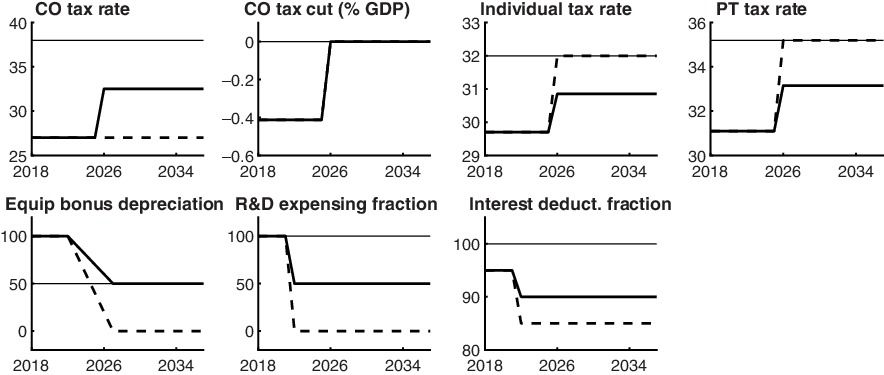
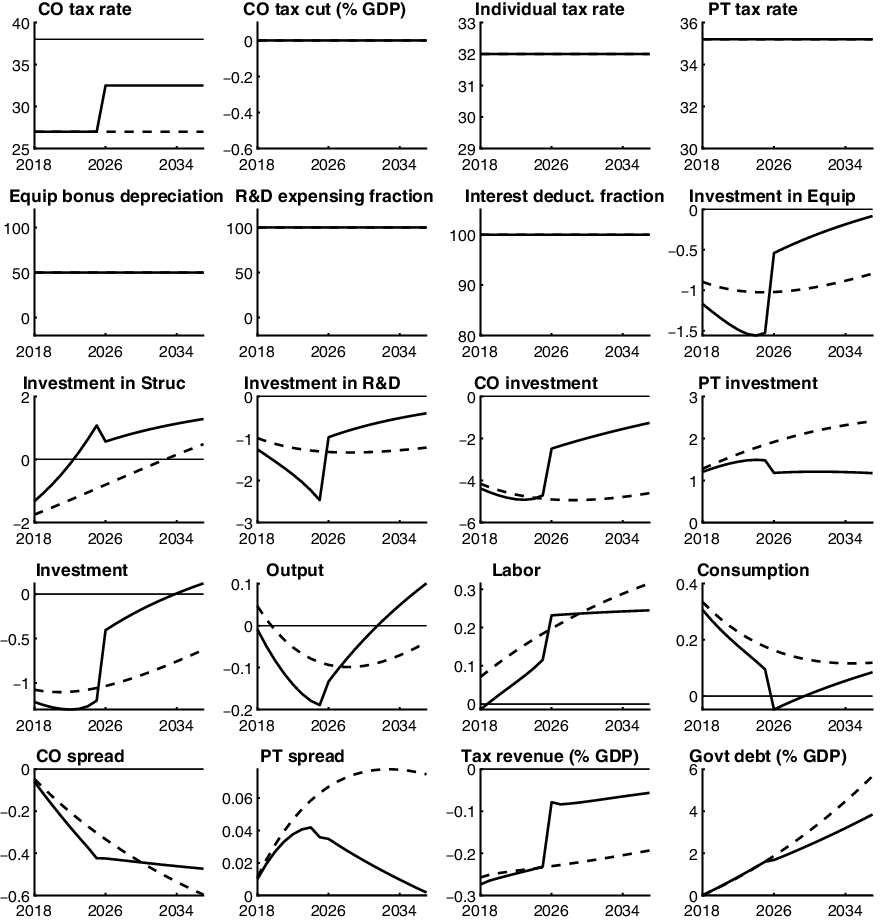
The parameter settings that model the tax reform in the legislation scenario are described by the dashed lines in Figure 1.
Changes in policy parameters designed to model the tax reform. Note: For the second subplot, the solid line refers to both the plausible scenario and the legislation scenario. For the other subplots, the solid and dashed lines refer, respectively, to the plausible scenario and the legislation scenario.

Beginning with the permanent corporate income tax cuts, Barro and Furman (Reference Barro and Furman2018, Table 4 and page 275) estimate that the tax rate on corporate income dropped by 11 percentage points, taking into account the new limits on the deduction of net operating losses, as well as other details of the tax legislation. Following their estimate, I model the corporate income tax cuts as a permanent drop by 11 percentage points from
 $\tau ^C=0.38$
to
 $\tau ^C=0.27$
from 2018 on (first subplot of Figure 1).
The provision on corporate earnings held overseas amounts to a lump-sum tax cut for corporations, since the earnings held overseas were subject to a higher tax rate (35%) under the old tax system, and became subject to a lower tax rate (15.5% on liquid assets and 8% on illiquid assets). The lump-sum tax cut is equal to the product of the tax rate cut and the amount of overseas earnings. The amount of earnings held overseas is, approximately,
 $\$ $
2.6 trillion [McKeon (Reference McKeon2017)]. Assuming that one-third of assets held overseas are liquid, the tax rate cut is equal to
 $0.35-(1/3 \times 0.155+2/3 \times 0.08)=0.245$
. The product of the tax rate cut and the amount of overseas earnings is
 $\$ $
637 billion, corresponding to 3.3% of GDP, so I model the provision as a lump-sum tax cut for corporations equal to 3.3% of GDP. Since corporations can pay the new tax in installments over 8 years, I assume that the lump-sum tax cut is equally spread over the 8 years starting in 2018 (second subplot of Figure 1).
As to the temporary individual tax cuts, Barro and Furman (Reference Barro and Furman2018, page 298) estimate a cut in the average marginal income tax rate of about 2.3 percentage points. Following their estimate, I model the individual tax cuts as a temporary drop by 2.3 percentage points to
 $\tau ^H=0.297$
in the years 2018–2025, followed by a return to
 $\tau ^H=0.32$
from 2026 on (third subplot of Figure 1).
Turning to the temporary tax cuts for pass-throughs, Barro and Furman (Reference Barro and Furman2018, Table 4 and page 283) estimate a drop by 4.1 percentage points, reflecting the limits on the pass-through deduction. Following their estimate, I assume a temporary cut by 4.1 percentage points, and set
 $\tau ^P=0.311$
in the years 2018–2025, followed by a return to
 $\tau ^P=0.352$
from 2026 on (fourth subplot of Figure 1).
To model the bonus depreciation for equipment, I set
 $\chi ^E_t=1$
for the years 2018–2022, then
 $\chi ^E_t=0.8, 0.6, 0.4, 0.2$
, respectively, for the years 2023–2026, and finally
 $\chi ^E_t=0$
from 2027 on (fifth subplot of Figure 1).
The amortization of R&D expenses starting in 2022 is modeled by keeping
 $\chi ^R_t=1$
for the years 2018–2021 and then setting
 $\chi ^R_t=0$
from 2022 on (sixth subplot of Figure 1). The value for the accounting depreciation rate for R&D is set to
 $\tilde \delta ^R=0.2$
, to model that R&D expenses need to be amortized over 5 years (
 $\tilde \delta ^R$
does not play any role unless
 $\chi ^R_t\lt 1$
).
With regard to the limits on interest deductibility, Barro and Furman (Reference Barro and Furman2018, pages 275–276) assume that the limits on interest deductibility are constraining 5% of investment in the initial years (when the limit is 30% of EBITDA) and will constrain 15% of investment in the long run (when the limit will be 30% of EBIT). Motivated by their assumption, I approximate the limits on the deductibility of interest expenses by setting
 $\zeta _t=0.95$
for the years 2018–2021, followed by
 $\zeta _t=0.85$
for the years from 2022 on (seventh subplot of Figure 1).
The final point regards the financing of the tax reform and the evolution of government debt. As I stated in Section 2.5, I assume that the lump-sum government transfers to households,
 $T^H_t$
, adjust to make government debt stationary, and insure the existence of an equilibrium. This assumption implies that, after the tax reform, the transfers decrease enough to balance the government’s intertemporal budget constraint, so the tax reform is financed by cuts in the government transfers to households. The timing of the adjustment in
 $T^H_t$
does not affect the dynamics of any variable, except for government debt,
 $D_t$
. Intuitively, if the transfers decrease in the initial years of the tax reform, the path of government debt is lower than in the case where the transfers decrease in the distant future. To be able to evaluate the costs of the tax reform in terms of increases in government debt, I assume that all of the adjustment in
 $T^H_t$
takes place in the distant future, after 20 years, that is, the transfers remain constant and equal to their steady-state value for the initial 20 years, and they decrease only afterwards. With this assumption, the path of government debt in the initial 20 years (which is the time horizon in the figures) is entirely the result of the tax reform.
3.2.2. Parameter settings for the plausible scenario
The parameter settings that model the tax reform in the plausible scenario are described by the solid lines in Figure 1. For each TCJA provision, I construct the plausible-scenario path as an average of two paths that are at the opposite ends of a range of plausible paths. The goal of this strategy is to generate expectations in the model that reflect ones the public might have plausibly held at the beginning of 2018.
Specifically, for the provision on corporate earnings held overseas, the plausible-scenario path is the same as the legislation-scenario path, since there is no uncertainty about the future of that provision. For the corporate income tax cuts, the plausible-scenario path is the average of the legislation-scenario path and a path where the cuts are repealed in 2026. For the other five provisions, the plausible-scenario path is the average of the legislation-scenario path and a path where the initial settings of the TCJA provisions are extended permanently.
As a result, the tax cuts for corporations, individuals, and pass-throughs are modeled by setting
 $\tau ^C=0.27$
,
 $\tau ^H=0.297$
, and
 $\tau ^P=0.311$
in the years 2018–2025, and then
 $\tau ^C=0.325$
,
 $\tau ^H=0.3085$
, and
 $\tau ^P=0.3315$
from 2026 on. The bonus depreciation of equipment is modeled by setting
 $\chi ^E_t=1$
for the years 2018–2022, then
 $\chi ^E_t=0.9, 0.8, 0.7, 0.6$
, respectively, for the years 2023–2026, and finally
 $\chi ^E_t=0.5$
from 2027 on. The amortization of R&D expenses is modeled as
 $\chi ^R_t=1$
for the years 2018–2021, followed by
 $\chi ^R_t=0.5$
from 2022 on (with
 $\tilde \delta ^R=0.2$
). The limits on the interest deductibility are modeled as
 $\zeta _t=0.95$
for the years 2018–2021, followed by
 $\zeta _t=0.9$
from 2022 on.
As in the legislation scenario, the transfers,
 $T^H_t$
, remain constant and equal to their steady-state value for the initial 20 years, and they decrease only afterwards.
4. Results
In this section, I will study, first, the effect of each TCJA provision considered separately (Section 4.1), and, then, their cumulative effect (Section 4.2).Footnote 4 After that, I will discuss why the economy’s response to the tax reform is different from a smooth convergence path to the long run (Section 4.3). In this section, I will focus on the plausible scenario, while I will discuss the legislation scenario in Section 5.1.
4.1. Effect of each individual TCJA provision
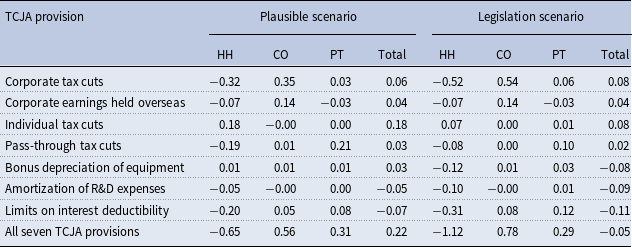
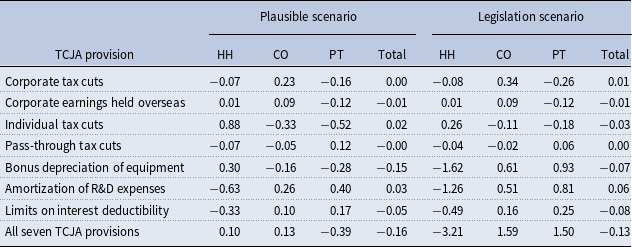
The solid lines in Figures 2–8 show, respectively, the effect of each of the seven TCJA provisions in the plausible scenario. In addition, the first three columns of Table 3 list, respectively, the effect of the TCJA provisions on the welfare of households, corporate owners, and pass-through owners. The welfare effect of a TCJA provision is computed as the equivalent permanent change in consumption, that is, the constant, permanent increase(/decrease) in consumption that would imply the same utility increase(/decrease) as the one generated by the TCJA provision. All equivalent permanent changes in consumption are expressed as percentages of aggregate consumption. The fourth column lists the total welfare effect, computed as the sum of the equivalent permanent changes in the consumption of households, corporate owners, and pass-through owners. The total welfare effect can be interpreted as the constant, permanent change in aggregate consumption necessary to generate the same utility changes as the ones generated by the TCJA provision.
Welfare effect of the tax reform

Note: Effect of the TCJA provisions on the welfare of households, corporate owners, and pass-through owners, measured as equivalent permanent change in their consumption, expressed as a percentage of aggregate consumption. The total is the sum of the three welfare effects. The first four columns refer to the plausible scenario, while the last four refer to the legislation scenario.
According to the model, the corporate income tax cut discouraged corporate investment (Figure 2). As explained in Section 2.7, the combination of interest deductibility and accelerated depreciation makes the business income tax act as an investment subsidy, so a tax cut decreases the subsidy and reduces investment. In addition, the tax cut strengthened the balance sheets of corporations and reduced the financial frictions, the credit spread, and the user cost of capital, which mitigated the decrease in corporate investment. As the investment demand by corporations decreased, the real interest rate decreased and stimulated pass-through investment. The opposite response of investment in the corporate and pass-through sectors is one example of how some TCJA provisions had different effects on the two sectors and highlights the benefit of modeling the two sectors separately, within a general equilibrium approach. Aggregate investment and output decreased. As a result of the tax cut, the tax revenue dropped and government debt began to rise: By 2036, the ratio of government debt to GDP will be 4 percentage points higher than steady state. Not surprisingly, the corporate tax cut increased the welfare of corporate owners (first row of Table 3). The equivalent permanent increase in their consumption amounted to 0.35% of aggregate consumption. Since we are assuming that the tax reform will be financed by future cuts in the lump-sum transfers to households, the corporate tax cut redistributed resources from households to corporate owners: The equivalent permanent decrease in the consumption of households was almost as large as the equivalent permanent increase in the consumption of corporate owners. In aggregate, however, the provision increased welfare, since it lowered a distortionary tax.
Effect of the income tax cuts for corporations. Note: The solid and dashed lines refer, respectively, to the plausible scenario and the legislation scenario.

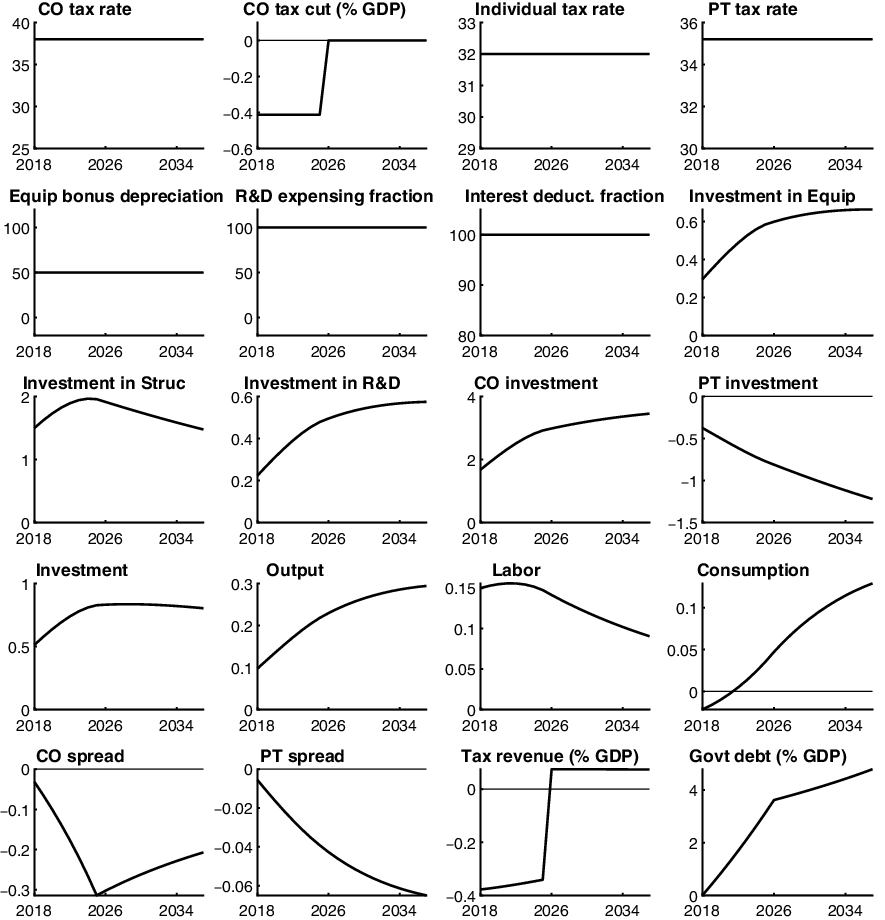
The provision on corporate earnings held overseas is modeled as a lump-sum tax cut for corporations in the years 2018–2025 (Figure 3). The tax cut led to a reduction of corporate debt and leverage, strengthened the balance sheets of corporations, mitigated the financial frictions, reduced the corporate spread and user cost of capital, and stimulated corporate investment. As the investment demand by corporations increased, the real interest rate increased and discouraged investment by pass-throughs. Aggregate investment and output increased. As a result of the tax cut, the tax revenue dropped and government debt began to rise: By 2036, the ratio of government debt to GDP will be 5 percentage points higher than steady state. Like the corporate tax cuts, this provision increased the welfare of corporate owners and decreased the welfare of households (second row of Table 3). In aggregate, the provision had a positive welfare effect, since it mitigated the financial frictions for corporations.
Effect of the provision on corporate earnings held overseas. Note: The solid line refers to both the plausible scenario and the legislation scenario.

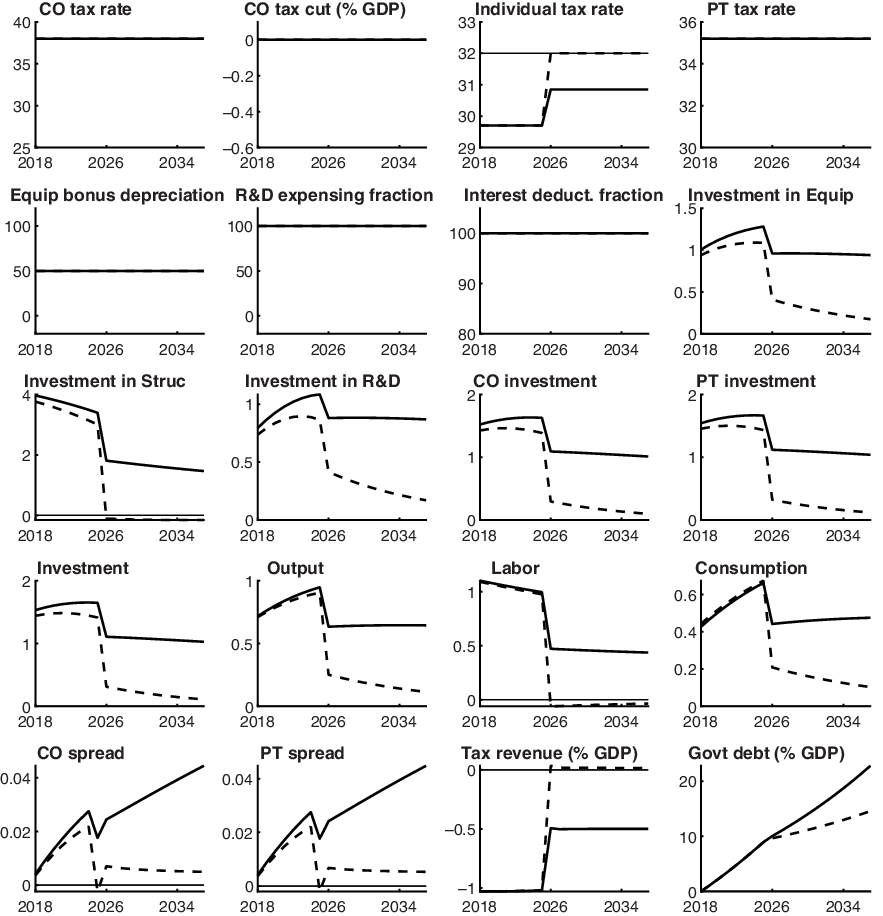
The individual income tax cut had a powerful positive effect on households’ labor supply and output (Figure 4). As labor increased, the marginal product of capital increased and investment in all types of capital was stimulated. This was the most expensive provision: The tax revenue dropped sizeably and persistently. As a percentage of GDP, government debt will increase by more than 20 percentage points by 2036. Intuitively, the individual income tax cut increased the welfare of households, as the benefit from their increased consumption outweighed the cost from their increased labor (third row of Table 3). The welfare effects on business owners were tiny, so the total welfare effect was, approximately, equal to the household welfare effect. The total welfare effect was equivalent to a 0.18% permanent increase in aggregate consumption, the largest total welfare benefit among the seven TCJA provisions, as the provision mitigated the large distortions associated with the individual income tax.
Effect of the income tax cuts for individuals. Note: The solid and dashed lines refer, respectively, to the plausible scenario and the legislation scenario.

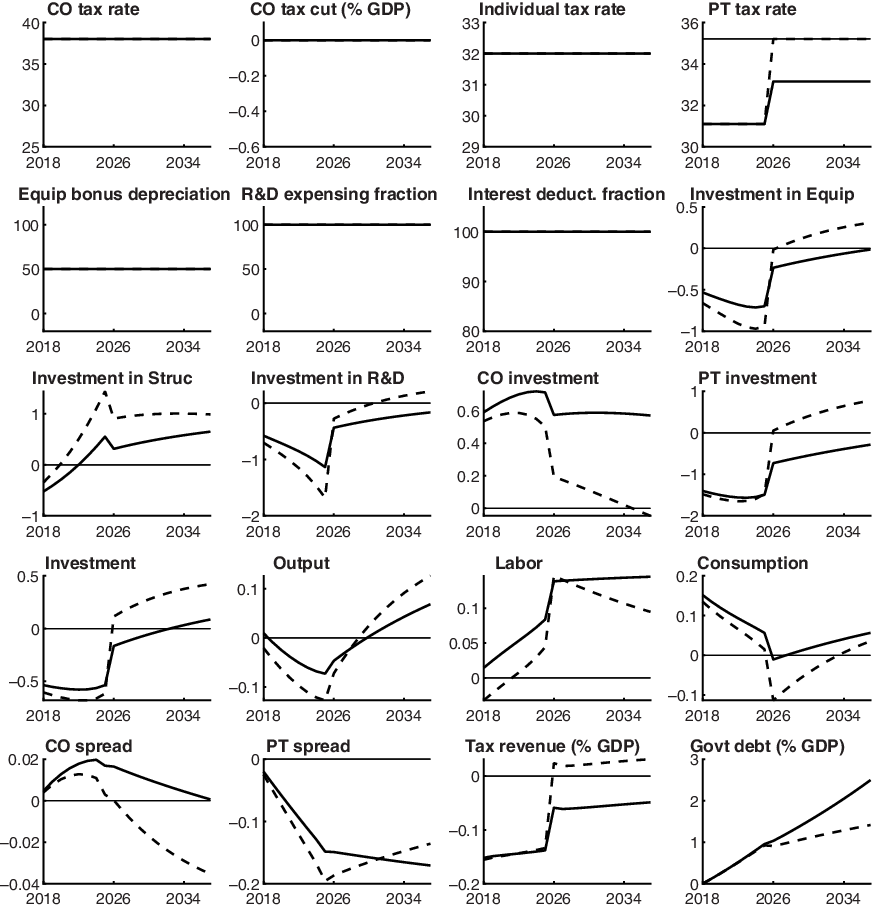
The macroeconomic effects of the income tax cut for pass-through businesses were analogous to the ones of the corporate income tax cut (Figure 5). The investment demand by pass-throughs dropped, lowering the real interest rate and encouraging corporate investment. Aggregate investment and output decreased. The credit spread for pass-through businesses declined, mitigating the decrease in investment. The tax revenue dropped and government debt began to rise: By 2036, the ratio of government debt to GDP will be 2.5 percentage points higher than steady state. Intuitively, the income tax cut for pass-through businesses raised the welfare of pass-through owners (fourth row of Table 3). The equivalent permanent increase in their consumption amounted to 0.21% of aggregate consumption. Resources were redistributed from households to corporate owners: The equivalent permanent decrease in the consumption of households was almost as large as the equivalent permanent increase in the consumption of pass-through owners. In aggregate, the provision had a positive welfare effect, since it lowered a distortionary tax.
Effect of the income tax cuts for pass-through businesses. Note: The solid and dashed lines refer, respectively, to the plausible scenario and the legislation scenario.

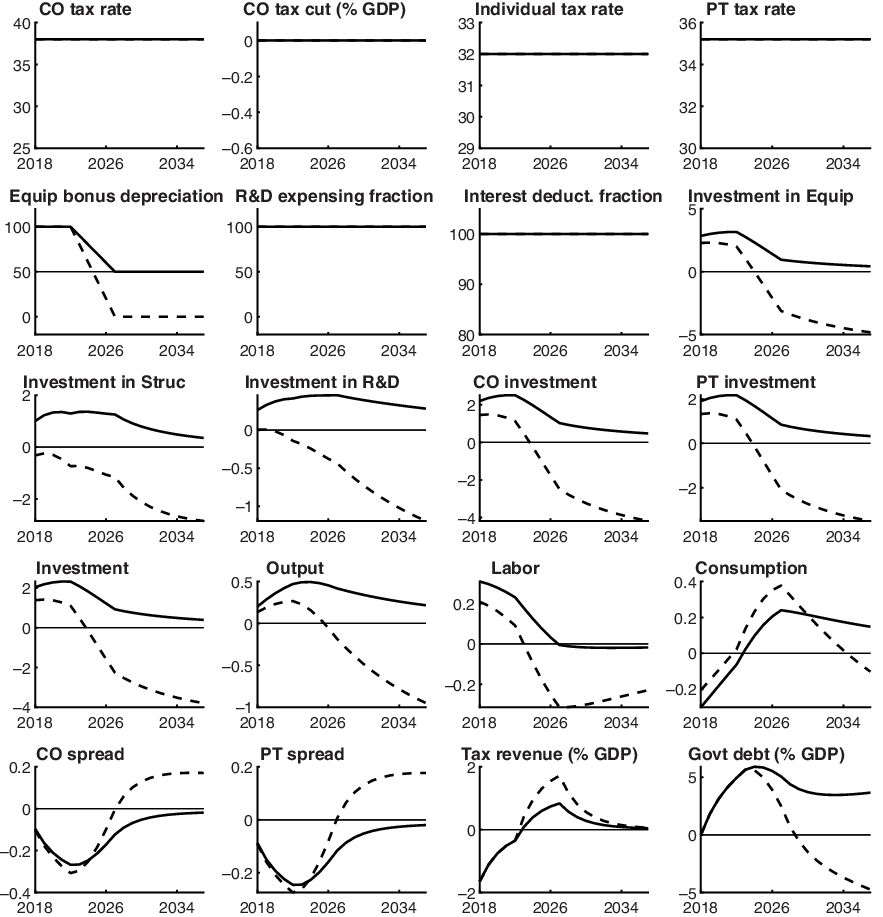
The main effect of the bonus depreciation of equipment was, as expected, to stimulate investment in equipment (Figure 6). The effect will fade away in the coming years, as the bonus depreciation returns to the steady-state value of 50%. Investment in structures and R&D was stimulated as well, although to a lesser extent. The increase in investment and capital raised the marginal product of labor and stimulated labor demand and output. The provision slightly increased the welfare of both households and business owners (fifth row of Table 3). The effect on the tax revenue was negative in the initial years, when the bonus depreciation was higher than steady state, but will turn positive in future years, when the bonus depreciation returns to steady state and output remains above steady state. Government debt will remain elevated and, as a percentage of GDP, will be 4 percentage points higher than steady state in 2036.
Effect of the bonus depreciation of equipment and software. Note: The solid and dashed lines refer, respectively, to the plausible scenario and the legislation scenario.

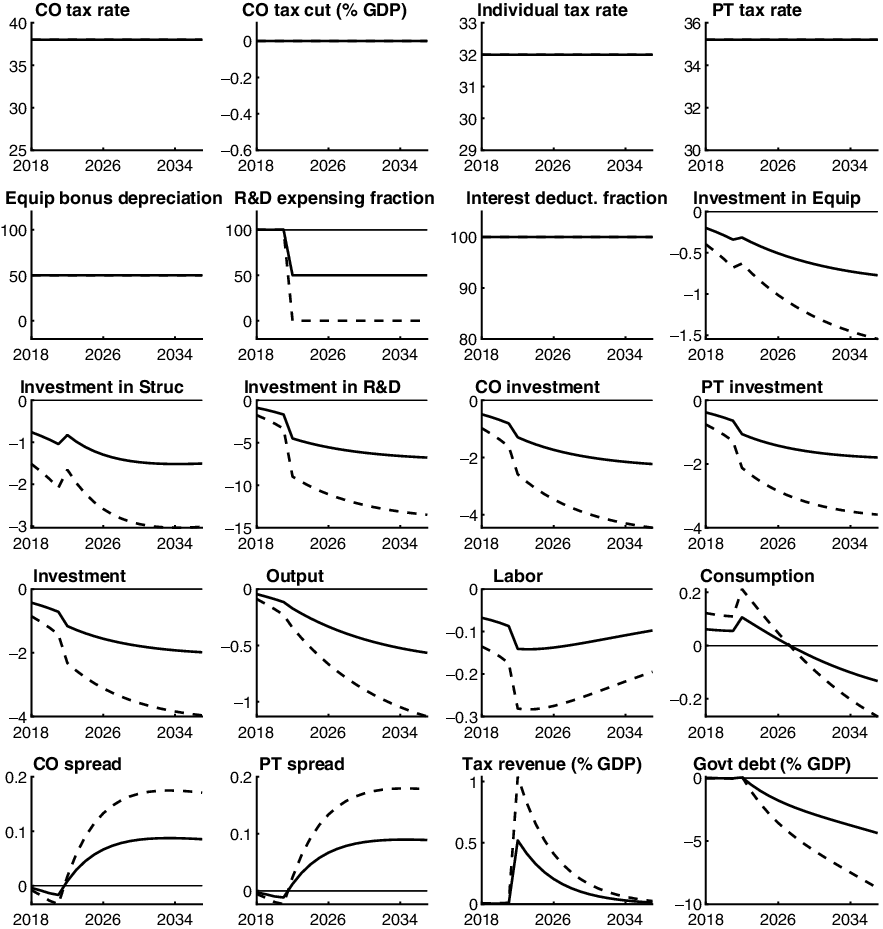
The macroeconomic effects of the amortization of R&D expenses were, in many ways, the opposite of the effects of the bonus depreciation of equipment (Figure 7). The main effect was, as expected, to depress investment in R&D. The provision indirectly discouraged investment in equipment and structures as well, although to a lesser extent. The negative effect on aggregate investment was sizeable and persistent. As investment decreased, labor demand and output decreased. As investment demand decreased, the real interest rate decreased and depressed the welfare of households, who are the recipients of interest payments (sixth row of Table 3). Unlike the previous provisions, this provision decreased total welfare, as it worsened the distortion on R&D investment. However, this provision will improve the government’s budget balance: As a percentage of GDP, government debt will decrease by more than 4 percentage points by 2036.
Effect of the amortization of R&D expenses. Note: The solid and dashed lines refer, respectively, to the plausible scenario and the legislation scenario.

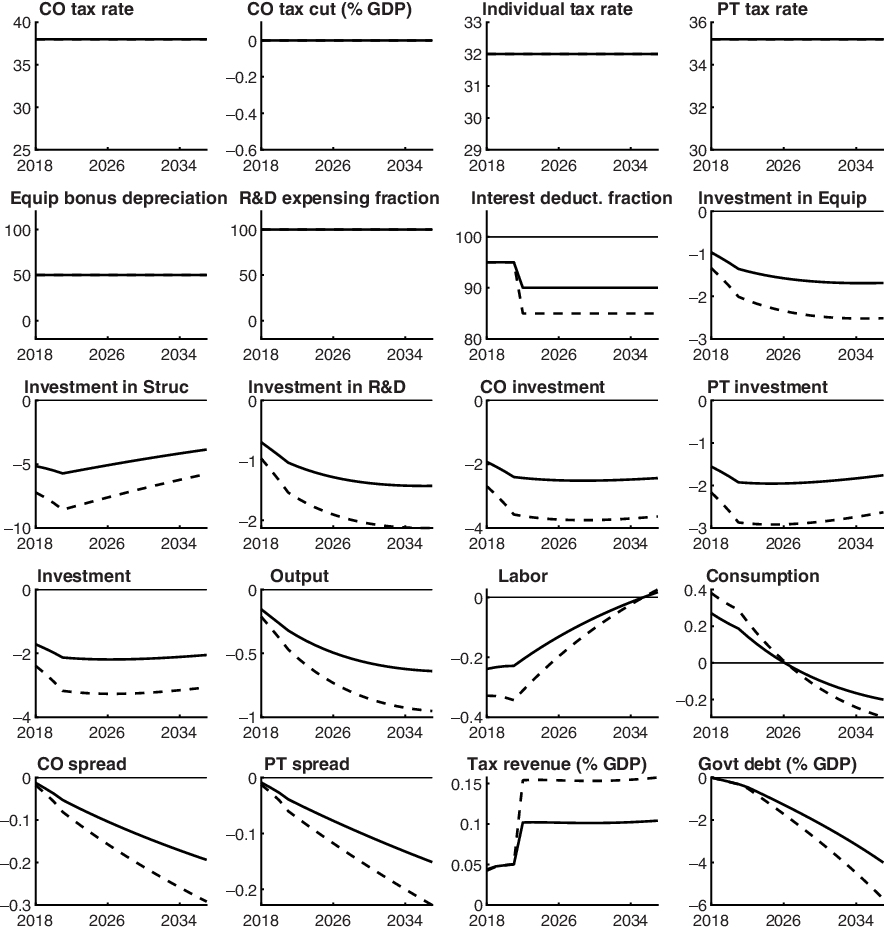
The main effect of the limits on interest deductibility was to depress investment (Figure 8). Labor demand and output declined as well. As investment demand decreased, the real interest rate decreased, depressing the welfare of households, who are the recipients of interest payments, and enhancing the welfare of business owners, who are the interest payers (seventh row of Table 3). Intuitively, this provision improved the government’s budget balance. As business were less able to deduct their interest expenses, the tax revenue increased, and government debt began to decline: By 2036, the ratio of government debt to GDP will be 4 percentage points lower than steady state.
Effect of the limits on interest deductibility. Note: The solid and dashed lines refer, respectively, to the plausible scenario and the legislation scenario.

4.2. Cumulative effect of the TCJA provisions
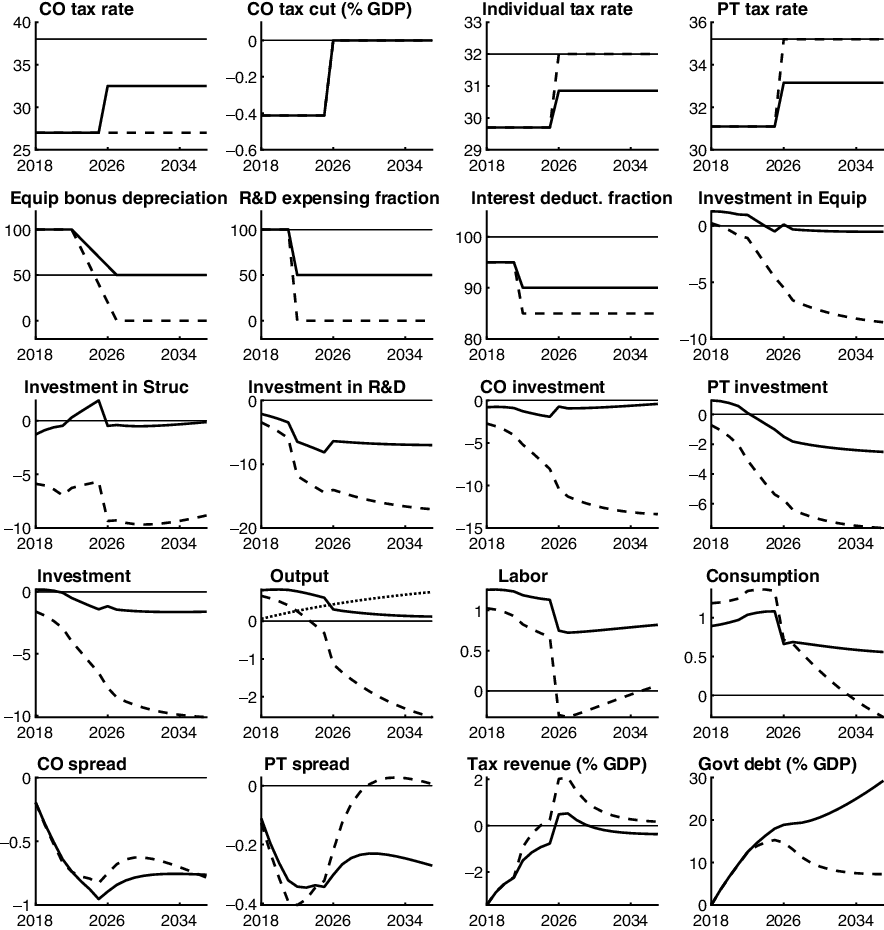
The solid line in Figure 9 displays the cumulative effect of the seven TCJA provisions in the plausible scenario.
Cumulative effect of the seven TCJA provisions. Note: The solid and dashed lines refer, respectively, to the plausible scenario and the legislation scenario. The dotted line in the output panel plots the response of output (derived from the response of GDP) in the law-as-written scenario of Barro and Furman (Reference Barro and Furman2018).

According to the model, the tax reform raised labor and output. In 2018, business output increased by 0.8%, implying that GDP increased by 0.6%. Households’ labor supply increased by 1.3%. Among the various TCJA provisions, the income tax cut for individuals was the one that contributed the most to the initial increase in labor and output. After 2026, the positive effect of the tax reform on the levels of labor and output will diminish, as the individual income tax rate increases. By 2036, while labor will remain 0.9% above steady state, output will be only 0.2% above steady state.Footnote 5
Turning to the effect of the tax reform on investment, the immediate effect was small (0.2%) because the various provisions worked in opposite directions. The provisions that stimulated investment were the bonus depreciation of equipment (by increasing investment in equipment); the individual tax cut (by increasing the labor supply); and the provision on corporate earnings held overseas (by decreasing the spread and the user cost of capital). The provisions that depressed investment were the amortization of R&D expenses (by decreasing investment in R&D); the business income tax cuts (by decreasing the interest deduction and raising the user cost of capital); and the limits on interest deductibility (by raising the user cost of capital). While the immediate response of pass-through investment was positive, the immediate response of corporate investment was negative. The difference in the responses was driven by the large cut in the corporate tax rate, which discouraged corporate investment and encouraged pass-through investment.
In the medium term, the effect of the tax reform on investment will turn negative because the provisions that will encourage investment (the individual tax cut and the provision on corporate earnings held overseas) will be more than offset by the provisions that will discourage investment (the amortization of R&D expenses and the limits on interest deductibility). The main factors behind the decline in the effect are the switch from expensing to amortization of R&D expenses in 2022, the phase-out of the 100% bonus depreciation for equipment between 2023 and 2026, and the increase in the individual tax rate in 2026. After 2026, investment will be about 1.6% below steady state, driven by the 7% drop in investment in R&D that is caused by the switch from expensing to amortizing R&D expenses.
As to the welfare effects, the tax reform had important distributional effects, decreasing the welfare of households and increasing the welfare of business owners (final row of Table 3). The effect on the welfare of households was equivalent to a permanent decrease in their consumption equal to 0.65% of aggregate consumption. The effect on the welfare of corporate (/pass-through) owners was equivalent to a permanent increase in their consumption equal to 0.56% (/0.31%) of aggregate consumption. The negative effect on household welfare was driven by the corporate and pass-through tax cuts, which led to a decrease in the government transfers to households, and the limits on interest deductibility, which decreased the interest rate and the interest payments to households. The negative effect on household welfare was only mitigated by the individual tax cuts, which decreased the distortions associated with the tax. Symmetrically, the positive effect on the welfare of corporate(/pass-through) owners was driven by the corporate(/pass-through) tax cuts and the limits on interest deductibility.
In aggregate, the tax reform had a positive welfare effect, as it tended to lower distortionary taxes and financial frictions. The total effect was equivalent to a 0.22% permanent increase in aggregate consumption. The total effect was the net result of positive contributions from the individual and business tax cuts, the provision on foreign corporate earnings, and the bonus depreciation of equipment, partially offset by negative contributions from the amortization of R&D expenses and the limits on interest deductibility. The individual tax cuts were by far the most important contributor.
With regard to welfare, however, it is important to remember that we are assuming that the tax reform will be financed by future cuts in the lump-sum transfers to households. In Section 5.2, we will see how the estimates of the welfare and distributional effects of the tax reform depend on this assumption.
As a result of the tax reform, the tax revenue plunged, mainly because of the provision on corporate earnings held overseas, the bonus depreciation of equipment, and the individual tax cuts. The tax revenue will remain below steady state until 2026, raising the ratio of government debt to GDP by 20 percentage points. After 2026, when the tax cuts decrease, the tax revenue will return close to steady state, but government debt will continue to rise because of the interest expenses. By 2036, the ratio of government debt to GDP will be 30 percentage points higher than steady state.
4.3. The transition to the long run
One feature that is evident when looking at the economy’s response in Figure 9 is that the medium-run response is different from a smooth convergence path to the longer run. For instance, the response of output is larger in size in the first 8 years than in the subsequent years, the opposite of what a smooth convergence path would predict. To highlight the contrast, the dotted line in the output panel of Figure 9 plots the response of business output in the law-as-written scenario of Barro and Furman (Reference Barro and Furman2018).Footnote 6 While their estimated response increases over time, my model’s response tends to be larger in the initial years.
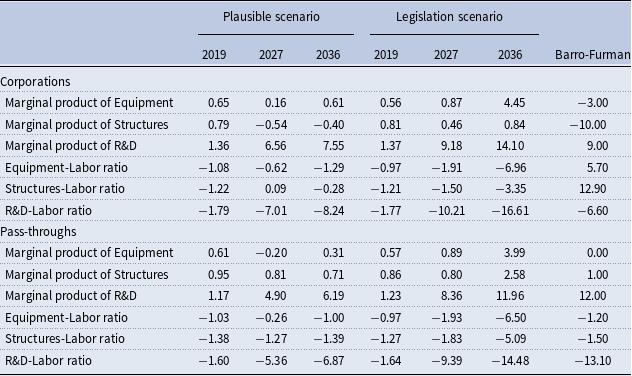
For another example of how the transition cannot be simply derived from the long-run values, Table 4 summarizes the transition of the marginal product of capital (which is equal to the user cost of capital in the long run) and the capital-labor ratio for the corporate and pass-through sectors. The table lists values for 2019 (the first year that capital changes), for 2027 (1 year after all provisions take their long-run values), and for 2036 (10 years after all provisions take their long-run values).Footnote 7 For these investment indicators as well, the effect of the tax reform in 2019 and 2027 is far different from the one that would be predicted by a smooth convergence path to the 2036 values. For equipment, for instance, the marginal product surges in 2019, declines in 2027, and partially rebounds in 2036.
Transition values of investment indicators

Note: Cumulative effect of the seven TCJA provisions on the investment indicators, expressed in percent changes. The Barro-Furman column refers to the law-as-written scenario in Tables 5 and 8 of Barro and Furman (Reference Barro and Furman2018), using the fact that the marginal product of capital is equal to the user cost of capital in the steady state.
The main reason why the transition is different from a smooth convergence path is that, for both scenarios, the settings of the TCJA provisions tend to be more expansionary in the earlier years than in the later years, so their benefits (in terms of economic stimulus) and costs (in terms of fiscal deficit) tend to be front-loaded. Quite naturally, the effect on investment, output, and labor is more positive in the medium run than in the longer run, while the effect on the tax revenue is more negative in the medium run than in the longer run.
Another reason why the transition is different from a smooth convergence path is that the TCJA provisions have effects on the business debt levels, the credit spreads, and the interest rates that businesses face when choosing their investment. These effects complicate the medium-term dynamics of the economy relative to a representative agent model without financial frictions.
This observation brings us to another important point. By affecting the levels of capital and business debt, which are state variables in the model, the TCJA provisions affect the economy long after their immediate effect. In other words, even when temporary, the TCJA provisions have long-lasting effects on the economy through their effects on capital and business debt. For instance, following a temporary corporate tax cut, corporate debt would decrease persistently, lowering the corporate credit spread and stimulating corporate investment for many years after the tax cut has ended.
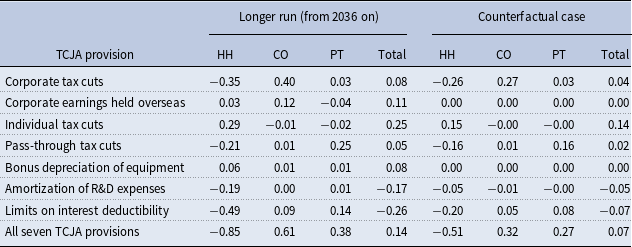
To see the implications of these points for welfare, the first four columns of Table 5 list the welfare effects of the TCJA provisions in the plausible scenario in the longer run (from 2036 on). The welfare effect is the equivalent permanent change in consumption, as in Table 3, except that it is computed from 2036 on, instead of 2018 on. One point that is evident from the table is that the two provisions that, by 2036, have returned to steady state (the provision on foreign corporate earnings and the bonus depreciation) will continue to have an effect on total welfare after 2036, through their effects on capital and business debt. More generally, the effects of the TCJA provisions will tend to be larger after 2036 than after 2018 due to the response of capital and business debt. A second point is that the two contractionary provisions (the amortization of R&D expenses and the limits on interest deductibility) will have a much larger negative effect on total welfare after 2036 than after 2018, so the total welfare effect of the tax reform will be less positive after 2036 than after 2018.
Welfare effect of the tax reform

Note: Effect of the TCJA provisions on the welfare of households, corporate owners, and pass-through owners, measured as equivalent permanent change in their consumption, expressed as a percentage of aggregate consumption. The total is the sum of the three welfare effects. The first four columns refer to the longer run (from 2036 on), while the last four columns refer to the counterfactual case where the TCJA provisions are set immediately at their long-run values. All columns refer to the plausible scenario.
For another perspective on these points, the last four columns of Table 5 list the welfare effects of the TCJA provisions in the plausible scenario in the counterfactual case where the TCJA provisions are set immediately at their permanent settings. First, the total welfare effect of the tax reform is smaller in this counterfactual case than in the baseline case (shown in the first four columns of Table 3), since the permanent settings of the TCJA provisions tend to be more distortionary than the temporary ones. Second, the total welfare effect of the tax reform is smaller in this counterfactual case than in the longer run of the baseline case (shown in the first four columns of Table 5), since the longer run of the baseline case includes the effect of capital and business debt from previous years, while capital and business debt are at their steady-state values in this counterfactual case.
5. Sensitivity of results
This section examines the sensitivity of results to the paths of the policy parameters and to the assumption about the financing of the tax reform. Appendix B in Supplementary Material documents the sensitivity of results to other model parameters and to the assumptions of interest deductibility and accelerated depreciation.
5.1. Comparison between the two scenarios and sensitivity to the paths of the policy parameters
The model results depend significantly on the assumptions about the paths of the policy parameters, as can be seen by comparing the plausible scenario and the legislation scenario (solid and dashed lines of Figures 2–9).
Focusing on the cumulative effect of the seven TCJA provisions (Figure 9), the estimate of the immediate effect on labor and output is smaller in the legislation scenario than in the plausible scenario. The estimate of the immediate effect on investment is negative in the legislation scenario, while it is positive in the plausible scenario. The difference in the estimates of the immediate effects is due to the difference in the agents’ expectations about the paths of the bonus depreciation of equipment, the amortization of R&D expenses, and the limits on interest deductibility (Figures 2–8).
The two scenarios estimate different future effects as well. According to the legislation scenario, tax revenue will remain above steady state for several years, helping to stabilize government debt. The improvement in fiscal conditions in the legislation scenario will be due to the expiration of the bonus depreciation of equipment, the amortization of R&D expenses, the expiration of the income tax cuts for individuals and pass-throughs, and the stricter limits on interest deductibility. However, the legislation scenario estimates worse future macroeconomic conditions than the plausible scenario. According to the legislation scenario, the labor supply will drop below steady state after 2026, when the income tax cuts for individuals expire. By 2036, investment will plunge by 10%, because of the expiration of the bonus depreciation of equipment, the amortization of R&D expenses, the expiration of the income tax cuts for individuals, and the stricter limits on interest deductibility. As labor, investment and capital drop, output will decrease by more than 2%.
The welfare implications of the two scenarios are different as well (first four columns vs. last four columns of Table 3). Most of the welfare effects are qualitatively similar, but differ in size depending on the settings of the provisions in each scenario. For instance, the corporate tax cuts are more persistent in the legislation scenario, so the related welfare effects are larger in size. Symmetrically, the individual and pass-through tax cuts are more temporary in the legislation scenario, so the related welfare effects are smaller in size. The limits on interest deductibility are stricter in the legislation scenario, so the related welfare effects are larger in size. Overall, the tax reform has larger distributional effects in the legislation scenario than in the plausible scenario. Moreover, the total welfare effect is negative in the legislation scenario (equivalent to a 0.05% permanent decrease in aggregate consumption), while it is positive in the plausible scenario.
More generally, the model results depend significantly on the paths of the policy parameters set to model the seven TCJA provisions. In particular, the provision on overseas earnings and the limits on interest deductibility could be modeled differently, so the estimated effects of these provisions are subject to especially large uncertainty. The sensitivity of the results to the modeling of each provision can be inferred from Figures 2–8, which show the effect of each individual TCJA provision. For instance, I model the provision on corporate earnings held overseas as a lump-sum tax cut for corporations equal to 3.3% of GDP. One may judge that it should be modeled as a lump-sum tax cut equal to, say, half that size, perhaps because corporations, in the past, may have anticipated a provision with similar effects. In this case, the effect of the provision would be half of what is shown in Figure 3, and the other half should be subtracted from the cumulative effect of the seven TCJA provisions shown in Figure 9.
5.2. Sensitivity to the assumption about the financing of the tax reform
The model’s baseline results are derived under the assumption that the tax reform will be financed by cuts in the government’s lump-sum transfers to households. Because of Ricardian equivalence, the timing of the cuts does not affect the equilibrium, except for the path of government debt. Under alternative assumptions about the financing of the tax reform, the model results are somewhat different, especially the results about the welfare and distributional effects.
One possible alternative assumption is that the tax reform will be financed, at least in part, by cuts in the government’s lump-sum transfers to businesses. With this assumption, the cuts in the lump-sum transfers to businesses weaken the balance sheets of businesses and worsen the financial frictions, mitigating the expansionary effects of the tax reform. Also, since businesses are subject to financial frictions, Ricardian equivalence does not hold, and the timing of the cuts matter for the equilibrium.
The welfare and distributional effects of the tax reform are different as well. Table 6 lists the welfare effects of the tax reform under the assumption that the tax reform will be entirely financed by cuts in the transfers to corporations and pass-throughs (in proportion of their measures
 $\omega ^C$
and
 $\omega ^P$
). Specifically, in each period, the government’s transfers to businesses are assumed to adjust to maintain the government’s primary budget deficit constant. In other words, the government’s transfers to businesses are cut when a provision tends to generate a fiscal deficit, while they are increased when a provision tends to generate a fiscal surplus.
Welfare effect of the tax reform under the alternative assumption that the tax reform is financed by cuts in the government’s transfers to businesses

Note: Effect of the TCJA provisions on the welfare of households, corporate owners, and pass-through owners, measured as equivalent permanent change in their consumption, expressed as a percentage of aggregate consumption. The total is the sum of the three welfare effects. The first four columns refer to the plausible scenario, while the last four refer to the legislation scenario.
Comparing Table 6 (which is derived under the assumption that the transfers to businesses adjust) and Table 3 (which is derived under the assumption that the transfers to households adjust), the differences in the distributional effects are intuitive. For the first five provisions, which tend to generate budget deficits and transfers cuts, the welfare of business owners (/households) is lower (/higher) in the case where the transfers cuts involve the businesses, rather than the households. For the last two provisions, which tend to generate budget surpluses and transfers increases, the welfare of business owners (/households) is higher (/lower) in the case where the transfers increases involve the businesses, rather than the households.
The differences in the total welfare effects are also intuitive. For the first five provisions, the ones that generate transfers cuts, the total welfare effect is lower in the case where the transfers cuts involve the businesses, since the transfers cuts worsen the financial frictions. For the last two provisions, the ones that generate transfers increases, the total welfare effect is higher in the case where the transfers increases involve the businesses, since the transfers increases mitigate the financial frictions.
In aggregate, for the seven TCJA provisions, the welfare of business owners is lower and the welfare of households is higher in the case where the transfers cuts involve the businesses, rather than the households. In the case where the transfers cuts involve the businesses, the transfers cuts worsen the financial frictions to the point that the total welfare effect is negative.
Another possible alternative assumption is that the tax reform will be financed, at least in part, by future increases in distortionary taxes. Table 7 lists the welfare effects of increasing the individual tax rate, the corporate tax rate, and the pass-through tax rate by 10 percentage points, starting in the year 2026, under the baseline assumption that the government’s transfers to households adjust to keep government debt stationary. Intuitively, an increase in the corporate (/pass-through) tax rate decreases the welfare of corporate (/pass-through) owners and increases the welfare of households, who benefit from the increase in government’s transfers. In contrast, an increase in the individual tax rate decreases the welfare of households, since this experiment amounts to an increase in a lump-sum transfer financed by an increase in a distortionary tax. The total welfare effect is negative when any of the three distortionary taxes increases. Quantitatively, the increase in the individual tax rate has, by far, the largest welfare effects.
Welfare effect of future tax increases

Note: Effect of future tax increases on the welfare of households, corporate owners, and pass-through owners, measured as equivalent permanent change in their consumption, expressed as a percentage of aggregate consumption. The total is the sum of the three welfare effects. Each tax rate increases by 10 percentage points starting in the year 2026.
5.3. Three mechanisms that may play some role
Although the model incorporates the key mechanisms for the effect of the tax reform, it abstracts from three mechanisms that may play some role.
First, because the tax reform decreases the tax rate for corporations more than for pass-throughs, it may encourage some pass-through businesses to change their legal form into corporations (besides shifting the demand for labor and capital as captured by the model). Based on regressions of the corporate share of business income on the wedge between corporate and noncorporate business tax rates, a 10 percentage point drop in the differential between the income tax rates for corporations and pass-throughs is associated with an increase in the corporate share of about 3.4 percentage points [Prisinzano and Pearce (Reference Prisinzano and Pearce2018), Section III.3]. In the plausible scenario, the long-run drop in the tax rate differential is only 3.35 percentage points, corresponding to an increase in the corporate share of about 1.1 percentage points. In the legislation scenario, the long-run drop in the tax rate differential is 11 percentage points, corresponding to a more significant increase in the corporate share of about 3.75 percentage points.
Second, inflation may respond to the tax reform, and monetary policy may respond to changes in output and inflation, thereby modifying the effects of the tax reform. It is plausible that monetary policy may mitigate the effect of the tax reform on output, by tightening in response to an increase in output. However, it is also possible that monetary policy may amplify the effect of the tax reform on output: For instance, monetary policy amplifies the effect of tax shocks on output, owing to its response to inflation, in the New Keynesian model of Sims and Wolff (Reference Sims and Wolff2018, Figure 5).
Third, the model predicts that the tax reform will persistently depress investment in R&D, by about 7%. Following Romer (Reference Romer1990), the endogenous growth literature indicates that the drop in R&D investment may have a negative effect not only on the levels but also on the growth rates of productivity and output, although the uncertainty around this effect is especially large. See Chu and Wang (Reference Chu and Wang2022) for a recent model of R&D investment, innovation, and growth.
6. Conclusion
In this paper, I examined the macroeconomic effects of seven key TCJA provisions using a dynamic general equilibrium model that features corporate and pass-through sectors, different types of capital, financial frictions, accelerated depreciation, and interest deductibility. The last two features play a crucial role: As shown by Fullerton (Reference Fullerton and Fullerton1999), in the presence of both interest deductibility and accelerated depreciation, a business income tax can reduce the user cost of capital and act as an investment subsidy, so a cut in the business income tax rate can decrease, rather than increase, investment.
According to the model, initially, the tax reform had a positive effect on labor and output, mainly because of the income tax cuts for individuals. In the medium term, the effect on labor and output will diminish, as individual income tax rates increase. As to the effect on investment, the immediate effect of the tax reform on investment was small because the various provisions worked in opposite directions: While the bonus depreciation of equipment, the income tax cuts for individuals, and the provision on corporate earnings held overseas raised investment, the amortization of R&D expenses, the income tax cuts for businesses, and the limits on interest deductibility lowered investment. In the medium term, the effect on investment will turn negative, mainly because of the amortization of R&D expenses and the stricter limits on interest deductibility. Overall, the estimated response of the economy is different from a smooth convergence path to the long run, as both the expansionary effects and the fiscal costs of the tax reform tend to be front-loaded.
Supplementary material
To view supplementary material for this article, please visit http://doi.org/10.1017/S1365100522000311