Introduction
With the development of radio astronomy in the late 1960s a number of polyatomic molecular species were identified in the interstellar medium (Rank et al. Reference Rank, Townes and Welch1971). Today 151 different molecular species have been observed in these environments (see http://phobos.jb.man.ac.uk/achemnet/), the most recent identification being that of propylene (CH2CHCH3) (Marcelino et al. Reference Marcelino, Cernicharo, Agúndez, Roueff, Gerin, Martín-Pintado, Mauersberger and Thum2007). Herbst and Klemperer (Reference Herbst and Klemperer1973) proposed that the formation of polyatomic molecules is driven to a large extent by the strong radical character of species ionized by stellar ultraviolet radiation and/or cosmic rays. This idea has been confirmed and has developed into its own field of interstellar ion chemistry (see, for example, Dalgarno (Reference Dalgarno2006) ). In any quantitative analysis of the interstellar chemistry the degree of ionization is thus a central parameter, and hence it is important to understand both the formation of ionized species as well as the counterbalancing recombination of opposite charges. The most obvious recombination process is the direct molecular recombination between a positive ion and a free electron. As the most efficient mechanism for dissipating the energy gained from the recombination is through dissociation of the neutral molecule, this process is known as dissociative recombination (DR):

With the introduction of the electron cooler storage ring technique in the early 1990s the experimental investigations of DR was revolutionized (Larsson Reference Larsson1997). The internal relaxation occurring during the storage of molecular ions provided better control of the internal states than in previous DR investigations, and the cold electron beams provided targets of unprecedented quality (Danared et al. Reference Danared1994). Along with the studies of the fundamental mechanisms of DR a large number of applied studies have been performed, shedding light on the chemistry of, for example, planetary atmospheres (Kella et al. Reference Kella, Vejby-Christensen, Johnson, Pedersen and Andersen1997) and the interstellar medium (McCall et al. Reference McCall2003).
In the standard scenario for DR in interstellar clouds it is assumed that the electrons are in thermodynamic equilibrium with the cold gas. To reach this equilibrium they must, however, make a substantial number of low-energy collisions with neutral molecules and hence there should be a possibility of forming negative ions. If through such attachment processes a situation is reached where the negative charge is dominated by anions rather than free electrons, the recombination mechanism of relevance is the mutual neutralization of a positive–negative ion pair:

In diffuse clouds anions are likely to be rapidly photodetached by the visible and ultraviolet radiation, but it has been speculated that negative ions could be abundant in dense clouds (Dalgarno Reference Dalgarno, Larsson, Mitchell and Schneider2000; Herbst Reference Herbst2005). This prediction was only very recently confirmed with the first observations of negative ions in interstellar clouds. The negative ions CnH− (n=4, 6, 8) have been identified by microwave astronomy in the molecular clouds TMC-1 and L1527 (McCarthy et al. Reference McCarthy, Gottlieb, Gupta and Thaddeus2006; Brünken et al. Reference Brünken, Gupta, Gottlieb, McCarthy and Thaddeus2007; Sakai et al. Reference Sakai, Sakai and Yamamoto2008). In the case of C6H− in L1527 (Sakai et al. Reference Sakai, Sakai, Osamura and Yamamoto2007), it was found that the abundance of this anion was almost 10% in relation to that of the neutral molecule. Such high anion concentration would suggest that in such environments it is likely that the negative charge in the form of anions dominates over free electrons. Studies of mutual neutralization as the terminating step in an ion–chemical reaction chain may therefore be important to fully understand the ion chemistry of dark molecular clouds, and within the present project we hope to be able to determine relevant reaction rates and, in the case of molecular reactants, also branching fractions for the following important processes:

The DESIREE project
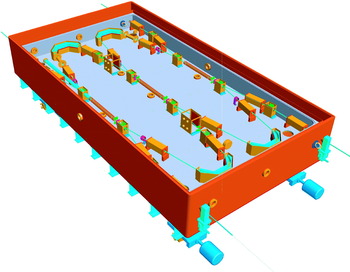
One of the specific purposes of DESIREE (the Double ElectroStatic Ion-Ring ExpEriment) is to study well-controlled low relative-energy collisions among ions of opposite charges. The apparatus (an outline is shown in Fig. 1) consists of two electrostatic ion-storage rings designed to store ions of 5–100 keV kinetic energy. Beams of anions and cations are stored simultaneously in each of the two rings and are merged along a common straight section. After the merging section a position-sensitive multihit detector detects the neutral products of the interaction. We have tested a detector consisting of a triple microchannel plate stack and a phosphor screen anode and concluded that even at cryogenic temperatures this detector assembly fulfils the requirements for DESIREE (Rosén et al. Reference Rosén, Schmidt, Reinhed, Fischer, Thomas, Cederquist, Liljeby, Bagge, Leontein and Blom2007). Due to the merged-beams configuration, very low relative velocities can be obtained in a well-controlled manner, and in single-pass ion–ion experiments controlled relative energies down to 10 meV have been demonstrated (Naji et al. Reference Naji, Nzeyimana, Urbain and Le Padellec2002). The two storage rings in DESIREE are similar to the first electrostatic ion-storage ring, ELISA, in Århus, Denmark (Møller Reference Møller1997), but the combination of ion storage and merged-beams interaction is a new, unique and potentially very powerful additional feature. By storage for extended periods of time (seconds or even minutes), infrared active molecular ions, which may be hot after production in the ion sources, will relax and eventually reach thermal equilibrium with the temperature of the surrounding vacuum walls. To take further advantage of this and at the same time achieve a very low background pressure, the electrodes and inner vacuum chamber walls will be cooled to cryogenic temperatures (10–20 K). The cooling is provided by closed-system helium cryogenerators and the necessary thermal insulation is achieved primarily by constructing the machine as a double-walled vacuum system with multi-layer insulation on both sides of an intermediate thermal screen. The inner vacuum chamber is kept at a cryogenic temperature of 10–20 K while the thermal screen is kept at a temperature of ~60 K, where more cooling power is available. This greatly reduces the heat radiation towards the cold inner vacuum chamber. With this combination of storage at cryogenic temperature and the merged-beams technique, we will for the first time have full control of both intra- and inter-molecular degrees of freedom in experiments on interacting molecular ions (Rensfelt et al. Reference Rensfelt2004; Danared et al. Reference Danared2006; Löfgren et al. Reference Löfgren2006). For infrared non-active molecular ions, buffer gas cooling in cryogenically cooled radiofrequency pre-traps will be applied prior to injection into DESIREE. This arrangement will also serve to accumulate ions from weak beams (Boyarkin et al. Reference Boyarkin, Mercier, Kamariotis and Rizzo2006).
The DESIREE double electrostatic ion beam storage ring. The inner vacuum chamber with its electrostatic elements is kept at cryogenic temperature. Two ion beams of opposite charge are injected along either side, and they travel together through the common central straight section. A multihit imaging detector following this straight section makes coincident detection of the neutral products.

Planned experimental investigations
In the standard scenario for formation of complex molecules via ion–chemical reactions, a positive molecular ion reacts with neutral molecules to form a larger ion and neutral fragment(s) (Herbst & Klemperer Reference Herbst and Klemperer1973). It has been the general belief that a specific molecule first is formed in its protonated form as a result of a chain of ion–molecule reactions. A DR reaction then takes place in which the final channel is the molecule of interest and a free hydrogen atom. However, it was recently shown that for the special case of protonated methanol the final channel, with one methanol molecule and one hydrogen atom, only accounts for 3% of the reactions (Geppert et al. Reference Geppert2006). Similar, though less dramatic, results in which the expected final DR channel is suppressed have been found for a variety of protonated species. In environments where the negative charges are primarily in the form of anions this terminating step will be through a mutual neutralization process rather than DR. This is interesting in the context of the branching ratio for producing the neutral molecule from its protonated form, since mutual neutralization in general populates states lower in energy by the electron affinity of the electron-donating molecule. It is therefore of interest to investigate whether this more gentle dissociation process is more likely to occur for mutual neutralization as compared with DR, which would indicate the direct importance of this process in the formation of methanol and other complex molecules which have been observed in the interstellar medium.
A question of astrobiological relevance is whether still more complex molecules, that form the building blocks of life, can be formed in the interstellar medium through the ion–chemical processes under discussion, and thus the search is on for amino acids and nucleobases in the interstellar medium. The recent report on the observation of glycine (Kuan et al. Reference Kuan, Charnley, Huang, Tseng and Kisiel2003) has, however, been almost certainly excluded by other investigators (Snyder et al. Reference Snyder, Lovas, Hollis, Friedel, Jewell, Remijan, Ilyushin, Alekseev and Dyubko2005). Recent simulations based on laboratory studies indicate that, once formed, the nucleobase adenine will be stable on a mega-year time scale in dense clouds (Peeters et al. Reference Peeters, Botta, Charnley, Ruiterkamp and Ehrenfreund2003). We intend to study the formation of these biological molecules from their protonated versions in mutual neutralization reactions with interstellar abundant anions.
Among the first experiments to be performed in DESIREE will be mutual neutralization between the now detected molecular anions CnH− and cations of known high abundance including H3+, N2H+ and the important atomic ion C+.
The astrophysically relevant experimental projects briefly outlined here constitute but one of several research areas to be addressed by means of the DESIREE facility. Other areas include the study of mutual neutralization in atomic (Szücs et al. Reference Szücs, Karemera, Terao and Bruoillard1984) and fundamental molecular systems (Eerden et al. Reference Eerden, van de Sanden, Otorbaev and Schram1995). In previous collision studies of fullerenes, a limitation has been the difficulty of producing targets of cold single fullerene molecules (Cederquist et al. Reference Cederquist, Hvelplund, Lebius, Schmidt, Tomita and Huber2001). In DESIREE this can be achieved by using beams of cold oppositely charged fullerene ions as collision partners. Further, a range of merged-beams experiments are planned in which aspects of radiation damage in biomolecular systems and the role of nanosolvation is investigated. Pilot experiments relating to these questions are studied in single-pass experiments (Liu et al. Reference Liu, Brøndsted Nielsen, Hvelplund, Zettergren, Cederquist, Manil and Huber2006, Reference Liu, Haag, Johansson, Schmidt, Cederquist, Brøndsted Nielsen, Zettergren, Hvelplund, Manil and Huber2008). Studies with relevance for atmospheric chemistry are also planned. We will investigate the reactivities of cluster cations (e.g. NH4+(H2O)n) and anions (e.g. HSO4−(H2O)n) believed to be important in the process of formation of aerosols (Turco et al. Reference Turco, Zhao and Yu1998). Finally, a range of experiments are planned which make use of only one storage ring. These include lifetime measurements of e.g. C602− (Tomita et al. Reference Tomita2006) at cryogenic temperature and of metastable states in atomic ions by a laser probing technique (Lundin et al. Reference Lundin, Gurell, Norlin, Royen, Mannervik, Palmeri, Quinet, Fivet and Biémont2007).
Concluding remarks
The double electrostatic storage ring DESIREE is expected to become operational during 2009. Here we have argued that this facility will be an important tool to widen the understanding of the ion-chemistry of the interstellar medium. The recent observations of anions in dense interstellar clouds are underlining the importance of considering the role of mutual neutralization in the synthesis of complex molecules including the building blocks of life.