There is more than a little irony in the recognition that as national economies have grown evermore deeply enmeshed in cross-border networks of investment, production, and trade, American international political economy (IPE) scholars have focused evermore heavily on domestic politics. Yet, research that investigates how domestic politics shape governments' foreign economic policy choices has emerged as the central and most visible focus of contemporary American IPE scholarship.Footnote 1 Often referred to as Open Economy Politics (OEP), this research program employs statistical analysis to examine the domestic determinants of foreign economic policies. It explores the source of societal preferences over tariffs, monetary and exchange rate policies, and investment flows.Footnote 2 It examines how domestic institutions—such as regime type, electoral and party systems, veto players, and central banks—aggregate and transform preferences into policies. Most work within this research program devotes little theoretical or empirical attention to macro processes.
IPE's initial embrace of domestic politics reflected a desire to place system-level or macro-oriented research on firmer micro-foundations. First-wave IPE research modeled the interaction between governments and paid little attention to domestic politics. The American school of IPE emerged in the 1970s as American military power failed to produce decisive victory in Vietnam and proved irrelevant in face of the oil embargo. The initial wave of theorizing focused on system-level considerations. Keohane and Nye developed complex interdependence; other scholars developed the hegemonic stability hypothesis to relate changes in global economic openness and stability to the distribution of power. Scholars began to explore the importance of international organization via regime theory and what came to be called neoliberal institutionalism.Footnote 3
IPE scholars began to focus more heavily on domestic politics in order to replace the simplifying assumptions that first-wave research embraced with logically sound and empirically verified models about how domestic politics shape government policy preferences and behavior.Footnote 4 Along the way, however, the study of domestic politics generated its own momentum. It emerged as a distinct research program and then became the most visible research in American IPE. Indeed, as one senior scholar has noted, its focus on domestic politics and relative neglect of the international dimension is now so pronounced that American IPE “has become “increasingly difficult to distinguish from comparative political economy.”Footnote 5
OEP scholars advance an epistemological justification for their focus on domestic politics. Generating enduring knowledge requires bringing scientific rigor to the study of IPE.Footnote 6 Scientific rigor involves developing coherent “theoretical arguments for which there is systematic empirical support” or generating “empirical evidence for a regularity, ‘law’ or other relationship that holds beyond a reasonable doubt.”Footnote 7 OEP practitioners argue that OEP's emphasis on midrange theories about domestic political relationships tested empirically with statistical methods is the approach most likely to generate such relatively certain knowledge.Footnote 8
Although using statistical methods to test hypotheses drawn from models of domestic politics can generate relatively certain knowledge, it does not necessarily do so. The governments whose behavior scholars model inhabit a system. Consequently, explaining phenomena in the global political economy often requires one to focus on macro processes as well as domestic politics. By macro processes I mean causal mechanisms and forces that inhere in the system or in the relationships between the individual units rather than inside domestic arenas. Such mechanisms can be political (for example, bargaining, coercion), economic (for example, contagion, network externalities), or ideational (for example, diffusion, learning). When such macro processes are present, the phenomena scholars model result, at least in part, from causal forces that originate outside domestic politics.
OEP typically omits macro processes from its models. OEP employs a reductionist methodology to decompose the global political economy into its constituent subsystems (domestic political systems). It then treats each subsystem as if it were independent of other countries.Footnote 9 Although one can sometimes study governments as if they were independent of one another, one cannot always study them in this fashion. When one applies this reductionist method to phenomena shaped by macro processes as well as domestic politics, one draws inaccurate empirical inferences.
OEP scholars have paid too little attention to the frequency with which and the conditions under which domestic politics can be studied in isolation. OEP scholars do not know whether the global political economy typically can be decomposed into independent subsystems, and do not know whether any specific phenomenon can be studied by isolating domestic politics from the international system. In short, OEP scholars have embraced a reductionist method without explicit attention to the downside risk (what are the consequences if reductionism is inappropriate?) and without calculating the odds (what is the likelihood that reductionism is appropriate to the causal mechanisms at work?). This is what I call OEP's “reductionist gamble.”
In highlighting the reductionist gamble, I do not mean to diminish the substantial and vital contributions to our understanding of politics in the global economy generated by OEP as a research program and by the individual scholars working within this program. OEP scholarship has broadened and deepened our knowledge immeasurably. Nor do I seek to fuel the battle of the “-ologies” and the “isms.” I do not argue against quantitative methods. Nor do I argue against rationalism or materialism or liberalism. Instead, I draw attention to the reductionist gamble to encourage a change in research practice. Because OEP does put us at risk of generating biased inferences, I argue that we should begin a transition to research that reduces our exposure to this risk. Such research is minimally more attentive to macro processes and, more ambitiously, more focused on developing a nonreductionist (systemic), problem-driven, and methodological and theoretically pluralistic IPE.
Methodological Reductionism and Open Economy Politics
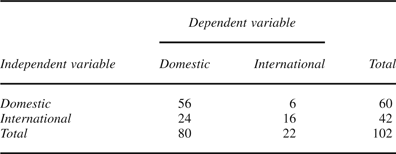
OEP's modal research design studies domestic politics in isolation from international politics. The extent to which OEP scholarship has prioritized research focused on domestic politics above other concerns is evident in publication patterns of the two highest-impact venues for IPE scholarship, International Organization (IO) and the American Political Science Review (APSR).Footnote 10 Although focusing only on these two journals underrepresents the diversity of contemporary IPE scholarship, because these two journals are the highest-impact outlets, examining the research they publish provides meaningful information about the type of research the profession believes warrants the scarce space available in top-tier outlets.Footnote 11 Between 1996 and 2006, IO and the APSR published 102 substantive IPE articles (see Table 1), that is, articles that focus primary theoretical and empirical attention on international trade, exchange rates and macroeconomic policy (including central banking), international finance, development, and multinational corporations.Footnote 12 Models that study domestic politics in isolation from international politics constituted more than three-quarters of these articles. This constitutes a dramatic reorientation of the discipline's focus. In 1993, for example, only four of the articles that IO published (roughly one-quarter of the total) focused on domestic politics, and two of these employed two-level-game analyses rather than focusing on domestic politics in isolation from international politics.Footnote 13
Research designs in IPE articles in IO and APSR, 1996–2006
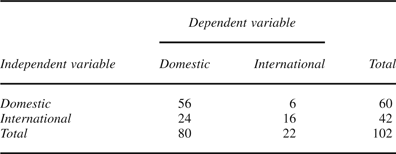
Fifty-six articles—more than half of all the IPE articles published by IO and the APSR in the past decade—focus exclusively on domestic politics. These articles employ a domestic independent variable to explain a domestic dependent variable and accord no explicit theoretical role to macro-level processes. Research on trade policy, for example, refines and evaluates the factoral and sectoral models of private-sector preferences derived from the Stolper-Samuelson and Ricardo-Viner models of trade.Footnote 14 A smaller literature examines how partisan politics or domestic political institutions transform these private-sector interests into trade policy.Footnote 15
The published articles on monetary and exchange rate policy similarly focus exclusively on domestic politics.Footnote 16 While some work focuses on individual preferences, most explores how domestic institutions shape policy choices or outcomes.Footnote 17 Researchers explore the choice between fixed exchange rates and central bank independence as commitment mechanisms; they explore how differences in electoral systems and legislative institutions affect the probability of maintaining a fixed exchange rate. Interaction between governments plays no central role in the theoretical models developed by these research programs, or in the empirical models used to evaluate them.Footnote 18
Even the literature that does employ global phenomena as central explanatory variables accords little role to international political processes. Research in this “second image reversed” tradition, which constitutes roughly 24 percent of published articles, explores how variation (cross-national and temporal) in the depth of integration into the global economy affects government policy choices.Footnote 19 A large literature, for example, examines how participation in the global market shapes incentives to create and reform the welfare state.Footnote 20 Other scholars examine how global markets constrain governments' ability to pursue independent macroeconomic policies, and to tax mobile capital.Footnote 21 Similarly, a body of research explores how foreign capital inflows, channeled through foreign aid programs, provided conditionally by international financial organizations, and loaned through private markets shape domestic political and economic structures.Footnote 22 Although second image reversed studies explicitly incorporate global forces, they typically explore how individual societies react to the environmental changes brought about by deepening participation in global markets. In modeling these responses, scholars treat nations as if they were independent of one another.
The priority that OEP has accorded research on domestic politics reflects methodological considerations. That is, it is not that OEP scholars consider macro processes unimportant. Instead, the focus on domestic politics reflects a decision to accumulate knowledge by employing methodological reductionism.Footnote 23 Methodological reductionism holds that one can deepen understanding of a complex system by breaking it into its subsystems and studying these subsystems in isolation.Footnote 24 OEP's objective in employing methodological reductionism is not to develop an IPE theory based on the institutional attributes or behavioral characteristics of lower-level subsystems, such as states, firms, or individuals.Footnote 25 Instead, the objective is to develop logically coherent and empirically accurate explanations of behavior within subsystems that one can assemble to produce an explanation of politics in the international economy as a whole. Thus, for OEP, reductionism is not a belief about the level of analysis at which one should cast one's explanations, as it is in neorealism. For OEP, reductionism is a method of inquiry.
Some OEP scholars might be surprised to be characterized as reductionist. But consider Lake's characterization of the central logic of OEP scholarship. Lake identifies three subsystems that constitute the global political economic system: private-sector interest formation, the domestic institutions that aggregate interests and transform them into government ideal points, and international bargaining. Lake notes that scholars typically examine only one subsystem, de-emphasizing or omitting completely the others. “Few theories give equal weight to all steps in this analysis. Most focus on one step—for instance, how institutions aggregate societal interests—and treat others in ‘reduced form,’ or as analytic simplifications that are unmodeled in the theory at hand.” Once scholars have developed a solid understanding of the subsystems, they can assemble the parts into the larger whole. “The broadly shared assumptions [adopted by scholars studying each subsystem] allow the components to be connected together into a more complete whole.”Footnote 26
OEP's focus on domestic politics has been accompanied by extensive reliance on statistical analysis to test hypotheses. Maliniak and Tierney suggest that quantitative analysis dominates research in American IPE.Footnote 27 They find that up to 70 percent of IPE articles published in top journals employ quantitative analysis, a tripling in relative frequency since 1993. The OEP research surveyed here fits this pattern closely. Approximately 75 percent of the OEP published by IO and APSR since 1997 employed statistical analysis. In contrast, in 1993, IO published only one IPE paper that employed statistical analysis.Footnote 28
OEP's principal (and principled) justification for adherence to methodological reductionism and quantitative analysis is epistemological. OEP practitioners believe that methodological reductionism is the research strategy most likely to produce relatively certain knowledge about well-specified causal relationships.Footnote 29 It holds this belief for two connected reasons. First, the midrange theories that OEP develops isolate well-specified causal relationships amenable to systematic empirical testing.Footnote 30 Second, statistical tests of these hypotheses conducted against relatively large samples provide greater confidence that the causal relationships scholars identify are general rather than idiosyncratic. In essence, through methodological reductionism, OEP has sought to purchase greater empirical certainty by reducing theoretical complexity.
The Downside Risk of Methodological Reductionism
Although methodological reductionism can generate relatively certain knowledge, it can also lead us astray. Methodological reductionism can lead us astray because the governments whose behavior is studied are not independent entities; they inhabit a complex social system. The defining element of any social system is that its subsystems, national political economies in the context of IPE, are connected by a variety of processes. In the global political economy, societies are linked by economic processes (cross-border product and factor flows), by ideational processes (cross-border flow of ideas and knowledge), by social processes (cross border activities of nongovernmental organizations; cross-border diffusion of culture) and by political processes (intergovernmental policy cooperation and coordination). Because governments inhabit a global system, the political behavior that we model often is a function of the interplay between domestic politics and macro processes.
Because the phenomena OEP studies emerge from the interplay between domestic politics and macro processes, one can study domestic political processes in isolation only when the system under investigation is what Simon calls “nearly decomposable.”Footnote 31 A nearly decomposable system is one in which “the short-run behavior of each of the component subsystems is approximately independent of the short-run behavior of the other components” while long-run behavior “of any one of the components depends in only an aggregate way on the behavior of the other components.”Footnote 32 In practice, whether a system is nearly decomposable is a function of the density of interaction between its subsystems. In the context of the global political economy, this suggests that the greater the role that macro processes play in determining developments within countries, the less the global political economy constitutes a nearly decomposable system. And the relevant macro processes include the traditional measures of economic interdependence such as cross-border flows of goods, factors, technology that second image reversed research treats as constraints. They also include causal mechanisms that inhere in the global political economy rather than in domestic politics. International bargaining shapes the outcomes scholars observe and model. International market processes such as contagion and network externalities affect the phenomena scholars study. The international diffusion of knowledge shapes preferences and policy choice. The more important the role of macro processes of this sort, the less the global economy constitutes a nearly decomposable system and the less appropriate it is to study domestic politics in isolation. Consequently, whether it is appropriate to study the domestic politics independent of macro processes is an empirical question.
In adhering to methodological reductionism, therefore, OEP transforms an empirical question (is the specific system under investigation nearly decomposable?) into a core assumption (the system is nearly decomposable). As a consequence, some portion of OEP research treats systems that are not nearly decomposable as if they were. When such misclassifications occur, OEP generates biased inferences. The problem is not just that scholars fail to explore causally significant macro processes. The more serious problem is that omitting macro processes causes scholars to draw biased inferences about the empirical relationships that they do explore—those that pertain to how variation in domestic politics shapes variation in the phenomena of interest. Some of the knowledge OEP has generated about how domestic politics shape foreign economic policies is therefore biased as a consequence of OEP's adherence to methodological reductionism.
I present three examples of how neglecting macro processes can generate biased inferences about domestic political relationships. Each illustration focuses on a distinct issue area (trade policy, speculative attacks, and exchange rate policy) and a distinct macro process (international bargaining, contagion, and cross-national learning). In spite of these differences, the neglect of macro processes in each instance generates biased inferences about the domestic political relationships under investigation. As a group, the examples illustrate that OEP's adherence to methodological reductionism introduces bias into empirical research by encouraging scholars to neglect causally significant macro processes.
Domestic Politics, International Bargaining, and Tariff Rates in Developing Countries
Consider first the politics of trade liberalization in developing countries.Footnote 33 Whereas most developing countries sheltered their economies behind high tariff barriers for the first thirty-five years that followed World War II, many have liberalized trade substantially since 1985. Governments have liberalized to different degrees, and OEP scholarship hypothesizes that this variation is a product of domestic political characteristics. In particular, existing OEP research suggests that democracies have lower tariffs than autocracies. The rationale rests on the Stolper-Samuelson and median voter theorems. Stolper-Samuelson suggests that low-skill workers in developing societies (the relatively abundant factor) are the principal winners from trade liberalization. The median voter in developing country democracies is likely to be a low-skill worker. Consequently, governments in developing country democracies must be responsive to the median voter and will therefore prefer relatively low tariffs. In autocracies, the government is more likely to be responsive to or controlled by actors that own the relatively scarce factor (capital-intensive heavy industry, including military-related production). Hence, autocratic governments will prefer high tariffs.
Notice that this approach adheres to OEP's three-step analytical logic: first look at private-sector preferences, then examine how domestic institutions aggregate these preferences, and then (if necessary) model international bargaining. Private-sector demands reflect underlying factor endowments. Domestic political institutions aggregate these demands and transform them into policy outcomes. Differences in tariff rates therefore reflect differences in the way domestic institutions transform private demands into policy outcomes. The study of trade liberalization also illustrates OEP's relative neglect of macro processes. The model provides no integrated causal role for bargaining between governments within the World Trade Organization (WTO). Instead, WTO membership is treated as an “analytic simplification” that is controlled for in the empirical model.Footnote 34
Macro theory suggests that tariffs are not a simple function of domestic politics; participation in the WTO should also affect developing country tariff rates. First, the WTO provides a forum in which each government can exchange domestic tariff reductions for foreign tariff reductions. As a consequence, a developing country government that is unwilling to unilaterally reduce its tariff rate on capital-intensive goods might be willing to liberalize in exchange for cuts in developed country agricultural protection. Second, the WTO enables governments to enforce agreements. As a consequence, while a developing country government and the United States might be willing to trade tariff concessions, they may refuse to do so unless each is confident that the other will comply with any bargain they reach. Because the WTO provides a forum that enables governments to exchange policy concessions and a quasi-judicial system that enables them to enforce the agreements they make, the tariff rates that WTO members enact are not the same as the tariff rates they would enact if the WTO did not exist, even if private-sector interests and domestic political institutions are constant across these two worlds.Footnote 35
Of course, the WTO does not have an independent impact on national tariff rates. The WTO mediates the relationship between the domestic political processes that generate government policy preferences and the tariff rates that one observes. One can incorporate this macro process into the OEP model. The OEP model hypothesizes that only democracies want to reduce tariffs. The macro hypothesis suggests that governments who might be willing to reduce tariffs will do so only if they are able to reach enforceable agreements with other governments. Combining the two produces a conditional hypothesis: the impact of regime type on tariffs is mediated by participation in the WTO. Among the subset of governments that belong to the WTO, democracies will have lower tariffs than autocracies. Among governments that do not belong to the WTO, democracies and autocracies should have similar tariff rates.
Suppose that this alternative model is the empirically correct model. This assumption allows one to explore the nature of the error one introduces by assuming that methodological reductionism is appropriate for the world one models when it is not. If one translates this theoretical model into an empirical model,Footnote 36 then the true (by assumption) empirical model is one in which the effect of regime type on tariff rates is conditional upon participation in the WTO. Thus:

where Y is the average national tariff rate, R is regime type, W is WTO, and R * W is the interaction term that captures the fact that R's impact on tariff rates is conditional upon WTO membership. One knows by assumption that the impact of regime type on tariff rates for WTO participants (that is, (β1 + β3) when W = 1) is significantly different from zero. One also knows (by assumption) that the relationship between regime type and tariffs when WTO equals zero (that is, β1) is not significantly different from zero.
Methodological reductionism assumes that the trade system is nearly decomposable: interaction between governments does not have a causal impact on government policy choices. Consequently, OEP omits R * W from the model. Yet, this creates omitted variable bias. The most obvious manifestation of omitted variable bias is the zero that I assign to β3, a significant underestimation of its true magnitude. Second, because R and R * W are correlated with each other and with Y, this will generate a β1 that is significantly different from zero, a significant overestimation of its actual magnitude.Footnote 37 Omitting international bargaining from the empirical model thus produces biased estimates: one overestimates the independent effect of regime type on tariff rates and one underestimates the causal impact of the WTO's mediating role.
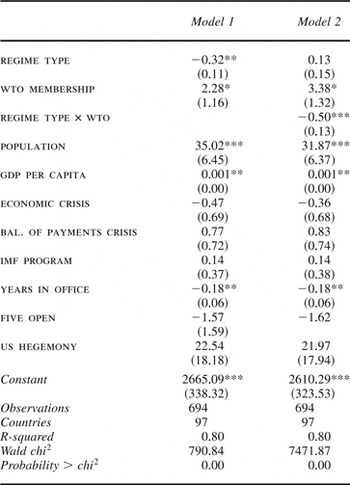
I show the magnitude of the bias by comparing estimates from a model that includes the interaction term to estimates from a model that does not.Footnote 38 The dependent variable is the average national statutory tariff rate. regime type is the Polity score and ranges from −10 (autocracy) to +10 (democracy). wto membership is a dummy that takes the value of 1 for each year a country is a member of the General Agreement on Tariffs and Trade (GATT)/WTO and the value of 0 for each country-year of nonmembership. I first estimated the OEP model as a fixed effects time series cross-sectional model with a common ar(1) process and panel-corrected standard errors. I then re-estimated the model with the interaction term regime type × wto membership. Table 2 reports the results from the two estimates.
Regime type, the WTO, and average tariffs

Notes: Panel-corrected standard errors in parentheses.
* p < .05;
** p < .01;
*** p < .001.
Model 2, which incorporates the interaction term, suggests that wto membership mediates the relationship between regime type and tariff rates.Footnote 39 When wto membership takes the value of 0, the marginal effect of regime type on tariffs is equal to the coefficient for the regime type variable.Footnote 40 The estimated standard errors suggest that for the group of countries that do not belong to the WTO, one has little confidence that differences in regime type affect tariff rates.Footnote 41 When wto membership takes the value of 1, regime type's effect on tariffrates is equal to the coefficient for regime type plus the coefficient for the regime type × wto membership interaction term. This conditional relationship is significant and large, with the estimated effect of −0.5 or −0.6 (depending on specification) and a range of −0.28 to −0.82. The analysis thus suggests that participation in the WTO mediates the relationship between regime type and tariff rates.
Is this significant interaction term really evidence that wto membership mediates the relationship between regime type and tariff rates? Might it instead be evidence that some unspecified exogenous factor shared by WTO members, such as an ideological commitment to economic openness, mediates the relationship between regime type and participation in the global economy? One way to answer this question is to examine whether WTO membership mediates the relationship between regime type and dimensions of economic openness that fall outside the WTO's purview. If WTO membership does not mediate the relationship between regime type and other dimensions of economic openness, then the significant interaction term in Model 2 may point to something meaningful about the impact of the WTO process on tariff rates.
The difficulty is that few measures of economic openness are not affected—directly or indirectly—by WTO membership. The Sachs-Warner economic openness index might be the only candidate.Footnote 42 The Sachs-Warner index uses five criteria to classify countries as open or closed economies.Footnote 43 Although tariffs and nontariff barriers constitute part of the Sachs-Warner index, it is well documented that variation in the index is driven largely by the black market premium and state monopoly on exports, neither of which falls within the scope of the WTO's authority.Footnote 44 The Sachs-Warner index therefore offers a measure of economic openness unlikely to reflect WTO bargaining processes.
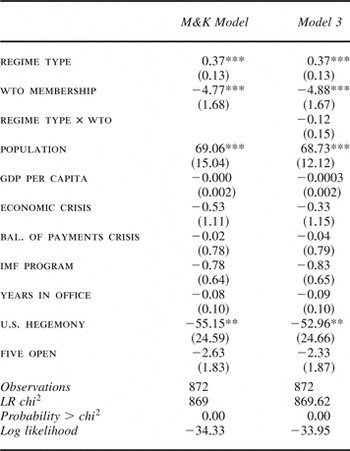
I estimated two models against the Sachs-Warner index: one that included and one that excluded the regime type × wto membership interaction term. The analysis yields two principal findings (see Table 3). First, regime type returns a positive and highly significant coefficient: democracies are more likely than autocracies to have open economies. Second, regime type × wto membership does not return a significant coefficient. WTO membership thus has no systematic impact on the relationship between regime type and the Sachs-Warner index of economic openness. The results from Models 2 and 3 together thus suggest that WTO membership mediates the relationship between regime type and tariff rates but does not mediate the relationship between regime type and other government policies that affect economic openness but fall outside WTO processes. It seems reasonable to conclude, therefore, that Model 2 provides evidence that wto membership has a meaningful impact on tariff rates. Governments who wish to liberalize trade (democracies) tend to do so within the context of the WTO rather than unilaterally.
Regime type, the WTO, and the Sachs-Warner Index of Economic Openness

Notes: M&K = Milner and Kubota 2005. Panel-corrected standard errors in parentheses.
* p < .05;
** p < .01;
*** p < .001.
Adherence to methodological reductionism therefore affects the inferences scholars draw. In this instance, a model based on methodological reductionism produces the inference that democracies always have lower tariffs than autocracies. When scholars model tariff politics as a product of the interplay between micro and macro processes, they generate different inferences. On the one hand, for the set of countries that belong to the WTO, democracies have lower tariffs than autocracies. In fact, the estimated effect of regime type on tariff rates is larger among the subset of WTO members than it is for the population as a whole. On the other hand, for the set of countries that do not belong to the WTO, democracies do not appear to have lower tariffs than autocracies. Hence, the decision to employ methodological reductionism (or not) affects the inferences scholars draw about the relationship between regime type and tariff rates.
The two models also produce very different inferences about the impact of WTO membership on tariff rates. The OEP model suggests that governments reduce tariffs prior to entering the multilateral institution and governments that are already members are less likely to liberalize further.Footnote 45 This finding is hard to reconcile with our broader understanding of the WTO process. Treating wto membership as a mediating variable generates the inference that wto membership is associated with substantially lower tariff rates for the subset of governments that want to liberalize trade (democracies) than for all other countries. Moreover, in this specification, the independent effect of wto membership is reduced to the impact of wto membership when regime type equals zero, a condition that holds only for a very small number of cases (Mexico in the mid-1980s). Recall that Mexico entered the GATT in the mid-1980s with some of the highest tariff rates in the world. Treating wto membership as a conditional rather than a direct effect thus yields findings more easily reconciled with a broader understanding of the WTO process. It also aligns understanding of the WTO's effect on tariff rates with recent research on the WTO's impact on trade flows.Footnote 46
Differences of this magnitude have large policy implications. The OEP model suggests that the best way to promote trade liberalization is to scrap the WTO and invest in the spread of democracy. The model that incorporates bargaining between governments suggests that outside of the WTO, democratic governments do not reduce tariffs to a greater extent than autocrats. Governments intent on liberalizing global trade should, therefore, encourage the spread of democracy and encourage new democracies to join the WTO. Thus, assumptions about methodological reductionism shapes policy recommendations: should the WTO be scrapped or sustained?
Political Expectations, Contagion, and Speculative Attacks
The second illustration focuses on speculative attacks on national currencies. OEP research hypothesizes that the likelihood that a country suffers a speculative attack is a function of financial markets' expectations about government survival.Footnote 47 Speculative attacks are especially likely when markets fail to anticipate the collapse of a conservative government. Because a leftist government often assumes power when a conservative government collapses, financial markets respond to an unexpected collapse of a conservative government with a panicked sale of assets denominated in that country's currency.Footnote 48
Modeling speculative attacks is challenging because they often are contagious rather than independent events. Contagion models suggest that the probability that one country experiences a speculative attack is a positive function of the number of attacks occurring elsewhere in the system.Footnote 49 In the period under investigation, 1973 to 1998, more than half of the 124 speculative attacks occur in groups of three or more, and almost one-third occur in groups of six or more. In February 1981, for example, eleven of fourteen countries in the sample experienced a speculative attack. Seven countries experienced an attack in May 1980, and six did so in July 1988, and in May 1989. Such clustering suggests that an attack on one country may not be independent of the number of countries being attacked elsewhere in the system.
Speculative episodes extend across time as well as space. The 1992 crisis of the European Monetary System, for example, began in the summer of 1992 and extended through the first quarter of 1993. Similarly, a series of attacks on European currencies began in November and December 1973 and extended through January 1974. Consequently, the probability that France is attacked in November 1992 may not be independent of its having been attacked in September 1992. Indeed, twenty-five of the episodes (about 20 percent of the total) are two or more attacks on a single country within a year or less. For example, Denmark and Finland are attacked in September 1992 and again in January 1993; Ireland is attacked in September 1992, November 1992, and January 1993.Footnote 50 The probability of a subsequent attack may not be independent of having been attacked a few months earlier.
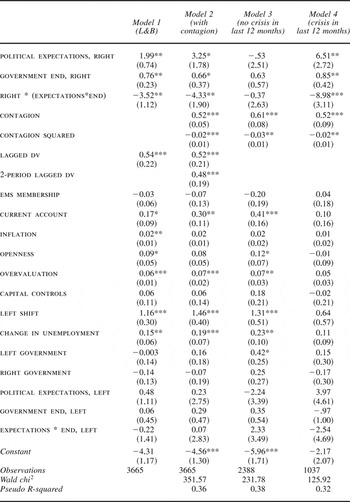
In modeling speculative attacks, therefore, scholars need to consider the importance of contagion as well as domestic political factors.Footnote 51 Empirical models that consider contagion generate results quite different from models that do not. Consider first a comparison based on the original OEP model (see Table 4). Model 1 is the original OEP model in which contagion is measured with a dummy variable that takes the value of 1 if another country experienced a speculative attack in the prior month. Model 2 measures contagion as the number of speculative attacks occurring simultaneously in other countries, and the square of the number of attacks occurring simultaneously. It also controls for a two-period lag within each country.
Political expectations, government end, and speculative attacks

Notes: L&B = Leblang and Bernhard 2000, tab. 9. Panel-corrected standard errors in parentheses.
* p < .05;
** p < .01;
*** p < .001.
The original OEP specification yields support for the hypothesis that the unexpected collapse of a conservative government substantially increases the probability of a speculative attack. Once the modified measure of contagion is incorporated into the statistical model, confidence in this conclusion weakens. The coefficients for government end, right, and right * (expectations * end) are larger in Model 2 than in Model 1, but so too are the standard errors. As a consequence, the estimated coefficients now fall outside the 95 percent confidence interval. In contrast, contagion and contagion squared both return highly significant coefficients, suggesting that contagion plays an important role in generating speculative attacks. Finally, the control variables change very little across the two models, suggesting that economic fundamentals are more robust to the inclusion of contagion than the domestic political variables hypothesized to drive attacks.
The differences become more pronounced when one changes the method by which one estimates the statistical model. It is now generally recognized that a full transition model is more appropriate for temporal dependence of the type exhibited here than binary probit with a lagged dependent variable.Footnote 52 In a full transition model, one creates interaction terms between the lagged dependent variable and all independent variables. One then calculates the effect of each independent variable in two states of the world: observations in which Yt−n = 1 and observations in which Yt−n = 0. Because I suspect that the temporal dependence in this sample is longer than a single month, this standard full transition model is not fully appropriate. I therefore split the sample into two subsamples. One subsample contains all country-months for which Yt−n = 0 for all of the twelve months prior. The second subsample contains all country-months for which Yt−n = 1 for any of the twelve months prior. I then estimated the same specification against each subsample. Model 3 therefore provides insight into the factors that trigger speculative attacks on countries that haven't suffered an attack in at least twelve months. Model 4 provides evidence on factors that provoke attacks on countries that have experienced an attack within the last twelve months.
The results differ from those generated by the original OEP model in important ways. Model 3 provides little support for the hypothesis that market expectations about government survival trigger attacks on countries that have not experienced an attack within the previous year. contagion, however, is tremendously important. Figure 1 illustrates the importance of contagion by plotting the probability that a country will experience an attack as a function of the number of attacks occurring elsewhere (holding all other factors constant at their mean value). In a system in which no other countries are under attack, the probability that a country suffers an attack is effectively zero (.004). The probability of attack rises sharply as the number of other countries under attack increases. When six other countries are under attack in a given month, the probability that other countries will experience an attack is almost 50 percent. This suggests a powerful macro process—the system is at rest until a speculative attack occurs, at which point contagion acquires substantial causal importance.
Probability of attack as a function of number of attacks elsewhere
Note: Figure generated with Clarity using Model 3 in Table 4.

Deteriorating economic fundamentals also trigger new attacks. Current account deficits, an increase in unemployment, and overvalued exchange rates all increase the probability that a country experiences an attack. left government is the only political variable that seems to spark fresh attacks. Countries ruled by left governments are more likely to experience attacks (although our confidence in this relationship is low), and countries in which governments shift to the left are more likely to experience attacks. The substantive import of this political effect is quite small, however. Holding all other variables at their mean values, shifting from a right to a left government increases the probability of a new speculative attack from 0.005 to 0.02.
In contrast, Model 4 indicates that political expectations about government collapse are significant causes of speculative attacks in countries that have been recent victims of speculative attacks. In this more limited context, one finds relationships almost identical to those generated by the original OEP model. With all other variables set at their mean, an unanticipated collapse of a right government increases the probability of a speculative attack from 2 percent to 13 percent. This compares to the original OEP estimate that an unanticipated collapse of rightist government increases the probability of an attack from 2 percent to 11 percent.Footnote 53 Although the magnitude is similar, the scope is quite different. Whereas the OEP model indicates that this relationship holds generally, the alternative model suggests that it holds only for countries with recent history of attack.
The estimates further suggest that the magnitude of the relationship between political expectations and government collapse on the one hand and speculative attacks on the other is conditional upon the intensity of the systemic crisis. If three other countries are subject to speculative attacks, then an unanticipated collapse of a conservative government increases the probability of attack from 21 to 33 percent. If five other countries are being attacked, an unanticipated collapse of a conservative government raises the probability of a speculative attack from 44 percent to 74 percent. If seven other countries are being attacked, an unanticipated collapse raises the probability of crisis from 65 percent to 87 percent. Thus, even when domestic political factors are important, the magnitude of their impact is conditional upon the severity of the systemic crisis.
Notice that none of the economic control variables that are significant in Models 1–3 are significant in Model 4. This suggests the factors that place a country at risk of a crisis initially may be less important in driving the evolution of the crisis in subsequent episodes. Moreover, those factors that keep a crisis moving seem less important in sparking the crisis in the first place.
Finally, the two models also generate very different policy implications. The OEP model suggests that shoring up rightist governments and minimizing a government's own macroeconomic imbalances is the best way to reduce the probability of falling victim to a speculative attack. The full transition model suggests that a government can reduce its chance of attack by minimizing the macroeconomic imbalances of its neighbors. In fact, short of keeping one's macroeconomic house in order, the most significant thing a government can do to minimize the risk of speculative attack is to reduce the probability that other countries experience an attack. This provides a strong rationale for participation in international policy coordination to reduce the likelihood of speculative crises.Footnote 54
Domestic Institutions, Cross-Border Learning, and Exchange Rate Regime Choice
The final example focuses on exchange rate regime choice. OEP models of exchange rate politics posit that the choice between fixed and floating exchange rate regimes is a function of domestic political institutions. Some research hypothesizes that the choice of exchange rate regime reflects the interaction between the number of veto players and the federal versus unitary structure.Footnote 55 Only governments in unitary systems with multiple veto players are likely to peg their currency. A second line of theorizing suggests that governments in more decisive electoral systems are less likely to peg their currency than governments in less decisive electoral systems.Footnote 56 A third line hypothesizes that democracies are less likely to peg their currency than autocracies.Footnote 57 Although each model emphasizes a different domestic political institution, all pay relatively little attention to macro processes.
As is the case with tariff rates and speculative attacks, estimates of the relationship between domestic institutions and exchange rate regime are not robust to the inclusion of macro processes. Because I cannot provide a full re-estimation of OEP research on exchange rate regime choice in the space available here, I summarize research conducted by Simmons and Hainmueller.Footnote 58 Simmons and Hainmueller hypothesize that a government's decision to fix or float is shaped by learning from their observations of foreign governments' experience with fixed exchange rates.Footnote 59 They suggest that because governments peg to maintain price stability, governments should “update their priors about the value of fixed rates” based on information gained by observing foreign governments' experience with fixed rates. Consequently, the lower is inflation in foreign countries with fixed exchange rates compared to countries with floating exchange rates, the greater is the value that a government will attach to fixed exchange rates.Footnote 60 Simmons and Hainmueller measure this “fixed exchange rate inflation advantage” (feria) by calculating the difference between the average log rate of inflation in countries with floating exchange rates and the average log rate of inflation in countries under fixed exchange rates. They enter this measure into three existing OEP models of exchange rate regime choice.
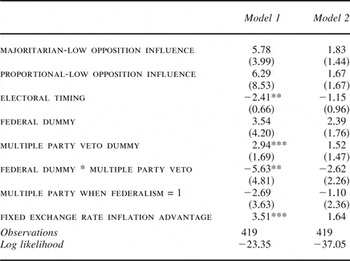
Table 5 summarizes some of their findings based on a sample of Organization for Economic Cooperation and Development (OECD) countries between 1973 and 1995. Model 1 incorporates domestic political institutions and omits their learning variable. The results suggest that domestic institutions play a critical role in exchange rate regime choice. The probability that a government pegs its currency is lower when election timing is exogenous than when elections are endogenous. The findings also suggest that governments in multiparty unitary political systems are more likely to peg their exchange rate than governments in other political systems. Model 2 incorporates feria into the statistical model. The estimated coefficients for the domestic political institutions are reduced by about one-half and cease to attain standard levels of statistical significance. Moreover, feria is statistically significant and substantively important. A change in this variable from its lowest to its highest value increases the probability that a government pegs its exchange rate by 0.25.Footnote 61 Incorporating macro learning into OEP models thus reduces the substantive and statistical significance of the relationship between domestic political institutions and exchange rate regime choice.
Exchange rate regime choice in the OECD

Notes: Model 1 is taken from Model 4, and Model 2 is taken from Model 7 in Simmons and Hainmueller 2005, tab. 2. Panel-corrected standard errors in parentheses.
* significant at 10%;
** significant at 5%;
*** significant at 1%.
Simmons and Hainmueller run a second analysis on a sample of developing countries. They employ a full transition model to evaluate whether democracies remain less likely to adopt a fixed exchange rate than autocracies once one incorporates their measure of learning into the statistical model.Footnote 62 The results parallel the findings for OECD countries. The estimated relationship between regime type and exchange rate regime choice is substantially reduced once feria is entered into the model, though in this context regime type retains standard levels of statistical significance. Again, feria returns a statistically significant and substantively important coefficient. Moreover, learning from observing foreign governments appears to have a greater impact on exchange rate regime choice than regime type. “The learning effect for floating countries swamps the democracy effect in terms of magnitude…. While a move from the most autocratic to the most democratic regime type shifts the probability of pegging by merely 0.07, the respective increase when going from the lowest to the highest values of contextual social learning is about 0.5.”Footnote 63
Modeling exchange rate regimes as if governments choose their policy in isolation thus generates biased results about the relationship between domestic political institutions and exchange rate regime choice. Once one incorporates learning from the experience of foreign governments into OEP models, the causal impact of domestic politics either disappears completely or is greatly reduced in magnitude. These different empirical models of exchange rate politics suggest quite different processes driving exchange rate policy choices. OEP models emphasize independent selection of exchange rate policy based on the suitability of domestic institutions. In contrast, Simmons and Hainmueller emphasize a global process wherein governments wrestling with high inflation draw lessons from the policy experiments conducted by other governments. Simmons and Hainmueller also reveal something that OEP models cannot: when do governments abandon fixed exchange rates? In the Simmons and Hainmueller model, the appeal of fixed exchange rates might diminish as concern about high inflation takes a back seat to other policy objectives.
Conclusion
OEP research thus rests on a reductionist gamble. Each time OEP employs methodological reductionism to study IPE, it bets that the system under investigation is nearly decomposable. Sometimes the system is nearly decomposable and the reductionist gamble produces relatively certain knowledge. In other instances, the system is not nearly decomposable and the reductionist gamble yields biased inferences about the role that domestic politics play in the foreign economic policy choices governments make. These biases can be large and substantively important.
I do not know with certainty the frequency with which methodological reductionism generates biased inferences in OEP research, but there are sound reasons to believe it occurs often enough to be a source of concern. Consider that this article illustrated that 5 of the 104 OEP articles published in IO and APSR in the period I surveyed generated biased inferences. Although a 5 percent error rate might be tolerable, one cannot conclude that these five are the only articles to pose the problem. Consider also that if one uses issue area rather than article as the unit of analysis, then the examples presented here suggests that methodological reductionism is problematic for research in three of IPE's core issue areas: international trade, international financial markets, and exchange rates.Footnote 64
Moreover, the particular empirical problem I have focused on (essentially variants of omitted variable bias) is only one manifestation of the macro processes and causal mechanisms that methodological reductionism leads OEP research to neglect.Footnote 65 Consider network effects; one cannot understand the U.S. dollar's continued dominance as reserve currency or the spread of the gold standard in the late nineteenth century without reference to network externalities.Footnote 66 Consider processes in which temporal sequence matters. Multilateral trade liberalization, for example generates positive feedback that reinforces political support for trade openness. As governments reduce trade barriers, uncompetitive industries disappear and competitive industries benefit from the access to foreign markets that multilateral liberalization provides. Consequently, the international trade system alters interest group politics in ways that reinforce domestic political support for the multilateral trade system.Footnote 67 Because so many of the phenomena that IPE investigates are shaped by the complex interplay between micro and macro processes, continued adherence to the assumption that methodological reductionism is always appropriate seems unnecessarily risky.
Let me conclude, therefore, by suggesting how scholars might alter research practices to minimize exposure to this risk. Minimally, awareness of the consequences that result from omitting causally significant macro processes from empirical models should shift the burden of proof. In other words, research that focuses primary attention on the domestic determinants of foreign economic policy should test whether rather than continue to assume that macro processes can be accorded relatively little attention without introducing biases into the analysis. In this minimal solution, the central issue is the nonindependence of the observations. As Cranmer and Desmarais note, “the validity of regression results breaks down when … dependencies go unmodeled.” Unless one models these dependencies, one generates biased coefficients and inconsistent standard errors.Footnote 68 OEP scholarship must be more cognizant of this potential and take appropriate the steps.
A more ambitious response would be to embrace a nonreductionist or systemic approach to IPE. Let me be clear; I am not advocating a return to a singular focus on the system level of analysis that characterized first-wave IPE scholarship. Such an approach is every bit as reductionist as research focused on domestic politics. I am advocating an approach that explores how the interaction between domestic and international, between the micro and the macro, shapes developments in the global political economy. This entails paying as much attention to macro processes as OEP currently accords to micro processes. It entails paying as much attention to the micro processes that shape behavior within the subsystems as current OEP scholarship. Hence, a nonreductionist IPE is not less domestic and more international. It recognizes that the phenomena scholars study emerge from the complex interaction between the micro and the macro.
Second, scholars should manage the complexity that inheres in the global political economy by engaging in problem-driven research. Problem-driven research differs from contemporary OEP in two important ways, both of which stem from its adherence to pragmatism rather than the positivism that appears to inform OEP.Footnote 69 First, problem-driven research focuses on identifying, describing, and explaining important empirical patterns and puzzles in the global political economy. Sometimes it defines the focus for research in terms of specific events: for example, what caused the 2008–9 financial crisis? Sometimes it defines the focus for research in more abstract terms: what accounts for the contemporary increase in global financial volatility? But in all instances, it studies problems the community deems important. Second, problem-driven research strives principally to produce useful knowledge rather than to identify law-like empirical regularities. As Farrell and Finnemore argue, “rather than seeking necessarily to construct coherent bodies of law-like generalizations … these accounts (in their social-scientific form) seek to identify relevant causal mechanisms, and arrive at useful, but often imperfect, judgments regarding the scope conditions under which these mechanisms are likely to apply.”Footnote 70
Finally, the problem-driven research scholars conduct should be pluralistic in its use of theory and method. Shapiro compellingly describes the requisite theoretical pluralism. “The problem-driven scholar … looks to previous theories [advanced] to account for these phenomena [and] tries to see … whether some alternative might do better. She need not deny that embracing one account rather than another implies different theoretical commitments, and she may even hope that one theoretical outcome will prevail. But she recognizes that she should be more concerned to discover which explanation works best than to vindicate any priors she may happen to have.”Footnote 71 What is true for theory applies also to methods. Rather than select or recast problems in order to apply a particular method, the problem-driven scholar selects the method that shines the brightest light on the problem under investigation.
Elements of a more systemic IPE are beginning to emerge. Simmons, Dobbin, and Garrett drew attention to systemic causal mechanisms in their application of diffusion theory to IPE. More recently, scholars have begun to adapt network theory to the study of international politics. Still other scholars are striving to apply historical institutionalism, with its focus on temporality and endogenous change, to IPE in a self-consciously systemic framework.Footnote 72 More research along these lines, and perhaps more effort to embed these distinct approaches within a common overarching framework, would substantially advance our understanding of how the interaction between domestic politics and macro processes shapes developments in the global political economy.